How to Write Research PapersPart 1 – General PrinciplesXiao QinDepartment of Computer Science and Software EngineeringAuburn Universityhttp://www.eng.auburn.edu/~xqinxqin@auburn.eduThese slides are adapted from notes by Simon Peyton Jones (Microsoft Research, Cambridge)1
Where is Auburn University?Ph.D.’04, U. of Nebraska-Lincoln04-07, New Mexico Tech07-now, Auburn University
Writing Papers is a SkillMany papers are badly writtenGood writing is a skill you can learnIt’s a skill that is worth learning:You will get more brownie points (more papers accepted etc)Your ideas will have more impactsYou will have better ideasIncreasing importance
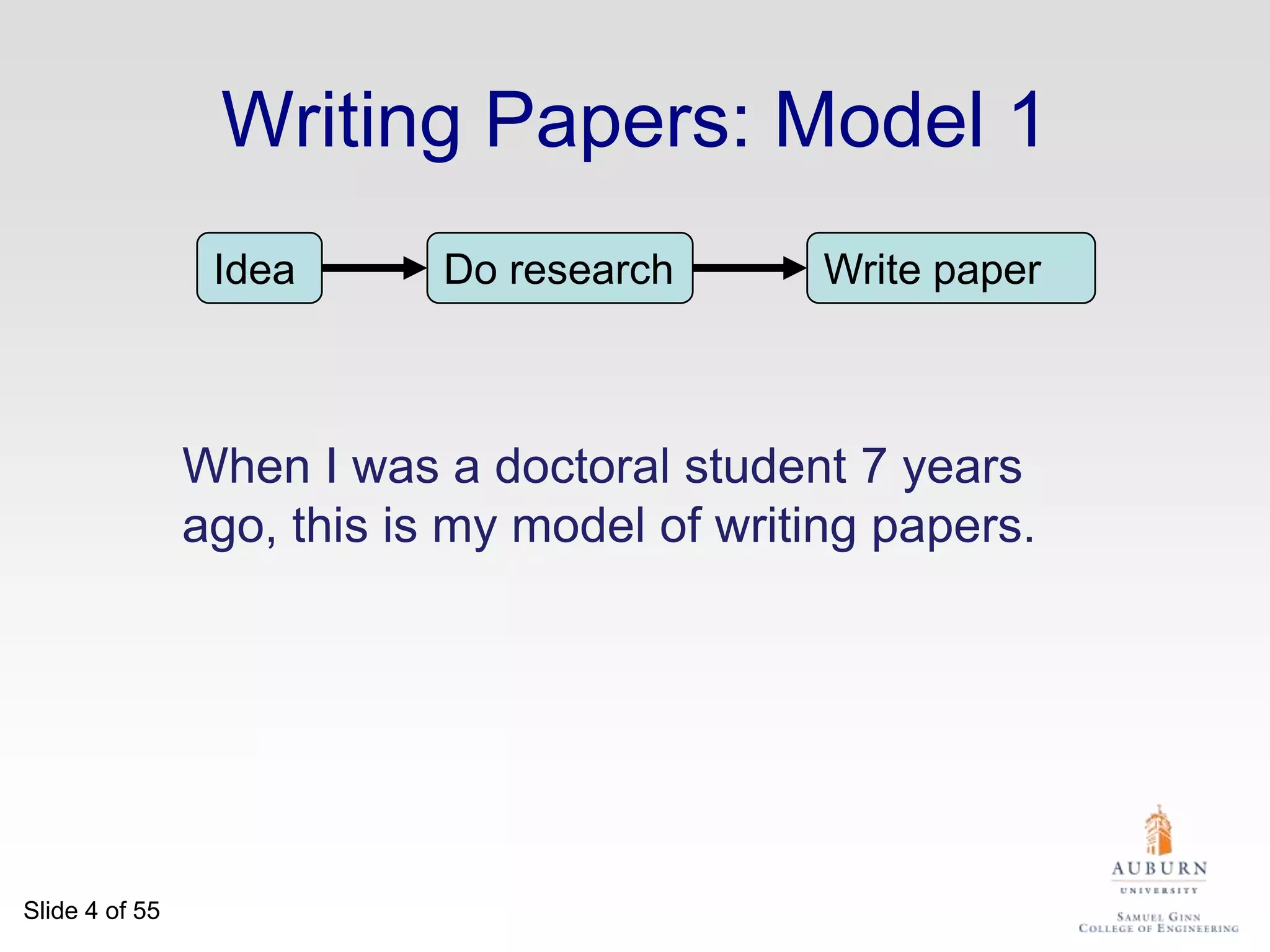
Writing Papers: Model 1IdeaDo researchWrite paperWhen I was a doctoral student 7years ago, this is my model of writing papers.
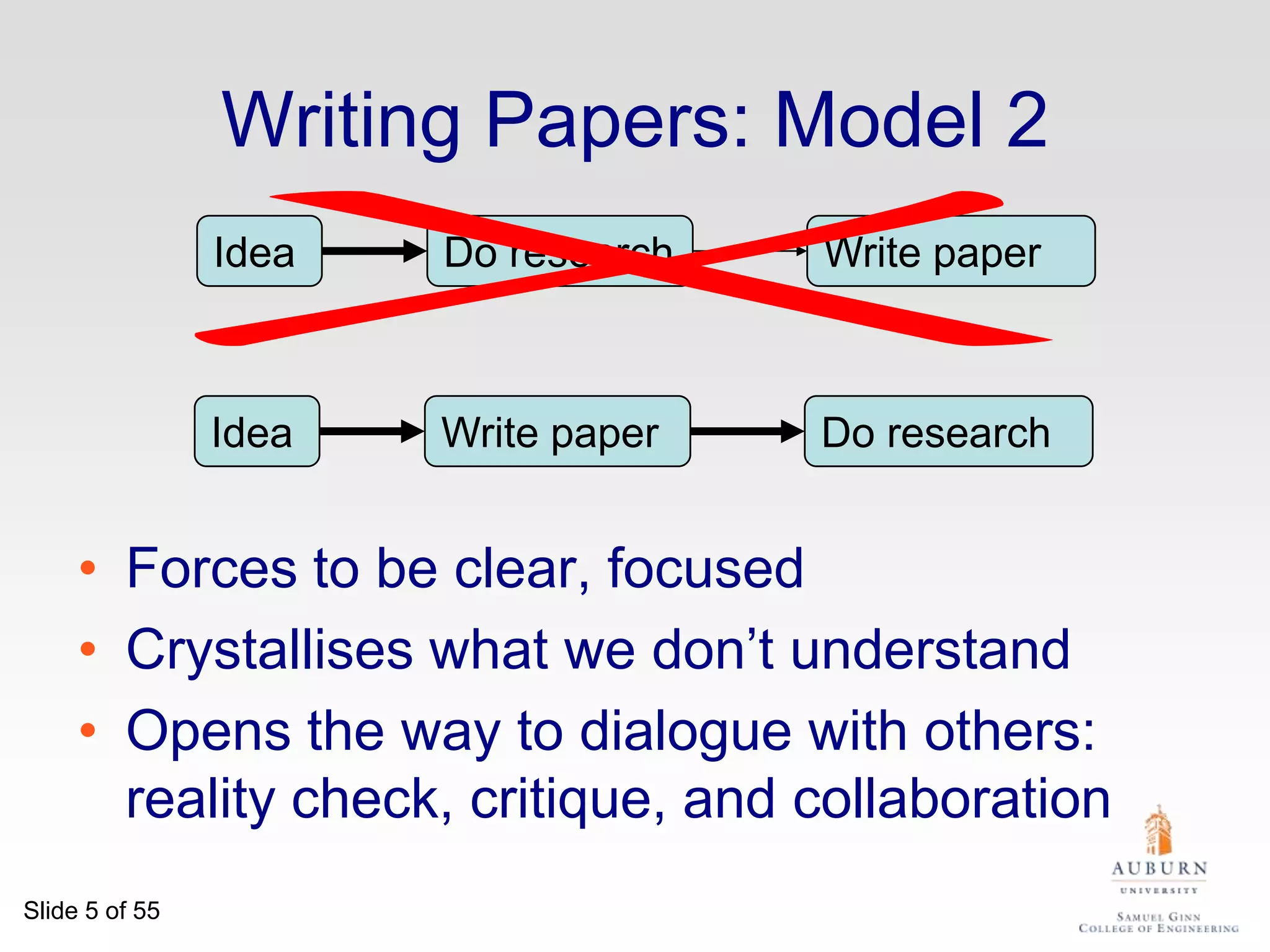
Writing Papers: Model 2IdeaDo researchWrite paperIdeaWrite paperDo researchForces to be clear, focusedCrystallises what we don’t understandOpens the way to dialogue with others: reality check, critique, and collaboration
Do not be IntimidatedFallacy	You need to have a fantastic idea before you can write a paper.  (Everyone else seems to.)Write a paper, and give a talk, about any idea, no matter how weedy and insignificant it may seem to you6
Do not be intimidatedWrite a paper, and give a talk, about any idea, no matter how insignificant it may seem to youWriting a paper is how you develop an idea in the first place
It usually turns out to be more interesting and challenging that it seemed at first7
The Purpose of Your PapersXiao QinDepartment of Computer Science and Software EngineeringAuburn Universityhttp://www.eng.auburn.edu/~xqinxqin@auburn.edu8
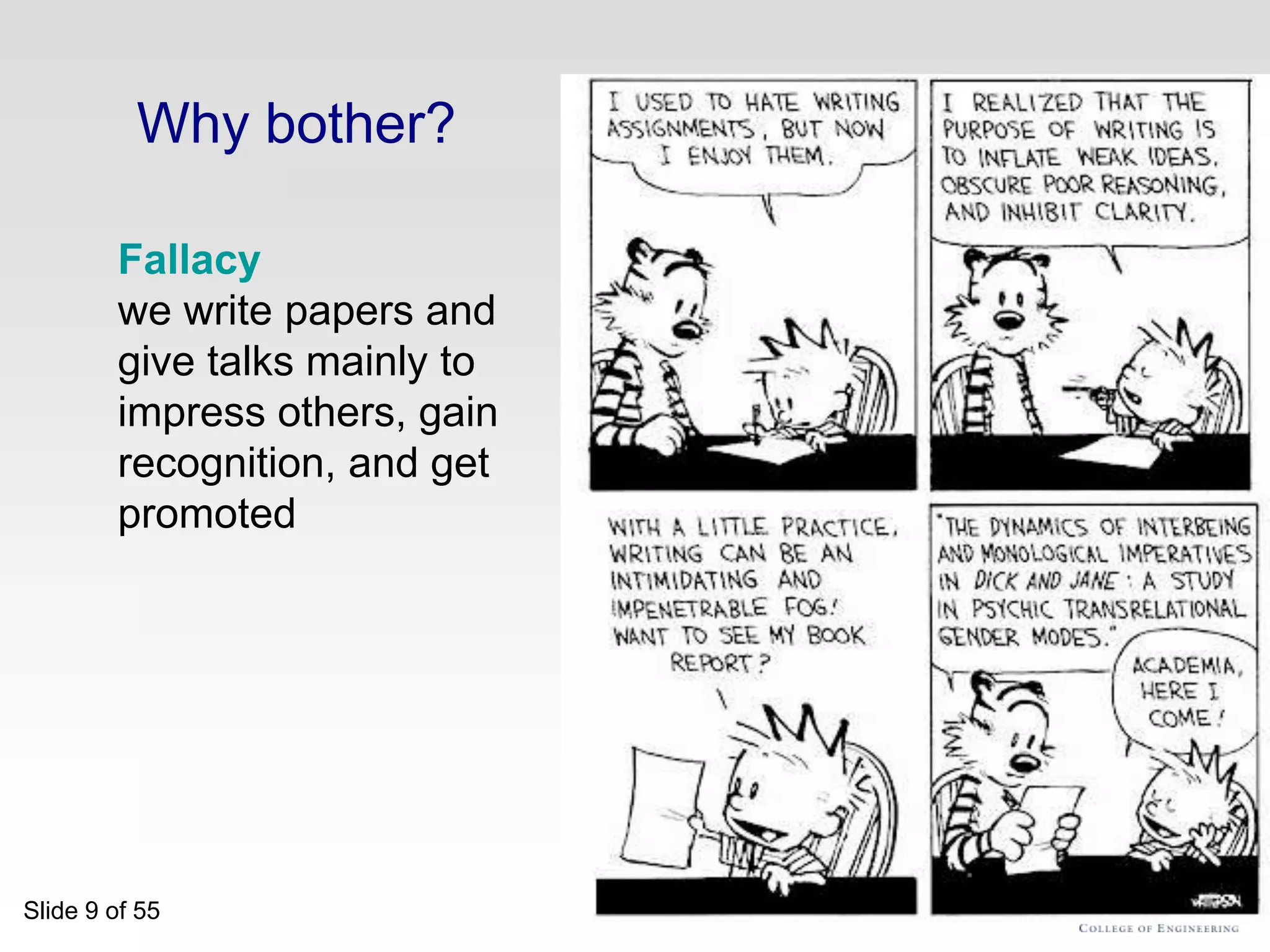
Why bother?Good papers and talks are a fundamental part of research excellenceFallacywe write papers and give talks mainly to impress others, gain recognition, and get promoted9
Papers Communicate IdeasYour goal: to infect the mind of your reader with your idea, like a virusPapers are far more durable than programs (think Mozart)The greatest ideas are (literally) worthless if you keep them to yourself
IdeaA re-usable insight, useful to the readerThe IdeaFigure out what your idea isMake certain that the reader is in no doubt what the idea is.  Be 100% explicit:“The main idea of this paper is....”“In this section we present the main contributions of the paper.”Many papers contain good ideas, but do not distil what they are.
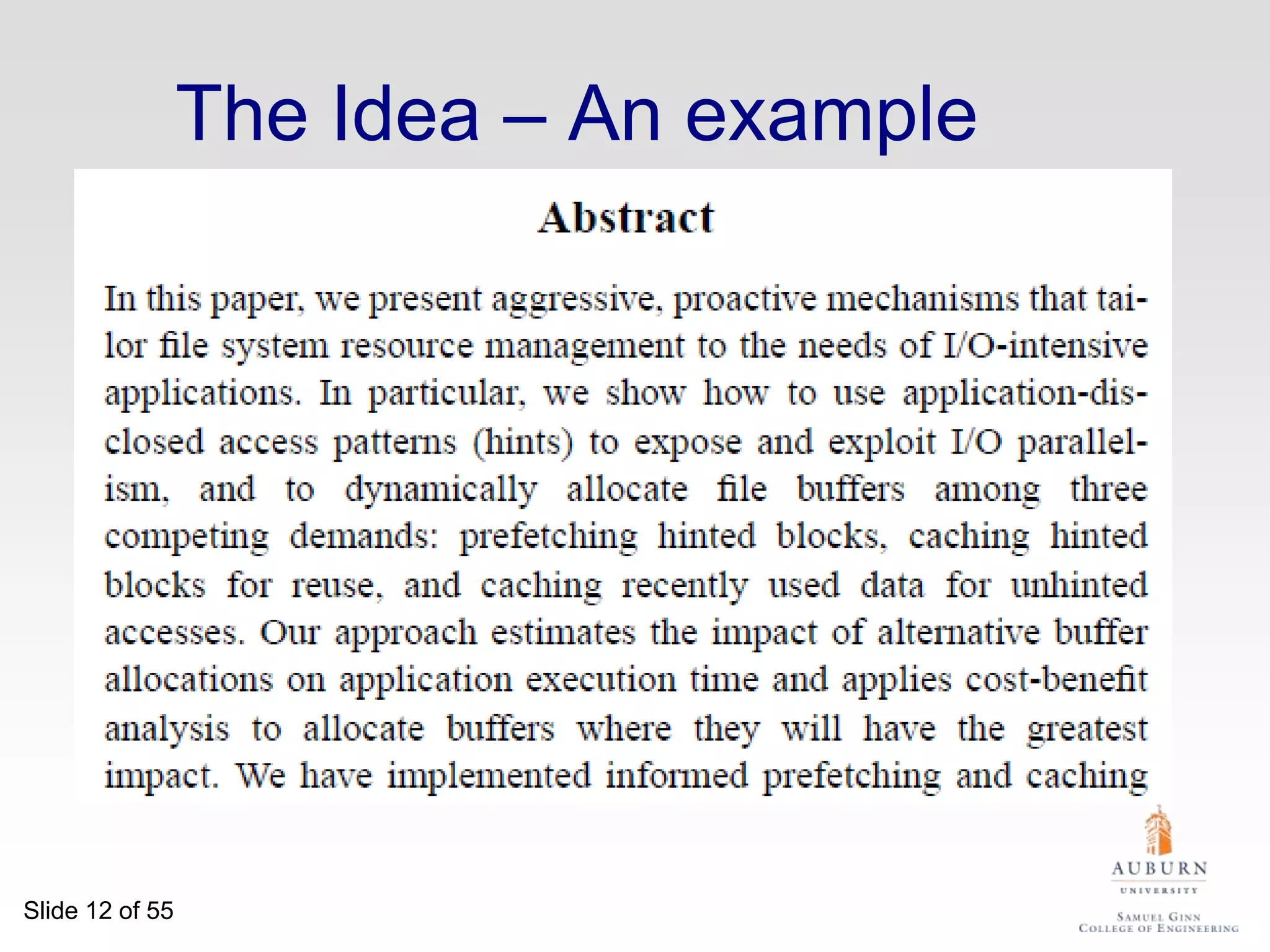
The Idea – An example
One PingYour paper should have just one “ping”: one clear, sharp ideaRead your paper again: can you hear the “ping”?You may not know exactly what the ping is when you start writing; but you must know when you finishIf you have lots of ideas, write lots of papersThanks to Joe Touch for “one ping”
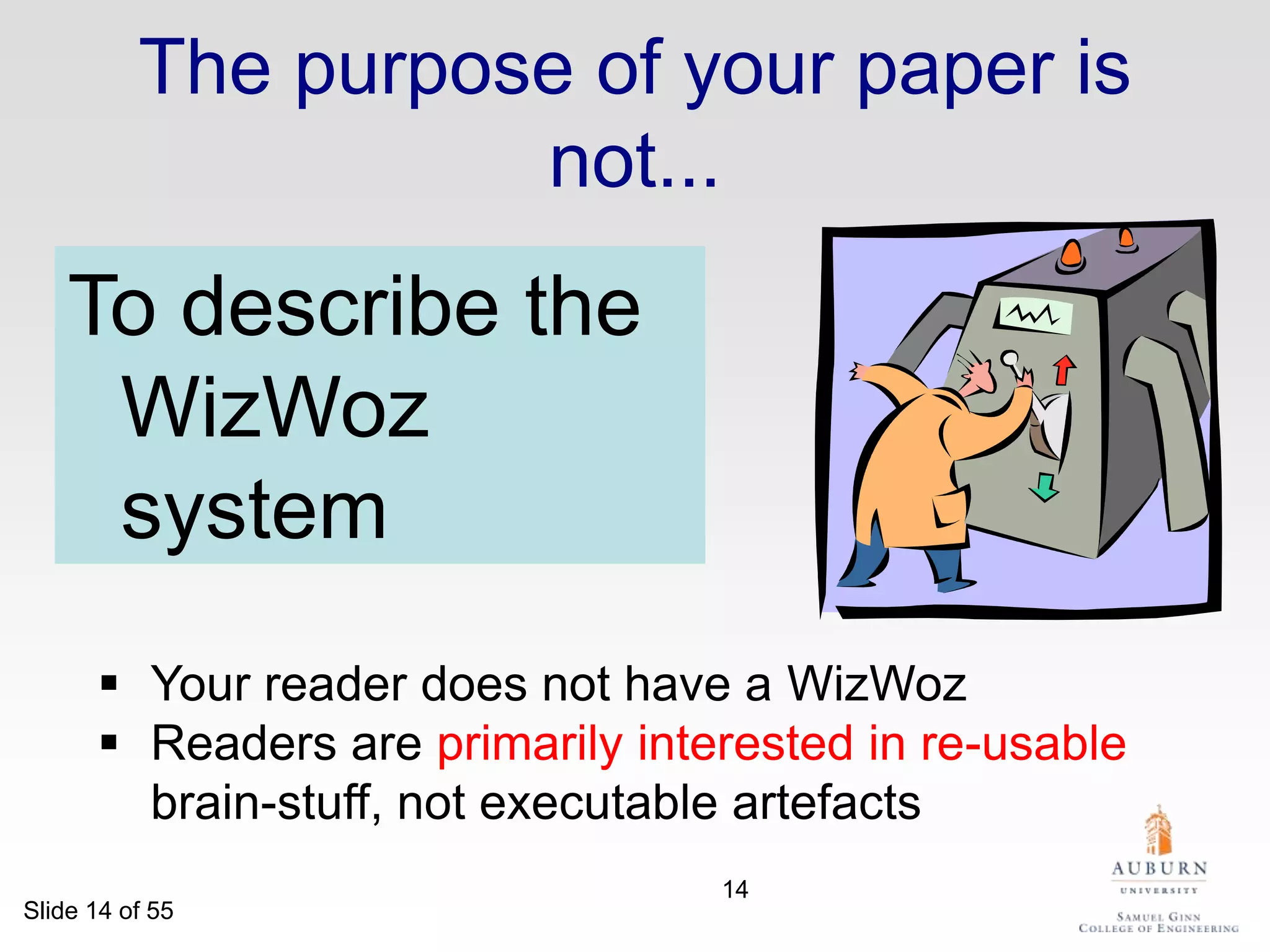
The purpose of your paper is not...To describe the WizWoz systemYour reader does not have a WizWoz
Readers are primarily interested in re-usable brain-stuff, not executable artefacts14
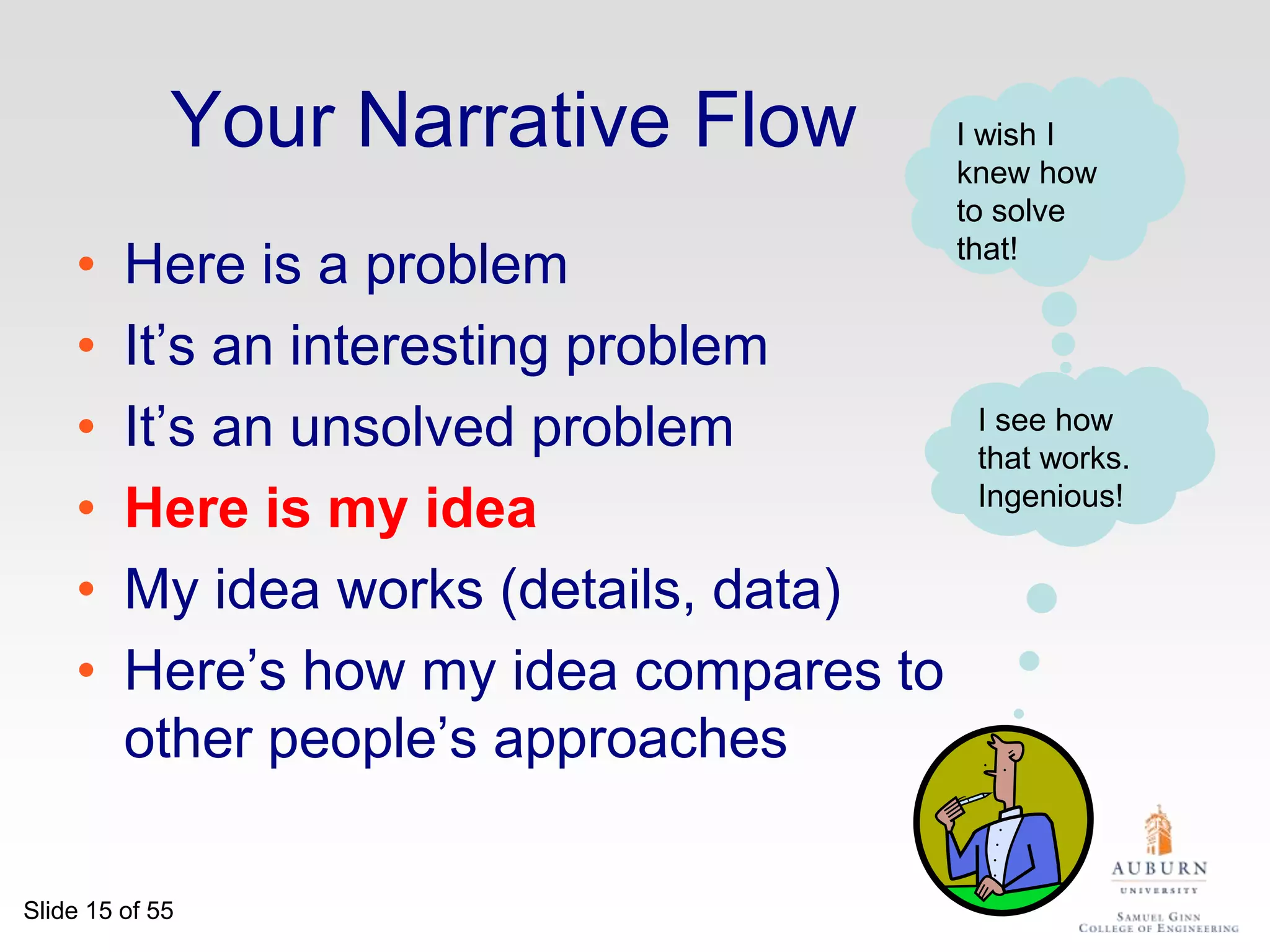
Your Narrative FlowI wish I knew how to solve that!Here is a problemIt’s an interesting problemIt’s an unsolved problemHere is my ideaMy idea works (details, data)Here’s how my idea compares to other people’s approachesI see how that works. Ingenious!
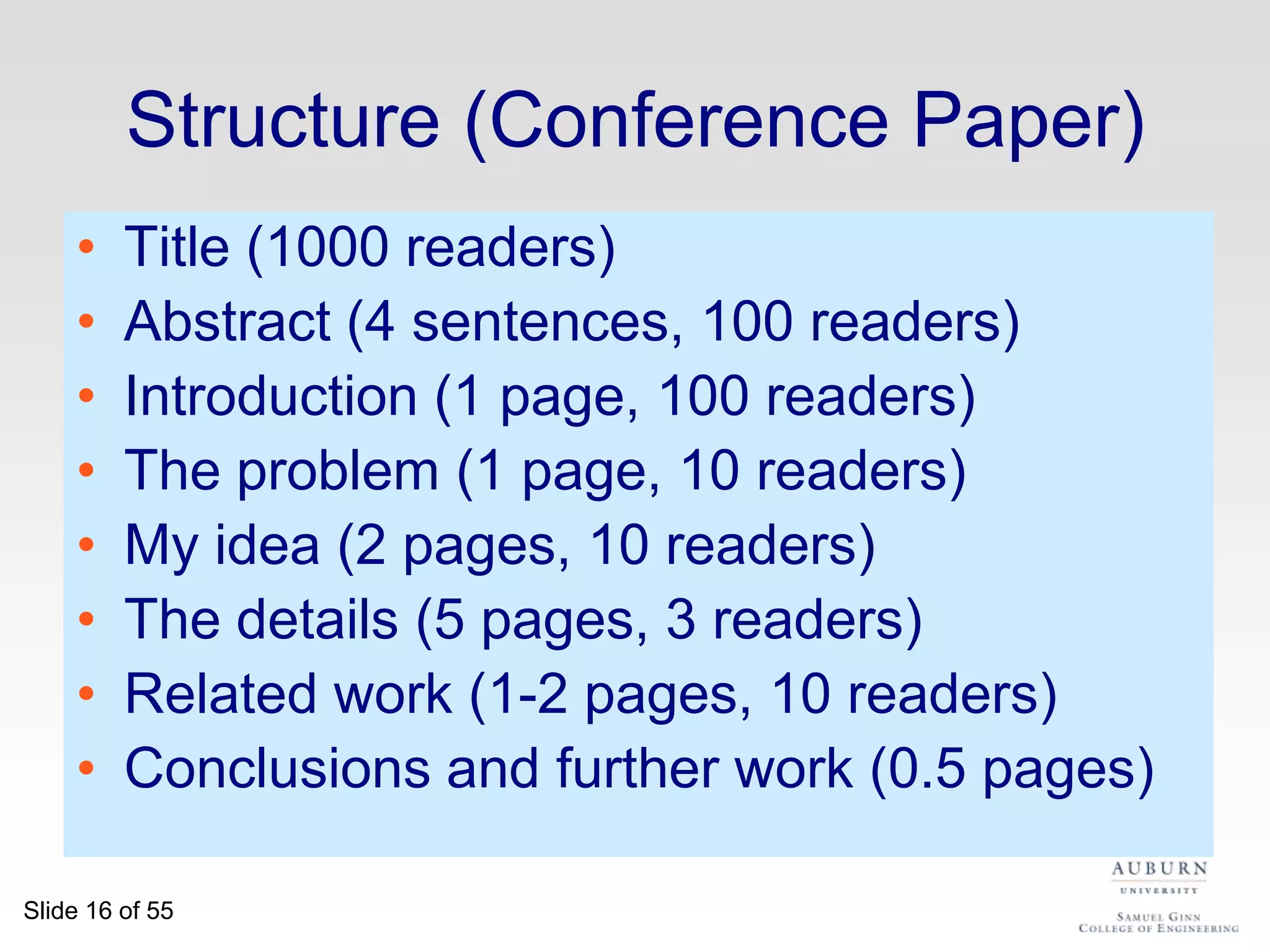
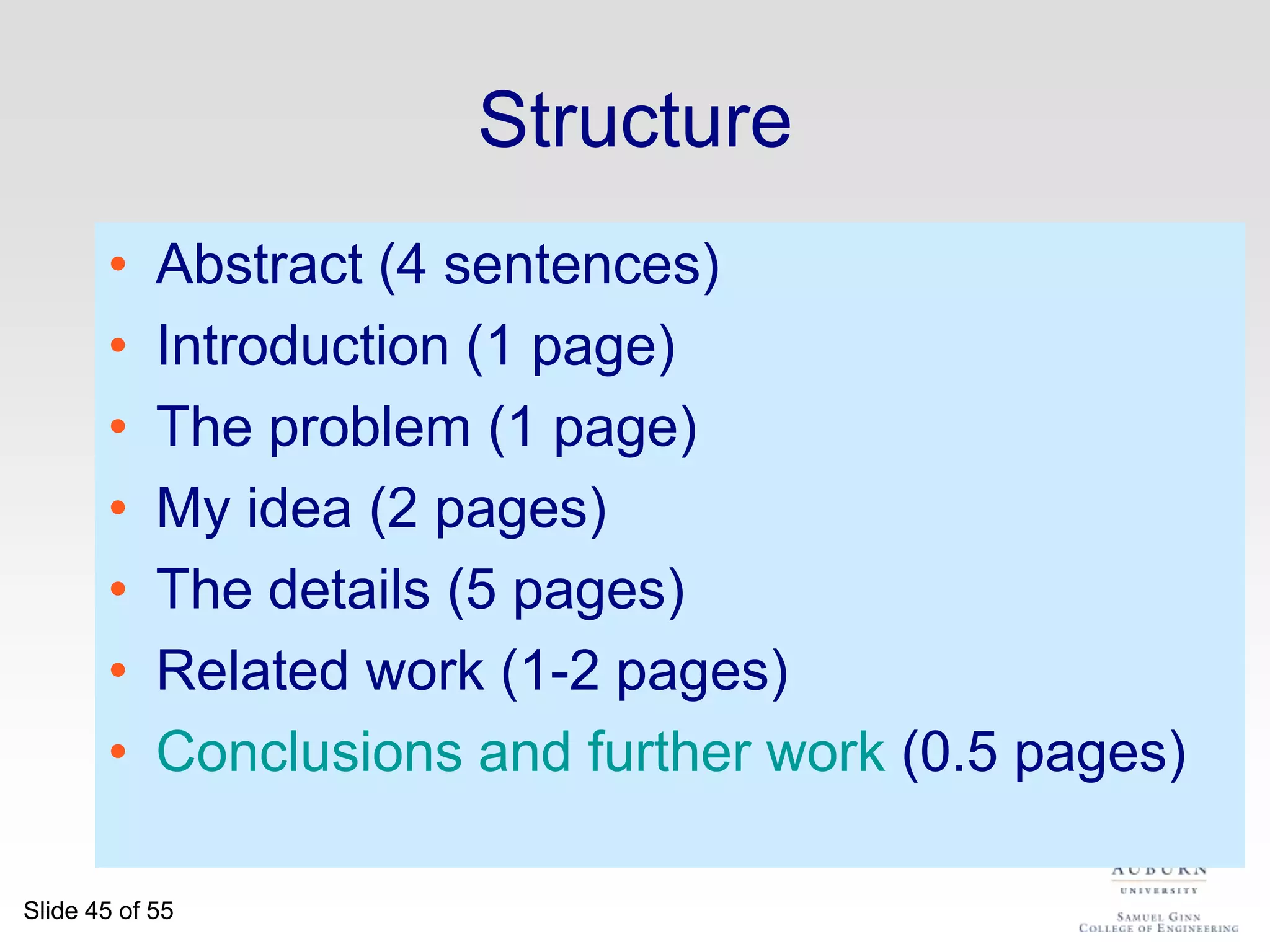
Structure (Conference Paper)Title (1000 readers)Abstract (4 sentences, 100 readers)Introduction (1 page, 100 readers)The problem (1 page, 10 readers)My idea (2 pages, 10 readers)The details (5 pages, 3 readers)Related work (1-2 pages, 10 readers)Conclusions and further work (0.5 pages)
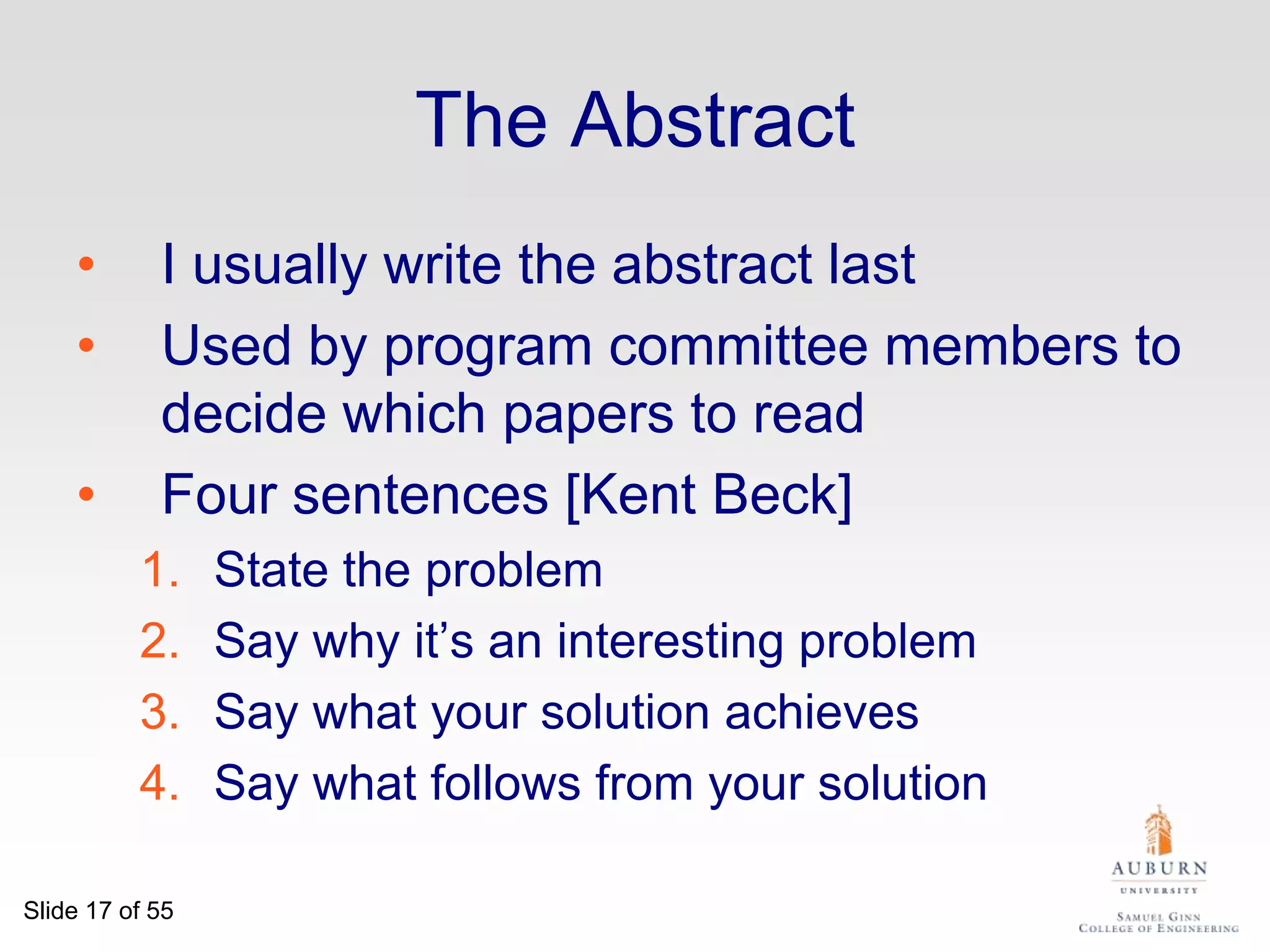
The AbstractI usually write the abstract lastUsed by program committee members to decide which papers to readFour sentences [Kent Beck]State the problemSay why it’s an interesting problemSay what your solution achievesSay what follows from your solution
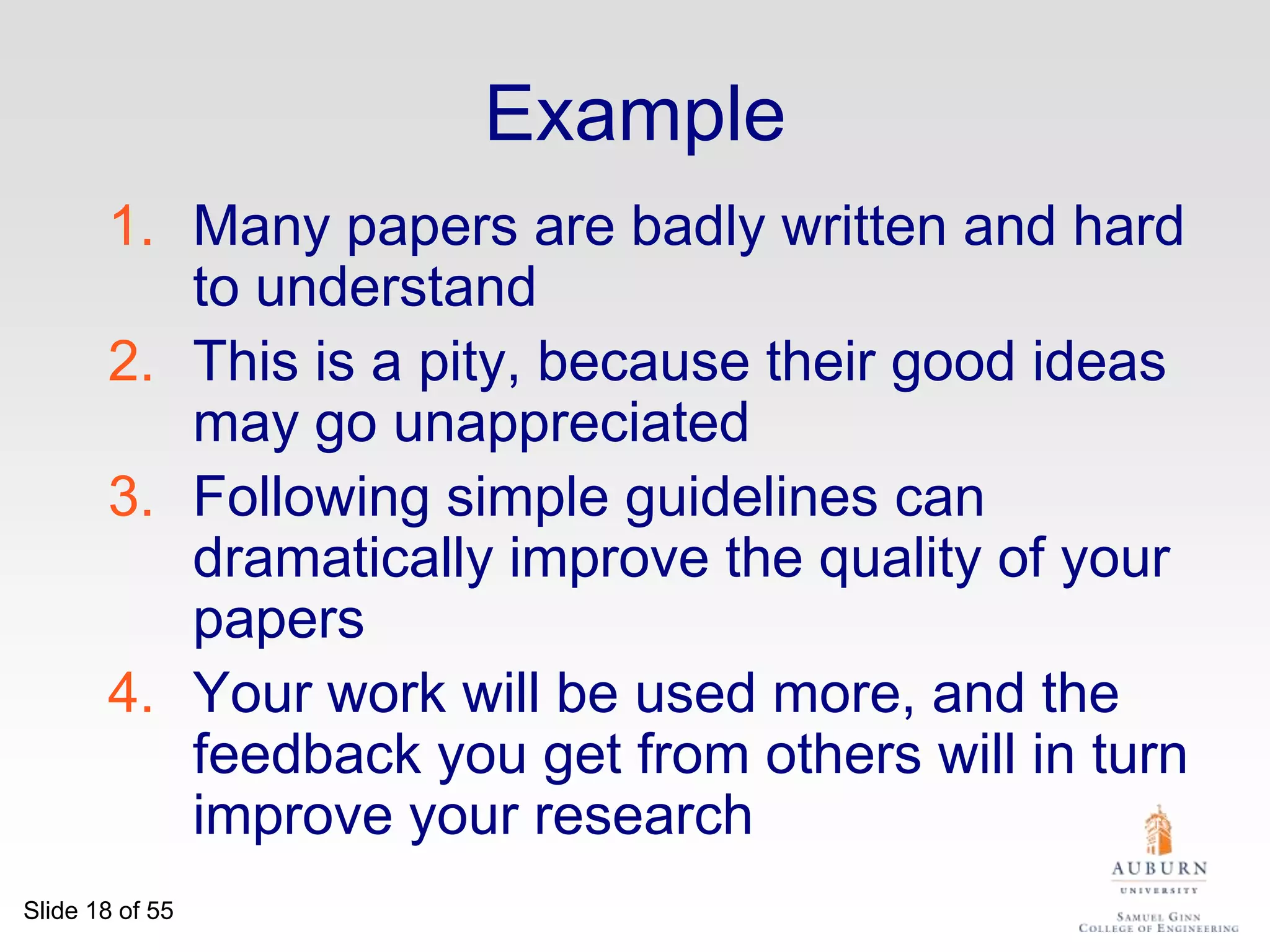
ExampleMany papers are badly written and hard to understandThis is a pity, because their good ideas may go unappreciatedFollowing simple guidelines can dramatically improve the quality of your papersYour work will be used more, and the feedback you get from others will in turn improve your research
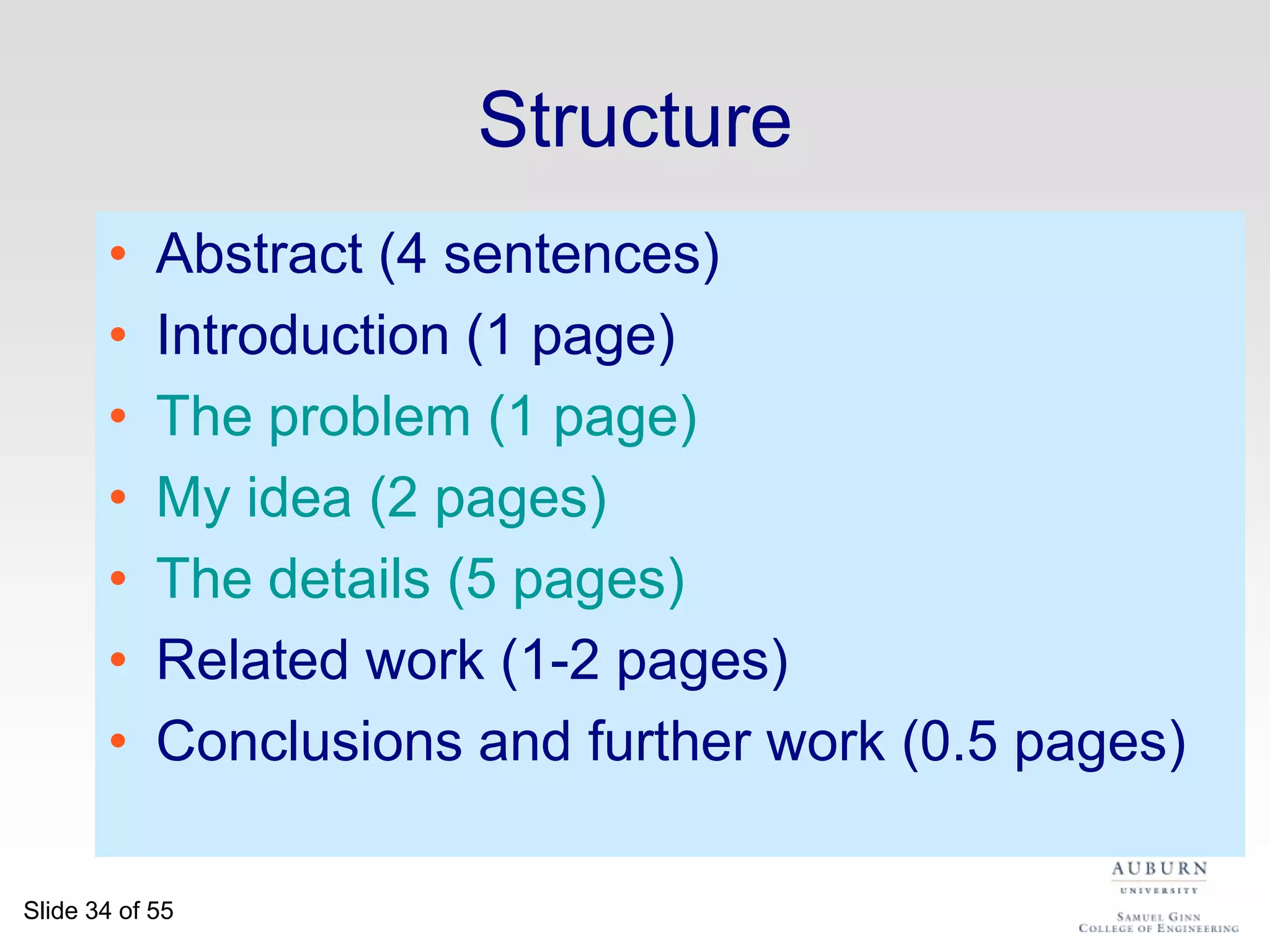
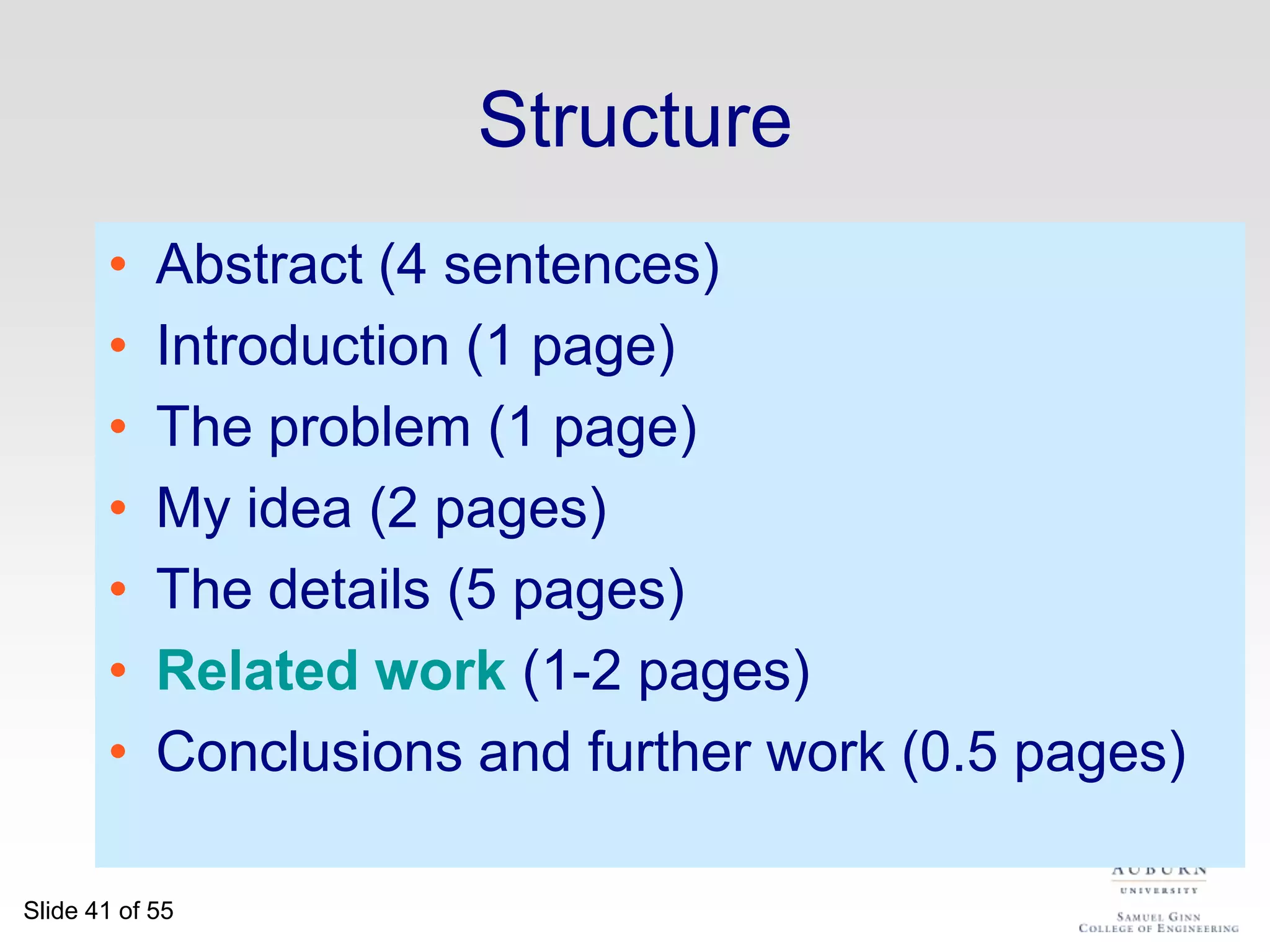
StructureAbstract (4 sentences)Introduction (1 page)The problem (1 page)My idea (2 pages)The details (5 pages)Related work (1-2 pages)Conclusions and further work (0.5 pages)
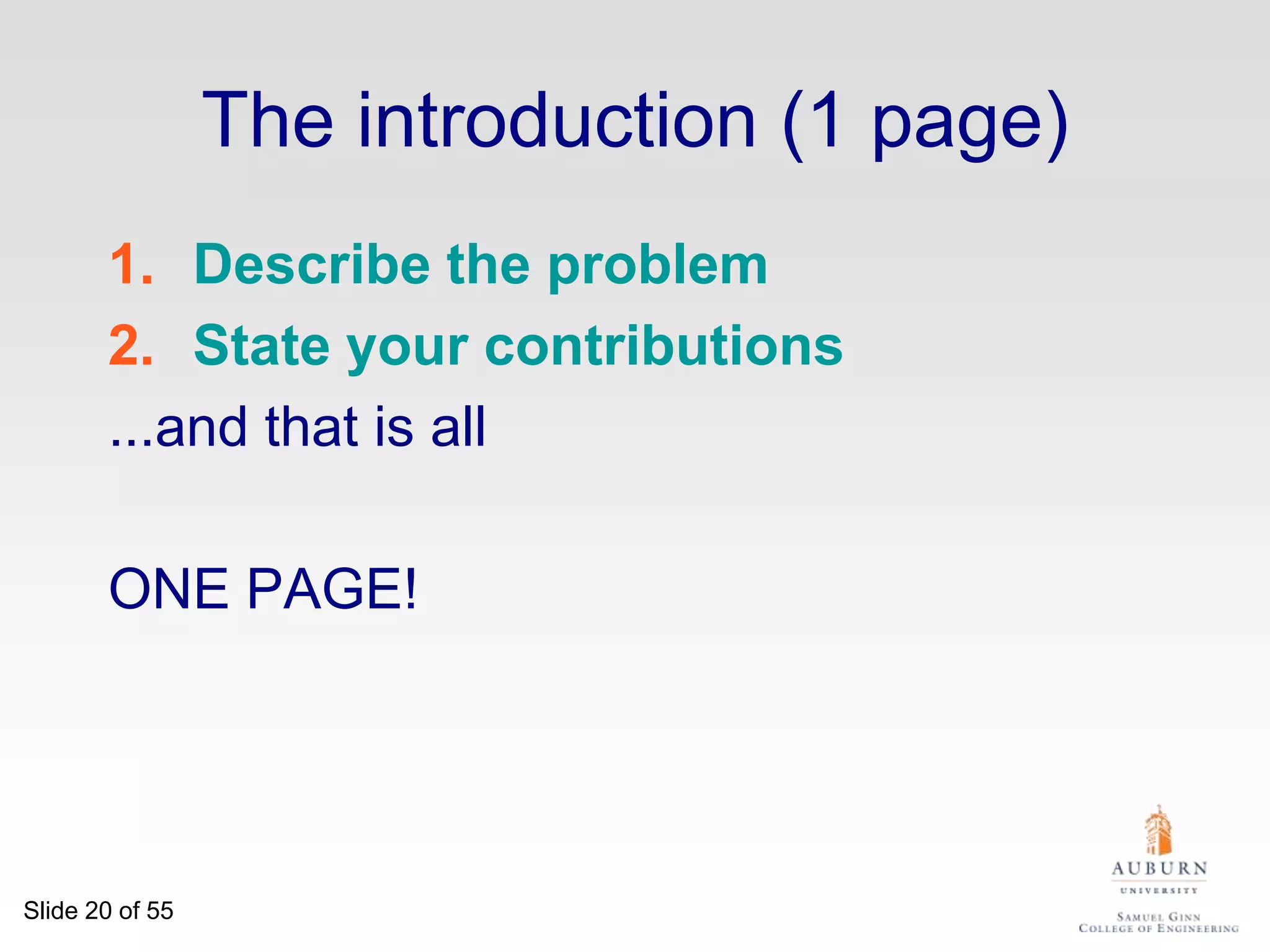
The introduction (1 page)Describe the problemState your contributions...and that is allONE PAGE!
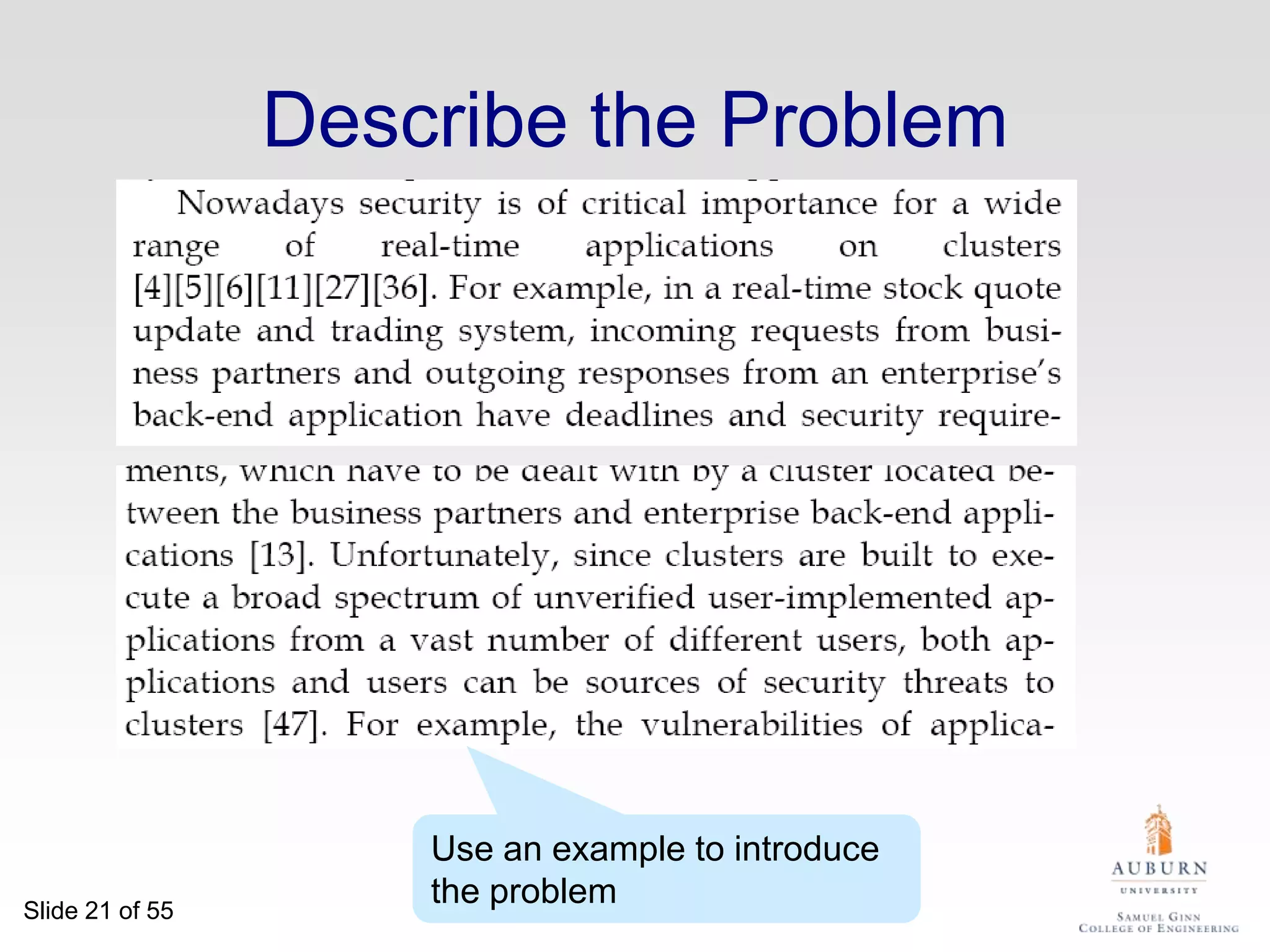
Describe the ProblemUse an example to introduce the problem
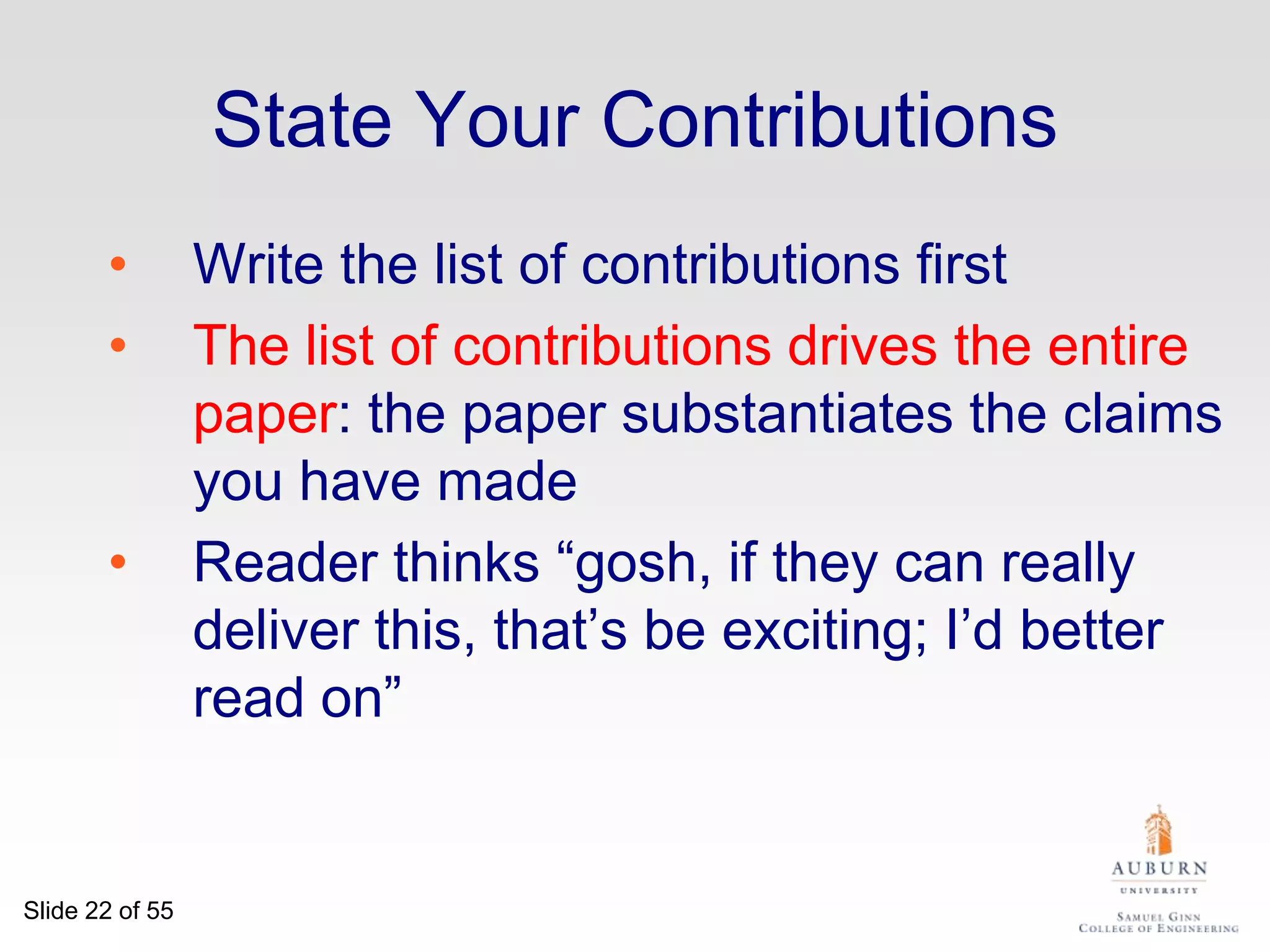
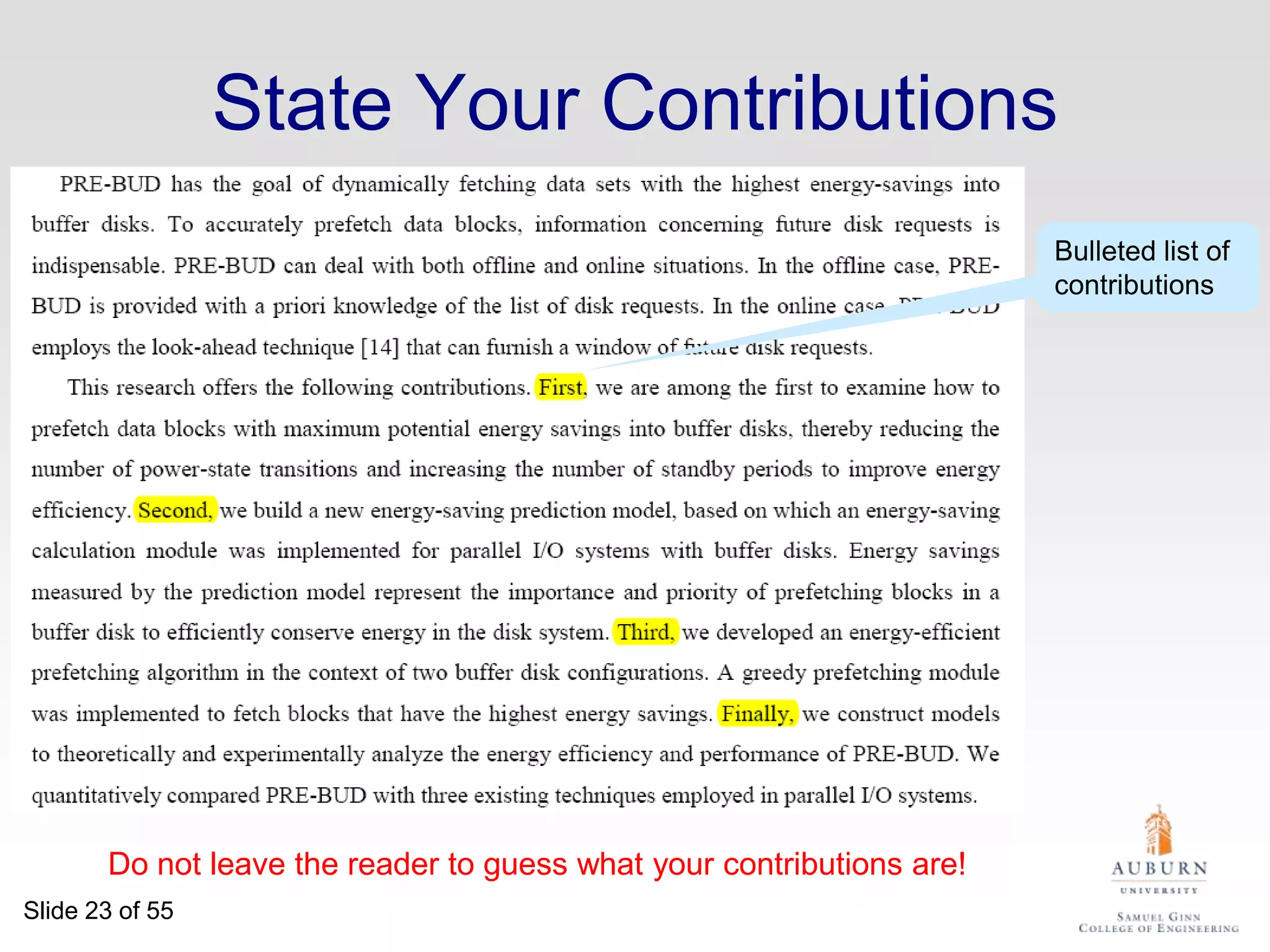
State Your ContributionsWrite the list of contributions firstThe list of contributions drives the entire paper: the paper substantiates the claims you have madeReader thinks “gosh, if they can really deliver this, that’s be exciting; I’d better read on”
State Your ContributionsBulleted list of contributionsDo not leave the reader to guess what your contributions are!
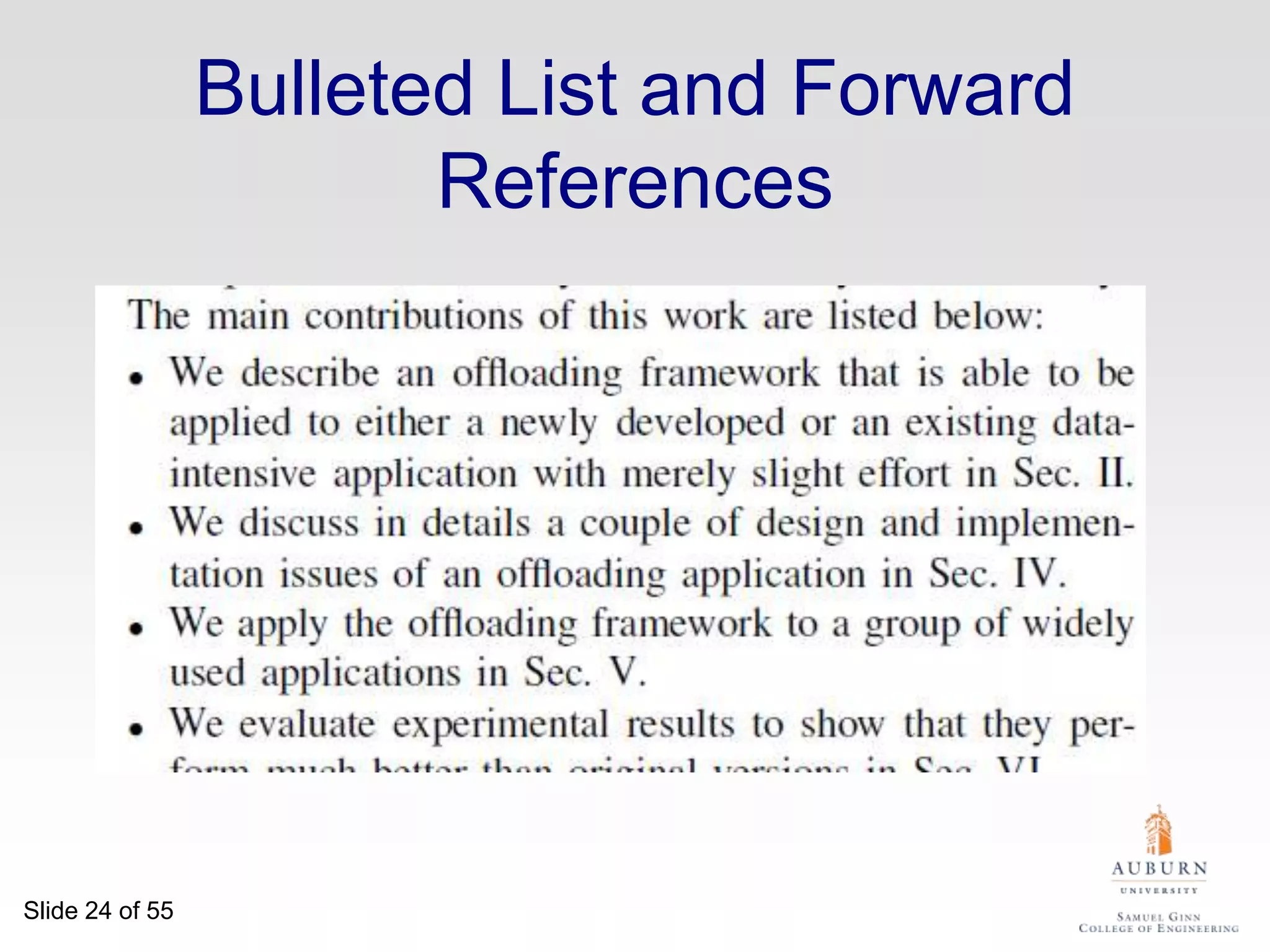
Bulleted List and Forward References
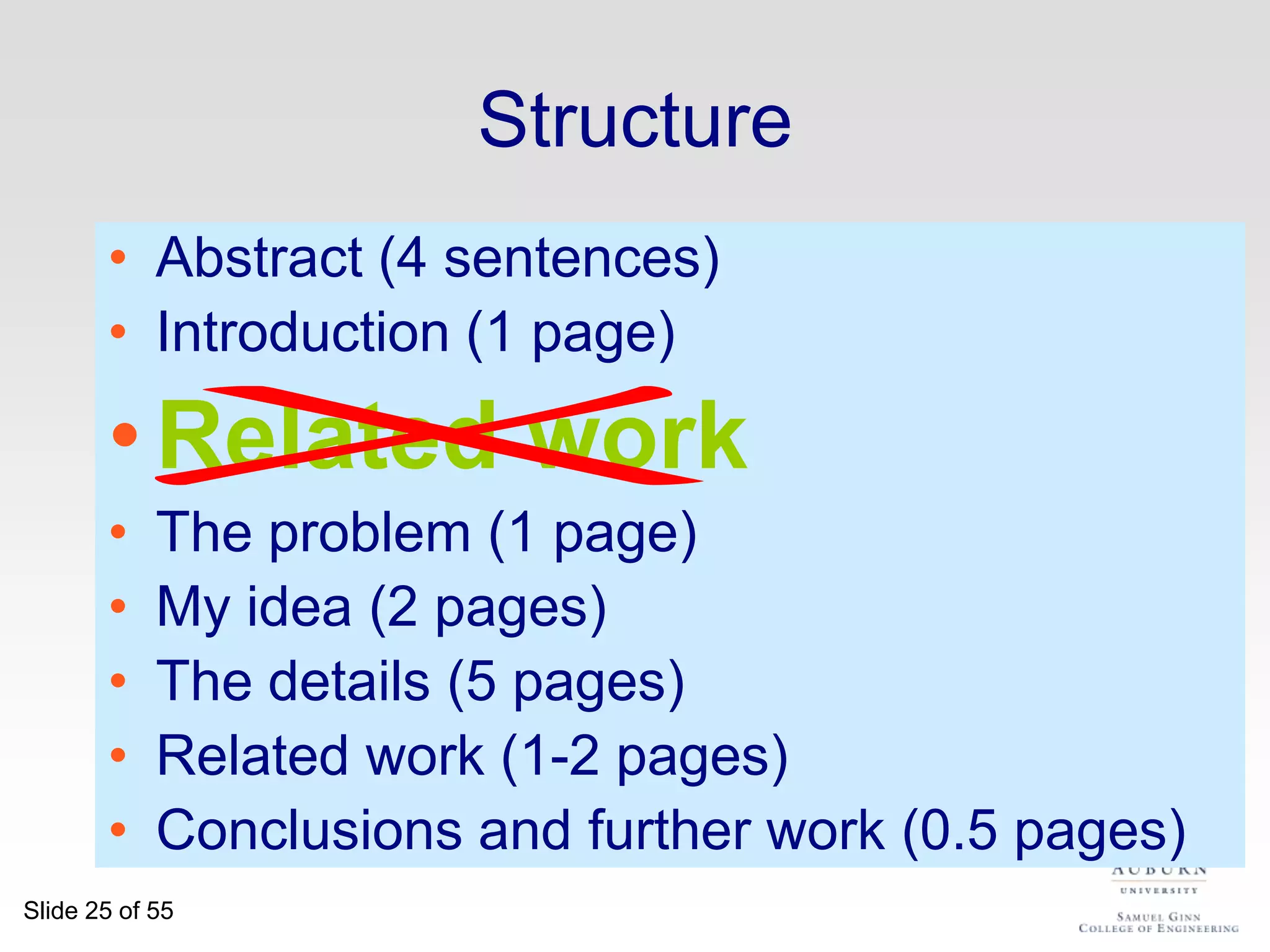
StructureAbstract (4 sentences)Introduction (1 page)Related workThe problem (1 page)My idea (2 pages)The details (5 pages)Related work (1-2 pages)Conclusions and further work (0.5 pages)
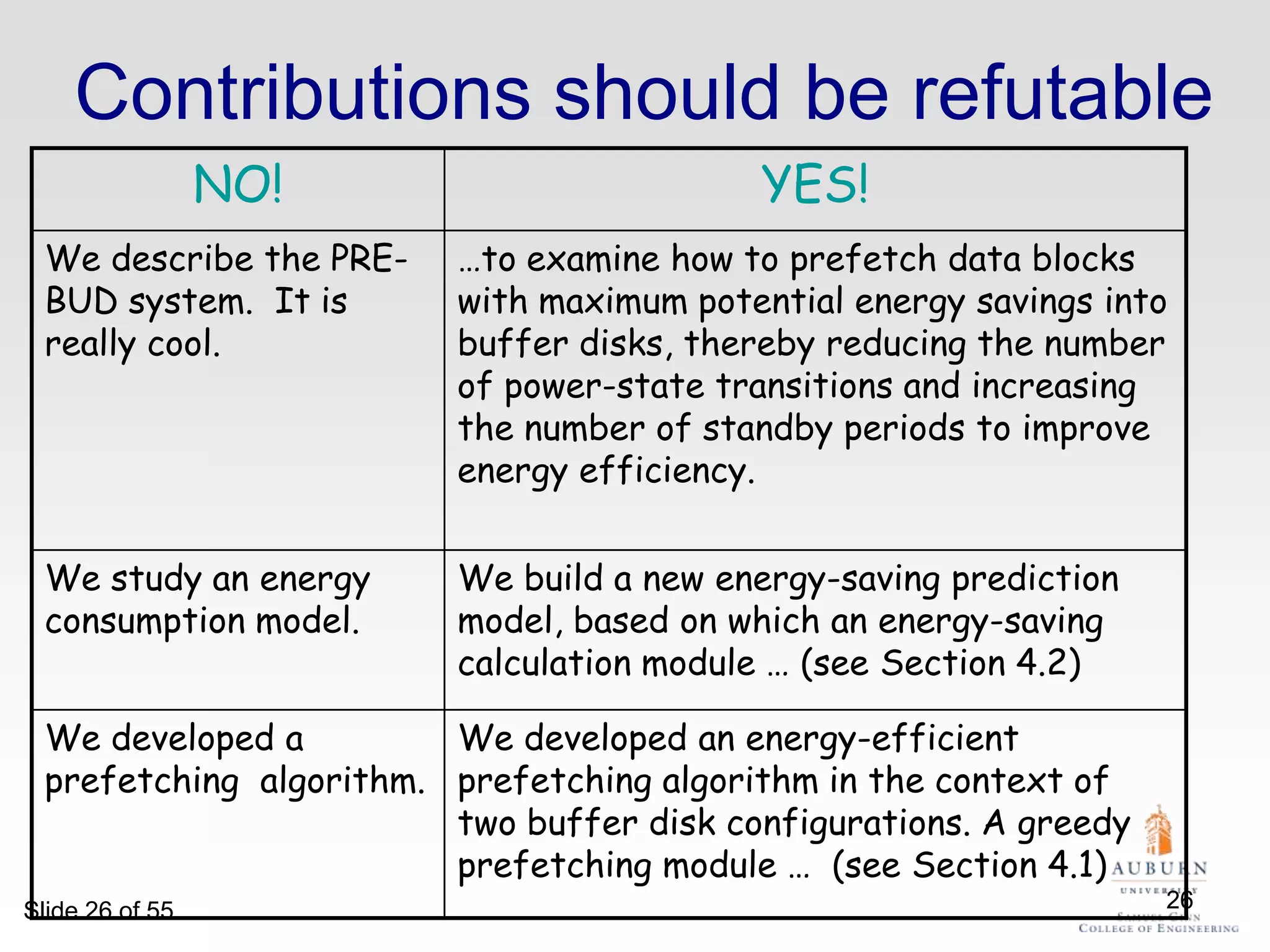
Contributions should be refutable26
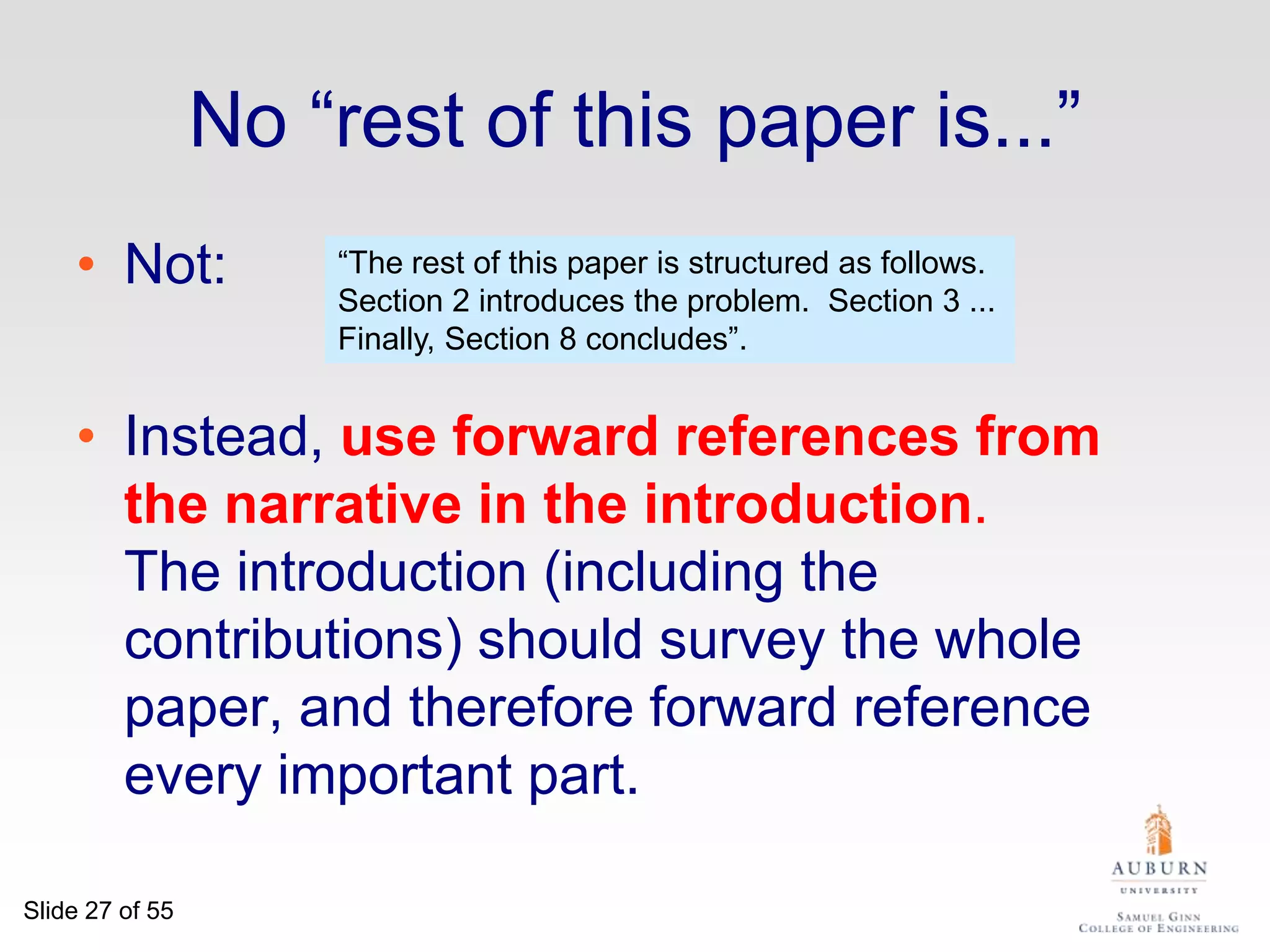
No “rest of this paper is...”Not:Instead, use forward references from the narrative in the introduction.  The introduction (including the contributions) should survey the whole paper, and therefore forward reference every important part.“The rest of this paper is structured as follows.  Section 2 introduces the problem.  Section 3 ...  Finally, Section 8 concludes”.
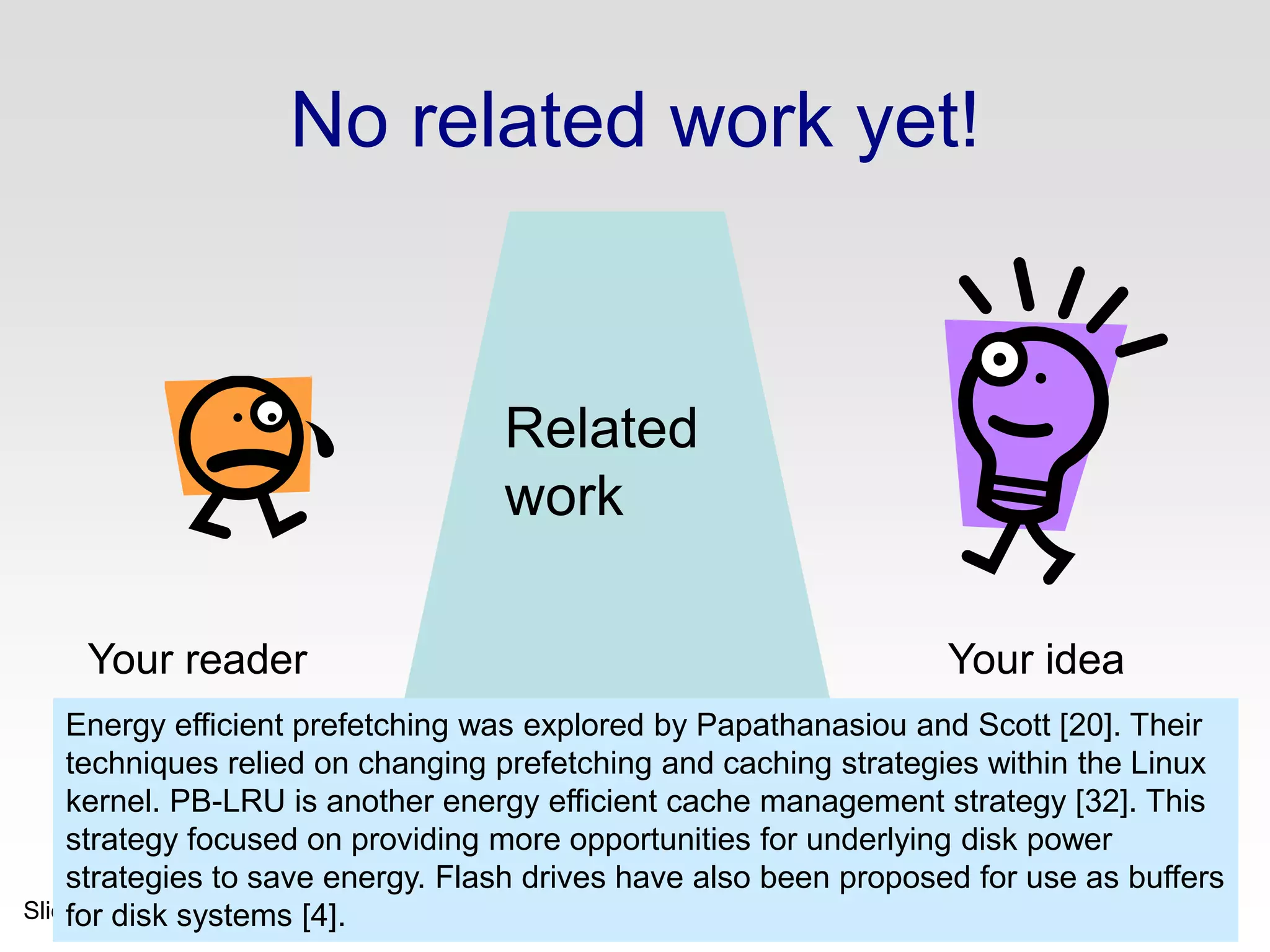
No related work yet!Related workYour readerYour ideaEnergy efficient prefetching was explored by Papathanasiou and Scott [20]. Their techniques relied on changing prefetching and caching strategies within the Linux kernel. PB-LRU is another energy efficient cache management strategy [32]. This strategy focused on providing more opportunities for underlying disk power strategies to save energy. Flash drives have also been proposed for use as buffers for disk systems [4].
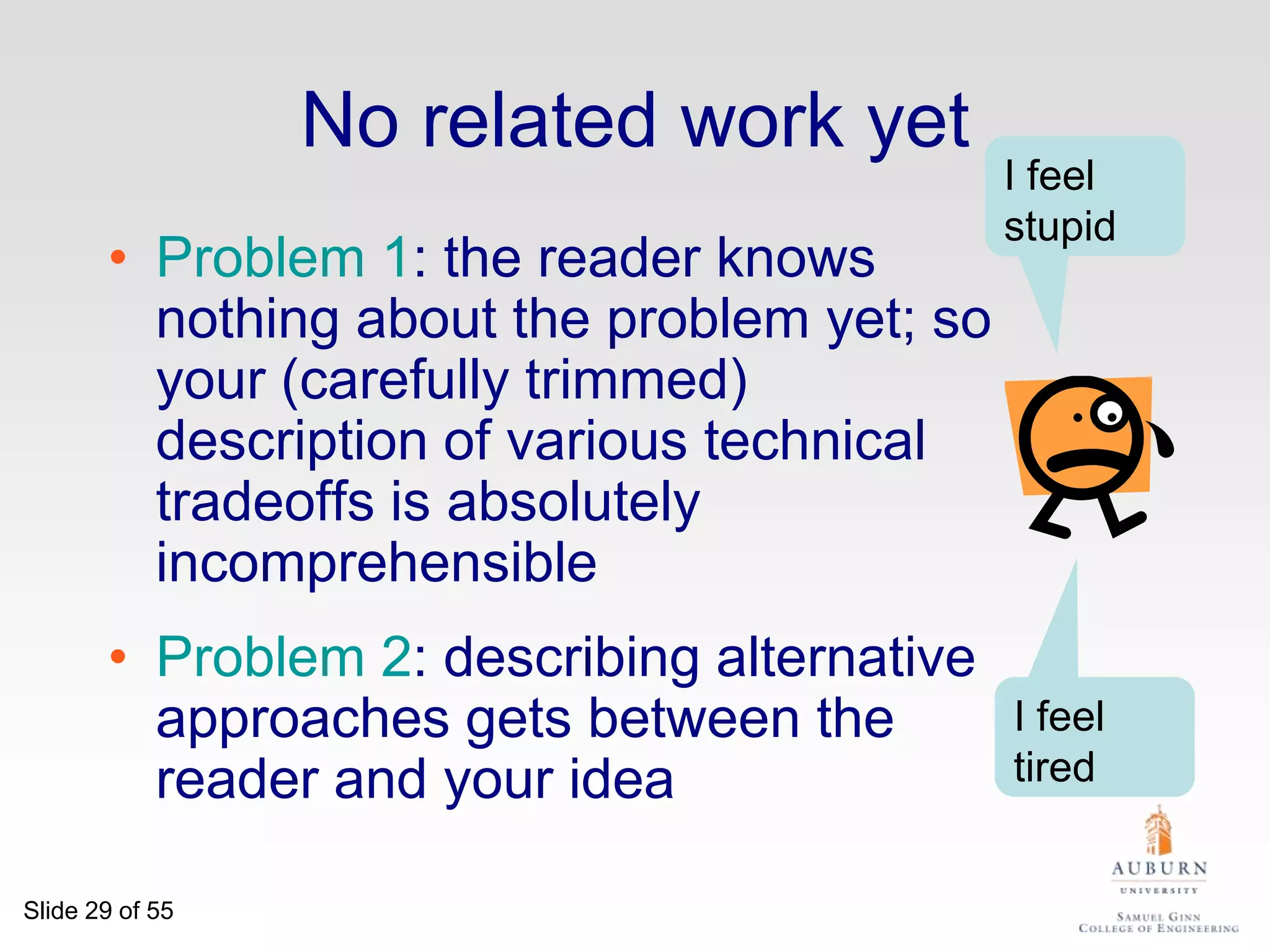
No related work yetI feel stupidProblem 1: the reader knows nothing about the problem yet; so your (carefully trimmed) description of various technical tradeoffs is absolutely incomprehensible Problem 2: describing alternative approaches gets between the reader and your ideaI feel tired
For readers who know your field very well...Abstract (4 sentences)Introduction (1 page)Related work (1-2 pages)The problem (1 page)My idea (2 pages)The details (5 pages)Related workConclusions and further work (0.5 pages)
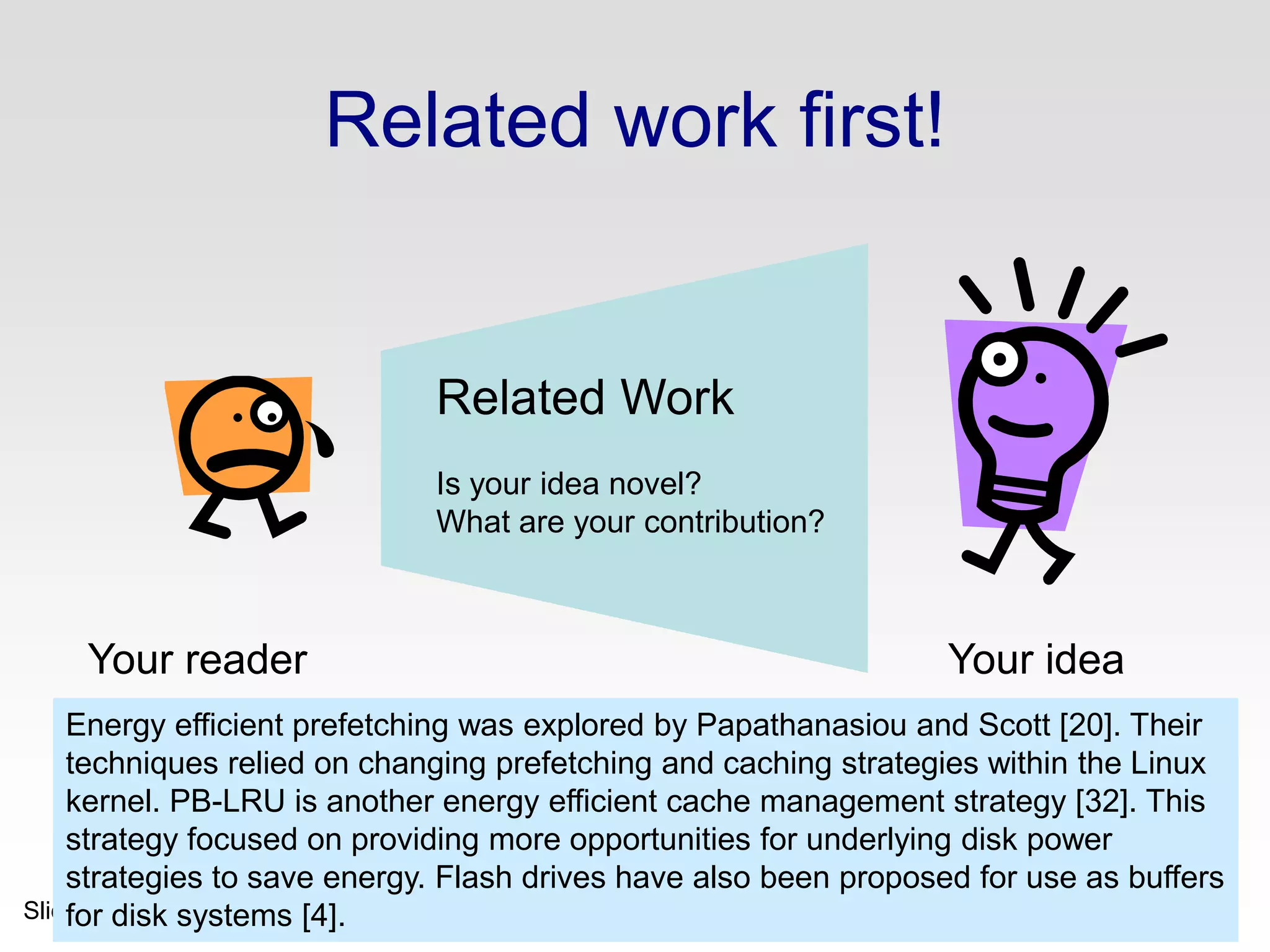
Related work first!Related WorkIs your idea novel?What are your contribution?Your readerYour ideaEnergy efficient prefetching was explored by Papathanasiou and Scott [20]. Their techniques relied on changing prefetching and caching strategies within the Linux kernel. PB-LRU is another energy efficient cache management strategy [32]. This strategy focused on providing more opportunities for underlying disk power strategies to save energy. Flash drives have also been proposed for use as buffers for disk systems [4].
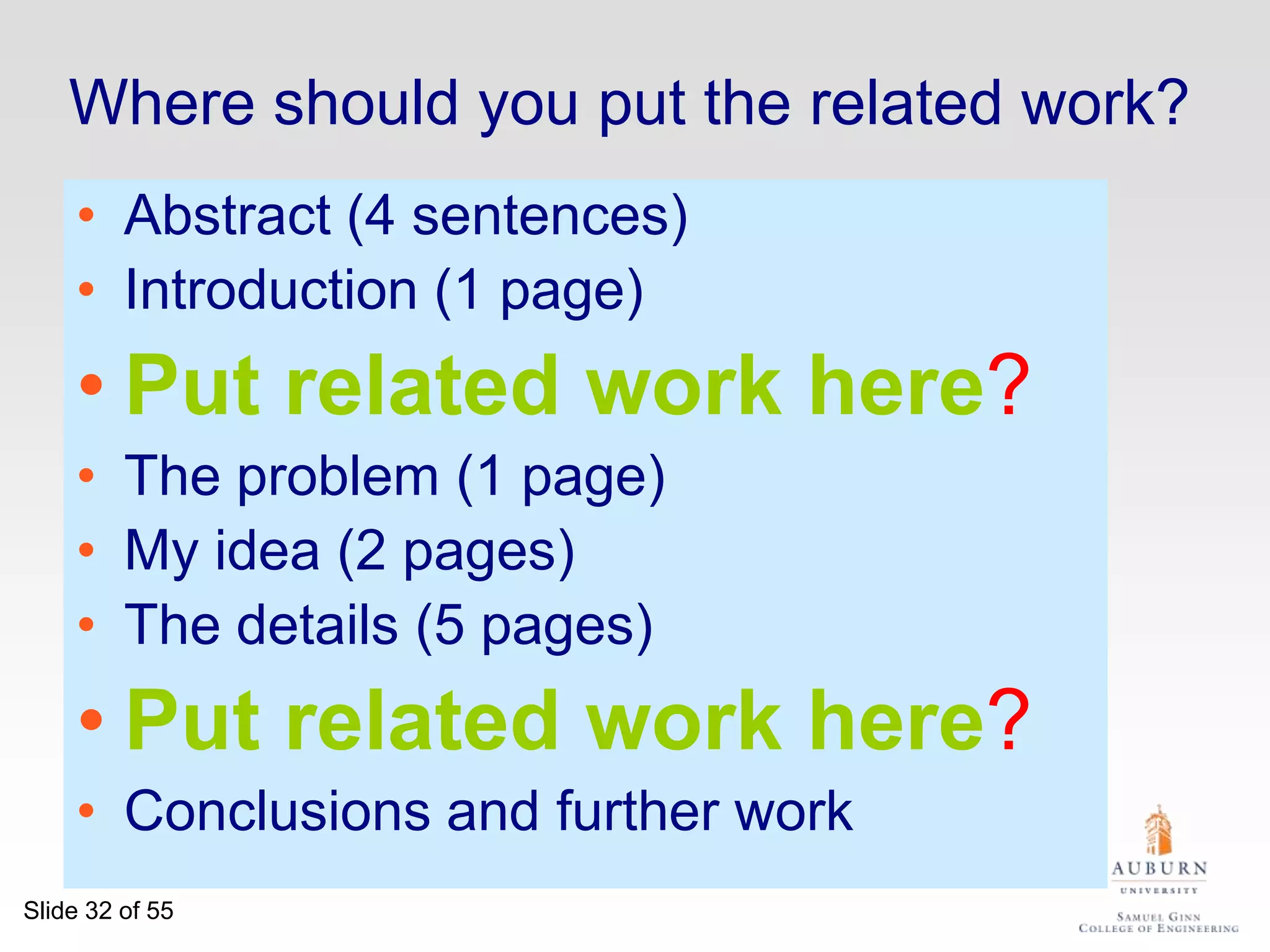
Where should you put the related work?Abstract (4 sentences)Introduction (1 page)Put related work here?The problem (1 page)My idea (2 pages)The details (5 pages)Put related work here?Conclusions and further work
Where should you put the related work?A Suggested PrincipleAbstract (4 sentences)Introduction (1 page)Put related work here?The problem (1 page)My idea (2 pages)The details (5 pages)Put related work here?Conclusions and further work You want to convince reviewers in the first place.You feel this is a novel idea
StructureAbstract (4 sentences)Introduction (1 page)The problem (1 page)My idea (2 pages)The details (5 pages)Related work (1-2 pages)Conclusions and further work (0.5 pages)
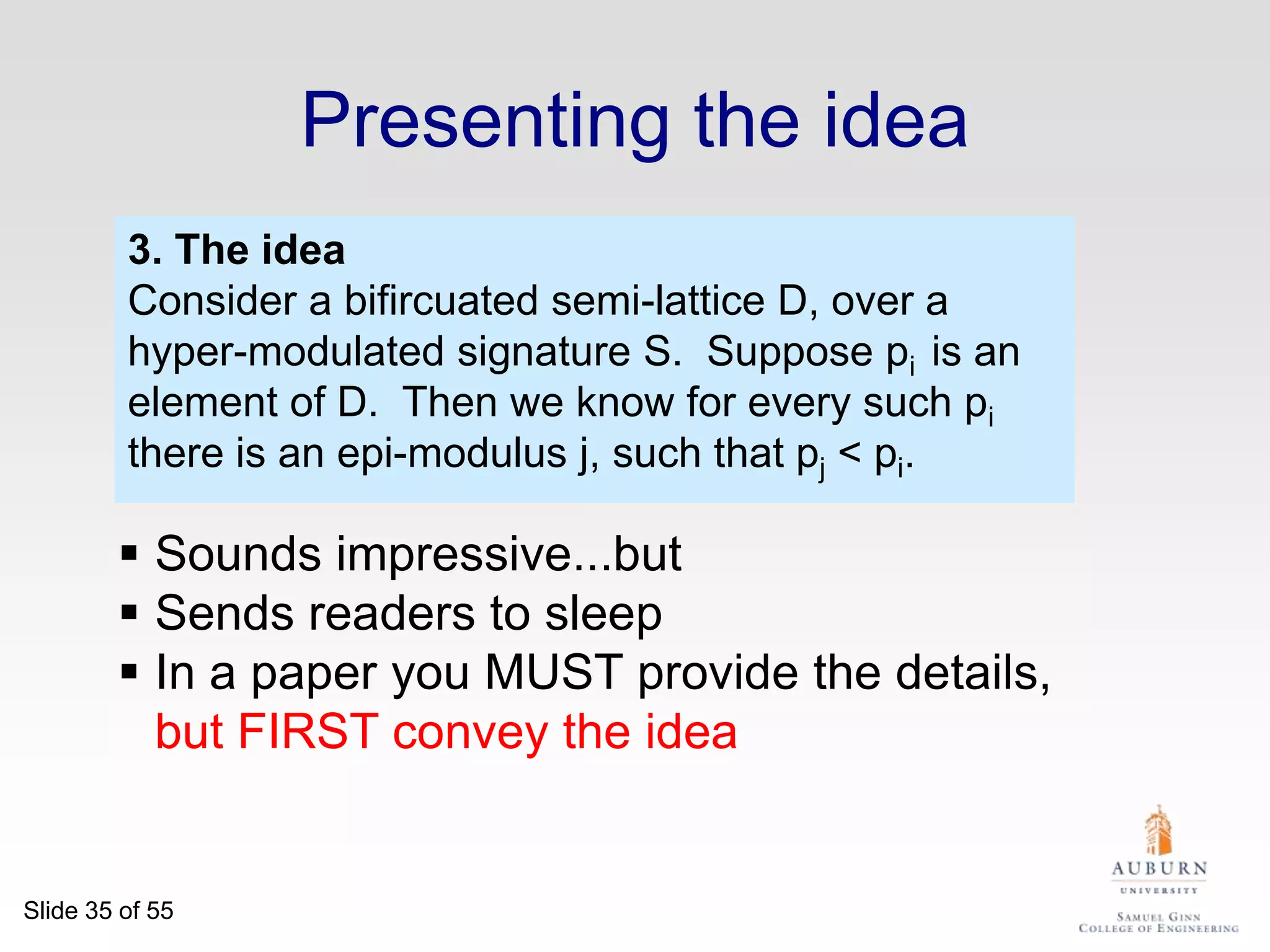
Presenting the idea3. The ideaConsider a bifircuated semi-lattice D, over a hyper-modulated signature S.  Suppose pi  is an element of D.  Then we know for every such pi there is an epi-modulus j, such that pj < pi.Sounds impressive...but
Sends readers to sleep
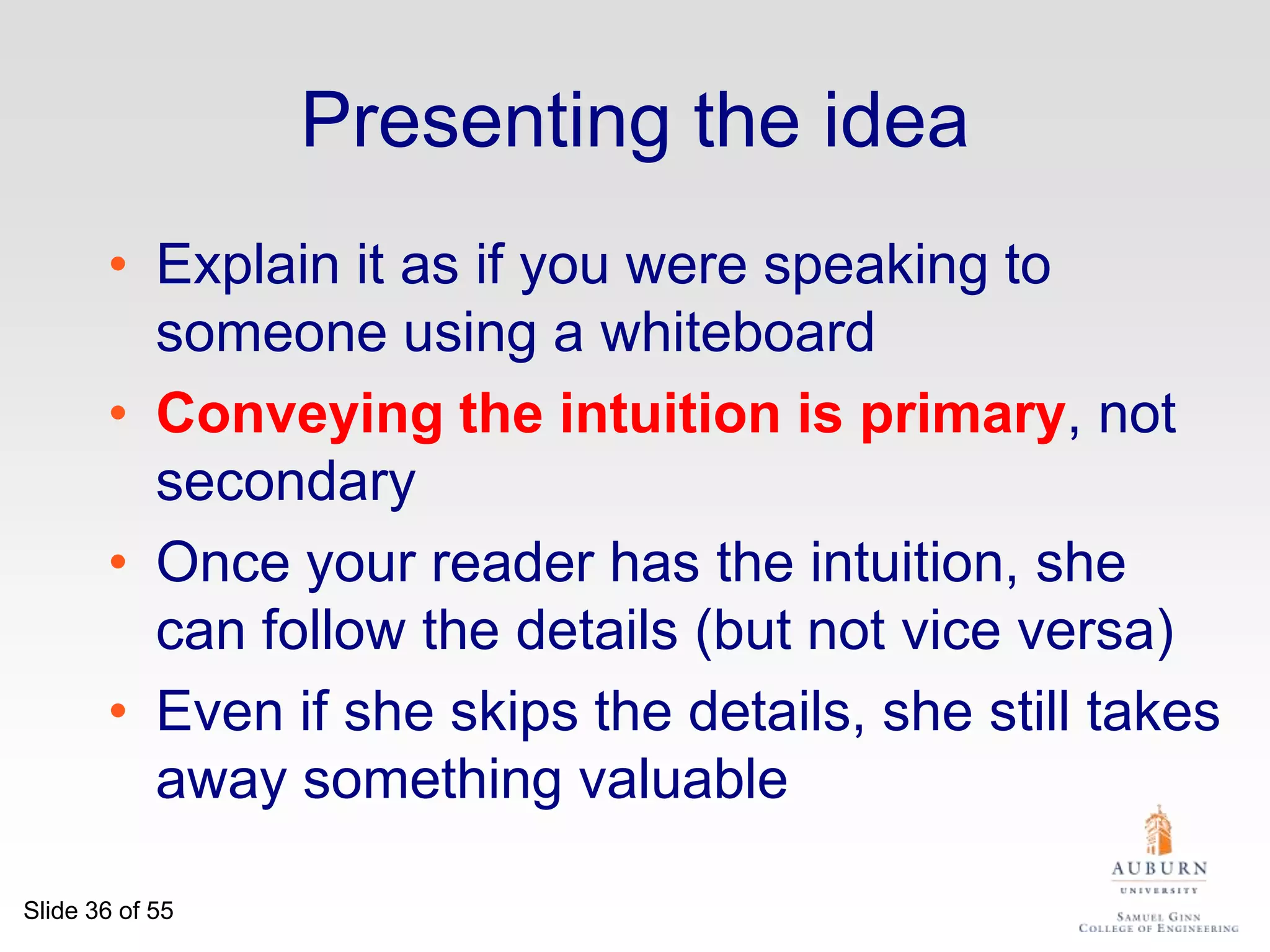
In a paper you MUST provide the details, but FIRST convey the ideaPresenting the ideaExplain it as if you were speaking to someone using a whiteboardConveying the intuition is primary, not secondaryOnce your reader has the intuition, she can follow the details (but not vice versa)Even if she skips the details, she still takes away something valuable
Putting the reader firstDo not recapitulate your personal journey of discovery.  This route may be soaked with your blood, but that is not interesting to the reader.Instead, choose the most direct route to the idea.
The payload of your paperIntroduce the problem, and your idea, usingEXAMPLESand only then present the general case
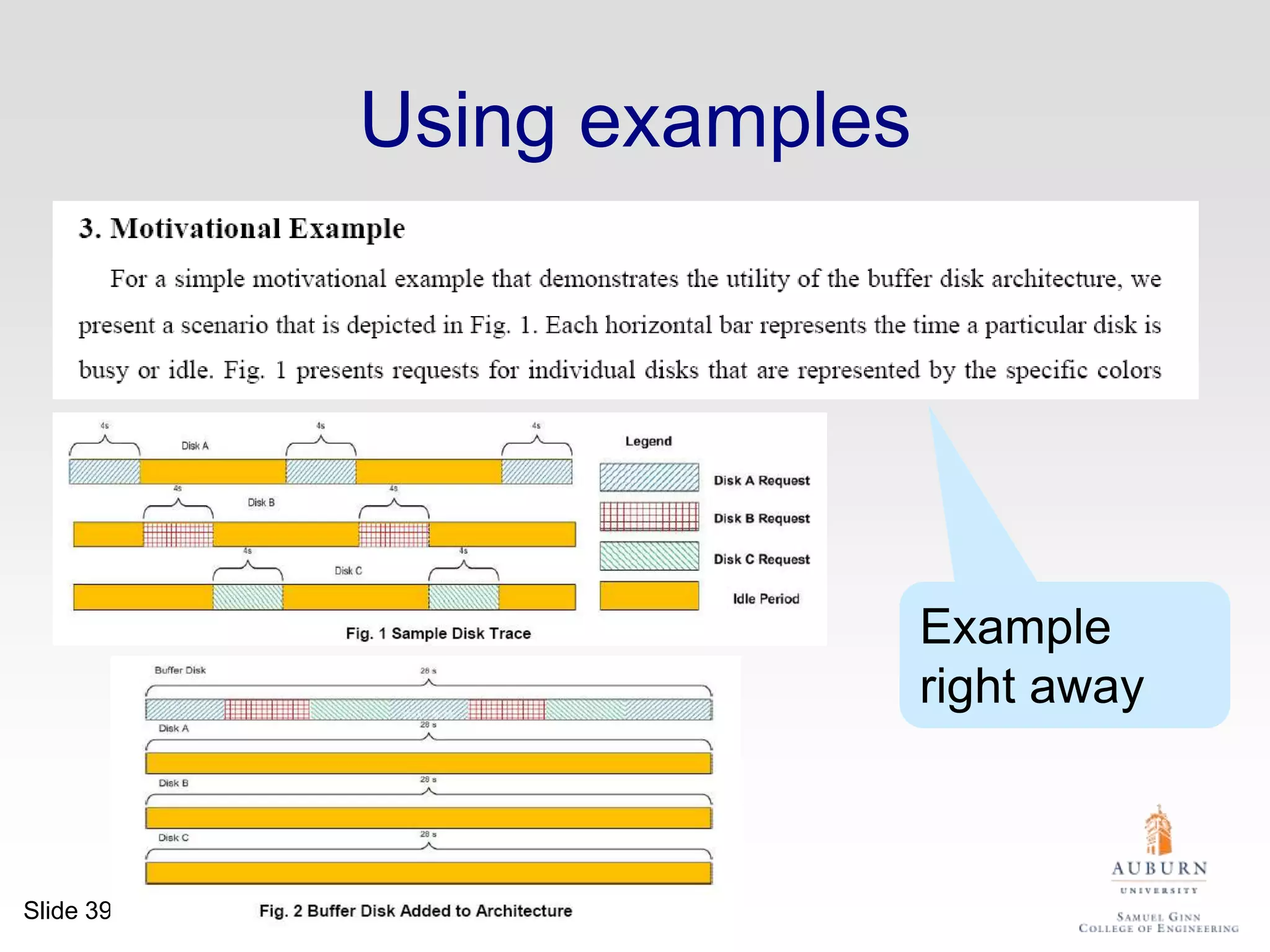
Using examplesExample right away
The details: evidence	Your introduction makes claimsThe body of the paper provides evidence to support each claimCheck each claim in the introduction, identify the evidence, and forward-reference it from the claimEvidence can be: analysis and comparison, theorems, measurements, case studies
StructureAbstract (4 sentences)Introduction (1 page)The problem (1 page)My idea (2 pages)The details (5 pages)Related work (1-2 pages)Conclusions and further work (0.5 pages)
Related workFallacy	To make my work look good, I have to make other people’s work look bad
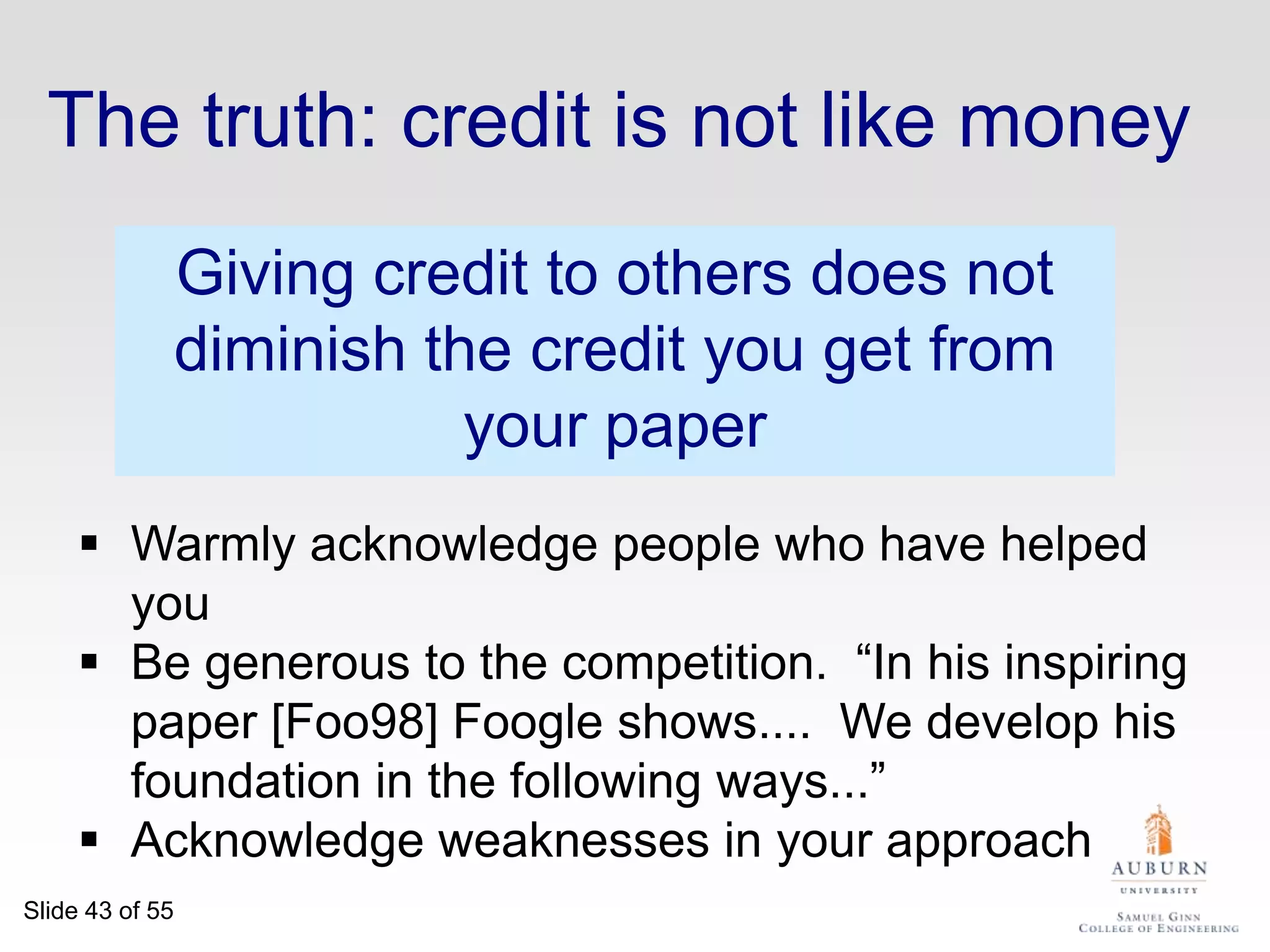
The truth: credit is not like moneyGiving credit to others does not diminish the credit you get from your paperWarmly acknowledge people who have helped you
Be generous to the competition.  “In his inspiring paper [Foo98] Foogle shows....  We develop his foundation in the following ways...”
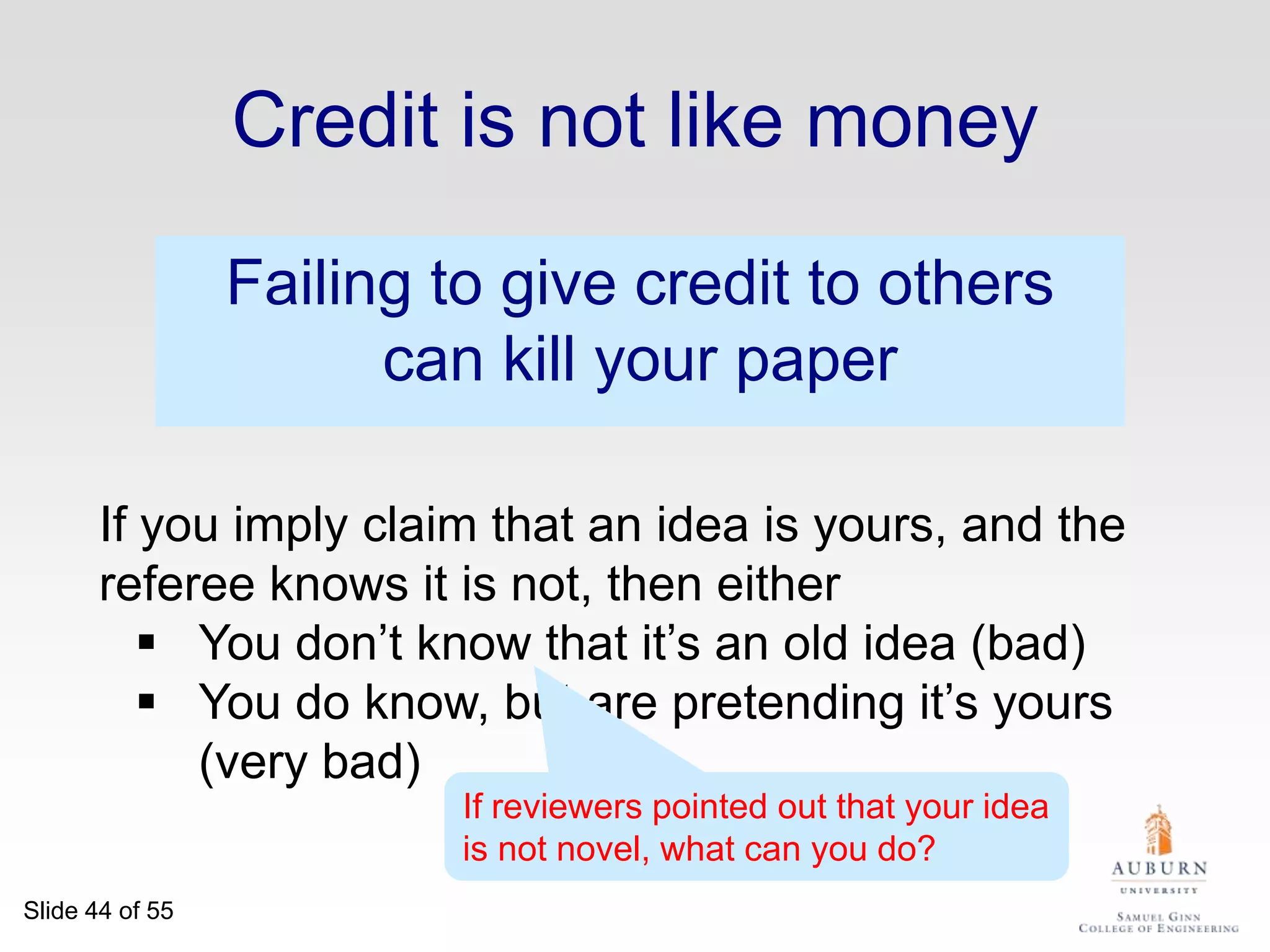
Acknowledge weaknesses in your approachCredit is not like moneyFailing to give credit to others can kill your paperIf you imply claim that an idea is yours, and the referee knows it is not, then eitherYou don’t know that it’s an old idea (bad)
You do know, but are pretending it’s yours (very bad)If reviewers pointed out that your idea is not novel, what can you do?
StructureAbstract (4 sentences)Introduction (1 page)The problem (1 page)My idea (2 pages)The details (5 pages)Related work (1-2 pages)Conclusions and further work (0.5 pages)
Conclusions and further workBe brief.
Future WorkFallacy	(1) Do not let others compete against me using my future work ideas. 	(2) Point out future directions that seems to be a dead-end. 	(3) A future work I believe I can complete sooner than the others.
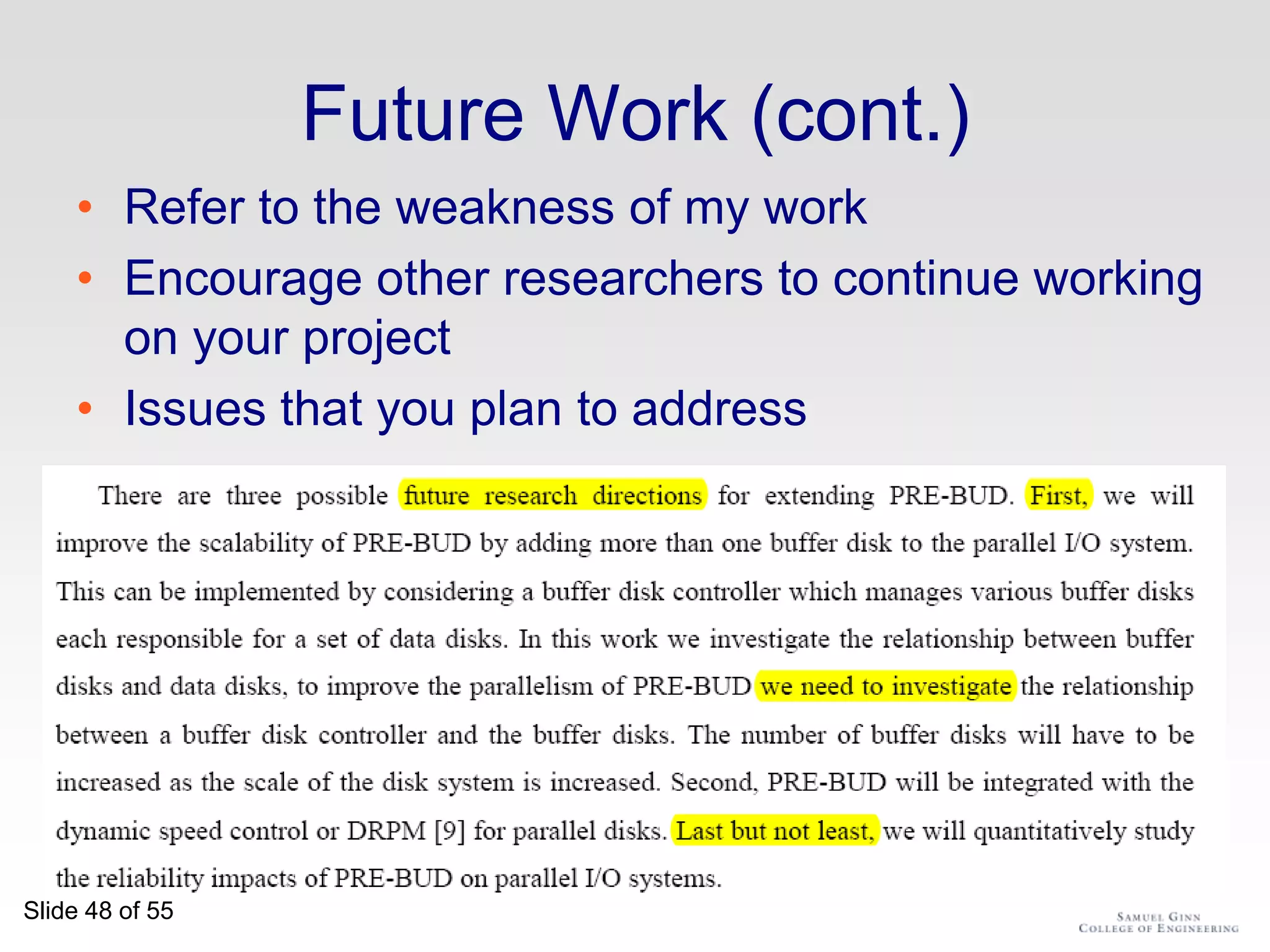
Future Work (cont.)Refer to the weakness of my workEncourage other researchers to continue working on your project Issues that you plan to address
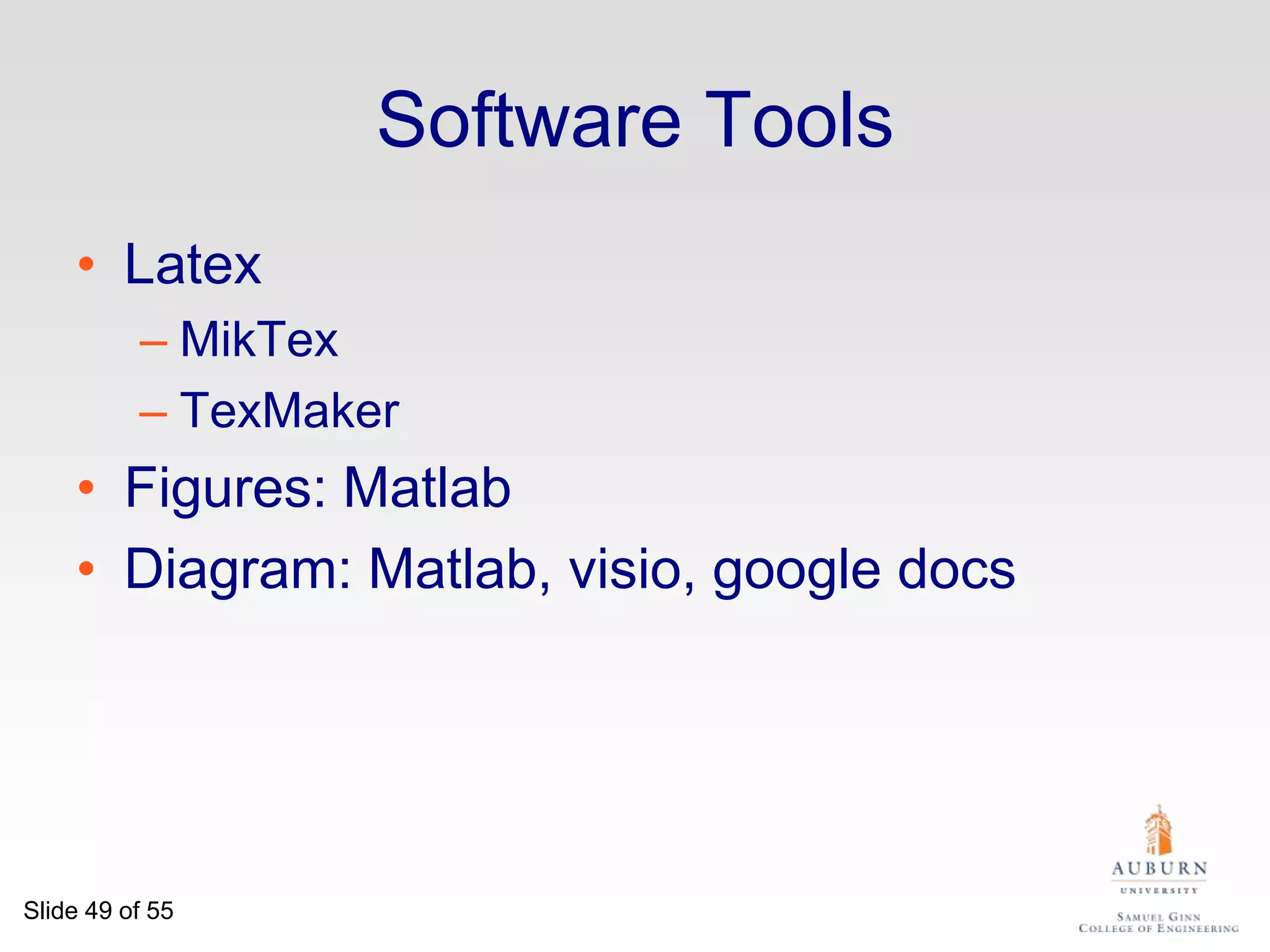
Software ToolsLatexMikTexTexMakerFigures: MatlabDiagram: Matlab, visio, google docs
SummaryIf you remember nothing else:Identify your key ideaMake your contributions explicitUse examplesDownload the slides fromA good starting point:	“Advice on Research and Writing”http://www.slideshare.net/xqin74/how-to-write-papers-part-1-principleshttp://www-2.cs.cmu.edu/afs/cs.cmu.edu/user/mleone/web/how-to.html

How to write papers, part 1 principles

  • 1.
    How to WriteResearch PapersPart 1 – General PrinciplesXiao QinDepartment of Computer Science and Software EngineeringAuburn Universityhttp://www.eng.auburn.edu/~xqinxqin@auburn.eduThese slides are adapted from notes by Simon Peyton Jones (Microsoft Research, Cambridge)1
  • 2.
    Where is AuburnUniversity?Ph.D.’04, U. of Nebraska-Lincoln04-07, New Mexico Tech07-now, Auburn University
  • 3.
    Writing Papers isa SkillMany papers are badly writtenGood writing is a skill you can learnIt’s a skill that is worth learning:You will get more brownie points (more papers accepted etc)Your ideas will have more impactsYou will have better ideasIncreasing importance
  • 4.
    Writing Papers: Model1IdeaDo researchWrite paperWhen I was a doctoral student 7years ago, this is my model of writing papers.
  • 5.
    Writing Papers: Model2IdeaDo researchWrite paperIdeaWrite paperDo researchForces to be clear, focusedCrystallises what we don’t understandOpens the way to dialogue with others: reality check, critique, and collaboration
  • 6.
    Do not beIntimidatedFallacy You need to have a fantastic idea before you can write a paper. (Everyone else seems to.)Write a paper, and give a talk, about any idea, no matter how weedy and insignificant it may seem to you6
  • 7.
    Do not beintimidatedWrite a paper, and give a talk, about any idea, no matter how insignificant it may seem to youWriting a paper is how you develop an idea in the first place
  • 8.
    It usually turnsout to be more interesting and challenging that it seemed at first7
  • 9.
    The Purpose ofYour PapersXiao QinDepartment of Computer Science and Software EngineeringAuburn Universityhttp://www.eng.auburn.edu/~xqinxqin@auburn.edu8
  • 10.
    Why bother?Good papersand talks are a fundamental part of research excellenceFallacywe write papers and give talks mainly to impress others, gain recognition, and get promoted9
  • 11.
    Papers Communicate IdeasYourgoal: to infect the mind of your reader with your idea, like a virusPapers are far more durable than programs (think Mozart)The greatest ideas are (literally) worthless if you keep them to yourself
  • 12.
    IdeaA re-usable insight,useful to the readerThe IdeaFigure out what your idea isMake certain that the reader is in no doubt what the idea is. Be 100% explicit:“The main idea of this paper is....”“In this section we present the main contributions of the paper.”Many papers contain good ideas, but do not distil what they are.
  • 13.
    The Idea –An example
  • 14.
    One PingYour papershould have just one “ping”: one clear, sharp ideaRead your paper again: can you hear the “ping”?You may not know exactly what the ping is when you start writing; but you must know when you finishIf you have lots of ideas, write lots of papersThanks to Joe Touch for “one ping”
  • 15.
    The purpose ofyour paper is not...To describe the WizWoz systemYour reader does not have a WizWoz
  • 16.
    Readers are primarilyinterested in re-usable brain-stuff, not executable artefacts14
  • 17.
    Your Narrative FlowIwish I knew how to solve that!Here is a problemIt’s an interesting problemIt’s an unsolved problemHere is my ideaMy idea works (details, data)Here’s how my idea compares to other people’s approachesI see how that works. Ingenious!
  • 18.
    Structure (Conference Paper)Title(1000 readers)Abstract (4 sentences, 100 readers)Introduction (1 page, 100 readers)The problem (1 page, 10 readers)My idea (2 pages, 10 readers)The details (5 pages, 3 readers)Related work (1-2 pages, 10 readers)Conclusions and further work (0.5 pages)
  • 19.
    The AbstractI usuallywrite the abstract lastUsed by program committee members to decide which papers to readFour sentences [Kent Beck]State the problemSay why it’s an interesting problemSay what your solution achievesSay what follows from your solution
  • 20.
    ExampleMany papers arebadly written and hard to understandThis is a pity, because their good ideas may go unappreciatedFollowing simple guidelines can dramatically improve the quality of your papersYour work will be used more, and the feedback you get from others will in turn improve your research
  • 21.
    StructureAbstract (4 sentences)Introduction(1 page)The problem (1 page)My idea (2 pages)The details (5 pages)Related work (1-2 pages)Conclusions and further work (0.5 pages)
  • 22.
    The introduction (1page)Describe the problemState your contributions...and that is allONE PAGE!
  • 23.
    Describe the ProblemUsean example to introduce the problem
  • 24.
    State Your ContributionsWritethe list of contributions firstThe list of contributions drives the entire paper: the paper substantiates the claims you have madeReader thinks “gosh, if they can really deliver this, that’s be exciting; I’d better read on”
  • 25.
    State Your ContributionsBulletedlist of contributionsDo not leave the reader to guess what your contributions are!
  • 26.
    Bulleted List andForward References
  • 27.
    StructureAbstract (4 sentences)Introduction(1 page)Related workThe problem (1 page)My idea (2 pages)The details (5 pages)Related work (1-2 pages)Conclusions and further work (0.5 pages)
  • 28.
  • 29.
    No “rest ofthis paper is...”Not:Instead, use forward references from the narrative in the introduction. The introduction (including the contributions) should survey the whole paper, and therefore forward reference every important part.“The rest of this paper is structured as follows. Section 2 introduces the problem. Section 3 ... Finally, Section 8 concludes”.
  • 30.
    No related workyet!Related workYour readerYour ideaEnergy efficient prefetching was explored by Papathanasiou and Scott [20]. Their techniques relied on changing prefetching and caching strategies within the Linux kernel. PB-LRU is another energy efficient cache management strategy [32]. This strategy focused on providing more opportunities for underlying disk power strategies to save energy. Flash drives have also been proposed for use as buffers for disk systems [4].
  • 31.
    No related workyetI feel stupidProblem 1: the reader knows nothing about the problem yet; so your (carefully trimmed) description of various technical tradeoffs is absolutely incomprehensible Problem 2: describing alternative approaches gets between the reader and your ideaI feel tired
  • 32.
    For readers whoknow your field very well...Abstract (4 sentences)Introduction (1 page)Related work (1-2 pages)The problem (1 page)My idea (2 pages)The details (5 pages)Related workConclusions and further work (0.5 pages)
  • 33.
    Related work first!RelatedWorkIs your idea novel?What are your contribution?Your readerYour ideaEnergy efficient prefetching was explored by Papathanasiou and Scott [20]. Their techniques relied on changing prefetching and caching strategies within the Linux kernel. PB-LRU is another energy efficient cache management strategy [32]. This strategy focused on providing more opportunities for underlying disk power strategies to save energy. Flash drives have also been proposed for use as buffers for disk systems [4].
  • 34.
    Where should youput the related work?Abstract (4 sentences)Introduction (1 page)Put related work here?The problem (1 page)My idea (2 pages)The details (5 pages)Put related work here?Conclusions and further work
  • 35.
    Where should youput the related work?A Suggested PrincipleAbstract (4 sentences)Introduction (1 page)Put related work here?The problem (1 page)My idea (2 pages)The details (5 pages)Put related work here?Conclusions and further work You want to convince reviewers in the first place.You feel this is a novel idea
  • 36.
    StructureAbstract (4 sentences)Introduction(1 page)The problem (1 page)My idea (2 pages)The details (5 pages)Related work (1-2 pages)Conclusions and further work (0.5 pages)
  • 37.
    Presenting the idea3.The ideaConsider a bifircuated semi-lattice D, over a hyper-modulated signature S. Suppose pi is an element of D. Then we know for every such pi there is an epi-modulus j, such that pj < pi.Sounds impressive...but
  • 38.
  • 39.
    In a paperyou MUST provide the details, but FIRST convey the ideaPresenting the ideaExplain it as if you were speaking to someone using a whiteboardConveying the intuition is primary, not secondaryOnce your reader has the intuition, she can follow the details (but not vice versa)Even if she skips the details, she still takes away something valuable
  • 40.
    Putting the readerfirstDo not recapitulate your personal journey of discovery. This route may be soaked with your blood, but that is not interesting to the reader.Instead, choose the most direct route to the idea.
  • 41.
    The payload ofyour paperIntroduce the problem, and your idea, usingEXAMPLESand only then present the general case
  • 42.
  • 43.
    The details: evidence Yourintroduction makes claimsThe body of the paper provides evidence to support each claimCheck each claim in the introduction, identify the evidence, and forward-reference it from the claimEvidence can be: analysis and comparison, theorems, measurements, case studies
  • 44.
    StructureAbstract (4 sentences)Introduction(1 page)The problem (1 page)My idea (2 pages)The details (5 pages)Related work (1-2 pages)Conclusions and further work (0.5 pages)
  • 45.
    Related workFallacy To makemy work look good, I have to make other people’s work look bad
  • 46.
    The truth: creditis not like moneyGiving credit to others does not diminish the credit you get from your paperWarmly acknowledge people who have helped you
  • 47.
    Be generous tothe competition. “In his inspiring paper [Foo98] Foogle shows.... We develop his foundation in the following ways...”
  • 48.
    Acknowledge weaknesses inyour approachCredit is not like moneyFailing to give credit to others can kill your paperIf you imply claim that an idea is yours, and the referee knows it is not, then eitherYou don’t know that it’s an old idea (bad)
  • 49.
    You do know,but are pretending it’s yours (very bad)If reviewers pointed out that your idea is not novel, what can you do?
  • 50.
    StructureAbstract (4 sentences)Introduction(1 page)The problem (1 page)My idea (2 pages)The details (5 pages)Related work (1-2 pages)Conclusions and further work (0.5 pages)
  • 51.
  • 52.
    Future WorkFallacy (1) Donot let others compete against me using my future work ideas. (2) Point out future directions that seems to be a dead-end. (3) A future work I believe I can complete sooner than the others.
  • 53.
    Future Work (cont.)Referto the weakness of my workEncourage other researchers to continue working on your project Issues that you plan to address
  • 54.
  • 55.
    SummaryIf you remembernothing else:Identify your key ideaMake your contributions explicitUse examplesDownload the slides fromA good starting point: “Advice on Research and Writing”http://www.slideshare.net/xqin74/how-to-write-papers-part-1-principleshttp://www-2.cs.cmu.edu/afs/cs.cmu.edu/user/mleone/web/how-to.html
  • 56.
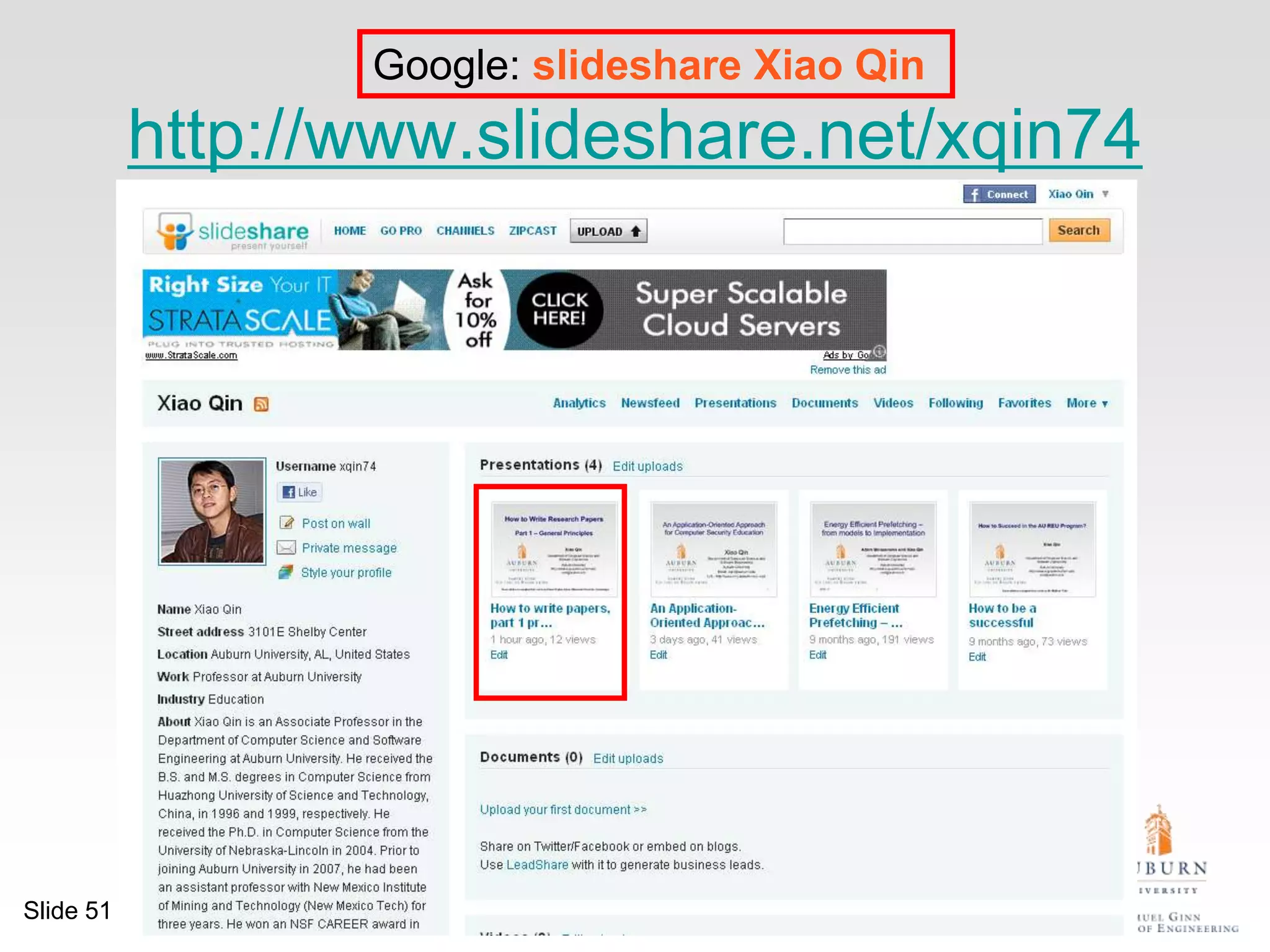
    Google: slideshare XiaoQinhttp://www.slideshare.net/xqin74
  • 57.
  • 58.
  • 59.
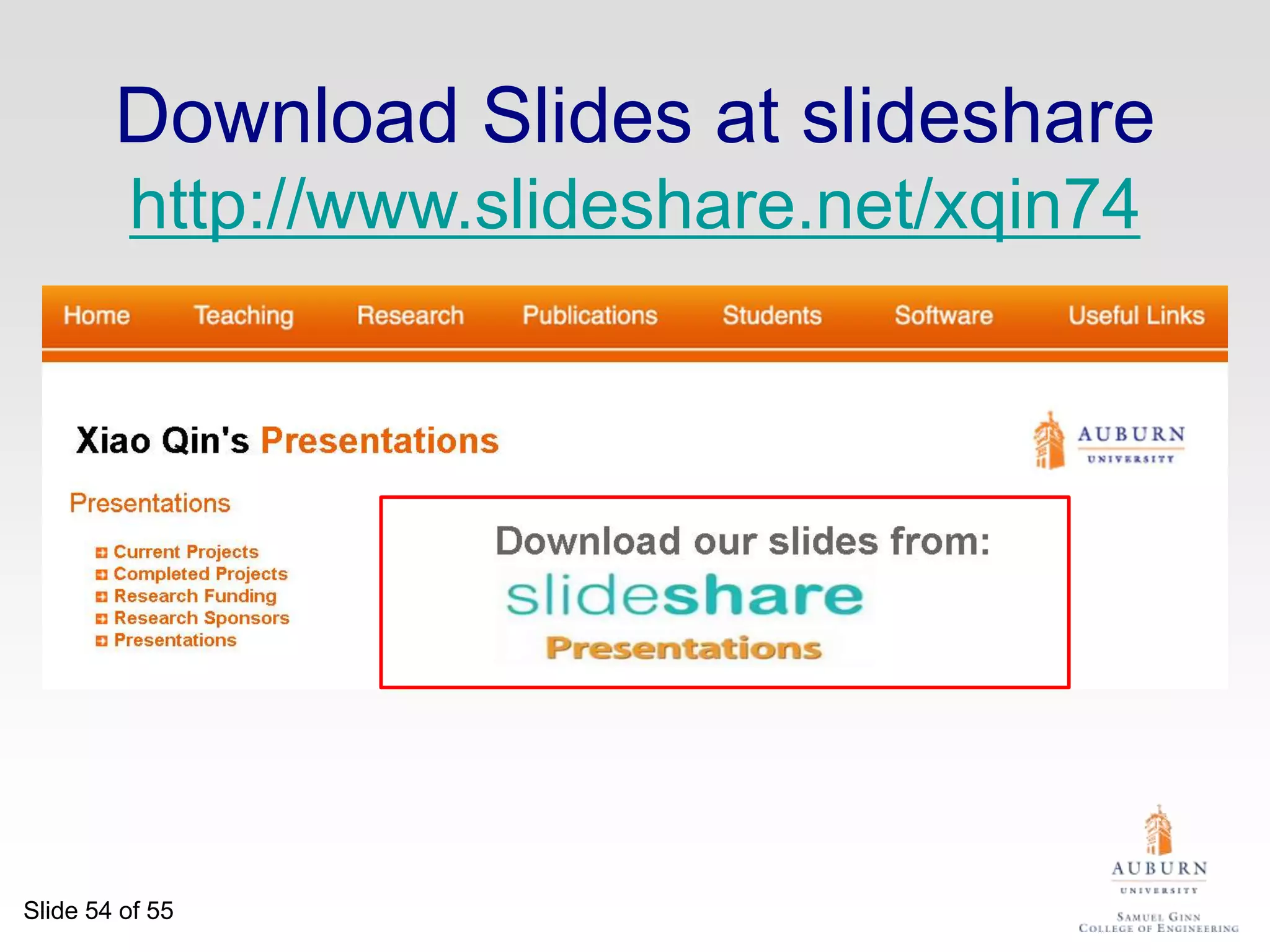
    Download Slides atslidesharehttp://www.slideshare.net/xqin74
  • 60.