Brian Cambourne’S Conditions Of Learning

Loading...

Flash Player 9 (or above) is needed to view presentations.
We have detected that you do not have it on your computer. To install it, go here.

0 comments

Post a comment

    Post a comment
    Embed Video
    Edit your comment Cancel

    2 Favorites & 1 Group

    Brian Cambourne’S Conditions Of Learning - Presentation Transcript

    1. Brian Cambourne’s Conditions for Learning Jocelyn Downs FLaRE Area Coordinator
    2. Think of a time when you had to learn something difficult, such as:
      • Cooking a new recipe
      • Doing your income taxes
      • Working on a car
      • Playing a card game
      • Riding a bicycle
      • Learning a new computer program
    3. What process did you use to help you learn?
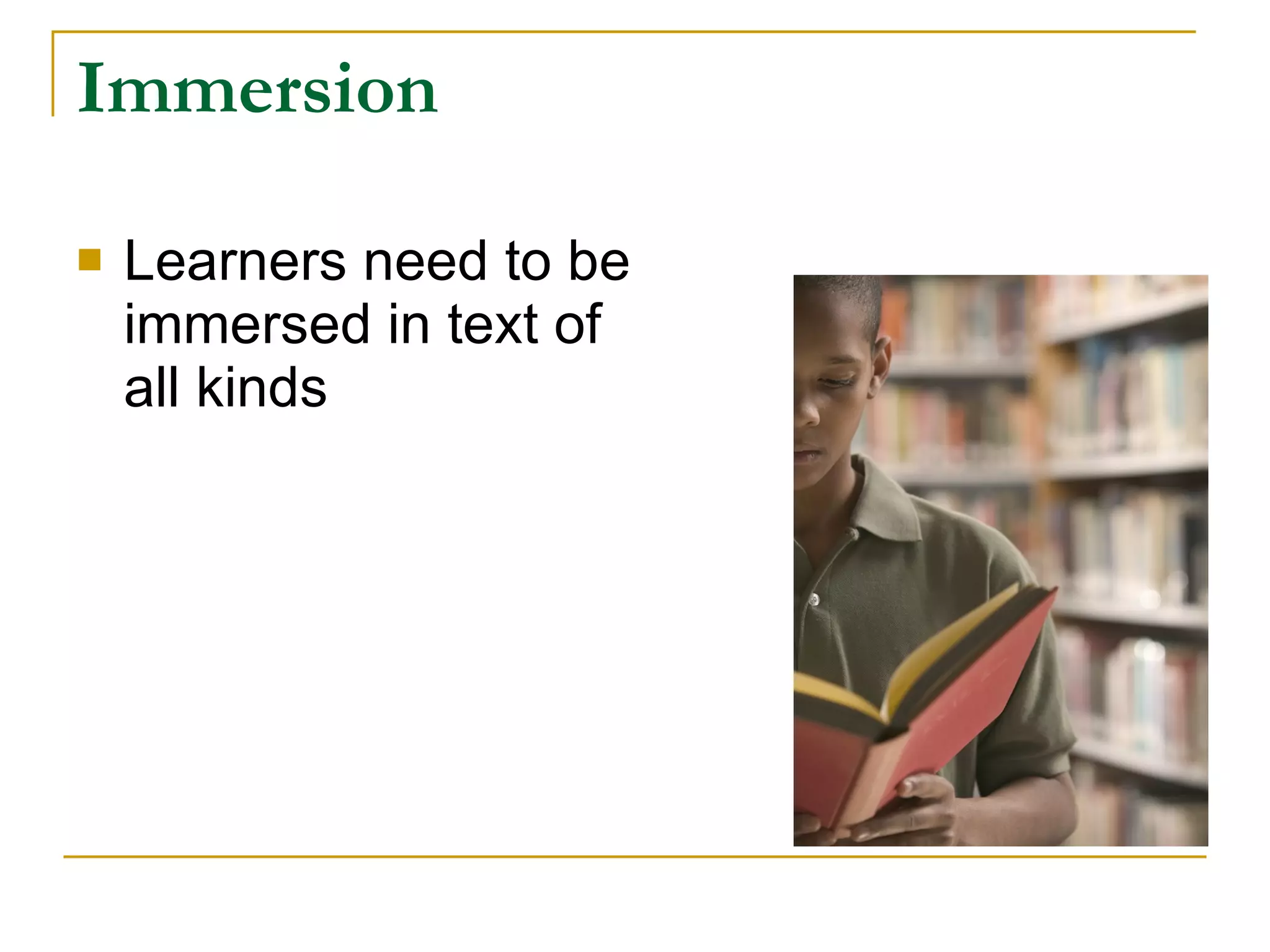
    4. Immersion
      • Learners need to be immersed in text of all kinds
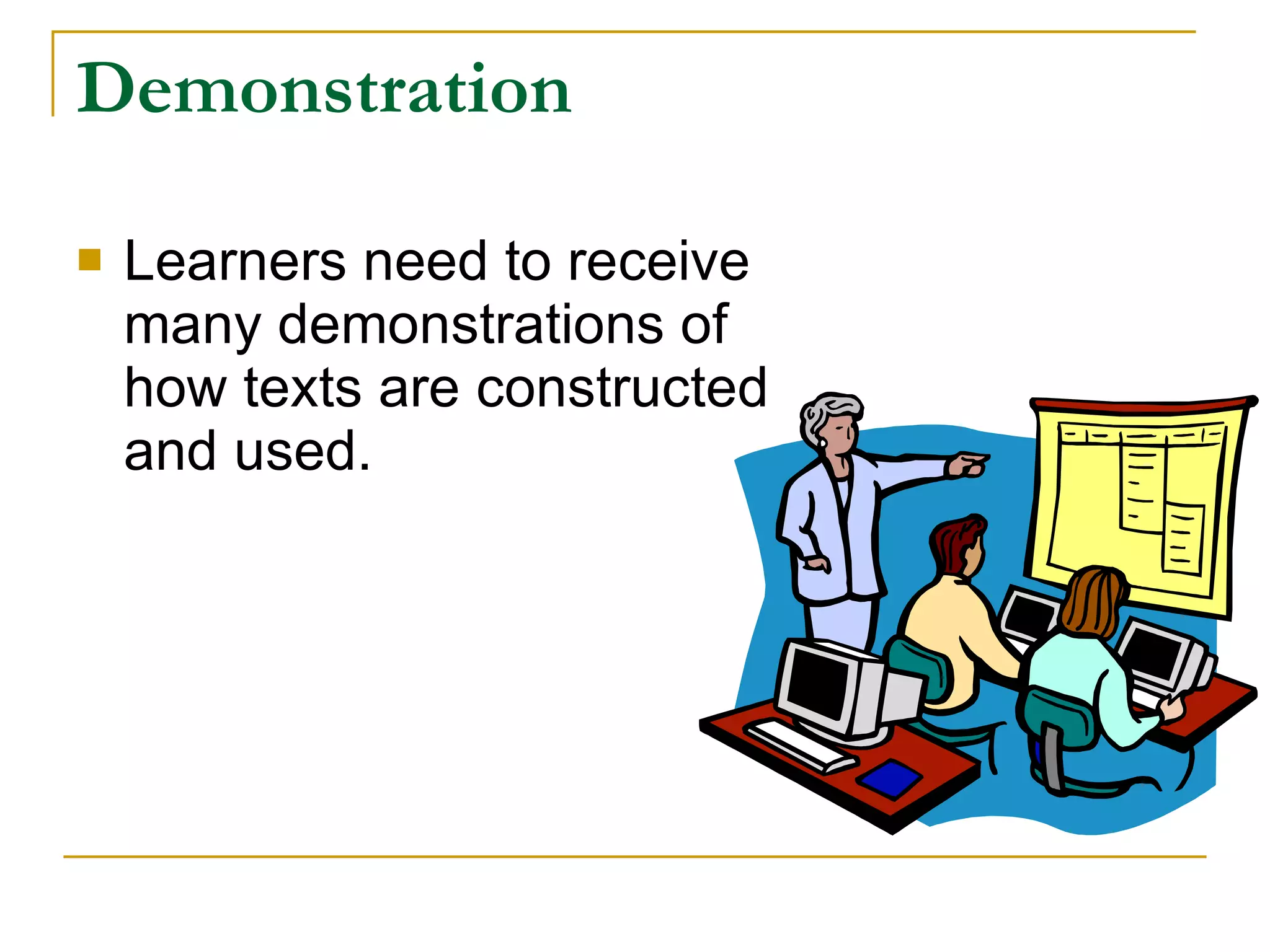
    5. Demonstration
      • Learners need to receive many demonstrations of how texts are constructed and used.
    6. Expectation
      • “ We achieve what we expect to achieve: we fail if we expect to fail. We are more likely to engage with demonstrations of those whom we regard as significant and who hold high expectations for us.”
    7. Response
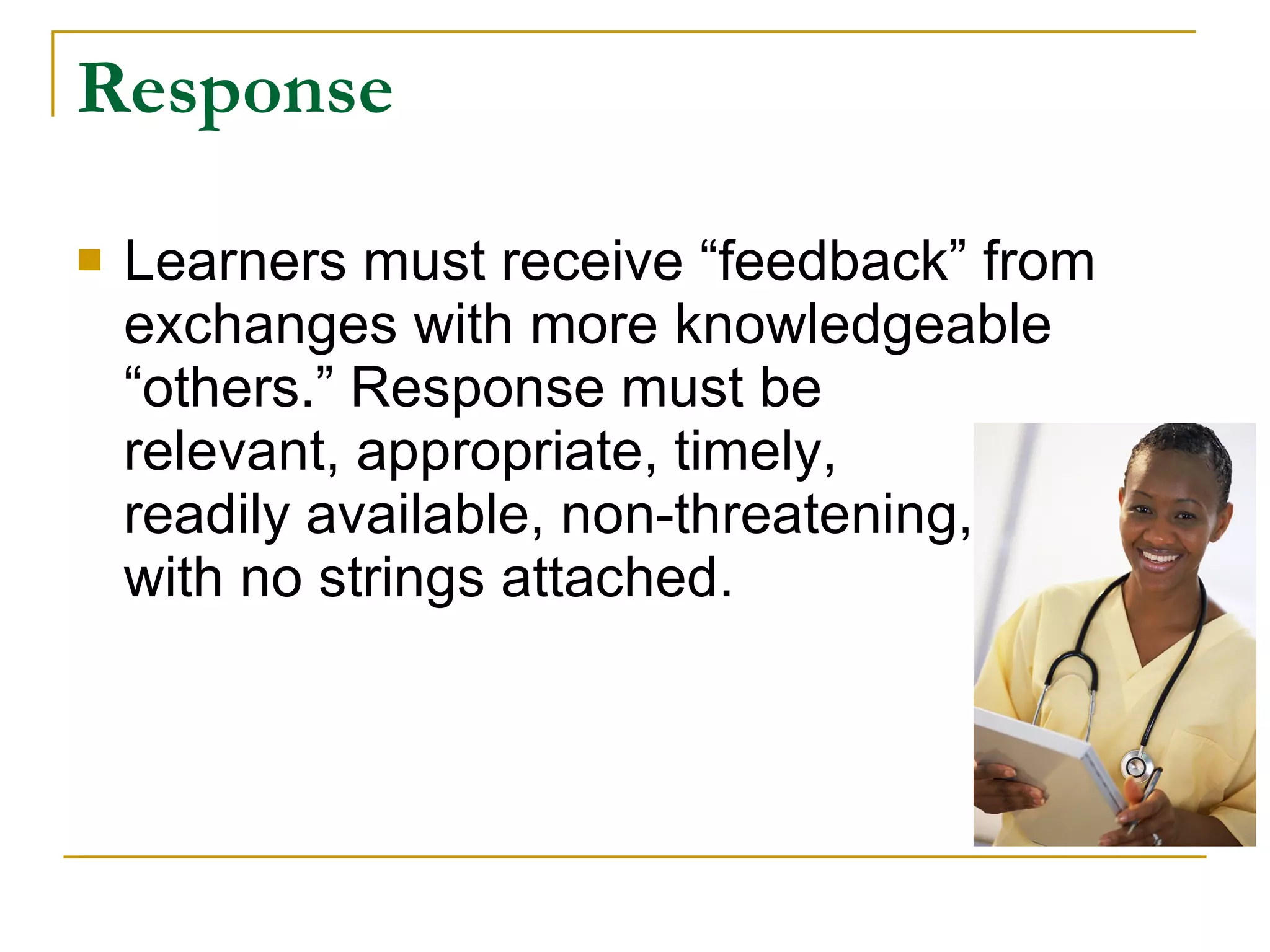
      • Learners must receive “feedback” from exchanges with more knowledgeable “others.” Response must be relevant, appropriate, timely, readily available, non-threatening, with no strings attached.
    8. Approximation
      • Learners must be free to approximate the desired model — “mistakes are essential for learning to occur.”
    9. Use
      • Learners need time and opportunity to use, employ, and practice their developing control in functional, realistic, non-artificial ways.
    10. Responsibility
      • Learners need to make their own decisions about when, how, and what “bits” to learn in any learning task. Learners who lose the ability to make decisions are “depowered.”
    11. Engagement occurs when:
      • The learner is convinced that he or she is a potential “doer” or “performer” of the demonstrations.
      • The learner believes that engagement with these demonstrations will further the purposes of his or her life.
      • The learner can engage and try to emulate without fear of physical or psychological hurt if the attempt is not fully “correct.”
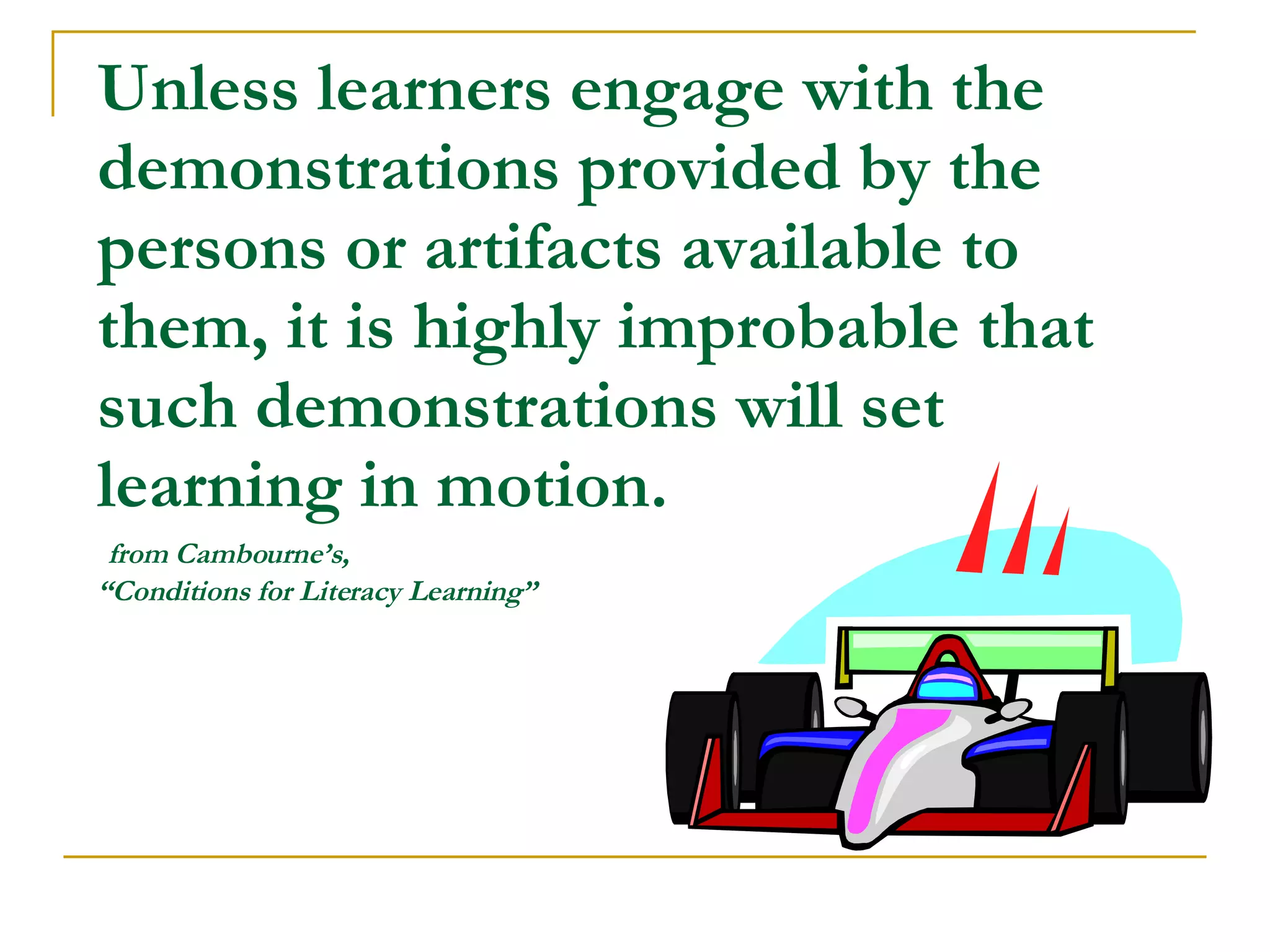
    12. Engagement is a compelling concept, especially when trying to explain learning failure. It suggests the clutch mechanism of a car engaging the motor; the clutch connects the engine’s power to the drive shaft, and this sets the car in motion. If the clutch does not engage properly, all that results is useless revving of the motor; the car does not move. from Cambourne’s, “Conditions for Literacy Learning”
    13. Unless learners engage with the demonstrations provided by the persons or artifacts available to them, it is highly improbable that such demonstrations will set learning in motion. from Cambourne’s, “Conditions for Literacy Learning”

    + whatsit81whatsit81, 2 years ago

    custom

    2055 views, 2 favs, 1 embeds more stats

    More info about this presentation

    © All Rights Reserved

    • Total Views 2055
      • 2054 on SlideShare
      • 1 from embeds
    • Comments 0
    • Favorites 2
    • Downloads 106
    Most viewed embeds
    • 1 views on http://projectwritemsu.wikispaces.com

    more

    All embeds
    • 1 views on http://projectwritemsu.wikispaces.com

    less

    Flagged as inappropriate Flag as inappropriate
    Flag as inappropriate

    Select your reason for flagging this presentation as inappropriate. If needed, use the feedback form to let us know more details.

    Cancel
    File a copyright complaint
    Having problems? Go to our helpdesk?

    Categories

    Groups / Events