1. Power
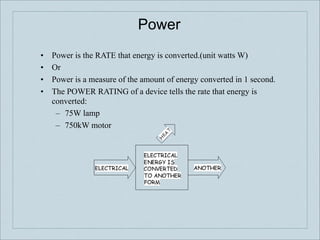
•! Power is the RATE that energy is converted.(unit watts W)
•! Or
•! Power is a measure of the amount of energy converted in 1 second.
•! The POWER RATING of a device tells the rate that energy is
converted:
–! 75W lamp
–! 750kW motor
2. Power cont.
•! During the conversion some input energy(electrical) is
changed to heat within the device.
•! The heating of the electrical device may produce a
problem:
–! motors
–! transformers
–! cables
•! In other electrical devices this is rarely a problem:
–! lamps
3. V
In the above circuit, we know we have a battery voltage of 18 volts and a lamp resistance of 3 Ω.
Using Ohm's Law to determine current, we get:
V
Now that we know the current, we can take that value and multiply it by the voltage to determine
power:
V
Answer: the lamp is dissipating (releasing) 108 watts of power, most likely in the form of both
light and heat.
4. Let's try taking that same circuit and increasing the battery voltage to see what happens. Intuition
should tell us that the circuit current will increase as the voltage increases and the lamp resistance
stays the same. Likewise, the power will increase as well:
V
Now, the battery voltage is 36 volts instead of 18 volts. The lamp is still providing 3 Ω of electrical
resistance to the flow of electrons. The current is now:
V
This stands to reason: if I = E/R, and we double V while R stays the same, the current should double.
Indeed, it has: we now have 12 amps of current instead of 6. Now, what about power?
V
Notice that the power has increased just as we might have suspected, but it increased quite a bit
more than the current. Why is this? Because power is a function of voltage multiplied by current,
and both voltage and current doubled from their previous values, the power will increase by a factor
of 2 x 2, or 4. You can check this by dividing 432 watts by 108 watts and seeing that the ratio
between them is indeed 4
5. Using algebra again to manipulate the formulae, we can take our original power formula and modify
it for applications where we don't know both voltage and current:
If we only know voltage (E) and resistance (R):
An historical note: it was James Prescott Joule, not Georg Simon Ohm, who first discovered the
mathematical relationship between power dissipation and current through a resistance. This
discovery, published in 1841, followed the form of the last equation (P = I2R), and is properly known
as Joule's Law. However, these power equations are so commonly associated with the Ohm's Law
equations relating voltage, current, and resistance (E=IR ; I=E/R ; and R=E/I) that they are
frequently credited to Ohm.