OpenStack Kilo Summit, Paris, Nov 2014 
Michael Cohen, Sumit Naiksatam, Prasad Vellanki, Stephen 
Wong
Agenda 
 Vision 
 GBP Model 
 GBP Architecture 
 Demo
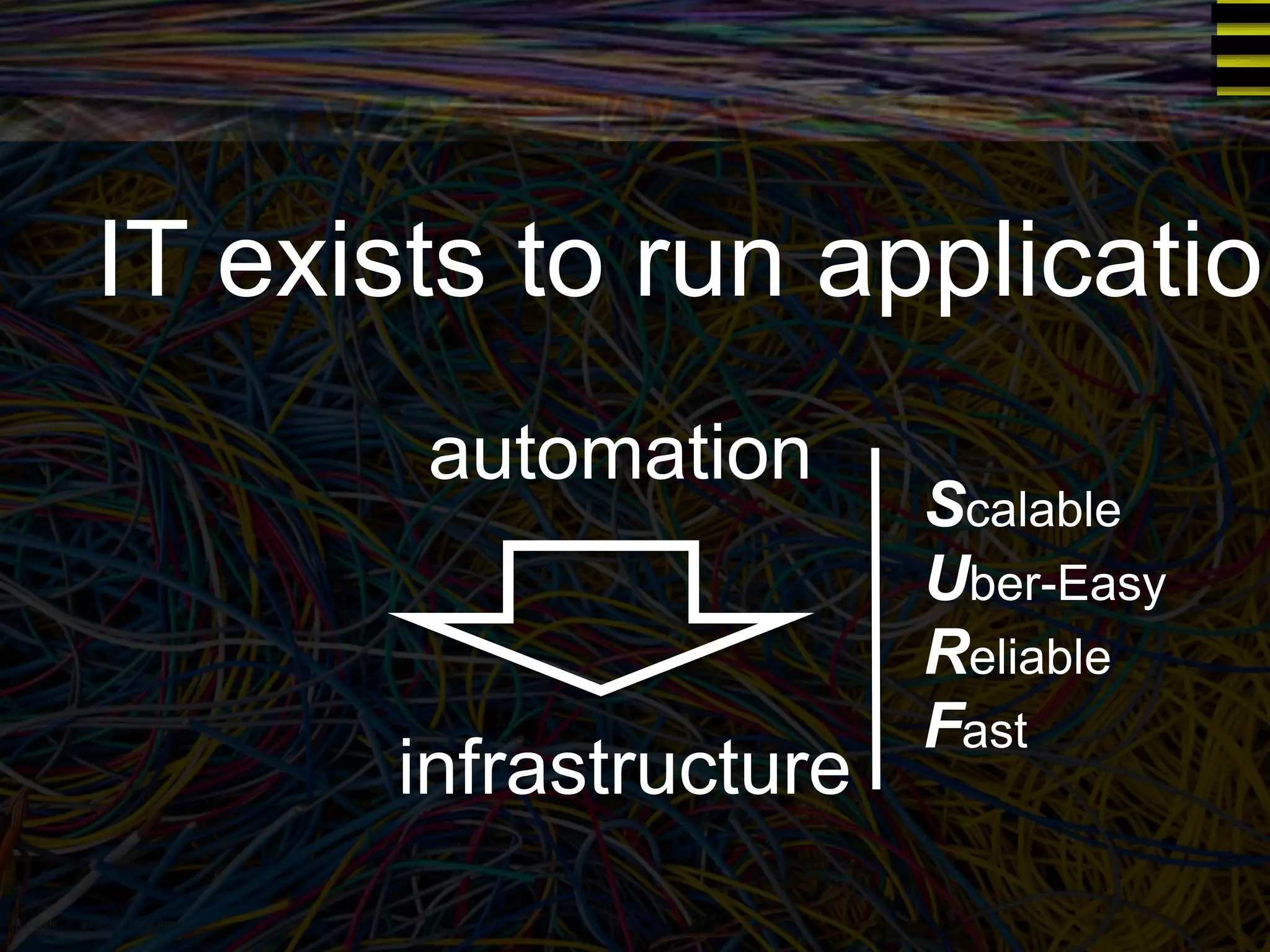
IT exists to run applications 
automation 
infrastructure 
Scalable 
Uber-Easy 
Reliable 
Fast
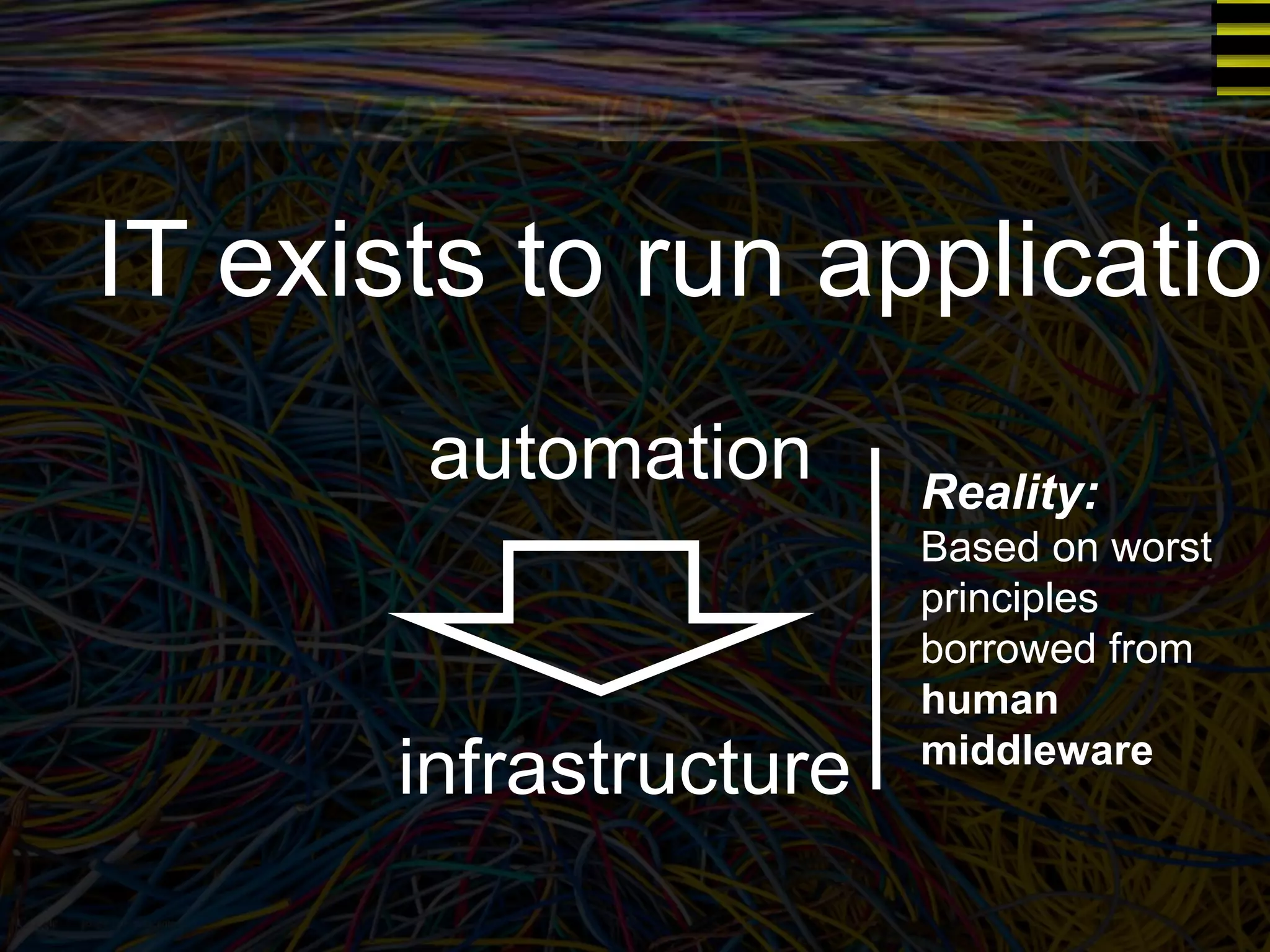
IT exists to run application 
Reality: 
Based on worst 
principles 
borrowed from 
human 
middleware 
automation 
infrastructure
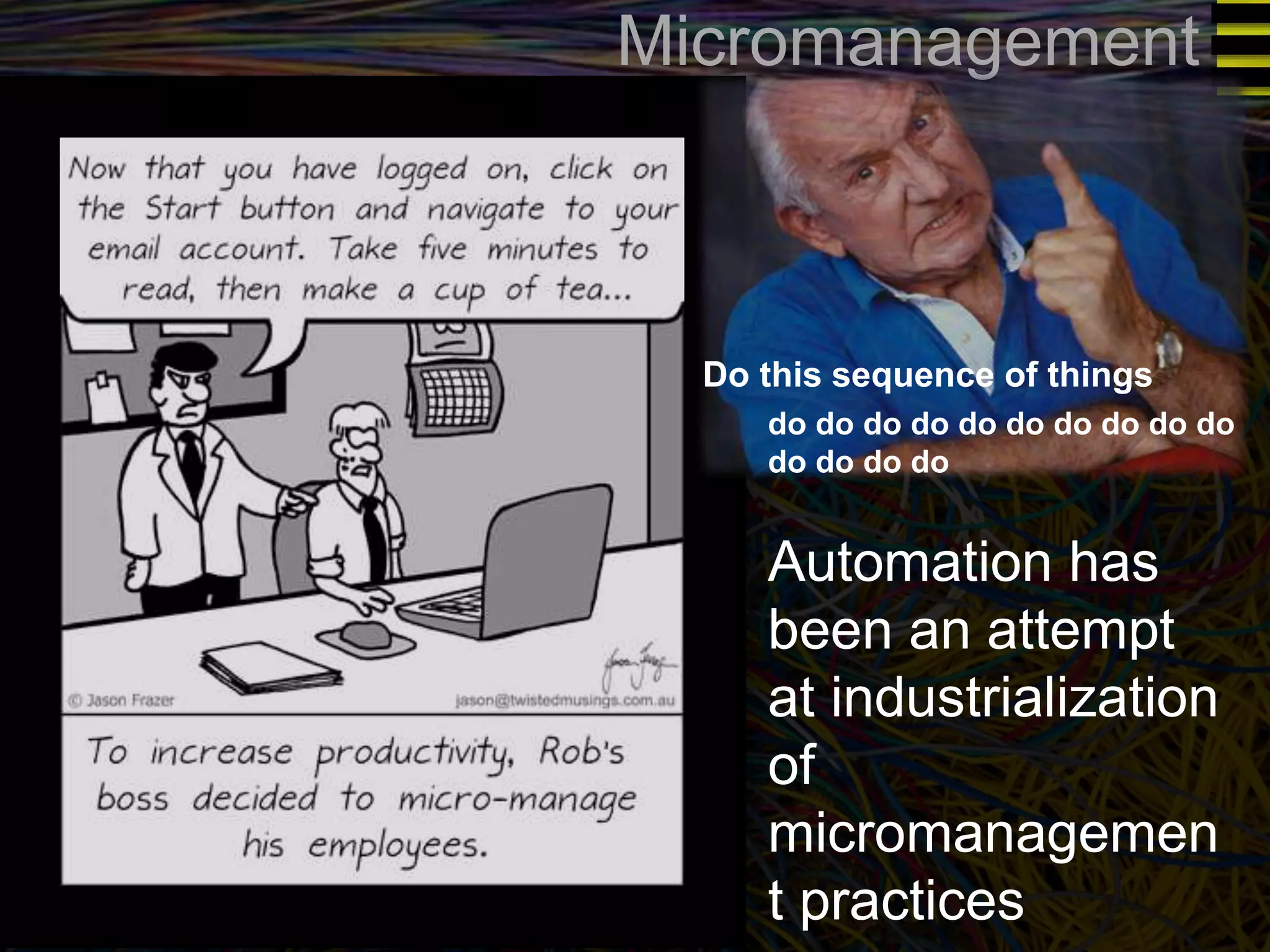
Micromanagement 
Do this sequence of things 
do do do do do do do do do do 
do do do do 
Automation has 
been an attempt 
at industrialization 
of 
micromanagemen 
t practices
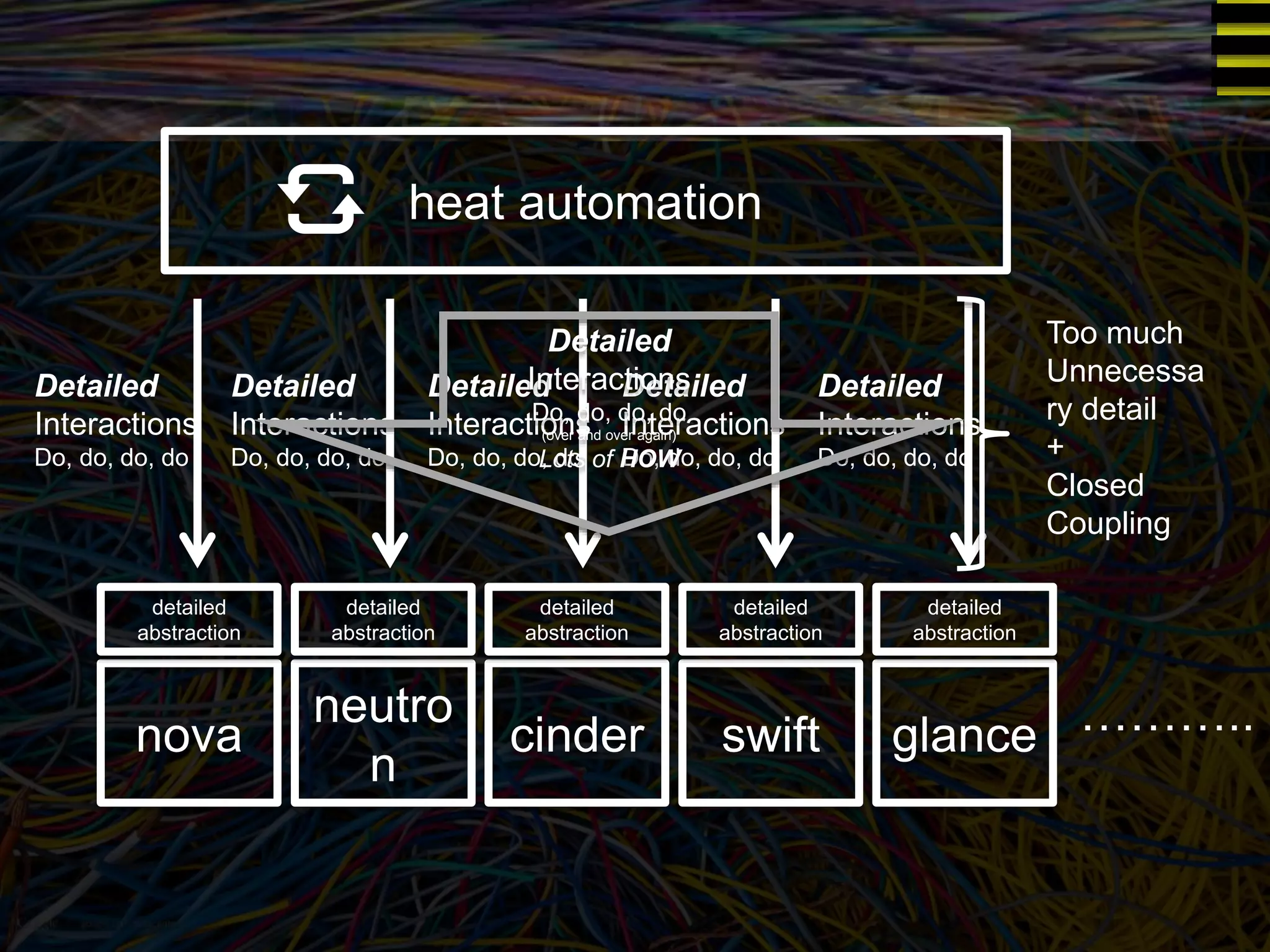
heat automation 
detailed 
abstraction 
neutro 
n 
detailed 
abstraction 
nova 
detailed 
abstraction 
cinder 
detailed 
abstraction 
swift 
detailed 
abstraction 
glance 
……….. 
Detailed 
Interactions 
Do, do, do, do 
Detailed 
Interactions 
Do, do, do, do 
Detailed 
Interactions 
Do, do, do, do 
Detailed 
Interactions 
Do, do, do, do 
Detailed 
Interactions 
Do, do, do, do 
Detailed 
Interactions 
Do, do, do, do 
(over and over again) 
Lots of HOW 
Too much 
Unnecessa 
ry detail 
+ 
Closed 
Coupling
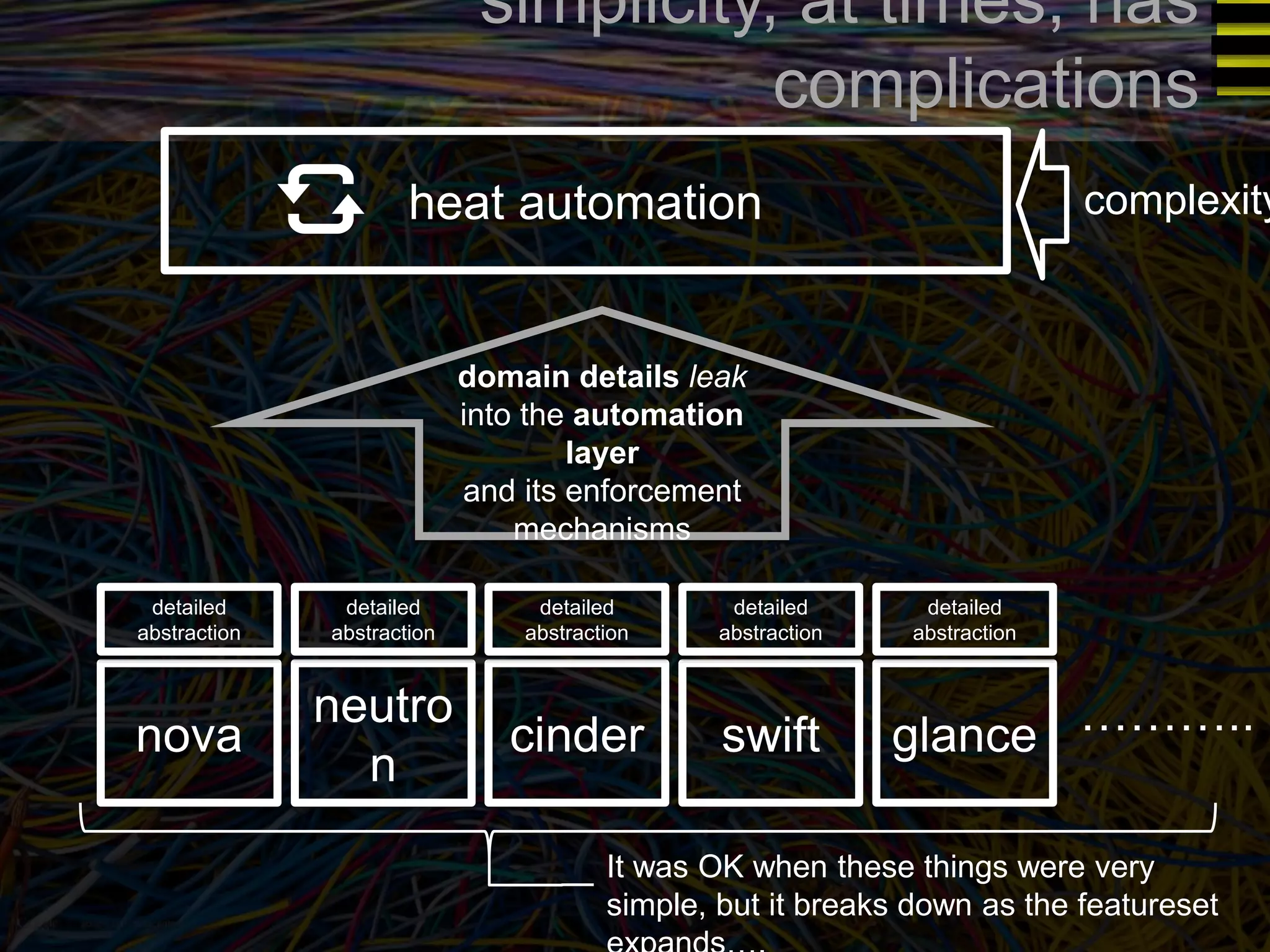
simplicity, at times, has 
heat automation 
detailed 
abstraction 
neutro 
n 
detailed 
abstraction 
nova 
detailed 
abstraction 
cinder 
complications 
detailed 
abstraction 
swift 
detailed 
abstraction 
glance 
complexity 
……….. 
domain details leak 
into the automation 
layer 
and its enforcement 
mechanisms 
It was OK when these things were very 
simple, but it breaks down as the featureset 
expands….
detailed 
abstraction 
neutro 
n 
detailed 
abstraction 
nova 
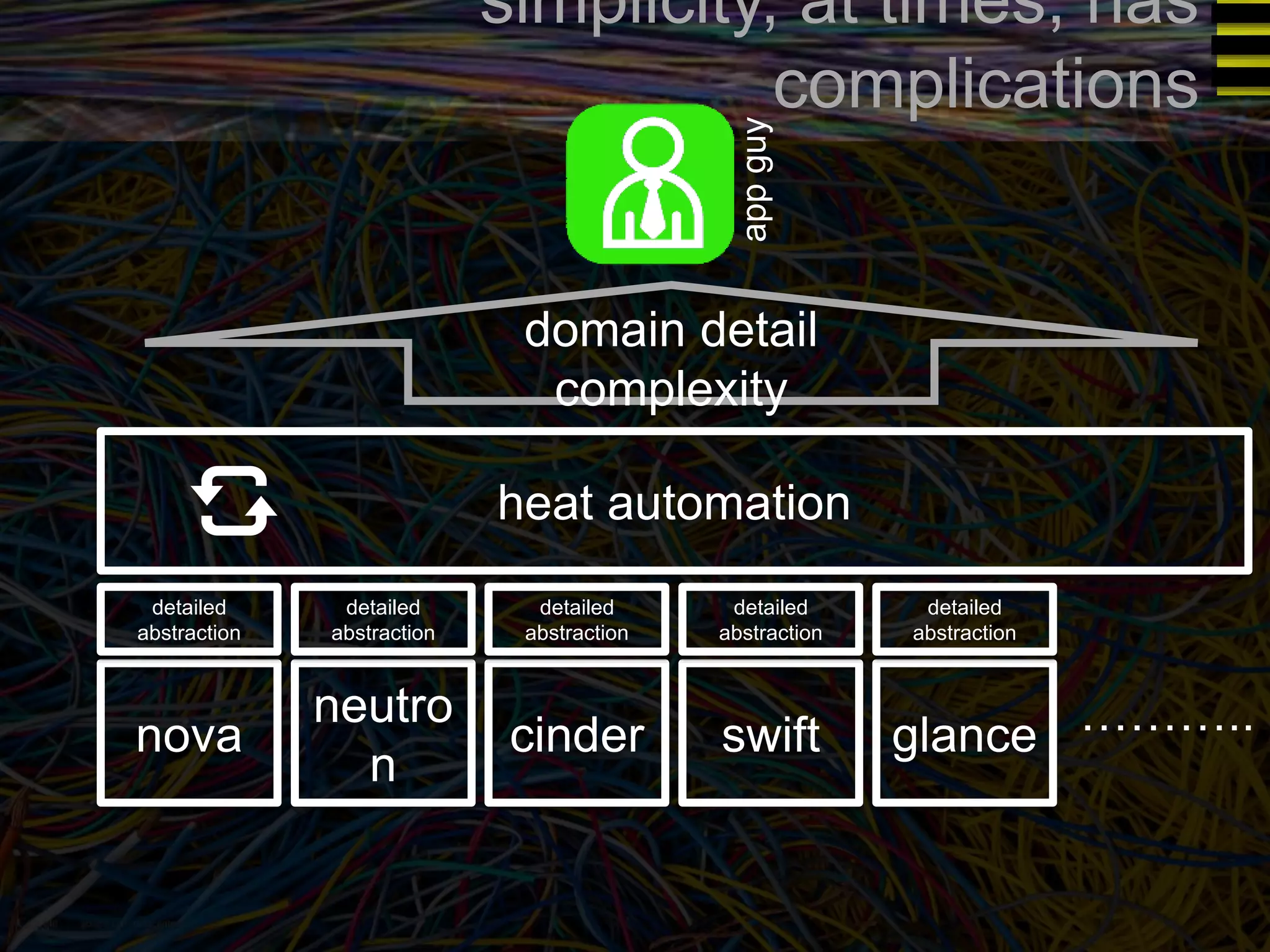
simplicity, at times, has 
domain detail 
complexity 
detailed 
abstraction 
cinder 
complications 
app guy 
detailed 
abstraction 
swift 
detailed 
abstraction 
glance 
……….. 
heat automation
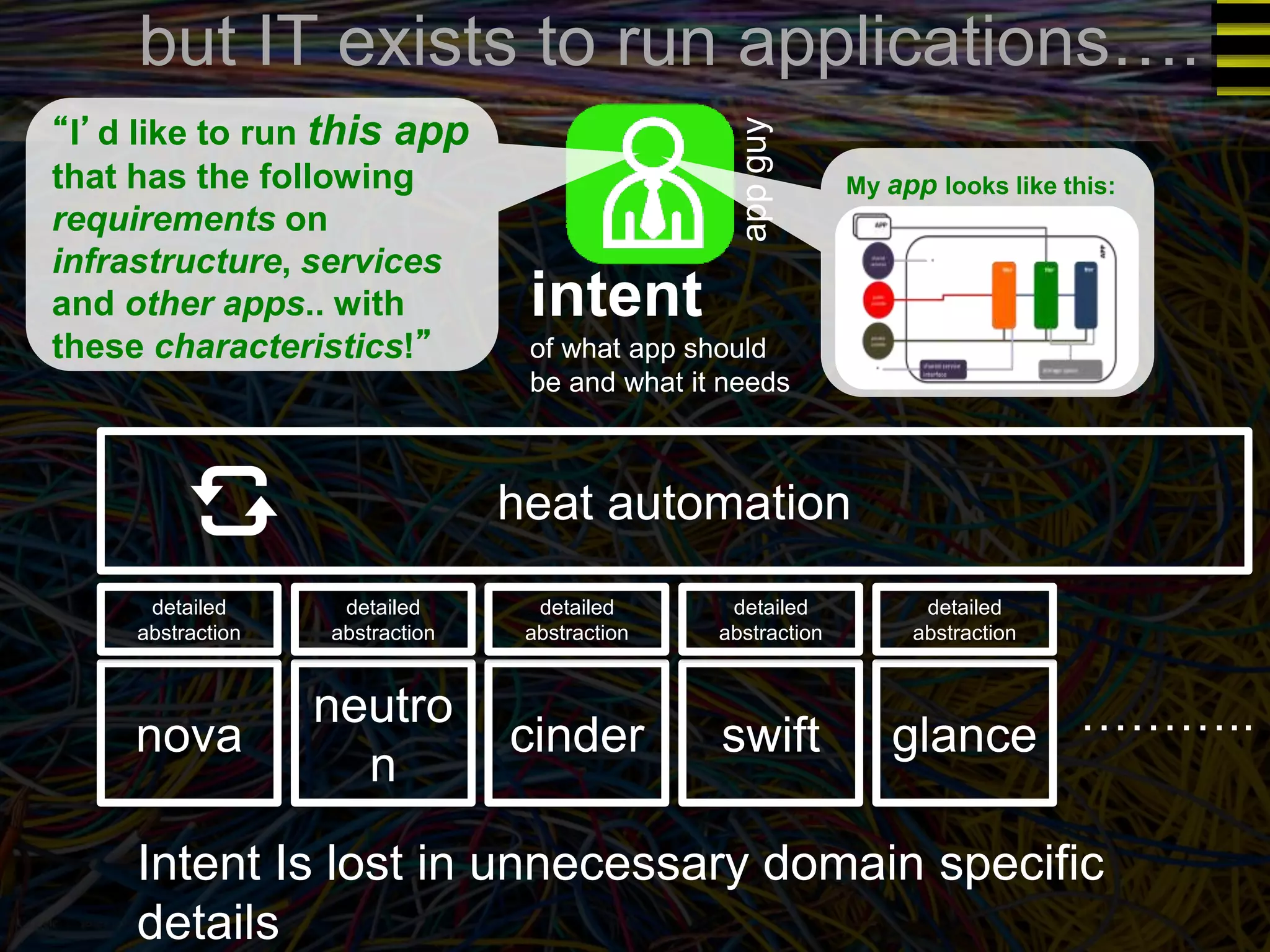
but IT exists to run applications…. 
detailed 
abstraction 
neutro 
n 
detailed 
abstraction 
nova 
detailed 
abstraction 
cinder 
app guy 
detailed 
abstraction 
swift 
detailed 
abstraction 
glance 
……….. 
heat automation 
“I’d like to run this app 
that has the following 
requirements on 
infrastructure, services 
and other apps.. with 
these characteristics!” 
My app looks like this: 
intent 
of what app should 
be and what it needs 
Intent Is lost in unnecessary domain specific 
details
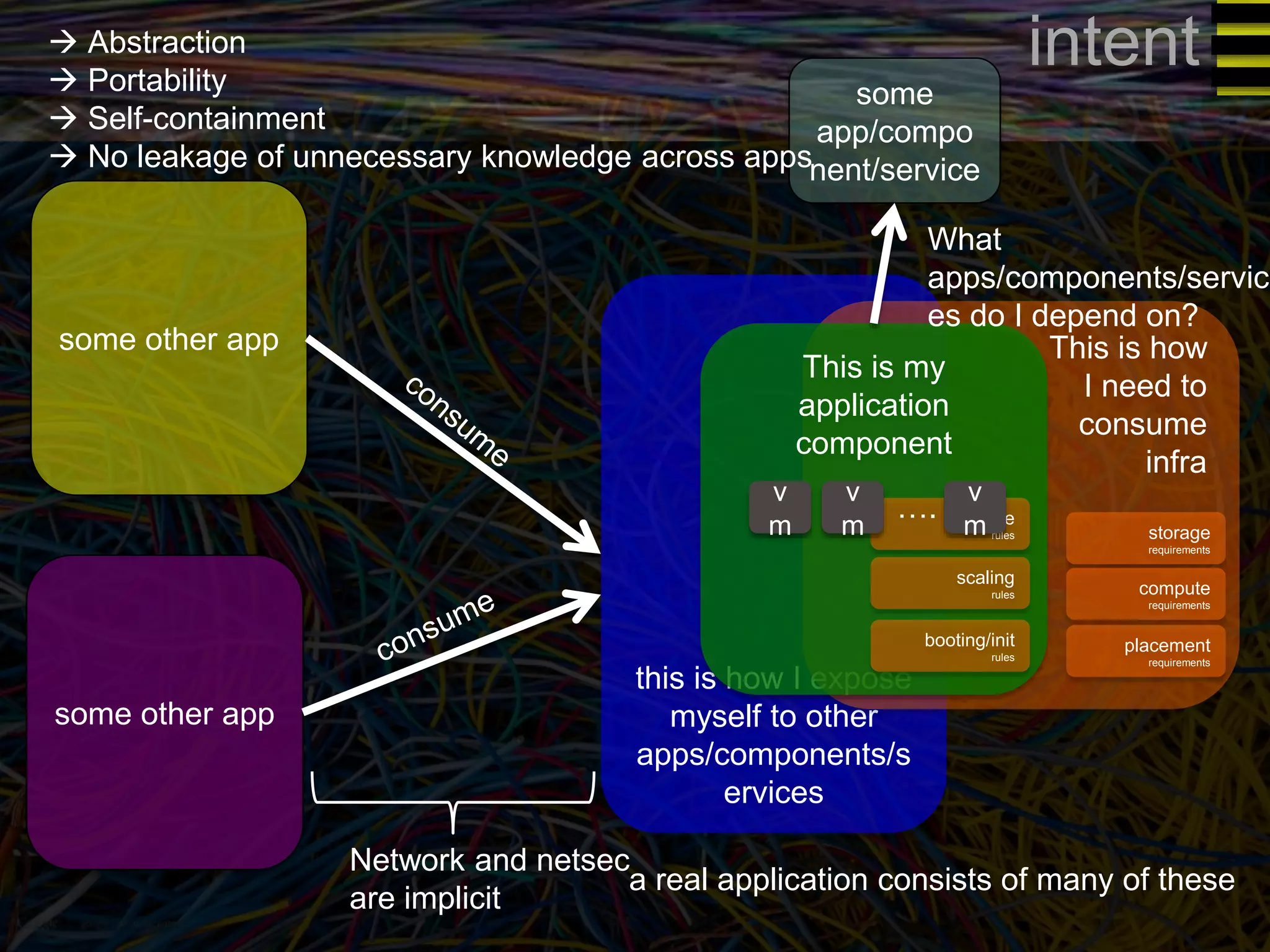
intent 
 Abstraction 
 Portability 
 Self-containment 
 No leakage of unnecessary knowledge across apps 
this is how I expose 
myself to other 
apps/components/s 
ervices 
This is how 
I need to 
consume 
infra 
This is my 
application 
component 
some other app 
some other app 
storage 
requirements 
compute 
requirements 
placement 
requirements 
image 
rules 
scaling 
rules 
booting/init 
rules 
v 
m 
v 
m 
…. 
v 
m 
some 
app/compo 
nent/service 
What 
apps/components/servic 
es do I depend on? 
Network and netsec 
are implicit 
a real application consists of many of these
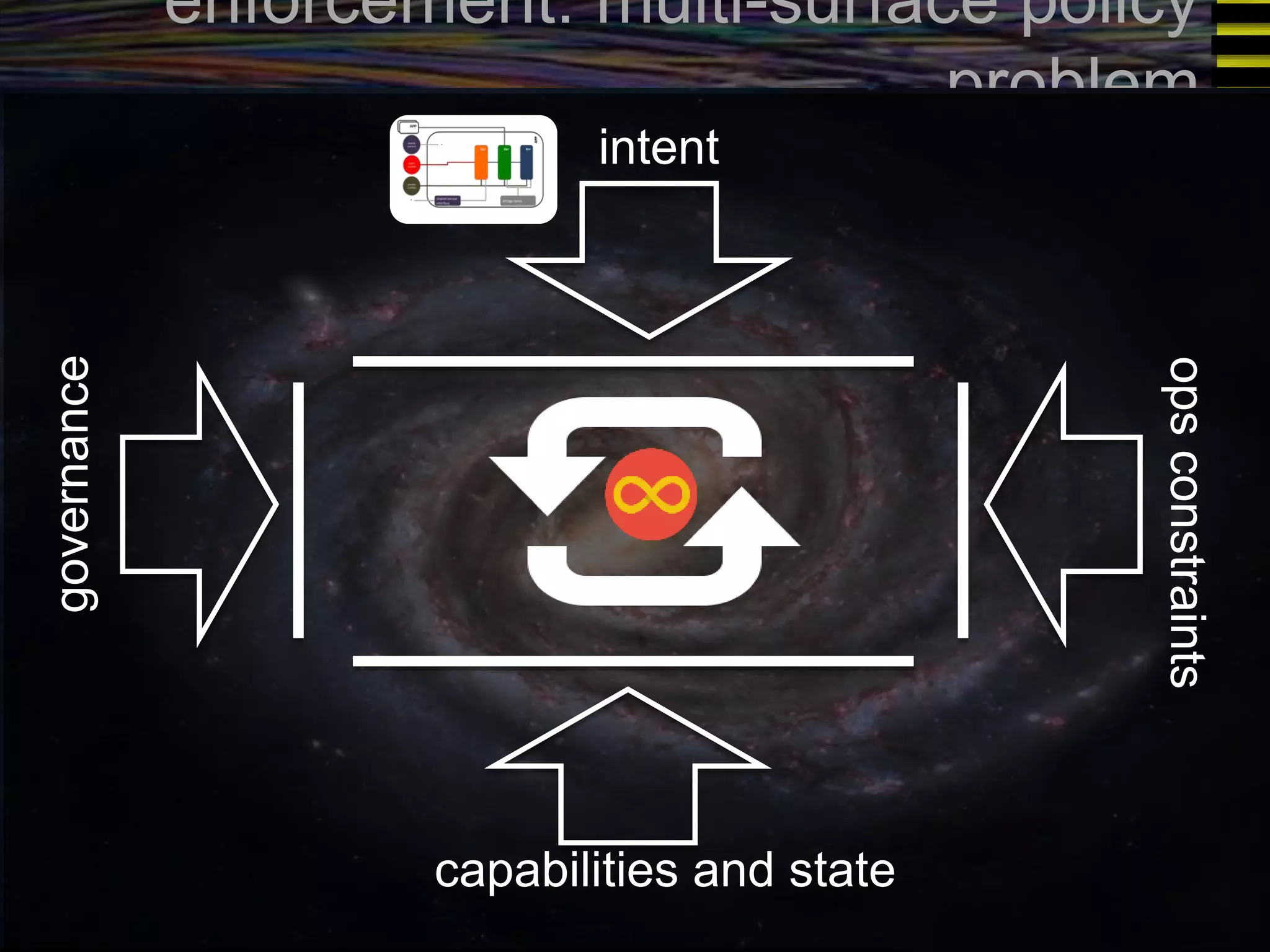
enforcement: multi-surface policy 
problem 
intent 
capabilities and state 
ops constraints 
governance
neutro 
nova cinder swift glance 
n 
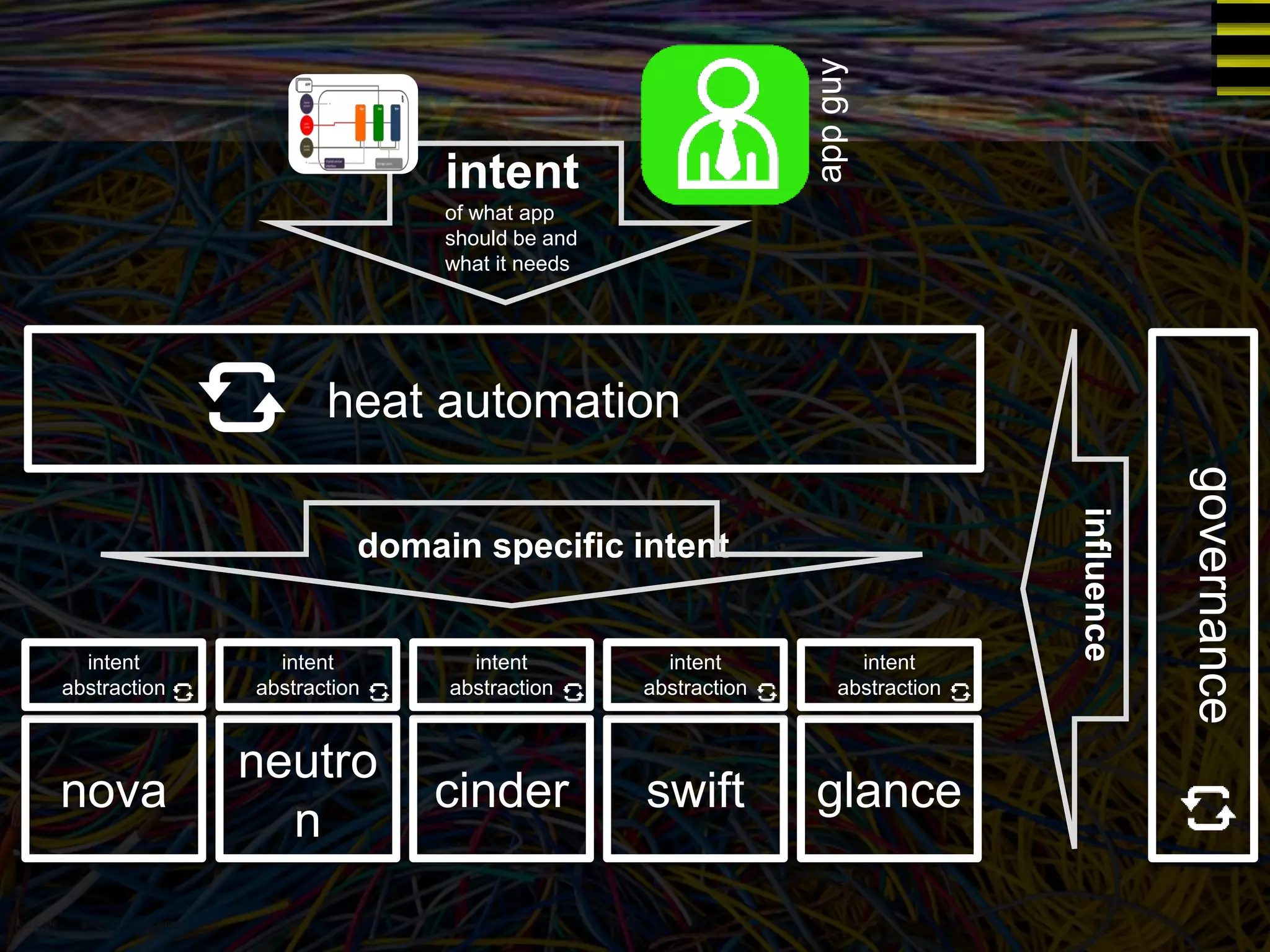
heat automation 
intent 
abstraction 
intent 
abstraction 
intent 
abstraction 
intent 
abstraction 
intent 
abstraction 
governance 
app guy 
intent 
of what app 
should be and 
what it needs 
domain specific intent 
influence
neutro 
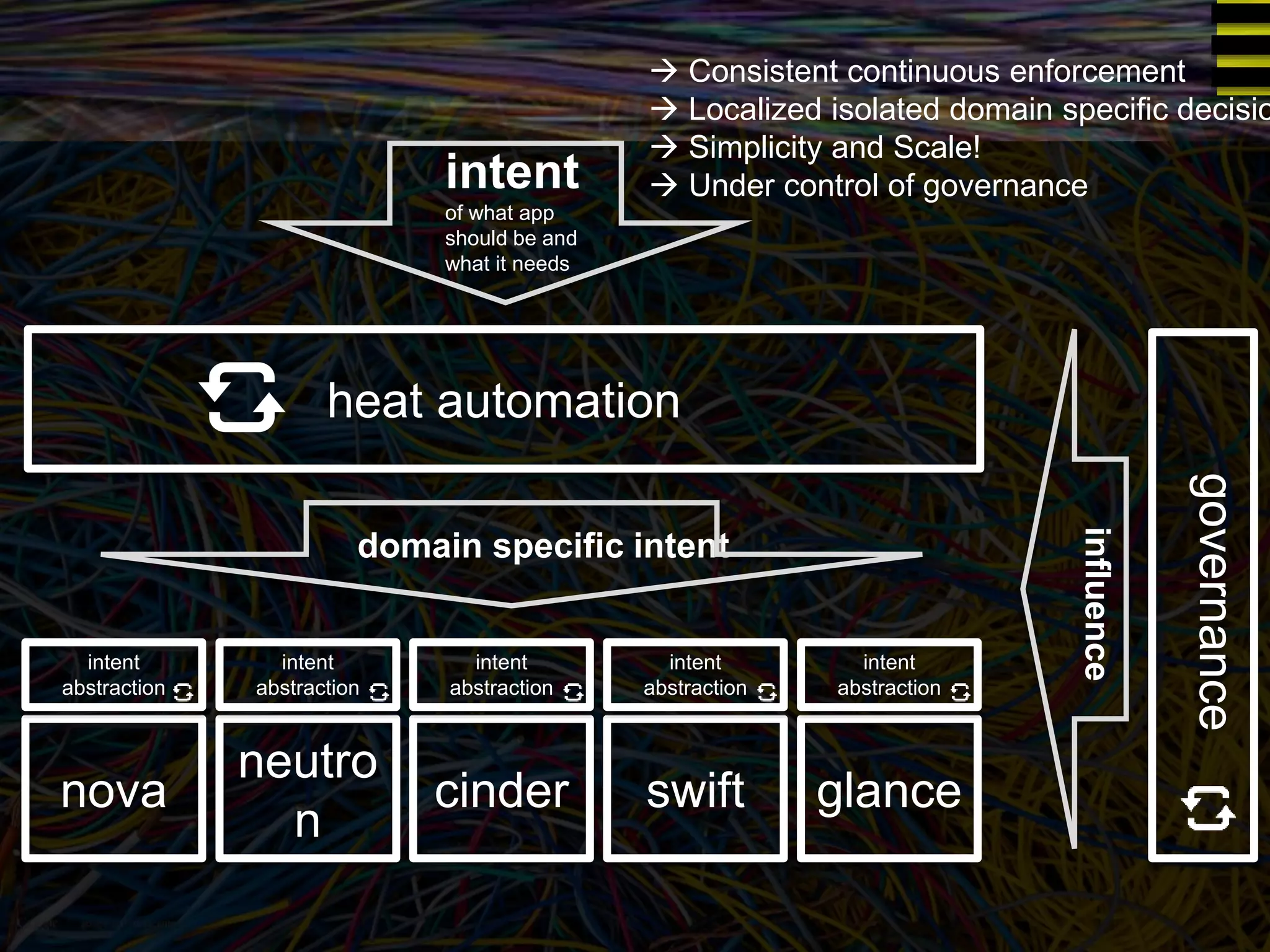
 Consistent continuous enforcement 
 Localized isolated domain specific decisions 
 Simplicity and Scale! 
 Under control of governance 
nova cinder swift glance 
n 
heat automation 
intent 
abstraction 
intent 
abstraction 
intent 
abstraction 
intent 
abstraction 
intent 
abstraction 
governance 
intent 
of what app 
should be and 
what it needs 
domain specific intent 
influence
neutro 
nova cinder swift glance 
n 
heat automation 
intent 
abstraction 
intent 
abstraction 
intent 
abstraction 
intent 
abstraction 
intent 
abstraction 
congress 
TOSCA 
group-based policy intent 
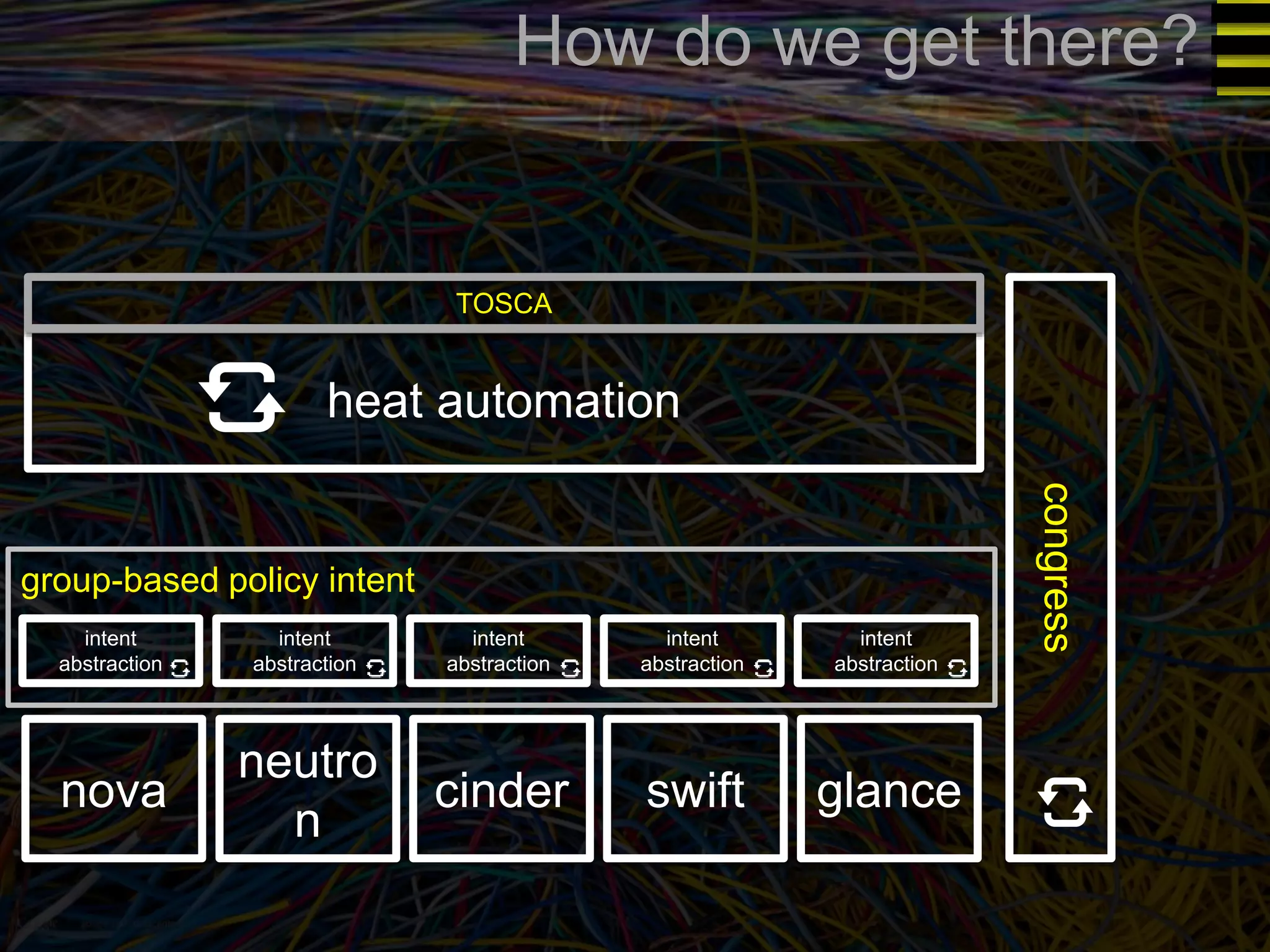
How do we get there?
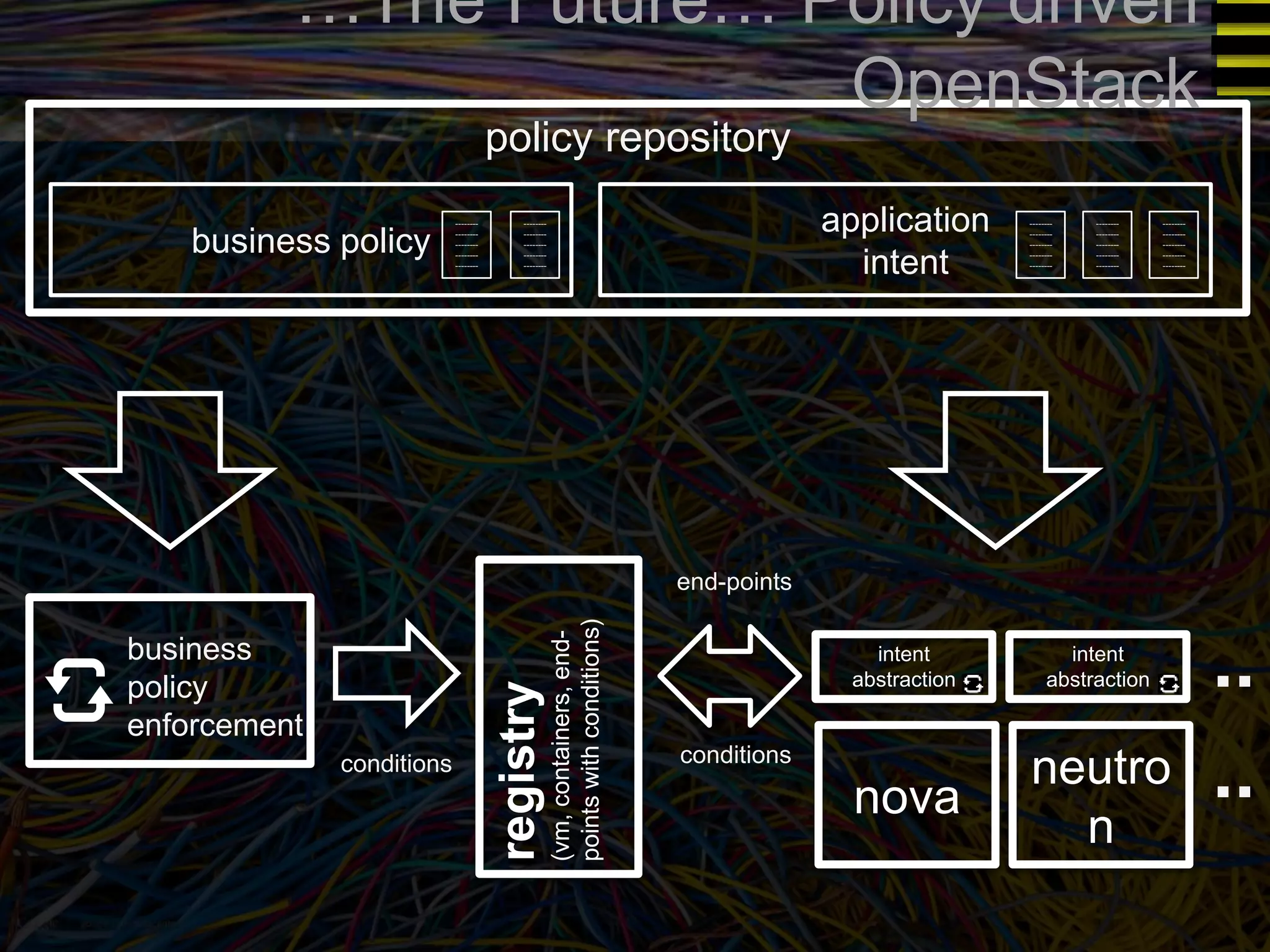
…The Future… Policy driven 
registry 
(vm, containers, end-points 
with conditions) 
neutro 
n 
nova 
intent 
abstraction 
intent 
abstraction 
policy repository 
OpenStack 
.. 
.. 
end-points 
conditions 
business policy 
business 
policy 
enforcement 
conditions 
application 
intent 
-------- 
-------- 
-------- 
-------- 
-------- 
-------- 
-------- 
-------- 
-------- 
-------- 
-------- 
-------- 
-------- 
-------- 
-------- 
-------- 
-------- 
-------- 
-------- 
-------- 
-------- 
-------- 
-------- 
-------- 
--------
Agenda 
 Vision 
 GBP Model 
 GBP Architecture 
 Demo
Goal of OpenStack Abstractions 
Capture the “infrastructure needs” of an 
application independent of the 
complexities of how the underlying 
infrastructure is implemented.
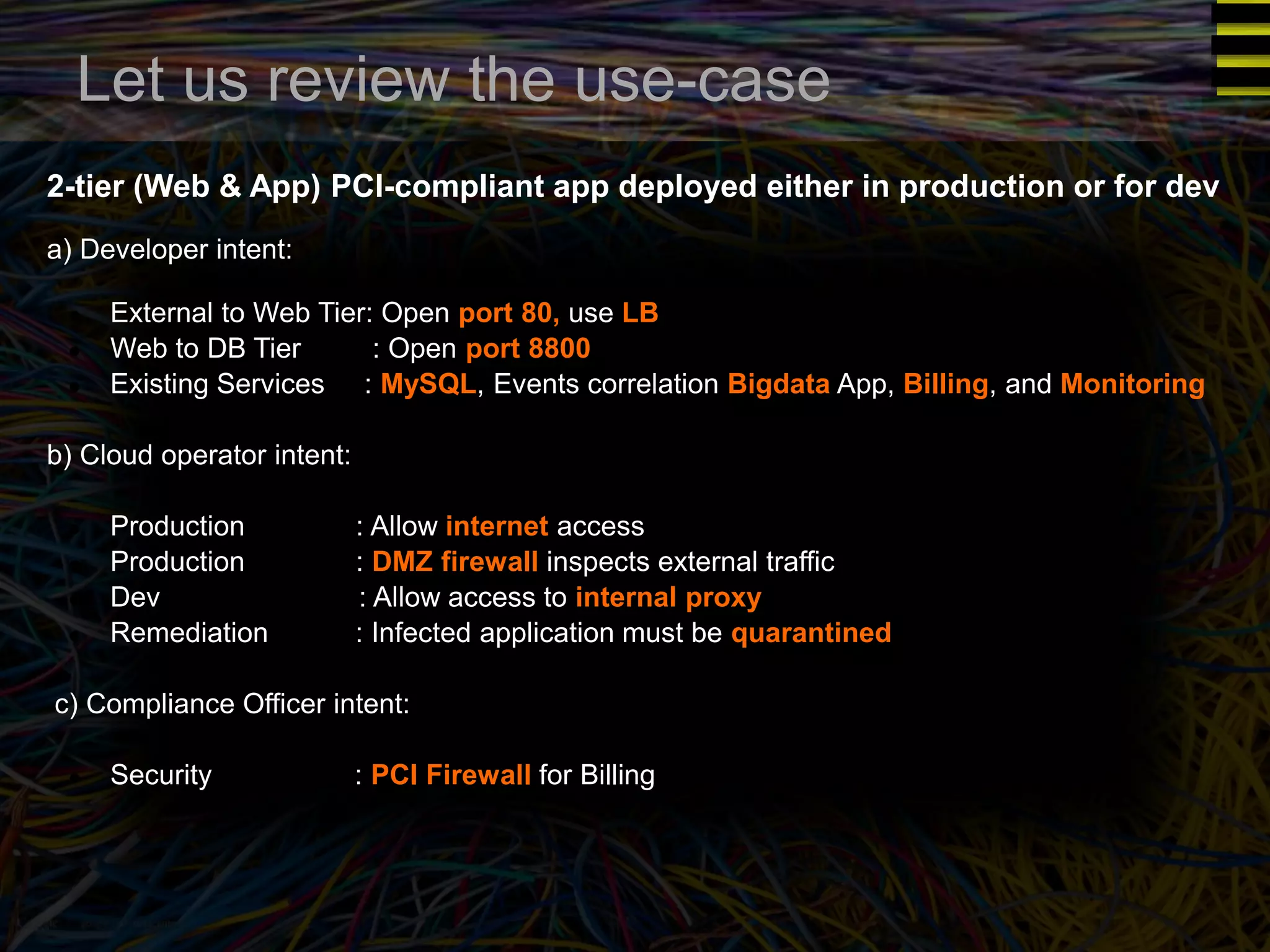
Let us review the use-case 
2-tier (Web & App) PCI-compliant app deployed either in production or for dev 
a) Developer intent: 
● External to Web Tier: Open port 80, use LB 
● Web to DB Tier : Open port 8800 
● Existing Services : MySQL, Events correlation Bigdata App, Billing, and Monitoring 
b) Cloud operator intent: 
● Production : Allow internet access 
● Production : DMZ firewall inspects external traffic 
● Dev : Allow access to internal proxy 
● Remediation : Infected application must be quarantined 
c) Compliance Officer intent: 
● Security : PCI Firewall for Billing
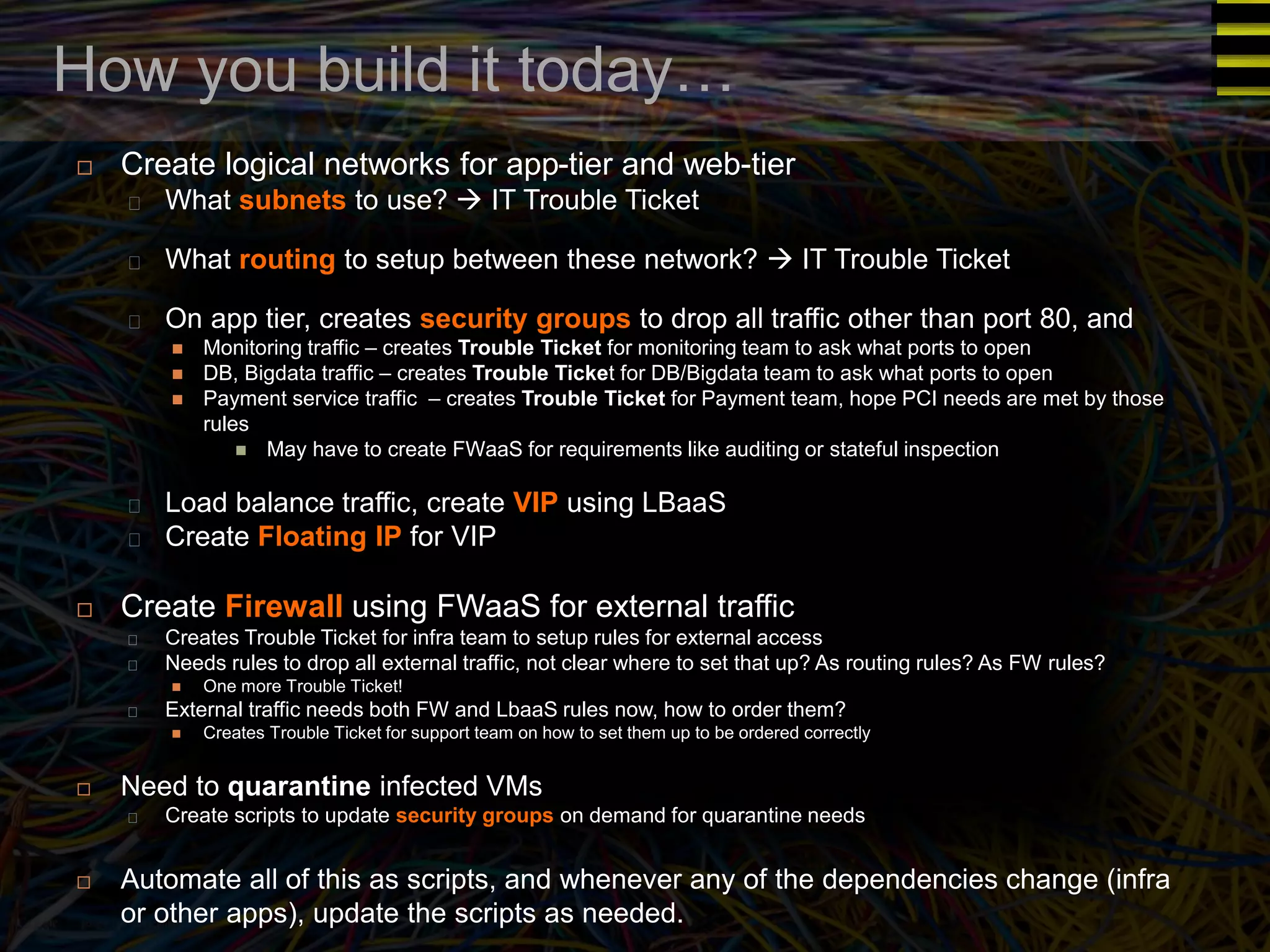
How you build it today… 
 Create logical networks for app-tier and web-tier 
What subnets to use?  IT Trouble Ticket 
What routing to setup between these network?  IT Trouble Ticket 
On app tier, creates security groups to drop all traffic other than port 80, and 
 Monitoring traffic – creates Trouble Ticket for monitoring team to ask what ports to open 
 DB, Bigdata traffic – creates Trouble Ticket for DB/Bigdata team to ask what ports to open 
 Payment service traffic – creates Trouble Ticket for Payment team, hope PCI needs are met by those 
rules 
 May have to create FWaaS for requirements like auditing or stateful inspection 
Load balance traffic, create VIP using LBaaS 
Create Floating IP for VIP 
 Create Firewall using FWaaS for external traffic 
Creates Trouble Ticket for infra team to setup rules for external access 
Needs rules to drop all external traffic, not clear where to set that up? As routing rules? As FW rules? 
 One more Trouble Ticket! 
External traffic needs both FW and LbaaS rules now, how to order them? 
 Creates Trouble Ticket for support team on how to set them up to be ordered correctly 
 Need to quarantine infected VMs 
Create scripts to update security groups on demand for quarantine needs 
 Automate all of this as scripts, and whenever any of the dependencies change (infra 
or other apps), update the scripts as needed.
Where we are today… 
 We have good abstractions for representing logical 
networks/routers/services 
 However, our abstractions are very low level. We spread 
application description across multiple abstractions like: 
L2/L3 address allocation 
Routing rules 
Security Groups 
Service configuration 
 Requires manual reconciliation 
Can we do better?
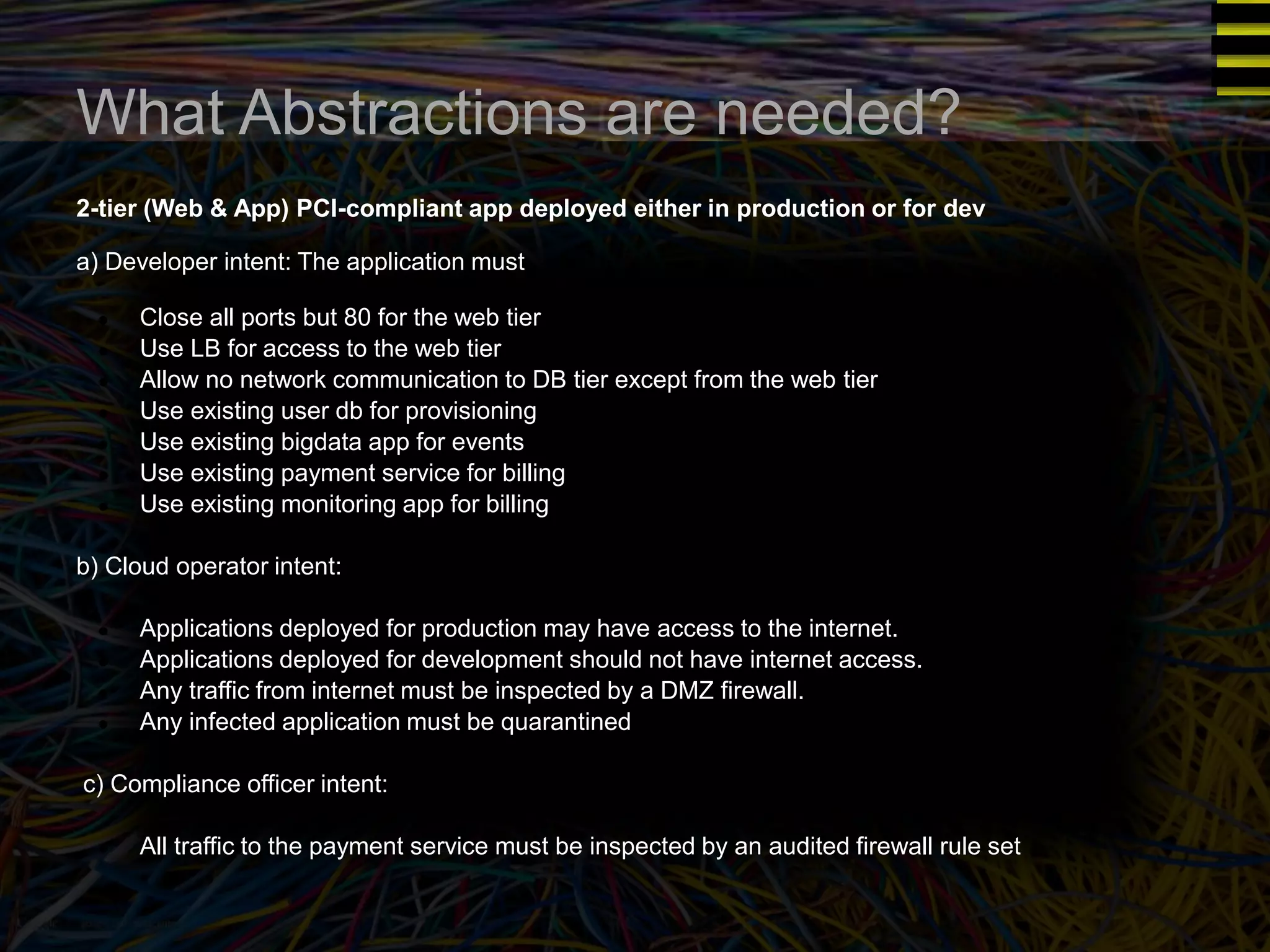
What Abstractions are needed? 
2-tier (Web & App) PCI-compliant app deployed either in production or for dev 
a) Developer intent: The application must 
● Close all ports but 80 for the web tier 
● Use LB for access to the web tier 
● Allow no network communication to DB tier except from the web tier 
● Use existing user db for provisioning 
● Use existing bigdata app for events 
● Use existing payment service for billing 
● Use existing monitoring app for billing 
b) Cloud operator intent: 
● Applications deployed for production may have access to the internet. 
● Applications deployed for development should not have internet access. 
● Any traffic from internet must be inspected by a DMZ firewall. 
● Any infected application must be quarantined 
c) Compliance officer intent: 
● All traffic to the payment service must be inspected by an audited firewall rule set
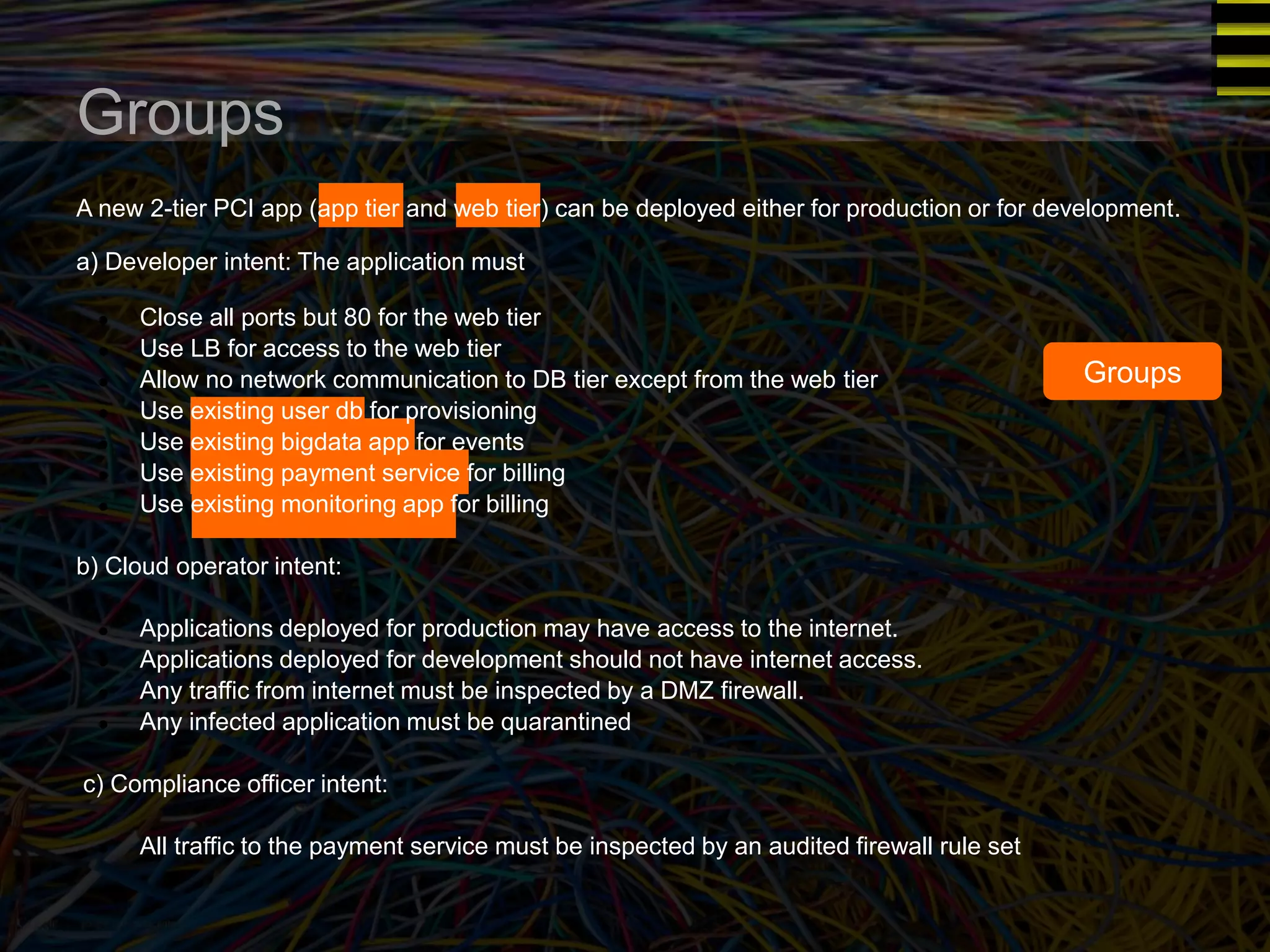
Groups 
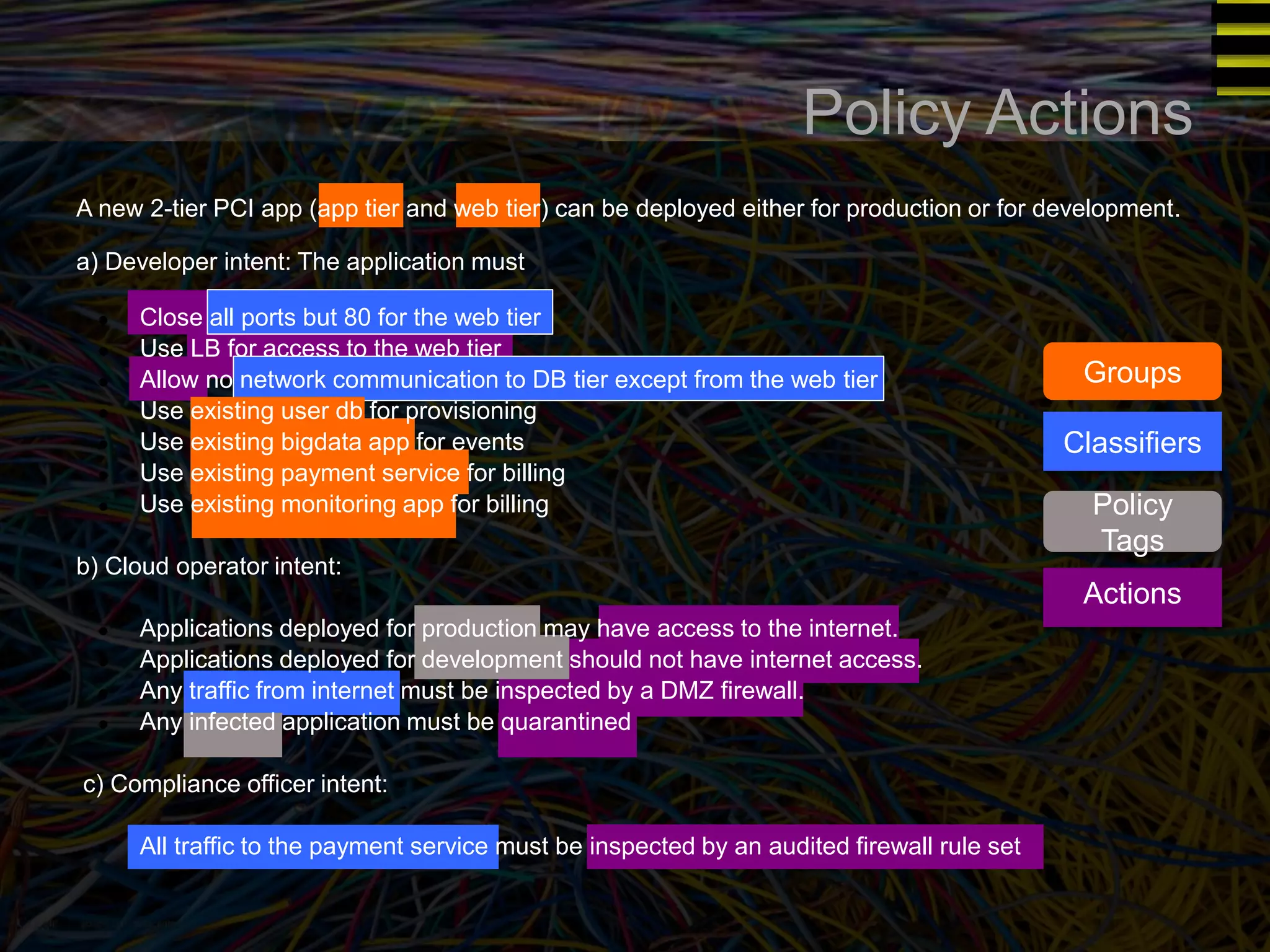
A new 2-tier PCI app (app tier and web tier) can be deployed either for production or for development. 
a) Developer intent: The application must 
● Close all ports but 80 for the web tier 
● Use LB for access to the web tier 
● Allow no network communication to DB tier except from the web tier 
● Use existing user db for provisioning 
● Use existing bigdata app for events 
● Use existing payment service for billing 
● Use existing monitoring app for billing 
b) Cloud operator intent: 
● Applications deployed for production may have access to the internet. 
● Applications deployed for development should not have internet access. 
● Any traffic from internet must be inspected by a DMZ firewall. 
● Any infected application must be quarantined 
c) Compliance officer intent: 
● All traffic to the payment service must be inspected by an audited firewall rule set 
Groups
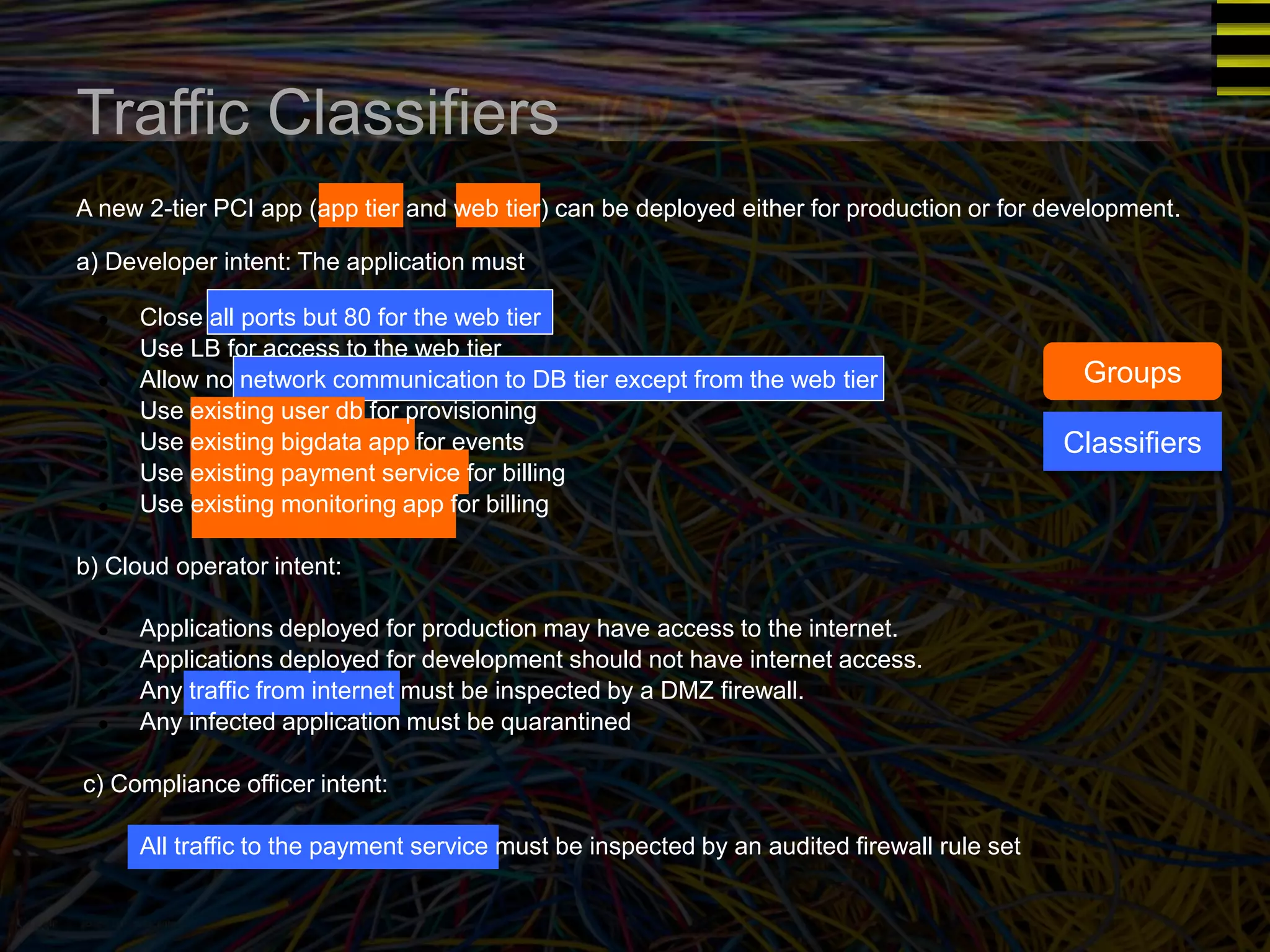
Traffic Classifiers 
A new 2-tier PCI app (app tier and web tier) can be deployed either for production or for development. 
a) Developer intent: The application must 
● Close all ports but 80 for the web tier 
● Use LB for access to the web tier 
● Allow no network communication to DB tier except from the web tier 
● Use existing user db for provisioning 
● Use existing bigdata app for events 
● Use existing payment service for billing 
● Use existing monitoring app for billing 
b) Cloud operator intent: 
● Applications deployed for production may have access to the internet. 
● Applications deployed for development should not have internet access. 
● Any traffic from internet must be inspected by a DMZ firewall. 
● Any infected application must be quarantined 
c) Compliance officer intent: 
● All traffic to the payment service must be inspected by an audited firewall rule set 
Groups 
Classifiers
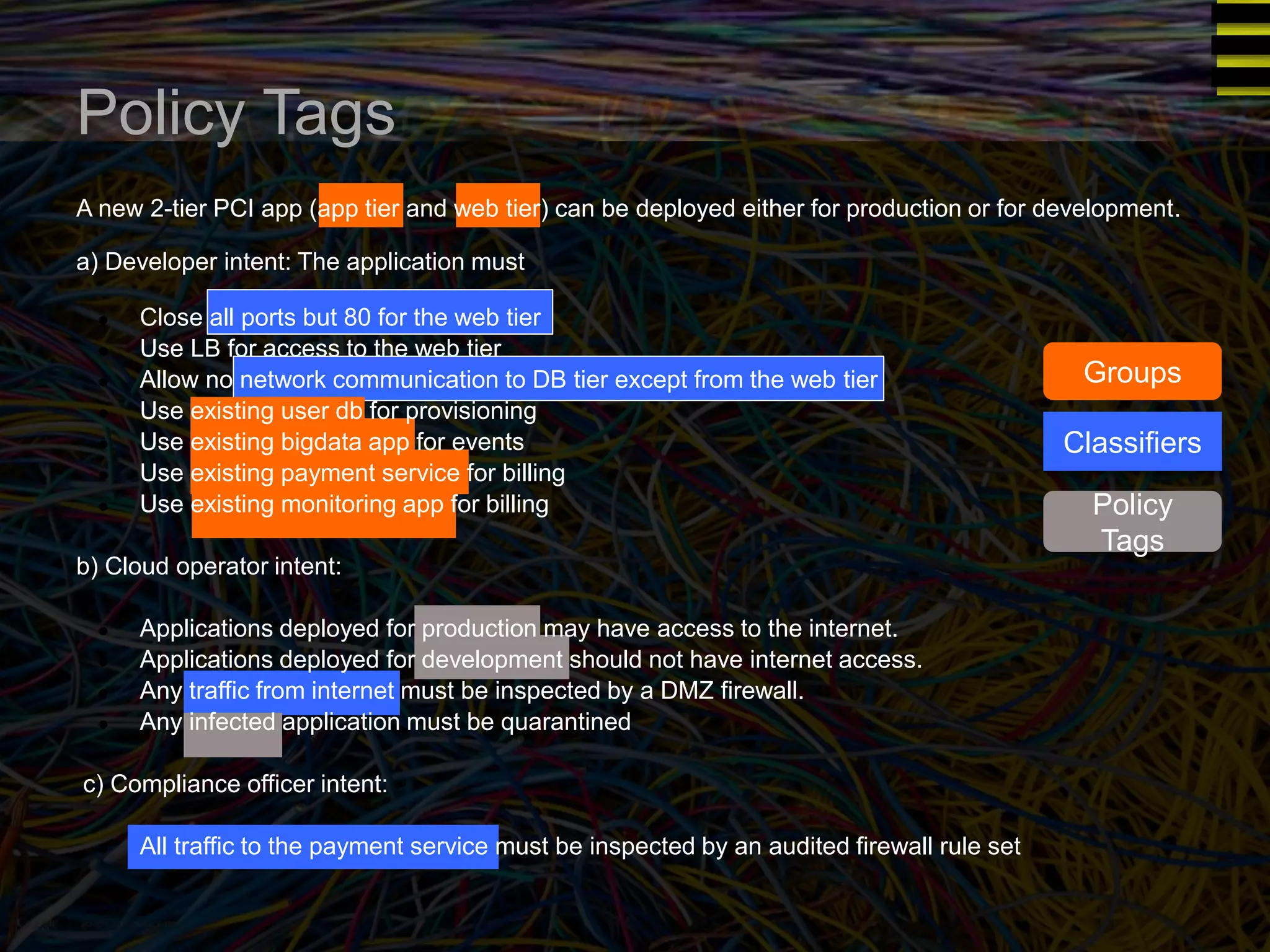
Policy Tags 
A new 2-tier PCI app (app tier and web tier) can be deployed either for production or for development. 
a) Developer intent: The application must 
● Close all ports but 80 for the web tier 
● Use LB for access to the web tier 
● Allow no network communication to DB tier except from the web tier 
● Use existing user db for provisioning 
● Use existing bigdata app for events 
● Use existing payment service for billing 
● Use existing monitoring app for billing 
b) Cloud operator intent: 
● Applications deployed for production may have access to the internet. 
● Applications deployed for development should not have internet access. 
● Any traffic from internet must be inspected by a DMZ firewall. 
● Any infected application must be quarantined 
c) Compliance officer intent: 
● All traffic to the payment service must be inspected by an audited firewall rule set 
Groups 
Classifiers 
Policy 
Tags
Policy Actions 
A new 2-tier PCI app (app tier and web tier) can be deployed either for production or for development. 
a) Developer intent: The application must 
● Close all ports but 80 for the web tier 
● Use LB for access to the web tier 
● Allow no network communication to DB tier except from the web tier 
● Use existing user db for provisioning 
● Use existing bigdata app for events 
● Use existing payment service for billing 
● Use existing monitoring app for billing 
b) Cloud operator intent: 
● Applications deployed for production may have access to the internet. 
● Applications deployed for development should not have internet access. 
● Any traffic from internet must be inspected by a DMZ firewall. 
● Any infected application must be quarantined 
c) Compliance officer intent: 
● All traffic to the payment service must be inspected by an audited firewall rule set 
Groups 
Classifiers 
Policy 
Tags 
Actions
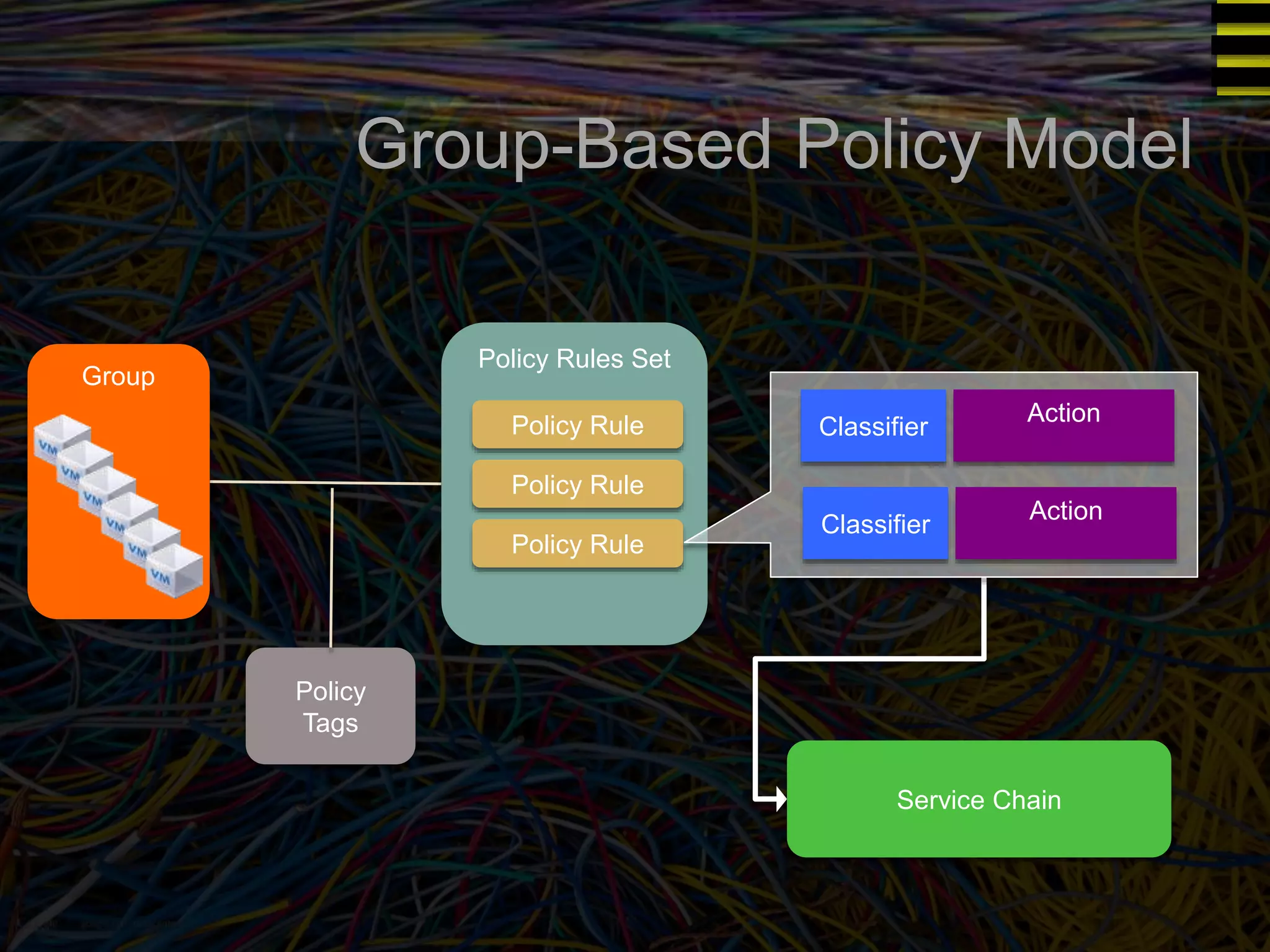
Group-Based Policy Model 
Policy 
Tags 
Policy Rules Set 
Policy Rule 
Policy Rule 
Policy Rule 
Group 
Classifier 
Classifier 
Action 
Action 
Service Chain
Agenda 
 Vision 
 GBP Model 
 GBP Architecture 
 Demo
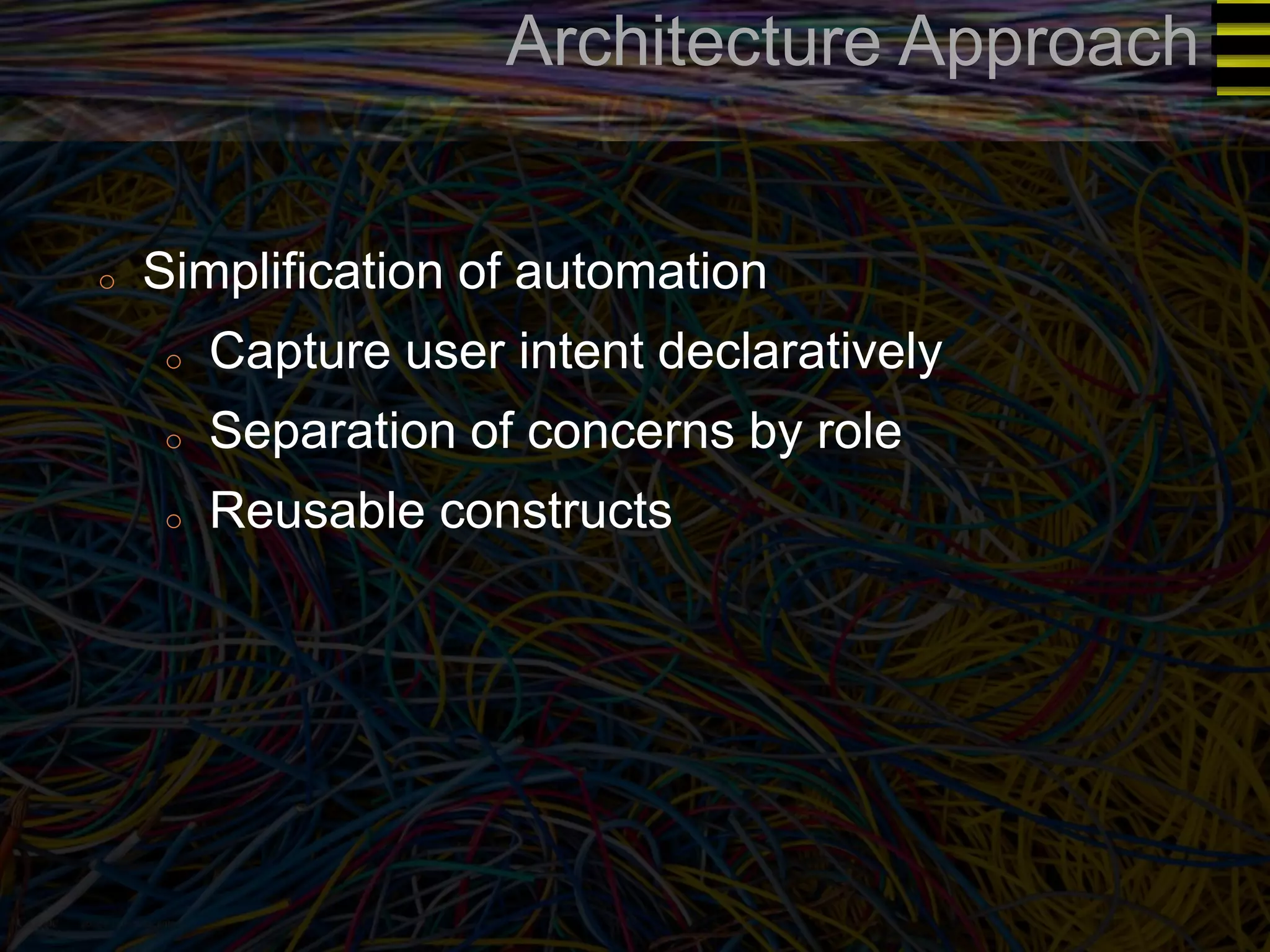
Architecture Approach 
o Simplification of automation 
o Capture user intent declaratively 
o Separation of concerns by role 
o Reusable constructs
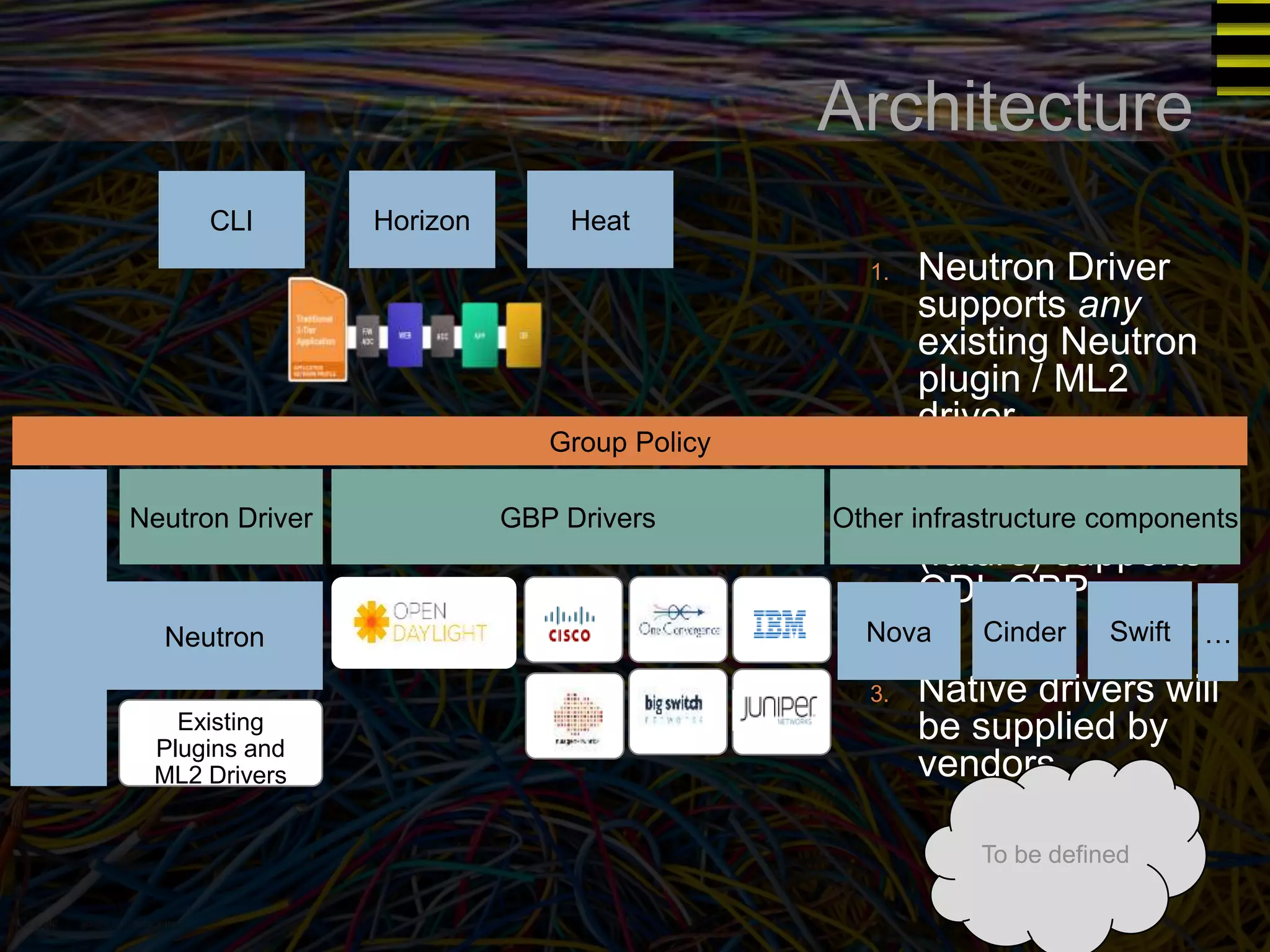
Architecture 
1. Neutron Driver 
supports any 
existing Neutron 
plugin / ML2 
driver 
2. ODL Driver 
Other infrastructure components 
(future) supports 
ODL GBP 
Swift … 
3. Native drivers will 
be supplied by 
vendors 
CLI Horizon Heat 
Group Policy 
Neutron Driver GBP Drivers 
Neutron 
Existing 
Plugins and 
ML2 Drivers 
Group Policy 
Nova Cinder 
To be defined
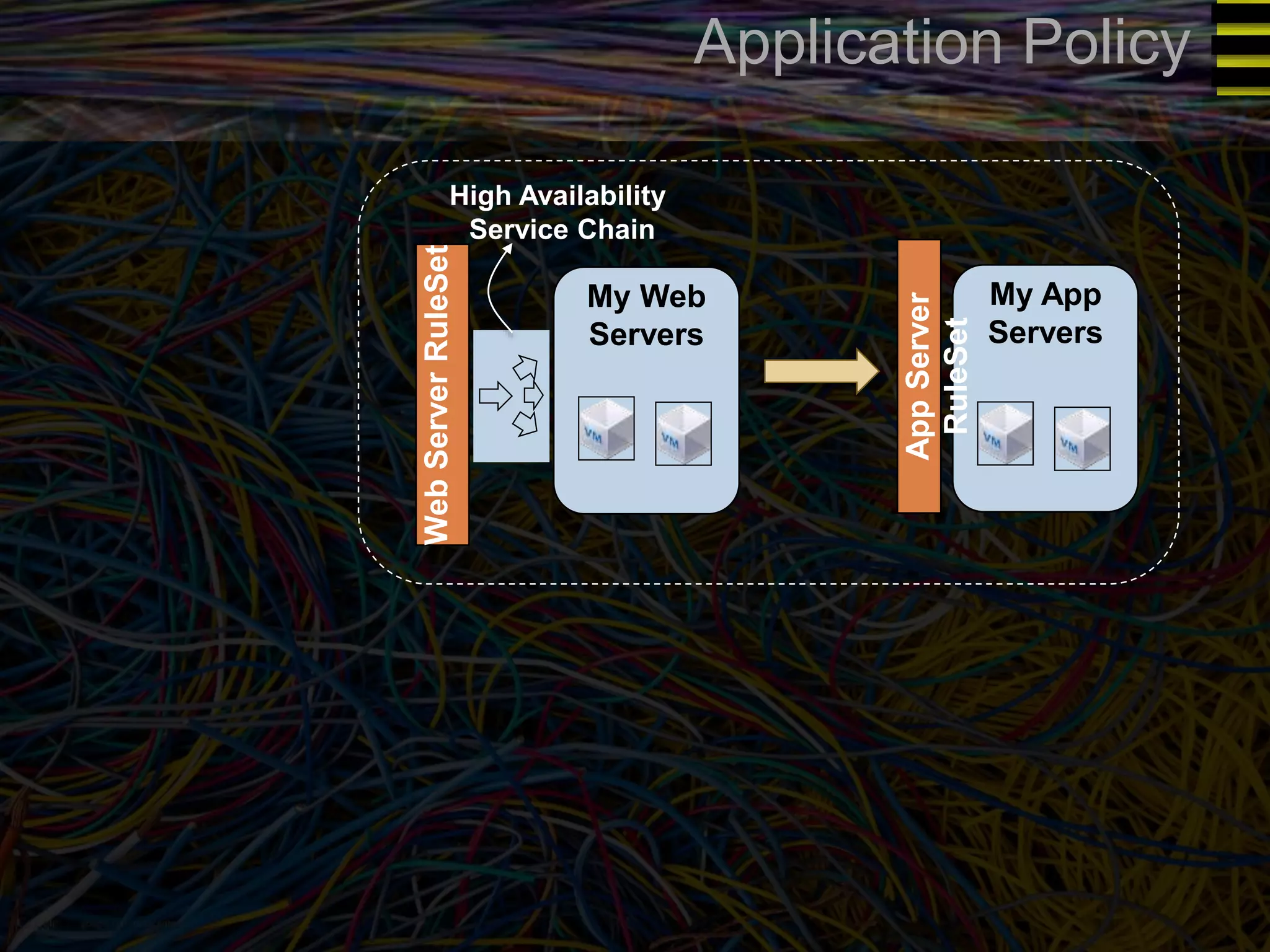
Application Policy 
My App 
Servers 
App Server 
RuleSet 
High Availability 
Service Chain 
My Web 
Servers 
Web Server RuleSet
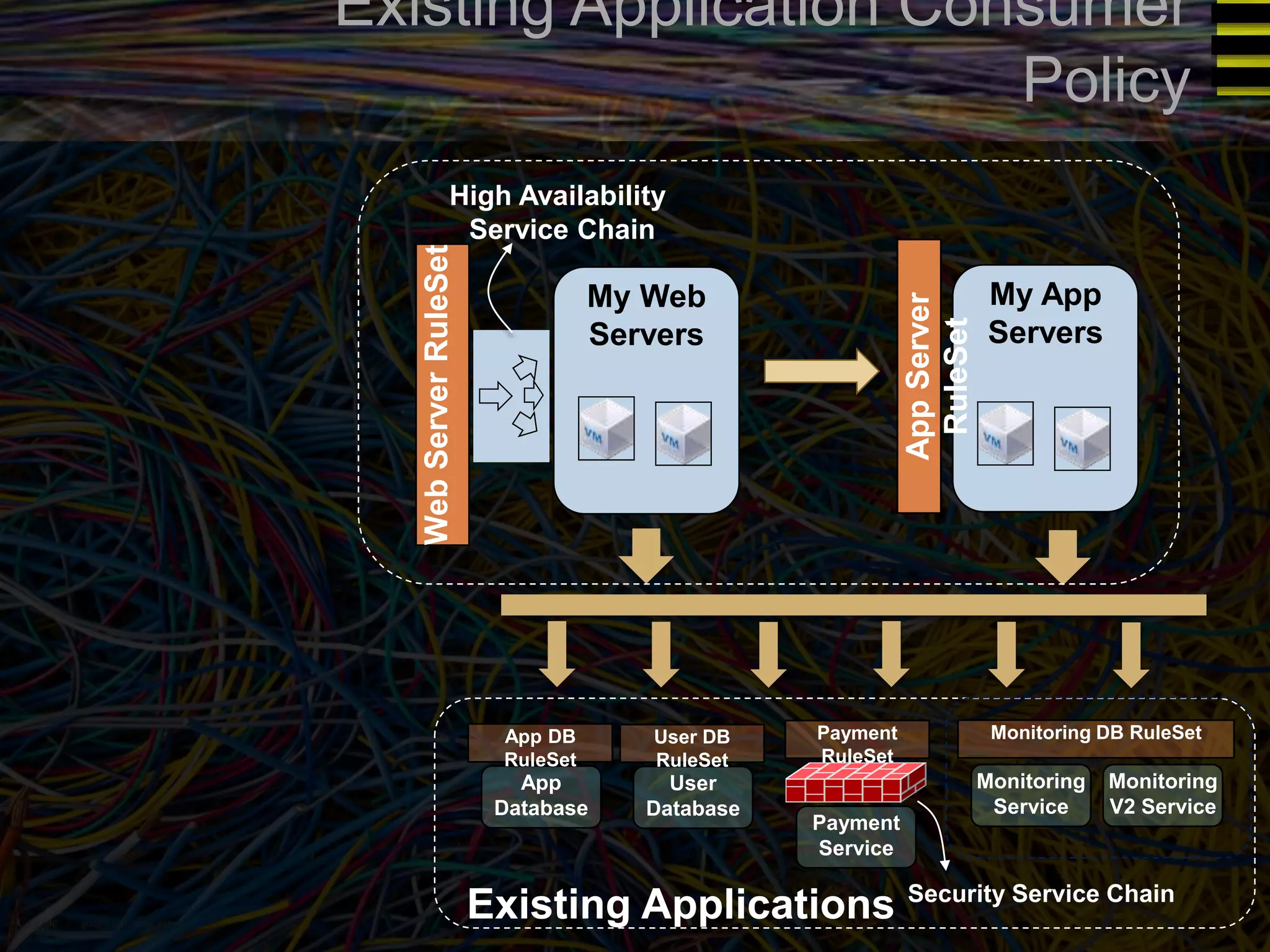
Existing Application Consumer 
Policy 
My App 
Servers 
App Server 
RuleSet 
High Availability 
Service Chain 
My Web 
Servers 
Web Server RuleSet 
App DB 
RuleSet 
App 
Database 
User DB 
RuleSet 
User 
Database 
Payment 
RuleSet 
Payment 
Service 
Monitoring DB RuleSet 
Monitoring 
Service 
Monitoring 
V2 Service 
Existing Applications Security Service Chain
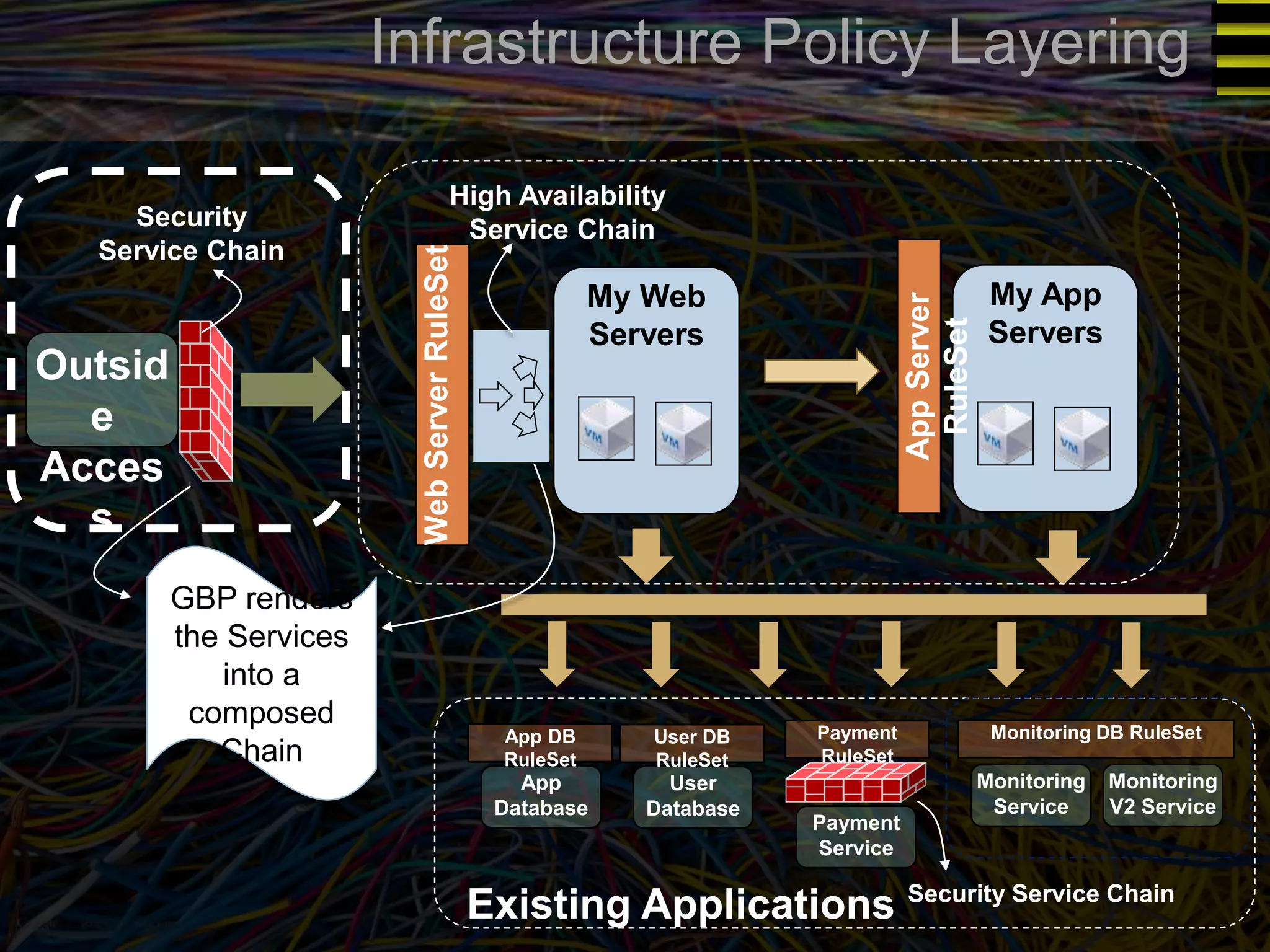
Infrastructure Policy Layering 
My App 
Servers 
App Server 
RuleSet 
My Web 
Servers 
Web Server RuleSet 
App DB 
RuleSet 
App 
Database 
User DB 
RuleSet 
User 
Database 
Payment 
RuleSet 
Payment 
Service 
Monitoring DB RuleSet 
Monitoring 
Service 
Monitoring 
V2 Service 
Existing Applications 
Outsid 
e 
Acces 
s 
Security Service Chain 
High Availability 
Security Service Chain 
Service Chain 
GBP renders 
the Services 
into a 
composed 
Chain
Agenda 
 Vision 
 GBP Model 
 GBP Architecture 
 Demo
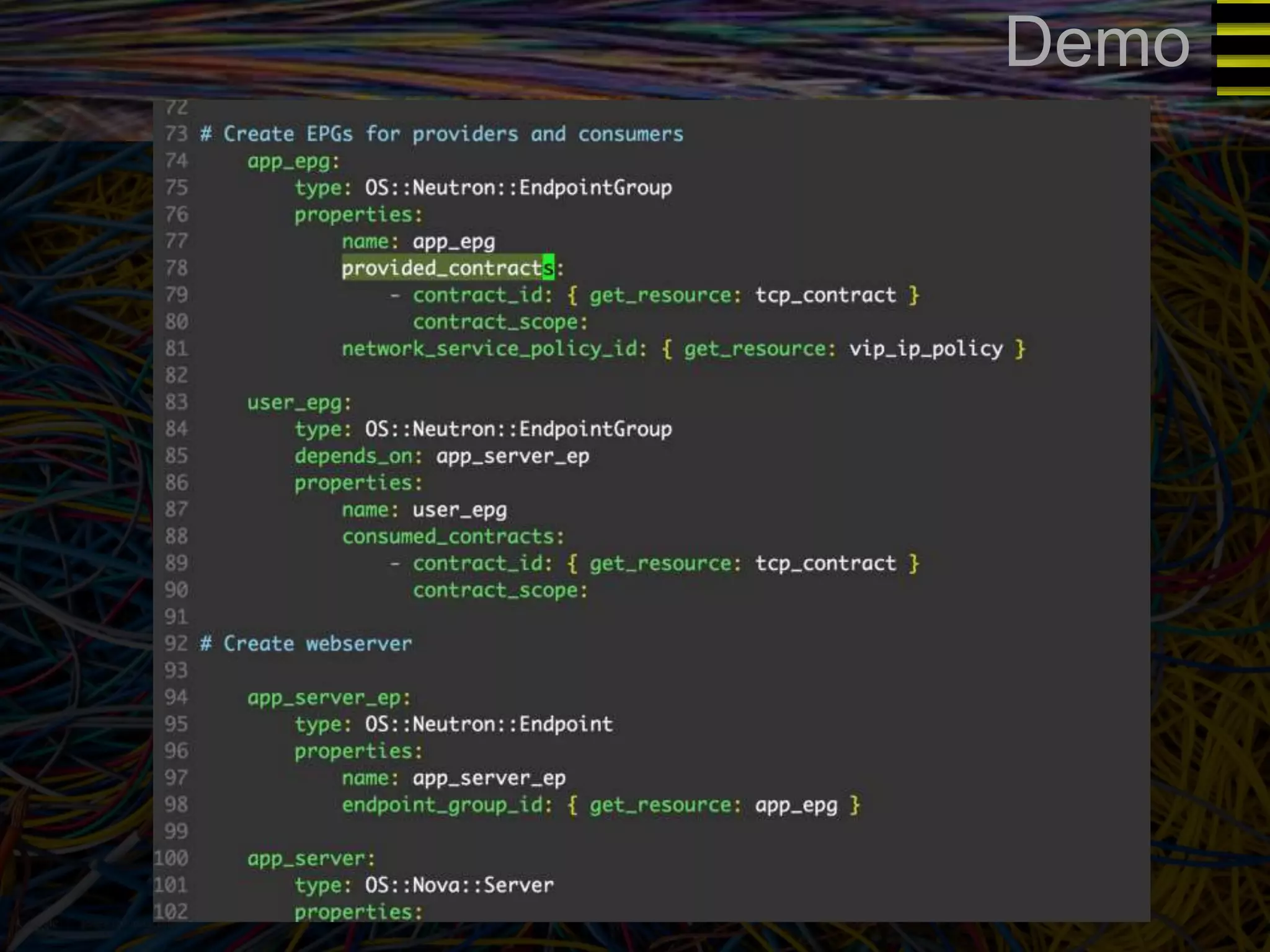
Demo
DEMO
References 
 GBP wiki page to get more information on how to 
install and work with GBP: 
https://wiki.openstack.org/wiki/GroupBasedPolicy 
 GBP Design Summit Session: 
Tuesday November 4, 2014 12:05 - 12:45 
Dufy (Le Meridien) 
http://kilodesignsummit.sched.org/event/98dc4255384e340 
682137c8a7ee7e60d#.VFKCJYt4r4w 
 Try it out 
https://wiki.openstack.org/wiki/GroupBasedPolicy/InstallDe 
vstack

Open stack gbp final sn-4-slideshare

  • 1.
    OpenStack Kilo Summit,Paris, Nov 2014 Michael Cohen, Sumit Naiksatam, Prasad Vellanki, Stephen Wong
  • 2.
    Agenda  Vision  GBP Model  GBP Architecture  Demo
  • 3.
    IT exists torun applications automation infrastructure Scalable Uber-Easy Reliable Fast
  • 4.
    IT exists torun application Reality: Based on worst principles borrowed from human middleware automation infrastructure
  • 5.
    Micromanagement Do thissequence of things do do do do do do do do do do do do do do Automation has been an attempt at industrialization of micromanagemen t practices
  • 6.
    heat automation detailed abstraction neutro n detailed abstraction nova detailed abstraction cinder detailed abstraction swift detailed abstraction glance ……….. Detailed Interactions Do, do, do, do Detailed Interactions Do, do, do, do Detailed Interactions Do, do, do, do Detailed Interactions Do, do, do, do Detailed Interactions Do, do, do, do Detailed Interactions Do, do, do, do (over and over again) Lots of HOW Too much Unnecessa ry detail + Closed Coupling
  • 7.
    simplicity, at times,has heat automation detailed abstraction neutro n detailed abstraction nova detailed abstraction cinder complications detailed abstraction swift detailed abstraction glance complexity ……….. domain details leak into the automation layer and its enforcement mechanisms It was OK when these things were very simple, but it breaks down as the featureset expands….
  • 8.
    detailed abstraction neutro n detailed abstraction nova simplicity, at times, has domain detail complexity detailed abstraction cinder complications app guy detailed abstraction swift detailed abstraction glance ……….. heat automation
  • 9.
    but IT existsto run applications…. detailed abstraction neutro n detailed abstraction nova detailed abstraction cinder app guy detailed abstraction swift detailed abstraction glance ……….. heat automation “I’d like to run this app that has the following requirements on infrastructure, services and other apps.. with these characteristics!” My app looks like this: intent of what app should be and what it needs Intent Is lost in unnecessary domain specific details
  • 10.
    intent  Abstraction  Portability  Self-containment  No leakage of unnecessary knowledge across apps this is how I expose myself to other apps/components/s ervices This is how I need to consume infra This is my application component some other app some other app storage requirements compute requirements placement requirements image rules scaling rules booting/init rules v m v m …. v m some app/compo nent/service What apps/components/servic es do I depend on? Network and netsec are implicit a real application consists of many of these
  • 11.
    enforcement: multi-surface policy problem intent capabilities and state ops constraints governance
  • 12.
    neutro nova cinderswift glance n heat automation intent abstraction intent abstraction intent abstraction intent abstraction intent abstraction governance app guy intent of what app should be and what it needs domain specific intent influence
  • 13.
    neutro  Consistentcontinuous enforcement  Localized isolated domain specific decisions  Simplicity and Scale!  Under control of governance nova cinder swift glance n heat automation intent abstraction intent abstraction intent abstraction intent abstraction intent abstraction governance intent of what app should be and what it needs domain specific intent influence
  • 14.
    neutro nova cinderswift glance n heat automation intent abstraction intent abstraction intent abstraction intent abstraction intent abstraction congress TOSCA group-based policy intent How do we get there?
  • 15.
    …The Future… Policydriven registry (vm, containers, end-points with conditions) neutro n nova intent abstraction intent abstraction policy repository OpenStack .. .. end-points conditions business policy business policy enforcement conditions application intent -------- -------- -------- -------- -------- -------- -------- -------- -------- -------- -------- -------- -------- -------- -------- -------- -------- -------- -------- -------- -------- -------- -------- -------- --------
  • 16.
    Agenda  Vision  GBP Model  GBP Architecture  Demo
  • 17.
    Goal of OpenStackAbstractions Capture the “infrastructure needs” of an application independent of the complexities of how the underlying infrastructure is implemented.
  • 18.
    Let us reviewthe use-case 2-tier (Web & App) PCI-compliant app deployed either in production or for dev a) Developer intent: ● External to Web Tier: Open port 80, use LB ● Web to DB Tier : Open port 8800 ● Existing Services : MySQL, Events correlation Bigdata App, Billing, and Monitoring b) Cloud operator intent: ● Production : Allow internet access ● Production : DMZ firewall inspects external traffic ● Dev : Allow access to internal proxy ● Remediation : Infected application must be quarantined c) Compliance Officer intent: ● Security : PCI Firewall for Billing
  • 19.
    How you buildit today…  Create logical networks for app-tier and web-tier What subnets to use?  IT Trouble Ticket What routing to setup between these network?  IT Trouble Ticket On app tier, creates security groups to drop all traffic other than port 80, and  Monitoring traffic – creates Trouble Ticket for monitoring team to ask what ports to open  DB, Bigdata traffic – creates Trouble Ticket for DB/Bigdata team to ask what ports to open  Payment service traffic – creates Trouble Ticket for Payment team, hope PCI needs are met by those rules  May have to create FWaaS for requirements like auditing or stateful inspection Load balance traffic, create VIP using LBaaS Create Floating IP for VIP  Create Firewall using FWaaS for external traffic Creates Trouble Ticket for infra team to setup rules for external access Needs rules to drop all external traffic, not clear where to set that up? As routing rules? As FW rules?  One more Trouble Ticket! External traffic needs both FW and LbaaS rules now, how to order them?  Creates Trouble Ticket for support team on how to set them up to be ordered correctly  Need to quarantine infected VMs Create scripts to update security groups on demand for quarantine needs  Automate all of this as scripts, and whenever any of the dependencies change (infra or other apps), update the scripts as needed.
  • 20.
    Where we aretoday…  We have good abstractions for representing logical networks/routers/services  However, our abstractions are very low level. We spread application description across multiple abstractions like: L2/L3 address allocation Routing rules Security Groups Service configuration  Requires manual reconciliation Can we do better?
  • 21.
    What Abstractions areneeded? 2-tier (Web & App) PCI-compliant app deployed either in production or for dev a) Developer intent: The application must ● Close all ports but 80 for the web tier ● Use LB for access to the web tier ● Allow no network communication to DB tier except from the web tier ● Use existing user db for provisioning ● Use existing bigdata app for events ● Use existing payment service for billing ● Use existing monitoring app for billing b) Cloud operator intent: ● Applications deployed for production may have access to the internet. ● Applications deployed for development should not have internet access. ● Any traffic from internet must be inspected by a DMZ firewall. ● Any infected application must be quarantined c) Compliance officer intent: ● All traffic to the payment service must be inspected by an audited firewall rule set
  • 22.
    Groups A new2-tier PCI app (app tier and web tier) can be deployed either for production or for development. a) Developer intent: The application must ● Close all ports but 80 for the web tier ● Use LB for access to the web tier ● Allow no network communication to DB tier except from the web tier ● Use existing user db for provisioning ● Use existing bigdata app for events ● Use existing payment service for billing ● Use existing monitoring app for billing b) Cloud operator intent: ● Applications deployed for production may have access to the internet. ● Applications deployed for development should not have internet access. ● Any traffic from internet must be inspected by a DMZ firewall. ● Any infected application must be quarantined c) Compliance officer intent: ● All traffic to the payment service must be inspected by an audited firewall rule set Groups
  • 23.
    Traffic Classifiers Anew 2-tier PCI app (app tier and web tier) can be deployed either for production or for development. a) Developer intent: The application must ● Close all ports but 80 for the web tier ● Use LB for access to the web tier ● Allow no network communication to DB tier except from the web tier ● Use existing user db for provisioning ● Use existing bigdata app for events ● Use existing payment service for billing ● Use existing monitoring app for billing b) Cloud operator intent: ● Applications deployed for production may have access to the internet. ● Applications deployed for development should not have internet access. ● Any traffic from internet must be inspected by a DMZ firewall. ● Any infected application must be quarantined c) Compliance officer intent: ● All traffic to the payment service must be inspected by an audited firewall rule set Groups Classifiers
  • 24.
    Policy Tags Anew 2-tier PCI app (app tier and web tier) can be deployed either for production or for development. a) Developer intent: The application must ● Close all ports but 80 for the web tier ● Use LB for access to the web tier ● Allow no network communication to DB tier except from the web tier ● Use existing user db for provisioning ● Use existing bigdata app for events ● Use existing payment service for billing ● Use existing monitoring app for billing b) Cloud operator intent: ● Applications deployed for production may have access to the internet. ● Applications deployed for development should not have internet access. ● Any traffic from internet must be inspected by a DMZ firewall. ● Any infected application must be quarantined c) Compliance officer intent: ● All traffic to the payment service must be inspected by an audited firewall rule set Groups Classifiers Policy Tags
  • 25.
    Policy Actions Anew 2-tier PCI app (app tier and web tier) can be deployed either for production or for development. a) Developer intent: The application must ● Close all ports but 80 for the web tier ● Use LB for access to the web tier ● Allow no network communication to DB tier except from the web tier ● Use existing user db for provisioning ● Use existing bigdata app for events ● Use existing payment service for billing ● Use existing monitoring app for billing b) Cloud operator intent: ● Applications deployed for production may have access to the internet. ● Applications deployed for development should not have internet access. ● Any traffic from internet must be inspected by a DMZ firewall. ● Any infected application must be quarantined c) Compliance officer intent: ● All traffic to the payment service must be inspected by an audited firewall rule set Groups Classifiers Policy Tags Actions
  • 26.
    Group-Based Policy Model Policy Tags Policy Rules Set Policy Rule Policy Rule Policy Rule Group Classifier Classifier Action Action Service Chain
  • 27.
    Agenda  Vision  GBP Model  GBP Architecture  Demo
  • 28.
    Architecture Approach oSimplification of automation o Capture user intent declaratively o Separation of concerns by role o Reusable constructs
  • 29.
    Architecture 1. NeutronDriver supports any existing Neutron plugin / ML2 driver 2. ODL Driver Other infrastructure components (future) supports ODL GBP Swift … 3. Native drivers will be supplied by vendors CLI Horizon Heat Group Policy Neutron Driver GBP Drivers Neutron Existing Plugins and ML2 Drivers Group Policy Nova Cinder To be defined
  • 30.
    Application Policy MyApp Servers App Server RuleSet High Availability Service Chain My Web Servers Web Server RuleSet
  • 31.
    Existing Application Consumer Policy My App Servers App Server RuleSet High Availability Service Chain My Web Servers Web Server RuleSet App DB RuleSet App Database User DB RuleSet User Database Payment RuleSet Payment Service Monitoring DB RuleSet Monitoring Service Monitoring V2 Service Existing Applications Security Service Chain
  • 32.
    Infrastructure Policy Layering My App Servers App Server RuleSet My Web Servers Web Server RuleSet App DB RuleSet App Database User DB RuleSet User Database Payment RuleSet Payment Service Monitoring DB RuleSet Monitoring Service Monitoring V2 Service Existing Applications Outsid e Acces s Security Service Chain High Availability Security Service Chain Service Chain GBP renders the Services into a composed Chain
  • 33.
    Agenda  Vision  GBP Model  GBP Architecture  Demo
  • 34.
  • 35.
  • 37.
    References  GBPwiki page to get more information on how to install and work with GBP: https://wiki.openstack.org/wiki/GroupBasedPolicy  GBP Design Summit Session: Tuesday November 4, 2014 12:05 - 12:45 Dufy (Le Meridien) http://kilodesignsummit.sched.org/event/98dc4255384e340 682137c8a7ee7e60d#.VFKCJYt4r4w  Try it out https://wiki.openstack.org/wiki/GroupBasedPolicy/InstallDe vstack

Editor's Notes

  • #4 Before we start on the topic of policy, I think we need to level set ourselves on why we are all here. We manage infrastructure and infrastructure EXISTS to run applications. An applications need to be deliverable in a way that is scalable, easy, reliable, and fast! ----- Meeting Notes (10/14/14 11:18) ----- we must automate application processes and well in infrastructure underneath.
  • #5 So, we did what smart people do – we developed automation. But our automation tools to date are mostly borrowed from human middleware. We took the things we used to type into our consoles and we embedded them in cripts and tools. Even our APIs are so level as they are not much help here. The end result is indeed automated but hardly scalable, easy, reliable.
  • #6 How many of you like being micromanaged? Do you think tools do better micromanaged as well? In reality what we’ve done is the industrialization of these bad practices. ----- Meeting Notes (10/14/14 11:20) ----- this is not the answer
  • #7 Now lets think about this in openStack. OpenStack was designed to offer a set of abstraction layers across different types of systems and architectures. But the abstractions today are still too detailed and low level for automation: networking I’m specifying L2/L3, Devops is great until its time to manage BGP… The result is to close a coupling between the automation and the underlying infrastructure. ----- Meeting Notes (10/14/14 11:30) ----- couple
  • #8  ----- Meeting Notes (10/14/14 11:30) ----- What is happening is that the details are leaking from the individuals systems trhough to the automation. This was ok when systems were simple but more and more domain details leak into the automation. This introduces complexity and reduces effectiviness. Complexity is the the enemy of automation and scale.
  • #9 And who does this impact the most? The poor application guy who has to define his services and build automation against them. He needs to understands a lot about how each of these detailed layers works and interacts. It is NOT easy or fast
  • #10 But remember IT exists to run applications. APplication guy know how his application looks. He knows how it interacts with other things. By the time you get to the interfaces of the cloud platform, all you think about is implementation details. THe intent is lost. THIS IS BAD. This is root of the problem we are facing.
  • #11 So what should we be doing? We have to capture intent. Networking is the worst but not the only culprit here. ----- Meeting Notes (10/14/14 11:30) ----- AN pplicaiton comprises of multiple components – each of them is compromised of units of compute with the same behavior. You have to scale them up and down and control them through a set of rules. Then you have to know how thye consume infrastructure. (re-arrange animation) app upper left reasons then say there are many of these. They are defined by different people. There is no one person who knows everything. If you rely on this model and clearly identify rules of consumption, networking and security becomes implicit.
  • #12  ----- Meeting Notes (10/14/14 11:30) ----- each of these surfaces should be indepdnent inputs where roles and division of labor are honored An unlike orchestration, this is a continuous enforcement loop. Each of these surfaces change and the system must react in any dynamic environment. For example, if there is a failure, you should be able to reconverge without manual intervention.
  • #13 We have to rethink the abstractions we are using to describe things to better capture intent. Automation tools must provide a set of intent-based interfaces to reflect the structural requirements of the application as well as how application consume other resources. Other systems must expose their own intent-based abstractions enforce its own policy loop in an autonomous domain specific manner. ANd all enformcement should be influenced and enforced through a set of gov and ops constraints.
  • #14 This is how we really make things scalable, easy, reliable, and fast!