Defining Value  and Measuring HR Mark O’ Donnell,  Director and Practice Leader, Human Capital Advisory Services, Consulting
Agenda Defining the Value of HR Introduction  2 HR Strategy 6 Understanding the business 8 Define your HR Strategy 14 Measuring Impact of HR 18 Assess HR Function 25 Reassess HR Service Delivery 34 Conclusion 42 Questions
Context If you can’t quantify the value that HR has on the Business, how do you prove your worth? Defining the Value of HR
Marketplace Trends Competition for funds and resources is today’s reality Major change and turbulent market conditions make it hard for Boards to determine what the strategy should be Top management want to know the Return On Investment for all they spend including leadership development and talent initiatives These more complex economic conditions offer an opportunity not only to rethink business strategies but also HR strategy, if HR is core to the business strategy More and more of our clients are telling us that there is particular focus on HR departments to ensure that  All  HR investments deliver quantifiable measurable value. How can HR demonstrate a quantifiable return on investment for Human Capital initiatives? Which HR initiatives can be directly targeted at building organisation capability that has a bottom-line impact – either increasing the organisation’s revenue or reducing costs? Defining the Value of HR
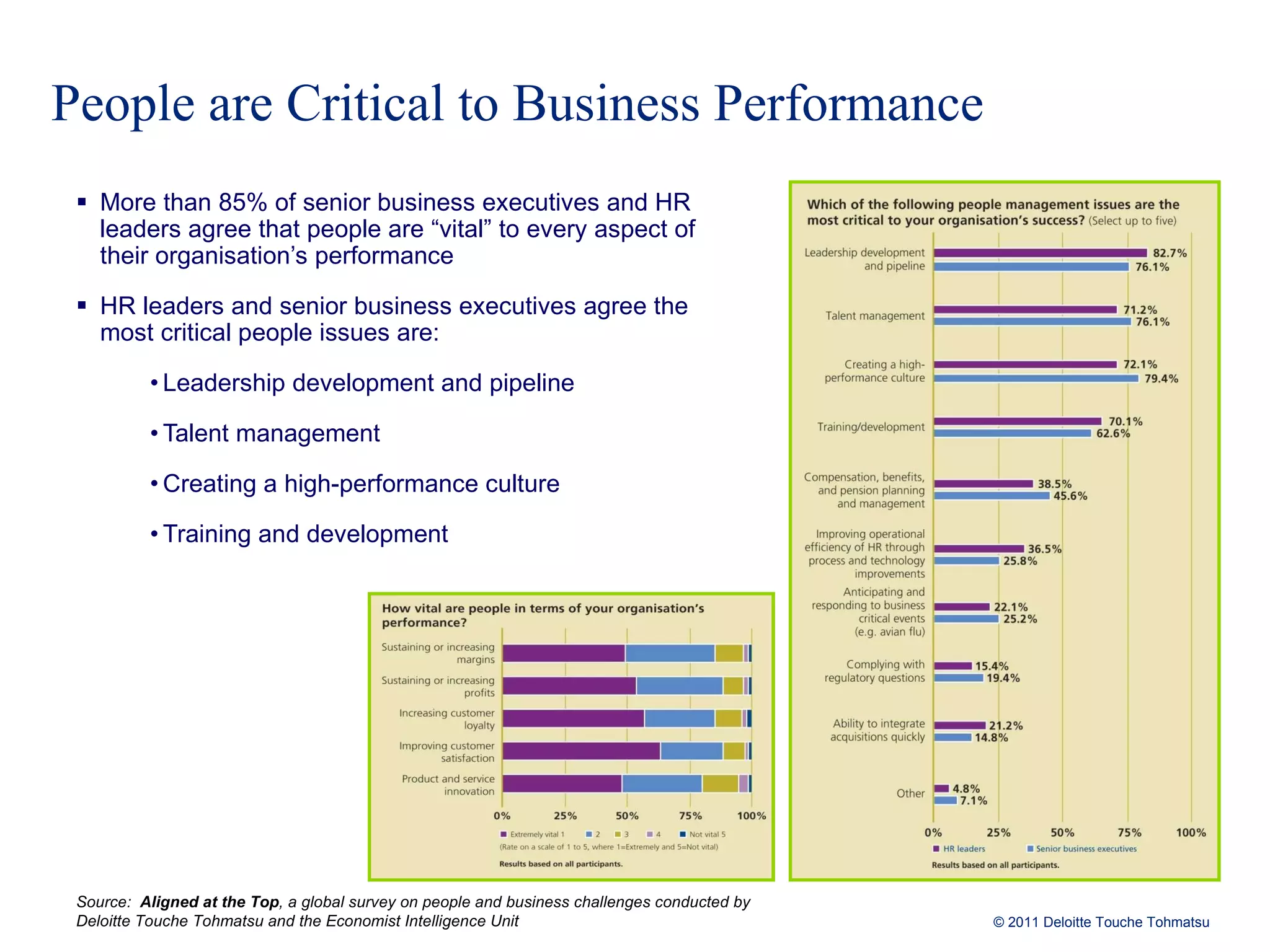
People are Critical to Business Performance More than 85% of senior business executives and HR leaders agree that people are “vital” to every aspect of their organisation’s performance HR leaders and senior business executives agree the most critical people issues are: Leadership development and pipeline Talent management Creating a high-performance culture Training and development Source:  Aligned at the Top ,  a global survey on people and business challenges conducted by Deloitte Touche Tohmatsu and the Economist Intelligence Unit
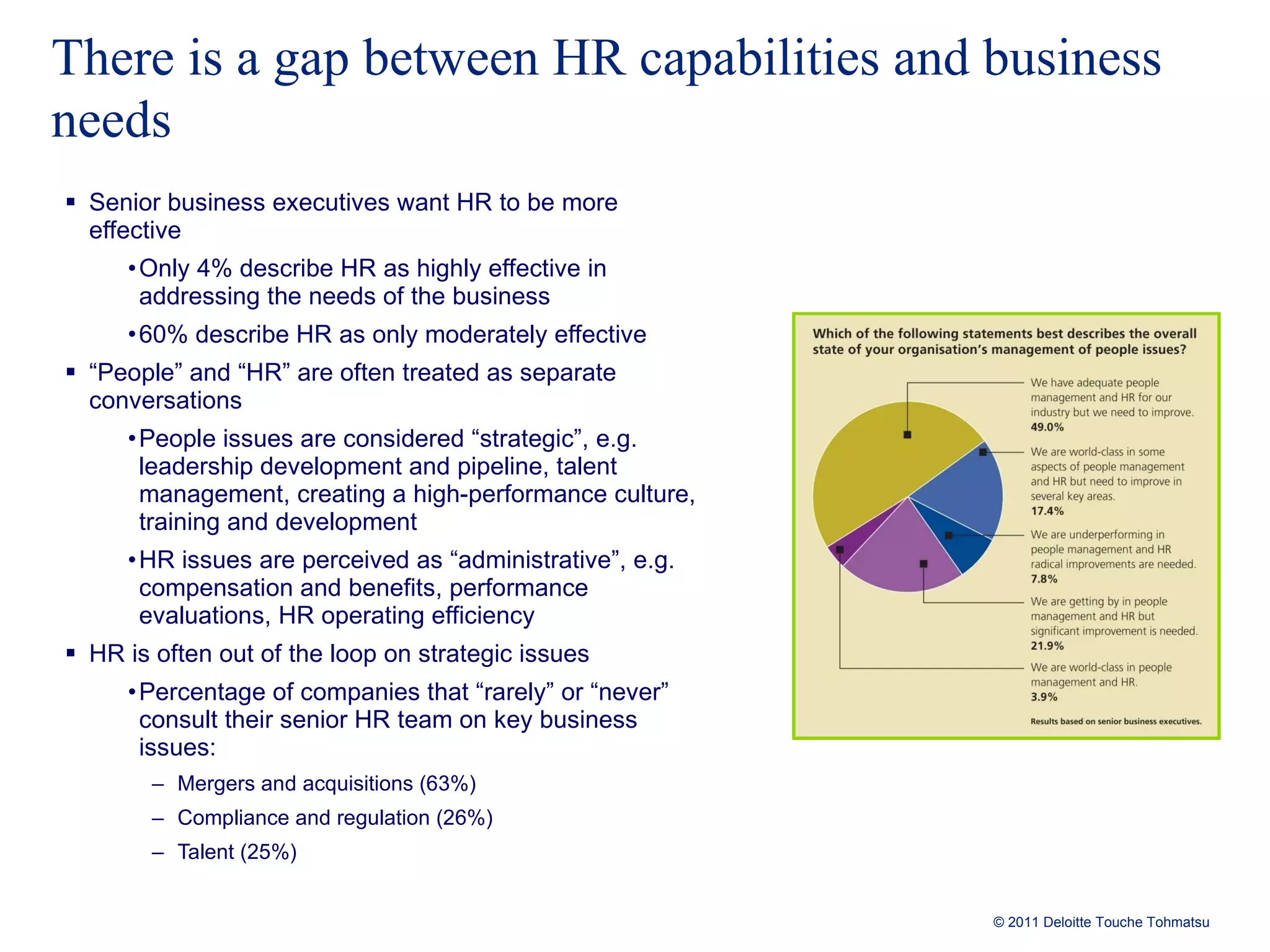
There is a gap between HR capabilities and business needs Senior business executives want HR to be more effective Only 4% describe HR as highly effective in addressing the needs of the business  60% describe HR as only moderately effective “ People” and “HR” are often treated as separate conversations People issues are considered “strategic”, e.g. leadership development and pipeline, talent management, creating a high-performance culture, training and development HR issues are perceived as “administrative”, e.g. compensation and benefits, performance evaluations, HR operating efficiency HR is often out of the loop on strategic issues Percentage of companies that “rarely” or “never” consult their senior HR team on key business issues: Mergers and acquisitions (63%) Compliance and regulation (26%) Talent (25%)
HR Strategy Defining the Value of HR
HR Strategy – Deloitte view A HR strategy should help an organisation  create unique competitive advantage  by outlining  how the HR function and the services it offers  will create business value and address the company’s most pressing strategic challenges.  The strategy should  identify priorities for investment  in HR products and services and in HR service delivery (people, process, technology, operations, etc.) to help address the organisation’s most pressing strategic challenges. The strategy should include a  roadmap   for how the HR function will execute on the strategy. The strategy should also outline the  foundational HR capabilities  required to effectively execute the strategy. Typically, the HR strategy will be a two to three year strategy, but it should be refreshed every year. Before forming your strategy you need to understand the Business
Understanding Business Strategy Defining the Value of HR
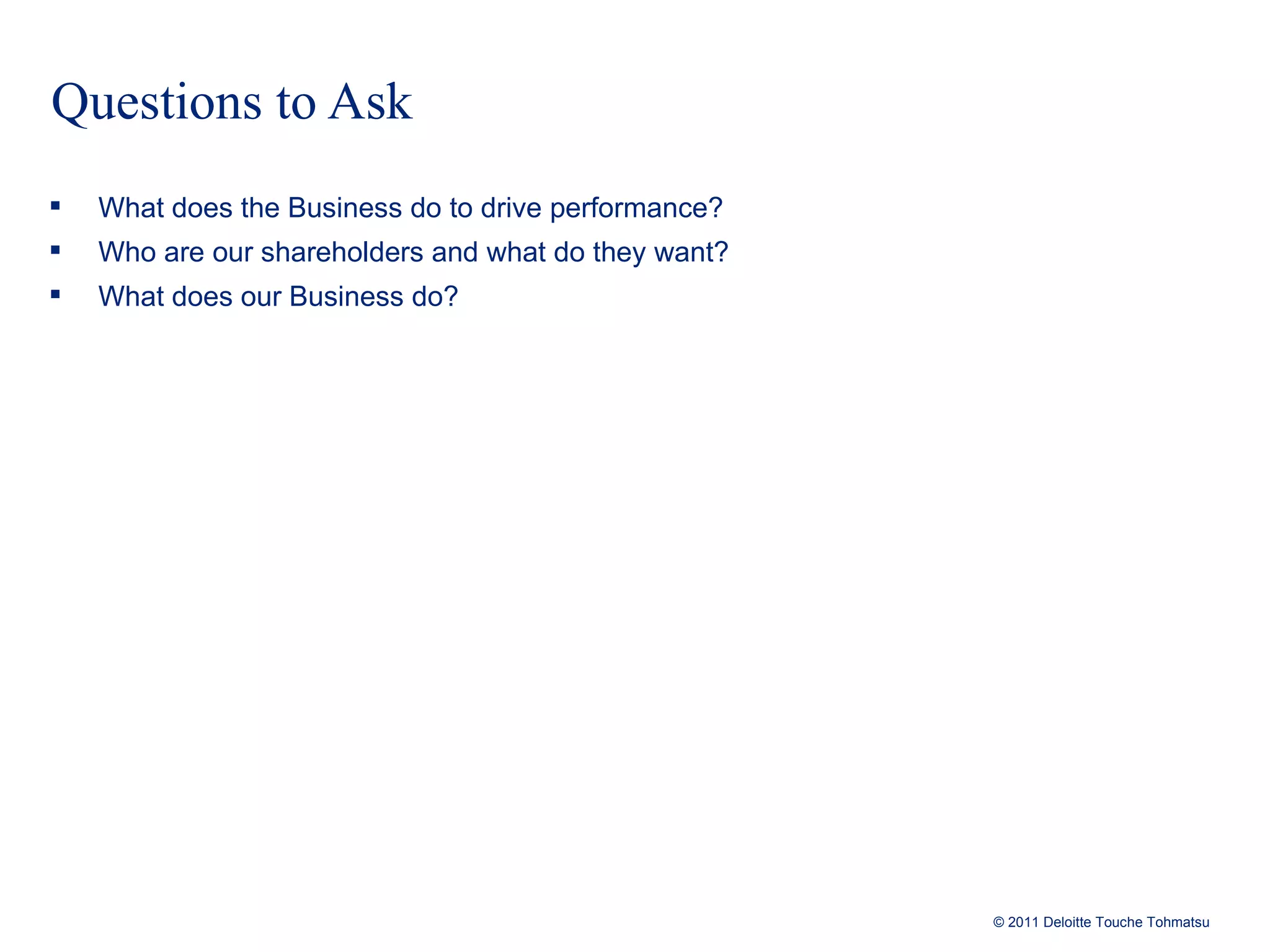
Questions to Ask What does the Business do to drive performance? Who are our shareholders and what do they want? What does our Business do?
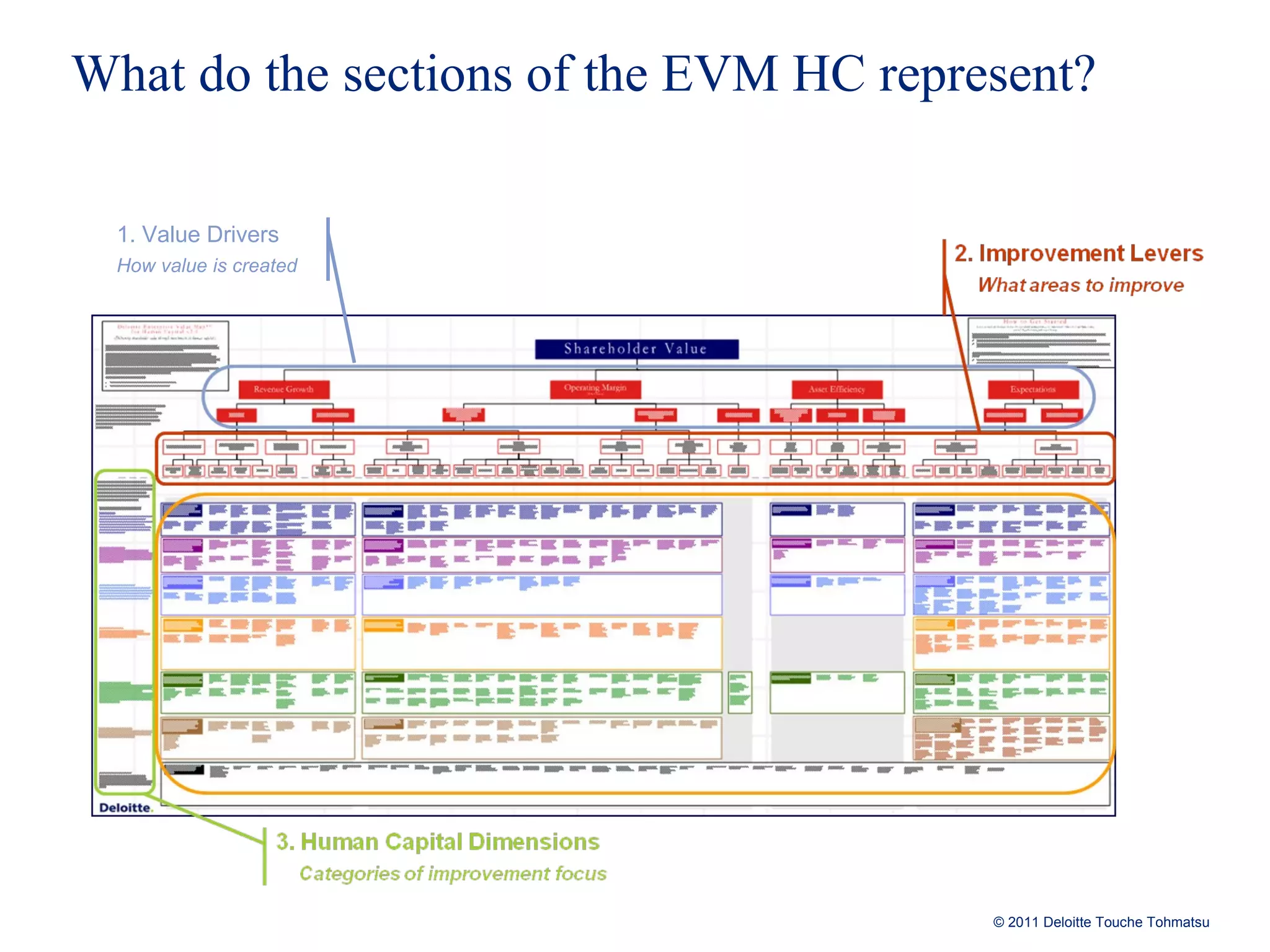
What do the sections of the EVM HC represent? 1. Value Drivers How value is created
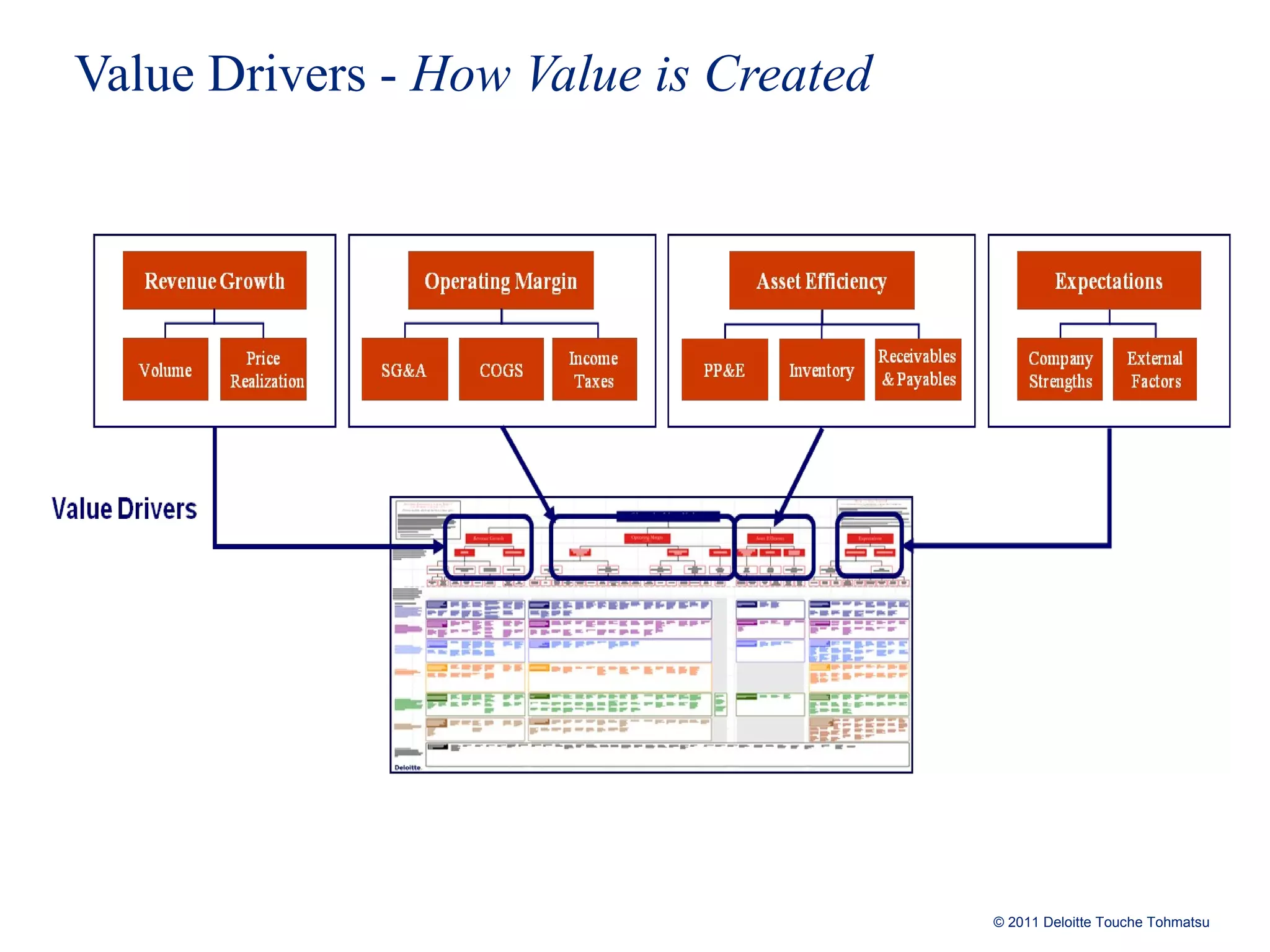
Value Drivers -  How Value is Created
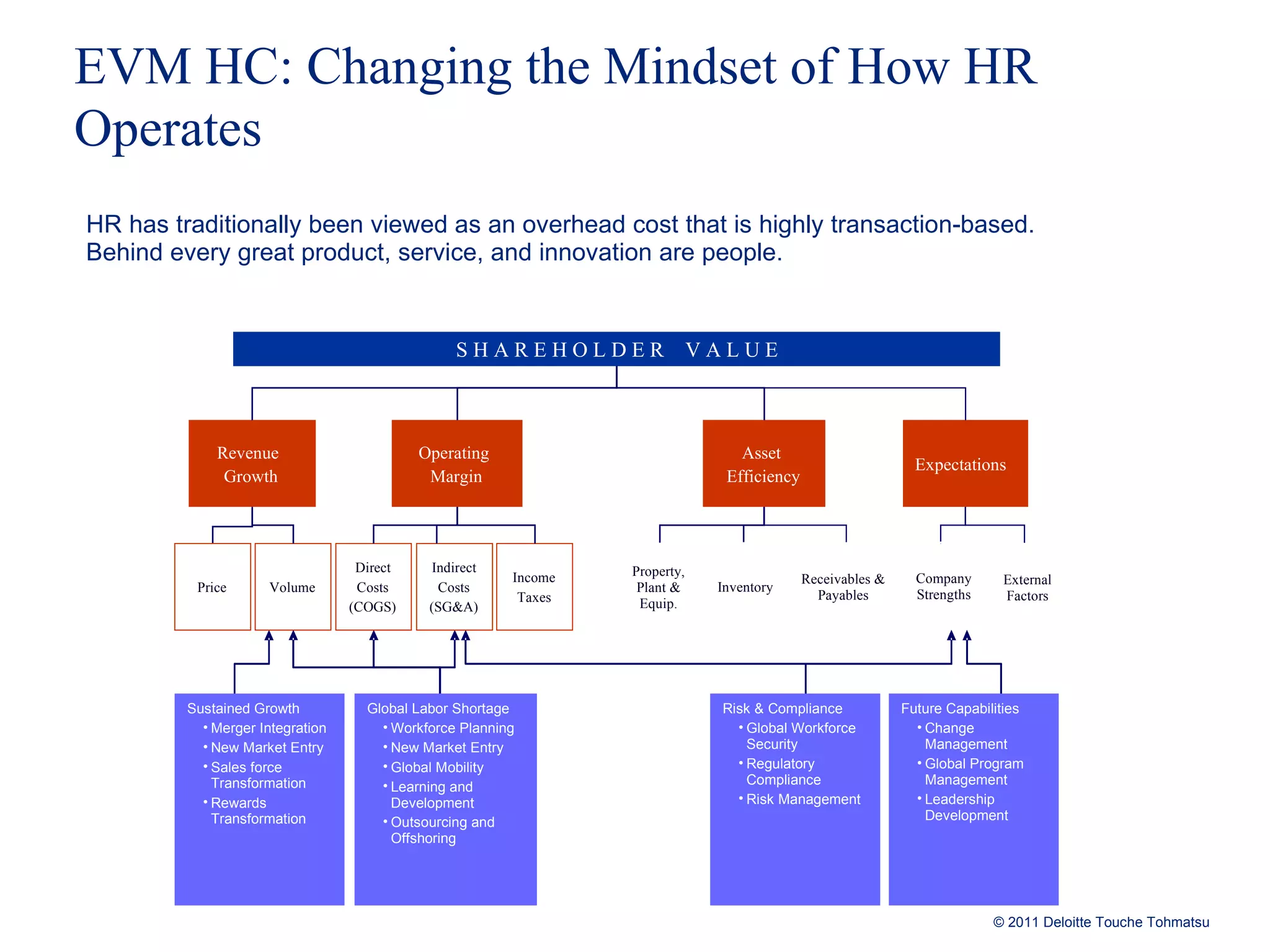
EVM HC: Changing the Mindset of How HR Operates HR has traditionally been viewed as an overhead cost that is highly transaction-based.  Behind every great product, service, and innovation are people.  Sustained Growth Merger Integration New Market Entry Sales force Transformation Rewards Transformation Global Labor Shortage Workforce Planning New Market Entry Global Mobility Learning and Development Outsourcing and Offshoring Risk & Compliance Global Workforce Security Regulatory Compliance Risk Management Future Capabilities Change Management Global Program Management Leadership Development Operating Margin Asset Efficiency Expectations Revenue Growth Volume Direct  Costs (COGS) Indirect  Costs (SG&A) Income  Taxes S H A R E H O L D E R  V A L U E Property, Plant & Equip. Inventory Receivables & Payables Company Strengths External Factors Price
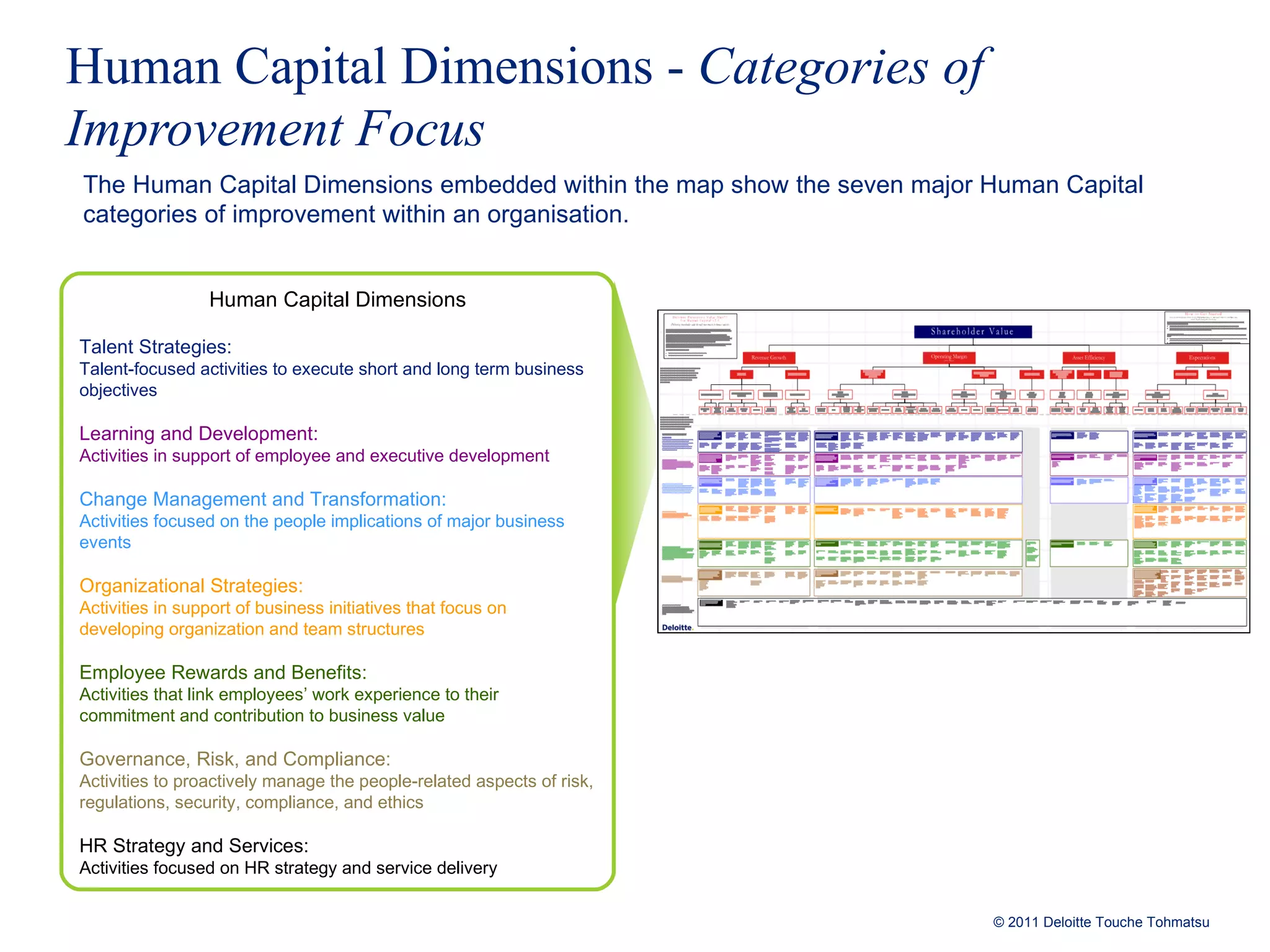
Human Capital Dimensions -  Categories of Improvement Focus The Human Capital Dimensions embedded within the map show the seven major Human Capital categories of improvement within an organisation.  Human Capital Dimensions Talent Strategies: Talent-focused activities to execute short and long term business objectives Learning and Development: Activities in support of employee and executive development  Change Management and Transformation: Activities focused on the people implications of major business events Organizational Strategies: Activities in support of business initiatives that focus on developing organization and team structures Employee Rewards and Benefits: Activities that link employees’ work experience to their commitment and contribution to business value Governance, Risk, and Compliance: Activities to proactively manage the people-related aspects of risk, regulations, security, compliance, and ethics HR Strategy and Services:  Activities focused on HR strategy and service delivery
Define HR Strategy Defining the Value of HR
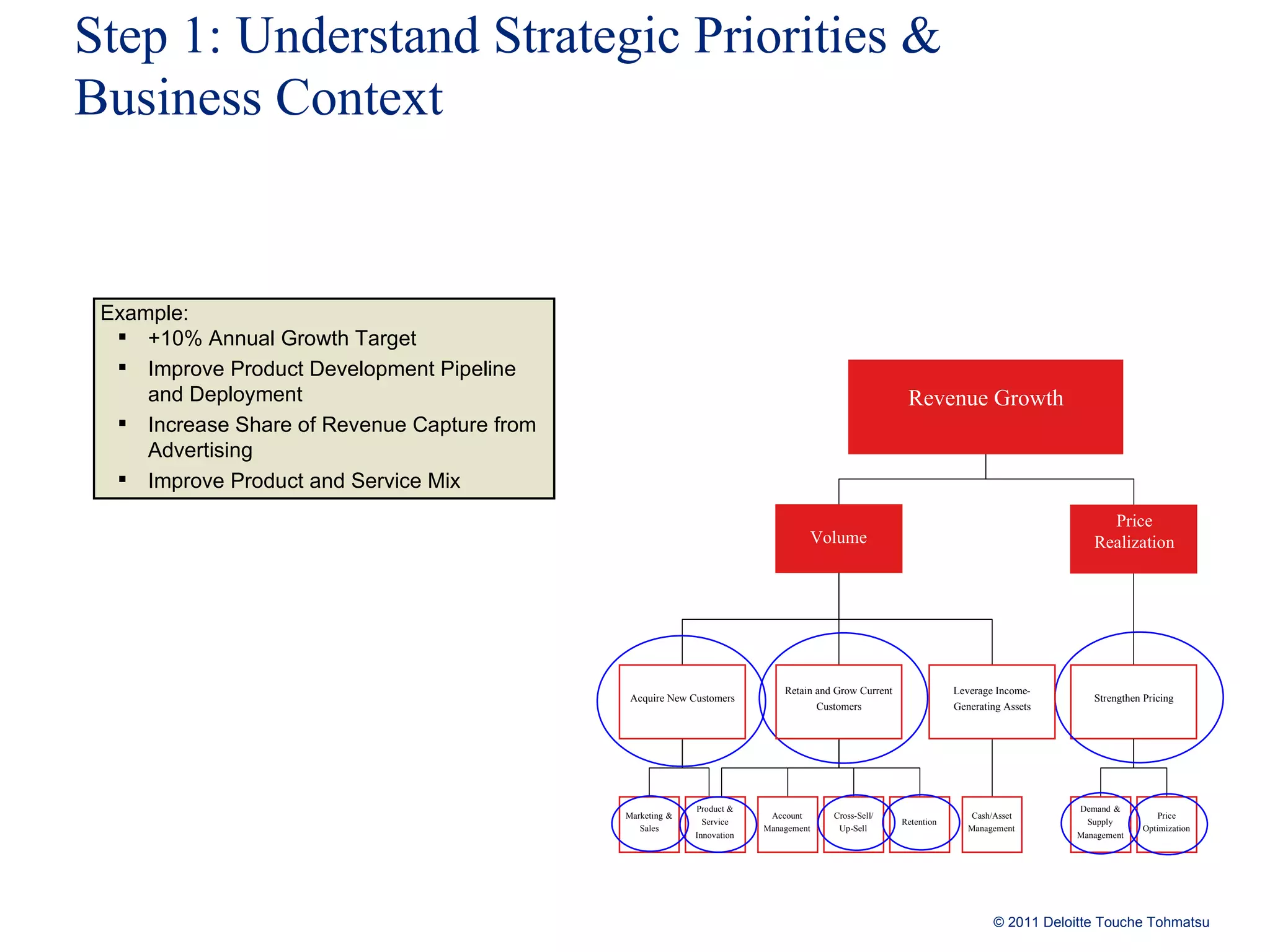
Step 1: Understand Strategic Priorities &  Business Context Example: +10% Annual Growth Target Improve Product Development Pipeline and Deployment Increase Share of Revenue Capture from Advertising Improve Product and Service Mix Acquire New Customers Retain and Grow Current  Customers Leverage Income - Strengthen Pricing Marketing  &  Sales Account  Management Cross - Sell / Up - Sell Retention Demand  &  Supply  Management Price  Optimization Product  &  Service  Innovation Cash / Asset  Management Volume Price Realization Revenue Growth Generating Assets
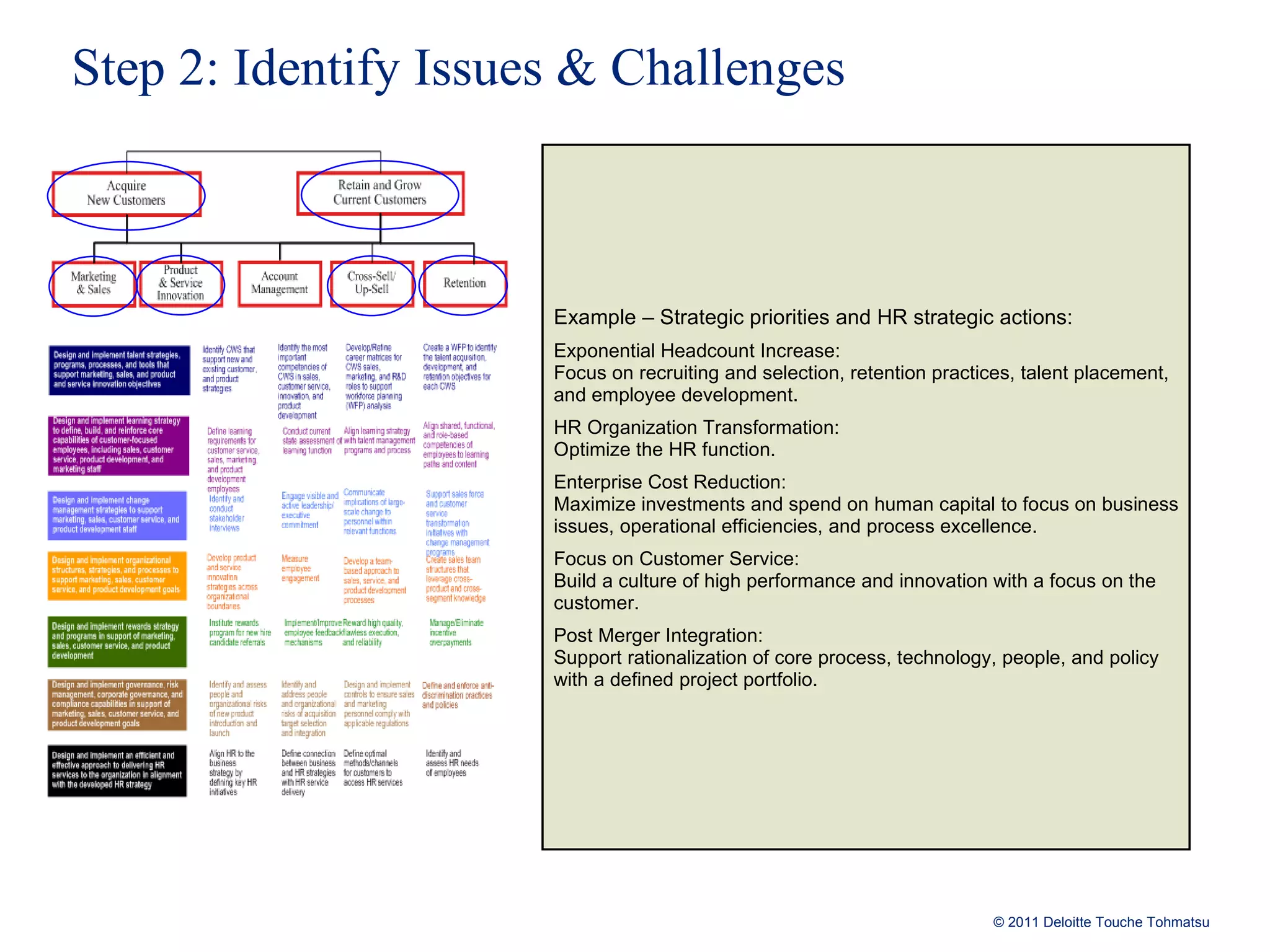
Step 2: Identify Issues & Challenges Example – Strategic priorities and HR strategic actions:  Exponential Headcount Increase: Focus on recruiting and selection, retention practices, talent placement, and employee development. HR Organization Transformation: Optimize the HR function. Enterprise Cost Reduction: Maximize investments and spend on human capital to focus on business issues, operational efficiencies, and process excellence. Focus on Customer Service: Build a culture of high performance and innovation with a focus on the customer. Post Merger Integration: Support rationalization of core process, technology, people, and policy with a defined project portfolio.
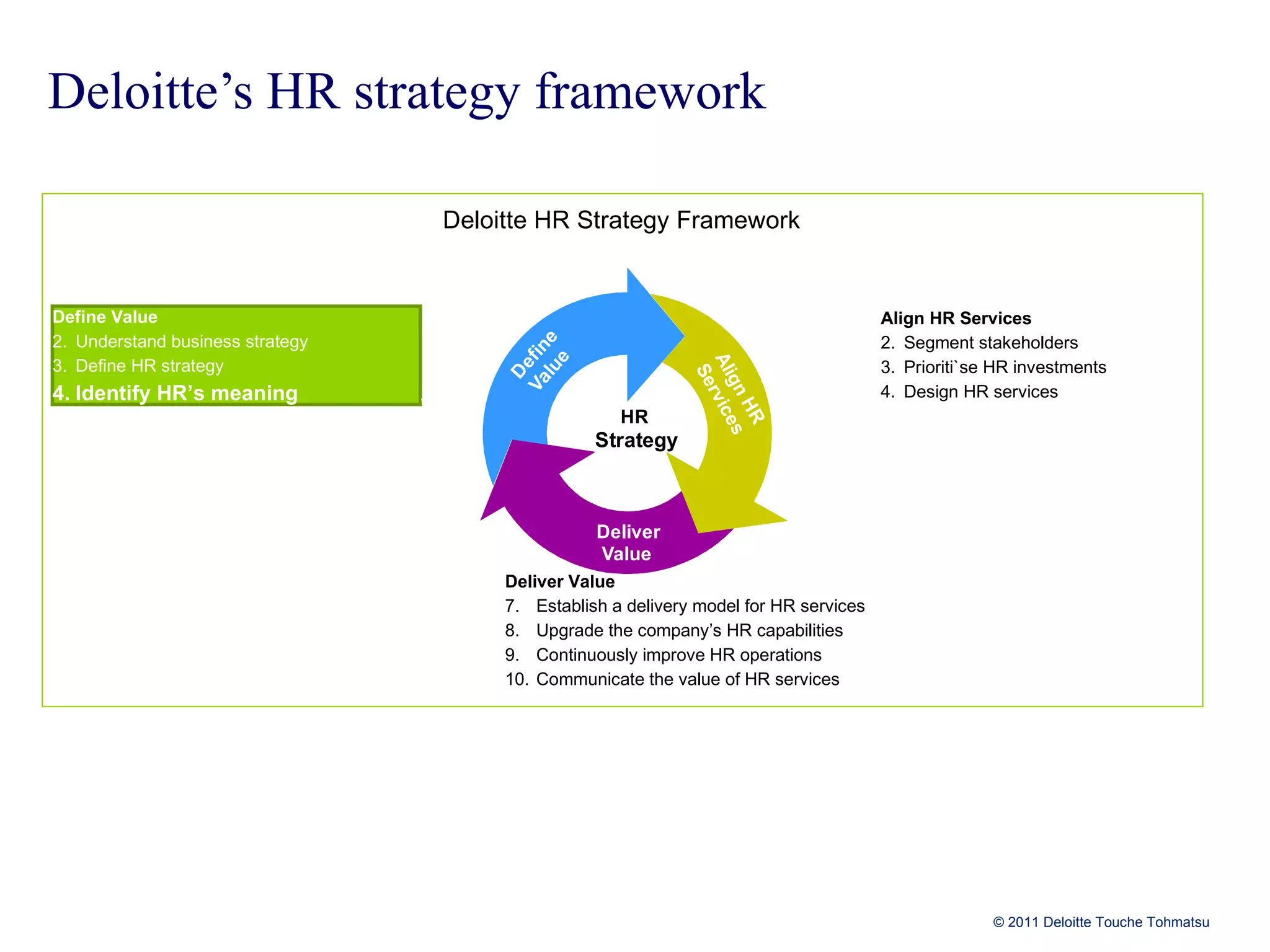
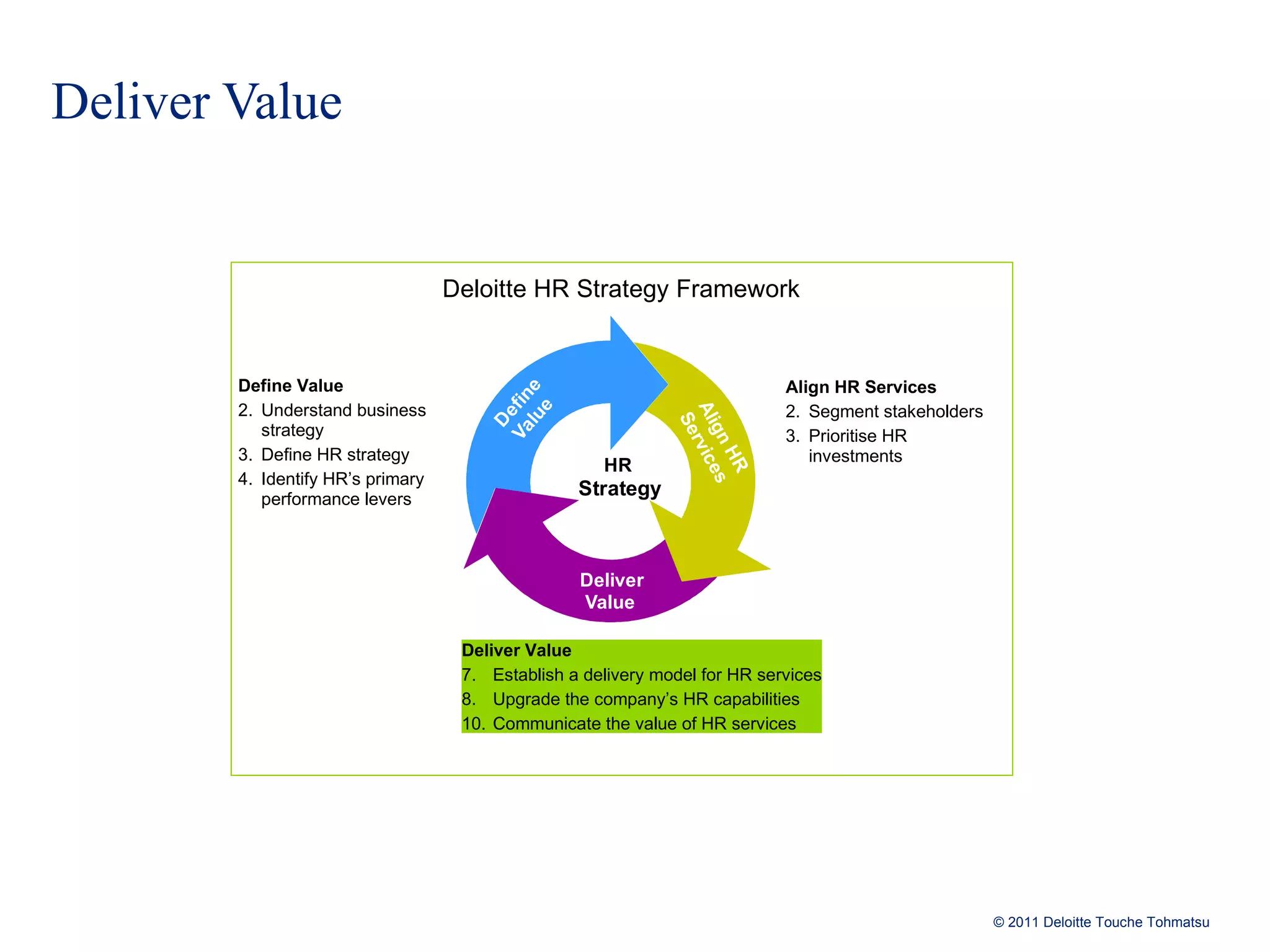
Deloitte’s HR strategy framework Deloitte HR Strategy Framework Define Value Understand business strategy Define HR strategy Identify HR’s meaning Deliver Value 7. Establish a delivery model for HR services 8. Upgrade the company’s HR capabilities 9. Continuously improve HR operations 10. Communicate the value of HR services Define Value Align HR Services Segment stakeholders Prioriti`se HR investments Design HR services
Measuring Impact of HR Defining the Value of HR
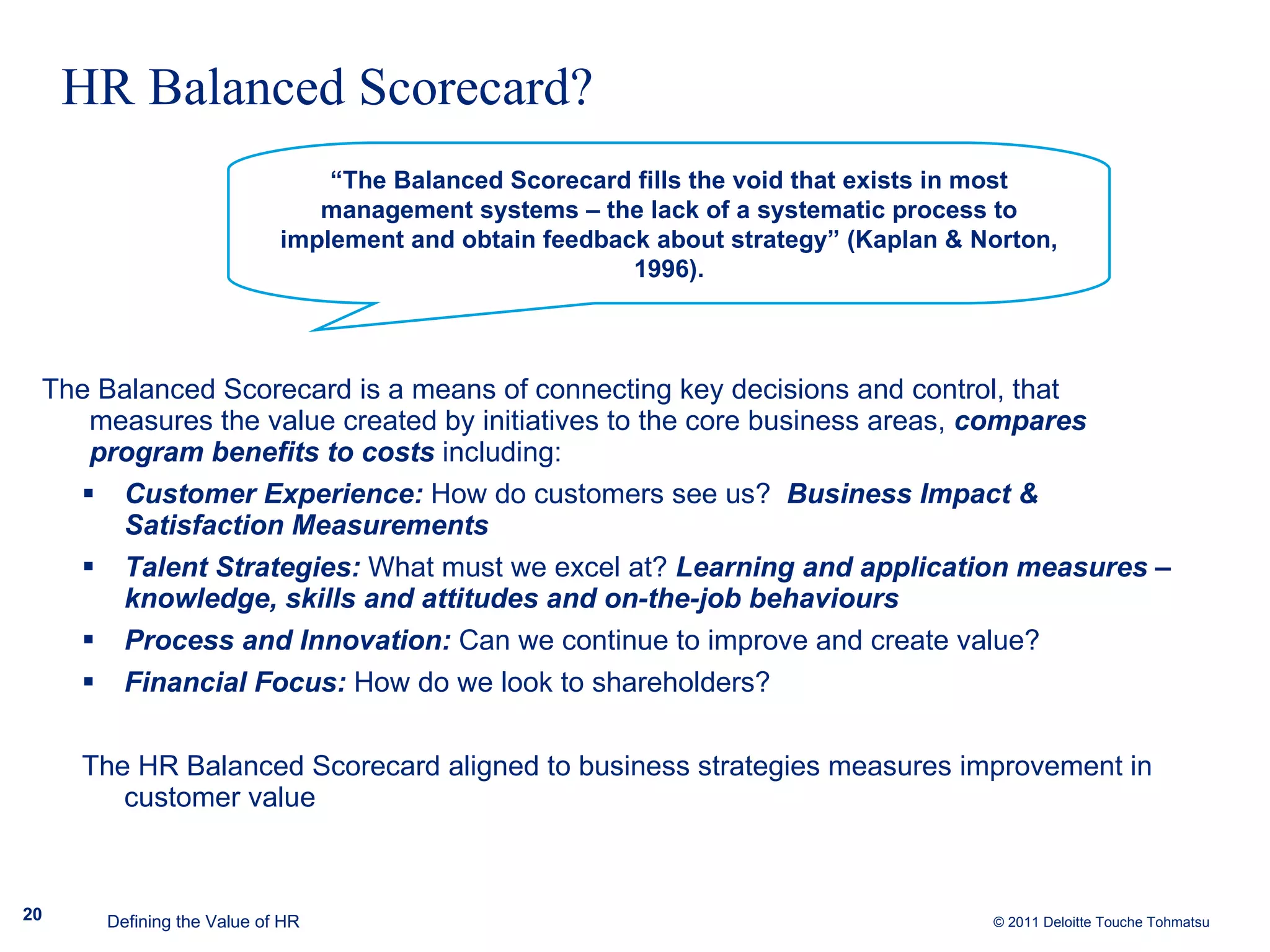
HR Balanced Scorecard? The Balanced Scorecard is a means of connecting key decisions and control, that measures the value created by initiatives to the core business areas,  compares program benefits to costs  including: Customer Experience:  How do customers see us?  Business Impact & Satisfaction Measurements Talent Strategies:  What must we excel at?  Learning and application measures – knowledge, skills and attitudes and on-the-job behaviours Process and Innovation:  Can we continue to improve and create value?   Financial Focus:  How do we look to shareholders?  The HR Balanced Scorecard aligned to business strategies measures improvement in customer value Defining the Value of HR “ The Balanced Scorecard fills the void that exists in most management systems – the lack of a systematic process to implement and obtain feedback about strategy” (Kaplan & Norton, 1996).
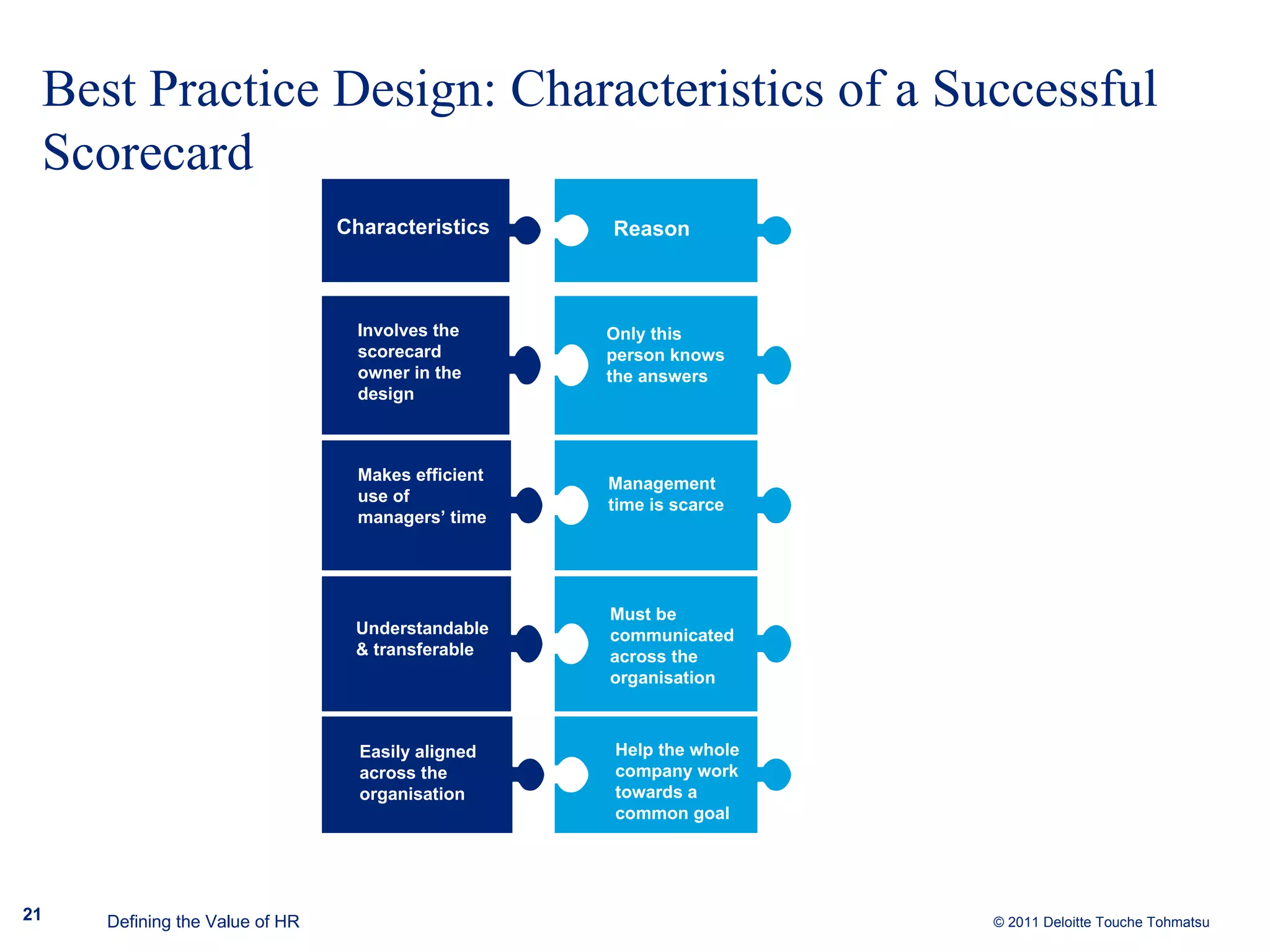
Best Practice Design: Characteristics of a Successful Scorecard Defining the Value of HR Involves the scorecard owner in the design Characteristics Makes efficient use of managers’ time Understandable & transferable Easily aligned across the organisation Only this person knows the answers Management time is scarce Must be communicated across the organisation Reason Help the whole company work towards a common goal
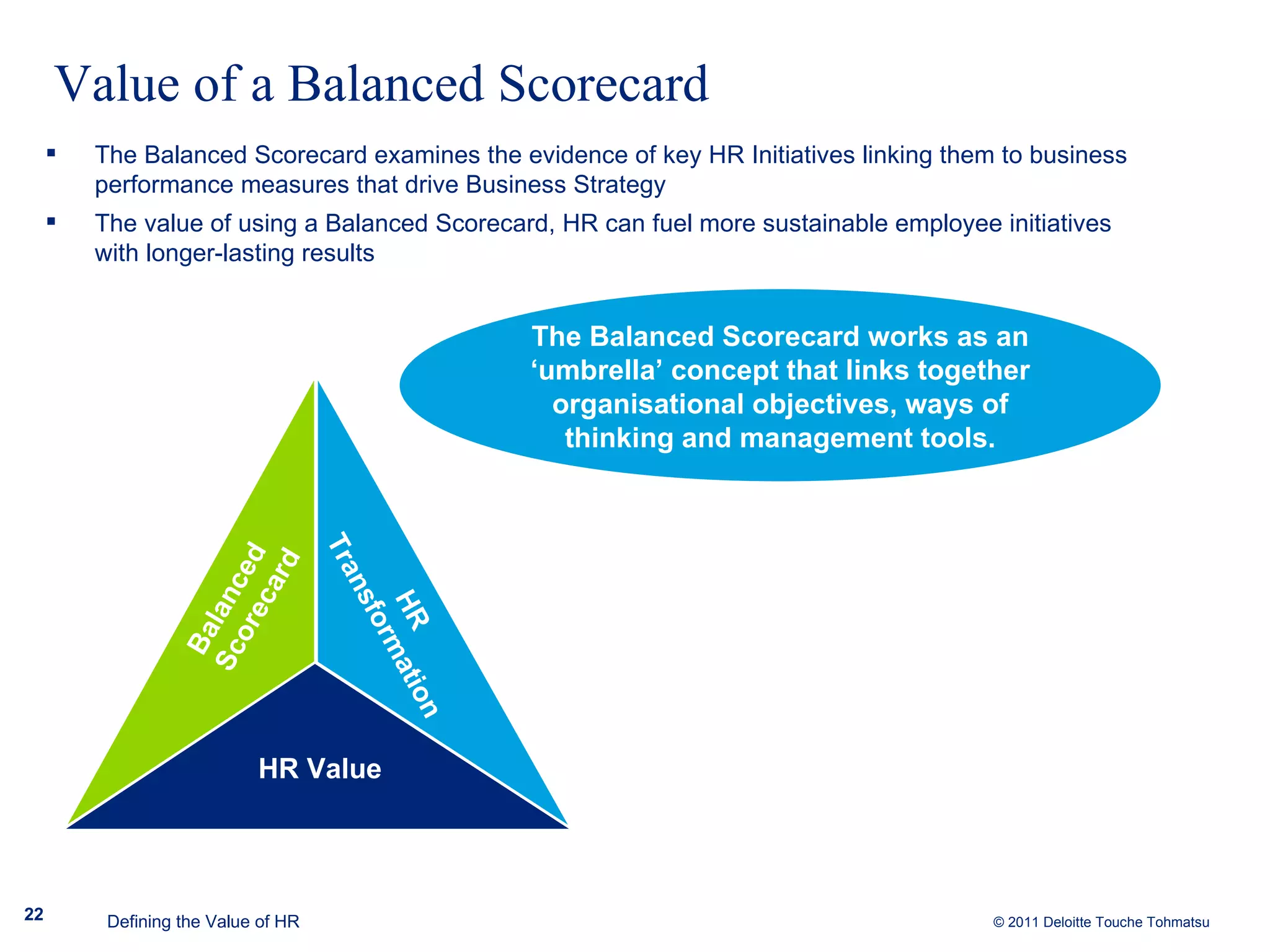
Value of a Balanced Scorecard HR Transformation HR Value Defining the Value of HR HR Transformation HR Value Balanced Scorecard The Balanced Scorecard examines the evidence of key HR Initiatives linking them to business performance measures that drive Business Strategy The value of using a Balanced Scorecard, HR can fuel more sustainable employee initiatives with longer-lasting results The Balanced Scorecard works as an ‘umbrella’ concept that links together organisational objectives, ways of thinking and management tools.
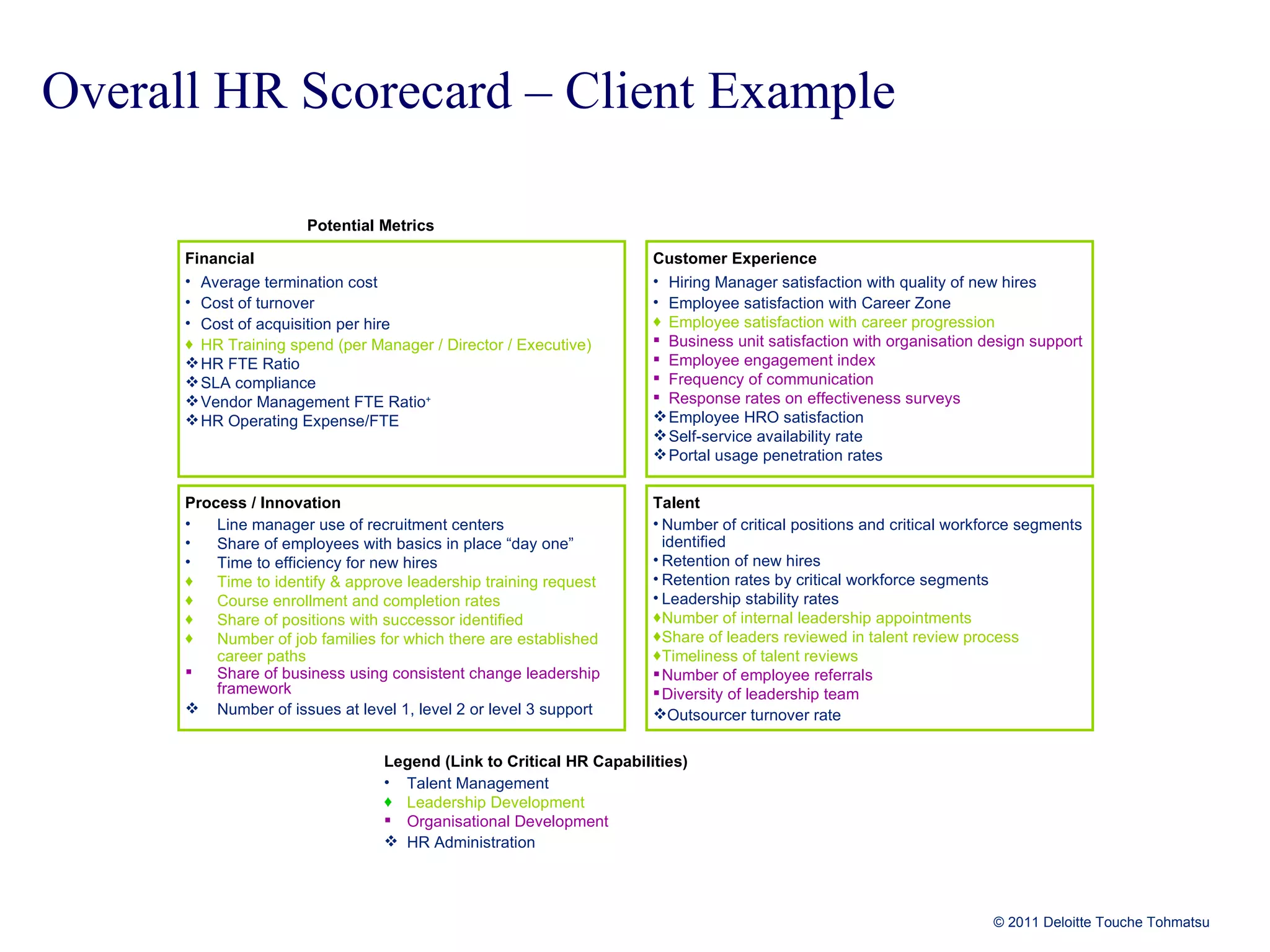
Overall HR Scorecard – Client Example Legend (Link to Critical HR Capabilities) Talent Management Leadership Development Organisational Development HR Administration Financial   Average termination cost  Cost of turnover Cost of acquisition per hire  HR Training spend (per Manager / Director / Executive) HR FTE Ratio SLA compliance  Vendor Management FTE Ratio + HR Operating Expense/FTE  Customer   Experience Hiring Manager satisfaction with quality of new hires Employee satisfaction with Career Zone Employee satisfaction with career progression Business unit satisfaction with organisation design support  Employee engagement index Frequency of communication  Response rates on effectiveness surveys Employee HRO satisfaction  Self-service availability rate  Portal usage penetration rates Process / Innovation Line manager use of recruitment centers Share of employees with basics in place “day one” Time to efficiency for new hires Time to identify & approve leadership training request  Course enrollment and completion rates  Share of positions with successor identified  Number of job families for which there are established career paths  Share of business using consistent change leadership framework Number of issues at level 1, level 2 or level 3 support Talent Number of critical positions and critical workforce segments identified Retention of new hires Retention rates by critical workforce segments Leadership stability rates Number of internal leadership appointments Share of leaders reviewed in talent review process Timeliness of talent reviews Number of employee referrals  Diversity of leadership team Outsourcer turnover rate Potential Metrics
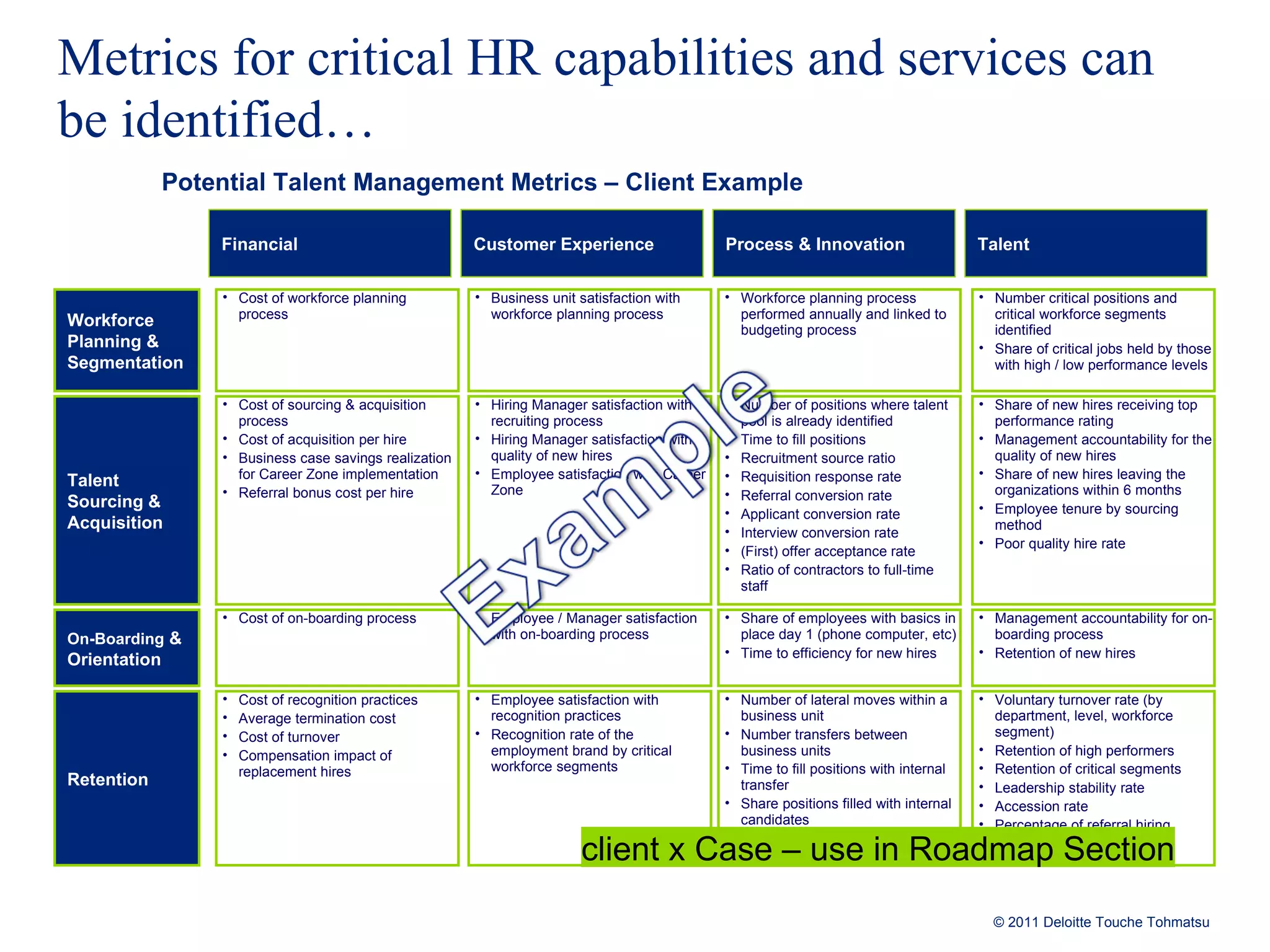
Metrics for critical HR capabilities and services can be identified… Financial Customer Experience Process & Innovation Talent client x Case – use in Roadmap Section Potential Talent Management Metrics – Client Example Workforce Planning & Segmentation Cost of workforce planning process Business unit satisfaction with workforce planning process   Workforce planning process performed annually and linked to budgeting process Number critical positions and critical workforce segments identified Share of critical jobs held by those with high / low performance levels   Talent Sourcing & Acquisition Cost of sourcing & acquisition process Cost of acquisition per hire Business case savings realization for Career Zone implementation Referral bonus cost per hire  Hiring Manager satisfaction with recruiting process Hiring Manager satisfaction with quality of new hires Employee satisfaction with Career Zone Number of positions where talent pool is already identified  Time to fill positions  Recruitment source ratio Requisition response rate Referral conversion rate Applicant conversion rate Interview conversion rate (First) offer acceptance rate  Ratio of contractors to full-time staff Share of new hires receiving top performance rating Management accountability for the quality of new hires Share of new hires leaving the organizations within 6 months Employee tenure by sourcing method Poor quality hire rate  On-Boarding  & Orientation Cost of on-boarding process   Employee / Manager satisfaction with on-boarding process   Share of employees with basics in place day 1 (phone computer, etc) Time to efficiency for new hires Management accountability for on-boarding process Retention of new hires  Retention Cost of recognition practices Average termination cost  Cost of turnover  Compensation impact of replacement hires  Employee satisfaction with recognition practices Recognition rate of the employment brand by critical workforce segments   Number of lateral moves within a business unit Number transfers between business units Time to fill positions with internal transfer Share positions filled with internal candidates  Number of recognition awards granted Voluntary turnover rate (by department, level, workforce segment) Retention of high performers Retention of critical segments  Leadership stability rate Accession rate  Percentage of referral hiring
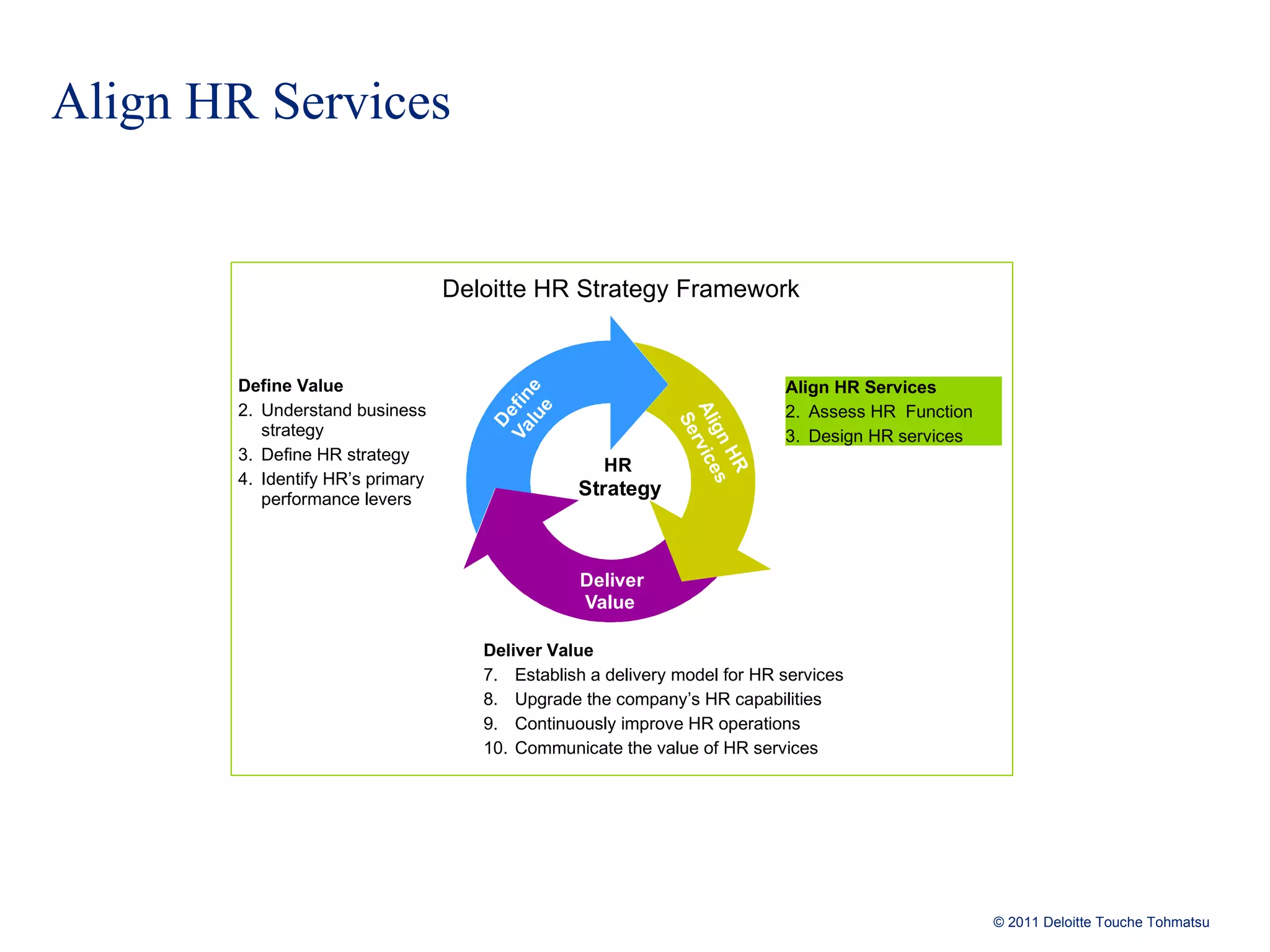
Align HR Services Deloitte HR Strategy Framework Define Value Understand business strategy Define HR strategy Identify HR’s primary performance levers Deliver Value 7. Establish a delivery model for HR services 8. Upgrade the company’s HR capabilities 9. Continuously improve HR operations 10. Communicate the value of HR services Define Value Align HR Services Assess HR  Function Design HR services
Assessing your HR Function Defining the Value of HR
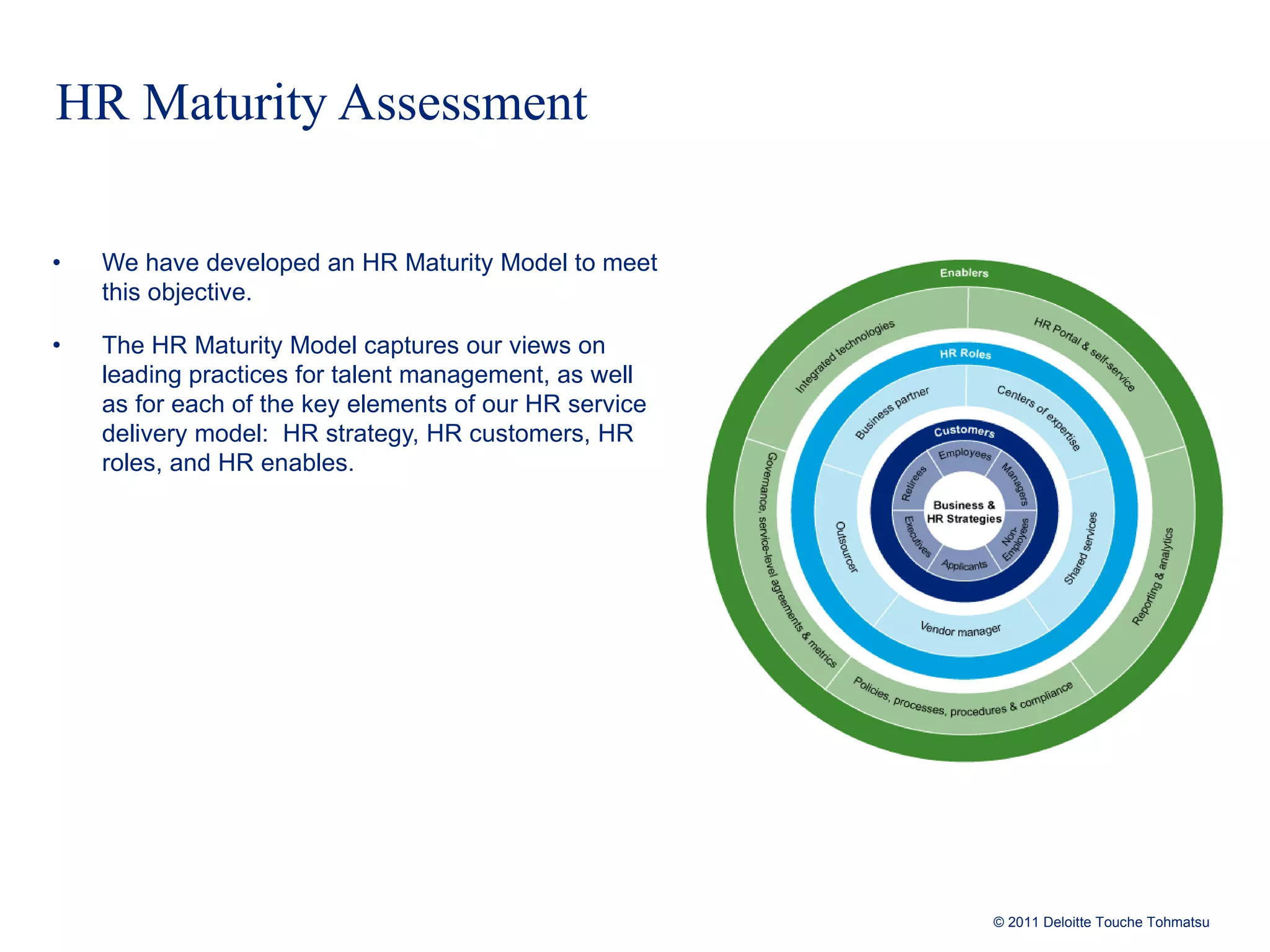
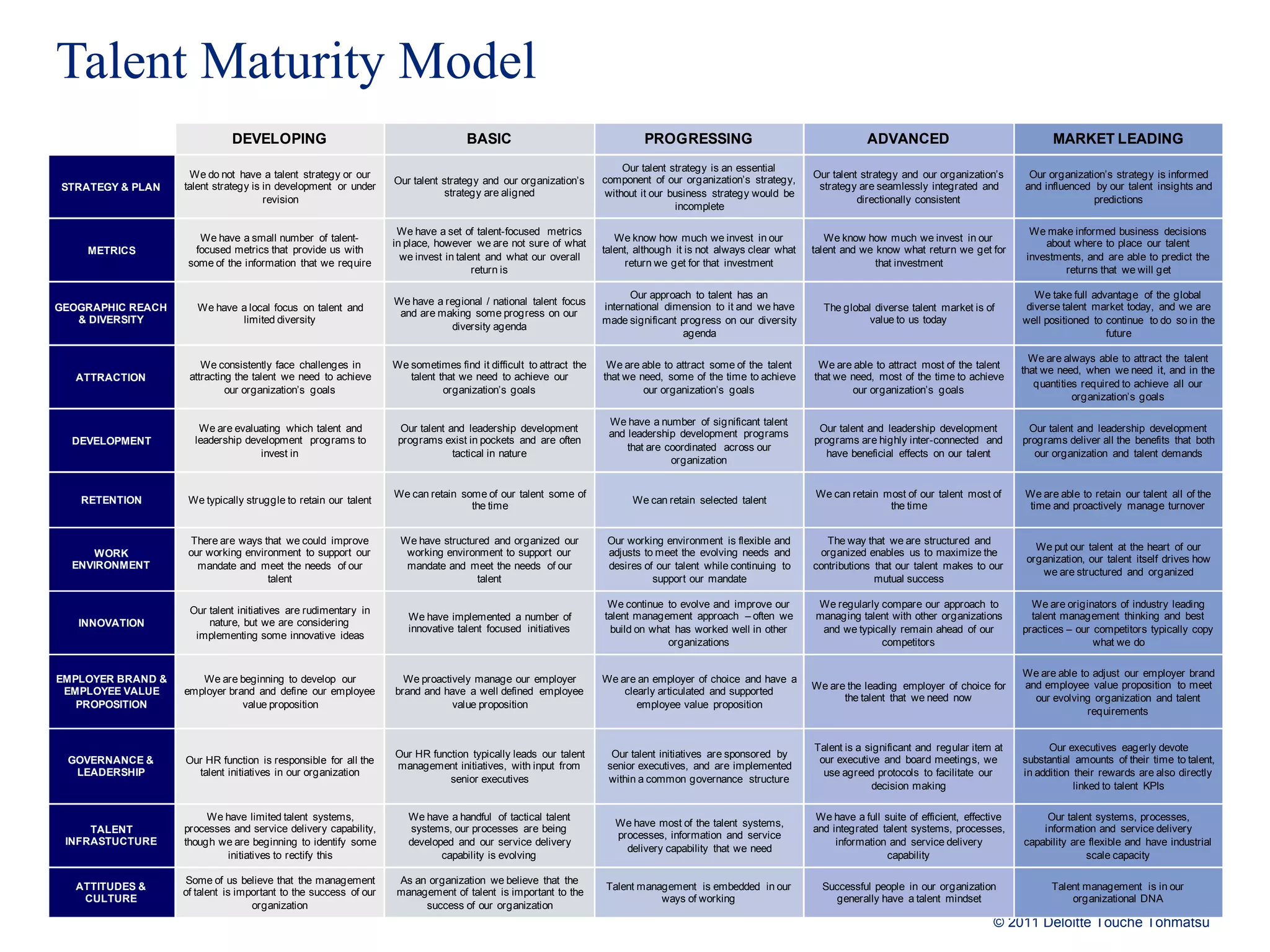
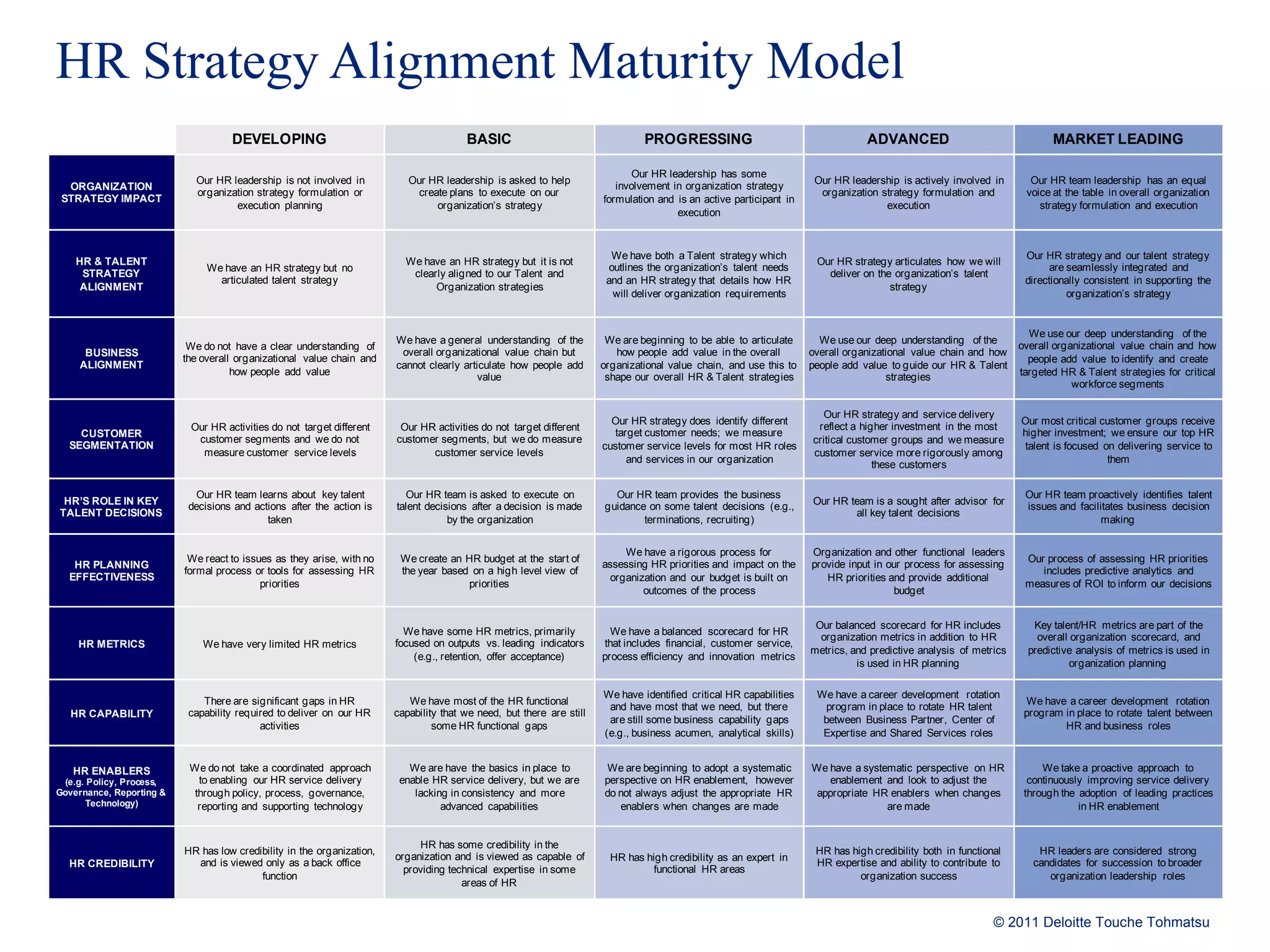
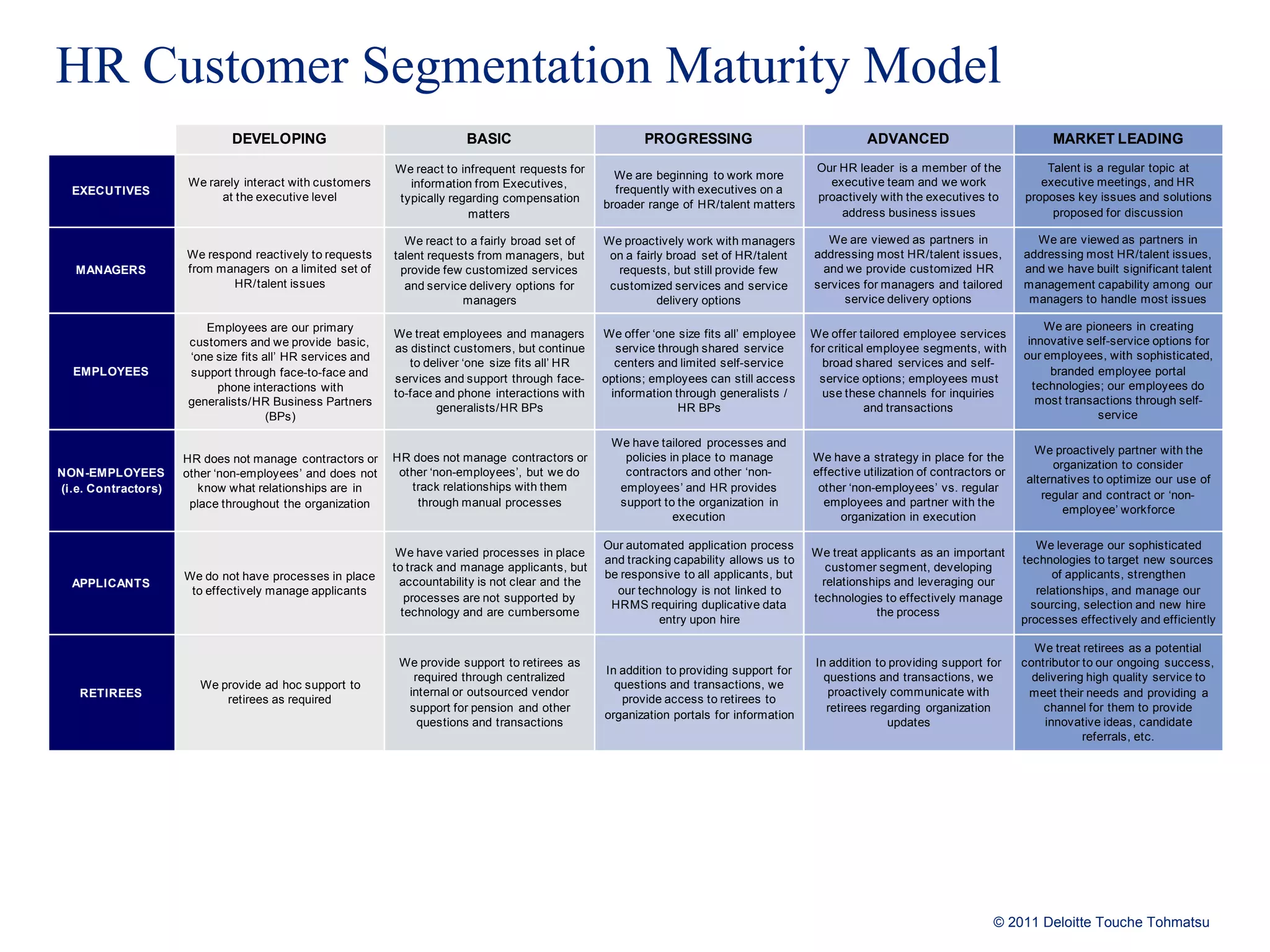
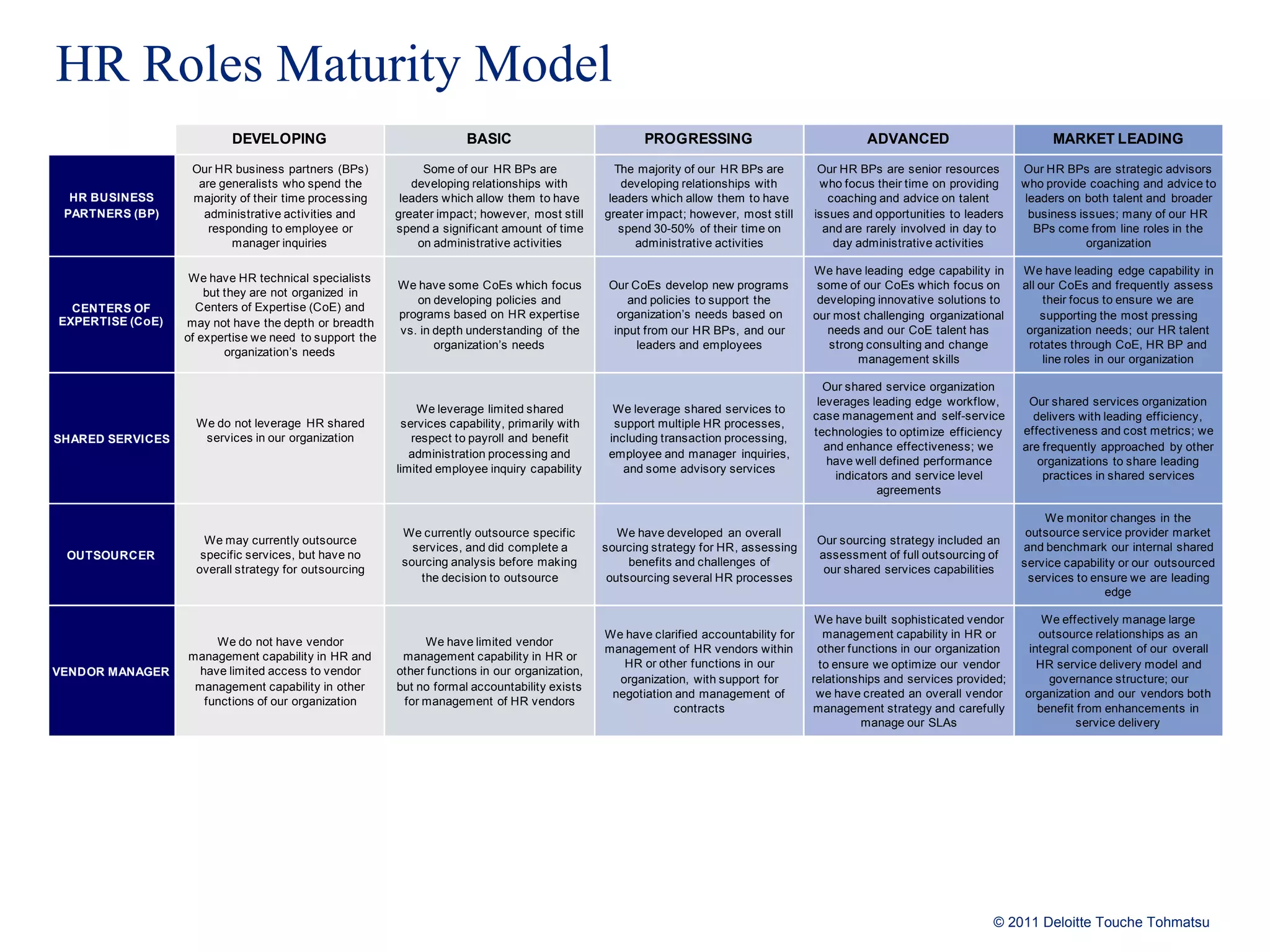
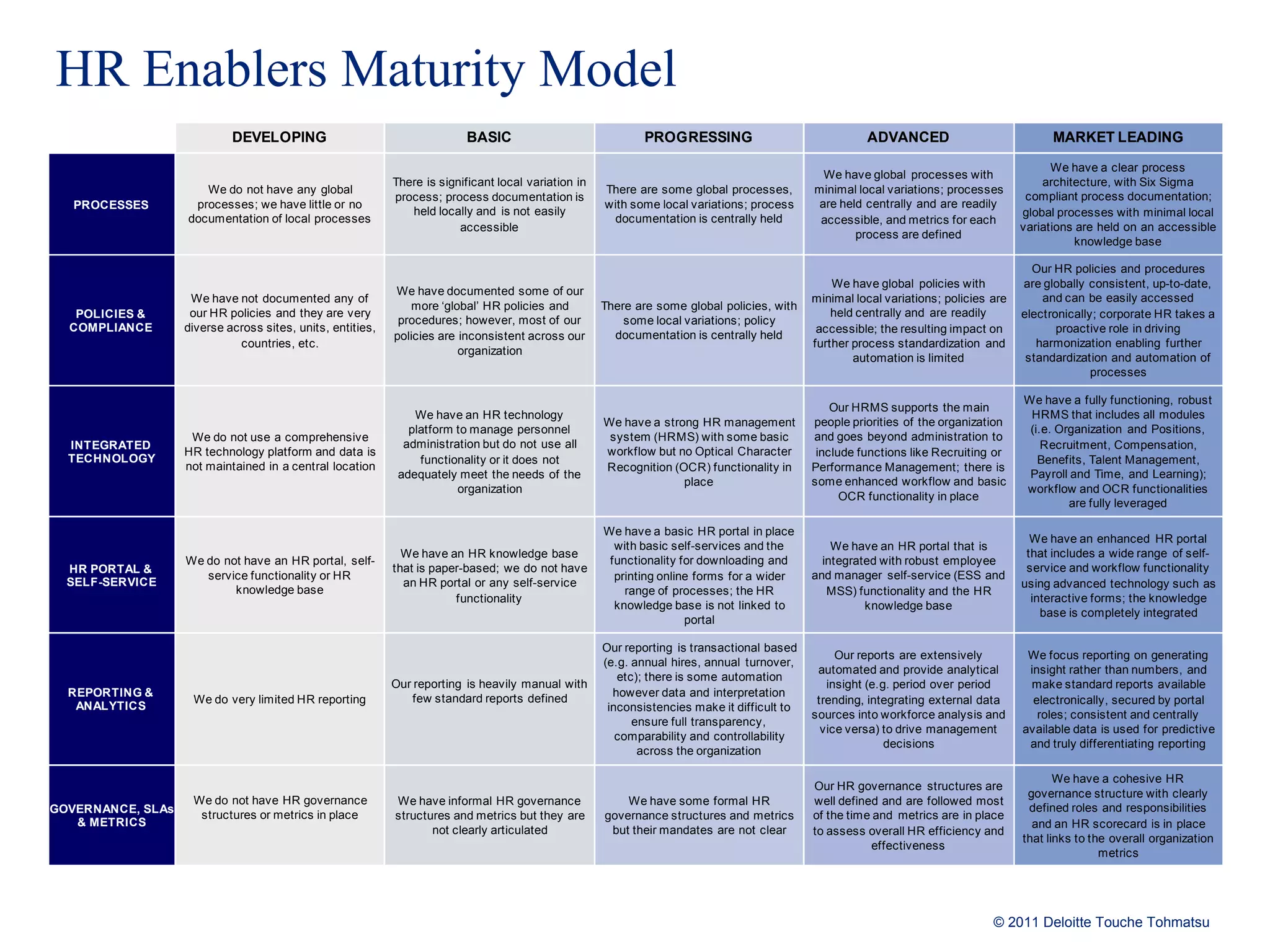
HR Maturity Assessment We have developed an HR Maturity Model to meet this objective.  The HR Maturity Model captures our views on leading practices for talent management, as well as for each of the key elements of our HR service delivery model:  HR strategy, HR customers, HR roles, and HR enables.
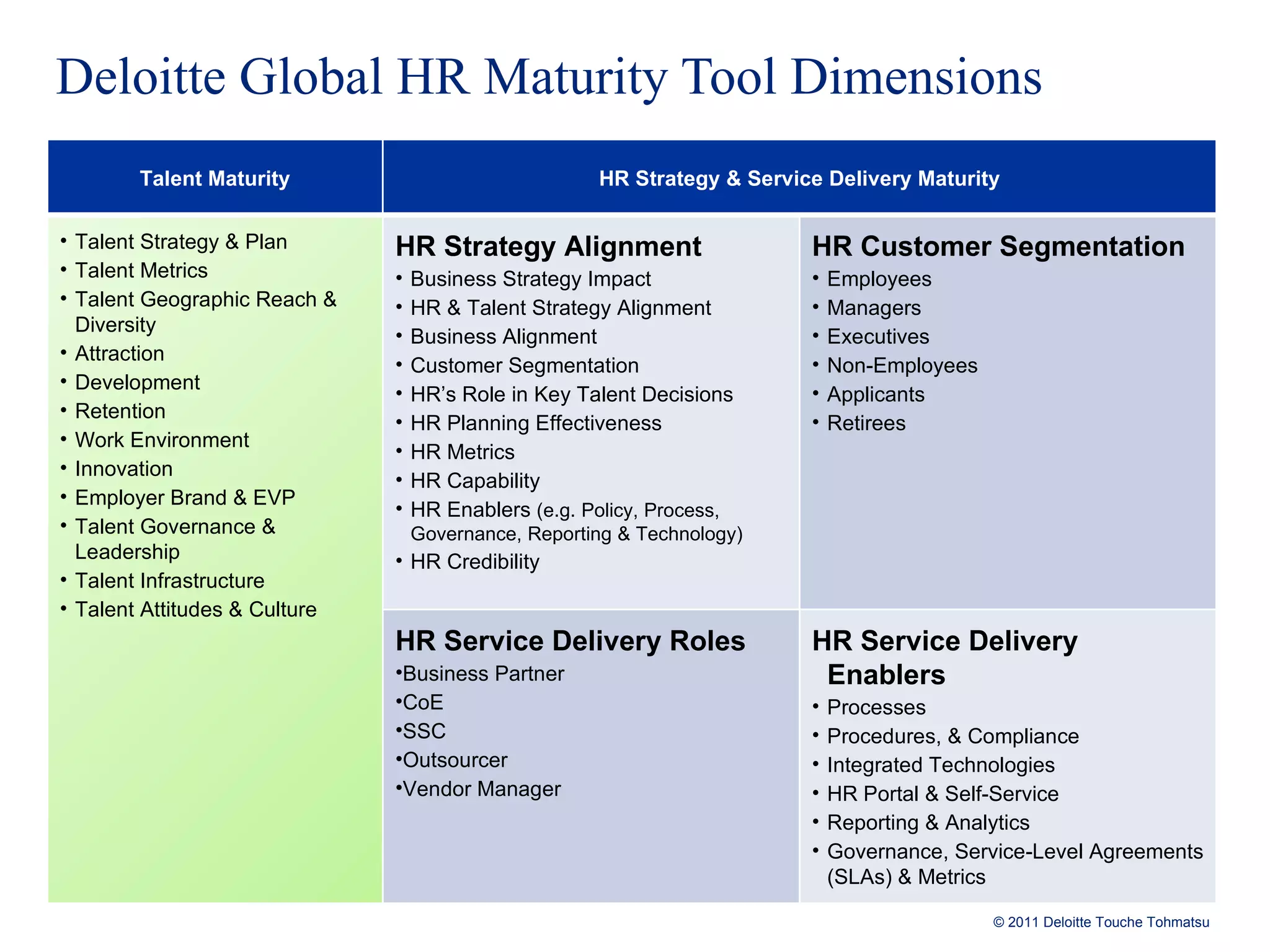
Deloitte Global HR Maturity Tool Dimensions Talent Maturity HR Strategy & Service Delivery Maturity Talent Strategy & Plan Talent Metrics Talent Geographic Reach & Diversity Attraction Development Retention Work Environment Innovation Employer Brand & EVP Talent Governance & Leadership Talent Infrastructure Talent Attitudes & Culture HR Strategy Alignment Business Strategy Impact HR & Talent Strategy Alignment Business Alignment Customer Segmentation HR’s Role in Key Talent Decisions HR Planning Effectiveness HR Metrics HR Capability  HR Enablers  (e.g. Policy, Process, Governance, Reporting & Technology) HR Credibility HR Customer Segmentation  Employees  Managers Executives Non-Employees Applicants Retirees HR Service Delivery Roles Business Partner CoE SSC Outsourcer Vendor Manager HR Service Delivery Enablers Processes Procedures, & Compliance Integrated Technologies HR Portal & Self-Service Reporting & Analytics Governance, Service-Level Agreements (SLAs) & Metrics
Talent Maturity Model
HR Strategy Alignment Maturity Model
HR Customer Segmentation Maturity Model
HR Roles Maturity Model
HR Enablers Maturity Model
Deliver Value Deloitte HR Strategy Framework Define Value Understand business strategy Define HR strategy Identify HR’s primary performance levers Deliver Value 7. Establish a delivery model for HR services 8. Upgrade the company’s HR capabilities 10. Communicate the value of HR services Define Value Align HR Services Segment stakeholders Prioritise HR investments
Establish and Re-assess HR Service Delivery Model Defining the Value of HR
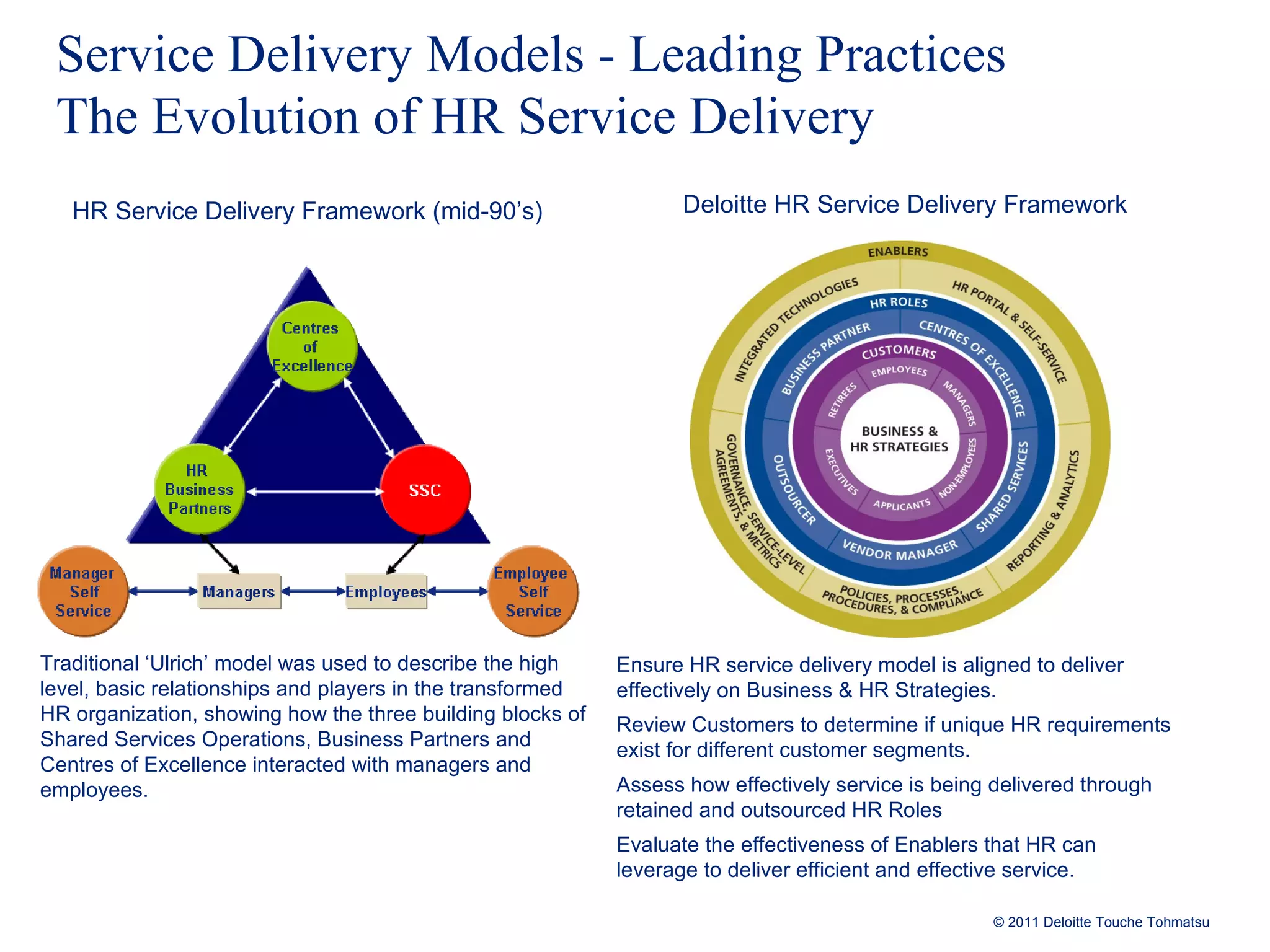
Service Delivery Models - Leading Practices The Evolution of HR Service Delivery Deloitte HR Service Delivery Framework  Ensure HR service delivery model is aligned to deliver effectively on Business & HR Strategies. Review Customers to determine if unique HR requirements exist for different customer segments. Assess how effectively service is being delivered through retained and outsourced HR Roles Evaluate the effectiveness of Enablers that HR can leverage to deliver efficient and effective service. Traditional ‘Ulrich’ model was used to describe the high level, basic relationships and players in the transformed HR organization, showing how the three building blocks of Shared Services Operations, Business Partners and Centres of Excellence interacted with managers and employees. HR Service Delivery Framework (mid-90’s)
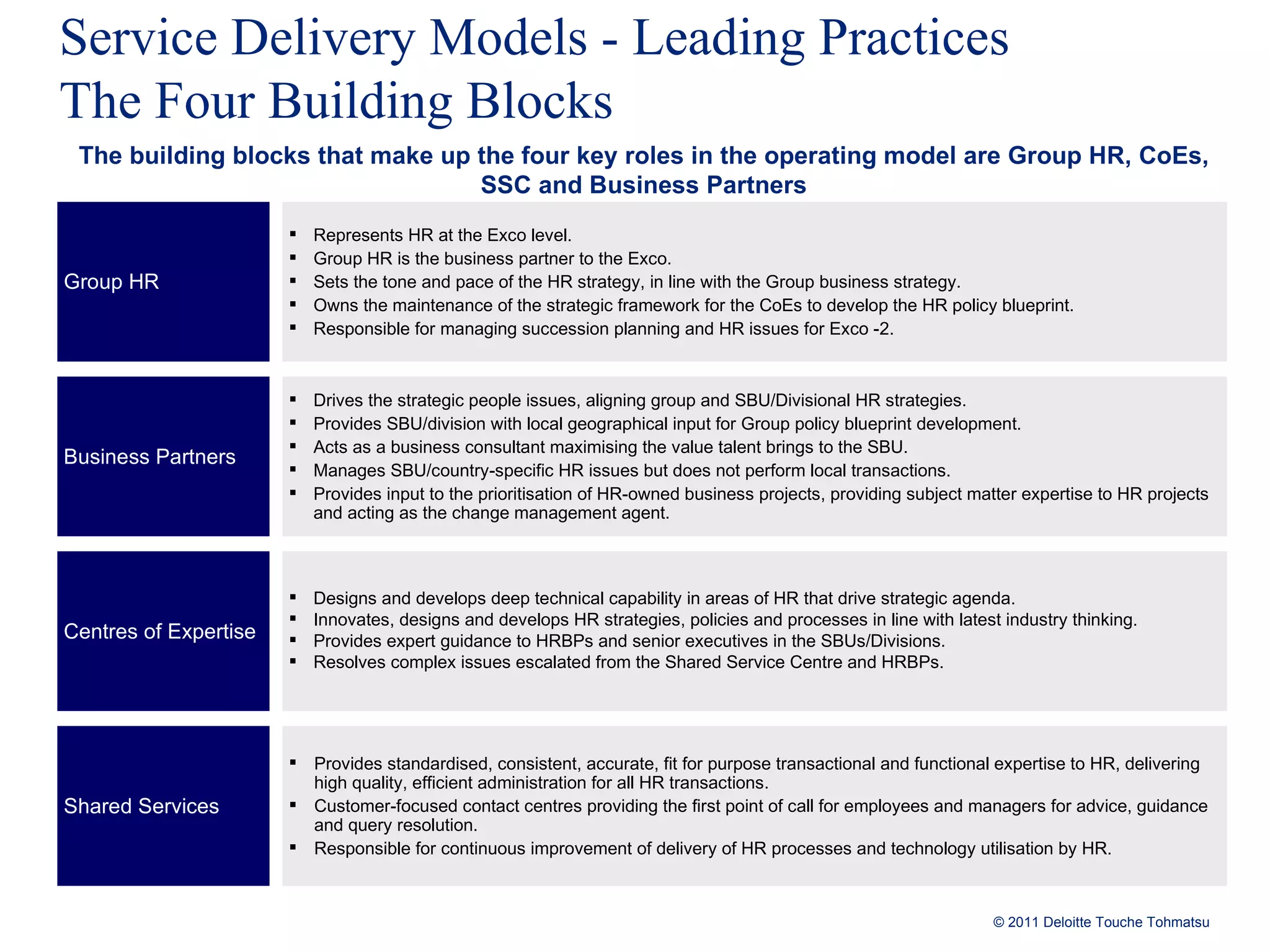
The building blocks that make up the four key roles in the operating model are Group HR, CoEs, SSC and Business Partners Represents HR at the Exco level. Group HR is the business partner to the Exco. Sets the tone and pace of the HR strategy, in line with the Group business strategy. Owns the maintenance of the strategic framework for the CoEs to develop the HR policy blueprint. Responsible for managing succession planning and HR issues for Exco -2. Group HR Centres of Expertise Designs and develops deep technical capability in areas of HR that drive strategic agenda. Innovates, designs and develops HR strategies, policies and processes in line with latest industry thinking. Provides expert guidance to HRBPs and senior executives in the SBUs/Divisions. Resolves complex issues escalated from the Shared Service Centre and HRBPs. Shared Services Provides standardised, consistent, accurate, fit for purpose transactional and functional expertise to HR, delivering high quality, efficient administration for all HR transactions. Customer-focused contact centres providing the first point of call for employees and managers for advice, guidance and query resolution. Responsible for continuous improvement of delivery of HR processes and technology utilisation by HR. Business Partners Drives the strategic people issues, aligning group and SBU/Divisional HR strategies. Provides SBU/division with local geographical input for Group policy blueprint development. Acts as a business consultant maximising the value talent brings to the SBU. Manages SBU/country-specific HR issues but does not perform local transactions. Provides input to the prioritisation of HR-owned business projects, providing subject matter expertise to HR projects and acting as the change management agent. Service Delivery Models - Leading Practices The Four Building Blocks
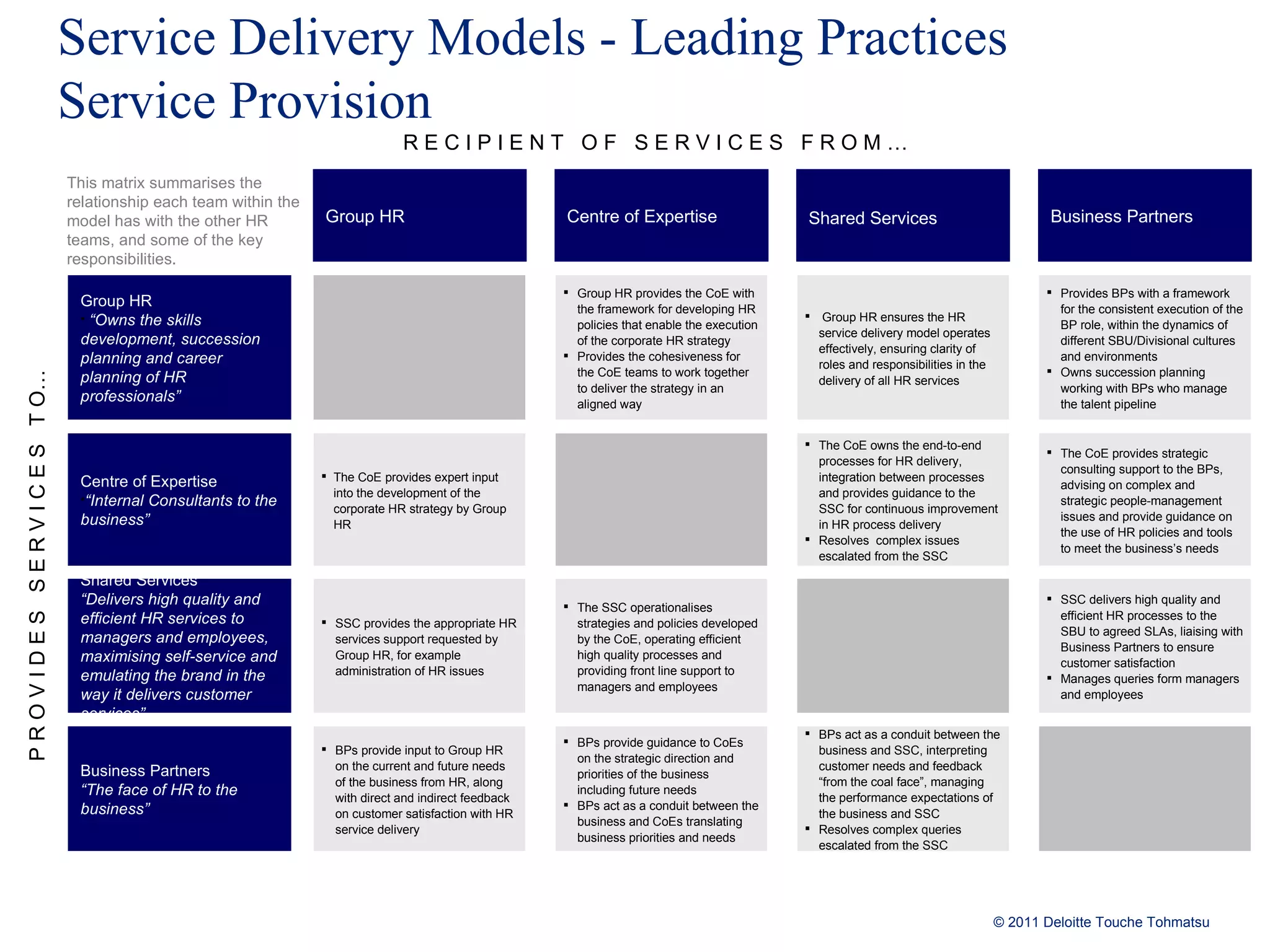
Service Delivery Models - Leading Practices Service Provision Group HR Centre of Expertise Shared Services Business Partners Group HR “ Owns the skills development, succession planning and career planning of HR professionals” Group HR provides the CoE with the framework for developing HR policies that enable the execution of the corporate HR strategy Provides the cohesiveness for the CoE teams to work together to deliver the strategy in an aligned way Group HR ensures the HR service delivery model operates effectively, ensuring clarity of roles and responsibilities in the delivery of all HR services Provides BPs with a framework for the consistent execution of the BP role, within the dynamics of different SBU/Divisional cultures and environments Owns succession planning working with BPs who manage the talent pipeline Centre of Expertise “ Internal Consultants to the business” The CoE provides expert input into the development of the corporate HR strategy by Group HR The CoE owns the end-to-end processes for HR delivery, integration between processes and provides guidance to the SSC for continuous improvement in HR process delivery Resolves  complex issues escalated from the SSC The CoE provides strategic consulting support to the BPs, advising on complex and strategic people-management issues and provide guidance on the use of HR policies and tools to meet the business’s needs Shared Services “ Delivers high quality and efficient HR services to managers and employees, maximising self-service and emulating the brand in the way it delivers customer services”  SSC provides the appropriate HR services support requested by Group HR, for example administration of HR issues The SSC operationalises strategies and policies developed by the CoE, operating efficient high quality processes and providing front line support to managers and employees SSC delivers high quality and efficient HR processes to the SBU to agreed SLAs, liaising with Business Partners to ensure customer satisfaction Manages queries form managers and employees Business Partners “ The face of HR to the business” BPs provide input to Group HR on the current and future needs of the business from HR, along with direct and indirect feedback on customer satisfaction with HR service delivery  BPs provide guidance to CoEs on the strategic direction and priorities of the business including future needs BPs act as a conduit between the business and CoEs translating business priorities and needs BPs act as a conduit between the business and SSC, interpreting customer needs and feedback “from the coal face”, managing the performance expectations of the business and SSC Resolves complex queries escalated from the SSC This matrix summarises the relationship each team within the model has with the other HR teams, and some of the key responsibilities. P R O V I D E S  S E R V I C E S  T O… R E C I P I E N T  O F  S E R V I C E S  F R O M …
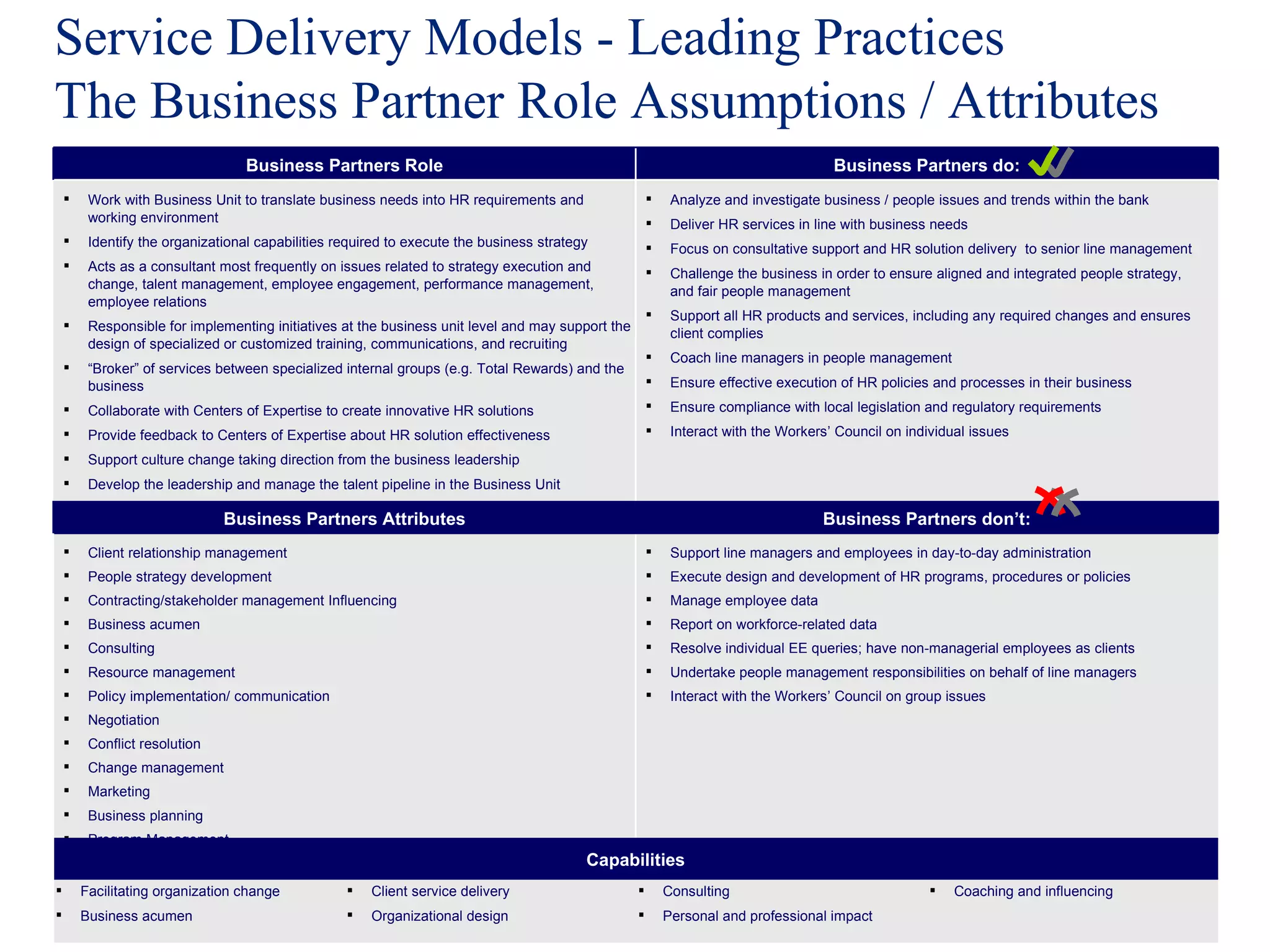
Service Delivery Models - Leading Practices The Business Partner Role Assumptions / Attributes Business Partners Role Business Partners do: Work with Business Unit to translate business needs into HR requirements and working environment Identify the organizational capabilities required to execute the business strategy Acts as a consultant most frequently on issues related to strategy execution and change, talent management, employee engagement, performance management, employee relations Responsible for implementing initiatives at the business unit level and may support the design of specialized or customized training, communications, and recruiting “ Broker” of services between specialized internal groups (e.g. Total Rewards) and the business Collaborate with Centers of Expertise to create innovative HR solutions Provide feedback to Centers of Expertise about HR solution effectiveness Support culture change taking direction from the business leadership Develop the leadership and manage the talent pipeline in the Business Unit Analyze and investigate business / people issues and trends within the bank Deliver HR services in line with business needs Focus on consultative support and HR solution delivery  to senior line management Challenge the business in order to ensure aligned and integrated people strategy, and fair people management Support all HR products and services, including any required changes and ensures client complies Coach line managers in people management Ensure effective execution of HR policies and processes in their business Ensure compliance with local legislation and regulatory requirements Interact with the Workers’ Council on individual issues Business Partners Attributes Business Partners don’t: Client relationship management People strategy development Contracting/stakeholder management Influencing Business acumen Consulting Resource management Policy implementation/ communication Negotiation Conflict resolution Change management Marketing Business planning Program Management Analytical skills (Interpret reporting) Support line managers and employees in day-to-day administration Execute design and development of HR programs, procedures or policies Manage employee data Report on workforce-related data Resolve individual EE queries; have non-managerial employees as clients Undertake people management responsibilities on behalf of line managers Interact with the Workers’ Council on group issues Capabilities Facilitating organization change Business acumen Client service delivery Organizational design Consulting Personal and professional impact Coaching and influencing
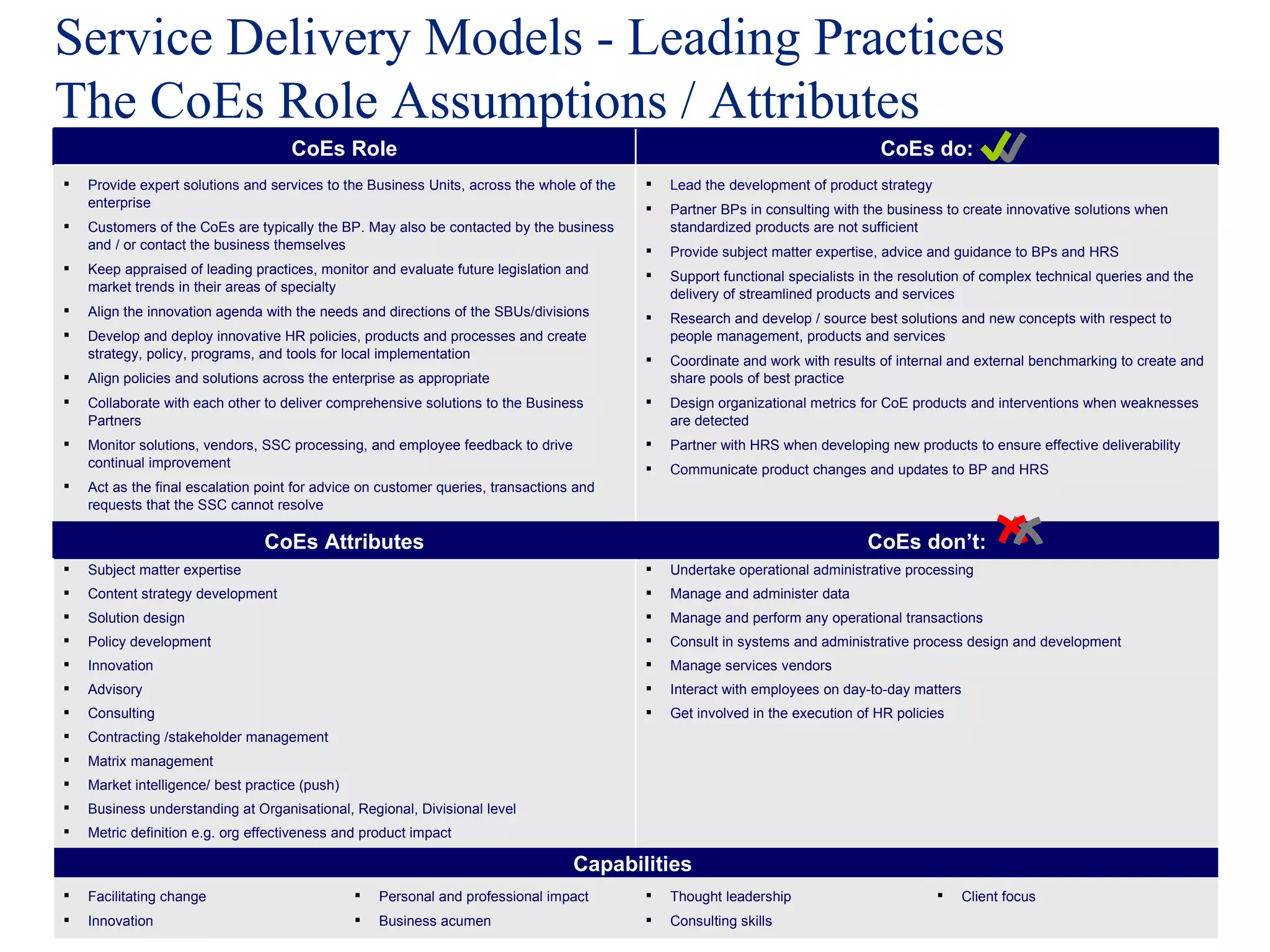
Service Delivery Models - Leading Practices The CoEs Role Assumptions / Attributes CoEs Role CoEs do: Provide expert solutions and services to the Business Units, across the whole of the enterprise Customers of the CoEs are typically the BP. May also be contacted by the business and / or contact the business themselves Keep appraised of leading practices, monitor and evaluate future legislation and market trends in their areas of specialty Align the innovation agenda with the needs and directions of the SBUs/divisions Develop and deploy innovative HR policies, products and processes and create strategy, policy, programs, and tools for local implementation Align policies and solutions across the enterprise as appropriate Collaborate with each other to deliver comprehensive solutions to the Business Partners Monitor solutions, vendors, SSC processing, and employee feedback to drive continual improvement Act as the final escalation point for advice on customer queries, transactions and requests that the SSC cannot resolve Lead the development of product strategy Partner BPs in consulting with the business to create innovative solutions when standardized products are not sufficient Provide subject matter expertise, advice and guidance to BPs and HRS Support functional specialists in the resolution of complex technical queries and the delivery of streamlined products and services Research and develop / source best solutions and new concepts with respect to people management, products and services Coordinate and work with results of internal and external benchmarking to create and share pools of best practice Design organizational metrics for CoE products and interventions when weaknesses are detected  Partner with HRS when developing new products to ensure effective deliverability Communicate product changes and updates to BP and HRS CoEs Attributes CoEs don’t: Subject matter expertise Content strategy development Solution design Policy development Innovation Advisory Consulting  Contracting /stakeholder management Matrix management Market intelligence/ best practice (push) Business understanding at Organisational, Regional, Divisional level Metric definition e.g. org effectiveness and product impact Analytical skills (Interpret reporting)  Quality and risk management Undertake operational administrative processing Manage and administer data  Manage and perform any operational transactions Consult in systems and administrative process design and development Manage services vendors Interact with employees on day-to-day matters Get involved in the execution of HR policies Capabilities  Facilitating change Innovation Personal and professional impact Business acumen Thought leadership Consulting skills Client focus
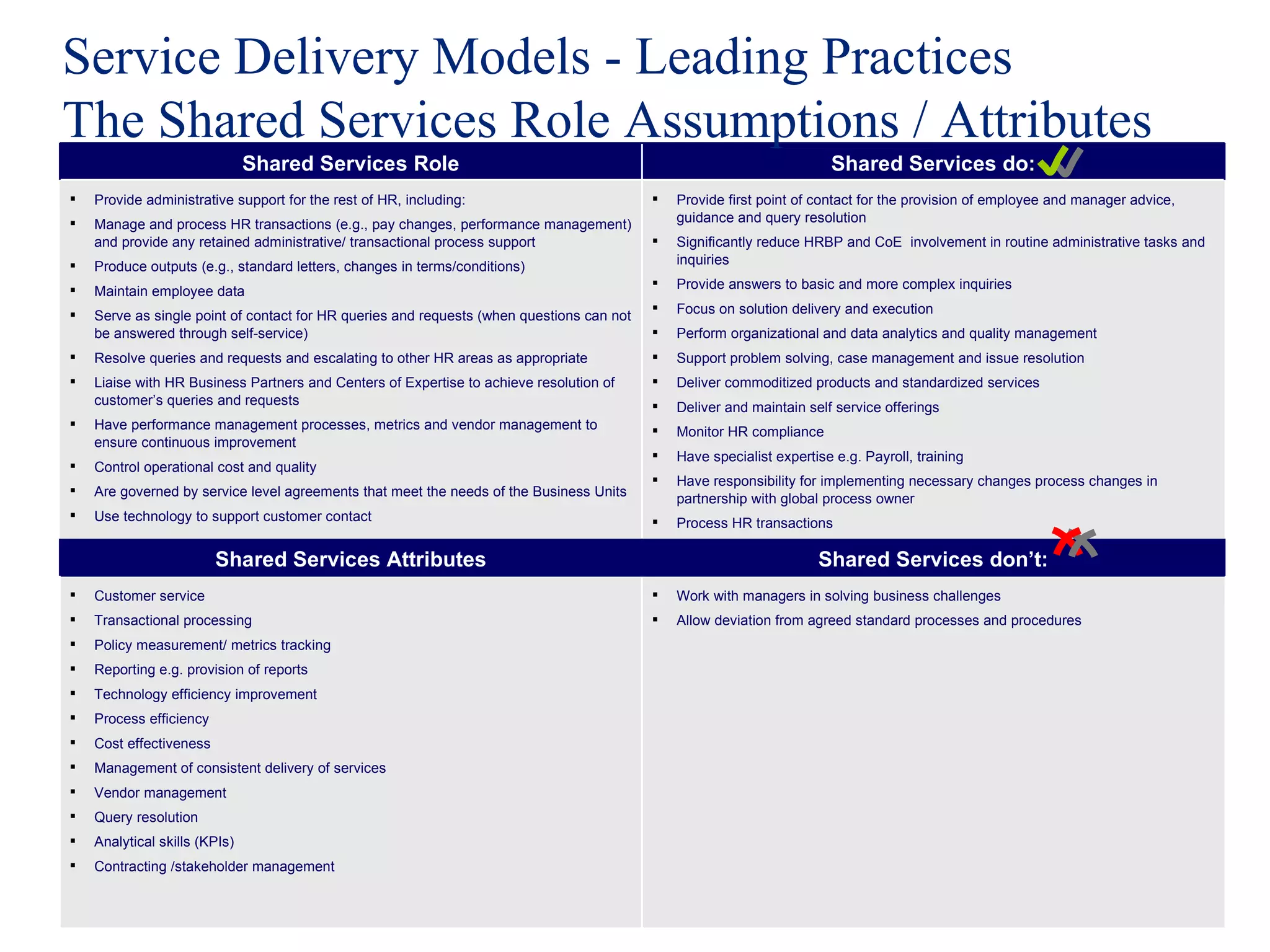
Service Delivery Models - Leading Practices The Shared Services Role Assumptions / Attributes Shared Services Role Shared Services do: Provide administrative support for the rest of HR, including: Manage and process HR transactions (e.g., pay changes, performance management) and provide any retained administrative/ transactional process support Produce outputs (e.g., standard letters, changes in terms/conditions) Maintain employee data Serve as single point of contact for HR queries and requests (when questions can not be answered through self-service) Resolve queries and requests and escalating to other HR areas as appropriate  Liaise with HR Business Partners and Centers of Expertise to achieve resolution of customer’s queries and requests Have performance management processes, metrics and vendor management to ensure continuous improvement Control operational cost and quality Are governed by service level agreements that meet the needs of the Business Units  Use technology to support customer contact Provide first point of contact for the provision of employee and manager advice, guidance and query resolution Significantly reduce HRBP and CoE  involvement in routine administrative tasks and inquiries Provide answers to basic and more complex inquiries Focus on solution delivery and execution Perform organizational and data analytics and quality management Support problem solving, case management and issue resolution Deliver commoditized products and standardized services Deliver and maintain self service offerings Monitor HR compliance Have specialist expertise e.g. Payroll, training Have responsibility for implementing necessary changes process changes in partnership with global process owner Process HR transactions Shared Services Attributes Shared Services don’t: Customer service  Transactional processing Policy measurement/ metrics tracking Reporting e.g. provision of reports Technology efficiency improvement Process efficiency Cost effectiveness Management of consistent delivery of services Vendor management Query resolution Analytical skills (KPIs) Contracting /stakeholder management Work with managers in solving business challenges Allow deviation from agreed standard processes and procedures
Key steps in delivering value through HR Continuously improve HR operations Implement robust systems and leading practices to deliver HR services Establish appropriate service levels and performance targets Maintain a competitive cost structure relative to industry benchmarks Implement Lean Sigma or other continuous improvement methods to help improve operational excellence  Communicate the value of HR services Understand the value of HR services Develop execution plans for specific constituencies Implement an integrated communication process and obtain feedback Create an innovative brand statement and/or logo that helps reinforce the HR value proposition
Conclusion Defining the Value of HR
Conclusion Understand the Business Define your Strategy Build Measures Assess Current  Re-evaluate how HR is Delivered Communicate
Defining Value And Measuring Hr

Defining Value And Measuring Hr

  • 1.
    Defining Value and Measuring HR Mark O’ Donnell, Director and Practice Leader, Human Capital Advisory Services, Consulting
  • 2.
    Agenda Defining theValue of HR Introduction 2 HR Strategy 6 Understanding the business 8 Define your HR Strategy 14 Measuring Impact of HR 18 Assess HR Function 25 Reassess HR Service Delivery 34 Conclusion 42 Questions
  • 3.
    Context If youcan’t quantify the value that HR has on the Business, how do you prove your worth? Defining the Value of HR
  • 4.
    Marketplace Trends Competitionfor funds and resources is today’s reality Major change and turbulent market conditions make it hard for Boards to determine what the strategy should be Top management want to know the Return On Investment for all they spend including leadership development and talent initiatives These more complex economic conditions offer an opportunity not only to rethink business strategies but also HR strategy, if HR is core to the business strategy More and more of our clients are telling us that there is particular focus on HR departments to ensure that All HR investments deliver quantifiable measurable value. How can HR demonstrate a quantifiable return on investment for Human Capital initiatives? Which HR initiatives can be directly targeted at building organisation capability that has a bottom-line impact – either increasing the organisation’s revenue or reducing costs? Defining the Value of HR
  • 5.
    People are Criticalto Business Performance More than 85% of senior business executives and HR leaders agree that people are “vital” to every aspect of their organisation’s performance HR leaders and senior business executives agree the most critical people issues are: Leadership development and pipeline Talent management Creating a high-performance culture Training and development Source: Aligned at the Top , a global survey on people and business challenges conducted by Deloitte Touche Tohmatsu and the Economist Intelligence Unit
  • 6.
    There is agap between HR capabilities and business needs Senior business executives want HR to be more effective Only 4% describe HR as highly effective in addressing the needs of the business 60% describe HR as only moderately effective “ People” and “HR” are often treated as separate conversations People issues are considered “strategic”, e.g. leadership development and pipeline, talent management, creating a high-performance culture, training and development HR issues are perceived as “administrative”, e.g. compensation and benefits, performance evaluations, HR operating efficiency HR is often out of the loop on strategic issues Percentage of companies that “rarely” or “never” consult their senior HR team on key business issues: Mergers and acquisitions (63%) Compliance and regulation (26%) Talent (25%)
  • 7.
    HR Strategy Definingthe Value of HR
  • 8.
    HR Strategy –Deloitte view A HR strategy should help an organisation create unique competitive advantage by outlining how the HR function and the services it offers will create business value and address the company’s most pressing strategic challenges. The strategy should identify priorities for investment in HR products and services and in HR service delivery (people, process, technology, operations, etc.) to help address the organisation’s most pressing strategic challenges. The strategy should include a roadmap for how the HR function will execute on the strategy. The strategy should also outline the foundational HR capabilities required to effectively execute the strategy. Typically, the HR strategy will be a two to three year strategy, but it should be refreshed every year. Before forming your strategy you need to understand the Business
  • 9.
    Understanding Business StrategyDefining the Value of HR
  • 10.
    Questions to AskWhat does the Business do to drive performance? Who are our shareholders and what do they want? What does our Business do?
  • 11.
    What do thesections of the EVM HC represent? 1. Value Drivers How value is created
  • 12.
    Value Drivers - How Value is Created
  • 13.
    EVM HC: Changingthe Mindset of How HR Operates HR has traditionally been viewed as an overhead cost that is highly transaction-based. Behind every great product, service, and innovation are people. Sustained Growth Merger Integration New Market Entry Sales force Transformation Rewards Transformation Global Labor Shortage Workforce Planning New Market Entry Global Mobility Learning and Development Outsourcing and Offshoring Risk & Compliance Global Workforce Security Regulatory Compliance Risk Management Future Capabilities Change Management Global Program Management Leadership Development Operating Margin Asset Efficiency Expectations Revenue Growth Volume Direct Costs (COGS) Indirect Costs (SG&A) Income Taxes S H A R E H O L D E R V A L U E Property, Plant & Equip. Inventory Receivables & Payables Company Strengths External Factors Price
  • 14.
    Human Capital Dimensions- Categories of Improvement Focus The Human Capital Dimensions embedded within the map show the seven major Human Capital categories of improvement within an organisation. Human Capital Dimensions Talent Strategies: Talent-focused activities to execute short and long term business objectives Learning and Development: Activities in support of employee and executive development Change Management and Transformation: Activities focused on the people implications of major business events Organizational Strategies: Activities in support of business initiatives that focus on developing organization and team structures Employee Rewards and Benefits: Activities that link employees’ work experience to their commitment and contribution to business value Governance, Risk, and Compliance: Activities to proactively manage the people-related aspects of risk, regulations, security, compliance, and ethics HR Strategy and Services: Activities focused on HR strategy and service delivery
  • 15.
    Define HR StrategyDefining the Value of HR
  • 16.
    Step 1: UnderstandStrategic Priorities & Business Context Example: +10% Annual Growth Target Improve Product Development Pipeline and Deployment Increase Share of Revenue Capture from Advertising Improve Product and Service Mix Acquire New Customers Retain and Grow Current Customers Leverage Income - Strengthen Pricing Marketing & Sales Account Management Cross - Sell / Up - Sell Retention Demand & Supply Management Price Optimization Product & Service Innovation Cash / Asset Management Volume Price Realization Revenue Growth Generating Assets
  • 17.
    Step 2: IdentifyIssues & Challenges Example – Strategic priorities and HR strategic actions: Exponential Headcount Increase: Focus on recruiting and selection, retention practices, talent placement, and employee development. HR Organization Transformation: Optimize the HR function. Enterprise Cost Reduction: Maximize investments and spend on human capital to focus on business issues, operational efficiencies, and process excellence. Focus on Customer Service: Build a culture of high performance and innovation with a focus on the customer. Post Merger Integration: Support rationalization of core process, technology, people, and policy with a defined project portfolio.
  • 18.
    Deloitte’s HR strategyframework Deloitte HR Strategy Framework Define Value Understand business strategy Define HR strategy Identify HR’s meaning Deliver Value 7. Establish a delivery model for HR services 8. Upgrade the company’s HR capabilities 9. Continuously improve HR operations 10. Communicate the value of HR services Define Value Align HR Services Segment stakeholders Prioriti`se HR investments Design HR services
  • 19.
    Measuring Impact ofHR Defining the Value of HR
  • 20.
    HR Balanced Scorecard?The Balanced Scorecard is a means of connecting key decisions and control, that measures the value created by initiatives to the core business areas, compares program benefits to costs including: Customer Experience: How do customers see us? Business Impact & Satisfaction Measurements Talent Strategies: What must we excel at? Learning and application measures – knowledge, skills and attitudes and on-the-job behaviours Process and Innovation: Can we continue to improve and create value? Financial Focus: How do we look to shareholders? The HR Balanced Scorecard aligned to business strategies measures improvement in customer value Defining the Value of HR “ The Balanced Scorecard fills the void that exists in most management systems – the lack of a systematic process to implement and obtain feedback about strategy” (Kaplan & Norton, 1996).
  • 21.
    Best Practice Design:Characteristics of a Successful Scorecard Defining the Value of HR Involves the scorecard owner in the design Characteristics Makes efficient use of managers’ time Understandable & transferable Easily aligned across the organisation Only this person knows the answers Management time is scarce Must be communicated across the organisation Reason Help the whole company work towards a common goal
  • 22.
    Value of aBalanced Scorecard HR Transformation HR Value Defining the Value of HR HR Transformation HR Value Balanced Scorecard The Balanced Scorecard examines the evidence of key HR Initiatives linking them to business performance measures that drive Business Strategy The value of using a Balanced Scorecard, HR can fuel more sustainable employee initiatives with longer-lasting results The Balanced Scorecard works as an ‘umbrella’ concept that links together organisational objectives, ways of thinking and management tools.
  • 23.
    Overall HR Scorecard– Client Example Legend (Link to Critical HR Capabilities) Talent Management Leadership Development Organisational Development HR Administration Financial Average termination cost Cost of turnover Cost of acquisition per hire HR Training spend (per Manager / Director / Executive) HR FTE Ratio SLA compliance Vendor Management FTE Ratio + HR Operating Expense/FTE Customer Experience Hiring Manager satisfaction with quality of new hires Employee satisfaction with Career Zone Employee satisfaction with career progression Business unit satisfaction with organisation design support Employee engagement index Frequency of communication Response rates on effectiveness surveys Employee HRO satisfaction Self-service availability rate Portal usage penetration rates Process / Innovation Line manager use of recruitment centers Share of employees with basics in place “day one” Time to efficiency for new hires Time to identify & approve leadership training request Course enrollment and completion rates Share of positions with successor identified Number of job families for which there are established career paths Share of business using consistent change leadership framework Number of issues at level 1, level 2 or level 3 support Talent Number of critical positions and critical workforce segments identified Retention of new hires Retention rates by critical workforce segments Leadership stability rates Number of internal leadership appointments Share of leaders reviewed in talent review process Timeliness of talent reviews Number of employee referrals Diversity of leadership team Outsourcer turnover rate Potential Metrics
  • 24.
    Metrics for criticalHR capabilities and services can be identified… Financial Customer Experience Process & Innovation Talent client x Case – use in Roadmap Section Potential Talent Management Metrics – Client Example Workforce Planning & Segmentation Cost of workforce planning process Business unit satisfaction with workforce planning process Workforce planning process performed annually and linked to budgeting process Number critical positions and critical workforce segments identified Share of critical jobs held by those with high / low performance levels Talent Sourcing & Acquisition Cost of sourcing & acquisition process Cost of acquisition per hire Business case savings realization for Career Zone implementation Referral bonus cost per hire Hiring Manager satisfaction with recruiting process Hiring Manager satisfaction with quality of new hires Employee satisfaction with Career Zone Number of positions where talent pool is already identified Time to fill positions Recruitment source ratio Requisition response rate Referral conversion rate Applicant conversion rate Interview conversion rate (First) offer acceptance rate Ratio of contractors to full-time staff Share of new hires receiving top performance rating Management accountability for the quality of new hires Share of new hires leaving the organizations within 6 months Employee tenure by sourcing method Poor quality hire rate On-Boarding & Orientation Cost of on-boarding process Employee / Manager satisfaction with on-boarding process Share of employees with basics in place day 1 (phone computer, etc) Time to efficiency for new hires Management accountability for on-boarding process Retention of new hires Retention Cost of recognition practices Average termination cost Cost of turnover Compensation impact of replacement hires Employee satisfaction with recognition practices Recognition rate of the employment brand by critical workforce segments Number of lateral moves within a business unit Number transfers between business units Time to fill positions with internal transfer Share positions filled with internal candidates Number of recognition awards granted Voluntary turnover rate (by department, level, workforce segment) Retention of high performers Retention of critical segments Leadership stability rate Accession rate Percentage of referral hiring
  • 25.
    Align HR ServicesDeloitte HR Strategy Framework Define Value Understand business strategy Define HR strategy Identify HR’s primary performance levers Deliver Value 7. Establish a delivery model for HR services 8. Upgrade the company’s HR capabilities 9. Continuously improve HR operations 10. Communicate the value of HR services Define Value Align HR Services Assess HR Function Design HR services
  • 26.
    Assessing your HRFunction Defining the Value of HR
  • 27.
    HR Maturity AssessmentWe have developed an HR Maturity Model to meet this objective. The HR Maturity Model captures our views on leading practices for talent management, as well as for each of the key elements of our HR service delivery model: HR strategy, HR customers, HR roles, and HR enables.
  • 28.
    Deloitte Global HRMaturity Tool Dimensions Talent Maturity HR Strategy & Service Delivery Maturity Talent Strategy & Plan Talent Metrics Talent Geographic Reach & Diversity Attraction Development Retention Work Environment Innovation Employer Brand & EVP Talent Governance & Leadership Talent Infrastructure Talent Attitudes & Culture HR Strategy Alignment Business Strategy Impact HR & Talent Strategy Alignment Business Alignment Customer Segmentation HR’s Role in Key Talent Decisions HR Planning Effectiveness HR Metrics HR Capability HR Enablers (e.g. Policy, Process, Governance, Reporting & Technology) HR Credibility HR Customer Segmentation Employees Managers Executives Non-Employees Applicants Retirees HR Service Delivery Roles Business Partner CoE SSC Outsourcer Vendor Manager HR Service Delivery Enablers Processes Procedures, & Compliance Integrated Technologies HR Portal & Self-Service Reporting & Analytics Governance, Service-Level Agreements (SLAs) & Metrics
  • 29.
  • 30.
    HR Strategy AlignmentMaturity Model
  • 31.
  • 32.
  • 33.
  • 34.
    Deliver Value DeloitteHR Strategy Framework Define Value Understand business strategy Define HR strategy Identify HR’s primary performance levers Deliver Value 7. Establish a delivery model for HR services 8. Upgrade the company’s HR capabilities 10. Communicate the value of HR services Define Value Align HR Services Segment stakeholders Prioritise HR investments
  • 35.
    Establish and Re-assessHR Service Delivery Model Defining the Value of HR
  • 36.
    Service Delivery Models- Leading Practices The Evolution of HR Service Delivery Deloitte HR Service Delivery Framework Ensure HR service delivery model is aligned to deliver effectively on Business & HR Strategies. Review Customers to determine if unique HR requirements exist for different customer segments. Assess how effectively service is being delivered through retained and outsourced HR Roles Evaluate the effectiveness of Enablers that HR can leverage to deliver efficient and effective service. Traditional ‘Ulrich’ model was used to describe the high level, basic relationships and players in the transformed HR organization, showing how the three building blocks of Shared Services Operations, Business Partners and Centres of Excellence interacted with managers and employees. HR Service Delivery Framework (mid-90’s)
  • 37.
    The building blocksthat make up the four key roles in the operating model are Group HR, CoEs, SSC and Business Partners Represents HR at the Exco level. Group HR is the business partner to the Exco. Sets the tone and pace of the HR strategy, in line with the Group business strategy. Owns the maintenance of the strategic framework for the CoEs to develop the HR policy blueprint. Responsible for managing succession planning and HR issues for Exco -2. Group HR Centres of Expertise Designs and develops deep technical capability in areas of HR that drive strategic agenda. Innovates, designs and develops HR strategies, policies and processes in line with latest industry thinking. Provides expert guidance to HRBPs and senior executives in the SBUs/Divisions. Resolves complex issues escalated from the Shared Service Centre and HRBPs. Shared Services Provides standardised, consistent, accurate, fit for purpose transactional and functional expertise to HR, delivering high quality, efficient administration for all HR transactions. Customer-focused contact centres providing the first point of call for employees and managers for advice, guidance and query resolution. Responsible for continuous improvement of delivery of HR processes and technology utilisation by HR. Business Partners Drives the strategic people issues, aligning group and SBU/Divisional HR strategies. Provides SBU/division with local geographical input for Group policy blueprint development. Acts as a business consultant maximising the value talent brings to the SBU. Manages SBU/country-specific HR issues but does not perform local transactions. Provides input to the prioritisation of HR-owned business projects, providing subject matter expertise to HR projects and acting as the change management agent. Service Delivery Models - Leading Practices The Four Building Blocks
  • 38.
    Service Delivery Models- Leading Practices Service Provision Group HR Centre of Expertise Shared Services Business Partners Group HR “ Owns the skills development, succession planning and career planning of HR professionals” Group HR provides the CoE with the framework for developing HR policies that enable the execution of the corporate HR strategy Provides the cohesiveness for the CoE teams to work together to deliver the strategy in an aligned way Group HR ensures the HR service delivery model operates effectively, ensuring clarity of roles and responsibilities in the delivery of all HR services Provides BPs with a framework for the consistent execution of the BP role, within the dynamics of different SBU/Divisional cultures and environments Owns succession planning working with BPs who manage the talent pipeline Centre of Expertise “ Internal Consultants to the business” The CoE provides expert input into the development of the corporate HR strategy by Group HR The CoE owns the end-to-end processes for HR delivery, integration between processes and provides guidance to the SSC for continuous improvement in HR process delivery Resolves complex issues escalated from the SSC The CoE provides strategic consulting support to the BPs, advising on complex and strategic people-management issues and provide guidance on the use of HR policies and tools to meet the business’s needs Shared Services “ Delivers high quality and efficient HR services to managers and employees, maximising self-service and emulating the brand in the way it delivers customer services” SSC provides the appropriate HR services support requested by Group HR, for example administration of HR issues The SSC operationalises strategies and policies developed by the CoE, operating efficient high quality processes and providing front line support to managers and employees SSC delivers high quality and efficient HR processes to the SBU to agreed SLAs, liaising with Business Partners to ensure customer satisfaction Manages queries form managers and employees Business Partners “ The face of HR to the business” BPs provide input to Group HR on the current and future needs of the business from HR, along with direct and indirect feedback on customer satisfaction with HR service delivery BPs provide guidance to CoEs on the strategic direction and priorities of the business including future needs BPs act as a conduit between the business and CoEs translating business priorities and needs BPs act as a conduit between the business and SSC, interpreting customer needs and feedback “from the coal face”, managing the performance expectations of the business and SSC Resolves complex queries escalated from the SSC This matrix summarises the relationship each team within the model has with the other HR teams, and some of the key responsibilities. P R O V I D E S S E R V I C E S T O… R E C I P I E N T O F S E R V I C E S F R O M …
  • 39.
    Service Delivery Models- Leading Practices The Business Partner Role Assumptions / Attributes Business Partners Role Business Partners do: Work with Business Unit to translate business needs into HR requirements and working environment Identify the organizational capabilities required to execute the business strategy Acts as a consultant most frequently on issues related to strategy execution and change, talent management, employee engagement, performance management, employee relations Responsible for implementing initiatives at the business unit level and may support the design of specialized or customized training, communications, and recruiting “ Broker” of services between specialized internal groups (e.g. Total Rewards) and the business Collaborate with Centers of Expertise to create innovative HR solutions Provide feedback to Centers of Expertise about HR solution effectiveness Support culture change taking direction from the business leadership Develop the leadership and manage the talent pipeline in the Business Unit Analyze and investigate business / people issues and trends within the bank Deliver HR services in line with business needs Focus on consultative support and HR solution delivery to senior line management Challenge the business in order to ensure aligned and integrated people strategy, and fair people management Support all HR products and services, including any required changes and ensures client complies Coach line managers in people management Ensure effective execution of HR policies and processes in their business Ensure compliance with local legislation and regulatory requirements Interact with the Workers’ Council on individual issues Business Partners Attributes Business Partners don’t: Client relationship management People strategy development Contracting/stakeholder management Influencing Business acumen Consulting Resource management Policy implementation/ communication Negotiation Conflict resolution Change management Marketing Business planning Program Management Analytical skills (Interpret reporting) Support line managers and employees in day-to-day administration Execute design and development of HR programs, procedures or policies Manage employee data Report on workforce-related data Resolve individual EE queries; have non-managerial employees as clients Undertake people management responsibilities on behalf of line managers Interact with the Workers’ Council on group issues Capabilities Facilitating organization change Business acumen Client service delivery Organizational design Consulting Personal and professional impact Coaching and influencing
  • 40.
    Service Delivery Models- Leading Practices The CoEs Role Assumptions / Attributes CoEs Role CoEs do: Provide expert solutions and services to the Business Units, across the whole of the enterprise Customers of the CoEs are typically the BP. May also be contacted by the business and / or contact the business themselves Keep appraised of leading practices, monitor and evaluate future legislation and market trends in their areas of specialty Align the innovation agenda with the needs and directions of the SBUs/divisions Develop and deploy innovative HR policies, products and processes and create strategy, policy, programs, and tools for local implementation Align policies and solutions across the enterprise as appropriate Collaborate with each other to deliver comprehensive solutions to the Business Partners Monitor solutions, vendors, SSC processing, and employee feedback to drive continual improvement Act as the final escalation point for advice on customer queries, transactions and requests that the SSC cannot resolve Lead the development of product strategy Partner BPs in consulting with the business to create innovative solutions when standardized products are not sufficient Provide subject matter expertise, advice and guidance to BPs and HRS Support functional specialists in the resolution of complex technical queries and the delivery of streamlined products and services Research and develop / source best solutions and new concepts with respect to people management, products and services Coordinate and work with results of internal and external benchmarking to create and share pools of best practice Design organizational metrics for CoE products and interventions when weaknesses are detected Partner with HRS when developing new products to ensure effective deliverability Communicate product changes and updates to BP and HRS CoEs Attributes CoEs don’t: Subject matter expertise Content strategy development Solution design Policy development Innovation Advisory Consulting Contracting /stakeholder management Matrix management Market intelligence/ best practice (push) Business understanding at Organisational, Regional, Divisional level Metric definition e.g. org effectiveness and product impact Analytical skills (Interpret reporting) Quality and risk management Undertake operational administrative processing Manage and administer data Manage and perform any operational transactions Consult in systems and administrative process design and development Manage services vendors Interact with employees on day-to-day matters Get involved in the execution of HR policies Capabilities Facilitating change Innovation Personal and professional impact Business acumen Thought leadership Consulting skills Client focus
  • 41.
    Service Delivery Models- Leading Practices The Shared Services Role Assumptions / Attributes Shared Services Role Shared Services do: Provide administrative support for the rest of HR, including: Manage and process HR transactions (e.g., pay changes, performance management) and provide any retained administrative/ transactional process support Produce outputs (e.g., standard letters, changes in terms/conditions) Maintain employee data Serve as single point of contact for HR queries and requests (when questions can not be answered through self-service) Resolve queries and requests and escalating to other HR areas as appropriate Liaise with HR Business Partners and Centers of Expertise to achieve resolution of customer’s queries and requests Have performance management processes, metrics and vendor management to ensure continuous improvement Control operational cost and quality Are governed by service level agreements that meet the needs of the Business Units Use technology to support customer contact Provide first point of contact for the provision of employee and manager advice, guidance and query resolution Significantly reduce HRBP and CoE involvement in routine administrative tasks and inquiries Provide answers to basic and more complex inquiries Focus on solution delivery and execution Perform organizational and data analytics and quality management Support problem solving, case management and issue resolution Deliver commoditized products and standardized services Deliver and maintain self service offerings Monitor HR compliance Have specialist expertise e.g. Payroll, training Have responsibility for implementing necessary changes process changes in partnership with global process owner Process HR transactions Shared Services Attributes Shared Services don’t: Customer service Transactional processing Policy measurement/ metrics tracking Reporting e.g. provision of reports Technology efficiency improvement Process efficiency Cost effectiveness Management of consistent delivery of services Vendor management Query resolution Analytical skills (KPIs) Contracting /stakeholder management Work with managers in solving business challenges Allow deviation from agreed standard processes and procedures
  • 42.
    Key steps indelivering value through HR Continuously improve HR operations Implement robust systems and leading practices to deliver HR services Establish appropriate service levels and performance targets Maintain a competitive cost structure relative to industry benchmarks Implement Lean Sigma or other continuous improvement methods to help improve operational excellence Communicate the value of HR services Understand the value of HR services Develop execution plans for specific constituencies Implement an integrated communication process and obtain feedback Create an innovative brand statement and/or logo that helps reinforce the HR value proposition
  • 43.
  • 44.
    Conclusion Understand theBusiness Define your Strategy Build Measures Assess Current Re-evaluate how HR is Delivered Communicate

Editor's Notes

  • #3 Structure of presentation as follows: Context of HR – why defining value of HR is more important now, renewed focus on proving HR’s worth etc. Deloitte’s approach to defining HR value and improving HR effectiveness Case Study to ground our approach and showcase benefits that can be achieved by applying a solid framework analysis to HR activities
  • #4 Structure of presentation as follows: Context of HR – why defining value of HR is more important now, renewed focus on proving HR’s worth etc. Deloitte’s approach to defining HR value and improving HR effectiveness Case Study to ground our approach and showcase benefits that can be achieved by applying a solid framework analysis to HR activities
  • #5 Structure of presentation as follows: Context of HR – why defining value of HR is more important now, renewed focus on proving HR’s worth etc. Deloitte’s approach to defining HR value and improving HR effectiveness Case Study to ground our approach and showcase benefits that can be achieved by applying a solid framework analysis to HR activities
  • #6 HR and business executives were closely aligned on the importance of people.
  • #8 Structure of presentation as follows: Context of HR – why defining value of HR is more important now, renewed focus on proving HR’s worth etc. Deloitte’s approach to defining HR value and improving HR effectiveness Case Study to ground our approach and showcase benefits that can be achieved by applying a solid framework analysis to HR activities
  • #10 Structure of presentation as follows: Context of HR – why defining value of HR is more important now, renewed focus on proving HR’s worth etc. Deloitte’s approach to defining HR value and improving HR effectiveness Case Study to ground our approach and showcase benefits that can be achieved by applying a solid framework analysis to HR activities
  • #15 This is a great way to do client interviews or talk with leadership about pain points, this is a great way to map the issues back to HC actions. At the beginning of projects we will do client interviews and map how to address issues to specific
  • #16 Structure of presentation as follows: Context of HR – why defining value of HR is more important now, renewed focus on proving HR’s worth etc. Deloitte’s approach to defining HR value and improving HR effectiveness Case Study to ground our approach and showcase benefits that can be achieved by applying a solid framework analysis to HR activities
  • #19 In the past, HR was primarily an administrative function and its strategies were fairly simple. But now that’s all changed. Today, people are seen as vital to every aspect of business performance and the HR function needs a sound strategy to provide services that maximize the value of this critical resource. Of course, developing a clear and robust HR strategy is just the beginning. In the end, the success of any strategy hinges on effective execution. The following framework outlines the 10 major steps for successfully developing and executing an HR strategy. Although the ideal approach varies from one situation to the next, this general framework can help any HR function develop and deliver the kinds of services and capabilities that today’s businesses need to survive and grow.
  • #20 Structure of presentation as follows: Context of HR – why defining value of HR is more important now, renewed focus on proving HR’s worth etc. Deloitte’s approach to defining HR value and improving HR effectiveness Case Study to ground our approach and showcase benefits that can be achieved by applying a solid framework analysis to HR activities
  • #21 Structure of presentation as follows: Context of HR – why defining value of HR is more important now, renewed focus on proving HR’s worth etc. Deloitte’s approach to defining HR value and improving HR effectiveness Case Study to ground our approach and showcase benefits that can be achieved by applying a solid framework analysis to HR activities
  • #22 Structure of presentation as follows: Context of HR – why defining value of HR is more important now, renewed focus on proving HR’s worth etc. Deloitte’s approach to defining HR value and improving HR effectiveness Case Study to ground our approach and showcase benefits that can be achieved by applying a solid framework analysis to HR activities
  • #27 Structure of presentation as follows: Context of HR – why defining value of HR is more important now, renewed focus on proving HR’s worth etc. Deloitte’s approach to defining HR value and improving HR effectiveness Case Study to ground our approach and showcase benefits that can be achieved by applying a solid framework analysis to HR activities
  • #36 Structure of presentation as follows: Context of HR – why defining value of HR is more important now, renewed focus on proving HR’s worth etc. Deloitte’s approach to defining HR value and improving HR effectiveness Case Study to ground our approach and showcase benefits that can be achieved by applying a solid framework analysis to HR activities
  • #44 Structure of presentation as follows: Context of HR – why defining value of HR is more important now, renewed focus on proving HR’s worth etc. Deloitte’s approach to defining HR value and improving HR effectiveness Case Study to ground our approach and showcase benefits that can be achieved by applying a solid framework analysis to HR activities