Social Architecture: Modeling the Next Generation

Loading...

Flash Player 9 (or above) is needed to view presentations.
We have detected that you do not have it on your computer. To install it, go here.

0 comments

Post a comment

    Post a comment
    Embed Video
    Edit your comment Cancel

    20 Favorites & 1 Group

    Social Architecture: Modeling the Next Generation - Presentation Transcript

    1. Social Architecture: Modeling the Next Generation Sean Madden Webvisions 2007, Portland OR
    2. Social networks have revolutionized the way people think about software, from both the business and consumer perspective Webvisions 2007 Social Architecture May 3rd, 2007
    3. Passion Centric vs. Passion Agnostic Webvisions 2007 Social Architecture May 3rd, 2007
    4. I Love @#&! Webvisions 2007 Social Architecture May 3rd, 2007
    5. Shaun the Stylist Webvisions 2007 Social Architecture May 3rd, 2007
    6. The Social Software Toolbox Webvisions 2007 Social Architecture May 3rd, 2007
    7. Tagging Webvisions 2007 Social Architecture May 3rd, 2007
    8. Tagging is reinventing information architecture as we know it Webvisions 2007 Social Architecture May 3rd, 2007
    9. Webvisions 2007 Social Architecture May 3rd, 2007
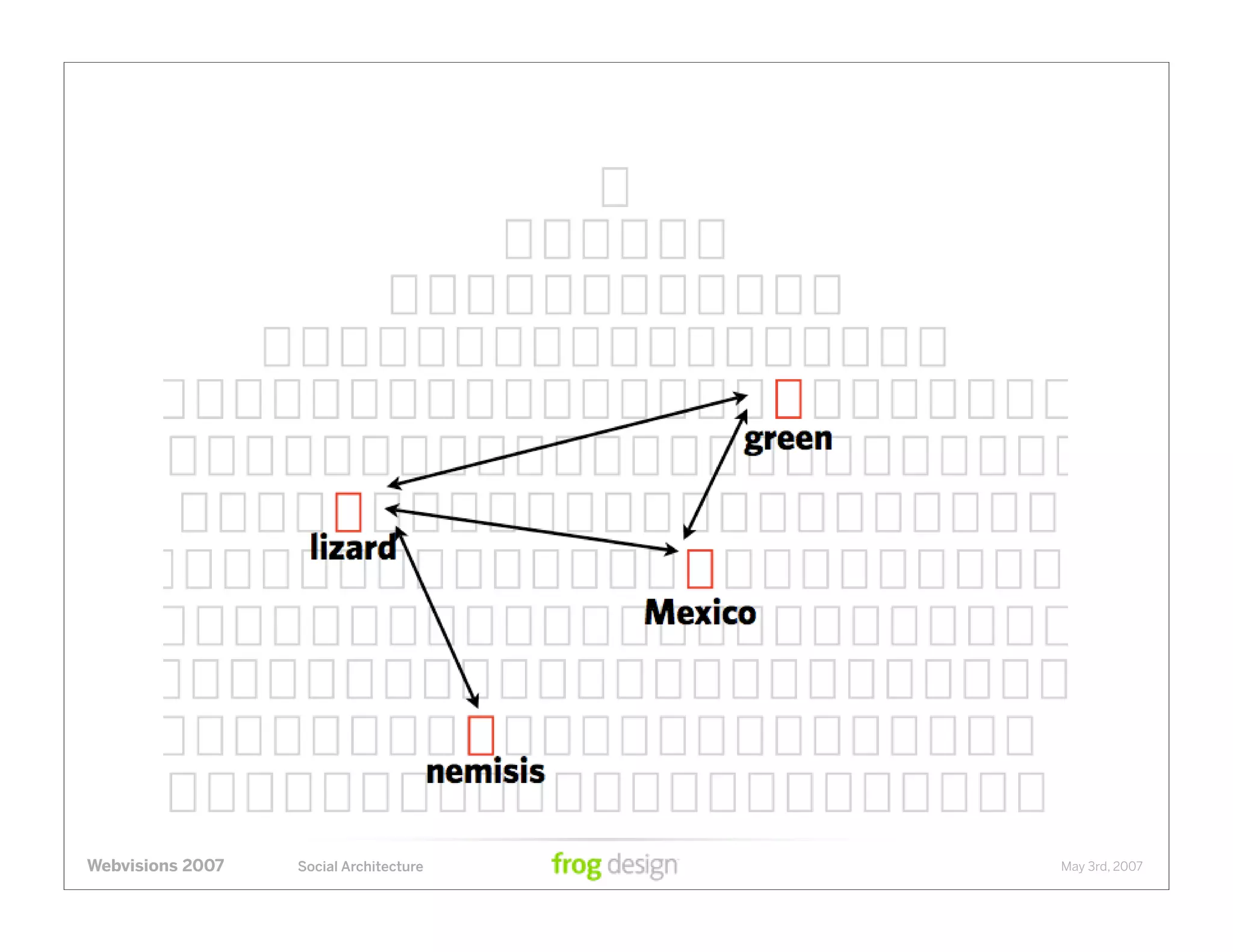
    10. Webvisions 2007 Social Architecture May 3rd, 2007
    11. Tags create a highly-malleable cataloguing system Tags communicate “meta data” to the masses Tags are easy Webvisions 2007 Social Architecture May 3rd, 2007
    12. Voting Webvisions 2007 Social Architecture May 3rd, 2007
    13. “... I suspect in a matter of a few years a Web page without a dynamic ratings system attached will trigger the same response that a Web page without hyperlinks triggers today” Stephen B. Johnson Emergence Webvisions 2007 Social Architecture May 3rd, 2007
    14. People understand voting Voting promotes trust and believability Voting enables the community to decide what it feels is important Webvisions 2007 Social Architecture May 3rd, 2007
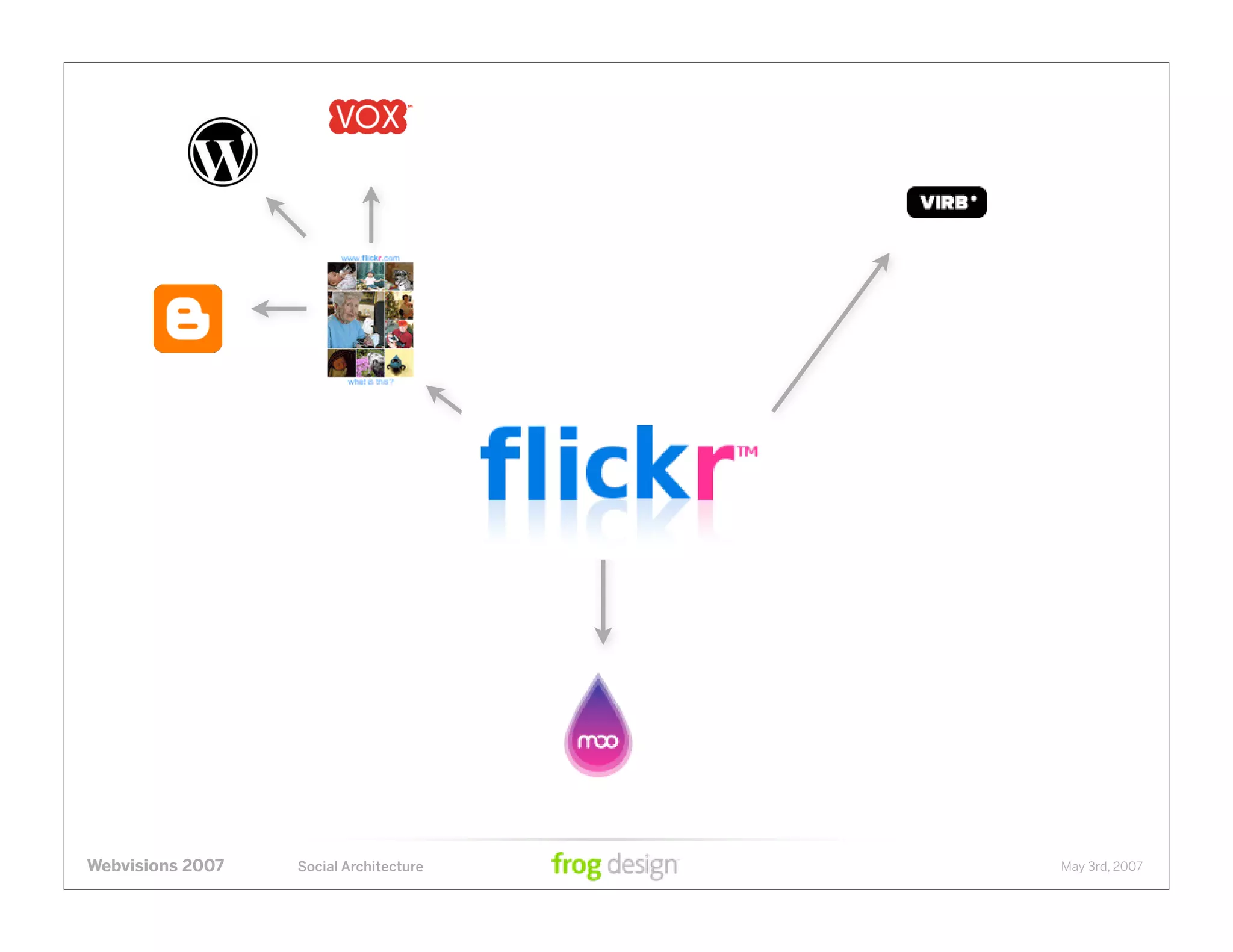
    15. Extension Webvisions 2007 Social Architecture May 3rd, 2007
    16. Webvisions 2007 Social Architecture May 3rd, 2007
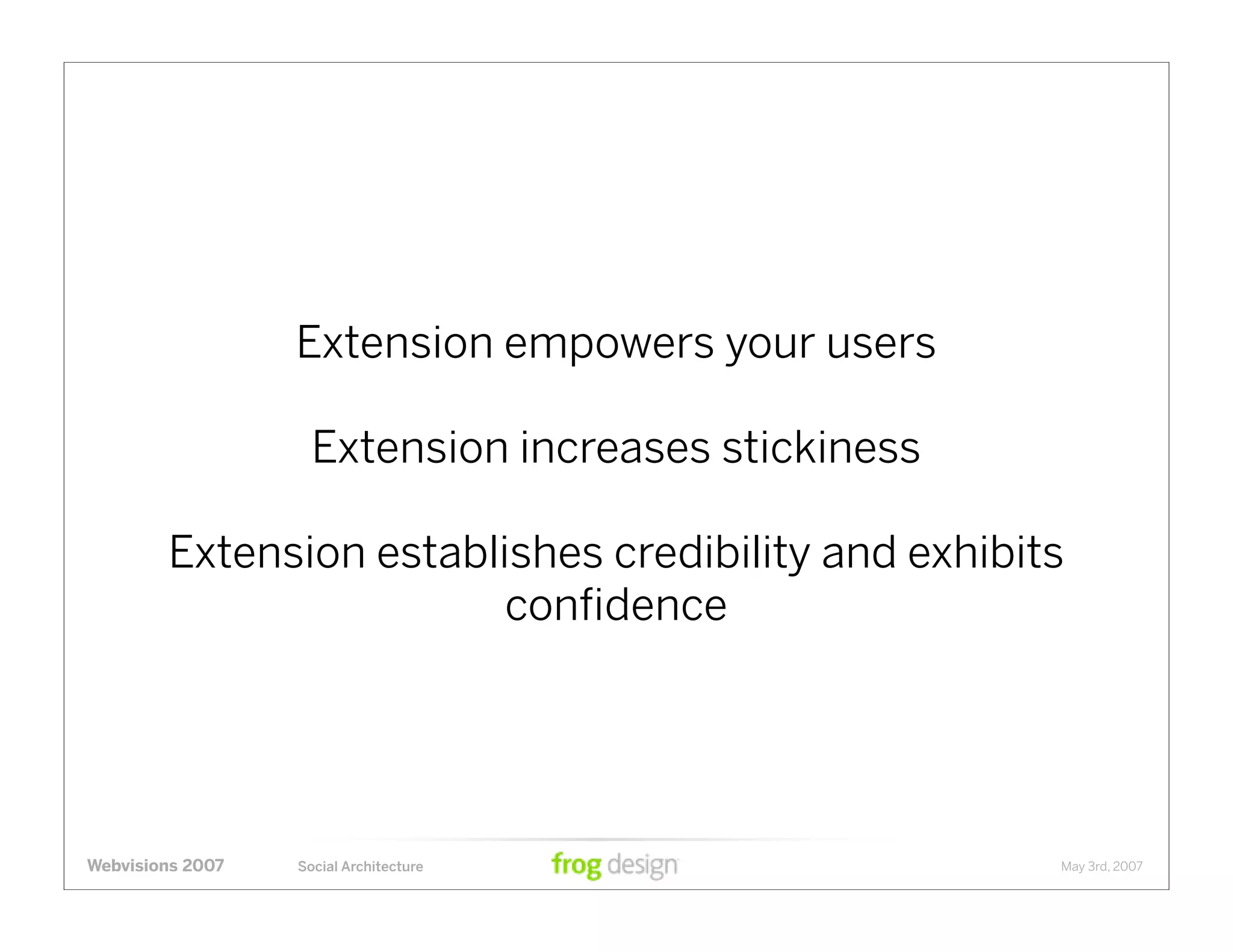
    17. Extension empowers your users Extension increases stickiness Extension establishes credibility and exhibits confidence Webvisions 2007 Social Architecture May 3rd, 2007
    18. Customization Webvisions 2007 Social Architecture May 3rd, 2007
    19. Customization in the social space represents an entirely new software paradigm Webvisions 2007 Social Architecture May 3rd, 2007
    20. Webvisions 2007 Social Architecture May 3rd, 2007
    21. Customization allows for self-expression Customization increases sense of ownership Customization is a di erentiator Webvisions 2007 Social Architecture May 3rd, 2007
    22. All of these combine to form what are being called self-organizing systems Webvisions 2007 Social Architecture May 3rd, 2007
    23. Purposeful Self-Organization Webvisions 2007 Social Architecture May 3rd, 2007
    24. Tagging is a conscious choice, it is work Webvisions 2007 Social Architecture May 3rd, 2007
    25. Voting pushes towards the mean, it does not organize Webvisions 2007 Social Architecture May 3rd, 2007
    26. In its current state, customization is too manual Webvisions 2007 Social Architecture May 3rd, 2007
    27. Ironically, these tools detract from the primary goals of our systems Webvisions 2007 Social Architecture May 3rd, 2007
    28. The next generation of social systems should organize information without inhibiting the acts of creating and consuming Webvisions 2007 Social Architecture May 3rd, 2007
    29. Ubiquitous Computing Webvisions 2007 Social Architecture May 3rd, 2007
    30. Ubiquitous computing is a model of computing in which computer functions are integrated into everyday life, often in an invisible way Webvisions 2007 Social Architecture May 3rd, 2007
    31. It is not only inevitable, it is already here Webvisions 2007 Social Architecture May 3rd, 2007
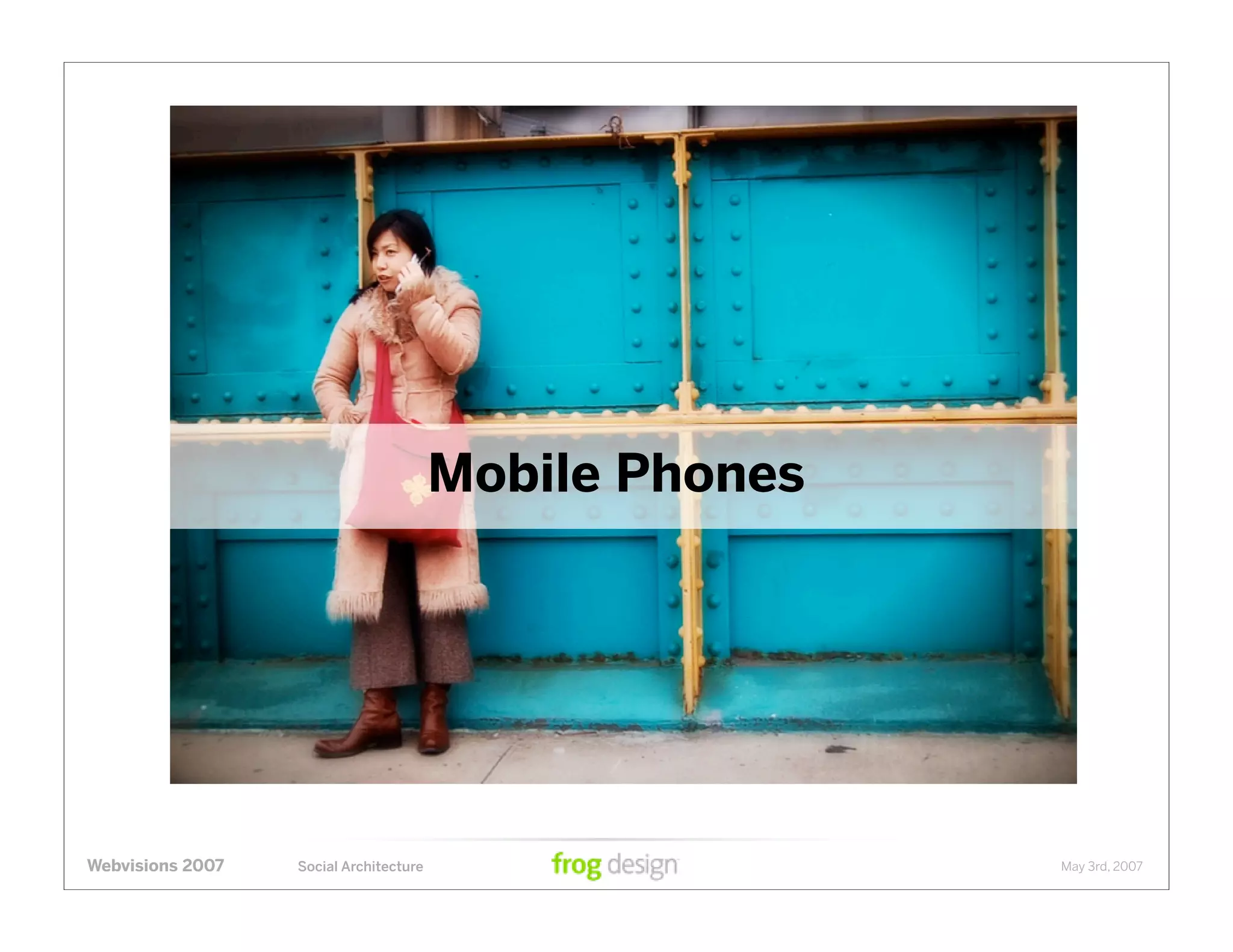
    32. Mobile Phones Webvisions 2007 Social Architecture May 3rd, 2007
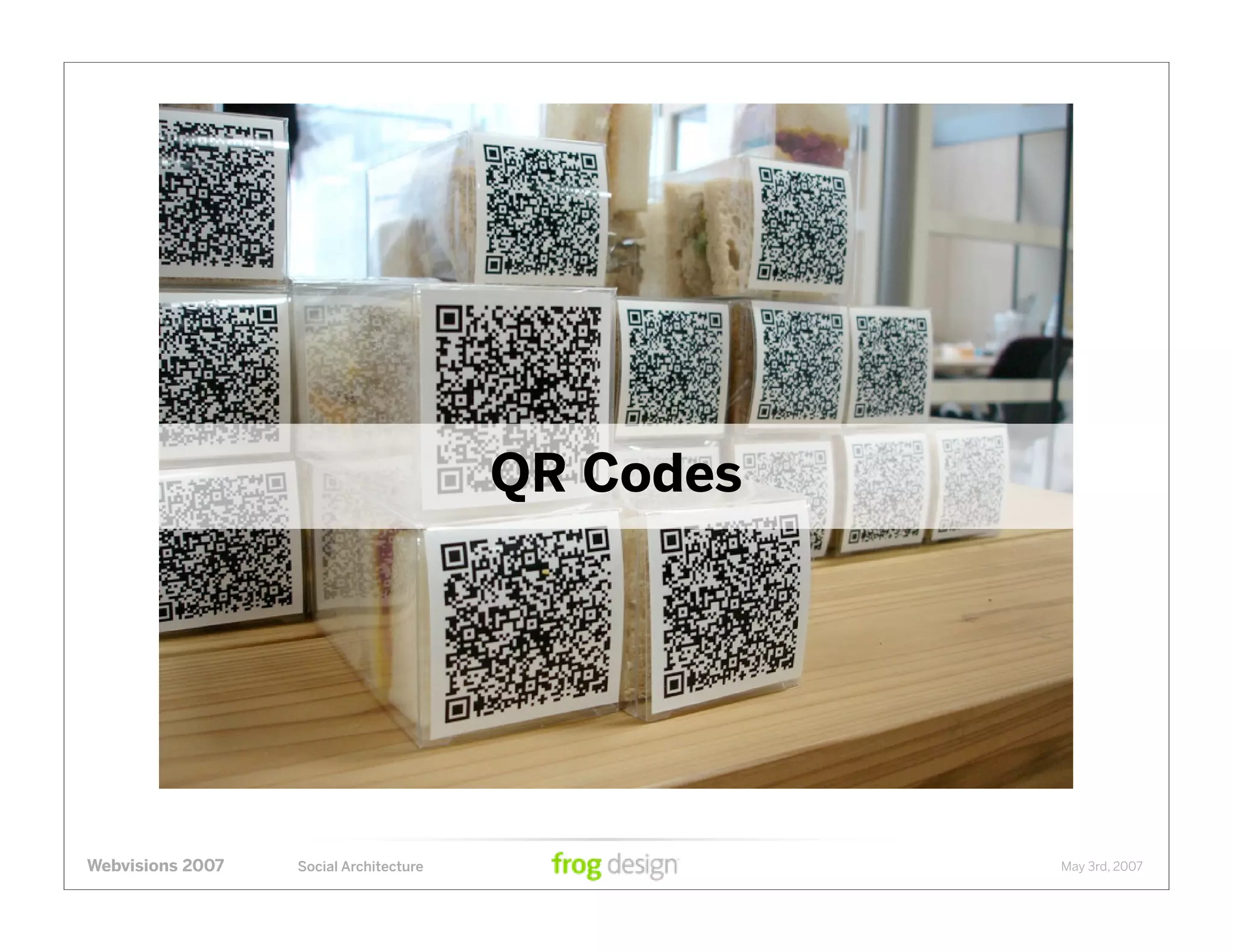
    33. QR Codes Webvisions 2007 Social Architecture May 3rd, 2007
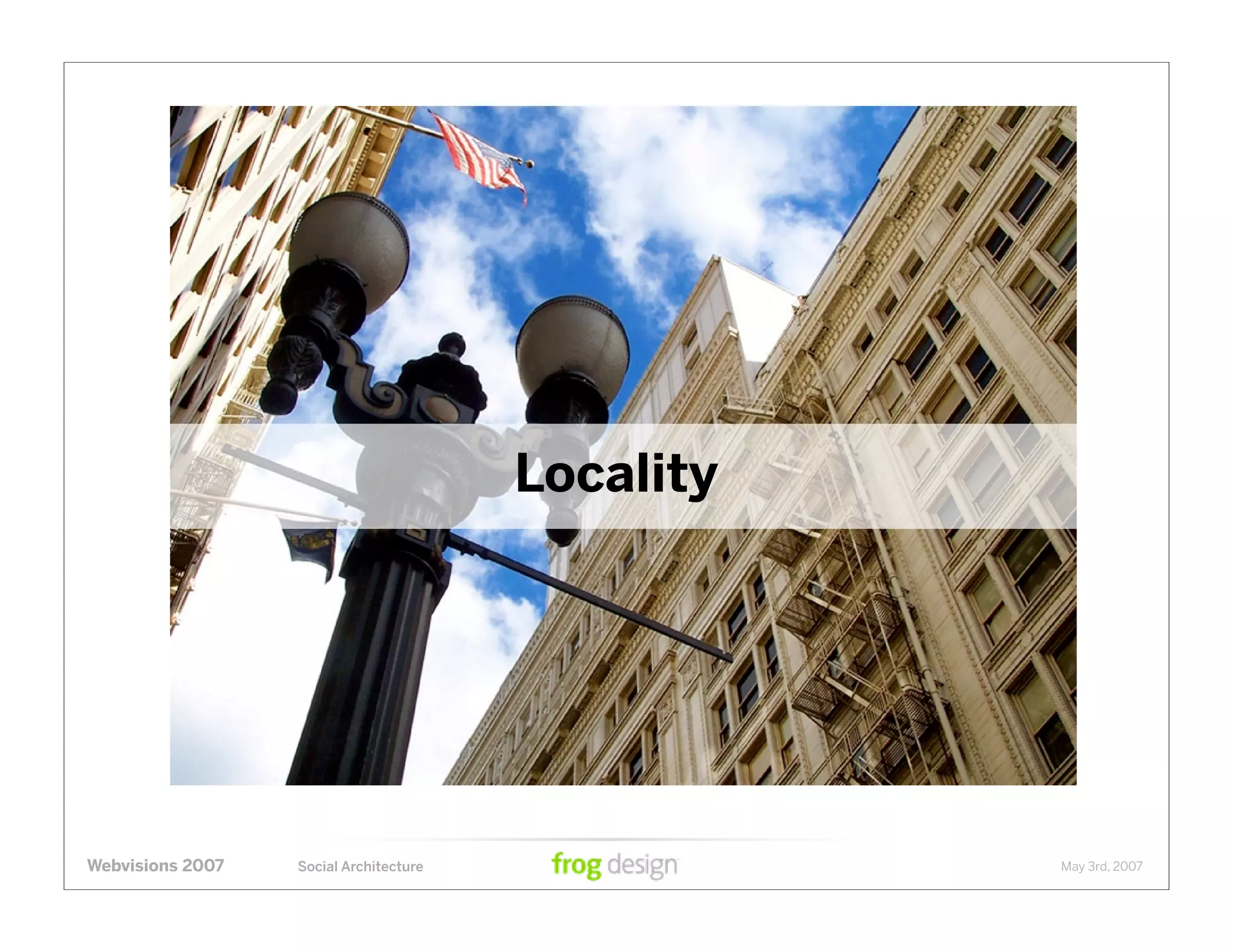
    34. Locality Webvisions 2007 Social Architecture May 3rd, 2007
    35. Aside from designing directly for it, we can learn from its basic principles Webvisions 2007 Social Architecture May 3rd, 2007
    36. Calm Technology Webvisions 2007 Social Architecture May 3rd, 2007
    37. Beautiful Seams Webvisions 2007 Social Architecture May 3rd, 2007
    38. A point of presence becomes a field of presence Webvisions 2007 Social Architecture May 3rd, 2007
    39. Enabling our networks to leverage ubiquitous computing will reduce the cognitive load required to achieve the desired task Webvisions 2007 Social Architecture May 3rd, 2007
    40. Emergence Webvisions 2007 Social Architecture May 3rd, 2007
    41. An emergent system is one of great complexity that is created without oversight from a “master designer” and comes about through agents following their own set of simple, local rules Webvisions 2007 Social Architecture May 3rd, 2007
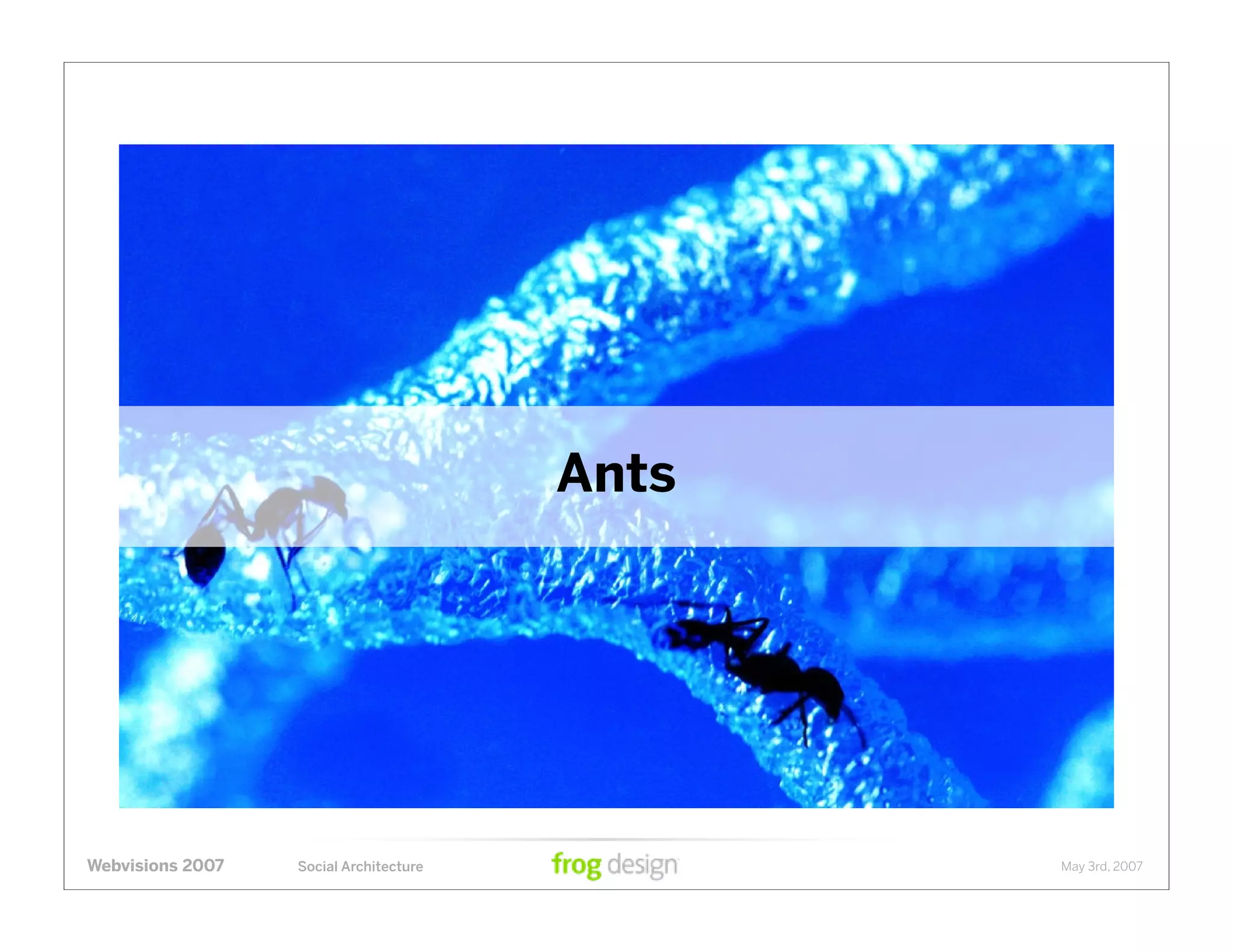
    42. Ants Webvisions 2007 Social Architecture May 3rd, 2007
    43. More is di erent Ignorance is useful Encourage random encounters Look for patterns Pay attention to your neighbors Webvisions 2007 Social Architecture May 3rd, 2007
    44. Truly emergent organization can be hard to pin to human behavior Webvisions 2007 Social Architecture May 3rd, 2007
    45. But we can start working towards it Webvisions 2007 Social Architecture May 3rd, 2007
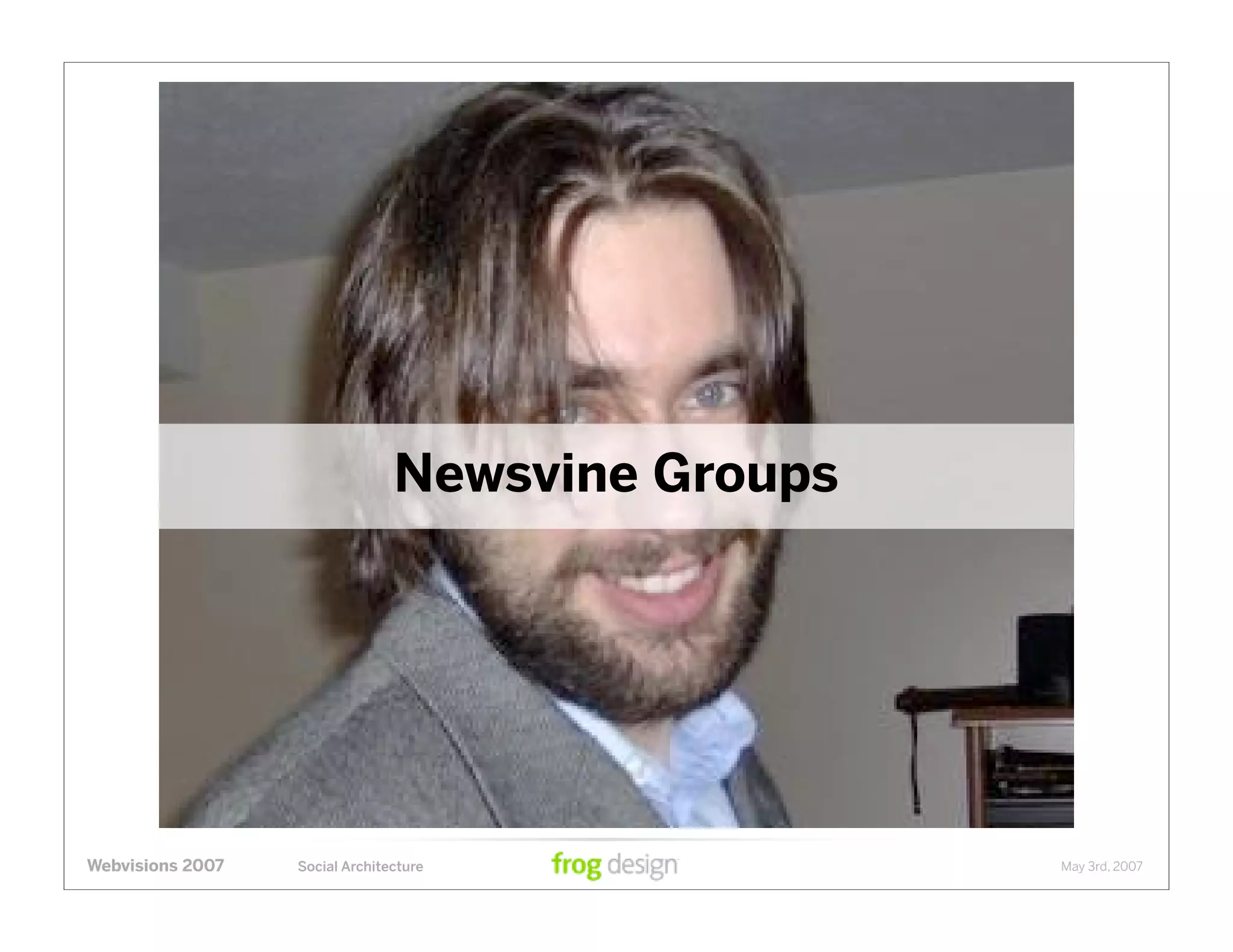
    46. Newsvine Groups Webvisions 2007 Social Architecture May 3rd, 2007
    47. Pattern Matching / Behavior Recognition Webvisions 2007 Social Architecture May 3rd, 2007
    48. The Genetic Algorithm Webvisions 2007 Social Architecture May 3rd, 2007
    49. The outer boundaries of today’s systems are defined by our own intellectual limitations Webvisions 2007 Social Architecture May 3rd, 2007
    50. Release the prioritization / creation of our back- end systems to the community in the same manner as we have released our IA through tagging Webvisions 2007 Social Architecture May 3rd, 2007
    51. Create a base set of rules and let the community grow /cultivate them through use Webvisions 2007 Social Architecture May 3rd, 2007
    52. A crowd is at its wisest when it is: Diverse, Independent, Decentralized, and Aggregated Webvisions 2007 Social Architecture May 3rd, 2007
    53. Purposeful Self-Organization becomes... Webvisions 2007 Social Architecture May 3rd, 2007
    54. Emergent Organization Webvisions 2007 Social Architecture May 3rd, 2007
    55. It’s already here in some capacity Webvisions 2007 Social Architecture May 3rd, 2007
    56. An emergent system is a less bounded system Webvisions 2007 Social Architecture May 3rd, 2007
    57. It is time to take the next step forward and stop putting the hard problems o to another day Webvisions 2007 Social Architecture May 3rd, 2007
    58. Social Networks have limitless potential, but we need to work towards designing them that way Webvisions 2007 Social Architecture May 3rd, 2007
    59. Acknowledgments Special Thanks To Jasmyn Madden, Nick Finck, Valerie Casey, Je Veen, Tom Watson, Jina Bolton, Mykola Bilokonsky Photo Credits http://flickr.com/photos/74833619@N00/93440933/ http://flickr.com/photos/boogah/151536846/ http://flickr.com/photos/damgaard/449566520/ http://flickr.com/photos/add/187811645/ http://flickr.com/photos/catskillsgrrl/99502267/ http://flickr.com/photos/whateverthing/128106986/ Webvisions 2007 Social Architecture May 3rd, 2007

    + smaddensmadden, 3 years ago

    custom

    5167 views, 20 favs, 3 embeds more stats

    Undoubtedly, social software and social media have more

    More info about this document

    © All Rights Reserved

    Go to text version

    • Total Views 5167
      • 5152 on SlideShare
      • 15 from embeds
    • Comments 0
    • Favorites 20
    • Downloads 342
    Most viewed embeds
    • 12 views on http://www.frogdesign.com
    • 2 views on http://designmind.frogdesign.com
    • 1 views on http://feeds.frogdesign.com

    more

    All embeds
    • 12 views on http://www.frogdesign.com
    • 2 views on http://designmind.frogdesign.com
    • 1 views on http://feeds.frogdesign.com

    less

    Flagged as inappropriate Flag as inappropriate
    Flag as inappropriate

    Select your reason for flagging this presentation as inappropriate. If needed, use the feedback form to let us know more details.

    Cancel
    File a copyright complaint
    Having problems? Go to our helpdesk?

    Categories

    Groups / Events