An Overview of Data Management Paradigms:
     Relational, Document, and Graph


                 Marko A. Rodriguez
          T-5, Center for Nonlinear Studies
          Los Alamos National Laboratory
             http://markorodriguez.com

                 February 15, 2010
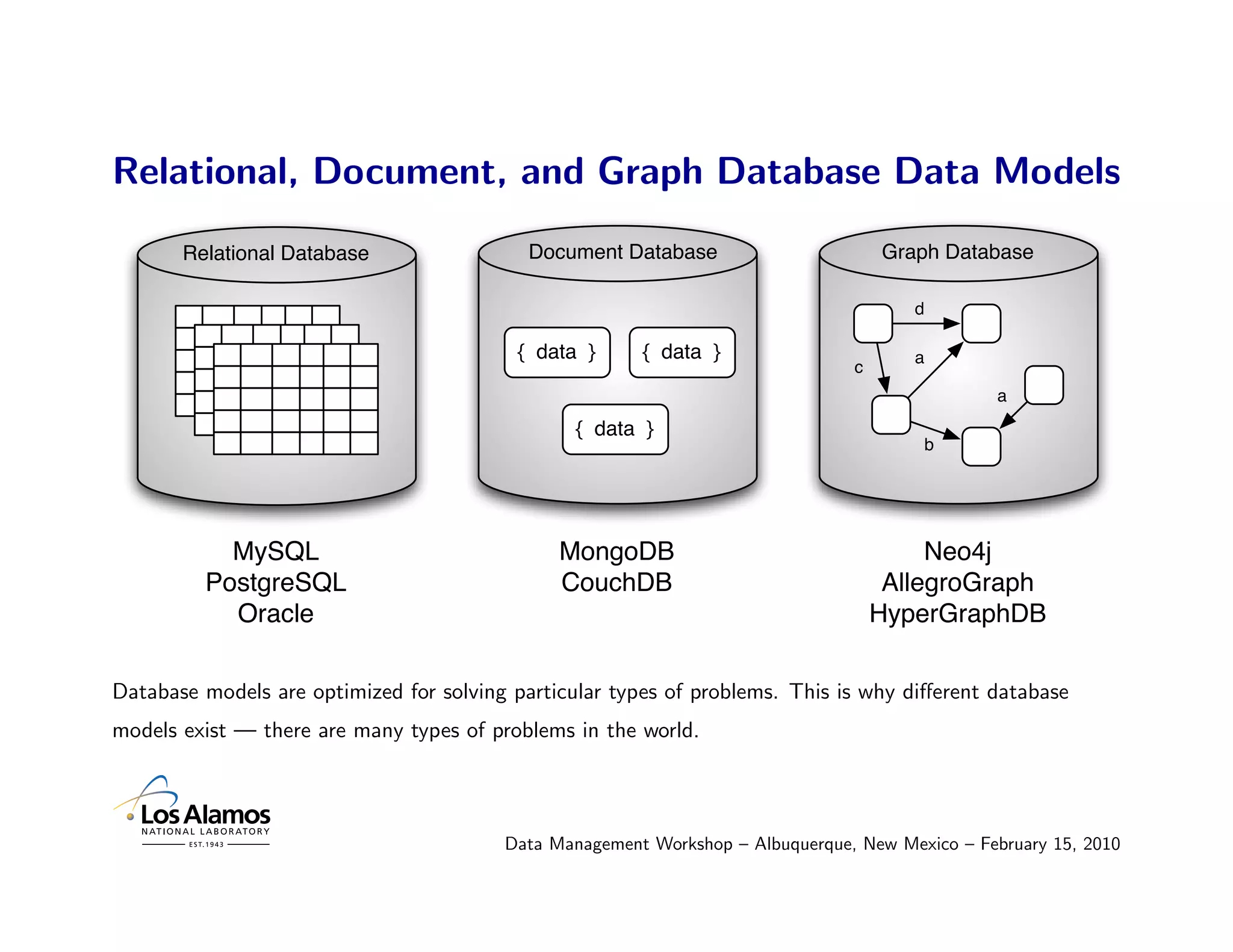
Relational, Document, and Graph Database Data Models
       Relational Database                 Document Database                        Graph Database

                                                                                       d

                                          { data }      { data }                       a
                                                                                c
                                                                                                a
                                                 { data }
                                                                                        b


           MySQL                               MongoDB                                   Neo4j
         PostgreSQL                            CouchDB                               AllegroGraph
           Oracle                                                                   HyperGraphDB

Database models are optimized for solving particular types of problems. This is why different database
models exist — there are many types of problems in the world.


                                         Data Management Workshop – Albuquerque, New Mexico – February 15, 2010
Finding the Right Solution to your Problem
1. Come to terms with your problem.
   • “I have metadata for a massive number of objects and I don’t know
     how to get at my data.”

2. Identify the solution to your problem.
   • “I need to be able to find objects based on their metadata.”

3. Identify the type of database that is optimized for that type of solution.
   • “A document database scales, stores metadata, and can be queried.”

4. Identify the database of that type that best meets your particular needs.
   • “CouchDB has a REST web interface and all my developers are
     good with REST.”


                              Data Management Workshop – Albuquerque, New Mexico – February 15, 2010
Relational Databases

• Relational databases have been the de facto data management solution
  for many years.


MySQL is available at http://www.mysql.com
PostgreSQL is available at http://www.postgresql.org
Oracle is available at http://www.oracle.com


                                      Data Management Workshop – Albuquerque, New Mexico – February 15, 2010
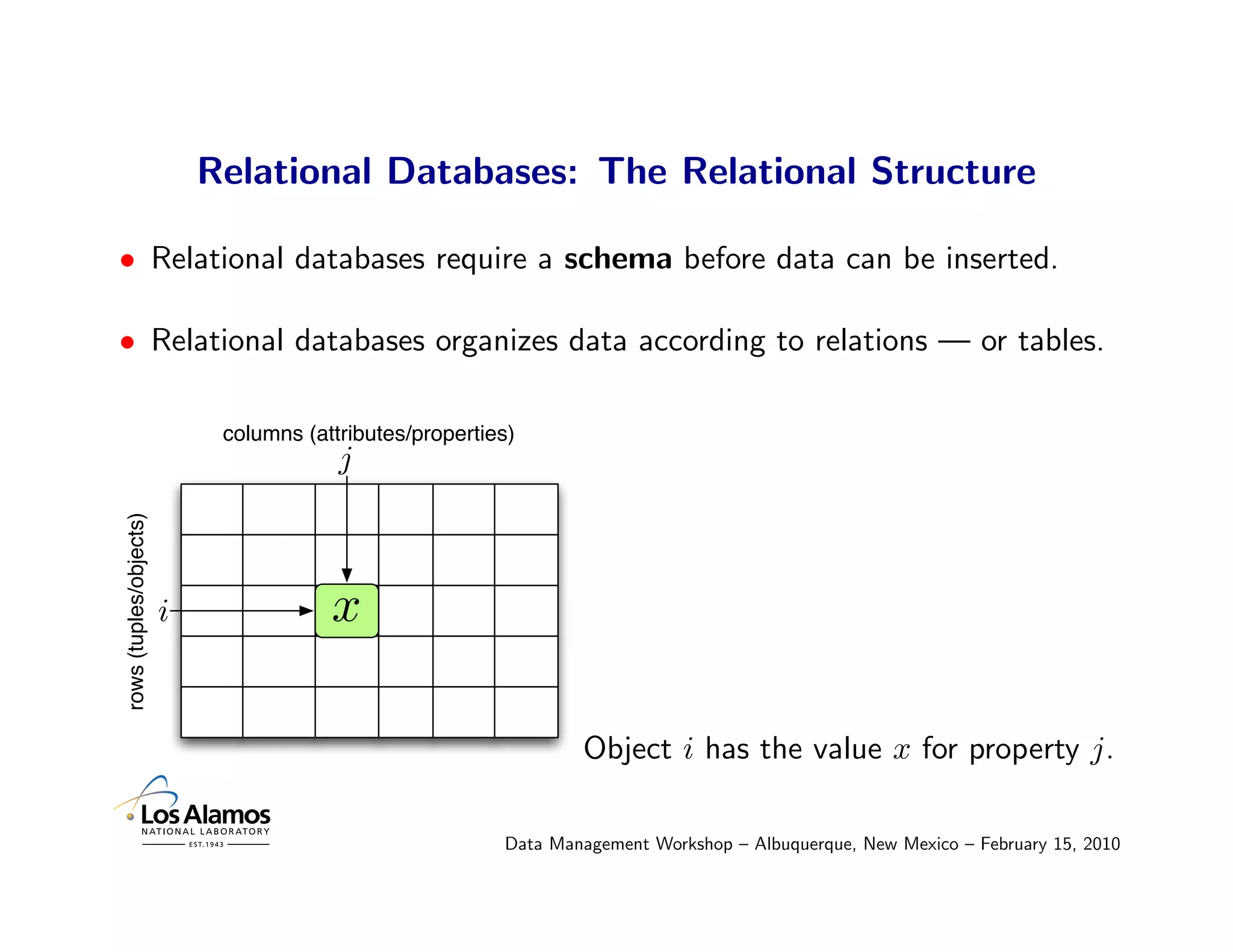
Relational Databases: The Relational Structure

• Relational databases require a schema before data can be inserted.

• Relational databases organizes data according to relations — or tables.

                             columns (attributes/properties)
                                         j
rows (tuples/objects)


                        i               x

                                                                  Object i has the value x for property j.

                                                          Data Management Workshop – Albuquerque, New Mexico – February 15, 2010
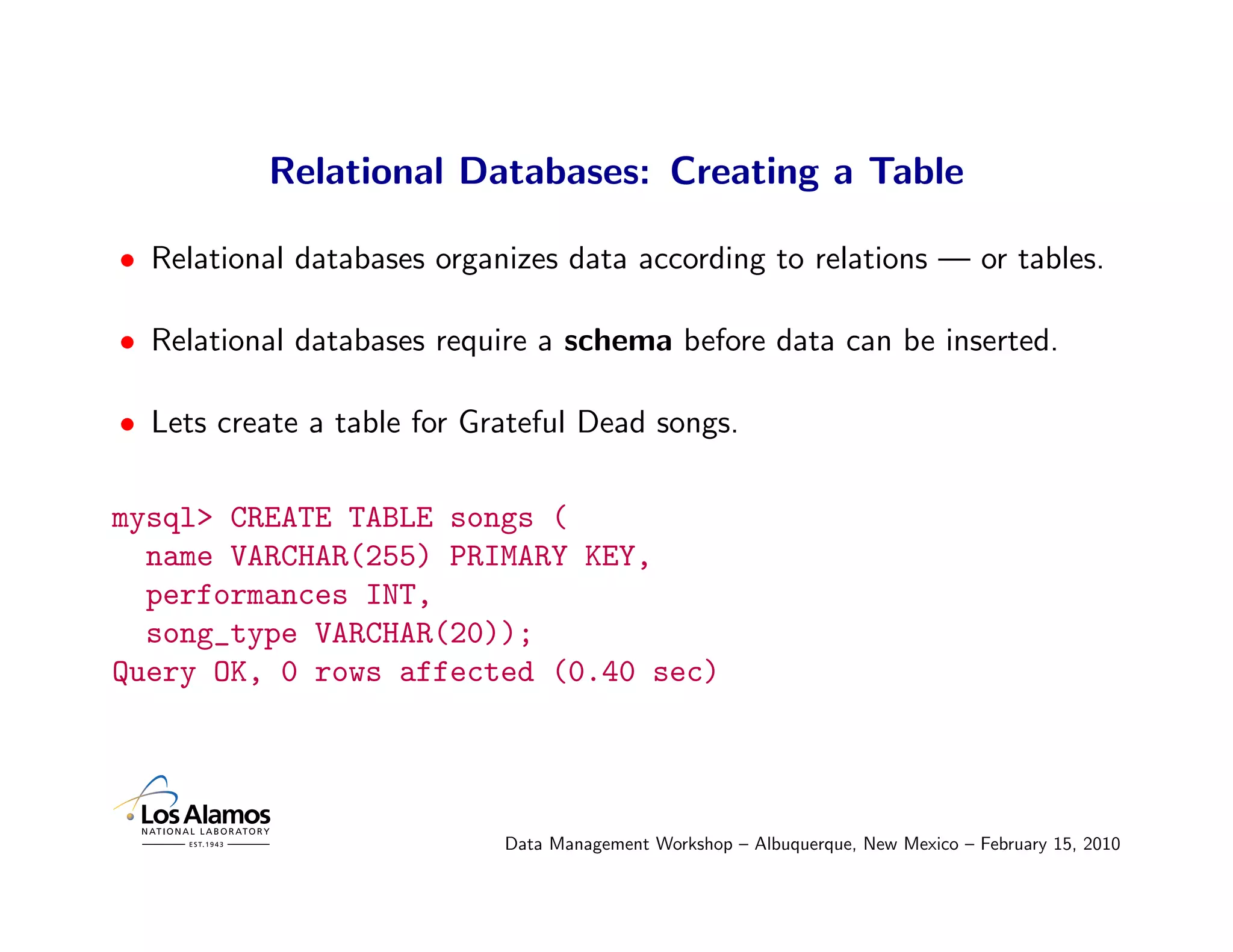
Relational Databases: Creating a Table

• Relational databases organizes data according to relations — or tables.

• Relational databases require a schema before data can be inserted.

• Lets create a table for Grateful Dead songs.

mysql> CREATE TABLE songs (
  name VARCHAR(255) PRIMARY KEY,
  performances INT,
  song_type VARCHAR(20));
Query OK, 0 rows affected (0.40 sec)


                            Data Management Workshop – Albuquerque, New Mexico – February 15, 2010
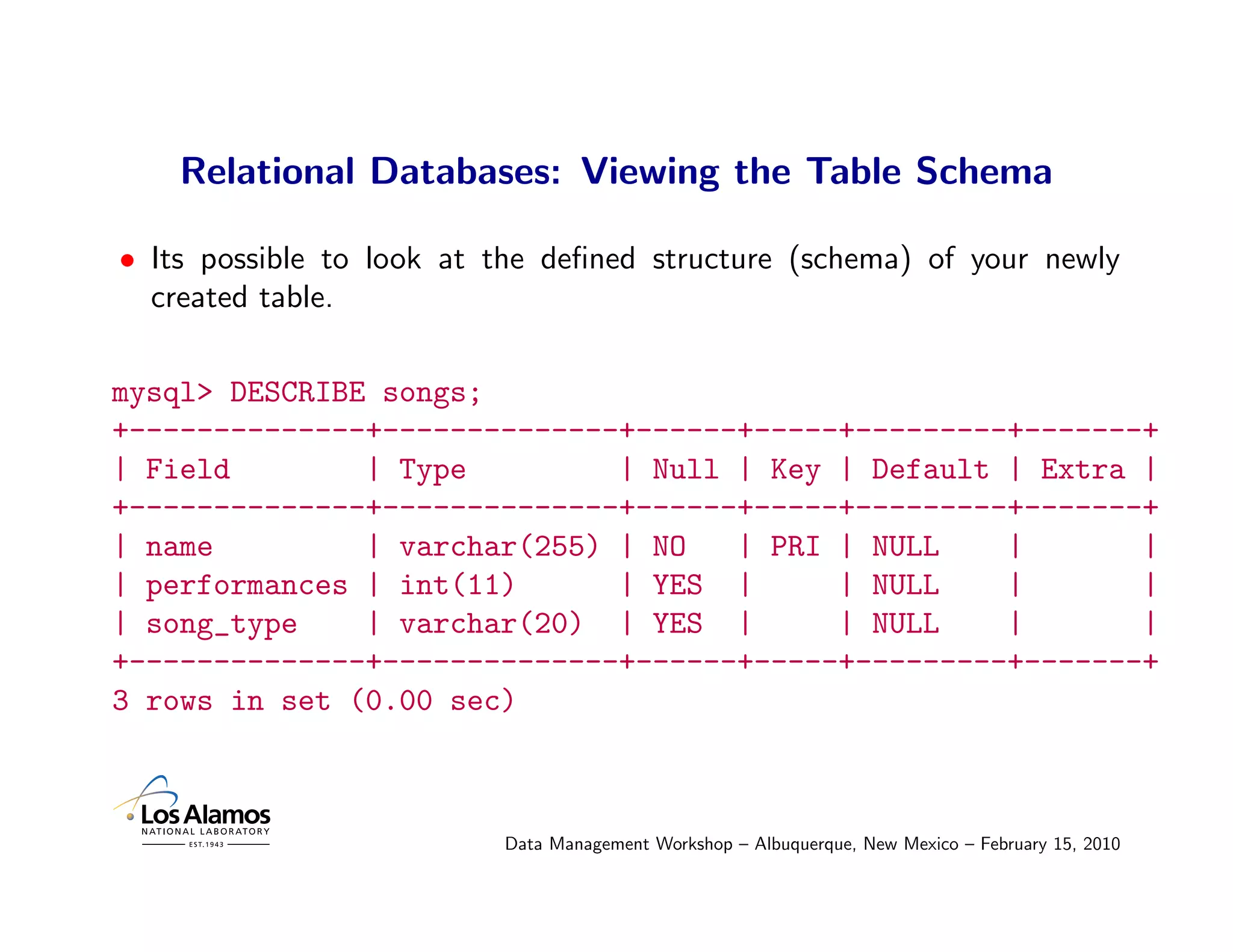
Relational Databases: Viewing the Table Schema

• Its possible to look at the defined structure (schema) of your newly
  created table.

mysql> DESCRIBE songs;
+--------------+--------------+------+-----+---------+-------+
| Field        | Type         | Null | Key | Default | Extra |
+--------------+--------------+------+-----+---------+-------+
| name         | varchar(255) | NO   | PRI | NULL    |       |
| performances | int(11)      | YES |      | NULL    |       |
| song_type    | varchar(20) | YES |       | NULL    |       |
+--------------+--------------+------+-----+---------+-------+
3 rows in set (0.00 sec)


                          Data Management Workshop – Albuquerque, New Mexico – February 15, 2010
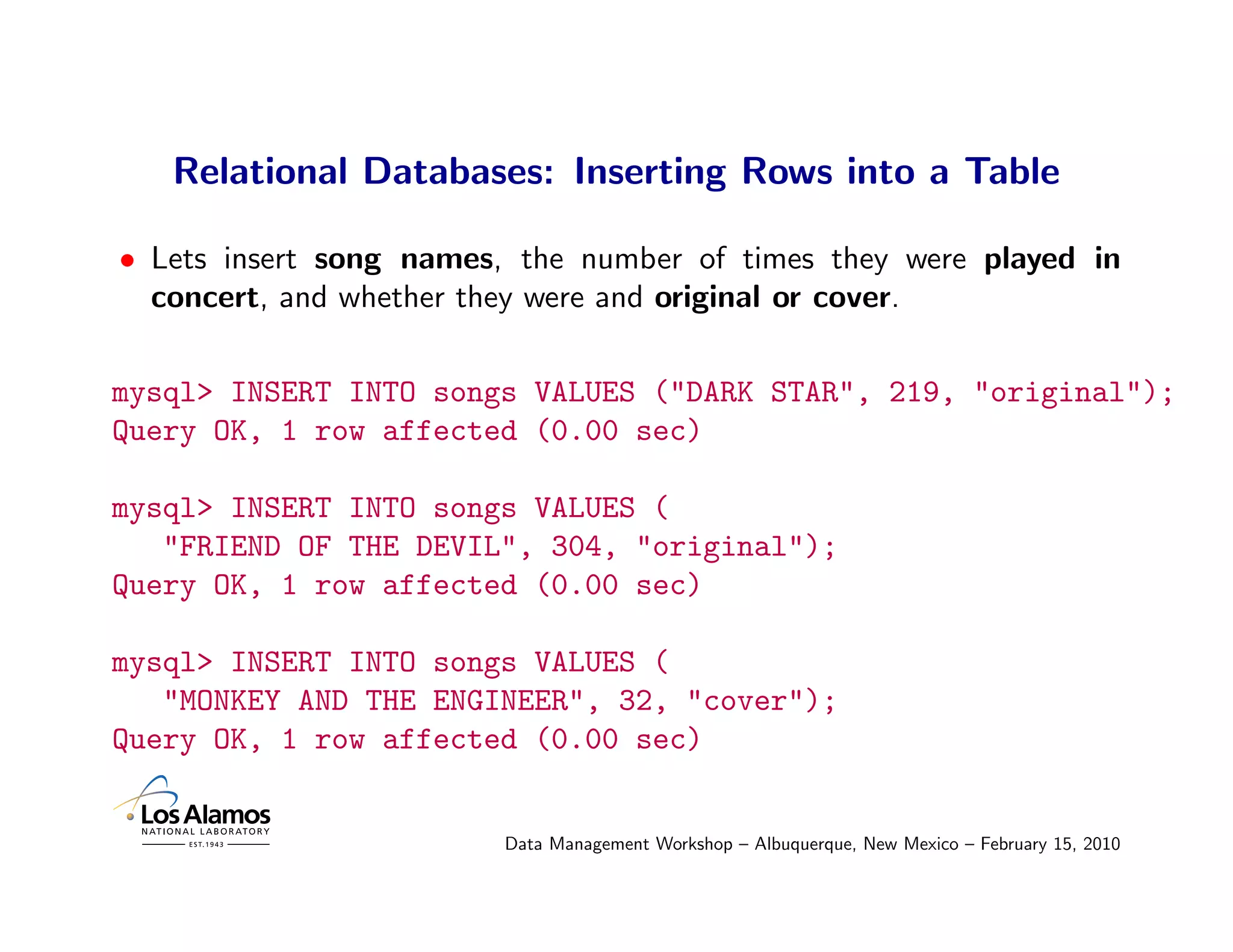
Relational Databases: Inserting Rows into a Table

• Lets insert song names, the number of times they were played in
  concert, and whether they were and original or cover.

mysql> INSERT INTO songs VALUES ("DARK STAR", 219, "original");
Query OK, 1 row affected (0.00 sec)

mysql> INSERT INTO songs VALUES (
   "FRIEND OF THE DEVIL", 304, "original");
Query OK, 1 row affected (0.00 sec)

mysql> INSERT INTO songs VALUES (
   "MONKEY AND THE ENGINEER", 32, "cover");
Query OK, 1 row affected (0.00 sec)


                         Data Management Workshop – Albuquerque, New Mexico – February 15, 2010
Relational Databases: Searching a Table

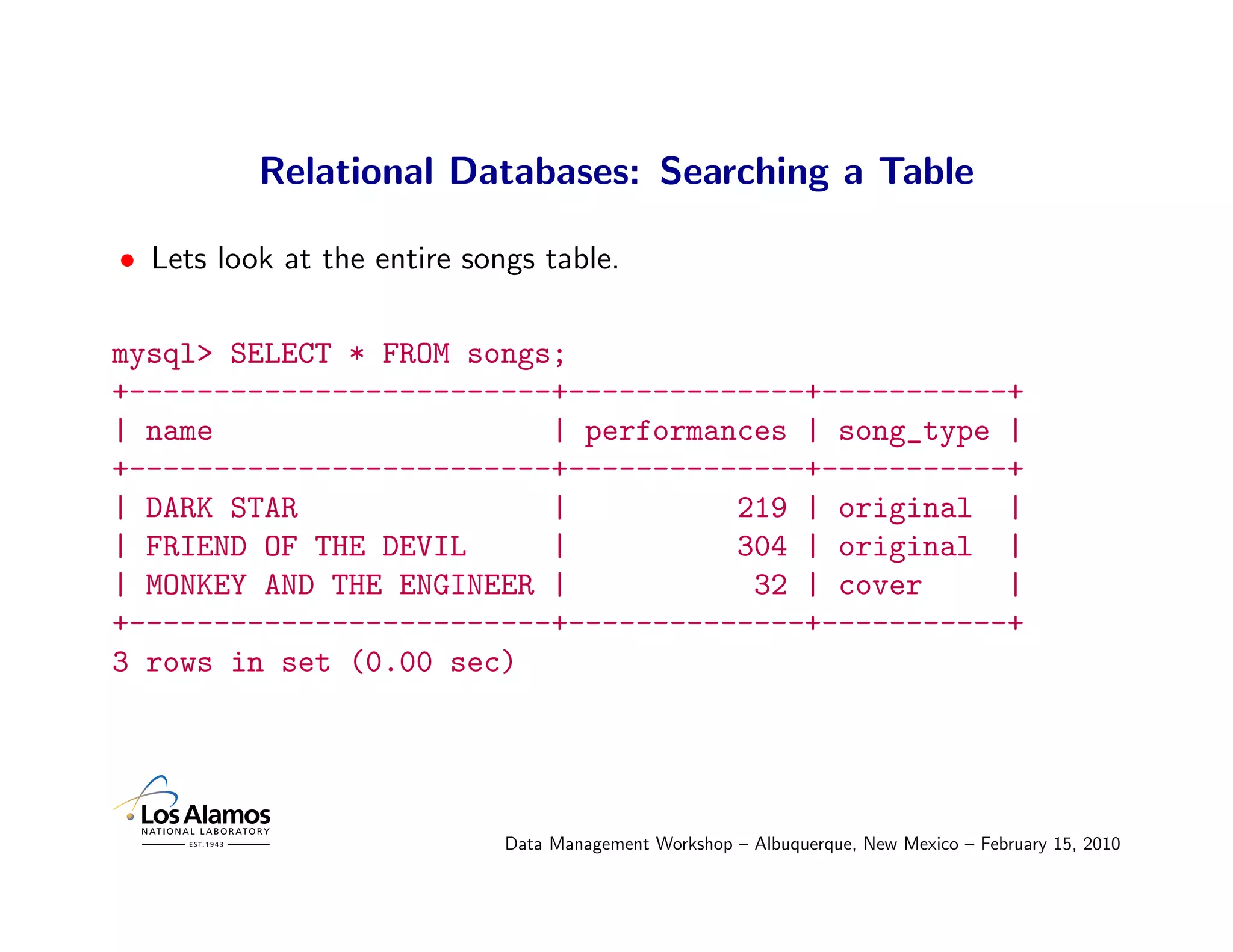
• Lets look at the entire songs table.

mysql> SELECT * FROM songs;
+-------------------------+--------------+-----------+
| name                    | performances | song_type |
+-------------------------+--------------+-----------+
| DARK STAR               |          219 | original |
| FRIEND OF THE DEVIL     |          304 | original |
| MONKEY AND THE ENGINEER |           32 | cover     |
+-------------------------+--------------+-----------+
3 rows in set (0.00 sec)


                             Data Management Workshop – Albuquerque, New Mexico – February 15, 2010
Relational Databases: Searching a Table

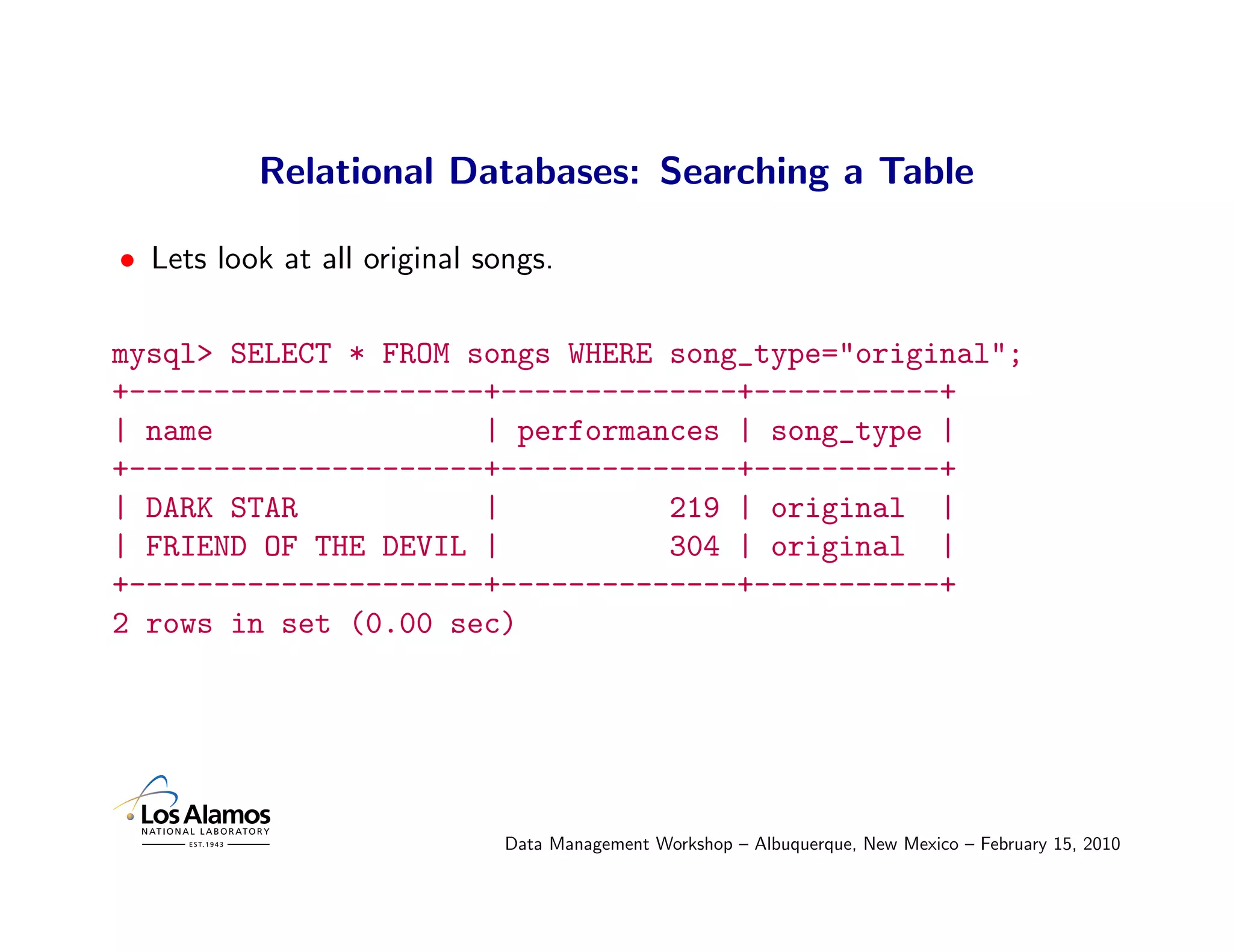
• Lets look at all original songs.

mysql> SELECT * FROM songs WHERE song_type="original";
+---------------------+--------------+-----------+
| name                | performances | song_type |
+---------------------+--------------+-----------+
| DARK STAR           |          219 | original |
| FRIEND OF THE DEVIL |          304 | original |
+---------------------+--------------+-----------+
2 rows in set (0.00 sec)


                              Data Management Workshop – Albuquerque, New Mexico – February 15, 2010
Relational Databases: Searching a Table

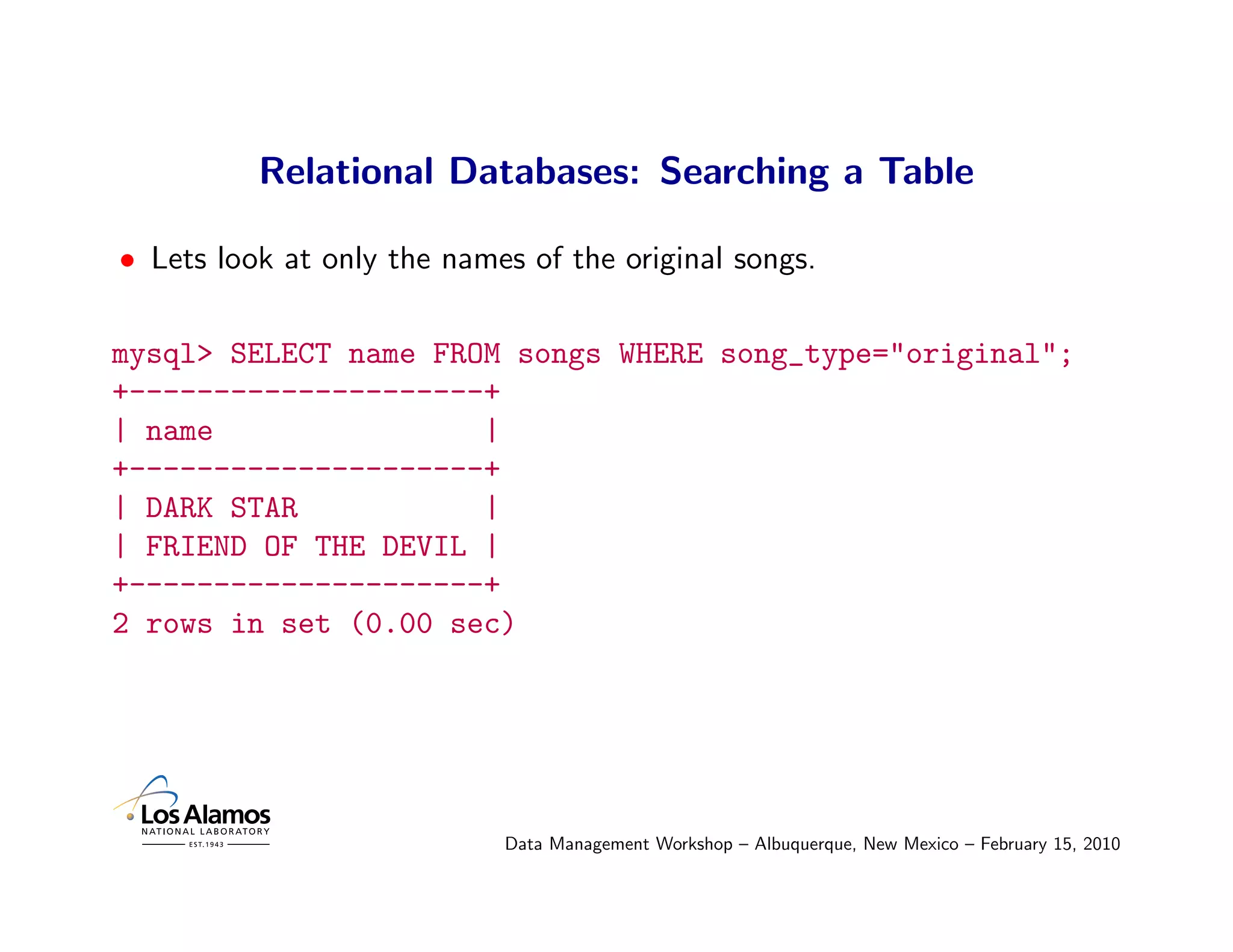
• Lets look at only the names of the original songs.

mysql> SELECT name FROM songs WHERE song_type="original";
+---------------------+
| name                |
+---------------------+
| DARK STAR           |
| FRIEND OF THE DEVIL |
+---------------------+
2 rows in set (0.00 sec)


                            Data Management Workshop – Albuquerque, New Mexico – February 15, 2010
Document Databases
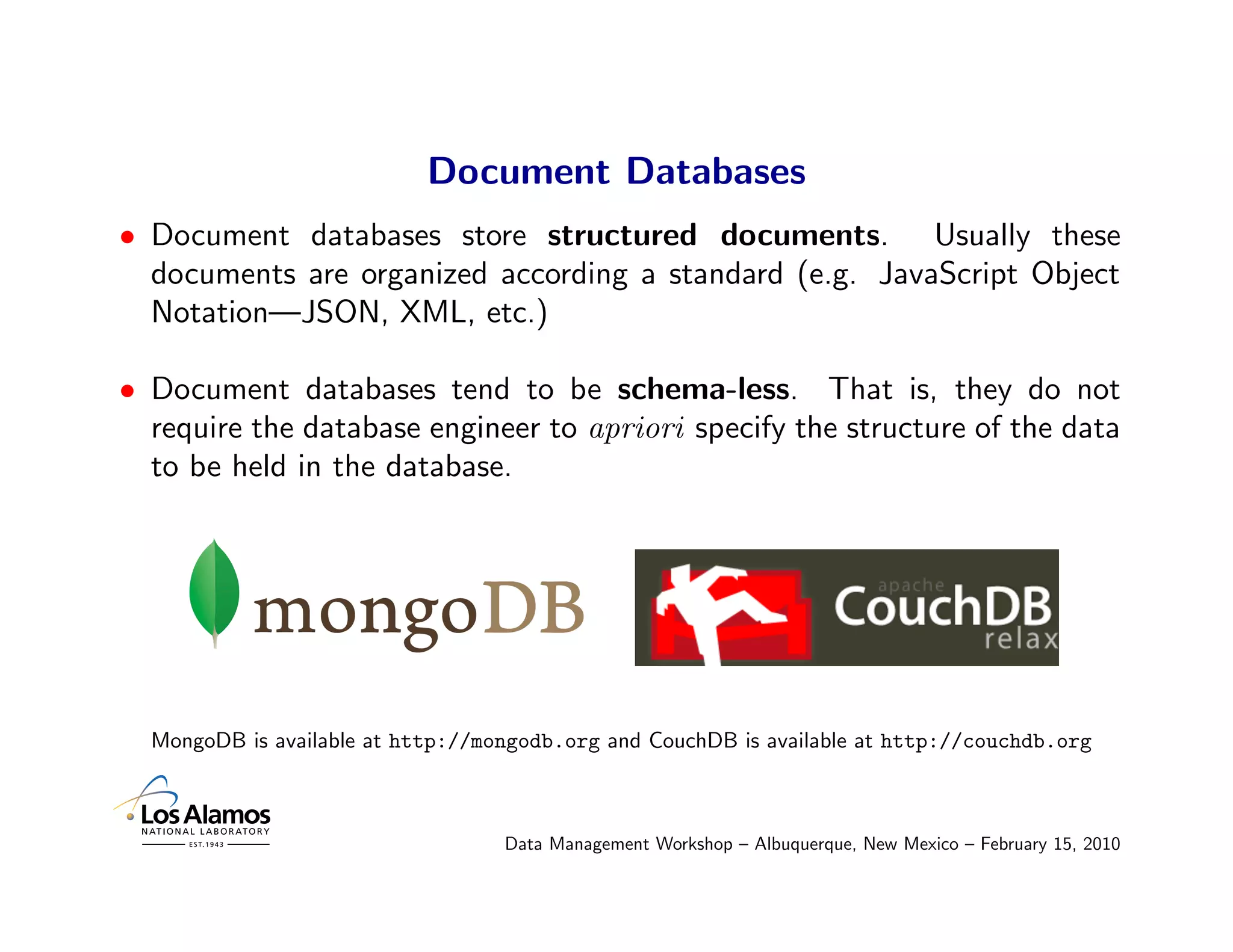
• Document databases store structured documents. Usually these
  documents are organized according a standard (e.g. JavaScript Object
  Notation—JSON, XML, etc.)

• Document databases tend to be schema-less. That is, they do not
  require the database engineer to apriori specify the structure of the data
  to be held in the database.


  MongoDB is available at http://mongodb.org and CouchDB is available at http://couchdb.org


                                   Data Management Workshop – Albuquerque, New Mexico – February 15, 2010
Document Databases: JavaScript Object Notation

• A JSON document is a collection of key/value pairs, where a value can
  be yet another collection of key/value pairs.
     string: a string value (e.g. “marko”, “rodriguez”).
     number: a numeric value (e.g. 1234, 67.012).
     boolean: a true/false value (e.g. true, false)
     null: a non-existant value.
     array: an array of values (e.g. [1,“marko”,true])
     object: a key/value map (e.g. { “key” : 123 })

The JSON specification is very simple and can be found at http://www.json.org/.


                               Data Management Workshop – Albuquerque, New Mexico – February 15, 2010
Document Databases: JavaScript Object Notation
{
    _id : "D0DC29E9-51AE-4A8C-8769-541501246737",
    name : "Marko A. Rodriguez",
    homepage : "http://markorodriguez.com",
    age : 30,
    location : {
        country : "United States",
        state : "New Mexico",
        city : "Santa Fe",
        zipcode : 87501
    },
    interests : ["graphs", "hockey", "motorcycles"]
}


                         Data Management Workshop – Albuquerque, New Mexico – February 15, 2010
Document Databases: Handling JSON Documents

• Use object-oriented “dot notation” to access components.

> marko = eval({_id : "D0DC29E9...", name : "Marko...})
> marko._id
D0DC29E9-51AE-4A8C-8769-541501246737
> marko.location.city
Santa Fe
> marko.interests[0]
graphs

All document database examples presented are using MongoDB [http://mongodb.org].


                               Data Management Workshop – Albuquerque, New Mexico – February 15, 2010
Document Databases: Inserting JSON Documents
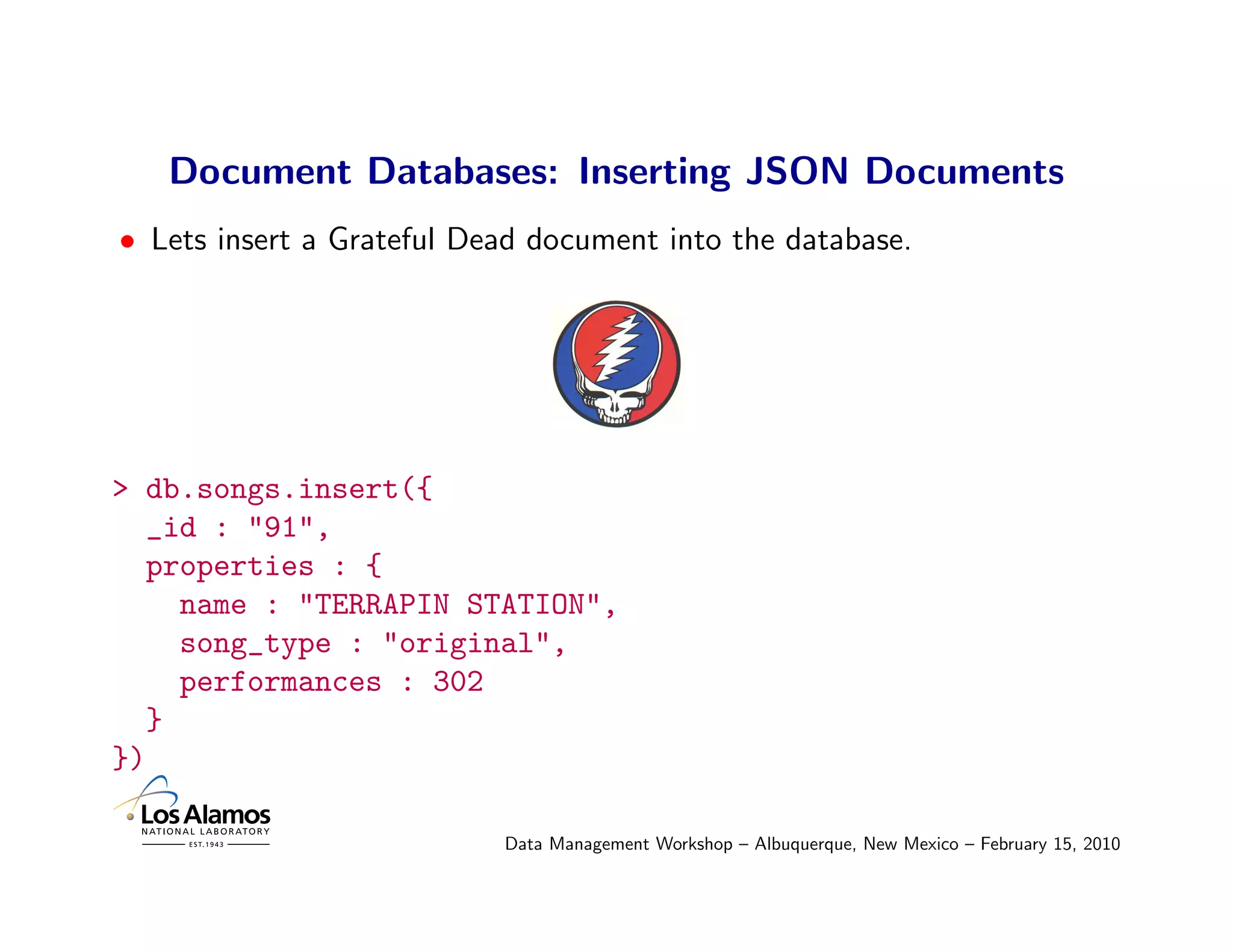
• Lets insert a Grateful Dead document into the database.


> db.songs.insert({
  _id : "91",
  properties : {
    name : "TERRAPIN STATION",
    song_type : "original",
    performances : 302
  }
})

                           Data Management Workshop – Albuquerque, New Mexico – February 15, 2010
Document Databases: Finding JSON Documents

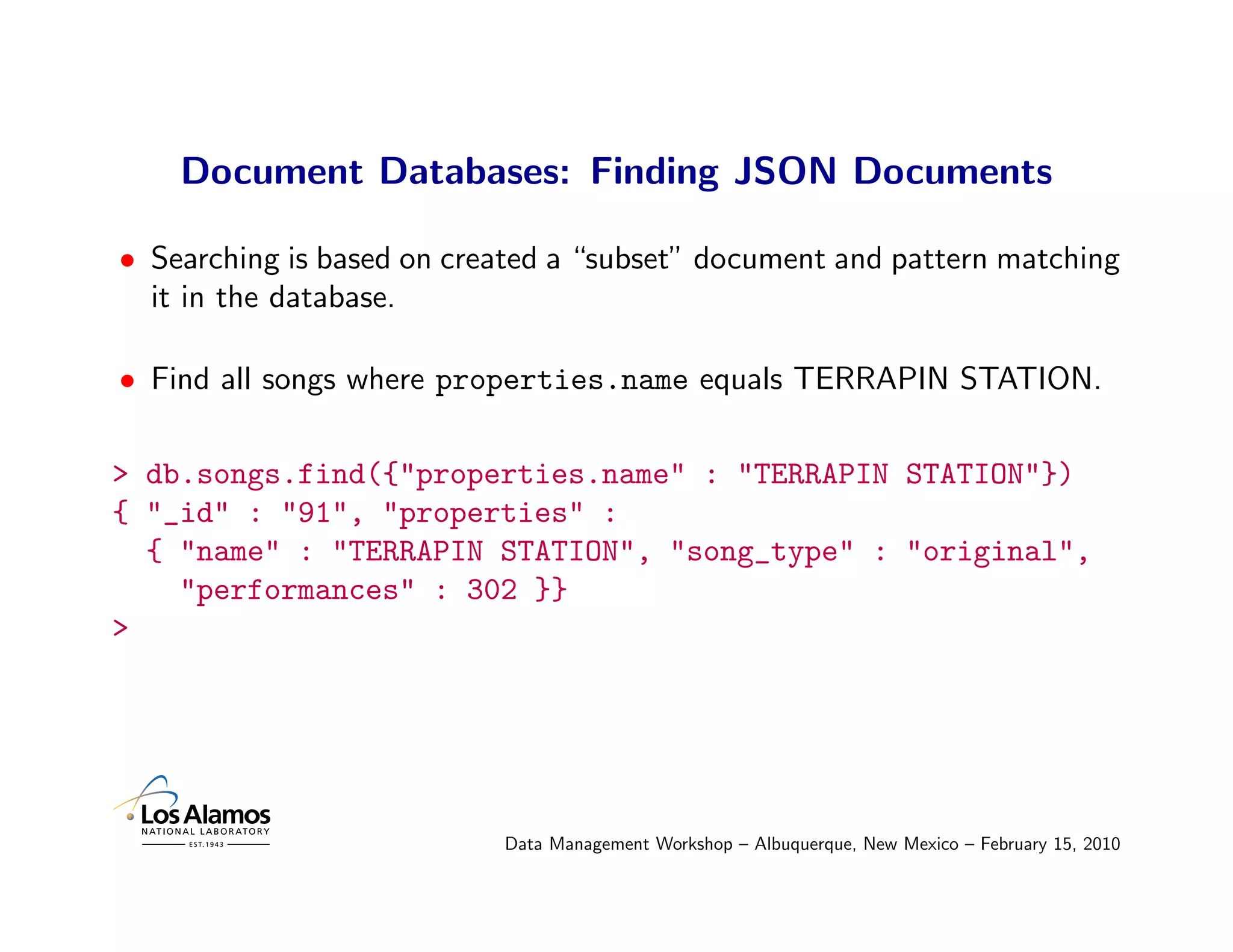
• Searching is based on created a “subset” document and pattern matching
  it in the database.

• Find all songs where properties.name equals TERRAPIN STATION.

> db.songs.find({"properties.name" : "TERRAPIN STATION"})
{ "_id" : "91", "properties" :
  { "name" : "TERRAPIN STATION", "song_type" : "original",
    "performances" : 302 }}
>


                           Data Management Workshop – Albuquerque, New Mexico – February 15, 2010
Document Databases: Finding JSON Documents

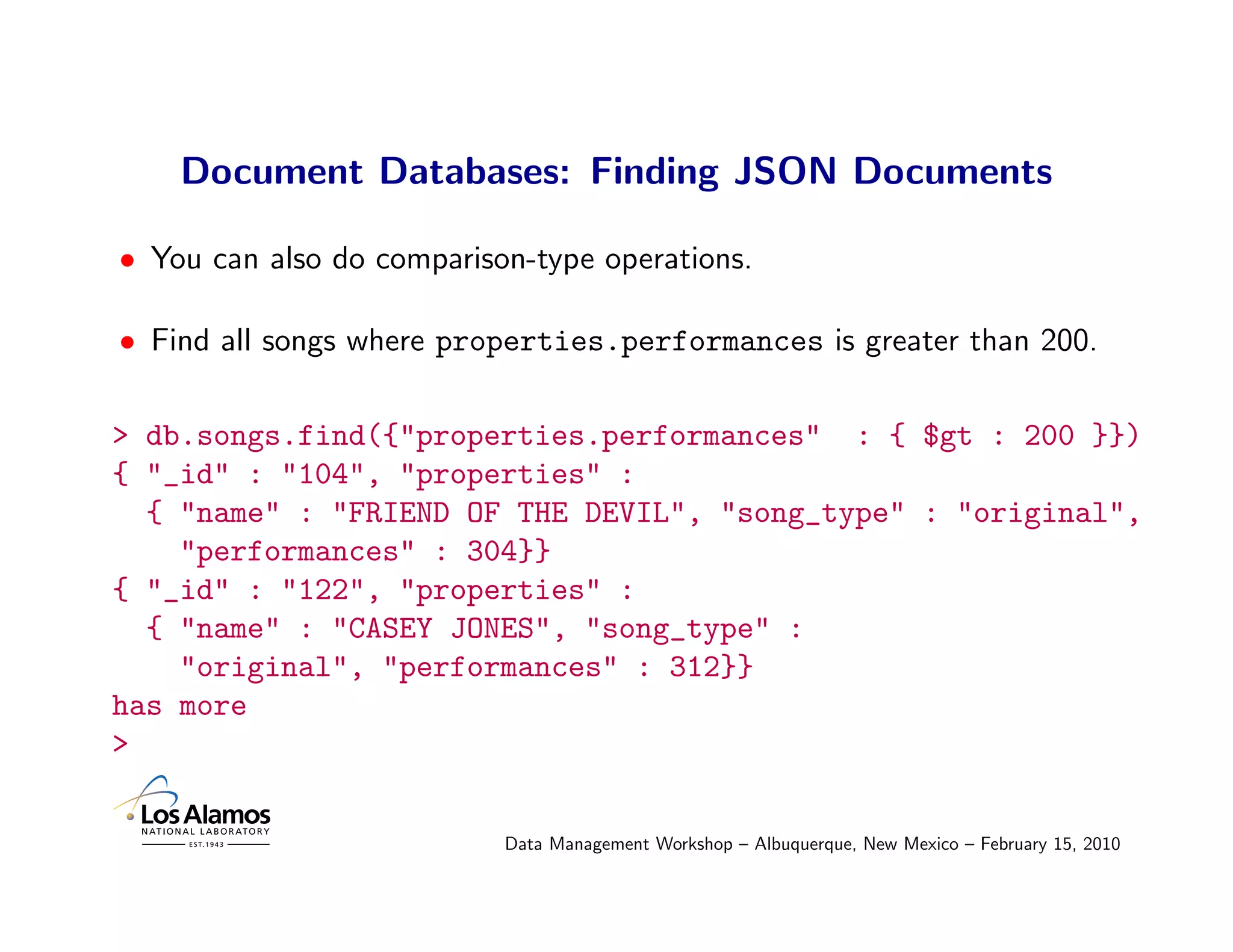
• You can also do comparison-type operations.

• Find all songs where properties.performances is greater than 200.

> db.songs.find({"properties.performances" : { $gt : 200 }})
{ "_id" : "104", "properties" :
  { "name" : "FRIEND OF THE DEVIL", "song_type" : "original",
    "performances" : 304}}
{ "_id" : "122", "properties" :
  { "name" : "CASEY JONES", "song_type" :
    "original", "performances" : 312}}
has more
>

                           Data Management Workshop – Albuquerque, New Mexico – February 15, 2010
Document Databases: Processing JSON Documents
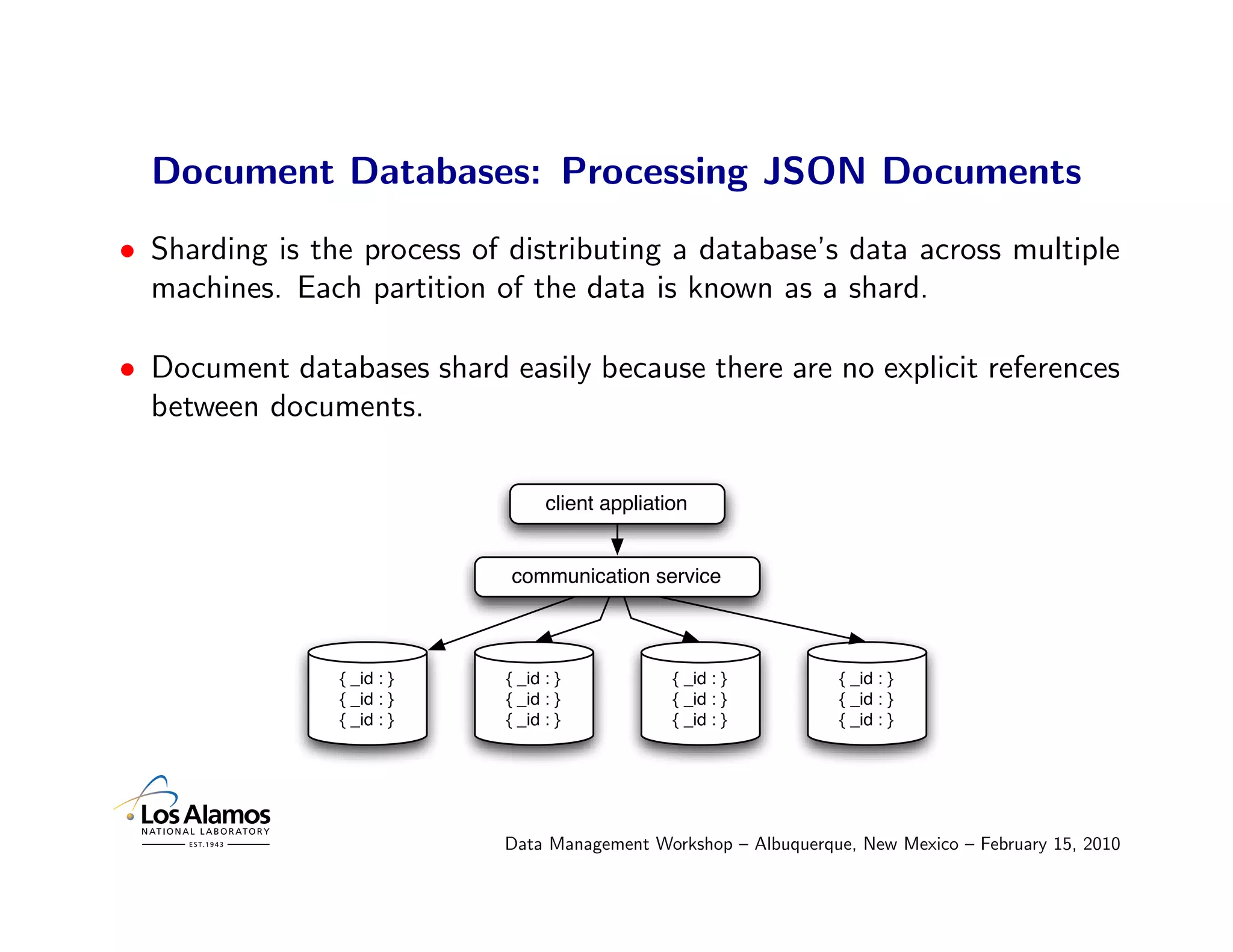
• Sharding is the process of distributing a database’s data across multiple
  machines. Each partition of the data is known as a shard.

• Document databases shard easily because there are no explicit references
  between documents.

                                  client appliation


                             communication service


                { _id : }   { _id : }            { _id : }        { _id : }
                { _id : }   { _id : }            { _id : }        { _id : }
                { _id : }   { _id : }            { _id : }        { _id : }


                            Data Management Workshop – Albuquerque, New Mexico – February 15, 2010
Document Databases: Processing JSON Documents

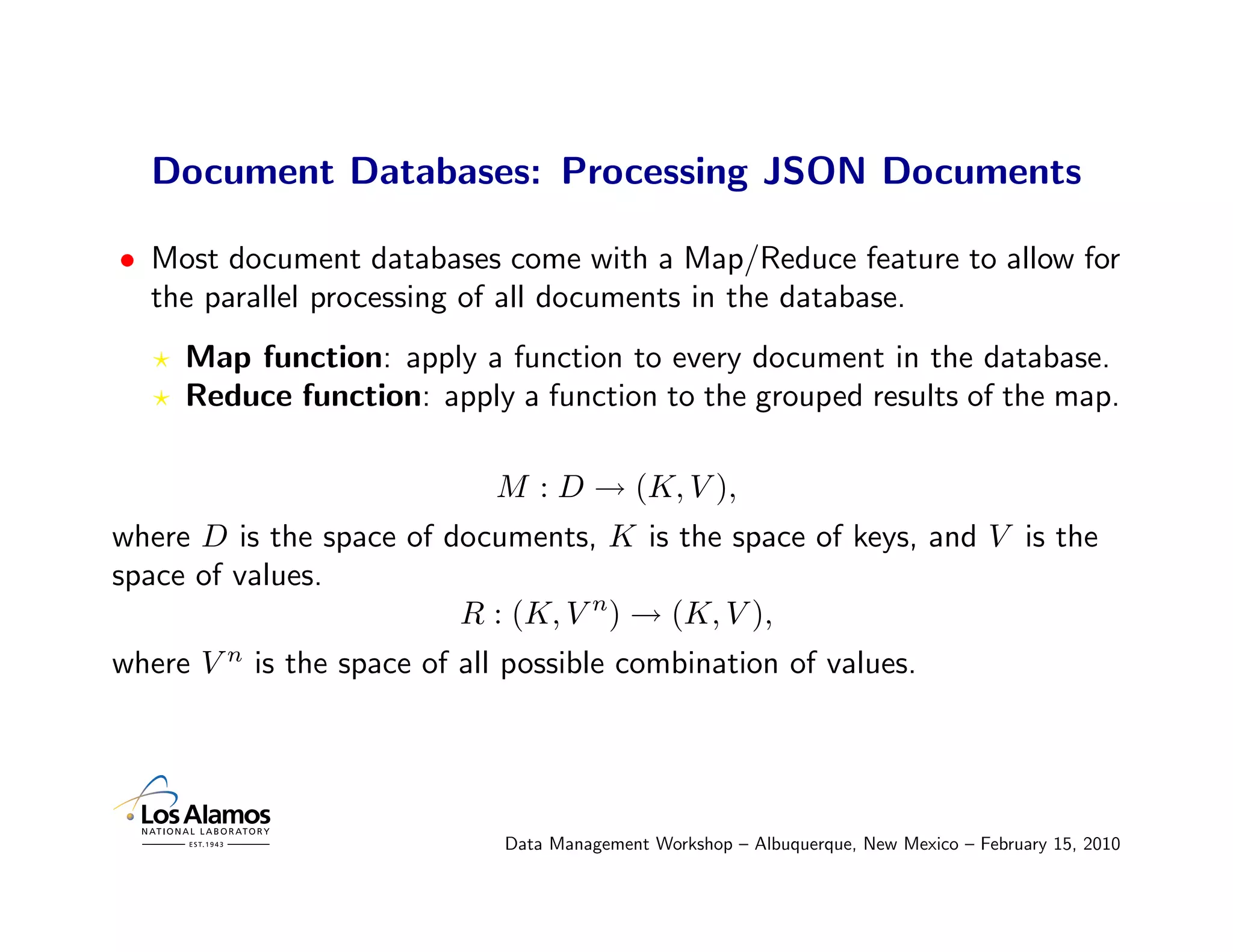
• Most document databases come with a Map/Reduce feature to allow for
  the parallel processing of all documents in the database.
     Map function: apply a function to every document in the database.
     Reduce function: apply a function to the grouped results of the map.

                             M : D → (K, V ),
where D is the space of documents, K is the space of keys, and V is the
space of values.
                         R : (K, V n) → (K, V ),
where V n is the space of all possible combination of values.


                             Data Management Workshop – Albuquerque, New Mexico – February 15, 2010
Document Databases: Processing JSON Documents
• Create a distribution of the Grateful Dead original song performances.

> map = function(){
  if(this.properties.song_type == "original")
    emit(this.properties.performances, 1);
};

> reduce = function(key, values) {
  var sum = 0;
  for(var i in values) {
    sum = sum + values[i];
  }
  return sum;
};

                            Data Management Workshop – Albuquerque, New Mexico – February 15, 2010
Document Databases: Processing JSON Documents
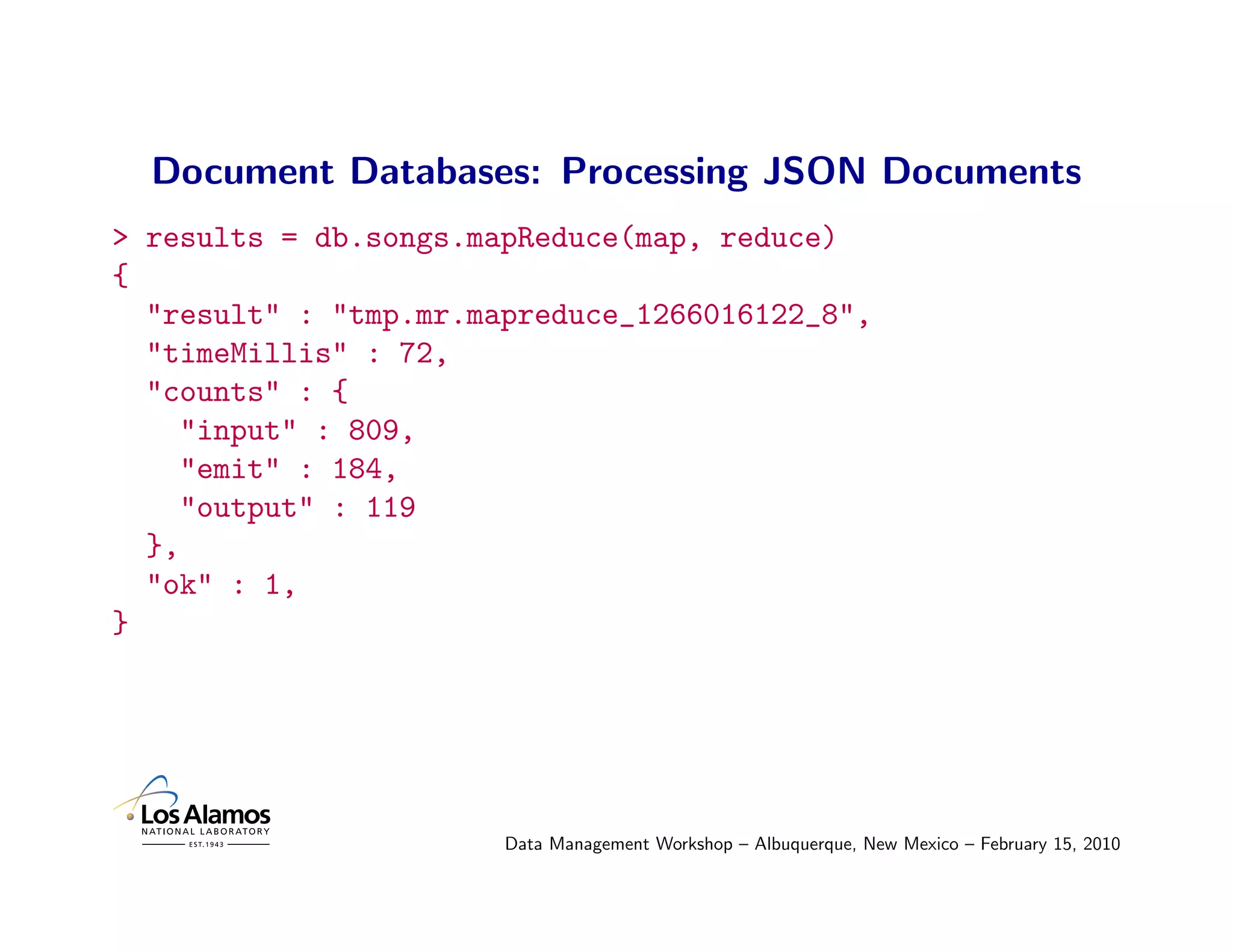
> results = db.songs.mapReduce(map, reduce)
{
  "result" : "tmp.mr.mapreduce_1266016122_8",
  "timeMillis" : 72,
  "counts" : {
     "input" : 809,
     "emit" : 184,
     "output" : 119
  },
  "ok" : 1,
}


                       Data Management Workshop – Albuquerque, New Mexico – February 15, 2010
{ _id : 122,                      { _id : 100,                       { _id : 91,
  properties : {                    properties : {                     properties : {
    name : "CASEY ..."                name : "PLAYIN..."                 name : "TERRAP..."
    performances : 312                performances : 312                 performances : 302
  }}                                }}                                 }}


                         map = function(){
                           if(this.properties.song_type == "original")
                             emit(this.properties.performances, 1);
                         };

                                         key     value
                                           312 : 1
                                           312 : 1
                                           302 : 1
                                             ...
                                         key       values
                                         312 : [1,1]
                                         302 : [1]
                                             ...


                             reduce = function(key, values) {
                               var sum = 0;
                               for(var i in values) {
                                 sum = sum + values[i];
                               }
                               return sum;
                             };


                                         {
                                             312 : 2
                                             302 : 1
                                             ...
                                         }


                              Data Management Workshop – Albuquerque, New Mexico – February 15, 2010
Document Databases: Processing JSON Documents
> db[results.result].find()
{ "_id" : 0, "value" : 11 }
{ "_id" : 1, "value" : 14 }
{ "_id" : 2, "value" : 5 }
{ "_id" : 3, "value" : 8 }
{ "_id" : 4, "value" : 3 }
{ "_id" : 5, "value" : 4 }
...
{ "_id" : 554, "value" : 1 }
{ "_id" : 582, "value" : 1 }
{ "_id" : 583, "value" : 1 }
{ "_id" : 594, "value" : 1 }
{ "_id" : 1386, "value" : 1 }


                       Data Management Workshop – Albuquerque, New Mexico – February 15, 2010
Graph Databases
• Graph databases store objects (vertices) and their relationships to one
  another (edges). Usually these relationships are typed/labeled and
  directed.

• Graph databases tend to be optimized for graph-based traversal
  algorithms.


Neo4j is available at http://neo4j.org
AllegroGraph is available at http://www.franz.com/agraph/allegrograph
HyperGraphDB is available at http://www.kobrix.com/hgdb.jsp


                                         Data Management Workshop – Albuquerque, New Mexico – February 15, 2010
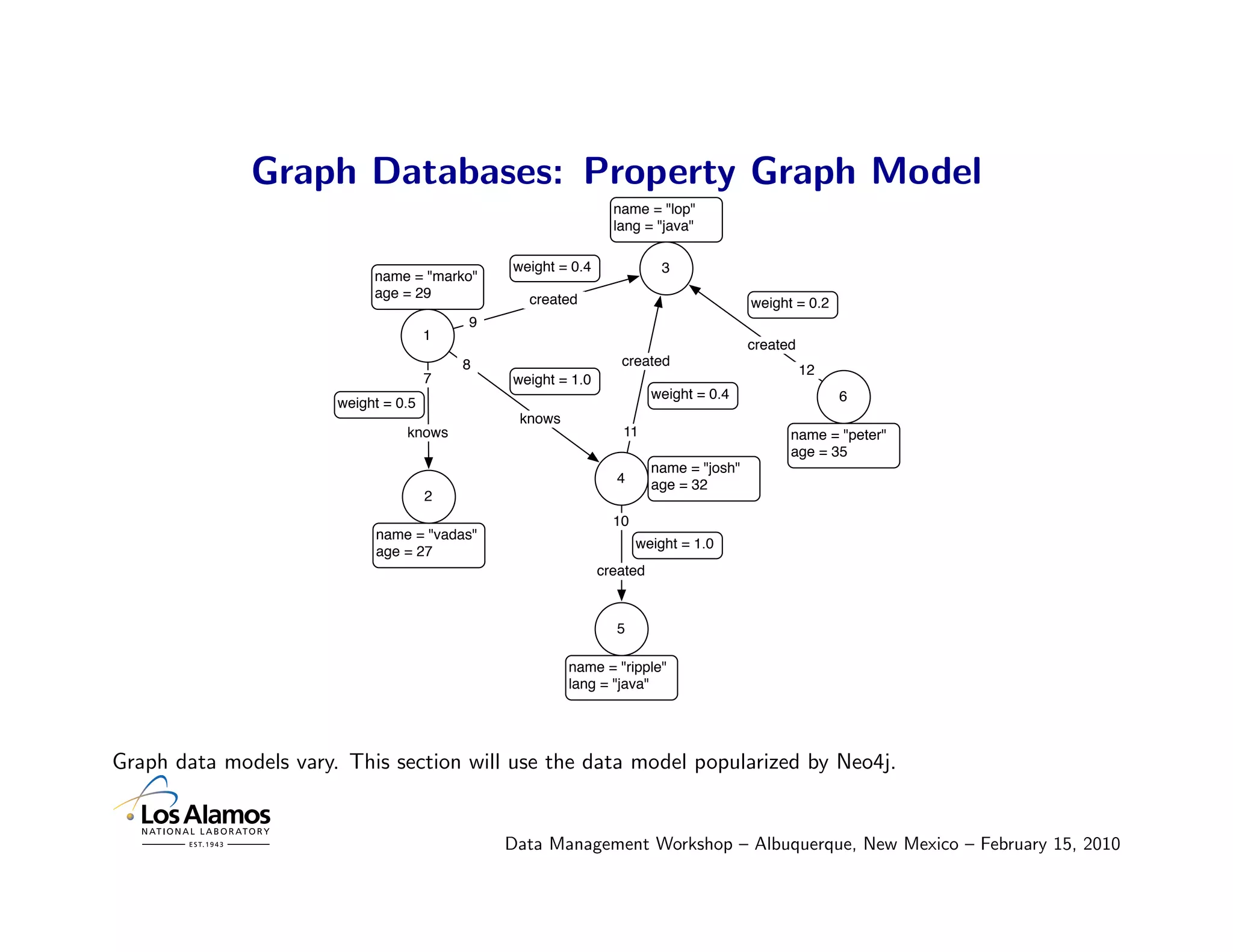
Graph Databases: Property Graph Model
                                                               name = "lop"
                                                               lang = "java"

                                              weight = 0.4              3
                            name = "marko"
                            age = 29            created                                weight = 0.2
                                          9
                                      1
                                                                                       created
                                          8                     created
                                                                                                 12
                                      7       weight = 1.0
                                                                       weight = 0.4                   6
                       weight = 0.5
                                               knows
                                 knows                          11                           name = "peter"
                                                                                             age = 35
                                                                       name = "josh"
                                                               4       age = 32
                                      2
                                                               10
                            name = "vadas"
                                                                    weight = 1.0
                            age = 27
                                                             created


                                                               5

                                                       name = "ripple"
                                                       lang = "java"


Graph data models vary. This section will use the data model popularized by Neo4j.


                                              Data Management Workshop – Albuquerque, New Mexico – February 15, 2010
Graph Databases: Handling Property Graphs
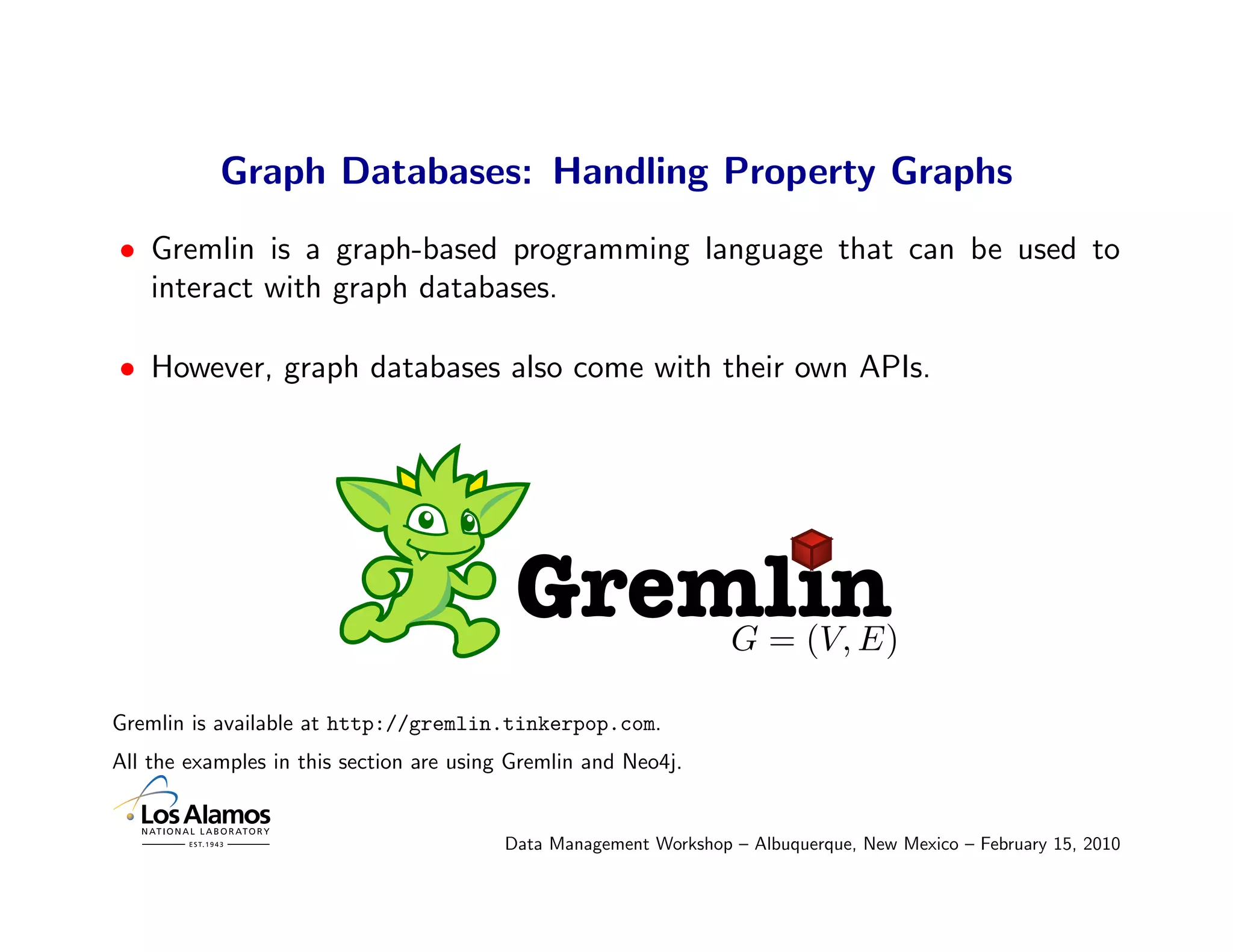
• Gremlin is a graph-based programming language that can be used to
  interact with graph databases.

• However, graph databases also come with their own APIs.


                                           Gremlin                G = (V, E)

Gremlin is available at http://gremlin.tinkerpop.com.
All the examples in this section are using Gremlin and Neo4j.


                                         Data Management Workshop – Albuquerque, New Mexico – February 15, 2010
Graph Databases: Moving Around a Graph in Gremlin
gremlin> $_ := g:key(‘name’,‘marko’)
==>v[1]
gremlin> ./outE
==>e[7][1-knows->2]
==>e[9][1-created->3]
==>e[8][1-knows->4]
gremlin> ./outE/inV
==>v[2]
==>v[3]
==>v[4]
gremlin> ./outE/inV/@name
==>vadas
==>lop
==>josh


                       Data Management Workshop – Albuquerque, New Mexico – February 15, 2010
Graph Databases: Inserting Vertices and Edges

• Lets create a Grateful Dead graph.

gremlin> $_g := neo4j:open(‘/tmp/grateful-dead’)
==>neo4jgraph[/tmp/grateful-dead]
gremlin> $v := g:add-v(g:map(‘name’,‘TERRAPIN STATION’))
==>v[0]
gremlin> $u := g:add-v(g:map(‘name’,‘TRUCKIN’))
==>v[1]
gremlin> $e := g:add-e(g:map(‘weight’,1),$v,‘followed_by’,$u)
==>e[2][0-followed_by->1]

You can batch load graph data as well: g:load(‘data/grateful-dead.xml’) using the GraphML
specification [http://graphml.graphdrawing.org/]


                                     Data Management Workshop – Albuquerque, New Mexico – February 15, 2010
Graph Databases: Inserting Vertices and Edges
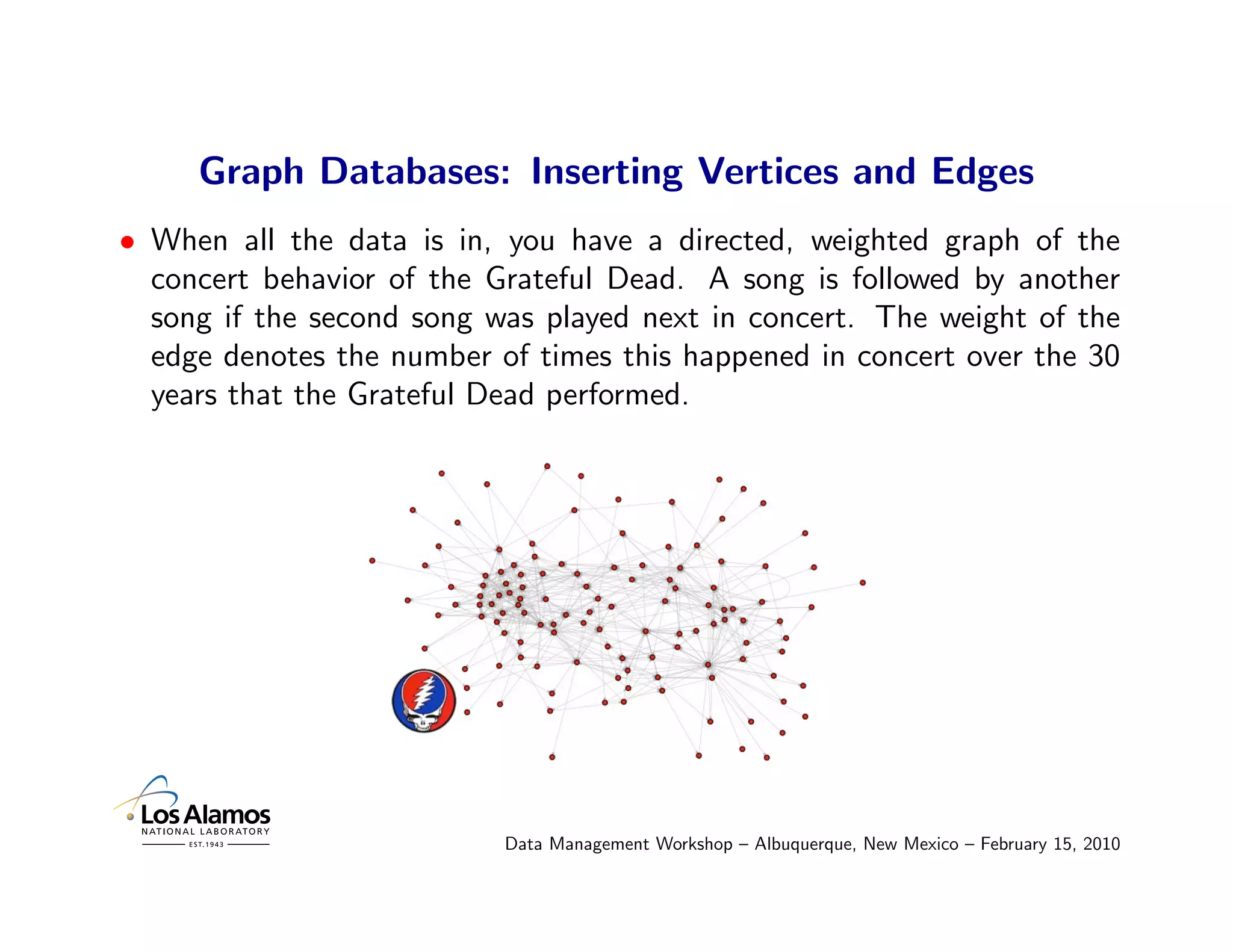
• When all the data is in, you have a directed, weighted graph of the
  concert behavior of the Grateful Dead. A song is followed by another
  song if the second song was played next in concert. The weight of the
  edge denotes the number of times this happened in concert over the 30
  years that the Grateful Dead performed.


                           Data Management Workshop – Albuquerque, New Mexico – February 15, 2010
Graph Databases: Finding Vertices

• Find the vertex with the name TERRAPIN STATION.

• Find the name of all the songs that followed TERRAPIN STATION in
  concert more than 3 times.

gremlin> $_ := g:key(‘name’,‘TERRAPIN STATION’)
==>v[0]
gremlin> ./outE[@weight > 3]/inV/@name
==>DRUMS
==>MORNING DEW
==>DONT NEED LOVE
==>ESTIMATED PROPHET
==>PLAYING IN THE BAND

                         Data Management Workshop – Albuquerque, New Mexico – February 15, 2010
Graph Databases: Processing Graphs
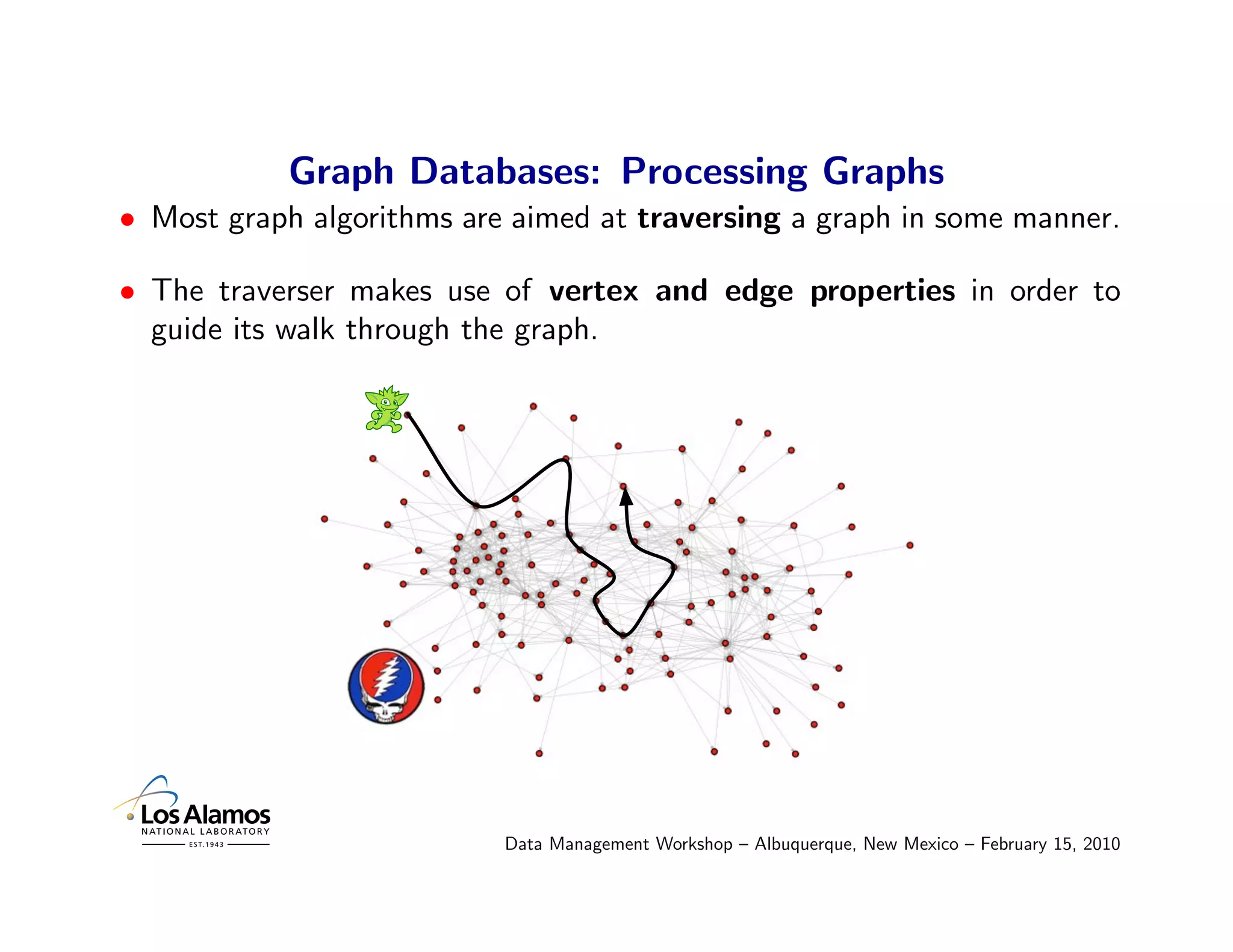
• Most graph algorithms are aimed at traversing a graph in some manner.

• The traverser makes use of vertex and edge properties in order to
  guide its walk through the graph.


                           Data Management Workshop – Albuquerque, New Mexico – February 15, 2010
Graph Databases: Processing Graphs
• Find all songs related to TERRAPIN STATION according to concert
  behavior.

$e := 1.0
$scores := g:map()
repeat 75
  $_ := (./outE[@label=‘followed_by’]/inV)[g:rand-nat()]
  if $_ != null()
    g:op-value(‘+’,$scores,$_/@name,$e)
    $e := $e * 0.85
  else
    $_ := g:key(‘name, ‘TERRAPIN STATION)
    $e := 1.0
  end
end

                         Data Management Workshop – Albuquerque, New Mexico – February 15, 2010
Graph Databases: Processing Graphs
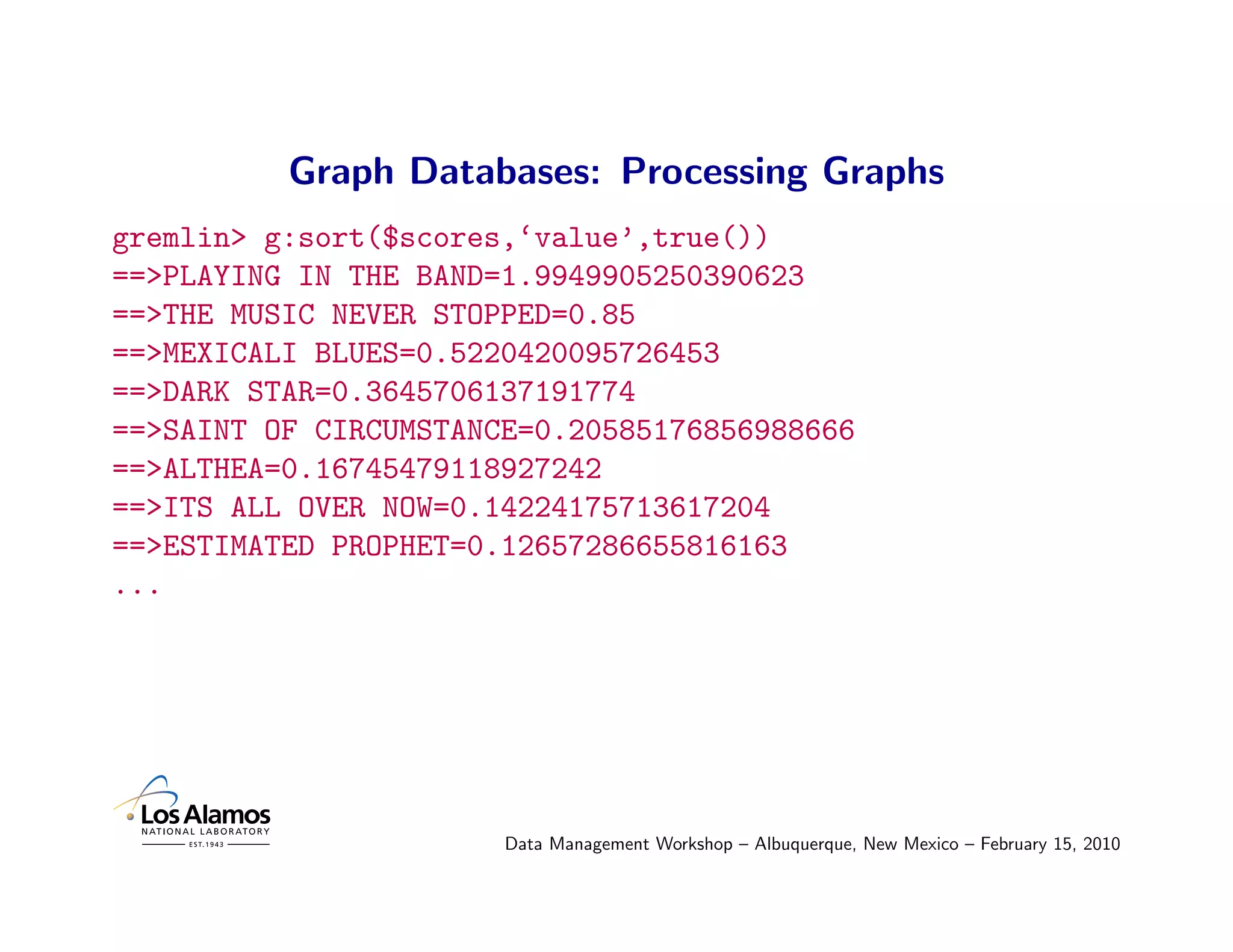
gremlin> g:sort($scores,‘value’,true())
==>PLAYING IN THE BAND=1.9949905250390623
==>THE MUSIC NEVER STOPPED=0.85
==>MEXICALI BLUES=0.5220420095726453
==>DARK STAR=0.3645706137191774
==>SAINT OF CIRCUMSTANCE=0.20585176856988666
==>ALTHEA=0.16745479118927242
==>ITS ALL OVER NOW=0.14224175713617204
==>ESTIMATED PROPHET=0.12657286655816163
...


                       Data Management Workshop – Albuquerque, New Mexico – February 15, 2010
Conclusions
• Relational Databases
    Stable, solid technology that has been used in production for decades.
    Good for storing inter-linked tables of data and querying within and across tables.
    They do not scale horizontally due to the interconnectivity of table keys and the
    cost of joins.
• Document Databases
    For JSON documents, there exists a one-to-one mapping from document-to-
    programming object.
    They scale horizontally and allow for parallel processing due to forced sharding at
    document.
    Performing complicated queries requires relatively sophisticated programming skills.
• Graph Databases
    Optimized for graph traversal algorithms and local neighborhood searches.
    Low impedance mismatch between a graph in a database and a graph of objects in
    object-oriented programming.
    They do not scale well horizontally due to interconnectivity of vertices.


                                 Data Management Workshop – Albuquerque, New Mexico – February 15, 2010
A Collection of References
•   http://www.wakandasoftware.com/blog/nosql-but-so-much-more/
•   http://horicky.blogspot.com/2009/07/choosing-between-sql-and-non-sql.html
•   http://ai.mee.nu/seeking a database that doesnt suck
•   http://blogs.neotechnology.com/emil/2009/11/
    nosql-scaling-to-size-and-scaling-to-complexity.html
• http://horicky.blogspot.com/2009/11/nosql-patterns.html
• http://horicky.blogspot.com/2010/02/nosql-graphdb.html


                             Data Management Workshop – Albuquerque, New Mexico – February 15, 2010
Fin.
Thank your for your time...

• My homepage: http://markorodriguez.com

• TinkerPop: http://tinkerpop.com


Acknowledgements: Peter Neubauer (Neo Technology) for comments and review.


                                      Data Management Workshop – Albuquerque, New Mexico – February 15, 2010

An Overview of Data Management Paradigms: Relational, Document, and Graph

  • 1.
    An Overview ofData Management Paradigms: Relational, Document, and Graph Marko A. Rodriguez T-5, Center for Nonlinear Studies Los Alamos National Laboratory http://markorodriguez.com February 15, 2010
  • 2.
    Relational, Document, andGraph Database Data Models Relational Database Document Database Graph Database d { data } { data } a c a { data } b MySQL MongoDB Neo4j PostgreSQL CouchDB AllegroGraph Oracle HyperGraphDB Database models are optimized for solving particular types of problems. This is why different database models exist — there are many types of problems in the world. Data Management Workshop – Albuquerque, New Mexico – February 15, 2010
  • 3.
    Finding the RightSolution to your Problem 1. Come to terms with your problem. • “I have metadata for a massive number of objects and I don’t know how to get at my data.” 2. Identify the solution to your problem. • “I need to be able to find objects based on their metadata.” 3. Identify the type of database that is optimized for that type of solution. • “A document database scales, stores metadata, and can be queried.” 4. Identify the database of that type that best meets your particular needs. • “CouchDB has a REST web interface and all my developers are good with REST.” Data Management Workshop – Albuquerque, New Mexico – February 15, 2010
  • 4.
    Relational Databases • Relationaldatabases have been the de facto data management solution for many years. MySQL is available at http://www.mysql.com PostgreSQL is available at http://www.postgresql.org Oracle is available at http://www.oracle.com Data Management Workshop – Albuquerque, New Mexico – February 15, 2010
  • 5.
    Relational Databases: TheRelational Structure • Relational databases require a schema before data can be inserted. • Relational databases organizes data according to relations — or tables. columns (attributes/properties) j rows (tuples/objects) i x Object i has the value x for property j. Data Management Workshop – Albuquerque, New Mexico – February 15, 2010
  • 6.
    Relational Databases: Creatinga Table • Relational databases organizes data according to relations — or tables. • Relational databases require a schema before data can be inserted. • Lets create a table for Grateful Dead songs. mysql> CREATE TABLE songs ( name VARCHAR(255) PRIMARY KEY, performances INT, song_type VARCHAR(20)); Query OK, 0 rows affected (0.40 sec) Data Management Workshop – Albuquerque, New Mexico – February 15, 2010
  • 7.
    Relational Databases: Viewingthe Table Schema • Its possible to look at the defined structure (schema) of your newly created table. mysql> DESCRIBE songs; +--------------+--------------+------+-----+---------+-------+ | Field | Type | Null | Key | Default | Extra | +--------------+--------------+------+-----+---------+-------+ | name | varchar(255) | NO | PRI | NULL | | | performances | int(11) | YES | | NULL | | | song_type | varchar(20) | YES | | NULL | | +--------------+--------------+------+-----+---------+-------+ 3 rows in set (0.00 sec) Data Management Workshop – Albuquerque, New Mexico – February 15, 2010
  • 8.
    Relational Databases: InsertingRows into a Table • Lets insert song names, the number of times they were played in concert, and whether they were and original or cover. mysql> INSERT INTO songs VALUES ("DARK STAR", 219, "original"); Query OK, 1 row affected (0.00 sec) mysql> INSERT INTO songs VALUES ( "FRIEND OF THE DEVIL", 304, "original"); Query OK, 1 row affected (0.00 sec) mysql> INSERT INTO songs VALUES ( "MONKEY AND THE ENGINEER", 32, "cover"); Query OK, 1 row affected (0.00 sec) Data Management Workshop – Albuquerque, New Mexico – February 15, 2010
  • 9.
    Relational Databases: Searchinga Table • Lets look at the entire songs table. mysql> SELECT * FROM songs; +-------------------------+--------------+-----------+ | name | performances | song_type | +-------------------------+--------------+-----------+ | DARK STAR | 219 | original | | FRIEND OF THE DEVIL | 304 | original | | MONKEY AND THE ENGINEER | 32 | cover | +-------------------------+--------------+-----------+ 3 rows in set (0.00 sec) Data Management Workshop – Albuquerque, New Mexico – February 15, 2010
  • 10.
    Relational Databases: Searchinga Table • Lets look at all original songs. mysql> SELECT * FROM songs WHERE song_type="original"; +---------------------+--------------+-----------+ | name | performances | song_type | +---------------------+--------------+-----------+ | DARK STAR | 219 | original | | FRIEND OF THE DEVIL | 304 | original | +---------------------+--------------+-----------+ 2 rows in set (0.00 sec) Data Management Workshop – Albuquerque, New Mexico – February 15, 2010
  • 11.
    Relational Databases: Searchinga Table • Lets look at only the names of the original songs. mysql> SELECT name FROM songs WHERE song_type="original"; +---------------------+ | name | +---------------------+ | DARK STAR | | FRIEND OF THE DEVIL | +---------------------+ 2 rows in set (0.00 sec) Data Management Workshop – Albuquerque, New Mexico – February 15, 2010
  • 12.
    Document Databases • Documentdatabases store structured documents. Usually these documents are organized according a standard (e.g. JavaScript Object Notation—JSON, XML, etc.) • Document databases tend to be schema-less. That is, they do not require the database engineer to apriori specify the structure of the data to be held in the database. MongoDB is available at http://mongodb.org and CouchDB is available at http://couchdb.org Data Management Workshop – Albuquerque, New Mexico – February 15, 2010
  • 13.
    Document Databases: JavaScriptObject Notation • A JSON document is a collection of key/value pairs, where a value can be yet another collection of key/value pairs. string: a string value (e.g. “marko”, “rodriguez”). number: a numeric value (e.g. 1234, 67.012). boolean: a true/false value (e.g. true, false) null: a non-existant value. array: an array of values (e.g. [1,“marko”,true]) object: a key/value map (e.g. { “key” : 123 }) The JSON specification is very simple and can be found at http://www.json.org/. Data Management Workshop – Albuquerque, New Mexico – February 15, 2010
  • 14.
    Document Databases: JavaScriptObject Notation { _id : "D0DC29E9-51AE-4A8C-8769-541501246737", name : "Marko A. Rodriguez", homepage : "http://markorodriguez.com", age : 30, location : { country : "United States", state : "New Mexico", city : "Santa Fe", zipcode : 87501 }, interests : ["graphs", "hockey", "motorcycles"] } Data Management Workshop – Albuquerque, New Mexico – February 15, 2010
  • 15.
    Document Databases: HandlingJSON Documents • Use object-oriented “dot notation” to access components. > marko = eval({_id : "D0DC29E9...", name : "Marko...}) > marko._id D0DC29E9-51AE-4A8C-8769-541501246737 > marko.location.city Santa Fe > marko.interests[0] graphs All document database examples presented are using MongoDB [http://mongodb.org]. Data Management Workshop – Albuquerque, New Mexico – February 15, 2010
  • 16.
    Document Databases: InsertingJSON Documents • Lets insert a Grateful Dead document into the database. > db.songs.insert({ _id : "91", properties : { name : "TERRAPIN STATION", song_type : "original", performances : 302 } }) Data Management Workshop – Albuquerque, New Mexico – February 15, 2010
  • 17.
    Document Databases: FindingJSON Documents • Searching is based on created a “subset” document and pattern matching it in the database. • Find all songs where properties.name equals TERRAPIN STATION. > db.songs.find({"properties.name" : "TERRAPIN STATION"}) { "_id" : "91", "properties" : { "name" : "TERRAPIN STATION", "song_type" : "original", "performances" : 302 }} > Data Management Workshop – Albuquerque, New Mexico – February 15, 2010
  • 18.
    Document Databases: FindingJSON Documents • You can also do comparison-type operations. • Find all songs where properties.performances is greater than 200. > db.songs.find({"properties.performances" : { $gt : 200 }}) { "_id" : "104", "properties" : { "name" : "FRIEND OF THE DEVIL", "song_type" : "original", "performances" : 304}} { "_id" : "122", "properties" : { "name" : "CASEY JONES", "song_type" : "original", "performances" : 312}} has more > Data Management Workshop – Albuquerque, New Mexico – February 15, 2010
  • 19.
    Document Databases: ProcessingJSON Documents • Sharding is the process of distributing a database’s data across multiple machines. Each partition of the data is known as a shard. • Document databases shard easily because there are no explicit references between documents. client appliation communication service { _id : } { _id : } { _id : } { _id : } { _id : } { _id : } { _id : } { _id : } { _id : } { _id : } { _id : } { _id : } Data Management Workshop – Albuquerque, New Mexico – February 15, 2010
  • 20.
    Document Databases: ProcessingJSON Documents • Most document databases come with a Map/Reduce feature to allow for the parallel processing of all documents in the database. Map function: apply a function to every document in the database. Reduce function: apply a function to the grouped results of the map. M : D → (K, V ), where D is the space of documents, K is the space of keys, and V is the space of values. R : (K, V n) → (K, V ), where V n is the space of all possible combination of values. Data Management Workshop – Albuquerque, New Mexico – February 15, 2010
  • 21.
    Document Databases: ProcessingJSON Documents • Create a distribution of the Grateful Dead original song performances. > map = function(){ if(this.properties.song_type == "original") emit(this.properties.performances, 1); }; > reduce = function(key, values) { var sum = 0; for(var i in values) { sum = sum + values[i]; } return sum; }; Data Management Workshop – Albuquerque, New Mexico – February 15, 2010
  • 22.
    Document Databases: ProcessingJSON Documents > results = db.songs.mapReduce(map, reduce) { "result" : "tmp.mr.mapreduce_1266016122_8", "timeMillis" : 72, "counts" : { "input" : 809, "emit" : 184, "output" : 119 }, "ok" : 1, } Data Management Workshop – Albuquerque, New Mexico – February 15, 2010
  • 23.
    { _id :122, { _id : 100, { _id : 91, properties : { properties : { properties : { name : "CASEY ..." name : "PLAYIN..." name : "TERRAP..." performances : 312 performances : 312 performances : 302 }} }} }} map = function(){ if(this.properties.song_type == "original") emit(this.properties.performances, 1); }; key value 312 : 1 312 : 1 302 : 1 ... key values 312 : [1,1] 302 : [1] ... reduce = function(key, values) { var sum = 0; for(var i in values) { sum = sum + values[i]; } return sum; }; { 312 : 2 302 : 1 ... } Data Management Workshop – Albuquerque, New Mexico – February 15, 2010
  • 24.
    Document Databases: ProcessingJSON Documents > db[results.result].find() { "_id" : 0, "value" : 11 } { "_id" : 1, "value" : 14 } { "_id" : 2, "value" : 5 } { "_id" : 3, "value" : 8 } { "_id" : 4, "value" : 3 } { "_id" : 5, "value" : 4 } ... { "_id" : 554, "value" : 1 } { "_id" : 582, "value" : 1 } { "_id" : 583, "value" : 1 } { "_id" : 594, "value" : 1 } { "_id" : 1386, "value" : 1 } Data Management Workshop – Albuquerque, New Mexico – February 15, 2010
  • 25.
    Graph Databases • Graphdatabases store objects (vertices) and their relationships to one another (edges). Usually these relationships are typed/labeled and directed. • Graph databases tend to be optimized for graph-based traversal algorithms. Neo4j is available at http://neo4j.org AllegroGraph is available at http://www.franz.com/agraph/allegrograph HyperGraphDB is available at http://www.kobrix.com/hgdb.jsp Data Management Workshop – Albuquerque, New Mexico – February 15, 2010
  • 26.
    Graph Databases: PropertyGraph Model name = "lop" lang = "java" weight = 0.4 3 name = "marko" age = 29 created weight = 0.2 9 1 created 8 created 12 7 weight = 1.0 weight = 0.4 6 weight = 0.5 knows knows 11 name = "peter" age = 35 name = "josh" 4 age = 32 2 10 name = "vadas" weight = 1.0 age = 27 created 5 name = "ripple" lang = "java" Graph data models vary. This section will use the data model popularized by Neo4j. Data Management Workshop – Albuquerque, New Mexico – February 15, 2010
  • 27.
    Graph Databases: HandlingProperty Graphs • Gremlin is a graph-based programming language that can be used to interact with graph databases. • However, graph databases also come with their own APIs. Gremlin G = (V, E) Gremlin is available at http://gremlin.tinkerpop.com. All the examples in this section are using Gremlin and Neo4j. Data Management Workshop – Albuquerque, New Mexico – February 15, 2010
  • 28.
    Graph Databases: MovingAround a Graph in Gremlin gremlin> $_ := g:key(‘name’,‘marko’) ==>v[1] gremlin> ./outE ==>e[7][1-knows->2] ==>e[9][1-created->3] ==>e[8][1-knows->4] gremlin> ./outE/inV ==>v[2] ==>v[3] ==>v[4] gremlin> ./outE/inV/@name ==>vadas ==>lop ==>josh Data Management Workshop – Albuquerque, New Mexico – February 15, 2010
  • 29.
    Graph Databases: InsertingVertices and Edges • Lets create a Grateful Dead graph. gremlin> $_g := neo4j:open(‘/tmp/grateful-dead’) ==>neo4jgraph[/tmp/grateful-dead] gremlin> $v := g:add-v(g:map(‘name’,‘TERRAPIN STATION’)) ==>v[0] gremlin> $u := g:add-v(g:map(‘name’,‘TRUCKIN’)) ==>v[1] gremlin> $e := g:add-e(g:map(‘weight’,1),$v,‘followed_by’,$u) ==>e[2][0-followed_by->1] You can batch load graph data as well: g:load(‘data/grateful-dead.xml’) using the GraphML specification [http://graphml.graphdrawing.org/] Data Management Workshop – Albuquerque, New Mexico – February 15, 2010
  • 30.
    Graph Databases: InsertingVertices and Edges • When all the data is in, you have a directed, weighted graph of the concert behavior of the Grateful Dead. A song is followed by another song if the second song was played next in concert. The weight of the edge denotes the number of times this happened in concert over the 30 years that the Grateful Dead performed. Data Management Workshop – Albuquerque, New Mexico – February 15, 2010
  • 31.
    Graph Databases: FindingVertices • Find the vertex with the name TERRAPIN STATION. • Find the name of all the songs that followed TERRAPIN STATION in concert more than 3 times. gremlin> $_ := g:key(‘name’,‘TERRAPIN STATION’) ==>v[0] gremlin> ./outE[@weight > 3]/inV/@name ==>DRUMS ==>MORNING DEW ==>DONT NEED LOVE ==>ESTIMATED PROPHET ==>PLAYING IN THE BAND Data Management Workshop – Albuquerque, New Mexico – February 15, 2010
  • 32.
    Graph Databases: ProcessingGraphs • Most graph algorithms are aimed at traversing a graph in some manner. • The traverser makes use of vertex and edge properties in order to guide its walk through the graph. Data Management Workshop – Albuquerque, New Mexico – February 15, 2010
  • 33.
    Graph Databases: ProcessingGraphs • Find all songs related to TERRAPIN STATION according to concert behavior. $e := 1.0 $scores := g:map() repeat 75 $_ := (./outE[@label=‘followed_by’]/inV)[g:rand-nat()] if $_ != null() g:op-value(‘+’,$scores,$_/@name,$e) $e := $e * 0.85 else $_ := g:key(‘name, ‘TERRAPIN STATION) $e := 1.0 end end Data Management Workshop – Albuquerque, New Mexico – February 15, 2010
  • 34.
    Graph Databases: ProcessingGraphs gremlin> g:sort($scores,‘value’,true()) ==>PLAYING IN THE BAND=1.9949905250390623 ==>THE MUSIC NEVER STOPPED=0.85 ==>MEXICALI BLUES=0.5220420095726453 ==>DARK STAR=0.3645706137191774 ==>SAINT OF CIRCUMSTANCE=0.20585176856988666 ==>ALTHEA=0.16745479118927242 ==>ITS ALL OVER NOW=0.14224175713617204 ==>ESTIMATED PROPHET=0.12657286655816163 ... Data Management Workshop – Albuquerque, New Mexico – February 15, 2010
  • 35.
    Conclusions • Relational Databases Stable, solid technology that has been used in production for decades. Good for storing inter-linked tables of data and querying within and across tables. They do not scale horizontally due to the interconnectivity of table keys and the cost of joins. • Document Databases For JSON documents, there exists a one-to-one mapping from document-to- programming object. They scale horizontally and allow for parallel processing due to forced sharding at document. Performing complicated queries requires relatively sophisticated programming skills. • Graph Databases Optimized for graph traversal algorithms and local neighborhood searches. Low impedance mismatch between a graph in a database and a graph of objects in object-oriented programming. They do not scale well horizontally due to interconnectivity of vertices. Data Management Workshop – Albuquerque, New Mexico – February 15, 2010
  • 36.
    A Collection ofReferences • http://www.wakandasoftware.com/blog/nosql-but-so-much-more/ • http://horicky.blogspot.com/2009/07/choosing-between-sql-and-non-sql.html • http://ai.mee.nu/seeking a database that doesnt suck • http://blogs.neotechnology.com/emil/2009/11/ nosql-scaling-to-size-and-scaling-to-complexity.html • http://horicky.blogspot.com/2009/11/nosql-patterns.html • http://horicky.blogspot.com/2010/02/nosql-graphdb.html Data Management Workshop – Albuquerque, New Mexico – February 15, 2010
  • 37.
    Fin. Thank your foryour time... • My homepage: http://markorodriguez.com • TinkerPop: http://tinkerpop.com Acknowledgements: Peter Neubauer (Neo Technology) for comments and review. Data Management Workshop – Albuquerque, New Mexico – February 15, 2010