Health and Physical Education
Curriculum Update
Fall 2019
Kristin Letendre & Joyce Edwards
Presentation Overview
● Alignment with District Improvement Plan
● Curriculum Review 2016-2017: Overview and Findings
● MetroWest Data 2018
● Health & Physical Education Program Overview
● Curriculum Revisions and Additions
● Questions
District Improvement Plan for 2018-2021
Strategic Objective:
To ensure that all students are supported and challenged to reach their full
potential, the Franklin Public Schools will align curriculum, instructional practices,
and varied assessment opportunities to personalize learning and meet individual
needs.
Health and Physical Education Action Item:
Continue to review outcomes from the 2016-2017 Health and Physical Education
Curriculum Review, align and refine curriculum maps, unit plans, and lesson plans
with the Massachusetts Frameworks in all areas as well as with best teaching
practices based in research to meet the needs of all students.
Curriculum Review: Overview
● K-12 Health and PE teachers and
Assistant Superintendent Joyce Edwards
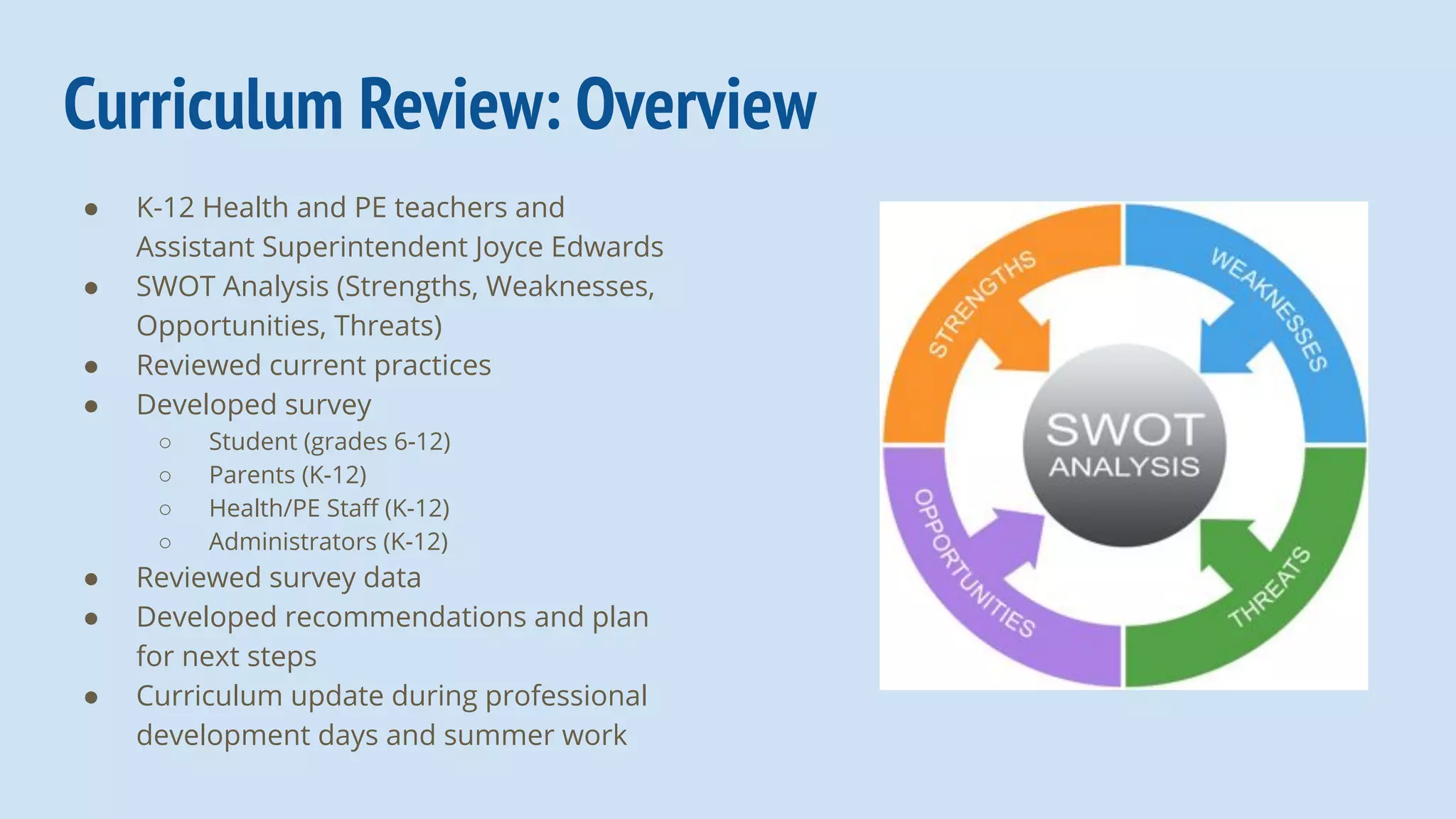
● SWOT Analysis (Strengths, Weaknesses,
Opportunities, Threats)
● Reviewed current practices
● Developed survey
○ Student (grades 6-12)
○ Parents (K-12)
○ Health/PE Staff (K-12)
○ Administrators (K-12)
● Reviewed survey data
● Developed recommendations and plan
for next steps
● Curriculum update during professional
development days and summer work
Curriculum Review: Major Findings
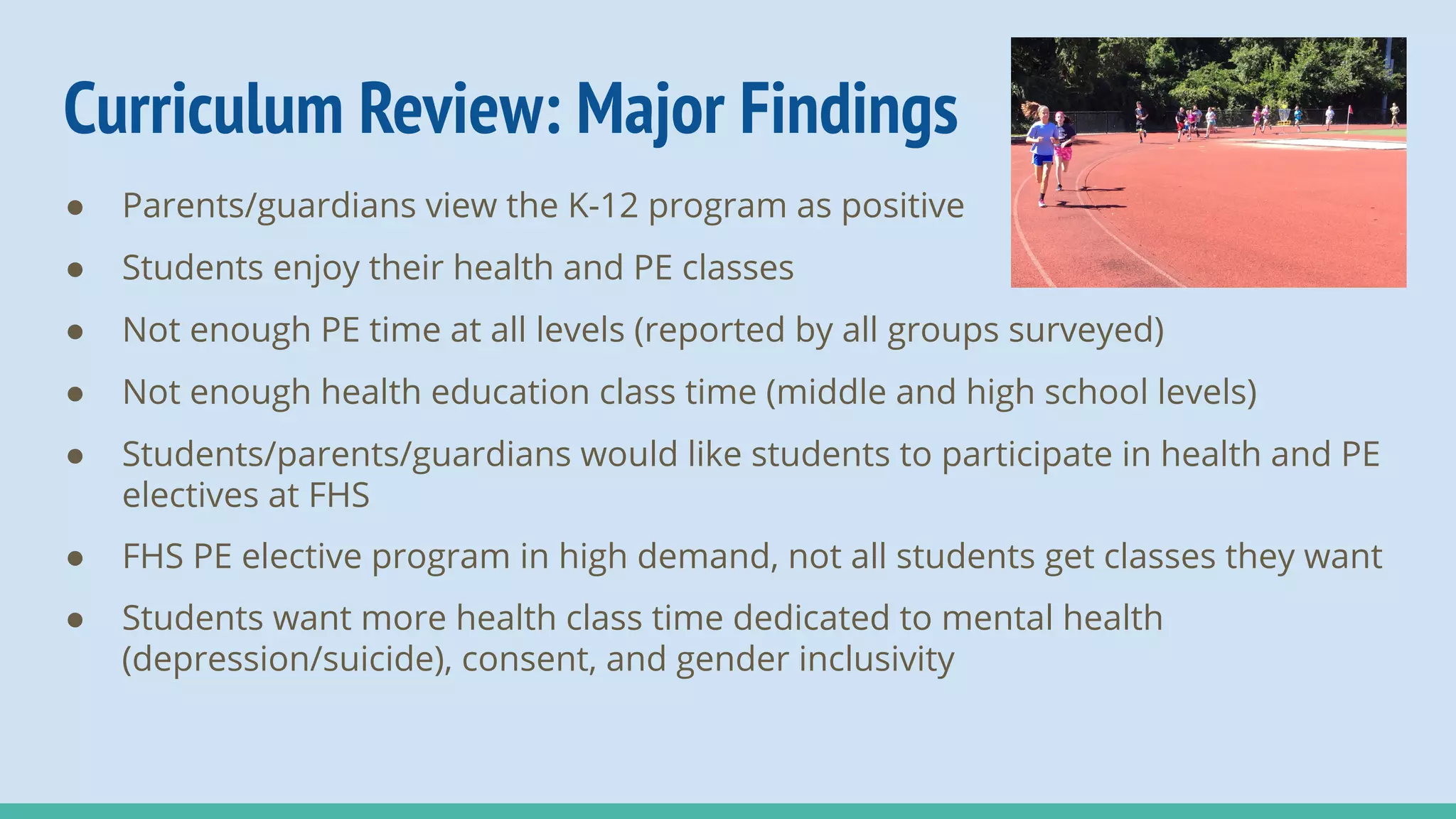
● Parents/guardians view the K-12 program as positive
● Students enjoy their health and PE classes
● Not enough PE time at all levels (reported by all groups surveyed)
● Not enough health education class time (middle and high school levels)
● Students/parents/guardians would like students to participate in health and PE
electives at FHS
● FHS PE elective program in high demand, not all students get classes they want
● Students want more health class time dedicated to mental health
(depression/suicide), consent, and gender inclusivity
Curriculum Review: Major Findings (continued)
● Continue to update and provide high quality health and PE curriculum
● Students should not receive health curriculum at the expense of active PE time
● Increased PD and common planning time needed
● Increased communication
● Increased use of social media
● All current health and PE units should continue to be offered
● High quality program
● Department staff feels supported by FPS administration
MetroWest Adolescent
Health Survey Data
(Franklin)
K-12 Health & Physical Education Program
● No program structure or time changes
● Curriculum revisions
Elementary Program:
● 30 minutes of Health 1x per week
● 30 minutes of PE 1x per week
Middle School Program:
● ~17-20 Health classes per year
● ~36-40 PE classes per year
High School Program:
● ~18-20 Health classes in grades 9 and 10 per year
● ~18-20 PE classes in grades 9 and 10 per year
● Health, Physical Education, and Family Life/Consumer Science electives
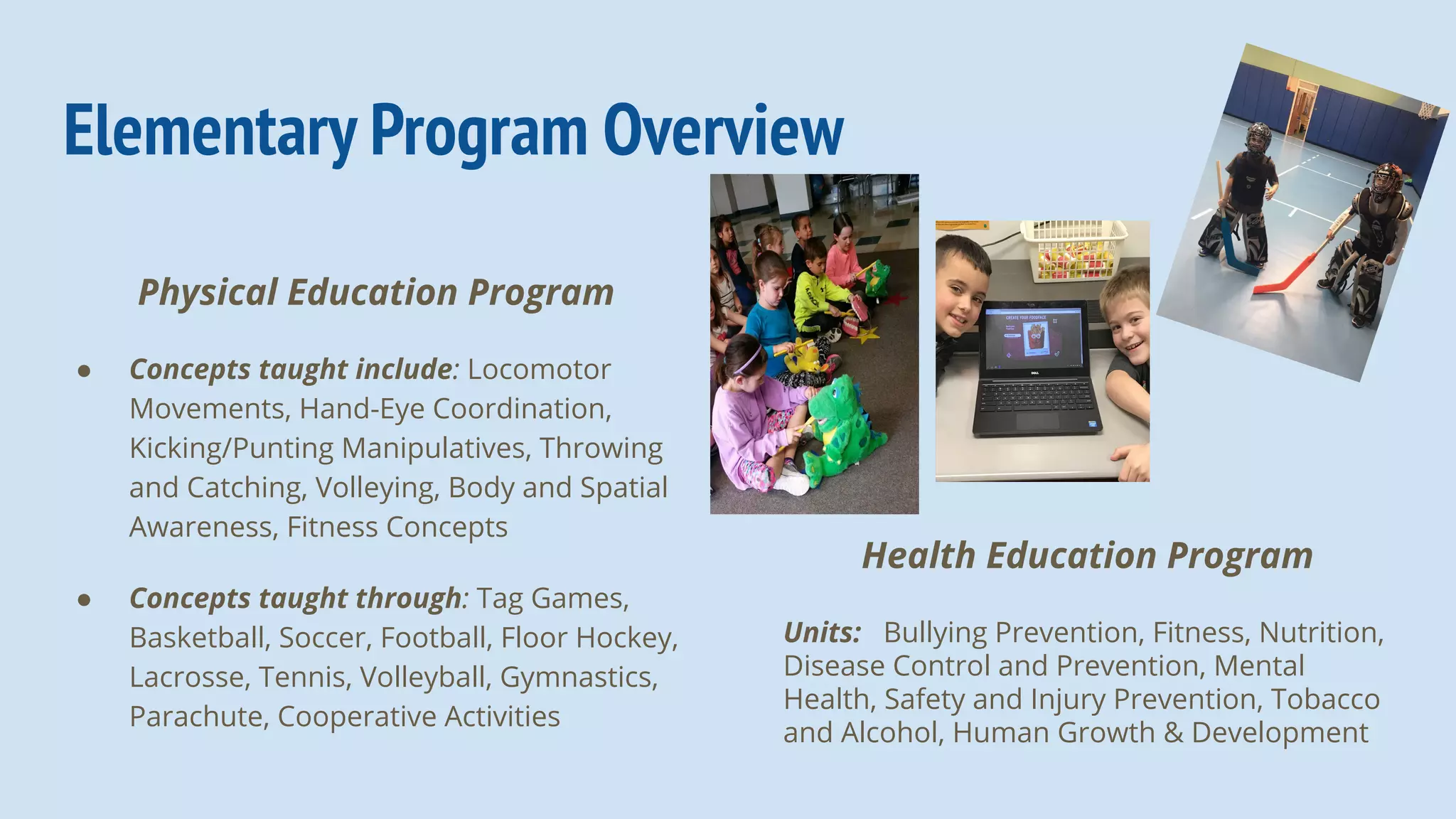
Elementary Program Overview
Physical Education Program
● Concepts taught include: Locomotor
Movements, Hand-Eye Coordination,
Kicking/Punting Manipulatives, Throwing
and Catching, Volleying, Body and Spatial
Awareness, Fitness Concepts
● Concepts taught through: Tag Games,
Basketball, Soccer, Football, Floor Hockey,
Lacrosse, Tennis, Volleyball, Gymnastics,
Parachute, Cooperative Activities
Health Education Program
Units: Bullying Prevention, Fitness, Nutrition,
Disease Control and Prevention, Mental
Health, Safety and Injury Prevention, Tobacco
and Alcohol, Human Growth & Development
Curriculum Revisions & Additions
Elementary:
● Human Growth & Development/Puberty Unit for Grades 4 & 5
○ Lexington program visits (2018-2019)
○ Research
○ Gender inclusive
○ Normalizing
○ November vs. May
○ 2 lessons per grade level
○ Grade 4 - social, emotional, and physical changes (hygiene focus) happening to all people
○ Grade 5 - reinforces Grade 4 lessons with focus on puberty based on biology
● Curriculum updates and revisions to enhance current lessons
● Addition of vaping education in Grades 4 & 5 (future PD work)
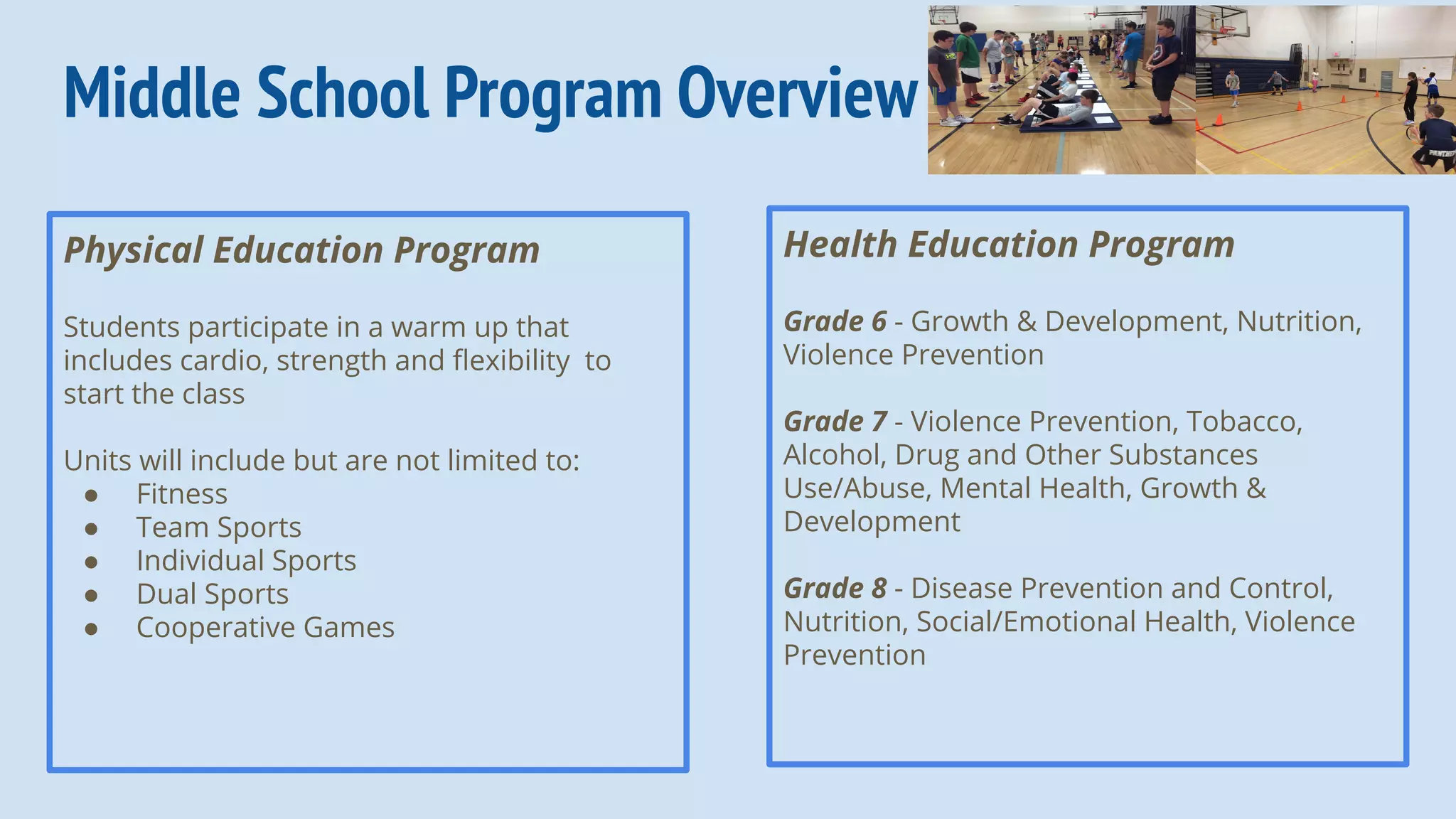
Middle School Program Overview
Physical Education Program
Students participate in a warm up that
includes cardio, strength and flexibility to
start the class
Units will include but are not limited to:
● Fitness
● Team Sports
● Individual Sports
● Dual Sports
● Cooperative Games
Health Education Program
Grade 6 - Growth & Development, Nutrition,
Violence Prevention
Grade 7 - Violence Prevention, Tobacco,
Alcohol, Drug and Other Substances
Use/Abuse, Mental Health, Growth &
Development
Grade 8 - Disease Prevention and Control,
Nutrition, Social/Emotional Health, Violence
Prevention
Curriculum Revisions & Additions
Middle School:
● Curriculum updates and revisions to enhance current lessons
● Implementation of Keys to Literacy strategies
● Vertical alignment of vaping curriculum in Grades 6-10
● Revision of vaping education in Grades 6-10 (future PD work)
● Addition of gender inclusive language during Human Growth &
Development/Human Sexuality Unit in Grades 6-8 (future PD work)
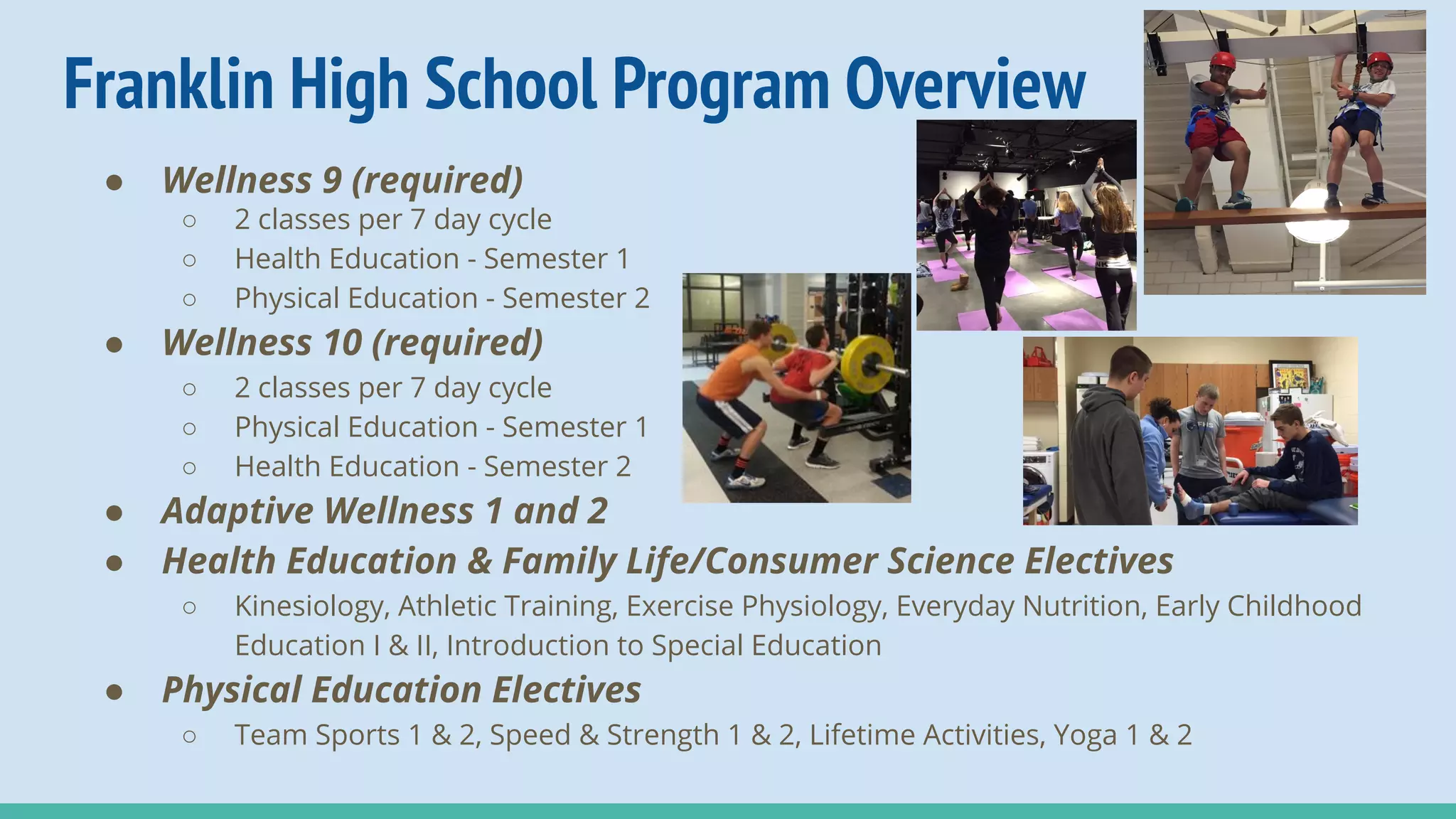
Franklin High School Program Overview
● Wellness 9 (required)
○ 2 classes per 7 day cycle
○ Health Education - Semester 1
○ Physical Education - Semester 2
● Wellness 10 (required)
○ 2 classes per 7 day cycle
○ Physical Education - Semester 1
○ Health Education - Semester 2
● Adaptive Wellness 1 and 2
● Health Education & Family Life/Consumer Science Electives
○ Kinesiology, Athletic Training, Exercise Physiology, Everyday Nutrition, Early Childhood
Education I & II, Introduction to Special Education
● Physical Education Electives
○ Team Sports 1 & 2, Speed & Strength 1 & 2, Lifetime Activities, Yoga 1 & 2
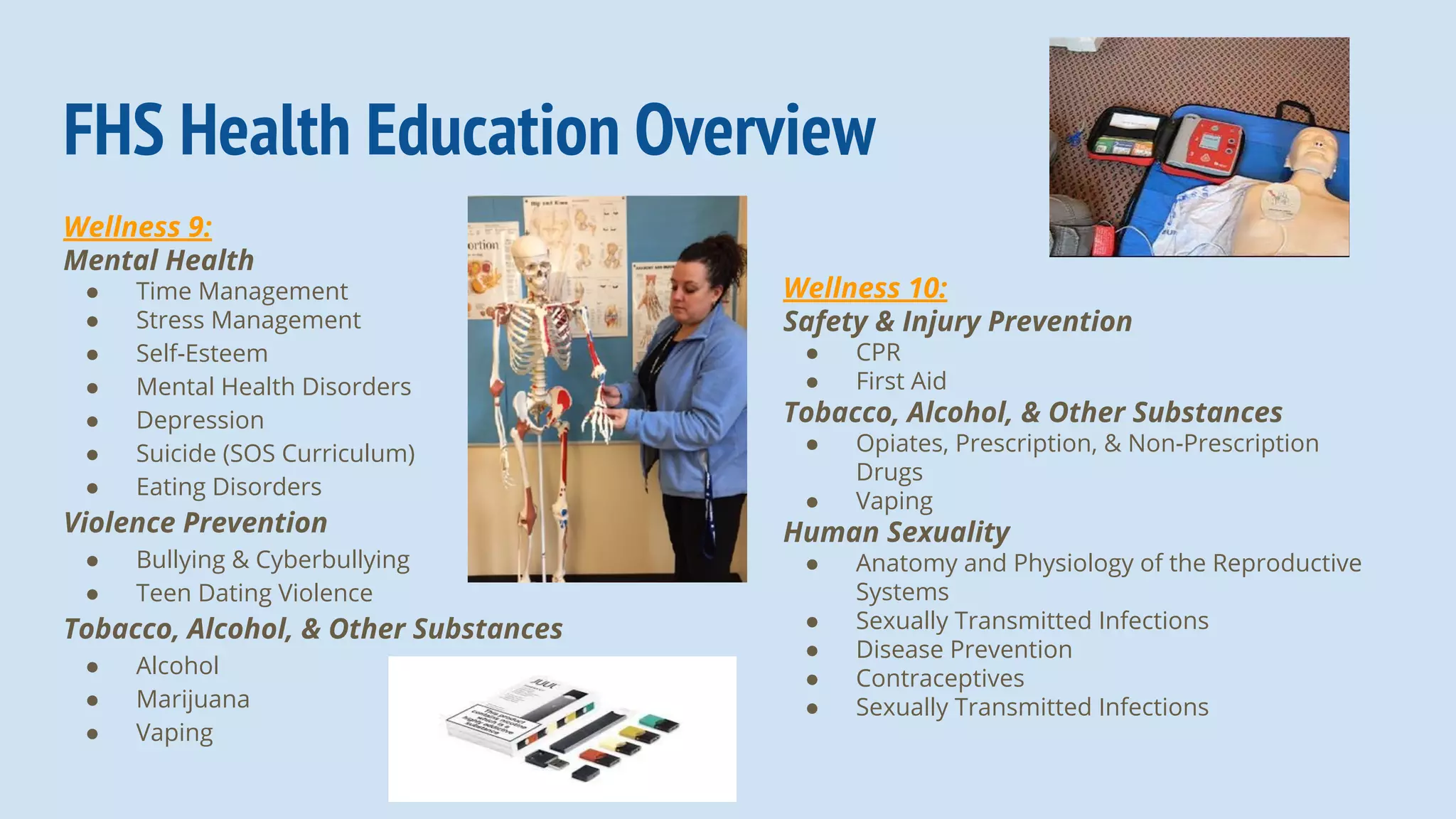
Wellness 9:
Mental Health
● Time Management
● Stress Management
● Self-Esteem
● Mental Health Disorders
● Depression
● Suicide (SOS Curriculum)
● Eating Disorders
Violence Prevention
● Bullying & Cyberbullying
● Teen Dating Violence
Tobacco, Alcohol, & Other Substances
● Alcohol
● Marijuana
● Vaping
FHS Health Education Overview
Wellness 10:
Safety & Injury Prevention
● CPR
● First Aid
Tobacco, Alcohol, & Other Substances
● Opiates, Prescription, & Non-Prescription
Drugs
● Vaping
Human Sexuality
● Anatomy and Physiology of the Reproductive
Systems
● Sexually Transmitted Infections
● Disease Prevention
● Contraceptives
● Sexually Transmitted Infections
Curriculum Revisions & Additions
High School:
● Curriculum updates and revisions to enhance current lessons
● Implementation of Keys to Literacy strategies
● Vertical alignment of vaping curriculum in Grades 6-10
● Revision of vaping education in Grades 6-10 (future PD work)
● Revisions and addition of gender inclusive language during Human
Sexuality Unit in Grade 10
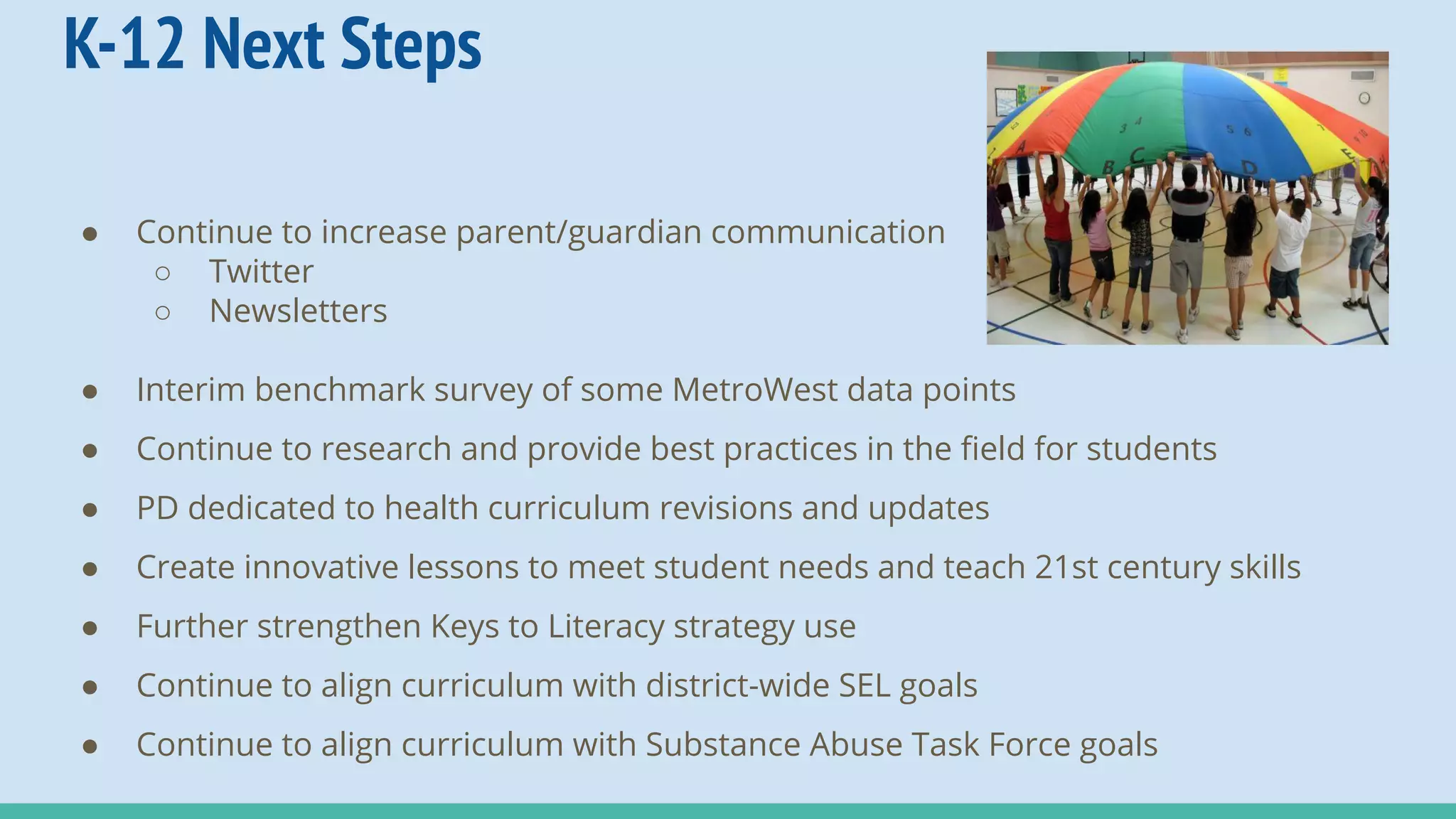
K-12 Next Steps
● Continue to increase parent/guardian communication
○ Twitter
○ Newsletters
● Interim benchmark survey of some MetroWest data points
● Continue to research and provide best practices in the field for students
● PD dedicated to health curriculum revisions and updates
● Create innovative lessons to meet student needs and teach 21st century skills
● Further strengthen Keys to Literacy strategy use
● Continue to align curriculum with district-wide SEL goals
● Continue to align curriculum with Substance Abuse Task Force goals
Thank you,Questions?
Follow us on Twitter!! @FPSHealthPE

Presentation on Health and Wellness

  • 1.
    Health and PhysicalEducation Curriculum Update Fall 2019 Kristin Letendre & Joyce Edwards
  • 2.
    Presentation Overview ● Alignmentwith District Improvement Plan ● Curriculum Review 2016-2017: Overview and Findings ● MetroWest Data 2018 ● Health & Physical Education Program Overview ● Curriculum Revisions and Additions ● Questions
  • 3.
    District Improvement Planfor 2018-2021 Strategic Objective: To ensure that all students are supported and challenged to reach their full potential, the Franklin Public Schools will align curriculum, instructional practices, and varied assessment opportunities to personalize learning and meet individual needs. Health and Physical Education Action Item: Continue to review outcomes from the 2016-2017 Health and Physical Education Curriculum Review, align and refine curriculum maps, unit plans, and lesson plans with the Massachusetts Frameworks in all areas as well as with best teaching practices based in research to meet the needs of all students.
  • 4.
    Curriculum Review: Overview ●K-12 Health and PE teachers and Assistant Superintendent Joyce Edwards ● SWOT Analysis (Strengths, Weaknesses, Opportunities, Threats) ● Reviewed current practices ● Developed survey ○ Student (grades 6-12) ○ Parents (K-12) ○ Health/PE Staff (K-12) ○ Administrators (K-12) ● Reviewed survey data ● Developed recommendations and plan for next steps ● Curriculum update during professional development days and summer work
  • 5.
    Curriculum Review: MajorFindings ● Parents/guardians view the K-12 program as positive ● Students enjoy their health and PE classes ● Not enough PE time at all levels (reported by all groups surveyed) ● Not enough health education class time (middle and high school levels) ● Students/parents/guardians would like students to participate in health and PE electives at FHS ● FHS PE elective program in high demand, not all students get classes they want ● Students want more health class time dedicated to mental health (depression/suicide), consent, and gender inclusivity
  • 6.
    Curriculum Review: MajorFindings (continued) ● Continue to update and provide high quality health and PE curriculum ● Students should not receive health curriculum at the expense of active PE time ● Increased PD and common planning time needed ● Increased communication ● Increased use of social media ● All current health and PE units should continue to be offered ● High quality program ● Department staff feels supported by FPS administration
  • 7.
  • 8.
    K-12 Health &Physical Education Program ● No program structure or time changes ● Curriculum revisions Elementary Program: ● 30 minutes of Health 1x per week ● 30 minutes of PE 1x per week Middle School Program: ● ~17-20 Health classes per year ● ~36-40 PE classes per year High School Program: ● ~18-20 Health classes in grades 9 and 10 per year ● ~18-20 PE classes in grades 9 and 10 per year ● Health, Physical Education, and Family Life/Consumer Science electives
  • 9.
    Elementary Program Overview PhysicalEducation Program ● Concepts taught include: Locomotor Movements, Hand-Eye Coordination, Kicking/Punting Manipulatives, Throwing and Catching, Volleying, Body and Spatial Awareness, Fitness Concepts ● Concepts taught through: Tag Games, Basketball, Soccer, Football, Floor Hockey, Lacrosse, Tennis, Volleyball, Gymnastics, Parachute, Cooperative Activities Health Education Program Units: Bullying Prevention, Fitness, Nutrition, Disease Control and Prevention, Mental Health, Safety and Injury Prevention, Tobacco and Alcohol, Human Growth & Development
  • 10.
    Curriculum Revisions &Additions Elementary: ● Human Growth & Development/Puberty Unit for Grades 4 & 5 ○ Lexington program visits (2018-2019) ○ Research ○ Gender inclusive ○ Normalizing ○ November vs. May ○ 2 lessons per grade level ○ Grade 4 - social, emotional, and physical changes (hygiene focus) happening to all people ○ Grade 5 - reinforces Grade 4 lessons with focus on puberty based on biology ● Curriculum updates and revisions to enhance current lessons ● Addition of vaping education in Grades 4 & 5 (future PD work)
  • 11.
    Middle School ProgramOverview Physical Education Program Students participate in a warm up that includes cardio, strength and flexibility to start the class Units will include but are not limited to: ● Fitness ● Team Sports ● Individual Sports ● Dual Sports ● Cooperative Games Health Education Program Grade 6 - Growth & Development, Nutrition, Violence Prevention Grade 7 - Violence Prevention, Tobacco, Alcohol, Drug and Other Substances Use/Abuse, Mental Health, Growth & Development Grade 8 - Disease Prevention and Control, Nutrition, Social/Emotional Health, Violence Prevention
  • 12.
    Curriculum Revisions &Additions Middle School: ● Curriculum updates and revisions to enhance current lessons ● Implementation of Keys to Literacy strategies ● Vertical alignment of vaping curriculum in Grades 6-10 ● Revision of vaping education in Grades 6-10 (future PD work) ● Addition of gender inclusive language during Human Growth & Development/Human Sexuality Unit in Grades 6-8 (future PD work)
  • 13.
    Franklin High SchoolProgram Overview ● Wellness 9 (required) ○ 2 classes per 7 day cycle ○ Health Education - Semester 1 ○ Physical Education - Semester 2 ● Wellness 10 (required) ○ 2 classes per 7 day cycle ○ Physical Education - Semester 1 ○ Health Education - Semester 2 ● Adaptive Wellness 1 and 2 ● Health Education & Family Life/Consumer Science Electives ○ Kinesiology, Athletic Training, Exercise Physiology, Everyday Nutrition, Early Childhood Education I & II, Introduction to Special Education ● Physical Education Electives ○ Team Sports 1 & 2, Speed & Strength 1 & 2, Lifetime Activities, Yoga 1 & 2
  • 14.
    Wellness 9: Mental Health ●Time Management ● Stress Management ● Self-Esteem ● Mental Health Disorders ● Depression ● Suicide (SOS Curriculum) ● Eating Disorders Violence Prevention ● Bullying & Cyberbullying ● Teen Dating Violence Tobacco, Alcohol, & Other Substances ● Alcohol ● Marijuana ● Vaping FHS Health Education Overview Wellness 10: Safety & Injury Prevention ● CPR ● First Aid Tobacco, Alcohol, & Other Substances ● Opiates, Prescription, & Non-Prescription Drugs ● Vaping Human Sexuality ● Anatomy and Physiology of the Reproductive Systems ● Sexually Transmitted Infections ● Disease Prevention ● Contraceptives ● Sexually Transmitted Infections
  • 15.
    Curriculum Revisions &Additions High School: ● Curriculum updates and revisions to enhance current lessons ● Implementation of Keys to Literacy strategies ● Vertical alignment of vaping curriculum in Grades 6-10 ● Revision of vaping education in Grades 6-10 (future PD work) ● Revisions and addition of gender inclusive language during Human Sexuality Unit in Grade 10
  • 16.
    K-12 Next Steps ●Continue to increase parent/guardian communication ○ Twitter ○ Newsletters ● Interim benchmark survey of some MetroWest data points ● Continue to research and provide best practices in the field for students ● PD dedicated to health curriculum revisions and updates ● Create innovative lessons to meet student needs and teach 21st century skills ● Further strengthen Keys to Literacy strategy use ● Continue to align curriculum with district-wide SEL goals ● Continue to align curriculum with Substance Abuse Task Force goals
  • 17.
    Thank you,Questions? Follow uson Twitter!! @FPSHealthPE