DYNAMIC ADAPTIVE STREAMING OVER
HTTP/2.0
Christopher Mueller, Stefan Lederer, Christian Timmerer and Hermann Hellwagner
Alpen-Adria Universität Klagenfurt (AAU)  Faculty of Technical Sciences (TEWI)
Institute of Information Technology (ITEC)  Multimedia Communication (MMC)
17-07-2013
Christopher Mueller 1Dynamic Adaptive Streaming over HTTP/2.0
OUTLINE
 Motivation & Contribution
 Introduction
 Dynamic Adaptive Streaming over HTTP (DASH)
 HTTP/2.0
 Experimental Setup & Evaluation
 Overhead
 Link Utilization
 Behavior under gradual changing bandwidth conditions
 Conclusion
Christopher Mueller 2Dynamic Adaptive Streaming over HTTP/2.0
MOTIVATION & CONTRIBUTION
Christopher Mueller Dynamic Adaptive Streaming over HTTP/2.0 3
 Situation in today's networks and new technologies
 Real-time entertainment is currently accounting for more than 50% of
the whole Internet traffic
 HTTP is one of the major protocols used to deploy a variety of services
 HTTP/2.0 standardization has recently started and SPDY has been
chosen as working draft
 DASH has the potential to play a significant role in future networks
Optimizations and problem analysis’s are crucial at that early stage of
standardization and deployment of DASH and HTTP/2.0
 Contribution
 First implementation and integration of MPEG-DASH with HTTP/2.0
 Evaluation of MPEG-DASH with different HTTP protocol versions with
network conditions that are common for fixed and wireless networks
DYNAMIC ADAPTIVE STREAMING
OVER HTTP – IN A NUTSHELL
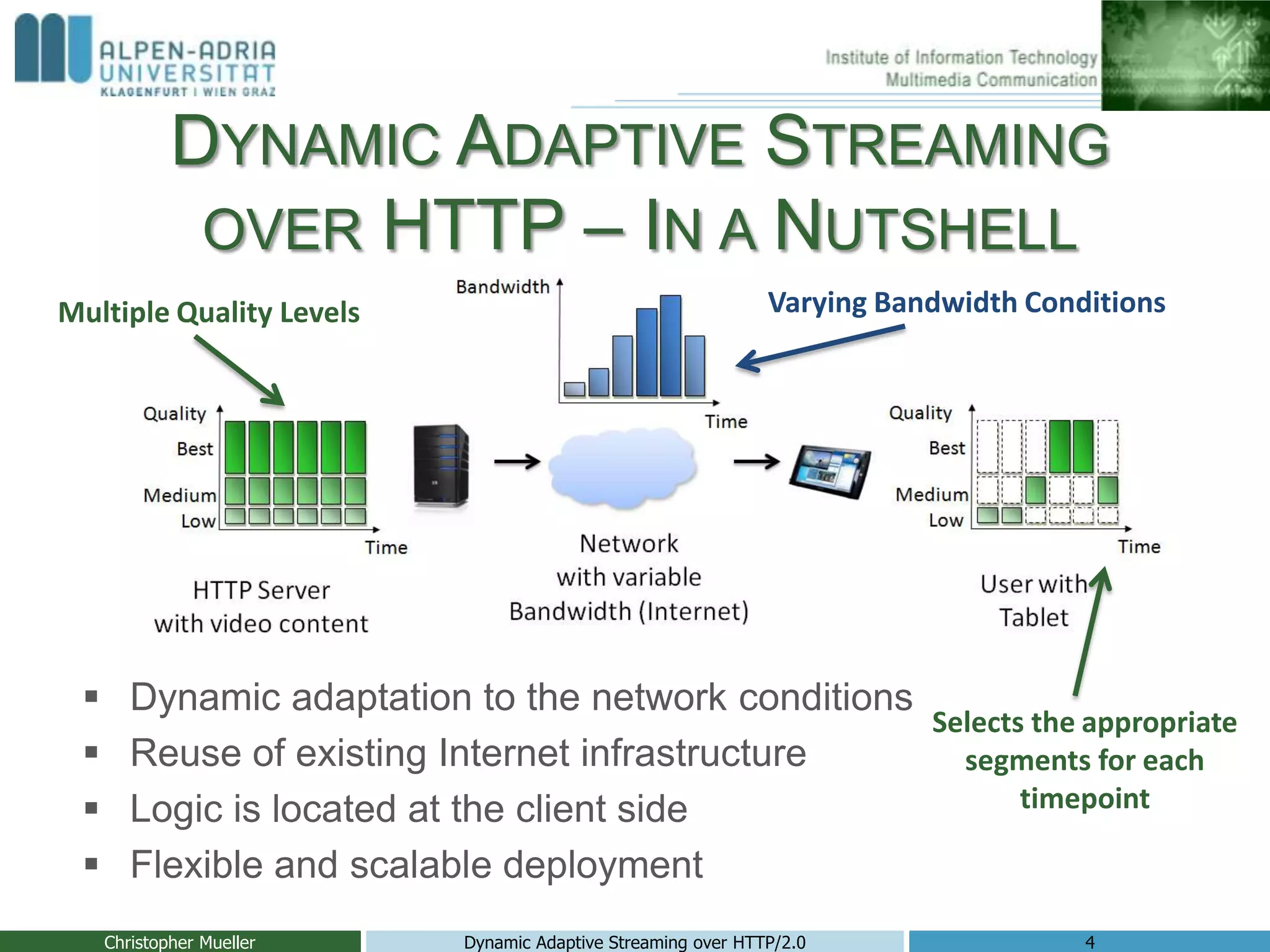
 Dynamic adaptation to the network conditions
 Reuse of existing Internet infrastructure
 Logic is located at the client side
 Flexible and scalable deployment
Christopher Mueller Dynamic Adaptive Streaming over HTTP/2.0 4
Multiple Quality Levels Varying Bandwidth Conditions
Selects the appropriate
segments for each
timepoint
HTTP/2.0 - SPDY
 HTTP Problems
 HTTP/1.0 uses one TCP connection per request and no pipelining support
 HTTP/1.1 solves problems of HTTP/1.0, but unfortunately not many
proxies are supporting it due to the Head of Line blocking problem
 Recently the IETF has started the development of HTTP/2.0
 SPDY has been officially chosen as working draft
 The protocol is based on TCP and maintains a single connection for each
session
 Multiple streams can be multiplexed on this connection
 SPDY is fully compatible with HTTP and could be integrated as a session layer
between HTTP and TCP
The network communication is based on frames that are exchanged between
client and server
Christopher Mueller Dynamic Adaptive Streaming over HTTP/2.0 5
EVALUATION SETUP
 Evaluation of MPEG-DASH with different HTTP protocol versions
 Conditions that are common for fixed and mobile access networks
 Overhead
 Link Utilization
 Switching behavior under gradual changing bandwidth conditions
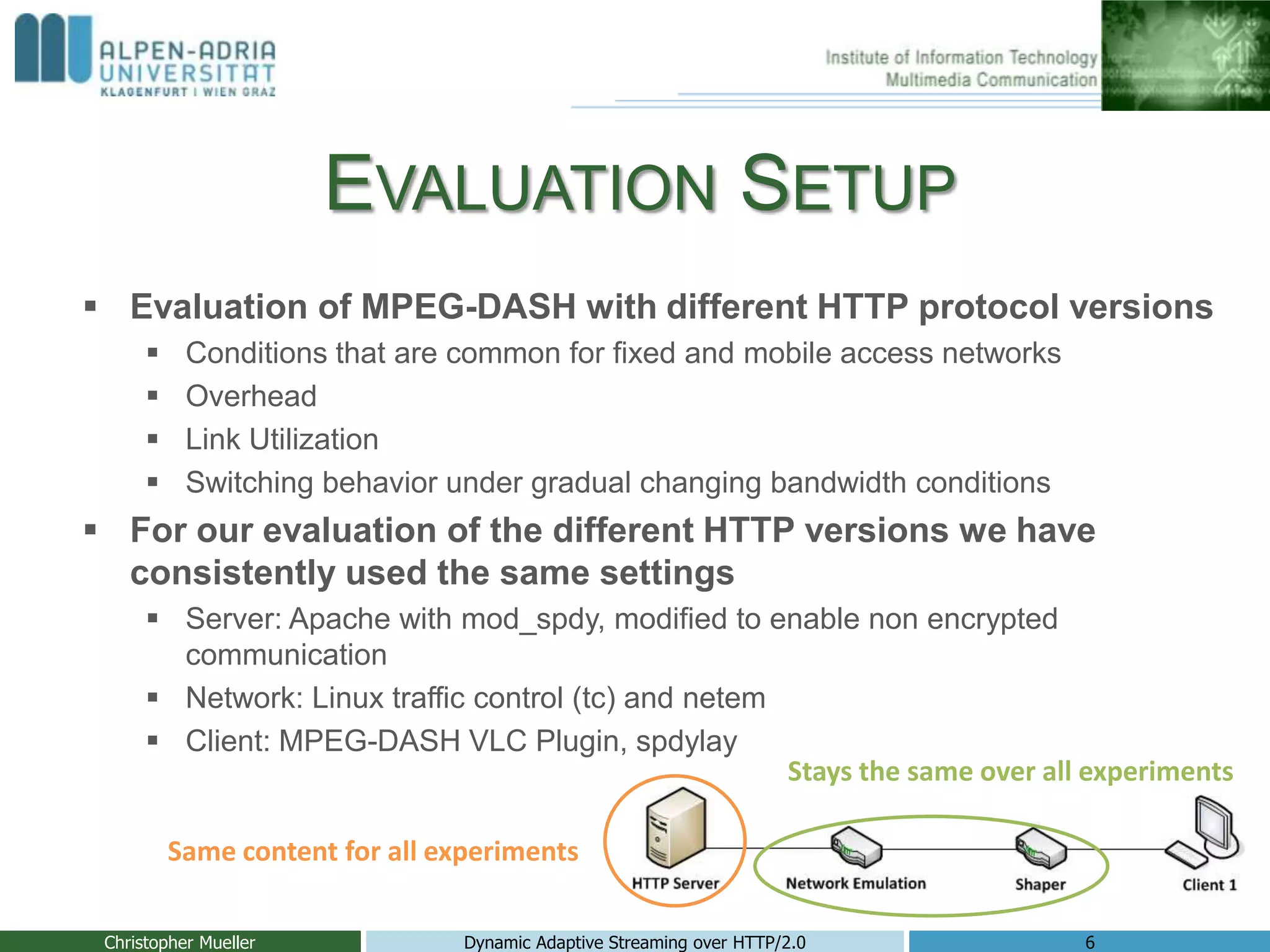
 For our evaluation of the different HTTP versions we have
consistently used the same settings
 Server: Apache with mod_spdy, modified to enable non encrypted
communication
 Network: Linux traffic control (tc) and netem
 Client: MPEG-DASH VLC Plugin, spdylay
Christopher Mueller Dynamic Adaptive Streaming over HTTP/2.0 6
Stays the same over all experiments
Same content for all experiments
OVERHEAD EVALUATION
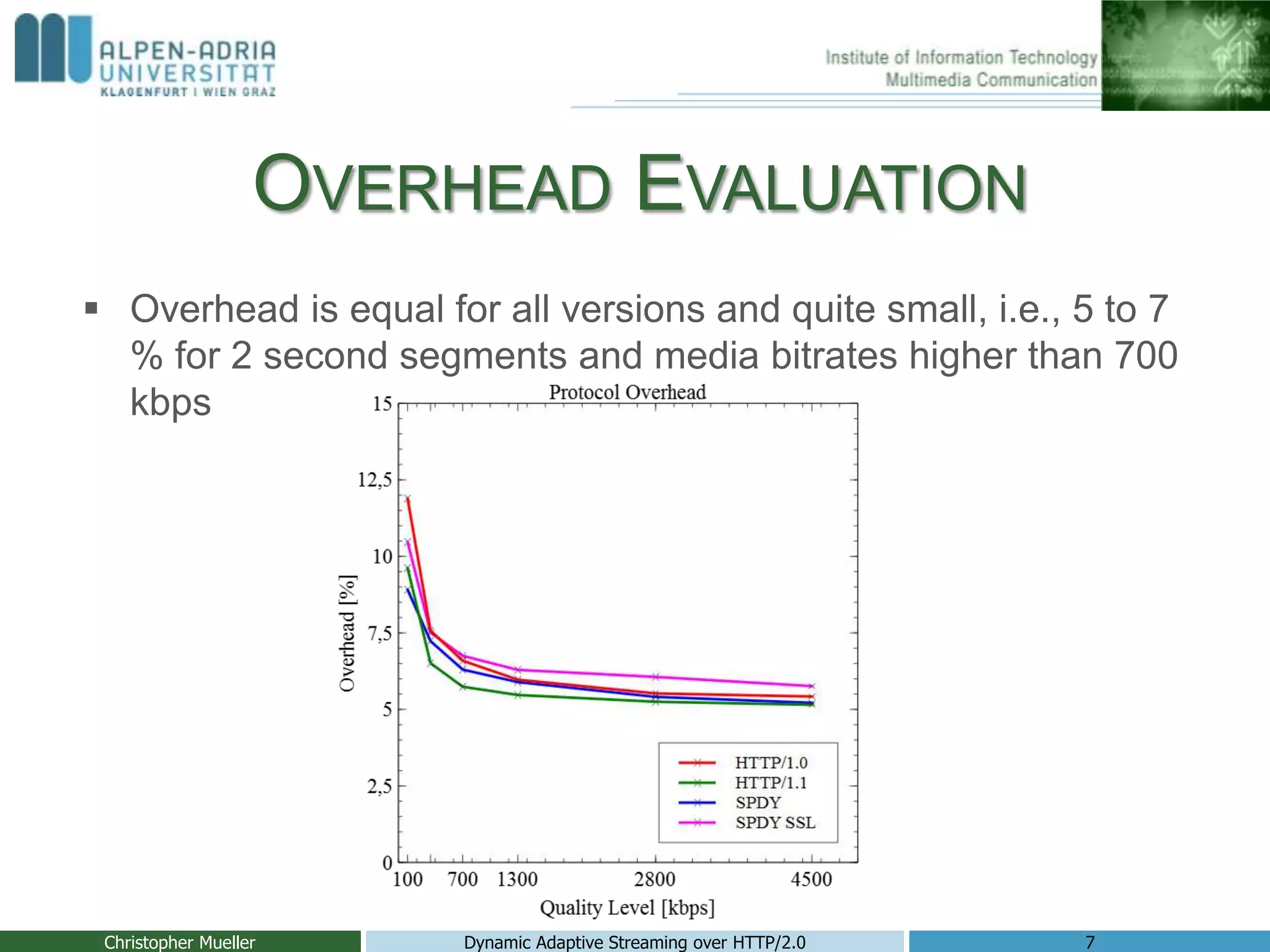
 Overhead is equal for all versions and quite small, i.e., 5 to 7
% for 2 second segments and media bitrates higher than 700
kbps
Christopher Mueller Dynamic Adaptive Streaming over HTTP/2.0 7
LINK UTILIZATION
Christopher Mueller Dynamic Adaptive Streaming over HTTP/2.0 8
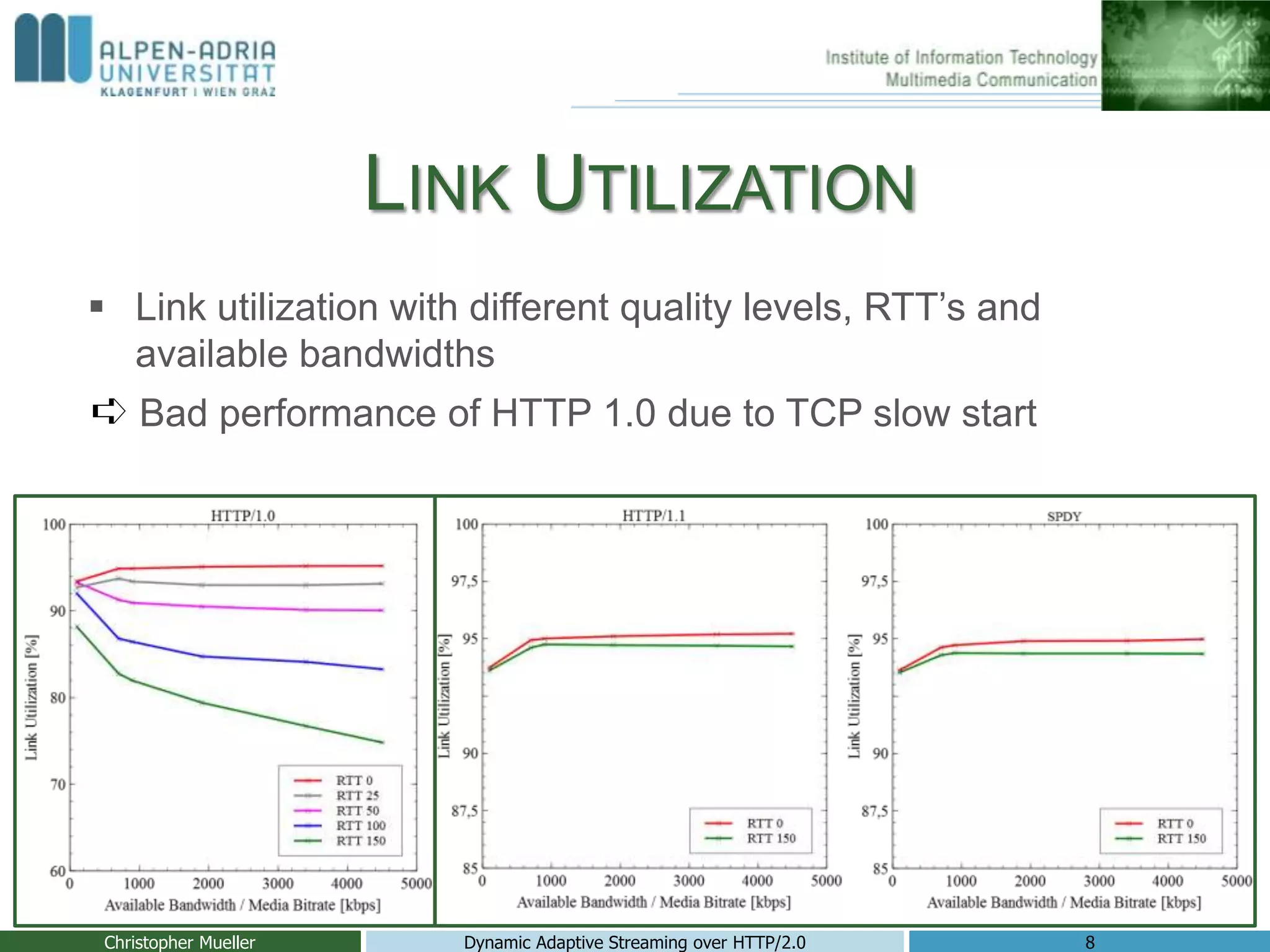
 Link utilization with different quality levels, RTT’s and
available bandwidths
➪ Bad performance of HTTP 1.0 due to TCP slow start
GRADUAL CHANGING BANDWIDTH
CONDITIONS
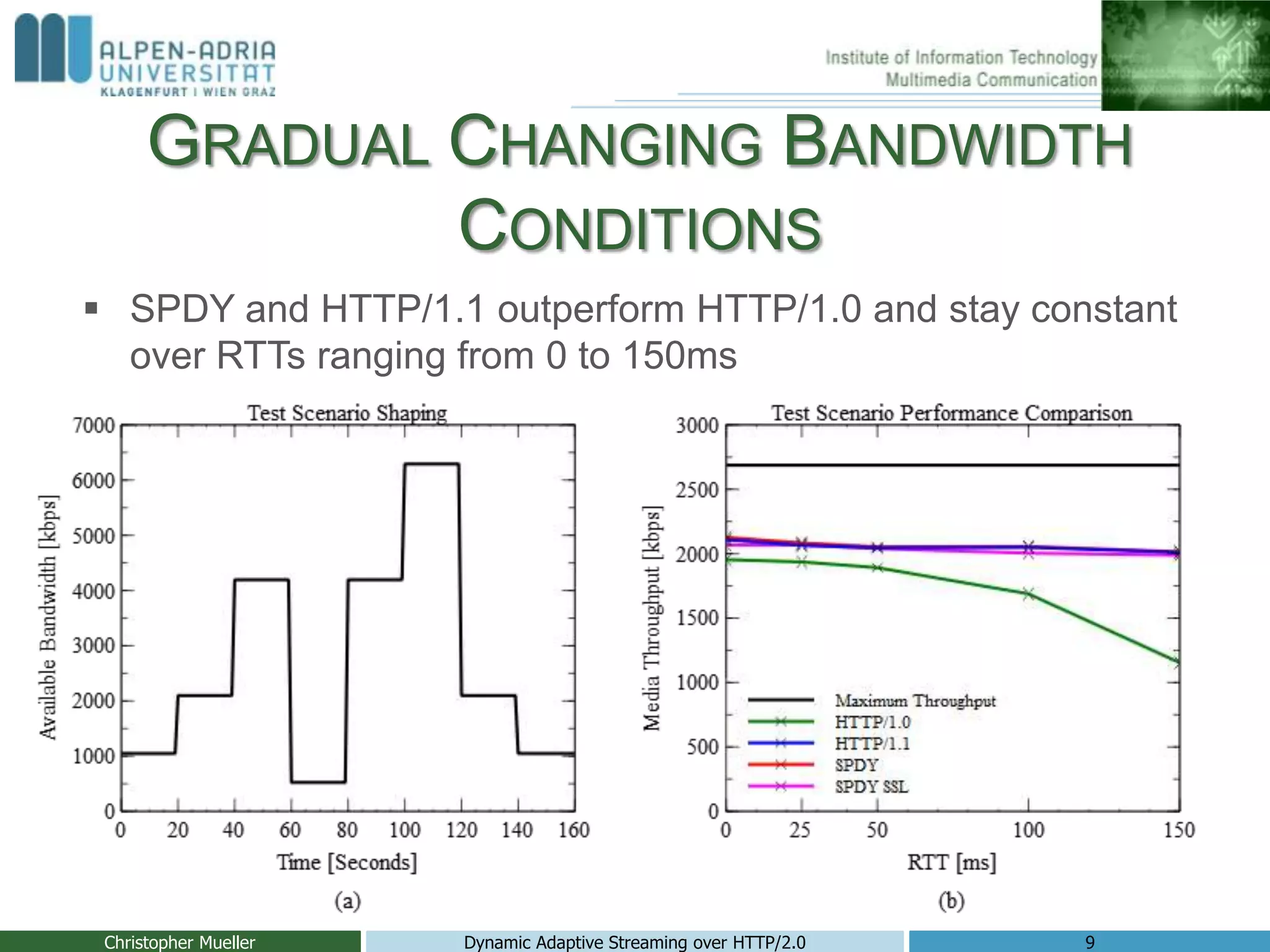
 SPDY and HTTP/1.1 outperform HTTP/1.0 and stay constant
over RTTs ranging from 0 to 150ms
Christopher Mueller Dynamic Adaptive Streaming over HTTP/2.0 9
CONCLUSION
 First implementation and evaluation of MPEG-DASH with
HTTP/2.0 (SPDY)
 Evaluation of MPEG-DASH with different HTTP protocol
versions under various conditions
 Overhead is equal for all versions and quite small, i.e., 5 to 7 % for
2 second segments and media bitrates higher than 700 kbps
 HTTP/1.0 achieves link utilization equal or higher than 90 % for
RTTs ranging from 0 to 50ms but in case of RTTs between 100 and
150 ms only 75 to 85 % can be utilized
 HTTP/1.1 and SPDY performs constant over varying RTTs due to
the persistent connection and pipelining features
SPDY performs equally well as HTTP/1.1 but SPDY offers
the HTTP/1.1 functionalities implicitly
Christopher Mueller Dynamic Adaptive Streaming over HTTP/2.0 10
THANK YOU FOR YOUR ATTENTION
… questions, comments, etc. are welcome …
Christopher Mueller Dynamic Adaptive Streaming over HTTP/2.0 11
Christopher Mueller | dash.itec.aau.at
Alpen-Adria Universität Klagenfurt (AAU)  Faculty of Technical Sciences (TEWI)
Institute of Information Technology (ITEC)  Multimedia Communication (MMC)
BACKUP
Christopher Mueller Dynamic Adaptive Streaming over HTTP/2.0 12
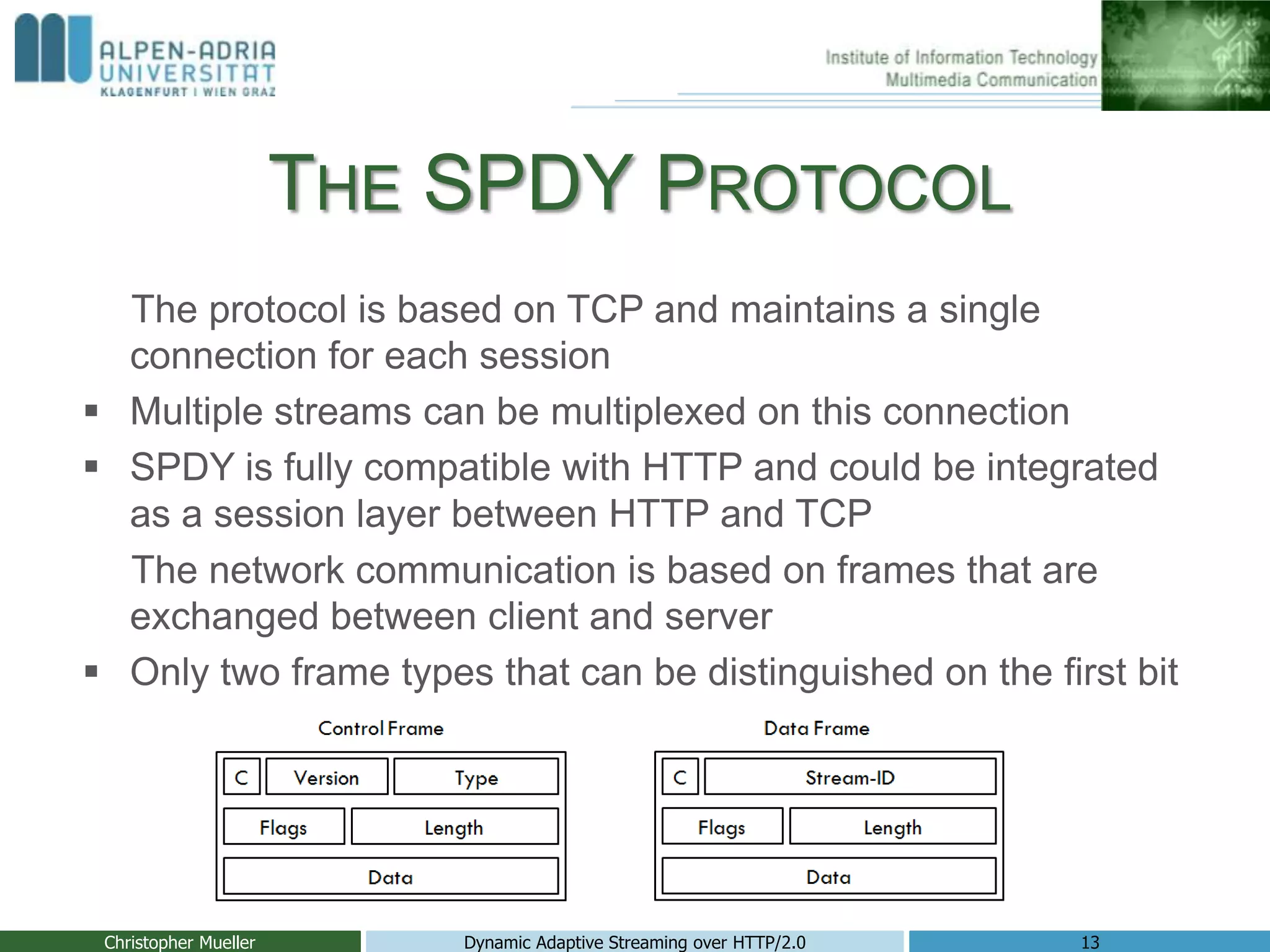
THE SPDY PROTOCOL
The protocol is based on TCP and maintains a single
connection for each session
 Multiple streams can be multiplexed on this connection
 SPDY is fully compatible with HTTP and could be integrated
as a session layer between HTTP and TCP
The network communication is based on frames that are
exchanged between client and server
 Only two frame types that can be distinguished on the first bit
Christopher Mueller Dynamic Adaptive Streaming over HTTP/2.0 13
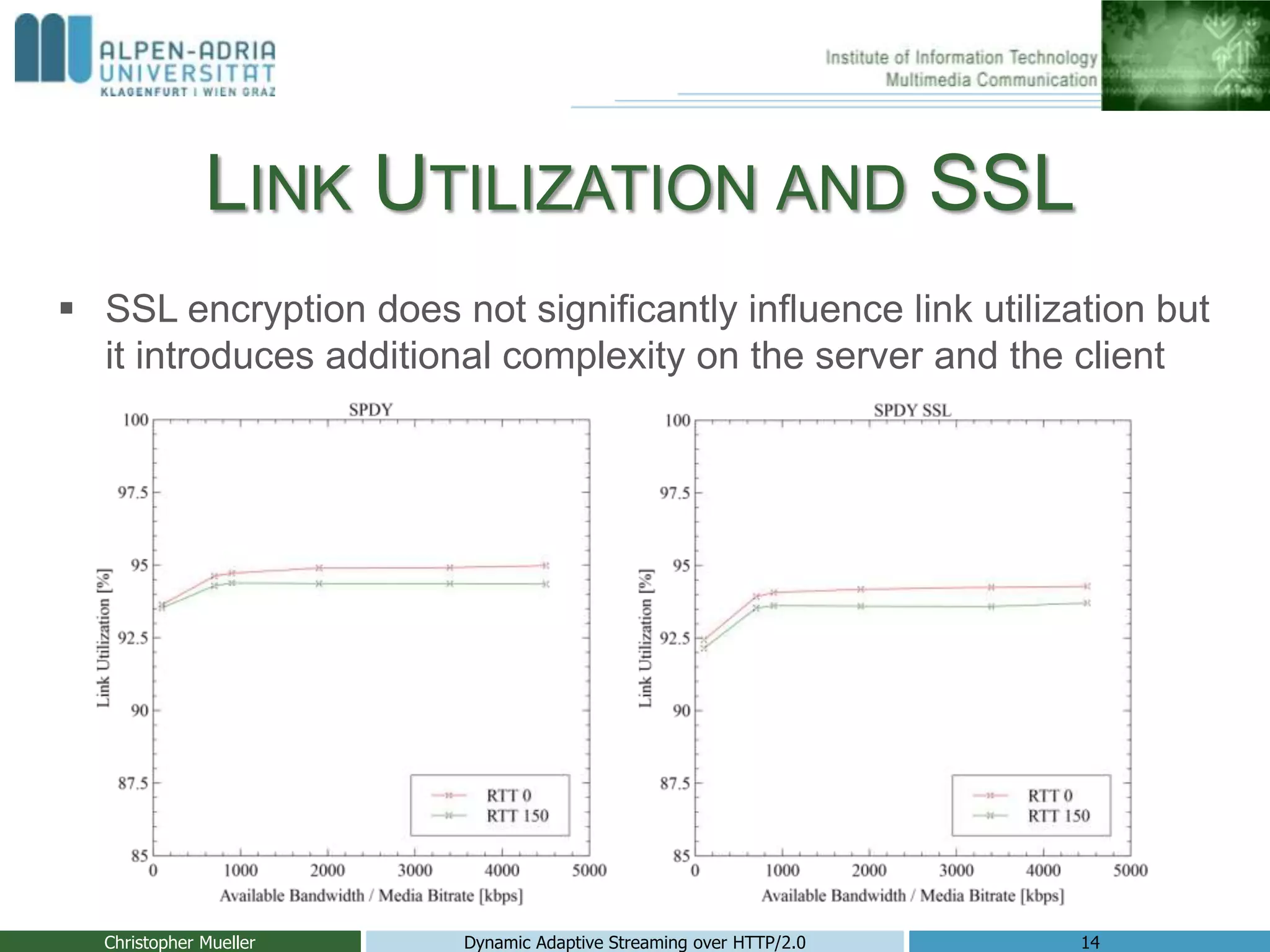
LINK UTILIZATION AND SSL
 SSL encryption does not significantly influence link utilization but
it introduces additional complexity on the server and the client
Christopher Mueller Dynamic Adaptive Streaming over HTTP/2.0 14

Dynamic Adaptive Streaming over HTTP/2.0

  • 1.
    DYNAMIC ADAPTIVE STREAMINGOVER HTTP/2.0 Christopher Mueller, Stefan Lederer, Christian Timmerer and Hermann Hellwagner Alpen-Adria Universität Klagenfurt (AAU)  Faculty of Technical Sciences (TEWI) Institute of Information Technology (ITEC)  Multimedia Communication (MMC) 17-07-2013 Christopher Mueller 1Dynamic Adaptive Streaming over HTTP/2.0
  • 2.
    OUTLINE  Motivation &Contribution  Introduction  Dynamic Adaptive Streaming over HTTP (DASH)  HTTP/2.0  Experimental Setup & Evaluation  Overhead  Link Utilization  Behavior under gradual changing bandwidth conditions  Conclusion Christopher Mueller 2Dynamic Adaptive Streaming over HTTP/2.0
  • 3.
    MOTIVATION & CONTRIBUTION ChristopherMueller Dynamic Adaptive Streaming over HTTP/2.0 3  Situation in today's networks and new technologies  Real-time entertainment is currently accounting for more than 50% of the whole Internet traffic  HTTP is one of the major protocols used to deploy a variety of services  HTTP/2.0 standardization has recently started and SPDY has been chosen as working draft  DASH has the potential to play a significant role in future networks Optimizations and problem analysis’s are crucial at that early stage of standardization and deployment of DASH and HTTP/2.0  Contribution  First implementation and integration of MPEG-DASH with HTTP/2.0  Evaluation of MPEG-DASH with different HTTP protocol versions with network conditions that are common for fixed and wireless networks
  • 4.
    DYNAMIC ADAPTIVE STREAMING OVERHTTP – IN A NUTSHELL  Dynamic adaptation to the network conditions  Reuse of existing Internet infrastructure  Logic is located at the client side  Flexible and scalable deployment Christopher Mueller Dynamic Adaptive Streaming over HTTP/2.0 4 Multiple Quality Levels Varying Bandwidth Conditions Selects the appropriate segments for each timepoint
  • 5.
    HTTP/2.0 - SPDY HTTP Problems  HTTP/1.0 uses one TCP connection per request and no pipelining support  HTTP/1.1 solves problems of HTTP/1.0, but unfortunately not many proxies are supporting it due to the Head of Line blocking problem  Recently the IETF has started the development of HTTP/2.0  SPDY has been officially chosen as working draft  The protocol is based on TCP and maintains a single connection for each session  Multiple streams can be multiplexed on this connection  SPDY is fully compatible with HTTP and could be integrated as a session layer between HTTP and TCP The network communication is based on frames that are exchanged between client and server Christopher Mueller Dynamic Adaptive Streaming over HTTP/2.0 5
  • 6.
    EVALUATION SETUP  Evaluationof MPEG-DASH with different HTTP protocol versions  Conditions that are common for fixed and mobile access networks  Overhead  Link Utilization  Switching behavior under gradual changing bandwidth conditions  For our evaluation of the different HTTP versions we have consistently used the same settings  Server: Apache with mod_spdy, modified to enable non encrypted communication  Network: Linux traffic control (tc) and netem  Client: MPEG-DASH VLC Plugin, spdylay Christopher Mueller Dynamic Adaptive Streaming over HTTP/2.0 6 Stays the same over all experiments Same content for all experiments
  • 7.
    OVERHEAD EVALUATION  Overheadis equal for all versions and quite small, i.e., 5 to 7 % for 2 second segments and media bitrates higher than 700 kbps Christopher Mueller Dynamic Adaptive Streaming over HTTP/2.0 7
  • 8.
    LINK UTILIZATION Christopher MuellerDynamic Adaptive Streaming over HTTP/2.0 8  Link utilization with different quality levels, RTT’s and available bandwidths ➪ Bad performance of HTTP 1.0 due to TCP slow start
  • 9.
    GRADUAL CHANGING BANDWIDTH CONDITIONS SPDY and HTTP/1.1 outperform HTTP/1.0 and stay constant over RTTs ranging from 0 to 150ms Christopher Mueller Dynamic Adaptive Streaming over HTTP/2.0 9
  • 10.
    CONCLUSION  First implementationand evaluation of MPEG-DASH with HTTP/2.0 (SPDY)  Evaluation of MPEG-DASH with different HTTP protocol versions under various conditions  Overhead is equal for all versions and quite small, i.e., 5 to 7 % for 2 second segments and media bitrates higher than 700 kbps  HTTP/1.0 achieves link utilization equal or higher than 90 % for RTTs ranging from 0 to 50ms but in case of RTTs between 100 and 150 ms only 75 to 85 % can be utilized  HTTP/1.1 and SPDY performs constant over varying RTTs due to the persistent connection and pipelining features SPDY performs equally well as HTTP/1.1 but SPDY offers the HTTP/1.1 functionalities implicitly Christopher Mueller Dynamic Adaptive Streaming over HTTP/2.0 10
  • 11.
    THANK YOU FORYOUR ATTENTION … questions, comments, etc. are welcome … Christopher Mueller Dynamic Adaptive Streaming over HTTP/2.0 11 Christopher Mueller | dash.itec.aau.at Alpen-Adria Universität Klagenfurt (AAU)  Faculty of Technical Sciences (TEWI) Institute of Information Technology (ITEC)  Multimedia Communication (MMC)
  • 12.
    BACKUP Christopher Mueller DynamicAdaptive Streaming over HTTP/2.0 12
  • 13.
    THE SPDY PROTOCOL Theprotocol is based on TCP and maintains a single connection for each session  Multiple streams can be multiplexed on this connection  SPDY is fully compatible with HTTP and could be integrated as a session layer between HTTP and TCP The network communication is based on frames that are exchanged between client and server  Only two frame types that can be distinguished on the first bit Christopher Mueller Dynamic Adaptive Streaming over HTTP/2.0 13
  • 14.
    LINK UTILIZATION ANDSSL  SSL encryption does not significantly influence link utilization but it introduces additional complexity on the server and the client Christopher Mueller Dynamic Adaptive Streaming over HTTP/2.0 14