Distribute Key-Value Store 

         &Cassandra
Part I 基础介绍
Distribute KV Store 介绍

     KV Store
       Key-Value Store 是一个存在了很久的数据库模式,
value = store.get(key) store.put(key, value) store.delete(key)
     KV Store的特点
        功能简单
        性能高
     Distribute KV Store
        把KV分布到多个Server上
        提供高并发访问和更大的容量
        最新的创新使DKV成为云计算的基础组件取得巨大成功
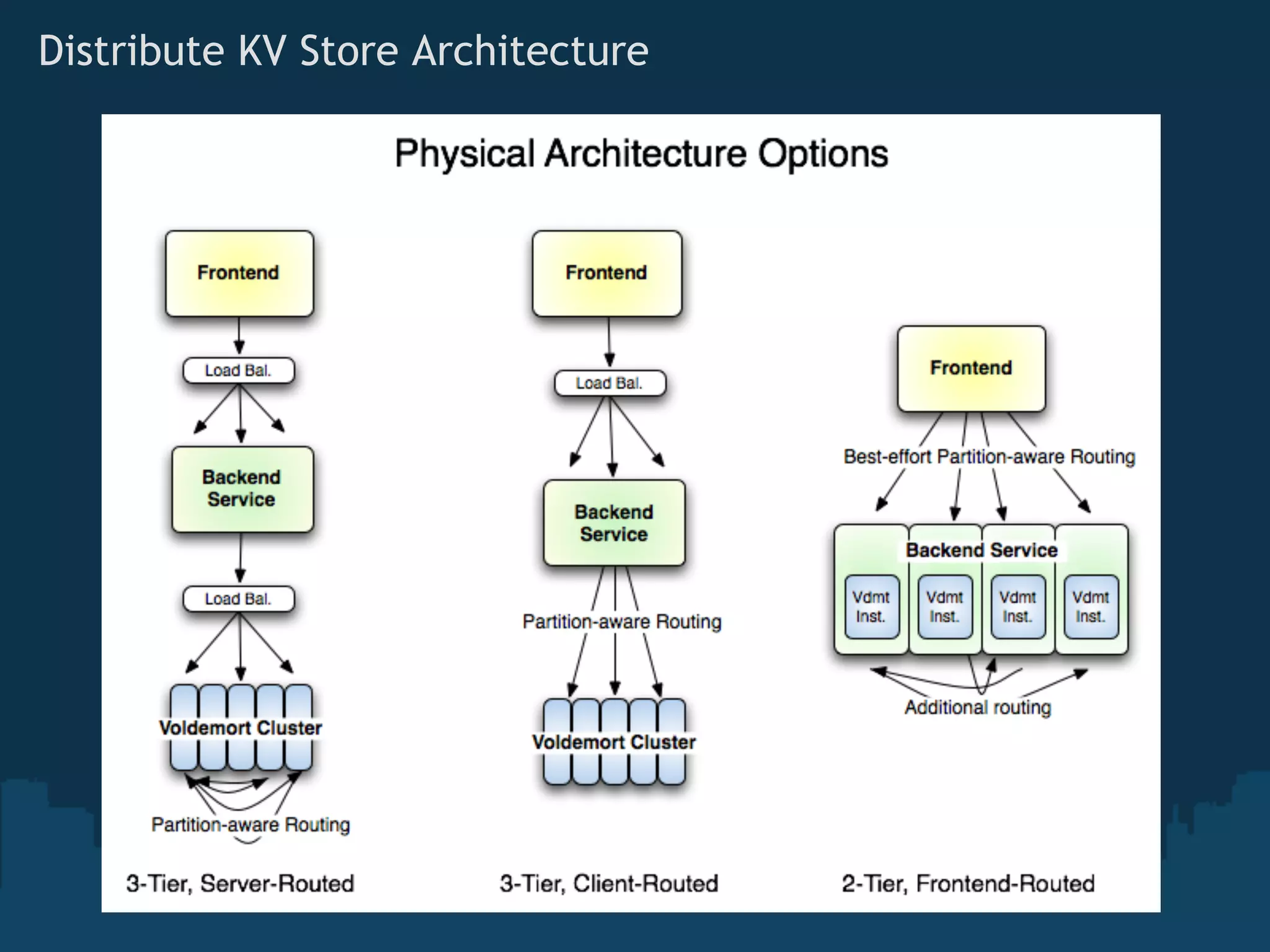
Distribute KV Store Architecture
分布式的Key-Value Store和CAP原理
简单的Key-Value一般是嵌入到调用的应用程序中的,所以受限制于机器的内存
和磁盘容量,不能服务于海量客户数据。尤其是现在的Web2.0时代,用户创建的
数据非常多,不但用Key-Value Store难以存储,即便是使用RDBMS数据库系统,
例如Oracle或者Mysql,也难以满足海量数据存放和海量并发读取的的要求,或
者需要非常高的硬件配置和开二次发代价才能让系统正常工作。

在解决海量数据和海量并发双难题的过程中,业界的一些技术上领先的公司进展
很大,象Amazon,Google,Yahoo都分别通过不同的方法解决了问题,他们的方
法归结起来就是依靠一点:Distribute,Amazon出了著名的论文:<Dynamo:
Amazon's Highly Available Key-Value Store>,并且在他们的云计算服务
EC2/S3中实现了比Dyname更强大的Simple DB,Google组合了GFS和一系列其他的
分布式算法,最终实现了BigTable,Yahoo既有分布式Key-Value Store的实现,
也资助了类似于GFS/BigTable的Hadoop项目,到目前为止,Hadoop最大的生产集
群依然由Yahoo建立并维护,多达1000 个Nodes.
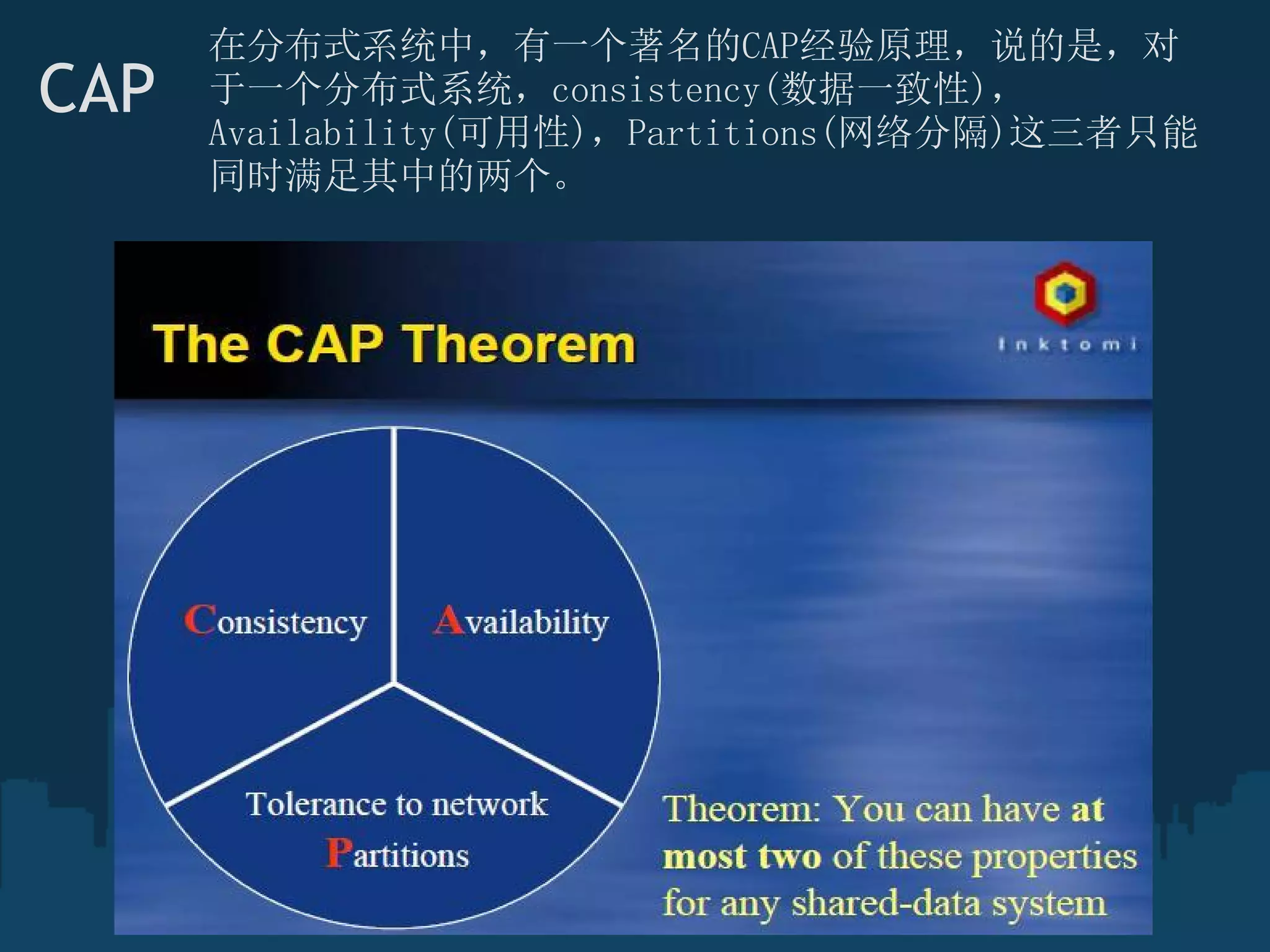
在分布式系统中,有一个著名的CAP经验原理,说的是,对
CAP    于一个分布式系统,consistency(数据一致性),
       Availability(可用性),Partitions(网络分隔)这三者只能
       同时满足其中的两个。
用CAP理论来解释RDBMS,它满足了Consistency和
Availability,但正是因为如此,所以它在 Partition上就很难
做得好。而对于很多的key-value形式的存储系统而言,它更强
调的是Availability和Network Partition,所以在Consistency
上做了弱化。例如,Amazon的Dynamo,它就不支持事务,只能提
供Eeventra Consistency,为了 高可用性而牺牲了数据的一致
性 

“Dynamo targets applications that operate with weaker
consistency
(the  “C”  in  ACID)  if  this  results  in  high  availability”。
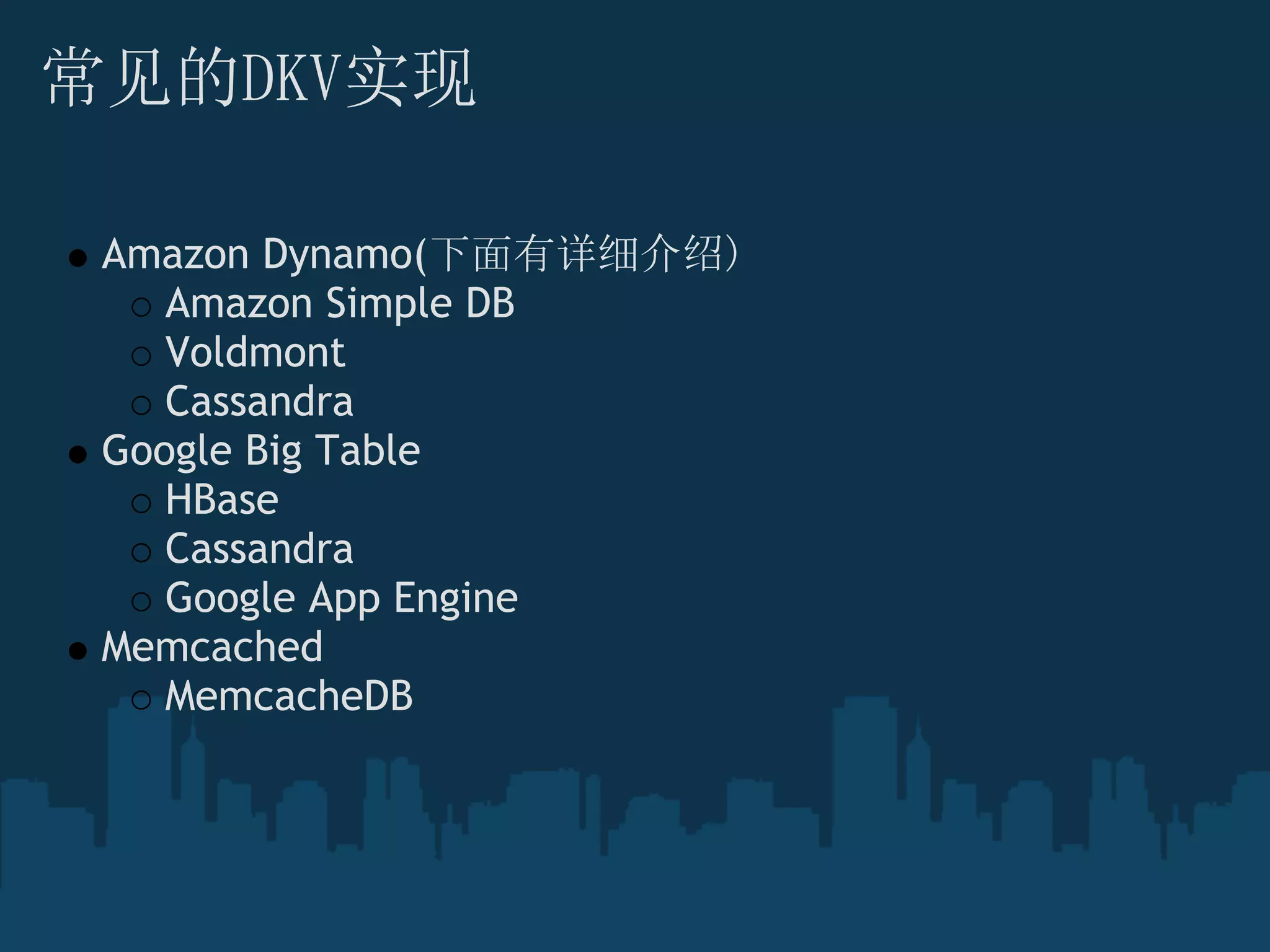
常见的DKV实现

 Amazon Dynamo(下面有详细介绍)
    Amazon Simple DB
    Voldmont 
    Cassandra
 Google Big Table 
    HBase 
    Cassandra
    Google App Engine
 Memcached  
    MemcacheDB
Amazon Dynamo
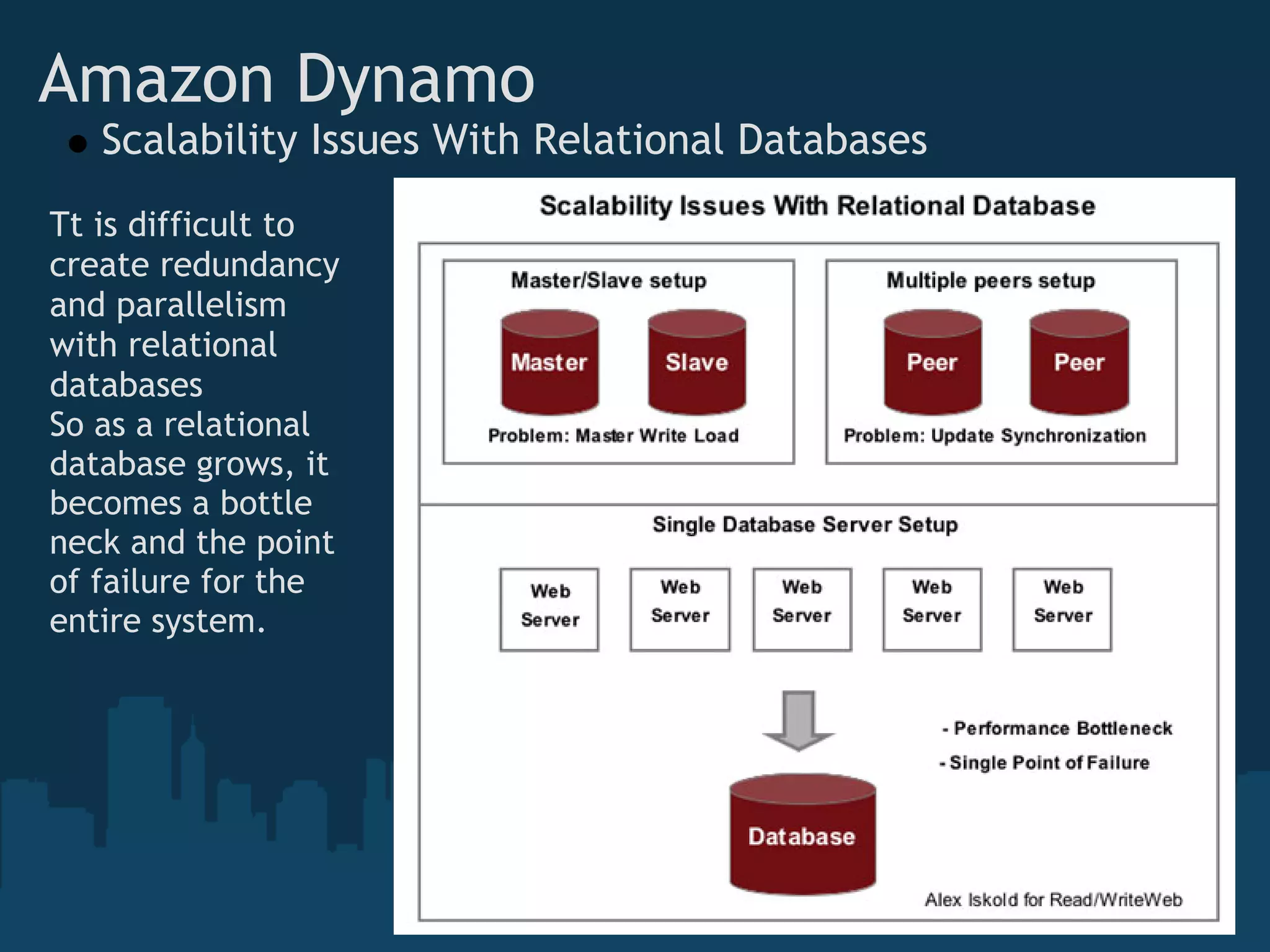
   Scalability Issues With Relational Databases
Tt is difficult to
create redundancy
and parallelism
with relational
databases
So as a relational
database grows, it
becomes a bottle
neck and the point
of failure for the
entire system. 
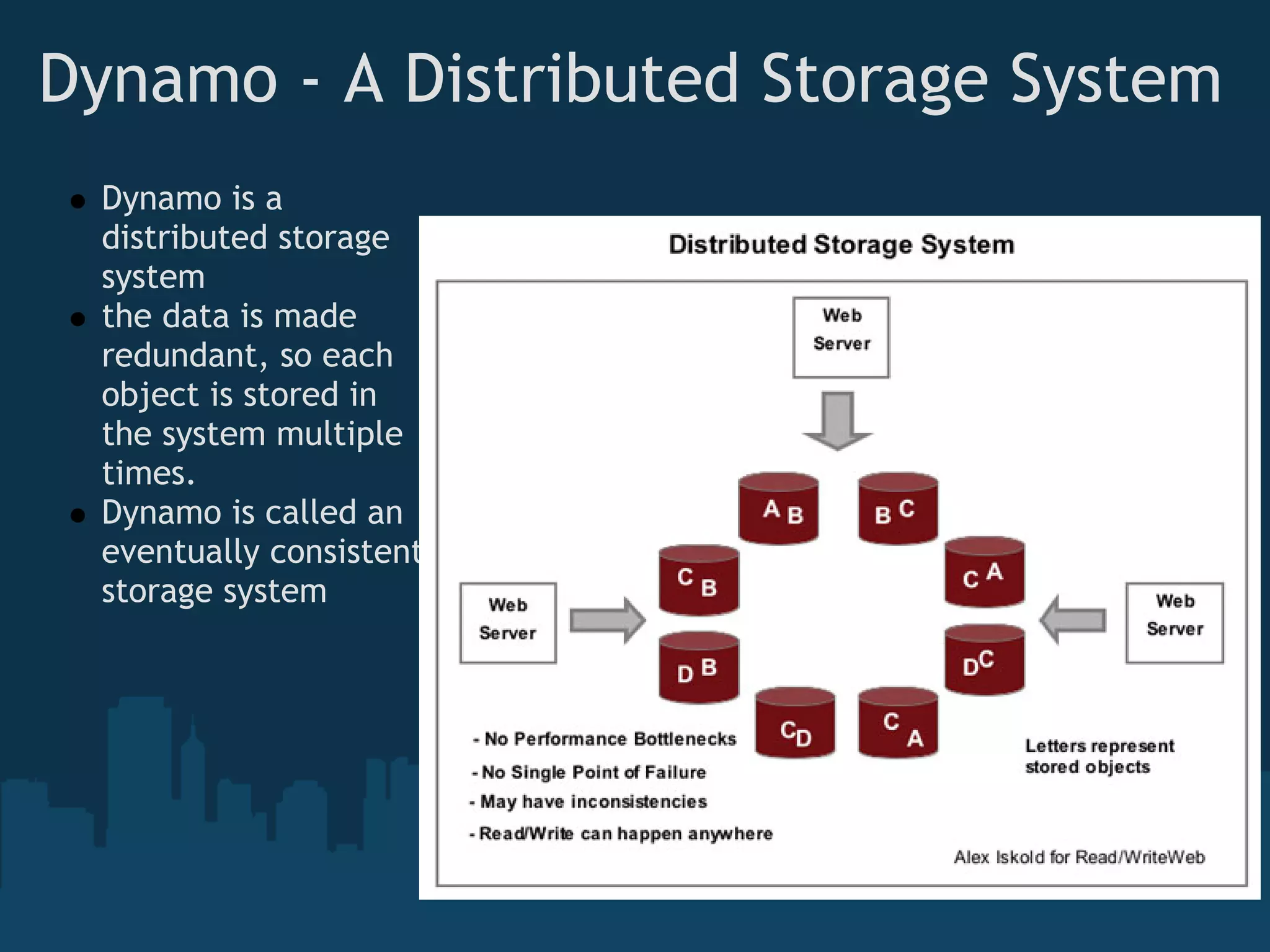
Dynamo - A Distributed Storage System
 Dynamo is a
 distributed storage
 system
 the data is made
 redundant, so each
 object is stored in
 the system multiple
 times.
 Dynamo is called an
 eventually consistent
 storage system
How Dynamo Works
 Physical nodes are thought of as identical and organized into a ring.
 Virtual nodes are created by the system and mapped onto physical nodes,
 so that hardware can be swapped for maintenance and failure.
 The partitioning algorithm is one of the most complicated pieces of the
 system, it specifies which nodes will store a given object.
 The partitioning mechanism automatically scales as nodes enter and
 leave the system.
 Every object is asynchronously replicated to N nodes.
 The updates to the system occur asynchronously and may result in
 multiple copies of the object in the system with slightly different states.
 The discrepancies in the system are reconciled after a period of time,
 ensuring eventual consistency.
 Any node in the system can be issued a put or get request for any key.
Part II 
Distributed Key-Value Store的
           算法基础
Data partitioning and replication

  Data Partitioning:
     Data needs to be partitioned across a cluster of servers
     so that no single server needs to hold the complete
     data set.
  Replication:
     Put the data into S partitions (one per server) and store
     copies of a given key K on R servers.
Consistency 
  Tolerate the possibility of inconsistency, and resolve
  inconsistencies at read time. 
     Two-Phase Commit — This is a locking protocol that involves two
     rounds of co-ordination between machines. It perfectly consistent,
     but not failure tolerant, and very slow.
     Paxos-style consensus — This is a protocol for coming to agreement
     on a value that is more failure tolerant.
     Read-repair — The first two approaches prevent permanent
     inconsistency. This approach involves writing all inconsistent
     versions, and then at read-time detecting the conflict, and resolving
     the problems. This involves little co-ordination and is completely
     failure tolerant, but may require additional application logic to
     resolve conflicts.
  Dynamo use versioning and read-repair.
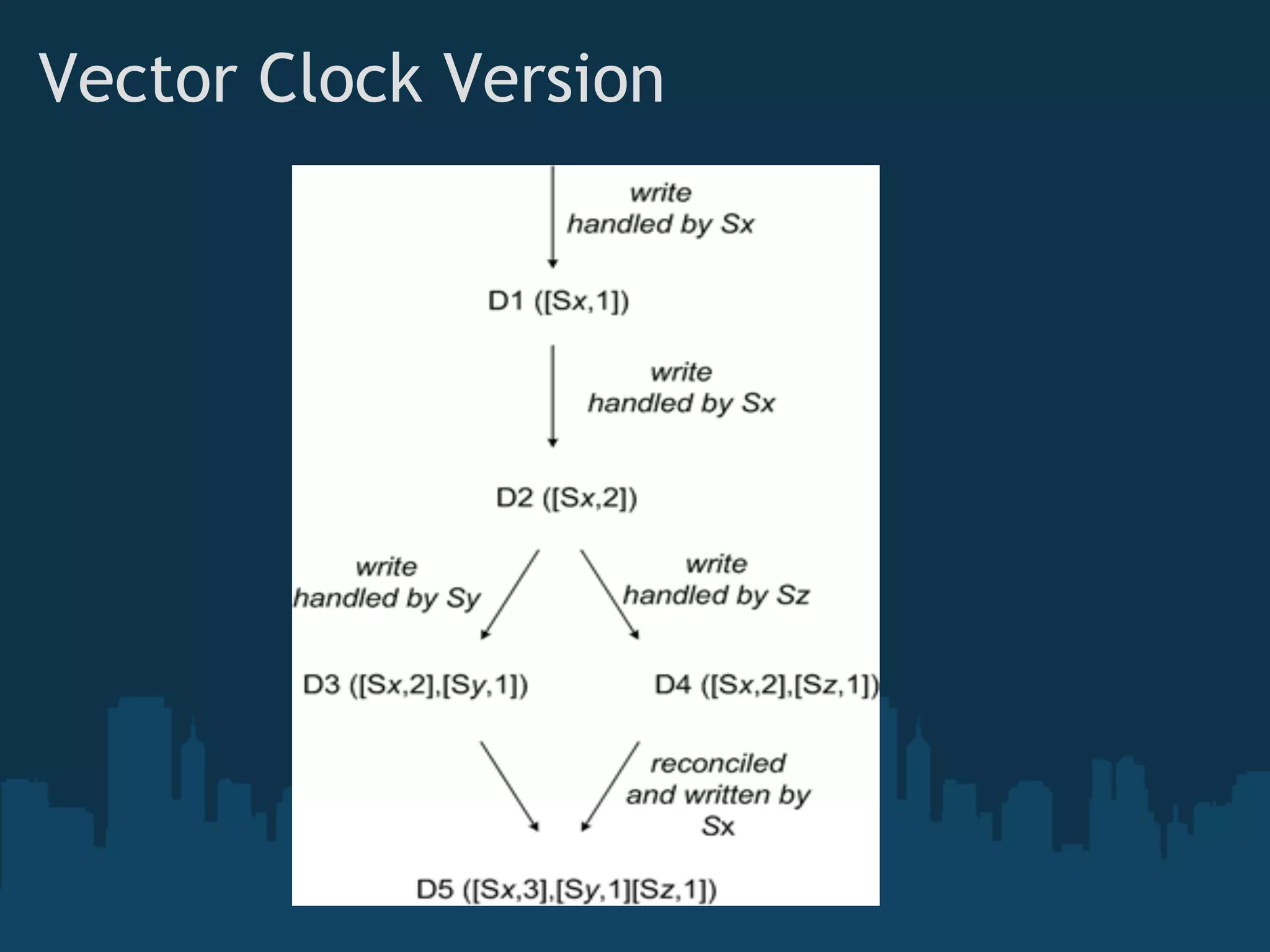
Versioning
    A vector clock keeps a counter for each writing server, and
    allows us to calculate when two versions are in conflict, and
    when one version succeeds or preceeds another.
A vector clock is a list of server:version pairs:
[1:45,2:3,5:55]
The version indicates that the server was the "master" for that
number of writes.
A version v1 succeeds a version v2 if for all i, v1i > v2i. If neither v1
> v2 nor v1 < v2, then v1 and v2 co-occur, and are in conflict. 
    Here is a simple example of two conflicting versions:
[1:2,2:1]
[1:1,2:2]
    vector clock versioning scheme defines a partial order over
    values where simple optimistic locking schemes define a total
    order.
Vector Clock Version
Data partitioning and replication

  Hash Partition
     使用某种Hash函数分布数据,性能好,简单,缺点在于如
     果HashBacket发生改变,会在大范围上导致rehash
  Consistent hashing 
     Consistent hashing is a technique that avoids these
     problems
     When a new server is added to a cluster of S servers,
     only 1/(S+1) values must be moved to the new
     machine.
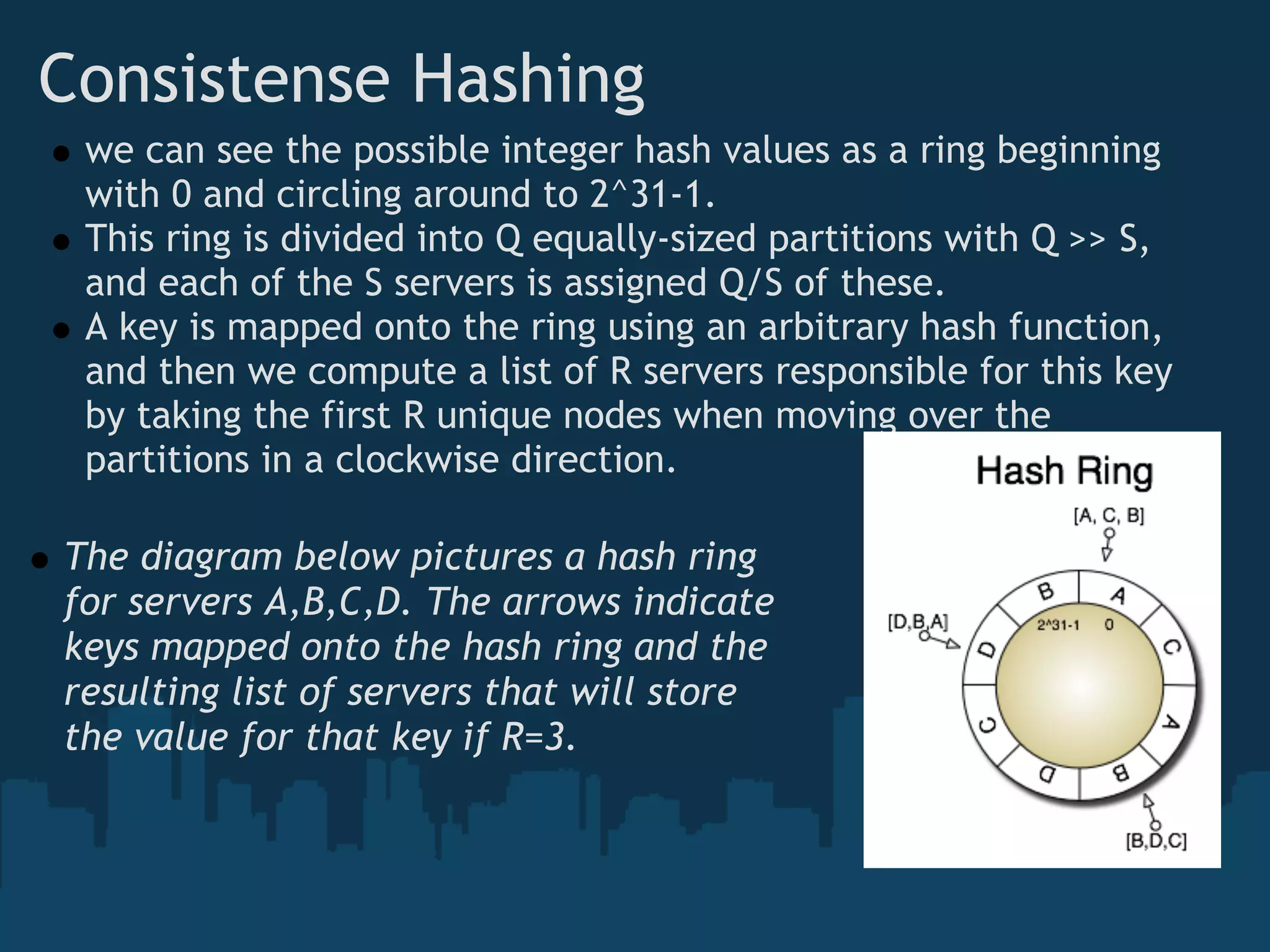
Consistense Hashing
 we can see the possible integer hash values as a ring beginning
 with 0 and circling around to 2^31-1.
 This ring is divided into Q equally-sized partitions with Q >> S,
 and each of the S servers is assigned Q/S of these.
 A key is mapped onto the ring using an arbitrary hash function,
 and then we compute a list of R servers responsible for this key
 by taking the first R unique nodes when moving over the
 partitions in a clockwise direction. 

The diagram below pictures a hash ring
for servers A,B,C,D. The arrows indicate
keys mapped onto the hash ring and the
resulting list of servers that will store
the value for that key if R=3.
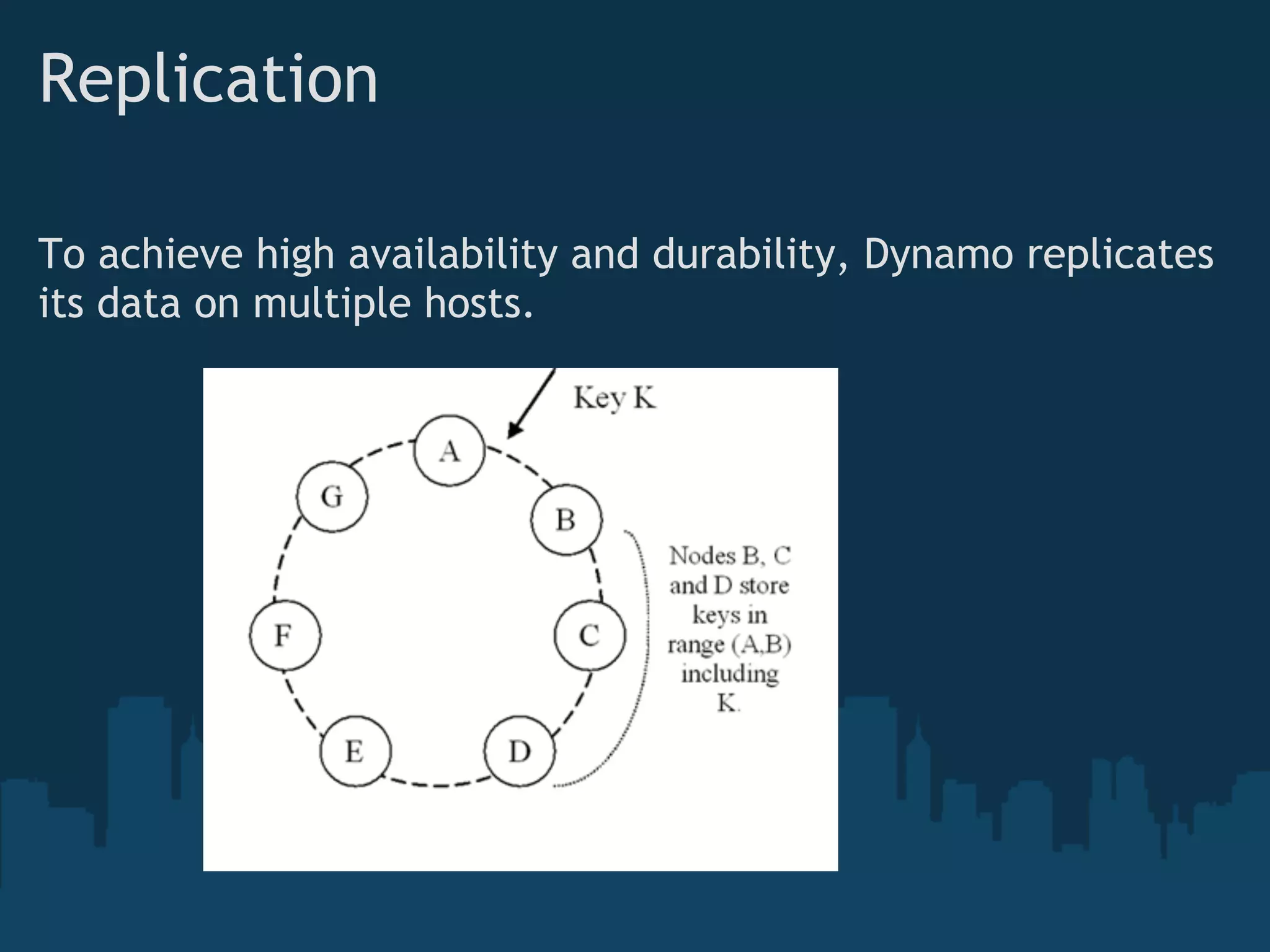
Replication 

To achieve high availability and durability, Dynamo replicates
its data on multiple hosts.
Others

    Handling Failures: Hinted Handoff
    Handling permanent failures: Replica synchronization
    HashTree(Merkely Tree)
    ...
   http://s3.amazonaws.com/AllThingsDistributed/sosp/amazon-dynamo-
sosp2007.pdf
Part III DKV的应用
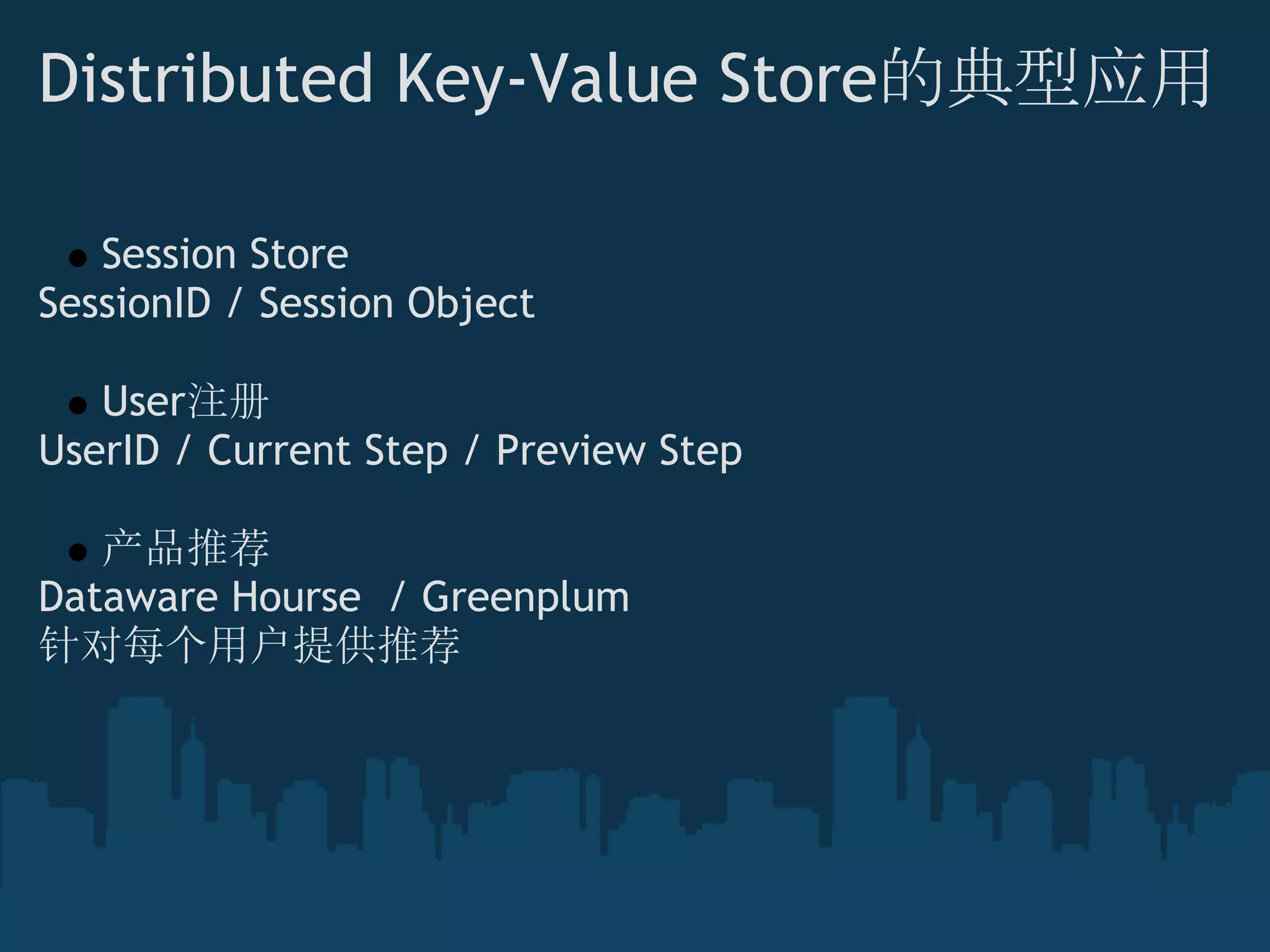
Distributed Key-Value Store的典型应用

   Session Store 
SessionID / Session Object

   User注册
UserID / Current Step / Preview Step

   产品推荐
Dataware Hourse  / Greenplum
针对每个用户提供推荐
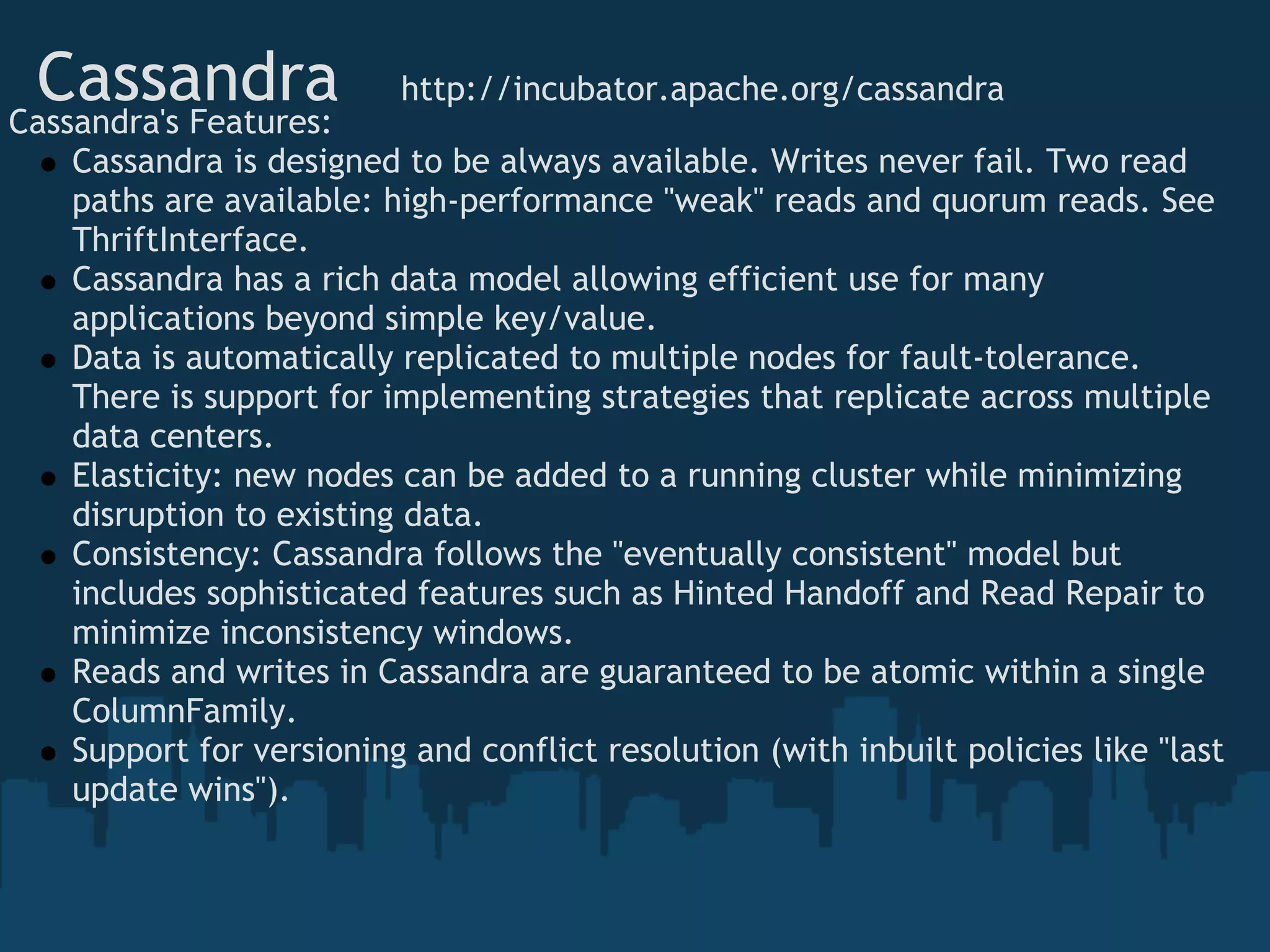
Cassandra   http://incubator.apache.org/cassandra
Cassandra's Features:
   Cassandra is designed to be always available. Writes never fail. Two read
   paths are available: high-performance "weak" reads and quorum reads. See
   ThriftInterface.
   Cassandra has a rich data model allowing efficient use for many
   applications beyond simple key/value.
   Data is automatically replicated to multiple nodes for fault-tolerance.
   There is support for implementing strategies that replicate across multiple
   data centers.
   Elasticity: new nodes can be added to a running cluster while minimizing
   disruption to existing data.
   Consistency: Cassandra follows the "eventually consistent" model but
   includes sophisticated features such as Hinted Handoff and Read Repair to
   minimize inconsistency windows.
   Reads and writes in Cassandra are guaranteed to be atomic within a single
   ColumnFamily.
   Support for versioning and conflict resolution (with inbuilt policies like "last
   update wins").
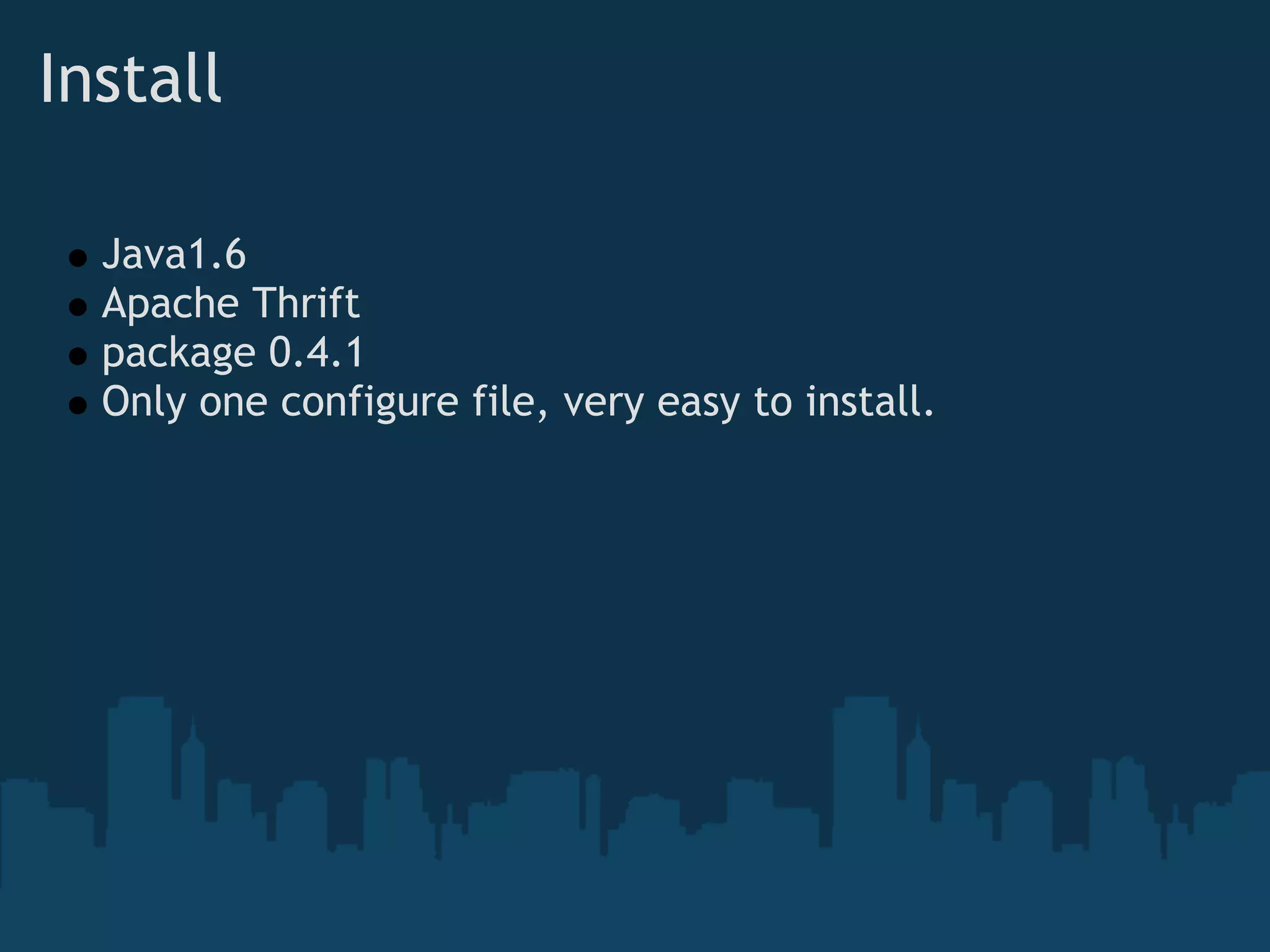
Install

  Java1.6 
  Apache Thrift
  package 0.4.1
  Only one configure file, very easy to install.
Client Code
... TTransport tr = new TSocket("localhost", 9160); TProtocol proto = new TBinaryProtocol(tr);
Cassandra.Client client = new Cassandra.Client(proto); tr.open(); String key_user_id = "1"; // insert
data long timestamp = System.currentTimeMillis(); client.insert("Keyspace1", key_user_id, new
ColumnPath("Standard1", null, "name".getBytes("UTF-8")), "Chris Goffinet".getBytes("UTF-8"), // read
single column ColumnPath path = new ColumnPath("Standard1", null, "name".getBytes("UTF-8"));
System.out.println(client.get("Keyspace1", key_user_id, path, ConsistencyLevel.ONE)); // read entire
row SlicePredicate predicate = new SlicePredicate(null, new SliceRange(new byte[0], new byte[0],
false, 10)); ColumnParent parent = new ColumnParent("Standard1", null); List<ColumnOrSuperColumn>
results = client.get_slice("Keyspace1", key_user_id, parent, predicate, ConsistencyLevel.ONE); for
(ColumnOrSuperColumn result : results) { Column column = result.column; System.out.println(new
String(column.name, "UTF-8") + " -> " + new String(column.value, "UTF-8")); } tr.close(); ...
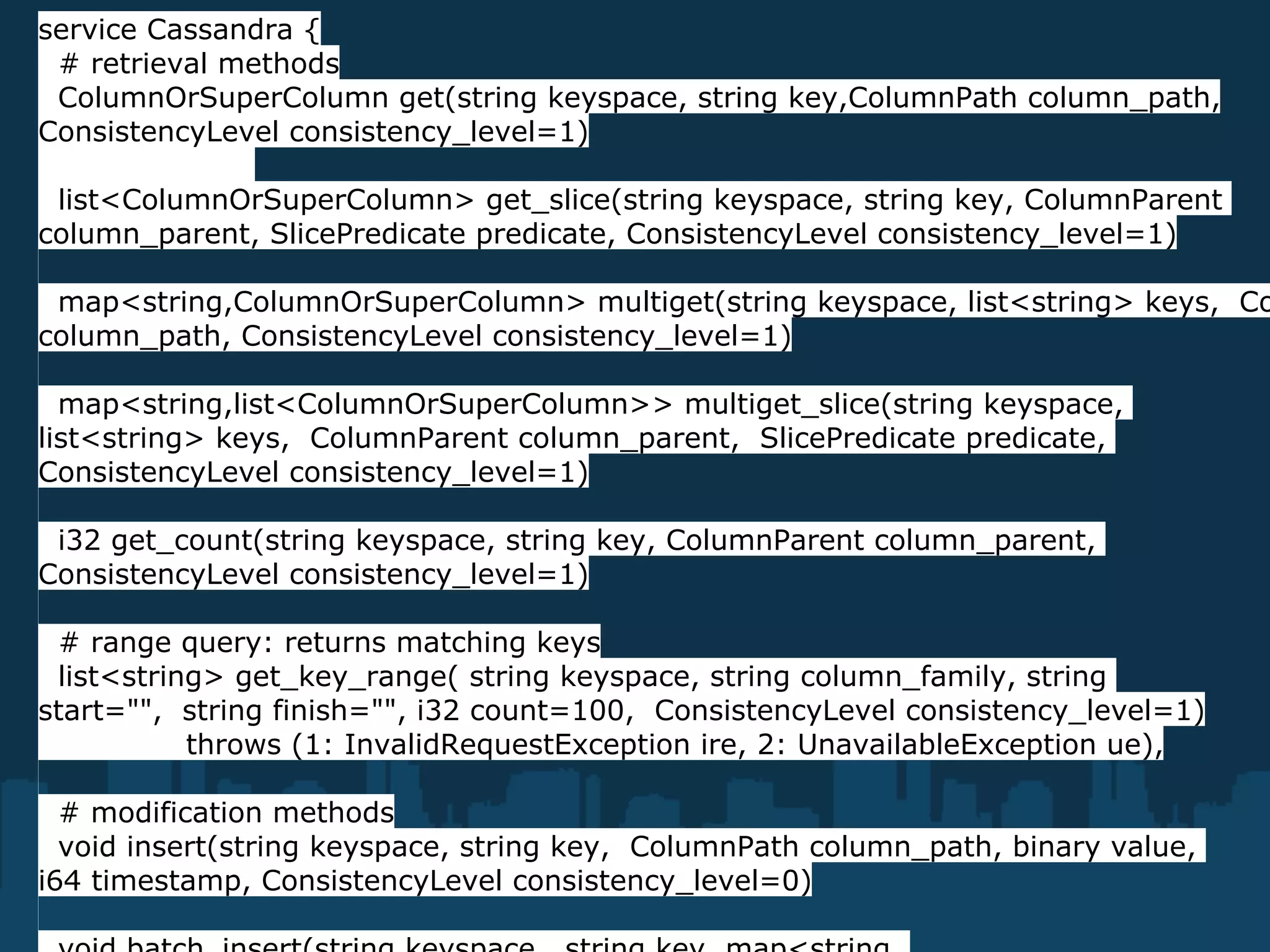
service Cassandra {
 # retrieval methods
 ColumnOrSuperColumn get(string keyspace, string key,ColumnPath column_path,
ConsistencyLevel consistency_level=1)

 list<ColumnOrSuperColumn> get_slice(string keyspace, string key, ColumnParent
column_parent, SlicePredicate predicate, ConsistencyLevel consistency_level=1)

 map<string,ColumnOrSuperColumn> multiget(string keyspace, list<string> keys, Co
column_path, ConsistencyLevel consistency_level=1)

  map<string,list<ColumnOrSuperColumn>> multiget_slice(string keyspace,
list<string> keys, ColumnParent column_parent, SlicePredicate predicate,
ConsistencyLevel consistency_level=1)

 i32 get_count(string keyspace, string key, ColumnParent column_parent,
ConsistencyLevel consistency_level=1)

 # range query: returns matching keys
 list<string> get_key_range( string keyspace, string column_family, string
start="", string finish="", i32 count=100, ConsistencyLevel consistency_level=1)
           throws (1: InvalidRequestException ire, 2: UnavailableException ue),

  # modification methods
  void insert(string keyspace, string key, ColumnPath column_path, binary value,
i64 timestamp, ConsistencyLevel consistency_level=0)
Cassandra Source Code

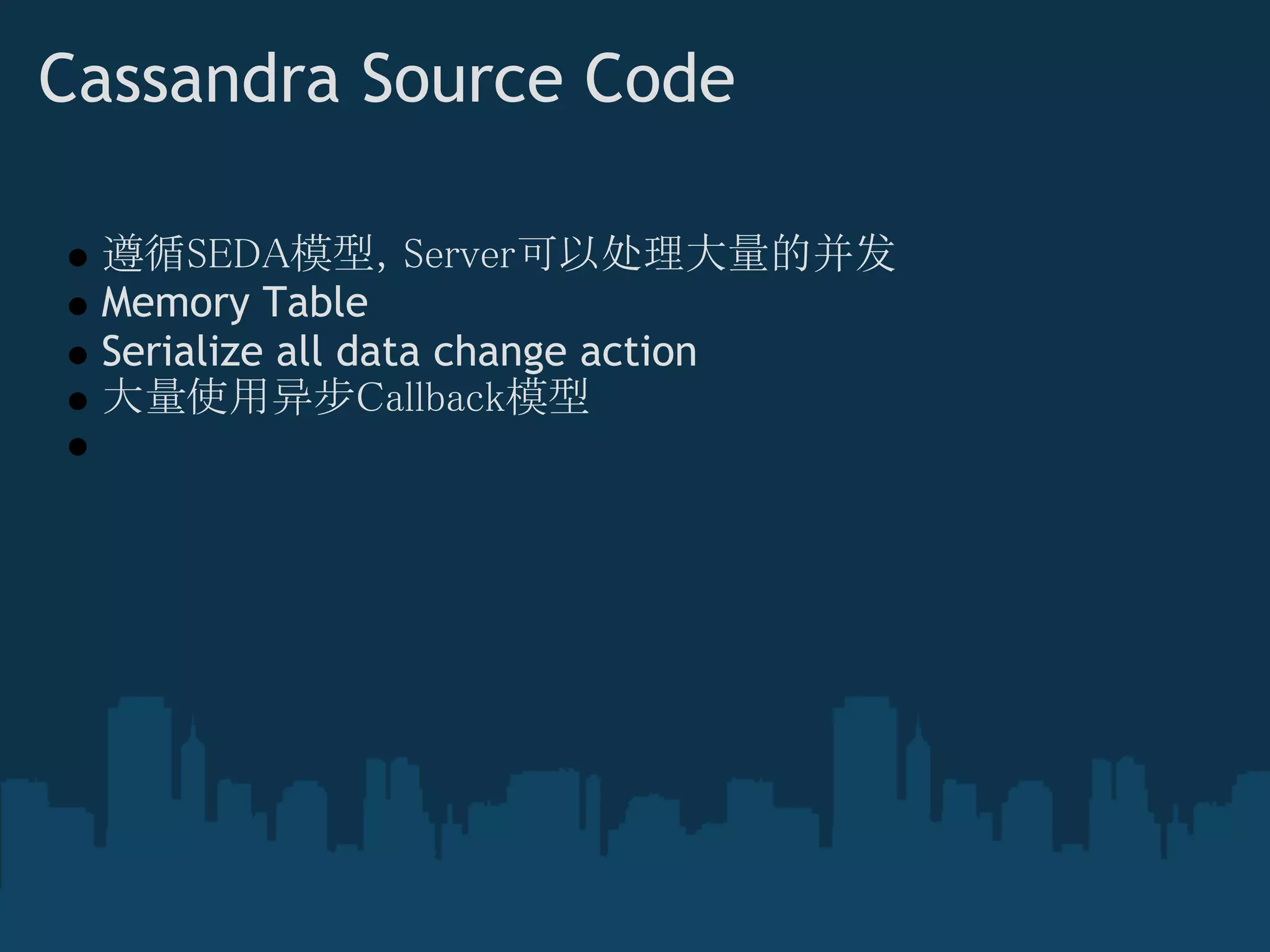
 遵循SEDA模型,Server可以处理大量的并发
 Memory Table
 Serialize all data change action
 大量使用异步Callback模型
性能测试结果
Thanks

 FAQ

Distribute Key Value Store

  • 1.
  • 2.
  • 3.
    Distribute KV Store介绍 KV Store Key-Value Store 是一个存在了很久的数据库模式, value = store.get(key) store.put(key, value) store.delete(key) KV Store的特点 功能简单 性能高 Distribute KV Store 把KV分布到多个Server上 提供高并发访问和更大的容量 最新的创新使DKV成为云计算的基础组件取得巨大成功
  • 4.
    Distribute KV StoreArchitecture
  • 5.
    分布式的Key-Value Store和CAP原理 简单的Key-Value一般是嵌入到调用的应用程序中的,所以受限制于机器的内存 和磁盘容量,不能服务于海量客户数据。尤其是现在的Web2.0时代,用户创建的 数据非常多,不但用Key-Value Store难以存储,即便是使用RDBMS数据库系统, 例如Oracle或者Mysql,也难以满足海量数据存放和海量并发读取的的要求,或 者需要非常高的硬件配置和开二次发代价才能让系统正常工作。 在解决海量数据和海量并发双难题的过程中,业界的一些技术上领先的公司进展 很大,象Amazon,Google,Yahoo都分别通过不同的方法解决了问题,他们的方 法归结起来就是依靠一点:Distribute,Amazon出了著名的论文:<Dynamo: Amazon'sHighly Available Key-Value Store>,并且在他们的云计算服务 EC2/S3中实现了比Dyname更强大的Simple DB,Google组合了GFS和一系列其他的 分布式算法,最终实现了BigTable,Yahoo既有分布式Key-Value Store的实现, 也资助了类似于GFS/BigTable的Hadoop项目,到目前为止,Hadoop最大的生产集 群依然由Yahoo建立并维护,多达1000 个Nodes.
  • 6.
    在分布式系统中,有一个著名的CAP经验原理,说的是,对 CAP  于一个分布式系统,consistency(数据一致性), Availability(可用性),Partitions(网络分隔)这三者只能 同时满足其中的两个。
  • 7.
  • 8.
    常见的DKV实现 Amazon Dynamo(下面有详细介绍) Amazon Simple DB Voldmont  Cassandra Google Big Table  HBase  Cassandra Google App Engine Memcached   MemcacheDB
  • 9.
    Amazon Dynamo Scalability Issues With Relational Databases Tt is difficult to create redundancy and parallelism with relational databases So as a relational database grows, it becomes a bottle neck and the point of failure for the entire system. 
  • 10.
    Dynamo - ADistributed Storage System Dynamo is a distributed storage system the data is made redundant, so each object is stored in the system multiple times. Dynamo is called an eventually consistent storage system
  • 11.
    How Dynamo Works Physical nodes are thought of as identical and organized into a ring. Virtual nodes are created by the system and mapped onto physical nodes, so that hardware can be swapped for maintenance and failure. The partitioning algorithm is one of the most complicated pieces of the system, it specifies which nodes will store a given object. The partitioning mechanism automatically scales as nodes enter and leave the system. Every object is asynchronously replicated to N nodes. The updates to the system occur asynchronously and may result in multiple copies of the object in the system with slightly different states. The discrepancies in the system are reconciled after a period of time, ensuring eventual consistency. Any node in the system can be issued a put or get request for any key.
  • 12.
    Part II  Distributed Key-ValueStore的 算法基础
  • 13.
    Data partitioning and replication Data Partitioning: Data needs to be partitioned across a cluster of servers so that no single server needs to hold the complete data set. Replication: Put the data into S partitions (one per server) and store copies of a given key K on R servers.
  • 14.
    Consistency  Toleratethe possibility of inconsistency, and resolve inconsistencies at read time.  Two-Phase Commit — This is a locking protocol that involves two rounds of co-ordination between machines. It perfectly consistent, but not failure tolerant, and very slow. Paxos-style consensus — This is a protocol for coming to agreement on a value that is more failure tolerant. Read-repair — The first two approaches prevent permanent inconsistency. This approach involves writing all inconsistent versions, and then at read-time detecting the conflict, and resolving the problems. This involves little co-ordination and is completely failure tolerant, but may require additional application logic to resolve conflicts. Dynamo use versioning and read-repair.
  • 15.
    Versioning A vector clock keeps a counter for each writing server, and allows us to calculate when two versions are in conflict, and when one version succeeds or preceeds another. A vector clock is a list of server:version pairs: [1:45,2:3,5:55] The version indicates that the server was the "master" for that number of writes. A version v1 succeeds a version v2 if for all i, v1i > v2i. If neither v1 > v2 nor v1 < v2, then v1 and v2 co-occur, and are in conflict.  Here is a simple example of two conflicting versions: [1:2,2:1] [1:1,2:2] vector clock versioning scheme defines a partial order over values where simple optimistic locking schemes define a total order.
  • 16.
  • 17.
    Data partitioning andreplication Hash Partition 使用某种Hash函数分布数据,性能好,简单,缺点在于如 果HashBacket发生改变,会在大范围上导致rehash Consistent hashing  Consistent hashing is a technique that avoids these problems When a new server is added to a cluster of S servers, only 1/(S+1) values must be moved to the new machine.
  • 18.
    Consistense Hashing wecan see the possible integer hash values as a ring beginning with 0 and circling around to 2^31-1. This ring is divided into Q equally-sized partitions with Q >> S, and each of the S servers is assigned Q/S of these. A key is mapped onto the ring using an arbitrary hash function, and then we compute a list of R servers responsible for this key by taking the first R unique nodes when moving over the partitions in a clockwise direction.  The diagram below pictures a hash ring for servers A,B,C,D. The arrows indicate keys mapped onto the hash ring and the resulting list of servers that will store the value for that key if R=3.
  • 19.
    Replication  To achieve highavailability and durability, Dynamo replicates its data on multiple hosts.
  • 20.
    Others Handling Failures: Hinted Handoff Handling permanent failures: Replica synchronization HashTree(Merkely Tree) ... http://s3.amazonaws.com/AllThingsDistributed/sosp/amazon-dynamo- sosp2007.pdf
  • 21.
  • 22.
    Distributed Key-Value Store的典型应用 Session Store  SessionID / Session Object User注册 UserID / Current Step / Preview Step 产品推荐 Dataware Hourse  / Greenplum 针对每个用户提供推荐
  • 23.
    Cassandra   http://incubator.apache.org/cassandra Cassandra's Features: Cassandra is designed to be always available. Writes never fail. Two read paths are available: high-performance "weak" reads and quorum reads. See ThriftInterface. Cassandra has a rich data model allowing efficient use for many applications beyond simple key/value. Data is automatically replicated to multiple nodes for fault-tolerance. There is support for implementing strategies that replicate across multiple data centers. Elasticity: new nodes can be added to a running cluster while minimizing disruption to existing data. Consistency: Cassandra follows the "eventually consistent" model but includes sophisticated features such as Hinted Handoff and Read Repair to minimize inconsistency windows. Reads and writes in Cassandra are guaranteed to be atomic within a single ColumnFamily. Support for versioning and conflict resolution (with inbuilt policies like "last update wins").
  • 24.
    Install Java1.6  Apache Thrift package 0.4.1 Only one configure file, very easy to install.
  • 25.
    Client Code ... TTransporttr = new TSocket("localhost", 9160); TProtocol proto = new TBinaryProtocol(tr); Cassandra.Client client = new Cassandra.Client(proto); tr.open(); String key_user_id = "1"; // insert data long timestamp = System.currentTimeMillis(); client.insert("Keyspace1", key_user_id, new ColumnPath("Standard1", null, "name".getBytes("UTF-8")), "Chris Goffinet".getBytes("UTF-8"), // read single column ColumnPath path = new ColumnPath("Standard1", null, "name".getBytes("UTF-8")); System.out.println(client.get("Keyspace1", key_user_id, path, ConsistencyLevel.ONE)); // read entire row SlicePredicate predicate = new SlicePredicate(null, new SliceRange(new byte[0], new byte[0], false, 10)); ColumnParent parent = new ColumnParent("Standard1", null); List<ColumnOrSuperColumn> results = client.get_slice("Keyspace1", key_user_id, parent, predicate, ConsistencyLevel.ONE); for (ColumnOrSuperColumn result : results) { Column column = result.column; System.out.println(new String(column.name, "UTF-8") + " -> " + new String(column.value, "UTF-8")); } tr.close(); ...
  • 26.
    service Cassandra { # retrieval methods ColumnOrSuperColumn get(string keyspace, string key,ColumnPath column_path, ConsistencyLevel consistency_level=1) list<ColumnOrSuperColumn> get_slice(string keyspace, string key, ColumnParent column_parent, SlicePredicate predicate, ConsistencyLevel consistency_level=1) map<string,ColumnOrSuperColumn> multiget(string keyspace, list<string> keys, Co column_path, ConsistencyLevel consistency_level=1) map<string,list<ColumnOrSuperColumn>> multiget_slice(string keyspace, list<string> keys, ColumnParent column_parent, SlicePredicate predicate, ConsistencyLevel consistency_level=1) i32 get_count(string keyspace, string key, ColumnParent column_parent, ConsistencyLevel consistency_level=1) # range query: returns matching keys list<string> get_key_range( string keyspace, string column_family, string start="", string finish="", i32 count=100, ConsistencyLevel consistency_level=1) throws (1: InvalidRequestException ire, 2: UnavailableException ue), # modification methods void insert(string keyspace, string key, ColumnPath column_path, binary value, i64 timestamp, ConsistencyLevel consistency_level=0)
  • 27.
    Cassandra Source Code 遵循SEDA模型,Server可以处理大量的并发 Memory Table Serialize all data change action 大量使用异步Callback模型
  • 28.
  • 29.