Improving Human-Semantic Web Interaction: The Rhizomer Experience Roberto García and Rosa Gil GRIHO - Human Computer Interaction Research Group Universitat de Lleida, Spain
Table of Contents Introduction Proposal Architecture Wiki Engine Rhizomer Guided tour Conclusions Future Work
Introduction Scenario:  semantic portal Framework for community knowledge sharing Non-expert users User interaction not just  consumption ,  also  production Follow  Semantic Wiki  style: Facilitate production Keep information organised
Introduction However, most  Semantic Wikis… Mix  human and machine-oriented content Quite unusable notation for  HTML content  and/or  semantic metadata [[Category:ResearchProject]] [[label:=Rhizomer]] [[homepage:=rhizomik.net/rhizomer]] Require user  aware  of available classes, props,… Difficult  reuse  of external data and ontologies More usable approaches: PlatypusWiki, OntoWiki,…
Proposal Focus on  simplicity  and  ease of use : Separate  HTML content and semantic metadata Simple wiki engine WYSIWYG wiki user interface Semantic metadata engine Usable semantic metadata interaction Common  HTML interface , just the web browser
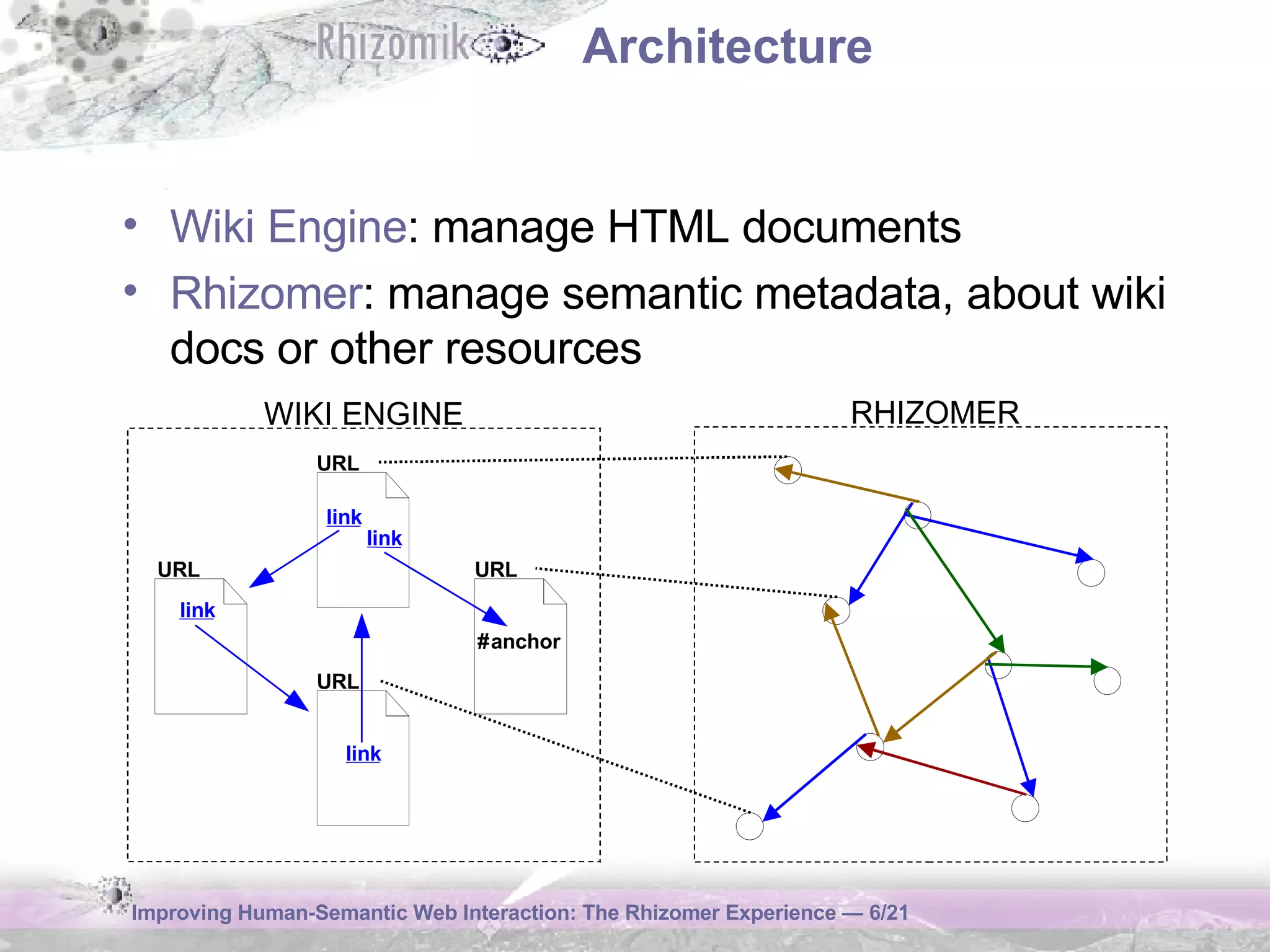
Architecture Wiki Engine : manage HTML documents Rhizomer : manage semantic metadata, about wiki docs or other resources URL URL URL URL RHIZOMER WIKI ENGINE link link # anchor link link
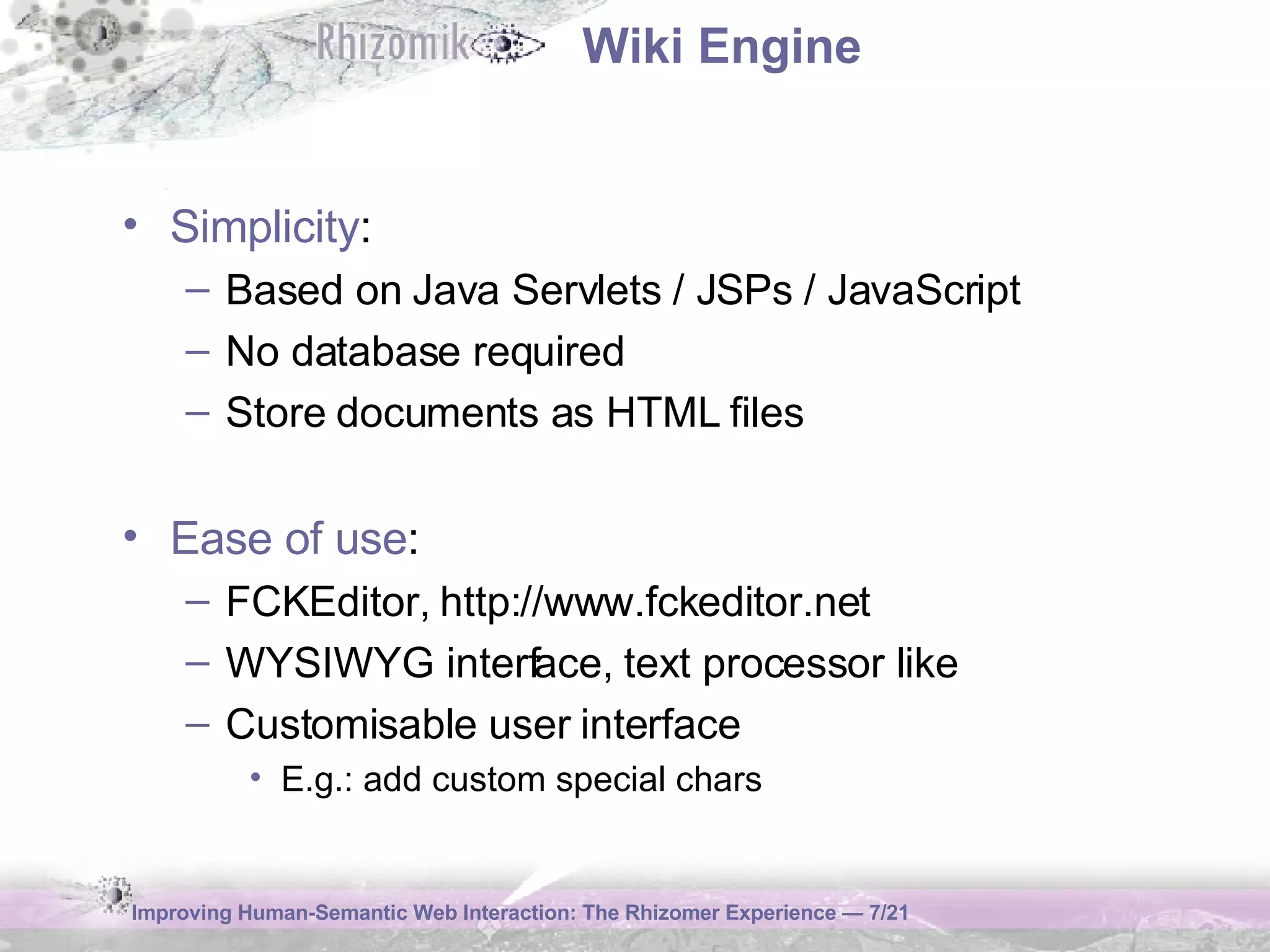
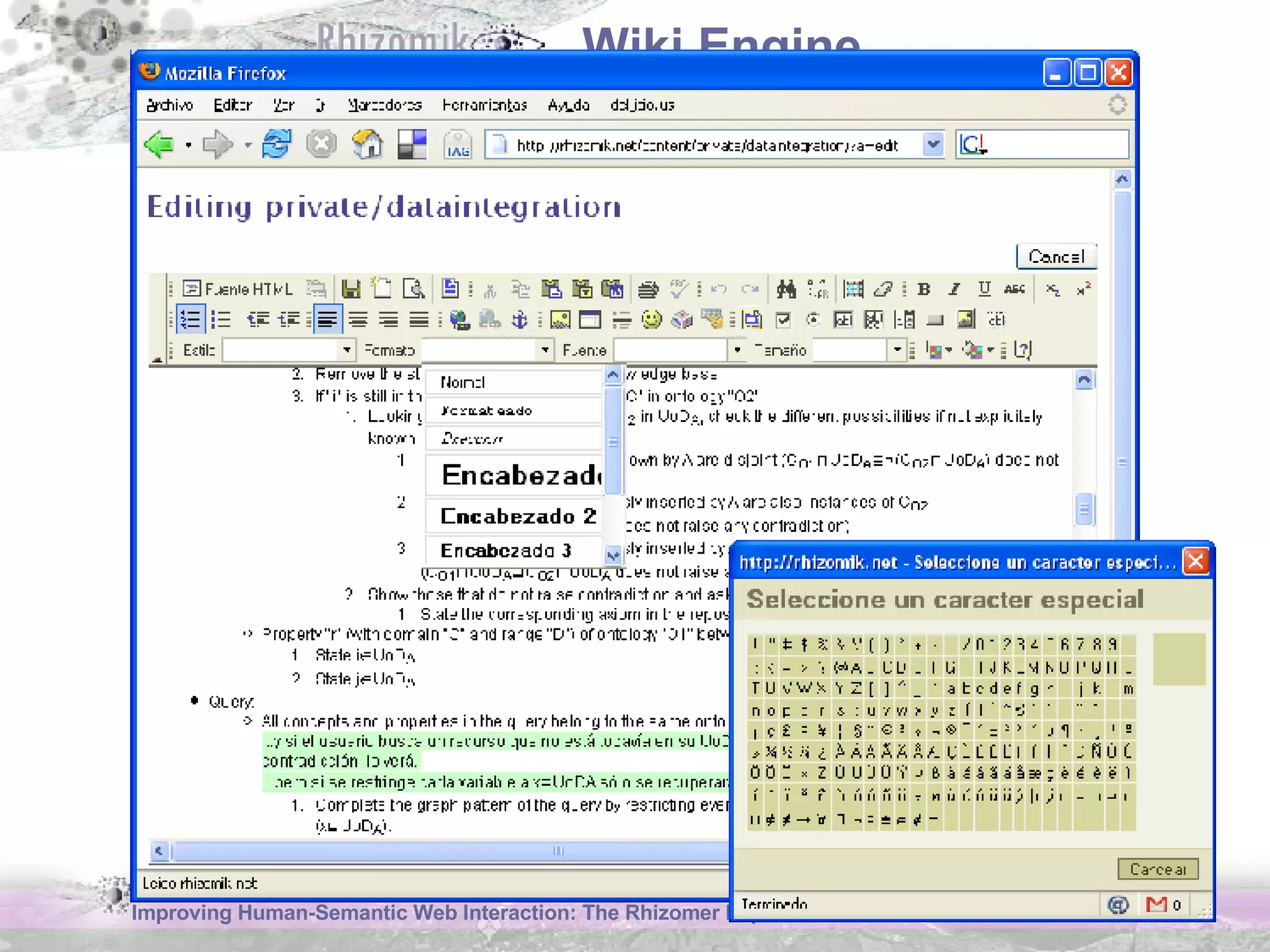
Wiki Engine Simplicity : Based on Java Servlets / JSPs / JavaScript No database required Store documents as HTML files Ease of use : FCKEditor, http://www.fckeditor.net WYSIWYG interface, text processor like Customisable user interface E.g.: add custom special chars
Wiki Engine
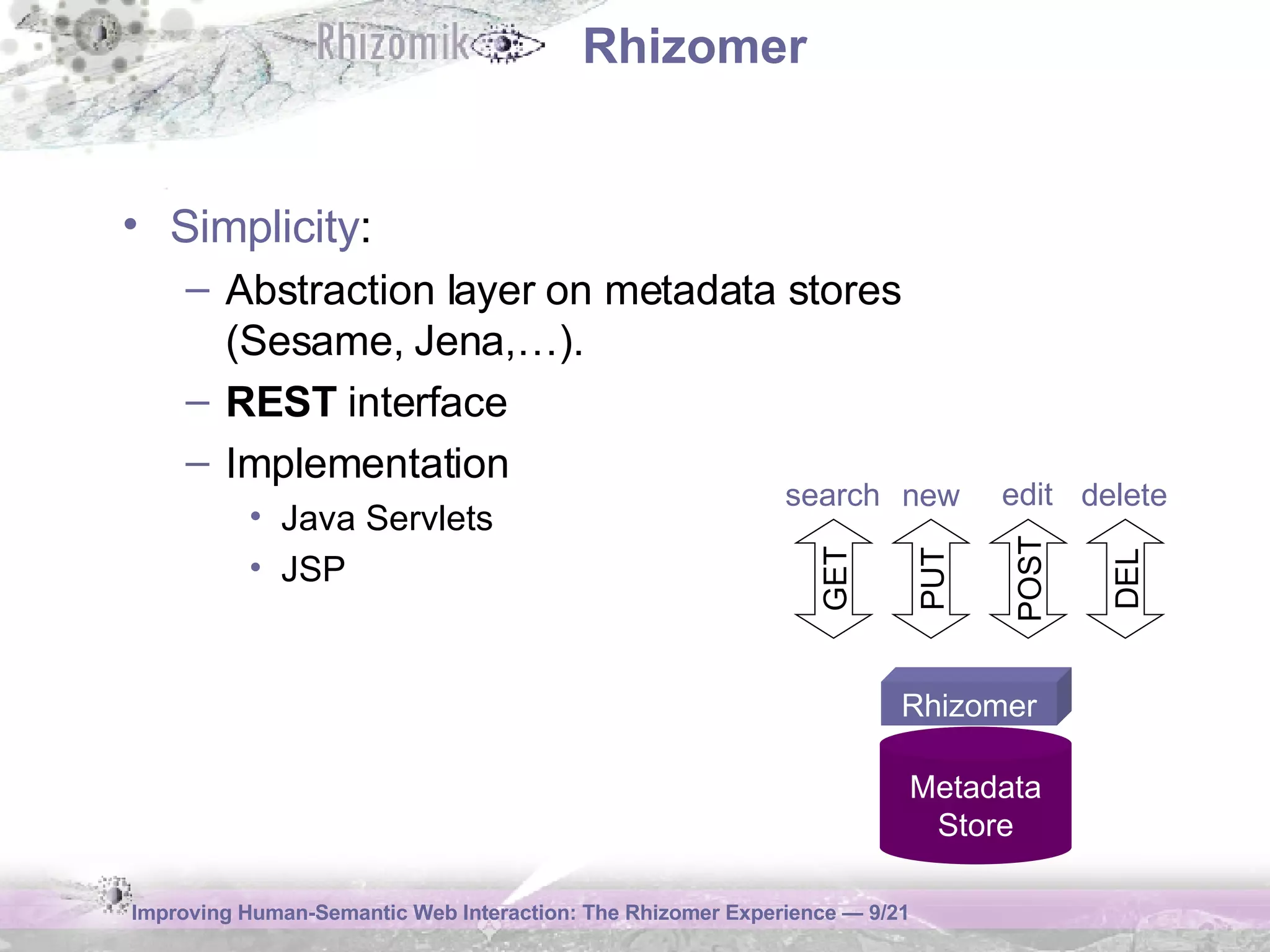
Rhizomer Simplicity : Abstraction layer on metadata stores  (Sesame, Jena,…). REST  interface Implementation Java Servlets JSP Metadata Store Rhizomer GET PUT POST DEL search new edit delete
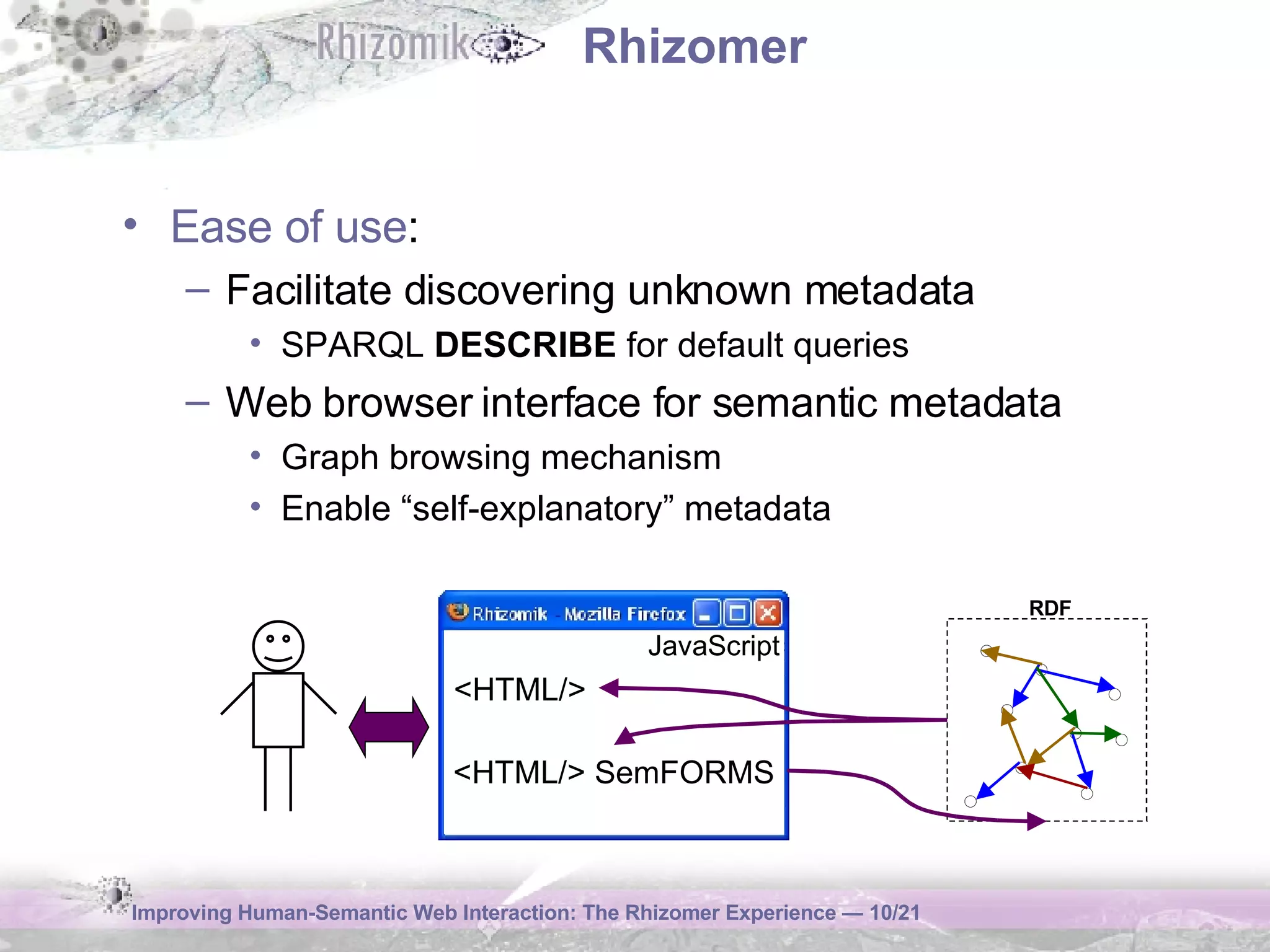
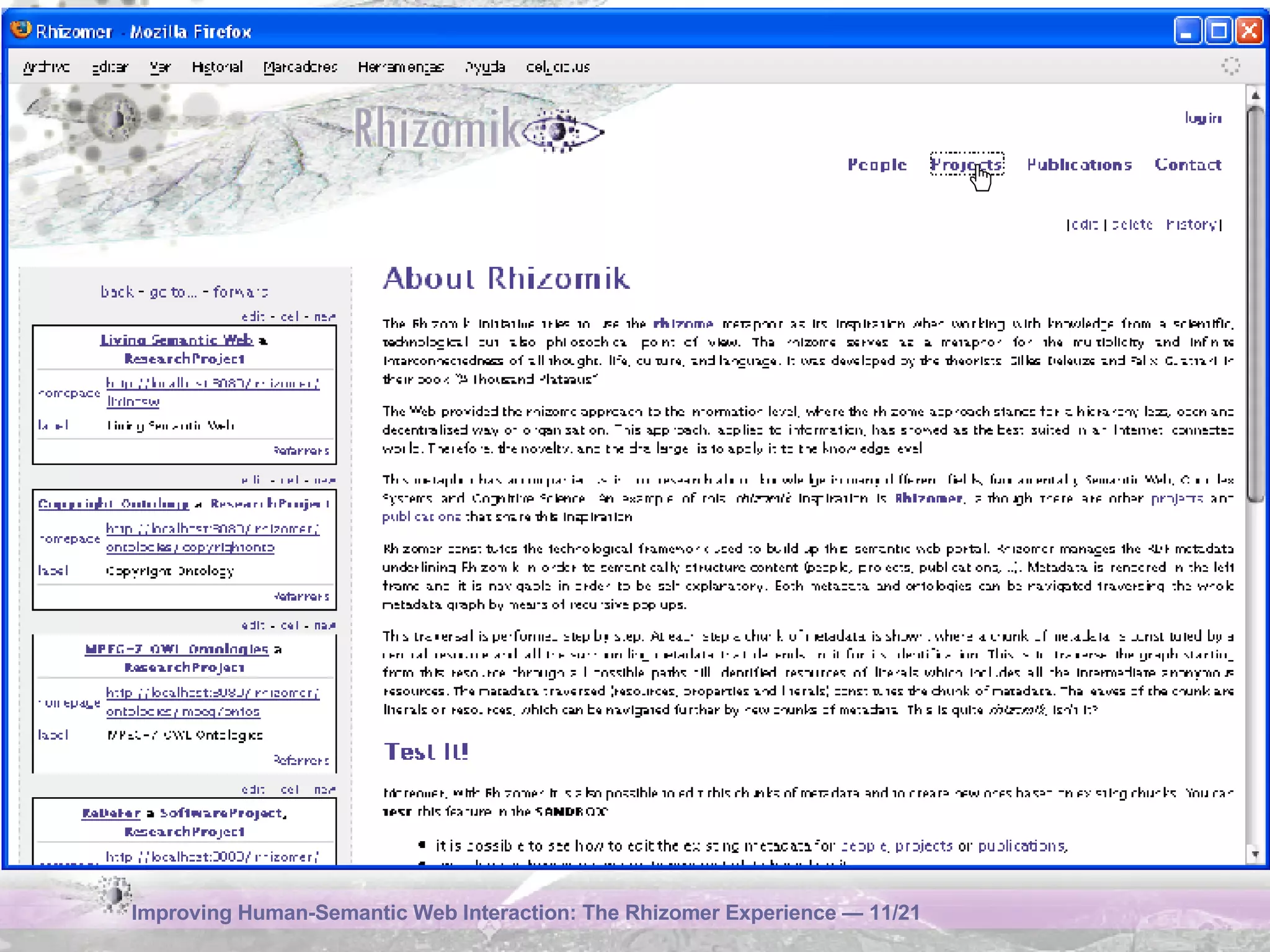
Rhizomer Ease of use : Facilitate discovering unknown metadata SPARQL  DESCRIBE  for default queries Web browser interface for semantic metadata Graph browsing mechanism Enable “self-explanatory” metadata RDF <HTML/> <HTML/> SemFORMS JavaScript
Guided Tour:  query
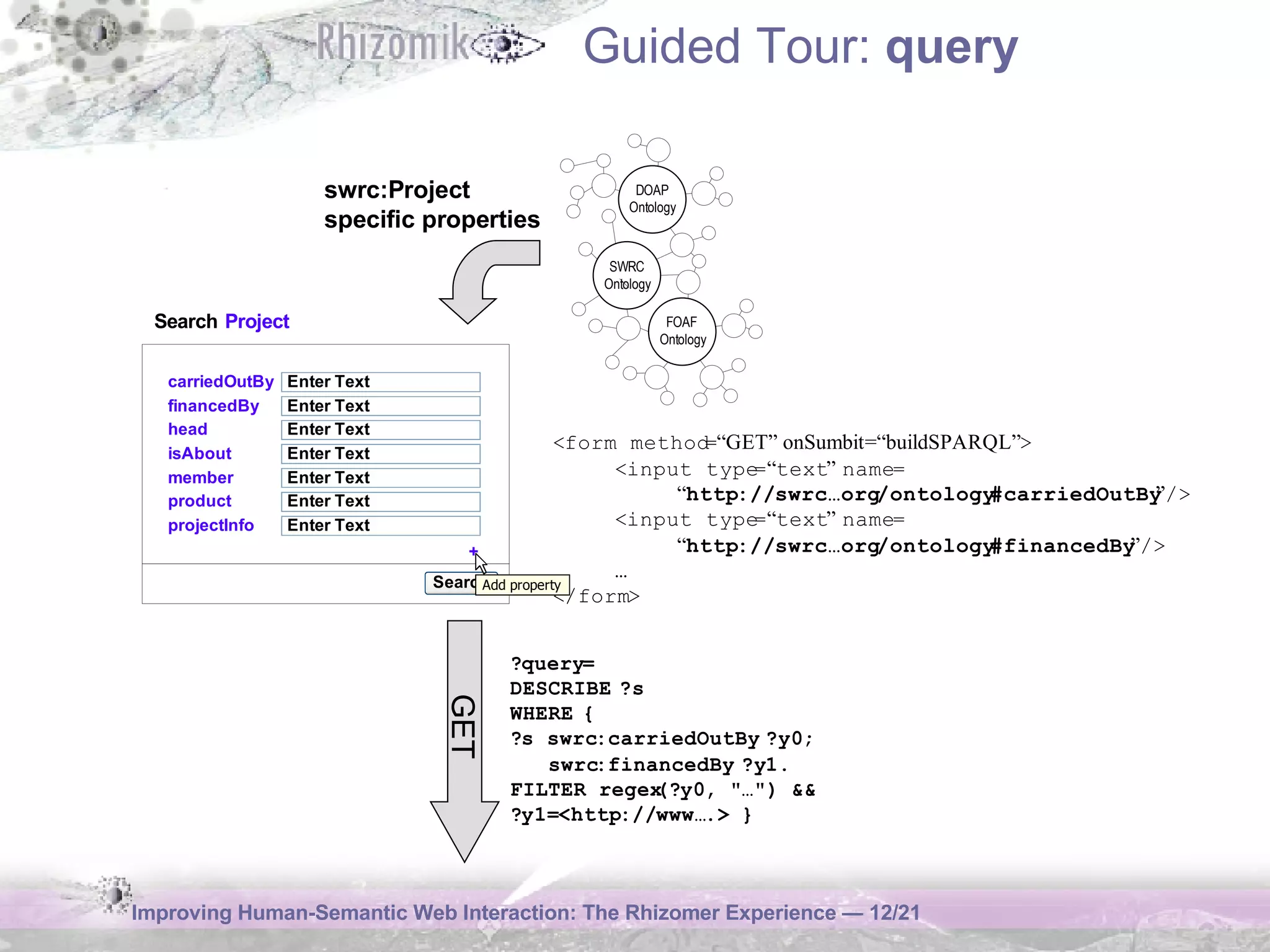
Guided Tour:  query GET swrc:Project specific properties
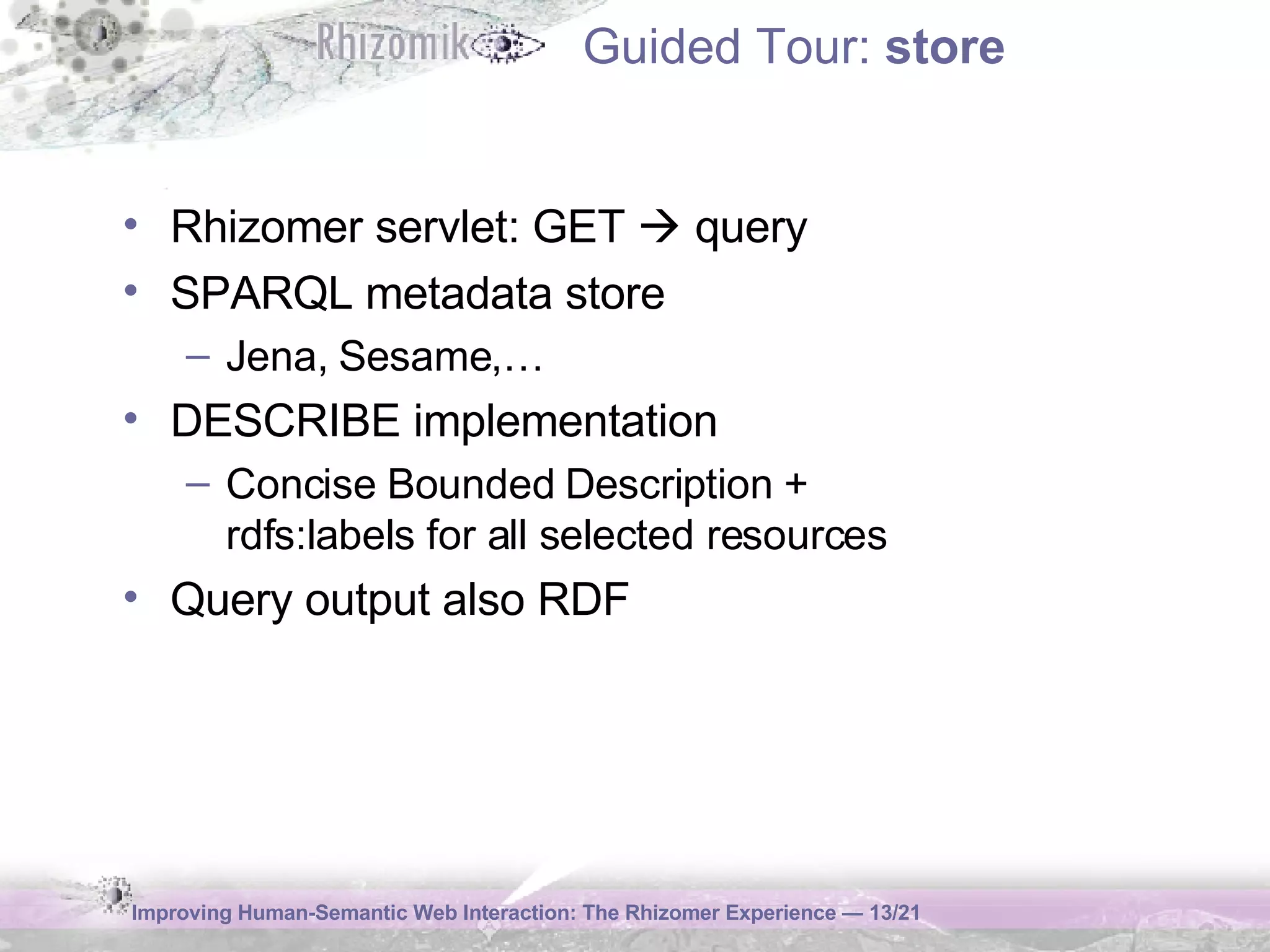
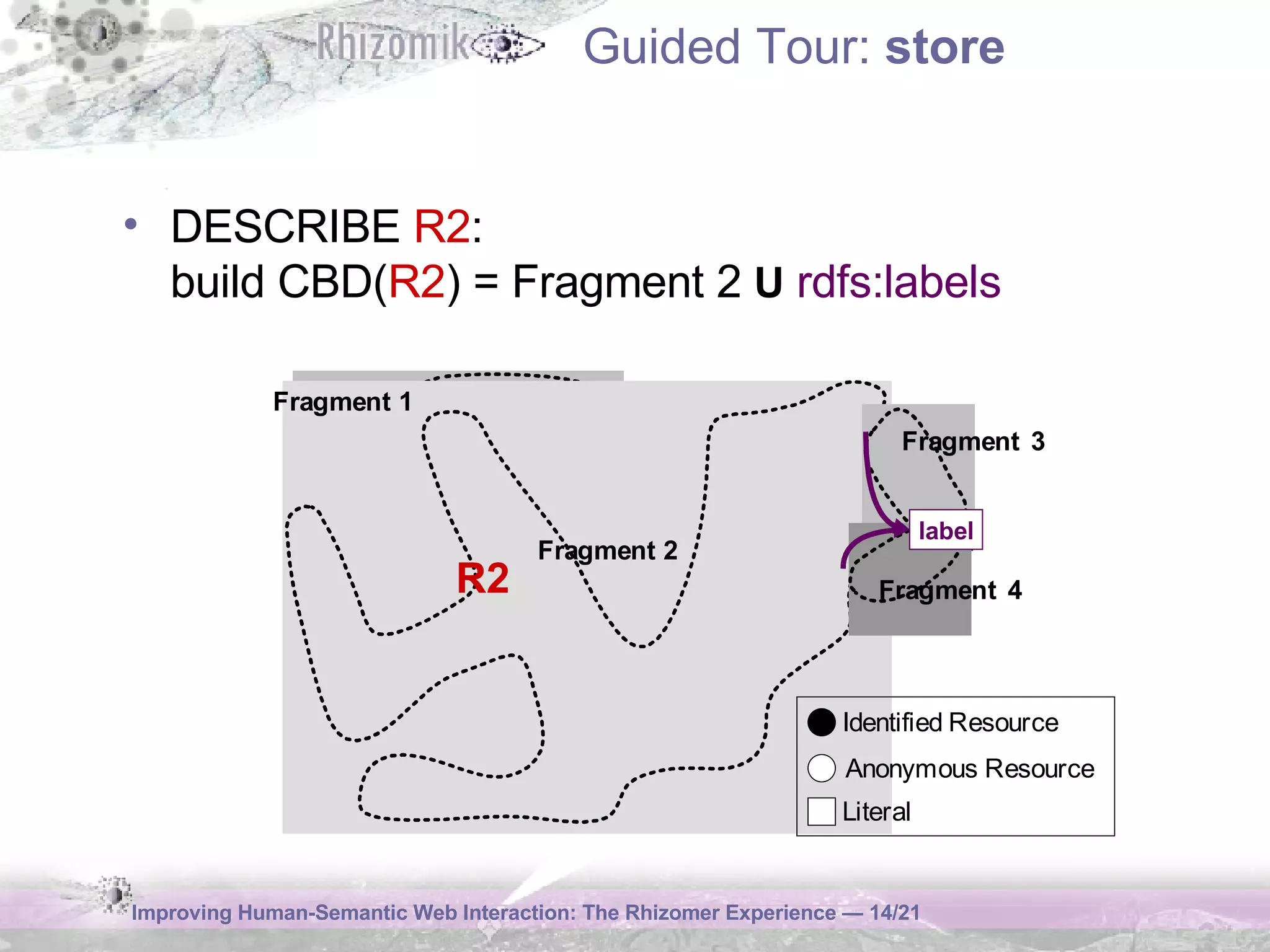
Guided Tour:  store Rhizomer servlet: GET    query SPARQL metadata store Jena, Sesame,… DESCRIBE implementation  Concise Bounded Description +  rdfs:labels for all selected resources Query output also RDF
Guided Tour:  store DESCRIBE  R2 :  build CBD( R2 ) = Fragment 2  U   rdfs:labels label R2
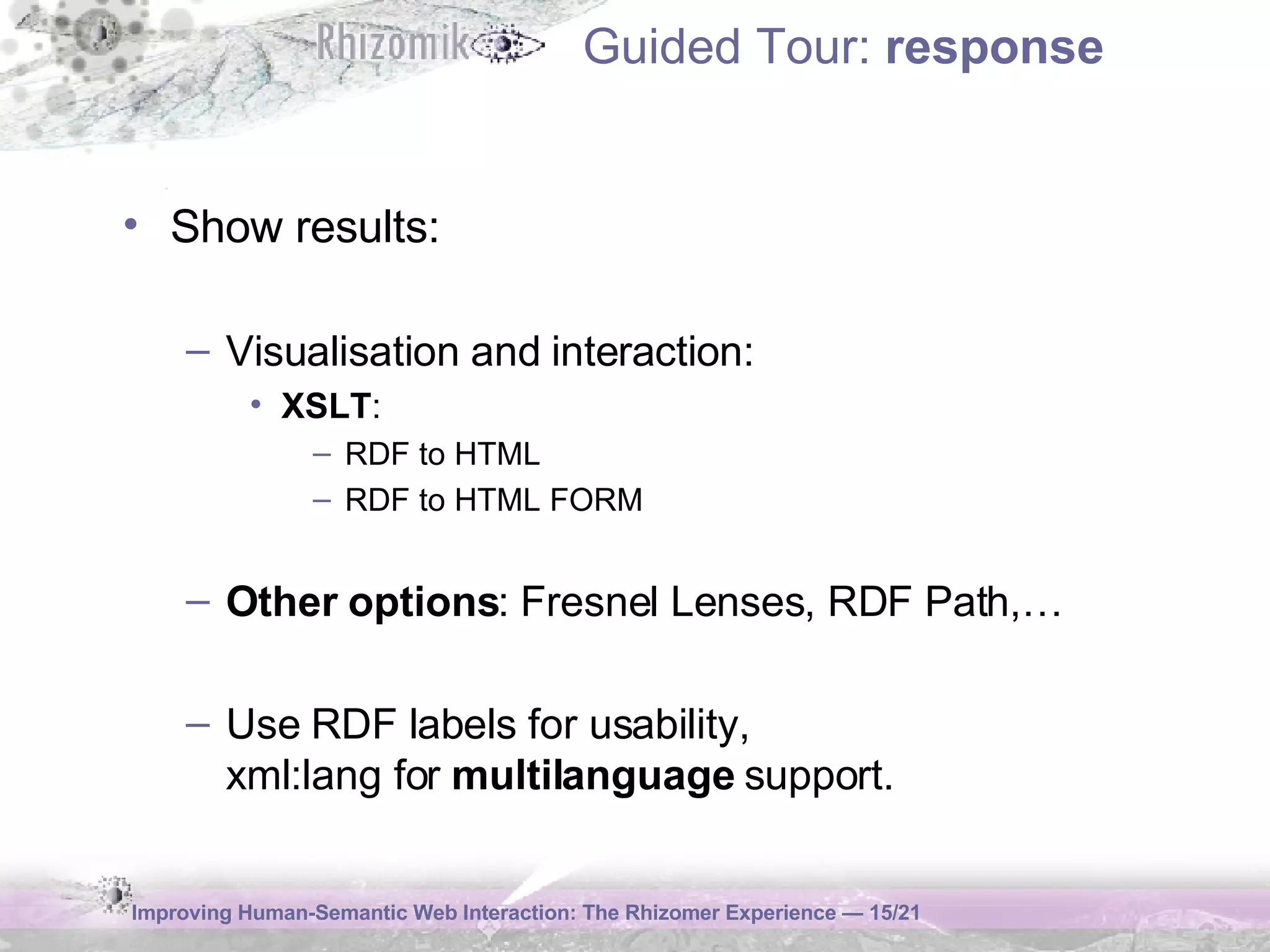
Guided Tour:  response Show results:  Visualisation and interaction: XSLT :  RDF to HTML  RDF to HTML FORM Other options : Fresnel Lenses, RDF Path,… Use RDF labels for usability,  xml:lang for  multilanguage  support.
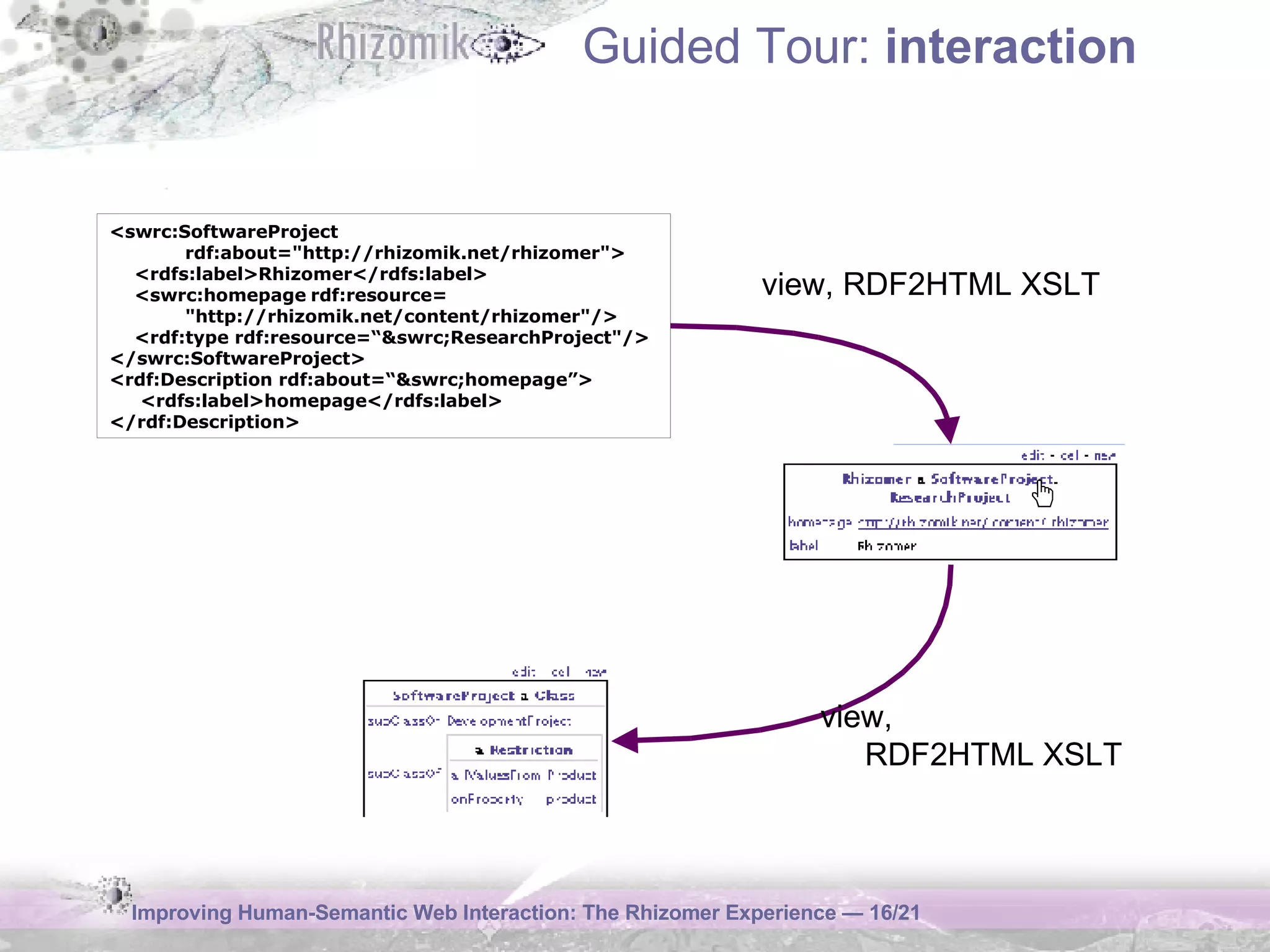
Guided Tour:  interaction view, RDF2HTML  XSLT view ,   RDF2HTML  XSLT <swrc:SoftwareProject rdf:about=&quot;http://rhizomik.net/rhizomer&quot;> <rdfs:label>Rhizomer</rdfs:label> <swrc:homepage rdf:resource= &quot;http://rhizomik.net/content/rhizomer&quot;/> <rdf:type rdf:resource=“&swrc;ResearchProject&quot;/> </swrc:SoftwareProject> <rdf:Description rdf:about=“&swrc;homepage”>   <rdfs:label>homepage</rdfs:label> </rdf:Description>
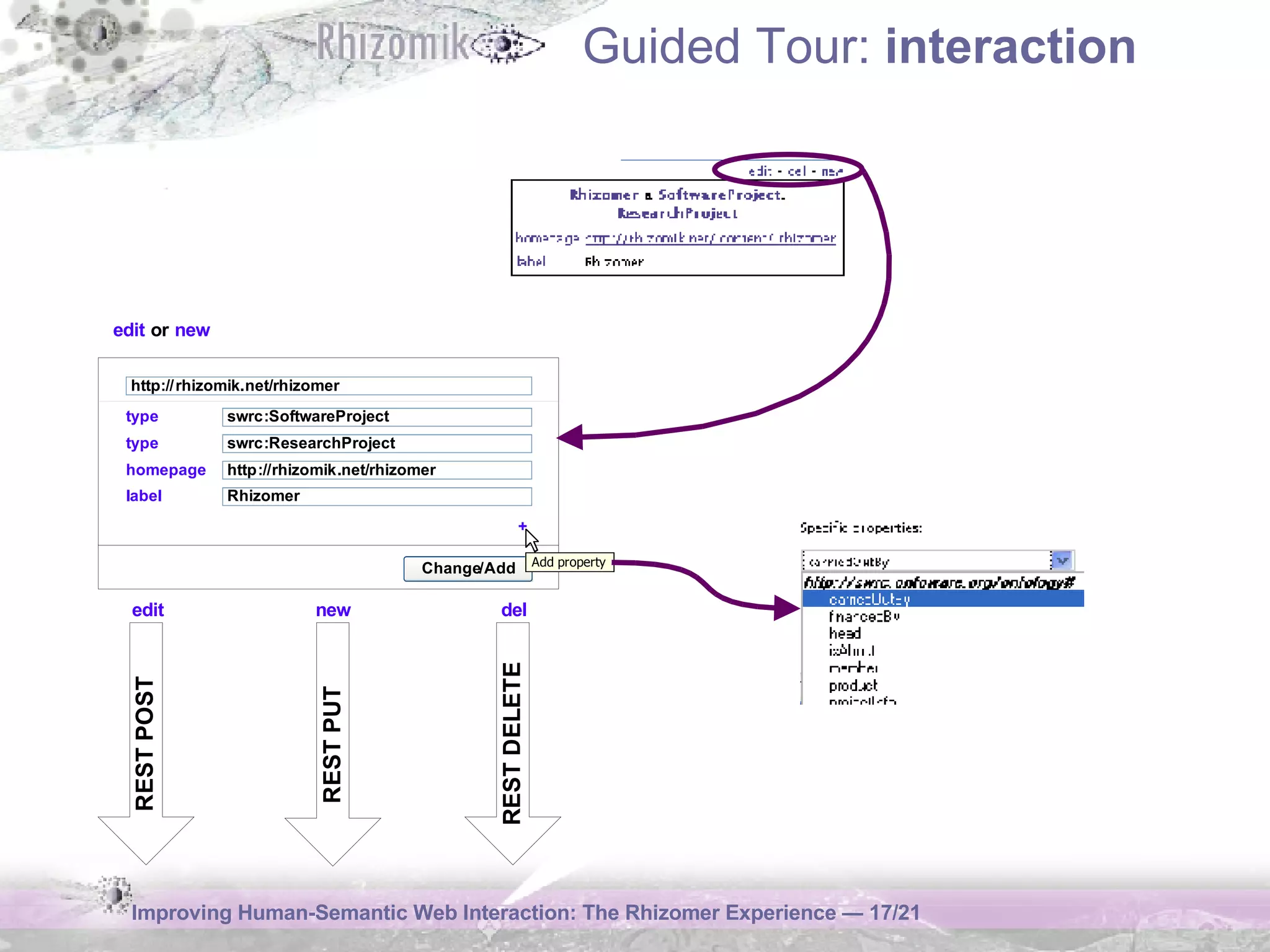
Guided Tour:  interaction
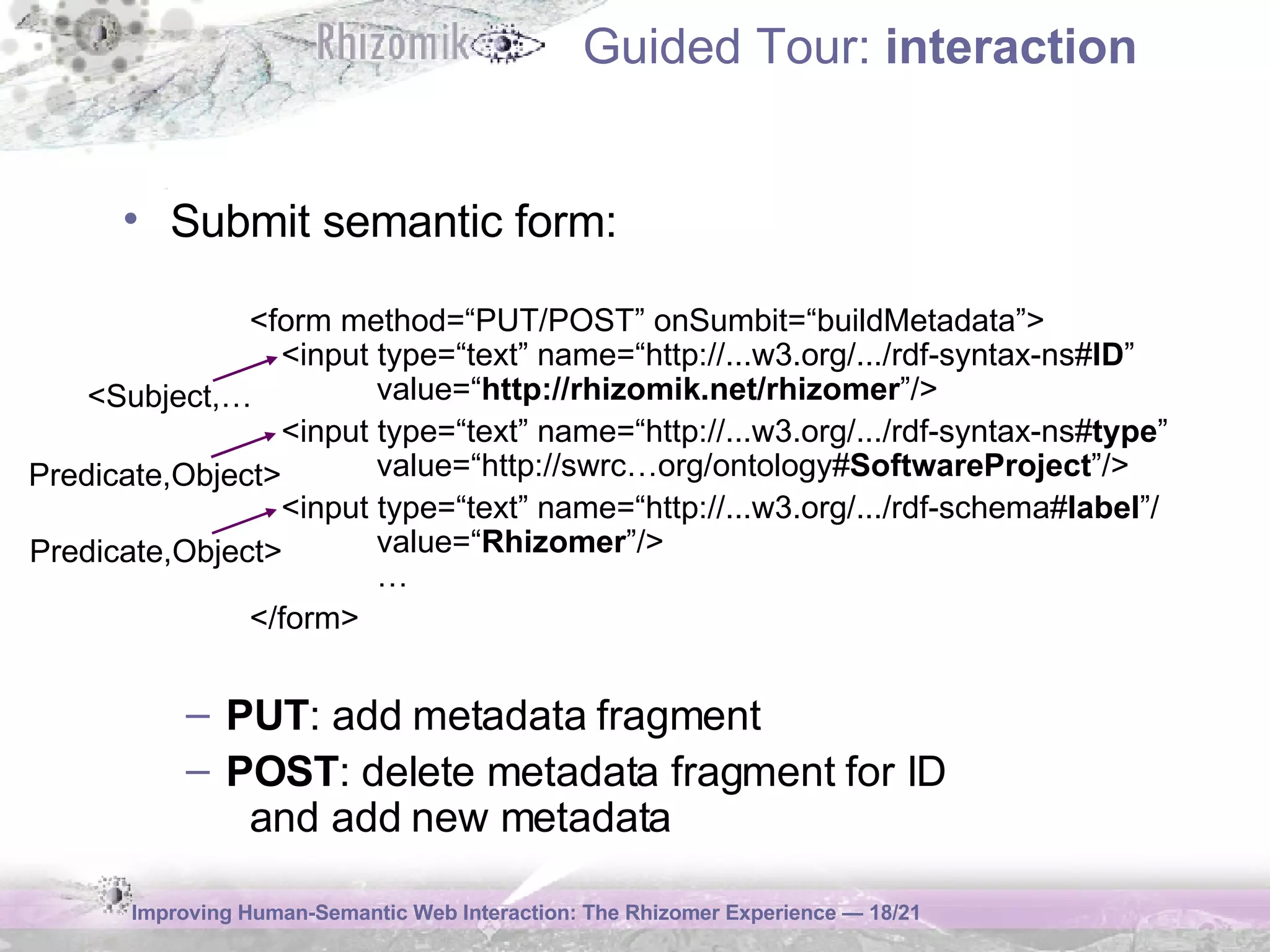
Guided Tour:  interaction Submit semantic form: <form method=“ PUT/POST ” onSumbit=“build Metadata ”> <input type=“text” name=“ http:// ...w3.org/.../rdf-syntax-ns# ID ”  value=“ http://rhizomik.net/rhizomer ”/> <input type=“text” name=“http:// ...w3.org/.../rdf-syntax-ns# type ” value=“ http:// swrc…org/ontology# SoftwareProject ” /> <input type=“text” name=“http:// ...w3.org/.../rdf-schema# label ”/ value=“ Rhizomer ”/ > … </form> PUT : add metadata fragment POST : delete metadata fragment for ID  and add new metadata <Subject,… Predicate,Object> Predicate,Object>
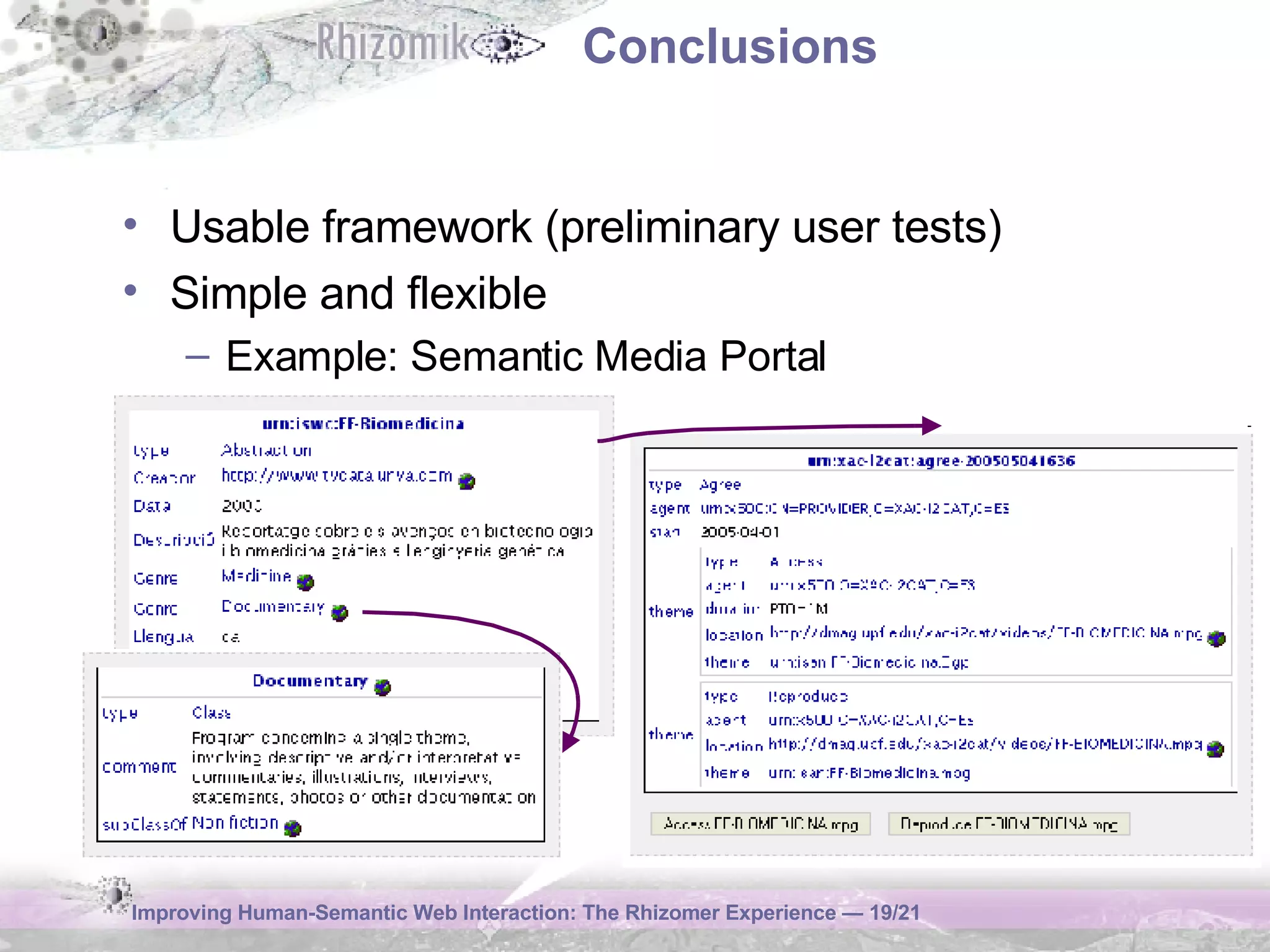
Conclusions Usable framework (preliminary user tests) Simple and flexible Example: Semantic Media Portal
Future Work AJAX to improve user interaction Assisted metadata creation: available properties, property values,… Specialised visualisation and interaction services Map for geo-tagged resources, Timeline or Calendar for events,… Deeper user testing
Thank you for your attention More at:  http:// rhizomik.net Contact [email_address] [email_address]

Improving Human–Semantic Web Interaction: The Rhizomer Experience

  • 1.
    Improving Human-Semantic WebInteraction: The Rhizomer Experience Roberto García and Rosa Gil GRIHO - Human Computer Interaction Research Group Universitat de Lleida, Spain
  • 2.
    Table of ContentsIntroduction Proposal Architecture Wiki Engine Rhizomer Guided tour Conclusions Future Work
  • 3.
    Introduction Scenario: semantic portal Framework for community knowledge sharing Non-expert users User interaction not just consumption , also production Follow Semantic Wiki style: Facilitate production Keep information organised
  • 4.
    Introduction However, most Semantic Wikis… Mix human and machine-oriented content Quite unusable notation for HTML content and/or semantic metadata [[Category:ResearchProject]] [[label:=Rhizomer]] [[homepage:=rhizomik.net/rhizomer]] Require user aware of available classes, props,… Difficult reuse of external data and ontologies More usable approaches: PlatypusWiki, OntoWiki,…
  • 5.
    Proposal Focus on simplicity and ease of use : Separate HTML content and semantic metadata Simple wiki engine WYSIWYG wiki user interface Semantic metadata engine Usable semantic metadata interaction Common HTML interface , just the web browser
  • 6.
    Architecture Wiki Engine: manage HTML documents Rhizomer : manage semantic metadata, about wiki docs or other resources URL URL URL URL RHIZOMER WIKI ENGINE link link # anchor link link
  • 7.
    Wiki Engine Simplicity: Based on Java Servlets / JSPs / JavaScript No database required Store documents as HTML files Ease of use : FCKEditor, http://www.fckeditor.net WYSIWYG interface, text processor like Customisable user interface E.g.: add custom special chars
  • 8.
  • 9.
    Rhizomer Simplicity :Abstraction layer on metadata stores (Sesame, Jena,…). REST interface Implementation Java Servlets JSP Metadata Store Rhizomer GET PUT POST DEL search new edit delete
  • 10.
    Rhizomer Ease ofuse : Facilitate discovering unknown metadata SPARQL DESCRIBE for default queries Web browser interface for semantic metadata Graph browsing mechanism Enable “self-explanatory” metadata RDF <HTML/> <HTML/> SemFORMS JavaScript
  • 11.
  • 12.
    Guided Tour: query GET swrc:Project specific properties
  • 13.
    Guided Tour: store Rhizomer servlet: GET  query SPARQL metadata store Jena, Sesame,… DESCRIBE implementation Concise Bounded Description + rdfs:labels for all selected resources Query output also RDF
  • 14.
    Guided Tour: store DESCRIBE R2 : build CBD( R2 ) = Fragment 2 U rdfs:labels label R2
  • 15.
    Guided Tour: response Show results: Visualisation and interaction: XSLT : RDF to HTML RDF to HTML FORM Other options : Fresnel Lenses, RDF Path,… Use RDF labels for usability, xml:lang for multilanguage support.
  • 16.
    Guided Tour: interaction view, RDF2HTML XSLT view , RDF2HTML XSLT <swrc:SoftwareProject rdf:about=&quot;http://rhizomik.net/rhizomer&quot;> <rdfs:label>Rhizomer</rdfs:label> <swrc:homepage rdf:resource= &quot;http://rhizomik.net/content/rhizomer&quot;/> <rdf:type rdf:resource=“&swrc;ResearchProject&quot;/> </swrc:SoftwareProject> <rdf:Description rdf:about=“&swrc;homepage”> <rdfs:label>homepage</rdfs:label> </rdf:Description>
  • 17.
    Guided Tour: interaction
  • 18.
    Guided Tour: interaction Submit semantic form: <form method=“ PUT/POST ” onSumbit=“build Metadata ”> <input type=“text” name=“ http:// ...w3.org/.../rdf-syntax-ns# ID ” value=“ http://rhizomik.net/rhizomer ”/> <input type=“text” name=“http:// ...w3.org/.../rdf-syntax-ns# type ” value=“ http:// swrc…org/ontology# SoftwareProject ” /> <input type=“text” name=“http:// ...w3.org/.../rdf-schema# label ”/ value=“ Rhizomer ”/ > … </form> PUT : add metadata fragment POST : delete metadata fragment for ID and add new metadata <Subject,… Predicate,Object> Predicate,Object>
  • 19.
    Conclusions Usable framework(preliminary user tests) Simple and flexible Example: Semantic Media Portal
  • 20.
    Future Work AJAXto improve user interaction Assisted metadata creation: available properties, property values,… Specialised visualisation and interaction services Map for geo-tagged resources, Timeline or Calendar for events,… Deeper user testing
  • 21.
    Thank you foryour attention More at: http:// rhizomik.net Contact [email_address] [email_address]