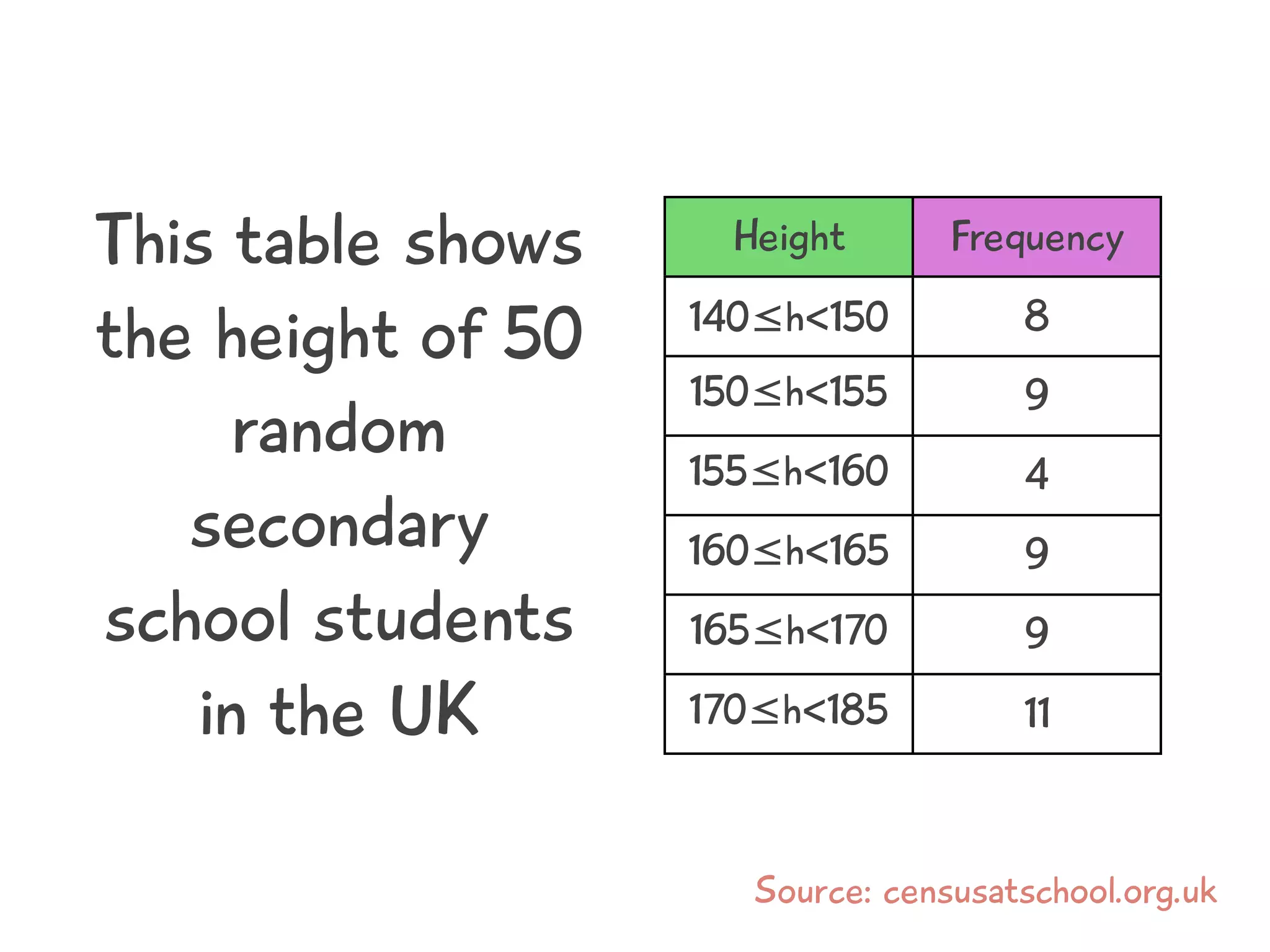
This table shows Height Frequency
the height of 50 140≤h<150 8
150≤h<155 9
random 155≤h<160 4
secondary 160≤h<165 9
school students 165≤h<170 9
in the UK 170≤h<185 11
Source: censusatschool.org.uk
Drawing a histogram
Height Frequency
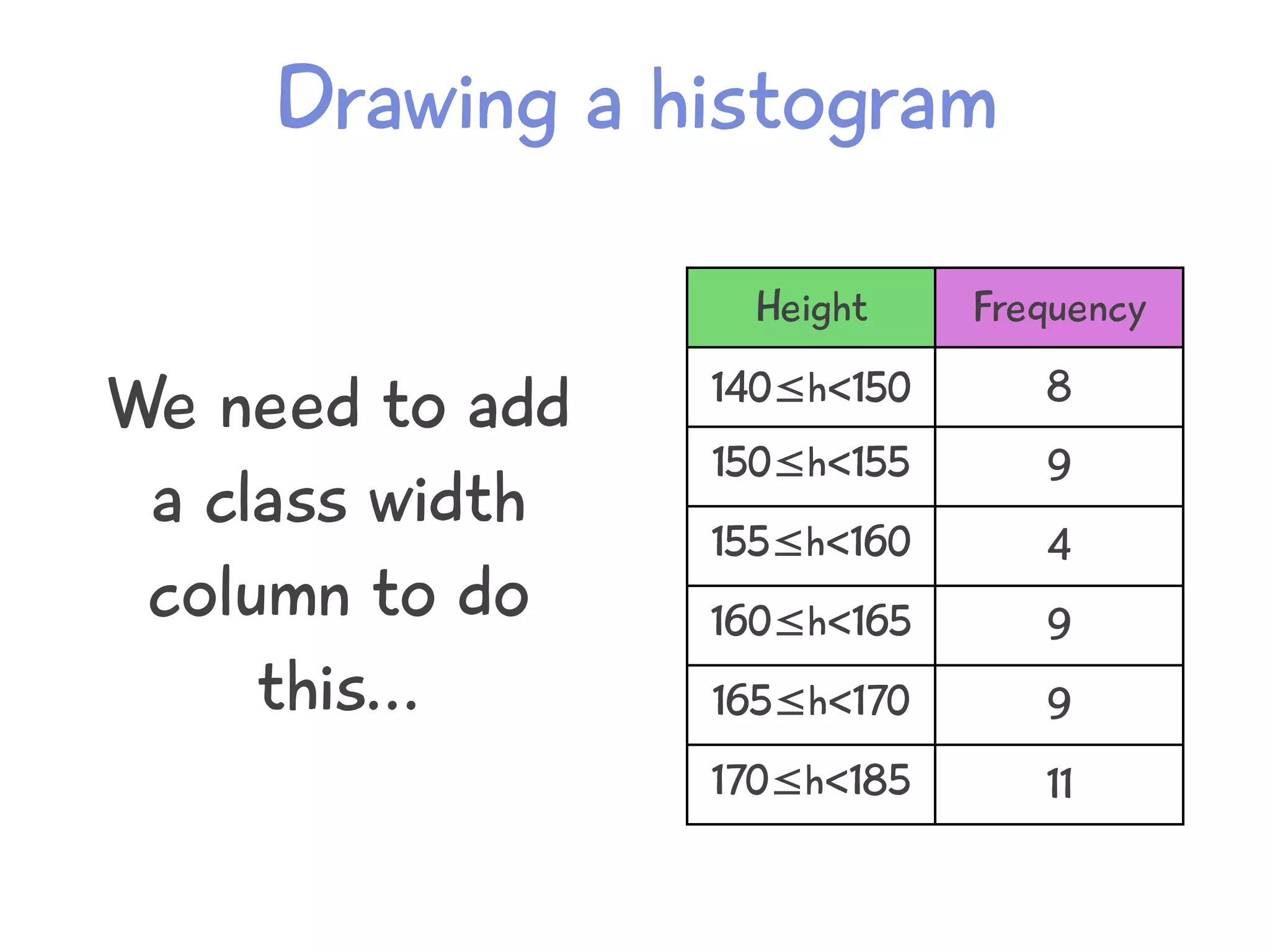
We need to add 140≤h<150 8
150≤h<155 9
a class width 155≤h<160 4
column to do 160≤h<165 9
this... 165≤h<170 9
170≤h<185 11
Drawing a histogram
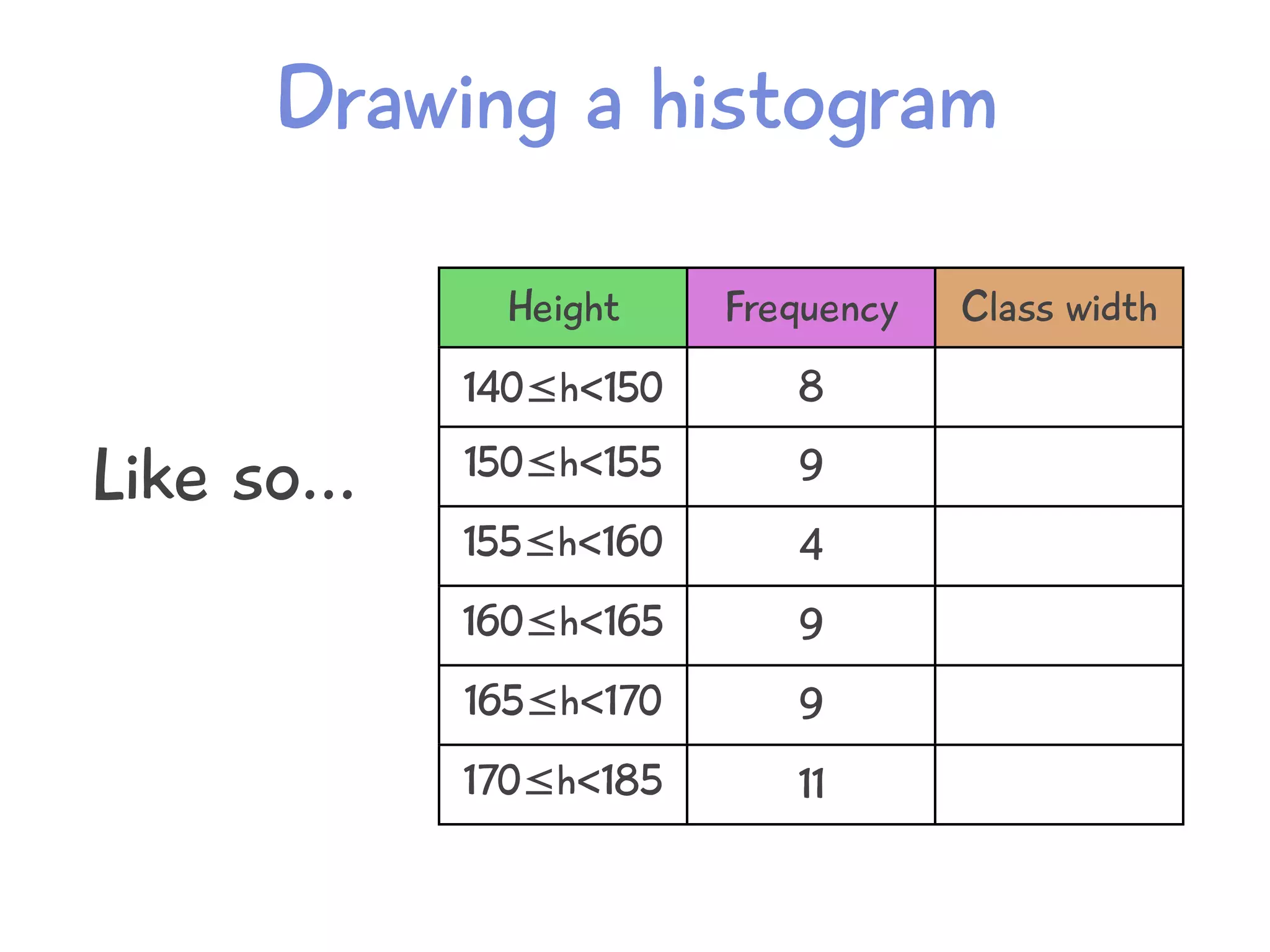
Height Frequency Class width
140≤h<150 8
Like so... 150≤h<155 9
155≤h<160 4
160≤h<165 9
165≤h<170 9
170≤h<185 11
Drawing a histogram
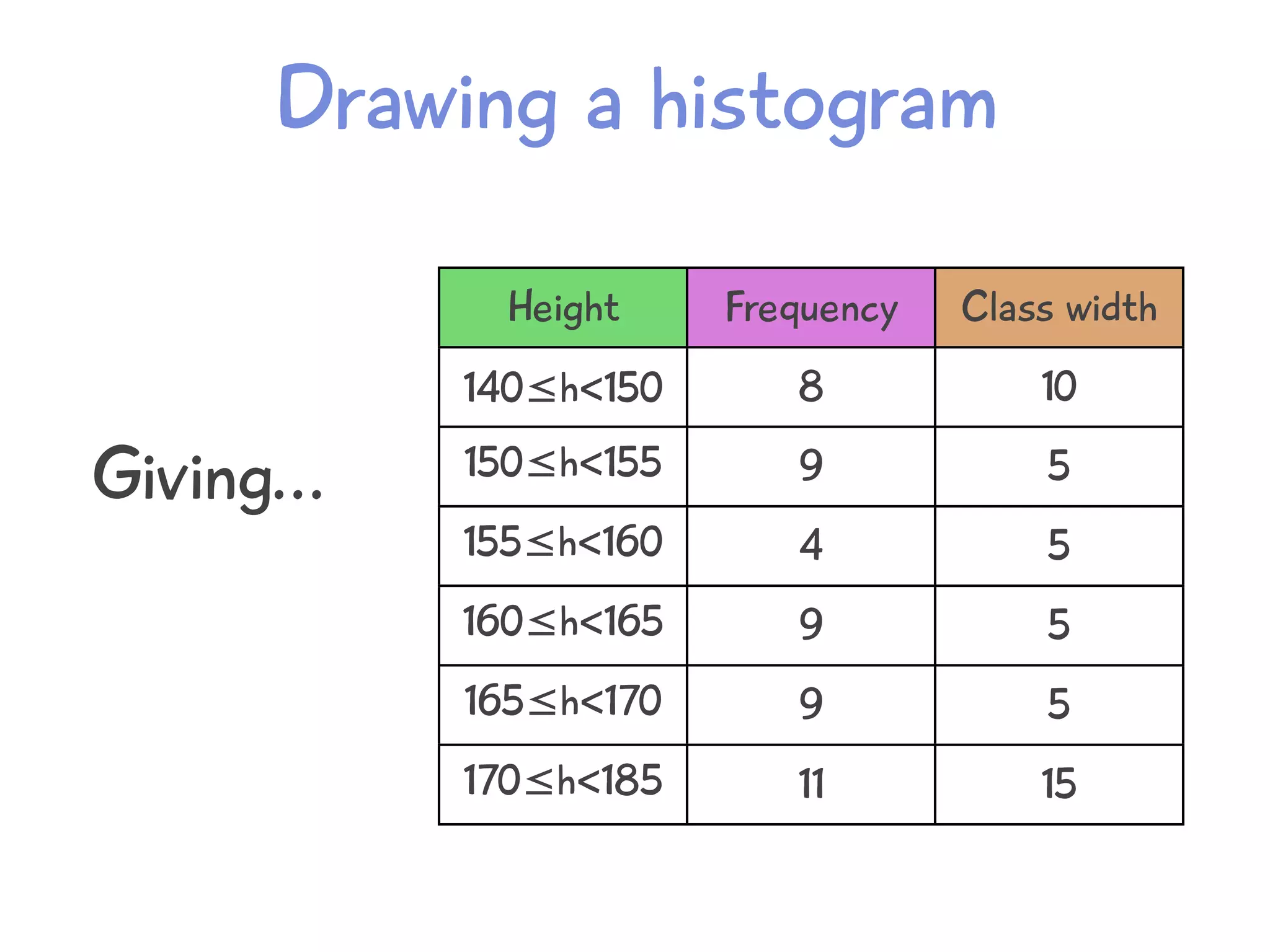
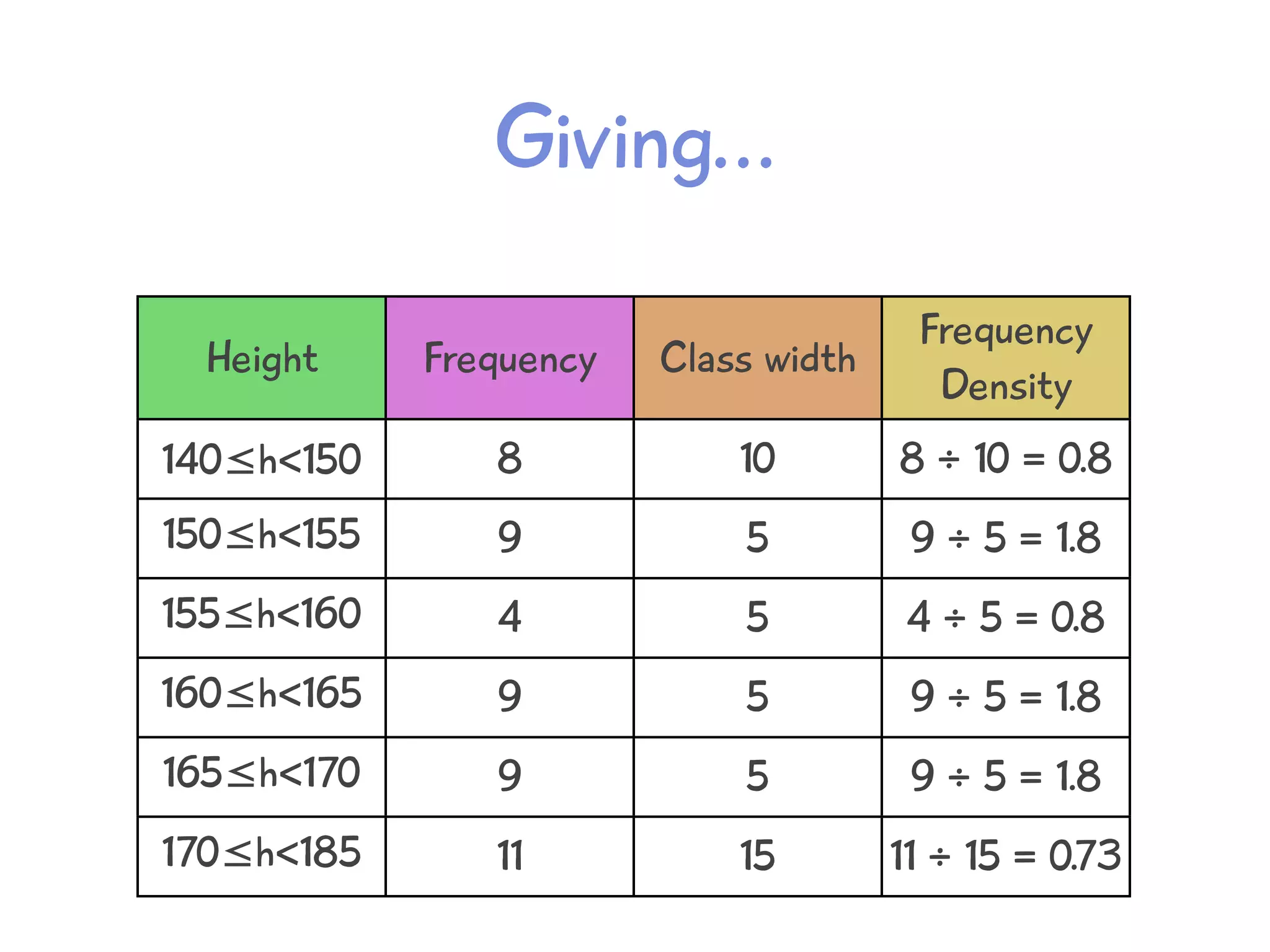
Height Frequency Class width
140≤h<150 8 10
Giving... 150≤h<155 9 5
155≤h<160 4 5
160≤h<165 9 5
165≤h<170 9 5
170≤h<185 11 15
To draw a histogram for data
with different class widths we
need to calculate the frequency
density for each class.
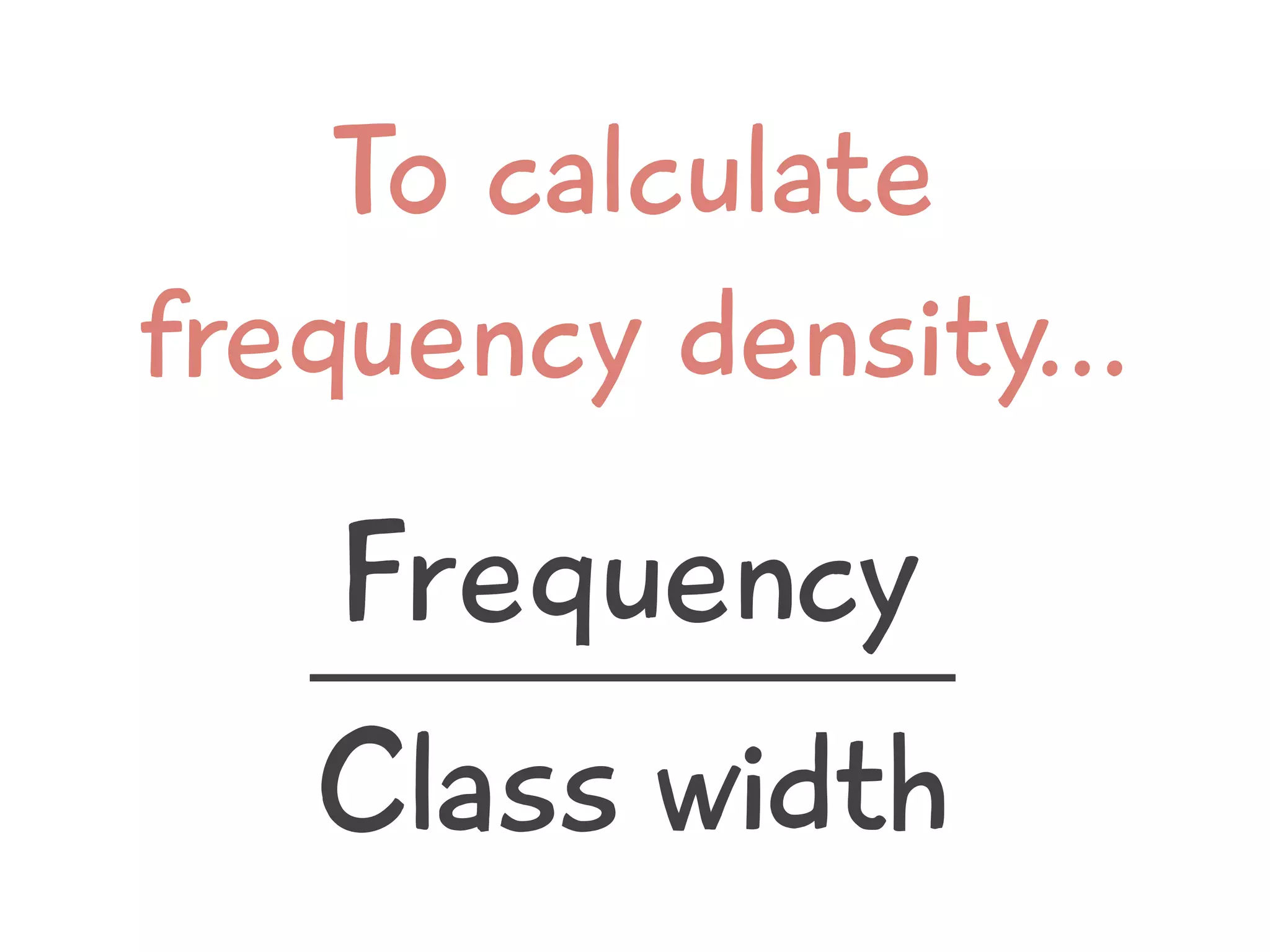
To calculate
frequency density...
Frequency
Class width
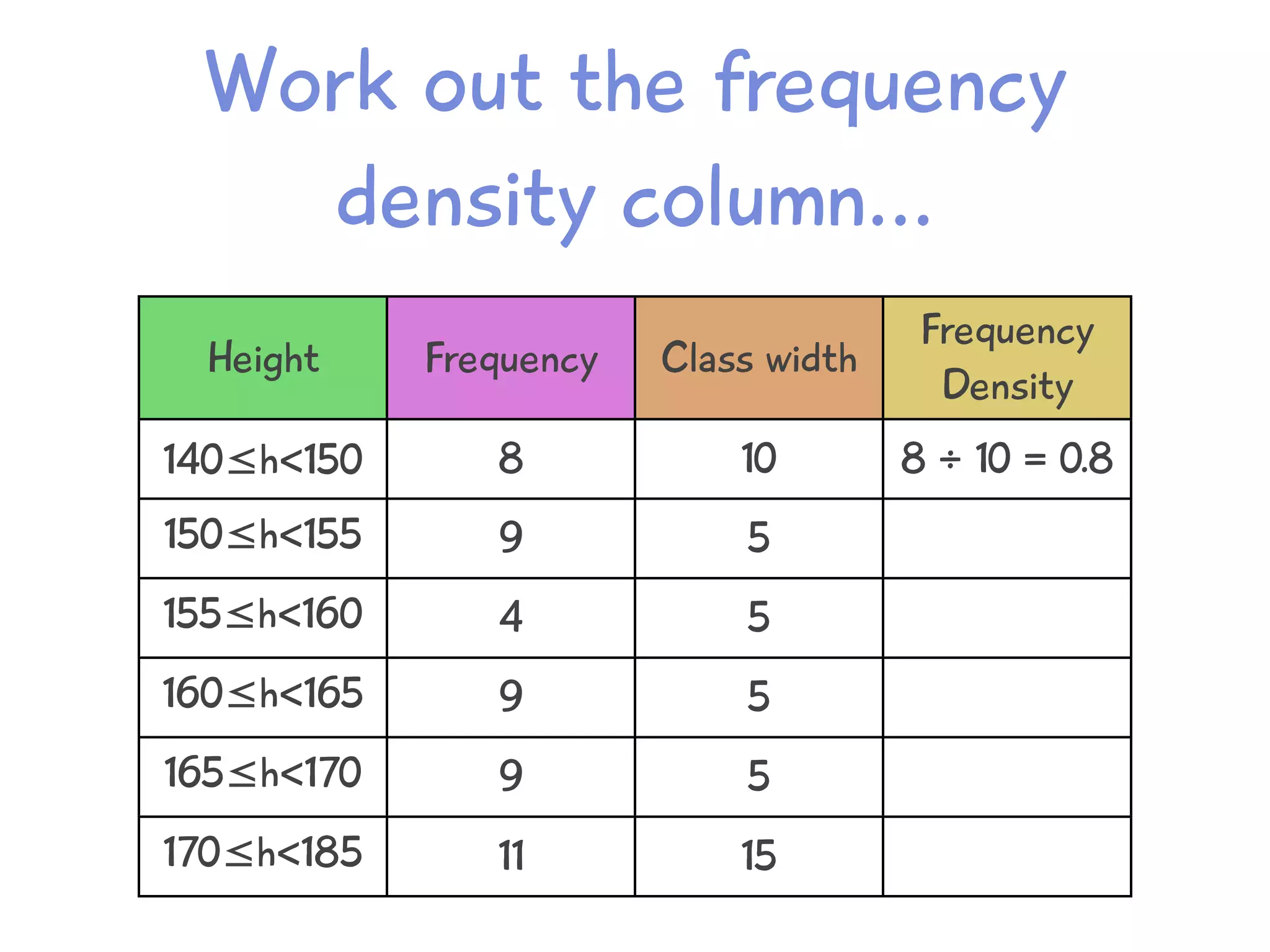
Work out the frequency
density column...
Frequency
Height Frequency Class width
Density
140≤h<150 8 10 8 ÷ 10 = 0.8
150≤h<155 9 5
155≤h<160 4 5
160≤h<165 9 5
165≤h<170 9 5
170≤h<185 11 15
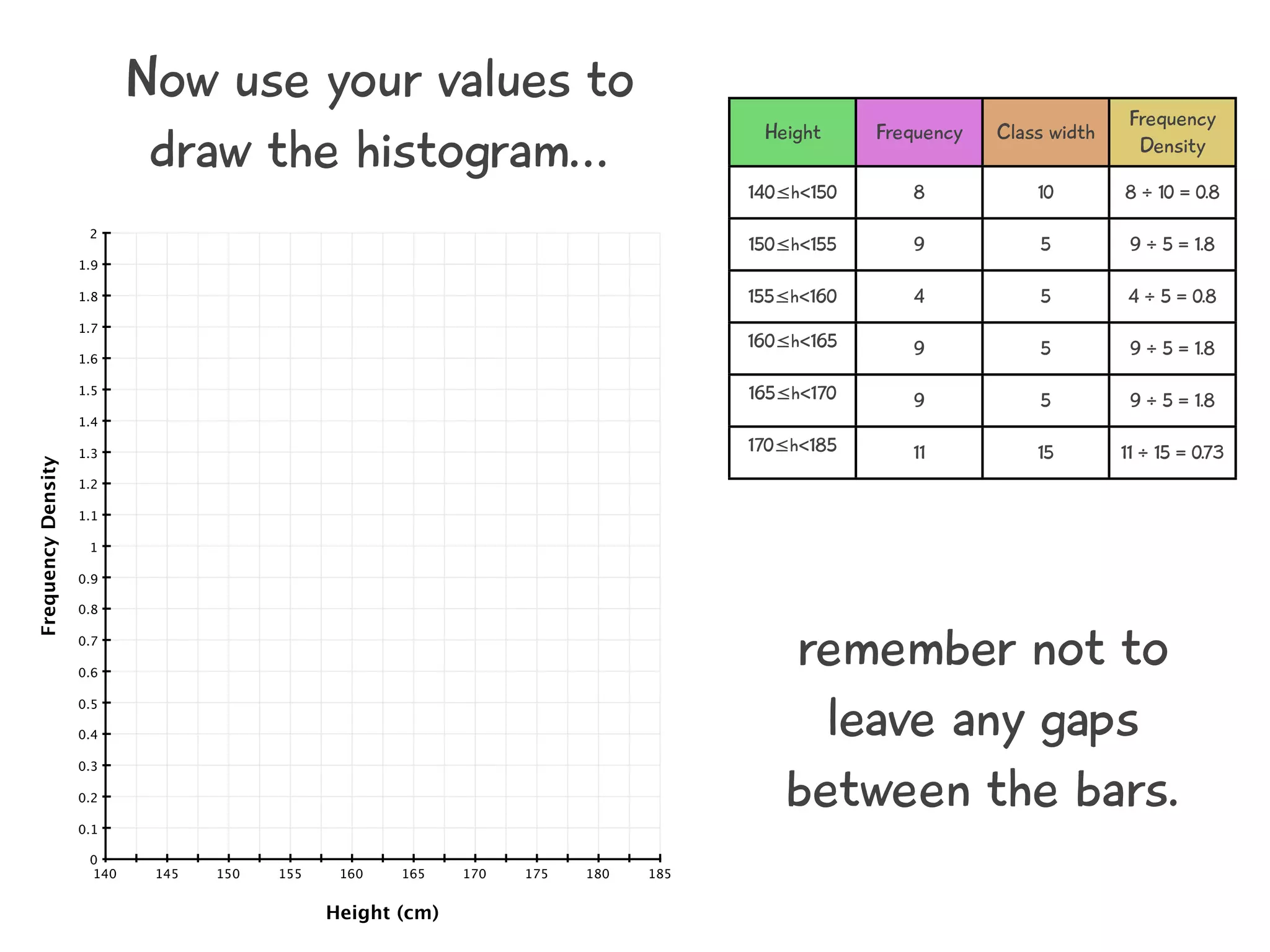
Now use your values to
Frequency
draw the histogram... Height Frequency Class width
Density
140≤h<150 8 10 8 ÷ 10 = 0.8
2
150≤h<155 9 5 9 ÷ 5 = 1.8
1.9
1.8 155≤h<160 4 5 4 ÷ 5 = 0.8
1.7
160≤h<165 9 5 9 ÷ 5 = 1.8
1.6
1.5 165≤h<170 9 5 9 ÷ 5 = 1.8
1.4
1.3
170≤h<185 11 15 11 ÷ 15 = 0.73
Frequency Density
1.2
1.1
1
0.9
0.8
0.7
0.6
remember not to
0.5
0.4 leave any gaps
between the bars.
0.3
0.2
0.1
0
140 145 150 155 160 165 170 175 180 185
Height (cm)
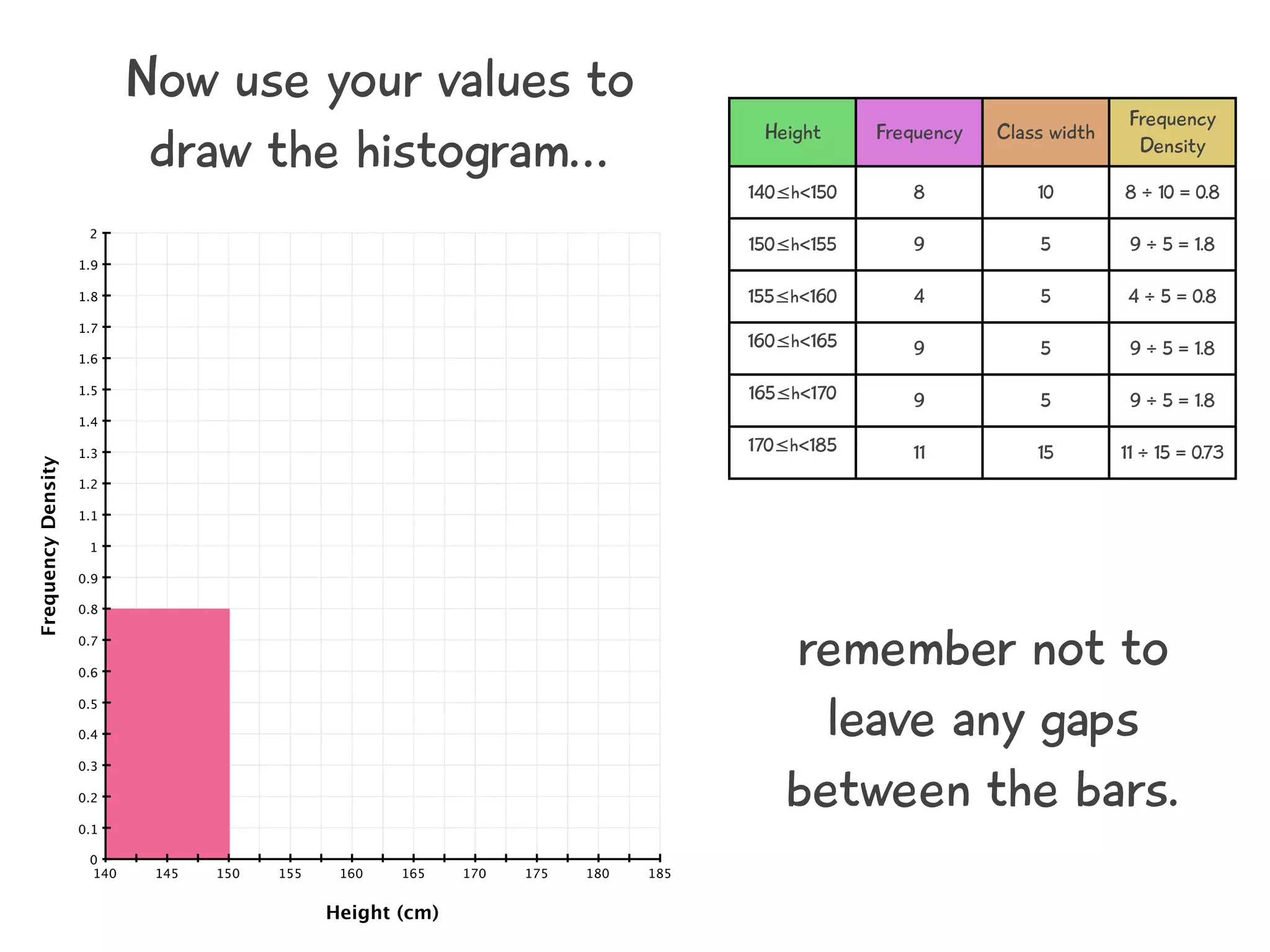
Now use your values to
Frequency
draw the histogram... Height Frequency Class width
Density
140≤h<150 8 10 8 ÷ 10 = 0.8
2
150≤h<155 9 5 9 ÷ 5 = 1.8
1.9
1.8 155≤h<160 4 5 4 ÷ 5 = 0.8
1.7
160≤h<165 9 5 9 ÷ 5 = 1.8
1.6
1.5 165≤h<170 9 5 9 ÷ 5 = 1.8
1.4
1.3
170≤h<185 11 15 11 ÷ 15 = 0.73
Frequency Density
1.2
1.1
1
0.9
0.8
0.7
0.6
remember not to
0.5
0.4 leave any gaps
between the bars.
0.3
0.2
0.1
0
140 145 150 155 160 165 170 175 180 185
Height (cm)
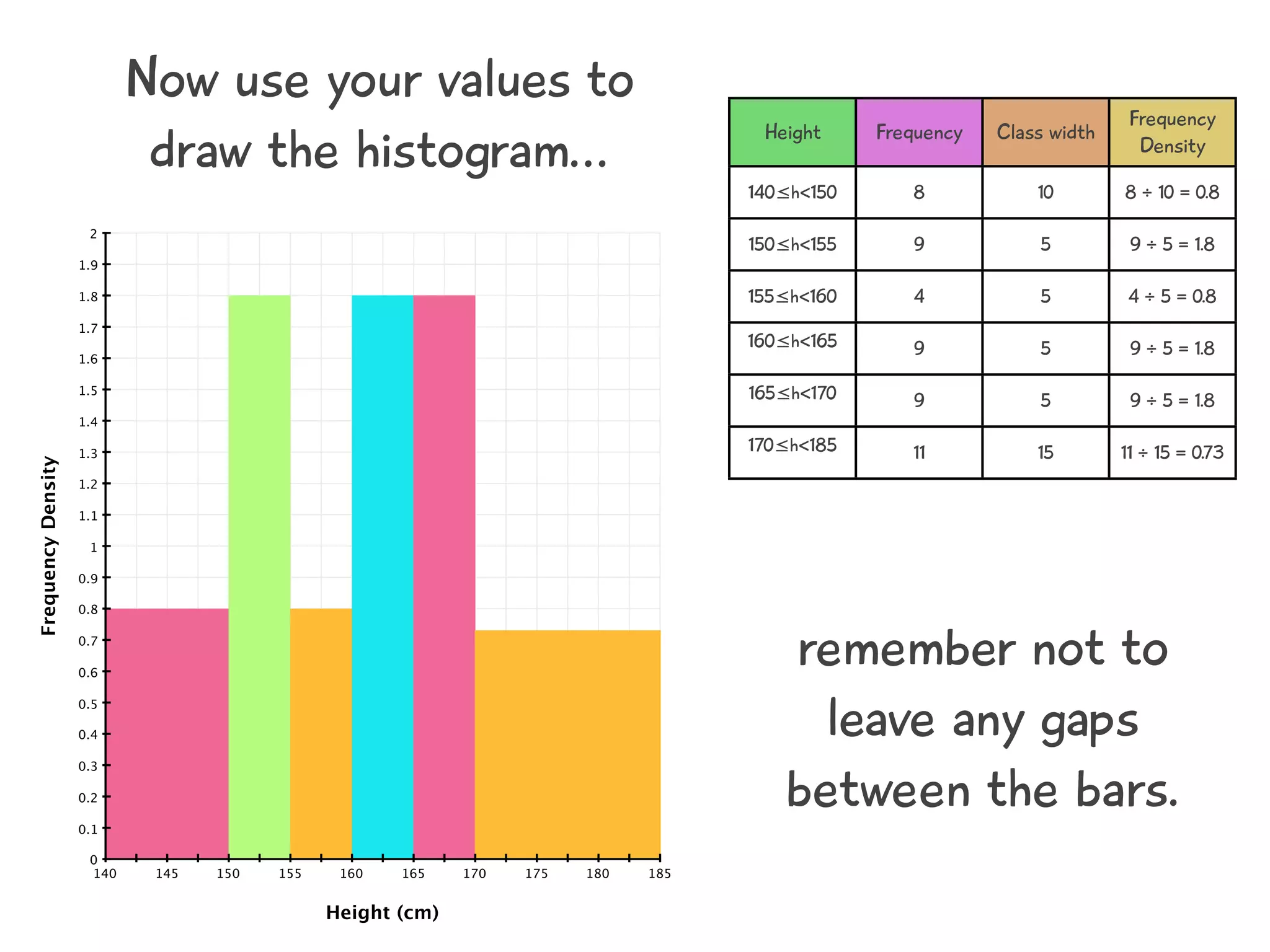
Now use your values to
Frequency
draw the histogram... Height Frequency Class width
Density
140≤h<150 8 10 8 ÷ 10 = 0.8
2
150≤h<155 9 5 9 ÷ 5 = 1.8
1.9
1.8 155≤h<160 4 5 4 ÷ 5 = 0.8
1.7
160≤h<165 9 5 9 ÷ 5 = 1.8
1.6
1.5 165≤h<170 9 5 9 ÷ 5 = 1.8
1.4
1.3
170≤h<185 11 15 11 ÷ 15 = 0.73
Frequency Density
1.2
1.1
1
0.9
0.8
0.7
0.6
remember not to
0.5
0.4 leave any gaps
between the bars.
0.3
0.2
0.1
0
140 145 150 155 160 165 170 175 180 185
Height (cm)
What, if anything, can we see
from this histogram?
Why?
If we look a bit closer there a
few other useful things about a
histogram.
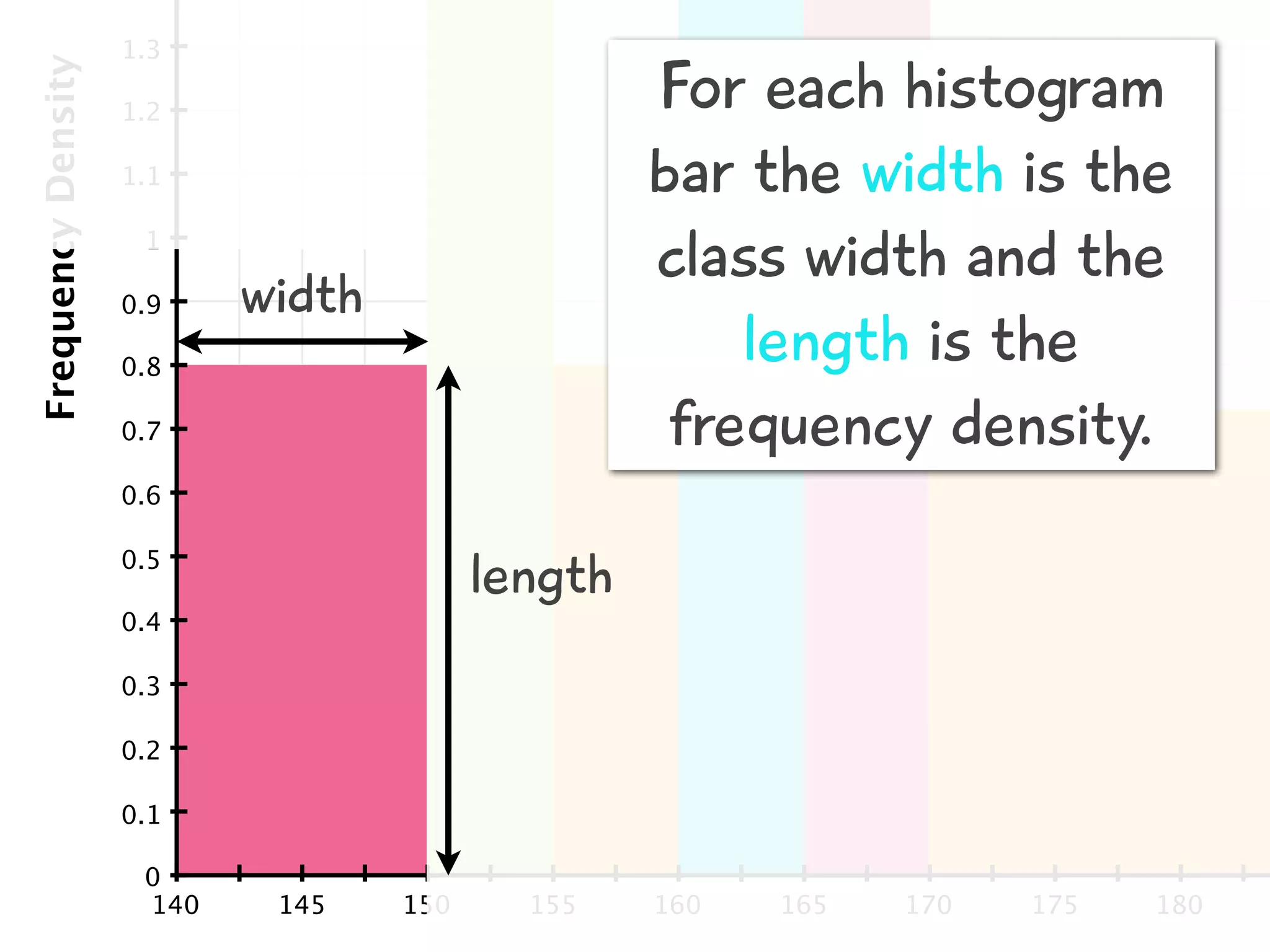
1.3
Frequency Density
1.2 For each histogram
1.1 bar the width is the
1
class width and the
0.9 width
0.8
length is the
0.7 frequency density.
0.6
0.5
length
0.4
0.3
0.2
0.1
0
140 145 150 155 160 165 170 175 180
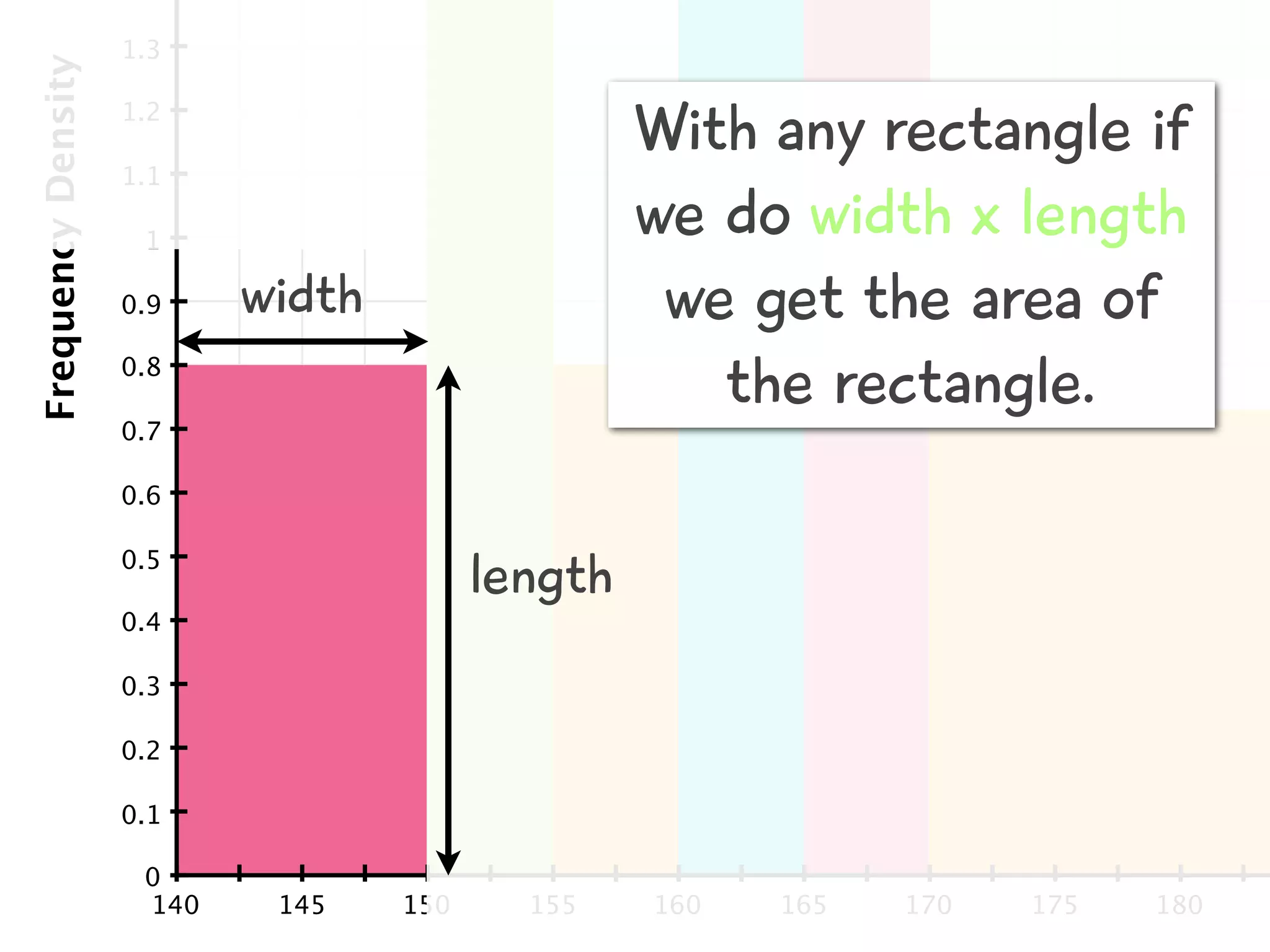
1.3
Frequency Density
1.2
With any rectangle if
1.1
1
we do width x length
0.9 width we get the area of
0.8
the rectangle.
0.7
0.6
0.5
length
0.4
0.3
0.2
0.1
0
140 145 150 155 160 165 170 175 180
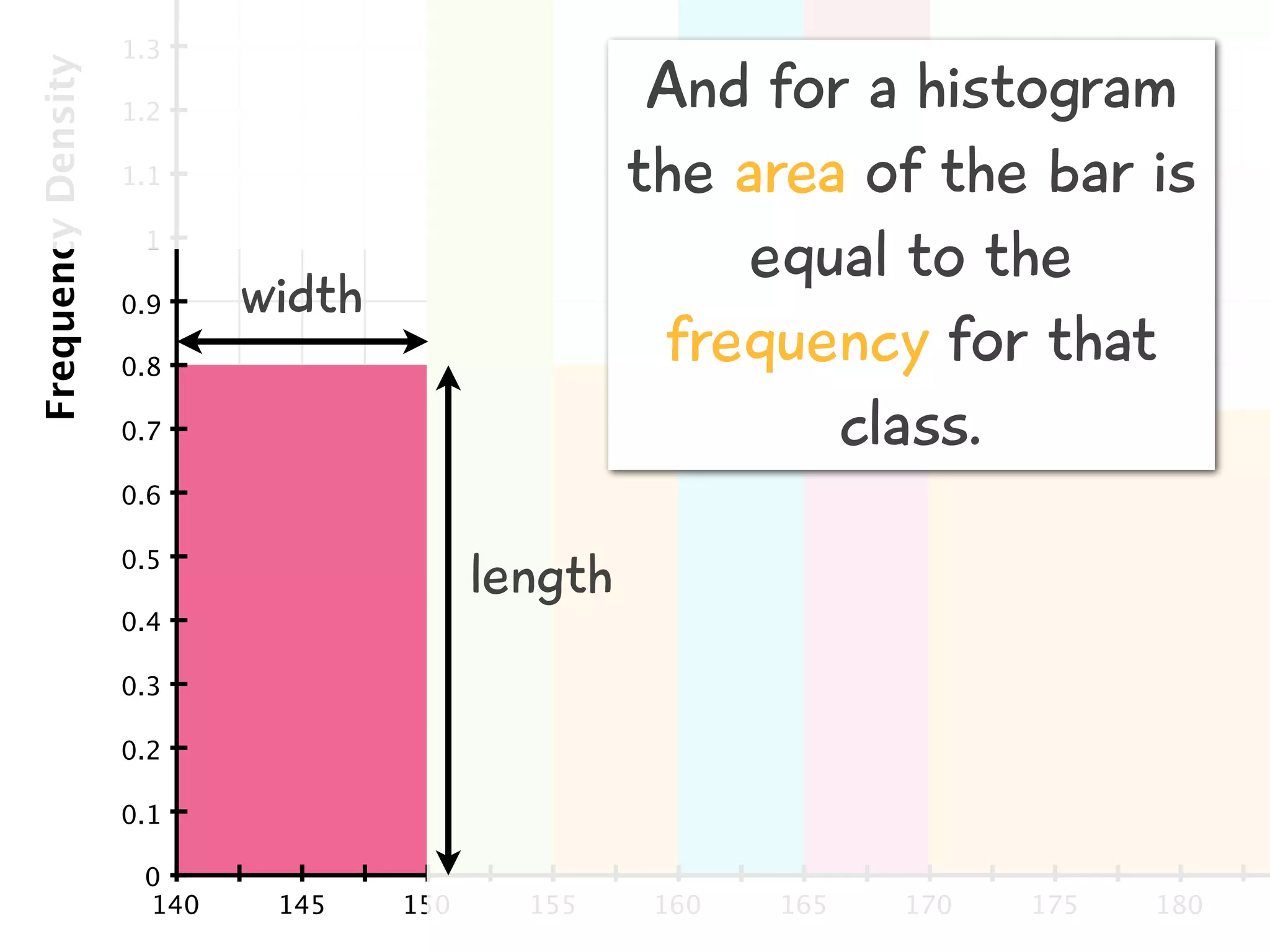
1.3
Frequency Density
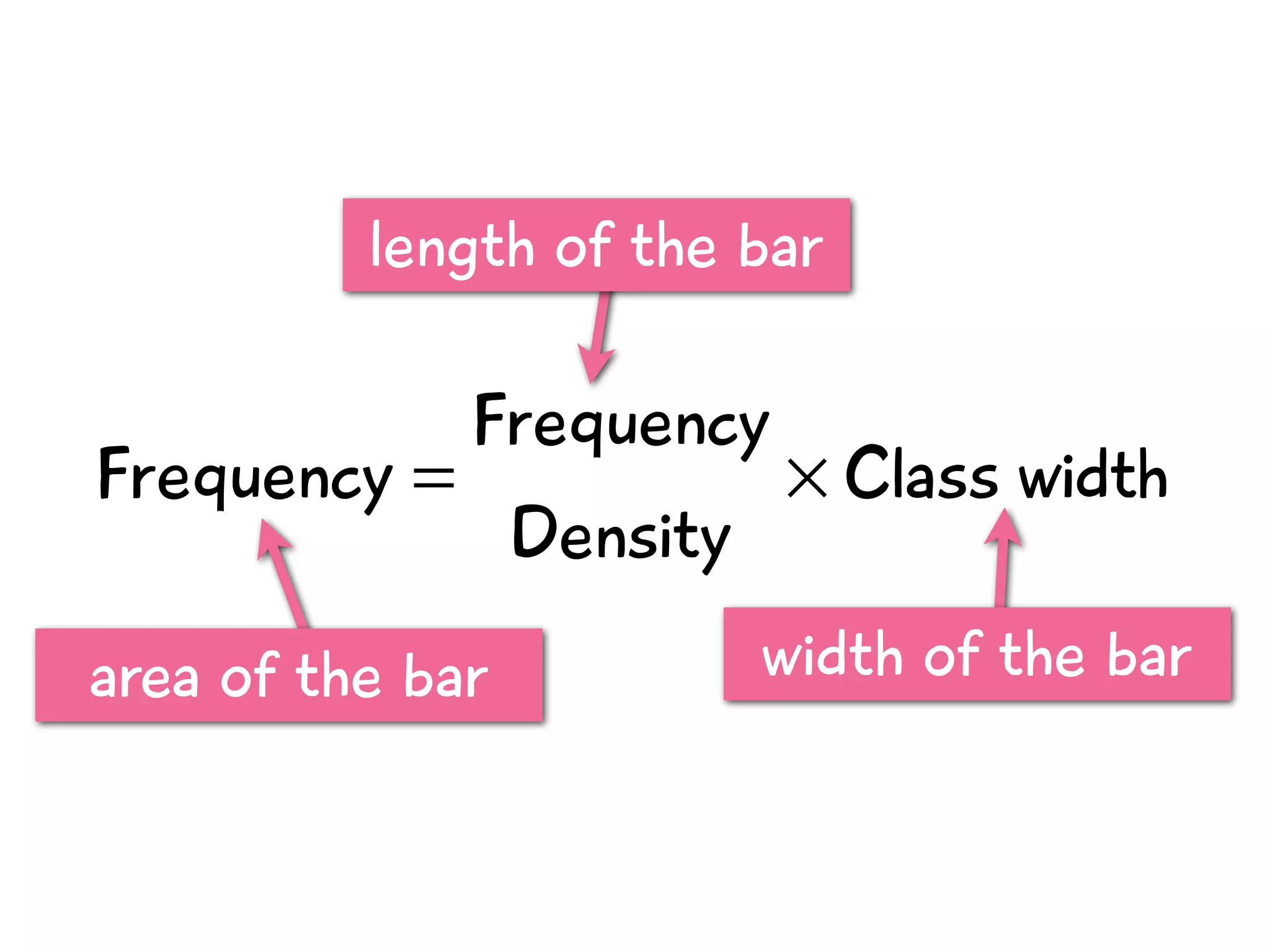
1.2 And for a histogram
1.1 the area of the bar is
1
equal to the
0.9 width
0.8
frequency for that
0.7 class.
0.6
0.5
length
0.4
0.3
0.2
0.1
0
140 145 150 155 160 165 170 175 180
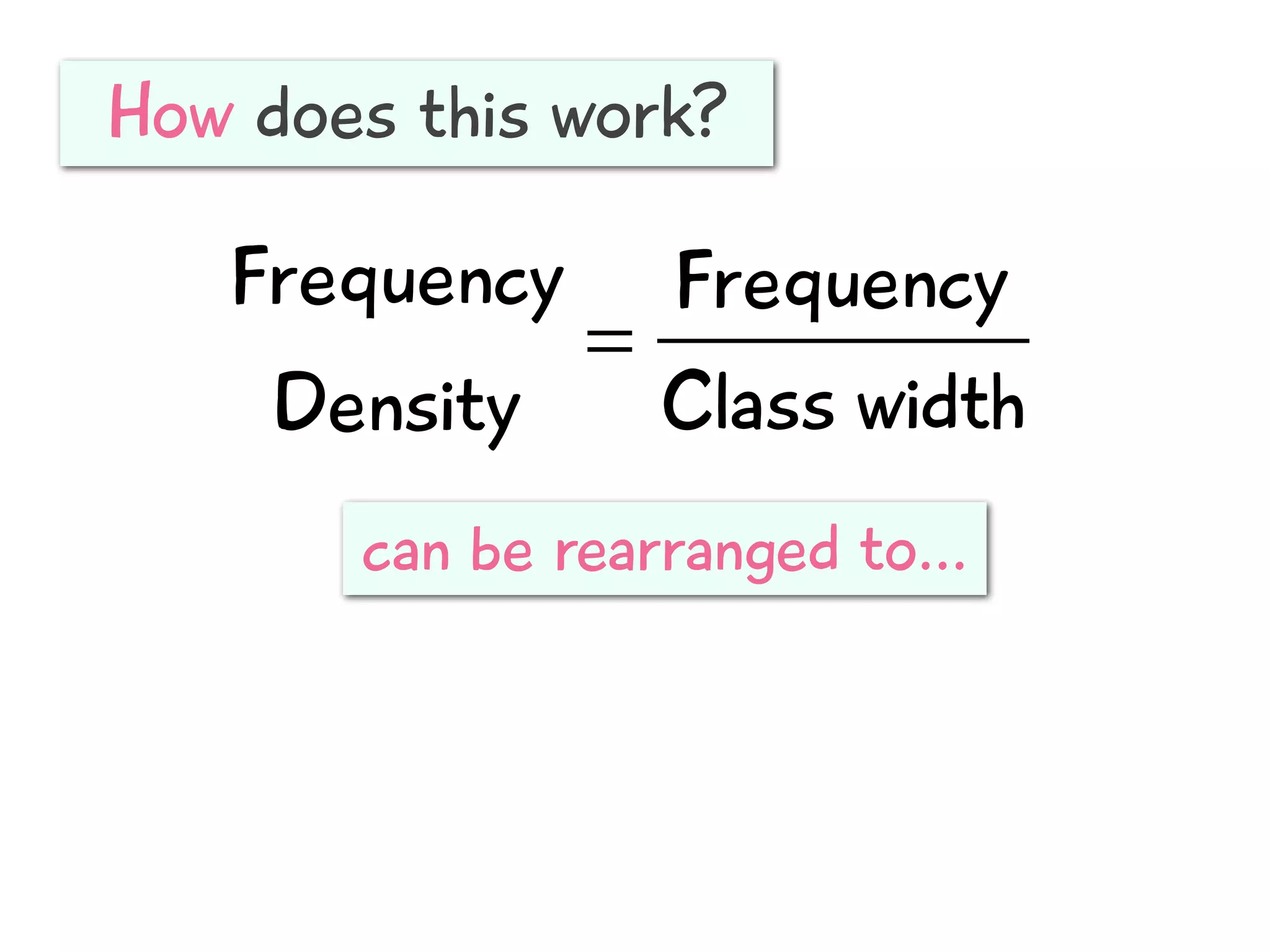
How does this work?
Frequency Frequency
=
Density Class width
can be rearranged to...
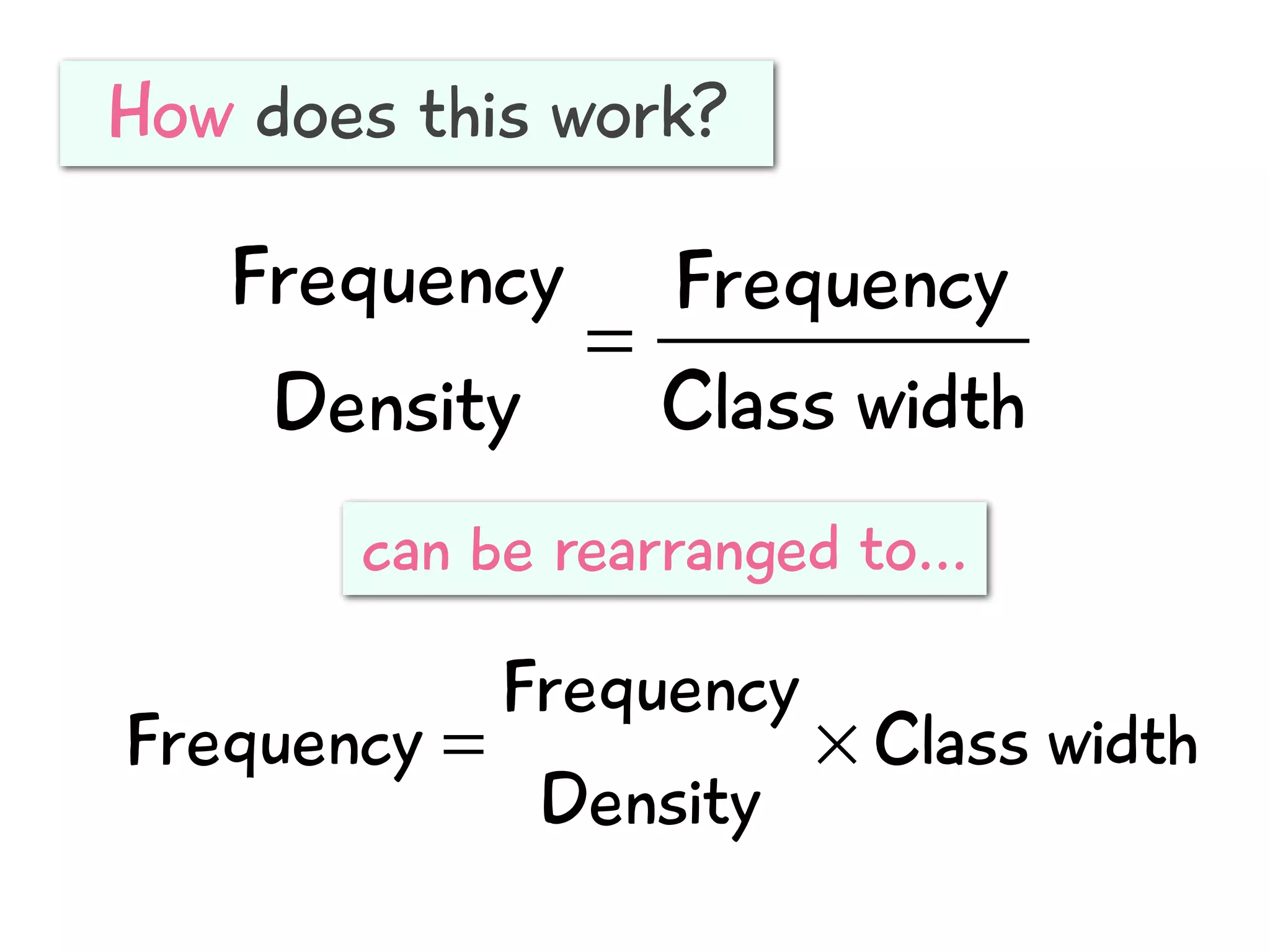
How does this work?
Frequency Frequency
=
Density Class width
can be rearranged to...
Frequency
Frequency = × Class width
Density
length of the bar
Frequency
Frequency = × Class width
Density
area of the bar width of the bar
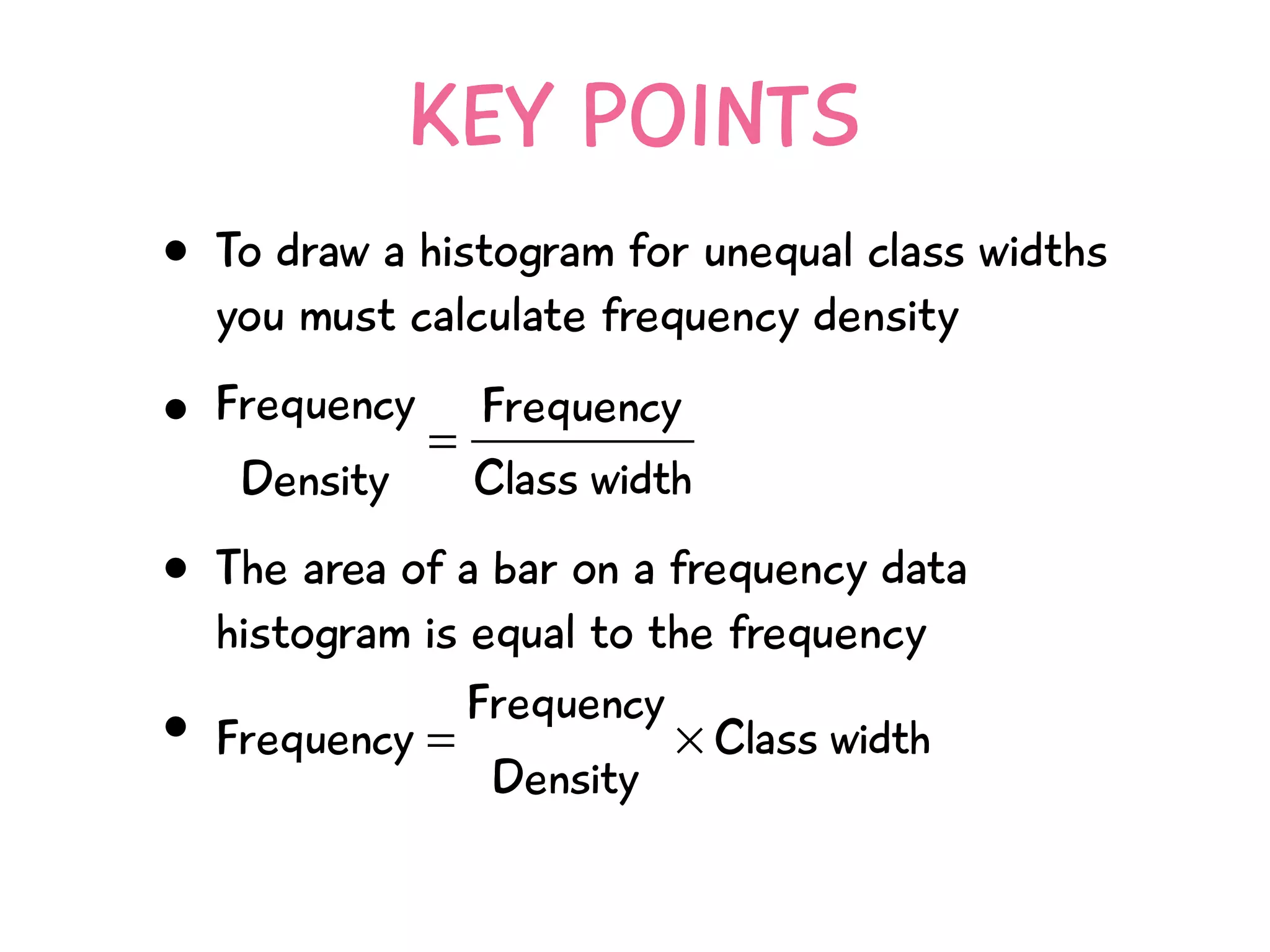
KEY POINTS
• To draw a histogram for unequal class widths
you must calculate frequency density
• Frequency
=
Frequency
Density Class width
• The area of a bar on a frequency data
histogram is equal to the frequency
Frequency
• Frequency =
Density
× Class width
0 comments
Post a comment