
NoSQL Databases: Why, what and when
•
770 likes•182,551 views

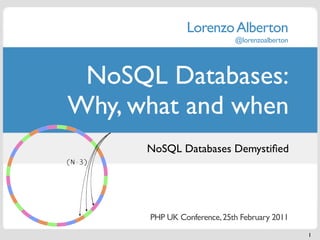
NoSQL databases get a lot of press coverage, but there seems to be a lot of confusion surrounding them, as in which situations they work better than a Relational Database, and how to choose one over another. This talk will give an overview of the NoSQL landscape and a classification for the different architectural categories, clarifying the base concepts and the terminology, and will provide a comparison of the features, the strengths and the drawbacks of the most popular projects (CouchDB, MongoDB, Riak, Redis, Membase, Neo4j, Cassandra, HBase, Hypertable).

Recommended
Recommended
More Related Content
What's hot
What's hot (20)
Viewers also liked
Viewers also liked (14)
Similar to NoSQL Databases: Why, what and when
Similar to NoSQL Databases: Why, what and when (20)
Recently uploaded
Recently uploaded (20)
NoSQL Databases: Why, what and when
- 1. Lorenzo Alberton @lorenzoalberton NoSQL Databases: Why, what and when NoSQL Databases Demystified PHP UK Conference, 25th February 2011 1
- 2. NoSQL: Why Scalability, Concurrency, New trends 2
- 3. New Trends 2002 2004 2006 2008 2010 2012 Big data 3
- 4. New Trends 2002 2004 2006 2008 2010 2012 Big data Concurrency 3
- 5. New Trends 2002 2004 2006 2008 2010 2012 Big data Connectivity Concurrency 3
- 6. New Trends 2002 2004 2006 2008 2010 2012 Big data Connectivity Concurrency Diversity 3
- 7. New Trends 2002 2004 2006 2008 2010 2012 Big data Connectivity P2P Knowledge Concurrency Diversity 3
- 8. New Trends 2002 2004 2006 2008 2010 2012 Big data Connectivity P2P Knowledge Concurrency Diversity Cloud-Grid 3
- 9. What’s the problem with RDBMS’s? http://www.codefutures.com/database-sharding 4
- 10. What’s the problem with RDBMS’s? Caching Master/Slave Master/Master Cluster Table Partitioning Federated Tables Sharding http://www.codefutures.com/database-sharding Distributed DBs 4
- 11. What’s the problem with RDBMS’s? 5
- 12. What’s the problem with RDBMS’s? http://www.flickr.com/photos/dimi3/3096166092 5
- 13. Quick Comparison Overview from 10,000 feet (random impressions from the interwebs) 6
- 14. Quick Comparison Overview from 10,000 feet (random impressions from the interwebs) http://www.flickr.com/photos/42433826@N00/4914337851 6
- 15. MongoDB is web-scale ...but /dev/null is even better! 7
- 16. Cassandra is teh schnitz ..Love,v/null .but /de is even better 8
- 17. CouchDB: Relax! .buve/a LO n ? t de ulfree space ..Love,v/T of!l !? You harenaieth?r Right? l, r x te? isyevay b g t an we 9
- 18. No, seriously...* (*) Not another “Mine is bigger” comparison, please 10
- 19. A little theory Fundamental Principles of (Distributed) Databases http://www.timbarcz.com/blog/PassionInProgrammers.aspx 11
- 20. ACID ATOMICITY: All or nothing CONSISTENCY: Any transaction will take the db from one consistent state to another, with no broken constraints (referential integrity) ISOLATION: Other operations cannot access data that has been modified during a transaction that has not yet completed DURABILITY: Ability to recover the committed transaction updates against any kind of system failure (transaction log) 12
- 21. Isolation Levels, Locking & MVCC Isolation noun Property that defines how/when the changes made by one operation become visible to other concurrent operations 13
- 22. Isolation Levels, Locking & MVCC Isolation noun Property that defines how/when the changes made by one operation become visible to other concurrent operations SERIALIZABLE All transactions occur in a completely isolated fashion, as if they were executed serially 13
- 23. Isolation Levels, Locking & MVCC Isolation noun Property that defines how/when the changes made by one operation become visible to other concurrent operations SERIALIZABLE REPEATABLE READ All transactions occur in a Multiple SELECT statements completely isolated fashion, as issued in the same transaction if they were executed serially will always yield the same result 13
- 24. Isolation Levels, Locking & MVCC Isolation noun Property that defines how/when the changes made by one operation become visible to other concurrent operations SERIALIZABLE REPEATABLE READ All transactions occur in a Multiple SELECT statements completely isolated fashion, as issued in the same transaction if they were executed serially will always yield the same result READ COMMITTED A lock is acquired only on the rows currently read/updated 13
- 25. Isolation Levels, Locking & MVCC Isolation noun Property that defines how/when the changes made by one operation become visible to other concurrent operations SERIALIZABLE REPEATABLE READ All transactions occur in a Multiple SELECT statements completely isolated fashion, as issued in the same transaction if they were executed serially will always yield the same result READ COMMITTED READ UNCOMMITTED A lock is acquired only on the A transaction can access rows currently read/updated uncommitted changes made by other transactions 13
- 26. Isolation Levels, Locking & MVCC Non-repeatable Isolation Level Dirty Reads Phantoms reads Serializable - - - Repeatable - - Read Read - Committed Read Uncommitted http://www.adayinthelifeof.nl/2010/12/20/innodb-isolation-levels/ 14
- 27. Isolation Levels, Locking & MVCC Isolation Level Range Lock Read Lock Write Lock Serializable Repeatable - Read Read - - Committed Read - - - Uncommitted 15
- 28. Multi-Version Concurrency Control Root Index Index Index Index Index Index Index Index Index Index Index Data Data Data Data Data Data Data Data Data Data Data Data 16
- 29. Multi-Version Concurrency Control obsolete Root new version Index Index Index Index Index Index Index Index Index Index Index Index Index Index Data Data Data Data Data Data Data Data Data Data Data Data Data 16
- 30. Multi-Version Concurrency Control obsolete Root atomic pointer update new version Index Index Index Index Index Index Index Index Index Index Index Index Index Index Data Data Data Data Data Data Data Data Data Data Data Data Data 16
- 31. Multi-Version Concurrency Control obsolete Root atomic pointer update new version marked for compaction Index Index Index Index Index Index Index Index Index Index Index Index Index Index Data Data Data Data Data Data Data Data Data Data Data Data Data 16
- 32. Multi-Version Concurrency Control obsolete Root atomic pointer update new version marked for compaction Index Index Reads: never blocked Index Index Index Index Index Index Index Index Index Index Index Index Data Data Data Data Data Data Data Data Data Data Data Data Data 16
- 33. Distributed Transactions - 2PC Coordinator 1) COMMIT REQUEST PHASE (voting phase) Participants 17
- 34. Distributed Transactions - 2PC Coordinator 1) COMMIT REQUEST PHASE (voting phase) Query to commit Participants 17
- 35. Distributed Transactions - 2PC Coordinator 1) COMMIT REQUEST PHASE (voting phase) Participants 1) Exec Transaction up to the COMMIT request 2) Write entry to undo and redo logs 17
- 36. Distributed Transactions - 2PC Coordinator 1) COMMIT REQUEST PHASE (voting phase) Agree or Abort Participants 17
- 37. Distributed Transactions - 2PC Coordinator 2) COMMIT PHASE (completion phase) a) SUCCESS (agreement from all) Participants 18
- 38. Distributed Transactions - 2PC Coordinator 2) COMMIT PHASE (completion phase) Commit a) SUCCESS (agreement from all) Participants 18
- 39. Distributed Transactions - 2PC Coordinator 2) COMMIT PHASE (completion phase) a) SUCCESS (agreement from all) Participants 1) Complete operation 2) Release locks 18
- 40. Distributed Transactions - 2PC Coordinator 2) COMMIT PHASE (completion phase) Acknowledge a) SUCCESS (agreement from all) Participants 18
- 41. Distributed Transactions - 2PC Coordinator 2) COMMIT PHASE Complete transaction (completion phase) a) SUCCESS (agreement from all) Participants 18
- 42. Distributed Transactions - 2PC Coordinator 2) COMMIT PHASE (completion phase) b) FAILURE (abort from any) Participants 19
- 43. Distributed Transactions - 2PC Coordinator 2) COMMIT PHASE (completion phase) Rollback b) FAILURE (abort from any) Participants 19
- 44. Distributed Transactions - 2PC Coordinator 2) COMMIT PHASE (completion phase) b) FAILURE (abort from any) Participants 1) Undo operation 2) Release locks 19
- 45. Distributed Transactions - 2PC Coordinator 2) COMMIT PHASE (completion phase) Acknowledge b) FAILURE (abort from any) Participants 19
- 46. Distributed Transactions - 2PC Coordinator 2) COMMIT PHASE Undo transaction (completion phase) b) FAILURE (abort from any) Participants 19
- 47. Problems with 2PC Blocking Protocol Risk of indefinite cohort Conservative behaviour blocks if coordinator fails biased to the abort case 20
- 48. Paxos Algorithm (Consensus) Family of Fault-tolerant, distributed implementations Spectrum of trade-offs: Number of processors Number of message delays Activity level of participants Number of messages sent Types of failures http://www.usenix.org/event/nsdi09/tech/full_papers/yabandeh/yabandeh_html/ http://en.wikipedia.org/wiki/Paxos_algorithm 21
- 49. [PSE image alert] 22
- 50. ACID & Distributed Systems http://images.tribe.net/tribe/upload/photo/deb/074/deb074db-81fc-4b8a-bfbd-b18b922885cb 23
- 51. ACID & Distributed Systems ACID properties are always desirable But what about: Latency Partition Tolerance High Availability ? http://images.tribe.net/tribe/upload/photo/deb/074/deb074db-81fc-4b8a-bfbd-b18b922885cb 23
- 52. CAP Theorem (Brewer’s conjecture) 2000 Prof. Eric Brewer, PoDC Conference Keynote 2002 Seth Gilbert and Nancy Lynch, ACM SIGACT News 33(2) Of three properties of shared-data systems - data Consistency, system Availability and tolerance to network Partitions - only two can be achieved at any given moment in time. http://www.cs.berkeley.edu/~brewer/cs262b-2004/PODC-keynote.pdf http://lpd.epfl.ch/sgilbert/pubs/BrewersConjecture-SigAct.pdf 24
- 53. CAP Theorem (Brewer’s conjecture) 2000 Prof. Eric Brewer, PoDC Conference Keynote 2002 Seth Gilbert and Nancy Lynch, ACM SIGACT News 33(2) Of three properties of shared-data systems - data Consistency, system Availability and tolerance to network Partitions - only two can be achieved at any given moment in time. http://www.cs.berkeley.edu/~brewer/cs262b-2004/PODC-keynote.pdf http://lpd.epfl.ch/sgilbert/pubs/BrewersConjecture-SigAct.pdf 24
- 54. Partition Tolerance - Availability “The network will be allowed to lose arbitrarily many messages sent from one node to another” [...] “For a distributed system to be continuously available, every request received by a non-failing node in the system must result in a response” - Gilbert and Lynch, SIGACT 2002 http://codahale.com/you-cant-sacrifice-partition-tolerance http://pl.atyp.us/wordpress/?p=2521 25
- 55. Partition Tolerance - Availability “The network will be allowed to lose arbitrarily many messages sent from one node to another” [...] “For a distributed system to be continuously available, every request received by a non-failing node in the system must result in a response” - Gilbert and Lynch, SIGACT 2002 http://codahale.com/you-cant-sacrifice-partition-tolerance http://pl.atyp.us/wordpress/?p=2521 25
- 56. Partition Tolerance - Availability “The network will be allowed to lose arbitrarily many messages sent from one node to another” [...] “For a distributed system to be continuously available, every request received by a non-failing node in the system must result in a response” - Gilbert and Lynch, SIGACT 2002 CP: requests can complete at nodes that have quorum AP: requests can complete at any live node, possibly violating strong consistency http://codahale.com/you-cant-sacrifice-partition-tolerance http://pl.atyp.us/wordpress/?p=2521 25
- 57. Partition Tolerance - Availability “The network will be allowed to lose arbitrarily many messages sent from one node to another” [...] “For a distributed system to be continuously available, every request received by a non-failing node in the system must result in a response” - Gilbert and Lynch, SIGACT 2002 CP: requests can complete at nodes that have quorum HIGH LATENCY AP: requests can complete at any ≈ live node, possiblyPARTITION NETWORK violating strong consistency http://dbmsmusings.blogspot.com/2010/04/problems-with-cap-and-yahoos-little.html http://codahale.com/you-cant-sacrifice-partition-tolerance http://pl.atyp.us/wordpress/?p=2521 25
- 58. Consistency: Client-side view A service that is consistent operates fully or not at all. Strong consistency (as in ACID) Weak consistency (no guarantee) - Inconsistency window (*) Temporary inconsistencies (e.g. in data constraints or replica versions) are accepted, but they’re resolved at the earliest opportunity http://www.allthingsdistributed.com/2008/12/eventually_consistent.html 26
- 59. Consistency: Client-side view A service that is consistent operates fully or not at all. Strong consistency (as in ACID) Weak consistency (no guarantee) - Inconsistency window Eventual* consistency (e.g. DNS) Causal consistency Read-your-writes consistency (the least surprise) Session consistency (*) Temporary inconsistencies (e.g. in data constraints or Monotonic read consistency replica versions) are accepted, but they’re resolved Monotonic write consistency at the earliest opportunity http://www.allthingsdistributed.com/2008/12/eventually_consistent.html 26
- 60. Consistency: Server-side (Quorum) N = number of nodes with a replica of the data (*) W = number of replicas that must acknowledge the update R = minimum number of replicas that must participate in a successful read operation (*) but the data will be written to N nodes no matter what W+R>N Strong consistency (usually N=3, W=R=2) W = N, R =1 Optimised for reads W = 1, R = N Optimised for writes (durability not guaranteed in presence of failures) W + R <= N Weak consistency 27
- 61. Amazon Dynamo Paper Consistent Hashing Vector Clocks Gossip Protocol Hinted Handoffs Read Repair http://s3.amazonaws.com/AllThingsDistributed/sosp/amazon-dynamo-sosp2007.pdf 28
- 62. Modulo-based Hashing N1 N2 N3 N4 29
- 63. Modulo-based Hashing N1 N2 N3 N4 ? 29
- 64. Modulo-based Hashing N1 N2 N3 N4 partition = key % n_servers 29
- 65. Modulo-based Hashing N1 N2 N3 N4 partition = key % n_servers - 1) (n_servers 29
- 66. Modulo-based Hashing N1 N2 N3 N4 partition = key % n_servers - 1) (n_servers Recalculate the hashes for all the entries if n_servers changes (i.e. full data redistribution when adding/removing a node) 29
- 67. Consistent Hashing 2160 0 A F B Ring Same hash function E (key space) for data and nodes idx = hash(key) D Coordinator: next C available clockwise node http://en.wikipedia.org/wiki/Consistent_hashing 30
- 68. Consistent Hashing 2160 0 A F B Ring Same hash function E (key space) for data and nodes idx = hash(key) D Coordinator: next C available clockwise node http://en.wikipedia.org/wiki/Consistent_hashing 30
- 69. Consistent Hashing 2160 0 A canonical home (coordinator node) for key range A-B F B Ring Same hash function E (key space) for data and nodes idx = hash(key) D Coordinator: next C available clockwise node http://en.wikipedia.org/wiki/Consistent_hashing 30
- 70. Consistent Hashing 2160 0 A F B Ring Same hash function E (key space) for data and nodes idx = hash(key) D Coordinator: next C available clockwise node http://en.wikipedia.org/wiki/Consistent_hashing 30
- 71. Consistent Hashing 2160 0 A F B Ring Same hash function E (key space) for data and nodes idx = hash(key) D Coordinator: next C canonical home for key range A-C available clockwise node http://en.wikipedia.org/wiki/Consistent_hashing 30
- 72. Consistent Hashing 2160 0 only the keys in this range change location A F B Ring Same hash function E (key space) for data and nodes idx = hash(key) D Coordinator: next C canonical home for key range A-C available clockwise node http://en.wikipedia.org/wiki/Consistent_hashing 30
- 73. Consistent Hashing - Replication A F B Ring E (key space) D C http://horicky.blogspot.com/2009/11/nosql-patterns.html 31
- 74. Consistent Hashing - Replication Key hosted AB A in B, C, D F B Data replicated in Ring the N-1 clockwise E (key space) successor nodes D C Node hosting Key , Key , Key FA AB BC http://horicky.blogspot.com/2009/11/nosql-patterns.html 31
- 75. Consistent Hashing - Node Changes A F B E D C 32
- 76. Consistent Hashing - Node Changes Key membership A and replicas are updated when a F B node joins or leaves Copy Key the network. Range AB The number of E Copy Key replicas for all data Range FA is kept consistent. D C Copy Key Range EF 32
- 77. Consistent Hashing - Load Distribution 2160 0 Different Strategies A I Virtual Nodes H B Random tokens per each Ring physical node, partition by C G (key space) token value D Node 1: tokens A, E, G F Node 2: tokens C, F, H E Node 3: tokens B, D, I 33
- 78. Consistent Hashing - Load Distribution 2160 0 Different Strategies Virtual Nodes Q equal-sized partitions, Ring S nodes, Q/S tokens per (key space) node (with Q >> S) Node 1 Node 2 Node 3 Node 4 ... 34
- 79. Vector Clocks & Conflict Detection A B C write handled by A Causality-based partial order over events that D1 ([A, 1]) happen in the system. Document version history: a counter for each node that updated the document. If all update counters in V1 are smaller or equal to all update counters in V2, then V1 precedes V2. http://en.wikipedia.org/wiki/Vector_clock http://pl.atyp.us/wordpress/?p=2601 35
- 80. Vector Clocks & Conflict Detection A B C write handled by A Causality-based partial order over events that D1 ([A, 1]) happen in the system. write handled by A Document version D2 ([A, 2]) history: a counter for each node that updated the document. If all update counters in V1 are smaller or equal to all update counters in V2, then V1 precedes V2. http://en.wikipedia.org/wiki/Vector_clock http://pl.atyp.us/wordpress/?p=2601 35
- 81. Vector Clocks & Conflict Detection A B C write handled by A Causality-based partial order over events that D1 ([A, 1]) happen in the system. write handled by A Document version D2 ([A, 2]) history: a counter for each node that updated write handled by B write handled by C the document. D3 ([A, 2], [B, 1]) D4 ([A, 2], [C,1]) If all update counters in V1 are smaller or equal to all update counters in V2, then V1 precedes V2. http://en.wikipedia.org/wiki/Vector_clock http://pl.atyp.us/wordpress/?p=2601 35
- 82. Vector Clocks & Conflict Detection A B C write handled by A Causality-based partial order over events that D1 ([A, 1]) happen in the system. write handled by A Document version D2 ([A, 2]) history: a counter for each node that updated write handled by B write handled by C the document. D3 ([A, 2], [B, 1]) D4 ([A, 2], [C,1]) If all update counters in V1 are smaller or equal conflict detected reconciliation handled by A to all update counters in ? V2, then V1 precedes V2. http://en.wikipedia.org/wiki/Vector_clock http://pl.atyp.us/wordpress/?p=2601 35
- 83. Vector Clocks & Conflict Detection A B C write handled by A Causality-based partial order over events that D1 ([A, 1]) happen in the system. write handled by A Document version D2 ([A, 2]) history: a counter for each node that updated write handled by B write handled by C the document. D3 ([A, 2], [B, 1]) D4 ([A, 2], [C,1]) If all update counters in V1 are smaller or equal conflict detected reconciliation handled by A to all update counters in D5 ([A, 3], [B, 1], [C,1]) ? V2, then V1 precedes V2. http://en.wikipedia.org/wiki/Vector_clock http://pl.atyp.us/wordpress/?p=2601 35
- 84. Vector Clocks & Conflict Detection A B C write handled by A Vector Clocks can detect a conflict. The conflict D1 ([A, 1]) resolution is left to the application or the user. The application might resolve conflicts by checking relative timestamps, or with other strategies (like merging the changes). Vector clocks can grow quite large (!) http://en.wikipedia.org/wiki/Vector_clock http://pl.atyp.us/wordpress/?p=2601 36
- 85. Vector Clocks & Conflict Detection A B C write handled by A Vector Clocks can detect a conflict. The conflict D1 ([A, 1]) resolution is left to the write handled by A application or the user. The application might D2 ([A, 2]) resolve conflicts by checking relative timestamps, or with other strategies (like merging the changes). Vector clocks can grow quite large (!) http://en.wikipedia.org/wiki/Vector_clock http://pl.atyp.us/wordpress/?p=2601 36
- 86. Vector Clocks & Conflict Detection A B C write handled by A Vector Clocks can detect a conflict. The conflict D1 ([A, 1]) resolution is left to the write handled by A application or the user. The application might D2 ([A, 2]) resolve conflicts by write handled by B un-modified replica checking relative timestamps, or with D3 ([A, 2], [B, 1]) D4 ([A, 2]) other strategies (like merging the changes). Vector clocks can grow quite large (!) http://en.wikipedia.org/wiki/Vector_clock http://pl.atyp.us/wordpress/?p=2601 36
- 87. Vector Clocks & Conflict Detection A B C write handled by A Vector Clocks can detect a conflict. The conflict D1 ([A, 1]) resolution is left to the write handled by A application or the user. The application might D2 ([A, 2]) resolve conflicts by write handled by B un-modified replica checking relative timestamps, or with D3 ([A, 2], [B, 1]) D4 ([A, 2]) other strategies (like merging the changes). version mismatch D3 ⊇ D4, conflict detected resolved automatically Vector clocks can grow D5 ([A, 3], [B, 1]) quite large (!) http://en.wikipedia.org/wiki/Vector_clock http://pl.atyp.us/wordpress/?p=2601 36
- 88. Gossip Protocol + Hinted Handoff A periodic, pairwise, F B inter-process interactions of bounded size E among randomly- chosen peers D C 37
- 89. Gossip Protocol + Hinted Handoff A I can’t see B, it might be periodic, pairwise, F down but I need some B inter-process ACK. My Merkle Tree root for range XY is interactions of “ab031dab4a385afda” bounded size E among randomly- I can’t see B either. My Merkle Tree root for chosen peers range XY is different! D C B must be down then. Let’s disable it. 37
- 90. Gossip Protocol + Hinted Handoff My canonical node is supposed to be B. A periodic, pairwise, F B inter-process interactions of bounded size E among randomly- chosen peers D I see. Well, I’ll take care of it for now, and let B know C when B is available again 37
- 91. Merkle Trees (Hash Trees) Leaves: hashes of ROOT hash(A, B) data blocks. Nodes: hashes of their children. A B hash(C, D) hash(E, F) Used to detect inconsistencies C D E F between replicas hash(001) hash(002) hash(003) hash(004) (anti-entropy) and to minimise the Data Data Data Data Block Block Block Block amount of 001 002 003 004 transferred data http://en.wikipedia.org/wiki/Hash_tree 38
- 92. Read Repair A F B GET(k, R=2) E D C 39
- 93. Read Repair A F B GET(k, R=2) E D C 39
- 94. Read Repair k=XYZ (v.2) A k=XYZ (v.2) F B GET(k, R=2) E D C k=ABC (v.1) 39
- 95. Read Repair A F B k=XYZ (v.2) E UPDATE(k = XYZ) D C 39
- 96. NoSQL Break-down Key-value stores, Column Families, Document-oriented dbs, Graph databases 40
- 97. Focus Of Different Data Models Key-Value Stores Size Column Families Document Databases Graph Databases Complexity http://www.slideshare.net/emileifrem/nosql-east-a-nosql-overview-and-the-benefits-of-graph-databases 41
- 98. 1) Key-value stores Amazon Dynamo Paper Data model: collection of key-value pairs 42
- 99. Voldemort AP LICENSE Dynamo DHT implementation Consistent hashing,Vector clocks Apache 2 LANGUAGE Java API/PROTOCOL HTTP Java Thrift Avro Protobuf PERSISTENCE Pluggable BDB/MySQL CONCURRENCY MVCC 43
- 100. Voldemort AP LICENSE Dynamo DHT implementation Consistent hashing,Vector clocks Apache 2 LANGUAGE Java HTTP / Sockets API/PROTOCOL HTTP Java Thrift Avro Protobuf PERSISTENCE Pluggable BDB/MySQL CONCURRENCY MVCC 43
- 101. Voldemort AP LICENSE Dynamo DHT implementation Consistent hashing,Vector clocks Apache 2 LANGUAGE Java API/PROTOCOL Conflicts resolved at read HTTP Java and write time Thrift Avro Protobuf PERSISTENCE Pluggable BDB/MySQL CONCURRENCY MVCC 43
- 102. Voldemort AP LICENSE Dynamo DHT implementation Consistent hashing,Vector clocks Apache 2 LANGUAGE Java API/PROTOCOL HTTP Java Thrift Json, Java String, byte[], Avro Protobuf Thrift, Avro, ProtoBuf PERSISTENCE Pluggable BDB/MySQL CONCURRENCY MVCC 43
- 103. Voldemort AP LICENSE Dynamo DHT implementation Consistent hashing,Vector clocks Apache 2 LANGUAGE Java API/PROTOCOL HTTP Java Thrift Avro Protobuf PERSISTENCE Pluggable BDB/MySQL CONCURRENCY MVCC Simple optimistic locking for multi-row updates, pluggable storage engine 43
- 104. Voldemort AP LICENSE Dynamo DHT implementation Consistent hashing,Vector clocks Apache 2 LANGUAGE Java API/PROTOCOL HTTP Java Thrift Avro Protobuf PERSISTENCE Pluggable BDB/MySQL CONCURRENCY MVCC 43
- 105. Membase CP LICENSE DHT (K-V), no SPoF Apache 2 “VBuckets” LANGUAGE C/C++ membase memcached Erlang API/PROTOCOL persistence distributed replication in-memory REST/JSON (fail-over HA) memcached rebalancing Unit of consistency and replication Owner of a subset of the cluster key space http://dustin.github.com/2010/06/29/memcached-vbuckets.html 44
- 106. Membase CP LICENSE DHT (K-V), no SPoF Apache 2 “VBuckets” LANGUAGE C/C++ membase memcached Erlang API/PROTOCOL persistence distributed replication in-memory REST/JSON (fail-over HA) memcached rebalancing Unit of consistency and replication Owner of a subset of the cluster key space hash function + table lookup http://dustin.github.com/2010/06/29/memcached-vbuckets.html 44
- 107. Membase CP LICENSE DHT (K-V), no SPoF Apache 2 “VBuckets” LANGUAGE C/C++ membase memcached Erlang API/PROTOCOL persistence distributed replication in-memory REST/JSON (fail-over HA) memcached rebalancing Unit of consistency and replication Owner of a subset of the cluster key space hash function + table lookup All metadata kept in memory (high throughput / low latency). Manual/Programmatic failover via the Management REST API. http://dustin.github.com/2010/06/29/memcached-vbuckets.html 44
- 108. Riak AP LICENSE Apache 2 LANGUAGE C, Erlang API/PROTOCOL REST HTTP * ProtoBuf Buckets → K-V “Links” (~relations) Targeted JS Map/Reduce Tune-able consistency (one-quorum-all) 45
- 109. Redis CP LICENSE K-V store “Data Structures Server” BSD Map, Set, Sorted Set, Linked List LANGUAGE Set/Queue operations, Counters, Pub-Sub, Volatile keys ANSI C API * + PROTOCOL Telnet- like PERSISTENCE 10-100K op/s (whole dataset in RAM + VM) in memory bg snapshots Persistence via snapshotting (tunable fsync freq.) REPLICATION master-slave Distributed if client supports consistent hashing http://redis.io/presentation/Redis_Cluster.pdf 46
- 110. 2) Column Families Google BigTable paper Data model: big table, column families 47
- 111. Google BigTable Paper Sparse, distributed, persistent multi-dimensional sorted map indexed by (row_key, column_key, timestamp) CF:col_name “contents:html” “anchor:cnnsi.com” “anchor:my.look.ca” “com.cnn.www” <html>... “CNN” “CNN.com” column column column row_key row http://labs.google.com/papers/bigtable-osdi06.pdf 48
- 112. Google BigTable Paper Sparse, distributed, persistent multi-dimensional sorted map indexed by (row_key, column_key, timestamp) CF:col_name “contents:html” “anchor:cnnsi.com” “anchor:my.look.ca” “com.cnn.www” <html>... “CNN” “CNN.com” column column column row_key row http://labs.google.com/papers/bigtable-osdi06.pdf 48
- 113. Google BigTable Paper Sparse, distributed, persistent multi-dimensional sorted map indexed by (row_key, column_key, timestamp) CF:col_name “contents:html” “anchor:cnnsi.com” “anchor:my.look.ca” “com.cnn.www” <html>... “CNN” “CNN.com” column column column row_key row http://labs.google.com/papers/bigtable-osdi06.pdf 48
- 114. Google BigTable Paper Sparse, distributed, persistent multi-dimensional sorted map indexed by (row_key, column_key, timestamp) CF:col_name “contents:html” “anchor:cnnsi.com” “anchor:my.look.ca” <html>... t3 <html>... t5 “com.cnn.www” <html>... t6 “CNN” t9 “CNN.com” t8 column column column row_key row http://labs.google.com/papers/bigtable-osdi06.pdf 48
- 115. Google BigTable Paper Sparse, distributed, persistent multi-dimensional sorted map indexed by (row_key, column_key, timestamp) CF:col_name “contents:html” “anchor:cnnsi.com” “anchor:my.look.ca” <html>... t3 <html>... t5 “com.cnn.www” <html>... t6 “CNN” t9 “CNN.com” t8 column column column row_key row column family http://labs.google.com/papers/bigtable-osdi06.pdf 48
- 116. Google BigTable Paper Sparse, distributed, persistent multi-dimensional sorted map indexed by (row_key, column_key, timestamp) CF:col_name “contents:html” “anchor:cnnsi.com” “anchor:my.look.ca” <html>... t3 <html>... t5 “com.cnn.www” <html>... t6 “CNN” t9 “CNN.com” t8 column column column row_key row column family ACL http://labs.google.com/papers/bigtable-osdi06.pdf 48
- 117. Google BigTable Paper Sparse, distributed, persistent multi-dimensional sorted map indexed by (row_key, column_key, timestamp) CF:col_name “contents:html” “anchor:cnnsi.com” “anchor:my.look.ca” <html>... t3 <html>... t5 “com.cnn.www” <html>... t6 “CNN” t9 “CNN.com” t8 column column column row_key row column family Atomic updates ACL http://labs.google.com/papers/bigtable-osdi06.pdf 48
- 118. Google BigTable Paper Sparse, distributed, persistent multi-dimensional sorted map indexed by (row_key, column_key, timestamp) CF:col_name “contents:html” “anchor:cnnsi.com” “anchor:my.look.ca” <html>... t3 <html>... t5 “com.cnn.www” <html>... t6 “CNN” t9 “CNN.com” t8 column column column row_key row column family Atomic updates Automatic GC ACL http://labs.google.com/papers/bigtable-osdi06.pdf 48
- 119. Google BigTable: Data Structure SSTable Smallest building block Persistent immutable Map[k,v] Operations: lookup by key / key range scan SSTable 64KB 64KB 64KB block block block lookup index 49
- 120. Google BigTable: Data Structure SSTable Tablet Smallest building block range of rows Dynamically partitioned Persistent immutable Map[k,v] Built from multiple SSTables Operations: lookup and loadkey range scan Unit of distribution by key / balancing Tablet (range Aaa → Bar) SSTable SSTable 64KB 64KB 64KB 64KB 64KB 64KB block block block lookup block block block lookup index index 49
- 121. Google BigTable: Data Structure SSTable Table Tablet Smallest Tablets (table segments) make up a table Multiple building block Dynamically partitioned range of rows Persistent immutable Map[k,v] Built from multiple SSTables Operations: lookup and loadkey range scan Unit of distribution by key / balancing Table Tablet (range Aaa → Bar) SSTable SSTable 64KB 64KB 64KB 64KB 64KB 64KB block block block lookup block block block lookup index index 49
- 122. Google BigTable: I/O memtable read memory GFS tablet log SSTable SSTable SSTable write 50
- 123. Google BigTable: I/O memtable read minor compaction memory GFS tablet log SSTable SSTable SSTable write 50
- 124. Google BigTable: I/O memtable read minor compaction memory GFS tablet log SSTable SSTable SSTable write BMDiff Zippy 50
- 125. Google BigTable: I/O memtable read minor compaction memory GFS tablet log SSTable SSTable SSTable write BMDiff Zippy merging / major compaction (GC) 50
- 126. Google BigTable: Location Dereferencing Metadata Tablets User Tables ... ... Root Tablet Master File ... Chubby ... ... Replicated, persisted Root of the lock service; maintains metadata tree tablet server locations 5 replicas, one elected ... master (via quorum) Up to 3 levels ... Paxos algorithm used in the metadata to keep consistency hierarchy 51
- 127. Google BigTable: Architecture fs metadata, ACL, GC, load balancing BigTable metadata operations BigTable client master data R/W heartbeat operations messages, GC, chunk migration Tablet Tablet Tablet Chubby Server Server Server track master lock, log of live servers Tablet Tablet Tablet 52
- 128. HBase CP LICENSE OSS implementation of BigTable Apache 2 LANGUAGE Java API/PROTOCOL REST HTTP Thrift PERSISTENCE memtable/ SSTable 53
- 129. HBase CP LICENSE OSS implementation of BigTable Apache 2 LANGUAGE Java ZooKeeper as API/PROTOCOL coordinator REST HTTP Thrift (instead of Chubby) PERSISTENCE memtable/ SSTable 53
- 130. HBase CP LICENSE OSS implementation of BigTable Apache 2 LANGUAGE Support for Java multiple masters API/PROTOCOL REST HTTP Thrift PERSISTENCE memtable/ SSTable 53
- 131. HBase CP LICENSE OSS implementation of BigTable Apache 2 LANGUAGE Java API/PROTOCOL REST HTTP Thrift PERSISTENCE memtable/ SSTable HDFS, S3, S3N, EBS (with GZip/LZO CF compression) 53
- 132. HBase CP LICENSE OSS implementation of BigTable Apache 2 LANGUAGE Java API/PROTOCOL REST HTTP Thrift PERSISTENCE memtable/ Data sorted by key SSTable but evenly distributed across the cluster 53
- 133. HBase CP LICENSE OSS implementation of BigTable Apache 2 LANGUAGE Java API/PROTOCOL REST HTTP Thrift PERSISTENCE memtable/ SSTable Batch Streaming, Map/Reduce 53
- 134. HBase CP LICENSE OSS implementation of BigTable Apache 2 LANGUAGE Java API/PROTOCOL REST HTTP Thrift PERSISTENCE memtable/ SSTable 53
- 135. Hypertable CP LICENSE OSS BigTable implementation Faster than HBase (10-30K/s) GPLv2 LANGUAGE C++ API/PROTOCOL C++ Thrift PERSISTENCE memtable/ SSTable CONCURRENCY MVCC HQL (~SQL) 54
- 136. Hypertable CP LICENSE OSS BigTable implementation Faster than HBase (10-30K/s) GPLv2 LANGUAGE C++ API/PROTOCOL C++ Hyperspace Thrift (paxos) used PERSISTENCE instead of memtable/ SSTable ZooKeeper CONCURRENCY MVCC HQL (~SQL) 54
- 137. Hypertable CP LICENSE OSS BigTable implementation Faster than HBase (10-30K/s) GPLv2 LANGUAGE C++ API/PROTOCOL C++ Thrift Dynamically PERSISTENCE adapts to memtable/ changes in SSTable workload CONCURRENCY MVCC HQL (~SQL) 54
- 138. Hypertable CP LICENSE OSS BigTable implementation Faster than HBase (10-30K/s) GPLv2 LANGUAGE C++ API/PROTOCOL C++ Thrift PERSISTENCE memtable/ SSTable CONCURRENCY MVCC HQL (~SQL) 54
- 139. Cassandra AP LICENSE Data model of BigTable, infrastructure of Dynamo Apache 2 LANGUAGE Java PROTOCOL B col_name Thrift Avro col_value PERSISTENCE timestamp memtable/ SSTable Column CONSISTENCY Tunable R/W/N x http://www.javageneration.com/?p=70 @cassandralondon http://www.meetup.com/Cassandra-London/ 55
- 140. Cassandra AP LICENSE Data model of BigTable, infrastructure of Dynamo Apache 2 LANGUAGE super_column_name Java PROTOCOL B col_name col_name Thrift ... Avro PERSISTENCE col_value col_value timestamp timestamp memtable/ SSTable CONSISTENCY Tunable R/W/N x http://www.javageneration.com/?p=70 @cassandralondon http://www.meetup.com/Cassandra-London/ 55
- 141. Cassandra AP LICENSE Data model of BigTable, infrastructure of Dynamo Column Family Apache 2 LANGUAGE Java PROTOCOL B col_name col_name Thrift row_key ... Avro PERSISTENCE col_value col_value timestamp timestamp memtable/ SSTable CONSISTENCY Tunable R/W/N x http://www.javageneration.com/?p=70 @cassandralondon http://www.meetup.com/Cassandra-London/ 55
- 142. Cassandra AP LICENSE Data model of BigTable, infrastructure of Dynamo Super Column Family Apache 2 LANGUAGE super_column_name super_column_name Java PROTOCOL B col_name col_name col_name col_name Thrift row_key ... ... ... Avro col_value col_value col_value col_value PERSISTENCE timestamp timestamp timestamp timestamp memtable/ SSTable CONSISTENCY keyspace.get("column_family", key, ["super_column",] "column") Tunable R/W/N x http://www.javageneration.com/?p=70 @cassandralondon http://www.meetup.com/Cassandra-London/ 55
Editor's Notes
- \n
- \n
- \n
- \n
- \n
- \n
- \n
- \n
- \n
- \n
- \n
- \n
- \n
- \n
- \n
- \n
- \n
- \n
- \n
- \n
- \n
- \n
- \n
- \n
- \n
- \n
- \n
- \n
- \n
- \n
- \n
- \n
- \n
- \n
- \n
- \n
- \n
- \n
- \n
- \n
- \n
- \n
- \n
- \n
- \n
- \n
- \n
- \n
- \n
- \n
- \n
- \n
- \n
- \n
- \n
- \n
- \n
- \n
- \n
- \n
- \n
- \n
- \n
- \n
- \n
- \n
- \n
- \n
- \n
- \n
- \n
- \n
- \n
- \n
- \n
- \n
- \n
- \n
- \n
- \n
- \n
- \n
- \n
- \n
- \n
- \n
- \n
- \n
- \n
- \n
- \n
- \n
- \n
- \n
- \n
- \n
- \n
- \n
- \n
- \n
- \n
- \n
- \n
- \n
- \n
- \n
- \n
- \n
- \n
- \n
- \n
- \n
- \n
- \n
- \n
- \n
- \n
- \n
- \n
- \n
- \n
- \n
- \n
- \n
- \n
- \n
- \n
- \n
- \n
- \n
- \n
- \n
- \n
- \n
- \n
- \n
- \n
- \n
- \n
- \n
- \n
- \n
- \n
- \n
- \n
- \n
- \n
- \n
- \n
- \n
- \n
- \n
- \n
- \n
- \n
- \n
- \n
- \n
- \n
- \n
- \n
- \n
- \n
- \n
- \n
- \n
- \n
- \n
- \n
- \n
- \n
- \n
- \n
- \n
- \n
- \n
- \n
- \n
- \n
- \n
- \n
- \n
- \n
- \n
- \n
- \n
- \n
- \n
- \n
- \n
- \n
- \n
- \n
- \n
- \n
- \n
- \n
- \n
- \n
- \n
- \n
- \n
- \n
- \n
- \n
- \n
- \n
- \n
- \n
- \n
- \n
- \n
- \n
- \n
- \n
- \n
- \n
- \n
- \n
- \n
- \n
- \n
- \n
- \n
- \n
- \n
- \n
- \n
- \n
- \n
- \n
- \n
- \n
- \n
- \n
- \n
- \n
- \n
- \n
- \n
- \n
- \n
- \n
- \n
- \n
- \n
- \n
- \n
- \n
- \n
- \n
- \n
- \n
- \n
- \n
- \n
- \n
- \n
- \n
- \n
- \n
- \n
- \n
- \n
- \n
- \n
- \n
- \n
- \n
- \n
- \n
- \n
- \n
- \n
- \n
- \n
- \n
- \n
- \n
- \n
- \n
- \n
- \n
- \n
- \n
- \n
- \n
- \n
- \n
- \n
- \n
- \n
- \n
- \n
- \n
- \n
- \n
- \n
- \n
- \n
- \n
- \n
- \n
- \n
- \n
- \n
- \n
- \n
- \n
- \n
- \n
- \n
- \n
- \n
- \n
- \n
- \n