
Professional use of social media
for residents

Nov. 28, 2013
Pat Rich @cmaer

1
Medical residents and social
media – A perspective
When I was a child, I spoke as a
child, I understood as a child, I
thought as a child; but when I
became a man, I put away childish
things
1 Corinthians 13
Who I am
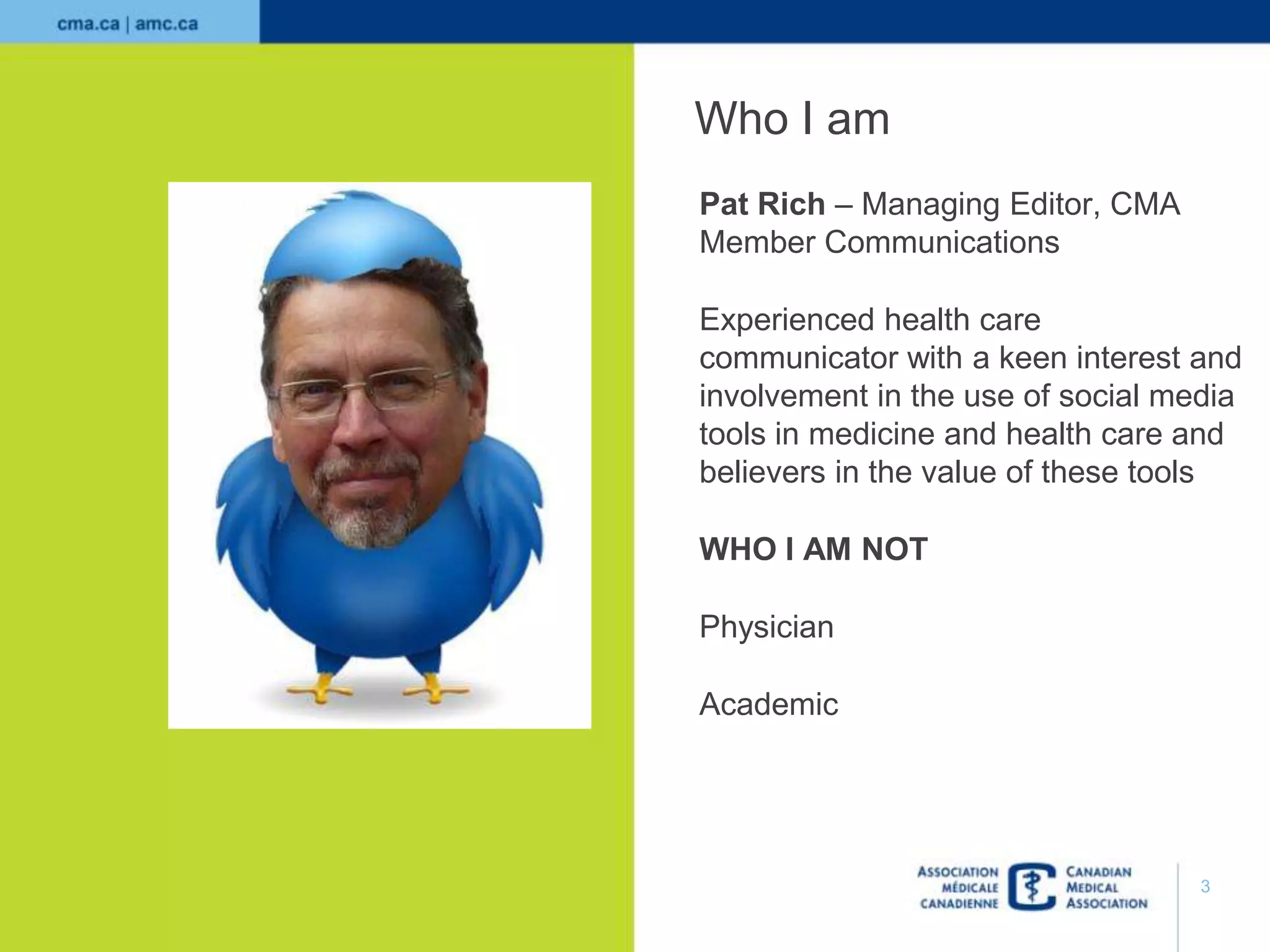
Pat Rich – Managing Editor, CMA
Member Communications
Experienced health care
communicator with a keen interest and
involvement in the use of social media
tools in medicine and health care and
believers in the value of these tools
WHO I AM NOT
Physician
Academic

3
Social media “policies” by
academic medical centers or
medical schools point out the
“don’t do this, don’t do that”, but
let’s also focus on what the
trainees CAN do. Let’s
consider how we can IMPROVE
our current health care system
and ultimately the care of
patients with innovative uses of
social media and social
networking …
Dr. Alex Djuricich, Association
Dean for CME, University of
Indiana School of Medicine

4
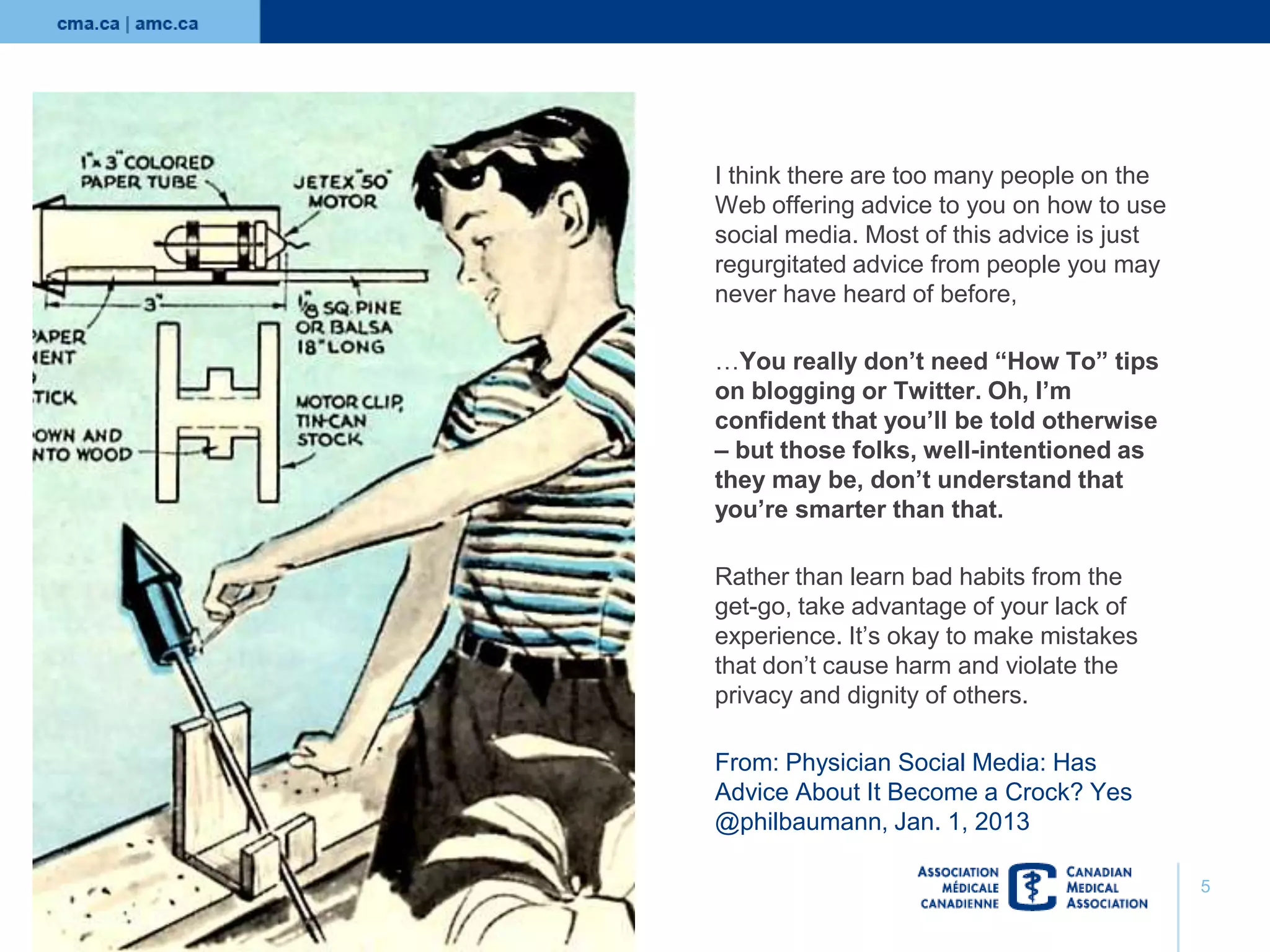
I think there are too many people on the
Web offering advice to you on how to use
social media. Most of this advice is just
regurgitated advice from people you may
never have heard of before,
…You really don’t need “How To” tips
on blogging or Twitter. Oh, I’m
confident that you’ll be told otherwise
– but those folks, well-intentioned as
they may be, don’t understand that
you’re smarter than that.
Rather than learn bad habits from the
get-go, take advantage of your lack of
experience. It’s okay to make mistakes
that don’t cause harm and violate the
privacy and dignity of others.

From: Physician Social Media: Has
Advice About It Become a Crock? Yes
@philbaumann, Jan. 1, 2013
5
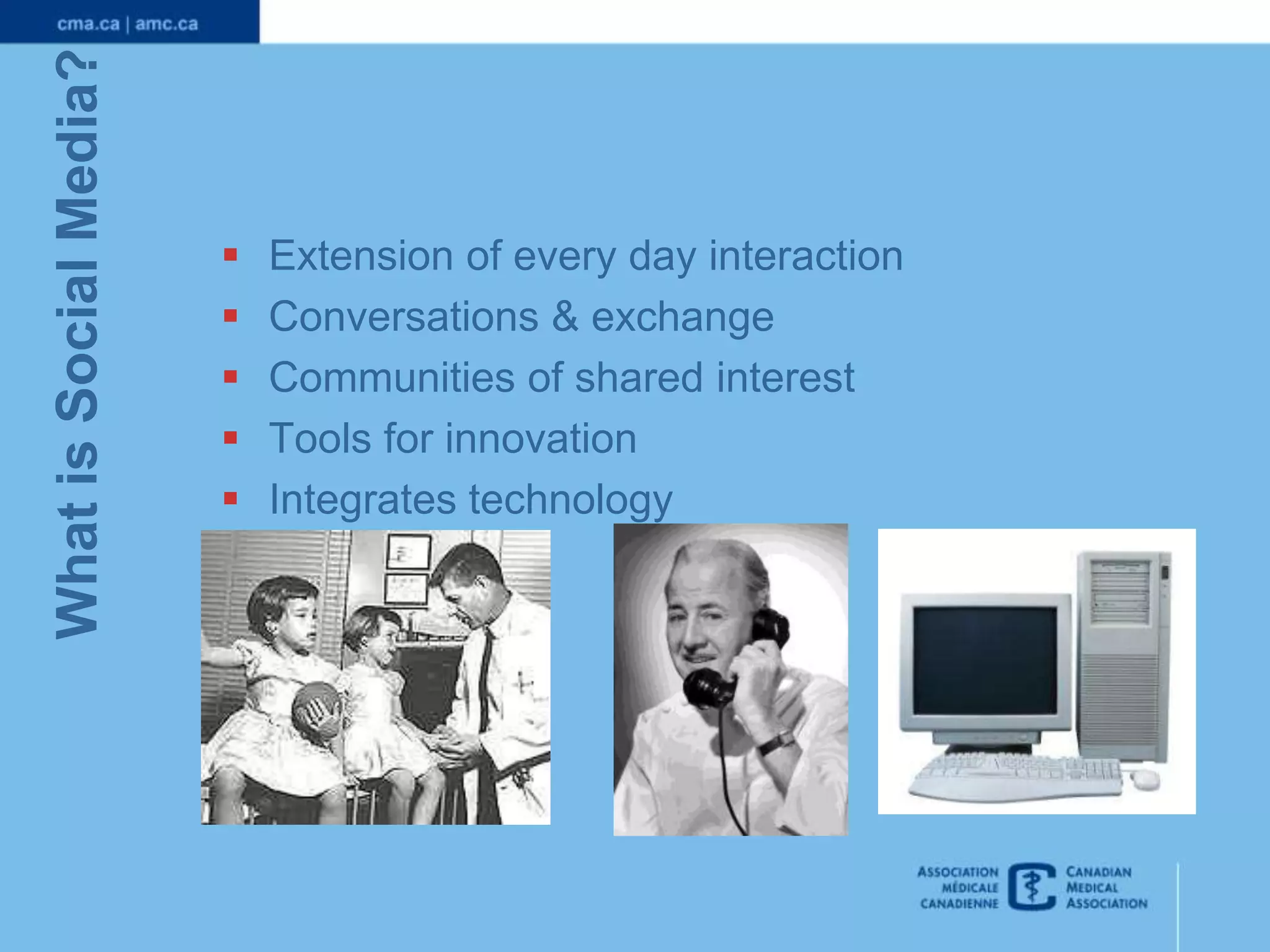
What is Social Media?







Extension of every day interaction
Conversations & exchange
Communities of shared interest
Tools for innovation
Integrates technology
Why consider social media?






To stay informed
Communicate (engage) with peers and patients
Disseminate information
Advocate for/against something
Because if you decide not to use social media, your
decision should be based on sound knowledge
about what you are choosing not to use
A changing environment




New health information technology tools
Engaged patients
Collaborative, team-based care

8
A changing environment








A variety of forces are conspiring to redefine the physician: tech |
information | health 2.0. We must understand our evolving role
Reality of the networked world: social communication will define the way
MDs engage, learn and communicate
The most important decision a physician will make is who and what to
listen to
The internet has changed the way patients see doctors, their diseases
and themselves
Med students are at a very unique point in med history: Between a
collapsing analog age and an emerging digital age
A great digital footprint will never cover for a doctor’s poor care
Dr. Bryan Vartabedian, adapted tweets from lecture to first
year Baylor College of Medicine Students

9
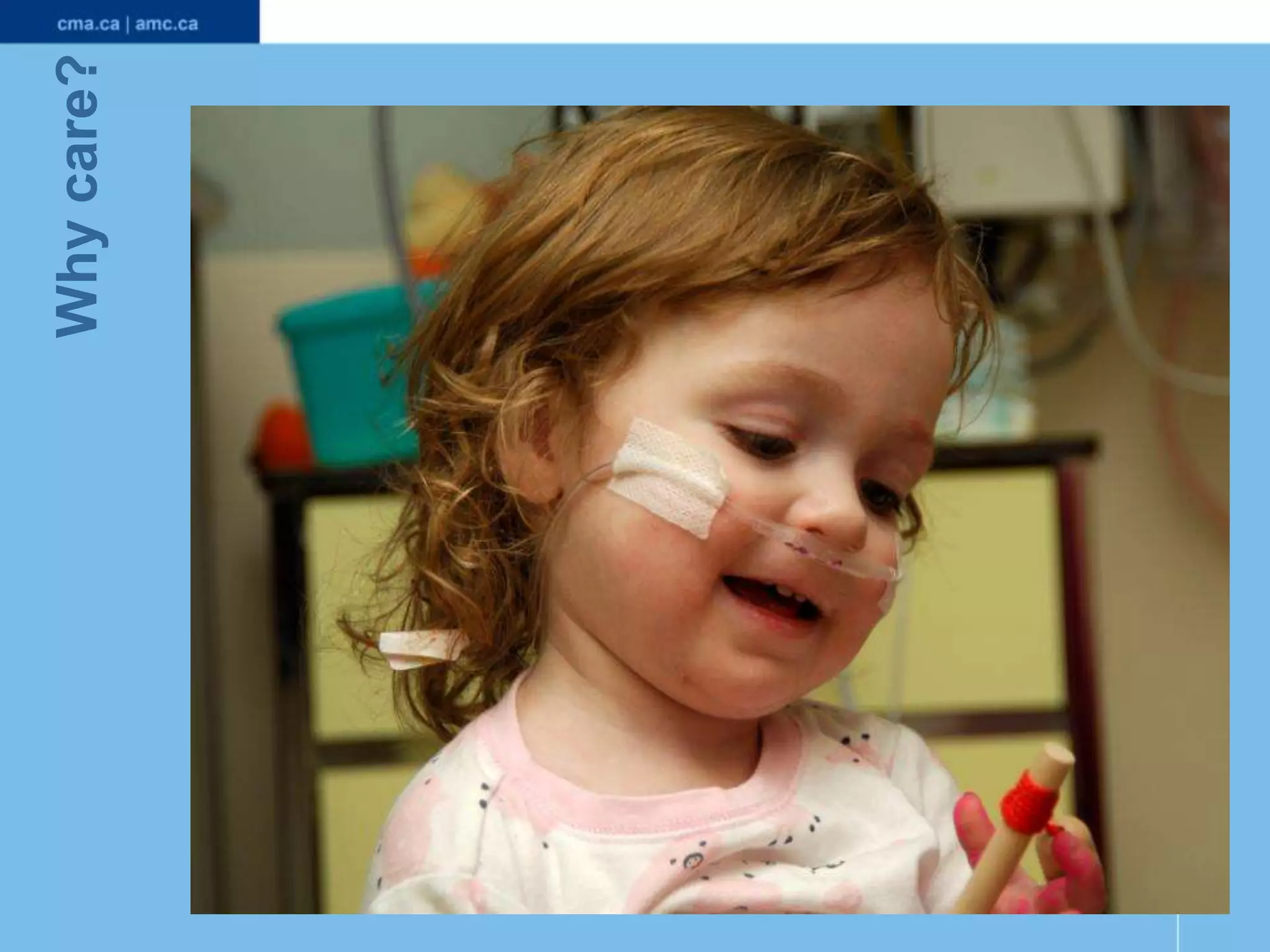
Why care?
Case study: The Political Resident
Brandon is a resident who, since starting medical
school, has kept a blog about his views on medicine,
medical education, and health care politics. Recently,
Brandon has blogged extensively about his extreme
political views regarding the upcoming election. His
residency director reads his blog and tells him that he
must delete his posts and can no longer write new
ones, as he is not only a hospital employee and a
representative of the residency program, but also a
professional who must represent himself accordingly
American College of Medical Schools Digital Literacy Toolkit
Discussion
Is it reasonable for the residency program director to tell this resident that
this non-medical blog should be removed? The residency director tells this
resident to remove his blog. What would an appropriate response be?
 A. What a resident does on his own time is his business.
 B. He should have asked him to remove the offending posts and be
careful in the future.
 C. When you are a student and resident, you are ultimately under the
guidance of your dean and residency director.

12
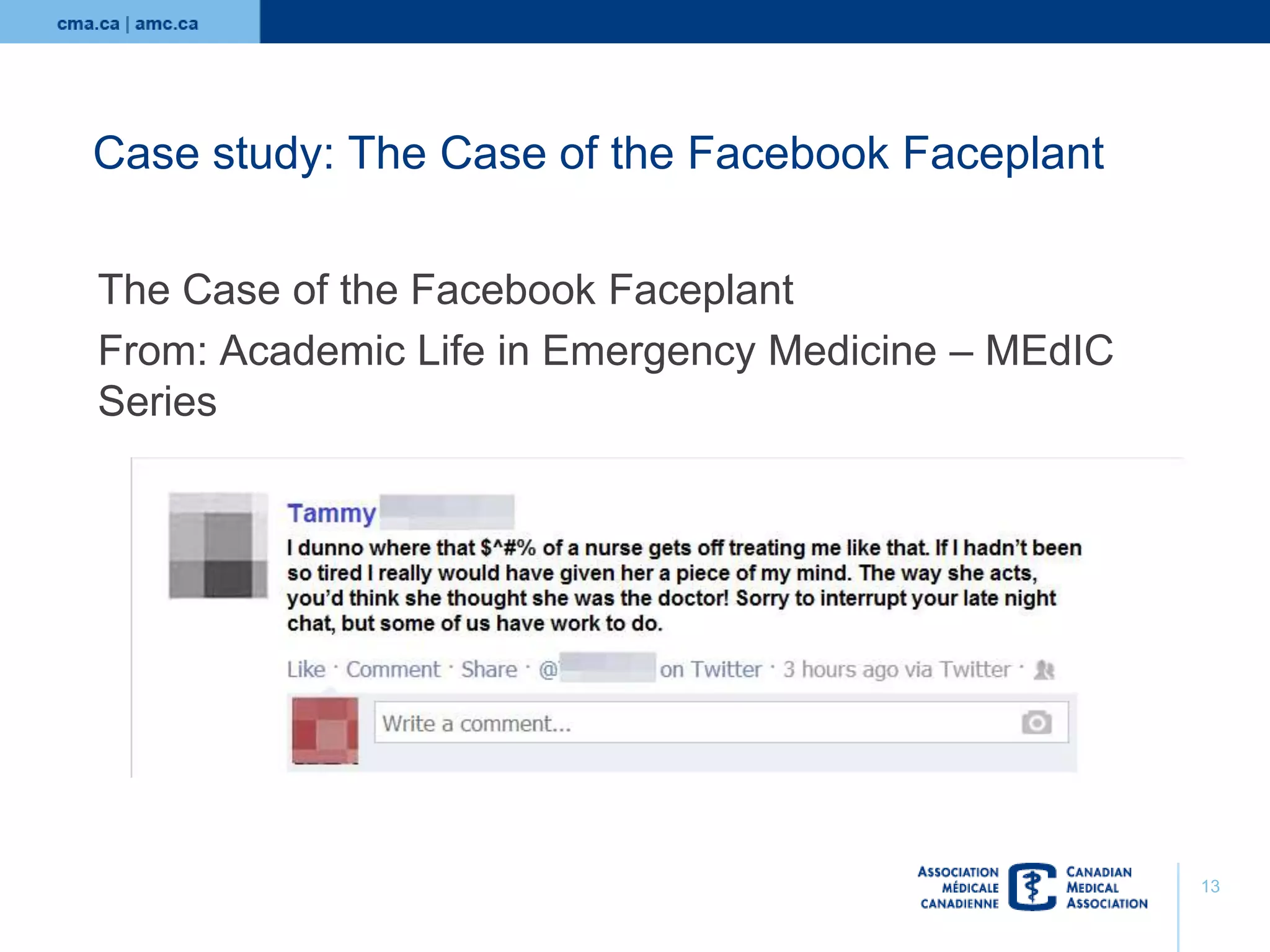
Case study: The Case of the Facebook Faceplant
The Case of the Facebook Faceplant
From: Academic Life in Emergency Medicine – MEdIC
Series

13
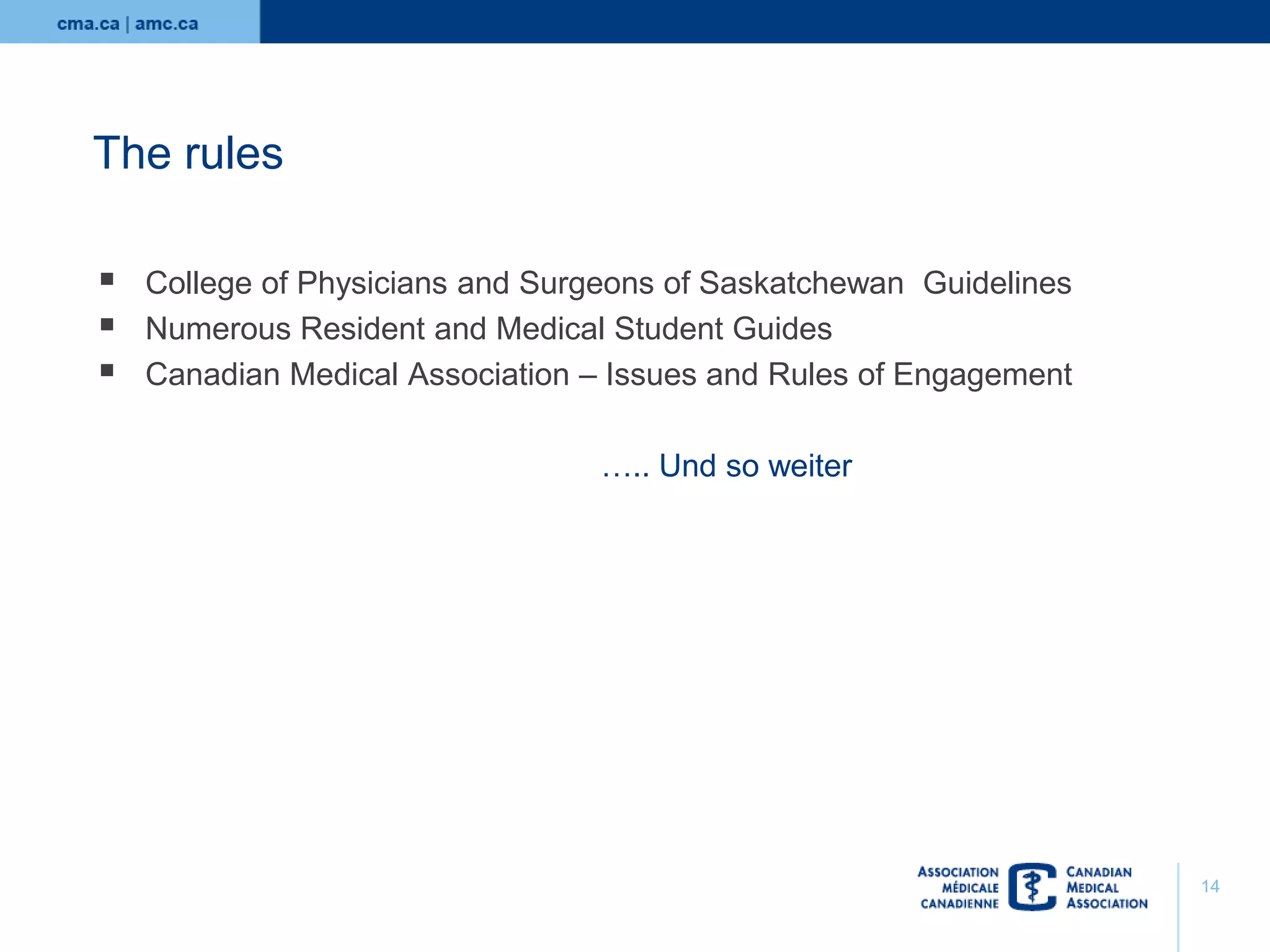
The rules




College of Physicians and Surgeons of Saskatchewan Guidelines
Numerous Resident and Medical Student Guides
Canadian Medical Association – Issues and Rules of Engagement
….. Und so weiter

14
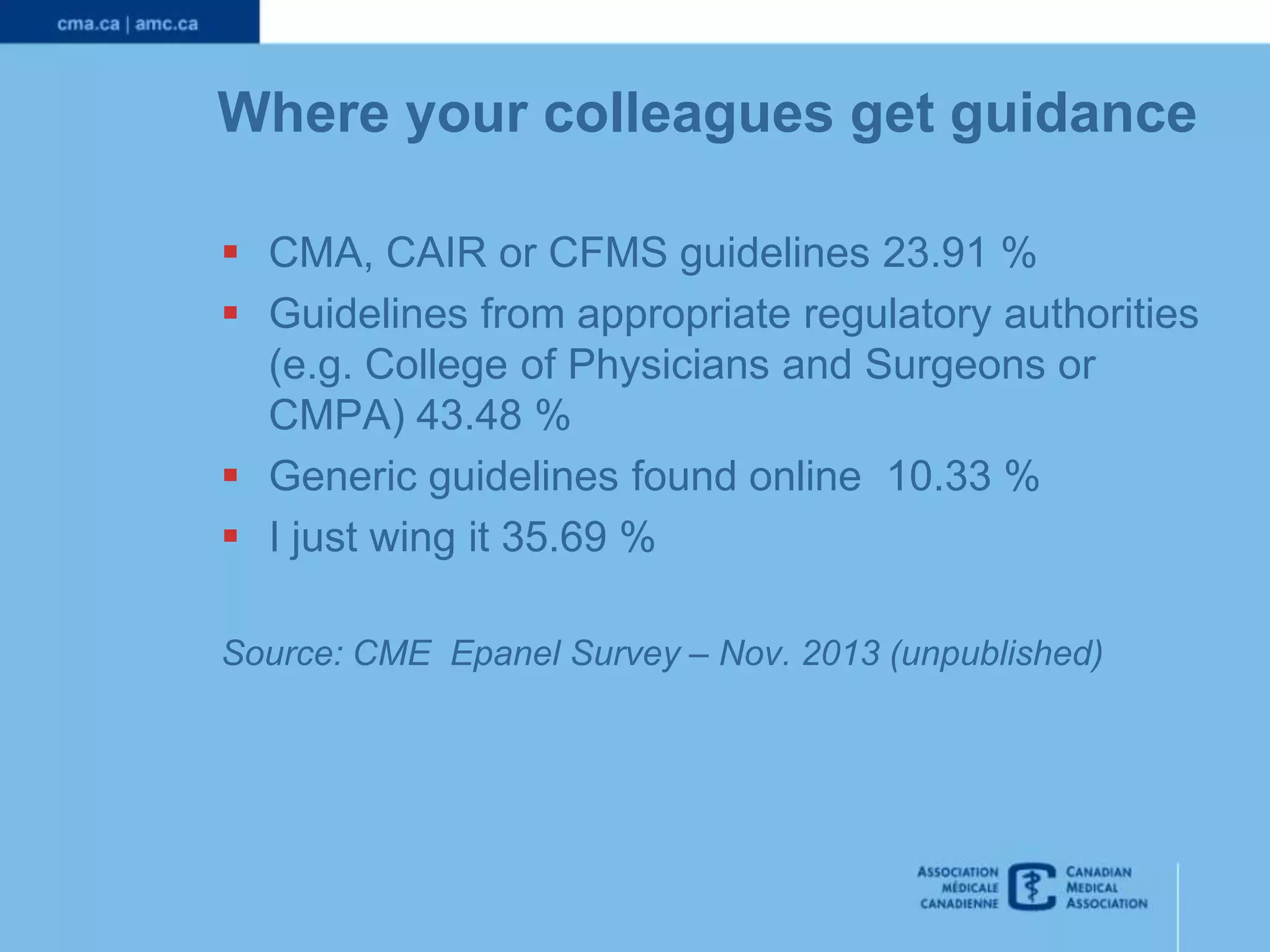
Where your colleagues get guidance
 CMA, CAIR or CFMS guidelines 23.91 %
 Guidelines from appropriate regulatory authorities
(e.g. College of Physicians and Surgeons or
CMPA) 43.48 %
 Generic guidelines found online 10.33 %
 I just wing it 35.69 %
Source: CME Epanel Survey – Nov. 2013 (unpublished)
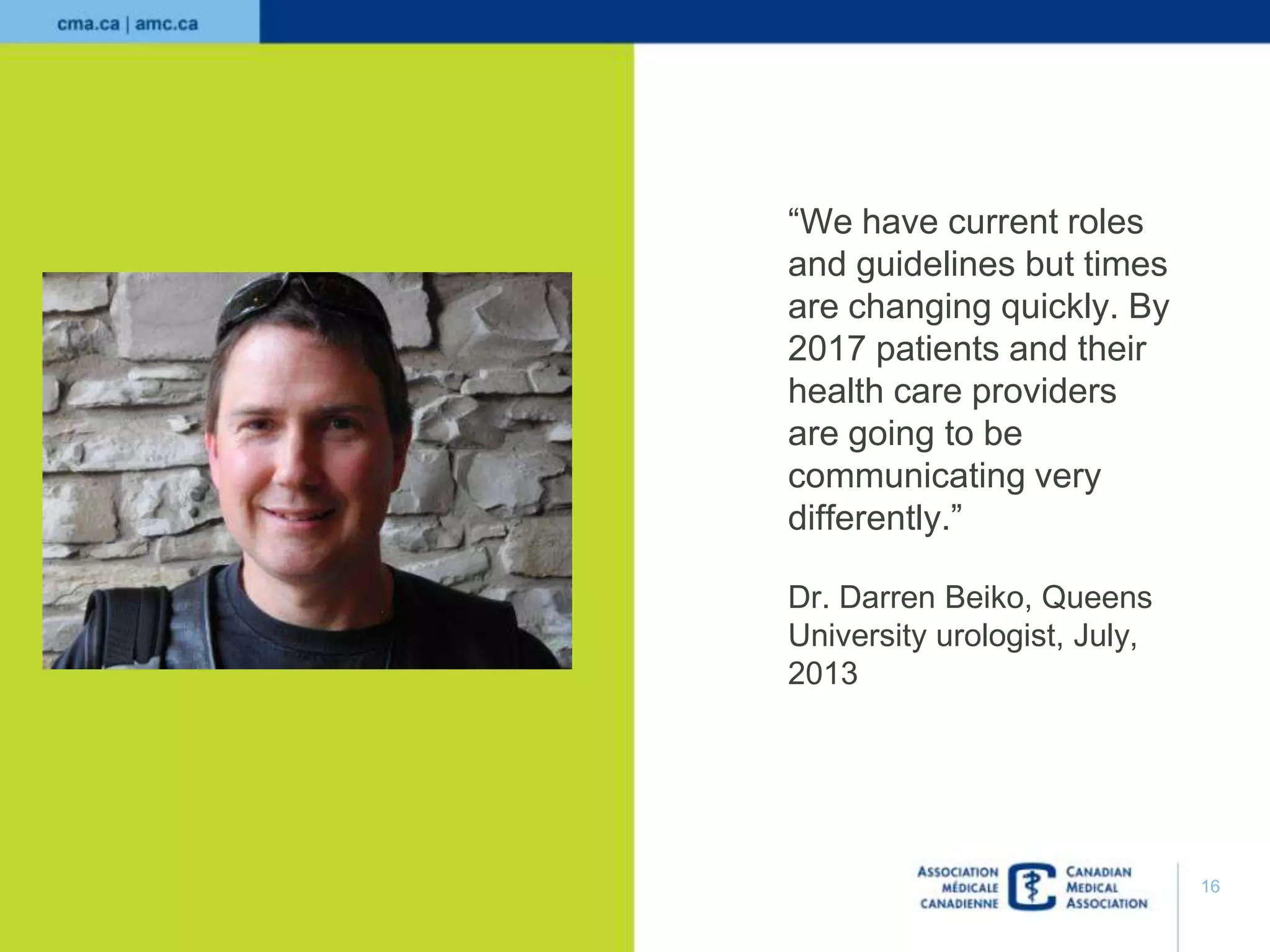
“We have current roles
and guidelines but times
are changing quickly. By
2017 patients and their
health care providers
are going to be
communicating very
differently.”
Dr. Darren Beiko, Queens
University urologist, July,
2013

16
The rules - translated
“Don’t be banal, self-promote excessively, share confidential material
(especially about patients), be a troll, break the law, commit a libel, or
overdo it.”
Dr. Richard Smith, BMJ, March 1, 2012

17
The rules - translated




Don’t Lie, Don’t Pry
Don’t Cheat, Can’t Delete
Don’t Steal. Don’t Reveal



Dr. Farris Timimi, medical director, Mayo Clinic Center for Social Media, April
5, 2012

18
Key elements of the rules
* Apply same principles of professionalism that apply in person
* Respect patient confidentiality
“Social media should be treated as a public forum akin to an op-ed in a
newspaper or a lecture. Anything that would be inappropriate to share in
these more traditional outlets should be considered inappropriate to share
online.”
CFMS Guide to Medical Professionalism:
Recommendations for Social Media

19
CMA guidance



Rules of Engagement
 Understand technology and audience
 Be transparent
 Respect others
 Focus on areas of expertise

20
The challenges










Impact to patients
Liability
Privacy
Ethics
Boundaries
Time theft
Reputation
Compensation
What not to do
Chicago Doctor Accused of Posting Photos of Intoxicated Patient
Aug. 20, 2013 (AP)
By ALANA ABRAMSON A former Northwestern University student claims
that after she was admitted to an Illinois hospital for extreme intoxication, a
doctor there took photos of her and posted them to social media sites with
commentary about her condition.
Elena Chernyakova filed suit in the Cook County Circuit Court against Dr.
Vinaya Puppala, the Feinberg School of Medicine and the Northwestern
Memorial Hospital on Aug. 15, claiming invasion of privacy and infliction of
emotional distress. Puppala is a fellow in the Multidisciplinary Pain Medicine
Fellowship at Feinberg, which works in conjunction with Northwestern
Memorial Hospital, according to court documents.

22
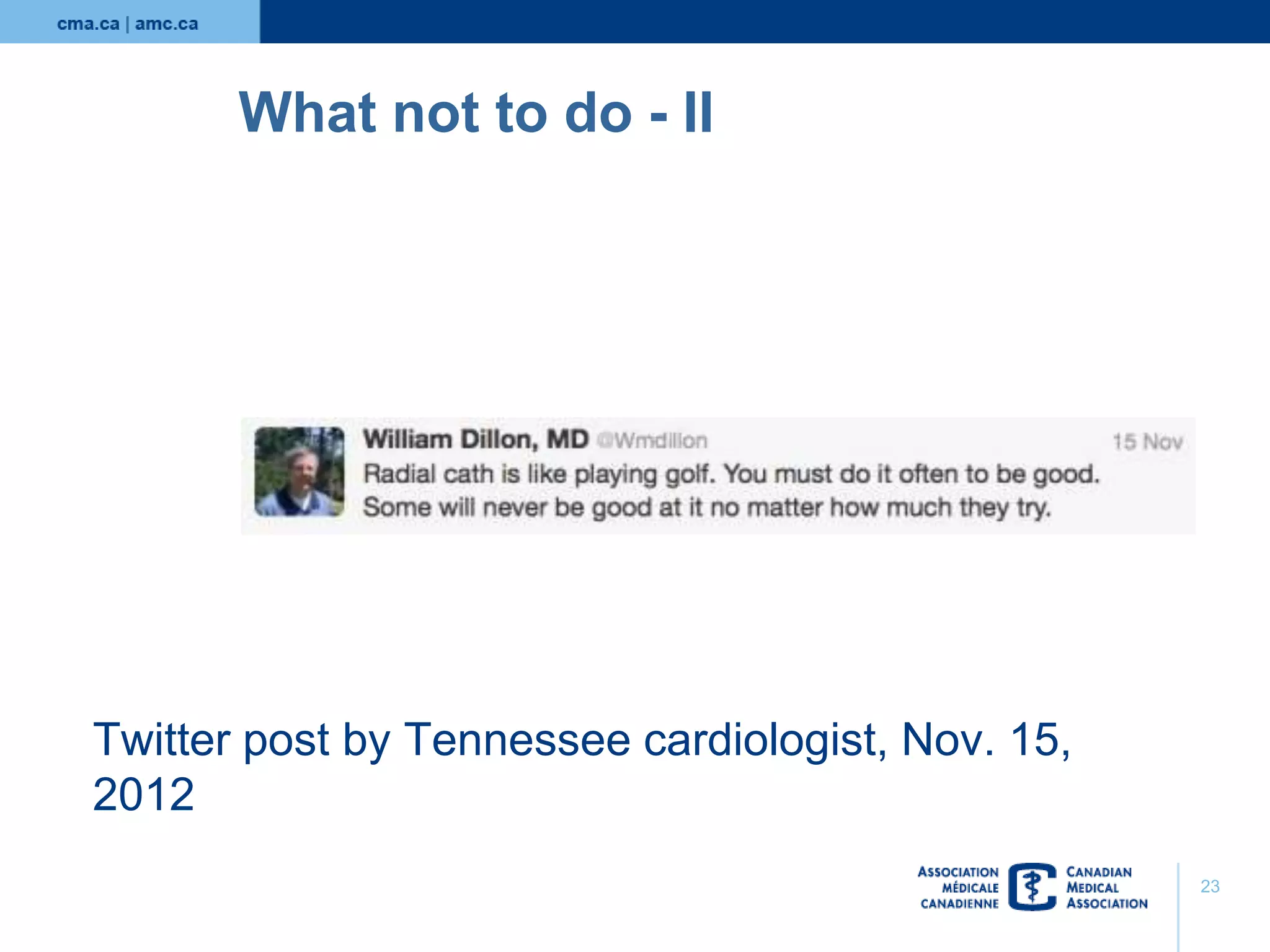
What not to do - II

Twitter post by Tennessee cardiologist, Nov. 15,
2012
23
The Boundary Fallacy

Keeping a boundary between
professional and personal life on social
media is “operationally impossible,
lacking in-agreement among active
physician social media users,
inconsistent with the concept of
professional identity, and potentially
harmful to physician and patients.”
Rather than eliminating boundaries and
“suggesting anything goes,” physicians
should just ask themselves whether
what they are posting on social media
is appropriate for a physician in a
public space – with the issue of the
content being professional or personal
being irrelevant.

“Social Media and Physicians’ Online Identity Crisis”
published in JAMA, Aug. 14 (v.310, no: 6, 581-582).

24
Why consider using social media







To stay informed
As a learning tool in medical education
Communicate (engage) with peers and patients
Disseminate information
Advocate for/against something
Because if you decide not to use social media, your decision should be
based on sound knowledge about what you are choosing not to use

25
Why consider using social media (post-graduate)
For public health purposes (e.g. tracking epidemics or spread of new
pathogens)
 To show your clinical technique on YouTube
 For public health purposes (e.g. tracking epidemics or spread of new
pathogens)
 To help get a job
 To deliver clinical care!!!

26
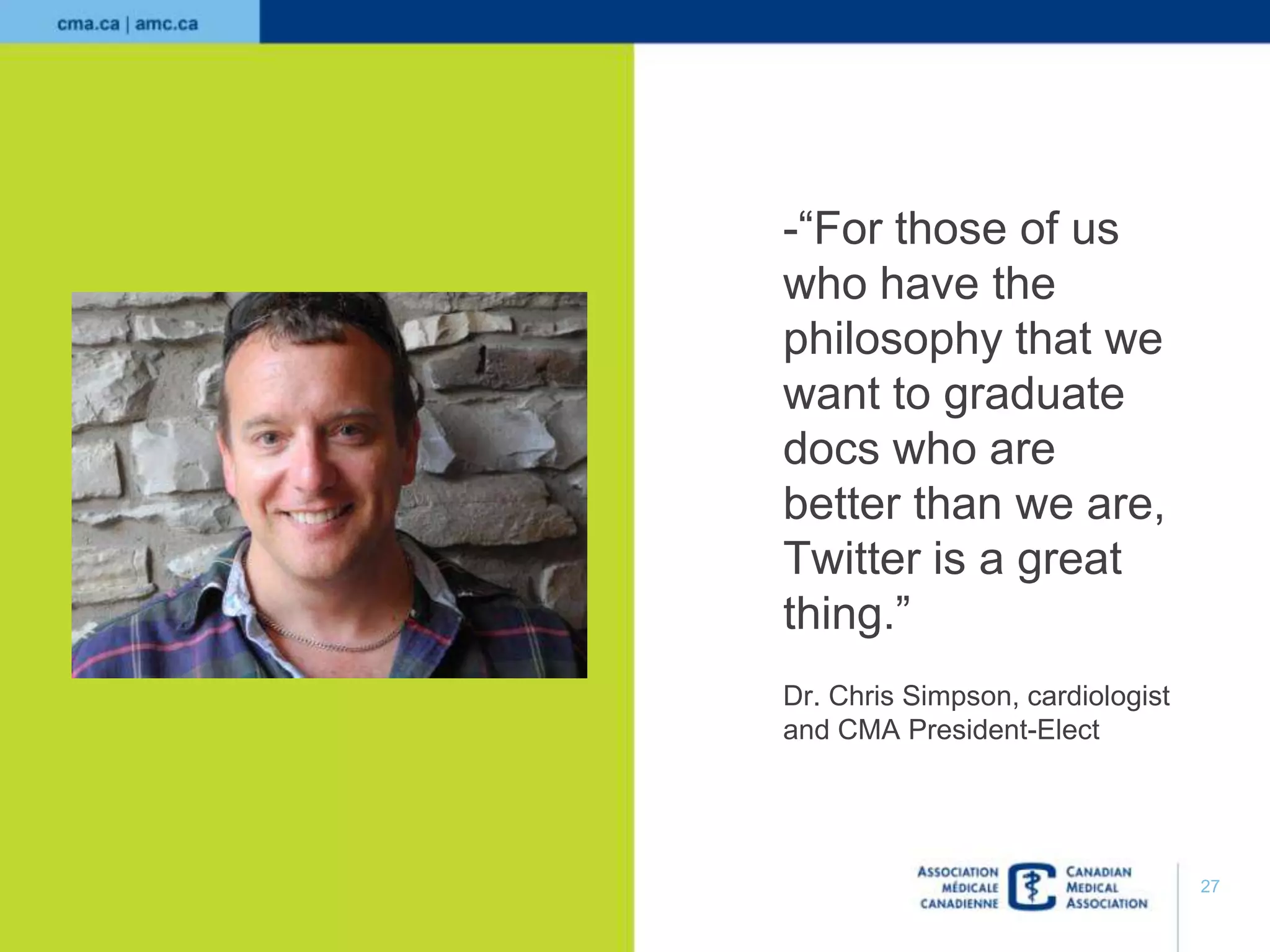
-“For those of us
who have the
philosophy that we
want to graduate
docs who are
better than we are,
Twitter is a great
thing.”
Dr. Chris Simpson, cardiologist
and CMA President-Elect

27
Using social media in residency: Suggestions





Facebook presence for colleagues etc
LinkedIn account to:
 Build network for future career
 Follow discussion forums on medical education
Twitter account to:
 Develop your list of people, journals and other accounts to follow
 Watch (and engage) medical Twitter community (e.g. #hcsmca,
#hcsm)
 Follow and engage your professors

28
Social media and you
Students come to medicine with a relatively self-focused view of their
networked world, and don’t yet understand how they fit into the broader
networked world. As they mature professionally, they recognize that they
are part of a broader community, which brings accountability. This
progression has real importance when we expose ourselves to the great
wide open.
Dr. Bryan Vartabedian, Aug. 14 (Wing of Zock via. 33charts)

29
An expert Canadian physician voice


Dr. Ali Jalali, teaching chair, faculty of medicine, University of Ottawa

30
▸ Questions?

31
Professional use of social media for residents

Professional use of social media for residents

  • 1.
    Professional use ofsocial media for residents Nov. 28, 2013 Pat Rich @cmaer 1
  • 2.
    Medical residents andsocial media – A perspective When I was a child, I spoke as a child, I understood as a child, I thought as a child; but when I became a man, I put away childish things 1 Corinthians 13
  • 3.
    Who I am PatRich – Managing Editor, CMA Member Communications Experienced health care communicator with a keen interest and involvement in the use of social media tools in medicine and health care and believers in the value of these tools WHO I AM NOT Physician Academic 3
  • 4.
    Social media “policies”by academic medical centers or medical schools point out the “don’t do this, don’t do that”, but let’s also focus on what the trainees CAN do. Let’s consider how we can IMPROVE our current health care system and ultimately the care of patients with innovative uses of social media and social networking … Dr. Alex Djuricich, Association Dean for CME, University of Indiana School of Medicine 4
  • 5.
    I think thereare too many people on the Web offering advice to you on how to use social media. Most of this advice is just regurgitated advice from people you may never have heard of before, …You really don’t need “How To” tips on blogging or Twitter. Oh, I’m confident that you’ll be told otherwise – but those folks, well-intentioned as they may be, don’t understand that you’re smarter than that. Rather than learn bad habits from the get-go, take advantage of your lack of experience. It’s okay to make mistakes that don’t cause harm and violate the privacy and dignity of others. From: Physician Social Media: Has Advice About It Become a Crock? Yes @philbaumann, Jan. 1, 2013 5
  • 6.
    What is SocialMedia?      Extension of every day interaction Conversations & exchange Communities of shared interest Tools for innovation Integrates technology
  • 7.
    Why consider socialmedia?      To stay informed Communicate (engage) with peers and patients Disseminate information Advocate for/against something Because if you decide not to use social media, your decision should be based on sound knowledge about what you are choosing not to use
  • 8.
    A changing environment    Newhealth information technology tools Engaged patients Collaborative, team-based care 8
  • 9.
    A changing environment       Avariety of forces are conspiring to redefine the physician: tech | information | health 2.0. We must understand our evolving role Reality of the networked world: social communication will define the way MDs engage, learn and communicate The most important decision a physician will make is who and what to listen to The internet has changed the way patients see doctors, their diseases and themselves Med students are at a very unique point in med history: Between a collapsing analog age and an emerging digital age A great digital footprint will never cover for a doctor’s poor care Dr. Bryan Vartabedian, adapted tweets from lecture to first year Baylor College of Medicine Students 9
  • 10.
  • 11.
    Case study: ThePolitical Resident Brandon is a resident who, since starting medical school, has kept a blog about his views on medicine, medical education, and health care politics. Recently, Brandon has blogged extensively about his extreme political views regarding the upcoming election. His residency director reads his blog and tells him that he must delete his posts and can no longer write new ones, as he is not only a hospital employee and a representative of the residency program, but also a professional who must represent himself accordingly American College of Medical Schools Digital Literacy Toolkit
  • 12.
    Discussion Is it reasonablefor the residency program director to tell this resident that this non-medical blog should be removed? The residency director tells this resident to remove his blog. What would an appropriate response be?  A. What a resident does on his own time is his business.  B. He should have asked him to remove the offending posts and be careful in the future.  C. When you are a student and resident, you are ultimately under the guidance of your dean and residency director. 12
  • 13.
    Case study: TheCase of the Facebook Faceplant The Case of the Facebook Faceplant From: Academic Life in Emergency Medicine – MEdIC Series 13
  • 14.
    The rules    College ofPhysicians and Surgeons of Saskatchewan Guidelines Numerous Resident and Medical Student Guides Canadian Medical Association – Issues and Rules of Engagement ….. Und so weiter 14
  • 15.
    Where your colleaguesget guidance  CMA, CAIR or CFMS guidelines 23.91 %  Guidelines from appropriate regulatory authorities (e.g. College of Physicians and Surgeons or CMPA) 43.48 %  Generic guidelines found online 10.33 %  I just wing it 35.69 % Source: CME Epanel Survey – Nov. 2013 (unpublished)
  • 16.
    “We have currentroles and guidelines but times are changing quickly. By 2017 patients and their health care providers are going to be communicating very differently.” Dr. Darren Beiko, Queens University urologist, July, 2013 16
  • 17.
    The rules -translated “Don’t be banal, self-promote excessively, share confidential material (especially about patients), be a troll, break the law, commit a libel, or overdo it.” Dr. Richard Smith, BMJ, March 1, 2012 17
  • 18.
    The rules -translated    Don’t Lie, Don’t Pry Don’t Cheat, Can’t Delete Don’t Steal. Don’t Reveal  Dr. Farris Timimi, medical director, Mayo Clinic Center for Social Media, April 5, 2012 18
  • 19.
    Key elements ofthe rules * Apply same principles of professionalism that apply in person * Respect patient confidentiality “Social media should be treated as a public forum akin to an op-ed in a newspaper or a lecture. Anything that would be inappropriate to share in these more traditional outlets should be considered inappropriate to share online.” CFMS Guide to Medical Professionalism: Recommendations for Social Media 19
  • 20.
    CMA guidance  Rules ofEngagement  Understand technology and audience  Be transparent  Respect others  Focus on areas of expertise 20
  • 21.
    The challenges         Impact topatients Liability Privacy Ethics Boundaries Time theft Reputation Compensation
  • 22.
    What not todo Chicago Doctor Accused of Posting Photos of Intoxicated Patient Aug. 20, 2013 (AP) By ALANA ABRAMSON A former Northwestern University student claims that after she was admitted to an Illinois hospital for extreme intoxication, a doctor there took photos of her and posted them to social media sites with commentary about her condition. Elena Chernyakova filed suit in the Cook County Circuit Court against Dr. Vinaya Puppala, the Feinberg School of Medicine and the Northwestern Memorial Hospital on Aug. 15, claiming invasion of privacy and infliction of emotional distress. Puppala is a fellow in the Multidisciplinary Pain Medicine Fellowship at Feinberg, which works in conjunction with Northwestern Memorial Hospital, according to court documents. 22
  • 23.
    What not todo - II Twitter post by Tennessee cardiologist, Nov. 15, 2012 23
  • 24.
    The Boundary Fallacy Keepinga boundary between professional and personal life on social media is “operationally impossible, lacking in-agreement among active physician social media users, inconsistent with the concept of professional identity, and potentially harmful to physician and patients.” Rather than eliminating boundaries and “suggesting anything goes,” physicians should just ask themselves whether what they are posting on social media is appropriate for a physician in a public space – with the issue of the content being professional or personal being irrelevant. “Social Media and Physicians’ Online Identity Crisis” published in JAMA, Aug. 14 (v.310, no: 6, 581-582). 24
  • 25.
    Why consider usingsocial media       To stay informed As a learning tool in medical education Communicate (engage) with peers and patients Disseminate information Advocate for/against something Because if you decide not to use social media, your decision should be based on sound knowledge about what you are choosing not to use 25
  • 26.
    Why consider usingsocial media (post-graduate) For public health purposes (e.g. tracking epidemics or spread of new pathogens)  To show your clinical technique on YouTube  For public health purposes (e.g. tracking epidemics or spread of new pathogens)  To help get a job  To deliver clinical care!!! 26
  • 27.
    -“For those ofus who have the philosophy that we want to graduate docs who are better than we are, Twitter is a great thing.” Dr. Chris Simpson, cardiologist and CMA President-Elect 27
  • 28.
    Using social mediain residency: Suggestions    Facebook presence for colleagues etc LinkedIn account to:  Build network for future career  Follow discussion forums on medical education Twitter account to:  Develop your list of people, journals and other accounts to follow  Watch (and engage) medical Twitter community (e.g. #hcsmca, #hcsm)  Follow and engage your professors 28
  • 29.
    Social media andyou Students come to medicine with a relatively self-focused view of their networked world, and don’t yet understand how they fit into the broader networked world. As they mature professionally, they recognize that they are part of a broader community, which brings accountability. This progression has real importance when we expose ourselves to the great wide open. Dr. Bryan Vartabedian, Aug. 14 (Wing of Zock via. 33charts) 29
  • 30.
    An expert Canadianphysician voice  Dr. Ali Jalali, teaching chair, faculty of medicine, University of Ottawa 30
  • 31.