WRITING EFFECTIVE POLICIES
& PROCEDURES
By: Noha Atef
TO BE COVERED
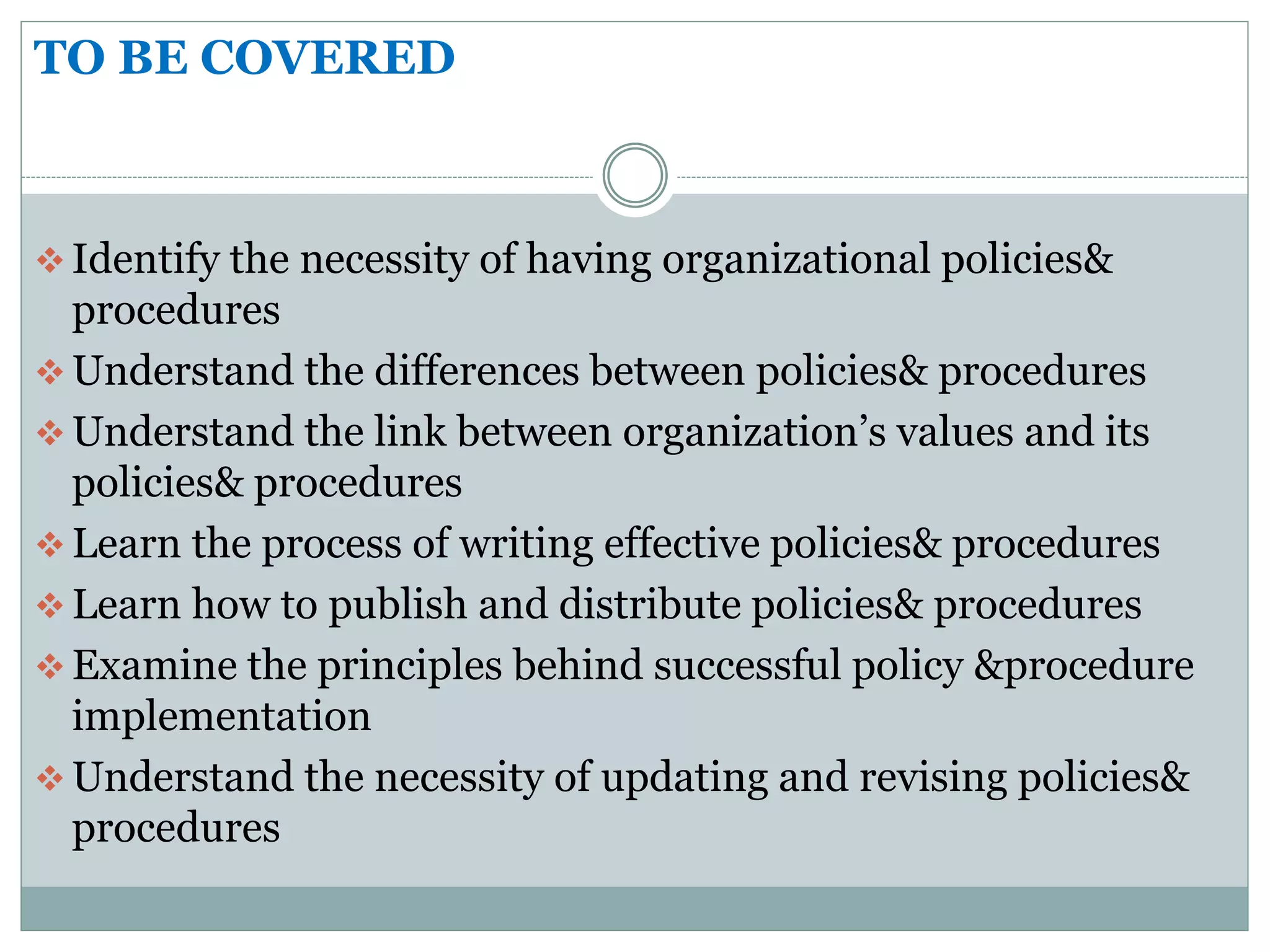
 Identify the necessity of having organizational policies&
procedures
 Understand the differences between policies& procedures
 Understand the link between organization’s values and its
policies& procedures
 Learn the process of writing effective policies& procedures
 Learn how to publish and distribute policies& procedures
 Examine the principles behind successful policy &procedure
implementation
 Understand the necessity of updating and revising policies&
procedures
DEFINITIONS OF POLICIES& PROCEDURES
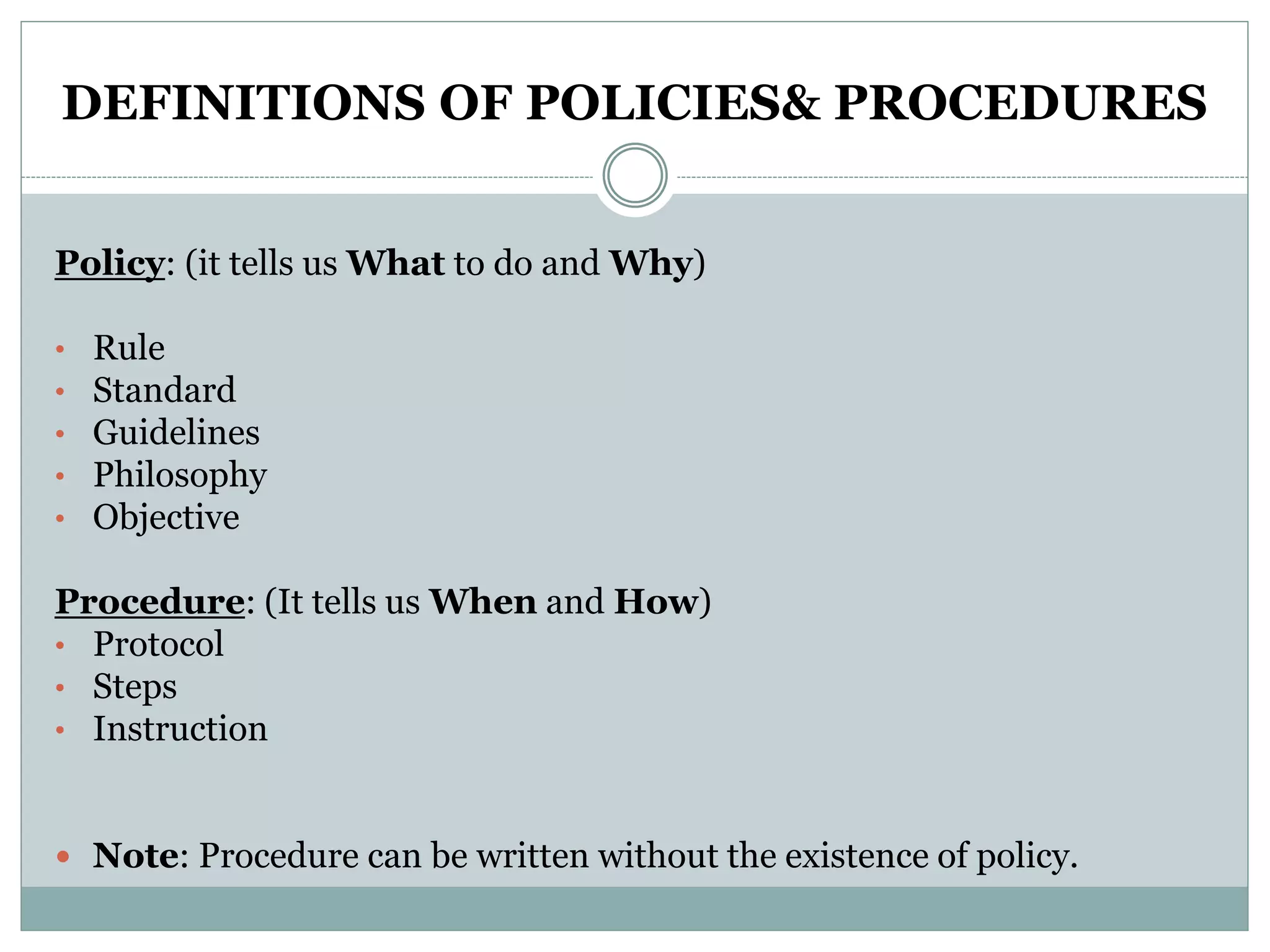
Policy: (it tells us What to do and Why)
• Rule
• Standard
• Guidelines
• Philosophy
• Objective
Procedure: (It tells us When and How)
• Protocol
• Steps
• Instruction
 Note: Procedure can be written without the existence of policy.
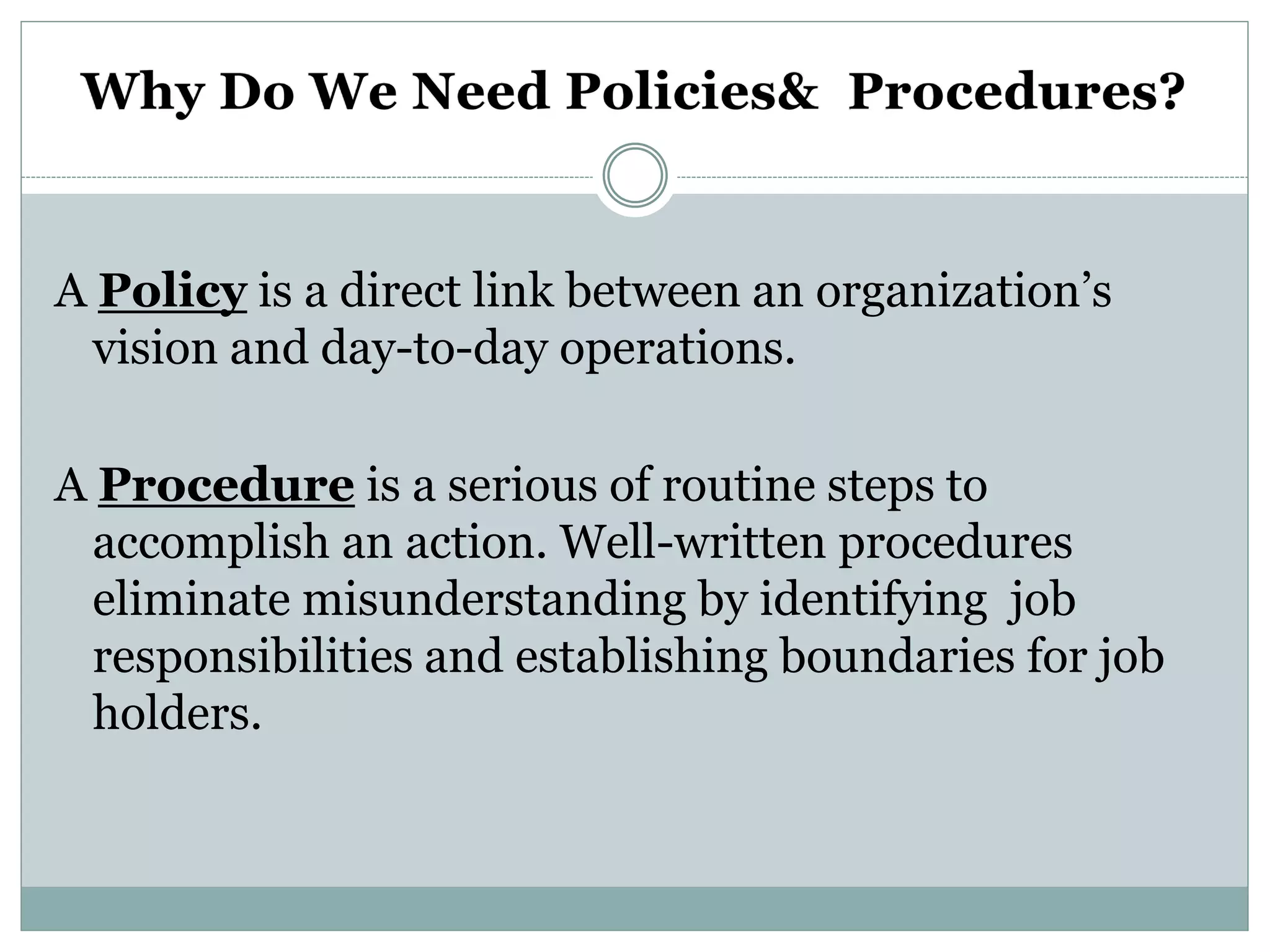
A Policy is a direct link between an organization’s
vision and day-to-day operations.
A Procedure is a serious of routine steps to
accomplish an action. Well-written procedures
eliminate misunderstanding by identifying job
responsibilities and establishing boundaries for job
holders.
DIFFERENCE
BETWEEN
POLICIES
&
PROCEDURES
POLICIES
 Major in nature
 Identify company rules
 Explain why they exist
 Tell when the rule applies
 Describe who it covers
 Describe the consequences
 Are described using simple
sentences and paragraphs.
PROCEDURES
•Identify specific actions or
steps
• Explain when to take actions
•Describe alternatives
•Include warnings and cautions
•Give examples
•Show how to complete forms
•Are normally written using and
outline format.
BENEFITS OF
POLICIES &
PROCEDURES
Employees are provided with information that allows them freedom to
carry out their jobs and make decisions within defined boundaries.
Policies and procedures enable the workforce to clearly understand
individual and team responsibilities.
Employees understand the constraints of their job without using a “
trial and error” approach.
Clearly written policies and procedures allow managers to exercise
control by exception rather than “ micro manage” their staff.
Policies provide guidance on how to handle issues properly.
Sticking to policies and procedures can help reduce the chances of
things going wrong and ensure consistency and professionalism
How Policies & Procedures
Flow From an Organization’s
Basic Values?
DEFINITION
OF
VALUES.
Values
Organizational values defines the
acceptable standards which govern the
behavior of the individuals within the
organization, and it must be in line with
its mission and vision.
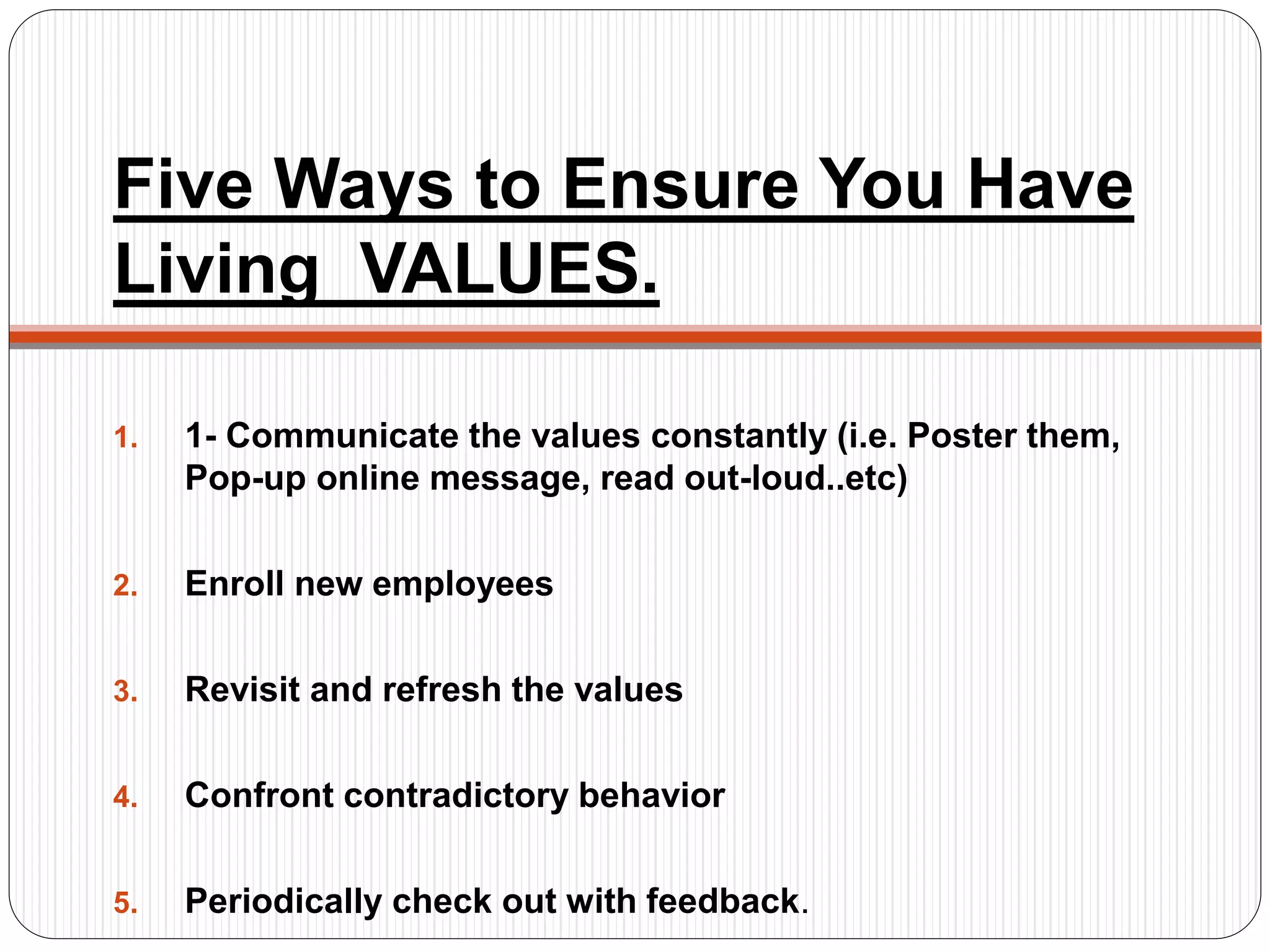
Five Ways to Ensure You Have
Living VALUES.
1. 1- Communicate the values constantly (i.e. Poster them,
Pop-up online message, read out-loud..etc)
2. Enroll new employees
3. Revisit and refresh the values
4. Confront contradictory behavior
5. Periodically check out with feedback.
TYPES
OF
POLICIES
BOARD Policy
(high level policy)
 They relate to the governance
of the organisation, not the
day-to-day operations
 It does not require a
procedures
 They are related to mission,
strategic plan, external
communication, code of ethics,
organizational values, issues for
staff and compliance with
legislation.
MANAGEMENT Policy
 Established by the
management team
 It relates to day-to-day
operations
 Management use Board
Policies to guide them in the
development of Management
Policies.
 They are related to health,
safety, admin, finance, PR,
privacy, confidentiality, and
ethics.
Steps To Create
Policy
GUIDELINES TO DETERMINE THE NECESSITY FOR POLICIES
A Policy is necessary:
 If the actions of employees indicate confusion about the most appropriate way
to behave
 If guidance is needed about the most suitable way to handle various situations
 When needed to protect the company legally
 To keep the company in compliance with governmental policies and laws
 To establish consistent work standards, rules, and regulations
 To provide consistent and fair treatment for employees
GUIDELINES TO DETERMINE THE NECESSITY FOR
PROCEDURES
A Procedure is necessary when a process
Is lengthy (i.e. year end inventory)
Is complex (i.e. benefits administration)
Is routine, but it is essential that everyone strictly follows rules (i.e. payroll)
Demands consistency (i.e. handling a refund request)
Involves documentation (i.e. conducting appraisals)
Involves a significant change (i.e. installing a new computer system)
Has serious consequence if done wrong (i.e. safety guidelines)
DEVELOPING A POLICY OR PROCEDURE
1- Articulate the Goal
2- Gather Information (pre-writing research)
2.1 Conduct interview with managers and employees regarding current practice
and ideas
2.2 A literature search on the topic of writing policies and procedures
2.3 Internet search for industry specific example policies and procedures
3- Develop and Write
4- Review
5- Obtain Management Support
6- Obtain Legal Review
7- Implement
8- Decide How you will Communicate
9- Interpret and Integrate
Helpful Hints when
Writing Policies &
Procedures
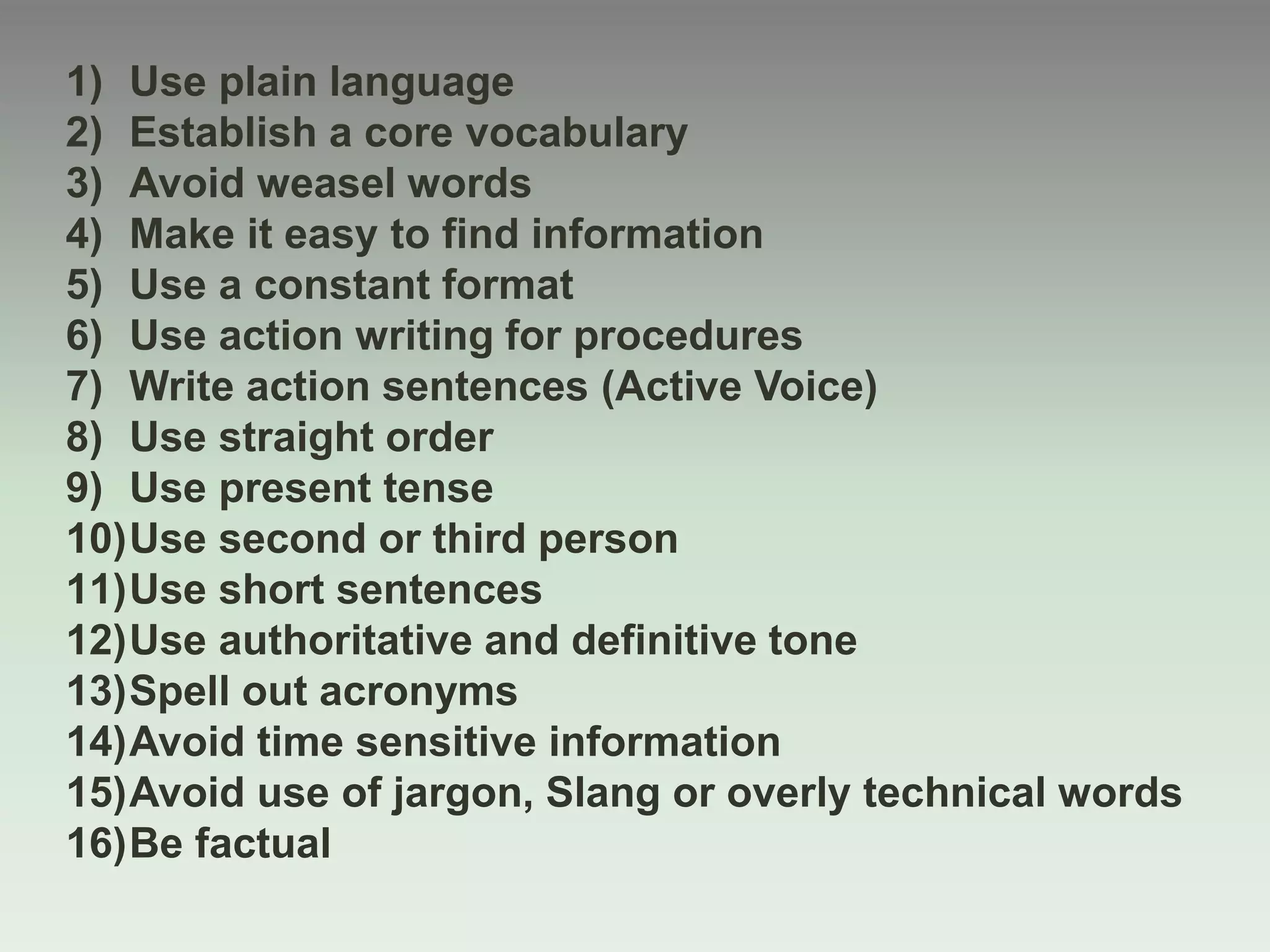
1) Use plain language
2) Establish a core vocabulary
3) Avoid weasel words
4) Make it easy to find information
5) Use a constant format
6) Use action writing for procedures
7) Write action sentences (Active Voice)
8) Use straight order
9) Use present tense
10)Use second or third person
11)Use short sentences
12)Use authoritative and definitive tone
13)Spell out acronyms
14)Avoid time sensitive information
15)Avoid use of jargon, Slang or overly technical words
16)Be factual
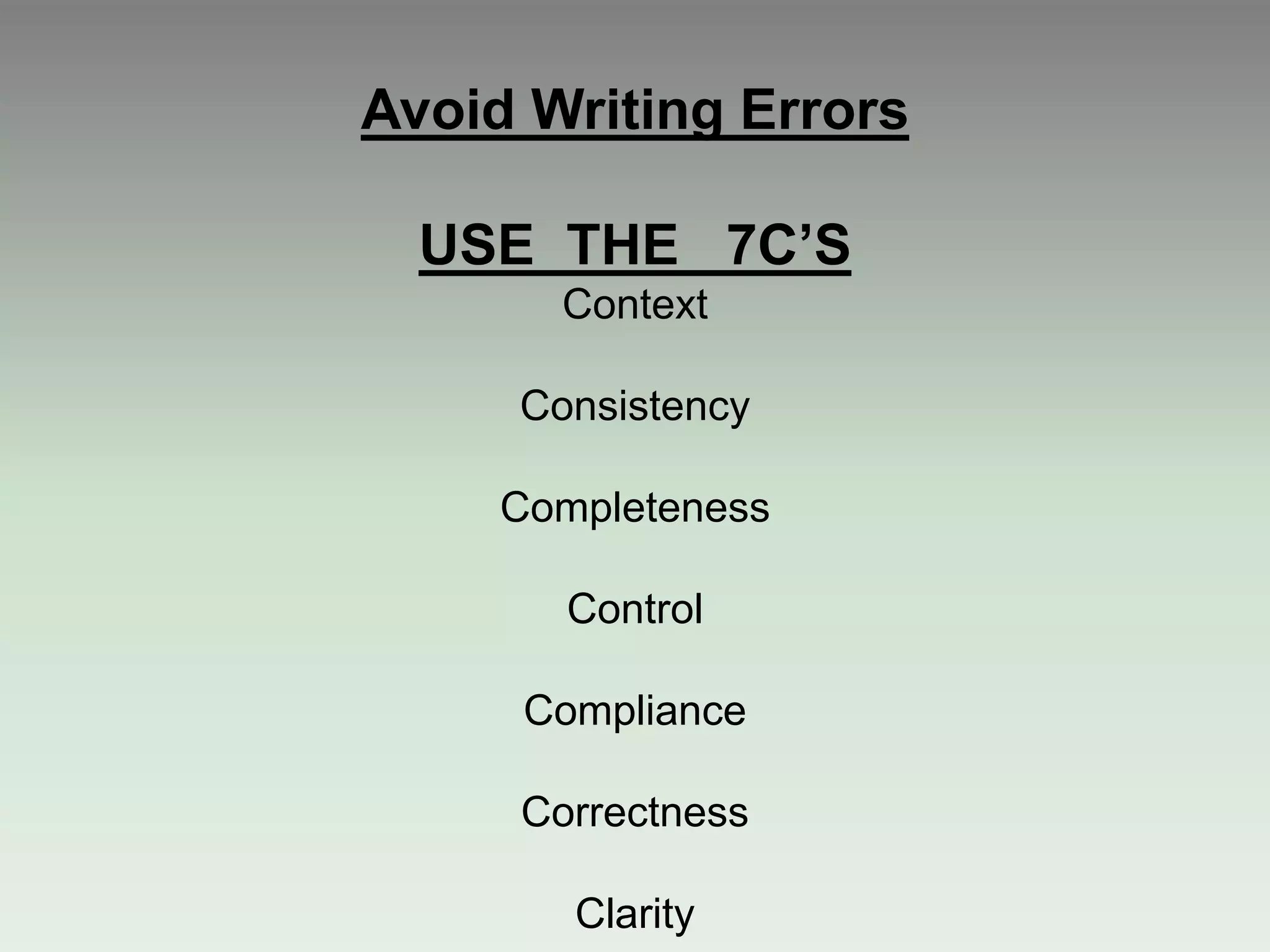
Avoid Writing Errors
USE THE 7C’S
Context
Consistency
Completeness
Control
Compliance
Correctness
Clarity
Note:
The most common format was developed by Stephan Page
and presented in his book:” Writing Exceptional Policies&
Procedures”
WRITING FORMAT
Use logical, structured format
A modular format allows for quick
and easy modification
Readers should know what to
expect
Most readers need to find
information quickly.
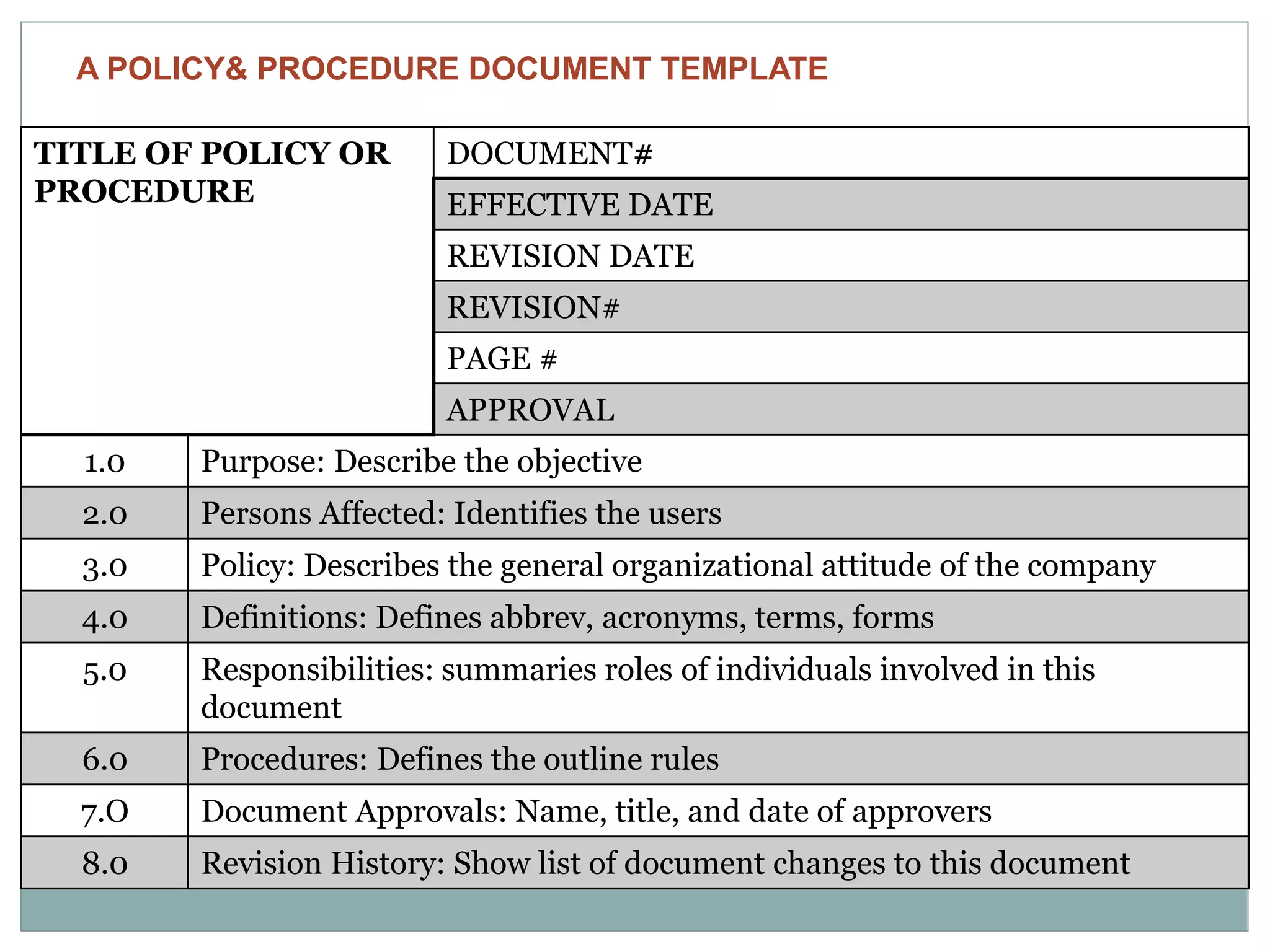
DOCUMENT#TITLE OF POLICY OR
PROCEDURE EFFECTIVE DATE
REVISION DATE
REVISION#
PAGE #
APPROVAL
Purpose: Describe the objective1.0
Persons Affected: Identifies the users2.0
Policy: Describes the general organizational attitude of the company3.0
Definitions: Defines abbrev, acronyms, terms, forms4.0
Responsibilities: summaries roles of individuals involved in this
document
5.0
Procedures: Defines the outline rules6.0
Document Approvals: Name, title, and date of approvers7.O
Revision History: Show list of document changes to this document8.0
A POLICY& PROCEDURE DOCUMENT TEMPLATE
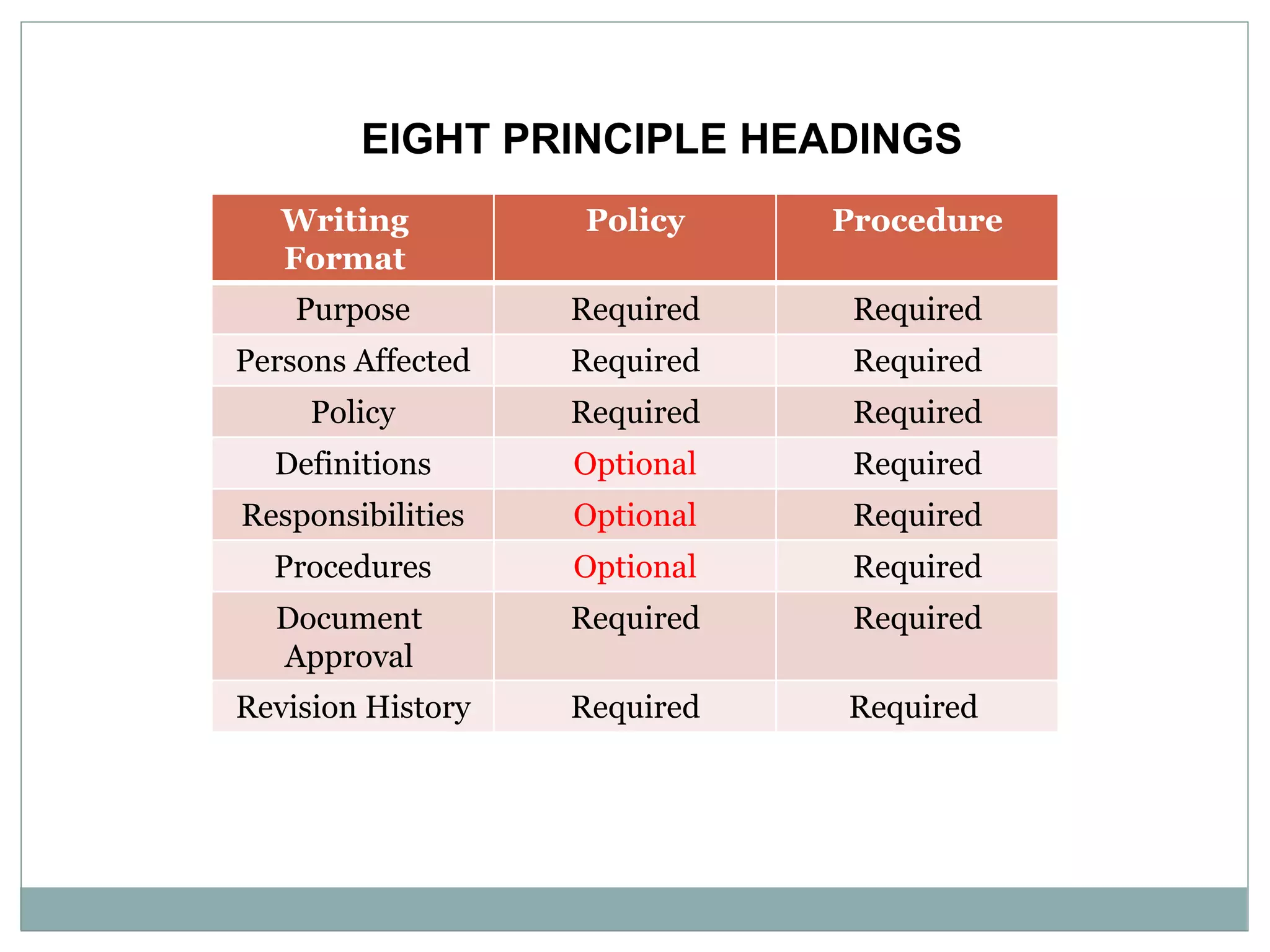
ProcedurePolicyWriting
Format
RequiredRequiredPurpose
RequiredRequiredPersons Affected
RequiredRequiredPolicy
RequiredOptionalDefinitions
RequiredOptionalResponsibilities
RequiredOptionalProcedures
RequiredRequiredDocument
Approval
RequiredRequiredRevision History
EIGHT PRINCIPLE HEADINGS
WHO SHOULD WRITE PROCEDURES?
Ideally procedures should be written by team and include some of the following
 People who will perform the job
People who will perform maintenance on equipment involved in the procedure
Engineers who designed the equipment
Technical writers
Safety personnel
Environmental personnel
Vendors
Suppliers
Contractors
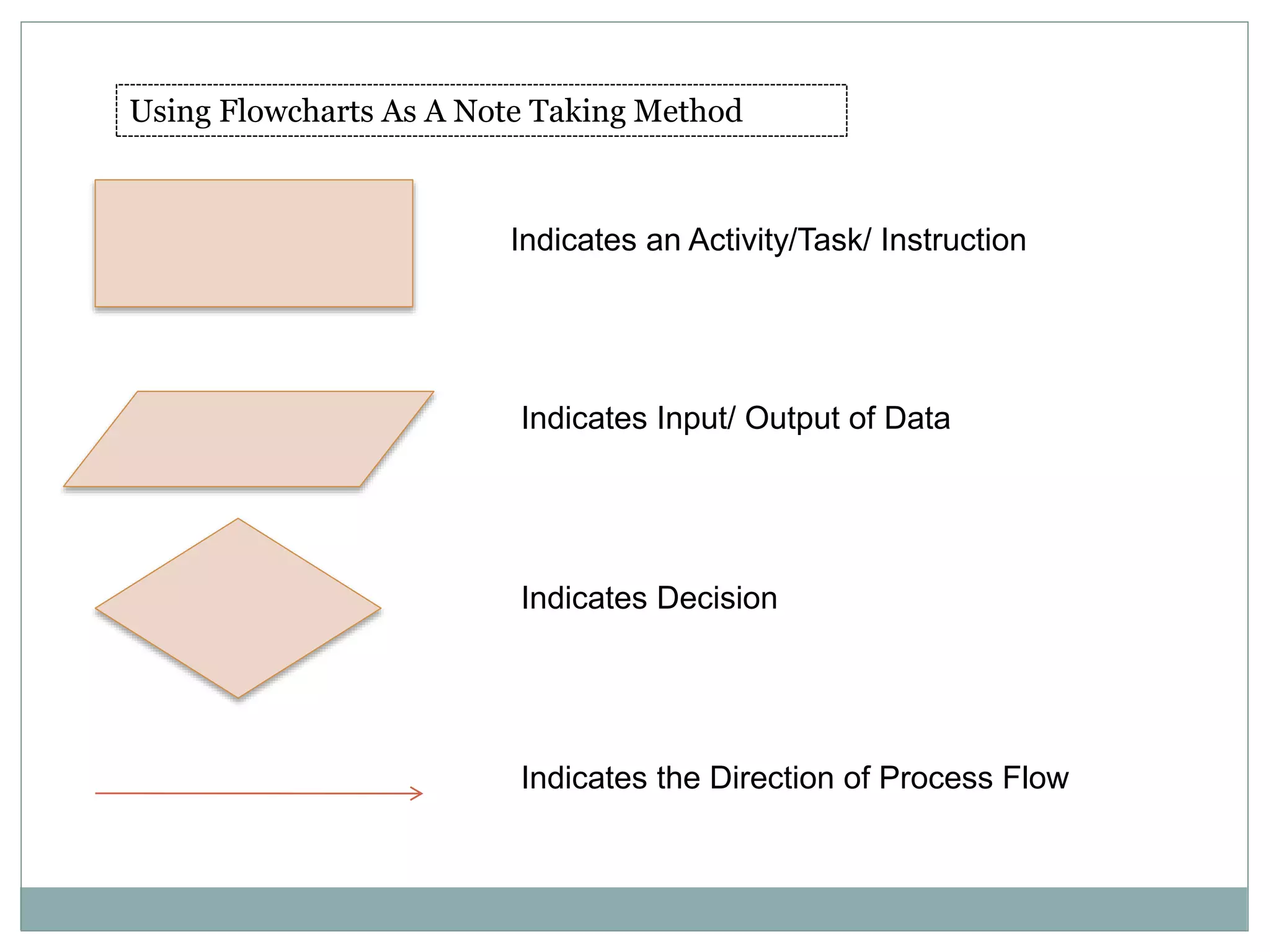
Using Flowcharts As A Note Taking Method
Indicates an Activity/Task/ Instruction
Indicates Input/ Output of Data
Indicates Decision
Indicates the Direction of Process Flow
Identify and involve other stakeholder in writing the procedure
Gather any pertinent background information i.e. interview
staff who are familiar with similar activities to learn from past
experiences
Identify applicable technical, regulatory and administrative
requirements through reading documents and manuals
Review any possible hazards associated with the activity
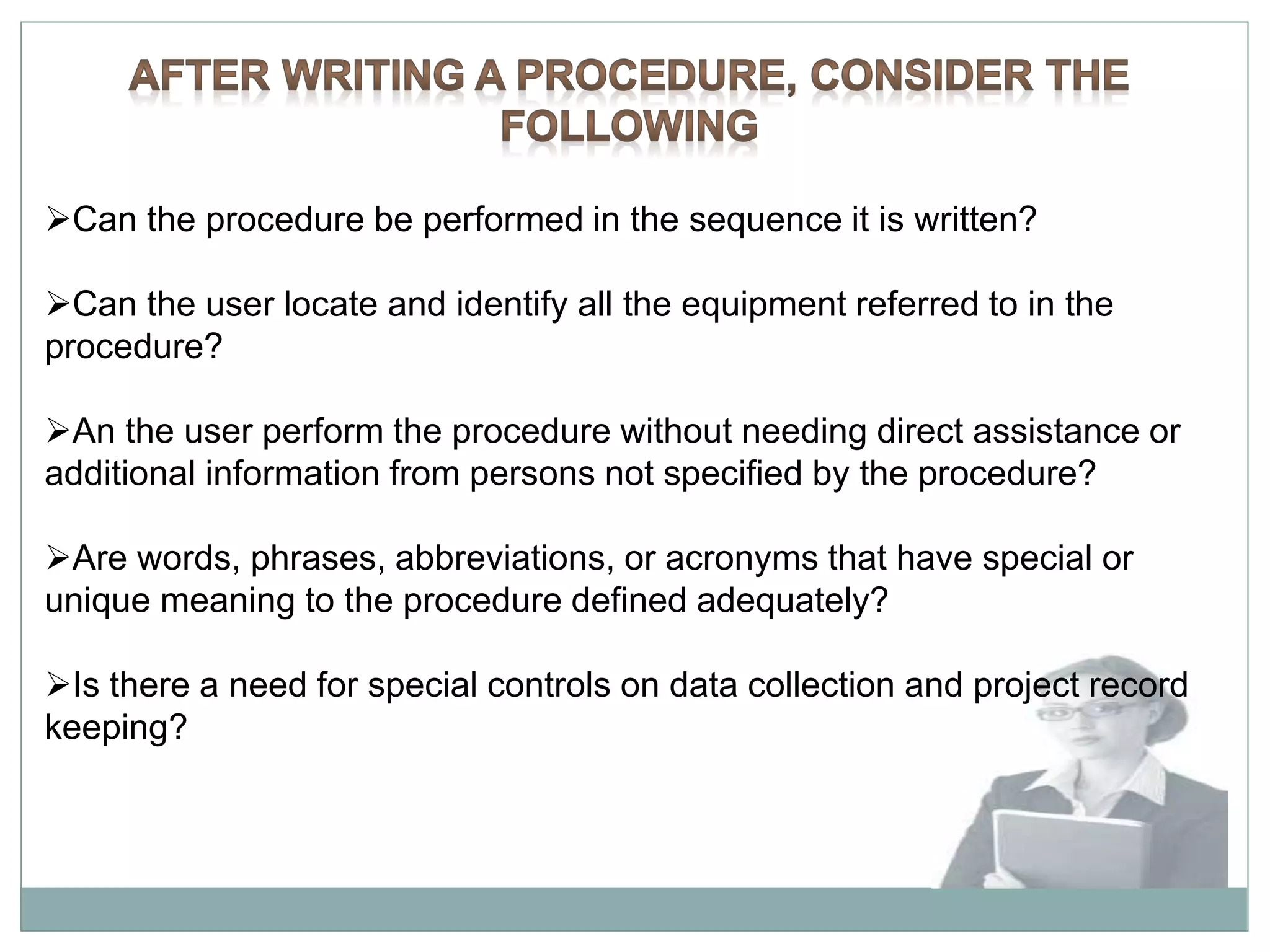
Can the procedure be performed in the sequence it is written?
Can the user locate and identify all the equipment referred to in the
procedure?
An the user perform the procedure without needing direct assistance or
additional information from persons not specified by the procedure?
Are words, phrases, abbreviations, or acronyms that have special or
unique meaning to the procedure defined adequately?
Is there a need for special controls on data collection and project record
keeping?
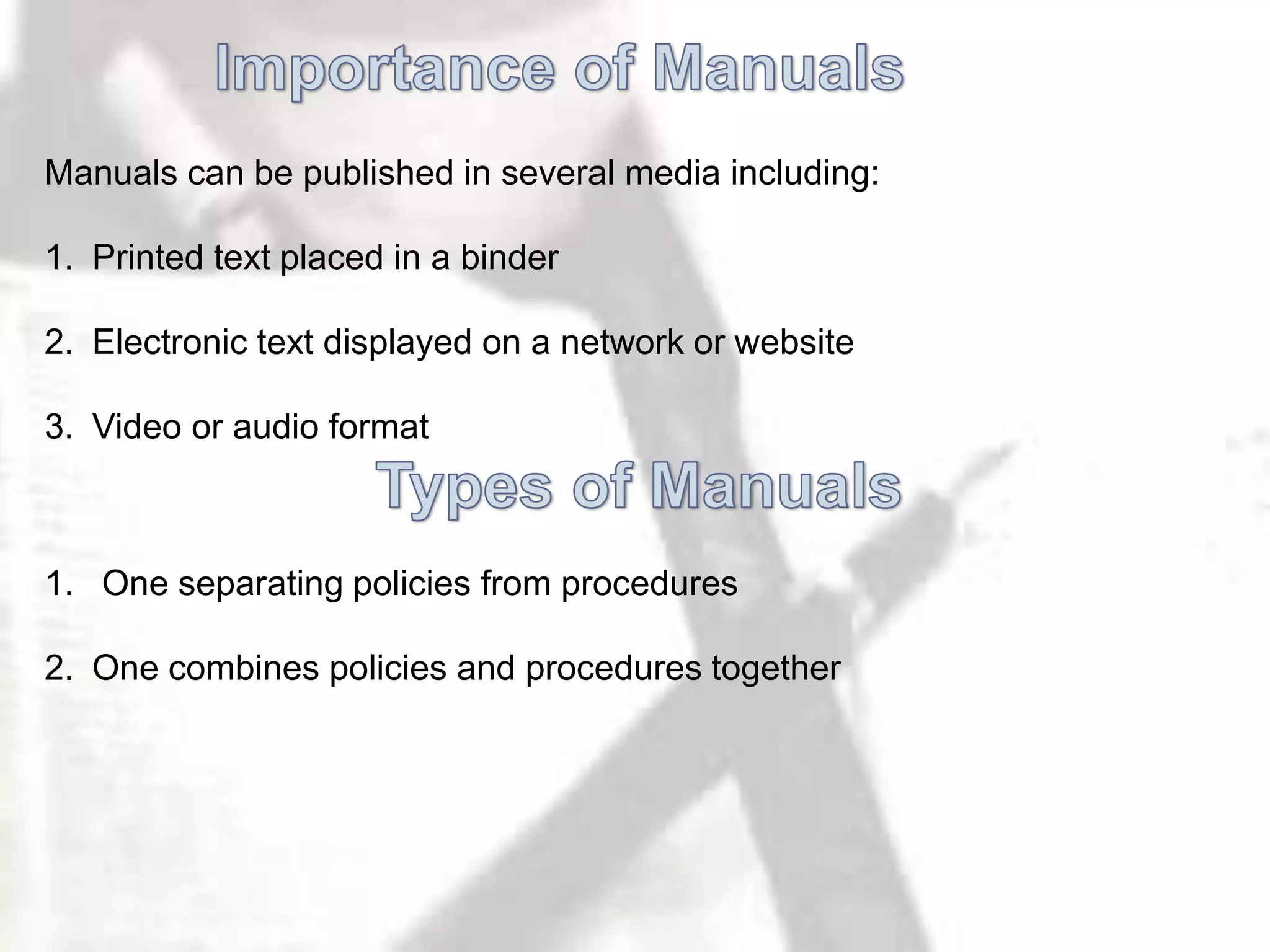
Manuals can be published in several media including:
1. Printed text placed in a binder
2. Electronic text displayed on a network or website
3. Video or audio format
1. One separating policies from procedures
2. One combines policies and procedures together
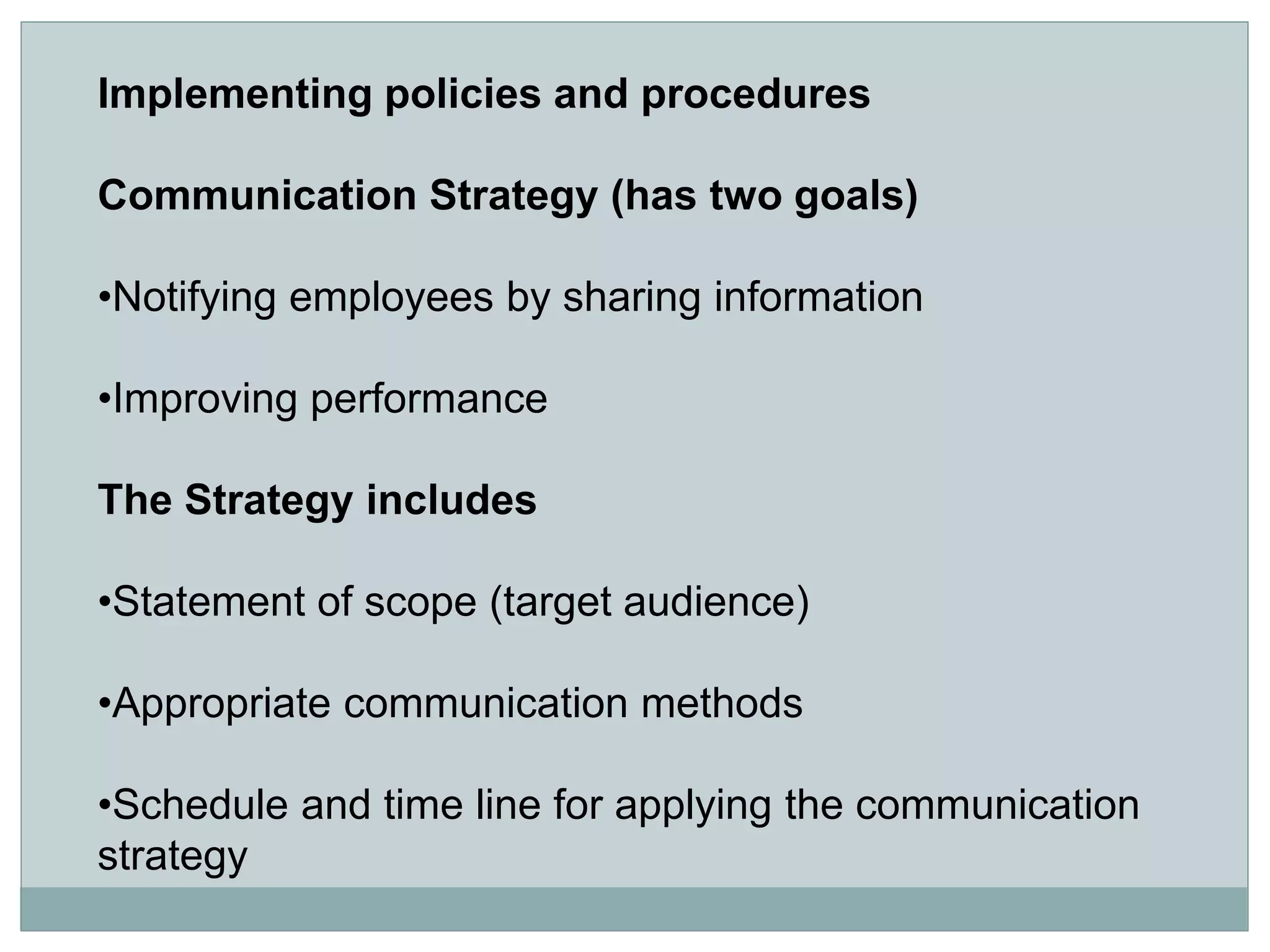
Implementing policies and procedures
Communication Strategy (has two goals)
•Notifying employees by sharing information
•Improving performance
The Strategy includes
•Statement of scope (target audience)
•Appropriate communication methods
•Schedule and time line for applying the communication
strategy
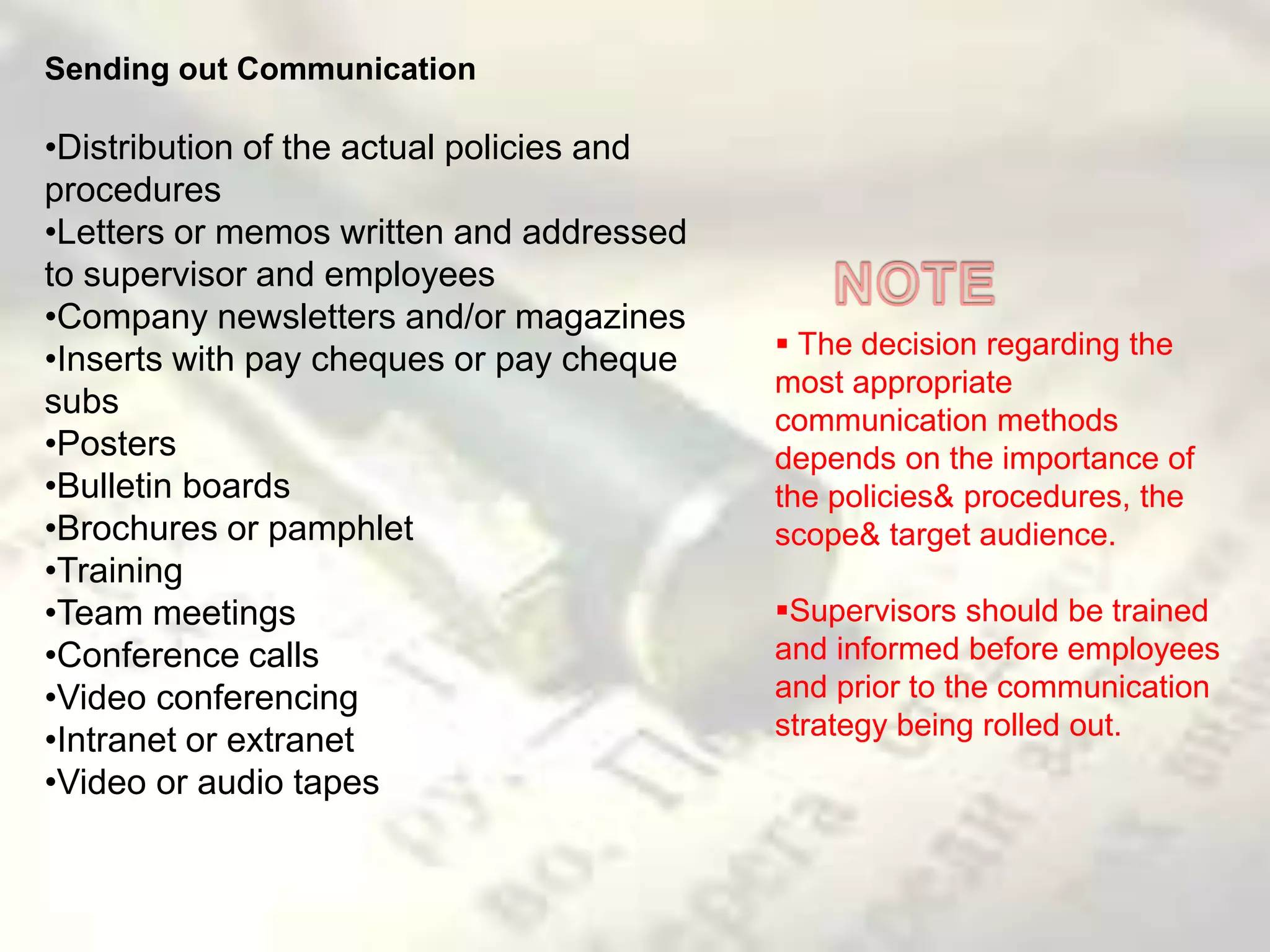
Sending out Communication
•Distribution of the actual policies and
procedures
•Letters or memos written and addressed
to supervisor and employees
•Company newsletters and/or magazines
•Inserts with pay cheques or pay cheque
subs
•Posters
•Bulletin boards
•Brochures or pamphlet
•Training
•Team meetings
•Conference calls
•Video conferencing
•Intranet or extranet
•Video or audio tapes
 The decision regarding the
most appropriate
communication methods
depends on the importance of
the policies& procedures, the
scope& target audience.
Supervisors should be trained
and informed before employees
and prior to the communication
strategy being rolled out.
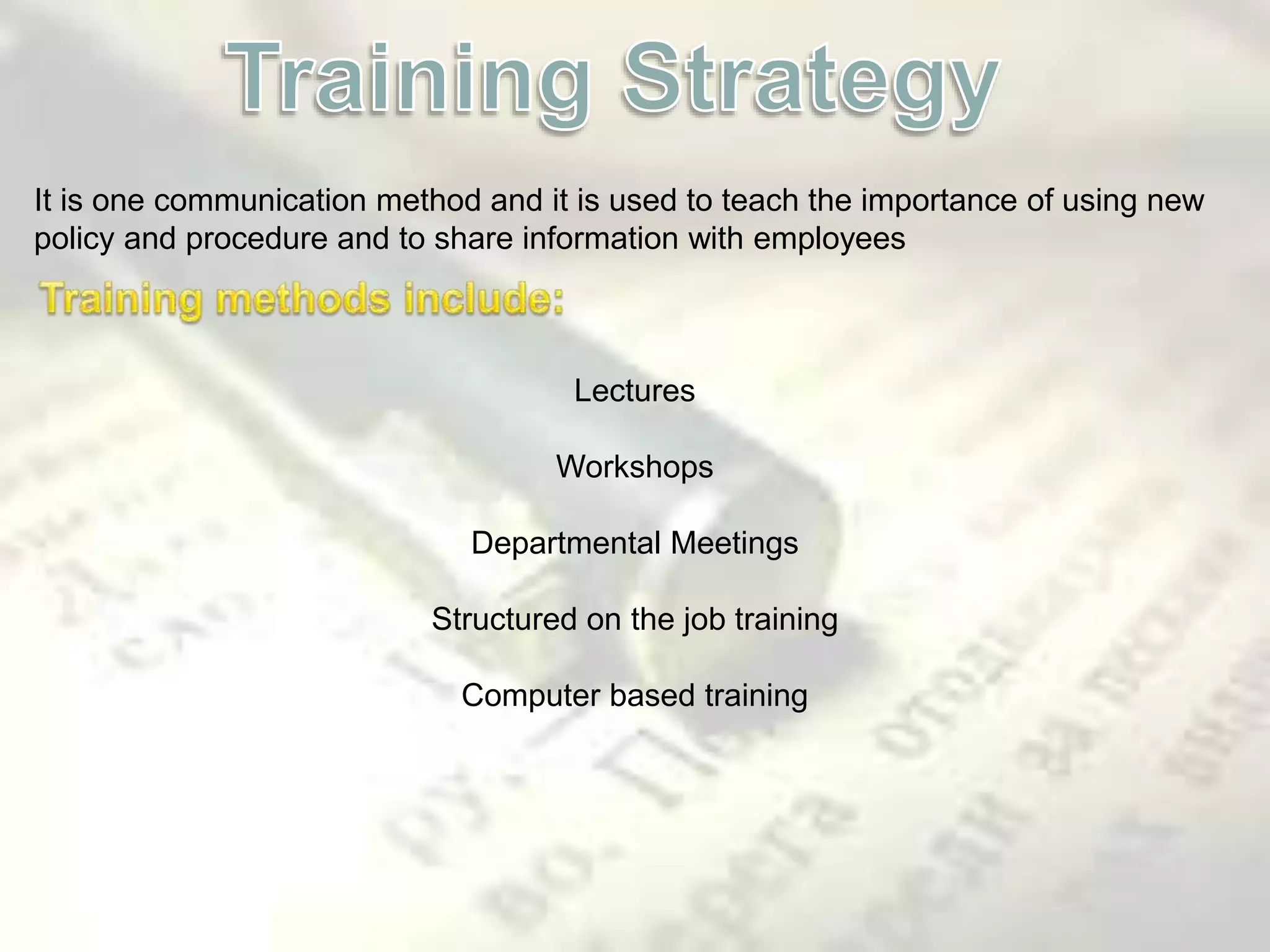
It is one communication method and it is used to teach the importance of using new
policy and procedure and to share information with employees
Lectures
Workshops
Departmental Meetings
Structured on the job training
Computer based training
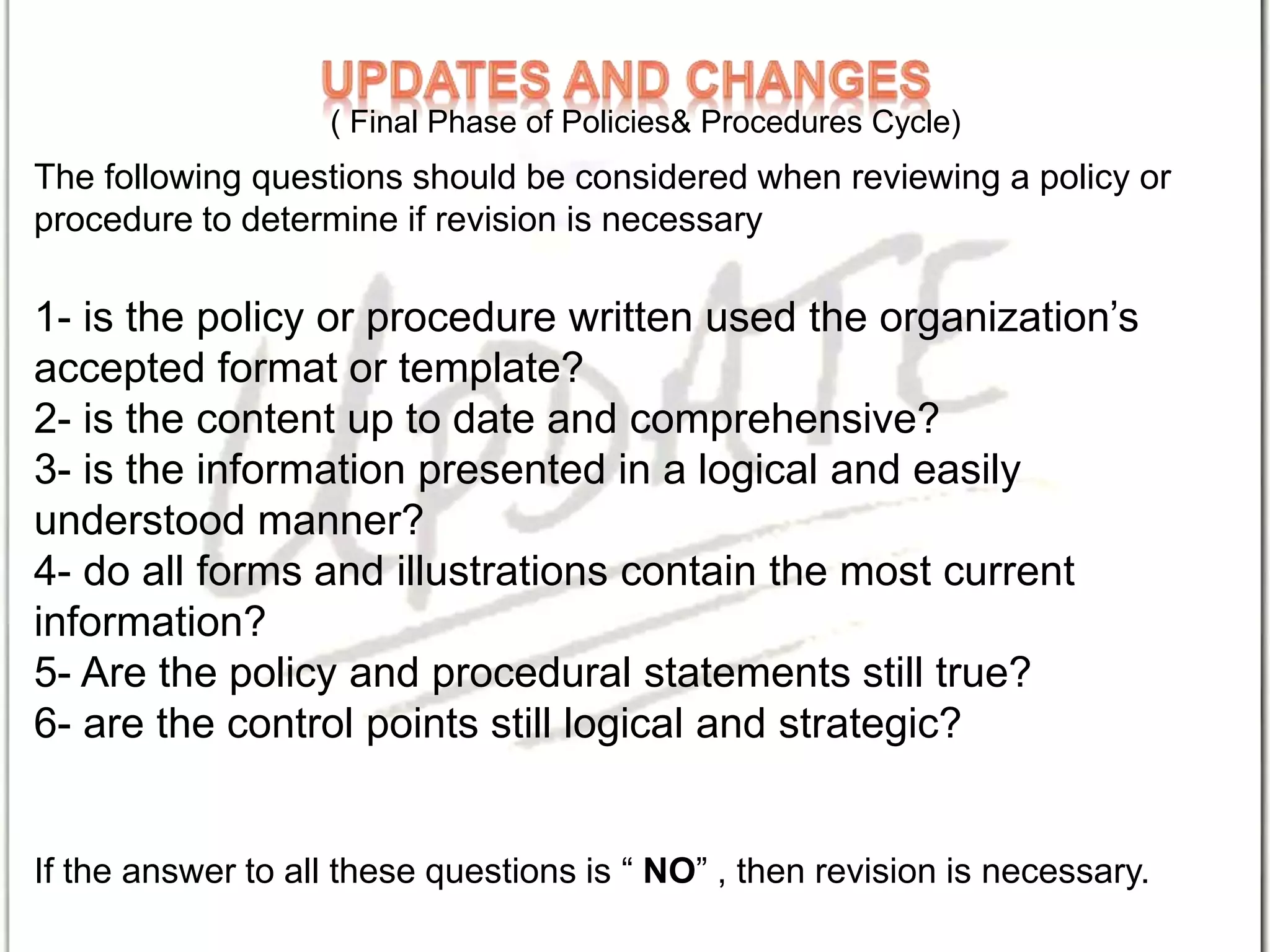
The following questions should be considered when reviewing a policy or
procedure to determine if revision is necessary
1- is the policy or procedure written used the organization’s
accepted format or template?
2- is the content up to date and comprehensive?
3- is the information presented in a logical and easily
understood manner?
4- do all forms and illustrations contain the most current
information?
5- Are the policy and procedural statements still true?
6- are the control points still logical and strategic?
If the answer to all these questions is “ NO” , then revision is necessary.
( Final Phase of Policies& Procedures Cycle)
Writing Effective  Policies & Procedures

Writing Effective Policies & Procedures

  • 1.
    WRITING EFFECTIVE POLICIES &PROCEDURES By: Noha Atef
  • 2.
    TO BE COVERED Identify the necessity of having organizational policies& procedures  Understand the differences between policies& procedures  Understand the link between organization’s values and its policies& procedures  Learn the process of writing effective policies& procedures  Learn how to publish and distribute policies& procedures  Examine the principles behind successful policy &procedure implementation  Understand the necessity of updating and revising policies& procedures
  • 3.
    DEFINITIONS OF POLICIES&PROCEDURES Policy: (it tells us What to do and Why) • Rule • Standard • Guidelines • Philosophy • Objective Procedure: (It tells us When and How) • Protocol • Steps • Instruction  Note: Procedure can be written without the existence of policy.
  • 4.
    A Policy isa direct link between an organization’s vision and day-to-day operations. A Procedure is a serious of routine steps to accomplish an action. Well-written procedures eliminate misunderstanding by identifying job responsibilities and establishing boundaries for job holders.
  • 5.
    DIFFERENCE BETWEEN POLICIES & PROCEDURES POLICIES  Major innature  Identify company rules  Explain why they exist  Tell when the rule applies  Describe who it covers  Describe the consequences  Are described using simple sentences and paragraphs.
  • 6.
    PROCEDURES •Identify specific actionsor steps • Explain when to take actions •Describe alternatives •Include warnings and cautions •Give examples •Show how to complete forms •Are normally written using and outline format.
  • 7.
  • 8.
    Employees are providedwith information that allows them freedom to carry out their jobs and make decisions within defined boundaries. Policies and procedures enable the workforce to clearly understand individual and team responsibilities. Employees understand the constraints of their job without using a “ trial and error” approach. Clearly written policies and procedures allow managers to exercise control by exception rather than “ micro manage” their staff. Policies provide guidance on how to handle issues properly. Sticking to policies and procedures can help reduce the chances of things going wrong and ensure consistency and professionalism
  • 9.
    How Policies &Procedures Flow From an Organization’s Basic Values? DEFINITION OF VALUES.
  • 10.
    Values Organizational values definesthe acceptable standards which govern the behavior of the individuals within the organization, and it must be in line with its mission and vision.
  • 11.
    Five Ways toEnsure You Have Living VALUES. 1. 1- Communicate the values constantly (i.e. Poster them, Pop-up online message, read out-loud..etc) 2. Enroll new employees 3. Revisit and refresh the values 4. Confront contradictory behavior 5. Periodically check out with feedback.
  • 12.
  • 13.
    BOARD Policy (high levelpolicy)  They relate to the governance of the organisation, not the day-to-day operations  It does not require a procedures  They are related to mission, strategic plan, external communication, code of ethics, organizational values, issues for staff and compliance with legislation. MANAGEMENT Policy  Established by the management team  It relates to day-to-day operations  Management use Board Policies to guide them in the development of Management Policies.  They are related to health, safety, admin, finance, PR, privacy, confidentiality, and ethics.
  • 14.
  • 15.
    GUIDELINES TO DETERMINETHE NECESSITY FOR POLICIES A Policy is necessary:  If the actions of employees indicate confusion about the most appropriate way to behave  If guidance is needed about the most suitable way to handle various situations  When needed to protect the company legally  To keep the company in compliance with governmental policies and laws  To establish consistent work standards, rules, and regulations  To provide consistent and fair treatment for employees
  • 16.
    GUIDELINES TO DETERMINETHE NECESSITY FOR PROCEDURES A Procedure is necessary when a process Is lengthy (i.e. year end inventory) Is complex (i.e. benefits administration) Is routine, but it is essential that everyone strictly follows rules (i.e. payroll) Demands consistency (i.e. handling a refund request) Involves documentation (i.e. conducting appraisals) Involves a significant change (i.e. installing a new computer system) Has serious consequence if done wrong (i.e. safety guidelines)
  • 17.
    DEVELOPING A POLICYOR PROCEDURE 1- Articulate the Goal 2- Gather Information (pre-writing research) 2.1 Conduct interview with managers and employees regarding current practice and ideas 2.2 A literature search on the topic of writing policies and procedures 2.3 Internet search for industry specific example policies and procedures 3- Develop and Write 4- Review 5- Obtain Management Support 6- Obtain Legal Review 7- Implement 8- Decide How you will Communicate 9- Interpret and Integrate
  • 18.
    Helpful Hints when WritingPolicies & Procedures
  • 19.
    1) Use plainlanguage 2) Establish a core vocabulary 3) Avoid weasel words 4) Make it easy to find information 5) Use a constant format 6) Use action writing for procedures 7) Write action sentences (Active Voice) 8) Use straight order 9) Use present tense 10)Use second or third person 11)Use short sentences 12)Use authoritative and definitive tone 13)Spell out acronyms 14)Avoid time sensitive information 15)Avoid use of jargon, Slang or overly technical words 16)Be factual
  • 20.
    Avoid Writing Errors USETHE 7C’S Context Consistency Completeness Control Compliance Correctness Clarity
  • 21.
    Note: The most commonformat was developed by Stephan Page and presented in his book:” Writing Exceptional Policies& Procedures” WRITING FORMAT Use logical, structured format A modular format allows for quick and easy modification Readers should know what to expect Most readers need to find information quickly.
  • 22.
    DOCUMENT#TITLE OF POLICYOR PROCEDURE EFFECTIVE DATE REVISION DATE REVISION# PAGE # APPROVAL Purpose: Describe the objective1.0 Persons Affected: Identifies the users2.0 Policy: Describes the general organizational attitude of the company3.0 Definitions: Defines abbrev, acronyms, terms, forms4.0 Responsibilities: summaries roles of individuals involved in this document 5.0 Procedures: Defines the outline rules6.0 Document Approvals: Name, title, and date of approvers7.O Revision History: Show list of document changes to this document8.0 A POLICY& PROCEDURE DOCUMENT TEMPLATE
  • 23.
  • 24.
    WHO SHOULD WRITEPROCEDURES? Ideally procedures should be written by team and include some of the following  People who will perform the job People who will perform maintenance on equipment involved in the procedure Engineers who designed the equipment Technical writers Safety personnel Environmental personnel Vendors Suppliers Contractors
  • 25.
    Using Flowcharts AsA Note Taking Method Indicates an Activity/Task/ Instruction Indicates Input/ Output of Data Indicates Decision Indicates the Direction of Process Flow
  • 27.
    Identify and involveother stakeholder in writing the procedure Gather any pertinent background information i.e. interview staff who are familiar with similar activities to learn from past experiences Identify applicable technical, regulatory and administrative requirements through reading documents and manuals Review any possible hazards associated with the activity
  • 28.
    Can the procedurebe performed in the sequence it is written? Can the user locate and identify all the equipment referred to in the procedure? An the user perform the procedure without needing direct assistance or additional information from persons not specified by the procedure? Are words, phrases, abbreviations, or acronyms that have special or unique meaning to the procedure defined adequately? Is there a need for special controls on data collection and project record keeping?
  • 29.
    Manuals can bepublished in several media including: 1. Printed text placed in a binder 2. Electronic text displayed on a network or website 3. Video or audio format 1. One separating policies from procedures 2. One combines policies and procedures together
  • 30.
    Implementing policies andprocedures Communication Strategy (has two goals) •Notifying employees by sharing information •Improving performance The Strategy includes •Statement of scope (target audience) •Appropriate communication methods •Schedule and time line for applying the communication strategy
  • 31.
    Sending out Communication •Distributionof the actual policies and procedures •Letters or memos written and addressed to supervisor and employees •Company newsletters and/or magazines •Inserts with pay cheques or pay cheque subs •Posters •Bulletin boards •Brochures or pamphlet •Training •Team meetings •Conference calls •Video conferencing •Intranet or extranet •Video or audio tapes  The decision regarding the most appropriate communication methods depends on the importance of the policies& procedures, the scope& target audience. Supervisors should be trained and informed before employees and prior to the communication strategy being rolled out.
  • 32.
    It is onecommunication method and it is used to teach the importance of using new policy and procedure and to share information with employees Lectures Workshops Departmental Meetings Structured on the job training Computer based training
  • 33.
    The following questionsshould be considered when reviewing a policy or procedure to determine if revision is necessary 1- is the policy or procedure written used the organization’s accepted format or template? 2- is the content up to date and comprehensive? 3- is the information presented in a logical and easily understood manner? 4- do all forms and illustrations contain the most current information? 5- Are the policy and procedural statements still true? 6- are the control points still logical and strategic? If the answer to all these questions is “ NO” , then revision is necessary. ( Final Phase of Policies& Procedures Cycle)