“ WE EXPECT
 MORE FROM
TECHNOLOGY
    AND LESS
  FROM EACH
       OTHER“
         Sherry Turkle
EVERYDAY LIFE OBSERVATIONS


•	 People don’t wait for others to get out the train in order to get in
•	 People get bored easily and are always looking for something to do
•	 People need don’t like to feel alone
•	 People expect others to be available instantly and always
•	 Americans eat on the go
•	 People are naturally curios for exotics
EVERYDAY LIFE OBSERVATIONS


•	 People don’t wait for others to get out the train in order to get in
•	 People get bored easily and are always looking for something to do
•	 People need don’t like to feel alone
•	 People expect others to be available instantly and always
•	 Americans eat on the go
•	 People are naturally curios for exotics
THESIS HYPOSTHESIS

This thesis presents the hypothesis that employing the metaphor
of front and back stage personalities and the idea of impression
management as articulated by the sociologist Erving Goffman,
when applied to messaging across short form media will lead to
a more nuanced portrayal of self.
This is contrast to the overdependence on mobile devices and its
justification by technology-for convenience sake. Such a thesis
will promote an analyses of the behavior taxonomy, as proposed
by Goffman, on the contemporary context of short form of
medias in order to encourage people to intensify their real world
connections and strengthen their self-consciousness, developing
into more prepared characters for life.
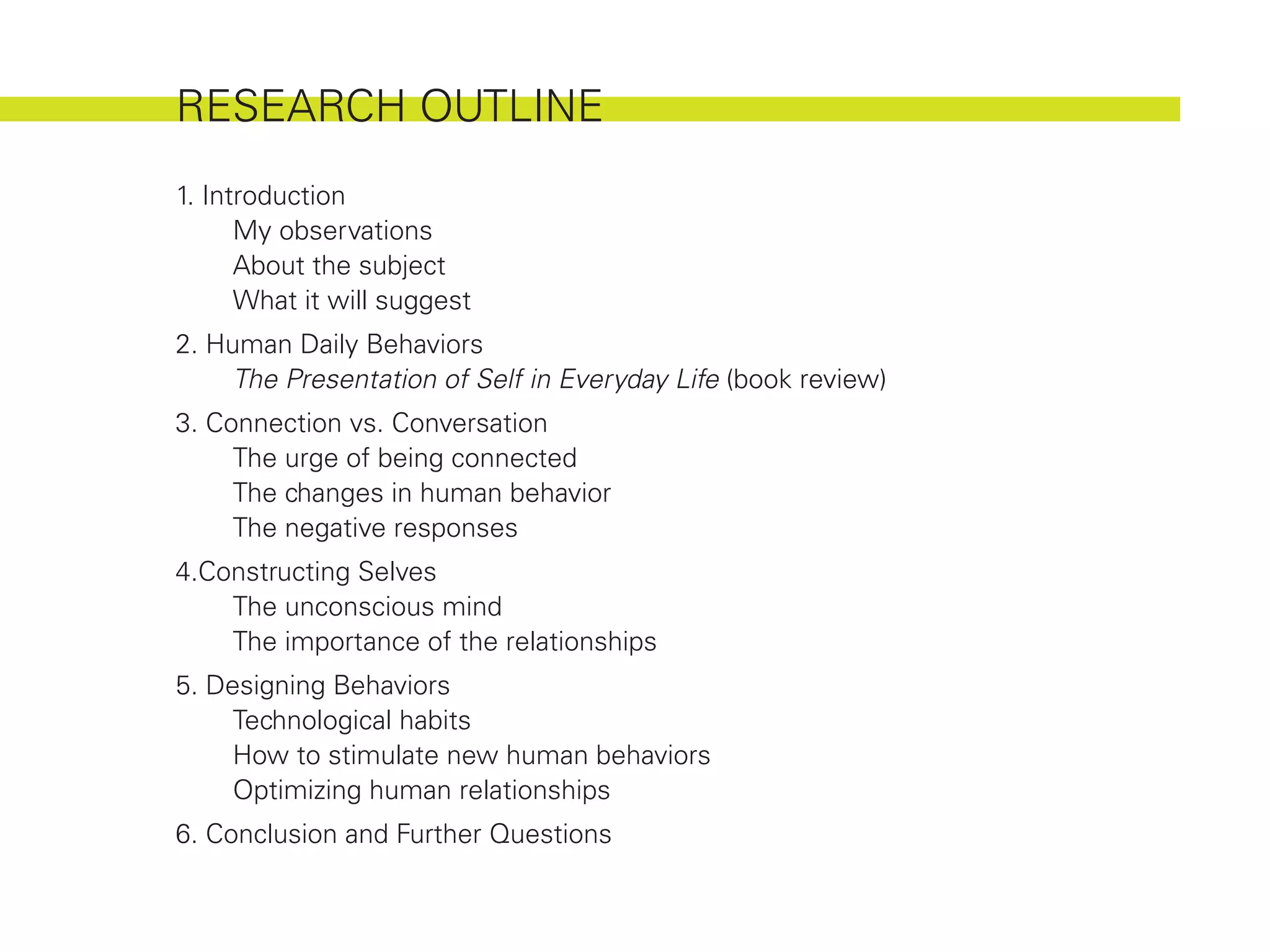
RESEARCH OUTLINE
1. Introduction
	     My observations
	     About the subject
	     What it will suggest
2. Human Daily Behaviors
	    The Presentation of Self in Everyday Life (book review)
3. Connection vs. Conversation
	    The urge of being connected
	    The changes in human behavior
	    The negative responses
4.Constructing Selves
	   The unconscious mind
	   The importance of the relationships
5. Designing Behaviors
	    Technological habits
	    How to stimulate new human behaviors
	    Optimizing human relationships
6. Conclusion and Further Questions
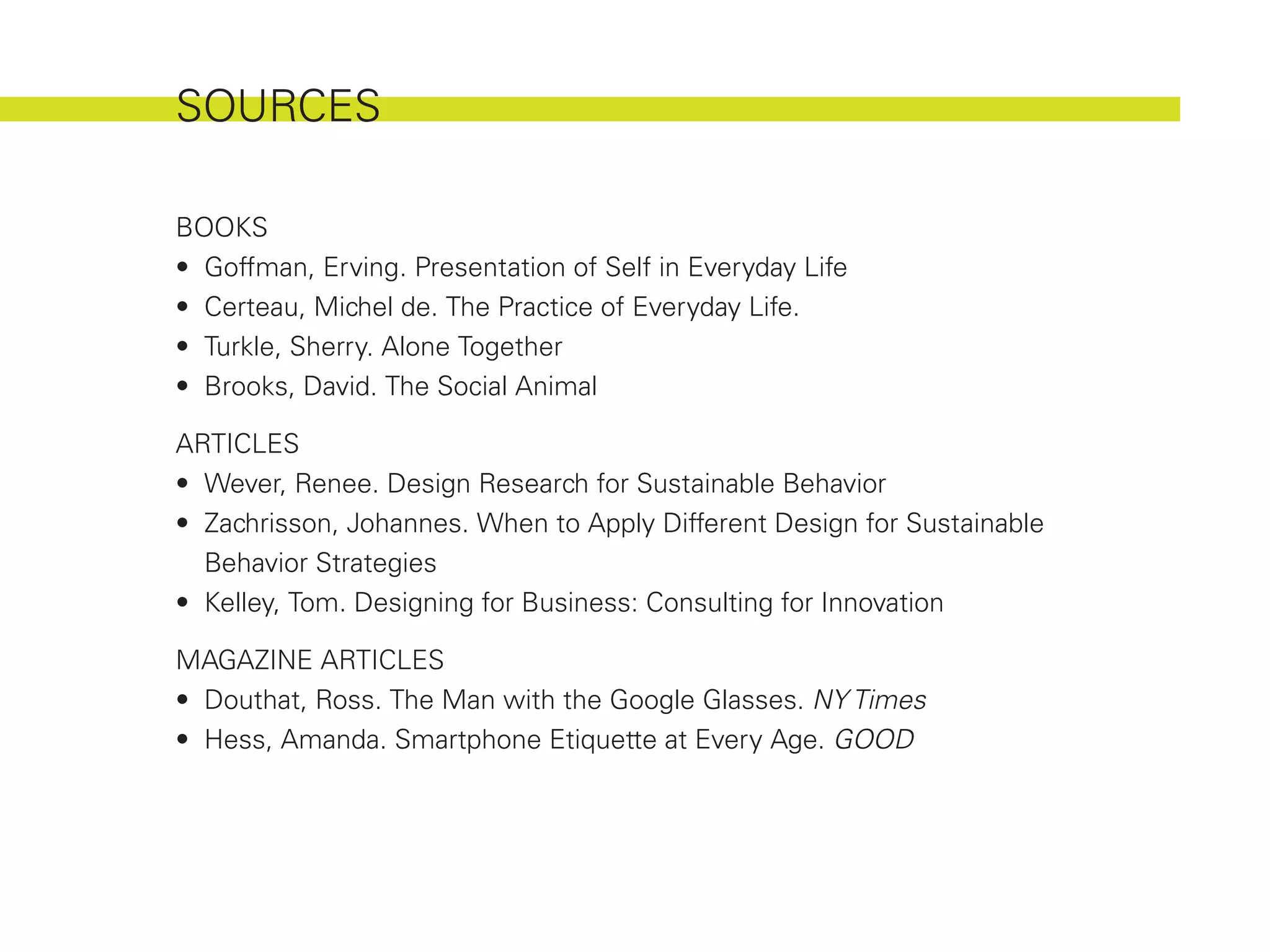
SOURCES

BOOKS
•	 Goffman, Erving. Presentation of Self in Everyday Life
•	 Certeau, Michel de. The Practice of Everyday Life.
•	 Turkle, Sherry. Alone Together
•	 Brooks, David. The Social Animal

ARTICLES
•	 Wever, Renee. Design Research for Sustainable Behavior
•	 Zachrisson, Johannes. When to Apply Different Design for Sustainable
   Behavior Strategies
•	 Kelley, Tom. Designing for Business: Consulting for Innovation

MAGAZINE ARTICLES
•	 Douthat, Ross. The Man with the Google Glasses. NY Times
•	 Hess, Amanda. Smartphone Etiquette at Every Age. GOOD

Direct Research_final

  • 1.
    “ WE EXPECT MORE FROM TECHNOLOGY AND LESS FROM EACH OTHER“ Sherry Turkle
  • 2.
    EVERYDAY LIFE OBSERVATIONS • People don’t wait for others to get out the train in order to get in • People get bored easily and are always looking for something to do • People need don’t like to feel alone • People expect others to be available instantly and always • Americans eat on the go • People are naturally curios for exotics
  • 3.
    EVERYDAY LIFE OBSERVATIONS • People don’t wait for others to get out the train in order to get in • People get bored easily and are always looking for something to do • People need don’t like to feel alone • People expect others to be available instantly and always • Americans eat on the go • People are naturally curios for exotics
  • 4.
    THESIS HYPOSTHESIS This thesispresents the hypothesis that employing the metaphor of front and back stage personalities and the idea of impression management as articulated by the sociologist Erving Goffman, when applied to messaging across short form media will lead to a more nuanced portrayal of self. This is contrast to the overdependence on mobile devices and its justification by technology-for convenience sake. Such a thesis will promote an analyses of the behavior taxonomy, as proposed by Goffman, on the contemporary context of short form of medias in order to encourage people to intensify their real world connections and strengthen their self-consciousness, developing into more prepared characters for life.
  • 5.
    RESEARCH OUTLINE 1. Introduction My observations About the subject What it will suggest 2. Human Daily Behaviors The Presentation of Self in Everyday Life (book review) 3. Connection vs. Conversation The urge of being connected The changes in human behavior The negative responses 4.Constructing Selves The unconscious mind The importance of the relationships 5. Designing Behaviors Technological habits How to stimulate new human behaviors Optimizing human relationships 6. Conclusion and Further Questions
  • 6.
    SOURCES BOOKS • Goffman, Erving.Presentation of Self in Everyday Life • Certeau, Michel de. The Practice of Everyday Life. • Turkle, Sherry. Alone Together • Brooks, David. The Social Animal ARTICLES • Wever, Renee. Design Research for Sustainable Behavior • Zachrisson, Johannes. When to Apply Different Design for Sustainable Behavior Strategies • Kelley, Tom. Designing for Business: Consulting for Innovation MAGAZINE ARTICLES • Douthat, Ross. The Man with the Google Glasses. NY Times • Hess, Amanda. Smartphone Etiquette at Every Age. GOOD