

Quality Control Tests For Tablets


  P. P.Raja abhilash. M.Pharm. (Ph.D.)
          Assistant professor,
       S.R. College of Pharmacy.
Introduction
   QUALITY CONTROL (QC) : It is a small part of QA and it is
    concerned with sampling, testing and documentation
    during manufacturing and also after completion of
    manufacturing .
   Quality control is the monitoring process through which
    manufacturer measures actual quality performance,
    compares it with standards and find out the causes of
    deviation from standard to ensure quality product not
    once but every time .
   Definition: In general terms, Quality control refers to a
    procedure or a set of steps taken during the
    manufacturing of a product to ensure that it meets
    requirements and that the product is reproducible .
QUALITY CONTROL TESTS FOR TABLETS:

   General appearance:
    - Size, shape, and thickness:
        This is important to facilitate packaging and to
    decide which tablet compressing machine to use.

    - Organoleptic properties:
      which include color and odor of the tablets.

    - Weight uniformity and content uniformity:
       The tablet should include the correct dose of
    the drug.
 Dissolution test: Drug should be released from
  tablet in a controlled and reproducible way.
 Weight variation, thickness & diameter: The
  appearance of tablet should be elegant & its
  weight, size & appearance should be consistent.
 Hardness & friability: The tablet should show
  sufficient mechanical strength to withstand
  fracture & erosion during manufacture & handling.
 These factors must be controlled during
  production and verified after production, hence
  called In-process control
OFFICIAL STANDARDS AS PER
            B.P. /I.P./ U.S.P.:
 comparison of different pharmacopoeial quality
  control tests :

  BRITISH PHARMACOPOEIA:
        FOR ALL TABLETS:
           Content of active ingredients
           Disintegration
           Uniformity of content
           Labeling
 Uncoated tablet:
     Disintegration Test
     uniformity of weight.

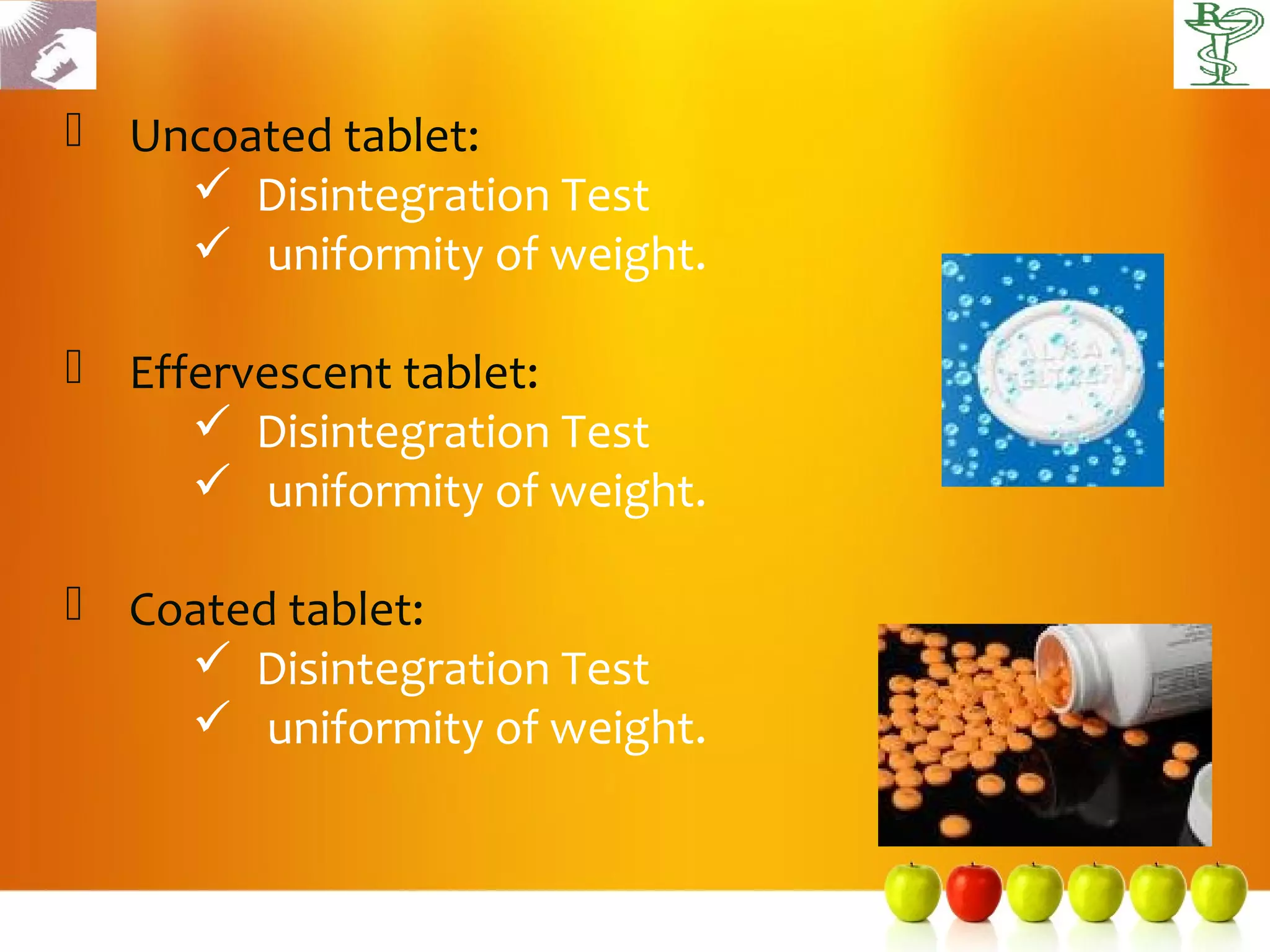
 Effervescent tablet:
      Disintegration Test
      uniformity of weight.

 Coated tablet:
     Disintegration Test
     uniformity of weight.
 Gastro resistant tablet :
     Disintegration Test

 Modified release tablet:
     Uniformity of weight.

 Dispersible tablet:
      Disintegration test.
      Uniformity of dispersion
      Uniformity of weight
INDIAN PHARMACOPOEIA
 Uncoated tablet:
     Uniformity of container content
     Content of active ingredient
     Uniformity of weight
     Uniformity of content
     Disintegration test

 Enteric coated tablet:
     Disintegration test
 Dispersible tablet :
      Uniformity of dispersion
      Disintegration test

 Soluble tablet :
     Disintegration test

 Effervescent tablet :
      Disintegration/Dissolution/Dispersion
       test
UNITED STATES PHARMACOPOEIA:
 Physical tests applicable to tablet formulation :
  -Bulk density /Tapped density of powder
  -Powder fineness
  -Loss on drying
  -Disintegration test
  -Tablet friability
  -Dissolution test
  -Drug release testing
  -Uniformity of dosage form
  -Container permeation test
  -Labeling of inactive ingredients
 Official and unofficial tests

 Official Tests :
        Weight variation
        Disintegration test
        Dissolution
        Drug content

 Non-Official Tests :
      Hardness
      friability
NON OFFICIAL TESTS: HARDNESS
        (CRUSHING STRENGTH):
 Hardness (crushing strength):
  It is the load required to crush the tablet when placed on its
  edge.

 Why do we measure hardness?
      To determine the need for pressure adjustments on
       the tableting machine.
      Hardness can affect the disintegration. So if the
       tablet is too hard, it may not disintegrate in the
       required period of time. And if the tablet is too soft,
       it will not withstand the handling during subsequent
       processing such as coating and packaging.
 In general, if the tablet hardness is too high,
  we first check its disintegration before
  rejecting the batch. And if the disintegration
  is within limit, we accept the batch.

 If Hardness is high and disintegration is
  within time we accept the batch .
PROCEDURE
 MONSANTO TESTER: The apparatus consists of 2
  jaws facing each other, one of which move
  towards the other.
 Measurements is carried out on 10 tablets, taking
  care to remove all the fragments of the broken
  tablets before each determination & then take
  the average hardness.
 LIMITS: Normal tablet hardness ranges from
  4 – 6 Kg (1 Kg = 10 Newton)
 however, certain tablets as lozenges and buccal
  tablets that are intended to dissolve slowly show
  deliberate higher hardness values.
 Factors Affecting the Hardness:
      Compression of the tablet and compressive force.
      Amount of binder. (More binder à more hardness)
      Method of granulation in preparing the tablet (wet
       method gives more hardness than direct method,
       Slugging method gives the best hardness).
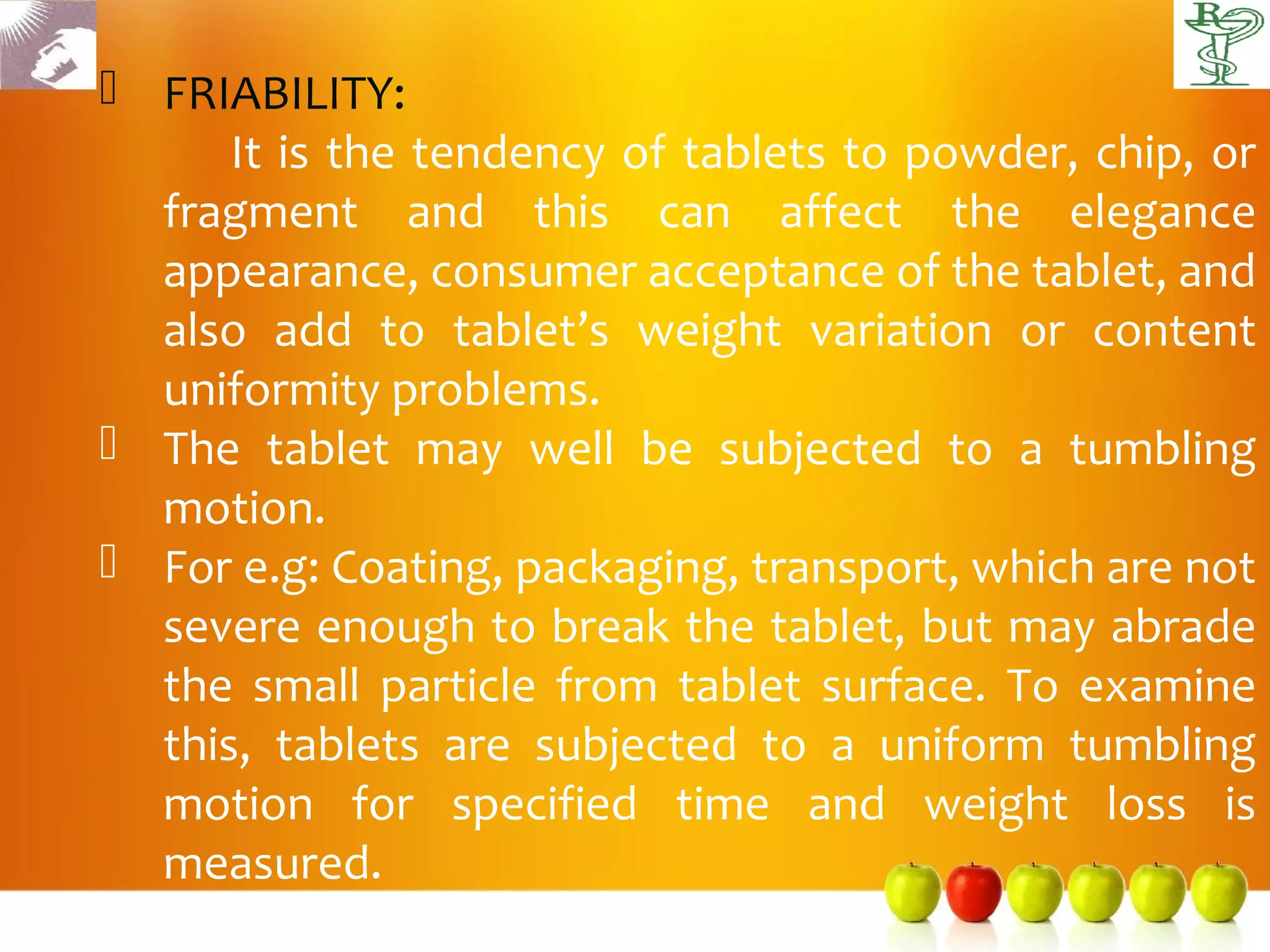
 Monsanto tester, Pfizer tester, stong cobb
  hardness tester are manually used & Heberlien
  schleuniger, Eweka, Casburt hardness tester are
  motor driven testers .
 FRIABILITY:
      It is the tendency of tablets to powder, chip, or
  fragment and this can affect the elegance
  appearance, consumer acceptance of the tablet, and
  also add to tablet’s weight variation or content
  uniformity problems.
 The tablet may well be subjected to a tumbling
  motion.
 For e.g: Coating, packaging, transport, which are not
  severe enough to break the tablet, but may abrade
  the small particle from tablet surface. To examine
  this, tablets are subjected to a uniform tumbling
  motion for specified time and weight loss is
  measured.
 Friability is a property that is related to the
  hardness of the tablet & and also add weight
  variation, content uniformity problems.

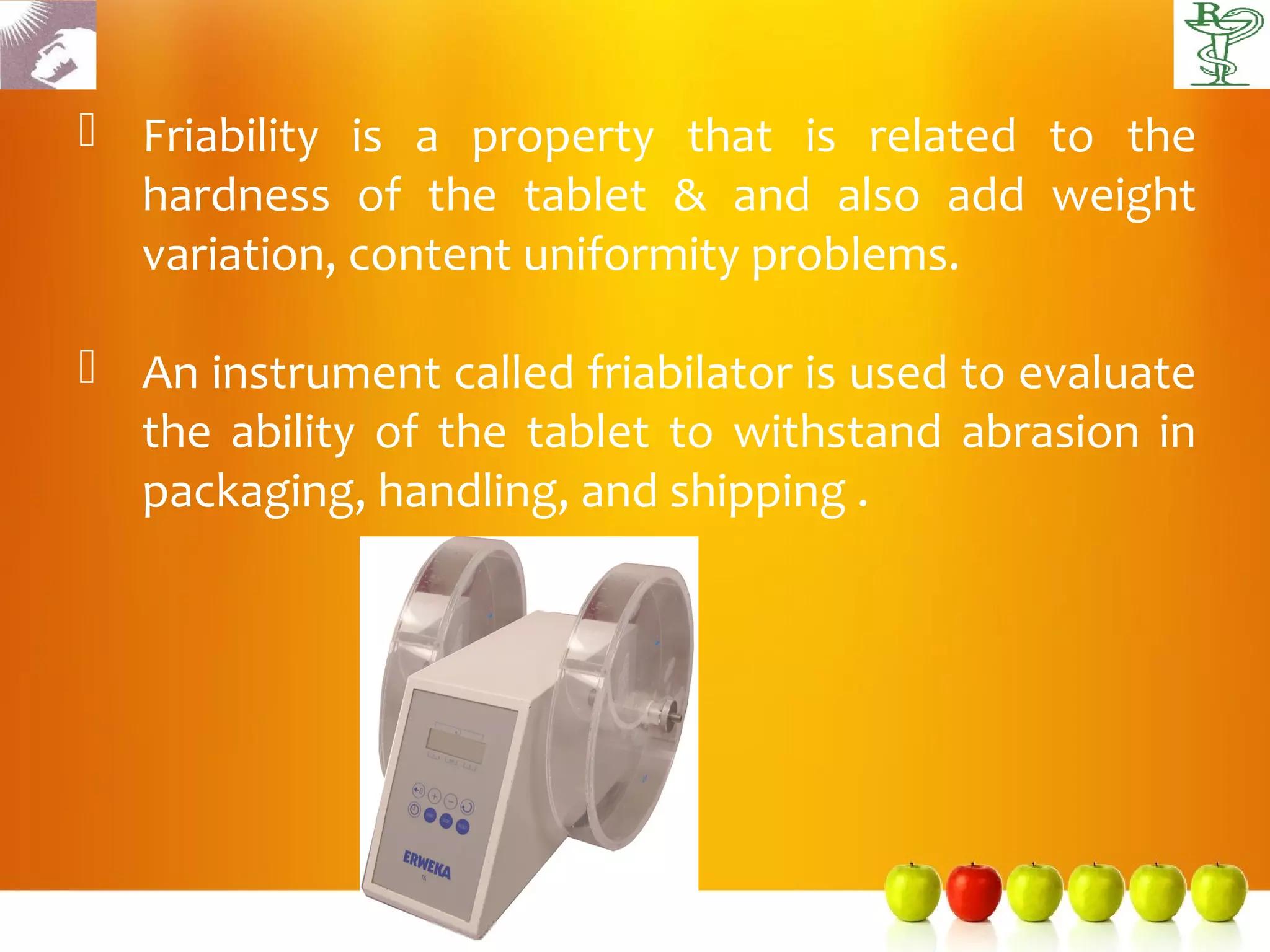
 An instrument called friabilator is used to evaluate
  the ability of the tablet to withstand abrasion in
  packaging, handling, and shipping .
Procedure
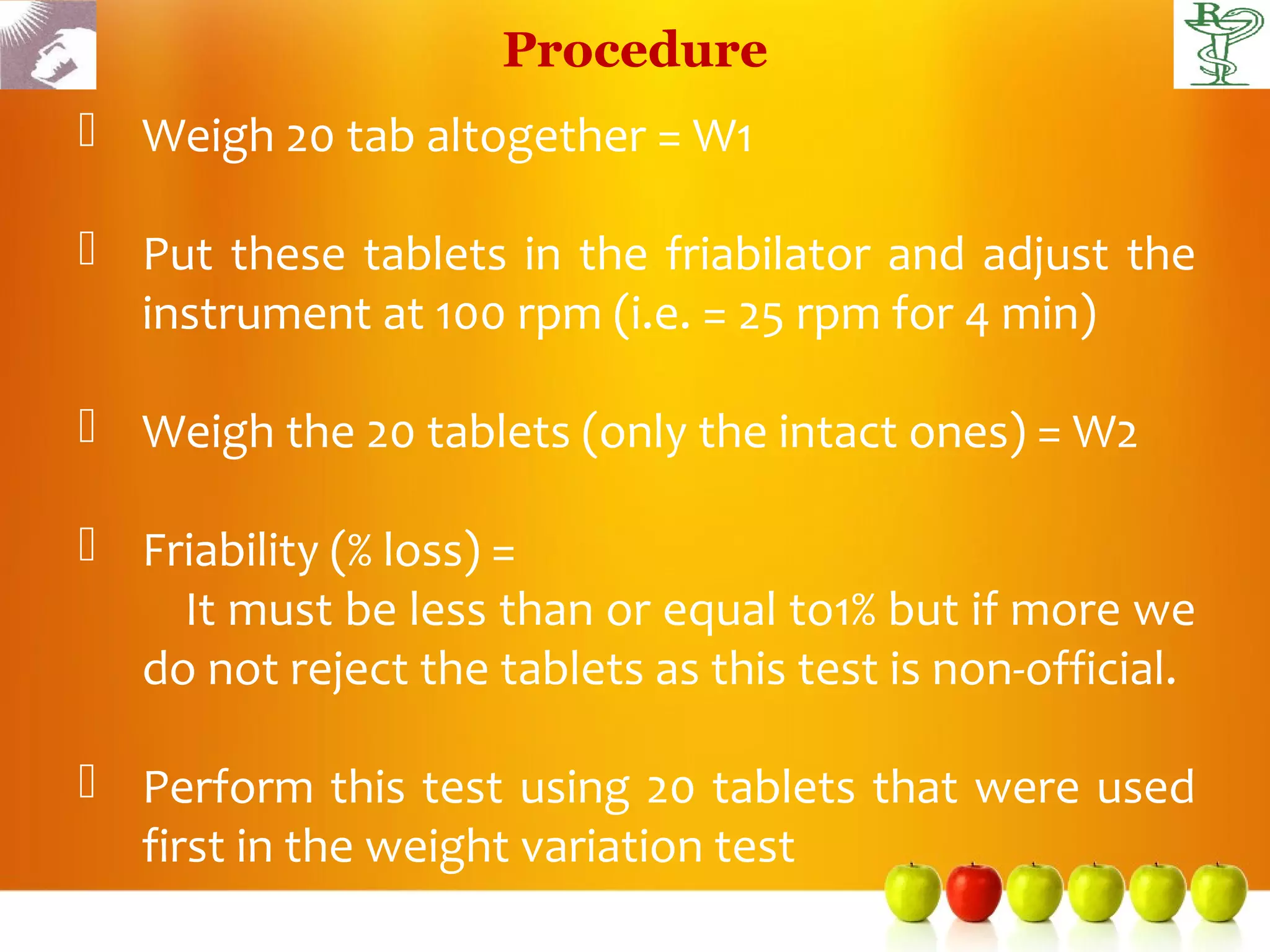
 Weigh 20 tab altogether = W1

 Put these tablets in the friabilator and adjust the
  instrument at 100 rpm (i.e. = 25 rpm for 4 min)

 Weigh the 20 tablets (only the intact ones) = W2

 Friability (% loss) =
    It must be less than or equal to1% but if more we
  do not reject the tablets as this test is non-official.

 Perform this test using 20 tablets that were used
  first in the weight variation test
OFFICIAL TESTS:

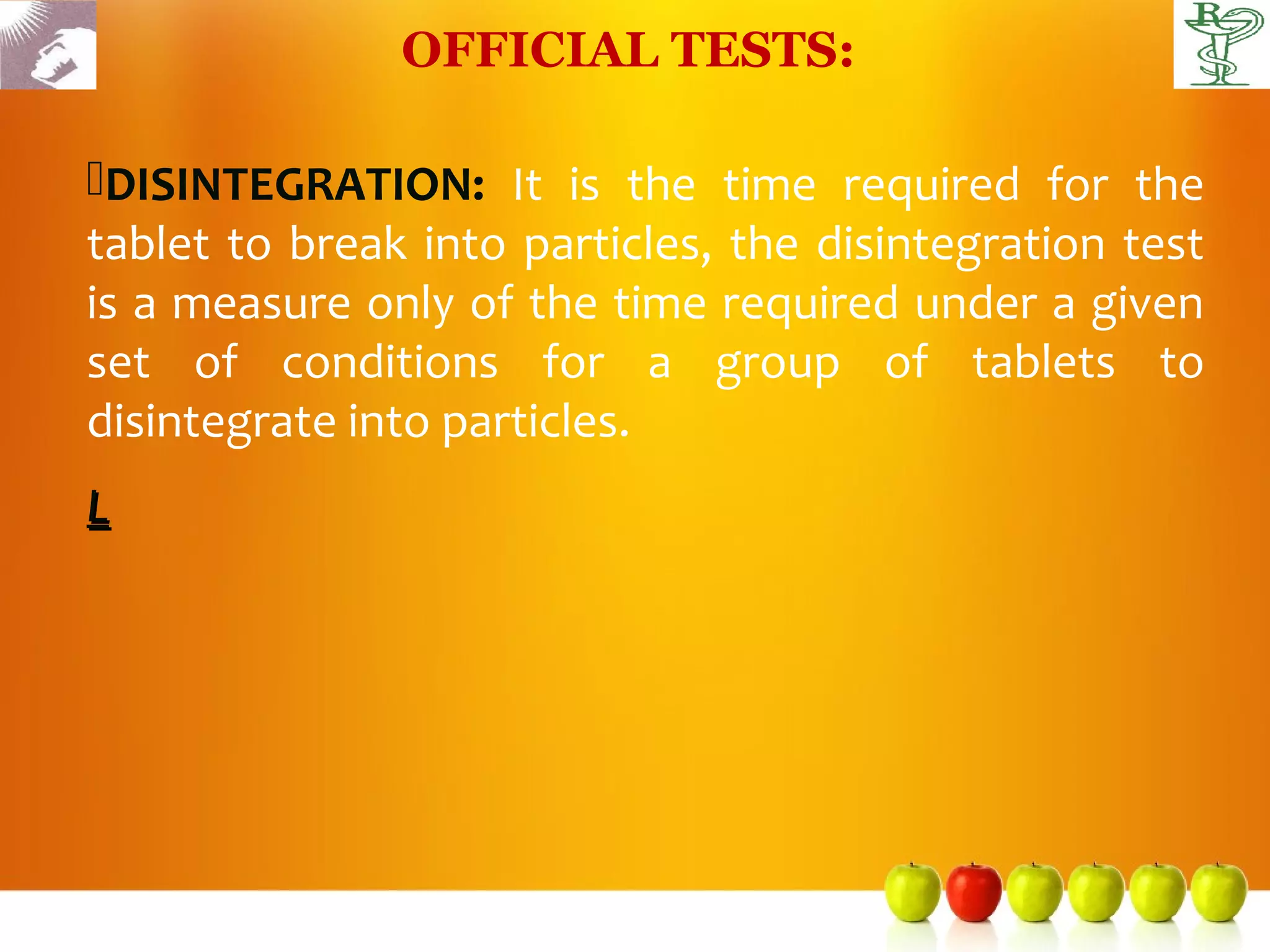
DISINTEGRATION: It is the time required for the
tablet to break into particles, the disintegration test
is a measure only of the time required under a given
set of conditions for a group of tablets to
disintegrate into particles.
L
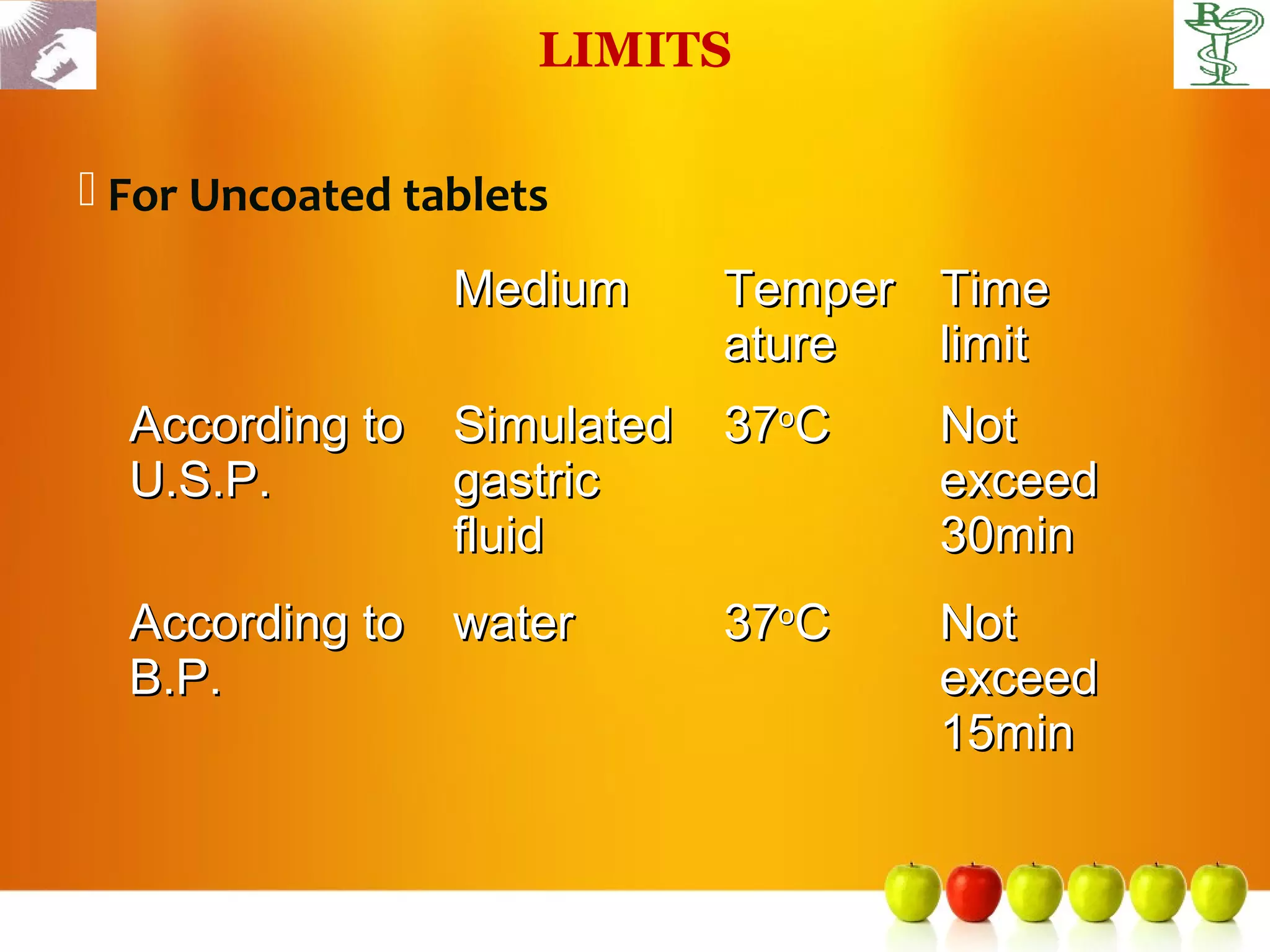
LIMITS

 For Uncoated tablets

                 Medium   Temper Time
                          ature  limit
  According to Simulated 37oC    Not
  U.S.P.       gastric           exceed
               fluid             30min
  According to water      37oC   Not
  B.P.                           exceed
                                 15min
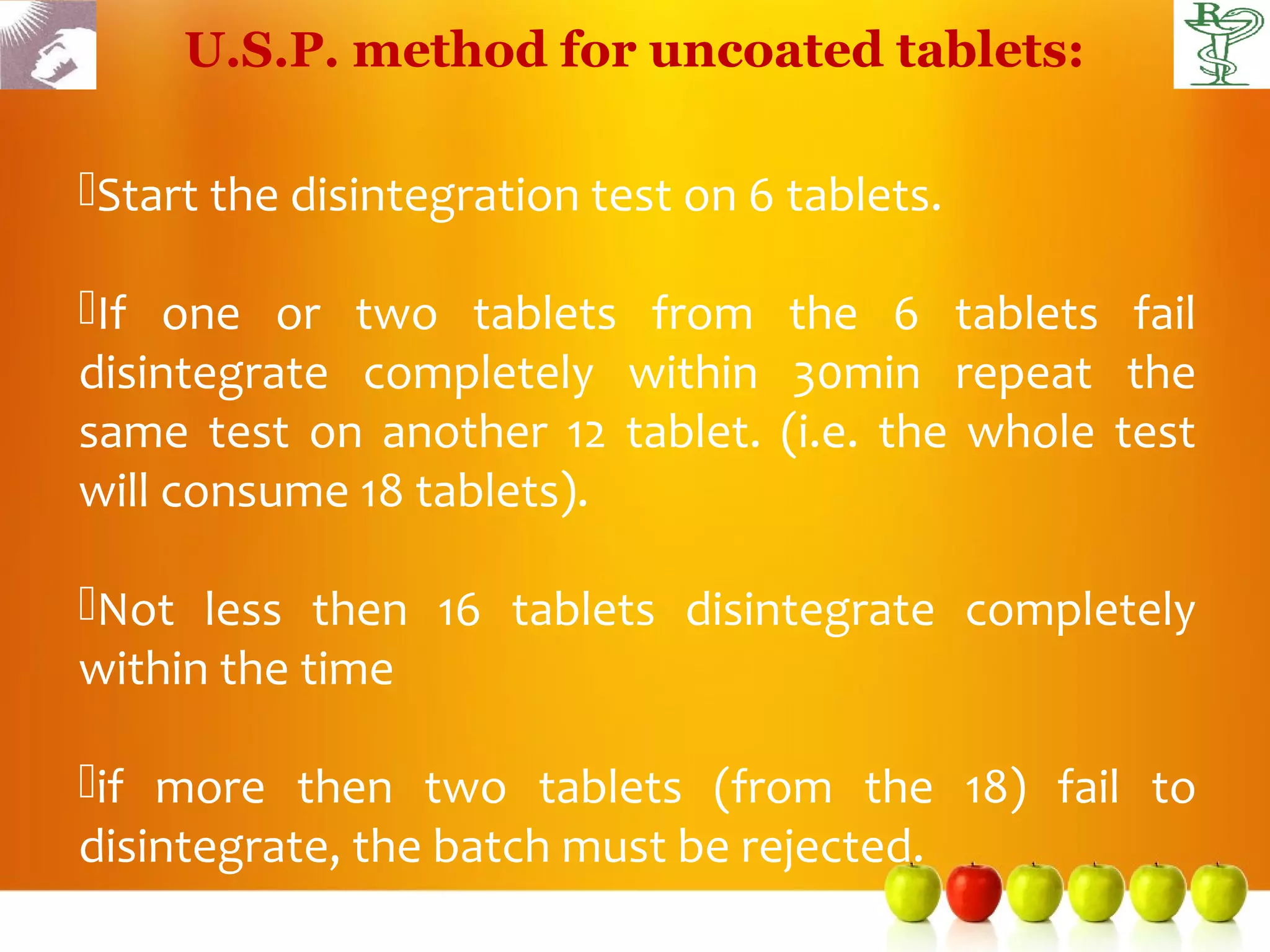
U.S.P. method for uncoated tablets:

Start the disintegration test on 6 tablets.

If one or two tablets from the 6 tablets fail
disintegrate completely within 30min repeat the
same test on another 12 tablet. (i.e. the whole test
will consume 18 tablets).

Not less then 16 tablets disintegrate completely
within the time

if more then two tablets (from the 18) fail to
disintegrate, the batch must be rejected.
For Coated tablets:
To remove or dissolve the coat, immerse the tablet in distilled
water for 5min.

Put the tablet in the apparatus in water or HCL for 30min at
37oC (according to the U.S.P). If not disintegrated, put in
intestinal fluid.

If one or two tablets fail to disintegrate, repeat on 12 tablets.
So,16 tablets from the 18 must completely disintegrate within
the time.

If two or more not disintegrated the batch is rejected.
U.S.P. Method for Enteric coated tablets:
Put in distilled water for five minutes to dissolve the
coat.

Then put in simulated gastric fluid (0.1M HCL) for
one hour.

Then put in simulated intestinal fluid for two hours.

If one or two tablets fail to disintegrate, repeat this
test on another 12 tablets. So 16 tablets from 18
should completely disintegrate. If more than two fail
to disintegrate the patch must be rejected.
B.P. method for Enteric coated tablets:

 Put in distilled water for five minutes to dissolve the
coat.
 Put in simulated gastric fluid for two hours
(emptying time).
 Put in phosphate buffer (PH 6.8) for one hour.
 If one or two tablets fail to disintegrate repeat on 12
tablets. So 16 tablets should disintegrate. If more
than two tables fail to disintegrate reject the batch.
Uniformity of Active Ingredients:
    It is measured to ensure a constant dose
     of drug between individual drugs

    Traditionally, dose variation between
     tablet is tested in two separate tests
     namely
     A) Weight variation
     B) Content uniformity
Weight variation:
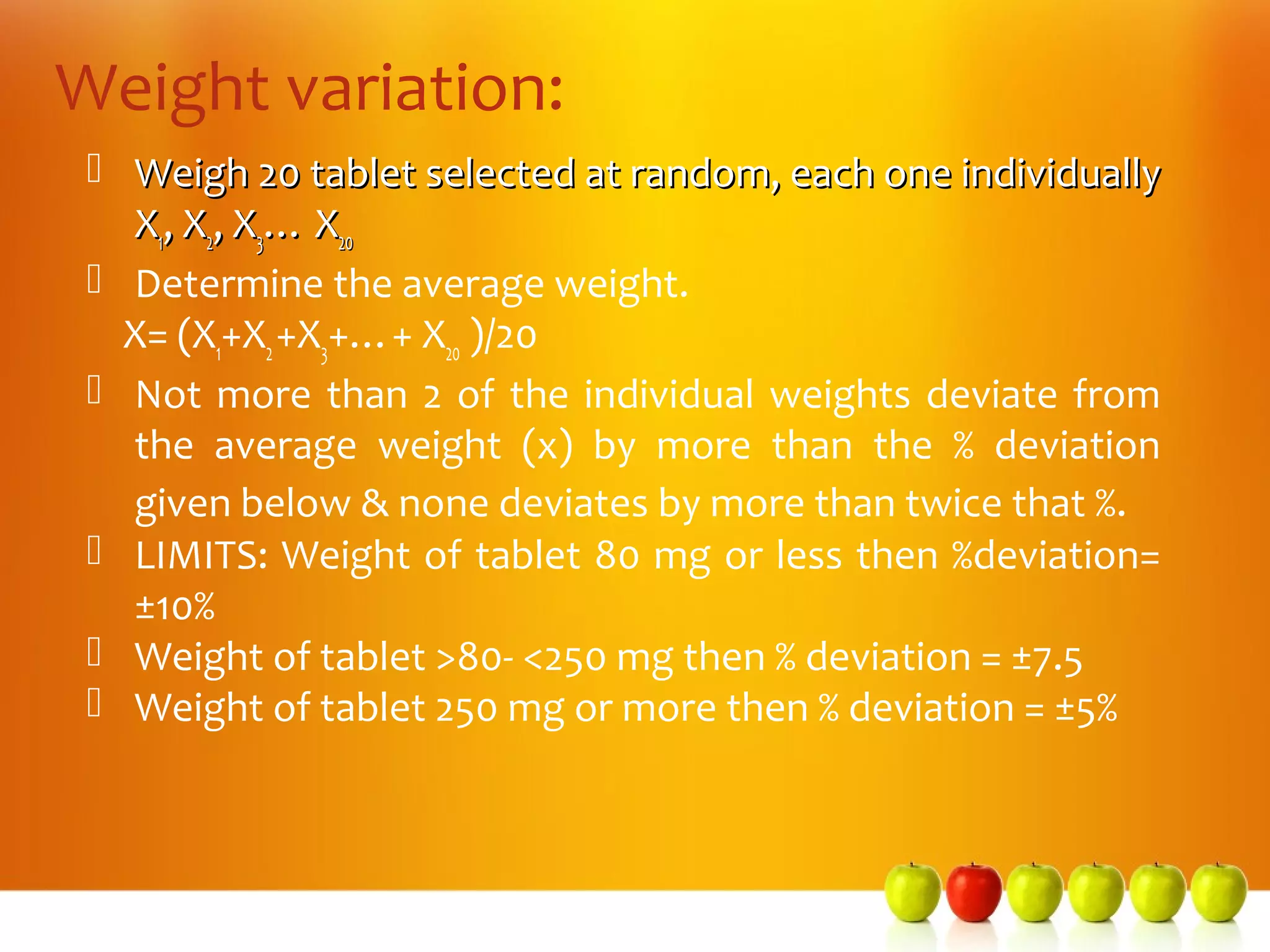
  Weigh 20 tablet selected at random, each one individually
   X1, X2, X3… X20
  Determine the average weight.
   X= (X1+X2 +X3+…+ X20 )/20
  Not more than 2 of the individual weights deviate from
   the average weight (x) by more than the % deviation
   given below & none deviates by more than twice that %.
  LIMITS: Weight of tablet 80 mg or less then %deviation=
   ±10%
  Weight of tablet >80- <250 mg then % deviation = ±7.5
  Weight of tablet 250 mg or more then % deviation = ±5%
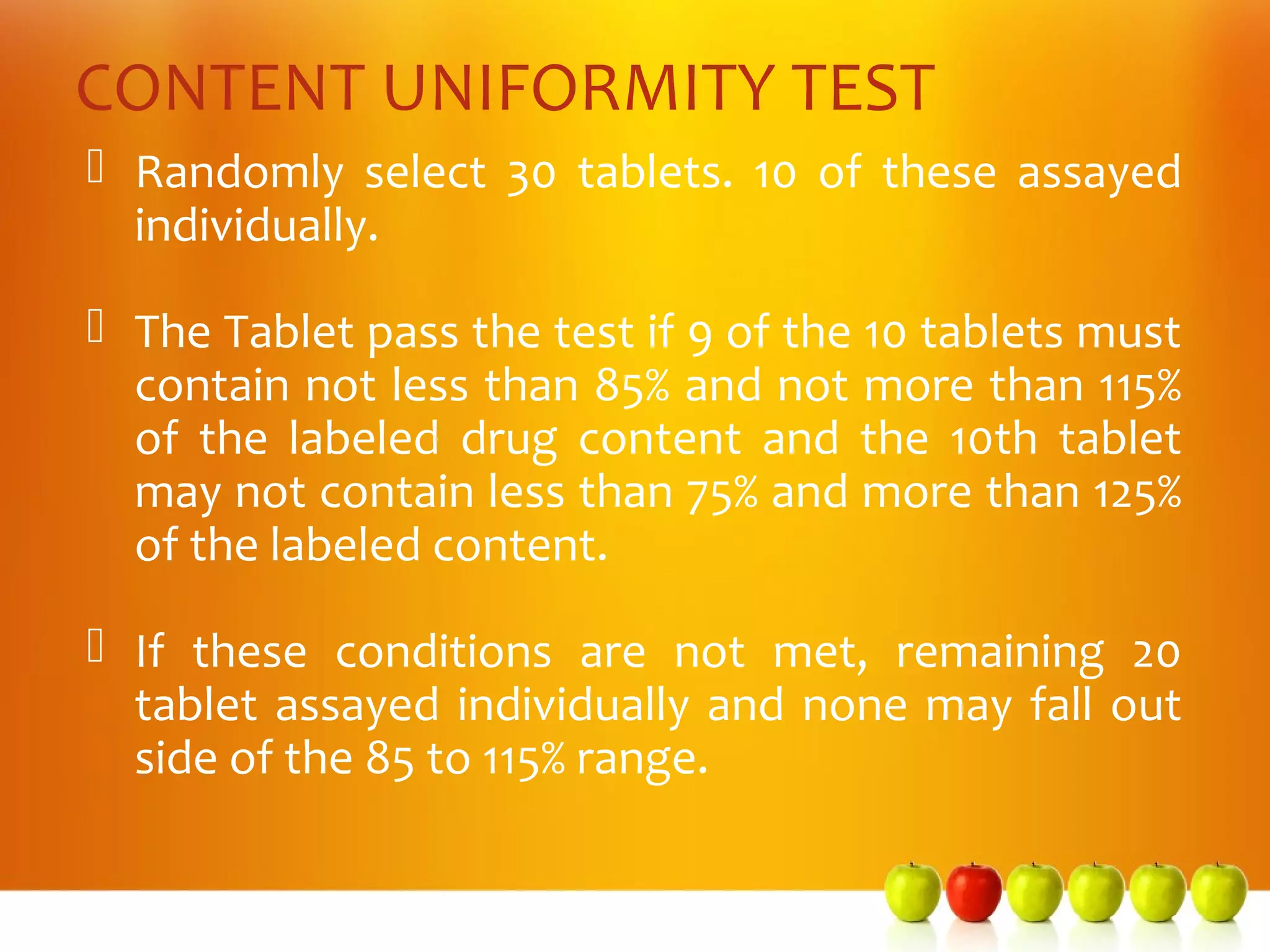
CONTENT UNIFORMITY TEST
 Randomly select 30 tablets. 10 of these assayed
  individually.

 The Tablet pass the test if 9 of the 10 tablets must
  contain not less than 85% and not more than 115%
  of the labeled drug content and the 10th tablet
  may not contain less than 75% and more than 125%
  of the labeled content.

 If these conditions are not met, remaining 20
  tablet assayed individually and none may fall out
  side of the 85 to 115% range.
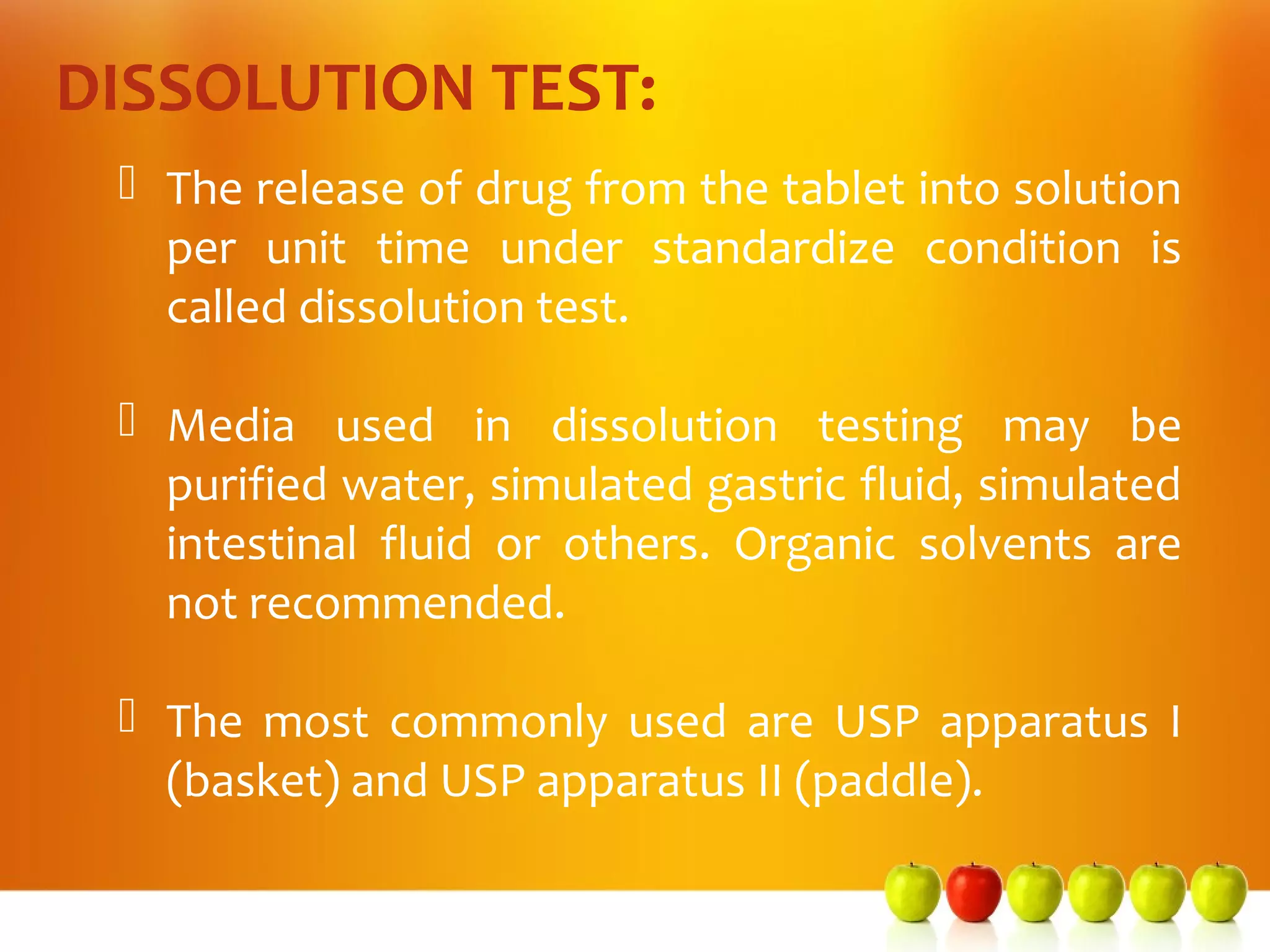
DISSOLUTION TEST:
  The release of drug from the tablet into solution
   per unit time under standardize condition is
   called dissolution test.

  Media used in dissolution testing may be
   purified water, simulated gastric fluid, simulated
   intestinal fluid or others. Organic solvents are
   not recommended.

  The most commonly used are USP apparatus I
   (basket) and USP apparatus II (paddle).
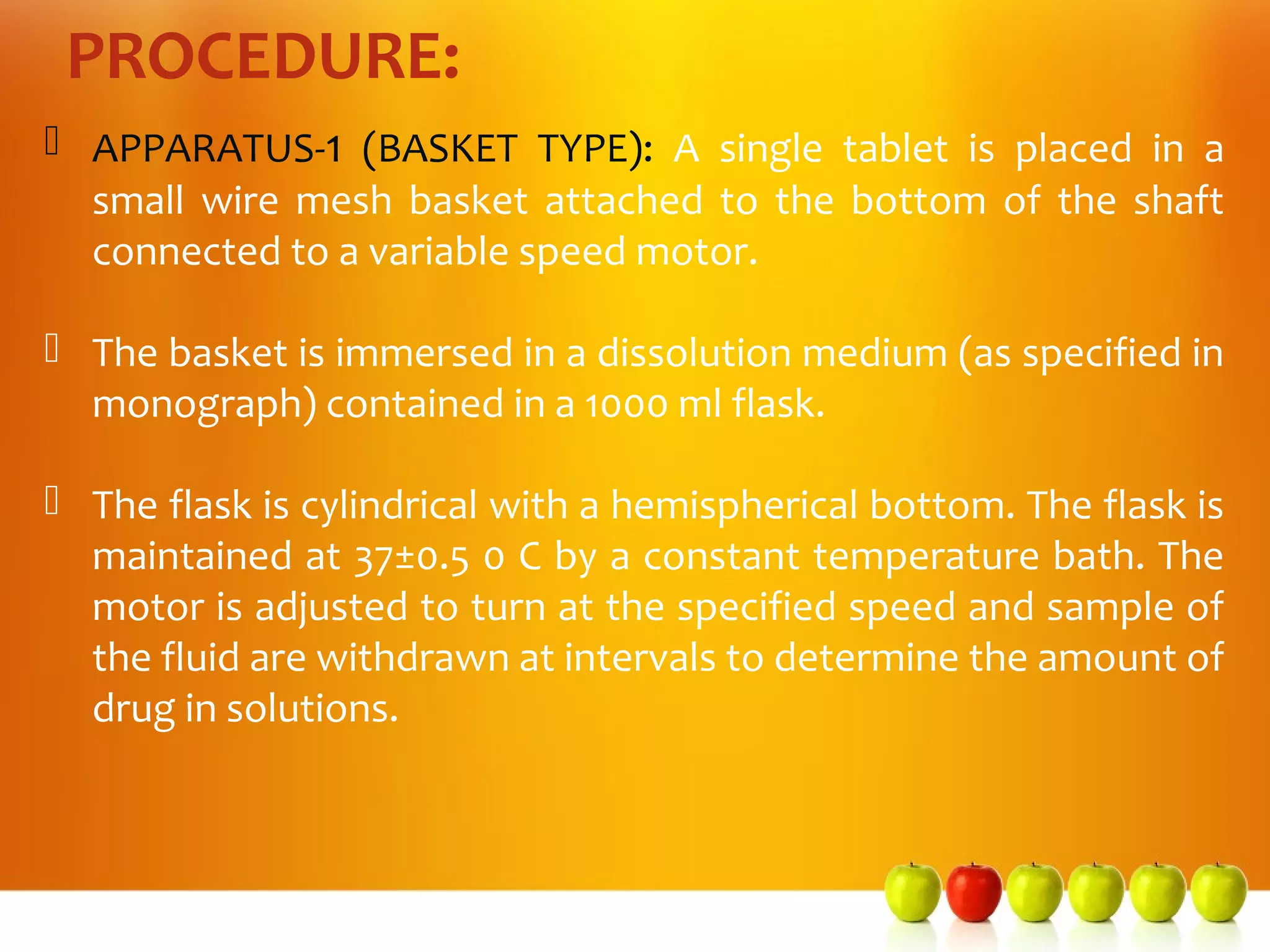
PROCEDURE:
 APPARATUS-1 (BASKET TYPE): A single tablet is placed in a
  small wire mesh basket attached to the bottom of the shaft
  connected to a variable speed motor.

 The basket is immersed in a dissolution medium (as specified in
  monograph) contained in a 1000 ml flask.

 The flask is cylindrical with a hemispherical bottom. The flask is
  maintained at 37±0.5 0 C by a constant temperature bath. The
  motor is adjusted to turn at the specified speed and sample of
  the fluid are withdrawn at intervals to determine the amount of
  drug in solutions.
 APPARATUS-2(PADDLE TYPE): It is same as apparatus-1,
  except the basket is replaced by a paddle.

 The tablet is allowed to sink to the bottom of the flask
  before stirring.

 For dissolution test U.S.P. specifies the dissolution test
  medium and volume, type of apparatus to be used, rpm of
  the shaft, time limit of the test and assay procedure.

 The test tolerance is expressed as a % of the labeled
  amount of drug dissolved in the time limit .
Quality control tests for tablets

Quality control tests for tablets

  • 1.
    Quality Control TestsFor Tablets P. P.Raja abhilash. M.Pharm. (Ph.D.) Assistant professor, S.R. College of Pharmacy.
  • 2.
    Introduction  QUALITY CONTROL (QC) : It is a small part of QA and it is concerned with sampling, testing and documentation during manufacturing and also after completion of manufacturing .  Quality control is the monitoring process through which manufacturer measures actual quality performance, compares it with standards and find out the causes of deviation from standard to ensure quality product not once but every time .  Definition: In general terms, Quality control refers to a procedure or a set of steps taken during the manufacturing of a product to ensure that it meets requirements and that the product is reproducible .
  • 3.
    QUALITY CONTROL TESTSFOR TABLETS:  General appearance: - Size, shape, and thickness: This is important to facilitate packaging and to decide which tablet compressing machine to use. - Organoleptic properties: which include color and odor of the tablets. - Weight uniformity and content uniformity: The tablet should include the correct dose of the drug.
  • 4.
     Dissolution test:Drug should be released from tablet in a controlled and reproducible way.  Weight variation, thickness & diameter: The appearance of tablet should be elegant & its weight, size & appearance should be consistent.  Hardness & friability: The tablet should show sufficient mechanical strength to withstand fracture & erosion during manufacture & handling.  These factors must be controlled during production and verified after production, hence called In-process control
  • 5.
    OFFICIAL STANDARDS ASPER B.P. /I.P./ U.S.P.:  comparison of different pharmacopoeial quality control tests : BRITISH PHARMACOPOEIA: FOR ALL TABLETS:  Content of active ingredients  Disintegration  Uniformity of content  Labeling
  • 6.
     Uncoated tablet:  Disintegration Test  uniformity of weight.  Effervescent tablet:  Disintegration Test  uniformity of weight.  Coated tablet:  Disintegration Test  uniformity of weight.
  • 7.
     Gastro resistanttablet :  Disintegration Test  Modified release tablet:  Uniformity of weight.  Dispersible tablet:  Disintegration test.  Uniformity of dispersion  Uniformity of weight
  • 8.
    INDIAN PHARMACOPOEIA  Uncoatedtablet:  Uniformity of container content  Content of active ingredient  Uniformity of weight  Uniformity of content  Disintegration test  Enteric coated tablet:  Disintegration test
  • 9.
     Dispersible tablet:  Uniformity of dispersion  Disintegration test  Soluble tablet :  Disintegration test  Effervescent tablet :  Disintegration/Dissolution/Dispersion test
  • 10.
    UNITED STATES PHARMACOPOEIA: Physical tests applicable to tablet formulation : -Bulk density /Tapped density of powder -Powder fineness -Loss on drying -Disintegration test -Tablet friability -Dissolution test -Drug release testing -Uniformity of dosage form -Container permeation test -Labeling of inactive ingredients
  • 11.
     Official andunofficial tests  Official Tests :  Weight variation  Disintegration test  Dissolution  Drug content  Non-Official Tests :  Hardness  friability
  • 12.
    NON OFFICIAL TESTS:HARDNESS (CRUSHING STRENGTH):  Hardness (crushing strength): It is the load required to crush the tablet when placed on its edge.  Why do we measure hardness?  To determine the need for pressure adjustments on the tableting machine.  Hardness can affect the disintegration. So if the tablet is too hard, it may not disintegrate in the required period of time. And if the tablet is too soft, it will not withstand the handling during subsequent processing such as coating and packaging.
  • 13.
     In general,if the tablet hardness is too high, we first check its disintegration before rejecting the batch. And if the disintegration is within limit, we accept the batch.  If Hardness is high and disintegration is within time we accept the batch .
  • 14.
    PROCEDURE  MONSANTO TESTER:The apparatus consists of 2 jaws facing each other, one of which move towards the other.  Measurements is carried out on 10 tablets, taking care to remove all the fragments of the broken tablets before each determination & then take the average hardness.  LIMITS: Normal tablet hardness ranges from 4 – 6 Kg (1 Kg = 10 Newton)  however, certain tablets as lozenges and buccal tablets that are intended to dissolve slowly show deliberate higher hardness values.
  • 15.
     Factors Affectingthe Hardness:  Compression of the tablet and compressive force.  Amount of binder. (More binder à more hardness)  Method of granulation in preparing the tablet (wet method gives more hardness than direct method, Slugging method gives the best hardness).  Monsanto tester, Pfizer tester, stong cobb hardness tester are manually used & Heberlien schleuniger, Eweka, Casburt hardness tester are motor driven testers .
  • 16.
     FRIABILITY: It is the tendency of tablets to powder, chip, or fragment and this can affect the elegance appearance, consumer acceptance of the tablet, and also add to tablet’s weight variation or content uniformity problems.  The tablet may well be subjected to a tumbling motion.  For e.g: Coating, packaging, transport, which are not severe enough to break the tablet, but may abrade the small particle from tablet surface. To examine this, tablets are subjected to a uniform tumbling motion for specified time and weight loss is measured.
  • 17.
     Friability isa property that is related to the hardness of the tablet & and also add weight variation, content uniformity problems.  An instrument called friabilator is used to evaluate the ability of the tablet to withstand abrasion in packaging, handling, and shipping .
  • 18.
    Procedure  Weigh 20tab altogether = W1  Put these tablets in the friabilator and adjust the instrument at 100 rpm (i.e. = 25 rpm for 4 min)  Weigh the 20 tablets (only the intact ones) = W2  Friability (% loss) = It must be less than or equal to1% but if more we do not reject the tablets as this test is non-official.  Perform this test using 20 tablets that were used first in the weight variation test
  • 19.
    OFFICIAL TESTS: DISINTEGRATION: Itis the time required for the tablet to break into particles, the disintegration test is a measure only of the time required under a given set of conditions for a group of tablets to disintegrate into particles. L
  • 20.
    LIMITS  For Uncoatedtablets Medium Temper Time ature limit According to Simulated 37oC Not U.S.P. gastric exceed fluid 30min According to water 37oC Not B.P. exceed 15min
  • 21.
    U.S.P. method foruncoated tablets: Start the disintegration test on 6 tablets. If one or two tablets from the 6 tablets fail disintegrate completely within 30min repeat the same test on another 12 tablet. (i.e. the whole test will consume 18 tablets). Not less then 16 tablets disintegrate completely within the time if more then two tablets (from the 18) fail to disintegrate, the batch must be rejected.
  • 22.
    For Coated tablets: Toremove or dissolve the coat, immerse the tablet in distilled water for 5min. Put the tablet in the apparatus in water or HCL for 30min at 37oC (according to the U.S.P). If not disintegrated, put in intestinal fluid. If one or two tablets fail to disintegrate, repeat on 12 tablets. So,16 tablets from the 18 must completely disintegrate within the time. If two or more not disintegrated the batch is rejected.
  • 23.
    U.S.P. Method forEnteric coated tablets: Put in distilled water for five minutes to dissolve the coat. Then put in simulated gastric fluid (0.1M HCL) for one hour. Then put in simulated intestinal fluid for two hours. If one or two tablets fail to disintegrate, repeat this test on another 12 tablets. So 16 tablets from 18 should completely disintegrate. If more than two fail to disintegrate the patch must be rejected.
  • 24.
    B.P. method forEnteric coated tablets:  Put in distilled water for five minutes to dissolve the coat.  Put in simulated gastric fluid for two hours (emptying time).  Put in phosphate buffer (PH 6.8) for one hour.  If one or two tablets fail to disintegrate repeat on 12 tablets. So 16 tablets should disintegrate. If more than two tables fail to disintegrate reject the batch.
  • 25.
    Uniformity of ActiveIngredients:  It is measured to ensure a constant dose of drug between individual drugs  Traditionally, dose variation between tablet is tested in two separate tests namely A) Weight variation B) Content uniformity
  • 26.
    Weight variation: Weigh 20 tablet selected at random, each one individually X1, X2, X3… X20  Determine the average weight. X= (X1+X2 +X3+…+ X20 )/20  Not more than 2 of the individual weights deviate from the average weight (x) by more than the % deviation given below & none deviates by more than twice that %.  LIMITS: Weight of tablet 80 mg or less then %deviation= ±10%  Weight of tablet >80- <250 mg then % deviation = ±7.5  Weight of tablet 250 mg or more then % deviation = ±5%
  • 27.
    CONTENT UNIFORMITY TEST Randomly select 30 tablets. 10 of these assayed individually.  The Tablet pass the test if 9 of the 10 tablets must contain not less than 85% and not more than 115% of the labeled drug content and the 10th tablet may not contain less than 75% and more than 125% of the labeled content.  If these conditions are not met, remaining 20 tablet assayed individually and none may fall out side of the 85 to 115% range.
  • 28.
    DISSOLUTION TEST: The release of drug from the tablet into solution per unit time under standardize condition is called dissolution test.  Media used in dissolution testing may be purified water, simulated gastric fluid, simulated intestinal fluid or others. Organic solvents are not recommended.  The most commonly used are USP apparatus I (basket) and USP apparatus II (paddle).
  • 29.
    PROCEDURE:  APPARATUS-1 (BASKETTYPE): A single tablet is placed in a small wire mesh basket attached to the bottom of the shaft connected to a variable speed motor.  The basket is immersed in a dissolution medium (as specified in monograph) contained in a 1000 ml flask.  The flask is cylindrical with a hemispherical bottom. The flask is maintained at 37±0.5 0 C by a constant temperature bath. The motor is adjusted to turn at the specified speed and sample of the fluid are withdrawn at intervals to determine the amount of drug in solutions.
  • 30.
     APPARATUS-2(PADDLE TYPE):It is same as apparatus-1, except the basket is replaced by a paddle.  The tablet is allowed to sink to the bottom of the flask before stirring.  For dissolution test U.S.P. specifies the dissolution test medium and volume, type of apparatus to be used, rpm of the shaft, time limit of the test and assay procedure.  The test tolerance is expressed as a % of the labeled amount of drug dissolved in the time limit .

Editor's Notes

  • #8 Mydriatic – dilate the pupil and paralyze the muscles of accommodation of the iris Spasm – involuntary contraction or twitching