CHANGES IN CAPITAL STRUCTURE AND INTERNAL
RECONSTRUNCTION
1. Prescribe accurately company’s reconstruction
procedurs and relevant accounting theory
application according to the situation given. (C5)
2. Conduct properly in preparing financial statements
of Financial Position after internal and external
company’s reconstruction. (P4)
3. Discuss precisely the underlying accounting theory
in preparing company’s financial statement and
accounting roles in sustainable development using
appropriate concepts according to the situation
given. (A2)
CHANGES IN
CAPITAL
STRUCTURE AND
INTERNAL
RECONSTRUCTION
Concept of CA 1965
Devising scheme of
capital reduction
Accounting entries
When the company
may have more
than its optimum
level of capital
or
Its paid up capital
was eroded by
heavy losses
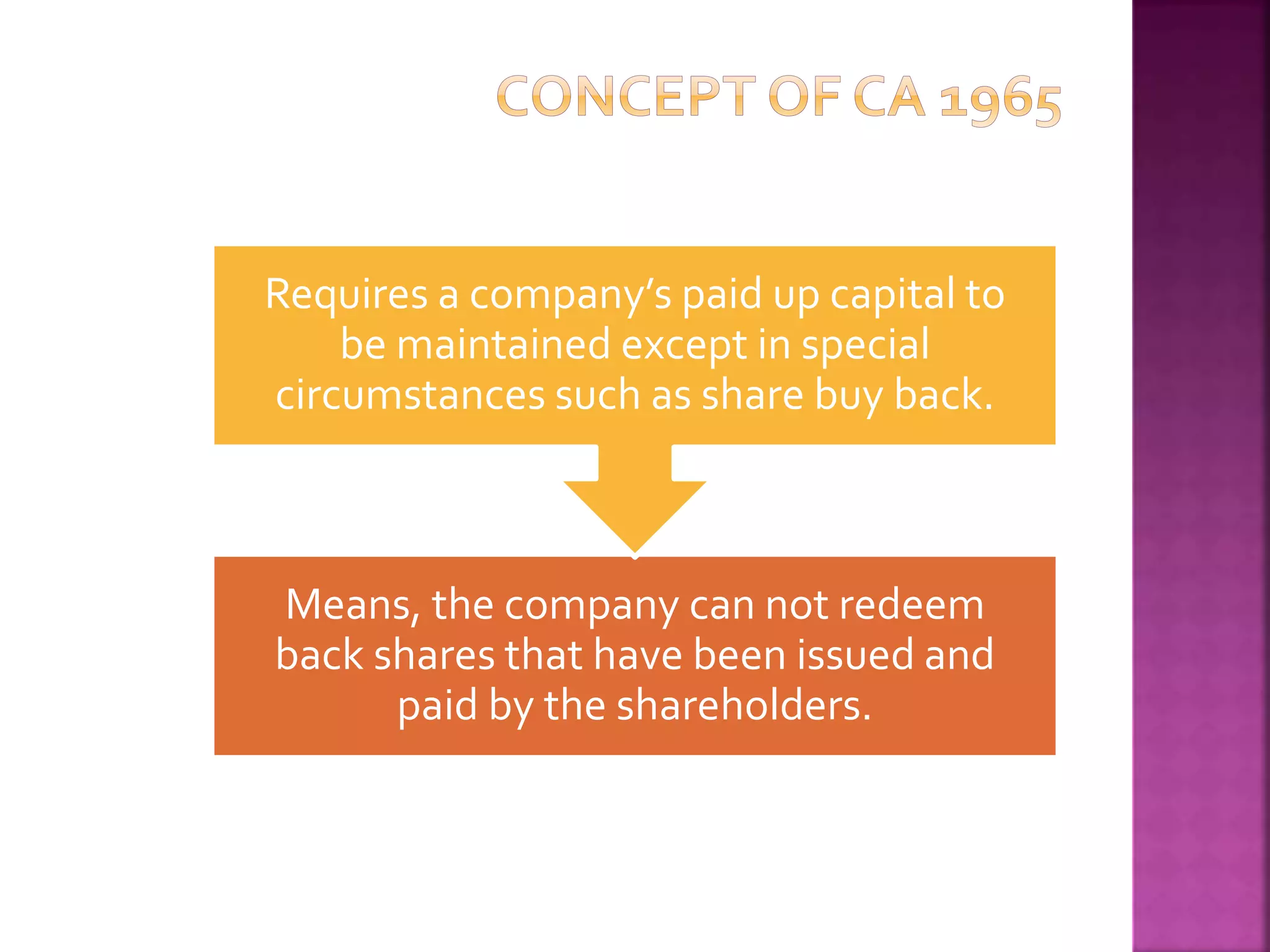
Means, the company can not redeem
back shares that have been issued and
paid by the shareholders.
Requires a company’s paid up capital to
be maintained except in special
circumstances such as share buy back.
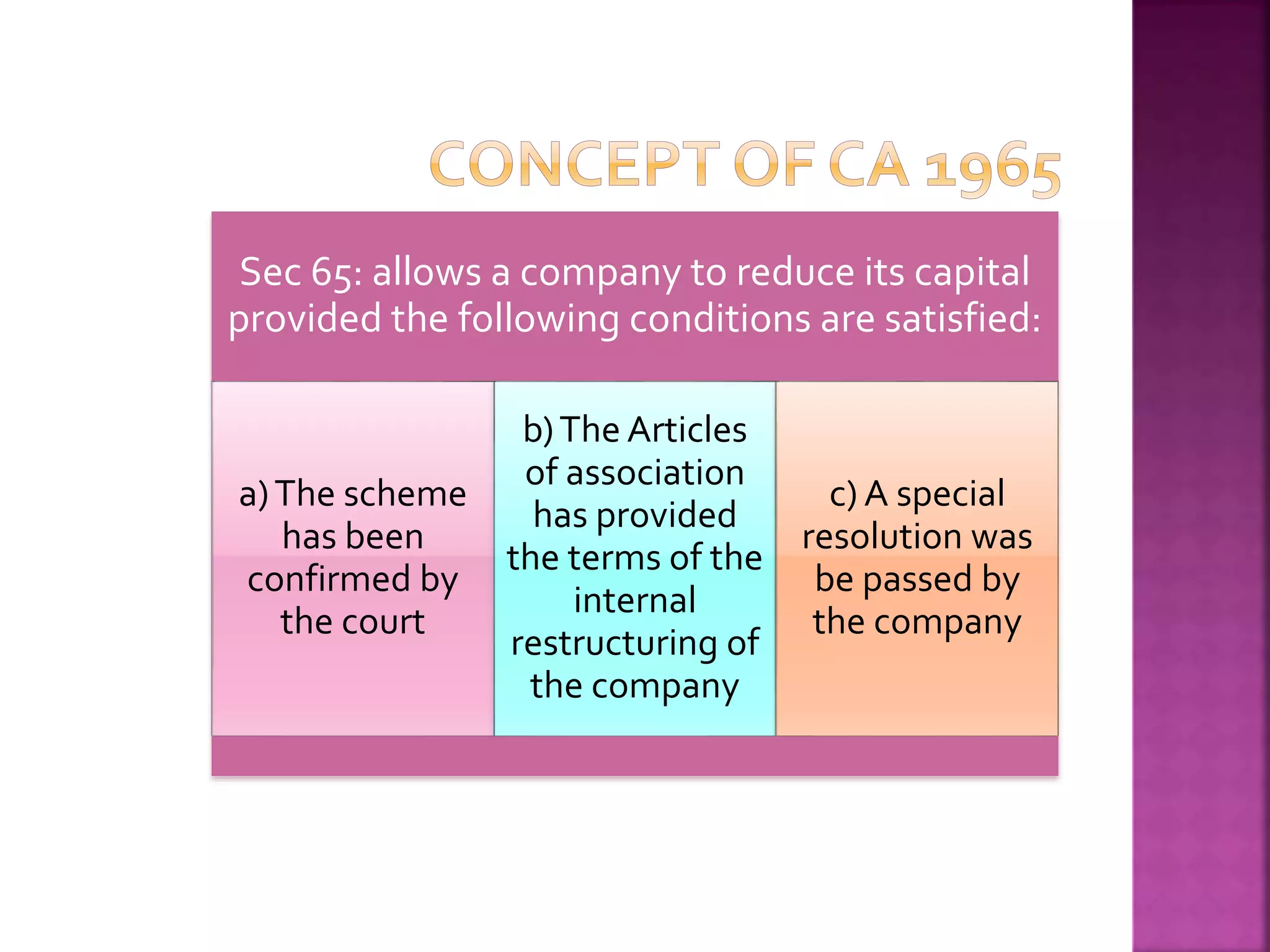
Sec 65: allows a company to reduce its capital
provided the following conditions are satisfied:
a)The scheme
has been
confirmed by
the court
b)The Articles
of association
has provided
the terms of the
internal
restructuring of
the company
c) A special
resolution was
be passed by
the company
* When the company had to go through
the process of winding. Winding up a
company is a process where all assets
are liquidated to raise cash to settle all
the liabilities of the company
* When the company have surplus
capital or whose capital was
eroded by trading losses. It
involves reducing the par value of
ordinary shares and preference
shares or dispose of the value of a
company not to call
EXTERNAL
INTERNAL
Determine the total amount to be
written off.
The accumulated losses have to
be eliminated.
Assets have to be revalued and
written down/up to market value
(fair value)
The right of various creditors must
be considered. Sometimes,
debenture holders and even trade
ant other creditors may accept a
reduction on their claims or be
willing to convert their claim into
shares.
Determine the amount of loss the
preference shares could bear.
Preference dividends may be
arrears, and the preference
shareholders may be willing to
waive their rights to the dividends
in arrears.
The scheme devised should be
equitable to all affected parties.
• Dt Share Capital Acc
(OS/PS)
• Cr Capital Reduction Acc
(CRA)
Amount
written off
share capital
• Dt ReserveAccounts
(Capital/General)
• Cr Capital Reduction Acc
(CRA)
Reserves
utilized for
the scheme
• Dt CRA
• Cr GW, Preliminary
Expenses & RND
ToWrite Off
GW, Preliminary
Expenses &
RND
• Dt CRA
• Cr Accumulated
losses
ToWrite off
Accumulated
Losses
• Dt RelevantAssets
• Cr CRA
Surplus On
Revaluation of
Assets
• Dt CRA
• Cr RelevantAssets
Amount
Written off
Assets on
Revaluation
• Dt Relevant
Liability
• Cr OSC Acc
Shares Issued In
Settlement of
Liabilities
• Dt Preference
Share
• Cr OSC Acc
Issue Ordinary
Shares in
Exchange of
Preference Shares
• Dt CRA
• Cr Bank
Expenses of
Capital
Reduction
• Dt CRA
• Cr Capital Reserve
Accounts
Surplus on
Capital
Reduction
Account
• Dt CRA
• Cr OSC Acc
Issue of new shares
in lieu of preference
dividends in arrears

CHANGES IN COMPANY CAPITAL STRUCTURE & RESTRUCTURING

  • 1.
    CHANGES IN CAPITALSTRUCTURE AND INTERNAL RECONSTRUNCTION
  • 2.
    1. Prescribe accuratelycompany’s reconstruction procedurs and relevant accounting theory application according to the situation given. (C5) 2. Conduct properly in preparing financial statements of Financial Position after internal and external company’s reconstruction. (P4) 3. Discuss precisely the underlying accounting theory in preparing company’s financial statement and accounting roles in sustainable development using appropriate concepts according to the situation given. (A2)
  • 3.
    CHANGES IN CAPITAL STRUCTURE AND INTERNAL RECONSTRUCTION Conceptof CA 1965 Devising scheme of capital reduction Accounting entries
  • 4.
    When the company mayhave more than its optimum level of capital or Its paid up capital was eroded by heavy losses
  • 5.
    Means, the companycan not redeem back shares that have been issued and paid by the shareholders. Requires a company’s paid up capital to be maintained except in special circumstances such as share buy back.
  • 6.
    Sec 65: allowsa company to reduce its capital provided the following conditions are satisfied: a)The scheme has been confirmed by the court b)The Articles of association has provided the terms of the internal restructuring of the company c) A special resolution was be passed by the company
  • 7.
    * When thecompany had to go through the process of winding. Winding up a company is a process where all assets are liquidated to raise cash to settle all the liabilities of the company * When the company have surplus capital or whose capital was eroded by trading losses. It involves reducing the par value of ordinary shares and preference shares or dispose of the value of a company not to call EXTERNAL INTERNAL
  • 8.
    Determine the totalamount to be written off. The accumulated losses have to be eliminated. Assets have to be revalued and written down/up to market value (fair value) The right of various creditors must be considered. Sometimes, debenture holders and even trade ant other creditors may accept a reduction on their claims or be willing to convert their claim into shares. Determine the amount of loss the preference shares could bear. Preference dividends may be arrears, and the preference shareholders may be willing to waive their rights to the dividends in arrears. The scheme devised should be equitable to all affected parties.
  • 9.
    • Dt ShareCapital Acc (OS/PS) • Cr Capital Reduction Acc (CRA) Amount written off share capital • Dt ReserveAccounts (Capital/General) • Cr Capital Reduction Acc (CRA) Reserves utilized for the scheme
  • 10.
    • Dt CRA •Cr GW, Preliminary Expenses & RND ToWrite Off GW, Preliminary Expenses & RND • Dt CRA • Cr Accumulated losses ToWrite off Accumulated Losses
  • 11.
    • Dt RelevantAssets •Cr CRA Surplus On Revaluation of Assets • Dt CRA • Cr RelevantAssets Amount Written off Assets on Revaluation
  • 12.
    • Dt Relevant Liability •Cr OSC Acc Shares Issued In Settlement of Liabilities • Dt Preference Share • Cr OSC Acc Issue Ordinary Shares in Exchange of Preference Shares
  • 13.
    • Dt CRA •Cr Bank Expenses of Capital Reduction • Dt CRA • Cr Capital Reserve Accounts Surplus on Capital Reduction Account
  • 14.
    • Dt CRA •Cr OSC Acc Issue of new shares in lieu of preference dividends in arrears