Analysis for Design
Evaluating game system behavior
Petri Lankoski Södertörn University
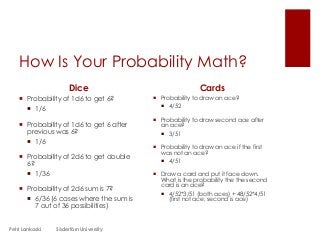
How Is Your Probability Math?
Dice
 Probability of 1d6 to get 6?
 1/6
 Probability of 1d6 to get 6 after
previous was 6?
 1/6
 Probability of 2d6 to get double
6?
 1/36
 Probability of 2d6 sum is 7?
 6/36 (6 cases where the sum is
7 out of 36 possibilities)
Cards
 Probability to draw an ace?
 4/52
 Probability to draw second ace after
an ace?
 3/51
 Probability to draw an ace if the first
was not an ace?
 4/51
 Draw a card and put it face down.
What is the probability the the second
card is an ace?
 4/52*3/51 (both aces) + 48/52*4/51
(first not ace, second is ace)
Petri Lankoski Södertörn University
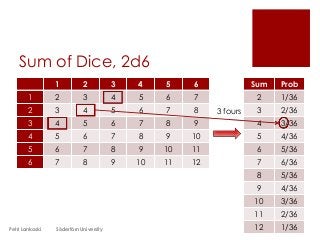
Sum of Dice, 2d6
1 2 3 4 5 6
1 2 3 4 5 6 7
2 3 4 5 6 7 8
3 4 5 6 7 8 9
4 5 6 7 8 9 10
5 6 7 8 9 10 11
6 7 8 9 10 11 12
Petri Lankoski Södertörn University
Sum Prob
2 1/36
3 2/36
4 3/36
5 4/36
6 5/36
7 6/36
8 5/36
9 4/36
10 3/36
11 2/36
12 1/36
3 fours
Dice vs Cards
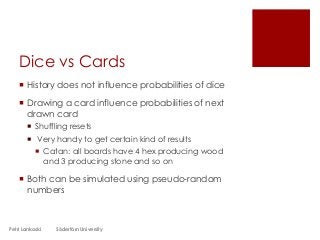
 History does not influence probabilities of dice
 Drawing a card influence probabilities of next
drawn card
 Shuffling resets
 Very handy to get certain kind of results
 Catan: all boards have 4 hex producing wood
and 3 producing stone and so on
 Both can be simulated using pseudo-random
numbers
Petri Lankoski Södertörn University
More about randomness
 Salen & Zimmerman, 2004. Rules of play.
 Game as systems of uncertainty, pp.173–188.
 Elias, Garfield & Gutschera, 2012. Characteristics
of games.
 Indeterminacy, pp. 137–166
Petri Lankoski Södertörn University
A Skill System
skilld10 vs difficulty example
Petri Lankoski Södertörn University
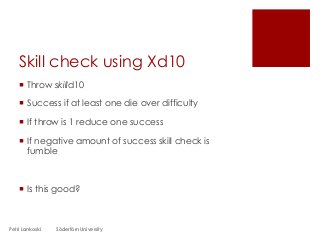
Skill check using Xd10
 Throw skilld10
 Success if at least one die over difficulty
 If throw is 1 reduce one success
 If negative amount of success skill check is
fumble
 Is this good?
Petri Lankoski Södertörn University
10000
20000
30000
40000
50000
2 4 6 8
diff
success
skill
1
2
3
4
5
6
7
8
9
10
0
10000
20000
30000
2 4 6 8
diff
fail
skill
1
2
3
4
5
6
7
8
9
10
0
2500
5000
7500
10000
2 4 6 8
diff
fumble
skill
1
2
3
4
5
6
7
8
9
10
Petri Lankoski Södertörn University
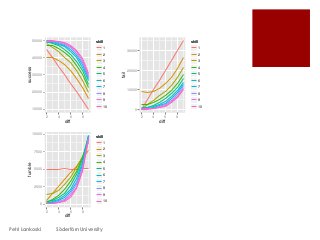
What we learned
 System works OK in most cases
 Skill level 1 and 2 differently to other levels
 High difficulties are significantly less likely to fumble
with skill level 1 than with high skills; skill level 2 less
anomaly, but still very different
 Skill levels 1 and 2 are less likely to success in most
cases
 But behaves differently than other skill levels
 One possible fix:
 No skill rolls use 1 or 2 dice
Petri Lankoski Södertörn University
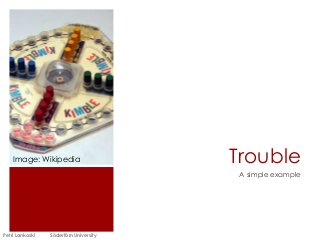
Trouble
A simple example
Petri Lankoski Södertörn University
Image: Wikipedia
Trouble
 How long (rounds & minutes ) in average game
takes?
 Ignore returning home by landing on them, on
board with with 6 and home with only correct roll
Petri Lankoski Södertörn University
Answer: Trouble
 Expected value: long run average
 D6: expected value = 3.5 (1+6/2), but…
 However, the Trouble die expected value is 4
 Simulated the die 50000 times and calculated
average
 Track length: 32, 31, 30, 29
 Game time estimate (underestimates)
 Average rounds to complete
 32 / 4 + 31 / 4 + 30 / 4 + 29 / 4 = 30.5 rounds
 Turn: 15 sec -> round: 1 min -> game: 30.5 * 1 min ~30
min
 But return home rule makes game more unpredictable
Petri Lankoski Södertörn University
Balance
 Is game balanced?
 How game is balanced?
Petri Lankoski Södertörn University
Answer: Balance
 Game is symmetrical
⇒balanced
 Except:
 1st (and so on) player has a small advantage over
next ones
 However, amount of rounds and return to home
mechanism is likely to reduce the advantage
Petri Lankoski Södertörn University
Assignment
Island Tour
Petri Lankoski Södertörn University
Game
Rules
 D6 to move
 Winner is the one who visit all
listed squares first (see the
column on the right hand
side)
 Must stop to a site
 All players start at START
 In one lands to red place,
one looses ones next turn
 Board in next slide
Goals
 Player 1 visits
 1, 6, 9, 15, 20, 32
 Player 2 visits
 4, 10, 13, 18, 27, 30
 Player 3 visits
 7, 8, 11, 15, 22, 29
 Player 4 visits
 5, 10, 11, 21, 23, 26
Petri Lankoski Södertörn University Assignment is based on Korkeasaari board game
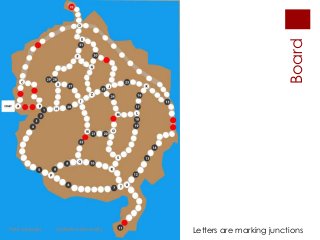
Board
Petri Lankoski Södertörn University
Letters are marking junctions
Island Tour
 Estimate how much time game takes
 How would you balance the game if it is not
balanced?
 Do not change core mechanics
 Racing with die
 Asymmetric
Petri Lankoski Södertörn University
Answers: Island Tour
Length Wait a
round
squares
Obl. wait
a round
squares
Expected
time
(rounds)
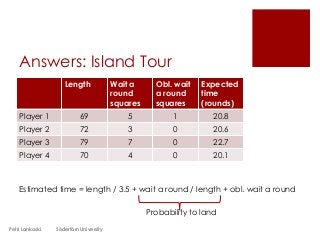
Player 1 69 5 1 20.8
Player 2 72 3 0 20.6
Player 3 79 7 0 22.7
Player 4 70 4 0 20.1
Petri Lankoski Södertörn University
Estimated time = length / 3.5 + wait a round / length + obl. wait a round
Probability to land
Answers: Island Tour
 Player 3 has longer / harder path
 Easy fix: shorten the path
 E.g. 7, 8, 15, 22, 28, 31
Petri Lankoski Södertörn University
Settlers of Catan
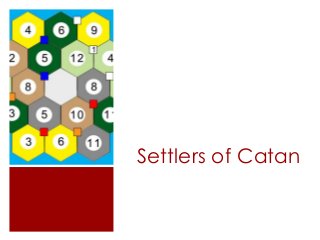
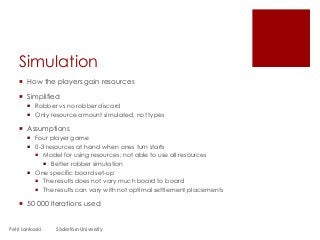
Simulation
 How the players gain resources
 Simplified
 Robber vs no robber discard
 Only resource amount simulated, not types
 Assumptions
 Four player game
 0-3 resources at hand when ones turn starts
 Model for using resources; not able to use all resources
 Better robber simulation
 One specific board set-up
 The results does not vary much board to board
 The results can vary with not optimal settlement placements
 50 000 iterations used
Petri Lankoski Södertörn University
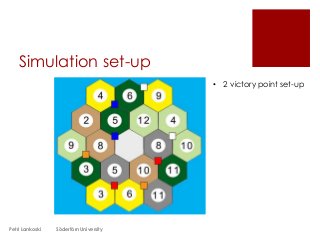
Simulation set-up
• 2 victory point set-up
Petri Lankoski Södertörn University
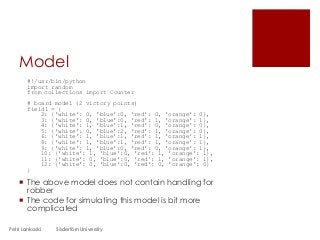
Model
#!/usr/bin/python
import random
from collections import Counter
# board model (2 victory points)
field1 = {
2: {'white': 0, 'blue':0, 'red': 0, 'orange': 0},
3: {'white': 0, 'blue':0, 'red': 1, 'orange': 1},
4: {'white': 1, 'blue':1, 'red': 0, 'orange': 0},
5: {'white': 0, 'blue':2, 'red': 1, 'orange': 0},
6: {'white': 1, 'blue':1, 'red': 1, 'orange': 1},
8: {'white': 1, 'blue':1, 'red': 1, 'orange': 1},
9: {'white': 1, 'blue':0, 'red': 0, 'orange': 1},
10: {'white': 1, 'blue':0, 'red': 1, 'orange': 1},
11: {'white': 0, 'blue':0, 'red': 1, 'orange': 1},
12: {'white': 0, 'blue':0, 'red': 0, 'orange': 0}
}
 The above model does not contain handling for
robber
 The code for simulating this model is bit more
complicated
Petri Lankoski Södertörn University
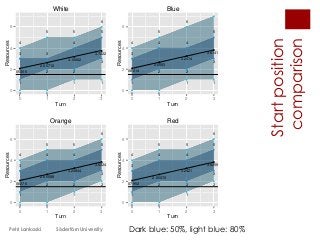
Startposition
comparison
Petri Lankoski Södertörn University Dark blue: 50%, light blue: 80%
4
5 5
6
0 0
1 11
2 2
3
3 3
4
5
2.05356
2.60712
3.16662
3.72224
0
2
4
6
0 1 2 3
Turn
Resources White
4
5
6
7
0 0
1 11
2 2
3
3
4 4
5
2.08214
2.6593
3.2414
3.81416
0
2
4
6
0 1 2 3
Turn
Resources
Blue
4
5 5
6
0 0
1
2
1
2 2
3
3
4 4
5
2.08276
2.66588
3.24844
3.83248
0
2
4
6
0 1 2 3
Turn
Resources
Orange
4
5 5
6
0 0
1
2
1
2 2
3
3
4 4
5
2.07952
2.66072
3.2421
3.82596
0
2
4
6
0 1 2 3
Turn
Resources Red
What this mean?
Petri Lankoski Södertörn University
What this mean?
 Rather well-balanced starting positions
 No advantage/disadvantage for any color
 White slightly lower average resource gain
 But have a port
 Blue slightly have more variation in resource gain
(80% area is wider)
Petri Lankoski Södertörn University
Impactofsetup
Petri Lankoski Södertörn University
Impactofsetup
Petri Lankoski Södertörn University
3
4
5 5
0 0
1 11 1
2 2
3 3
4 4
1.89398
2.28342
2.67204
3.06254
0
2
4
6
0 1 2 3
Turn
Resources
White, bad
3
4
5 5
0 0 0 0
1 1 1
2
3 3 3
4
1.8087
2.11382
2.42424
2.72642
0
2
4
6
0 1 2 3
Turn
Resources
White, bad alt 2
4
5 5
6
0 0
1
2
1
2 2
3
3
4 4
5
2.08718
2.67596
3.26016
3.84286
0
2
4
6
0 1 2 3
Turn
Resources
White, good alt
4
5 5
6
0 0
1 11
2 2
3
3 3
4
5
2.05356
2.60712
3.16662
3.72224
0
2
4
6
0 1 2 3
Turn
Resources
White
What this mean?
Petri Lankoski Södertörn University
What this mean?
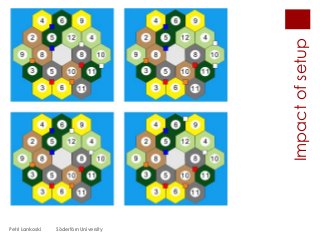
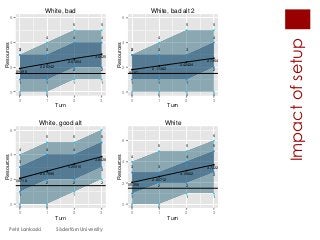
 Initial placement of ones settlement is important
 Rather big impact on resource gain
 Even bigger after upgrading settlements to cities
Petri Lankoski Södertörn University
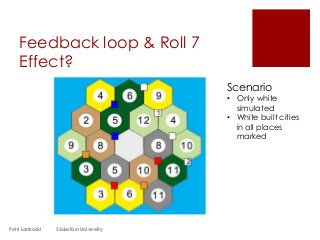
Feedback loop & Roll 7
Effect?
Petri Lankoski Södertörn University
Scenario
• Only white
simulated
• White built cities
in all places
marked
Feedbackloop&roll
“7”effect
Petri Lankoski Södertörn University
6
11
12
14
1 1
2
3
2
3
4
64
6
8
10
3.28772
5.07054
6.68098
8.11302
0
5
10
15
0 1 2 3
Turn
Resources Robber=Default
6
11
13
15
1 1
2
3
2
3
4
64
6
8
11
3.2899
5.0725
6.85024
8.62992
0
5
10
15
0 1 2 3
Turn
Resources
Robber=No
6
11
12
14
1 1
2 22
3
4
5
4
6
8
10
3.27528
5.04646
6.527
7.68936
0
5
10
15
0 1 2 3
Turn
Resources
Robber=To zero
6
11
12
14
1 1
2
3
2
3
4
5
4
6
8
10
3.29602
5.0909
6.50472
7.7635
0
5
10
15
0 1 2 3
Turn
Resources Robber=Limit 4 & half
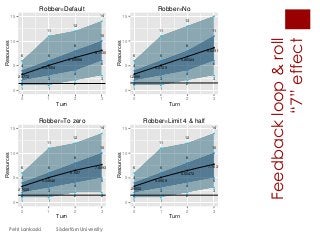
What this mean?
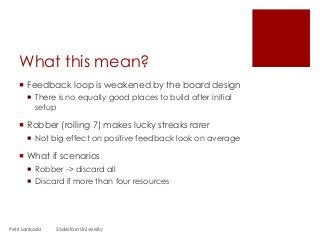
 Feedback loop is weakened by the board design
 There is no equally good places to build after initial
setup
 Robber (rolling 7) makes lucky streaks rarer
 Not big effect on positive feedback look on average
 What if scenarios
 Robber -> discard all
 Discard if more than four resources
Petri Lankoski Södertörn University
Monopoly
Petri Lankoski Södertörn University
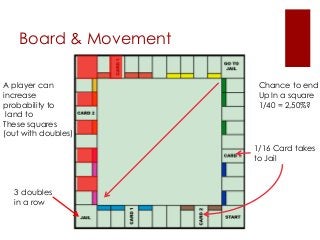
Board & Movement
Chance to end
Up In a square
1/40 = 2,50%?
3 doubles
in a row
1/16 Card takes
to Jail
A player can
increase
probability to
land to
These squares
(out with doubles)
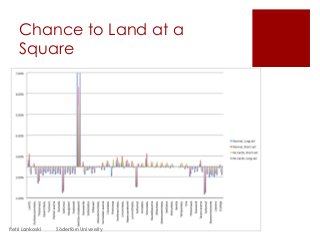
Chance to Land at a
Square
Petri Lankoski Södertörn University
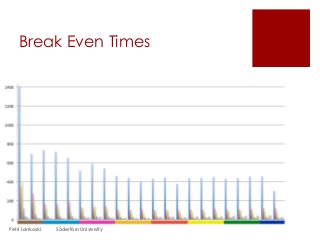
Break Even Times
Petri Lankoski Södertörn University
What we learned
 Staying in prison strategy alters changes to land
other squares
 Long prison stay good at the end game
 Break even time downward trend is good
 Breakeven times are long
 Slow start
 Note that one cannot build before owning all
squares with that color
Petri Lankoski Södertörn University
Forbidden Island
Petri Lankoski Södertörn University
Rules in brief
 Randomly generated boar,
 Treasure deck (28 cards)
 4 treasure cards are needed to
collect a certain (1/4) treasure
from specific tile
 Water rise! (3) cards increase
speed which the island is going
under water
 Flood cards
 Tells which tile will be flooded
or sink
 Players has three actions
 Support a tile
 Move
 Give a treasure card
 Capture a treasure
 Win by collecting all four treasures
and escape by helicopter
 Loose by
 Water level raises too high (with
Water Rise! Cards)
 Cannot collect the treasures
because of sunken tile
 Cannot escape because of
the exit tile is sunken
Petri Lankoski Södertörn University
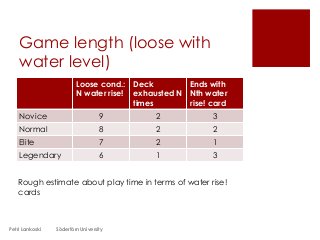
Game length (loose with
water level)
 3 water raises cards in treasure cards deck (28
cards)
Petri Lankoski Södertörn University
Game length (loose with
water level)
Petri Lankoski Södertörn University
Loose cond.:
N water rise!
Deck
exhausted N
times
Ends with
Nth water
rise! card
Novice 9 2 3
Normal 8 2 2
Elite 7 2 1
Legendary 6 1 3
Rough estimate about play time in terms of water rise!
cards
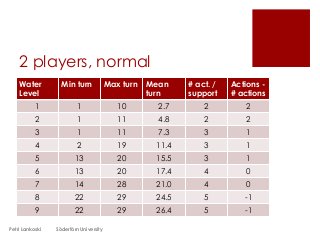
2 players, normal
Petri Lankoski Södertörn University
Water
Level
Min turn Max turn Mean
turn
# act. /
support
Actions -
# actions
1 1 10 2.7 2 2
2 1 11 4.8 2 2
3 1 11 7.3 3 1
4 2 19 11.4 3 1
5 13 20 15.5 3 1
6 13 20 17.4 4 0
7 14 28 21.0 4 0
8 22 29 24.5 5 -1
9 22 29 26.4 5 -1
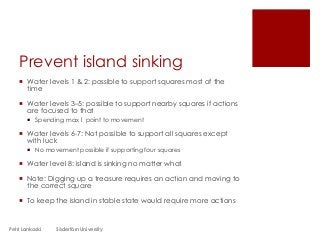
Prevent island sinking
 Water levels 1 & 2: possible to support squares most of the
time
 Water levels 3–5: possible to support nearby squares if actions
are focused to that
 Spending max 1 point to movement
 Water levels 6-7: Not possible to support all squares except
with luck
 No movement possible if supporting four squares
 Water level 8: island is sinking no matter what
 Note: Digging up a treasure requires an action and moving to
the correct square
 To keep the island in stable state would require more actions
Petri Lankoski Södertörn University
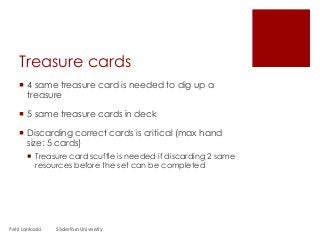
Treasure cards
Petri Lankoski Södertörn University
 4 same treasure card is needed to dig up a
treasure
 5 same treasure cards in deck
 Discarding correct cards is critical (max hand
size: 5 cards)
 Treasure card scuffle is needed if discarding 2 same
resources before the set can be completed
Summary
Petri Lankoski Södertörn University
Balance
 Symmetry typically leads to balance
 Note: turn order / some typically start in board games
 Creates imbalance
 Catan solution to balance set-up
 turn order in setup: 1-2-3-4-4-3-2-1
 Symmetry can be also in form of rock-paper-scissors
 Balancing weapons & troops
 non-symmetrical things are harder to balance
 Difficulty in co-op games:
 resources needed to keep status quo or
 to progress vs resources available
Petri Lankoski Södertörn University
Simulations
 Game systems with random component are
complex to predict
 Card-based are even history-dependent
 How many / what cards are played influence
probabilities
 Simulations can help to understand how a part of
the system behaves
 One does not need ready game for simulation
 But one needs to understand what to simulate
 Does not replace playtesting
 But simulation can show the features work in the long
run
Petri Lankoski Södertörn University
Assignment
Petri Lankoski Södertörn University
Assignment
 Use relevant presented approaches to analyze
your game design and
 Balance it / set difficulty
 Fine-tune play time
 Combine with play-testing
 Return
 Documentation of your process (steps, calculations)
 Around 1-2 pages
Petri Lankoski Södertörn University
That’s all folks
Petri Lankoski Södertörn University

Analysis for design

  • 1.
    Analysis for Design Evaluatinggame system behavior Petri Lankoski Södertörn University
  • 2.
    How Is YourProbability Math? Dice  Probability of 1d6 to get 6?  1/6  Probability of 1d6 to get 6 after previous was 6?  1/6  Probability of 2d6 to get double 6?  1/36  Probability of 2d6 sum is 7?  6/36 (6 cases where the sum is 7 out of 36 possibilities) Cards  Probability to draw an ace?  4/52  Probability to draw second ace after an ace?  3/51  Probability to draw an ace if the first was not an ace?  4/51  Draw a card and put it face down. What is the probability the the second card is an ace?  4/52*3/51 (both aces) + 48/52*4/51 (first not ace, second is ace) Petri Lankoski Södertörn University
  • 3.
    Sum of Dice,2d6 1 2 3 4 5 6 1 2 3 4 5 6 7 2 3 4 5 6 7 8 3 4 5 6 7 8 9 4 5 6 7 8 9 10 5 6 7 8 9 10 11 6 7 8 9 10 11 12 Petri Lankoski Södertörn University Sum Prob 2 1/36 3 2/36 4 3/36 5 4/36 6 5/36 7 6/36 8 5/36 9 4/36 10 3/36 11 2/36 12 1/36 3 fours
  • 4.
    Dice vs Cards History does not influence probabilities of dice  Drawing a card influence probabilities of next drawn card  Shuffling resets  Very handy to get certain kind of results  Catan: all boards have 4 hex producing wood and 3 producing stone and so on  Both can be simulated using pseudo-random numbers Petri Lankoski Södertörn University
  • 5.
    More about randomness Salen & Zimmerman, 2004. Rules of play.  Game as systems of uncertainty, pp.173–188.  Elias, Garfield & Gutschera, 2012. Characteristics of games.  Indeterminacy, pp. 137–166 Petri Lankoski Södertörn University
  • 6.
    A Skill System skilld10vs difficulty example Petri Lankoski Södertörn University
  • 7.
    Skill check usingXd10  Throw skilld10  Success if at least one die over difficulty  If throw is 1 reduce one success  If negative amount of success skill check is fumble  Is this good? Petri Lankoski Södertörn University
  • 8.
    10000 20000 30000 40000 50000 2 4 68 diff success skill 1 2 3 4 5 6 7 8 9 10 0 10000 20000 30000 2 4 6 8 diff fail skill 1 2 3 4 5 6 7 8 9 10 0 2500 5000 7500 10000 2 4 6 8 diff fumble skill 1 2 3 4 5 6 7 8 9 10 Petri Lankoski Södertörn University
  • 9.
    What we learned System works OK in most cases  Skill level 1 and 2 differently to other levels  High difficulties are significantly less likely to fumble with skill level 1 than with high skills; skill level 2 less anomaly, but still very different  Skill levels 1 and 2 are less likely to success in most cases  But behaves differently than other skill levels  One possible fix:  No skill rolls use 1 or 2 dice Petri Lankoski Södertörn University
  • 10.
    Trouble A simple example PetriLankoski Södertörn University Image: Wikipedia
  • 11.
    Trouble  How long(rounds & minutes ) in average game takes?  Ignore returning home by landing on them, on board with with 6 and home with only correct roll Petri Lankoski Södertörn University
  • 12.
    Answer: Trouble  Expectedvalue: long run average  D6: expected value = 3.5 (1+6/2), but…  However, the Trouble die expected value is 4  Simulated the die 50000 times and calculated average  Track length: 32, 31, 30, 29  Game time estimate (underestimates)  Average rounds to complete  32 / 4 + 31 / 4 + 30 / 4 + 29 / 4 = 30.5 rounds  Turn: 15 sec -> round: 1 min -> game: 30.5 * 1 min ~30 min  But return home rule makes game more unpredictable Petri Lankoski Södertörn University
  • 13.
    Balance  Is gamebalanced?  How game is balanced? Petri Lankoski Södertörn University
  • 14.
    Answer: Balance  Gameis symmetrical ⇒balanced  Except:  1st (and so on) player has a small advantage over next ones  However, amount of rounds and return to home mechanism is likely to reduce the advantage Petri Lankoski Södertörn University
  • 15.
  • 16.
    Game Rules  D6 tomove  Winner is the one who visit all listed squares first (see the column on the right hand side)  Must stop to a site  All players start at START  In one lands to red place, one looses ones next turn  Board in next slide Goals  Player 1 visits  1, 6, 9, 15, 20, 32  Player 2 visits  4, 10, 13, 18, 27, 30  Player 3 visits  7, 8, 11, 15, 22, 29  Player 4 visits  5, 10, 11, 21, 23, 26 Petri Lankoski Södertörn University Assignment is based on Korkeasaari board game
  • 17.
    Board Petri Lankoski SödertörnUniversity Letters are marking junctions
  • 18.
    Island Tour  Estimatehow much time game takes  How would you balance the game if it is not balanced?  Do not change core mechanics  Racing with die  Asymmetric Petri Lankoski Södertörn University
  • 19.
    Answers: Island Tour LengthWait a round squares Obl. wait a round squares Expected time (rounds) Player 1 69 5 1 20.8 Player 2 72 3 0 20.6 Player 3 79 7 0 22.7 Player 4 70 4 0 20.1 Petri Lankoski Södertörn University Estimated time = length / 3.5 + wait a round / length + obl. wait a round Probability to land
  • 20.
    Answers: Island Tour Player 3 has longer / harder path  Easy fix: shorten the path  E.g. 7, 8, 15, 22, 28, 31 Petri Lankoski Södertörn University
  • 21.
  • 22.
    Simulation  How theplayers gain resources  Simplified  Robber vs no robber discard  Only resource amount simulated, not types  Assumptions  Four player game  0-3 resources at hand when ones turn starts  Model for using resources; not able to use all resources  Better robber simulation  One specific board set-up  The results does not vary much board to board  The results can vary with not optimal settlement placements  50 000 iterations used Petri Lankoski Södertörn University
  • 23.
    Simulation set-up • 2victory point set-up Petri Lankoski Södertörn University
  • 24.
    Model #!/usr/bin/python import random from collectionsimport Counter # board model (2 victory points) field1 = { 2: {'white': 0, 'blue':0, 'red': 0, 'orange': 0}, 3: {'white': 0, 'blue':0, 'red': 1, 'orange': 1}, 4: {'white': 1, 'blue':1, 'red': 0, 'orange': 0}, 5: {'white': 0, 'blue':2, 'red': 1, 'orange': 0}, 6: {'white': 1, 'blue':1, 'red': 1, 'orange': 1}, 8: {'white': 1, 'blue':1, 'red': 1, 'orange': 1}, 9: {'white': 1, 'blue':0, 'red': 0, 'orange': 1}, 10: {'white': 1, 'blue':0, 'red': 1, 'orange': 1}, 11: {'white': 0, 'blue':0, 'red': 1, 'orange': 1}, 12: {'white': 0, 'blue':0, 'red': 0, 'orange': 0} }  The above model does not contain handling for robber  The code for simulating this model is bit more complicated Petri Lankoski Södertörn University
  • 25.
    Startposition comparison Petri Lankoski SödertörnUniversity Dark blue: 50%, light blue: 80% 4 5 5 6 0 0 1 11 2 2 3 3 3 4 5 2.05356 2.60712 3.16662 3.72224 0 2 4 6 0 1 2 3 Turn Resources White 4 5 6 7 0 0 1 11 2 2 3 3 4 4 5 2.08214 2.6593 3.2414 3.81416 0 2 4 6 0 1 2 3 Turn Resources Blue 4 5 5 6 0 0 1 2 1 2 2 3 3 4 4 5 2.08276 2.66588 3.24844 3.83248 0 2 4 6 0 1 2 3 Turn Resources Orange 4 5 5 6 0 0 1 2 1 2 2 3 3 4 4 5 2.07952 2.66072 3.2421 3.82596 0 2 4 6 0 1 2 3 Turn Resources Red
  • 26.
    What this mean? PetriLankoski Södertörn University
  • 27.
    What this mean? Rather well-balanced starting positions  No advantage/disadvantage for any color  White slightly lower average resource gain  But have a port  Blue slightly have more variation in resource gain (80% area is wider) Petri Lankoski Södertörn University
  • 28.
  • 29.
    Impactofsetup Petri Lankoski SödertörnUniversity 3 4 5 5 0 0 1 11 1 2 2 3 3 4 4 1.89398 2.28342 2.67204 3.06254 0 2 4 6 0 1 2 3 Turn Resources White, bad 3 4 5 5 0 0 0 0 1 1 1 2 3 3 3 4 1.8087 2.11382 2.42424 2.72642 0 2 4 6 0 1 2 3 Turn Resources White, bad alt 2 4 5 5 6 0 0 1 2 1 2 2 3 3 4 4 5 2.08718 2.67596 3.26016 3.84286 0 2 4 6 0 1 2 3 Turn Resources White, good alt 4 5 5 6 0 0 1 11 2 2 3 3 3 4 5 2.05356 2.60712 3.16662 3.72224 0 2 4 6 0 1 2 3 Turn Resources White
  • 30.
    What this mean? PetriLankoski Södertörn University
  • 31.
    What this mean? Initial placement of ones settlement is important  Rather big impact on resource gain  Even bigger after upgrading settlements to cities Petri Lankoski Södertörn University
  • 32.
    Feedback loop &Roll 7 Effect? Petri Lankoski Södertörn University Scenario • Only white simulated • White built cities in all places marked
  • 33.
    Feedbackloop&roll “7”effect Petri Lankoski SödertörnUniversity 6 11 12 14 1 1 2 3 2 3 4 64 6 8 10 3.28772 5.07054 6.68098 8.11302 0 5 10 15 0 1 2 3 Turn Resources Robber=Default 6 11 13 15 1 1 2 3 2 3 4 64 6 8 11 3.2899 5.0725 6.85024 8.62992 0 5 10 15 0 1 2 3 Turn Resources Robber=No 6 11 12 14 1 1 2 22 3 4 5 4 6 8 10 3.27528 5.04646 6.527 7.68936 0 5 10 15 0 1 2 3 Turn Resources Robber=To zero 6 11 12 14 1 1 2 3 2 3 4 5 4 6 8 10 3.29602 5.0909 6.50472 7.7635 0 5 10 15 0 1 2 3 Turn Resources Robber=Limit 4 & half
  • 34.
    What this mean? Feedback loop is weakened by the board design  There is no equally good places to build after initial setup  Robber (rolling 7) makes lucky streaks rarer  Not big effect on positive feedback look on average  What if scenarios  Robber -> discard all  Discard if more than four resources Petri Lankoski Södertörn University
  • 35.
  • 36.
    Board & Movement Chanceto end Up In a square 1/40 = 2,50%? 3 doubles in a row 1/16 Card takes to Jail A player can increase probability to land to These squares (out with doubles)
  • 37.
    Chance to Landat a Square Petri Lankoski Södertörn University
  • 38.
    Break Even Times PetriLankoski Södertörn University
  • 39.
    What we learned Staying in prison strategy alters changes to land other squares  Long prison stay good at the end game  Break even time downward trend is good  Breakeven times are long  Slow start  Note that one cannot build before owning all squares with that color Petri Lankoski Södertörn University
  • 40.
    Forbidden Island Petri LankoskiSödertörn University
  • 41.
    Rules in brief Randomly generated boar,  Treasure deck (28 cards)  4 treasure cards are needed to collect a certain (1/4) treasure from specific tile  Water rise! (3) cards increase speed which the island is going under water  Flood cards  Tells which tile will be flooded or sink  Players has three actions  Support a tile  Move  Give a treasure card  Capture a treasure  Win by collecting all four treasures and escape by helicopter  Loose by  Water level raises too high (with Water Rise! Cards)  Cannot collect the treasures because of sunken tile  Cannot escape because of the exit tile is sunken Petri Lankoski Södertörn University
  • 42.
    Game length (loosewith water level)  3 water raises cards in treasure cards deck (28 cards) Petri Lankoski Södertörn University
  • 43.
    Game length (loosewith water level) Petri Lankoski Södertörn University Loose cond.: N water rise! Deck exhausted N times Ends with Nth water rise! card Novice 9 2 3 Normal 8 2 2 Elite 7 2 1 Legendary 6 1 3 Rough estimate about play time in terms of water rise! cards
  • 44.
    2 players, normal PetriLankoski Södertörn University Water Level Min turn Max turn Mean turn # act. / support Actions - # actions 1 1 10 2.7 2 2 2 1 11 4.8 2 2 3 1 11 7.3 3 1 4 2 19 11.4 3 1 5 13 20 15.5 3 1 6 13 20 17.4 4 0 7 14 28 21.0 4 0 8 22 29 24.5 5 -1 9 22 29 26.4 5 -1
  • 45.
    Prevent island sinking Water levels 1 & 2: possible to support squares most of the time  Water levels 3–5: possible to support nearby squares if actions are focused to that  Spending max 1 point to movement  Water levels 6-7: Not possible to support all squares except with luck  No movement possible if supporting four squares  Water level 8: island is sinking no matter what  Note: Digging up a treasure requires an action and moving to the correct square  To keep the island in stable state would require more actions Petri Lankoski Södertörn University
  • 46.
    Treasure cards Petri LankoskiSödertörn University  4 same treasure card is needed to dig up a treasure  5 same treasure cards in deck  Discarding correct cards is critical (max hand size: 5 cards)  Treasure card scuffle is needed if discarding 2 same resources before the set can be completed
  • 47.
  • 48.
    Balance  Symmetry typicallyleads to balance  Note: turn order / some typically start in board games  Creates imbalance  Catan solution to balance set-up  turn order in setup: 1-2-3-4-4-3-2-1  Symmetry can be also in form of rock-paper-scissors  Balancing weapons & troops  non-symmetrical things are harder to balance  Difficulty in co-op games:  resources needed to keep status quo or  to progress vs resources available Petri Lankoski Södertörn University
  • 49.
    Simulations  Game systemswith random component are complex to predict  Card-based are even history-dependent  How many / what cards are played influence probabilities  Simulations can help to understand how a part of the system behaves  One does not need ready game for simulation  But one needs to understand what to simulate  Does not replace playtesting  But simulation can show the features work in the long run Petri Lankoski Södertörn University
  • 50.
  • 51.
    Assignment  Use relevantpresented approaches to analyze your game design and  Balance it / set difficulty  Fine-tune play time  Combine with play-testing  Return  Documentation of your process (steps, calculations)  Around 1-2 pages Petri Lankoski Södertörn University
  • 52.
    That’s all folks PetriLankoski Södertörn University
Editor's Notes

  • #16 Very simple asymmetric racing game with a luck element
  • #45 With water levels 8 and 9 it is impossible to keep island sinking even with a good luc