
Khoi Vinh presentation on interactive design vs print design
•
299 likes•51,219 views

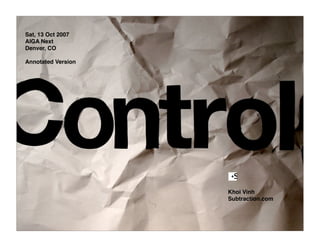
This is the main stage presentation I made at the AIGA National Design Conference in Denver, CO on 13 Oct 2007. It's been annotated to include additional captions on some slides that were images only when I presented them. See also <a href="http://www.subtraction.com/archives/2007/1015_new_york_to_.php">my blog post</a>.

Recommended
More Related Content
What's hot
What's hot (20)
Similar to Khoi Vinh presentation on interactive design vs print design
Similar to Khoi Vinh presentation on interactive design vs print design (14)
Recently uploaded
Recently uploaded (20)
Khoi Vinh presentation on interactive design vs print design
- 1. Sat, 13 Oct 2007 AIGA Next Denver, CO Annotated Version Khoi Vinh Subtraction.com
- 2. About Me
- 7. Khoi Vinh Subtraction.com Why is interactive design different from print design?
- 8. Khoi Vinh Subtraction.com The answer lies in control.
- 9. But First… What Is Good Design?
- 10. Khoi Vinh Narrative Subtraction.com Historically, we’ve defined good design as solutions that also tell good stories.
- 11. Khoi Vinh Subtraction.com A handful of examples of narrative in good design…
- 12. Khoi Vinh Napoleon’s March to Moscow Charles Joseph Minard Subtraction.com An information graphic that is transformed into great graphic design when narrative is added. Made famous by Edward Tufte.
- 13. Khoi Vinh Priester Matches Lucien Bernhard Subtraction.com Good storytelling in graphic design can be highly succinct. In this example, Bernhard lets the audience’s imaginations complete the story. Priester Matches, c. 1905
- 14. Khoi Vinh Harper’s Bazaar Alexey Brodovitch Subtraction.com Publication design, of course, has always been about good storytelling. Alexey Brodovitch took this to new heights through supremely elegant juxtaposition of image and text with Harper’s Bazaar.
- 15. Khoi Vinh Concert Posters J. Müller-Brockmann Subtraction.com Narrative can also be highly abstract and non- literal. These posters from Josef Müller- Brockmann are so reductive as to be similar to modern painting, and yet they are still powerful storytelling. Tonhalle-Quartett, 1955. Helmhaus Zürich, 1953. Beethoven, 1955. Junifestkonzert, 1957.
- 16. Khoi Vinh IBM 1975 Annual Report Paul Rand Subtraction.com Masters like Paul Rand were terrific storytellers — even when the story he was telling was a year in the life of IBM, the world’s most boring company. Paul Rand, IBM Annual Report, 1975
- 17. Khoi Vinh Beach Culture David Carson Subtraction.com Narrative is such a strong impulse in graphic design, that in many instances, designers assume authorial roles alongside the actual authors — as David Carson did for Beach Culture Magazine in the Nineties.
- 18. Khoi Vinh Principles of Good Storytelling Subtraction.com • A coherent world view • Fine-tuned management of every element • One-way communication of information from the author to the audience
- 19. Khoi Vinh What Do These Add up To? Subtraction.com + A coherent world view + Fine-tuned management of every element + One-way communication of information from the author to the audience Control
- 20. Khoi Vinh Subtraction.com If narrative is the guiding principle of traditional design, then control is its most important tool.
- 21. Khoi Vinh Subtraction.com But the guiding principle of interactive media is not narrative—it’s behavior.
- 22. Khoi Vinh Subtraction.com Designing for behavior means transferring some measure of control from author to user.
- 23. Khoi Vinh Or, Put Another Way… Subtraction.com Digital media is taking control away from designers.
- 24. Khoi Vinh For Many Designers… Subtraction.com Many designers think: “This is blasphemy!”
- 25. Khoi Vinh Subtraction.com “Designers must control the communication, because we know what we’re doing.”
- 26. Khoi Vinh Subtraction.com “If we give people what they say they want, they’ll never get what we know they need.”
- 27. Khoi Vinh “Don’t They Know This Is Bad?” Subtraction.com A notorious example is MySpace, where design values are completely different from any professional publication.
- 28. Khoi Vinh Subtraction.com Undesigned sites like MySpace have been on the Internet since day one, and designers have made many attempts to fight back against them.
- 29. Khoi Vinh Subtraction.com Over the past decade, users have rejected many of these techniques that designers have used to exert control in digital media…
- 30. Khoi Vinh Failed Techniques for Control Subtraction.com Typographic requirements. (Very early on.) This site best viewed with Cooper Black. Please download and install it before viewing.
- 31. Khoi Vinh Failed Techniques for Control Subtraction.com Rendering text as images instead of as HTML.
- 32. Khoi Vinh Failed Techniques for Control Subtraction.com Resizing browser windows or launching daughter windows.
- 33. Khoi Vinh Subtraction.com Linking a site’s functionality exclusively to a proprietary technology, e.g., Microsoft Internet Explorer or even sometimes Adobe Flash.
- 34. Khoi Vinh Failed Techniques for Control Subtraction.com Counting on users to ‘learn how to use a site over time.’
- 35. Khoi Vinh Subtraction.com “If user control trumps all, aren’t we saying that design has no value?”
- 36. Khoi Vinh Subtraction.com No, actually. But to understand why, we have to look at behaviors.
- 37. Behaviors
- 38. Khoi Vinh Given a Page of Text… Subtraction.com What can you do with print? • Read it • Mark it • Clip it out • Photocopy it
- 39. Khoi Vinh Content and Presentation Are Wedded Subtraction.com In each case, it’s difficult to separate the printed text from its presentation. The design is baked in. The designer retains control.
- 40. Khoi Vinh Subtraction.com Given a block of text on the Web, what can you do with it?
- 41. Khoi Vinh Subtraction.com • Enlarge it
- 42. Khoi Vinh Subtraction.com • Click on it to go somewhere else
- 43. Khoi Vinh Subtraction.com • Roll-over it to reveal other behaviors
- 44. Khoi Vinh Subtraction.com • Re-render it in a different typeface
- 45. Khoi Vinh Subtraction.com • Read it back via screen reader
- 46. Khoi Vinh Subtraction.com • Comment on it
- 47. Khoi Vinh Subtraction.com • Read it via RSS aggregator, completely stripped of its presentation layer
- 48. Khoi Vinh Subtraction.com • Quote it liberally.
- 49. Khoi Vinh Subtraction.com • Edit it (in Wiki form)
- 50. Khoi Vinh Let’s Split Up Subtraction.com In digital media, presentation and content are separable. Design is not baked in. The designer has seemingly lost control.
- 51. Khoi Vinh Subtraction.com That’s not necessarily the case. What we’re interpreting as a loss of control is actually a multiplicity of states.
- 52. Khoi Vinh Subtraction.com The challenge has changed. There are more states to design. But also: the user demands a certain amount of control over these various states.
- 53. Khoi Vinh Subtraction.com The designer still has a job to do. How does the content behave in each of its possible states? What is the overall experience of the user?
- 54. What Are We Designing?
- 55. Khoi Vinh Subtraction.com Digital media is as different from print as a speech is different from a conversation.
- 56. Khoi Vinh What They Have in Common Subtraction.com They’re both exchanges of information between people. But one is a controlled environment and the other is uncontrolled.
- 57. Khoi Vinh Compare and Contrast Subtraction.com Print (Speech) Interactive (Conversation) Environmental and Knowable Mix of knowable and Behavioral Factors unknowable Kinds of Essentially one kind Potentially many different Audience kinds Experiences The audience receives the The audience takes part in experience the experience
- 58. Khoi Vinh Subtraction.com In fact, what we’re talking about here is the difference between documents and conversations. More on this later.
- 59. Khoi Vinh Subtraction.com Digital media looks like writing, but it’s actually conversation.
- 60. Khoi Vinh Instant Messaging & Bulletin Boards = Conversation Subtraction.com
- 61. Khoi Vinh Email Looks Like a Document—But It’s Really Conversation Subtraction.com
- 62. Khoi Vinh Blogs Subtraction.com Sometimes documentary, almost always conversational.
- 63. Khoi Vinh Del.icio.us Is Conversation Subtraction.com Meta-sites enable conversation through links, tagging, micro-comments
- 64. Khoi Vinh Traditional Documents Too Subtraction.com Traditional journalism becomes a framework for conversation.
- 65. Khoi Vinh Social Context Subtraction.com The tension between print and digital is emblematic of a long-running pattern of media evolution. There is often a struggle between documents and conversations. “Glut: Mastering Information Through the Ages” By Alex Wright
- 66. Khoi Vinh Subtraction.com Writing transformed ancient peoples from tribal organizations into governments. Conver- Documents sations
- 67. Khoi Vinh Subtraction.com In Medieval Europe, the failure of governments and the rise of illiteracy renewed folkloric traditions. Conver- Documents sations
- 68. Khoi Vinh Subtraction.com Gutenberg’s press pitted mass communication against folkloric traditions. Conver- Documents sations
- 69. Khoi Vinh Subtraction.com The PC transformed ‘cathedrals’ of information systems into ‘bazaars’ of personal computing Conver- Documents sations Ref. Richard Stallman
- 70. Khoi Vinh But They Need to Co-Exist Subtraction.com This push and pull is essential to media evolution. Documents and conversations are not mutually exclusive. They are inherently dependent upon one another.
- 71. Khoi Vinh Subtraction.com Good narrative gives rise to good conversations.
- 72. What’s Next
- 73. Khoi Vinh Subtraction.com Yes. People are looking for traditional design values online.
- 74. Khoi Vinh From MySpace to Facebook Subtraction.com It’s no accident that the shift is on in favor of a more highly designed environment like Facebook
- 75. Khoi Vinh Blueprint CSS Subtraction.com There’s a tremendous interest in grid-based layouts online at the moment, including this CSS framework for grids Developed by Olav Frihagen Bjørkøy
- 76. Khoi Vinh Technological Formalization of Traditional Design Subtraction.com And this proposed specification for grid layouts to the CSS standard http://dev.w3.org/csswg/css3-grid/overview.html
- 77. Khoi Vinh Technologists Seek Typography Subtraction.com “Fonts & Encodings” by Yannis Haralambous Contents include: • The History and Classifications of Latin Typefaces
- 78. Khoi Vinh Downloadable Typefaces Subtraction.com Recent revisions to WebKit (Safari) allow for downloadable TrueType fonts, so designers can in theory specify any typeface.
- 79. Khoi Vinh The Trend in Tools Is for More Control Subtraction.com As our tools progress, they give us incrementally more power to control the presentation of our interfaces. Print Fidelity Flash CSS 3.0 Tables Fireworks/ CSS 2.0 Dreamweaver HTML CSS 1.0 HTML 1.0 1990 1995 2000 2005 2010
- 80. Khoi Vinh Good News Subtraction.com Principles of good storytelling still apply—with adjustment.
- 81. Khoi Vinh People Want Traditional Design Values, But… Subtraction.com People are looking for narrative design to be expressed in a language that’s native to digital media.
- 82. Khoi Vinh Subtraction.com Users want to retain control over their own experiences.
- 83. Khoi Vinh Subtraction.com Users also want their experiences to be guided and clear.
- 84. Khoi Vinh Subtraction.com There’s a compromise between user control and designer intention. We just haven’t reached the sweet spot yet.
- 85. Khoi Vinh Subtraction.com As our tools enable more control, the expectation for greater control will increase—for users and designers.
- 86. End