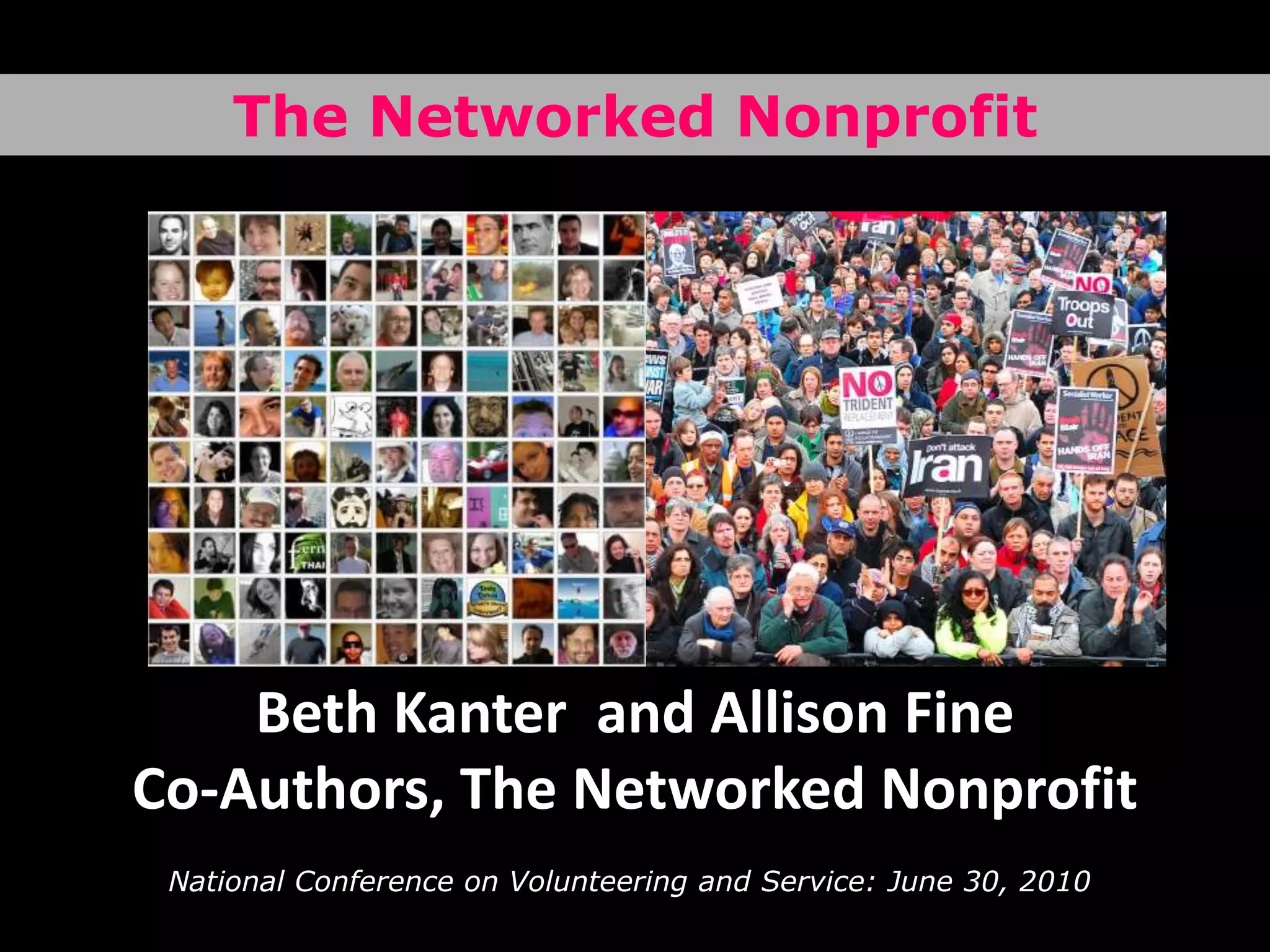



The Networked NonprofitBeth Kanter and Allison FineCo-Authors, The Networked NonprofitNational Conference on Volunteering and Service: June 30, 2010
What we’re going to cover ….Intros  and IcebreakerOpen Kimono: The Networked Book LaunchThe Networked Nonprofit DefinedA couple of themes from the book ….  Free Agents and Fortresses
 Social Culture
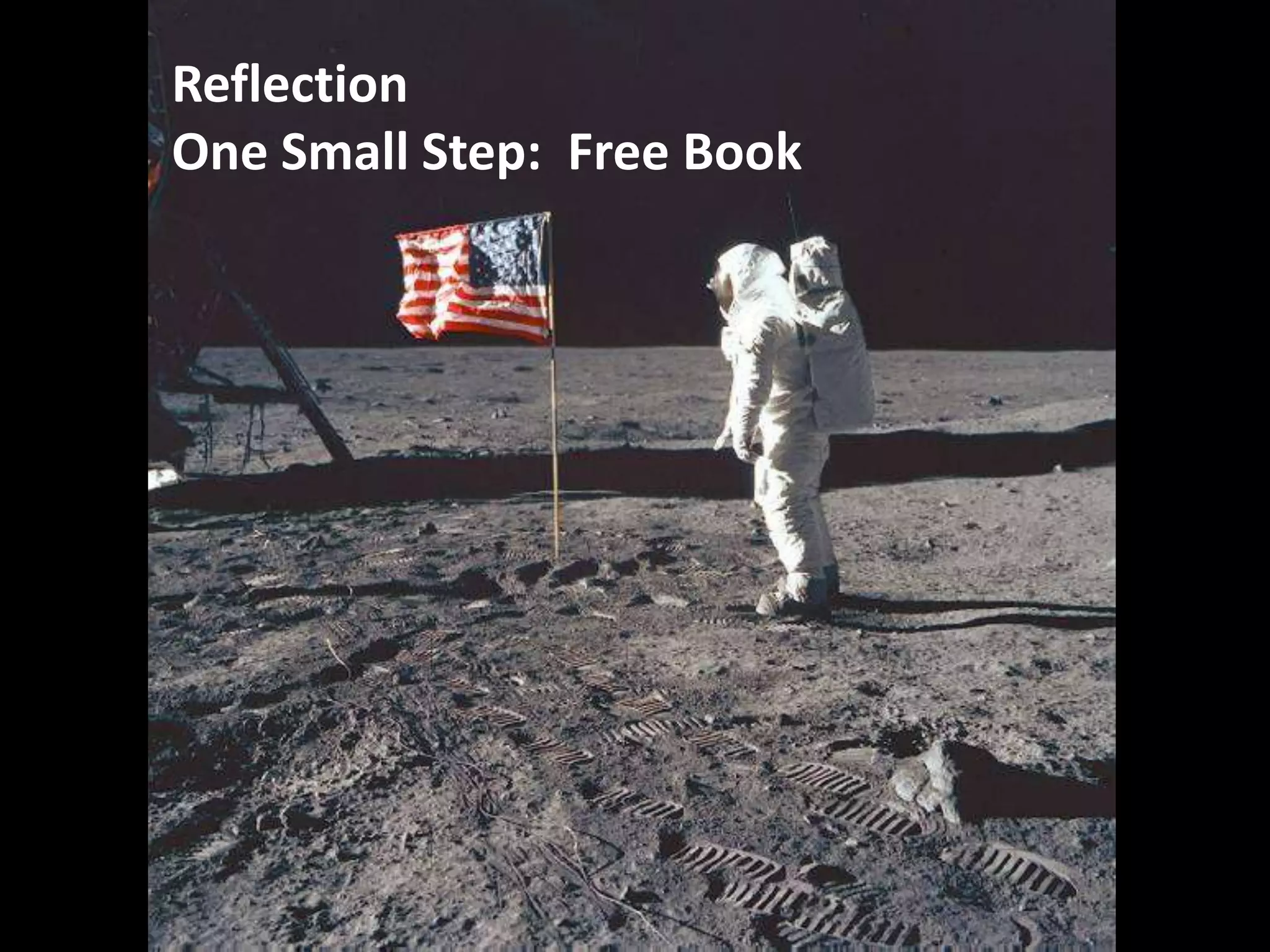
  SimplicityReflection
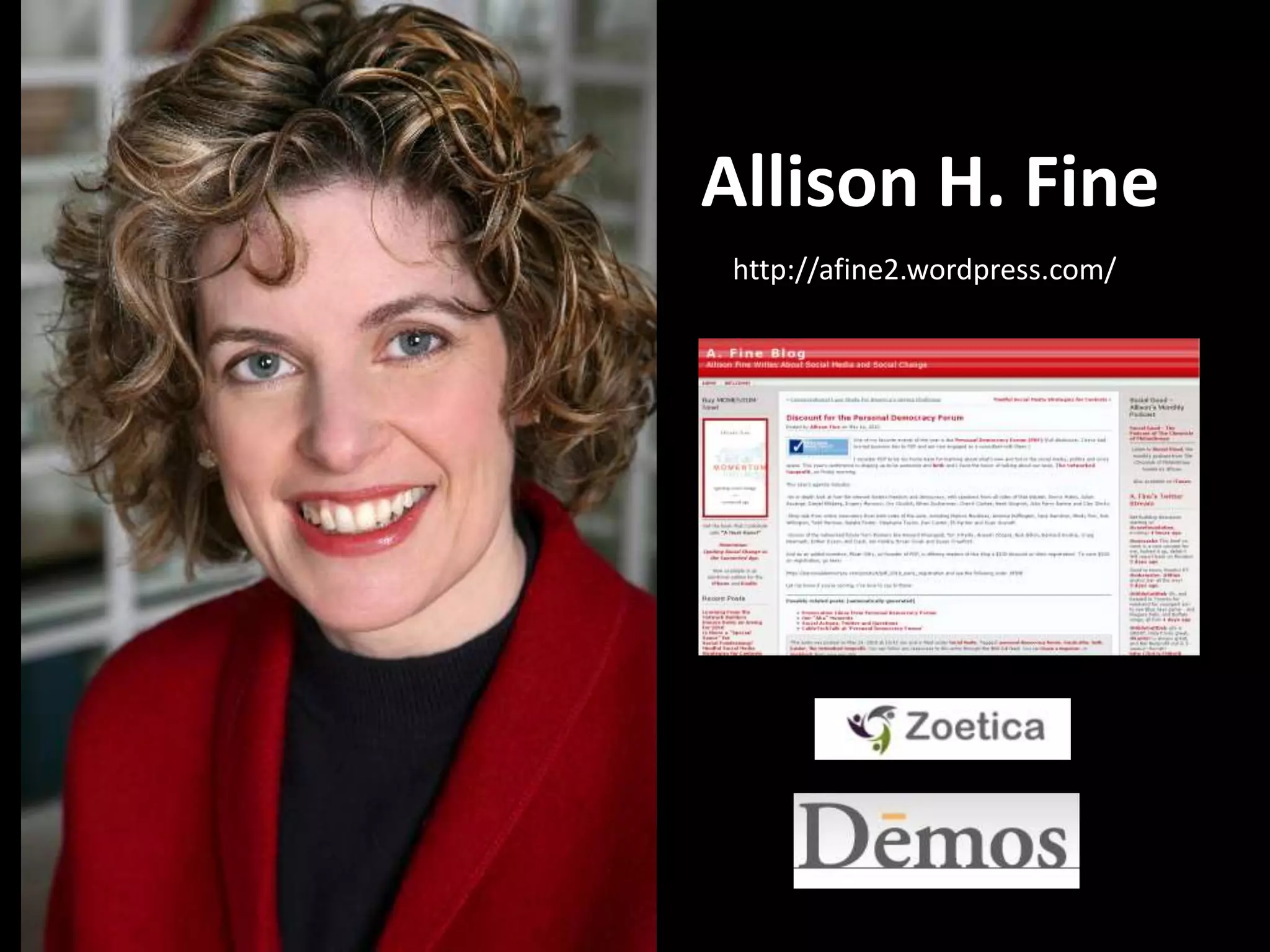
Allison H. Finehttp://afine2.wordpress.com/
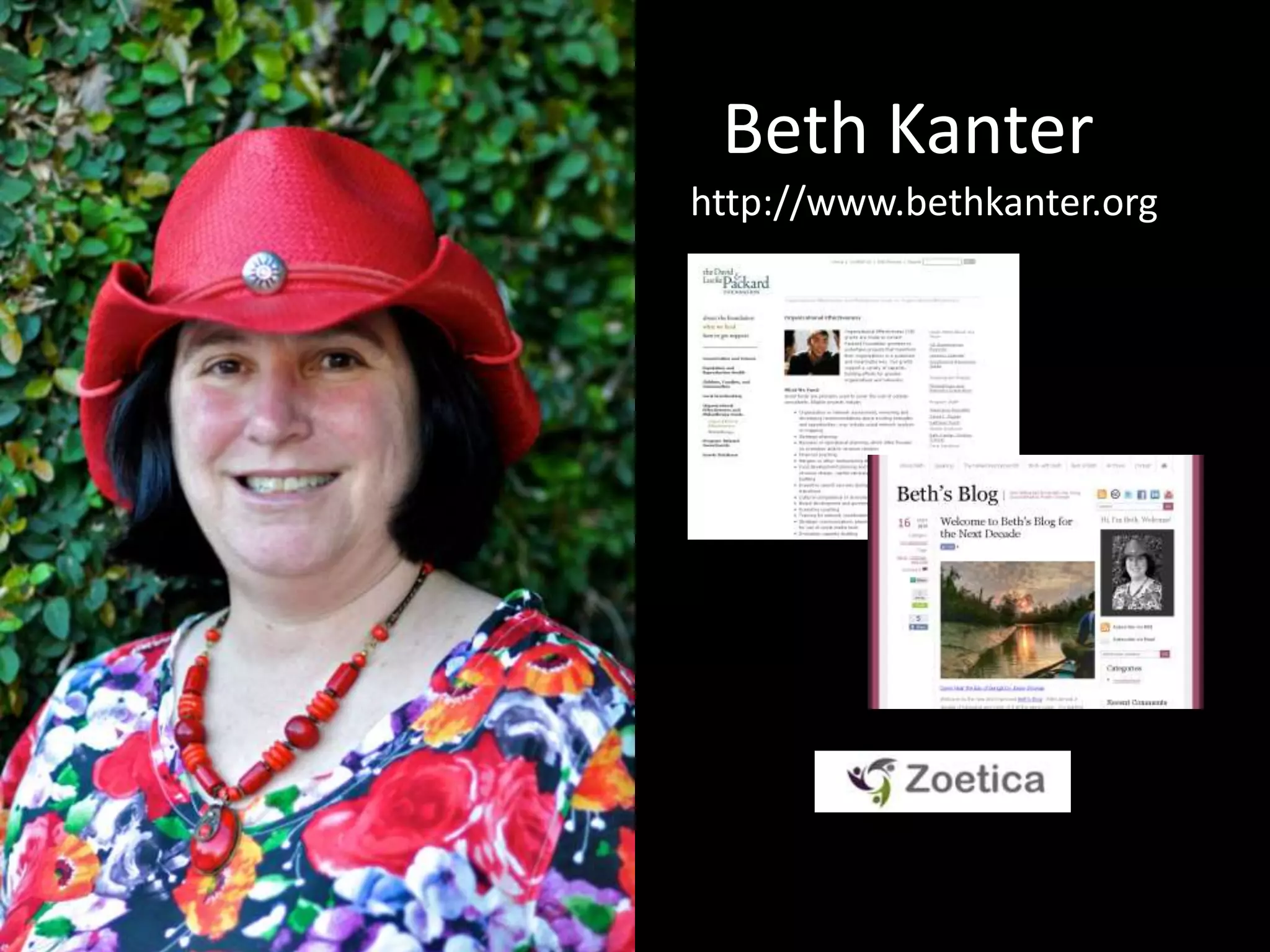
Beth Kanterhttp://www.bethkanter.org
Let’s Get Social! Quick Poll:  Social Media Use;  WhoHashtag: networkednpWiki: http://networkednonprofit.wikispaces.comBook on Amazon:  http://bit.ly/networkednp
Open the KimonoThe Networked Book Launch Kimono Shot
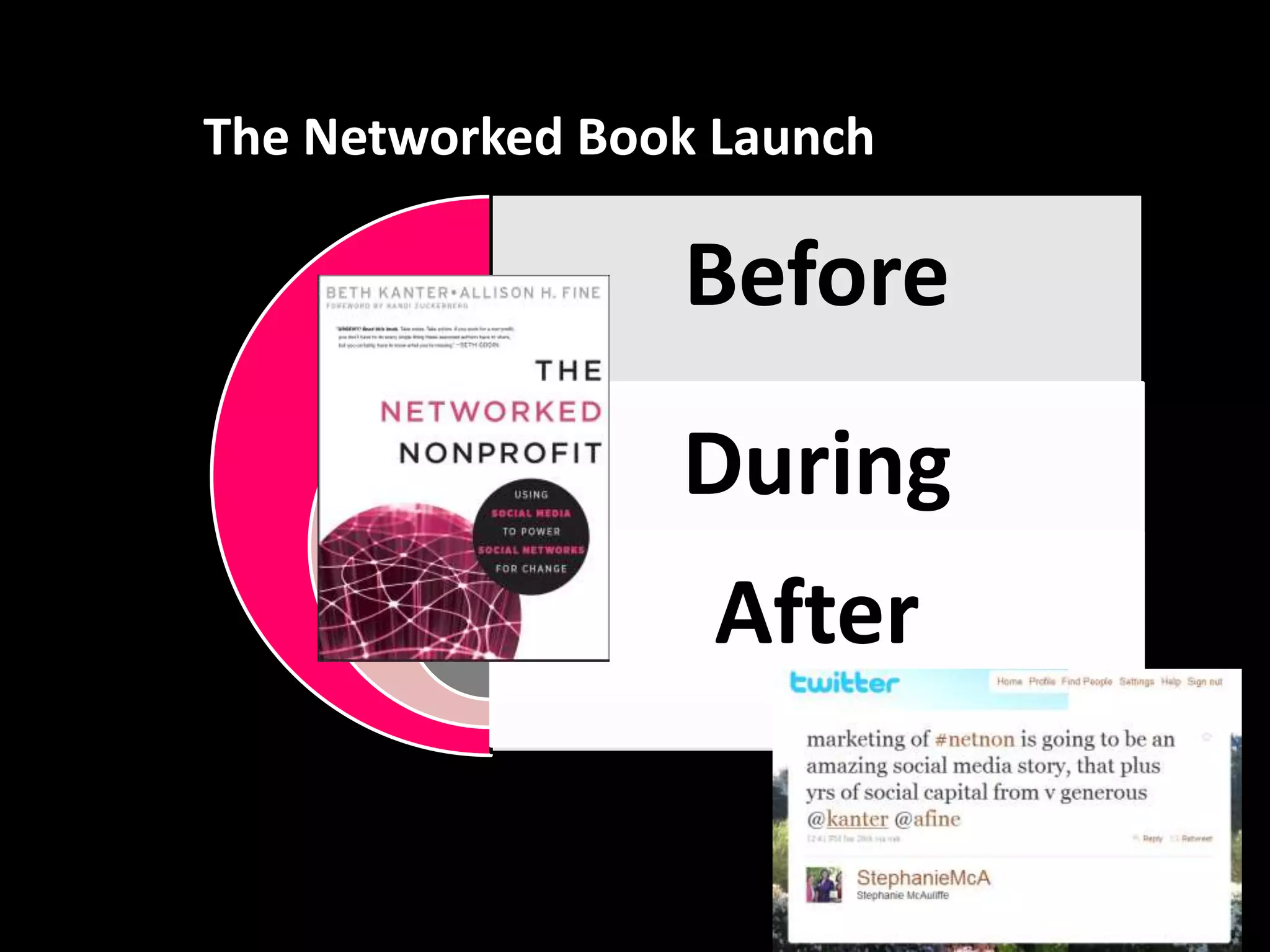
The Networked Book Launch
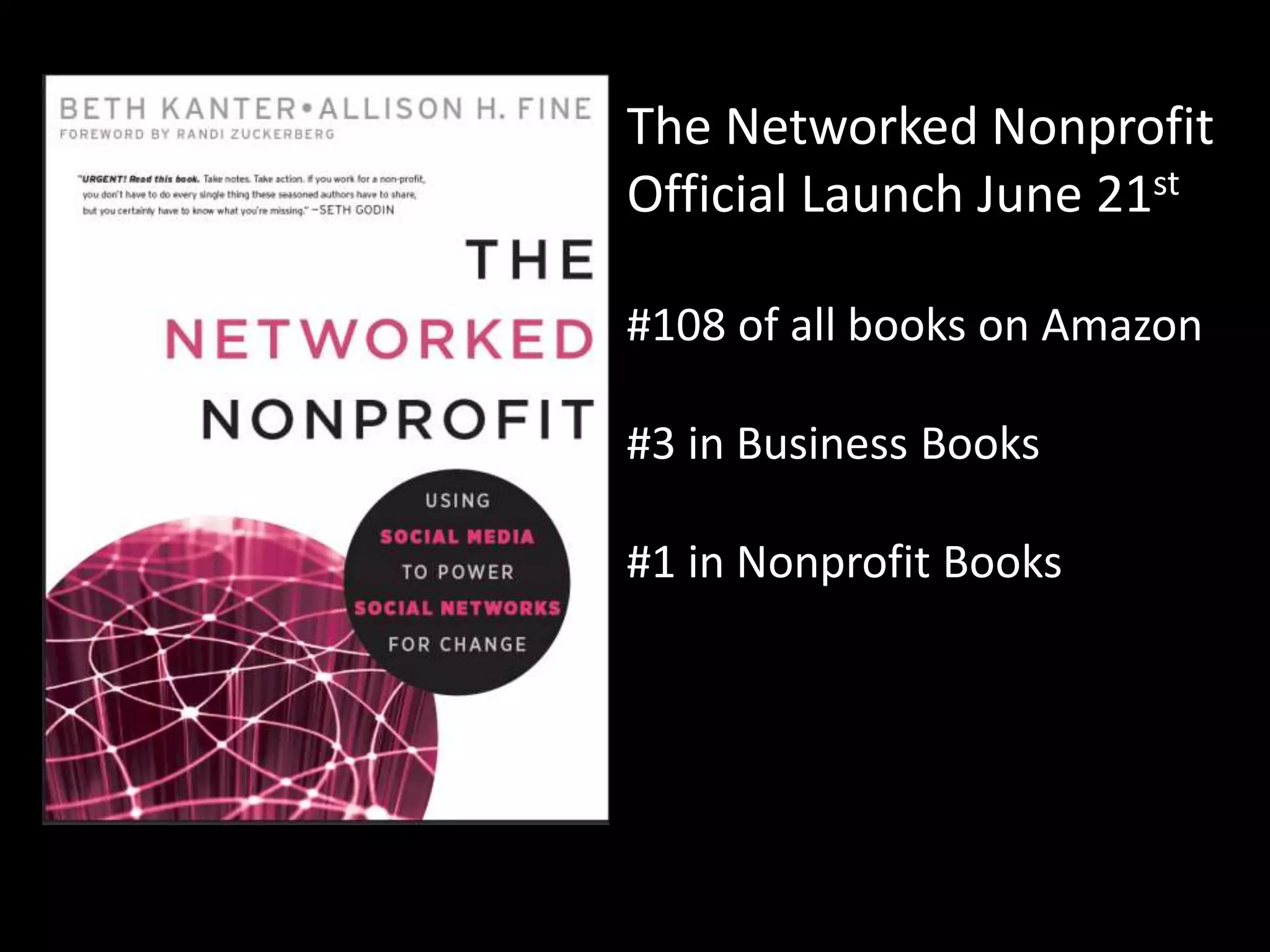
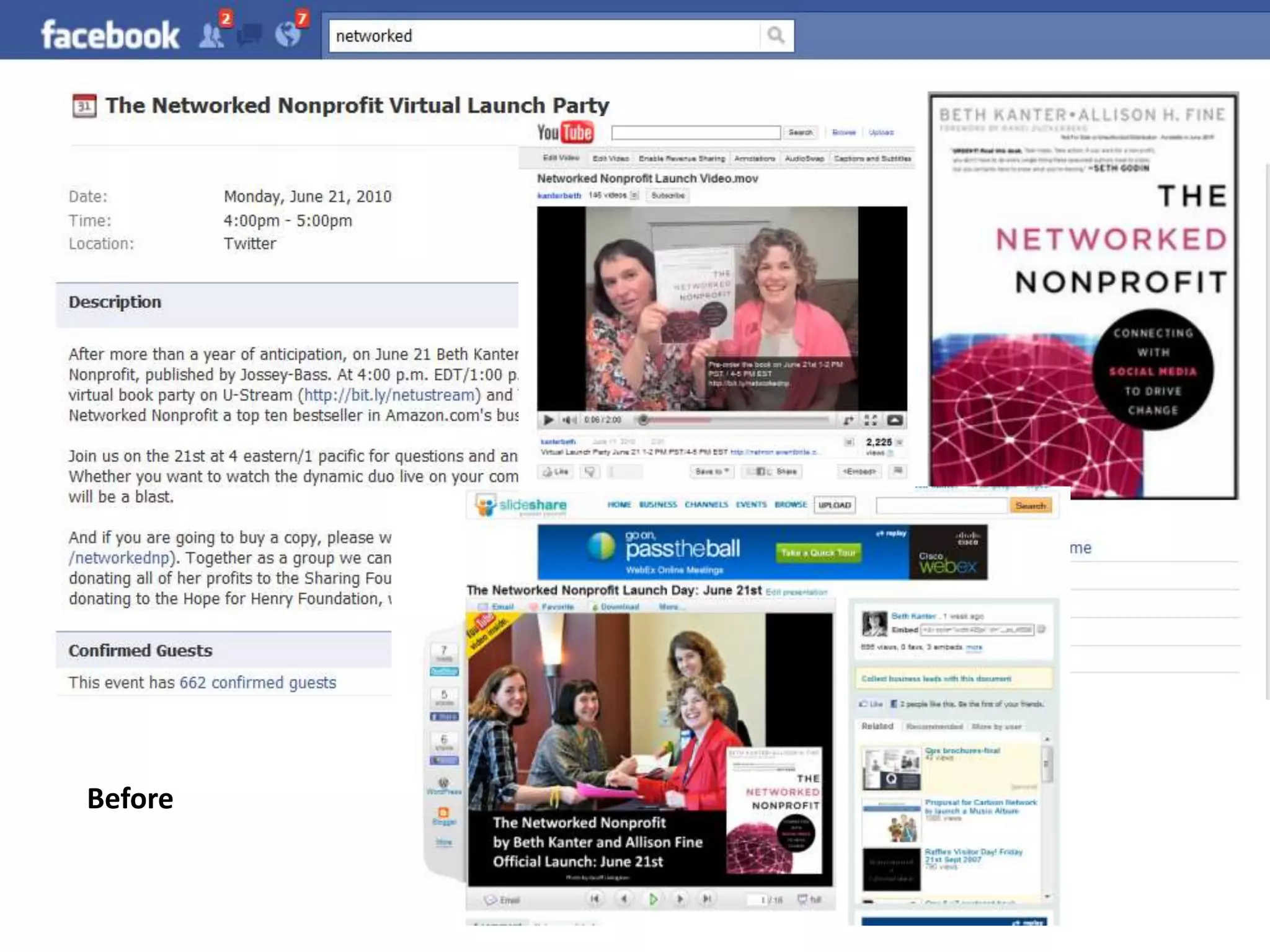
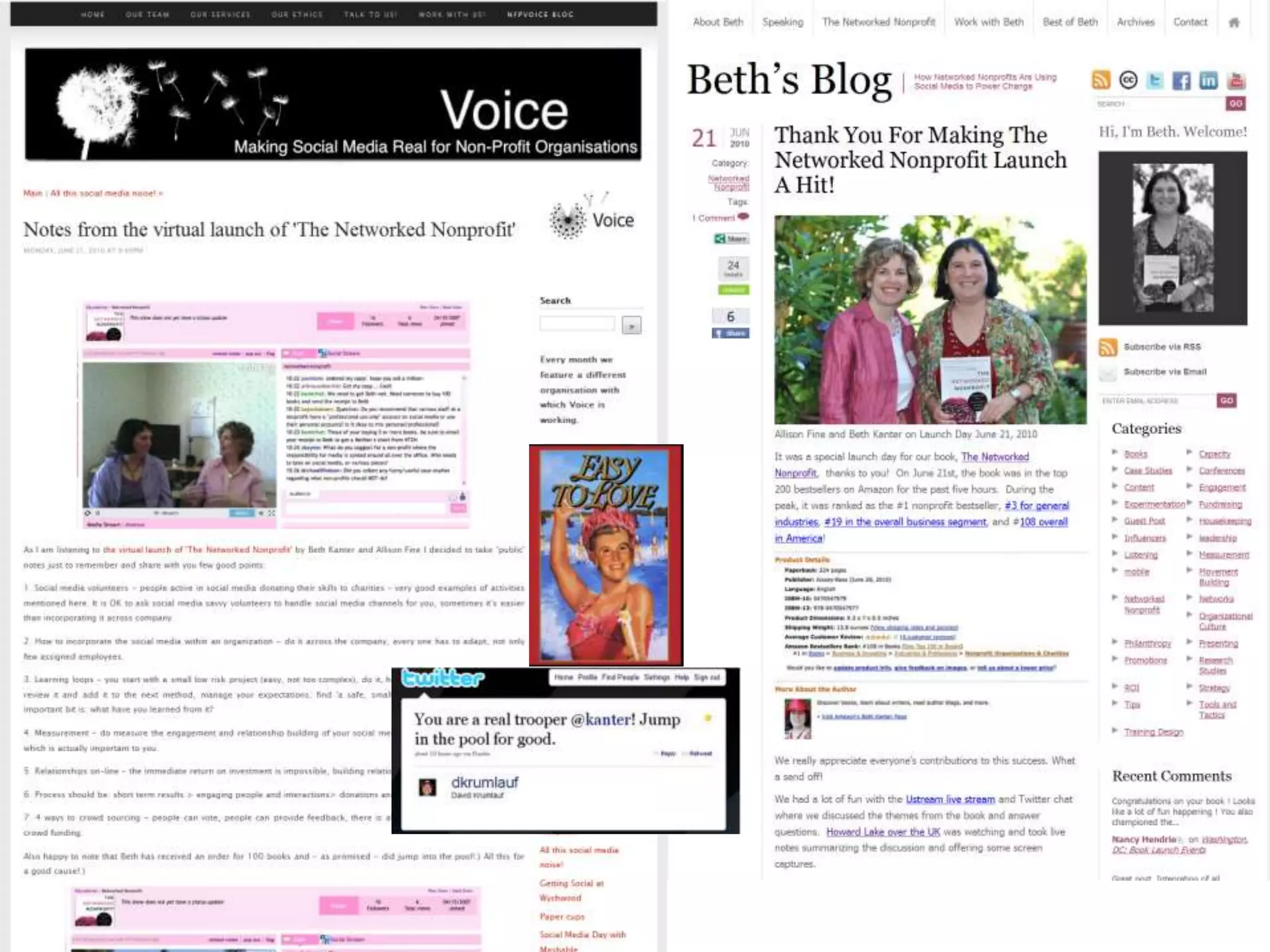
The Networked Nonprofit Official Launch June 21st#108 of all books on Amazon#3 in Business Books#1 in Nonprofit Books
Before
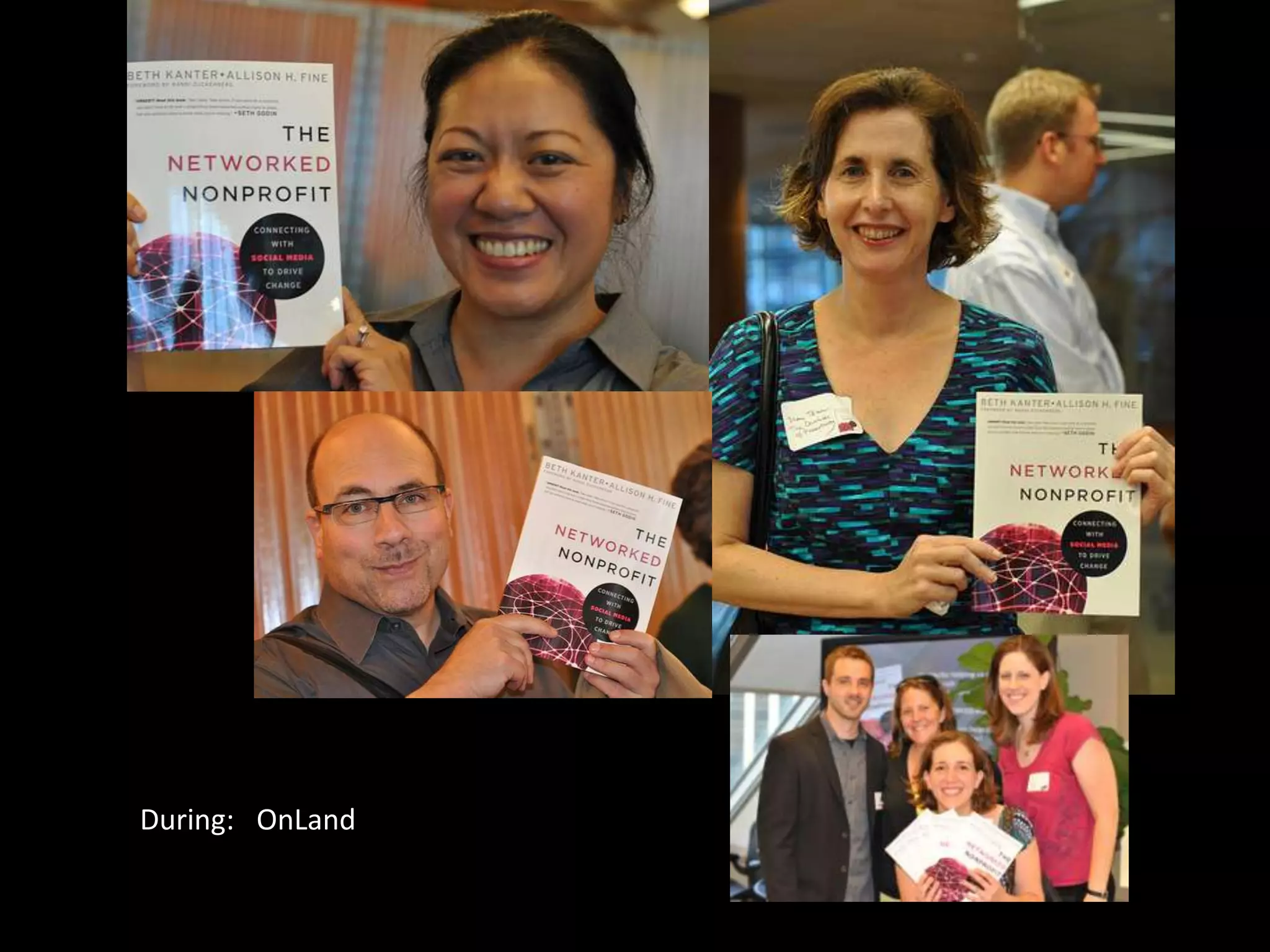
The Books in pDuring:   OnLand
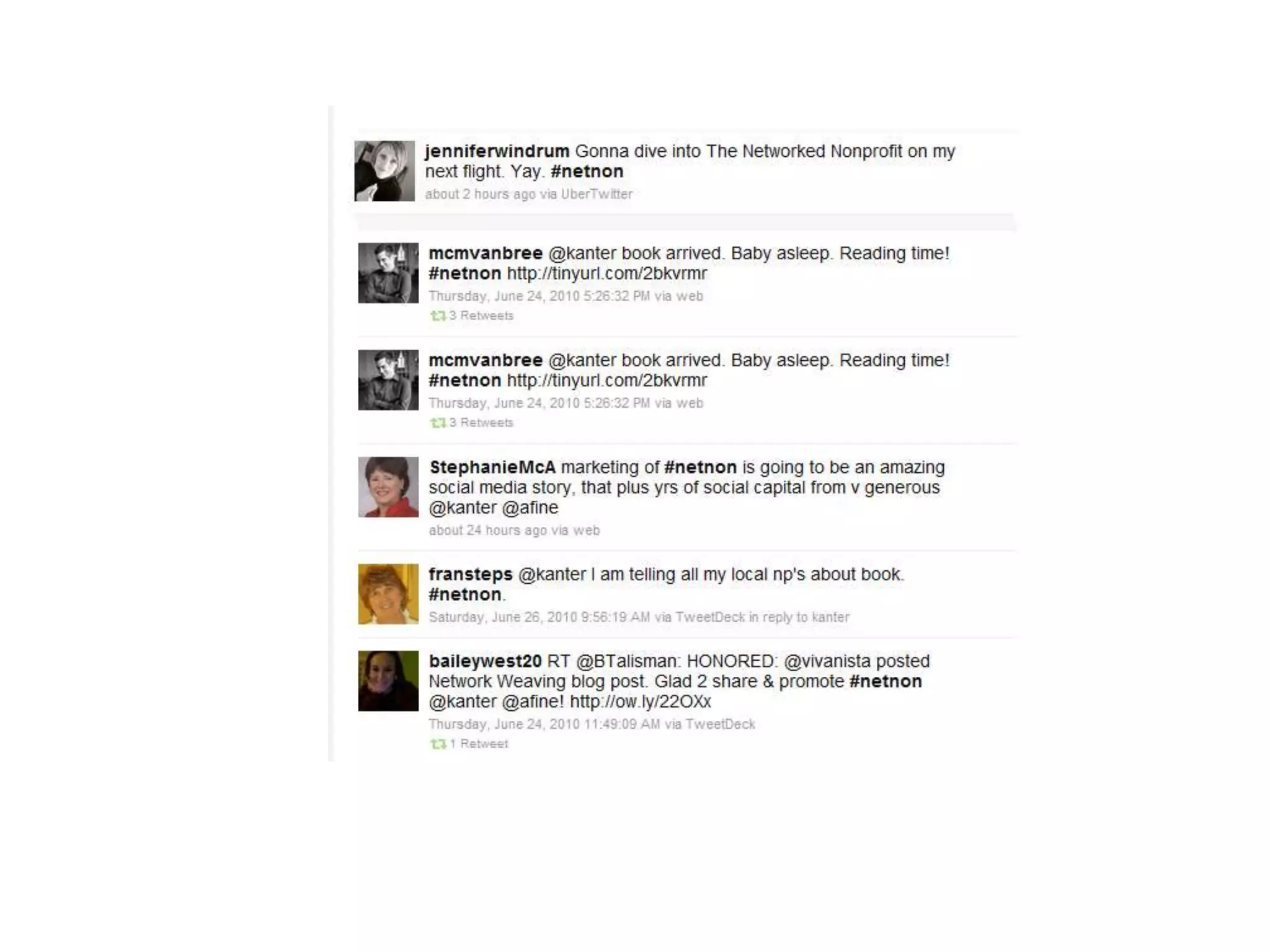
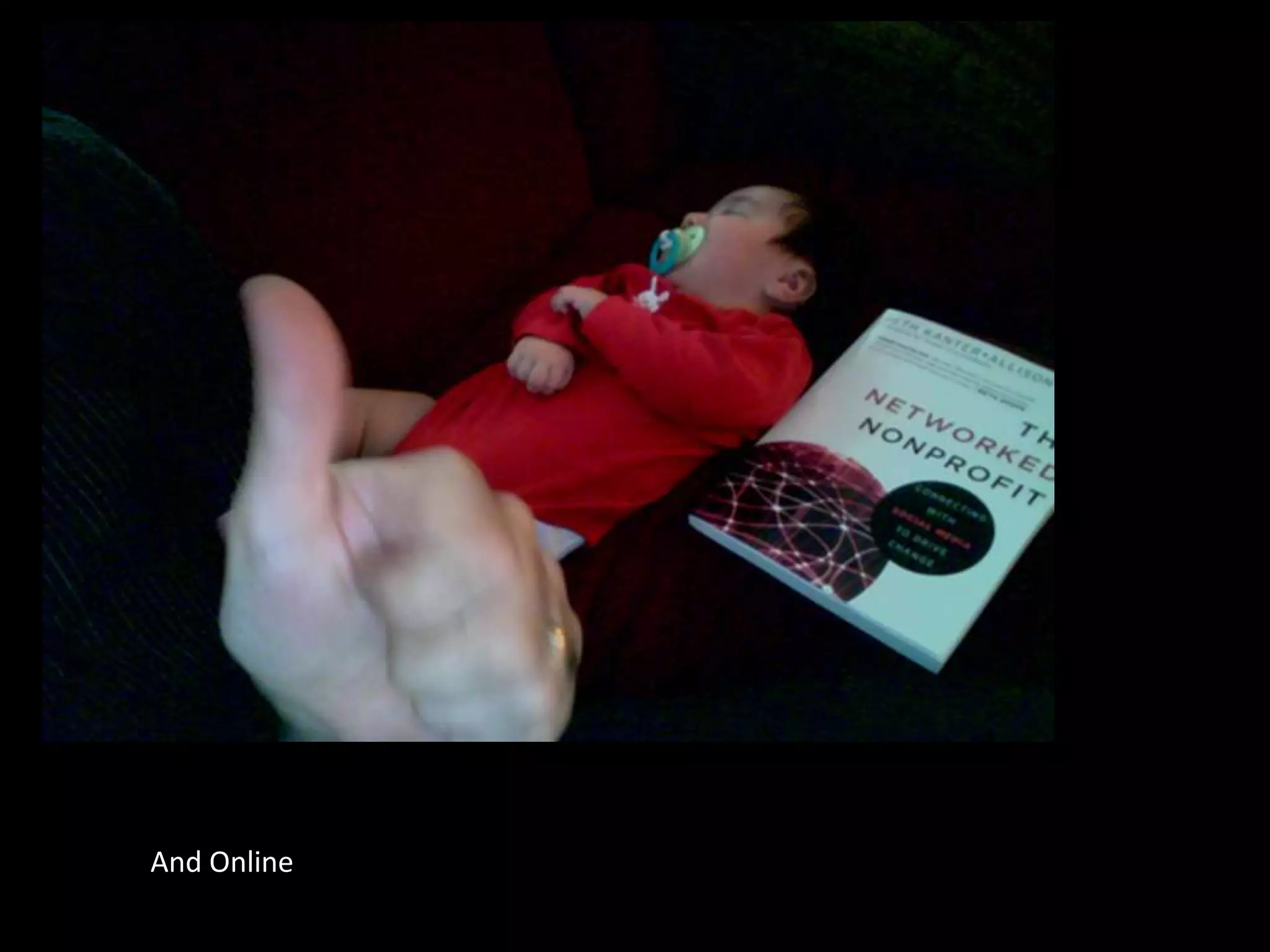
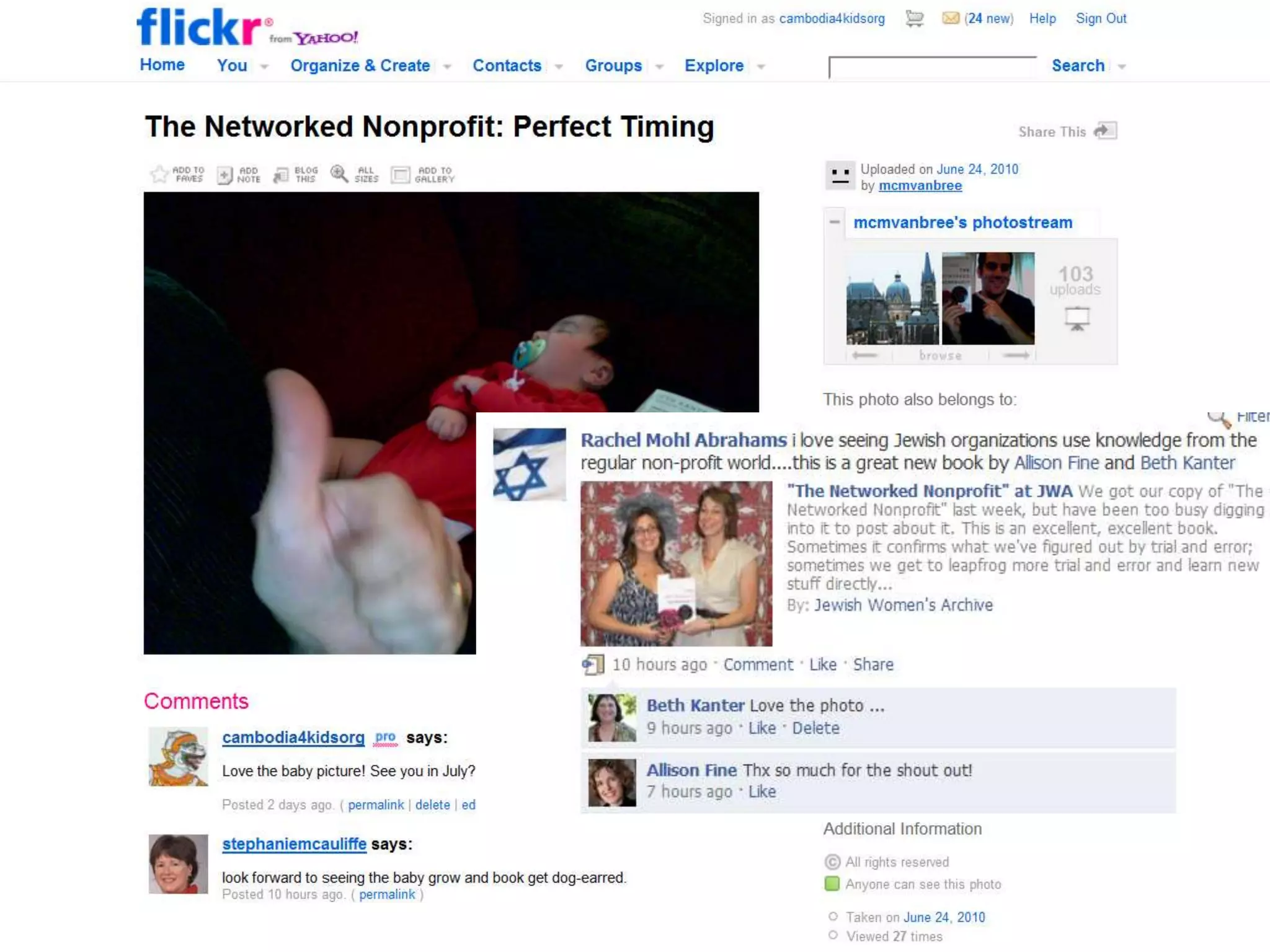
And Online
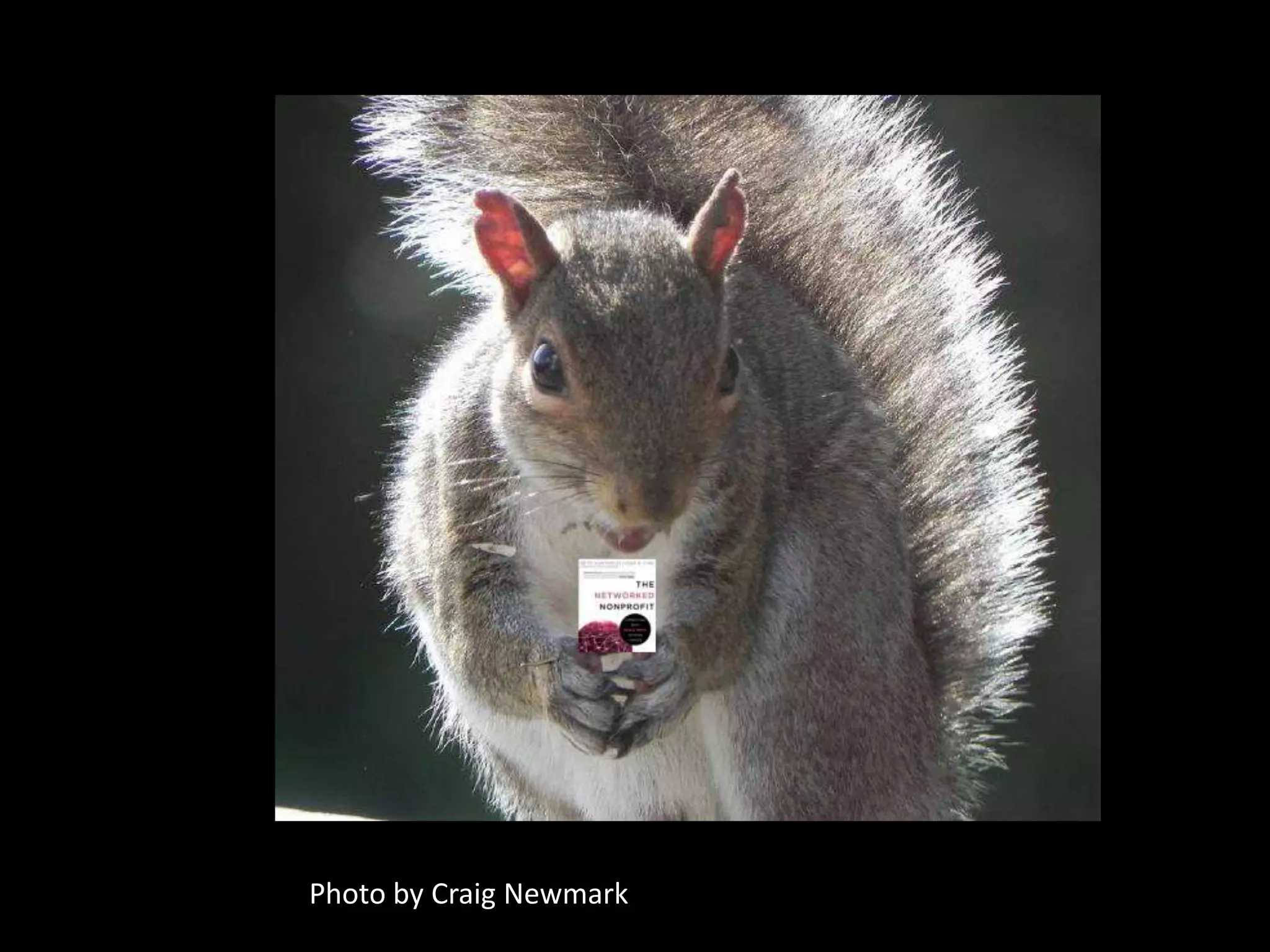
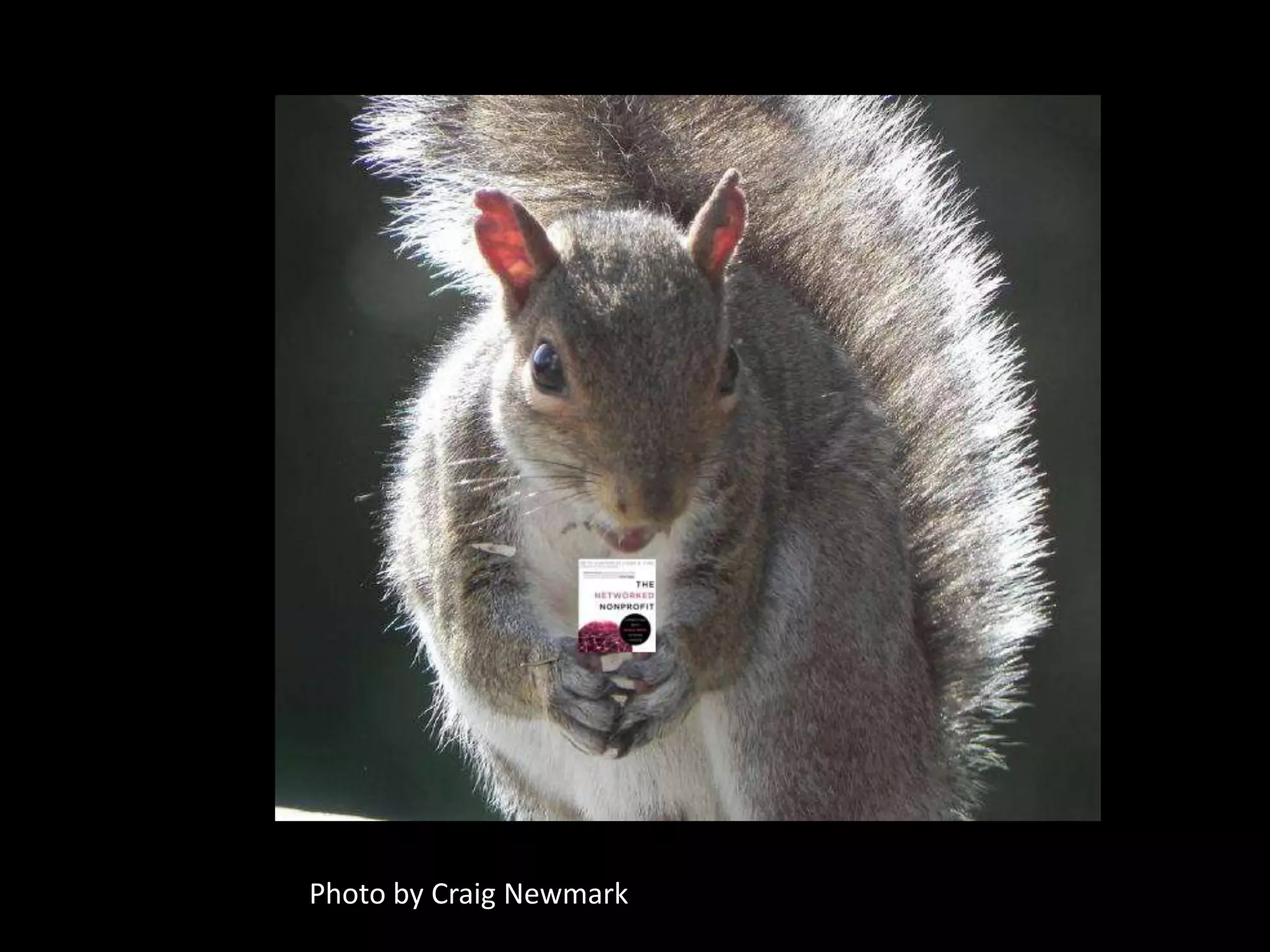
Photo by Craig Newmark
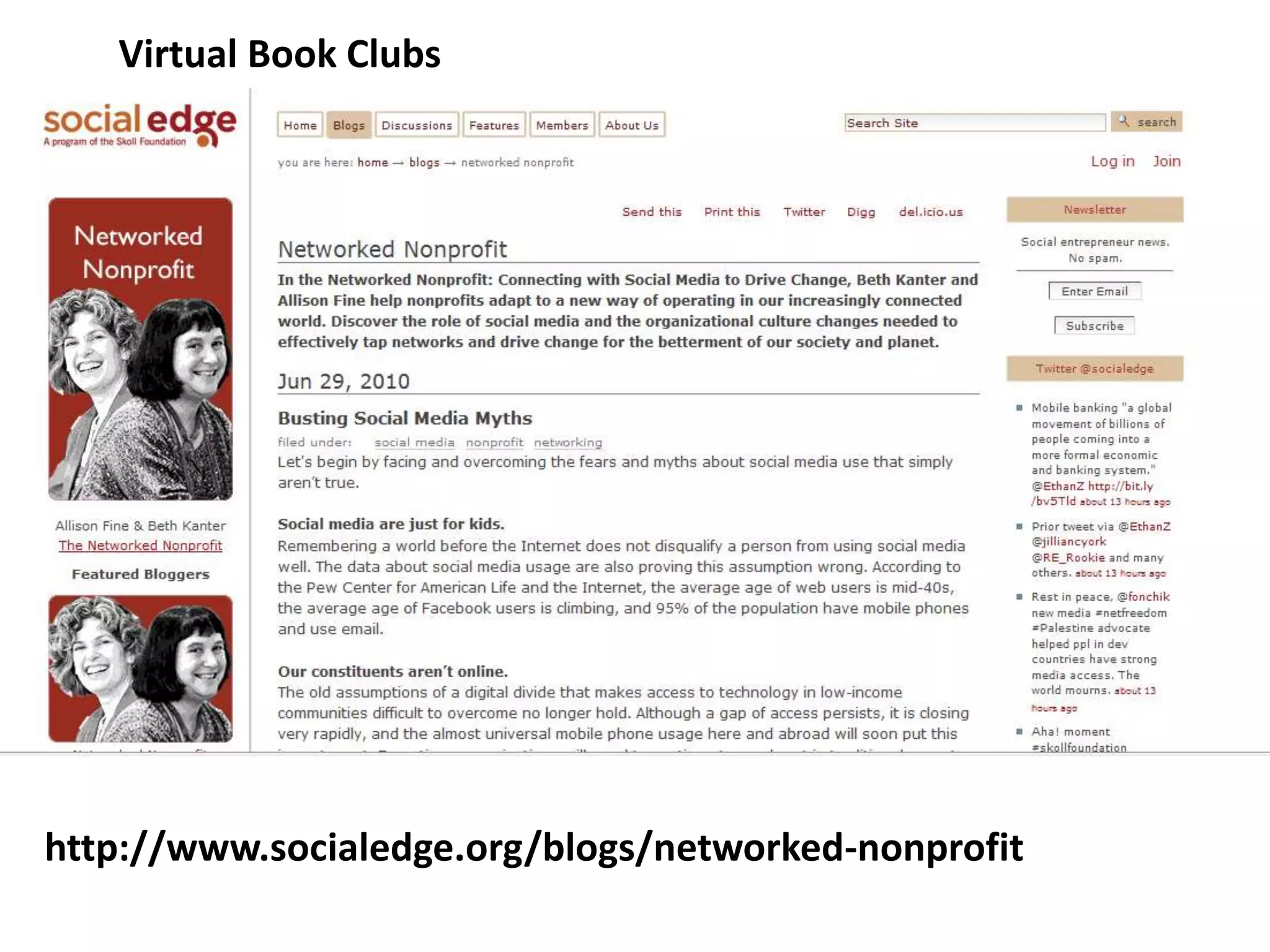
Virtual Book Clubshttp://www.socialedge.org/blogs/networked-nonprofit
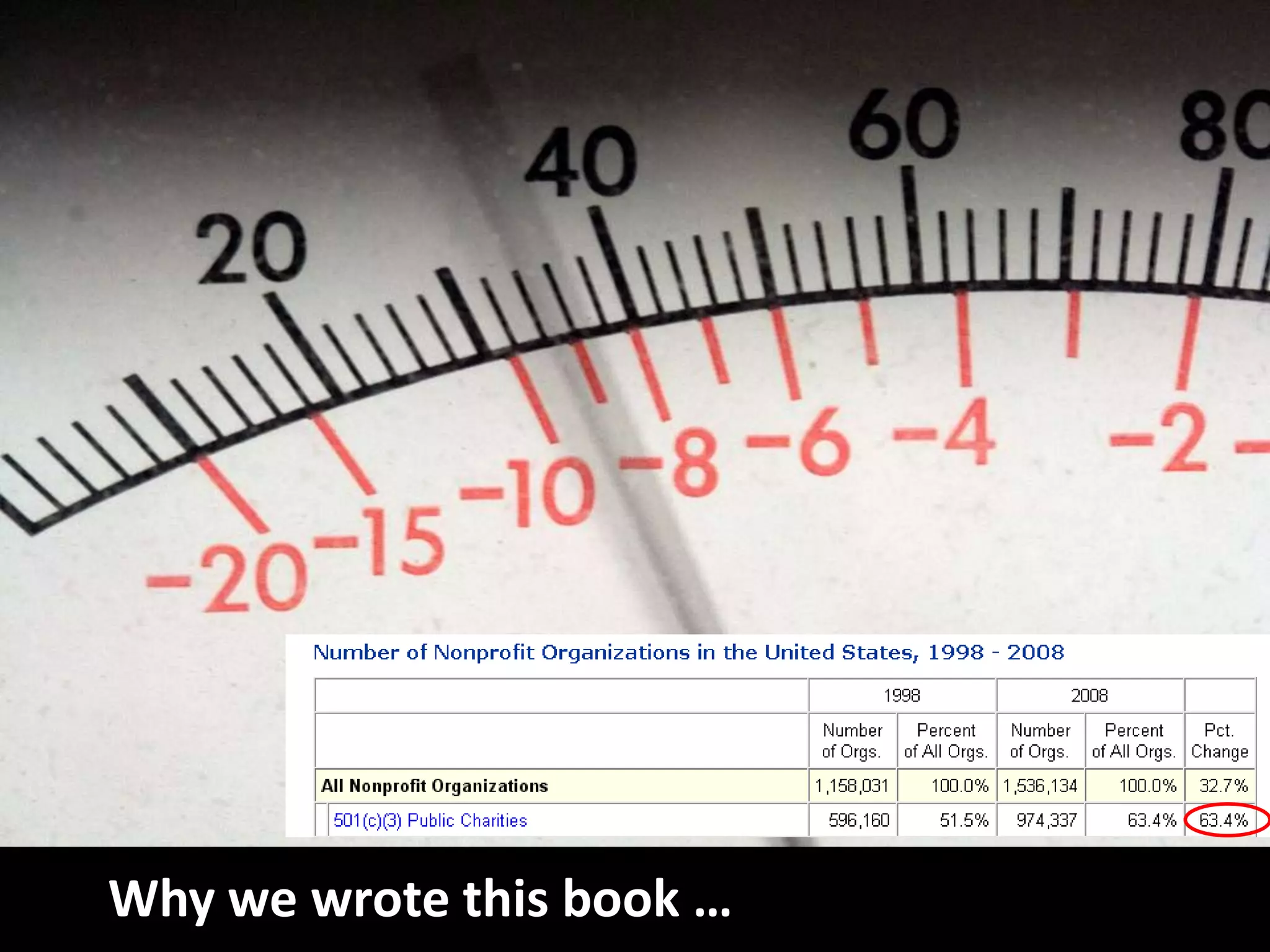
Why we wrote this book …
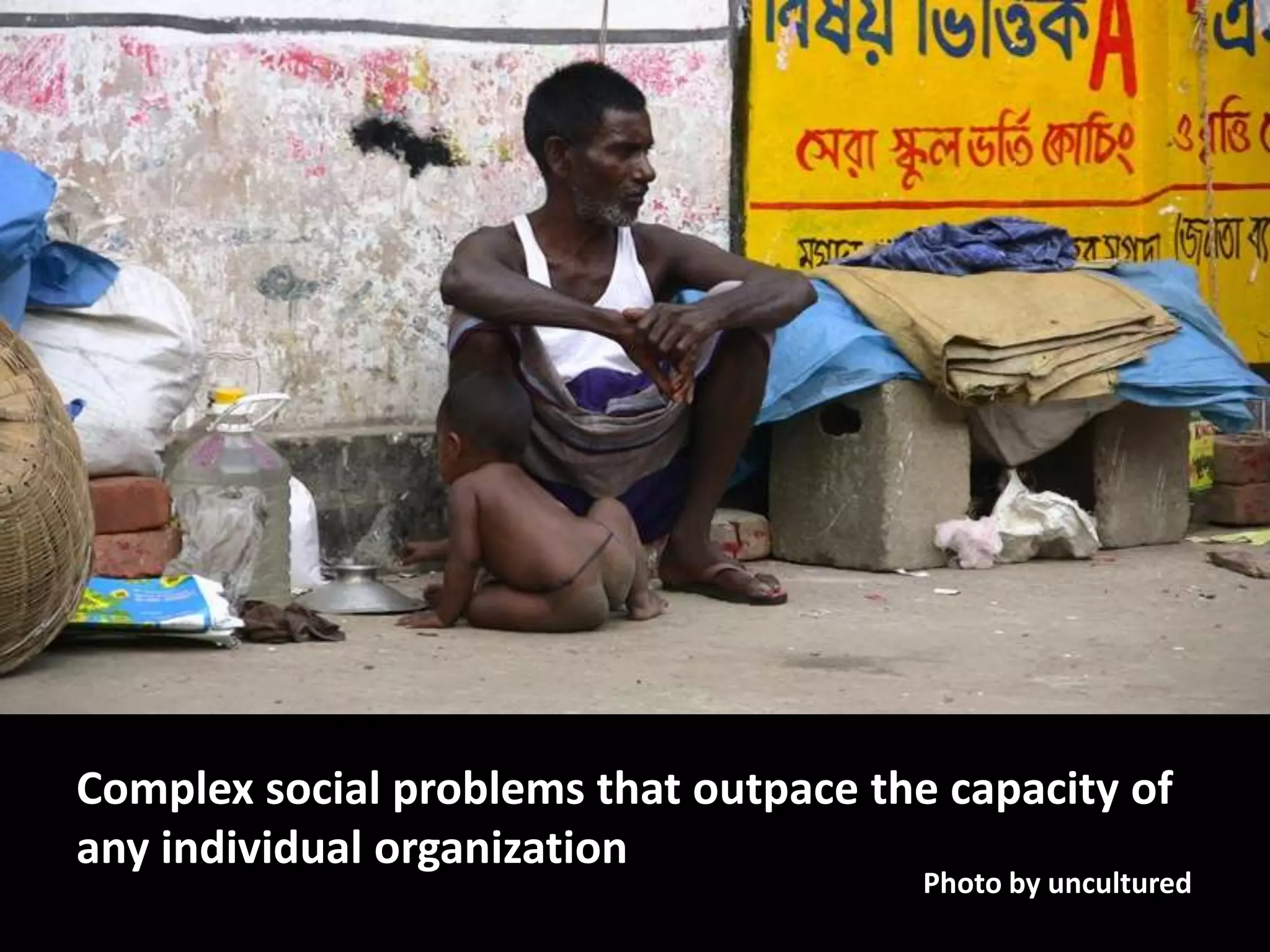
Complex social problems that outpace the capacity of any individual organizationPhoto by uncultured
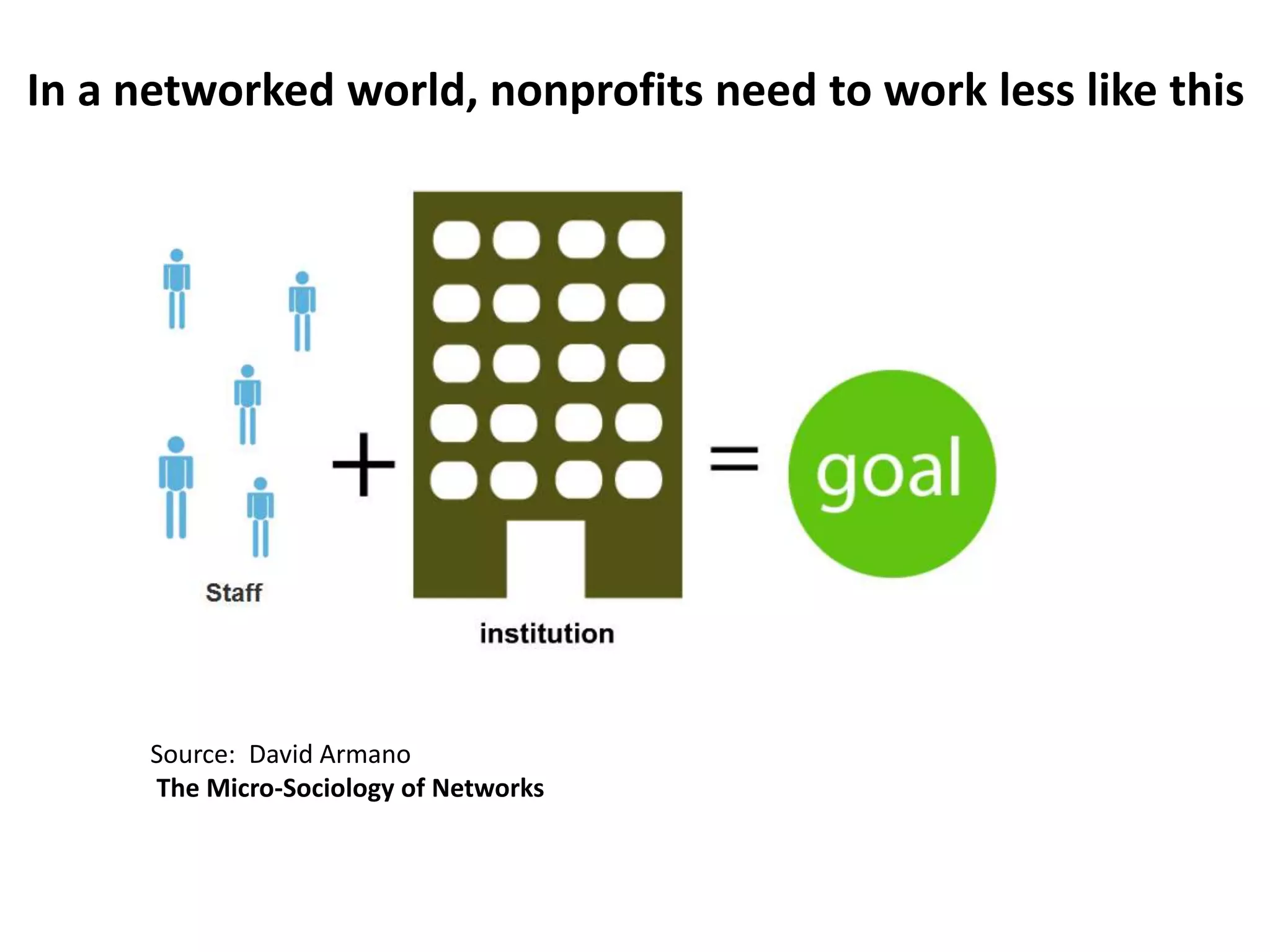
In a networked world, nonprofits need to work less like thisSource:  David Armano The Micro-Sociology of Networks
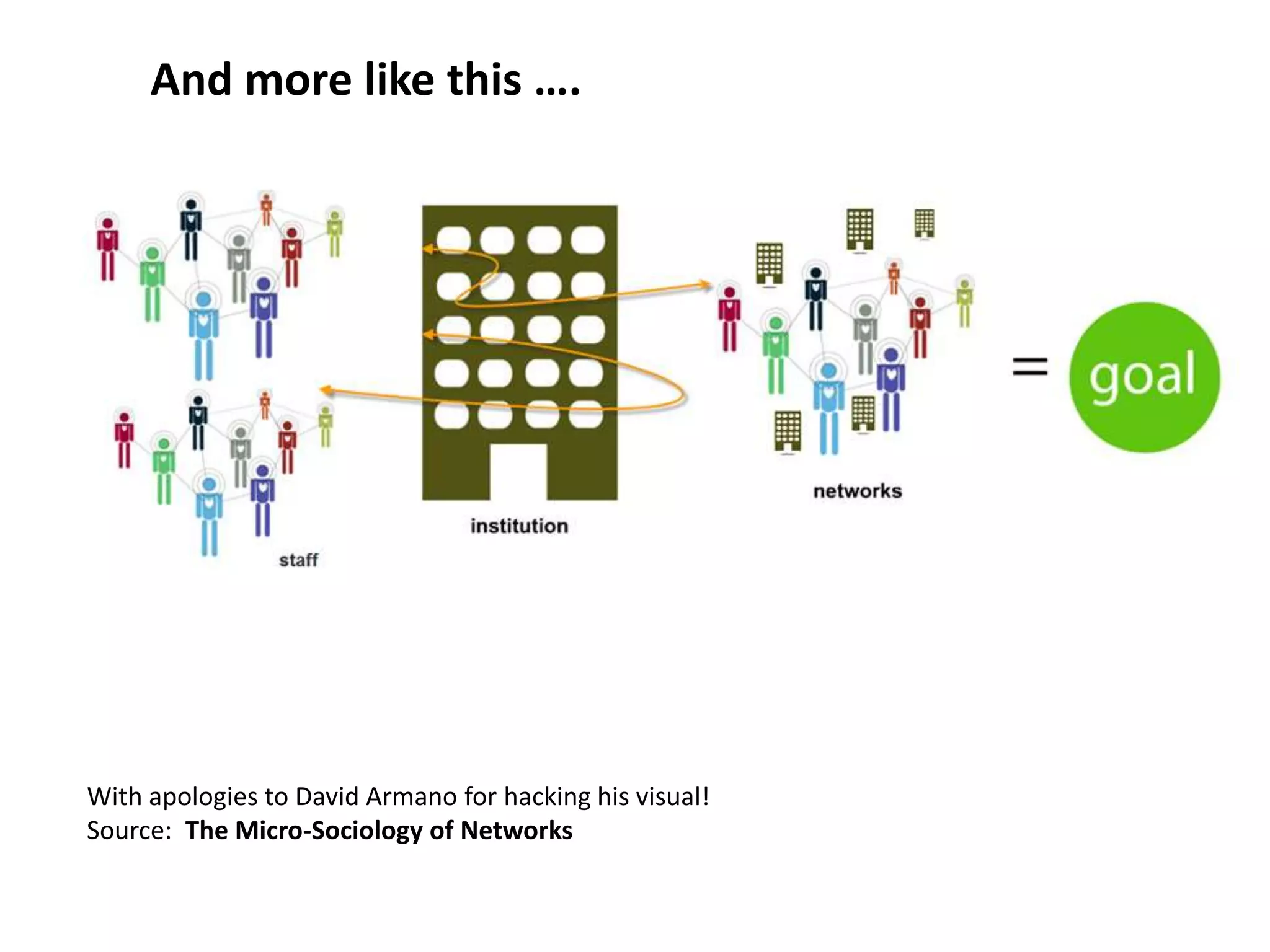
And more like this ….With apologies to David Armano for hacking his visual! Source:  The Micro-Sociology of Networks
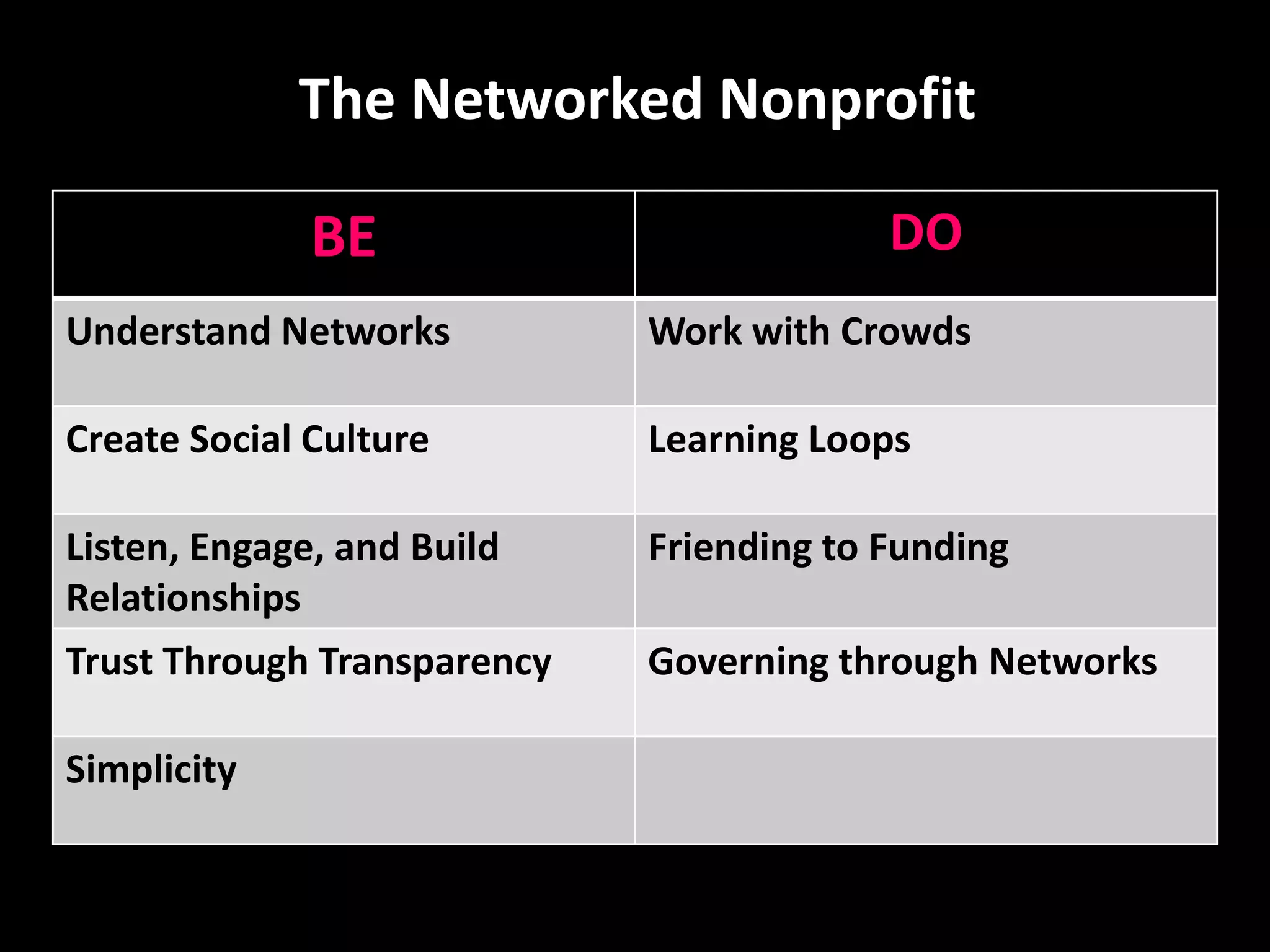
The Networked Nonprofit
Share PairsWhat is something you heard that resonated?What is something new or thought about before?Photo by Franie
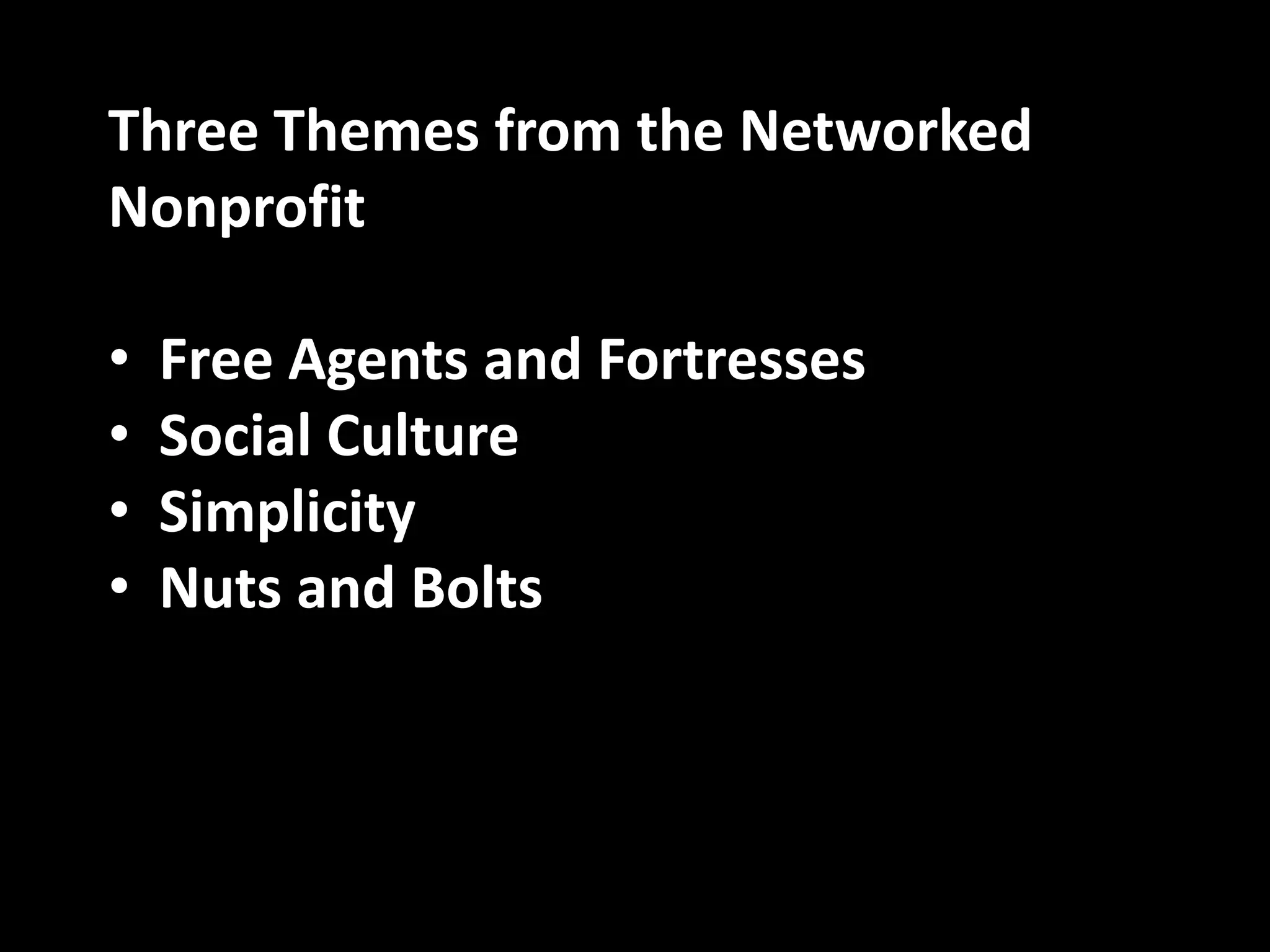
Three Themes from the Networked Nonprofit  Free Agents and Fortresses
  Social Culture
  Simplicity
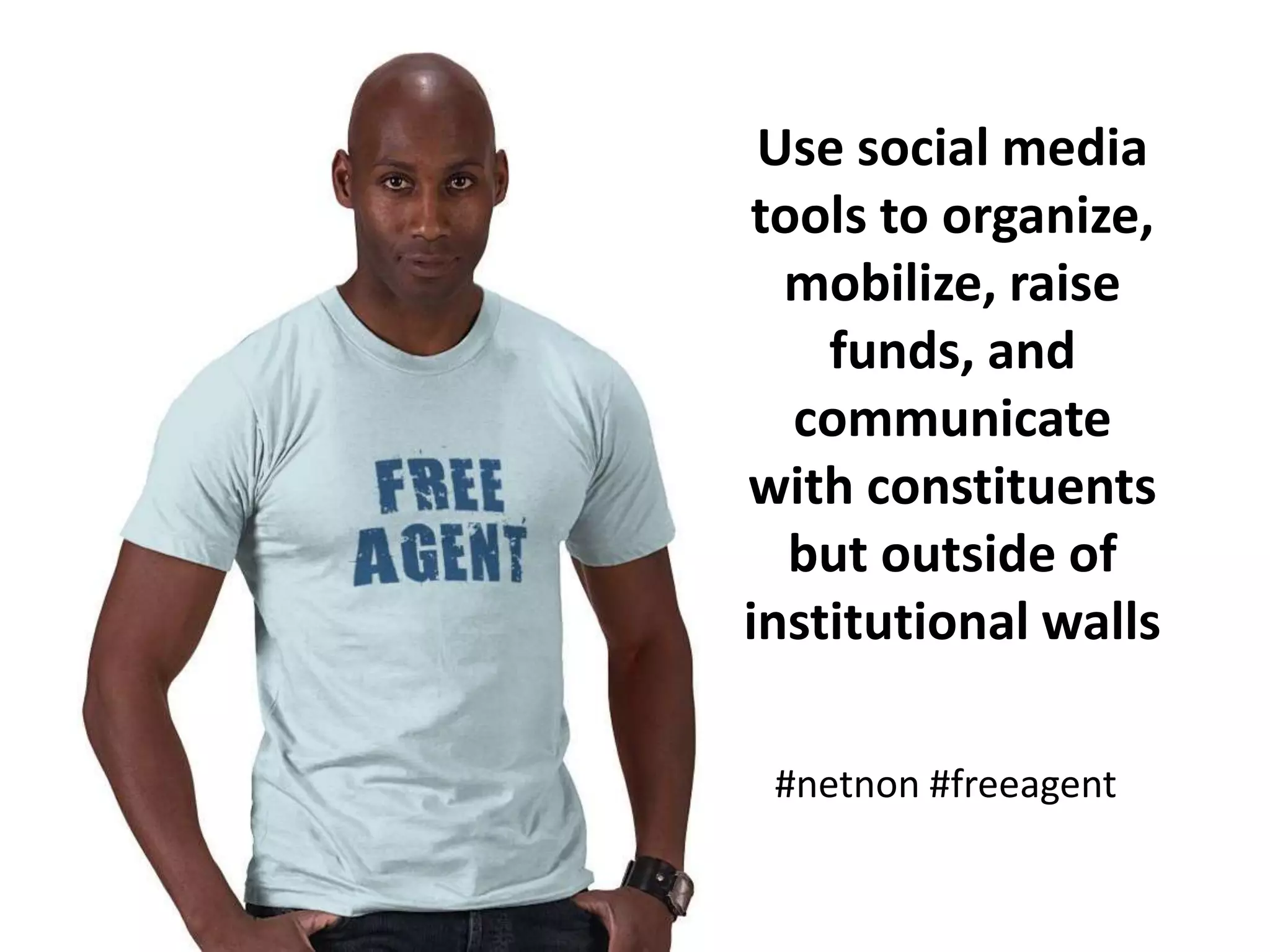
  Nuts and BoltsUse social media tools to organize, mobilize, raise funds, and communicate with constituents  but outside of institutional walls #netnon #freeagent
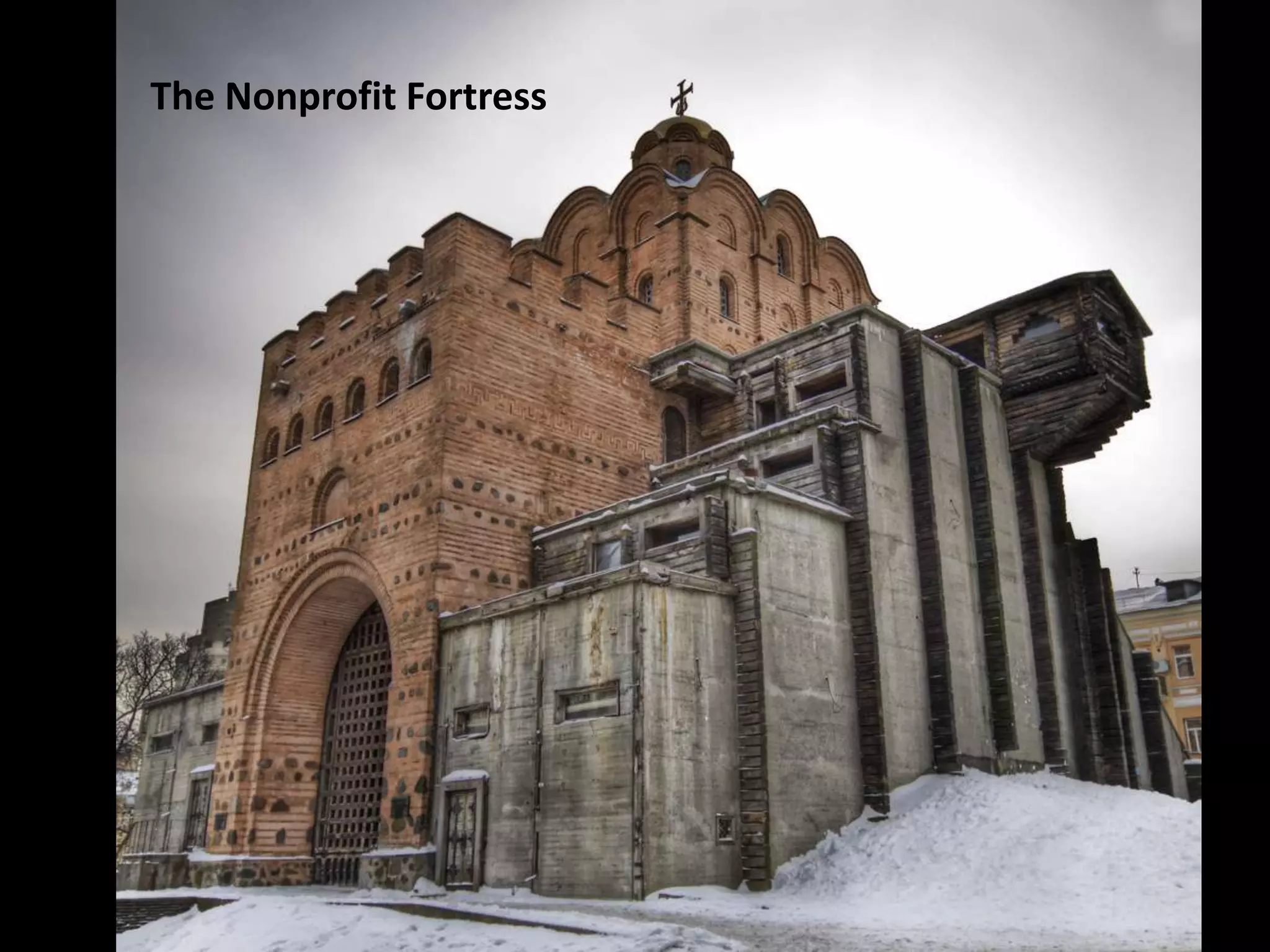
The Nonprofit Fortress
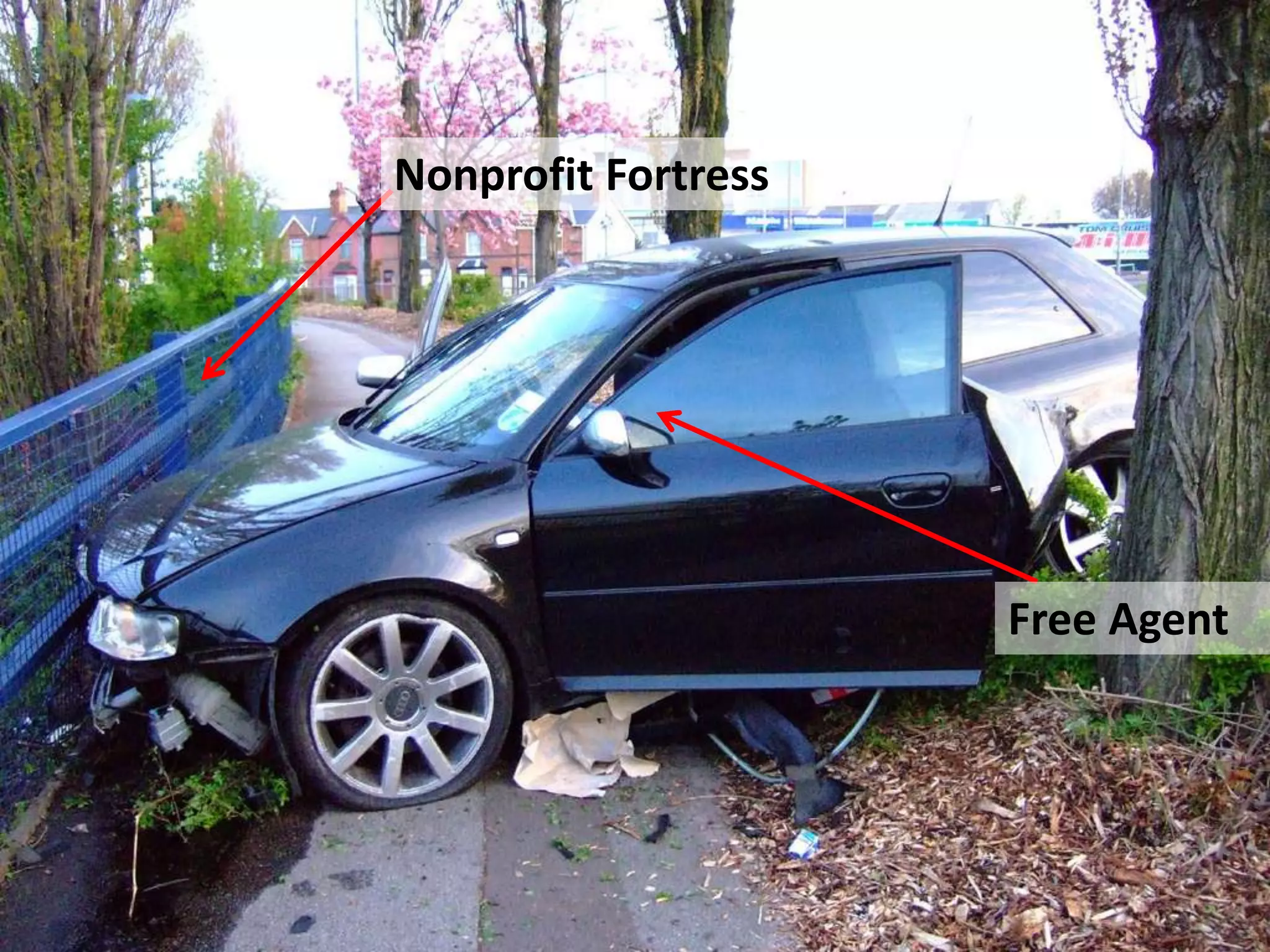
Nonprofit FortressFree Agent
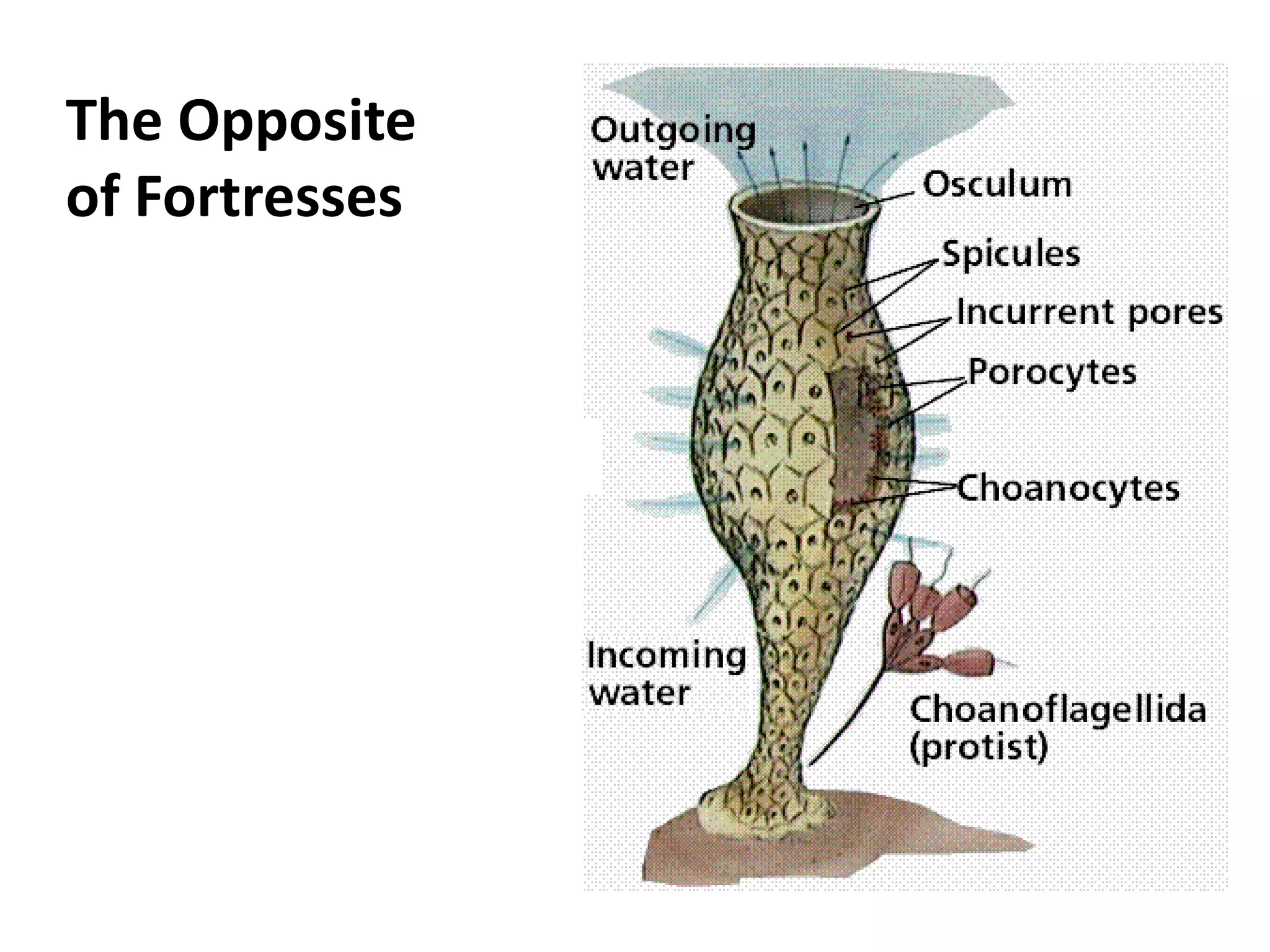
The Opposite of FortressesTransparent
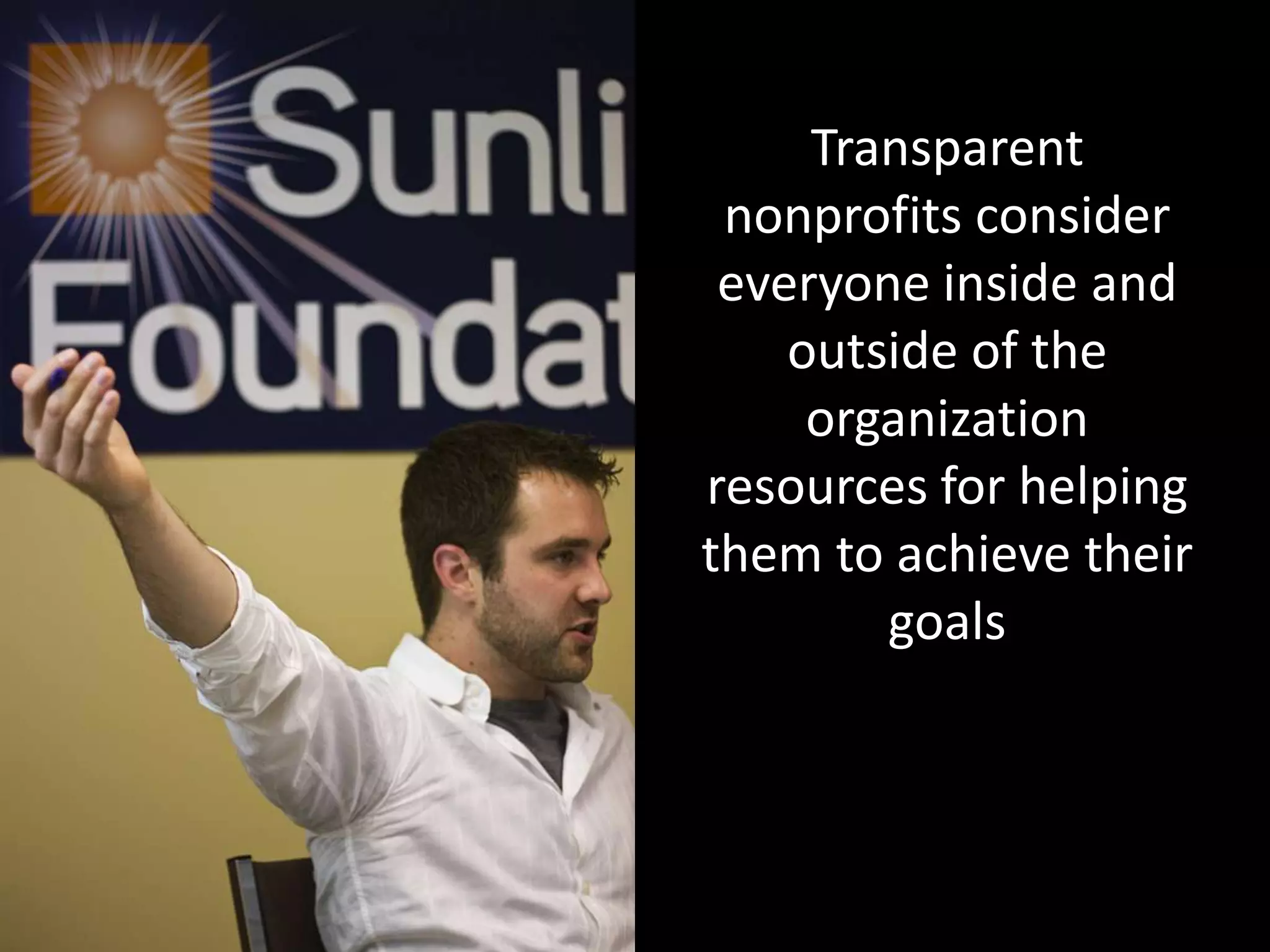
Transparent nonprofits consider everyone inside and outside of the organization resources for helping them to achieve their goals
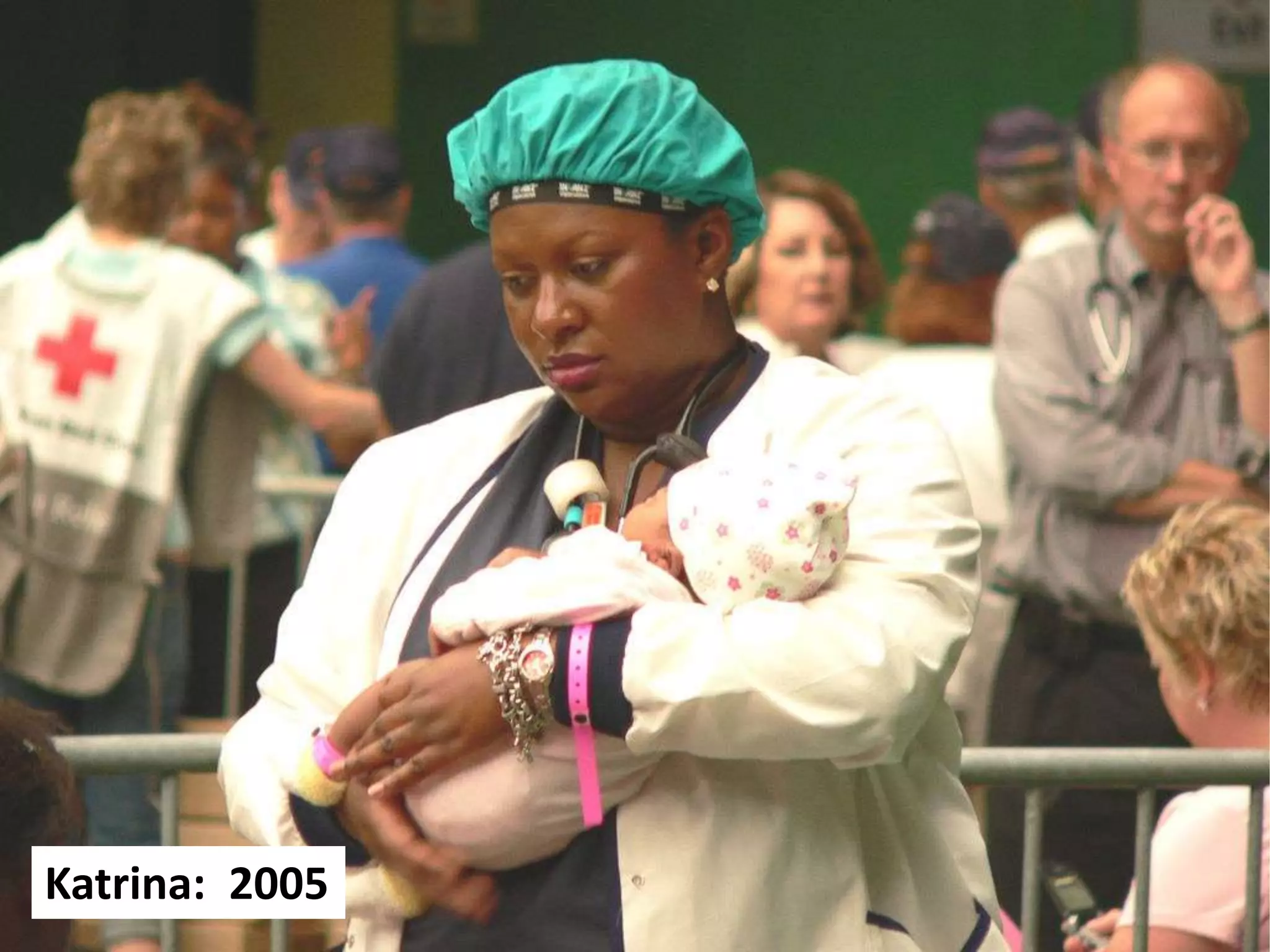
Katrina:  2005
Haiti:  2010
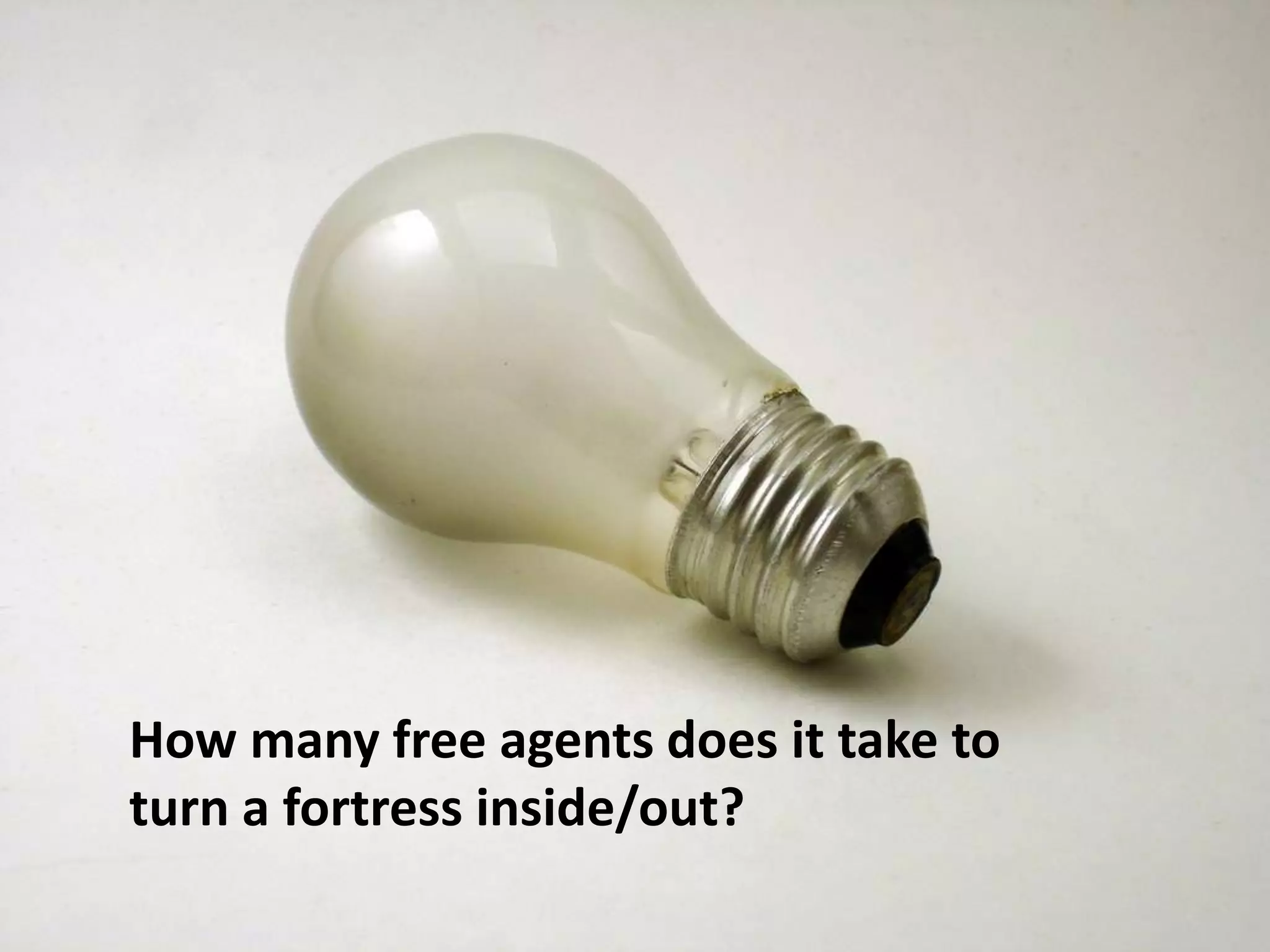
How many free agents does it take to turn a fortress inside/out?
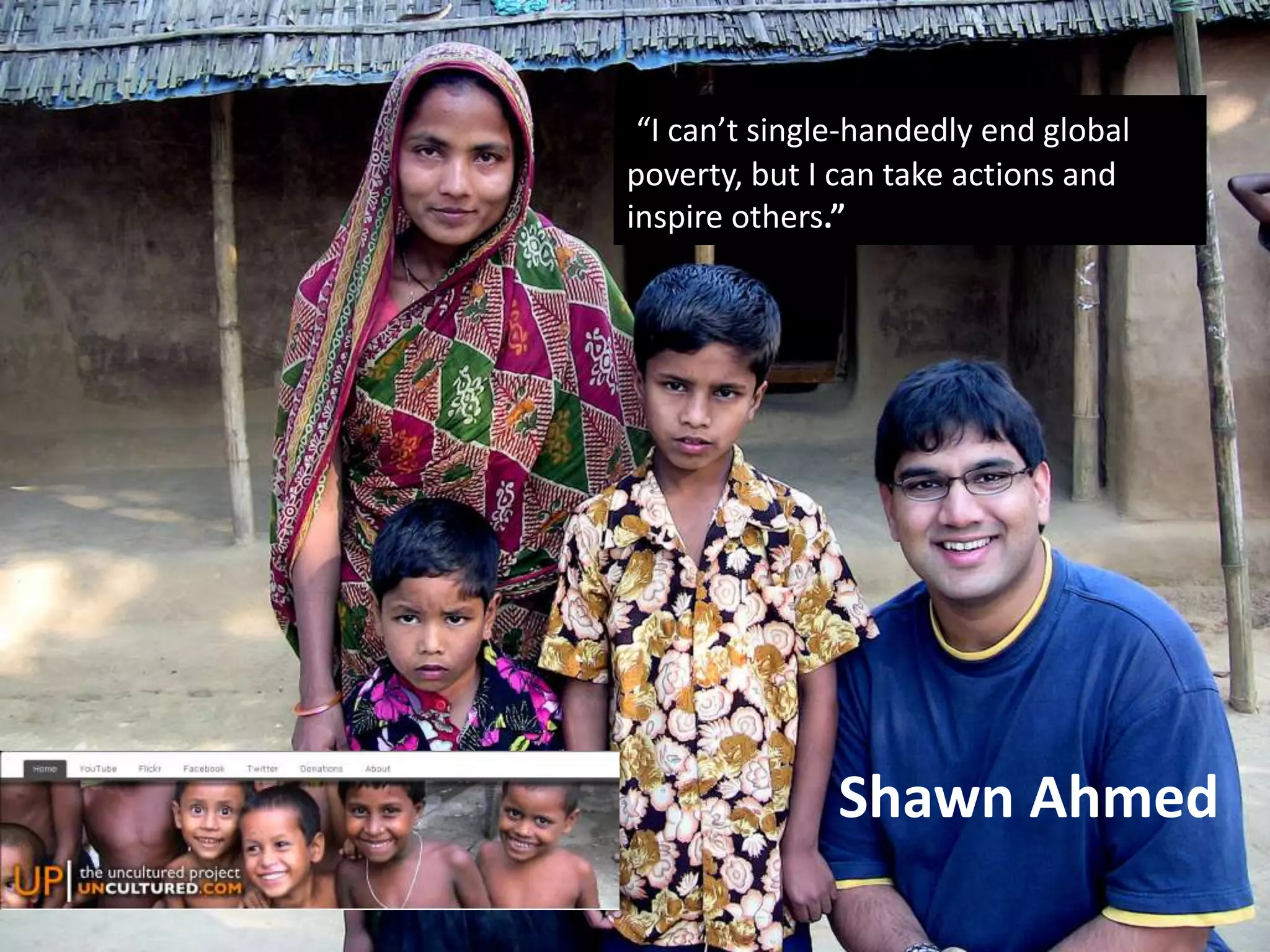
“I can’t single-handedly end global poverty, but I can take actions and inspire others.” Shawn Ahmed
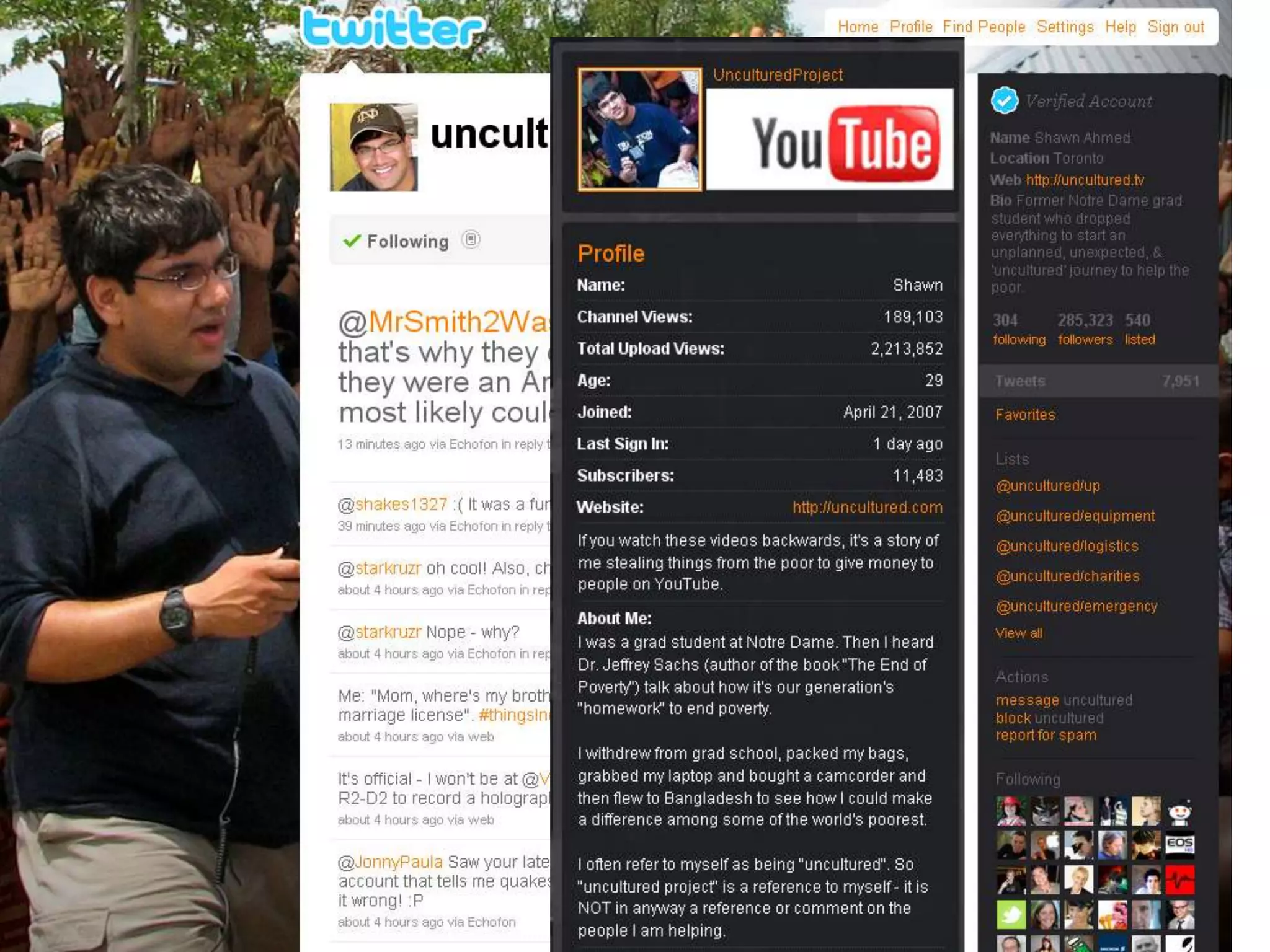
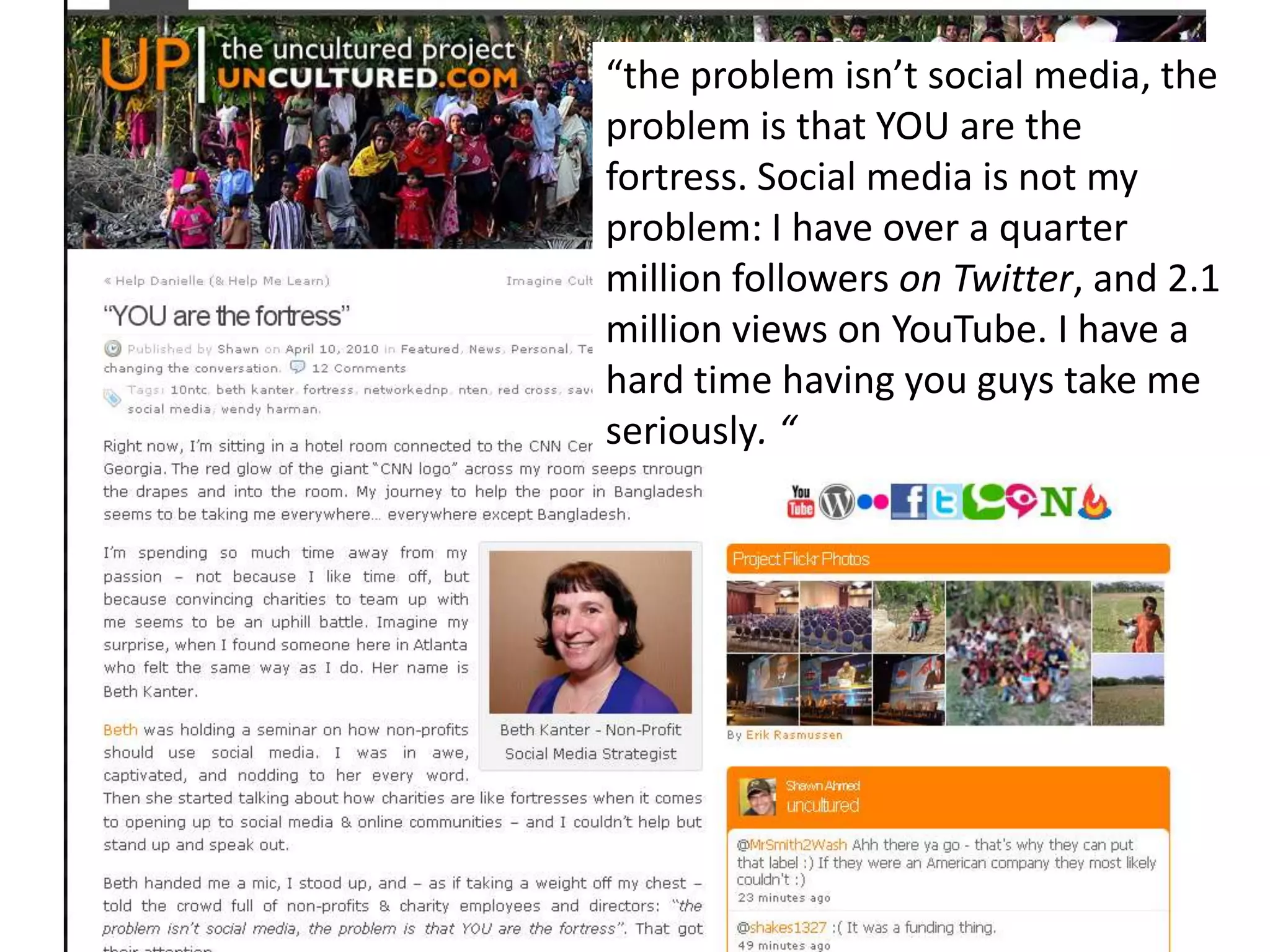
“the problem isn’t social media, the problem is that YOU are the fortress.Social media is not my problem: I have over a quarter million followers on Twitter, and 2.1 million views on YouTube. I have a hard time having you guys take me seriously. “
Share PairsWhat is something you heard that resonated?What is something new or thought about before?What struck you?Photo by Franie
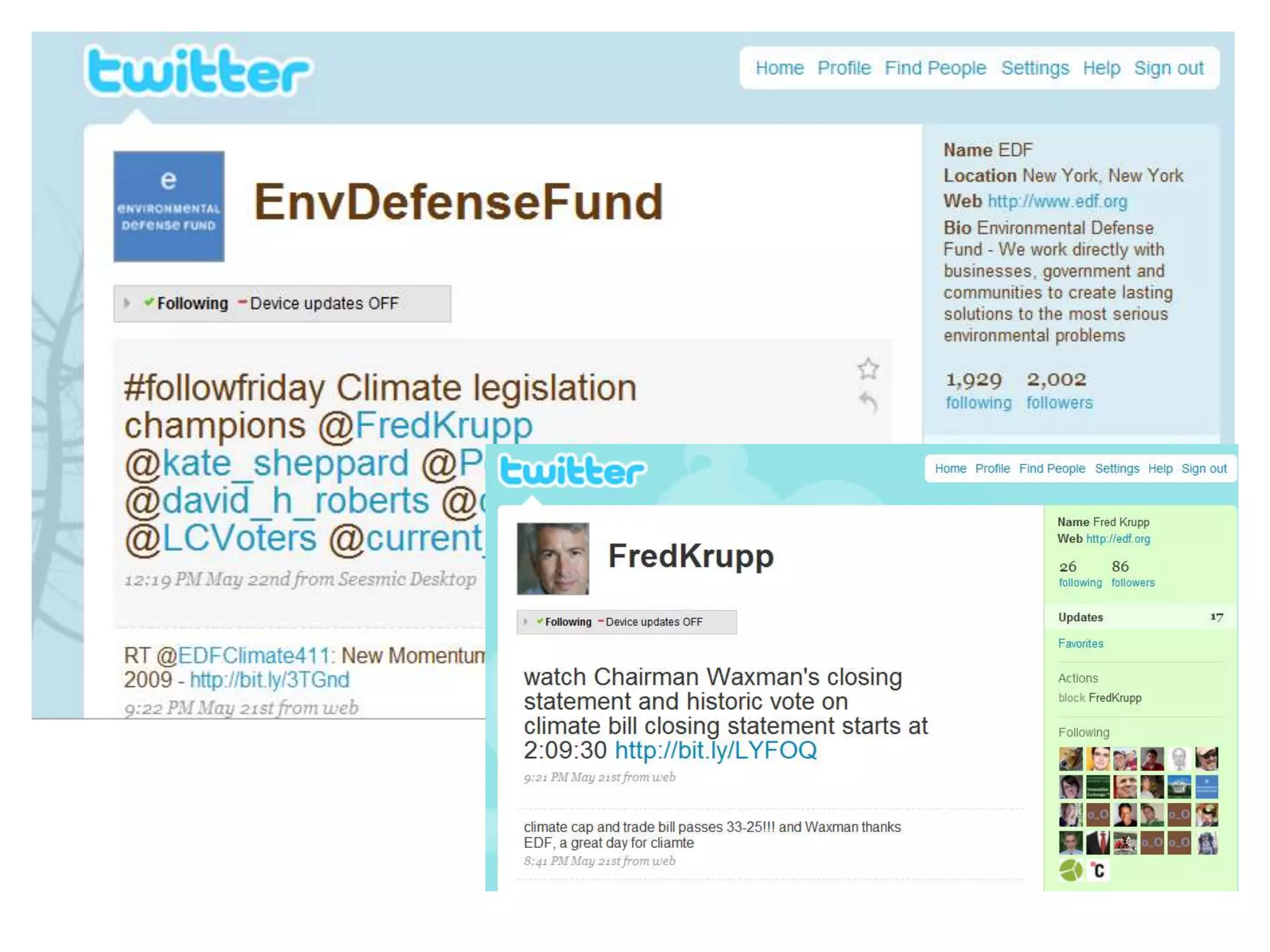
Defining  A Social CultureUses social media to engage people inside/outside to improve programs, services, or reach communications goals
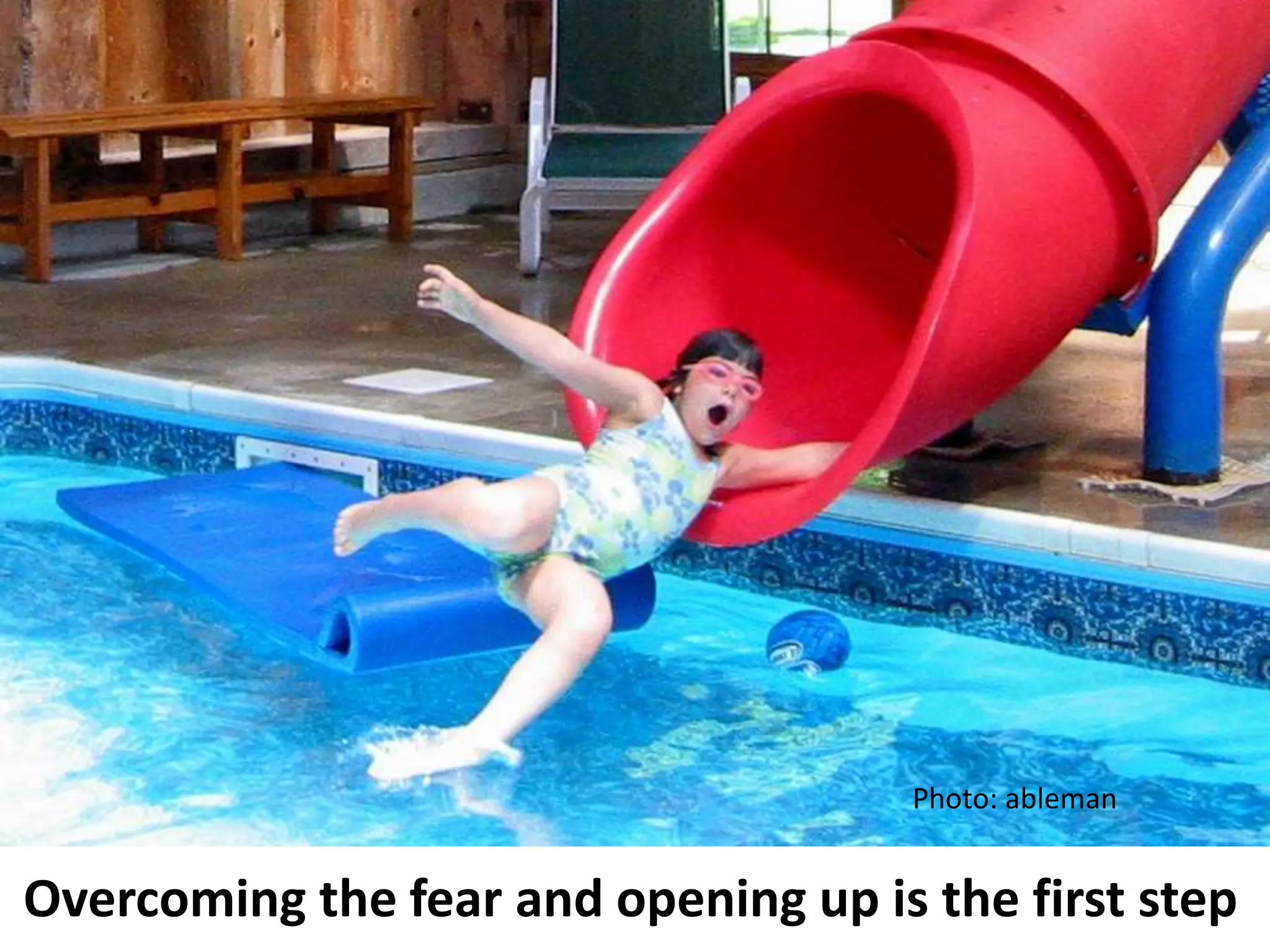
Photo: ablemanOvercoming the fear and opening up is the first step
Loss of control over their branding and marketing messagesDealing with negative commentsAddressing personality versus organizational voice  (trusting employees)Make mistakesMake senior staff too accessiblePerception of wasted of time and resources Suffering from information overload already, this will cause more
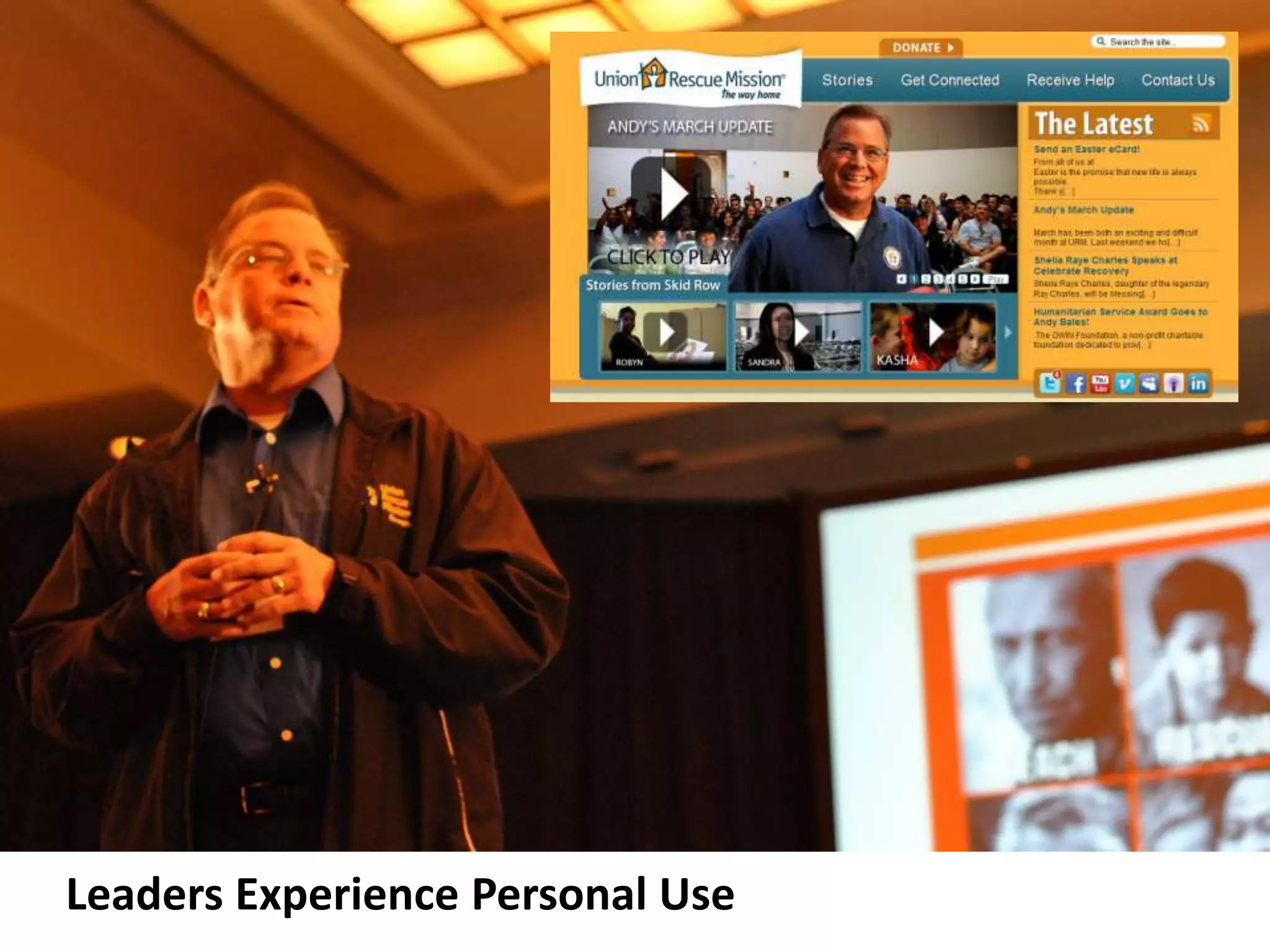
Leaders Experience Personal Use
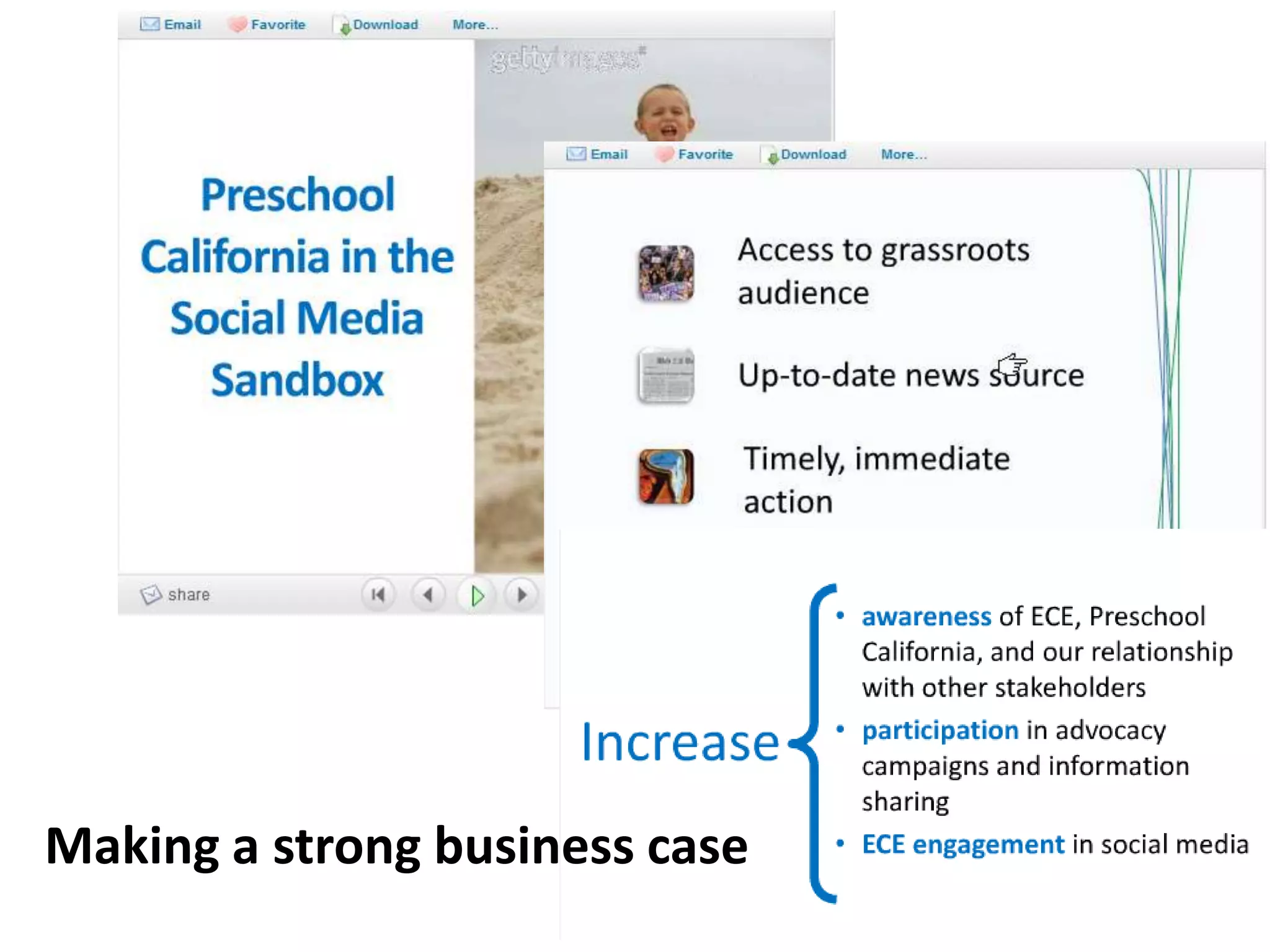
Making a strong business case
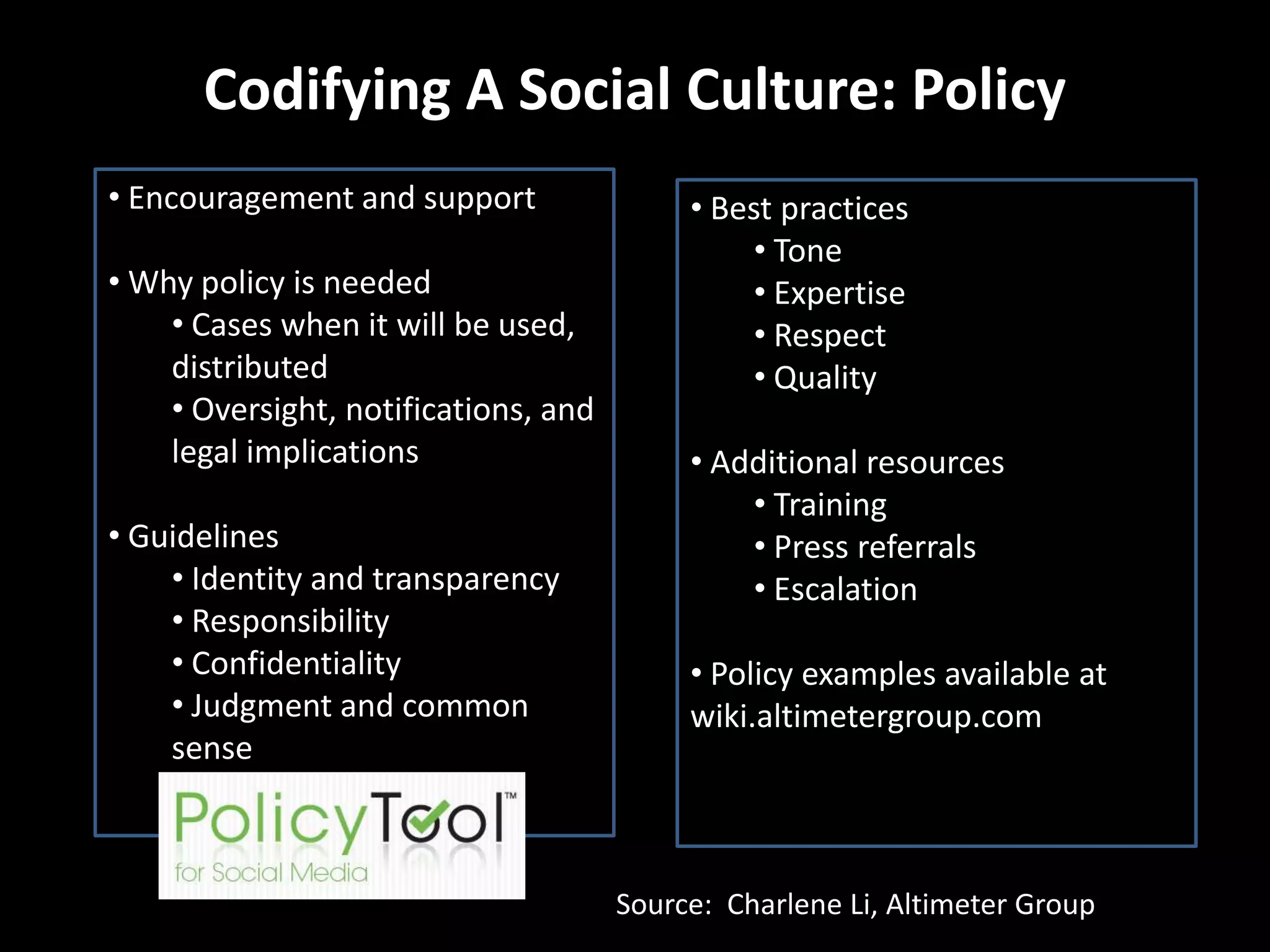
Codifying A Social Culture: Policy Encouragement and support
 Why policy is needed
 Cases when it will be used, distributed
 Oversight, notifications, and legal implications
 Guidelines
 Identity and transparency
 Responsibility
 Confidentiality
 Judgment and common sense
 Best practices

NCVS Presentation

Editor's Notes

  • #3 This is what we’re going to cover ….
  • #5 I wear many hats these days. I’m the CEO of Zoetica, write Beth’s Blog, and have been Visiting Scholar for Nonprofits and Social Media at the Packard Foundation
  • #6 WhoHow many organizations are not yet using social media, just getting started, have a strategy in place – using effectively or not?
  • #18 http://www.flickr.com/photos/nicmcphee/422442291/Problem statement: Explosion in size of nonprofit sector over last twenty years, huge increase in donations and number of foundations, and yet needle hasn’t moved on any serious social issue. A sector that has focused on growing individual institutions ever larger has failed to address complex social problems that outpace the capacity of any individual org. or institution to solve them. Our interest and passion is in solving these problems.
  • #19 Problem statement: Explosion in size of nonprofit sector over last twenty years, huge increase in donations and number of foundations, and yet needle hasn’t moved on any serious social issue. A sector that has focused on growing individual institutions ever larger has failed to address complex social problems that outpace the capacity of any individual org. or institution to solve them. That’s why feel strongly that nonprofits need to work more like networks.http://www.flickr.com/photos/sorby/258577150/http://www.flickr.com/photos/uncultured/1815645413/
  • #21 Solution: Networks of individuals and institutions that reduces the burden on everyone, leverages the capacity, creativity, energy and resources of everyone to share solutions, solve problems. This changes the definition of scale for social change – was institutions now networks. The transition from working like this to this – doesn’t happen over night, can’t flip a switch
  • #23 http://www.flickr.com/photos/franie/471300085/Beth:Share Pairs Stand Up – Every other row to stand out and face the back of the roomSpace in room – then find someone in the room you haven’t talked toIntroduce yourselves, an idea that excited you that you heard at the conference?(each pair, find another pair)What do you think are some adjectives that describe a the Networked Nonprofit?   Make wordle -- Pop Corn Report: Ring bells
  • #25 PDF celebrate free agents ---What we’d like to talk about today – is the challenges that some nonprofits are facing – working with free agents.Millennials, with their passion for causes and fluency with social media, are also a part of a powerful new force for social change players called free agents. Free agents are individuals working outside of organizations to organize, mobilize, raise funds, and communicate with constituents. In the old paradigm, organizations could dismiss free agents as amateurs not worthy of their time and attention. And without the connectedness of social media they might have been able to afford to ignore them. But not any more, not with the power of an entire social movement in the palm of an individual’s hand. Free agents are not by definition Millennials, but many free agents are young people. Free agents take advantage of the social media toolset to do everything organizations have always done, but outside of institutional walls.  
  • #26 http://www.flickr.com/photos/stuckincustoms/444790702/Fortresses work hard to keep their communities and constituents at a distance, pushing out messages and dictating strategy rather than listening or building relationships. Fortress organizations are losing ground today because they spend an extraordinary amount of energy fearing what might happen if they open themselves up to the world. These organizations are floundering in this set-me-free world powered by social media and free agents.This trajectory changes when organizations learn to use social media and actually become their own social networks.
  • #27 http://www.flickr.com/photos/bigtallguy/139143816/We wrote this book because we saw a landscape of free agents and nonprofit fortresses crashing into one another ….
  • #28 The opposite of Fortresses, Transparents can be considered as glass houses, with the organizations presumably sitting behind glass walls. However, this isn’t really transparency because a wall still exists. True transparency happens when the walls are taken down, when the distinction between inside and outside becomes blurred, and when people are let in and staffers are let out.Transparency is even stronger when the high walls and closed doors are not created in the first place. We can think of transparency like a sponge in the ocean. The scientific name for sponges is Porifera, which means pore bearing. These simple organisms let up to 20,000 times their volume in water pass through them every day as they breathe and eat. But because they are also anchored to the ocean floor, the sponges can withstand the open, constant flow without inhibiting it.University of California Museum of Paleontology, “Introduction to Porifera,” http://www.ucmp.berkeley.edu/porifera/porifera.html (accessed on May 21, 2009). Opening the Kimono in Beth’s Blog: A Day in the Life of Nonprofit Social Media Strategists and Transparency,” Beth’s Blog, posted August 3, 2009, http://beth.typepad.com/beths_blog/2009/08/opening-the-kimino-week-on-beths-blog-a-day-in-the-life-of-nonprofit-social-media-strategists-and-tr.html (accessed September 30, 2009). 
  • #29 Transparent organizations behave like these sponges. They are anchored, they are clear about what they do, and they know what they are trying to accomplish. However, they still let people in and out easily, and are enriched in the process. This can only happen when organizations trust that people on the outside have good intentions, a key ingredient for relationship building. Organizations are transparent when: Leadership is straightforward when talking to various audiences.Employees are accessible to reinforce the public view of the organization and to help people when appropriate.Their values are easily seen and understood.Their culture and operations are apparent to everyone inside and out.They communicate all results, good and bad. Transparent organizations consider everyone inside and outside of the organization resources for helping them to achieve their goals. Jake Brewer, the Engagement Director for the Sunlight Foundation, describes his organization’s efforts to be transparent this way: “We often ask in team meetings, 'How can the community help with this?' or 'How can this be more open?' The result is that instead of an internal email that only the team sees, all of our Twitter followers see it along with our staff.”http://www.flickr.com/photos/avelino_maestas/3886212111/sizes/o/
  • #31 In early 2010, I started to notice social media as part of program delivery – continuing evidence of a social culture.
  • #33 Shawn Ahmed is 29 year-old Canadian from Toronto and the founder of the “The Uncultured Project.” He raises money and awareness on the issue of extreme global poverty. He is idealistic, facile with social media and works outside the walls of an institution. He’s passionate about wanted to end global poverty and wants to do it on his terms.Shawn feels strongly that his generation can end extreme poverty with one small action at a time in places like Bangladesh. His on-the-ground work aims to make as many meaningful differences in other people’s lives as possible. This includes helping a widow keep her children, helping a student stay in high school, helping malaria survivors live malaria-free lives, and much more. But as he acknowledges, that he can’t do it alone.http://www.flickr.com/photos/uncultured/1173511851/
  • #34 By sharing this journey on social networks like YouTube and Twitter, he is inspiring other people to talk about issue of global poverty and take action, and as he says, “in a way that is different from the big nonprofit organizations.”
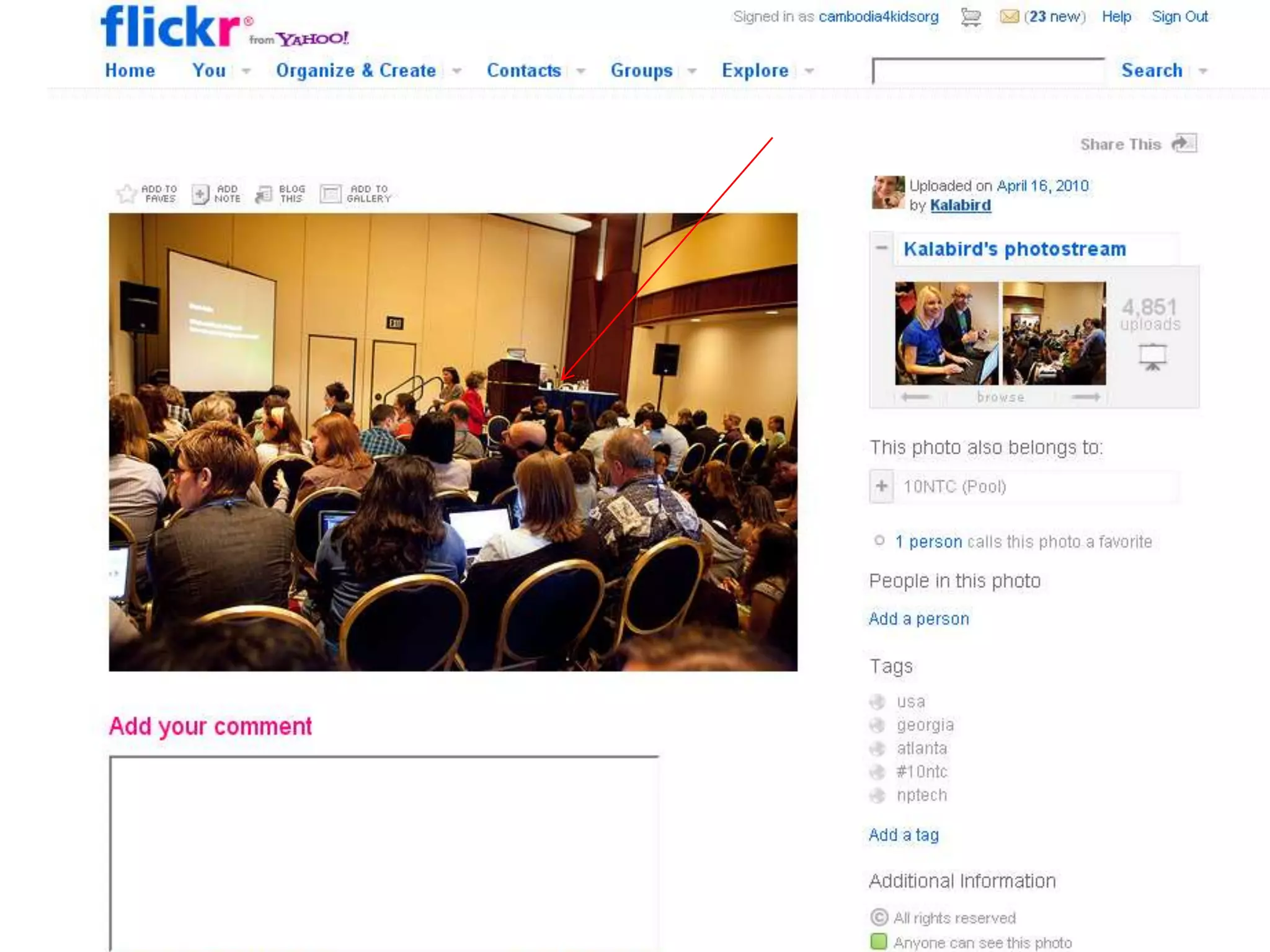
  • #35  We witnessed this collision first hand during our session on the Networked Nonprofit at the NTEN NTC Conference as Shawn’s frustration with traditional organizations spilled over. He grabbed the microphone to address the room full of nonprofit professionals and said, “the problem isn’t social media, the problem is that YOU are the fortress.Social media is not my problem: I have over a quarter million followers on Twitter, 10,800 subscribers on YouTube, and 2.1 million views. Yet, despite that, I have a hard time having you guys take me seriously. “
  • #36 He turned and pointed a finger at Wendy Harman from the Red Cross who was in the room. He told the room full of nonprofits staffers …..When the Haiti earthquake struck, I contacted the Red Cross. I offered to connect the community supporting my work with your efforts in Haiti. But I was dismissed as ‘just a guy on YouTube’”.
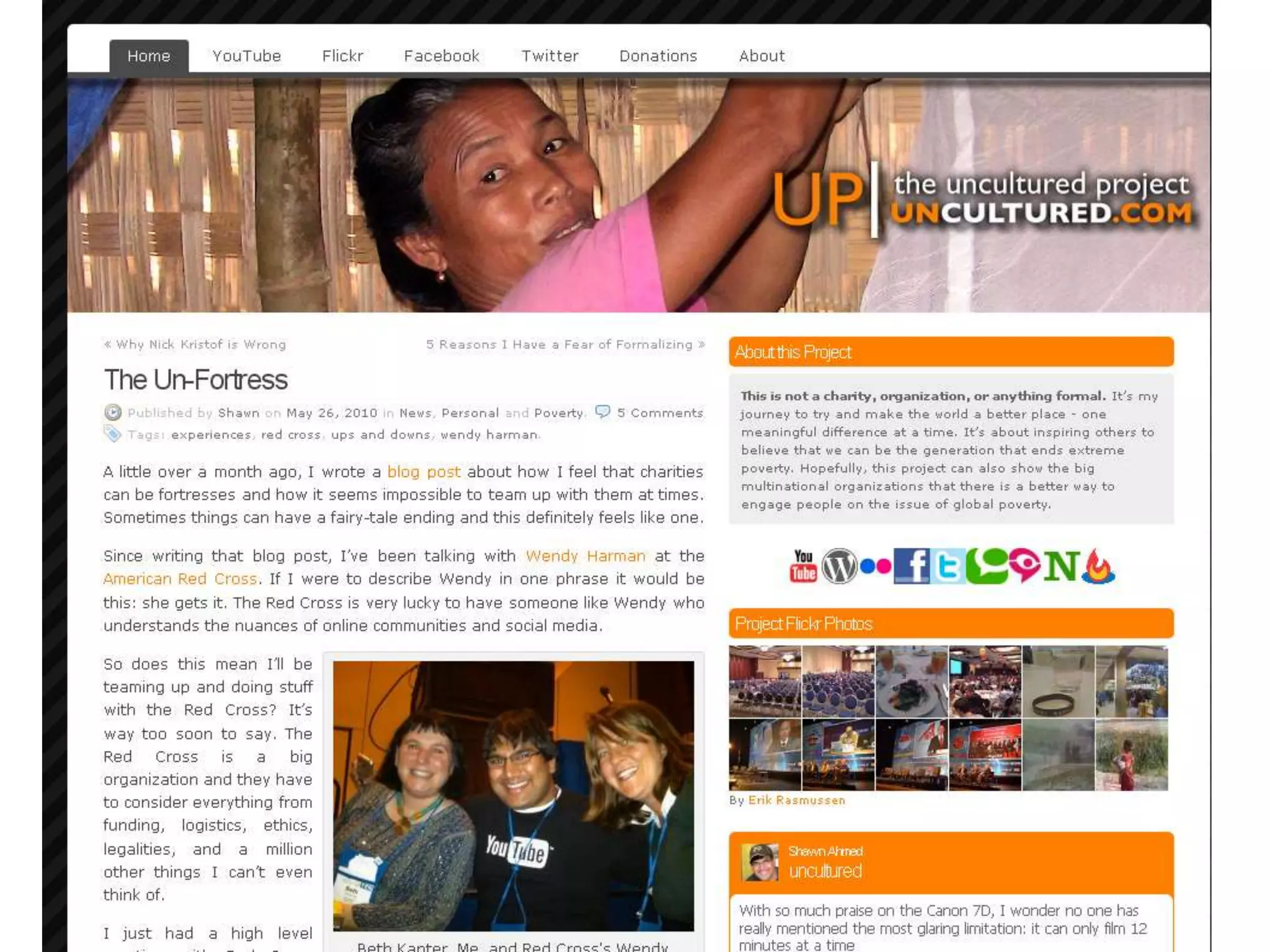
  • #37 A month after our gathering in Atlanta. Shawn Admed shared news of a meeting with the Red Cross, an organization he now describes as “unfortress.” He applauds them for exploring ways to team up with a free agent. The hardest step is for most organizations is the first one. They have to admit their fear of a loss of control that prevents them from working with free agents – and get to a conversation to explore the possibilities. The Red Cross took that first step. There are actually 12 steps – and we lay this out in the chapter on social culture.
  • #38 http://www.flickr.com/photos/franie/471300085/Beth:Share Pairs Stand Up – Every other row to stand out and face the back of the roomSpace in room – then find someone in the room you haven’t talked toIntroduce yourselves, an idea that excited you that you heard at the conference?(each pair, find another pair)What do you think are some adjectives that describe a the Networked Nonprofit?   Make wordle -- Pop Corn Report: Ring bells
  • #39 Organizational culture is the psychology, attitudes, and experiences and beliefs of the people who lead organizations. Culture impactsUse social media to engage people inside and outside the organization to improve programs, services, or reach communications goals. Embrace mistakes and take calculated risksReward learning and reflectionUse a “try it and fix it as we go” approach that emphasizes failing fastOvercomes organizational innertiaUnderstand and appreciate informality and individuality do not necessarily indicate a lack of professionalism and caring.Trust staff to make decisions and respond rapidly rather than craw through endless check-ins and approval processes
  • #40 http://www.flickr.com/photos/ableman/144373997/
  • #41 http://www.flickr.com/photos/24443965@N08/3639694353/
  • #44 There is also a need to describe your social media strategy in terms of the value – how it will help you reach your goals. Many leaders are “yellow thinkers” – that is they need to see the results laid out in advance before they will say.Pre-school California – there is also a conversation about value – and that happens by connecting social media strategy to communications objectives.
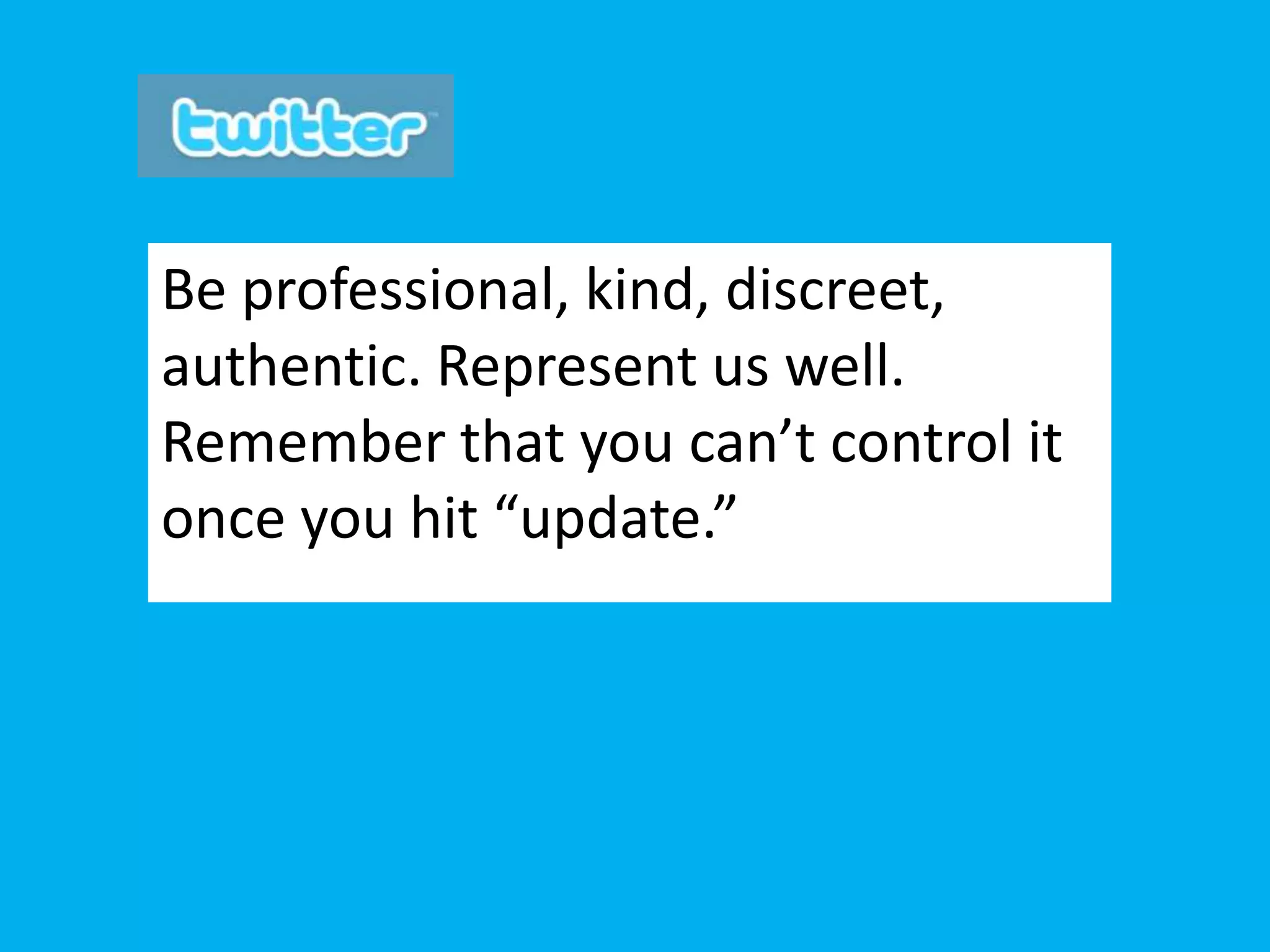
  • #46 Don’t do anything stupid – Social MediaDon’t moon anyone with camera
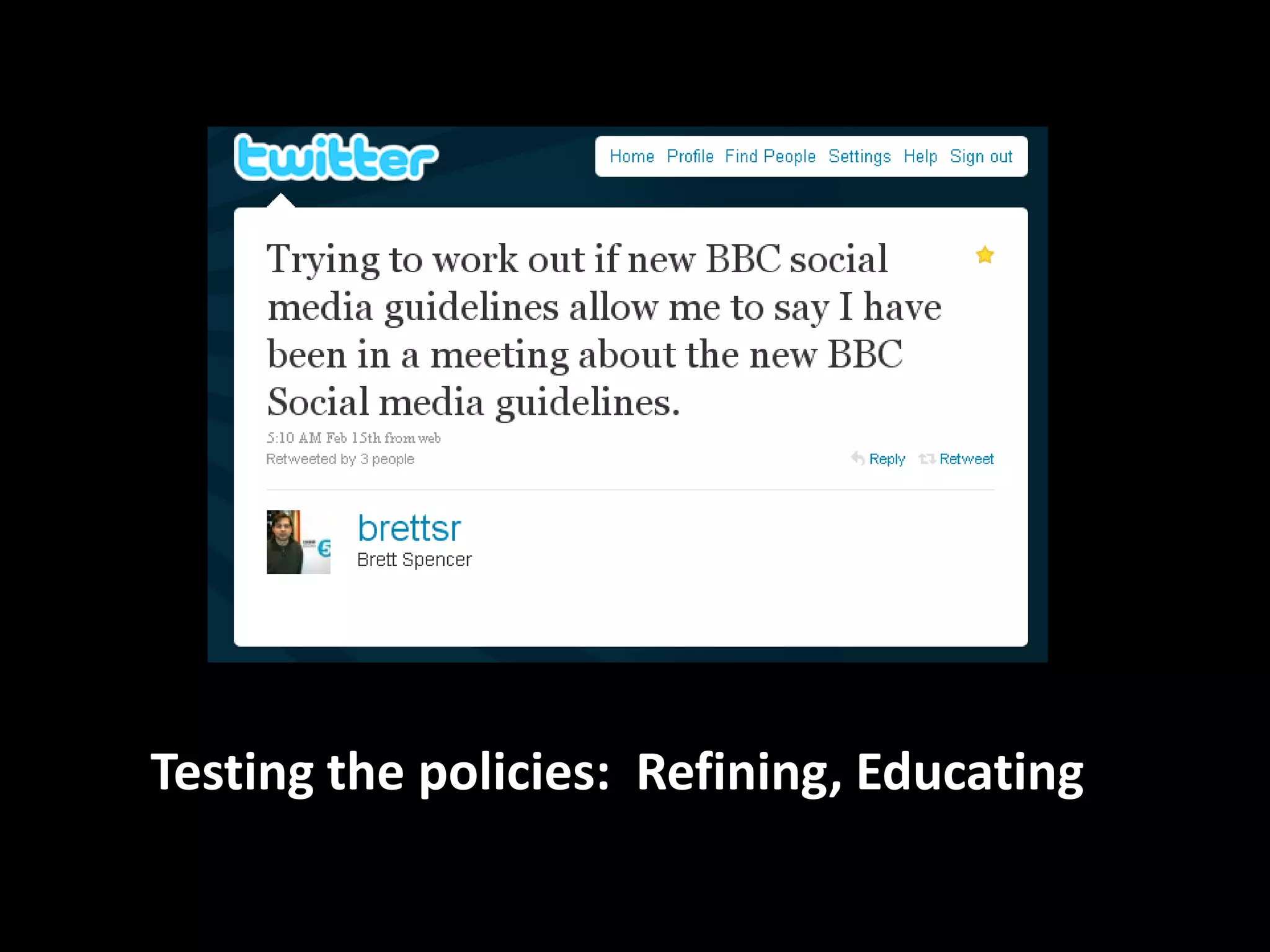
  • #47 Testing of the policy – and there may be things that you didn’t think
  • #49 But it really boils down to common sense ….
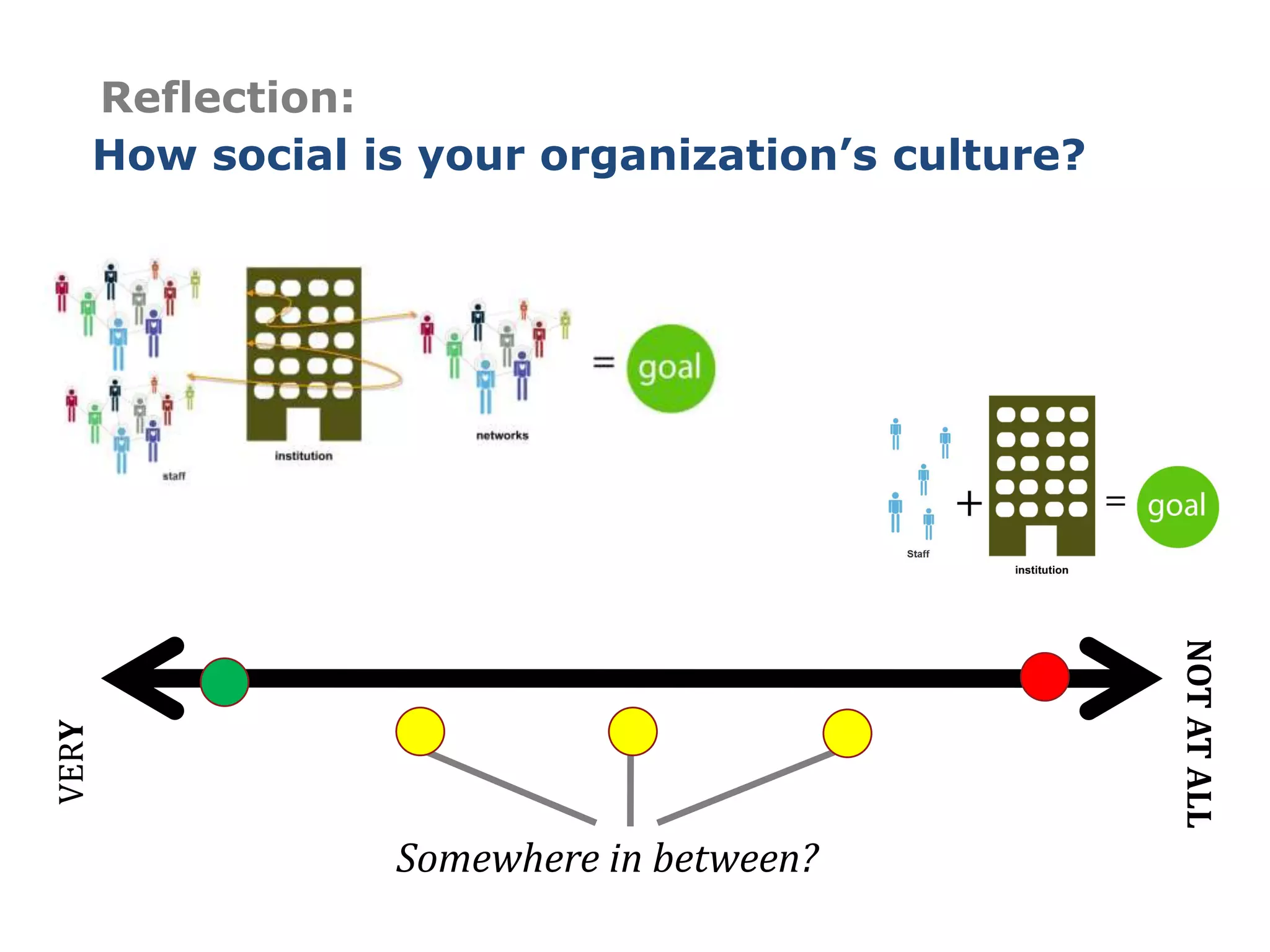
  • #50 http://www.flickr.com/photos/hermida/490868828/Share pair, where are you and what does it look like?Ask Very social, Ask Not all, Ask MiddleWhat does your organization need to do to be more social?
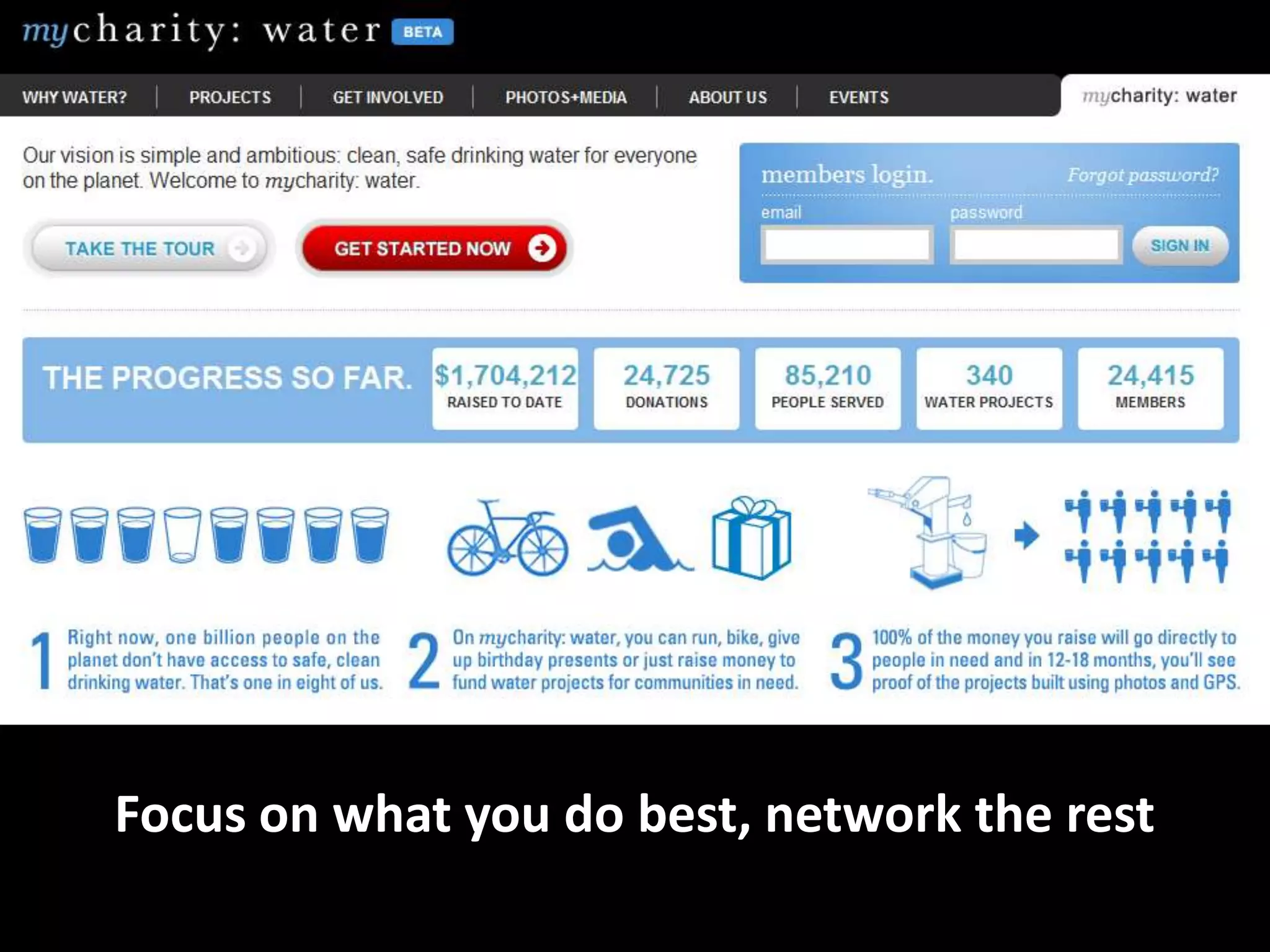
  • #51 Organizations and people do too much because they work within systems that took complicated.Complexity slows us down and keeps good ideas and energy behind the firewallMaking something complex is easy, simplicity is harder.It was hard for me to put one word on the slideThe networked nonprofit has clarified what it does and focuses their energy on what they do best and networks the rest. Simplicity powers more informal connections between people and organizations and blurs boundaries – enables insiders to get out and outsiders to get in.It helps organizations scale.
  • #52 Focus on what you do best, network the rest
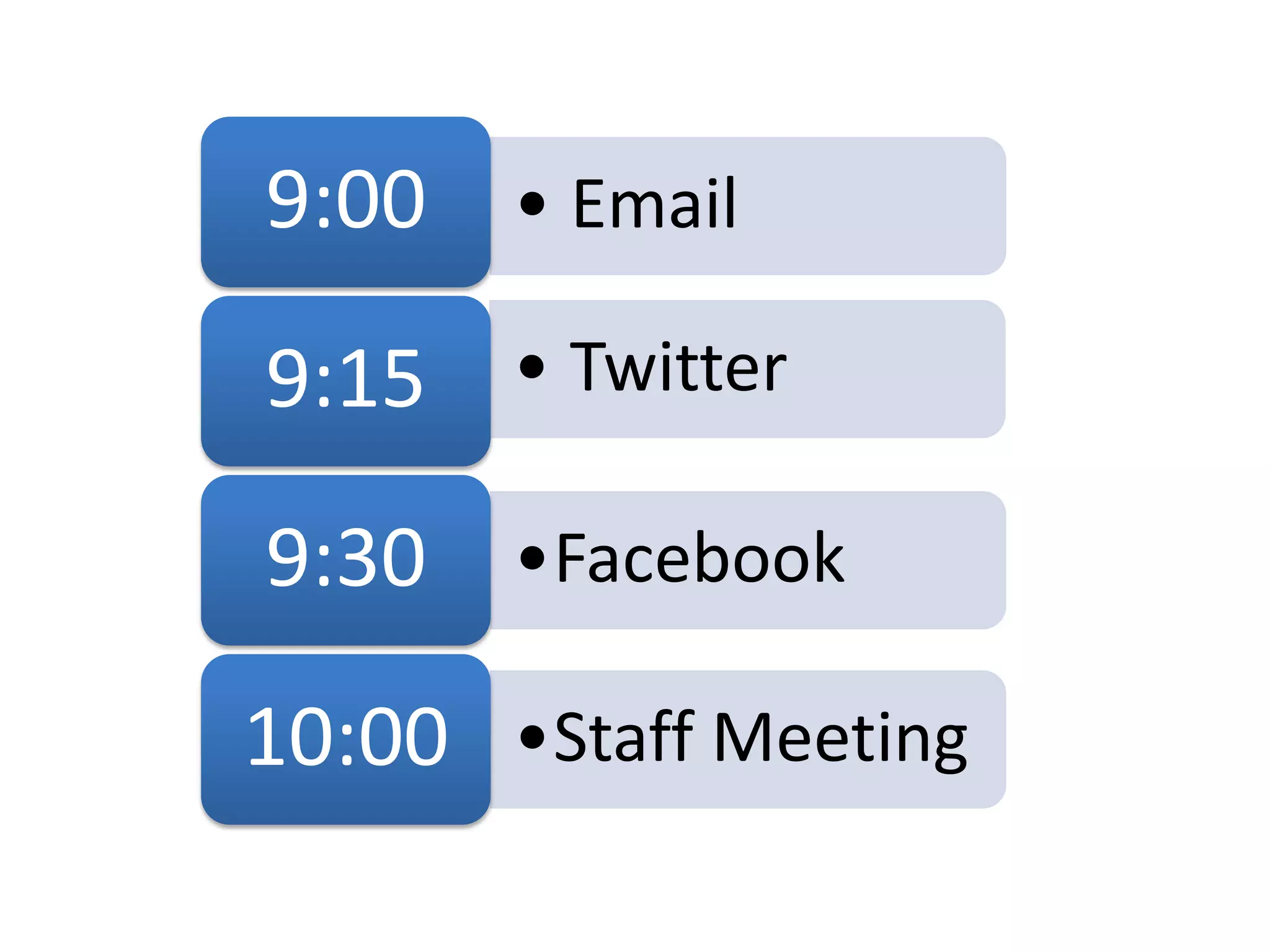
  • #53 Doing more by Theme: Explain - Feel like you have too much to do, because you do too much - do what you do best and network the rest Exercise: Surfrider - Reflection question doing less
  • #54 http://www.flickr.com/photos/notanartist/263545370/sizes/l/
  • #58 What's one small step that your organization can take towards being a networked nonprofit? on the back of business card - and draw a winner free copy.