Joshua Shinavier


 Semantics and Sensors


Wednesday Nights in the Tetherless World (TWed)
            November 28th, 2012
Overview


•   intro to sensors

•   semantic sensor networks

•   components of an application

•   a demo


                       2
What is a sensor?


•   any device that measures a physical quantity

    •   e.g. temperature, pressure, electrical potential

•   more abstract quantities are sometimes measured by
    “sensors”

    •   e.g. the number of bicycles available at a bicycle
        sharing station

•   however, for our purposes...


                              3
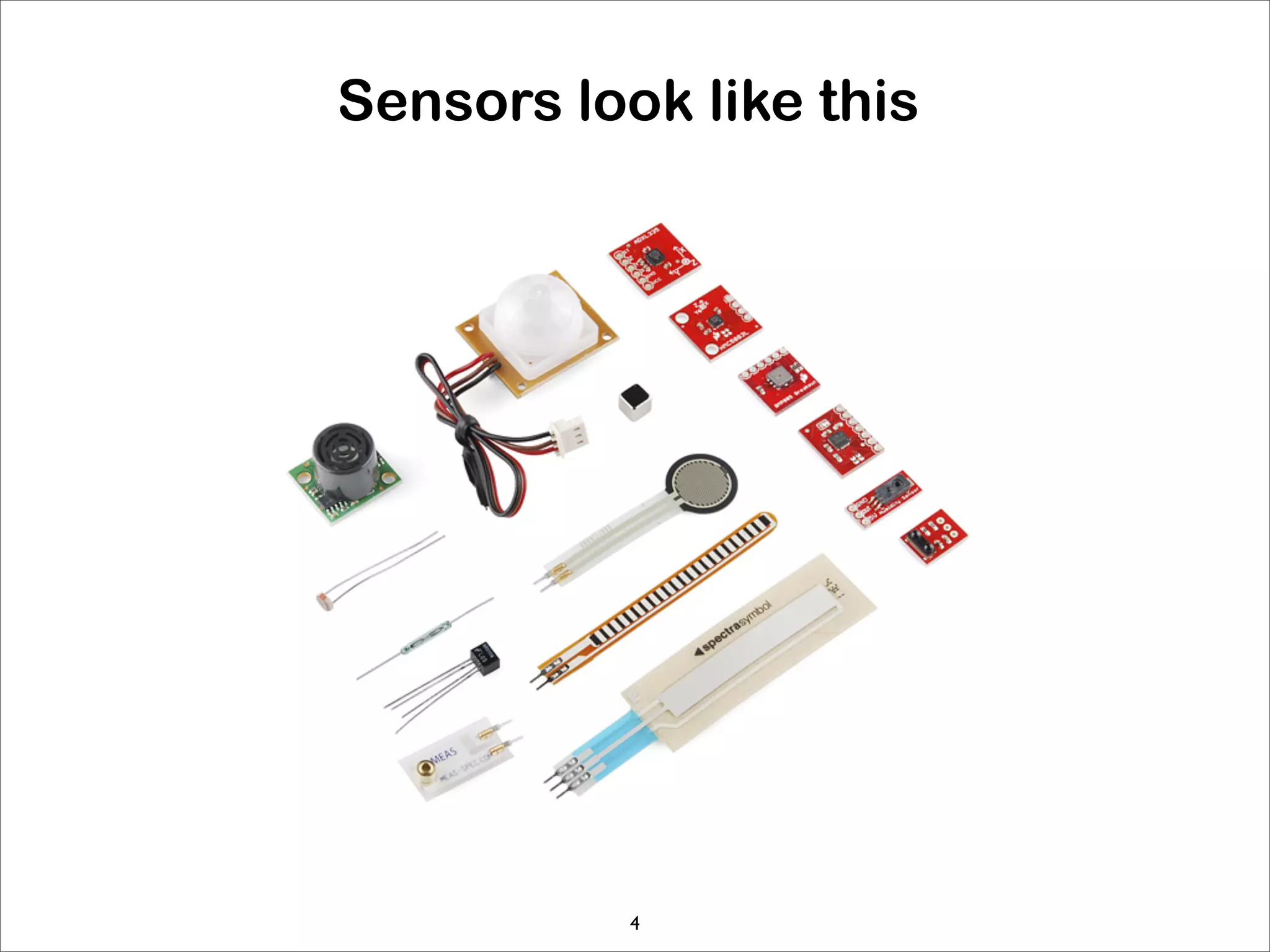
Sensors look like this


           4
How do you talk to a sensor?


•   basic sensors produce simple analog or digital
    signals,

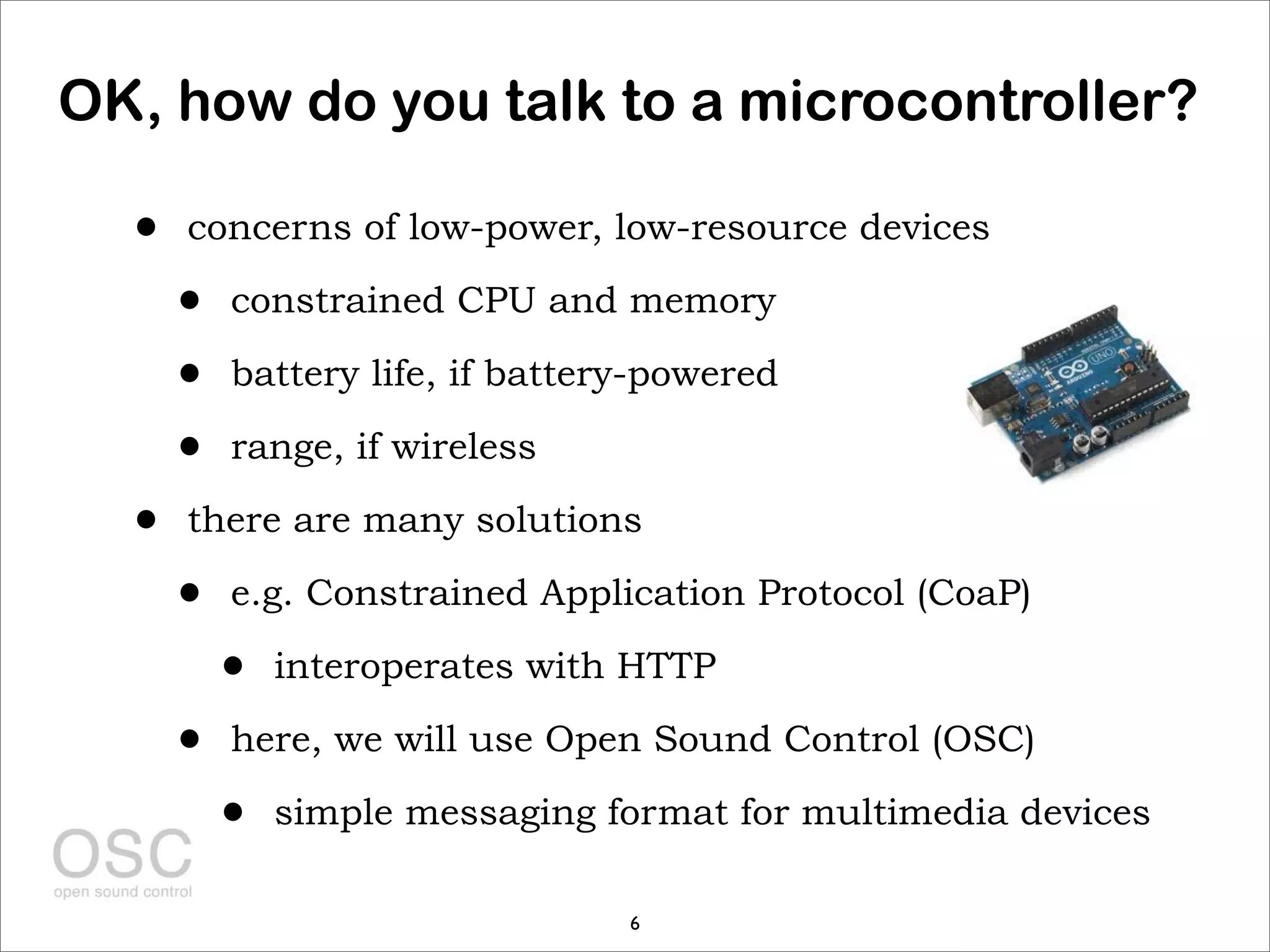
•   or use simple protocols such as I²C

•   they don’t understand HTTP

•   nor even TCP/IP

•   they need to be connected with a more general-
    purpose device

    •   e.g. a microcontroller


                                 5
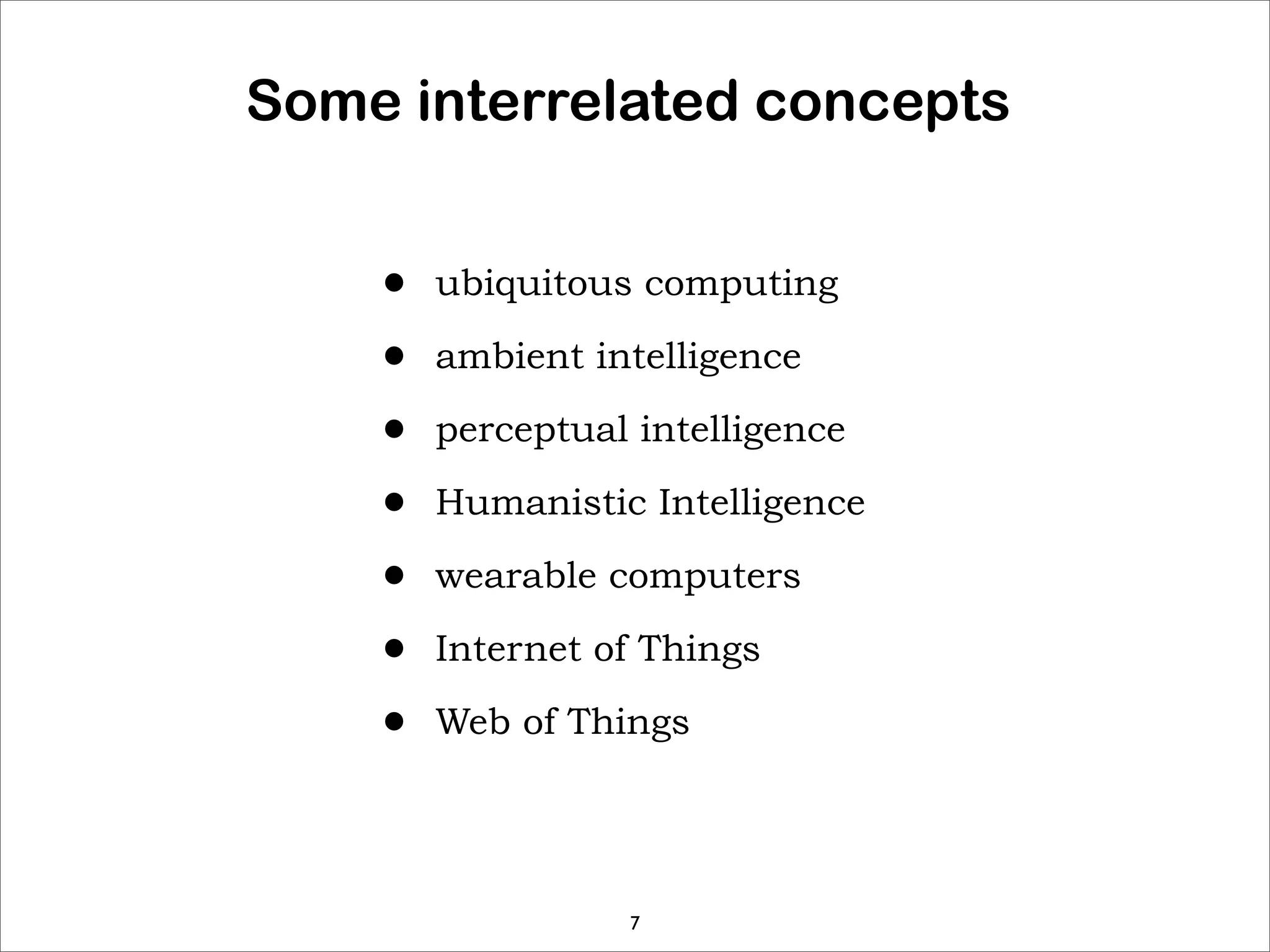
OK, how do you talk to a microcontroller?

  •   concerns of low-power, low-resource devices

      •   constrained CPU and memory

      •   battery life, if battery-powered

      •   range, if wireless

  •   there are many solutions

      •   e.g. Constrained Application Protocol (CoaP)

          •   interoperates with HTTP

      •   here, we will use Open Sound Control (OSC)

          •   simple messaging format for multimedia devices

                                 6
Some interrelated concepts


    •   ubiquitous computing

    •   ambient intelligence

    •   perceptual intelligence

    •   Humanistic Intelligence

    •   wearable computers

    •   Internet of Things

    •   Web of Things


                  7
Some quantities we can measure with
              sensors


                 8
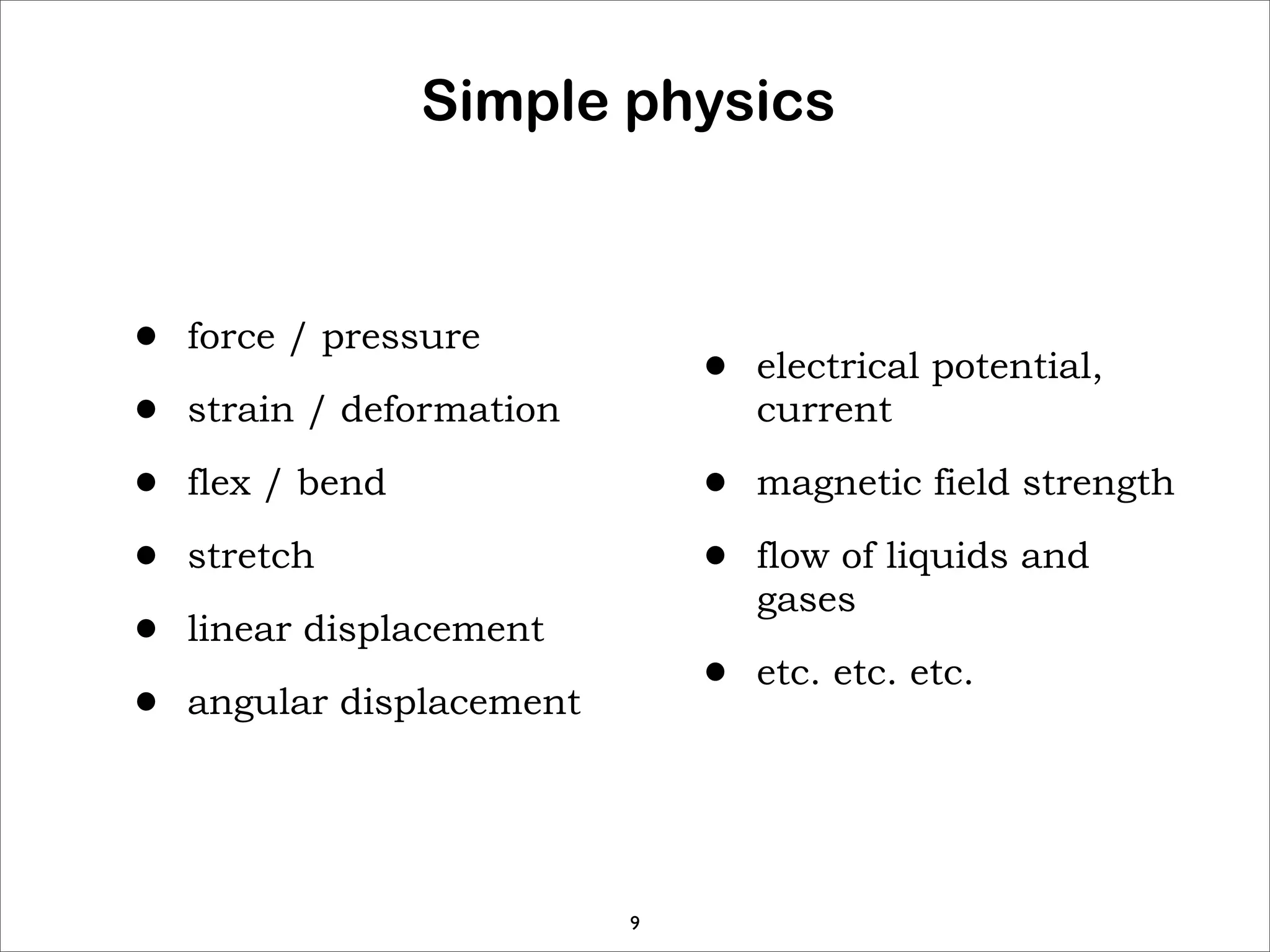
Simple physics


•   force / pressure
                               •   electrical potential,
•   strain / deformation           current

•   flex / bend                •   magnetic field strength

•   stretch                    •   flow of liquids and
                                   gases
•   linear displacement

•   angular displacement
                               •   etc. etc. etc.


                           9
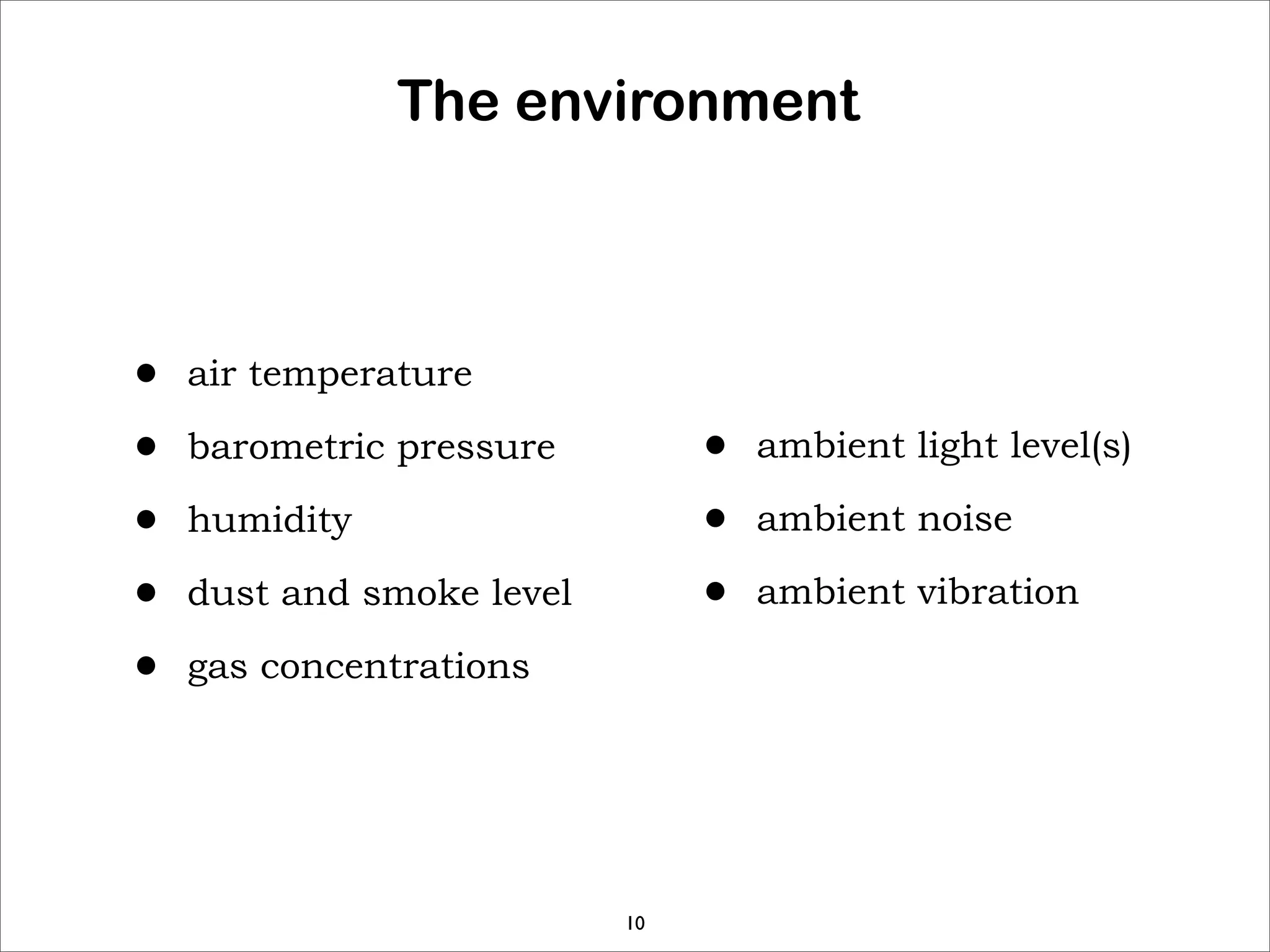
The environment


•   air temperature

•   barometric pressure         •   ambient light level(s)

•   humidity                    •   ambient noise

•   dust and smoke level        •   ambient vibration

•   gas concentrations


                           10
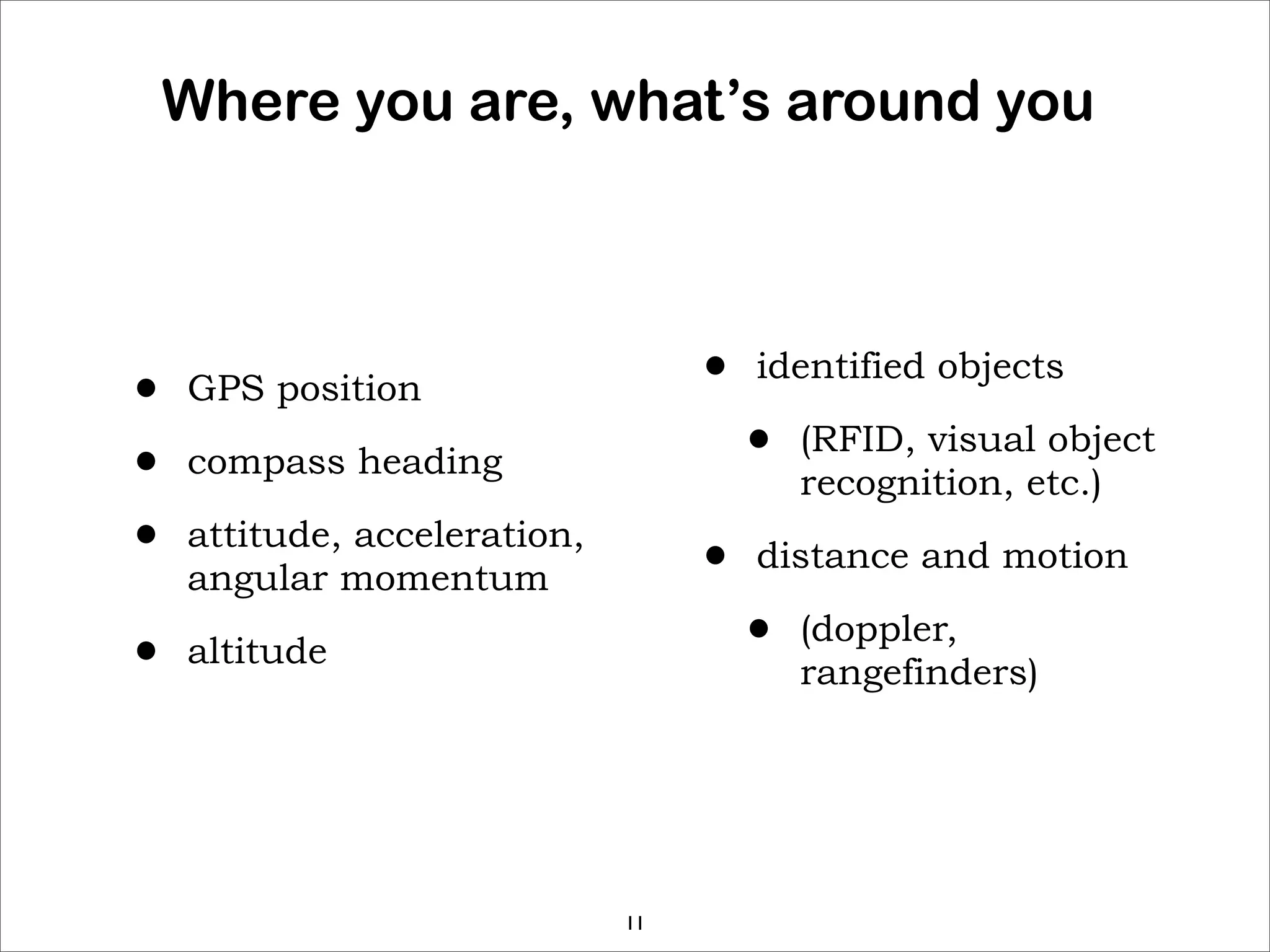
Where you are, what’s around you


•   GPS position                   •   identified objects

•   compass heading                    •   (RFID, visual object
                                           recognition, etc.)
•   attitude, acceleration,
                                   •   distance and motion
    angular momentum

•   altitude                           •   (doppler,
                                           rangefinders)


                              11
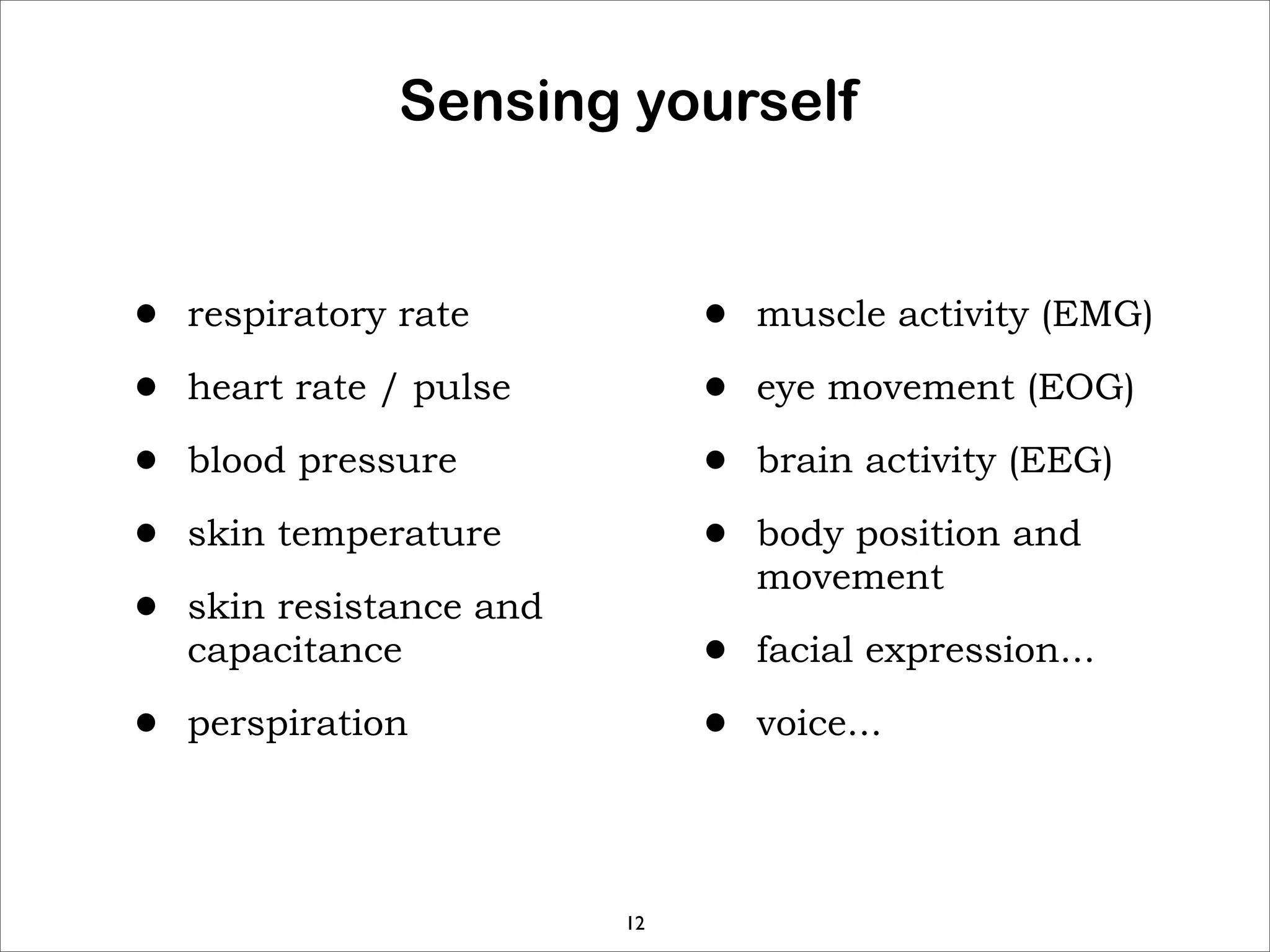
Sensing yourself


•   respiratory rate           •   muscle activity (EMG)

•   heart rate / pulse         •   eye movement (EOG)

•   blood pressure             •   brain activity (EEG)

•   skin temperature           •   body position and
                                   movement
•   skin resistance and
    capacitance                •   facial expression...

•   perspiration               •   voice...


                          12
Common themes in semantic sensor
          networks


               13
Sources of sensor data and metadata


•   gathering sensor data from source x, e.g.

    •   sensor data from wireless networks

    •   sensor data from mobile phones

    •   citizen sensing

•   gathering sensor metadata

    •   through human input

    •   derived from raw measurements


                            14
Modeling and publication of sensor data


 •   ontological representation of sensor data

 •   sensor metadata as Linked Data

 •   integration of streaming sensor data with static
     metadata, web service APIs

 •   annotation of sensor data with quality measures

 •   publishing historical time series data


                             15
Applications of sensor data


•   complex event processing over sensor data streams

•   composition of sensor web APIs

•   ubiquitous computing applications

•   search over sensor data

•   stream reasoning over sensor data


                              16
Components of a semantic sensor
     network application


               17
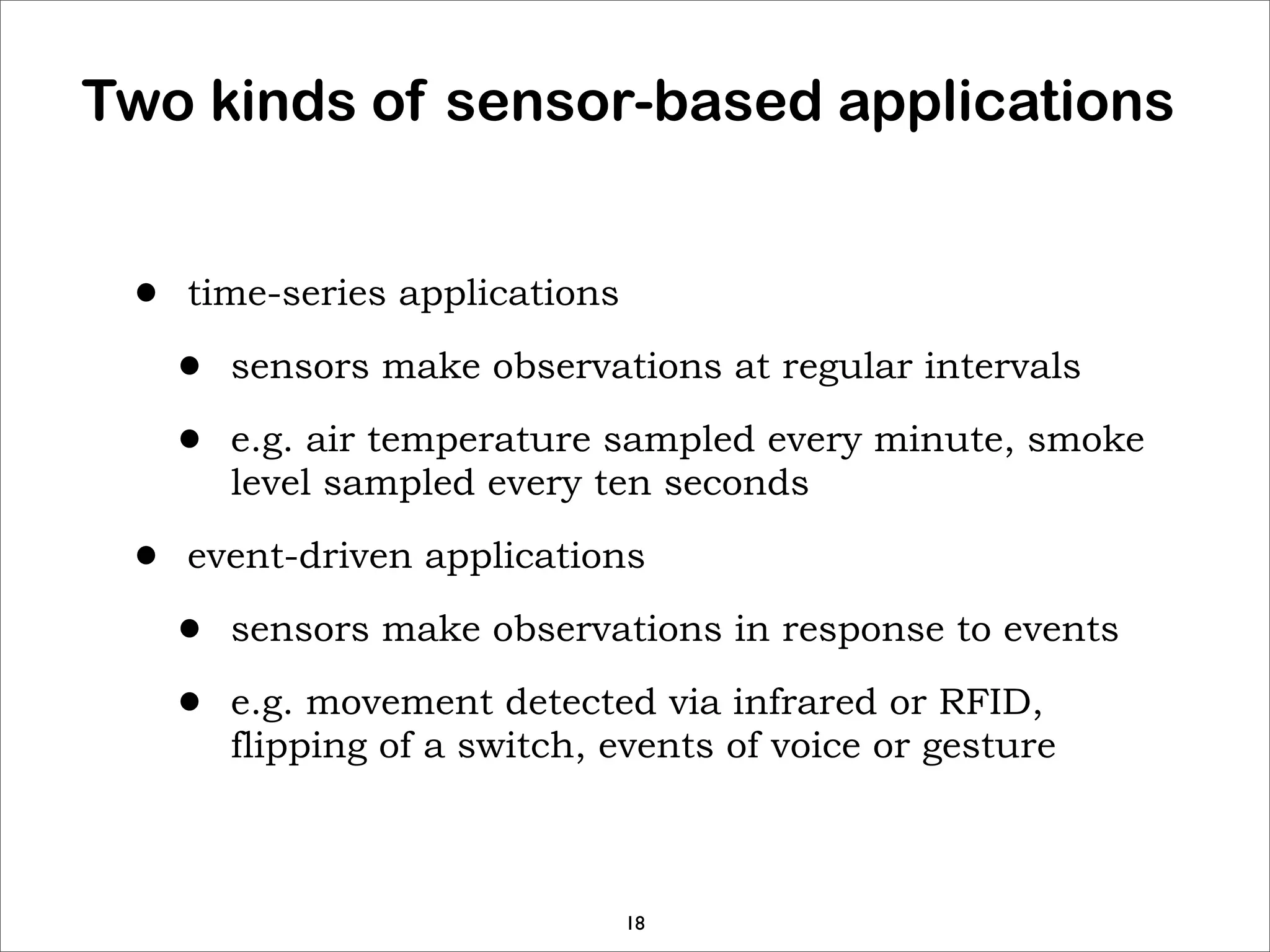
Two kinds of sensor-based applications


 •   time-series applications

     •   sensors make observations at regular intervals

     •   e.g. air temperature sampled every minute, smoke
         level sampled every ten seconds

 •   event-driven applications

     •   sensors make observations in response to events

     •   e.g. movement detected via infrared or RFID,
         flipping of a switch, events of voice or gesture


                                18
Sensor network ontologies


•   Observations and Measurements model in OWL

    •   OGC Sensor Web Enablement Initiative

•   Semantic Sensor Network ontology

    •   W3C Semantic Sensor Network Incubator Group

•   OntoSensor ontology

    •   builds on SUMO and ISO 19115 (geo metadata)

•   there are many others


                            19
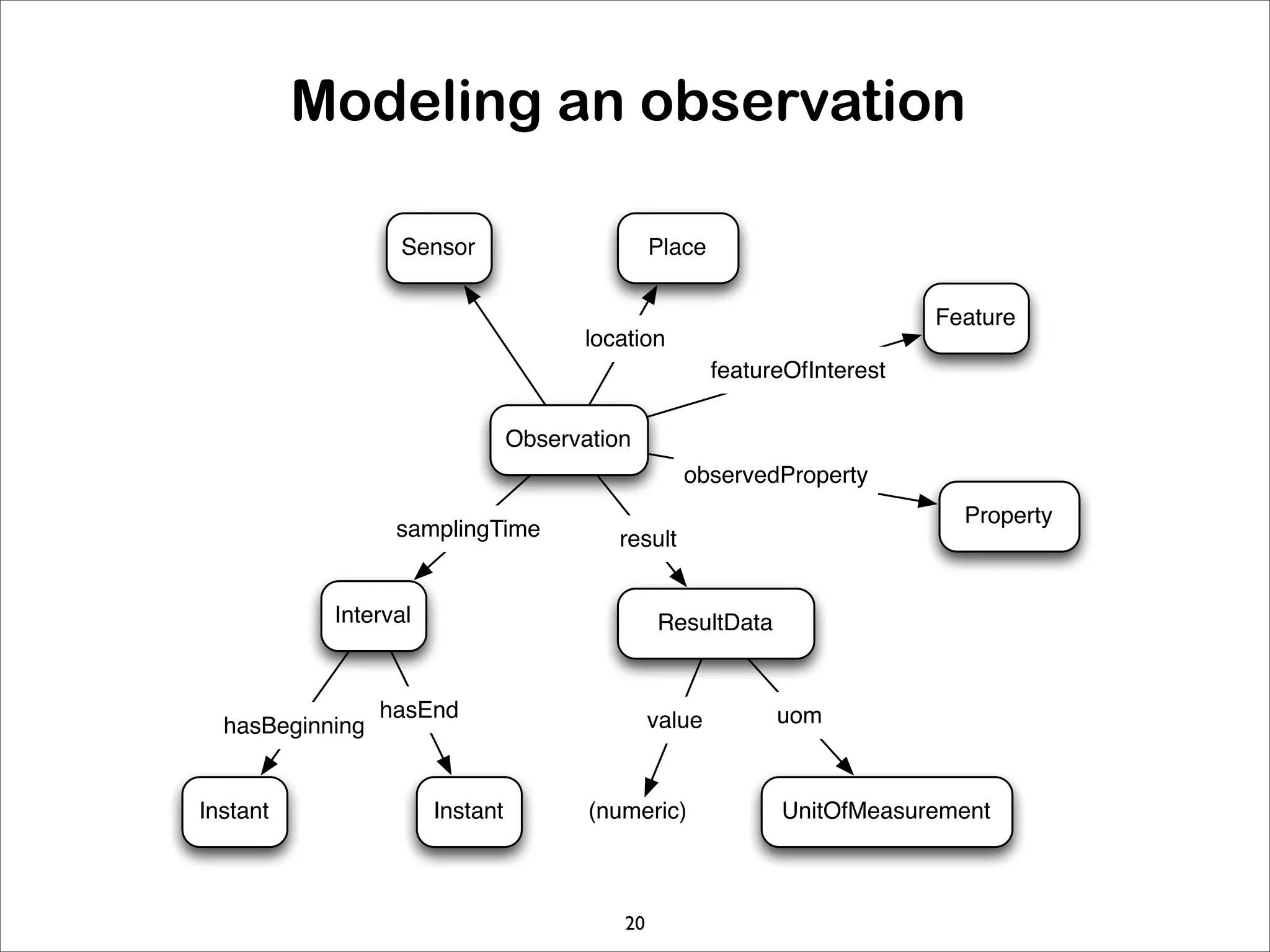
Modeling an observation

                  Sensor                       Place


                                                                           Feature
                                      location
                                                       featureOfInterest

                                Observation
                                                  observedProperty
                                                                             Property
                  samplingTime           result


           Interval                            ResultData


                 hasEnd                        value         uom
  hasBeginning


Instant               Instant          (numeric)             UnitOfMeasurement


                                          20
Some options for RDF streams


•   SPARQL 1.1 Update

•   SparqlPuSH

    •   SPARQL + pubsubhubbub

•   RDFAgents

    •   provenance chains via Named Graphs

•   roll your own


                           21
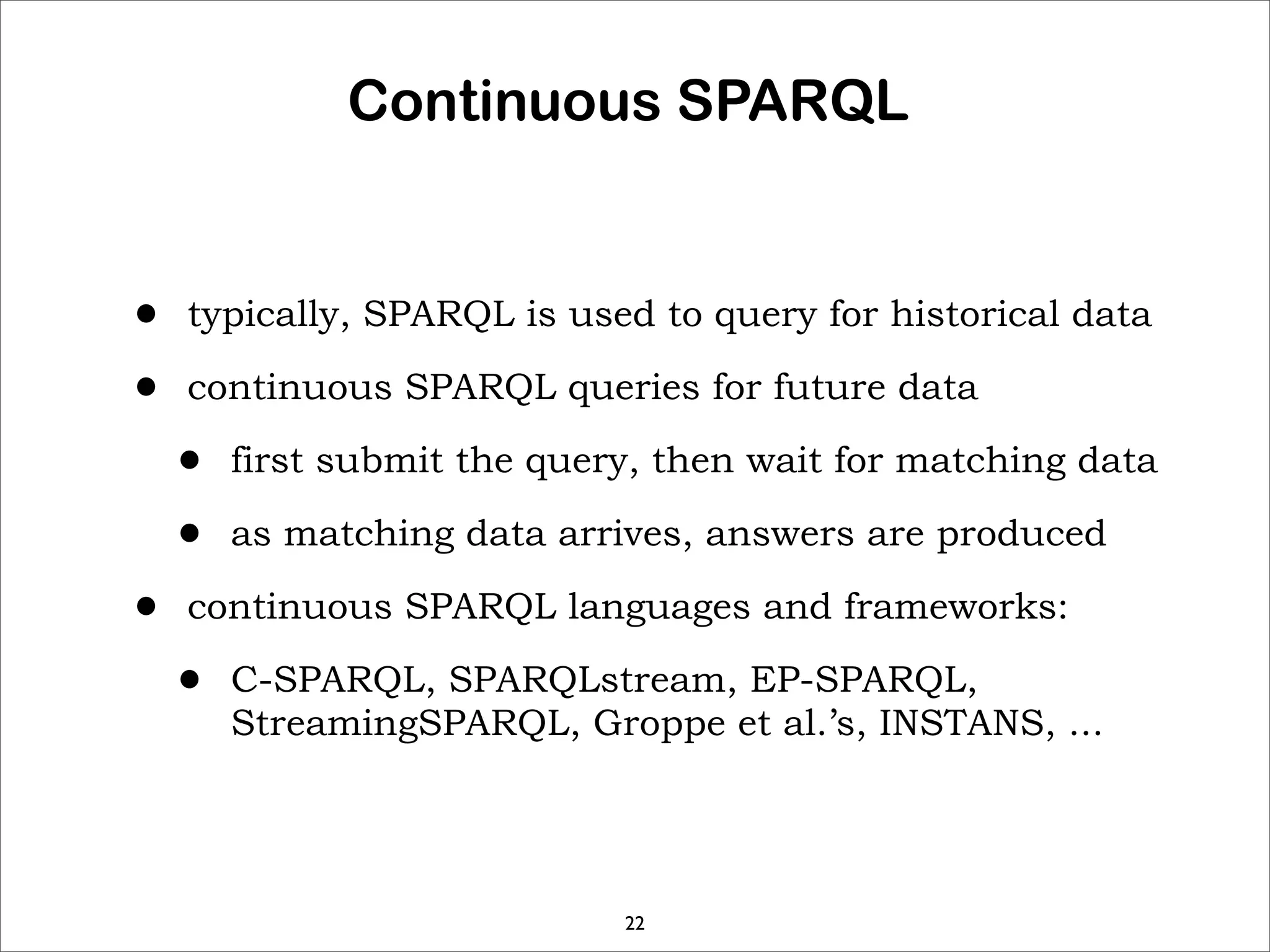
Continuous SPARQL


•   typically, SPARQL is used to query for historical data

•   continuous SPARQL queries for future data

    •   first submit the query, then wait for matching data

    •   as matching data arrives, answers are produced

•   continuous SPARQL languages and frameworks:

    •   C-SPARQL, SPARQLstream, EP-SPARQL,
        StreamingSPARQL, Groppe et al.’s, INSTANS, ...


                             22
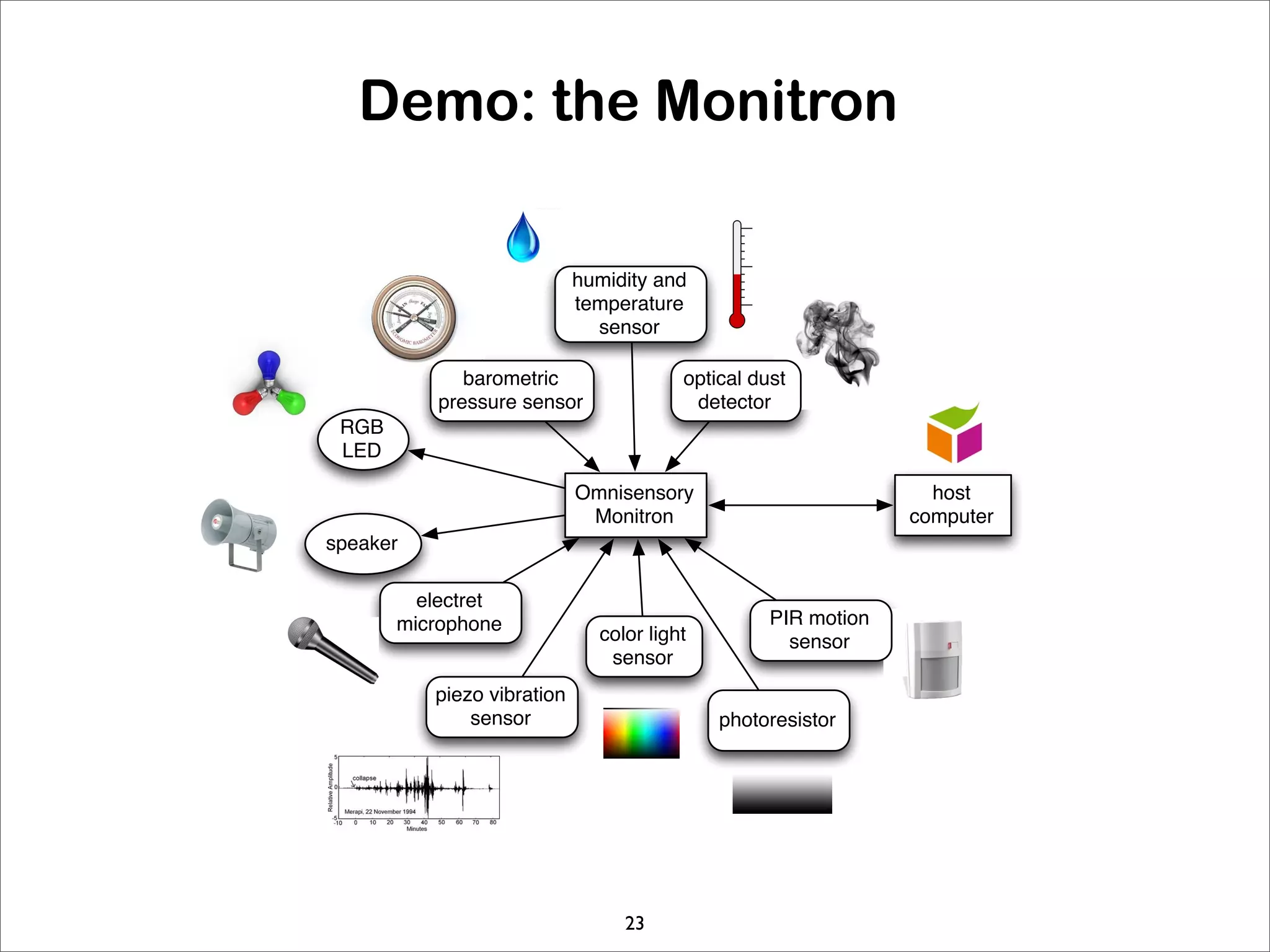
Demo: the Monitron

                            humidity and
                            temperature
                              sensor

             barometric                 optical dust
          pressure sensor                detector
 RGB
 LED

                            Omnisensory                          host
                             Monitron                          computer
speaker

         electret
       microphone                                 PIR motion
                              color light           sensor
                               sensor
          piezo vibration
              sensor                        photoresistor


                                 23
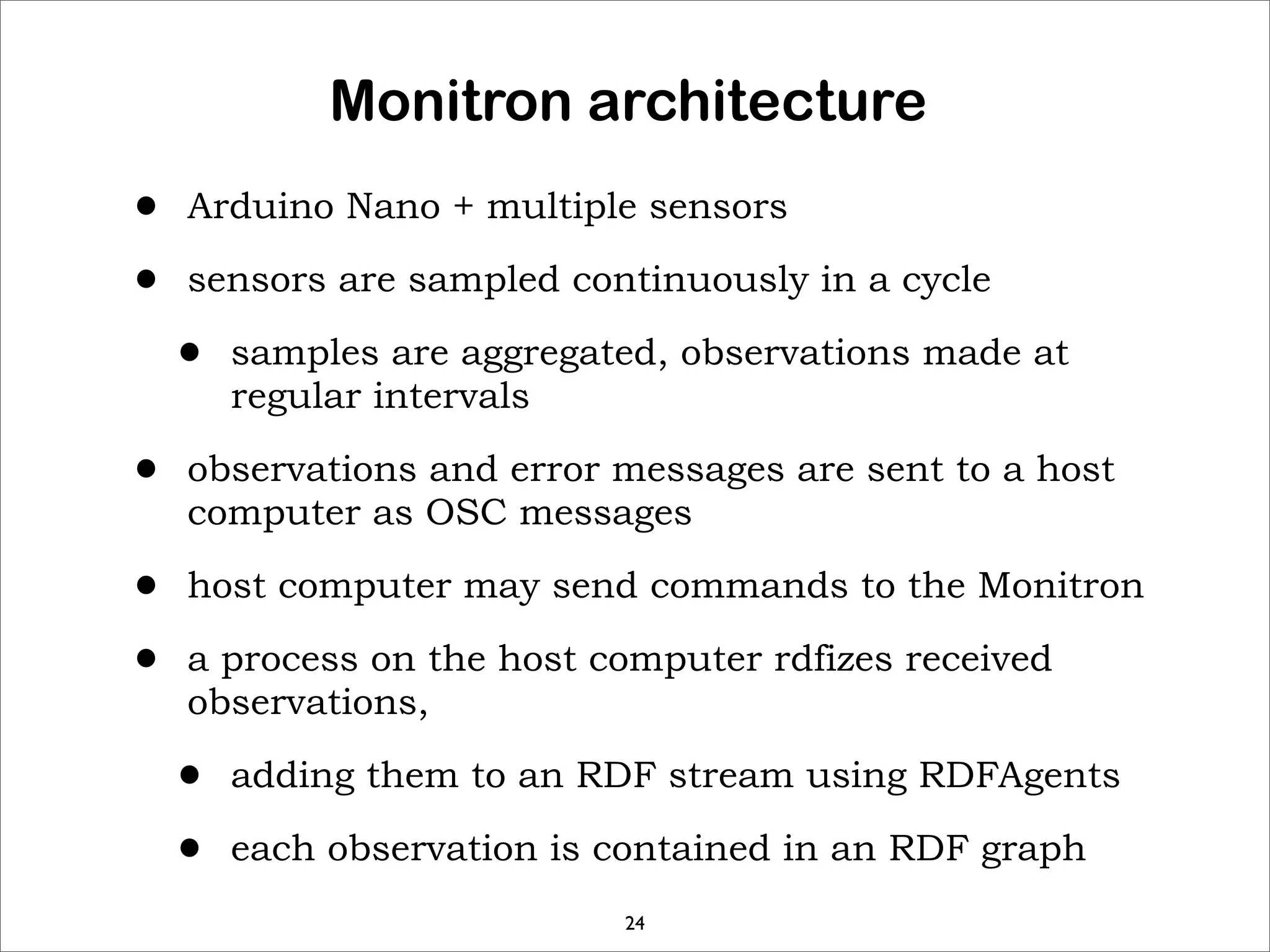
Monitron architecture
•   Arduino Nano + multiple sensors

•   sensors are sampled continuously in a cycle

    •   samples are aggregated, observations made at
        regular intervals

•   observations and error messages are sent to a host
    computer as OSC messages

•   host computer may send commands to the Monitron

•   a process on the host computer rdfizes received
    observations,

    •   adding them to an RDF stream using RDFAgents

    •   each observation is contained in an RDF graph
                            24
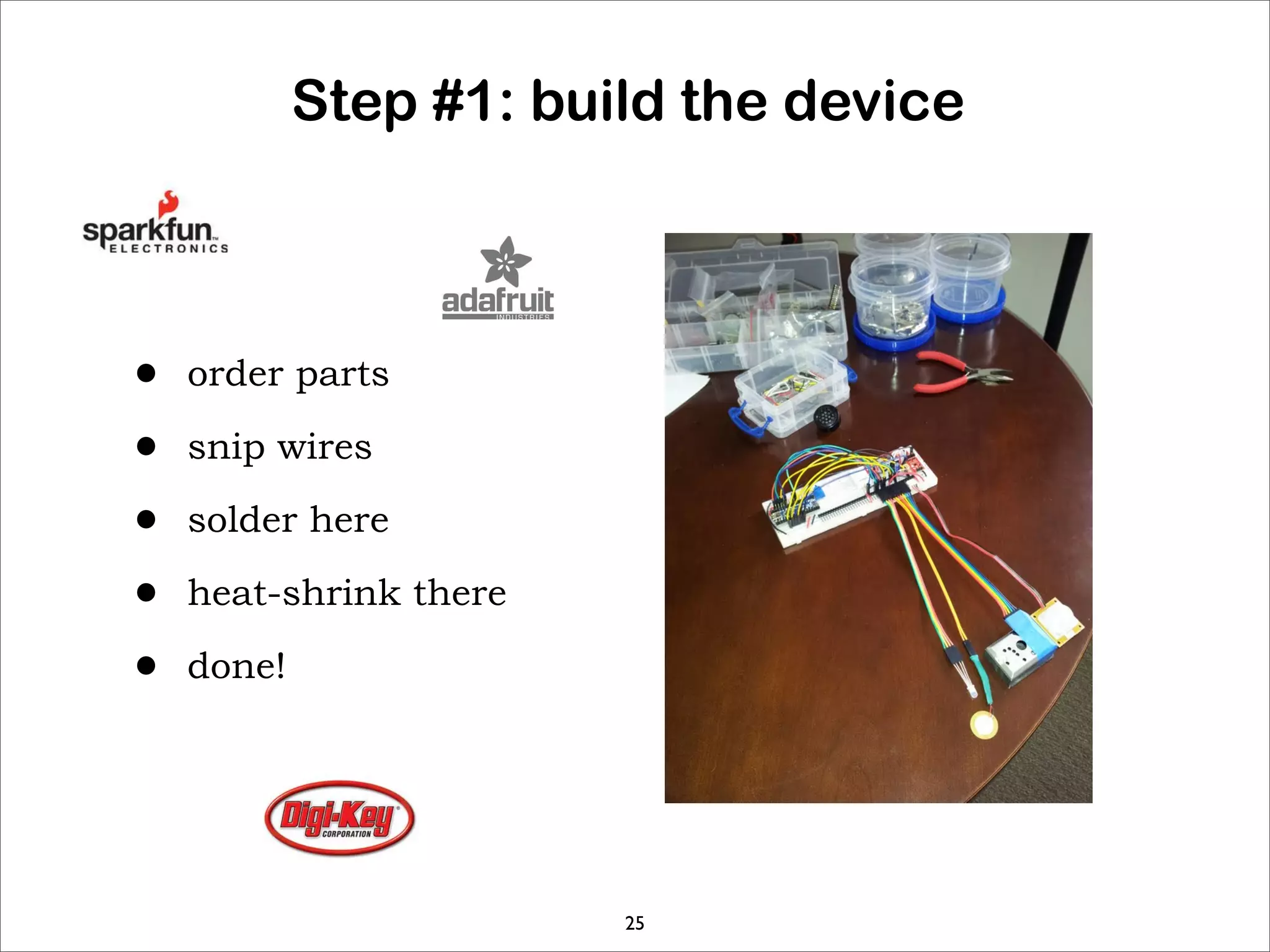
Step #1: build the device


•   order parts

•   snip wires

•   solder here

•   heat-shrink there

•   done!


                        25
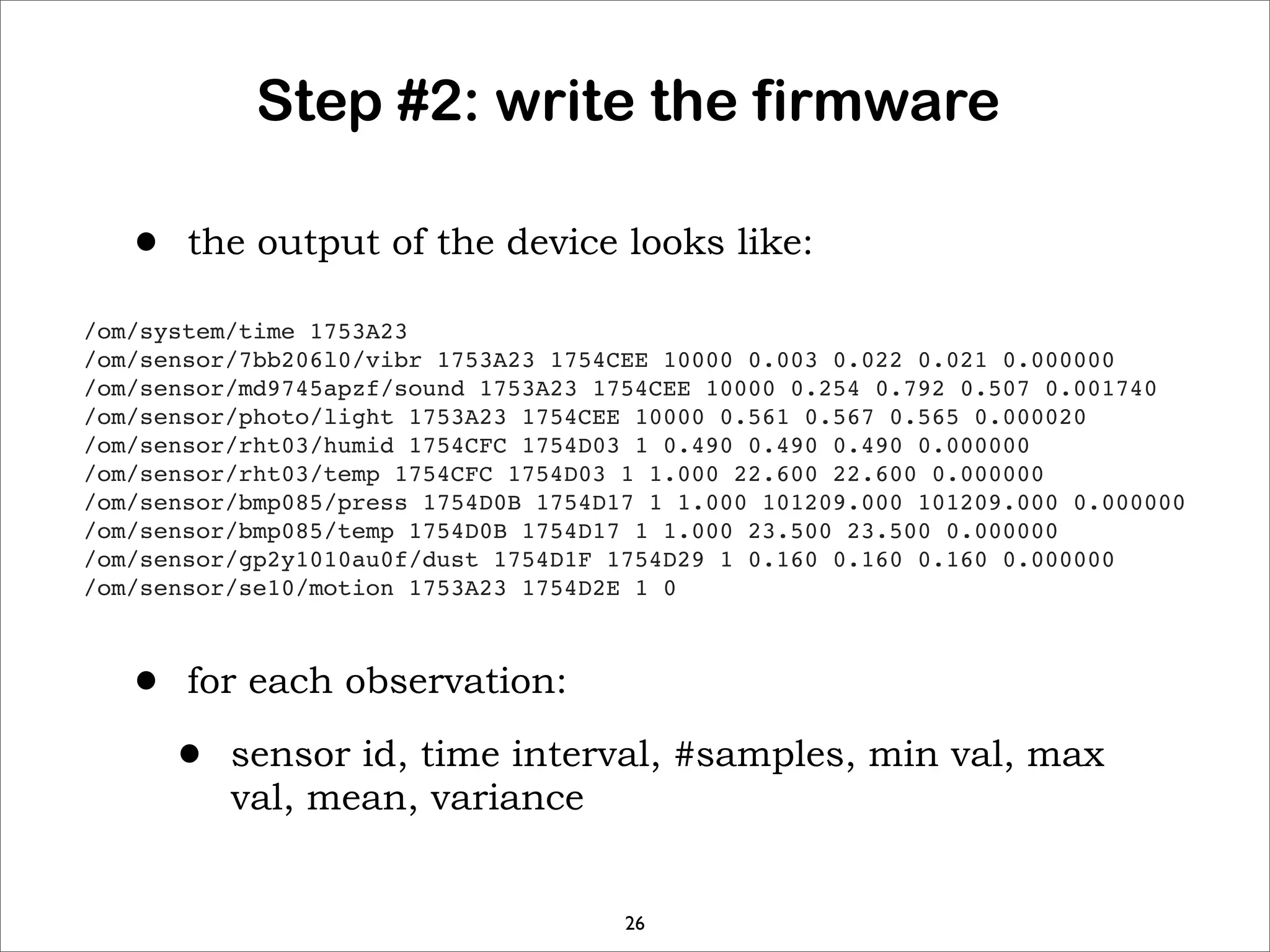
Step #2: write the firmware

   •   the output of the device looks like:

/om/system/time 1753A23
/om/sensor/7bb206l0/vibr 1753A23 1754CEE 10000 0.003 0.022 0.021 0.000000
/om/sensor/md9745apzf/sound 1753A23 1754CEE 10000 0.254 0.792 0.507 0.001740
/om/sensor/photo/light 1753A23 1754CEE 10000 0.561 0.567 0.565 0.000020
/om/sensor/rht03/humid 1754CFC 1754D03 1 0.490 0.490 0.490 0.000000
/om/sensor/rht03/temp 1754CFC 1754D03 1 1.000 22.600 22.600 0.000000
/om/sensor/bmp085/press 1754D0B 1754D17 1 1.000 101209.000 101209.000 0.000000
/om/sensor/bmp085/temp 1754D0B 1754D17 1 1.000 23.500 23.500 0.000000
/om/sensor/gp2y1010au0f/dust 1754D1F 1754D29 1 0.160 0.160 0.160 0.000000
/om/sensor/se10/motion 1753A23 1754D2E 1 0


   •   for each observation:

       •   sensor id, time interval, #samples, min val, max
           val, mean, variance


                                      26
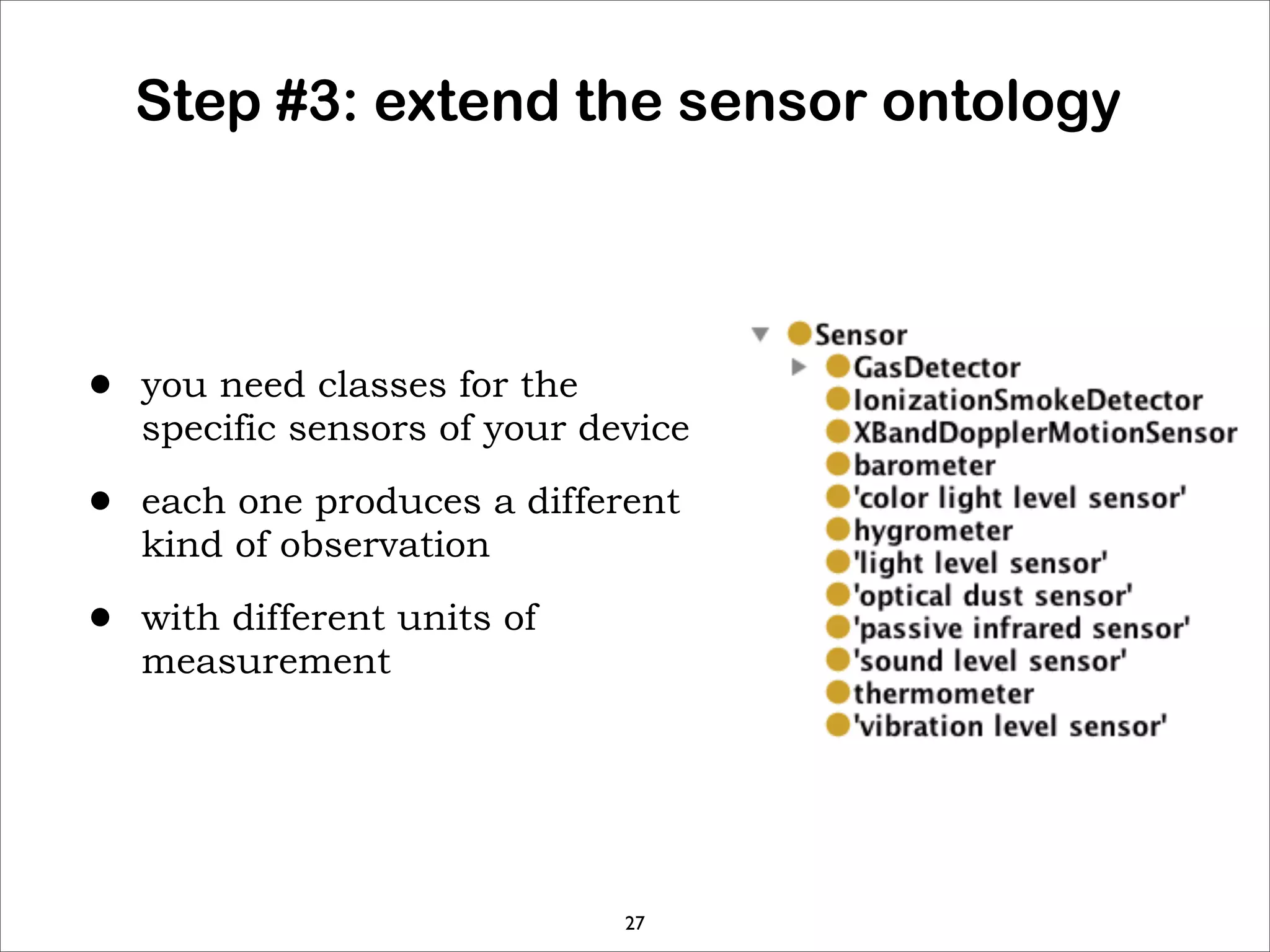
Step #3: extend the sensor ontology


•   you need classes for the
    specific sensors of your device

•   each one produces a different
    kind of observation

•   with different units of
    measurement


                               27
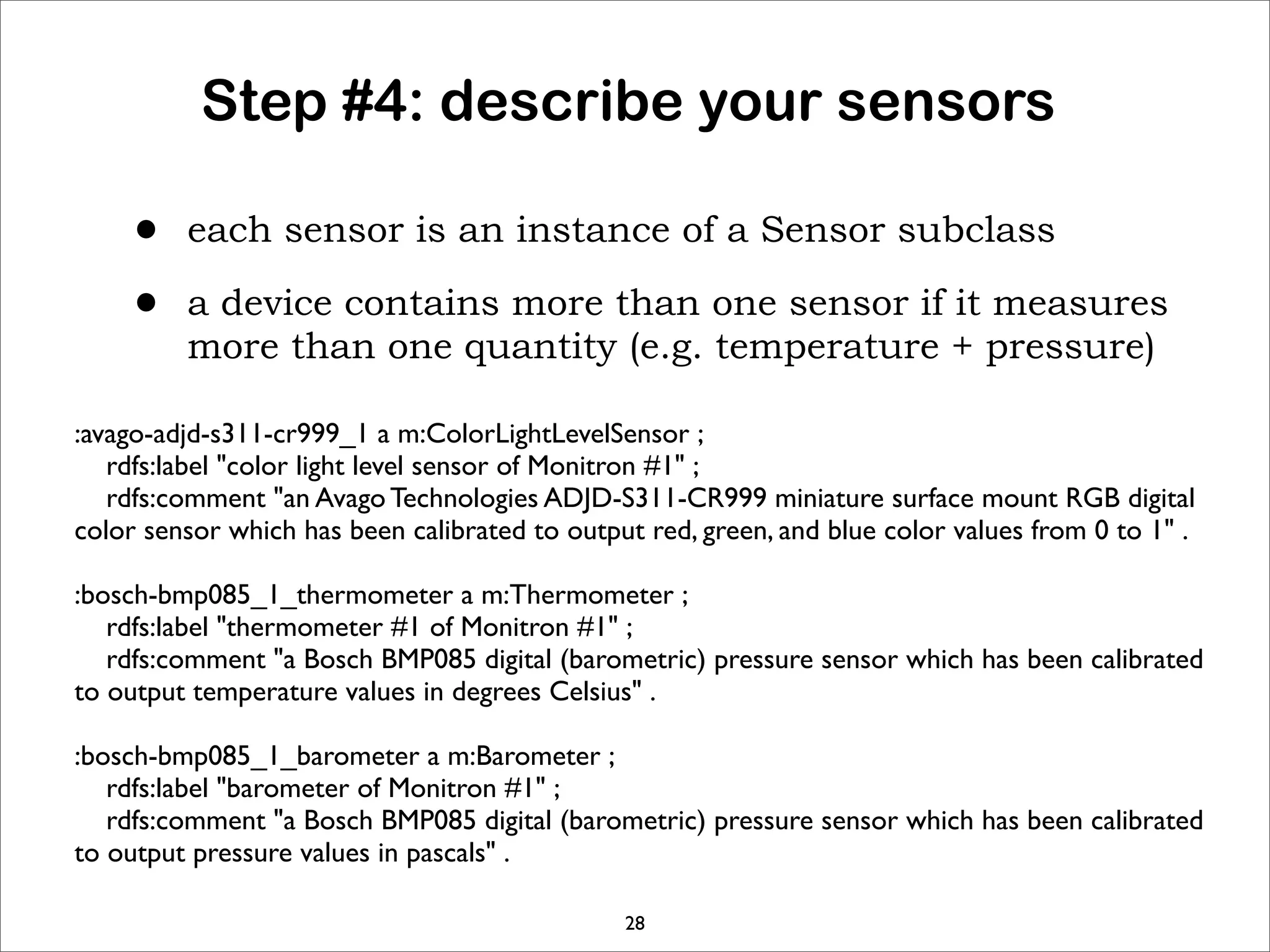
Step #4: describe your sensors

    •    each sensor is an instance of a Sensor subclass

    •    a device contains more than one sensor if it measures
         more than one quantity (e.g. temperature + pressure)

:avago-adjd-s311-cr999_1 a m:ColorLightLevelSensor ;
   rdfs:label "color light level sensor of Monitron #1" ;
   rdfs:comment "an Avago Technologies ADJD-S311-CR999 miniature surface mount RGB digital
color sensor which has been calibrated to output red, green, and blue color values from 0 to 1" .

:bosch-bmp085_1_thermometer a m:Thermometer ;
   rdfs:label "thermometer #1 of Monitron #1" ;
   rdfs:comment "a Bosch BMP085 digital (barometric) pressure sensor which has been calibrated
to output temperature values in degrees Celsius" .

:bosch-bmp085_1_barometer a m:Barometer ;
   rdfs:label "barometer of Monitron #1" ;
   rdfs:comment "a Bosch BMP085 digital (barometric) pressure sensor which has been calibrated
to output pressure values in pascals" .

                                               28
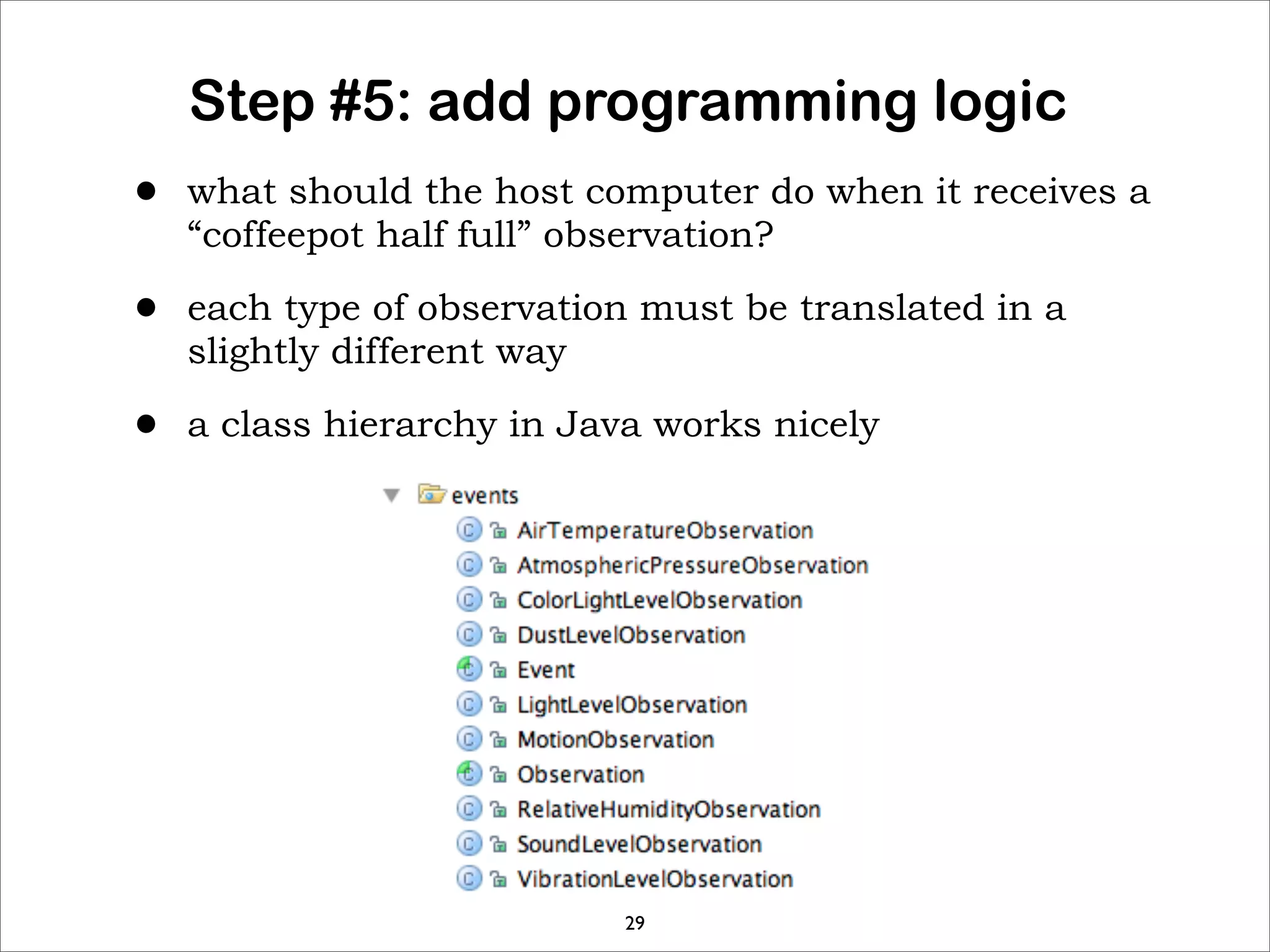
Step #5: add programming logic
•   what should the host computer do when it receives a
    “coffeepot half full” observation?

•   each type of observation must be translated in a
    slightly different way

•   a class hierarchy in Java works nicely


                            29
Step #6: start streaming
@prefix rdf: <http://www.w3.org/1999/02/22-rdf-syntax-ns#> .
@prefix monitron: <http://fortytwo.net/2012/08/monitron#> .
@prefix om: <http://schemas.opengis.net/om/2.0/> .
@prefix time: <http://www.w3.org/2006/time#> .
@prefix xsd: <http://www.w3.org/2001/XMLSchema#> .
@prefix : <http://fortytwo.net/2012/08/universe#> .

:event-UXhu5B5
   om:Procedure :bosch-bmp085_1_thermometer ;
   om:featureOfInterest :room_1 ;
   om:observationLocation :room_1 ;
   om:observedProperty monitron:airTemperature ;
   om:result [
     om:uom monitron:degreesCelsius ;
     om:value 23.3 ;
     a om:ResultData] ;
   om:samplingTime [
     a time:Interval ;
     time:hasBeginning [
        a time:Instant ;
        time:inXSDDateTime "2012-11-28T07:50:06.132-05:00"^^xsd:dateTime] ;
     time:hasEnd [
        a time:Instant ;
        time:inXSDDateTime "2012-11-28T07:50:06.145-05:00"^^xsd:dateTime]] ;
   a monitron:AirTemperatureObservation .
                                           30
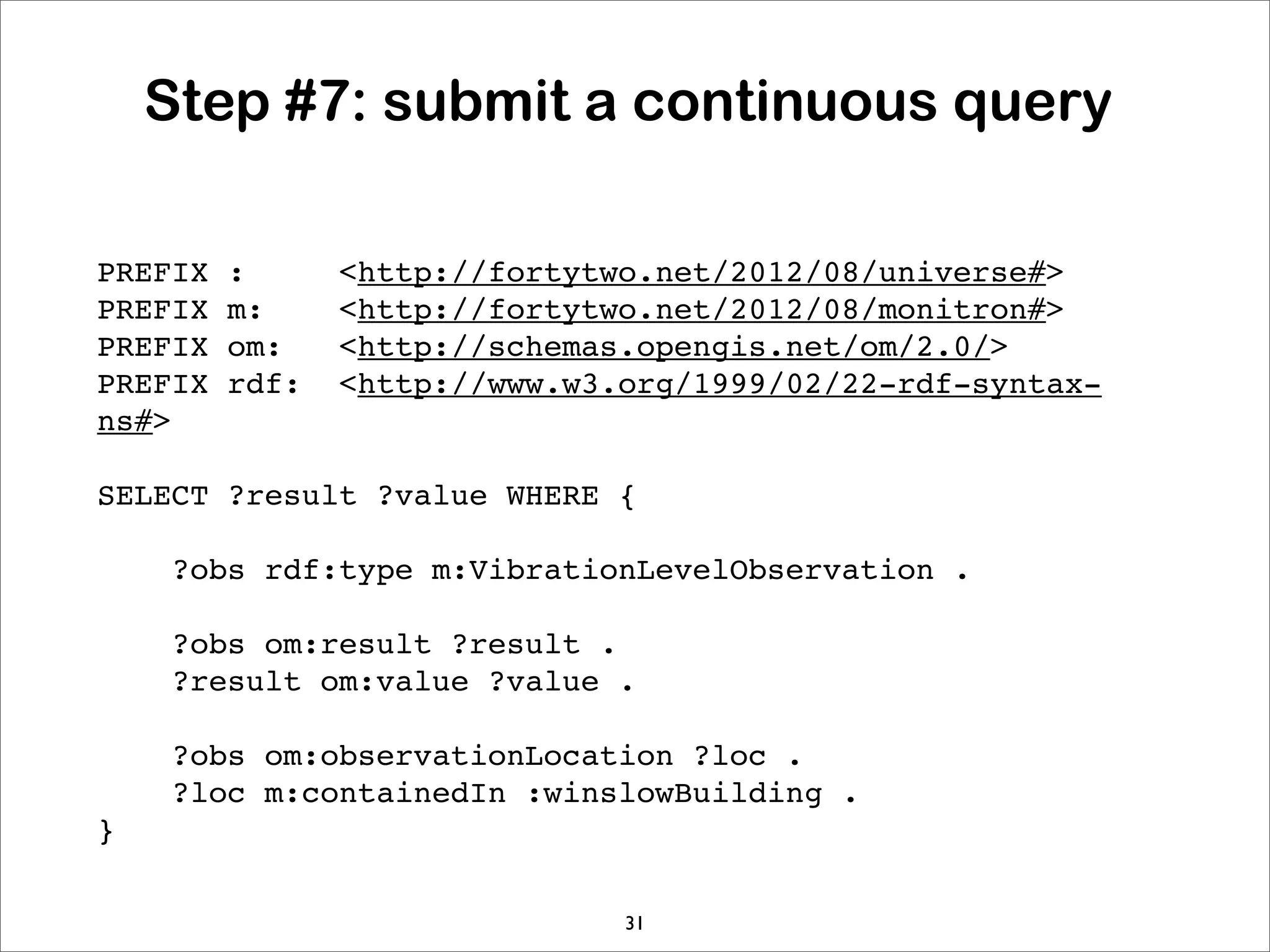
Step #7: submit a continuous query

PREFIX   :      <http://fortytwo.net/2012/08/universe#>
PREFIX   m:     <http://fortytwo.net/2012/08/monitron#>
PREFIX   om:    <http://schemas.opengis.net/om/2.0/>
PREFIX   rdf:   <http://www.w3.org/1999/02/22-rdf-syntax-
ns#>

SELECT ?result ?value WHERE {

    ?obs rdf:type m:VibrationLevelObservation .

    ?obs om:result ?result .
    ?result om:value ?value .

    ?obs om:observationLocation ?loc .
    ?loc m:containedIn :winslowBuilding .
}

                               31
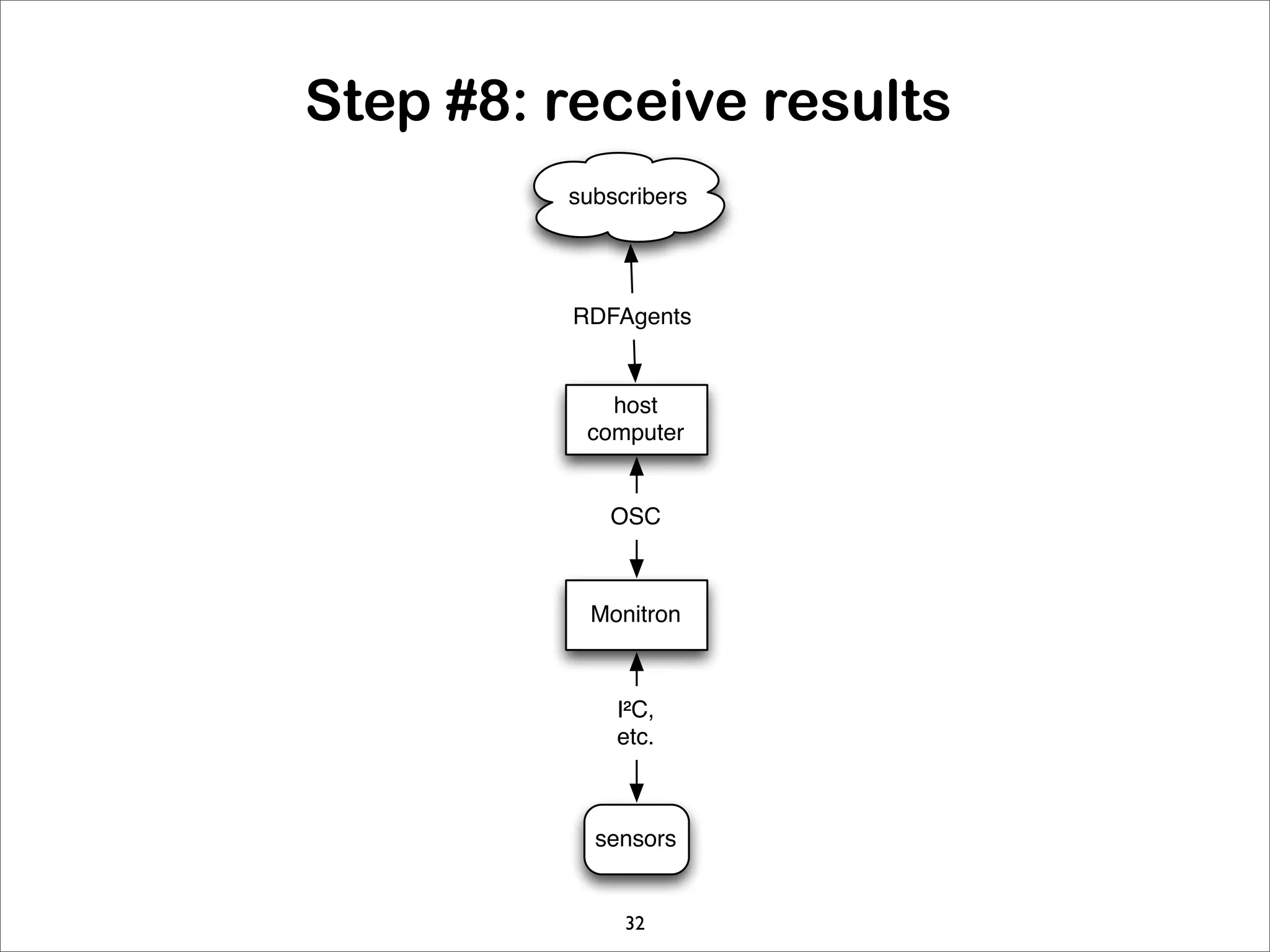
Step #8: receive results
         subscribers


         RDFAgents


            host
          computer


            OSC


           Monitron


             I²C,
             etc.


           sensors


              32
Thanks!


•   Tetherless World Constellation:

    •   http://tw.rpi.edu

•   Code:

    •   https://github.com/joshsh/laboratory

•   Contact:

    •   josh@fortytwo.net, @joshsh


                    33

Semantics and Sensors

  • 1.
    Joshua Shinavier Semanticsand Sensors Wednesday Nights in the Tetherless World (TWed) November 28th, 2012
  • 2.
    Overview • intro to sensors • semantic sensor networks • components of an application • a demo 2
  • 3.
    What is asensor? • any device that measures a physical quantity • e.g. temperature, pressure, electrical potential • more abstract quantities are sometimes measured by “sensors” • e.g. the number of bicycles available at a bicycle sharing station • however, for our purposes... 3
  • 4.
  • 5.
    How do youtalk to a sensor? • basic sensors produce simple analog or digital signals, • or use simple protocols such as I²C • they don’t understand HTTP • nor even TCP/IP • they need to be connected with a more general- purpose device • e.g. a microcontroller 5
  • 6.
    OK, how doyou talk to a microcontroller? • concerns of low-power, low-resource devices • constrained CPU and memory • battery life, if battery-powered • range, if wireless • there are many solutions • e.g. Constrained Application Protocol (CoaP) • interoperates with HTTP • here, we will use Open Sound Control (OSC) • simple messaging format for multimedia devices 6
  • 7.
    Some interrelated concepts • ubiquitous computing • ambient intelligence • perceptual intelligence • Humanistic Intelligence • wearable computers • Internet of Things • Web of Things 7
  • 8.
    Some quantities wecan measure with sensors 8
  • 9.
    Simple physics • force / pressure • electrical potential, • strain / deformation current • flex / bend • magnetic field strength • stretch • flow of liquids and gases • linear displacement • angular displacement • etc. etc. etc. 9
  • 10.
    The environment • air temperature • barometric pressure • ambient light level(s) • humidity • ambient noise • dust and smoke level • ambient vibration • gas concentrations 10
  • 11.
    Where you are,what’s around you • GPS position • identified objects • compass heading • (RFID, visual object recognition, etc.) • attitude, acceleration, • distance and motion angular momentum • altitude • (doppler, rangefinders) 11
  • 12.
    Sensing yourself • respiratory rate • muscle activity (EMG) • heart rate / pulse • eye movement (EOG) • blood pressure • brain activity (EEG) • skin temperature • body position and movement • skin resistance and capacitance • facial expression... • perspiration • voice... 12
  • 13.
    Common themes insemantic sensor networks 13
  • 14.
    Sources of sensordata and metadata • gathering sensor data from source x, e.g. • sensor data from wireless networks • sensor data from mobile phones • citizen sensing • gathering sensor metadata • through human input • derived from raw measurements 14
  • 15.
    Modeling and publicationof sensor data • ontological representation of sensor data • sensor metadata as Linked Data • integration of streaming sensor data with static metadata, web service APIs • annotation of sensor data with quality measures • publishing historical time series data 15
  • 16.
    Applications of sensordata • complex event processing over sensor data streams • composition of sensor web APIs • ubiquitous computing applications • search over sensor data • stream reasoning over sensor data 16
  • 17.
    Components of asemantic sensor network application 17
  • 18.
    Two kinds ofsensor-based applications • time-series applications • sensors make observations at regular intervals • e.g. air temperature sampled every minute, smoke level sampled every ten seconds • event-driven applications • sensors make observations in response to events • e.g. movement detected via infrared or RFID, flipping of a switch, events of voice or gesture 18
  • 19.
    Sensor network ontologies • Observations and Measurements model in OWL • OGC Sensor Web Enablement Initiative • Semantic Sensor Network ontology • W3C Semantic Sensor Network Incubator Group • OntoSensor ontology • builds on SUMO and ISO 19115 (geo metadata) • there are many others 19
  • 20.
    Modeling an observation Sensor Place Feature location featureOfInterest Observation observedProperty Property samplingTime result Interval ResultData hasEnd value uom hasBeginning Instant Instant (numeric) UnitOfMeasurement 20
  • 21.
    Some options forRDF streams • SPARQL 1.1 Update • SparqlPuSH • SPARQL + pubsubhubbub • RDFAgents • provenance chains via Named Graphs • roll your own 21
  • 22.
    Continuous SPARQL • typically, SPARQL is used to query for historical data • continuous SPARQL queries for future data • first submit the query, then wait for matching data • as matching data arrives, answers are produced • continuous SPARQL languages and frameworks: • C-SPARQL, SPARQLstream, EP-SPARQL, StreamingSPARQL, Groppe et al.’s, INSTANS, ... 22
  • 23.
    Demo: the Monitron humidity and temperature sensor barometric optical dust pressure sensor detector RGB LED Omnisensory host Monitron computer speaker electret microphone PIR motion color light sensor sensor piezo vibration sensor photoresistor 23
  • 24.
    Monitron architecture • Arduino Nano + multiple sensors • sensors are sampled continuously in a cycle • samples are aggregated, observations made at regular intervals • observations and error messages are sent to a host computer as OSC messages • host computer may send commands to the Monitron • a process on the host computer rdfizes received observations, • adding them to an RDF stream using RDFAgents • each observation is contained in an RDF graph 24
  • 25.
    Step #1: buildthe device • order parts • snip wires • solder here • heat-shrink there • done! 25
  • 26.
    Step #2: writethe firmware • the output of the device looks like: /om/system/time 1753A23 /om/sensor/7bb206l0/vibr 1753A23 1754CEE 10000 0.003 0.022 0.021 0.000000 /om/sensor/md9745apzf/sound 1753A23 1754CEE 10000 0.254 0.792 0.507 0.001740 /om/sensor/photo/light 1753A23 1754CEE 10000 0.561 0.567 0.565 0.000020 /om/sensor/rht03/humid 1754CFC 1754D03 1 0.490 0.490 0.490 0.000000 /om/sensor/rht03/temp 1754CFC 1754D03 1 1.000 22.600 22.600 0.000000 /om/sensor/bmp085/press 1754D0B 1754D17 1 1.000 101209.000 101209.000 0.000000 /om/sensor/bmp085/temp 1754D0B 1754D17 1 1.000 23.500 23.500 0.000000 /om/sensor/gp2y1010au0f/dust 1754D1F 1754D29 1 0.160 0.160 0.160 0.000000 /om/sensor/se10/motion 1753A23 1754D2E 1 0 • for each observation: • sensor id, time interval, #samples, min val, max val, mean, variance 26
  • 27.
    Step #3: extendthe sensor ontology • you need classes for the specific sensors of your device • each one produces a different kind of observation • with different units of measurement 27
  • 28.
    Step #4: describeyour sensors • each sensor is an instance of a Sensor subclass • a device contains more than one sensor if it measures more than one quantity (e.g. temperature + pressure) :avago-adjd-s311-cr999_1 a m:ColorLightLevelSensor ; rdfs:label "color light level sensor of Monitron #1" ; rdfs:comment "an Avago Technologies ADJD-S311-CR999 miniature surface mount RGB digital color sensor which has been calibrated to output red, green, and blue color values from 0 to 1" . :bosch-bmp085_1_thermometer a m:Thermometer ; rdfs:label "thermometer #1 of Monitron #1" ; rdfs:comment "a Bosch BMP085 digital (barometric) pressure sensor which has been calibrated to output temperature values in degrees Celsius" . :bosch-bmp085_1_barometer a m:Barometer ; rdfs:label "barometer of Monitron #1" ; rdfs:comment "a Bosch BMP085 digital (barometric) pressure sensor which has been calibrated to output pressure values in pascals" . 28
  • 29.
    Step #5: addprogramming logic • what should the host computer do when it receives a “coffeepot half full” observation? • each type of observation must be translated in a slightly different way • a class hierarchy in Java works nicely 29
  • 30.
    Step #6: startstreaming @prefix rdf: <http://www.w3.org/1999/02/22-rdf-syntax-ns#> . @prefix monitron: <http://fortytwo.net/2012/08/monitron#> . @prefix om: <http://schemas.opengis.net/om/2.0/> . @prefix time: <http://www.w3.org/2006/time#> . @prefix xsd: <http://www.w3.org/2001/XMLSchema#> . @prefix : <http://fortytwo.net/2012/08/universe#> . :event-UXhu5B5 om:Procedure :bosch-bmp085_1_thermometer ; om:featureOfInterest :room_1 ; om:observationLocation :room_1 ; om:observedProperty monitron:airTemperature ; om:result [ om:uom monitron:degreesCelsius ; om:value 23.3 ; a om:ResultData] ; om:samplingTime [ a time:Interval ; time:hasBeginning [ a time:Instant ; time:inXSDDateTime "2012-11-28T07:50:06.132-05:00"^^xsd:dateTime] ; time:hasEnd [ a time:Instant ; time:inXSDDateTime "2012-11-28T07:50:06.145-05:00"^^xsd:dateTime]] ; a monitron:AirTemperatureObservation . 30
  • 31.
    Step #7: submita continuous query PREFIX : <http://fortytwo.net/2012/08/universe#> PREFIX m: <http://fortytwo.net/2012/08/monitron#> PREFIX om: <http://schemas.opengis.net/om/2.0/> PREFIX rdf: <http://www.w3.org/1999/02/22-rdf-syntax- ns#> SELECT ?result ?value WHERE { ?obs rdf:type m:VibrationLevelObservation . ?obs om:result ?result . ?result om:value ?value . ?obs om:observationLocation ?loc . ?loc m:containedIn :winslowBuilding . } 31
  • 32.
    Step #8: receiveresults subscribers RDFAgents host computer OSC Monitron I²C, etc. sensors 32
  • 33.
    Thanks! • Tetherless World Constellation: • http://tw.rpi.edu • Code: • https://github.com/joshsh/laboratory • Contact: • josh@fortytwo.net, @joshsh 33