UNIT -5
SENSOR NODES,DATAACQUISITION AND
PROCESSING
20ECE506T------IoT SENSOR NODES WITH ARTIFICIAL INTELLIGENCE
2.
Sensors
• They performsome input functions by sensing or feeling the physical changes in characteristics of a system in
response to a stimuli.
• For example heat is converted to electrical signals in a temperature sensor, or atmospheric pressure is converted
to electrical signals in a barometer.
Sensor nodes
A sensor node, is a node in a sensor network that is capable of performing some processing, gathering sensory
information and communicating with other connected nodes in the network.
The main components of a sensor node are a microcontroller, transceiver, external memory, power source and one or
more sensors.
3.
• Broadly speaking,sensors are devices that detect and respond to changes in an environment. Inputs can come from a
variety of sources such as light, temperature, motion and pressure.
• Sensors output valuable information and if they are connected to a network, they can share data with other connected
devices and management systems.
• Sensors are crucial to the operation of many of today’s businesses. They can warn you of potential problems before they
become big problems, allowing businesses to perform predictive maintenance and avoid costly downtime.
• The data from sensors can also be analyzed for trends allowing business owners to gain insight into crucial trends and
make informed evidence-based decisions.
Need for sensors and sensor nodes:
4.
Sensors used inIOT
There are many types of IoT sensors and an even greater number of applications and use cases. Here are 10 of the more
popular types of IoT sensors and some of their use cases.
1. Temperature Sensors
Temperature sensors measure the amount of heat energy in a source,
allowing them to detect temperature changes and convert these
changes to data. Machinery used in manufacturing often requires
environmental and device temperatures to be at specific levels.
Similarly, within agriculture, soil temperature is a key factor for crop
growth.
2. Humidity Sensors
These types of sensors measure the amount of water vapor in the
atmosphere of air or other gases. Humidity sensors are commonly
found in heating, vents and air conditioning (HVAC) systems in both
industrial and residential domains. They can be found in many other
areas including hospitals, and meteorology stations to report and
predict weather.
5.
3. Pressure Sensors
Apressure sensor senses changes in gases and liquids. When the
pressure changes, the sensor detects these changes, and communicates
them to connected systems. Common use cases include leak testing
which can be a result of decay. Pressure sensors are also useful in the
manufacturing of water systems as it is easy to detect fluctuations or
drops in pressure.
4. Proximity Sensors
Proximity sensors are used for non-contact detection of objects near the
sensor. These types of sensors often emit electromagnetic fields or beams
of radiation such as infrared. Proximity sensors have some interesting use
cases. In retail, a proximity sensor can detect the motion between a
customer and a product in which he or she is interested. The user can be
notified of any discounts or special offers of products located near the
sensor. Proximity sensors are also used in the parking lots of malls,
stadiums and airports to indicate parking availability. They can also be
used on the assembly lines of chemical, food and many other types of
industries.
6.
5. Level Sensors
Levelsensors are used to detect the level of substances including liquids,
powders and granular materials. Many industries including oil manufacturing,
water treatment and beverage and food manufacturing factories use level
sensors. Waste management systems provide a common use case as level sensors
can detect the level of waste in a garbage can or dumpster.
6. Accelerometers
Accelerometers detect an object’s acceleration i.e. the rate of change of the
object’s velocity with respect to time. Accelerometers can also detect changes to
gravity. Use cases for accelerometers include smart pedometers and monitoring
driving fleets. They can also be used as anti-theft protection alerting the system if
an object that should be stationary is moved.
7.
Gyroscope
Gyroscope sensors measurethe angular rate or velocity, often defined as a
measurement of speed and rotation around an axis. Use cases include automotive,
such as car navigation and electronic stability control (anti-skid) systems.
Additional use cases include motion sensing for video games, and camera-shake
detection systems.
Gas Sensors
These types of sensors monitor and detect changes in air quality, including the
presence of toxic, combustible or hazardous gasses. Industries using gas sensors
include mining, oil and gas, chemical research and manufacturing. A common
consumer use case is the familiar carbon dioxide detectors used in many homes.
8.
Infrared Sensors
These typesof sensors sense characteristics in their surroundings by either emitting or detecting
infrared radiation. They can also measure the heat emitted by objects. Infrared sensors are used in a
variety of different IoT projects including healthcare as they simplify the monitoring of blood flow
and blood pressure. Televisions use infrared sensors to interpret the signals sent from a remote
control. Another interesting application is that of art historians using infrared sensors to see hidden
layers in paintings to help determine whether a work of art is original or fake or has been altered by a
restoration process.
Optical Sensors
Optical sensors convert rays of light into electrical signals. There are many applications and use
cases for optical sensors. In the auto industry, vehicles use optical sensors to recognize signs,
obstacles, and other things that a driver would notice when driving or parking. Optical sensors play
a big role in the development of driverless cars. Optical sensors are very common in smart phones.
For example, ambient light sensors can extend battery life. Optical sensors are also used in the
biomedical field including breath analysis and heart-rate monitors.
9.
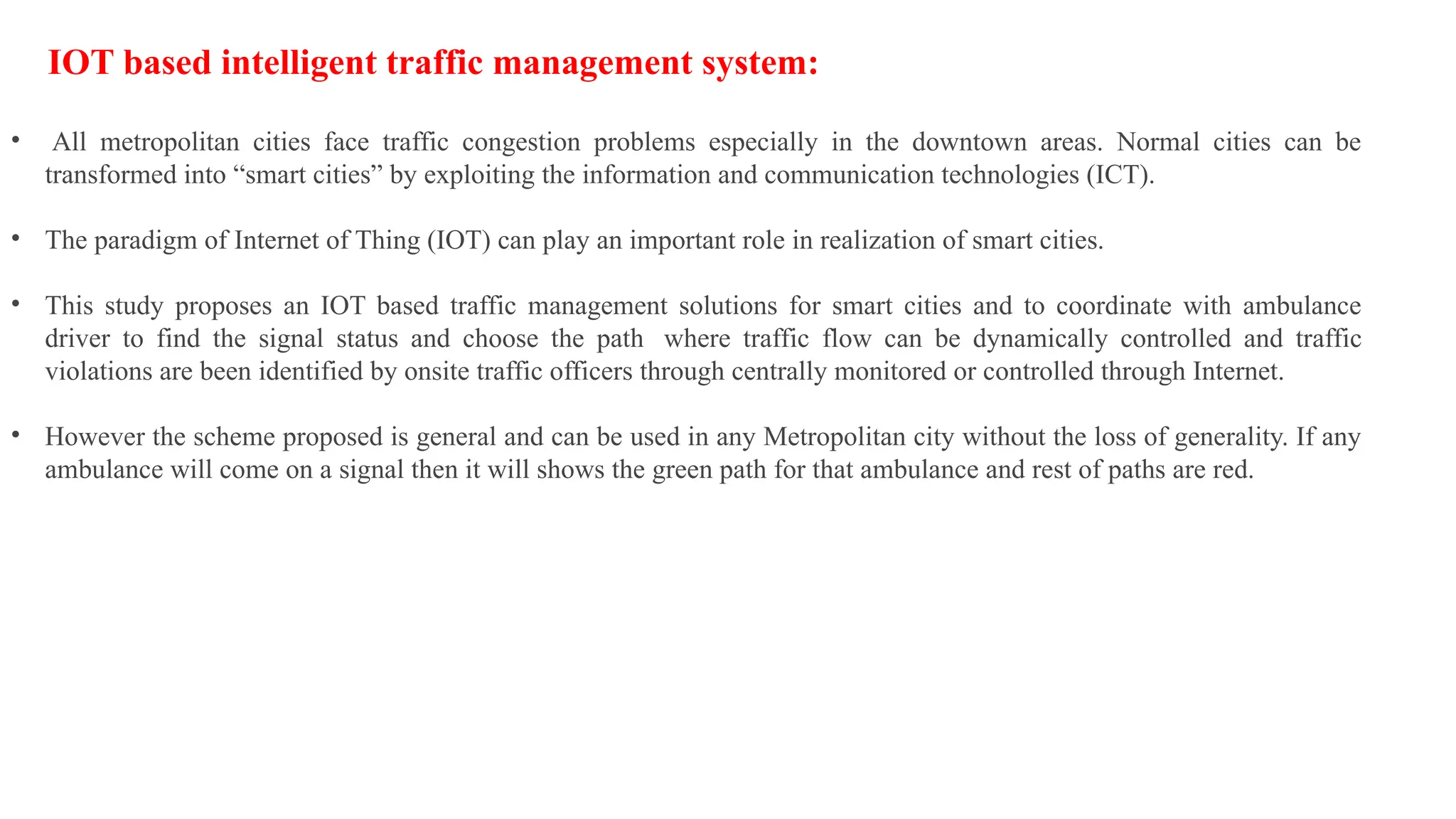
IOT based intelligenttraffic management system:
• All metropolitan cities face traffic congestion problems especially in the downtown areas. Normal cities can be
transformed into “smart cities” by exploiting the information and communication technologies (ICT).
• The paradigm of Internet of Thing (IOT) can play an important role in realization of smart cities.
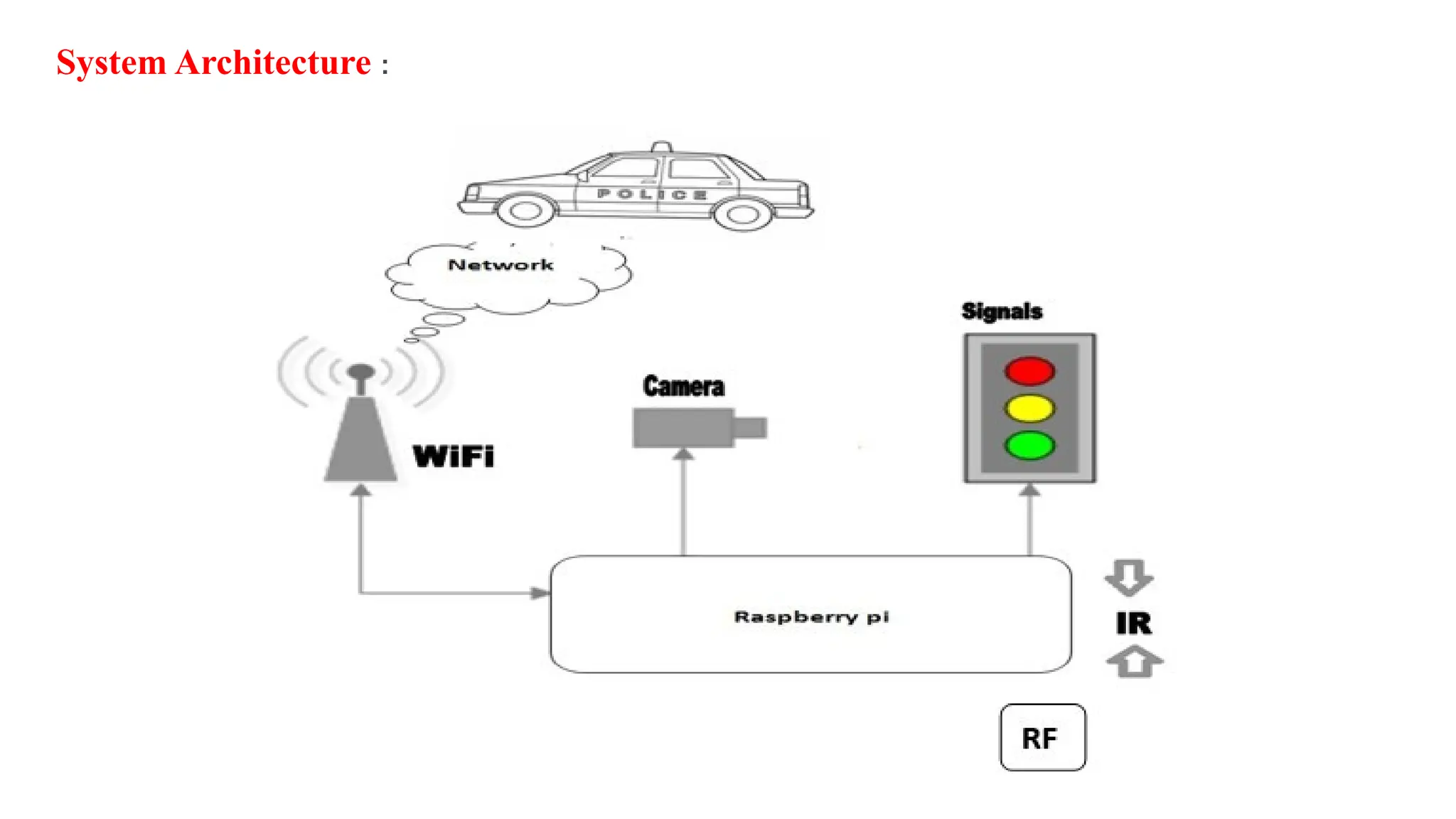
• This study proposes an IOT based traffic management solutions for smart cities and to coordinate with ambulance
driver to find the signal status and choose the path where traffic flow can be dynamically controlled and traffic
violations are been identified by onsite traffic officers through centrally monitored or controlled through Internet.
• However the scheme proposed is general and can be used in any Metropolitan city without the loss of generality. If any
ambulance will come on a signal then it will shows the green path for that ambulance and rest of paths are red.
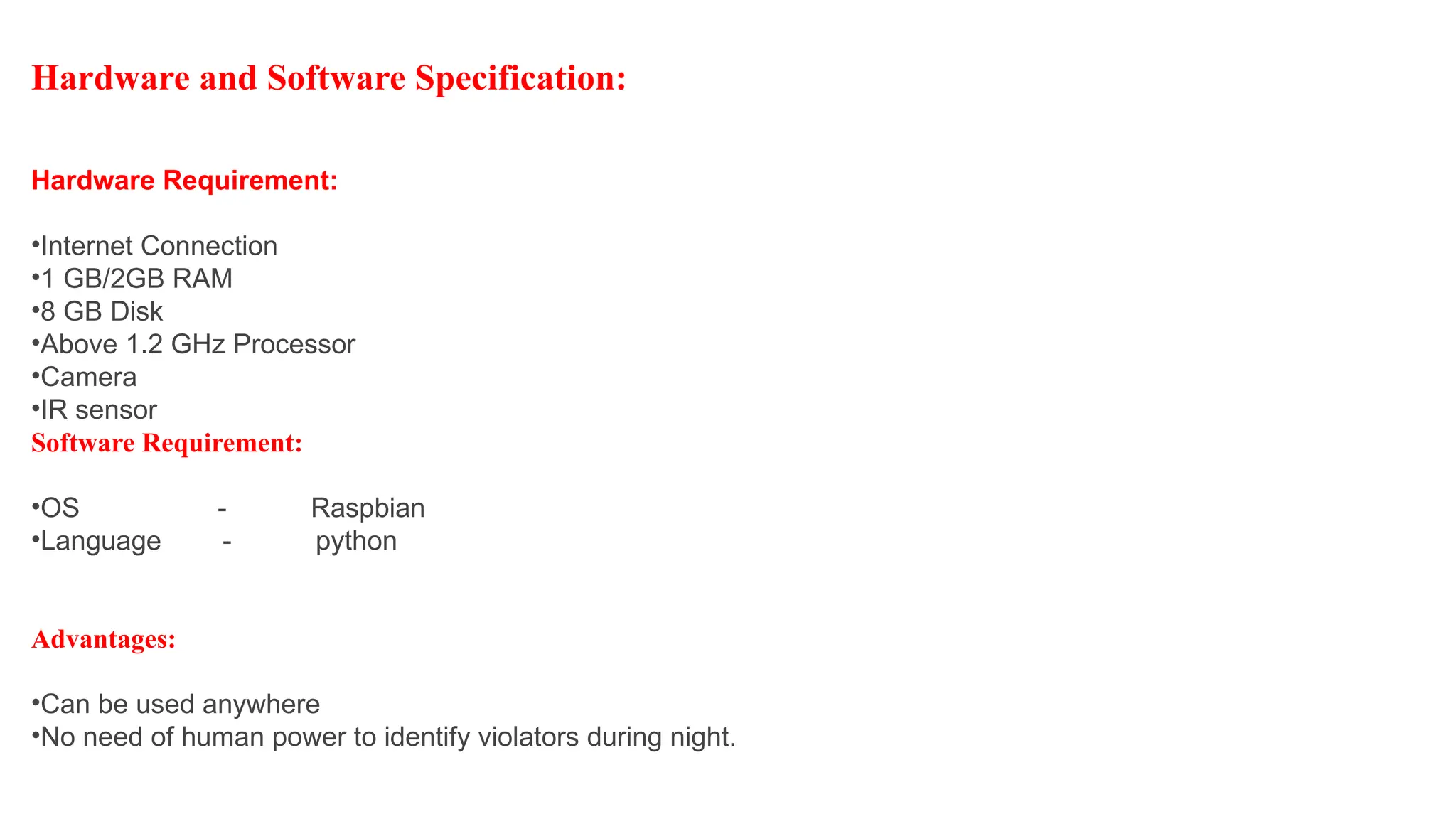
Advantages:
•Can be usedanywhere
•No need of human power to identify violators during night.
Hardware and Software Specification:
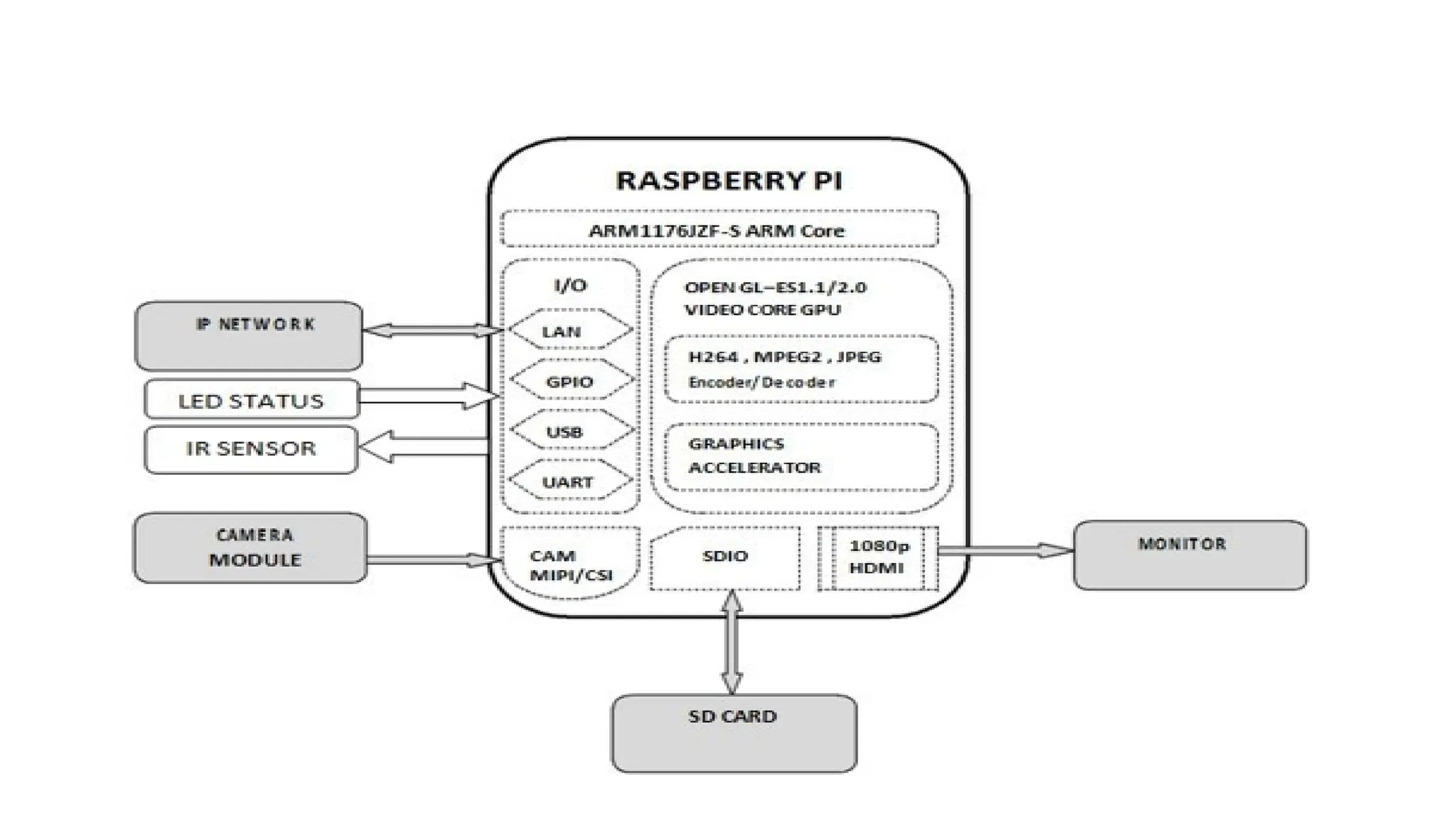
Hardware Requirement:
•Internet Connection
•1 GB/2GB RAM
•8 GB Disk
•Above 1.2 GHz Processor
•Camera
•IR sensor
Software Requirement:
•OS - Raspbian
•Language - python
13.
IoT Based Humidityand Temperature Monitoring Using Arduino Uno:
• Using Internet of Things (IOT), we can control any electronic equipment in homes and industries. Moreover, we can read a
data from any sensor and analyse it graphically from anywhere in the world.
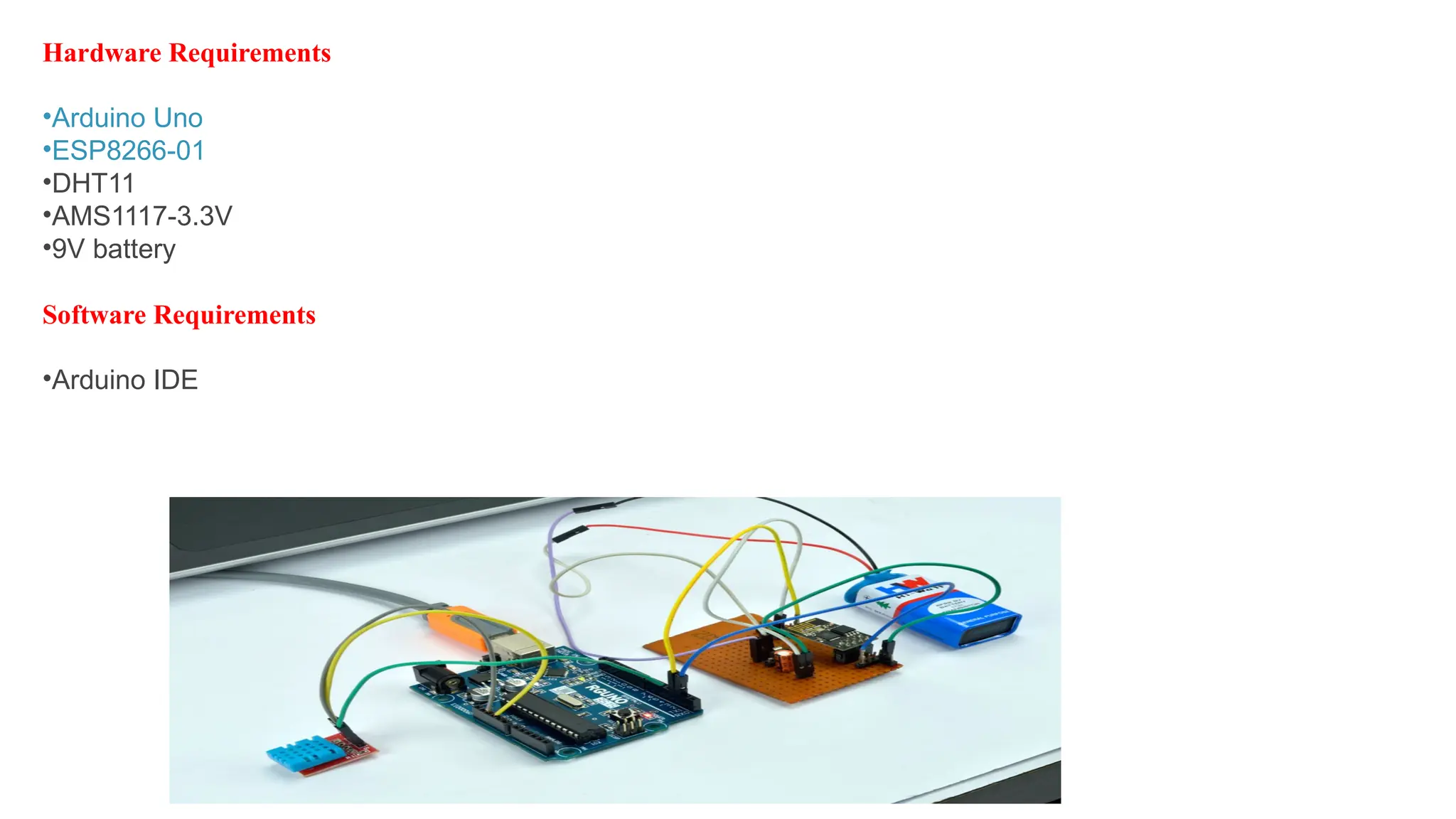
• Here, we can read temperature and humidity data from DHT11 sensor and upload it to a ThingSpeak cloud using Arduino
Uno and ESP8266-01 module. Arduino Uno is MCU, it fetch a data of humidity and temperature from DHT11 sensor and
Process it and give it to a ESP8266 Module.ESP8266 is a WiFi module, it is one of the leading platform for Internet of
Things.
• It can transfer a data to IOT cloud.
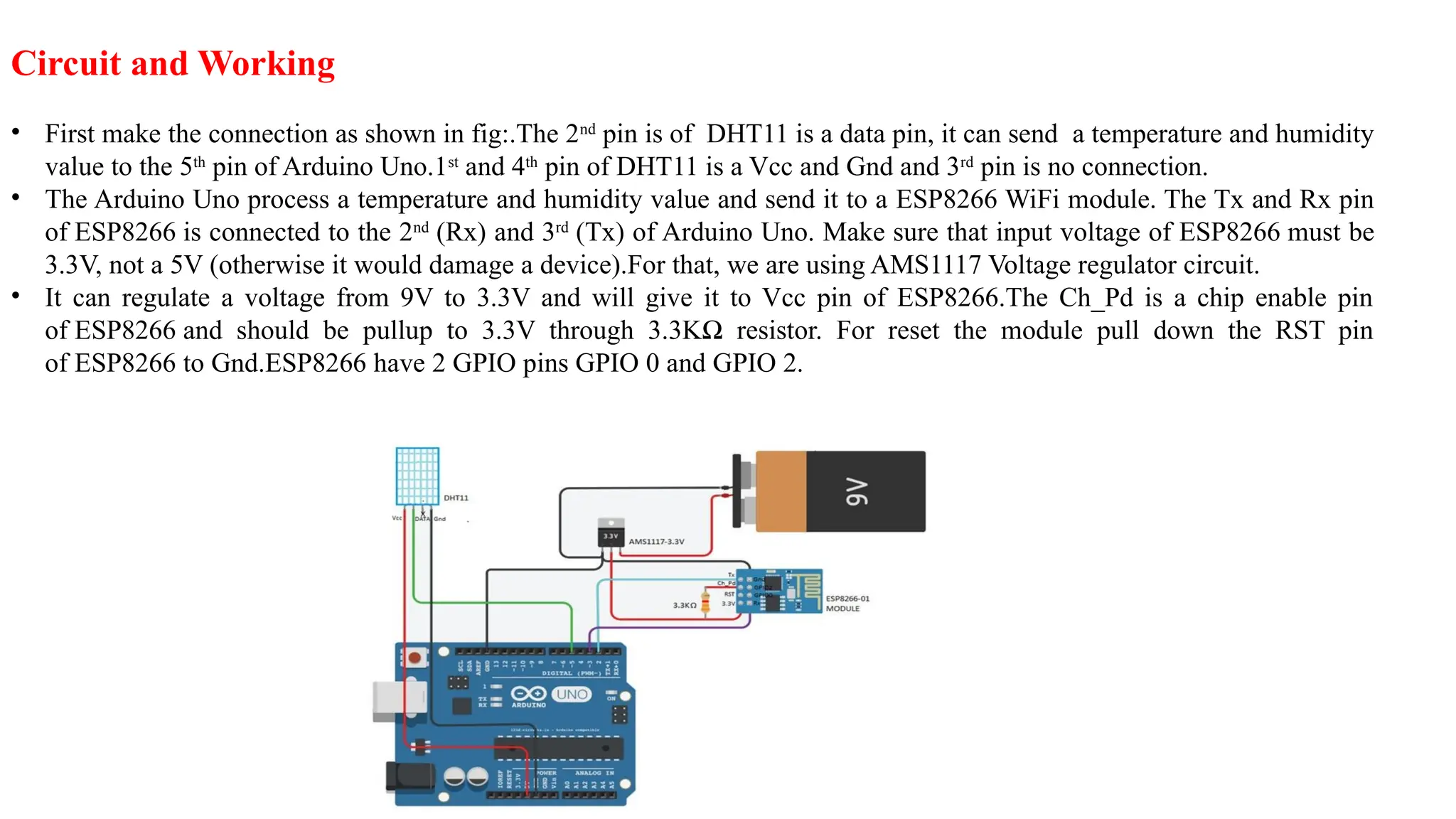
Circuit and Working
•First make the connection as shown in fig:.The 2nd
pin is of DHT11 is a data pin, it can send a temperature and humidity
value to the 5th
pin of Arduino Uno.1st
and 4th
pin of DHT11 is a Vcc and Gnd and 3rd
pin is no connection.
• The Arduino Uno process a temperature and humidity value and send it to a ESP8266 WiFi module. The Tx and Rx pin
of ESP8266 is connected to the 2nd
(Rx) and 3rd
(Tx) of Arduino Uno. Make sure that input voltage of ESP8266 must be
3.3V, not a 5V (otherwise it would damage a device).For that, we are using AMS1117 Voltage regulator circuit.
• It can regulate a voltage from 9V to 3.3V and will give it to Vcc pin of ESP8266.The Ch_Pd is a chip enable pin
of ESP8266 and should be pullup to 3.3V through 3.3KΩ resistor. For reset the module pull down the RST pin
of ESP8266 to Gnd.ESP8266 have 2 GPIO pins GPIO 0 and GPIO 2.
16.
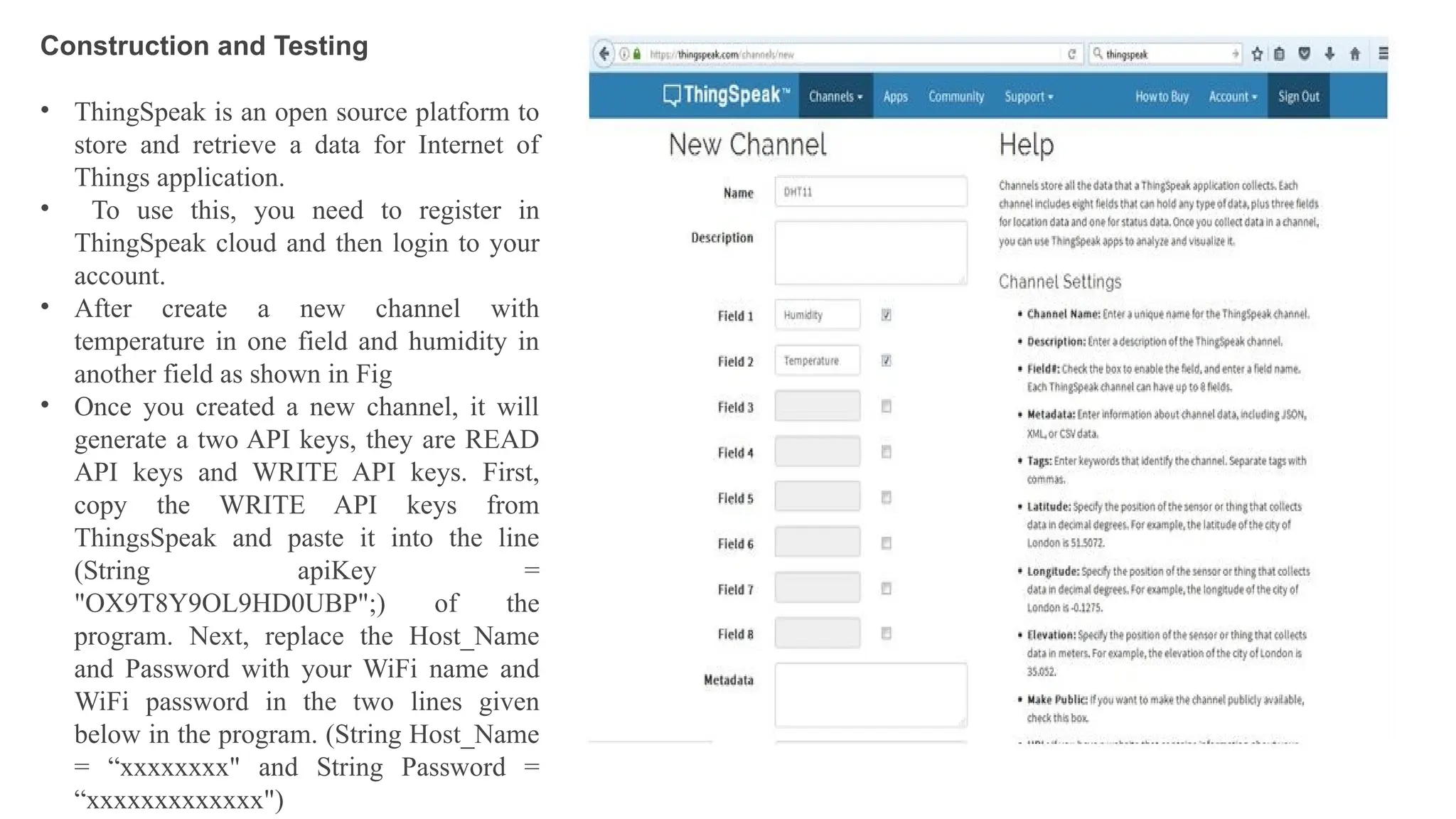
Construction and Testing
•ThingSpeak is an open source platform to
store and retrieve a data for Internet of
Things application.
• To use this, you need to register in
ThingSpeak cloud and then login to your
account.
• After create a new channel with
temperature in one field and humidity in
another field as shown in Fig
• Once you created a new channel, it will
generate a two API keys, they are READ
API keys and WRITE API keys. First,
copy the WRITE API keys from
ThingsSpeak and paste it into the line
(String apiKey =
"OX9T8Y9OL9HD0UBP";) of the
program. Next, replace the Host_Name
and Password with your WiFi name and
WiFi password in the two lines given
below in the program. (String Host_Name
= “xxxxxxxx" and String Password =
“xxxxxxxxxxxxx")
17.
The Arduino programUses DHT library, if
it is not presented in your arduino IDE,
select Sketch-Include-library-Manage
libraries-Install DHT Sensor library. Then
compile the program and upload to a
Arduino Uno through Arduino IDE. Ensure
that WiFi modem and internet connection in
your Smartphone or PC are working
properly. After uploaded a program, the
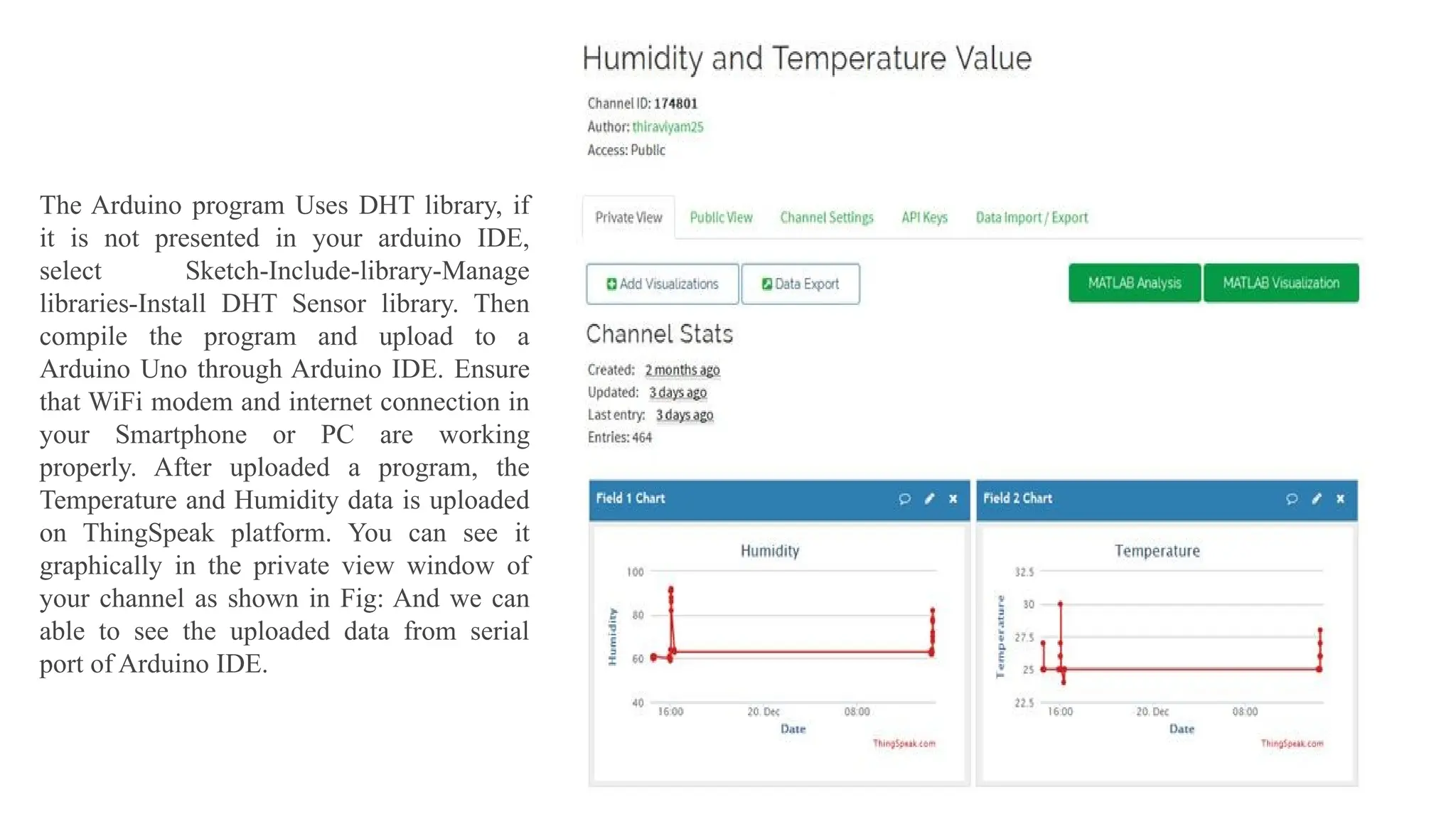
Temperature and Humidity data is uploaded
on ThingSpeak platform. You can see it
graphically in the private view window of
your channel as shown in Fig: And we can
able to see the uploaded data from serial
port of Arduino IDE.
18.
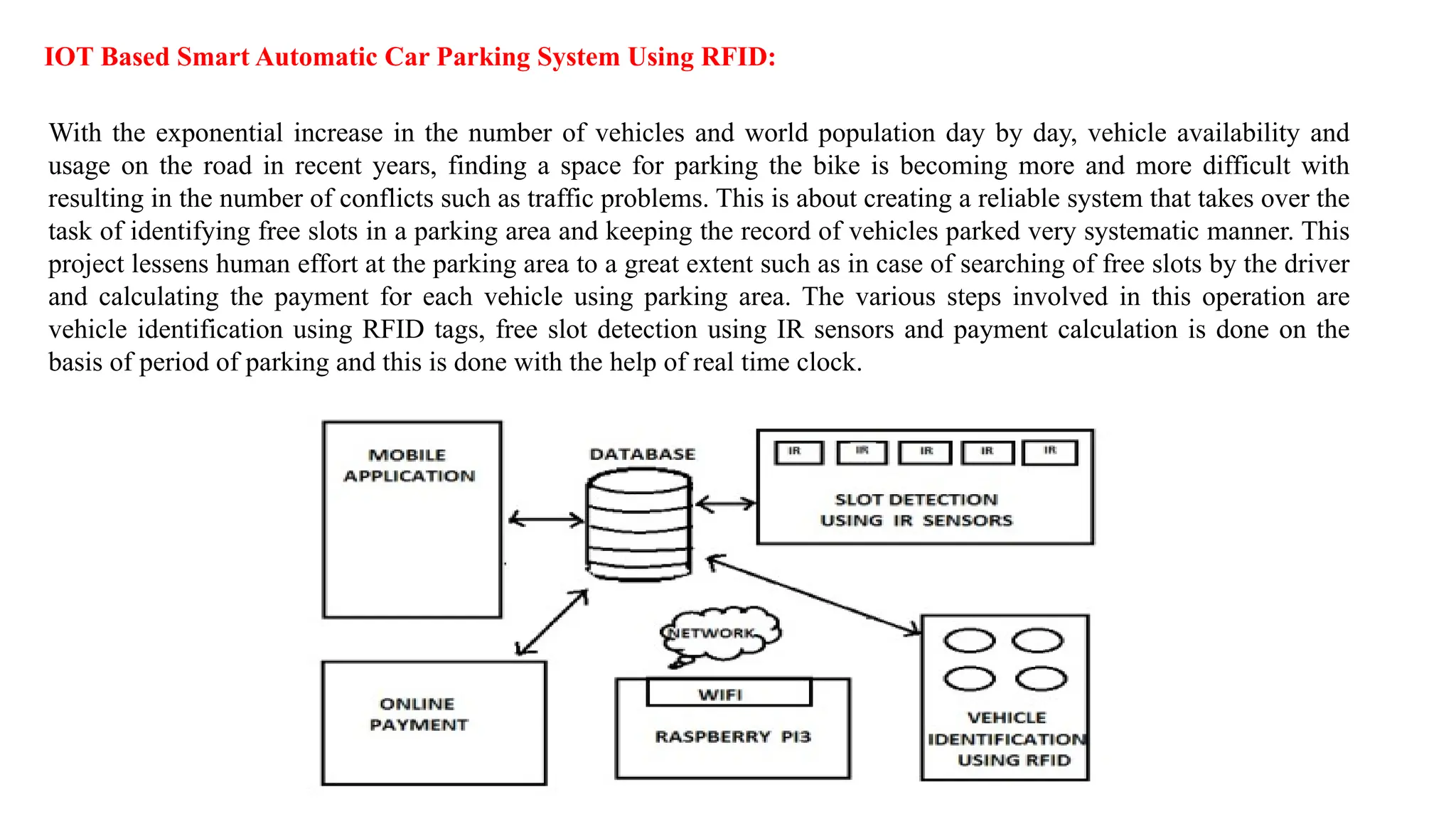
IOT Based SmartAutomatic Car Parking System Using RFID:
With the exponential increase in the number of vehicles and world population day by day, vehicle availability and
usage on the road in recent years, finding a space for parking the bike is becoming more and more difficult with
resulting in the number of conflicts such as traffic problems. This is about creating a reliable system that takes over the
task of identifying free slots in a parking area and keeping the record of vehicles parked very systematic manner. This
project lessens human effort at the parking area to a great extent such as in case of searching of free slots by the driver
and calculating the payment for each vehicle using parking area. The various steps involved in this operation are
vehicle identification using RFID tags, free slot detection using IR sensors and payment calculation is done on the
basis of period of parking and this is done with the help of real time clock.
19.
The architecture ,mainlyconsists of the following components:-
1. Mobile Application
2. Slot Detection UsingIRSensors
3. Vehicle DetectionUsingRFID
4. Payment through Online Banking
5. Database
6. RaspberryPI3
7. Tracking of Vehicles
• The transitions indicate the flow of the data between the database and the rest of the components. As the fig. suggests the
user has to first register himself through the mobile application which indeed stores his information onto the server.
• This data is useful to track the user later if he tries to breach the system policies. After registering into the parking system
his user has the privilege to go into the application and checkout fora free parking space available and then he can actually
go and park his bike there.
• The application is updated each time when the bike is detected on the parking area with the help of IR sensors. IR sensors
are responsible to detect if a particular slot contains bike or not.
20.
• Vehicle identificationis done with the help of RFID tags which are present on each bike which in deed helps us in calculating
the amount to be paid by each user separately.
• RFID readers are present on the parking area which captures the RFID information of each user. Before generating the parking
bill, IR sensors and RFID tags work together to know which vehicle is being parked and depending on the time and the amount
the corresponding bill is generated.
• Raspberry PI3 is a processor which performs all of the above functions through the use of Internet. Payment of the parking bill
is done through online banking which will be done using the mobile application. All of the data generated above is stored and
retrieved from the database.
• The tracking system is an integration of several modern embedded and communication technologies. To provide location and
time information anywhere on earth, Global Positioning System (GPS) is commonly used as a space-based global navigation
satellite system. The location information provided by us GPS systems can be visualized using Google Earth technology.
• The tracking system can be used to monitor various parameters related to safety, emergency services and engine stall.


![Constrained node networks [Autosaved].pptx](https://cdn.slidesharecdn.com/ss_thumbnails/constrainednodenetworksautosaved-241224072549-3091df07-thumbnail.jpg?width=640&height=640&fit=bounds)


