
1 
Customer Relationship Management 
(CRM) 
Presented By: 
JAYA IMB2014006 
SONAM SHARMA IMB2014007
2 
CRM Definition: 
 An integrated sales, marketing & service strategy 
 “Methodologies, software and usually internet 
capabilities that help an organisation manage customer 
relationships in an efficient and organised manner”
3 
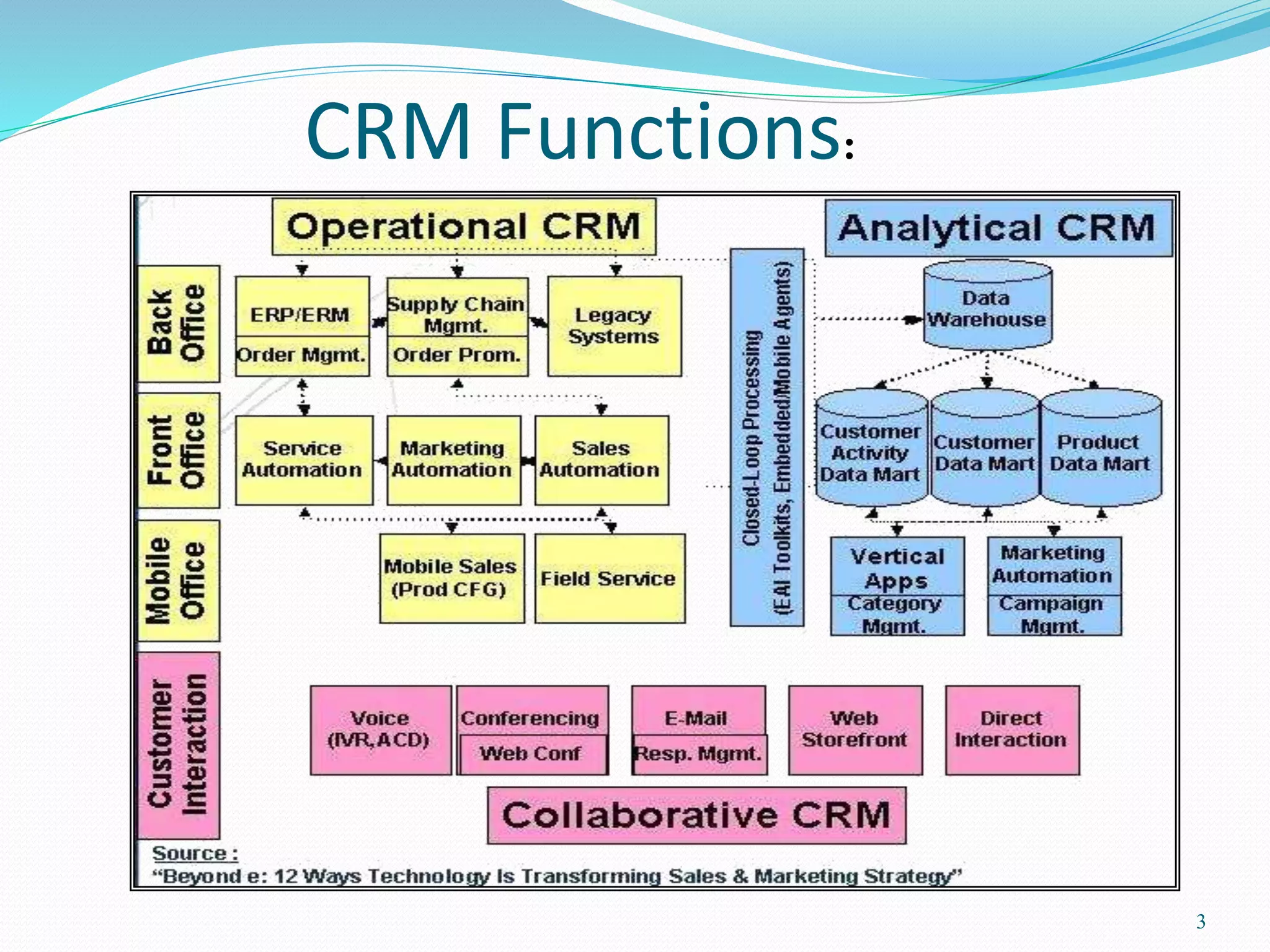
CRM Functions:
4 
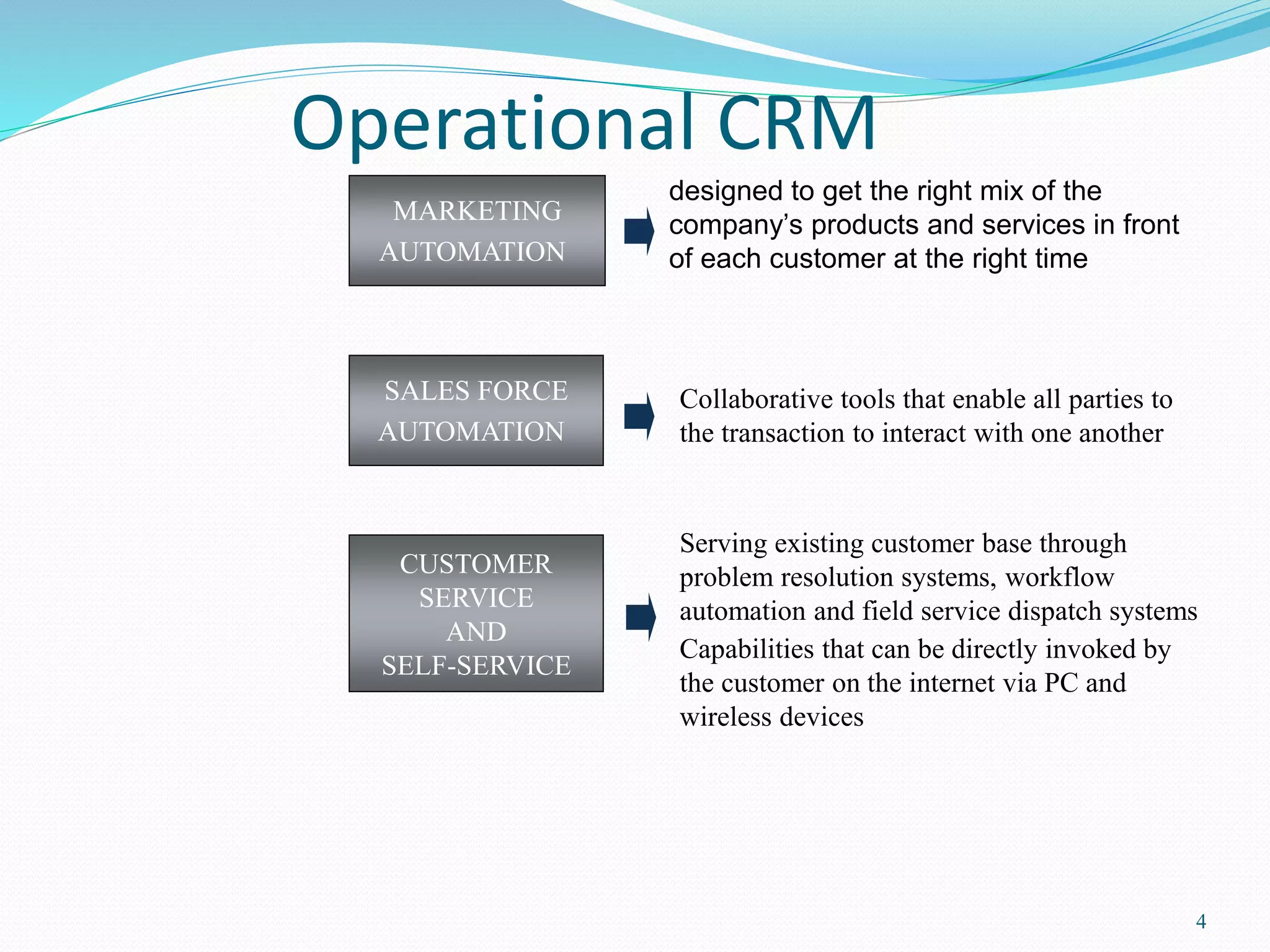
Operational CRM 
MARKETING 
AUTOMATION 
designed to get the right mix of the 
company’s products and services in front 
of each customer at the right time 
SALES FORCE 
AUTOMATION 
Collaborative tools that enable all parties to 
the transaction to interact with one another 
CUSTOMER 
SERVICE 
AND 
SELF-SERVICE 
Serving existing customer base through 
problem resolution systems, workflow 
automation and field service dispatch systems 
Capabilities that can be directly invoked by 
the customer on the internet via PC and 
wireless devices
5 
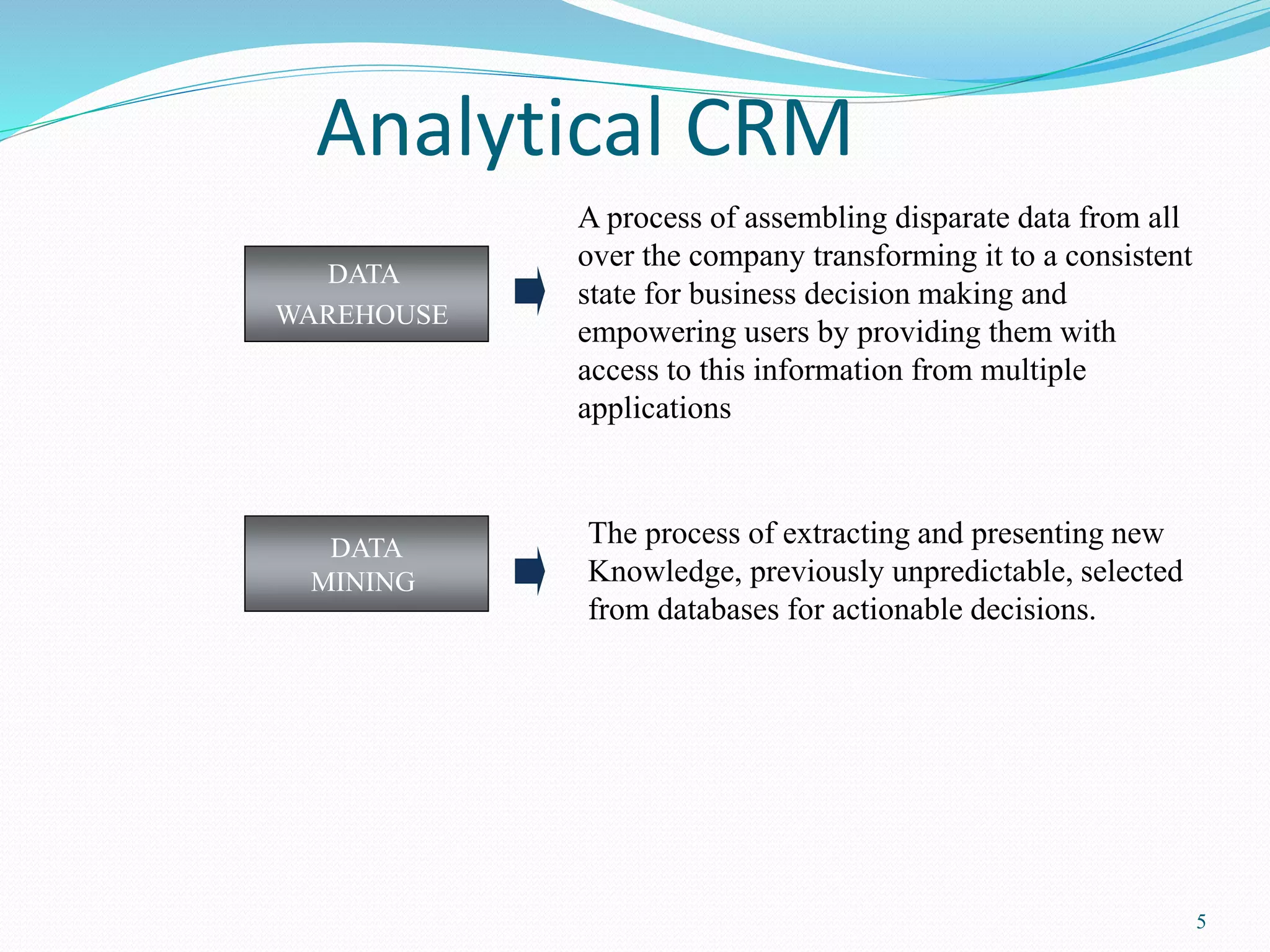
Analytical CRM 
DATA 
WAREHOUSE 
A process of assembling disparate data from all 
over the company transforming it to a consistent 
state for business decision making and 
empowering users by providing them with 
access to this information from multiple 
applications 
DATA 
MINING 
The process of extracting and presenting new 
Knowledge, previously unpredictable, selected 
from databases for actionable decisions.
6 
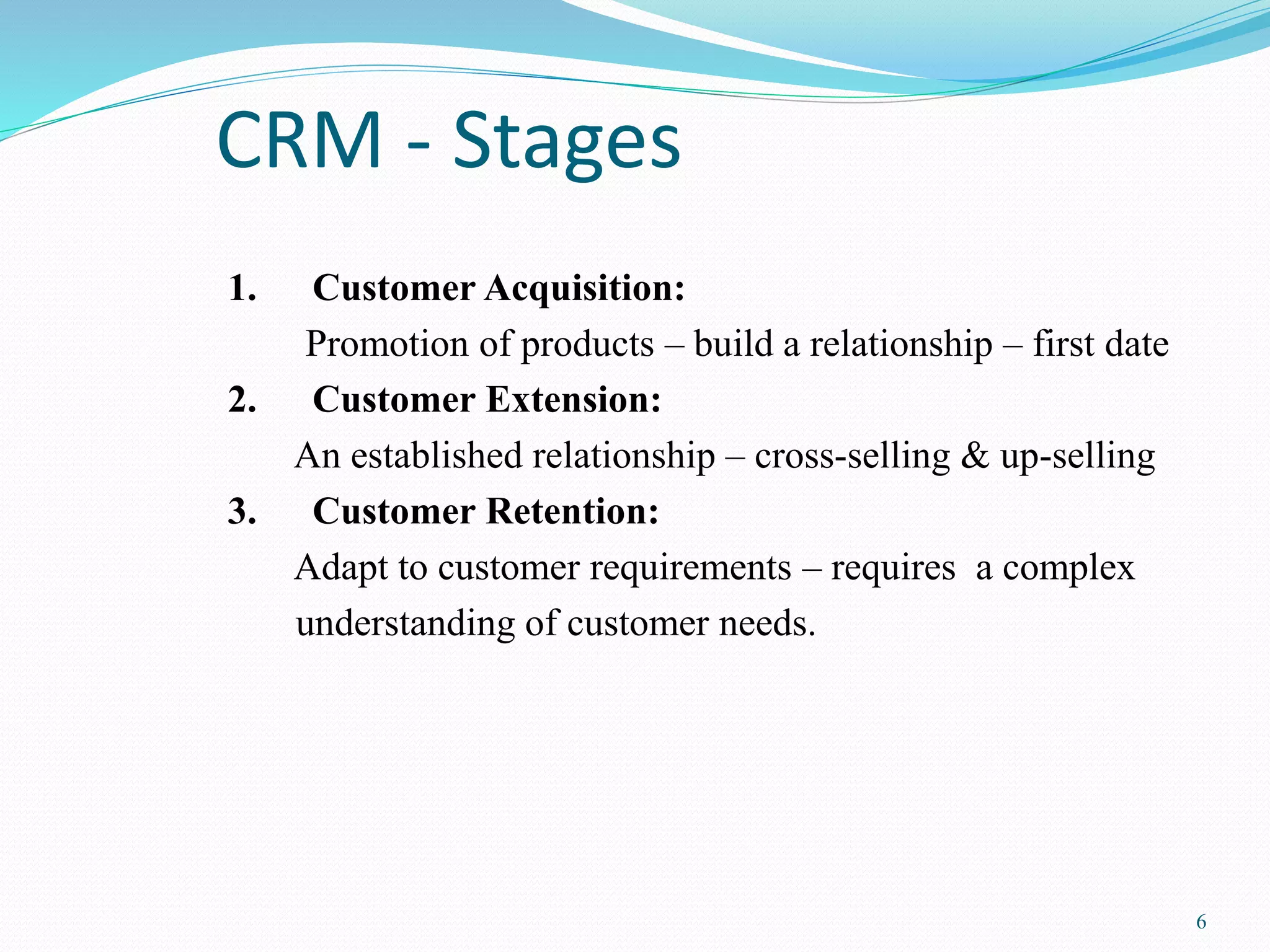
CRM - Stages 
1. Customer Acquisition: 
Promotion of products – build a relationship – first date 
2. Customer Extension: 
An established relationship – cross-selling & up-selling 
3. Customer Retention: 
Adapt to customer requirements – requires a complex 
understanding of customer needs.
7 
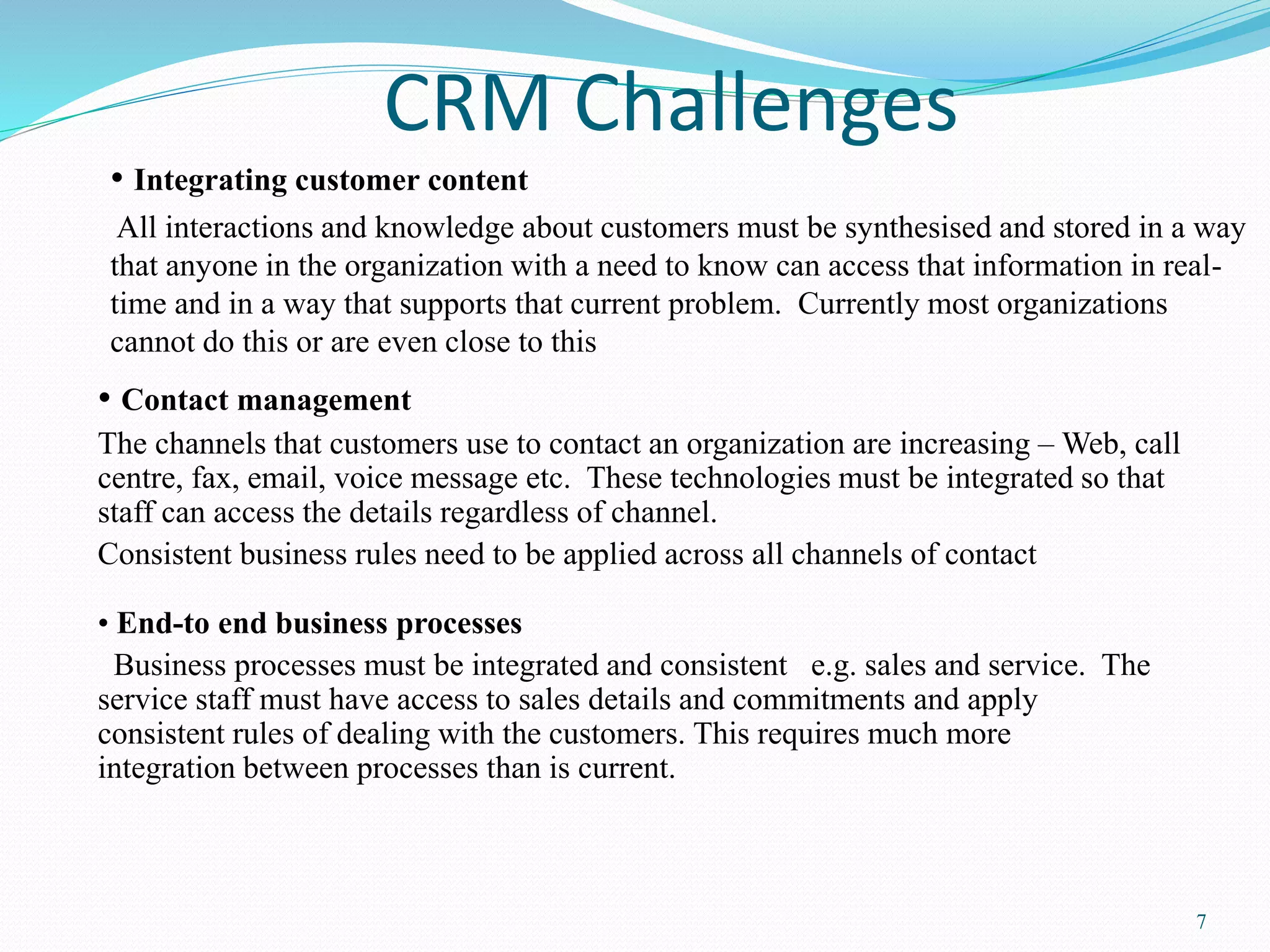
CRM Challenges 
• Integrating customer content 
All interactions and knowledge about customers must be synthesised and stored in a way 
that anyone in the organization with a need to know can access that information in real-time 
and in a way that supports that current problem. Currently most organizations 
cannot do this or are even close to this 
• Contact management 
The channels that customers use to contact an organization are increasing –Web, call 
centre, fax, email, voice message etc. These technologies must be integrated so that 
staff can access the details regardless of channel. 
Consistent business rules need to be applied across all channels of contact 
• End-to end business processes 
Business processes must be integrated and consistent e.g. sales and service. The 
service staff must have access to sales details and commitments and apply 
consistent rules of dealing with the customers. This requires much more 
integration between processes than is current.
8 
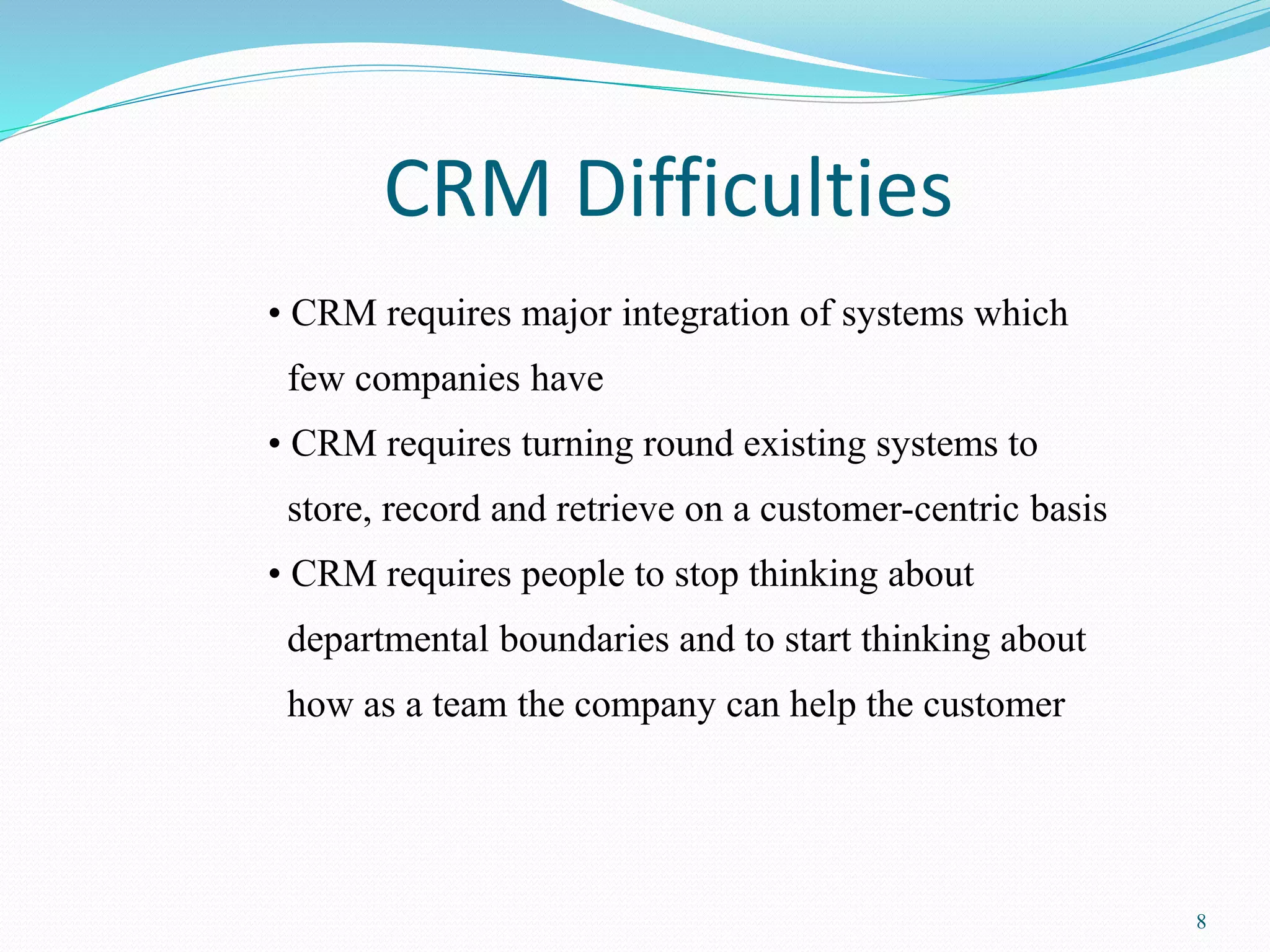
CRM Difficulties 
• CRM requires major integration of systems which 
few companies have 
• CRM requires turning round existing systems to 
store, record and retrieve on a customer-centric basis 
• CRM requires people to stop thinking about 
departmental boundaries and to start thinking about 
how as a team the company can help the customer
CRM: PROS and CONS 
PROS CONS 
 CRM offers the advantage of 
gaining customer loyalty. 
 A good CRM associated with a 
good tool ensures companies to 
have a good view over the list of 
customers and ensures a better 
and more targeted 
communication. 
 CRM also ensures enhanced 
productivity. By fostering 
customer's loyalty, the company 
spends less time acquiring new 
customers and saves time on other 
projects. 
9 
• CRM requires major integration of 
systems which few companies have 
• CRM requires turning round 
existing systems to store, record and 
retrieve on a customer-centric basis 
• CRM requires people to stop 
thinking about departmental 
boundaries and to start thinking 
about how as a team the company 
can help the customer
BUSINESSES THAT USE CRM 
 Any businesses that have a sales team –CRM can help salespeople to identify 
various trends in their customers behaviour it can assist them when selling 
products. 
 Any businesses that use any form of marketing – when using a good business 
CRM solution businesses can use sales information from customers records to 
finely tune theirMARKETING campaigns. 
 Any businesses that create quotes and invoices – having a built-in invoicing 
tool in CRM software programs that is used daily can really speed up the 
quality and invoicing process. Using just one software program to do 
everything in a business can increase productivity dramatically. 
 Any businesses that want to show their customers that they are a priority – 
customers like to feel as though they are wanted, and using CRM can do this. 
10
Example: Marriott International 
 A year into its implementation of Siebel Systems Inc.'s CRM 
package, Marriott has put the tool in the hands of 2,000 
salespeople and events-booking staffers. 
 Marriott also relies on NetMarketplace sales and catering 
software to link the inventory at its hotels into a single database 
that allows for cross-selling and centralized account 
management of business groups and meetings. 
 It is also planning upgrades to central reservations, revenue and 
property management, and CRM systems. For example, the 
property-management system is used around the world to 
manage everything from room inventory to kitchen supplies. 
11
12 
The End

CRM

  • 1.
    1 Customer RelationshipManagement (CRM) Presented By: JAYA IMB2014006 SONAM SHARMA IMB2014007
  • 2.
    2 CRM Definition:  An integrated sales, marketing & service strategy  “Methodologies, software and usually internet capabilities that help an organisation manage customer relationships in an efficient and organised manner”
  • 3.
  • 4.
    4 Operational CRM MARKETING AUTOMATION designed to get the right mix of the company’s products and services in front of each customer at the right time SALES FORCE AUTOMATION Collaborative tools that enable all parties to the transaction to interact with one another CUSTOMER SERVICE AND SELF-SERVICE Serving existing customer base through problem resolution systems, workflow automation and field service dispatch systems Capabilities that can be directly invoked by the customer on the internet via PC and wireless devices
  • 5.
    5 Analytical CRM DATA WAREHOUSE A process of assembling disparate data from all over the company transforming it to a consistent state for business decision making and empowering users by providing them with access to this information from multiple applications DATA MINING The process of extracting and presenting new Knowledge, previously unpredictable, selected from databases for actionable decisions.
  • 6.
    6 CRM -Stages 1. Customer Acquisition: Promotion of products – build a relationship – first date 2. Customer Extension: An established relationship – cross-selling & up-selling 3. Customer Retention: Adapt to customer requirements – requires a complex understanding of customer needs.
  • 7.
    7 CRM Challenges • Integrating customer content All interactions and knowledge about customers must be synthesised and stored in a way that anyone in the organization with a need to know can access that information in real-time and in a way that supports that current problem. Currently most organizations cannot do this or are even close to this • Contact management The channels that customers use to contact an organization are increasing –Web, call centre, fax, email, voice message etc. These technologies must be integrated so that staff can access the details regardless of channel. Consistent business rules need to be applied across all channels of contact • End-to end business processes Business processes must be integrated and consistent e.g. sales and service. The service staff must have access to sales details and commitments and apply consistent rules of dealing with the customers. This requires much more integration between processes than is current.
  • 8.
    8 CRM Difficulties • CRM requires major integration of systems which few companies have • CRM requires turning round existing systems to store, record and retrieve on a customer-centric basis • CRM requires people to stop thinking about departmental boundaries and to start thinking about how as a team the company can help the customer
  • 9.
    CRM: PROS andCONS PROS CONS  CRM offers the advantage of gaining customer loyalty.  A good CRM associated with a good tool ensures companies to have a good view over the list of customers and ensures a better and more targeted communication.  CRM also ensures enhanced productivity. By fostering customer's loyalty, the company spends less time acquiring new customers and saves time on other projects. 9 • CRM requires major integration of systems which few companies have • CRM requires turning round existing systems to store, record and retrieve on a customer-centric basis • CRM requires people to stop thinking about departmental boundaries and to start thinking about how as a team the company can help the customer
  • 10.
    BUSINESSES THAT USECRM  Any businesses that have a sales team –CRM can help salespeople to identify various trends in their customers behaviour it can assist them when selling products.  Any businesses that use any form of marketing – when using a good business CRM solution businesses can use sales information from customers records to finely tune theirMARKETING campaigns.  Any businesses that create quotes and invoices – having a built-in invoicing tool in CRM software programs that is used daily can really speed up the quality and invoicing process. Using just one software program to do everything in a business can increase productivity dramatically.  Any businesses that want to show their customers that they are a priority – customers like to feel as though they are wanted, and using CRM can do this. 10
  • 11.
    Example: Marriott International  A year into its implementation of Siebel Systems Inc.'s CRM package, Marriott has put the tool in the hands of 2,000 salespeople and events-booking staffers.  Marriott also relies on NetMarketplace sales and catering software to link the inventory at its hotels into a single database that allows for cross-selling and centralized account management of business groups and meetings.  It is also planning upgrades to central reservations, revenue and property management, and CRM systems. For example, the property-management system is used around the world to manage everything from room inventory to kitchen supplies. 11
  • 12.