BRIEF HISTORY OFSTANDARDIZED TESTSOriginated in ChinaPotential employees had to fill out exams detailing their knowledge of the state religion. Out of the Industrial Revolution of the early 1800s there was a desire to test large numbers of students since more were leaving the farm and factories and going to school.
3.
Standardized Testing forCollege AdmissionsACT= National College Placement Exam. First administered in 1959Average score out of 36: 21Subject areas: Math, Science, Reading, English, and writing1.6 million high school students took it in 201024% of all high school graduates met the four College Readiness Benchmarks on the ACT.
4.
Standardized Testing ForCollege AdmissionsSAT= Most widely used college entrance exam in the United States. First used as an Army IQ Test during the first World War. In 1942, it was used as the main test for all college applicants. Administered seven times a year.Average score out of 2400: 1520
5.
Standardized Testing forPublic SchoolTAKS= Texas Assessment of Knowledge and Skills.First implemented in 2003. Grades 3-10 are required to take the exam. It is complimented by the TEKS (Texas Essential Knowledge and Skills) standards.Covers Math, Reading, English, Science, and Writing.
National Association forCollege Admission CounselingDespite their prevalence in American high school culture, college admission exams—such as the SAT and ACT—may not be critical to making good admission decisions at many of the colleges and universities that use them. While the exams, used by a large majority of four-year colleges and universities to make admission decisions, provide useful information, colleges and universities may be better served by admission exams more closely linked to high school curriculum.
8.
NY Times onSAT v. ACTIvy League Schools reject nine out of ten qualified candidates.Boys do better on standardized tests. Women and minorities are affected by stereotypes and therefore may perform bad on the test. ACT is curriculum based.SAT is more problem solving and reasoningStudents are easily stressed not knowing whether to take both exams to get a better advantage at admissions.
9.
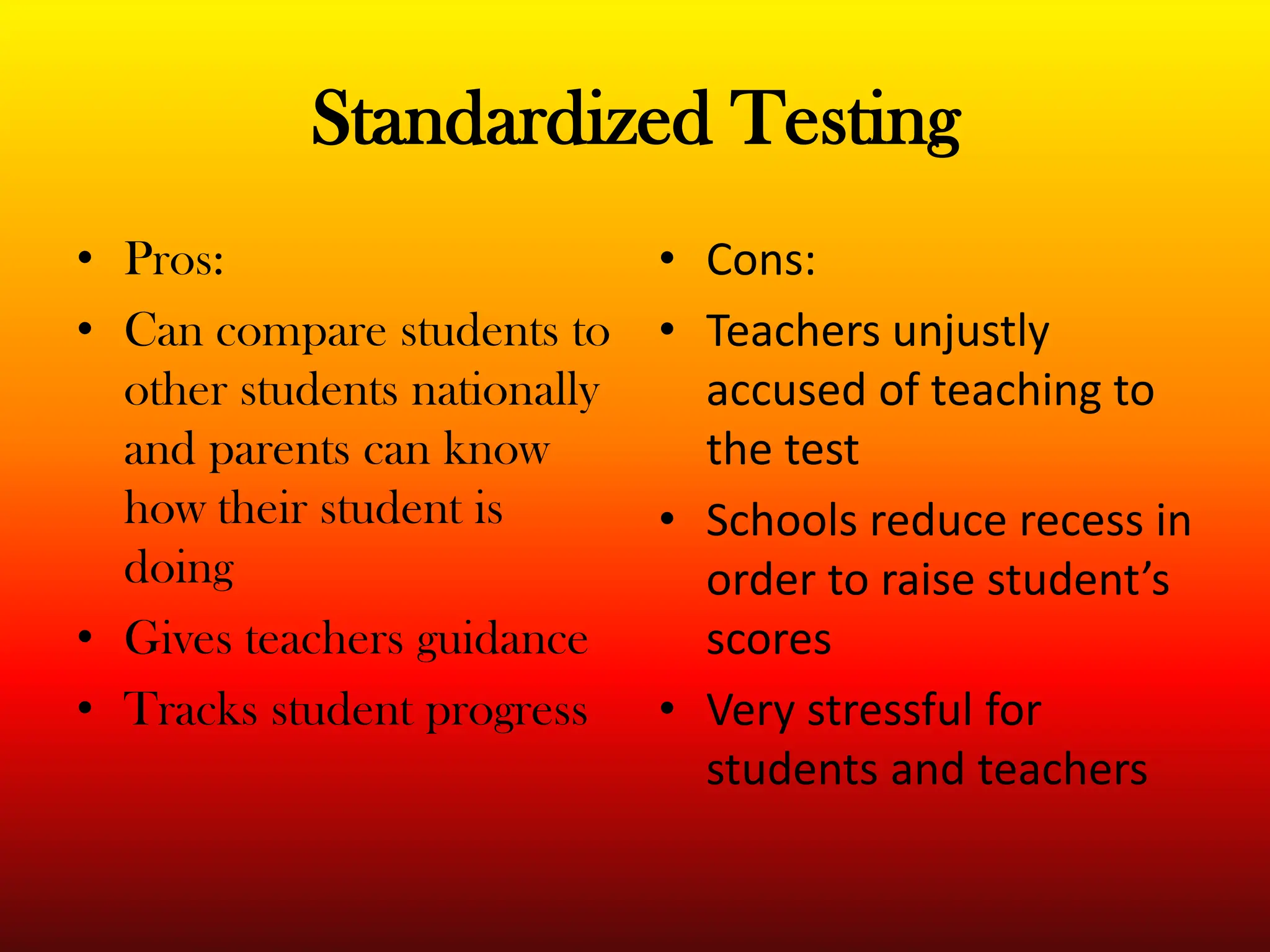
Standardized TestingPros:Can comparestudents to other students nationally and parents can know how their student is doingGives teachers guidanceTracks student progressCons:Teachers unjustly accused of teaching to the testSchools reduce recess in order to raise student’s scoresVery stressful for students and teachers
10.
WHY STANDARDIZED TESTSNEED TO BE ABOLISHEDCauses teachers to hide student’s poor performance on examThere is no set standard for standardized tests. They vary in quality.There is no agreed assessment rubric for them. NCLB failed to require tests to measure higher thinking skills such as reasoning.NCLB has instituted too many tests.
11.
WHY STANDARDIZED TESTSNEED TO BE ABOLISHEDStandardized testing has streamlined the curriculum so much that other subjects are covered less. Standardized testing has put undue pressure on teachers to have all their students pass their exams. Teachers are teaching to the test.This means no enrichment for the student.
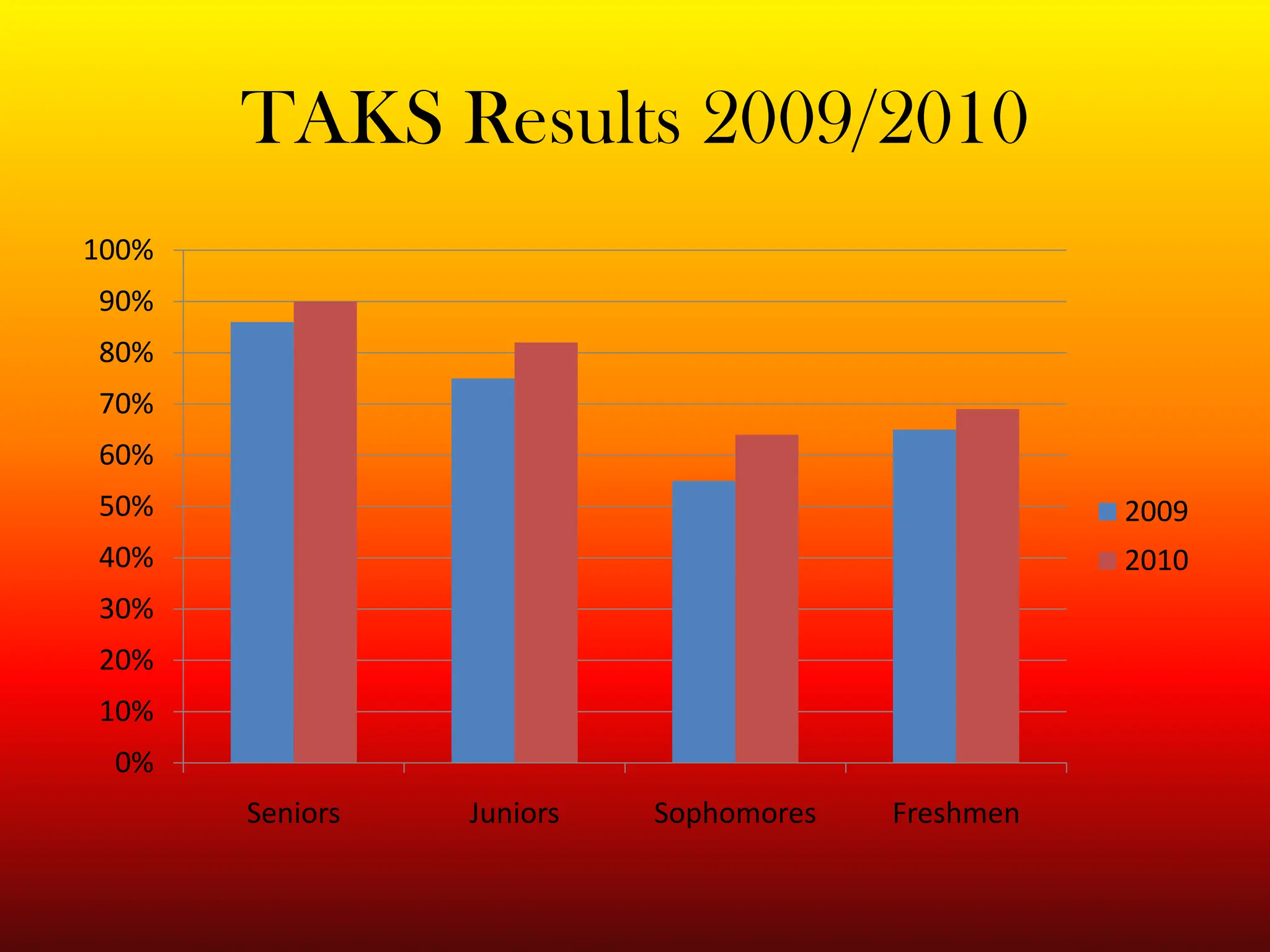
Misleading InformationStudents aredoing better this year than last year on the TAKS.Most students are still not ready for college.Students are deficient in Math , Reading, and Writing when they enter college.
14.
Purpose for theStudyStudents are increasingly unprepared for college life. The purpose is to find the reason why standardized show students are proficient in the core subjects, but students go on to developmental courses in their first year in college. School districts and the state can find other ways to assess students.
15.
ConclusionStandardized testing iscausing curriculums in non core classes to be curtailed.This mandatory testing has caused teachers to teach to the test. Quality of teachers has gone down. The SAT and ACT are being lessened as a tool for admissions. High school students are doing well on the TAKS, yet are still taking developmental courses at the college level.
BibliographyACT News. (2010).Facts about the ACT. Retrieved from http://www.act.org/news/aapfacts.htmlAmerican-Statesman Staff. (2010). Statewide early TAKS results released. The Austin American-Statesman. Retrieved from http://www.statesman.com/blogs/content/shared- gen/blogs/austin/education/entries/2010/06/03/statewide_e arly_taks_results_r.htmlFletcher, Dan. (2009, December 11). A Brief History of Standardized Testing. Time Magazine. Retrieved from http://www.time.com/time/nation/article/0,8599,1947019,0 0.html
18.
BibliographySmith, Joyce, Alveraz,R., Boshoven, J., Hooker, S., Len tino, A., Miller, J., Peterson, C., Sohmer, L., White, E., Knaus, T. (2008, September). Report of the Commission on the use of Standardized Testing in Undergraduate Admission. Retrieved from http://www.nacacnet.org/PublicationsResources/Research/Documents/TestingComission_FinalReport.pdfSlatalla, Michelle. (2007, November 4). ACT vs.SAT. The New York Times. Retrieved from http://www.nytimes.com/2007/11/04/education/edlife/guidance.html
19.
BibliographyThevenot, Brian. (2010,February 2). Most Community College Students Never Graduate. The Texas Tribune. Retrieved from http://www.texastribune.org/texas-education/higher-education/most-community-college-students-never-graduate/