

Recommended
Recommended
More Related Content
What's hot
What's hot (20)
Similar to Public Media's Purpose in Broadband Era
Similar to Public Media's Purpose in Broadband Era (20)
Recently uploaded
Recently uploaded (20)
Public Media's Purpose in Broadband Era
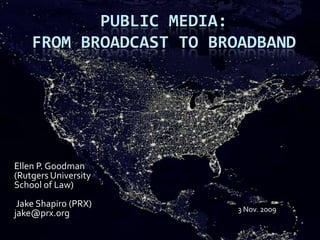
- 1. Public Media: From Broadcast to Broadband Ellen P. Goodman (Rutgers University School of Law) Jake Shapiro (PRX)jake@prx.org 3 Nov. 2009
- 2. What is Public Media’s Purpose given:
- 3. Context
- 4. Context
- 6. Public Broadcasting Act of 1967 Access: foster growth and development of public radio and television broadcasting and nonbroadcast telecommunications technologies for the delivery of public telecommunications services;
- 7. Public Broadcasting Act of 1967 Outreach: that constitute a source of alternative services for all, and that serve as valuable local community resources through outreach;
- 8. Public Broadcasting Act of 1967 Engagement: that are responsive to local and general interests, expressing diversity and excellence , involving creative risks, and addressing the needs of unserved and underserved audiences, particularly children and minorities.
- 9. A New Role for Public Media
- 10. Case for Public Media
- 11. Case against Public Media
- 12. Public Media
- 13. Some Aspirations
- 19. Next Steps
- 20. discussion
- 21. Additional pages CPB 2009 budgetPublic Broadcasting Act introduction
- 23. The Congress hereby finds and declares that: it is in the public interest to encourage the growth and development of public radio and television broadcasting, including the use of such media for instructional, educational, and cultural purposes;
- 24. The Congress hereby finds and declares that: it is in the public interest to encourage the growth and development of nonbroadcast telecommunications technologies for the delivery of public telecommunications services;
- 25. The Congress hereby finds and declares that: expansion and development of public telecommunications and of diversity of its programming depend on freedom, imagination, and initiative on both local and national levels;
- 26. The Congress hereby finds and declares that: the encouragement and support of public telecommunications, while matters of importance for private and local development, are also of appropriate and important concern to the Federal Government;
- 27. The Congress hereby finds and declares that: it furthers the general welfare to encourage public telecommunications services which will be responsive to the interests of people both in particular localities and throughout the United States, which will constitute an expression of diversity and excellence, and which will constitute a source of alternative telecommunications services for all the citizens of the Nation;
- 28. The Congress hereby finds and declares that: it is in the public interest to encourage the development of programming that involves creative risks and that addresses the needs of unserved and underserved audiences, particularly children and minorities;
- 29. The Congress hereby finds and declares that: it is necessary and appropriate for the Federal Government to complement, assist, and support a national policy that will most effectively make public telecommunications services available to all citizens of the United States;
- 30. The Congress hereby finds and declares that: public television and radio stations and public telecommunications services constitute valuable local community resources for utilizing electronic media to address national concerns and solve local problems through community programs and outreach programs;
- 31. The Congress hereby finds and declares that: it is in the public interest for the Federal Government to ensure that all citizens of the United States have access to public telecommunications services through all appropriate available telecommunications distribution technologies; and
- 32. The Congress hereby finds and declares that: a private corporation should be created to facilitate the development of public telecommunications and to afford maximum protection from extraneous interference and control.
Editor's Notes
- Credit: NASA/GSFC US at Night photo http://www.flickr.com/photos/wwworks/2712986388/
- Center for Social Media’s Public Media 2.0 report takeaways : Public media 2.0’s core function is to generate publics around problems. Participatory behaviors: choice, conversation, curation, creation, and collaboration.
- CC license “Stuck in Customs” http://www.flickr.com/photos/stuckincustoms/4007754192/