Urban Computing in LarKC
ITN – Infrastructure, Telematics and Navigation – Turin, October 15th
-16th
2009 - © CEFRIEL 2009
Urban Computing in LarKC
http://www.larkc.eu
Irene Celino
Project Manager – Senior Consultant – “Semantic Web & Web 3.0” Practice Coordinator
CEFRIEL – ICT Institute – Politecnico di Milano
Turin, October 16th 2009
2Urban Computing in LarKC
Cities Are AliveCities Are Alive
 Cities born, grow, evolve
like living beings.
 The state of a city
changes continuously,
influenced by a lot of
factors,
 human ones: people
moving in the city or
extending it
 natural ones:
precipitations or climate
changes
2
[source http://www.citysense.com]
Turin, October 16th 2009
3Urban Computing in LarKC
Some Mobile Users’ QuestionSome Mobile Users’ Question
 “Is public transportation where I am?”
 “Is the event where I am the one that attract more people
right now?”
 “Where are all my friends meeting?”
 “Is the traffic moving where I’m going?”
3
Turin, October 16th 2009
4Urban Computing in LarKC
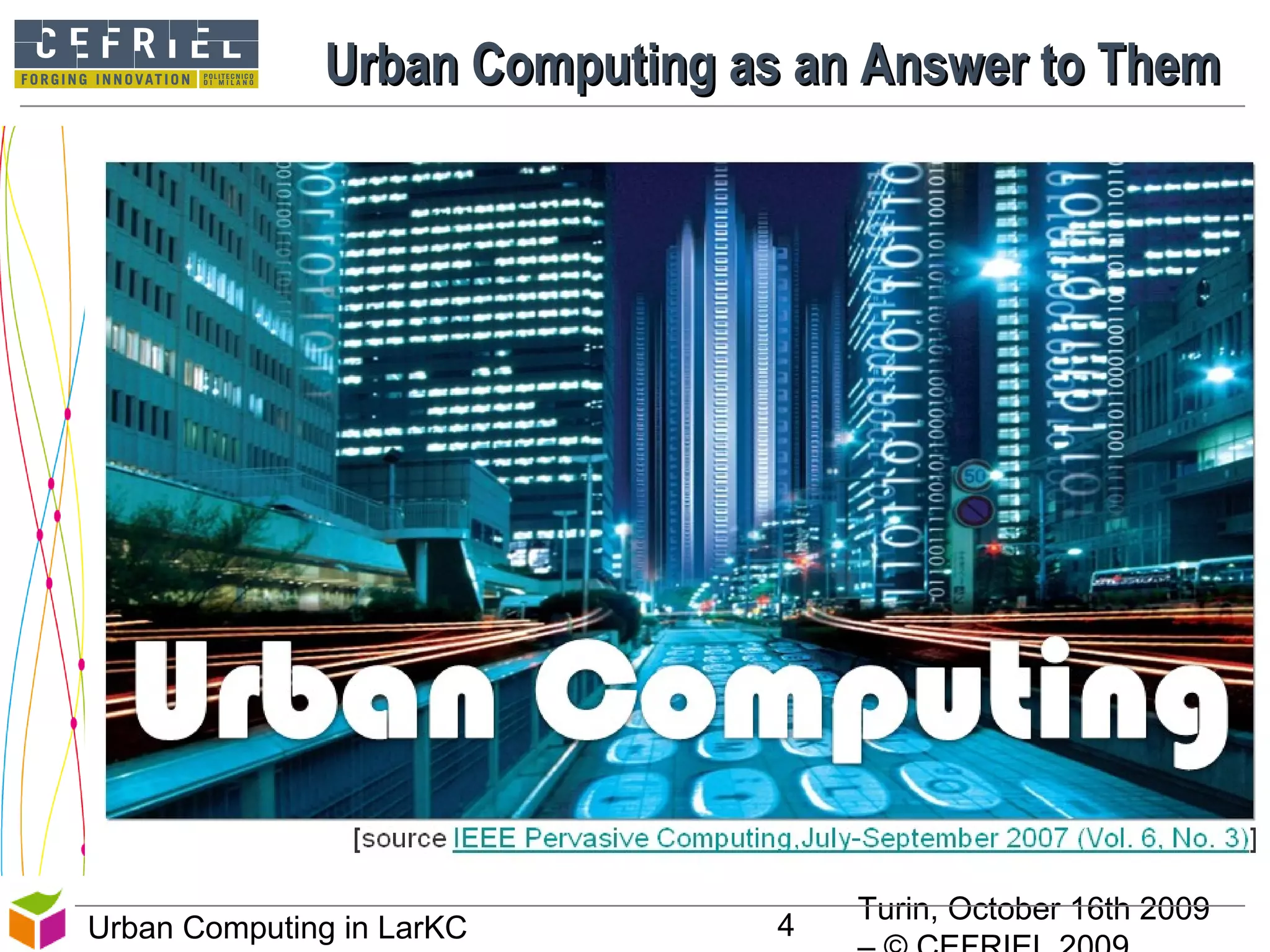
Urban Computing as an Answer to ThemUrban Computing as an Answer to Them
4
Turin, October 16th 2009
5Urban Computing in LarKC
[source IEEE Pervasive Computing,July-September 2007 (Vol. 6, No. 3)]
Urban ComputingUrban Computing
The integration of computing, sensing, and actuation technologies
into everyday urban settings and lifestyles.
 Urban settings include, for example, streets, squares, pubs, shops,
buses, and cafés - any space in the semipublic realms of our towns
and cities.
 Only in the last few years have researchers paid much attention to
technologies in these spaces.
 Pervasive computing has largely been applied
 either in relatively homogeneous rural areas, where researchers have
added sensors in places such as forests, vineyards, and glaciers
 or, on the other hand, in small-scale, well-defined patches of the built
environment such as smart houses or rooms.
 Urban settings are challenging for experimentation and deployment,
and they remain little explored
5
Turin, October 16th 2009
6Urban Computing in LarKC
Dimension of Urban ComputingDimension of Urban Computing
6
Turin, October 16th 2009
7Urban Computing in LarKC
Urban Computing Use Case in LarKCUrban Computing Use Case in LarKC
7
Turin, October 16th 2009
8Urban Computing in LarKC
Data AvailabilityData Availability
 Some years ago, due to the lack of data, Urban Computing looked
like a Sci-Fi idea.
 Nowadays, a large amount of the required information can be made
available on the Internet at almost no cost. We are running a survey
[1,2] and we have collected more than 50 sources of data:
 maps (Google, Yahoo!, Wikimapia, OpenStreetMap),
 events scheduled (Eventful, Upcoming…),
 voluntarily provided users location (Google Latitude),
 mass presence and movements
 multimedia data with information about location (Flickr…)
 relevant places (schools, bus stops, airports...)
 traffic information (accidents, problems of public transportation...)
 city life (job ads, pollution, health care...)
[1] http://wiki.larkc.eu/UrbanComputing/ShowUsABetterWay
[2] http://wiki.larkc.eu/UrbanComputing/OtherDataSources
8
Turin, October 16th 2009
9Urban Computing in LarKC
Are Mashups the Solution?Are Mashups the Solution?
9
[source: http://www-01.ibm.com/software/lotus/products/mashups/ ]
IBM Lotus Mashups
[source: http://editor.googlemashups.com ]
[source: http://pipes.yahoo.com/pipes/ ]
[source: http://www.popfly.com/ ]
[source: http://openkapow.com/ ]
Turin, October 16th 2009
10Urban Computing in LarKC
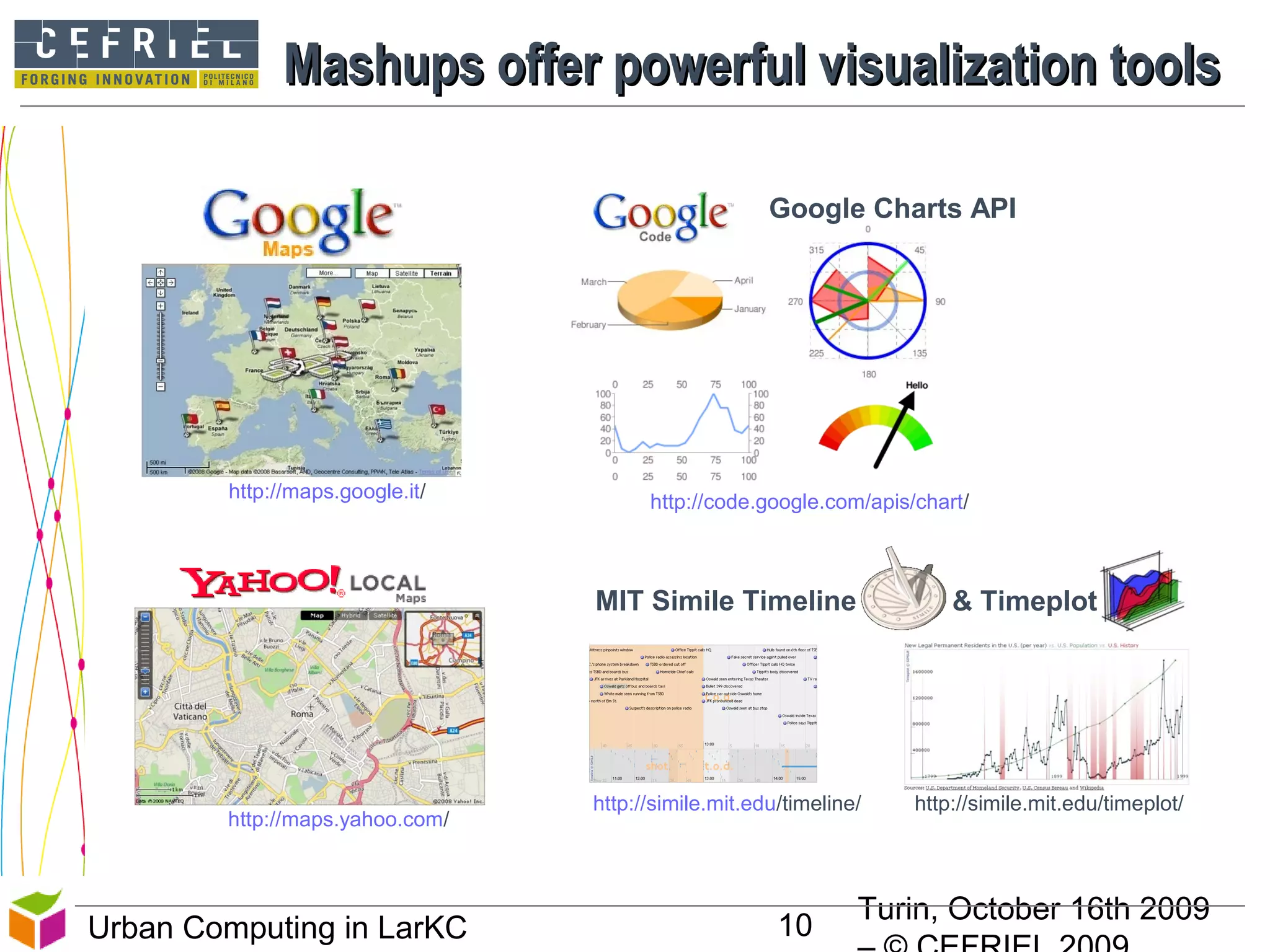
Mashups offer powerful visualization toolsMashups offer powerful visualization tools
10
Google Charts API
http://code.google.com/apis/chart/http://maps.google.it/
http://maps.yahoo.com/
MIT Simile Timeline & Timeplot
http://simile.mit.edu/timeline/ http://simile.mit.edu/timeplot/
Turin, October 16th 2009
11Urban Computing in LarKC
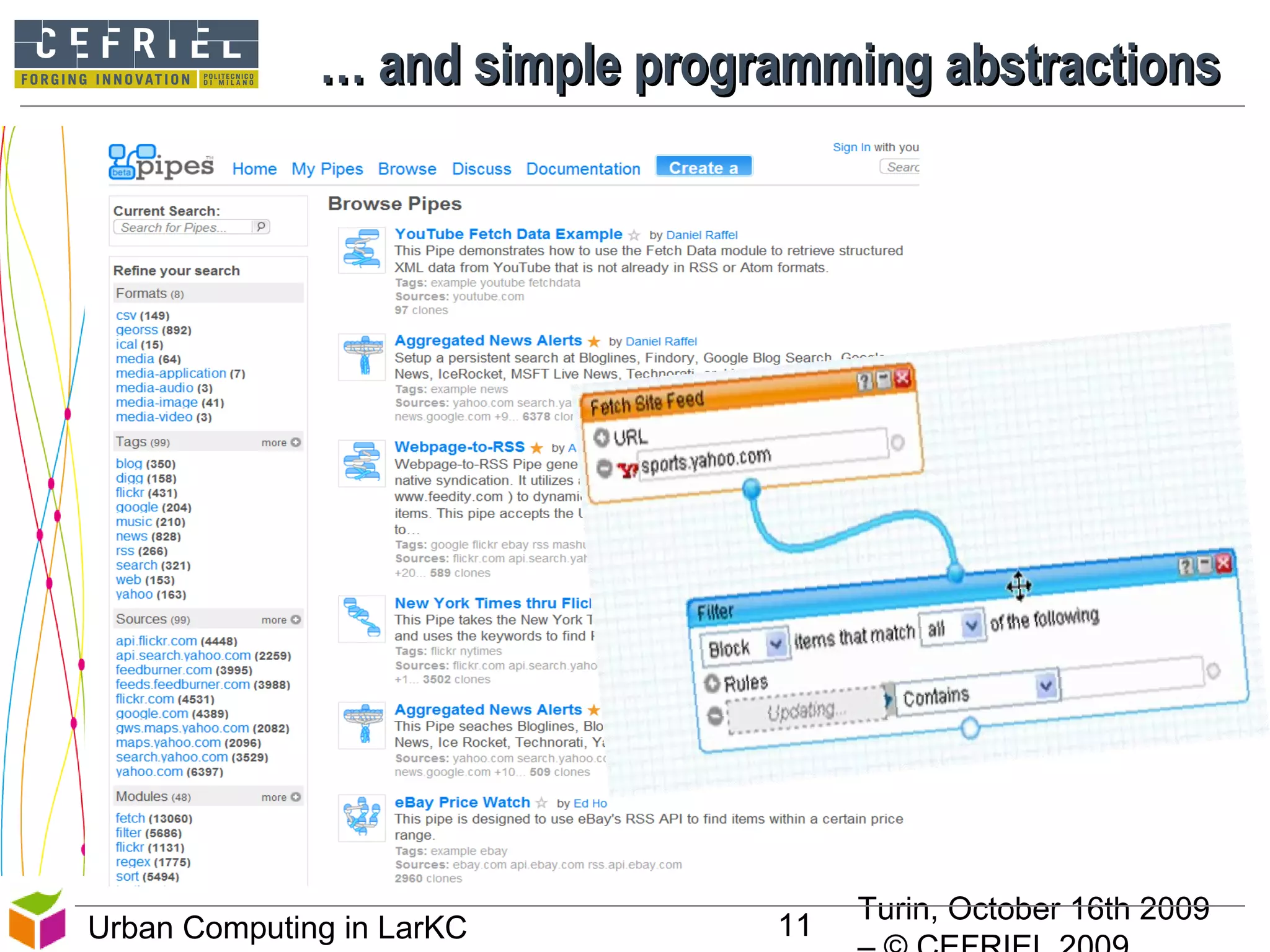
…… and simple programming abstractionsand simple programming abstractions
11
Turin, October 16th 2009
12Urban Computing in LarKC
Not Everything Boils Down to PlumbingNot Everything Boils Down to Plumbing
12
Turin, October 16th 2009
13Urban Computing in LarKC
Requirements for Mobile Data MashupsRequirements for Mobile Data Mashups
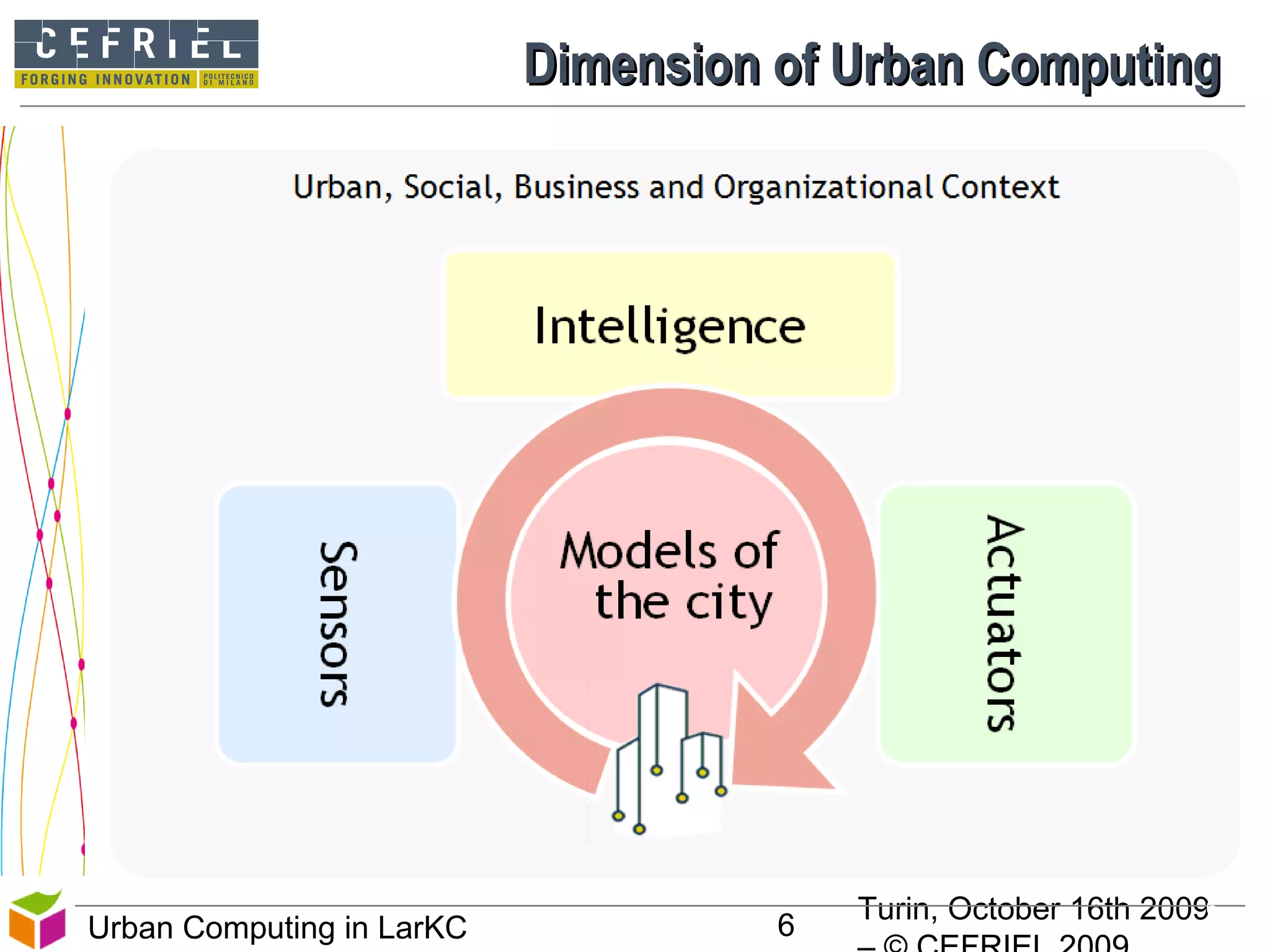
 Urban Computing encompass sensing, actuation and
computing requirements.
 Many previous work in the area of Pervasive and Ubiquitous
Computing investigated requirements in sensing, actuation,
and several aspects of computation (from hardware to
software, from networks to devices)
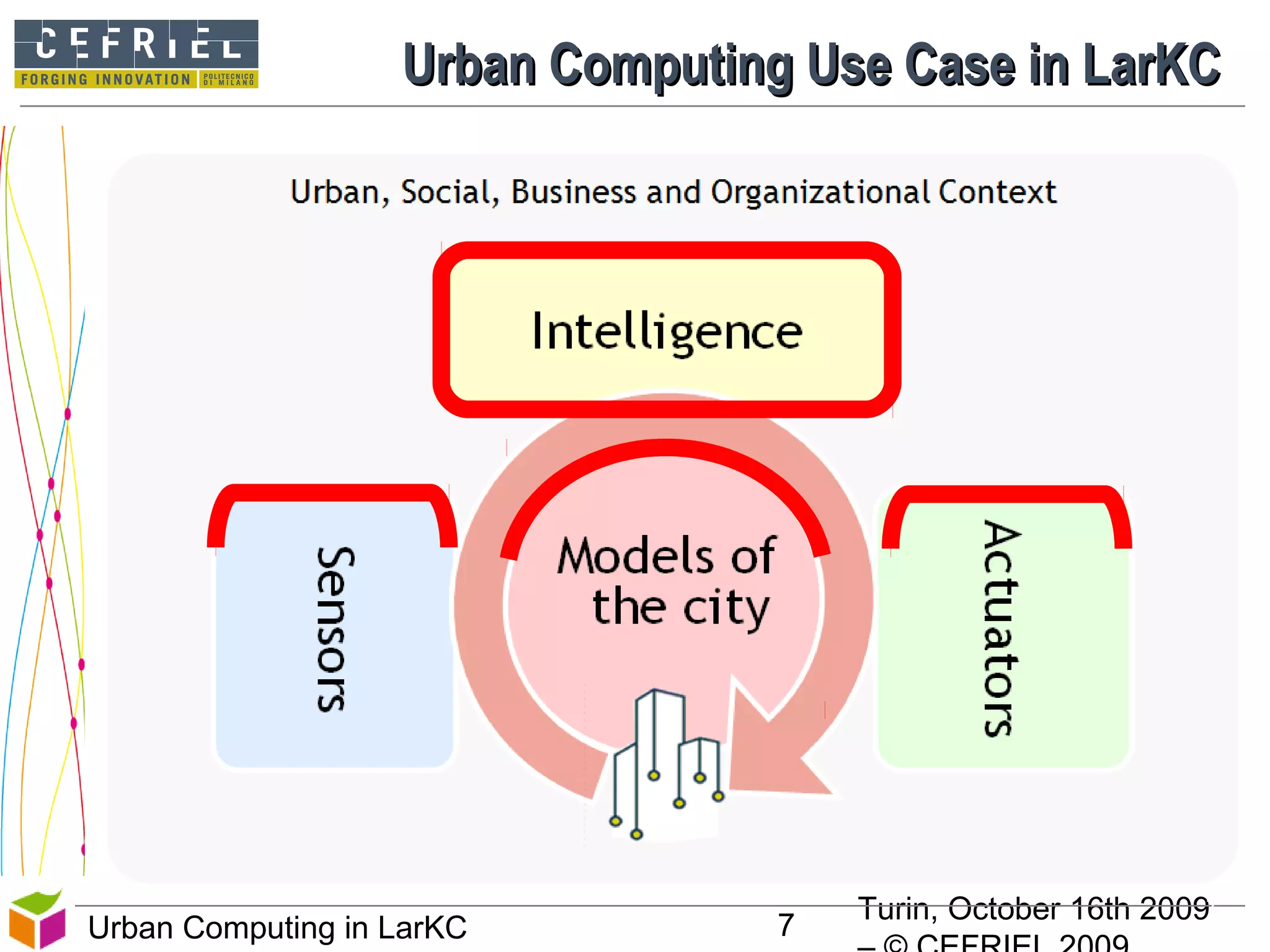
 In LarKC we focus on Knowledge Representation and
Reasoning requirements
 Hereafter we exemplify the need to cope with
 representational, reasoning, and defaults heterogeneity
 scale
 time-dependency
 noisy, uncertain and inconsistent data
13
Turin, October 16th 2009
14Urban Computing in LarKC
Coping with representational heterogeneityCoping with representational heterogeneity
 It is an obvious requirement
 data always come in different formats (syntactic and structural
heterogeneity)
 the problem of merging and aligning data is a structural problem of
system interoperability
 while the perfect “one-size-fit-all” solution does not exist, a
comprehensive array of partial solutions exit
14
Turin, October 16th 2009
15Urban Computing in LarKC
Coping with multiple reasoning paradigmsCoping with multiple reasoning paradigms
precise and vs. approximate
consistent inference reasoning
[ source http://senseable.mit.edu/ ]
Turin, October 16th 2009
16Urban Computing in LarKC
Open World vs. Closed World
Assumption Assumption
[source: http://gizmodo.com/photogallery/trafficsky/1003143552 ]
Supporting Heterogeneity 1/2Supporting Heterogeneity 1/2
Turin, October 16th 2009
17Urban Computing in LarKC
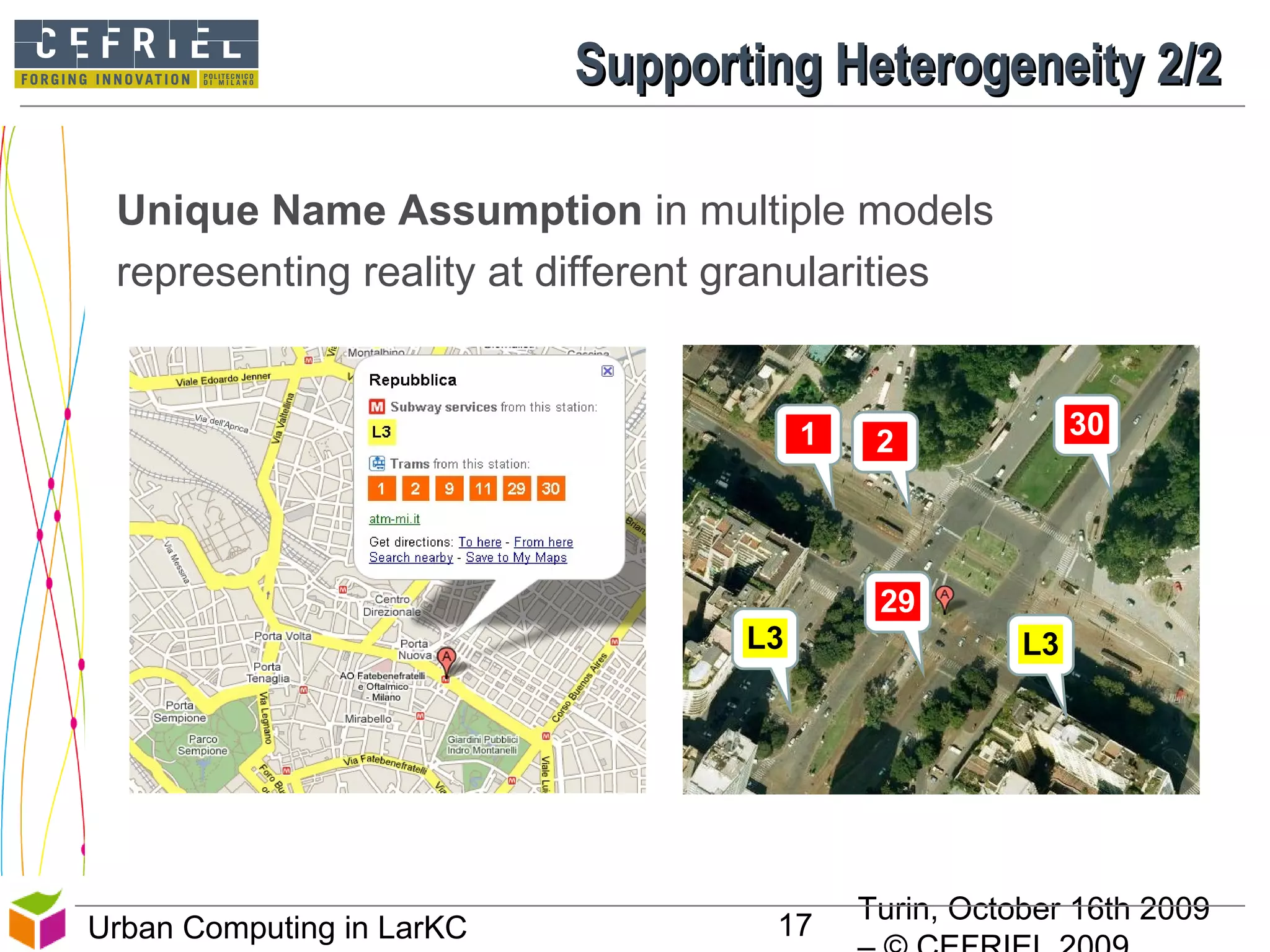
Unique Name Assumption in multiple models
representing reality at different granularities
1 2
29
30
L3L3
Supporting Heterogeneity 2/2Supporting Heterogeneity 2/2
Turin, October 16th 2009
18Urban Computing in LarKC
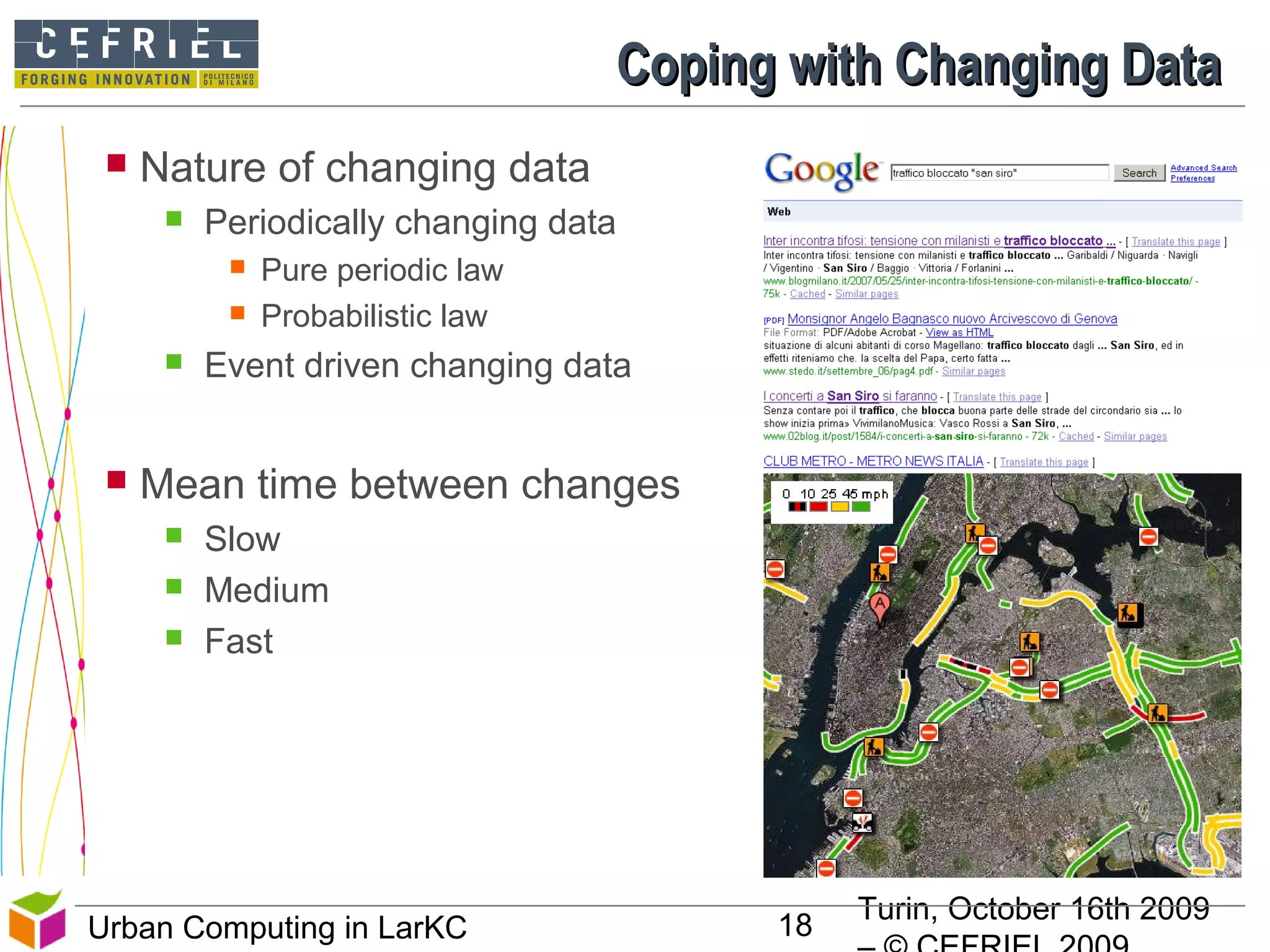
 Nature of changing data
 Periodically changing data
 Pure periodic law
 Probabilistic law
 Event driven changing data
 Mean time between changes
 Slow
 Medium
 Fast
Coping with Changing DataCoping with Changing Data
Turin, October 16th 2009
19Urban Computing in LarKC
Coping with Changing KnowledgeCoping with Changing Knowledge
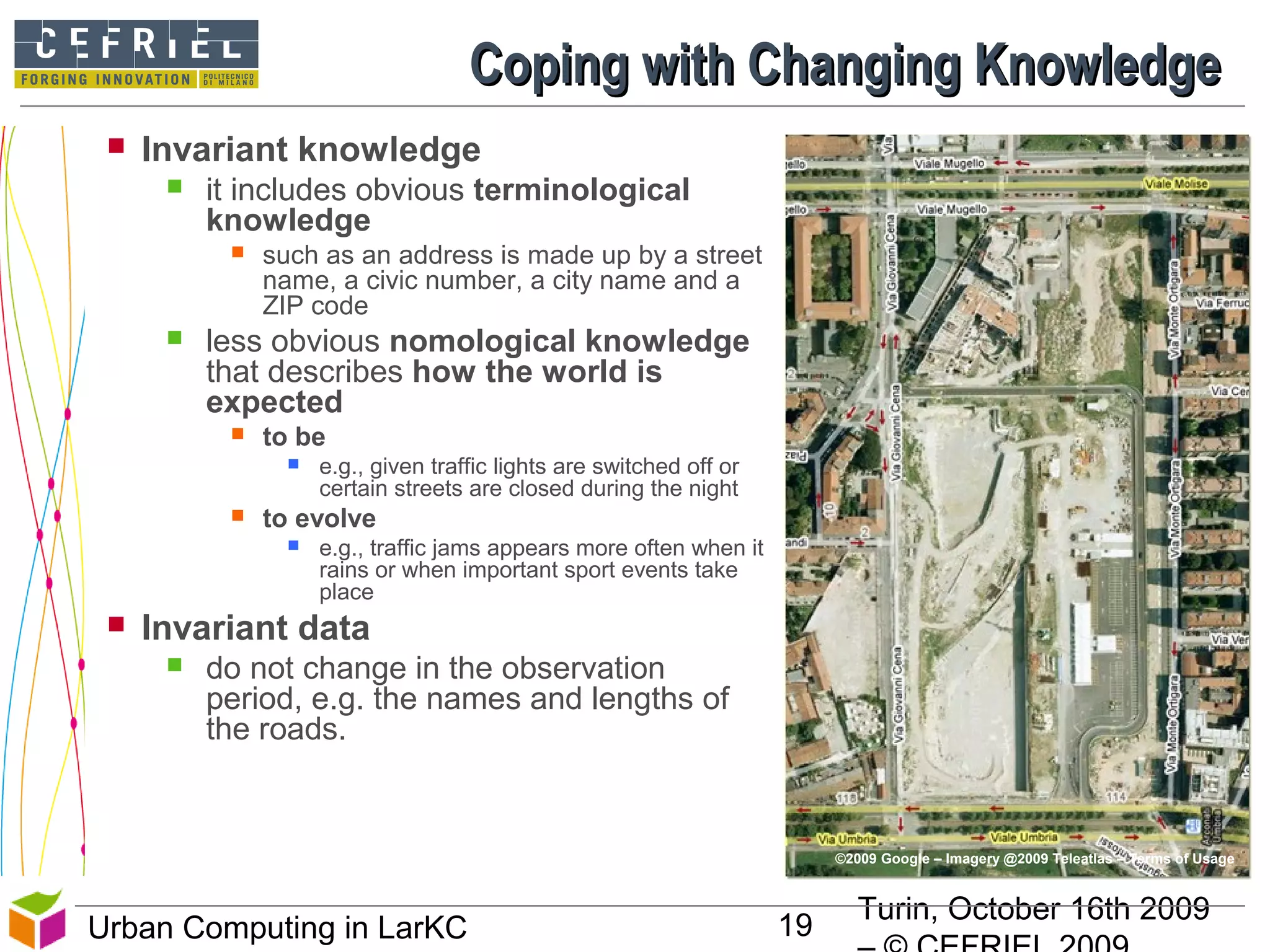
 Invariant knowledge
 it includes obvious terminological
knowledge
 such as an address is made up by a street
name, a civic number, a city name and a
ZIP code
 less obvious nomological knowledge
that describes how the world is
expected
 to be
 e.g., given traffic lights are switched off or
certain streets are closed during the night
 to evolve
 e.g., traffic jams appears more often when it
rains or when important sport events take
place
 Invariant data
 do not change in the observation
period, e.g. the names and lengths of
the roads.
19
©2009 Google – Imagery @2009 Teleatlas – Terms of Usage
Turin, October 16th 2009
20Urban Computing in LarKC
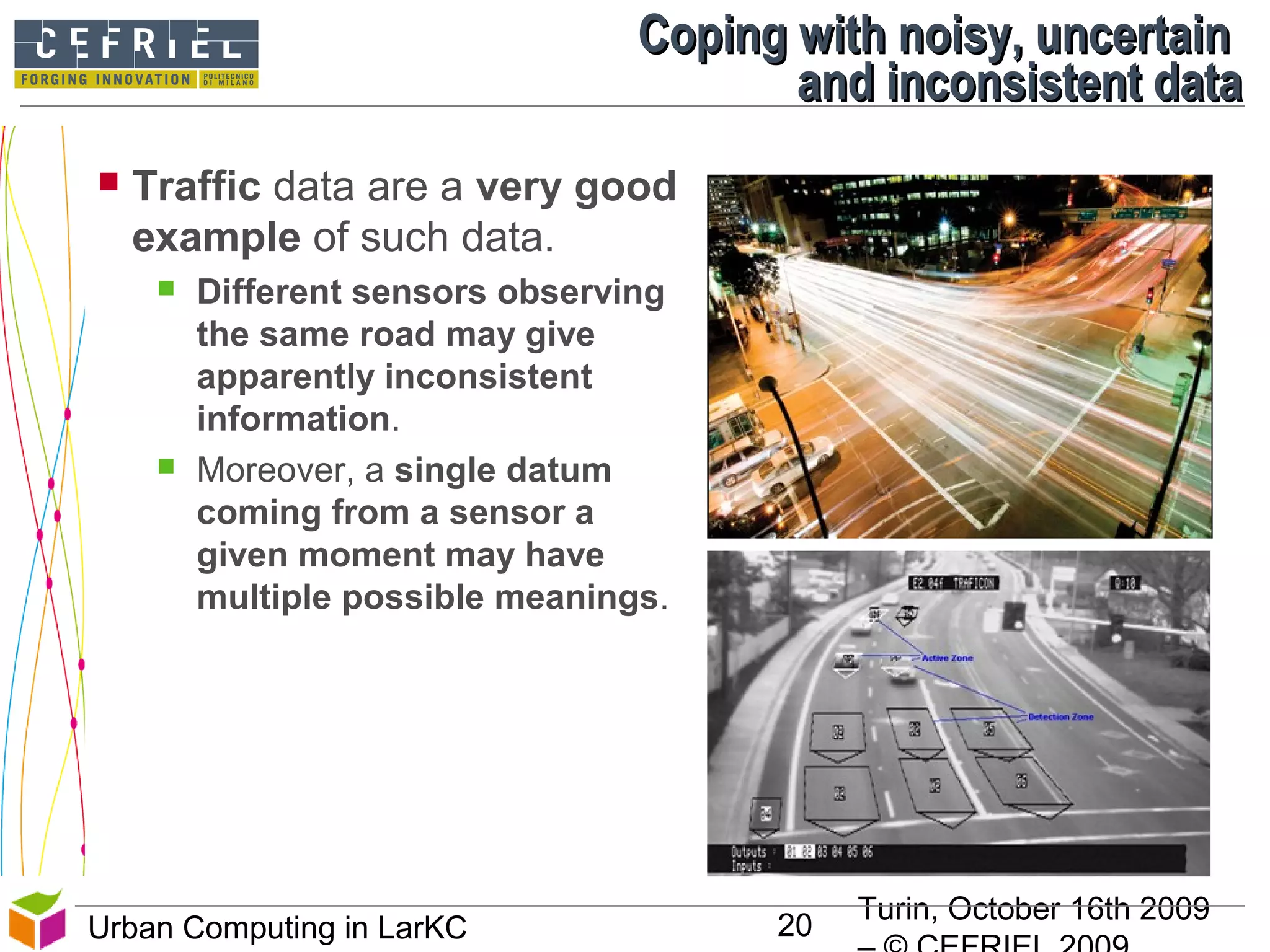
 Traffic data are a very good
example of such data.
 Different sensors observing
the same road may give
apparently inconsistent
information.
 Moreover, a single datum
coming from a sensor a
given moment may have
multiple possible meanings.
Coping with noisy, uncertainCoping with noisy, uncertain
and inconsistent dataand inconsistent data
Turin, October 16th 2009
21Urban Computing in LarKC
Coping with Data ScaleCoping with Data Scale
 The advent of Pervasive Computing and Web 2.0 technologies
led to a constantly growing amount of interconnected data
about urban environments
[source: http://senseable.mit.edu/nyte/]
Turin, October 16th 2009
22Urban Computing in LarKC
Usage Scenario of Alpha Urban LarKCUsage Scenario of Alpha Urban LarKC
 A user is in a (potentially unknown) city and would like to
organize a day/night of visiting some places, meeting friends,
attending a musical concert, etc.
 He needs to:
 Find interesting destinations:
 Monuments or relevant places in the city
 Events that take places in the city
 Understand the most suitable way to reach them
 To solve the problem today, the user would have to:
 use multiple applications, and
 manually pass intermediate results from a service to another
one
Turin, October 16th 2009
23Urban Computing in LarKC
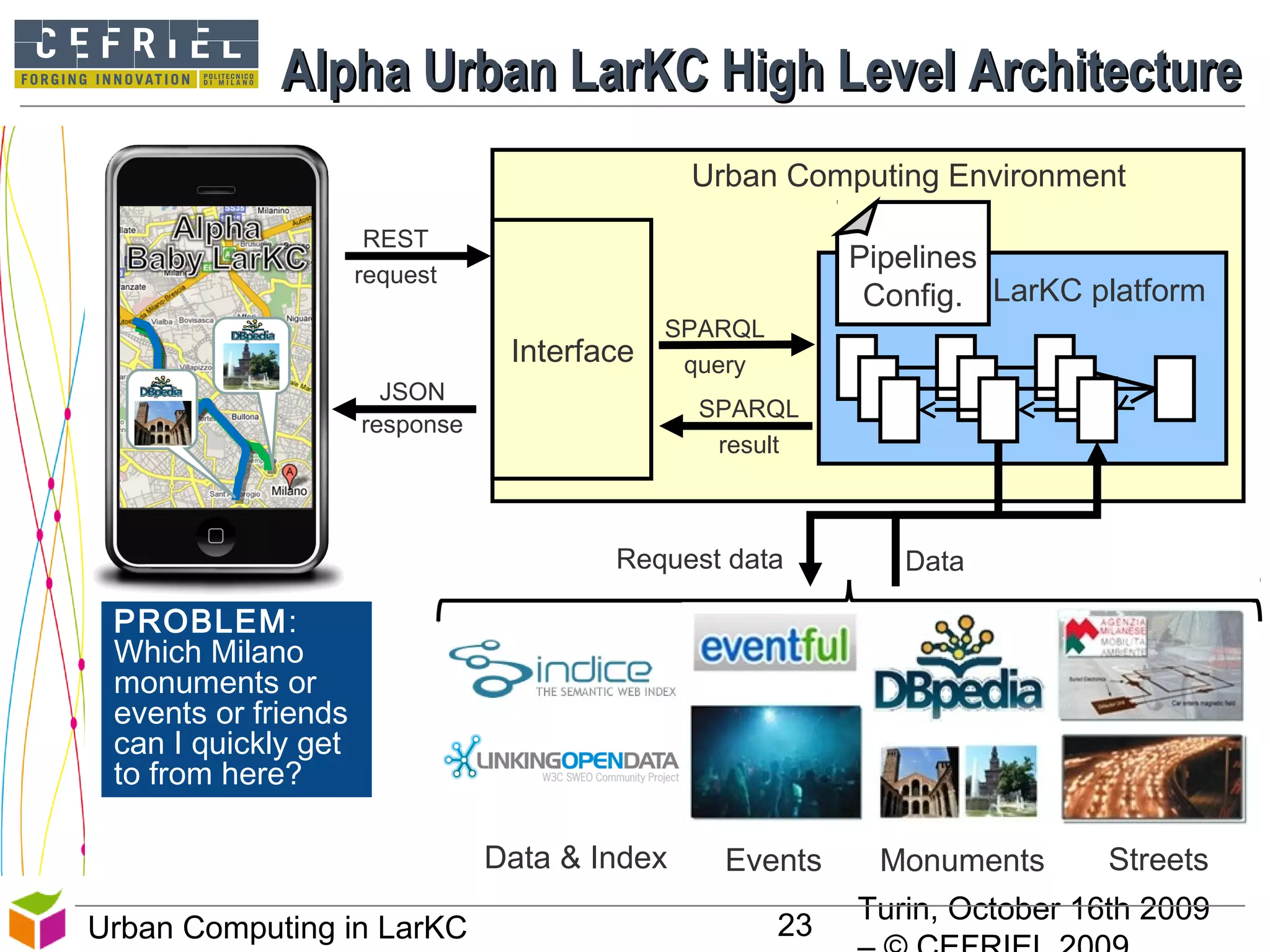
Alpha Urban LarKC High Level ArchitectureAlpha Urban LarKC High Level Architecture
LarKC platform
Interface
Urban Computing Environment
SPARQL
query
SPARQL
result
REST
request
JSON
response
Request data Data
Pipelines
Config.
PROBLEM:
Which Milano
monuments or
events or friends
can I quickly get
to from here?
StreetsMonumentsEventsData & Index
Turin, October 16th 2009
24Urban Computing in LarKC
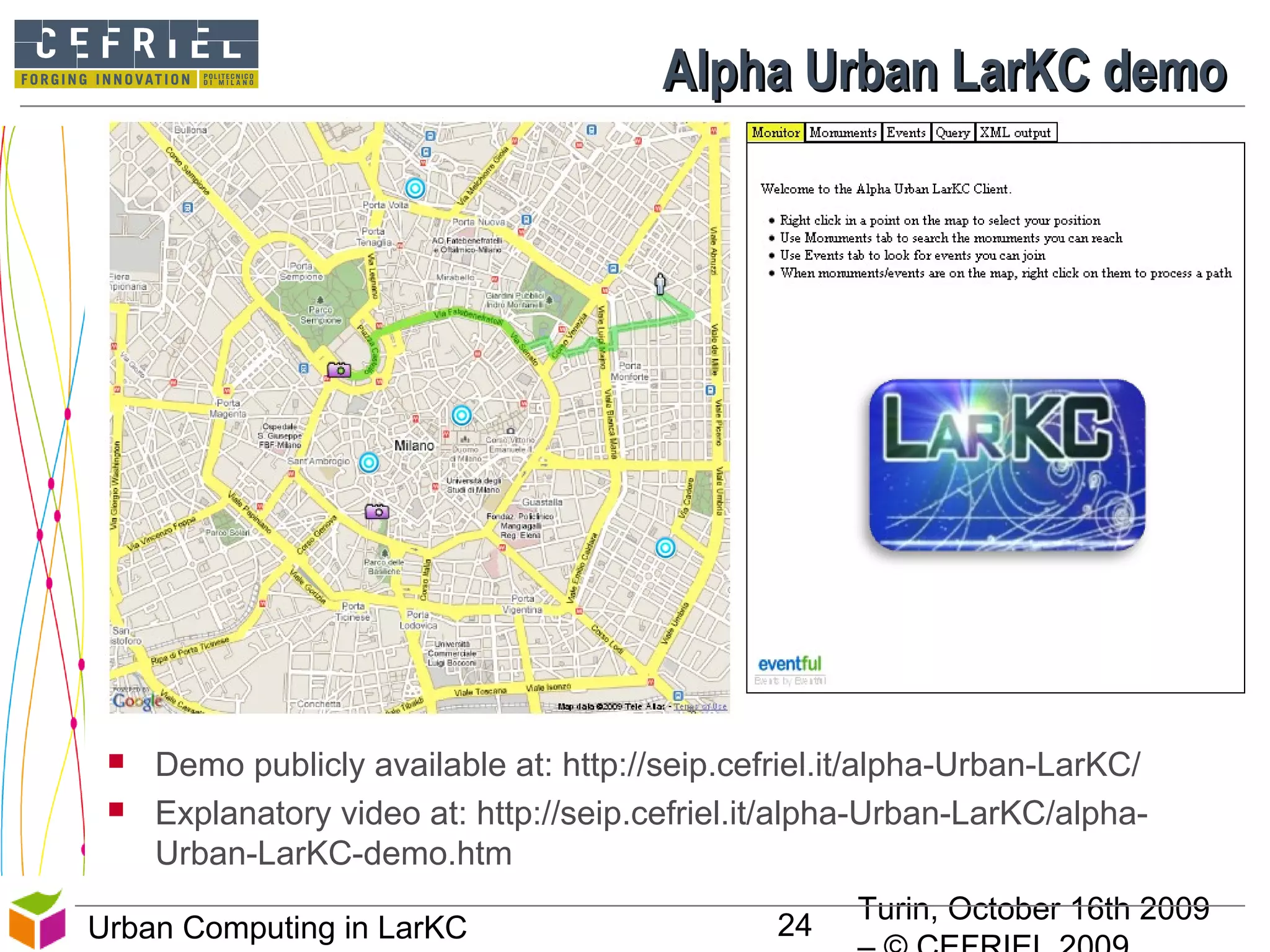
Alpha Urban LarKC demoAlpha Urban LarKC demo
 Demo publicly available at: http://seip.cefriel.it/alpha-Urban-LarKC/
 Explanatory video at: http://seip.cefriel.it/alpha-Urban-LarKC/alpha-
Urban-LarKC-demo.htm
Turin, October 16th 2009
25Urban Computing in LarKC
Much More to Come!Much More to Come!
Keep an eye on
http://wiki.larkc.eu/UrbanComputing
Urban Computing in LarKC
ITN – Infrastructure, Telematics and Navigation – Turin, October 15th
-16th
2009 - © CEFRIEL 2009
Thanks for your attention!
Irene Celino
email: irene.celino@cefriel.it
web: http://www.cefriel.it, http://swa.cefriel.it
Semantic Web Practice
CEFRIEL – ICT Institute – Politecnico di Milano

Urban Computing in LarKC

  • 1.
    Urban Computing inLarKC ITN – Infrastructure, Telematics and Navigation – Turin, October 15th -16th 2009 - © CEFRIEL 2009 Urban Computing in LarKC http://www.larkc.eu Irene Celino Project Manager – Senior Consultant – “Semantic Web & Web 3.0” Practice Coordinator CEFRIEL – ICT Institute – Politecnico di Milano
  • 2.
    Turin, October 16th2009 2Urban Computing in LarKC Cities Are AliveCities Are Alive  Cities born, grow, evolve like living beings.  The state of a city changes continuously, influenced by a lot of factors,  human ones: people moving in the city or extending it  natural ones: precipitations or climate changes 2 [source http://www.citysense.com]
  • 3.
    Turin, October 16th2009 3Urban Computing in LarKC Some Mobile Users’ QuestionSome Mobile Users’ Question  “Is public transportation where I am?”  “Is the event where I am the one that attract more people right now?”  “Where are all my friends meeting?”  “Is the traffic moving where I’m going?” 3
  • 4.
    Turin, October 16th2009 4Urban Computing in LarKC Urban Computing as an Answer to ThemUrban Computing as an Answer to Them 4
  • 5.
    Turin, October 16th2009 5Urban Computing in LarKC [source IEEE Pervasive Computing,July-September 2007 (Vol. 6, No. 3)] Urban ComputingUrban Computing The integration of computing, sensing, and actuation technologies into everyday urban settings and lifestyles.  Urban settings include, for example, streets, squares, pubs, shops, buses, and cafés - any space in the semipublic realms of our towns and cities.  Only in the last few years have researchers paid much attention to technologies in these spaces.  Pervasive computing has largely been applied  either in relatively homogeneous rural areas, where researchers have added sensors in places such as forests, vineyards, and glaciers  or, on the other hand, in small-scale, well-defined patches of the built environment such as smart houses or rooms.  Urban settings are challenging for experimentation and deployment, and they remain little explored 5
  • 6.
    Turin, October 16th2009 6Urban Computing in LarKC Dimension of Urban ComputingDimension of Urban Computing 6
  • 7.
    Turin, October 16th2009 7Urban Computing in LarKC Urban Computing Use Case in LarKCUrban Computing Use Case in LarKC 7
  • 8.
    Turin, October 16th2009 8Urban Computing in LarKC Data AvailabilityData Availability  Some years ago, due to the lack of data, Urban Computing looked like a Sci-Fi idea.  Nowadays, a large amount of the required information can be made available on the Internet at almost no cost. We are running a survey [1,2] and we have collected more than 50 sources of data:  maps (Google, Yahoo!, Wikimapia, OpenStreetMap),  events scheduled (Eventful, Upcoming…),  voluntarily provided users location (Google Latitude),  mass presence and movements  multimedia data with information about location (Flickr…)  relevant places (schools, bus stops, airports...)  traffic information (accidents, problems of public transportation...)  city life (job ads, pollution, health care...) [1] http://wiki.larkc.eu/UrbanComputing/ShowUsABetterWay [2] http://wiki.larkc.eu/UrbanComputing/OtherDataSources 8
  • 9.
    Turin, October 16th2009 9Urban Computing in LarKC Are Mashups the Solution?Are Mashups the Solution? 9 [source: http://www-01.ibm.com/software/lotus/products/mashups/ ] IBM Lotus Mashups [source: http://editor.googlemashups.com ] [source: http://pipes.yahoo.com/pipes/ ] [source: http://www.popfly.com/ ] [source: http://openkapow.com/ ]
  • 10.
    Turin, October 16th2009 10Urban Computing in LarKC Mashups offer powerful visualization toolsMashups offer powerful visualization tools 10 Google Charts API http://code.google.com/apis/chart/http://maps.google.it/ http://maps.yahoo.com/ MIT Simile Timeline & Timeplot http://simile.mit.edu/timeline/ http://simile.mit.edu/timeplot/
  • 11.
    Turin, October 16th2009 11Urban Computing in LarKC …… and simple programming abstractionsand simple programming abstractions 11
  • 12.
    Turin, October 16th2009 12Urban Computing in LarKC Not Everything Boils Down to PlumbingNot Everything Boils Down to Plumbing 12
  • 13.
    Turin, October 16th2009 13Urban Computing in LarKC Requirements for Mobile Data MashupsRequirements for Mobile Data Mashups  Urban Computing encompass sensing, actuation and computing requirements.  Many previous work in the area of Pervasive and Ubiquitous Computing investigated requirements in sensing, actuation, and several aspects of computation (from hardware to software, from networks to devices)  In LarKC we focus on Knowledge Representation and Reasoning requirements  Hereafter we exemplify the need to cope with  representational, reasoning, and defaults heterogeneity  scale  time-dependency  noisy, uncertain and inconsistent data 13
  • 14.
    Turin, October 16th2009 14Urban Computing in LarKC Coping with representational heterogeneityCoping with representational heterogeneity  It is an obvious requirement  data always come in different formats (syntactic and structural heterogeneity)  the problem of merging and aligning data is a structural problem of system interoperability  while the perfect “one-size-fit-all” solution does not exist, a comprehensive array of partial solutions exit 14
  • 15.
    Turin, October 16th2009 15Urban Computing in LarKC Coping with multiple reasoning paradigmsCoping with multiple reasoning paradigms precise and vs. approximate consistent inference reasoning [ source http://senseable.mit.edu/ ]
  • 16.
    Turin, October 16th2009 16Urban Computing in LarKC Open World vs. Closed World Assumption Assumption [source: http://gizmodo.com/photogallery/trafficsky/1003143552 ] Supporting Heterogeneity 1/2Supporting Heterogeneity 1/2
  • 17.
    Turin, October 16th2009 17Urban Computing in LarKC Unique Name Assumption in multiple models representing reality at different granularities 1 2 29 30 L3L3 Supporting Heterogeneity 2/2Supporting Heterogeneity 2/2
  • 18.
    Turin, October 16th2009 18Urban Computing in LarKC  Nature of changing data  Periodically changing data  Pure periodic law  Probabilistic law  Event driven changing data  Mean time between changes  Slow  Medium  Fast Coping with Changing DataCoping with Changing Data
  • 19.
    Turin, October 16th2009 19Urban Computing in LarKC Coping with Changing KnowledgeCoping with Changing Knowledge  Invariant knowledge  it includes obvious terminological knowledge  such as an address is made up by a street name, a civic number, a city name and a ZIP code  less obvious nomological knowledge that describes how the world is expected  to be  e.g., given traffic lights are switched off or certain streets are closed during the night  to evolve  e.g., traffic jams appears more often when it rains or when important sport events take place  Invariant data  do not change in the observation period, e.g. the names and lengths of the roads. 19 ©2009 Google – Imagery @2009 Teleatlas – Terms of Usage
  • 20.
    Turin, October 16th2009 20Urban Computing in LarKC  Traffic data are a very good example of such data.  Different sensors observing the same road may give apparently inconsistent information.  Moreover, a single datum coming from a sensor a given moment may have multiple possible meanings. Coping with noisy, uncertainCoping with noisy, uncertain and inconsistent dataand inconsistent data
  • 21.
    Turin, October 16th2009 21Urban Computing in LarKC Coping with Data ScaleCoping with Data Scale  The advent of Pervasive Computing and Web 2.0 technologies led to a constantly growing amount of interconnected data about urban environments [source: http://senseable.mit.edu/nyte/]
  • 22.
    Turin, October 16th2009 22Urban Computing in LarKC Usage Scenario of Alpha Urban LarKCUsage Scenario of Alpha Urban LarKC  A user is in a (potentially unknown) city and would like to organize a day/night of visiting some places, meeting friends, attending a musical concert, etc.  He needs to:  Find interesting destinations:  Monuments or relevant places in the city  Events that take places in the city  Understand the most suitable way to reach them  To solve the problem today, the user would have to:  use multiple applications, and  manually pass intermediate results from a service to another one
  • 23.
    Turin, October 16th2009 23Urban Computing in LarKC Alpha Urban LarKC High Level ArchitectureAlpha Urban LarKC High Level Architecture LarKC platform Interface Urban Computing Environment SPARQL query SPARQL result REST request JSON response Request data Data Pipelines Config. PROBLEM: Which Milano monuments or events or friends can I quickly get to from here? StreetsMonumentsEventsData & Index
  • 24.
    Turin, October 16th2009 24Urban Computing in LarKC Alpha Urban LarKC demoAlpha Urban LarKC demo  Demo publicly available at: http://seip.cefriel.it/alpha-Urban-LarKC/  Explanatory video at: http://seip.cefriel.it/alpha-Urban-LarKC/alpha- Urban-LarKC-demo.htm
  • 25.
    Turin, October 16th2009 25Urban Computing in LarKC Much More to Come!Much More to Come! Keep an eye on http://wiki.larkc.eu/UrbanComputing
  • 26.
    Urban Computing inLarKC ITN – Infrastructure, Telematics and Navigation – Turin, October 15th -16th 2009 - © CEFRIEL 2009 Thanks for your attention! Irene Celino email: irene.celino@cefriel.it web: http://www.cefriel.it, http://swa.cefriel.it Semantic Web Practice CEFRIEL – ICT Institute – Politecnico di Milano

Editor's Notes

  • #16 It was too much text (original below) It means the systems allow for multiple reasoning paradigms; e.g. precise and consistent inference for telling that at a given junction all vehicles, but public transportation ones, must go straight approximate reasoning when calculating the probability of a traffic jam given the current traffic conditions and the past history.
  • #17 I dropped the second level sentence which was: While for the an entire city we cannot assume complete knowledge, for a time table of a bus station we can Change the first image with something else???
  • #18 I dropped the second level sentence which was: A square with several station for buses and subway can be considered a unique point for multimodal travel planning, but not when the problem is giving direction in that square to a pedestrian
  • #19 I completely changed the text which was: Periodically changing data change according to a temporal law that can be Pure periodic law, e.g. every night at 10pm Milano overpasses close. Probabilistic law, e.g. traffic jam appear in the west side of Milano due to bad weather or when San Siro stadium hosts a soccer match. Event driven changing data are updated as a consequence of some external event. They can be further characterized by the mean time between changes: Slow, e.g. roads closed for scheduled works Medium, e.g. roads closed for accidents or congestion due to traffic Fast, e.g. the intensity of traffic for each street in a city
  • #22 Change the image with something else??? I changed the text which was: Although we encounter large scale data which are not manageable, it does not necessary mean that we have to deal with all of the data simultaneously. Usually, only very limited amount data are relevant for a single query/processing at a specific application.