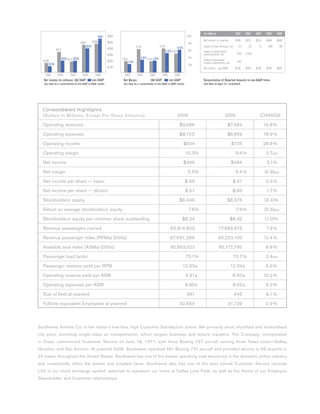
(in millions) 2002 2003 2004 2005 2006
$600 10%
$587
Net income, as reported $188 $372 $215 $484 $499
$499 $500
$484 8%
(7) (2) 11 (59) 88
$425 6.4% Impact of fuel contracts, net
6.3% 6.5%
$400
$372 6%
5.6% 5.5% Impact of government
- -
-
(25) (144)
grant proceeds, net
$300
3.8% 3.3% 3.5% 4%
$226 $215 $226 3.4% Impact of passenger
$188 $200 - - - -
(18)
2.5% revenue adjustments, net
$138 2%
$100 $226 $226 $425 $587
$138
Net income – non-GAAP
2002 2003 2004 2005 2006 2002 2003 2004 2005 2006
non-GAAP
GAAP non-GAAP
GAAP
Net Income (in millions) Net Margin Reconciliation of Reported Amounts to non-GAAP Items
(See Note on page 15.) (unaudited)
See table for a reconciliation of non-GAAP to GAAP results. See table for a reconciliation of non-GAAP to GAAP results.
Consolidated Highlights
2006 2005 CHANGE
(D ollar s I n M illions , E xc ept Per S hare A mounts)
Operating revenues $9,086 $7,584 19.8 %
Operating expenses $8,152 $6,859 18.9 %
Operating income $934 $725 28.8 %
Operating margin 10.3% 9.6 % 0.7pts.
Net income $499 $484 3.1%
Net margin 5.5% 6.4 % (0.9)pts.
Net income per share — basic $.63 $.61 3.3 %
Net income per share — diluted $.61 $.60 1.7 %
Stockholders’ equity $6,449 $6,675 (3.4)%
Return on average stockholders’ equity 7.6% 7.9 % (0.3)pts.
Stockholders’ equity per common share outstanding $8.24 $8.32 (1.0)%
Revenue passengers carried 83,814,823 77,693,875 7.9 %
Revenue passenger miles (RPMs) (000s) 67,691,289 60,223,100 12.4 %
Available seat miles (ASMs) (000s) 92,663,023 85,172,795 8.8 %
Passenger load factor 73.1% 70.7 % 2.4pts.
Passenger revenue yield per RPM 12.93 ¢ 12.09 ¢ 6.9 %
Operating revenue yield per ASM 9.81 ¢ 8.90 ¢ 10.2 %
Operating expenses per ASM 8.80 ¢ 8.05 ¢ 9.3 %
Size of fleet at yearend 481 445 8.1 %
Fulltime equivalent Employees at yearend 32,664 31,729 2.9 %
Southwest Airlines Co. is the nation’s low-fare, high Customer Satisfaction airline. We primarily serve shorthaul and mediumhaul
city pairs, providing single-class air transportation, which targets business and leisure travelers. The Company, incorporated
in Texas, commenced Customer Service on June 18, 1971, with three Boeing 737 aircraft serving three Texas cities—Dallas,
Houston, and San Antonio. At yearend 2006, Southwest operated 481 Boeing 737 aircraft and provided service to 63 airports in
32 states throughout the United States. Southwest has one of the lowest operating cost structures in the domestic airline industry
and consistently offers the lowest and simplest fares. Southwest also has one of the best overall Customer Service records.
LUV is our stock exchange symbol, selected to represent our home at Dallas Love Field, as well as the theme of our Employee,
Shareholder, and Customer relationships.
SOUTHWEST AIRLINES CO. ANNUAL REPORT 2006
New Departures. New Destinations. New Directions.
2006 marks Southwest Airlines’ 35th Anniversary, a signal of new departures, new destinations, and new
directions. With the repeal of the Wright Amendment, the skies over Dallas Love Field are finally
open to new departures to great cities beyond Texas and its neighboring states. There are exciting
upgrades being planned for Love Field as well. We opened two new destinations this year, Denver
and Washington Dulles, and returned significant service to hurricane-ravaged New Orleans. Our expansion
at Chicago Midway catapulted it to our #2 airpor t systemwide. We are confidently looking
ahead to new directions for our airline, our Customers, and our People in the coming years, directions
designed to allow Southwest Airlines to prosper as we continue to give America the Freedom to Fly.
®
2 SOUTHWEST AIRLINES CO. ANNUAL REPORT 2006
To Our Shareholders:
In 2006, Southwest Airlines recorded its 34th consecutive year of profitability, a record unmatched in commercial
airline history.
Our 2006 GAAP profit was $499 million, or $.61 per diluted share, compared to $484 million, or $.60 per
diluted share, for 2005.
Each year includes unrealized gains or losses and other items as required by Statement of Financial Accounting
Standard 133, related to our successful fuel hedging activities. Excluding these items ($88 million in losses in
2006 and $59 million in gains in 2005) produces a year-over-year profit increase of 38.1 percent and per diluted
share increase of 34.0 percent.
Driving these increases was strong revenue growth coupled with excellent cost controls. The earnings growth
was achieved despite an almost 50 percent increase in hedged jet fuel prices per gallon in 2006 versus 2005.
Operating revenues grew 19.8 percent on capacity growth of 8.8 percent (as measured by Available Seat Miles).
Revenue growth was driven by strong, record load factors (73.1 percent in 2006 versus 70.7 percent in 2005) and
Performing Above & Beyond.
higher yield per passenger, up 6.9 percent year-over-year. The result was a 10.2 percent increase in unit revenue
year-over-year, the strongest annual growth rate realized since 1992. An improving economy, driving stronger travel
demand, coupled with stable airline industry seat capacity combined to support strong revenue growth.
While revenue trends were softened by the August London terrorist threat and related carryon baggage
restrictions, such trends stabilized in fourth quarter 2006, resulting in a steady unit revenue growth rate of
4.2 percent. Based upon our January 2007 traffic and bookings to date, we expect 2007 first quarter year-over-year
unit revenue growth to exceed the prior year performance.
Our Employees did an excellent job providing outstanding Customer Service. Once again, Southwest placed
first in Customer Satisfaction, as measured by fewest Customer complaints reported to the Department of
Transportation (DOT) per passenger carried. It is, in large part, our People’s devotion to quality Customer Service
that has enabled Southwest to reach the point where it carries more passengers than any other U.S. airline, based
on the most recent DOT monthly statistics.
Our near-record 2006 unit revenue growth was achieved utilizing modest fare increases while maintaining our
Low-Fare Brand. As the Low-Fare Leader, we cherish our position in the U.S. industry as the Low-Cost Producer.
This position is a major element of our preparedness for bad times in the airline business and a major reason we
have remained the lone profitable airline throughout the entirety of the worst five-year period in airline history. In
addition, we have a strong “A Rated” balance sheet with only modest debt levels; substantial liquidity in the form
of cash on hand plus a $600 million fully available bank line of credit; and the best jet fuel price protection in
the airline industry. Coming into 2006, we had fuel derivative contracts in place for over 70 percent of our 2006
expected jet fuel needs at $36 per barrel, which saved us $675 million from cash settlements of these contracts.
We also have substantial hedging positions over the next three years at roughly $50 per barrel, providing us ample
protection against jet fuel price spikes, albeit at higher prices than during the last several years. These positions
also allow us to benefit from energy price decreases.
Our Employees have worked extremely hard to mitigate our fuel cost increases: first, by providing the best
airline Customer Service in the business; and second, by controlling the rest of our operating cost structure. For
the fourth year in a row, our People further improved their productivity and the overall efficiency of Southwest
Airlines, achieving constant unit costs with 2005 (excluding fuel). On the heels of 2004 and 2005, where we
3
SOUTHWEST AIRLINES CO. ANNUAL REPORT 2006
achieved unit cost reductions, this was an exceptional performance.
It was even more impressive considering we carried record
numbers of Customers and record numbers of checked bags.
This was all accomplished with pay increases and not pay cuts,
furloughs, or layoffs.
Last year was exciting in terms of our route network expansion.
We started 2006 in grand style by reinaugurating service to Denver
on January 3. Starting with 13 daily departures, Denver has been one
of our fastest new city startups ever, now at 33 daily departures.
In October, we initiated service to Washington Dulles Airport
in Northern Virginia, located in one of the United States’ fastest
growing regions. We are off to a great start and very excited about
our growth potential from that airport and region.
And last, but certainly not least, there is the Reform of the Wright
Amendment, which finally starts to free Dallas Love Field after
27 years of federal restraint. Under the Reform law, we were allowed
to immediately begin offering through and connecting service beyond
the nine Wright Amendment states, generating an incremental
$11 million in revenue in fourth quarter 2006 alone. In 2014, the
law permits us to offer nonstop service from Dallas Love Field to any
domestic destination. Almost two years to the day from when we
started our legislative efforts, Love Field is liberated. Hallelujah!
In 2007, we presently plan to add 37 new Boeing 737s to our
fleet of 481 aircraft (as of December 31, 2006). That will produce
an estimated eight percent increase in Available Seat Miles. We
are very excited about our growth prospects for 2007. Currently,
there is much speculation about airline industry consolidation. While
we have no plans to merge with or acquire any other carrier, we
are poised and well-positioned to consider any asset sales or route
reductions that might ensue from consolidation.
The spectacular improvements realized in 2006 were achieved
solely by the efforts and resolve of our Employees. The results belie
the significant challenges that they faced and overcame. They are the
reason that FORTUNE magazine, for the tenth year in a row, named
Southwest Airlines one of America’s Most Admired Companies.
They are the reason we are optimistic and confident about the future
of Southwest Airlines. They are, simply, the best.
January 17, 2007
Gary C. Kelly Colleen C. Barrett Herbert D. Kelleher
Chief Executive Officer President Chairman of the Board
SOUTHWEST AIRLINES CO. ANNUAL REPORT 2006
5
SOUTHWEST AIRLINES CO. ANNUAL REPORT 2006
For 2006, Southwest posted its 34th consecutive year of profitability, which is a
record unmatched in the airline industry. Despite almost 50 percent higher jet fuel
prices versus 2005 and the adverse impact of the August 2006 London terrorist
plot and related carryon restrictions, our annual profits (economic) were up nearly
40 percent. Following what has been the most difficult five-year period in airline history,
Construction crew building giant
the industry in 2006 reported its first collective operating profit since before the unknown structure.
New Departures: Repeal Of The Wright Amendment.
events of September 11, 2001. In 2006, overall domestic seat capacity declined for the
first time since 2002. Through reorganizations both inside and outside of bankruptcy,
major carriers have reduced unprofitable capacity, and several smaller airlines have
ceased operations entirely.
Giant cranes lift new structure to
As a result of the decline in unprofitable seat capacity in the U.S., the pricing vertical position.
environment throughout much of 2006 was favorable. The industry steadily raised fares
throughout the year in an attempt to offset significantly higher fuel costs. Although
Southwest has the best fuel hedge program in the industry, we also faced significantly
higher fuel costs, with year-over-year jet fuel costs per gallon up almost 50 percent
versus 2005. Despite an $800 million increase in fuel costs, we significantly exceeded
our goal to increase economic earnings per diluted share by at least 15 percent with only
Stop signs above the clouds.
VO: Why stop Southwest Airlines from flying
modest fare increases, due largely to the excellent cost-control efforts of our Employees. nonstop from Dallas Love Field?
The Company’s 2006 earnings growth represented an enormous accomplishment.
Coming into 2006, our goal of 15 percent earnings growth was one that few outside of
Southwest believed was possible to achieve. However, our People believed and, once
again, demonstrated that they are the best and will do whatever is necessary to stay on
top in the brutally competitive and difficult airline industry. Over the past five years, our
Employees have adapted to significant changes in airport security and continue to
GARY: Enough is enough. Southwest Airlines
and the people of Dallas deserve better.
innovate and implement the changes necessary to secure our future and protect our
Low-Cost Leadership. Although the legacy carriers have lowered their cost structures
through bankruptcy, furloughs, wage concessions, and other actions, their unit costs
(adjusted for stage length) remain substantially above ours, including and excluding fuel.
Our People have democratized the skies with low fares and understand low costs are
the key to our enduring success in the airline business and the only way we can provide
our Customers the Freedom to Fly. The Wright Amendment is outdated, and its
repeal is long overdue.
9.0¢ 6.7¢ 2002 2003 2004 2005 2006
6.67¢
8.80¢
Passenger Revenues $5,341 $5,741 $6,280 $7,279 $8,750
8.6¢ 6.6¢
6.59¢
49% 54% 59% 65% 70%
Internet
8.05¢ 6.49¢
8.2¢ 6.5¢
6.48¢
7.97¢
Reservations Center 19% 18% 15% 12%
20%
6.41¢
7.8¢ 6.4¢
7.74¢
7.52¢ 20% 16% 13% 11% 11%
Travel Agency
7.4¢ 6.3¢
11% 11% 10% 9% 7%
Other
2002 2003 2004 2005 2006 2002 2003 2004 2005 2006 So go to SetLoveFree.com today and support
Operating Expenses Per Available Seat Mile Operating Expenses Per Available Seat Mile Passenger Revenues (in millions) and Distribution Method the Freedom to Fly.
Excluding Fuel and Related Taxes
6 SOUTHWEST AIRLINES CO. ANNUAL REPORT 2006
For more than 35 years, Southwest’s number one priority has been to profitably provide our Customers the Freedom to
Fly. While many of our competitors reduced capacity in 2006, we continued to profitably expand with the addition of
36 Boeing 737-700 aircraft, growing capacity by almost nine percent and ending the year with nearly 3,200 daily departures.
Since we currently serve only 63 airports, opportunities to grow our existing network remain plentiful. In 2006, we added two
new destinations—Denver and Washington Dulles—and we are pleased with the Customer response to our service. Denver was
opened in January 2006 with 13 daily flights, and we ended the year with 33 daily flights, increasing capacity 150 percent in
New Destinations: Denver, Washington & Beyond.
less than a year. We started service to Washington Dulles in October 2006 with 12 daily flights to four nonstop markets. We
also recently announced our intent to resume service at San Francisco International Airport (SFO) in early fall 2007. We are
very pleased with the operational improvements at SFO, making it a more cost-efficient airport than it was when we ceased
service in 2001. We have a 70 percent market share position in intra-California and are excited to serve all major Bay Area
airports with our return to SFO.
We are also thrilled about our new opportunities to grow in Southwest’s hometown airport, Dallas Love Field. After
27 years, the Wright Amendment has finally been reformed, and we can now sell one-stop (same plane) and connecting
service between Dallas Love Field and destinations beyond Texas and eight nearby states: Alabama, Arkansas, Kansas,
Louisiana, Oklahoma, Mississippi, Missouri, and New Mexico (the Wright Amendment perimeter). For eight years, the
one-stop and connecting service will have to first land inside the Wright Amendment perimeter. In 2014, we can begin to add
nonstop service between Dallas Love Field and any airport we serve. Since the passage of the Wright Amendment Reform
Act in October 2006, Dallas traffic is already up 20 percent and incremental fourth quarter 2006 revenues were approximately
$11 million due to our ability to offer through-ticketing to our Customers. We will continue to optimize our Dallas Love Field
schedule and expect an annual revenue benefit of at least $50 million.
7
SOUTHWEST AIRLINES CO. ANNUAL REPORT 2006
We are pleased with our continued expansion at Chicago Midway and have increased 11:40
11:34
11:30
capacity there nearly 70 percent since first quarter 2004. In less than three years, Chicago 11:25
11:20 11:20
has grown to be our second-largest city with 218 daily departures, behind only Las Vegas. 11:12
11:10
11:09
We also continue to grow Philadelphia, which is currently at 65 daily departures. Recent new 11:00
destinations Pittsburgh and Ft. Myers continue to expand and are at 20 and ten daily departures, 2002 2003 2004 2005 2006
Aircraft Utilization (hours and minutes per day)
respectively. Southwest also remains committed to expand our service in New Orleans as the
500
481
city continues to recover from the hurricanes in August and September 2005. We are currently 445
417
388 400
375
up to 26 daily departures and plan to add service as demand dictates. Through our codeshare 300
200
with ATA Airlines, we continue to add connecting service through Chicago, Phoenix, Las Vegas,
100
Houston, and Oakland to destinations such as Honolulu, Kauai, Kona, Maui, New York’s
2002 2003 2004 2005 2006
LaGuardia Airport, and Washington D.C.’s Reagan National Airport. Fleet Size (at yearend)
11:40
11:34
11:30
11:25
11:20 11:20
11:12 2010-
2009 11:10 Total
2007 2008
11:09 2012
11:00
37 30 18 30
Firm Orders 115
2002 2003 2004 – 2005 4 2006 18 92
Options 114
Aircraft Utilization (hours and minutes –per day)
Purchase Rights – 54 54
–
37 36
176 283
34
Total
500
481
445
417
Boeing 737-700 Firm Orders,
388 400
375 Options, and Purchase Rights
300
200
100
2002 2003 2004 2005 2006
Fleet Size (at yearend)
Our frequent flights and expansive route system offer our Customers convenience and Southwest Airlines added Denver
International and Washington Dulles
reliability with lots of options to get where they want to go when they want to get there. We airports in 2006, part of a carefully
planned expansion of our coast-to-
also have numerous other opportunities to expand our network and plan to grow capacity by
coast service.
approximately eight percent in 2007 with 37 737-700 deliveries from Boeing. Our 2008–2012
future Boeing orders include 78 firm orders, 114 options, and 54 purchase rights.
2010- Total
2007 2008 2009
Low Fares. Low Costs. Financial Strength. 2012
37 30 18 30
Firm Orders 115
Southwest is the airline that made air travel affordable for Americans, and we are committed
4 18 92
Options 114
–
to low fares and high-quality Customer Service. In fact, we believe our future has never been Purchase Rights 54 54
– – –
37 36 176 283
34
Total
brighter. We increased traffic by 12.4 percent in 2006 and carried approximately 84 million
Boeing 737-700 Firm Orders,
Customers. As a result of our strong brand, low fares, frequent flights, and excellent Customer Options, and Purchase Rights
8 SOUTHWEST AIRLINES CO. ANNUAL REPORT 2006
Service, we are now the largest U.S. carrier in fewer flights than most other Major airlines during
terms of passengers carried (based on the most that period. Our Employees take great pride in
recent figures released by the U.S. Department being the best in the industry, and Customer
of Transportation’s Bureau of Transportation Service is far more than our smile. Our People
statistics). We consistently rank first in market consistently go the extra mile to deliver friendly
share in approximately 90 percent of our top 100 city and caring Customer Service. Our Customers
pairs and in the aggregate hold 65 percent of the know they can consistently count on us for low,
total market share in those markets. friendly fares. Our loyal Customers know we care
Southwest consistently had the Highest and that low fares exist in the marketplace
Customer Satisfaction and the Best Ontime because of Southwest Airlines.
Performance ranking of all Major airlines during In addition to low fares, we have a generous,
2006, based on statistics published in Department award-winning Rapid Rewards program,
of Transportation reports. We also cancelled which is widely recognized by Customers
In 2006, Southwest Airlines increased our
gates by almost 50 percent at Chicago Midway,
now our #2 airport in terms of daily departures
systemwide. Chicago Midway remains a shining
example of our unwavering promise:
You are now free to move about the country.
9
SOUTHWEST AIRLINES CO. ANNUAL REPORT 2006
and industry watchers as the simplest and most lucrative frequent flyer program in the airline industry. In 2006, our program
was honored with the top loyalty program award — Program of the Year — at InsideFlyer magazine’s 18th annual Freddie
Awards ceremony. Rapid Rewards also received first place awards for Best Award Redemption, Best Web Site, Best Award,
and for the eighth straight year, Best Bonus Promotion. In addition to earning credits by flying on Southwest, members can
also earn credits by doing business with the program’s Preferred Partners and via Southwest’s codeshare with ATA Airlines.
In addition to our own robust network, Rapid Rewards Members may also redeem Rapid Rewards Awards for travel to and
from Hawaii through our codeshare with ATA Airlines.
Low costs are essential to profitably offer low fares and generous Rapid Rewards. We have a low-cost business model
that airlines across the globe have attempted to emulate. Our proven model was instituted largely by strategic decisions
made early in our history to fly a single aircraft type; operate an efficient point-to-point route system; and utilize our assets
in a highly efficient manner. However, our low costs are preserved through the hard work, creativity, and high spirits of our
People. Our People continue to innovate and improve our efficiency, which is why Business Week magazine named Southwest
as one of the world’s top 25 Most Innovative Companies in 2006. Our 33,000 Employees are also the reason no other airline
$9,086 9.81¢
$9,000 10.0¢
$8,000 9.5¢
$7,584
8.90¢
$7,000 9.0¢
$6,530
8.50¢
$5,522 $5,937 $6,000 8.5¢
8.27¢
8.02¢
$5,000 8.0¢
$4,000 7.5¢
2002 2003 2004 2005 2006 2002 2003 2004 2005 2006
Operating Revenues (in millions) Operating Revenues Per Available Seat Mile
1.50
1.36 1.36
1.25
1.09
1.03
1.00
.88 .88
.75
.62
.52
.50
.40
.18 .25
CAL
LUV JBLU ALK AAI NWAC DAL AMR UAIR UAL
Customer Service (Complaints per 100,000 Customers boarded)
For the year ending December 31, 2006
10 SOUTHWEST AIRLINES CO. ANNUAL REPORT 2006
Passenger tries to open Passenger wants to recline seat. Sees Passenger tries to lower window shade, VO: Tired of being nickeled and dimed
overhead bin then notices coin slot, coin slot on armrest, deposits money. sees another coin slot. by other airlines?
puts in money to open it.
has been able to duplicate our success. At the end of 2006, our fulltime equivalent Employees per aircraft of 68 represented
the lowest level since 1972.
In addition to being the most productive airline of any Major U.S. carrier, Southwest has the best fuel hedge program in
the airline industry. Since 2000, the Company has saved more than $2 billion in fuel costs through our fuel hedge program.
Although we currently expect fuel headwinds in 2007 of more than $400 million, we have insured ourselves against further
Southwest Airlines returned
significant service in 2006 to
hurricane-ravaged New Orleans.
Our commitment to help rebuild
and renew this great American
city is unwavering. We were the
last airline to leave New Orleans
during the natural disaster and
the first airline to return full-
time service. We will continue
to add flights as more and more
Americans return to laissez les
bon temps rouler!
catastrophic energy price increases by putting fuel derivative contracts in place for about 95 percent of our 2007 expected
jet fuel needs at $50 per barrel of crude oil. We also have protection in 2008 with fuel derivative contracts for 65 percent of
our anticipated fuel needs at $49 per barrel. We continue to opportunistically build positions for future years and currently
have fuel derivative contracts in place for 50 percent of expected fuel needs at $51 per barrel in 2009; more than
25 percent at $63 per barrel in 2010; 15 percent at $64 per barrel in 2011; and 15 percent at $63 per barrel in 2012.
In addition to fuel price protection, Southwest is working hard to reduce fuel consumption. We have installed blended
winglets on our entire 737-700 fleet and plan to install winglets on a significant portion of our 737-300 fleet, beginning in
first quarter 2007.
As a result of prudent risk management, conservative planning, and discipline, our balance sheet has never been stronger.
After the five most difficult years in the airline industry, we continue to retain an investment-grade credit rating and have
ample liquidity and access to capital. We ended 2006 with $1.8 billion in cash, including shortterm investments, and have a
fully available unsecured revolving credit line of $600 million. We also had approximately $600 million in cash deposits at
Boeing for future aircraft deliveries. Our unmortgaged assets have a value of more than $9 billion, and our debt to total
capital is under 35 percent, including aircraft leases as debt.
11
SOUTHWEST AIRLINES CO. ANNUAL REPORT 2006
BOY: Is this your first flight? VO: On Southwest Airlines our leather ...and smiles are always free. SFX: DING
seats, blankets, pillows, snacks... VO: You are now free to move about
the country.
While our number one priority is to profitably grow our route system, we also have opportunities to optimize our capital
structure to further enhance Shareholder value. In 2006, your Board authorized stock repurchase programs totaling
$1 billion. During 2006, Southwest repurchased $800 million of common stock through these programs, representing more
than 49 million common shares. Southwest was named one of America’s “Most Shareholder Friendly” companies, and was
recognized for the “Top Performing CEO” in the airline industry by Institutional Investor magazine. And Fortune magazine
picked Southwest Airlines as one of its top ten stock picks for 2007.
Although we have fuel and other cost pressures in 2007, we will continue our efforts to improve productivity and improve
revenue production. We have a stated goal in 2007 to grow economic earnings per diluted share 15 percent compared to
2006. We are evaluating several untapped revenue opportunities to offset higher expected fuel costs and minimize the need
for fare increases. We are dedicated to our Low-Fare Brand, and we are a true Low-Cost Carrier. However, our low-cost
New Directions: The Future Looks Very Bright.
business model does not keep us from providing competitive compensation packages to our People, and we are widely
recognized as one of the best places to work in America. We also operate a young, efficient fleet, ending 2006 with 481 Boeing
737 aircraft. Our fleet consists of 194 -300s, 25 -500s and 262 -700s. Each one of our aircraft has all-leather interiors and
specially designed seats, which provide our Customers more comfort.
We are excited about 2007 and remain confident in our future because we have the best Employees in America. Our
Employees are passionate about our mission to provide America the Freedom to Fly, and for more than 35 years they have
demonstrated that they genuinely care about our Customers, the communities we serve, and our Shareholders. It is that
passion that has made Southwest one of the most respected brands in America. For the tenth straight year, Southwest was
recognized in 2006 by Fortune magazine as one of America’s Most Admired Companies.
While no one knows what the
future of air travel may look like,
two things are certain: It will be
exciting, and Southwest Airlines
will remain at the forefront of
giving America the Freedom to
Fly. We may see new kinds of
airplanes, new kinds of airports,
even new kinds of airlines.
Whatever the future holds, our
Employees, our Customers, and
our Shareholders can rest
assured that Southwest Airlines
will continue to lead the way in
low-cost flying.
12 SOUTHWEST AIRLINES CO. ANNUAL REPORT 2006
Southwest’s Top Ten Airports — Daily Departures (at yearend)
California East
225 225 17% 30%
218
207 Other Carriers
200 35%
Remaining West
175
173 26%
Midwest
Southwest
17%
65%
150
142
141
127
125 Heartland
118
10%
100 100
92
75 Southwest’s Market Share
Southwest’s Capacity By Region
Southwest’s top 100 city-pair markets
(at yearend)
Chicago
Baltimore/
Dallas Houston based on passengers carried (at yearend)
Los Angeles Oakland
Orlando Phoenix Las Vegas
San Diego Midway
Washington
Love Hobby
Seattle/Tacoma
Spokane
Portland
Manchester
(Boston Area)
Buffalo/
Niagara Falls
Boise Providence
Albany (Boston Area)
Hartford/Springfield
Detroit
Long Island/Islip
Pittsburgh Philadelphia
Cleveland
Chicago
Sacramento Reno/Tahoe Omaha (Midway)
Salt Lake City
Baltimore/Washington (BWI)
Columbus
Oakland
Washington, D.C. (Dulles)
Denver
San Francisco
Indianapolis
Kansas City
San Jose
Norfolk
Louisville (Southern Virginia)
St. Louis
Las Vegas
Raleigh-Durham
Burbank Albuquerque
Tulsa Nashville
Los Angeles (LAX) (Santa Fe Area) Little Rock
Ontario
Amarillo
(Palm Springs Area)
Orange County Oklahoma City
Phoenix
San Diego Lubbock
Birmingham
Tucson
Dallas Jackson
El Paso Midland/ (Love Field)
Odessa
Jacksonville
Austin
San Antonio New Orleans
Orlando
Houston
(Hobby) Tampa Bay
West Palm Beach
Corpus Christi Ft. Myers/Naples
Ft. Lauderdale
(Miami Area)
Harlingen/South Padre Island
Southwest System Map (at yearend)
Service to San Francisco begins fall 2007
Service to Denver began January 3, 2006
Service to Washington, D.C., began October 6, 2006
Flights from Love Field restricted to these states by the Wright Amendment (1979)
Flights from Love Field expanded to these states by the Shelby Amendment (1997)
Flights from Love Field expanded to Missouri by amendment to appropriations bill (2005)
One-stop and connecting flights from Love Field expanded to these cities by the Wright Amendment Reform Act (October 19, 2006)
One-stop and connecting flights from Love Field expanded to these cities as scheduling permitted (October 19, 2006)
13
SOUTHWEST AIRLINES CO. ANNUAL REPORT 2006
Quarterly Financial Data (Unaudited)
Three Months Ended
March 31 June 30 September 30 December 31
(in millions, except per share amounts)
2006
Operating revenues $ 2,019 $ 2,449 $ 2,342 $ 2,276
Operating income 98 402 261 174
Income before income taxes 96 515 78 101
Net income 61 333 48 57
Net income per share, basic .08 .42 .06 .07
Net income per share, diluted .07 .40 .06 .07
2005
Operating revenues $ 1,663 $ 1,944 $ 1,989 $ 1,987
Operating income 81 256 248 140
Income before income taxes 89 235 343 113
Net income 59 144 210 70
Net income per share, basic .08 .18 .27 .09
Net income per share, diluted .07 .18 .26 .09
Commmon Stock Price Ranges and Dividends
Southwest’s common stock is listed on the New York Stock Exchange and is traded under the symbol LUV. The high,
low, and close sales prices of the common stock on the Composite Tape and the quarterly dividends per share paid on
the common stock were:
PERIOD DIVIDENDS HIGH LOW CLOSE
2006
1st Quarter $ 0.0045 $ 18.10 $ 15.51 $ 17.99
2nd Quarter 0.0045 18.20 15.10 16.37
3rd Quarter 0.0045 18.20 15.66 16.66
4th Quarter 0.0045 17.03 14.61 15.32
2005
1st Quarter $ 0.0045 $ 16.45 $ 13.60 $ 14.24
2nd Quarter 0.0045 15.50 13.56 13.93
3rd Quarter 0.0045 14.85 13.05 14.85
4th Quarter 0.0045 16.95 14.54 16.43
75%
95,000 70,000
92,663 67,691 73.1%
69.5% 70.7%
85,173 60,223 70%
85,000 60,000
65.9% 66.8%
53,418
76,861 65%
47,943 50,000
75,000
71,790 45,392
68,887 60%
40,000
65,000 55%
30,000
55,000 50%
2002 2003 2004 2005 2006 2002 2003 2004 2005 2006 2002 2003 2004 2005 2006
Available Seat Miles (in millions) Revenue Passenger Miles (in millions) Passenger Load Factor
14 SOUTHWEST AIRLINES CO. ANNUAL REPORT 2006
TEN-YEAR SUMMARY Selected Consolidated Financial Data
2006 2005 2004 2003(4)
(Dollars in millions, except per share amounts)
Operating revenues:
$ 8,750 $ 7,279 $ 6,280 $ 5,741
Passenger (2)
134 133 117 94
Freight
202 172 133 102
Other (2)
9,086 7,584 6,530 5,937
Total operating revenues
8,152 6,859 6,126 5,558
Operating expenses
934 725 404 379
Operating income
144 (54) 65 (225)
Other expenses (income) , net
790 779 339 604
Income before income taxes
291 295 124 232
Provision for income taxes
$ 499 $ 484 $ 215 $ 372
Net income
$ .63 $ .61 $ .27 $ .48
Net income per share, basic
$ .61 $ .60 $ .27 $ .46
Net income per share, diluted
$ .0180 $ .0180 $ .0180 $ .0180
Cash dividends per common share
$ 13,460 $ 14,003 $ 11,137 $ 9,693
Total assets
$ 1,567 $ 1,394 $ 1,700 $ 1,332
Long-term debt less current maturities
$ 6,449 $ 6,675 $ 5,527 $ 5,029
Stockholders’ equity
CONSOLIDATED FINANCIAL RATIOS
3.6% 3.9% 2.1% 4.0%
Return on average total assets
7.6% 7.9% 4.1% 7.9%
Return on average stockholders’ equity
10.3% 9.6% 6.2% 6.4%
Operating margin
5.5% 6.4% 3.3% 6.3%
Net margin
CONSOLIDATED OPERATING STATISTICS
83,814,823 77,693,875 70,902,773 65,673,945
Revenue passengers carried
96,276,907 88,379,900 81,066,038 74,719,340
Enplaned passengers
67,691,289 60,223,100 53,418,353 47,943,066
RPMs (000s)
92,663,023 85,172,795 76,861,296 71,790,425
ASMs (000s)
73.1% 70.7% 69.5% 66.8%
Passenger load factor
808 775 753 730
Average length of passenger haul (miles)
622 607 576 558
Average stage length (miles)
1,092,331 1,028,639 981,591 949,882
Trips flown
$104.40 $93.68 $88.57 $87.42
Average passenger fare (2)
12.93 ¢ 12.09 ¢ 11.76¢ 11.97¢
Passenger revenue yield per RPM (2)
9.81 ¢ 8.90 ¢ 8.50¢ 8.27¢
Operating revenue yield per ASM
8.80 ¢ 8.05 ¢ 7.97¢ 7.74¢
Operating expenses per ASM
6.49 ¢ 6.48 ¢ 6.67¢ 6.59¢
Operating expenses per ASM, excluding fuel
153.0 ¢ 103.3 ¢ 82.8¢ 72.3¢
Fuel cost per gallon (average)
1,389 1,287 1,201 1,143
Fuel consumed, in gallons (millions)
32,664 31,729 31,011 32,847
Fulltime equivalent Employees at yearend
481 445 417 388
Size of fleet at yearend (1)
(1) Includes leased aircraft
(2) Includes effect of reclassification of revenue reported in 1999 through
1997 related to the sale of flight segment credits from Other to Passenger
due to an accounting change in 2000
(3) Certain figures in 2001 and 2002 include special items related to the
September 11, 2001, terrorist attacks and Stabilization Act grant
(4) Certain figures in 2003 include special items related to the Wartime Act grant
(5) After cumulative effect of change in accounting principle
SOUTHWEST AIRLINES CO. ANNUAL REPORT 2006 15
2002(3) 2001(3) 2000 1999 1998 1997
$ 5,341 $ 5,379 $ 5,468 $ 4,563 $ 4,010 $ 3,670
85 91 111 103 99 95
96 85 71 70 55 52
5,522 5,555 5,650 4,736 4,164 3,817
5,181 5,016 4,702 4,001 3,518 3,316
341 539 948 735 646 501
24 (197) 4 8 (21) 7
317 736 944 727 667 494
129 285 367 283 256 190
$ 188 $ 451 $ 555 (5) $ 444 $ 411 $ 304
$ .24 $ .59 $ .59 $ .55 $ .41
$ .74 (5)
$ .23 $ .56 $ .56 $ .52 $ .39
$ .70 (5)
$ .0180 $ .0180 $ .0143 $ .0126 $ .0098
$ .0148
$ 8,766 $ 8,779 $ 5,519 $ 4,605 $ 4,153
$ 6,500
$ 1,553 $ 1,327 $ 872 $ 623 $ 628
$ 761
$ 4,374 $ 3,921 $ 2,780 $ 2,352 $ 1,969
$ 3,376
2.1% 5.9% 8.8% 9.4% 7.8%
9.2%
4.5% 12.4% 17.3% 19.0% 17.0%
18.0%
6.2% 9.7% 15.5% 15.5% 13.1%
16.8%
3.4% 8.1% 9.4% 9.9% 8.0%
9.8%
63,045,988 64,446,773 57,500,213 52,586,400 50,399,960
63,678,261
72,462,123 73,628,723 65,287,540 59,053,217 55,943,540
72,566,817
45,391,903 44,493,916 36,479,322 31,419,110 28,355,169
42,215,162
68,886,546 65,295,290 52,855,467 47,543,515 44,487,496
59,909,965
65.9% 68.1% 69.0% 66.1% 63.7%
70.5%
720 690 634 597 563
663
537 514 465 441 425
492
947,331 940,426 846,823 806,822 786,288
903,754
$84.72 $83.46 $79.35 $76.26 $72.81
$85.87
11.77¢ 12.09¢ 12.51¢ 12.76¢ 12.94¢
12.95¢
8.02¢ 8.51¢ 8.96¢ 8.76¢ 8.58¢
9.43¢
7.52¢ 7.68¢ 7.57¢ 7.40¢ 7.45¢
7.85¢
6.41¢ 6.50¢ 6.64¢ 6.58¢ 6.34¢
6.50¢
68.0¢ 70.9¢ 52.7¢ 45.7¢ 62.5¢
78.7¢
1,117 1,086 924 843 788
1,013
33,705 31,580 27,653 25,844 23,974
29,274
375 355 312 280 261
344
Note: The schedule inside the front cover reconciles the non-GAAP financial measures included in this report to the most comparable GAAP financial
measures. The special items, which are net of profitsharing and income taxes as appropriate, consist primarily of certain passenger revenue adjustments
(2002); government grants received under the Air Transportation Safety and System Stabilization Act as a result of the 2001 terrorist attacks (2002);
government grants received under the Emergency Wartime Supplemental Appropriations Act as a result of the U.S. war with Iraq (2003); and certain
unrealized gains or losses and other items related to derivative instruments associated with the Company’s fuel hedging program, recorded as a result of
SFAS 133, “Accounting for Derivative Instruments and Hedging Activities,” as amended (2002, 2003, 2004, 2005, 2006) . In management’s view,
comparative analysis of results can be enhanced by excluding the impact of these items as the amounts are not indicative of the Company’s operating
performance for the applicable period, nor should they be considered in developing trend analysis for future periods.
16 SOUTHWEST AIRLINES CO. ANNUAL REPORT 2006
TRANSFER AGENT AND REGISTRAR SOUTHWEST AIRLINES GENERAL OFFICES WEB SITES
Registered shareholder inquiries regarding P.O. Box 36611 www.southwest.com
stock transfers, address changes, lost stock Dallas, Texas 75235-1611 www.swabiz.com
certificates, dividend payments, or account www.swavacations.com
FINANCIAL INFORMATION
consolidation should be directed to: www.swacargo.com
A copy of the Company’s Annual Report on
www.swamedia.com
Wells Fargo Shareowner Services Form 10-K as filed with the U.S. Securities
161 N. Concord Exchange and Exchange Commission (SEC) is included
ANNUAL MEETING
South St. Paul, MN 55075 herein. Other financial information can be
The Annual Meeting of Shareholders of
(866) 877-6206 (651) 450-4064 found on Southwest’s web site (southwest.com) or
Southwest Airlines Co. will be held at 10:00 a.m.
www.shareowneronline.com may be obtained without charge by writing or
on May 16, 2007, at the Southwest Airlines
calling:
Corporate Headquarters, 2702 Love Field
STOCK EXCHANGE LISTING
Drive, Dallas, Texas.
New York Stock Exchange Southwest Airlines Co.
Ticker Symbol: LUV Investor Relations
P.O. Box 36611
INDEPENDENT AUDITORS
Dallas, Texas 75235-1611
Ernst & Young LLP
Telephone (214) 792-4908
Dallas, Texas
DIRECTORS
JOHN T. MONTFORD JEFF LAMB
COLLEEN C. BARRETT
Senior Vice President — Western Region Vice President — People and Leadership
President and Corporate Secretary,
Legislative and Regulatory Affairs, AT&T Services, Development
Southwest Airlines Co., Dallas, Texas
Inc., San Antonio, Texas; Audit and Nominating and
Corporate Governance (Chairman) Committees TERESA LARABA
DAVID BIEGLER
Vice President — Ground Operations
Chairman of the Board and CEO, OFFICERS
Estrella Energy LP; Retired Vice Chairman JAN MARSHALL
of TXU Corp., Dallas, Texas; GARY C. KELLY* Vice President — Technology and Chief
Vice Chairman and Chief Executive Officer
Audit and Compensation Committees Information Officer
COLLEEN C. BARRETT* PETE MCGLADE
LOUIS CALDERA
President and Corporate Secretary Vice President — Schedule Planning
Professor of Law at The University of New Mexico,
Albuquerque, New Mexico; Audit and Nominating
ROBERT E. JORDAN* BOB MONTGOMERY
and Corporate Governance Committees Executive Vice President — Strategy, Vice President — Properties
Procurement, and Technology
C. WEBB CROCKETT ROB MYRBEN
Attorney, Fennemore Craig, RON RICKS* Vice President — Fuel Management
Executive Vice President — Law, Airports, and
Attorneys at Law, Phoenix, Arizona;
Public Affairs
Compensation and Nominating and LORI RAINWATER
Vice President — Internal Audit
Corporate Governance Committees
MICHAEL G. VAN DE VEN*
Executive Vice President and Chief of Operations TAMMY ROMO
WILLIAM H. CUNNINGHAM, Ph.D.
Vice President — Controller
James L. Bayless Professor of Marketing, GINGER C. HARDAGE*
University of Texas School of Business; Senior Vice President — Corporate JAMES A. RUPPEL
Former Chancellor, The University of Communications Vice President — Customer Relations and Rapid
Texas System, Austin, Texas; Rewards
DARYL KRAUSE*
Audit (Chairman) and Executive Committees
Senior Vice President — Inflight and Provisioning LINDA B. RUTHERFORD
WILLIAM P. HOBBY Vice President — Public Relations and Community
GREG WELLS* Affairs
Chairman of the Board, Hobby Communications,
Senior Vice President — Ground Operations
L.L.C.; Former Lieutenant Governor of Texas;
KERRY SCHWAB
Houston, Texas; Audit, Compensation (Chairman), LAURA H. WRIGHT* Vice President and Chief Technology Officer
and Nominating and Corporate Governance Senior Vice President — Finance and Chief
Committees Financial Officer
RAY SEARS
Vice President — Purchasing
DEBORAH ACKERMAN
TRAVIS C. JOHNSON
Vice President — General Counsel
Attorney at Law, El Paso, Texas; JIM SOKOL
Audit, Executive, and Nominating and Vice President — Maintenance and Engineering
BARRY BROWN
Corporate Governance Committees
Vice President — Safety and Security
KEITH L. TAYLOR
Vice President — Revenue Management
HERBERT D. KELLEHER GREGORY N. CRUM
Chairman of the Board, Southwest Airlines Co., Vice President — Director of Operations
SCOTT E. TOPPING
Dallas, Texas; Executive Committee (Chairman)
Vice President — Treasurer
SCOTT HALFMANN
Vice President — Provisioning
GARY C. KELLY ELLEN TORBERT
Vice Chairman and Chief Executive Officer, Vice President — Reservations
JOE HARRIS
Southwest Airlines Co., Dallas, Texas
Vice President — Labor and Employee Relations
CHRIS WAHLENMAIER
NANCY LOEFFLER Vice President — Ground Operations
KEVIN M. KRONE
Longtime advocate of volunteerism, Vice President — Marketing, Sales, and
*Member of Executive Planning Committee
San Antonio, Texas Distribution
UNITED STATES SECURITIES AND EXCHANGE COMMISSION
Washington, D.C. 20549
Form 10-K
(Mark One)
¥ ANNUAL REPORT PURSUANT TO SECTION 13 OR 15(d)
OF THE SECURITIES EXCHANGE ACT OF 1934
For the fiscal year ended December 31, 2006
or
n TRANSITION REPORT PURSUANT TO SECTION 13 OR 15(d)
OF THE SECURITIES EXCHANGE ACT OF 1934
For the transition period from to
Commission File No. 1-7259
Southwest Airlines Co.
(Exact name of registrant as specified in its charter)
Texas 74-1563240
(State or other jurisdiction of (I.R.S. Employer
incorporation or organization) Identification No.)
P.O. Box 36611 75235-1611
(Zip Code)
Dallas, Texas
(Address of principal executive offices)
Registrant’s telephone number, including area code:
(214) 792-4000
Securities registered pursuant to Section 12(b) of the Act:
Title of Each Class Name of Each Exchange on Which Registered
Common Stock ($1.00 par value) New York Stock Exchange, Inc.
Securities registered pursuant to Section 12(g) of the Act:
None
Indicate by check mark whether the registrant is a well-known seasoned issuer, as defined in Rule 405 of the Securities Act.
Yes ¥ No n
Indicate by check mark whether the registrant is not required to file reports pursuant to Section 13 or Section 15(d) of the
Act. Yes n No ¥
Indicate by check mark whether the registrant (1) has filed all reports required to be filed by Section 13 or 15(d) of the
Securities Exchange Act of 1934 during the preceding 12 months (or for such shorter period that the registrant was required to
file such reports), and (2) has been subject to such filing requirements for the past 90 days. Yes ¥ No n
Indicate by check mark if disclosure of delinquent filers pursuant to Item 405 of Regulation S-K is not contained herein,
and will not be contained, to the best of registrant’s knowledge, in definitive proxy or information statements incorporated by
reference in Part III of this Form 10-K or any amendment to this Form 10-K. n
Indicate by check mark whether the registrant is a large accelerated filer, an accelerated filer, or a non-accelerated filer. See
definition of “accelerated filer and large accelerated filer” in Rule 12b-2 of the Exchange Act.
Large accelerated filer ¥ Accelerated filer n Non-accelerated filer n
Indicate by check mark whether the registrant is a shell company (as defined in Rule 12b-2 of the Exchange
Act). Yes n No ¥
The aggregate market value of the Common Stock held by non-affiliates of the registrant was approximately
$12,811,246,960, computed by reference to the closing sale price of the Common Stock on the New York Stock Exchange
on June 30, 2006, the last trading day of the registrant’s most recently completed second fiscal quarter.
Number of shares of Common Stock outstanding as of the close of business on January 29, 2007: 788,431,522 shares
DOCUMENTS INCORPORATED BY REFERENCE
Portions of the Proxy Statement for our Annual Meeting of Shareholders to be held May 16, 2007 are incorporated into
Part III of this Form 10-K.
PART I Fuel
The cost of fuel is an item that has significant
Item 1. Business impact on the Company’s results of operations. The
Company’s average cost of jet fuel, net of hedging gains
Overview
and excluding fuel taxes, over the past five years was as
Southwest Airlines Co. is a major passenger airline follows:
that provides scheduled air transportation in the United
Cost Average Cost Percent of
States. Based on the most recent data available from the Year (Millions) Per Gallon Operating Expenses
Department of Transportation, Southwest Airlines is the
2002 .. $ 762 $ .68 14.7%
largest carrier in the United States, as measured by
2003 .. $ 830 $ .72 14.9%
originating passengers boarded and scheduled domestic
2004 .. $1,000 $ .83 16.3%
departures. Southwest was incorporated in Texas in 1967
and commenced Customer Service on June 18, 1971, 2005 .. $1,341 $1.03 19.6%
with three Boeing 737 aircraft serving three Texas cit- 2006 .. $2,138 $1.53 26.2%
ies — Dallas, Houston, and San Antonio. At year-end
From October 1, 2006 through December 31,
2006, Southwest operated 481 Boeing 737 aircraft and
2006, the average cost per gallon was $1.55. Fuel costs
provided service to 63 cities in 32 states throughout the
and Southwest’s fuel hedging activities are discussed in
United States. During 2006, the Company began service
more detail below under “Risk Factors” and “Manage-
to Denver, Colorado, and Washington Dulles Interna-
ment’s Discussion and Analysis of Financial Condition
tional Airport. The terms “Southwest,” the “Company,”
and Results of Operations.”
“we,” “us,” and similar terms refer to Southwest Airlines
Co. and its subsidiaries.
Regulation
Southwest focuses principally on point-to-point,
Economic.
rather than hub-and-spoke, service, providing its markets
with frequent, conveniently timed flights and low fares. • Department of Transportation. The Department
At December 31, 2006, Southwest served 397 nonstop of Transportation (“DOT”) has significant regu-
city pairs. Historically, Southwest has served predomi- latory jurisdiction over passenger airlines. To pro-
nantly short-haul routes, with high frequencies. In recent vide passenger transportation in the United States, a
years, the Company has complemented this service with domestic airline is required to hold a certificate of
more medium to long-haul routes, including transconti- public convenience and necessity issued by the
nental service. DOT. A certificate is unlimited in duration and
generally permits the Company to operate among
One of Southwest’s primary competitive strengths is
any points within the United States, its territories
its low operating costs. Southwest has the lowest costs,
and possessions. The DOT may revoke a certificate,
adjusted for stage length, on a seat mile basis, of all the
in whole or in part, for intentional failure to comply
major airlines. Among the factors that contribute to its
with federal aviation statutes, regulations, orders, or
low cost structure are a single aircraft type, an efficient,
the terms of the certificate itself. The DOT also has
high-utilization, point-to-point route structure, and
jurisdiction over certain economic and consumer
hardworking, innovative, and highly productive
protection matters such as advertising, denied
Employees.
boarding compensation, baggage liability, and
The business of the Company is somewhat seasonal. access for persons with disabilities. The DOT
Quarterly operating income and, to a lesser extent, rev- may impose civil penalties on air carriers for viola-
enues tend to be lower in the first quarter (January 1 - tions of its regulations in these areas.
March 31) and fourth quarter (October 1 - Decem-
• Wright Amendment. The International Air
ber 31) of most years.
Transportation Competition Act of 1979, as
Southwest’s annual report on Form 10-K, quarterly amended (the “Act”), includes restrictions on
reports on Form 10-Q, current reports on Form 8-K, and the provision of air transportation to and from
amendments to those reports that are filed with or fur- Dallas Love Field. The applicable portion of the
nished to the SEC, are accessible free of charge at Act, commonly known as the “Wright Amend-
www.southwest.com as soon as reasonably practicable ment,” as it affects Southwest’s scheduled service,
after they are electronically filed with, or furnished to, has prohibited carrying nonstop and through pas-
the SEC. sengers on commercial flights between Dallas Love
1
specifications and a maintenance program for the Com-
Field and all states outside of Texas, with the
pany’s aircraft, ranging from frequent routine inspections
exception of the states of Alabama, Arkansas, Kan-
to major overhauls. The FAA, acting through its own
sas, Louisiana, Mississippi, Missouri, New Mexico,
powers or through the appropriate U.S. Attorney, also
and Oklahoma, which will be referred to as “Wright
has the power to bring proceedings for the imposition and
Amendment States.” Flights between Dallas Love
collection of fines for violation of the Federal Air
Field and the Wright Amendment States have been
Regulations.
permitted only when an airline has not offered or
provided any through service or ticketing with
The Company is subject to various other federal,
another air carrier at Dallas Love Field and has
state, and local laws and regulations relating to occupa-
not offered service to or from any point that was
tional safety and health, including Occupational Safety
outside of a Wright Amendment State. The Wright
and Health Administration and Food and Drug Admin-
Amendment does not restrict flights operated with
istration regulations.
aircraft having 56 or fewer passenger seats. In addi-
tion, the Wright Amendment does not restrict
Security. Pursuant to the Aviation and Transpor-
Southwest’s intrastate Texas flights or its air service
tation Security Act (the “Aviation Security Act”), the
from points other than Dallas Love Field.
Transportation Security Administration (“TSA”), a
division of the Department of Homeland Security, is
In the third quarter of 2006, Southwest entered into
responsible for certain civil aviation security matters.
an agreement with the City of Dallas, the City of
The Aviation Security Act mandated, among other
Fort Worth, American Airlines, Inc., and the DFW
things, improved flight deck security, deployment of
International Airport Board. Pursuant to this agree-
federal air marshals onboard flights, improved airport
ment, the five parties sought enactment of legisla-
perimeter access security, airline crew security training,
tion to amend the Act. On October 13, 2006,
enhanced security screening of passengers, baggage,
Congress responded by passing the Wright Amend-
cargo, mail, employees, and vendors, enhanced training
ment Reform Act of 2006 (the “Reform Act”),
and qualifications of security screening personnel, addi-
which provides for, among other things, (1) sub-
tional provision of passenger data to U.S. Customs, and
stantial repeal of the Wright Amendment in 2014,
enhanced background checks. Under the Aviation Secu-
(2) immediate repeal of through service and tick-
rity Act, substantially all security screeners at airports are
eting restrictions, so that Customers can purchase a
federal employees, and significant other elements of air-
single ticket between Dallas Love Field and any
line and airport security are overseen and performed by
U.S. destination (while still requiring the Custom-
federal employees, including federal security managers,
er’s flight to make a stop in a Wright Amendment
federal law enforcement officers, and federal air marshals.
State), and (3) reduction of the maximum number
Under the Aviation Security Act, funding for passenger
of gates available for commercial air service at Dallas
security is provided in part by a $2.50 per enplanement
Love Field from 32 to 20. Southwest currently uses
security fee, subject to a maximum of $5.00 per one-way
14 gates at Dallas Love Field. Pursuant to the
trip. The Aviation Security Act also allows the TSA to
Reform Act and local agreements with the City
assess an Aviation Security Infrastructure Fee on each
of Dallas with respect to gates, Southwest can
airline up to the total amount spent by that airline on
expand scheduled service from Dallas Love Field
passenger and property screening in calendar year 2000.
and intends to do so.
Southwest was assessed a fee, and recorded expense,
Safety and Health. The Company and its third- totaling approximately $50 million in each of 2005
party maintenance providers are subject to the jurisdic- and 2006 (of which approximately $24 million in each
tion of the Federal Aviation Administration (“FAA”) year is being contested by Southwest). Like the FAA, the
with respect to the Company’s aircraft maintenance and TSA may impose and collect fines for violations of its
operations, including equipment, ground facilities, dis- regulations.
patch, communications, flight training personnel, and
Enhanced security measures have had, and will
other matters affecting air safety. To ensure compliance
continue to have, a significant impact on the airport
with its regulations, the FAA requires airlines to obtain
experience for passengers. While these security require-
operating, airworthiness, and other certificates, which are
ments have not impacted aircraft utilization, they have
subject to suspension or revocation for cause. The Com-
impacted our business. In particular, the third quarter of
pany has obtained such certificates. In addition, pursuant
2006 presented challenges to the airline industry due to
to FAA regulations, the Company has established, and
new security measures mandated by the TSA, as a result
the FAA has approved, the Company’s operations
2
protection of the environment, including the discharge
of a terrorist plot uncovered by authorities in London.
or disposal of materials such as chemicals, hazardous
The stringent new rules, mostly regarding the types of
waste, and aircraft deicing fluid. Regulatory develop-
liquid items that can be carried onboard the aircraft, had a
ments pertaining to such things as control of engine
negative impact on air travel beginning in mid-August,
exhaust emissions from ground support equipment and
especially on shorthaul routes and with business travelers.
prevention of leaks from underground aircraft fueling
Although the TSA has relaxed some of the requirements
systems could increase operating costs in the airline
for carryon luggage, the Company is not able to predict
industry. The Company does not believe, however, that
the ongoing impact, if any, that these security changes
such environmental regulatory developments will have a
will have on passenger revenues, both in the shortterm
material impact on the Company’s capital expenditures or
and the longterm.
otherwise adversely affect its operations, operating costs,
The Company has invested significantly in facilities, or competitive position. Additionally, in conjunction
equipment, and technology to process Customers effi- with airport authorities, other airlines, and state and local
ciently and restore the airport experience. The Compa- environmental regulatory agencies, the Company is
ny’s Automated Boarding Passes and E-Ticket Check-In undertaking voluntary investigation or remediation of
self service kiosks, which the Company has implemented soil or groundwater contamination at several airport sites.
in all airports it serves, have reduced the number of lines The Company does not believe that any environmental
in which a Customer must wait. The Company has also liability associated with such sites will have a material
installed gate readers at all of its airports to improve the adverse effect on the Company’s operations, costs, or
boarding reconciliation process and offers baggage profitability.
checkin through E-Ticket Check-In kiosks at certain
Customer Service Commitment. From time to
airport locations, as well as Internet checkin and transfer
time, the airline transportation industry has been faced
boarding passes at the time of checkin.
with possible legislation dealing with certain Customer
Environmental. The Airport Noise and Capacity Service practices. As a compromise with Congress, the
Act of 1990 gives airport operators the right, under industry, working with the Air Transport Association,
certain circumstances, to implement local noise abate- has responded by adopting and filing with the DOT
ment programs, so long as they do not unreasonably written plans disclosing how it would commit to improv-
interfere with interstate or foreign commerce or the ing performance. Southwest Airlines’ Customer Service
national air transportation system. Some airports, includ- Commitment is a comprehensive plan which embodies
ing San Diego and Orange County, California have the Mission Statement of Southwest Airlines: dedication
established airport restrictions to limit noise, including to the highest quality of Customer Service delivered with
restrictions on aircraft types to be used, and limits on the a sense of warmth, friendliness, individual pride, and
number of hourly or daily operations or the time of such Company Spirit. The Customer Service Commitment
operations. In some instances, these restrictions have can be reviewed by clicking on “About Southwest” at
caused curtailments in service or increases in operating www.southwest.com. The DOT and Congress monitor
costs, and such restrictions could limit the ability of the industry’s plans, and there can be no assurance that
Southwest to expand its operations at the affected air- legislation or regulations will not be proposed in the
ports. Local authorities at other airports may consider future to regulate airline Customer Service practices.
adopting similar noise regulations, but such regulations
are subject to the provisions of the Airport Noise and
Operations and Marketing
Capacity Act of 1990 and regulations promulgated
thereunder. Operating Strategies. Southwest focuses princi-
pally on point-to-point, rather than hub-and-spoke, ser-
Operations at John Wayne Airport, Orange County,
vice, providing its markets with frequent, conveniently
California, are governed by the Airport’s Phase 2 Com-
timed flights and low fares. Southwest’s average aircraft
mercial Airline Access Plan and Regulation (the
trip stage length in 2006 was 622 miles with an average
“Plan”). Pursuant to the Plan, each airline is allocated
duration of approximately 1.7 hours, as compared to an
total annual seat capacity to be operated at the airport,
average aircraft trip stage length of 607 miles and an
subject to renewal/reallocation on an annual basis. Ser-
average duration of approximately 1.7 hours in 2005.
vice at this airport may be adjusted annually to meet these
Examples of markets offering frequent daily flights are:
requirements.
Dallas to Houston Hobby, 30 weekday roundtrips;
Phoenix to Las Vegas, 19 weekday roundtrips; and Los
The Company is subject to various other federal,
Angeles International to Oakland, 22 weekday
state, and local laws and regulations relating to the
3
Airport. Also, members of Southwest’s and ATA’s
roundtrips. Southwest complements these high-fre-
respective frequent flier programs are able to earn and
quency shorthaul routes with longhaul nonstop service
redeem awards in the other carrier’s program. Finally,
between markets such as Baltimore and Los Angeles,
beginning in 2006, Southwest began selling ATA-only
Phoenix and Tampa Bay, Las Vegas and Orlando, and
service at www.southwest.com. Other than the ATA
Houston and Oakland.
arrangement, Southwest does not interline or offer joint
Most major U.S. airlines have adopted the fares with other airlines, nor does Southwest have any
“hub-and-spoke” system, which concentrates most of marketing or commuter feeder relationships with other
an airline’s operations at a limited number of hub cities carriers.
and serves most other destinations in the system by
Simplified Fare Structure. Southwest employs a
providing one-stop or connecting service through the
relatively simple fare structure, featuring low, unre-
hub. Southwest focuses on nonstop, not connecting,
stricted, unlimited, everyday coach fares, as well as even
traffic over its point-to-point route system. The
lower fares available on a restricted basis. As of Novem-
point-to-point route system, as compared to
ber 1, 2006, the Company’s highest non-codeshare,
hub-and-spoke, allows for more direct nonstop routings
oneway unrestricted walkup fare offered was $319 for
for our Customers and, therefore, minimizes connections,
any flight. Even lower walkup fares are available on
delays, and total trip time. As a result, approximately
Southwest’s short and medium haul flights.
79 percent of the Company’s Customers fly nonstop.
Ticketless Travel. Southwest was the first major
Southwest serves many conveniently located second-
airline to introduce a Ticketless travel option, eliminating
ary or downtown airports such as Dallas Love Field,
the need to print and then process a paper ticket alto-
Houston Hobby, Chicago Midway, Baltimore-Washing-
gether, and the first to offer Ticketless travel through the
ton International, Burbank, Manchester, Oakland,
Company’s home page on the Internet, at
San Jose, Providence, Ft. Lauderdale/Hollywood, and
www.southwest.com. For the year ended December 31,
Long Island Islip airports, which are typically less con-
2006, more than 94 percent of Southwest’s Customers
gested than other airlines’ hub airports. This operating
chose the Ticketless travel option and over 70 percent of
strategy enables the Company to achieve high asset uti-
Southwest’s passenger revenues came through its Internet
lization because aircraft can be scheduled to minimize the
site, which has become a vital part of the Company’s
amount of time they are at the gate (currently approx-
distribution strategy. The Company has not paid com-
imately 25 minutes). This in turn reduces the number of
missions to travel agents for sales since December 15,
aircraft and gate facilities that would otherwise be
2003.
required. The Company is also able to simplify schedul-
ing, maintenance, flight operations, and training activi-
Competition
ties by operating only one aircraft type, the Boeing 737.
All of these strategies enhance the Company’s ability to The airline industry is highly competitive. We
sustain high Employee productivity and reliable ontime believe the principal competitive factors in the industry
performance. are:
• Fares
Introduction of Codesharing. In first quarter 2005,
Southwest began its first codeshare arrangement, with • Customer Service
ATA Airlines. Under its codeshare arrangement with
• Costs
ATA, Southwest may market and sell tickets for certain
• Frequency and convenience of scheduling
flights on ATA that are identified by Southwest’s des-
ignator code (for example, “WN Flight 123”). Con- • Frequent flyer benefits
versely, ATA may market and sell tickets under its code • Efficiency and productivity, including effective
designator (TZ) for certain flights on Southwest Air- selection and use of aircraft
lines. Any flight bearing a Southwest code designator that
We currently compete with other airlines on all of
is operated by ATA is disclosed in Southwest’s reserva-
our routes, some of which airlines have larger fleets and
tions systems and on the Customer’s flight itinerary,
some of which airlines may have wider name recognition
boarding pass, and ticket, if a paper ticket is issued.
in some markets. Certain major U.S. airlines have estab-
As a result of the ATA codeshare, Southwest’s Customers
lished marketing or codesharing alliances with each
are able to purchase single ticket service on Southwest
other, including Northwest Airlines/Continental Air-
connecting to ATA’s service to Hawaii, New York’s
lines/Delta Air Lines; American Airlines/Alaska
LaGuardia Airport, and Washington Reagan National
4
consolidation. For example, US Airways is pursuing a
Airlines; and United Airlines/US Airways. These alli-
merger with Delta Air Lines, and AirTran Airways has
ances are more extensive than ours and enable the carriers
recently announced an unsolicited offer for Midwest
to expand their destinations and marketing opportunities.
Airlines. The Company cannot predict the timing or
The Company is also subject to varying degrees of com-
extent of any such consolidation or its impact (either
petition from surface transportation in its shorthaul mar-
positive or negative) on the Company’s operations or
kets, particularly the private automobile. In shorthaul air
results of operations.
services that compete with surface transportation, price is
a competitive factor, but frequency and convenience of
scheduling, facilities, transportation safety and security Insurance
procedures, and Customer Service are also of great impor-
The Company carries insurance of types customary
tance to many passengers.
in the airline industry and at amounts deemed adequate to
The competitive landscape for airlines has changed protect the Company and its property and to comply both
significantly over the last few years. Following the ter- with federal regulations and certain of the Company’s
rorist attacks on September 11, 2001, the airline indus- credit and lease agreements. The policies principally
try, as a whole, incurred substantial losses through 2005. provide coverage for public and passenger liability, prop-
The war in Iraq and significant increases in the cost of erty damage, cargo and baggage liability, loss or damage
fuel have exacerbated industry challenges. As a result, a to aircraft, engines, and spare parts, and workers’
number of carriers have sought relief from financial compensation.
obligations in bankruptcy, including UAL Corporation,
Following the terrorist attacks, commercial aviation
the parent of United Airlines; ATA Airlines; US Airways;
insurers significantly increased the premiums and
Northwest Airlines Corporation, the parent of Northwest
reduced the amount of war-risk coverage available to
Airlines; and Delta Air Lines. UAL Corporation and
commercial carriers. The federal Homeland Security
ATA Airlines emerged from bankruptcy in 2006.
Act of 2002 requires the federal government to provide
US Airways’ emergence from bankruptcy in 2005 cul-
third party, passenger, and hull war-risk insurance cov-
minated in its merger with America West Airlines in
erage to commercial carriers through a period of time that
September of that year. Northwest Airlines Corporation
has now been extended to August 31, 2007. The Com-
and Delta Air Lines remain under the protection of
pany is unable to predict whether the government will
bankruptcy proceedings. Other, smaller carriers have
extend this insurance coverage past August 31, 2007,
ceased operations entirely. In addition, post-9/11, many
whether alternative commercial insurance with compa-
carriers shrank capacity, grounded their most inefficient
rable coverage will become available at reasonable pre-
aircraft, cut back on unprofitable service, and furloughed
miums, and what impact this will have on the Company’s
employees. Reorganization in bankruptcy has allowed
ongoing operations or future financial performance.
carriers to decrease operating costs through renegotiated
labor, supply, and financing contracts. As a result of those
events, as well as actions taken by some carriers outside of Frequent Flyer Awards
bankruptcy, differentials in cost structures between tra-
Southwest’s frequent flyer program, Rapid Rewards,
ditional hub-and-spoke carriers and low cost carriers have
is based on trips flown rather than mileage. Rapid
significantly diminished. Nevertheless, throughout this
Rewards Customers earn a credit for each one-way trip
entire time period, Southwest has continued to maintain
flown or two credits for each roundtrip flown. Rapid
its cost advantage, improve Employee productivity, pur-
Rewards Customers can also receive credits by using the
sue steady, controlled growth, and provide outstanding
services of non-airline partners, which include car rental
Service to its Customers. The factors discussed above
agencies, hotels, telecommunication companies, and
have, however, led to more intense competition in the
credit card partners, including the Southwest Airlines
airline industry generally. Some carriers reported profit-
Chase» Visa card. Rapid Rewards offers two types of
able results in one or more quarters in 2006 for the first
travel awards. The Rapid Rewards Award Ticket
time since 9/11.
(“Award Ticket”) offers one free roundtrip award valid
The re-emerging competitiveness of some of the to any destination available on Southwest after the accu-
larger carriers, such as United, US Airways, and Amer- mulation of 16 credits. The Rapid Rewards Companion
ican, has put pressure on smaller carriers such as AirTran Pass (“Companion Pass”) is granted for flying 50 round-
Airways, JetBlue, and Frontier. AirTran Airways and trips (or 100 one-way trips) on Southwest or earning
JetBlue have announced scaled back growth plans, and 100 credits within a consecutive twelve-month period.
many carriers have expressed interest in industry The Companion Pass offers unlimited free roundtrip
5
travel to any destination available on Southwest for a awards. The number of fully earned Award Tickets and
designated companion of the qualifying Rapid Rewards partially earned awards outstanding at December 31,
member. For the designated companion to use this pass, 2005 was approximately 6.8 million, of which approxi-
the Rapid Rewards member must purchase a ticket or use mately 78 percent were partially earned awards. However,
an Award Ticket. Additionally, the Rapid Rewards mem- due to the expected expiration of a portion of credits
ber and designated companion must travel together on making up partial awards, not all of them will eventually
the same flight. turn into useable Award Tickets. Also, not all Award
Tickets will be redeemed for future travel. Since the
Award Tickets and Companion Passes are automat-
inception of Rapid Rewards in 1987, approximately
ically generated when earned by the Customer rather than
14 percent of all fully earned Award Tickets have expired
allowing the Customer to bank credits indefinitely.
without being used. The number of Companion Passes
Award Tickets are valid for 12 months after issuance.
for Southwest outstanding at December 31, 2006 and
Award Tickets issued before February 10, 2006 have no
2005 was approximately 58,000 and 60,000, respec-
seat restrictions, but are subject to published “Black out”
tively. The Company currently estimates that an average
dates. Effective February 10, 2006, systemwide “Black
of 3 to 4 trips will be redeemed per outstanding Com-
out” dates for Award Tickets were eliminated, but Award
panion Pass.
Tickets are subject to seat restrictions. Companion travel
has no seat restrictions or “Black out” dates. The Company accounts for its frequent flyer pro-
gram obligations by recording a liability for the estimated
The Company also sells credits to business partners
incremental cost of flight awards the Company expects to
including credit card companies, hotels, telecommunica-
be redeemed. The estimated incremental cost includes
tion companies, and car rental agencies. These credits
direct passenger costs such as fuel, food, and other
may be redeemed for Award Tickets having the same
operational costs, but does not include any contribution
program characteristics as those earned by flying. South-
to overhead or profit. Revenue from the sale of credits to
west’s codeshare agreement with ATA Airlines offers
business partners and associated with future travel is
Customers of each airline the opportunity to earn and
deferred and recognized when the ultimate free travel
redeem frequent flier award credits on the other.
award is flown or the credits expire unused. The liability
Customers redeemed approximately 2.7 million, for free travel awards earned but not used at December 31,
2.6 million, and 2.5 million Award Tickets and flights 2006 and 2005 was not material.
on Companion Passes during 2006, 2005, and 2004,
respectively. The amount of free travel award usage as a Employees
percentage of total Southwest revenue passengers carried
was 6.4 percent in 2006, 6.6 percent in 2005, and At December 31, 2006, Southwest had 32,664
7.1 percent in 2004. The number of fully earned Award active Employees, consisting of 12,954 flight, 2,056
Tickets and partially earned awards outstanding at maintenance, 13,446 ground, Customer, and fleet service
December 31, 2006 was approximately 10.1 million, and 4,208 management, accounting, marketing, and
of which approximately 81 percent were partially earned clerical personnel.
6
Southwest has ten collective bargaining agreements, which agreements covered approximately 82 percent of
Southwest’s Employees as of December 31, 2006. Our relations with labor unions are governed by the Railway Labor Act
(the “RLA”), which establishes the right of airline employees to organize and bargain collectively. Under the RLA, a
collective bargaining agreement between an airline and a labor union generally does not expire, but instead becomes
amendable as of a stated date. If either party wants to modify the terms of such agreement, it must notify the other party in
the manner required by the RLA and/or described in the agreement. After receipt of such notice, the parties must meet
for direct negotiations, and, if no agreement is reached, either party may request the National Mediation Board (the
“NMB”) to appoint a federal mediator. If no agreement is reached in mediation, the NMB may determine that an impasse
exists and offer binding arbitration to the parties. If either party rejects binding arbitration, a 30-day “cooling off” period
begins. At the end of this 30-day period, the parties may engage in “self-help,” unless a Presidential Emergency Board is
established to investigate and report on the disputes. The appointment of a Presidential Emergency Board maintains the
“status quo” for an additional 60 days. If the parties do not reach agreement during this period, the parties may then
engage in “self-help.” “Self-help” includes, among other things, a strike by the union or the airline’s imposition of any or
all of its proposed amendments and the hiring of new employees to replace any striking workers. The following table sets
forth the Company’s Employee groups and collective bargaining status:
Employee Group Represented by Agreement Amendable in
Pilots Southwest Airlines Pilots’ Currently in negotiation
Association
Flight Attendants Transportation Workers of America, June 2008
AFL-CIO (‘‘TWU”)
Ramp, Operations, Provisioning, TWU July 2008
and Freight Agents
Stock Clerks International Brotherhood of August 2008
Teamsters (‘‘Teamsters”)
Mechanics Aircraft Mechanics Fraternal August 2008
Association (“AMFA”)
Customer Service and Reservations International Association of November 2008
Agents Machinists and Aerospace Workers,
AFL-CIO
Aircraft Appearance Technicians AMFA February 2009
Flight Dispatchers Southwest Airlines Employee December 2009
Association
Flight Simulator Technicians Teamsters November 2011
Flight/Ground School Instructors Southwest Airlines Professional January 2013
and Flight Crew Training Instructors Association
Instructors
Item 1A. Risk Factors Southwest’s business is dependent on the price and
availability of aircraft fuel. Continued periods of
In addition to the other information contained in
high fuel costs and/or significant disruptions in the
this Form 10-K, the following risk factors should be
supply of fuel, could adversely affect our results of
considered carefully in evaluating Southwest’s business.
operations.
The Company’s business, financial condition, or results
of operations could be materially adversely affected by any Airline operators are inherently dependent upon
of these risks. Additional risks not presently known to the energy to operate and, therefore, are impacted by changes
Company or that the Company currently deems imma- in jet fuel prices. The cost of fuel, which was at an
terial may also impair its business and operations. historically high level over the last two years, is largely
unpredictable and has a significant impact on the Com-
pany’s results of operations. Jet fuel and oil consumed for
fiscal 2006 and 2005 represented approximately 26 percent
and 20 percent of Southwest’s operating expenses,
respectively. Fuel availability, as well as pricing, is also
7
subject to an agreement with the Southwest Airlines
impacted by political and economic factors. We do not
Pilots’ Association (“SWAPA”), which became amend-
currently anticipate a significant reduction in fuel avail-
able during September 2006. The Company and SWAPA
ability; however, it is difficult to predict the future avail-
recently began discussions on a new agreement.
ability of jet fuel due to the following, among other,
Although, historically, the Company’s relationships with
factors: dependency on foreign imports of crude oil and
its Employees have been good, the following items could
the potential for hostilities or other conflicts in oil pro-
have a significant impact on the Company’s results of
ducing areas; limited refining capacity; and the possibility
operations: results of labor contract negotiations,
of changes in governmental policies on jet fuel produc-
employee hiring and retention rates, pay rates, outsourc-
tion, transportation, and marketing. Significant disrup-
ing costs, the impact of work rules, and costs for health
tions in the supply of aircraft fuel could have a negative
care.
impact on the Company’s operations and results of
operations.
Southwest’s business is affected by many changing
Due to the competitive nature of the airline industry,
economic and other conditions beyond its control.
the Company’s ability to increase fares is limited, and it is
Our business, and the airline industry in general, is
not certain that future fuel cost increases can be covered
particularly impacted by changes in economic and other
by increasing fares. From time to time the Company
conditions that are largely outside of our control, includ-
enters into fuel derivative contracts to protect against
ing, among others:
rising fuel costs. Changes in the Company’s overall fuel
hedging strategy, the ability of the commodities used in
• Actual or potential changes in international,
fuel hedging (principally crude oil, heating oil, and
national, regional, and local economic, business,
unleaded gasoline) to qualify for special hedge account-
and financial conditions, including recession,
ing, and the effectiveness of the Company’s fuel hedges
inflation, interest rate increases, war, terrorist
pursuant to highly complex accounting rules, are all
attacks, and political instability;
significant factors impacting the Company’s results of
operations. For more information on Southwest’s fuel • Changes in consumer preferences, perceptions,
hedging arrangements, see “Management’s Discussion spending patterns, or demographic trends;
and Analysis of Financial Condition and Results of
• Actual or potential disruptions in the air traffic
Operations,” and Note 10 to the Consolidated Financial
control system;
Statements.
• Increases in costs of safety, security, and envi-
ronmental measures; and
Southwest’s business is labor-intensive; we could be
adversely affected if we are unable to maintain
• Weather and natural disasters.
satisfactory relations with any unionized or other
Because expenses of a flight do not vary significantly
Employee work group.
with the number of passengers carried, a relatively small
The airline business is labor intensive. Wages, sal- change in the number of passengers can have a dispro-
aries, and benefits represented approximately 37 percent portionate effect on an airline’s operating and financial
of the Company’s operating expenses for the year ended results. Therefore, any general reduction in airline pas-
December 31, 2006. In addition, as of December 31, senger traffic as a result of any of these factors could
2006, approximately 82 percent of the Company’s adversely affect our business, financial condition, and
Employees were represented for collective bargaining results of operations.
purposes by labor unions. The Company’s Ramp, Oper-
ations, Provisioning, and Freight Agents are subject to an
Southwest relies on technology to operate its business,
agreement with the Transport Workers Union of Amer-
and any failure of these systems could harm the
ica, AFL-CIO (“TWU”), which becomes amendable on
Company.
June 30, 2008. However, under certain conditions, TWU
could elect to give notice to the Company by June 1, Southwest is increasingly dependent on automated
2007, of its desire to make the agreement amendable on systems and technology to operate its business, enhance
June 30, 2007. During second quarter 2006, TWU Customer Service and back office support systems, and
membership voted to not make the contract amendable increase Employee productivity, including the Compa-
on June 30, 2007. The Company is unable to predict ny’s computerized airline reservation system, flight oper-
whether future votes between now and June 2007 would ations systems, telecommunication systems, website at
result in the same outcome. The Company’s Pilots are www.southwest.com, Automated Boarding Passes
8
Airlines are largely dependent on these governmental
system, and the E-Ticket Check-In self service kiosks.
entities to provide adequate airport facilities and capacity
Any disruptions in these systems due to internal failures
at an affordable cost. Similarly, the federal government
of technology or large-scale external interruptions in
singularly controls all U.S. airspace, and airlines are
technology infrastructure, such as power, telecommuni-
completely dependent on the FAA to operate that air-
cations, or the internet, could result in the loss of revenue
space in a safe, efficient, and affordable manner. As
or important data, increase the Company’s expenses, and
discussed above, under “Business — Regulation,” airlines
generally harm the Company’s business. In addition, our
are also subject to other extensive regulatory require-
growth strategies may be dependent on our ability to
ments. These requirements often impose substantial costs
effectively implement technology advancements.
on airlines. Our results of operations may be affected by
changes in law and future actions taken by governmental
The travel industry continues to face on-going
agencies having jurisdiction over our operations,
security concerns and cost burdens; further
including:
threatened or actual terrorist attacks, or other
hostilities, could significantly harm our industry • Increases in airport rates and charges;
and our business.
• Limitations on airport gate capacity or other use
The attacks of September 11, 2001, materially of airport facilities;
impacted, and continue to impact, air travel and the
• Increases in taxes;
results of operations for Southwest and the airline indus-
try generally. The Department of Homeland Security and • Changes in the law that affect the services that
the TSA have implemented numerous security measures can be offered by airlines in particular markets
that affect airline operations and costs. Substantially all and at particular airports;
security screeners at airports are now federal employees,
• Restrictions on competitive practices;
and significant other elements of airline and airport
security are now overseen and performed by federal
• The adoption of regulations that impact customer
employees, including federal security managers, federal
service standards, such as security standards; and
law enforcement officers, and federal air marshals.
Enhanced security procedures, including enhanced secu- • The adoption of more restrictive locally-imposed
rity screening of passengers, baggage, cargo, mail, noise restrictions.
employees, and vendors, introduced at airports since
the terrorist attacks of September 11 have increased costs The airline industry is intensely competitive.
to airlines and have from time to time impacted demand
As discussed in more detail above under “Busi-
for air travel.
ness — Competition,” the airline industry is extremely
Additional terrorist attacks, even if not made competitive. Southwest’s competitors include other major
directly on the airline industry, or the fear of such attacks domestic airlines, as well as regional and new entrant
or other hostilities (including elevated national threat airlines, and other forms of transportation, including rail
warnings or selective cancellation or redirection of flights and private automobiles. The Company’s revenues are
due to terror threats) could have a further significant sensitive to the actions of other carriers in the areas of
negative impact on Southwest and the airline industry. capacity, pricing, scheduling, codesharing, and
The war in Iraq further decreased demand for air travel promotions.
during the first half of 2003, and additional international
hostilities could potentially have a material adverse Southwest’s low cost structure is one of its primary
impact on the Company’s results of operations. competitive advantages, and many factors could
affect the Company’s ability to control its costs.
Airport capacity constraints and air traffic control
Factors affecting the Company’s ability to control
inefficiencies could limit the Company’s growth;
its costs include the price and availability of fuel, results of
changes in or additional governmental regulation
Employee labor contract negotiations, Employee hiring
could increase the Company’s operating costs or
and retention rates, costs for health care, capacity deci-
otherwise limit the Company’s ability to conduct
sions by the Company and its competitors, unscheduled
business.
required aircraft airframe or engine repairs, regulatory
Almost all commercial service airports are owned requirements, availability of capital markets, and future
and/or operated by units of local or state government. financing decisions made by the Company.
9
Item 1B. Item 2.
Unresolved Staff Comments Properties
None. Aircraft
Southwest operated a total of 481 Boeing 737 air-
craft as of December 31, 2006, of which 84 and 9 were
under operating and capital leases, respectively. The
remaining 388 aircraft were owned.
The following table details information on the 481 aircraft in the Company’s fleet as of December 31, 2006:
Average Age Number of Number Number
737 Type Seats (Yrs) Aircraft Owned Leased
-300 . . . . . . . . . . . . . . . . . . . . . . . . . . . . . . . . . 137 15.7 194 112 82
-500 . . . . . . . . . . . . . . . . . . . . . . . . . . . . . . . . . 122 15.7 25 16 9
-700 . . . . . . . . . . . . . . . . . . . . . . . . . . . . . . . . . 137 4.0 262 260 2
Totals . . . . . . . . . . . . . . . . . . . . . . . . . . . . . . . . 9.3 481 388 93
In total, at December 31, 2006, the Company had firm orders, options and purchase rights for the purchase of
Boeing 737 aircraft as follows:
Firm Orders, Options and Purchase Rights for Boeing 737-700 Aircraft
Delivery Year Firm Orders Options Purchase Rights Total
2007 . . . . . . . . . . . . . . . . . . . . . . . . . . . . . . . . . . . . . 37 — — 37
2008 . . . . . . . . . . . . . . . . . . . . . . . . . . . . . . . . . . . . . 30 4 — 34
2009 . . . . . . . . . . . . . . . . . . . . . . . . . . . . . . . . . . . . . 18 18 — 36
2010 . . . . . . . . . . . . . . . . . . . . . . . . . . . . . . . . . . . . . 10 32 — 42
2011 . . . . . . . . . . . . . . . . . . . . . . . . . . . . . . . . . . . . . 10 30 — 40
2012 . . . . . . . . . . . . . . . . . . . . . . . . . . . . . . . . . . . . . 10 30 — 40
2008-2014 . . . . . . . . . . . . . . . . . . . . . . . . . . . . . . . . . — — 54 54
Totals . . . . . . . . . . . . . . . . . . . . . . . . . . . . . . . . . . . . 115 114 54 283
Ground Facilities and Services new concourse at the airport. Phase I of this project,
which began operations in August 2004, includes four
Southwest leases terminal passenger service facilities
gates. Phase II of the project, which includes an addi-
at each of the airports it serves, to which it has added
tional four gates, was completed in November 2006. The
various leasehold improvements. The Company leases
entire new concourse is now the property of the Town of
land on a long-term basis for its maintenance centers
Islip. In return for constructing the new concourse,
located at Dallas Love Field, Houston Hobby, Phoenix
Southwest is receiving fixed-rent abatements for a total
Sky Harbor, and Chicago Midway, its training center
of 25 years; however, the Company is still be required to
near Dallas Love Field, which houses seven 737 simula-
tors, and its corporate headquarters, also located near pay variable rents for common use areas and manage the
Dallas Love Field. The maintenance, training center, and new concourse.
corporate headquarters buildings on these sites were built
and are owned by Southwest. At December 31, 2006, the The Company performs substantially all line main-
Company operated six reservation centers. The reserva- tenance on its aircraft and provides ground support ser-
tion centers located in Chicago, Albuquerque, and Okla- vices at most of the airports it serves. However, the
homa City occupy leased space. The Company owns its Company has arrangements with certain aircraft main-
Houston, Phoenix, and San Antonio reservation centers. tenance firms for major component inspections and
repairs for its airframes and engines, which comprise
Southwest has entered into a concession agreement
the majority of the Company’s annual aircraft mainte-
with the Town of Islip, New York, which gives Southwest
the right to construct, furnish, occupy, and maintain a nance costs.
10
Item 3. Legal Proceedings 1248 to have a material adverse affect on the financial
position or results of operations of the Company.
On December 8, 2005, Southwest Airlines Flight
1248 was involved in an accident at Chicago Midway
The Company is subject to various legal proceedings
Airport while the aircraft, a Boeing 737-700, was land-
and claims arising in the ordinary course of business,
ing. The aircraft overran the runway onto a roadway and
including, but not limited to, examinations by the Inter-
collided with an automobile. Several occupants of the
nal Revenue Service (IRS). The IRS regularly examines
vehicles involved in the accident were injured, one fatally.
the Company’s federal income tax returns and, in the
The Company continues to cooperate fully with all fed-
course of those examinations, proposes adjustments to the
eral, state, and local regulatory and investigatory agencies
Company’s federal income tax liability reported on such
to determine the cause of this accident. The Company is
returns. It is the Company’s practice to vigorously contest
currently unable to predict the amount of claims, if any,
those proposed adjustments that it deems lacking merit.
relating to this accident which may ultimately be made
The Company’s management does not expect the out-
against it and how those claims might be resolved. At this
come in any of its currently ongoing legal proceedings or
time, the Company has no reason to believe that the costs
the outcome of any proposed adjustments presented to
to defend any claims and any potential liability exposure
date by the IRS, individually or collectively, will have a
will not be covered by the insurance maintained by the
material adverse effect on the Company’s financial con-
Company. Consequently, the Company does not expect
any litigation arising from the accident involving Flight dition, results of operations, or cash flows.
Item 4. Submission of Matters to a Vote of Security Holders
None to be reported.
EXECUTIVE OFFICERS OF THE REGISTRANT
The executive officers of Southwest, their positions, and their respective ages (as of January 1, 2007) are as follows:
Name Position Age
Herbert D. Kelleher . . . . . . . . . ... Chairman of the Board 75
Gary C. Kelly . . . . . . . . . . . . . ... Vice Chairman of the Board and Chief Executive Officer 51
Colleen C. Barrett . . . . . . . . . . ... President and Secretary 62
Robert E. Jordan . . . . . . . . . . . ... Executive Vice President — Strategy, Procurement, and 46
Technology
Michael G. Van de Ven . . . . . . . . . Executive Vice President — Aircraft Operations 45
Ron Ricks . . . . . . . . . . . . . . . . . . . Executive Vice President — Law, Airports and Public 57
Affairs
Laura H. Wright . . . . . . . . . . . . . . Senior Vice President — Finance and Chief Financial 46
Officer
Executive officers are elected annually at the first meeting of Southwest’s Board of Directors following the annual
meeting of Shareholders or appointed by the Chief Executive Officer pursuant to Board authorization. Each of the above
individuals has worked for Southwest Airlines Co. for more than the past five years.
11
PART II
Item 5. Market for Registrant’s Common Equity, Related Stockholder Matters, and Issuer Purchases of Equity
Securities
Southwest’s common stock is listed on the New York Stock Exchange and is traded under the symbol LUV. The high
and low sales prices of the common stock on the Composite Tape and the quarterly dividends per share paid on the
common stock were:
Period Dividend High Low
2006
1st Quarter . . . . . . . . . . . . . . . . . . . . . . . . . . . . . . . . . . . . . . . . . . . . . . . . . $0.00450 $18.10 $15.51
2nd Quarter . . . . . . . . . . . . . . . . . . . . . . . . . . . . . . . . . . . . . . . . . . . . . . . . 0.00450 18.20 15.10
3rd Quarter . . . . . . . . . . . . . . . . . . . . . . . . . . . . . . . . . . . . . . . . . . . . . . . . . 0.00450 18.20 15.66
4th Quarter . . . . . . . . . . . . . . . . . . . . . . . . . . . . . . . . . . . . . . . . . . . . . . . . . 0.00450 17.03 14.61
2005
1st Quarter . . . . . . . . . . . . . . . . . . . . . . . . . . . . . . . . . . . . . . . . . . . . . . . . . $0.00450 $16.45 $13.60
2nd Quarter . . . . . . . . . . . . . . . . . . . . . . . . . . . . . . . . . . . . . . . . . . . . . . . . 0.00450 15.50 13.56
3rd Quarter . . . . . . . . . . . . . . . . . . . . . . . . . . . . . . . . . . . . . . . . . . . . . . . . . 0.00450 14.85 13.05
4th Quarter . . . . . . . . . . . . . . . . . . . . . . . . . . . . . . . . . . . . . . . . . . . . . . . . . 0.00450 16.95 14.54
As of December 31, 2006, there were 11,055 holders of record of the Company’s common stock.
The following table presents information with respect to purchases of Common Stock of the Company made during
the three months ended December 31, 2006 by the Company, or any “affiliated purchaser,” of the Company, as defined in
Rule 10b-18(a)(3) under the Exchange Act.
Issuer Purchases of Equity Securities
Maximum Number (or
Approximate Dollar
Total Number of Value) of Shares
Shares Purchased as that May Yet Be
Part of Publicly Purchased Under the
Total Number of Average Price Paid Announced Plans or Plans or Programs
Period Shares Purchased per Share Programs(1) (1)
October 1, 2006 through
October 31, 2006 . . . . . . . . . . . — — — —
November 1, 2006 through
November 30, 2006 . . . . . . . . . . 2,649,200 $15.92 2,649,200 $357,811,822
December 1, 2006 through
December 31, 2006 . . . . . . . . . . 10,053,800 $15.70 10,053,800 $199,747,357
(1) On November 16, 2006, the Company publicly announced that its Board of Directors had authorized a share
repurchase program to acquire up to $400 million of the Company’s Common Stock.
12
Performance Graph
The following Performance Graph and related information shall not be deemed “soliciting material” or to be “filed”
with the Securities and Exchange Commission, nor shall such information be incorporated by reference into any future filing
under the Securities Act of 1933 or Securities Exchange Act of 1934, each as amended, except to the extent that the Company
specifically incorporates it by reference into such filing.
The following table compares total Shareholder returns for the Company over the last five years to the Standard and
Poor’s 500 Stock Index and the AMEX Airline Index assuming a $100 investment made on December 31, 2001. Each of
the three measures of cumulative total return assumes reinvestment of dividends. The stock performance shown on the
graph below is not necessarily indicative of future price performance.
COMPARISON OF FIVE YEAR CUMULATIVE TOTAL RETURN
AMONG SOUTHWEST AIRLINES CO., S&P 500 INDEX,
AND AMEX AIRLINE INDEX
175 Southwest Airlines
S&P 500
Total Cumulative Return - Dollars
150 AMEX Airline
125
100
75
50
25
0
12/31/01 12/31/02 12/31/03 12/31/04 12/31/05 12/31/06
12/31/01 12/31/02 12/31/03 12/31/04 12/31/05 12/31/06
Southwest Airlines $100 $75 $ 88 $ 88 $ 89 $ 83
S&P 500 $100 $78 $100 $111 $117 $135
AMEX Airline $100 $44 $ 70 $ 69 $ 62 $ 67
13
Securities Authorized for Issuance under Equity Compensation Plans
The following table provides information as of December 31, 2006, regarding compensation plans (including
individual compensation arrangements) under which equity securities of Southwest are authorized for issuance.
Equity Compensation Plan Information
Number of Securities Remaining
Number of Securities to be Weighted-Average Available for Future Issuance Under
Issued upon Exercise of Exercise Price of Equity Compensation Plans
Outstanding Options, Outstanding Options, (Excluding Securities
Warrants, and Rights Warrants, and Rights* Reflected in Column (a))
Plan Category (a) (b) (c)
(In thousands) (In thousands)
Equity Compensation Plans
Approved by Security Holders . . 27,299 $15.40 4,303
Equity Compensation Plans not
Approved by Security Holders . . 85,689 $15.79 30,840
Total . . . . . . . . . . . . . . . . . . . 112,988 $15.70 35,143
* As adjusted for stock splits.
See Note 13 to the Consolidated Financial Statements for information regarding the material features of the above
plans. Each of the above plans provides that the number of shares with respect to which options may be granted, and the
number of shares of Common Stock subject to an outstanding option, shall be proportionately adjusted in the event of a
subdivision or consolidation of shares or the payment of a stock dividend on Common Stock, and the purchase price per
share of outstanding options shall be proportionately revised.
14
Item 6. Selected Financial Data
The following financial information for the five years ended December 31, 2006, has been derived from the
Company’s Consolidated Financial Statements. This information should be read in conjunction with the Consolidated
Financial Statements and related notes thereto included elsewhere herein.
Years Ended December 31,
2006 2005 2004 2003 2002
(in millions, except per share amounts)
Financial Data:
Operating revenues . . . . . . . . . . . . . . $ 9,086 $ 7,584 $ 6,530 $ 5,937 $ 5,522
Operating expenses . . . . . . . . . . . . . . 8,152 6,859 6,126 5,558 5,181
Operating income . . . . . . . . . . . . . . . 934 725 404 379 341
Other expenses (income) net . . . . . . 144 (54) 65 (225) 24
Income before income taxes . . . . . . . . 790 779 339 604 317
Provision for income taxes . . . . . . . . . 291 295 124 232 129
Net income . . . . . . . . . . . . . . . . . . . $ 499 $ 484 $ 215 $ 372 $ 188
Net income per share, basic . . . . . . . . $ .63 $ .61 $ .27 $ .48 $ .24
Net income per share, diluted . . . . . . $ .61 $ .60 $ .27 $ .46 $ .23
Cash dividends per common share . . . $ .0180 $ .0180 $ .0180 $ .0180 $ .0180
Total assets at period-end . . . . . . . . . $ 13,460 $ 14,003 $ 11,137 $ 9,693 $ 8,766
Long-term obligations at period-end. . $ 1,567 $ 1,394 $ 1,700 $ 1,332 $ 1,553
Stockholders’ equity at period-end . . . $ 6,449 $ 6,675 $ 5,527 $ 5,029 $ 4,374
Operating Data:
Revenue passengers carried . . . . . . . . 83,814,823 77,693,875 70,902,773 65,673,945 63,045,988
Enplaned passengers . . . . . . . . . . . . . 96,276,907 88,379,900 81,066,038 74,719,340 72,462,123
Revenue passenger miles (RPMs)
(000s) . . . . . . . . . . . . . . . . . . . . 67,691,289 60,223,100 53,418,353 47,943,066 45,391,903
Available seat miles (ASMs)
(000s) . . . . . . . . . . . . . . . . . . . . 92,663,023 85,172,795 76,861,296 71,790,425 68,886,546
Load factor(1). . . . . . . . . . . . . . . . . 73.1% 70.7% 69.5% 66.8% 65.9%
Average length of passenger haul
(miles) . . . . . . . . . . . . . . . . . . . . 808 775 753 730 720
Average stage length (miles) . . . . . . . 622 607 576 558 537
Trips flown . . . . . . . . . . . . . . . . . . . 1,092,331 1,028,639 981,591 949,882 947,331
Average passenger fare . . . . . . . . . . . $ 104.40 $ 93.68 $ 88.57 $ 87.42 $ 84.72
Passenger revenue yield per RPM . . . . 12.93¢ 12.09¢ 11.76¢ 11.97¢ 11.77¢
Operating revenue yield per ASM. . . . 9.81¢ 8.90¢ 8.50¢ 8.27¢ 8.02¢
Operating expenses per ASM . . . . . . . 8.80¢ 8.05¢ 7.97¢ 7.74¢ 7.52¢
Operating expenses per ASM,
excluding fuel . . . . . . . . . . . . . . . . 6.49¢ 6.48¢ 6.67¢ 6.59¢ 6.41¢
Fuel cost per gallon (average) . . . . . . $ 1.53 $ 1.03 $ .83 $ .72 $ .68
Number of Employees at year-end . . . 32,664 31,729 31,011 32,847 33,705
Size of fleet at year-end(2) . . . . . . . . 481 445 417 388 375
(1) Revenue passenger miles divided by available seat miles.
(2) Includes leased aircraft.
15
Item 7. Management’s Discussion and Analysis of Significant events for Southwest and/or the airline
industry during 2006 included:
Financial Condition and Results of
Operations
* The Wright Amendment Reform Act of 2006
immediately lifted through-ticketing restrictions, so that
Year in Review
Customers could purchase a single one-stop ticket
between Dallas Love Field and any Southwest destination
Southwest recorded a profit of $499 million in
beyond the nine Wright Amendment states (to which
2006, an increase of $15 million, or 3.1 percent, com-
nonstop Love Field service is permitted), and will even-
pared to the Company’s 2005 net income of $484 million.
tually eliminate substantially all restrictions associated
Although the airline industry as a whole in 2006 was with the Wright Amendment in 2014. This Act also
expected to report its first collective profit since 2000, reduced the maximum number of available gates for
Southwest’s string of consecutive profitable years has now commercial air service at Love Field from 32 to 20, of
reached 34, and the Company also extended its number of which the Company will ultimately lease 16. Dallas Love
consecutive profitable quarters to 63, both of which are Field is a significant destination for Southwest as well as
unmatched in the industry. the location of the Company’s headquarters.
* The Department of Transportation announced
Southwest’s 2006 operating income was $934 mil-
that for August, September, and October 2006, South-
lion, an increase of $209 million, or 28.8 percent, com-
west carried the most passengers of any U.S. airline.
pared to 2005. The increase in operating income was
driven primarily by strong revenues, especially during the * Southwest began service to two new destina-
first half of the year, and effective cost control measures. tions — Denver, Colorado and Washington Dulles in
As a result of the extensive restructuring in the U.S. airline northern Virginia.
industry in 2004 and 2005, several carriers reduced
* During 2006, Southwest was authorized by its
domestic capacity, resulting in fare increases and higher
Board of Directors to repurchase a total of $1.0 billion of
load factors for many airlines in 2006. In fact, South-
its outstanding common stock. For the year ended
west’s 2006 load factor of 73.1 percent was a company
December 31, 2006, the Company repurchased 49.1 mil-
record. The Company modestly raised its fares over the
lion shares for $800 million.
course of the year, resulting in an increase in passenger
revenue yield per RPM (passenger revenues divided by * The Transportation Security Administration
revenue passenger miles) of 6.9 percent compared to (TSA) mandated new security measures as a result of
a terrorist plot uncovered by authorities in London. The
2005. Unit revenue (total revenue divided by available
stringent new rules, mostly regarding the types of liquid
seat miles) also increased a healthy 10.2 percent com-
items that can be carried onboard the aircraft, had a
pared to 2005 levels, as a result of the higher load factor
negative impact on air travel beginning in mid-August,
and higher RPM yield.
especially on shorthaul routes and with business travelers.
The Company estimated it lost more than $40 million in
The Company’s 2006 CASM (cost per available
passenger revenue in August and September related to the
seat mile) was basically flat compared to 2005, excluding
security threat and these new restrictions.
fuel. This was primarily a result of the Company’s con-
tinued focus on controlling non-fuel costs and attempting * The price of jet fuel continued to be a significant
to offset wage rate and benefit increases through produc- factor for Southwest and other airlines. Despite the
tivity and efficiency improvements. In addition, the Company’s industry-leading fuel hedging program,
Company’s headcount per aircraft at December 31, which resulted in cash savings of $675 million in
2006 was 68, which was an improvement versus a 2006, the Company’s jet fuel cost per gallon still
year-ago level of 71. Furthermore, from the end of increased by 48.5 percent compared to 2005.
2003 to the end of 2006, the Company’s headcount
* The Company added 36 737-700 aircraft in
per aircraft decreased 20.0 percent, as the number of
2006, bringing its fleet to 481 Boeing 737s at Decem-
Employees remained virtually flat despite the net addition
ber 31, 2006.
of 93 aircraft during that three year period. Including fuel
expense, 2006 CASM increased 9.3 percent compared to As the Company experienced in 2006, it must
2005, primarily due to the 48.5 percent increase in the continue to overcome higher jet fuel prices to grow
Company’s fuel cost per gallon, including the effects of profits. Based on current and projected energy prices
hedging. for 2007 and expected growth plans, the Company
16
believes expenditures for jet fuel could increase between Operating Revenues
$400 million and $500 million compared to 2006, even
Consolidated operating revenues increased $1.5 bil-
including the effects of fuel derivative contracts the Com-
lion, or 19.8 percent, primarily due to a $1.5 billion, or
pany has in place as of January 2007. The Company’s fuel
20.2 percent, increase in passenger revenues. The
derivative contracts in place for 2007 provide protection
increase in passenger revenues primarily was due to an
for nearly 95 percent of the Company’s expected jet fuel
increase in capacity, an increase in RPM yield, and an
consumption at an average price of approximately $50 per
increase in load factor. Approximately 45 percent of the
barrel of crude oil. The Company once again hopes to
increase in passenger revenue was due to the Company’s
overcome the impact of higher anticipated 2007 fuel
8.8 percent increase in available seat miles compared to
prices and other cost pressures through improved reve-
2005. The Company increased available seat miles as a
nues and continued focus on non-fuel costs.
result of the addition of 36 aircraft (all 737-700 aircraft).
Approximately 35 percent of the increase in passenger
As Southwest moves into 2007, the Company
revenue was due to the 6.9 percent increase in passenger
believes its low-cost competitive advantage, protective
yields. Average passenger fares increased 11.4 percent
fuel hedging position, excellent Employees, and strong
compared to 2005, primarily due to less fare discounting
balance sheet will allow Southwest to respond quickly to
because of the strong demand for air travel coupled with
potential industry consolidation and to favorable market
the availability of fewer seats as a result of industrywide
opportunities. The Company plans to add 37 new
domestic capacity reductions. The remainder of the pas-
737-700 aircraft to its fleet in 2007, resulting in a net
senger revenue increase primarily was due to the 2.4 point
available seat mile (ASM) capacity increase of approx-
increase in the Company’s load factor compared to 2005.
imately eight percent. Based on these deliveries, the
The 73.1 percent load factor for 2006 represented the
Company’s fleet will total 518 737s by the end of 2007.
highest annual load factor in the Company’s history.
The airline revenue environment changed signifi-
Results of Operations
cantly from the first half of 2006 to the second half of the
year. The Company believes this was due to both reduced
2006 Compared With 2005
demand related to domestic economic factors, as well as
the effects of the increased carryon baggage restrictions
The Company’s consolidated net income for 2006
put in place following the terrorist plot uncovered by
was $499 million ($.61 per share, diluted), as compared
London authorities in August 2006. The airline revenue
to 2005 net income of $484 million ($.60 per share, environment regained some momentum during late
diluted), an increase of $15 million, or 3.1 percent. fourth quarter 2006, and, despite growing capacity
Operating income for 2006 was $934 million, an increase 10 percent during the quarter, the Company achieved
of $209 million, or 28.8 percent, compared to 2005. The a record load factor of 70.2 percent at healthy yields,
2006 increase in operating income was primarily due to which resulted in a steady unit revenue growth rate of
higher revenues from the Company’s fleet growth, 4.2 percent. Based upon traffic and bookings to date, the
improved load factors, and higher fares, which more than Company expects 2007 first quarter unit revenue growth
offset a significant increase in the cost of jet fuel. The to exceed first quarter 2006’s 9.15 cents per ASM.
Company believes operating income provides a better
indication of the Company’s financial performance for Consolidated freight revenues increased slightly ver-
both 2006 and 2005 than does net income. This is due to sus 2005. An $18 million, or 17.1 percent, increase in
the fact that, generally, certain gains and losses, recorded freight and cargo revenues, primarily as a result of higher
in accordance with Statement of Financial Accounting rates charged, was almost entirely offset by lower mail
Standards No. 133, Accounting for Derivative Instru- revenues. The lower mail revenues were primarily due to
ments and Hedging Activities, as amended (SFAS 133), the Company’s decision to discontinue carrying mail for
that relate to fuel derivatives expiring in future periods, the U.S. Postal Service effective as of the end of second
are included in “Other (gains) losses,” which is below quarter 2006. Due to this mid-year decision in 2006, the
the operating income line, in both periods. In 2006, these Company expects a year-over-year decrease in freight
adjustments, which are related to the ineffectiveness of revenue for the first half of 2007. “Other revenues”
hedges and the loss of hedge accounting for certain fuel increased $30 million, or 17.4 percent, compared to
derivatives and are included in “Other (gains) losses,” 2005, primarily from higher commissions earned from
totaled net losses of $101 million. For 2005, these programs the Company sponsors with certain business
partners, such as the Company sponsored Chase» Visa
adjustments totaled net gains of $110 million.
17
card. The Company expects a similar increase in first
quarter 2007, also due to higher commissions earned.
Operating Expenses
Consolidated operating expenses for 2006 increased $1.3 billion, or 18.9 percent, compared to the 8.8 percent
increase in capacity. To a large extent, changes in operating expenses for airlines are driven by changes in capacity, or
ASMs. The following presents Southwest’s operating expenses per ASM for 2006 and 2005 followed by explanations of
these changes on a per-ASM basis:
Increase Percent
2006 2005 (Decrease) Change
Salaries, wages, and benefits . . . . . . . . . . . . . . . . . . . . . . . . . . . . 3.29¢ 3.27¢ .02¢ .6%
Fuel and oil. . . . . . . . . . . . . . . . . . . . . . . . . . . . . . . . . . . . . . . . 2.31 1.58 .73 46.2
Maintenance materials and repairs . . . . . . . . . . . . . . . . . . . . . . . . .51 .52 (.01) (1.9)
Aircraft rentals . . . . . . . . . . . . . . . . . . . . . . . . . . . . . . . . . . . . . .17 .19 (.02) (10.5)
Landing fees and other rentals . . . . . . . . . . . . . . . . . . . . . . . . . . .53 .53 — —
Depreciation and amortization . . . . . . . . . . . . . . . . . . . . . . . . . . .56 .55 .01 1.8
Other . . . . . . . . . . . . . . . . . . . . . . . . . . . . . . . . . . . . . . . . . . . . 1.43 1.41 .02 1.4
Total . . . . . . . . . . . . . . . . . . . . . . . . . . . . . . . . . . . . . . . . . . 8.80¢ 8.05¢ .75¢ 9.3%
Operating expenses per ASM increased 9.3 percent 2007. The Company is unable to predict whether future
to 8.80 cents, primarily due to an increase in jet fuel votes between now and June 2007 would result in the
prices, net of gains from the Company’s fuel hedging same outcome.
program. The Company’s average cost per gallon of fuel
increased 48.5 percent versus the prior year. Excluding The Company’s Pilots are subject to an agreement
fuel, year-over-year CASM was basically flat with 2005. with the Southwest Airlines Pilots’ Association
Based on current cost trends, the Company expects first (“SWAPA”), which became amendable during Septem-
quarter 2007 unit costs, excluding fuel, to increase from ber, 2006. The Company and SWAPA recently began
2006’s full year figure of 6.49 cents. discussions on a new agreement.
Salaries, wages, and benefits expense per ASM
Fuel and oil expense per ASM increased 46.2 per-
increased .6 percent compared to 2005, primarily due
cent, net of hedging gains, primarily due to a significant
to an increase in average wage rates, mostly offset by
increase in the average jet fuel cost per gallon. Although
productivity efforts that have enabled the Company to
the Company’s fuel hedge position was not as strong as
grow overall headcount at a rate that is less than the
the position the Company held in 2005, the Company’s
growth in ASMs. The Company’s headcount at Decem-
hedging program still resulted in the realization of
ber 31, 2006, was 2.9 percent higher than at Decem-
$675 million in cash settlements during 2006. These
ber 31, 2005, despite the 8.8 growth in available seat
miles. The Company expects a similar performance for settlements resulted in a 2006 reduction to Fuel and oil
salaries, wages, and benefits per ASM in first quarter expense of $634 million. However, even with this hedge
2007 versus first quarter 2006, due to higher wage rates position, the Company’s jet fuel cost per gallon increased
partially offset by a reduction in share-based compensa- 48.5 percent versus 2005. The average cost per gallon of
tion expense. jet fuel in 2006 was $1.53 compared to $1.03 in 2005,
excluding fuel-related taxes and net of hedging gains. See
The Company’s Ramp, Operations, Provisioning,
Note 10 to the Consolidated Financial Statements. The
and Freight Agents are subject to an agreement with the
increase in fuel prices was partially offset by steps the
Transport Workers Union of America, AFL-CIO
Company has taken to improve the fuel efficiency of its
(“TWU”), which becomes amendable on June 30,
aircraft, including the addition of blended winglets to all
2008. However, under certain conditions, TWU could
of the Company’s 737-700 aircraft. The Company has
elect to give notice to the Company by June 1, 2007, of its
also announced it will install blended winglets on a
desire to make the agreement amendable on June 30,
significant number of its 737-300 aircraft, beginning
2007. During second quarter 2006, TWU membership
voted to not make the contract amendable on June 30, in first quarter 2007.
18
increase in passenger revenues. The Company currently
The Company has benefited from the recent decline
expects a similar year-over-year comparison for first
in energy prices and is currently 100 percent protected
quarter 2007.
with fuel derivative instruments for its first quarter 2007
jet fuel purchase requirements. These instruments are at
an average crude oil equivalent price of $50 per barrel, Other
and the majority of these positions effectively perform
“Other expenses (income)” included interest
like option contracts — allowing the Company to benefit
expense, capitalized interest, interest income, and other
in most cases from energy price decreases. Based on this
gains and losses. Interest expense increased by $6 million,
protection and current market conditions, the Company
or 4.9 percent, primarily due to an increase in floating
expects its first quarter 2007 jet fuel cost per gallon to be
interest rates. This was partially offset by the Company’s
in the $1.65 to $1.70 range, excluding the impact of any
repayment of $607 million in debt during 2006. The
hedge ineffectiveness and derivatives that do not qualify
majority of the Company’s long-term debt is at floating
for hedge accounting as defined in SFAS 133. As of mid-
rates. In addition, the Company issued $300 million in
January 2007, the Company had fuel derivative contracts
senior unsecured notes during December 2006. Exclud-
in place for approximately 95 percent of its expected fuel
ing the effect of any new debt offerings the Company may
consumption for the remainder of 2007 at approximately
execute during 2007, the Company expects a reduction in
$50 per barrel; 65 percent in 2008 at approximately $49
interest expense compared to 2006, primarily due to a
per barrel; over 50 percent in 2009 at approximately
lower average debt balance. See Note 7 to the Consol-
$51 per barrel; over 25 percent in 2010 at $63 per barrel;
idated Financial Statements for more information. Cap-
approximately 15 percent in 2011 at $64 per barrel, and
italized interest increased $12 million, or 30.8 percent,
15 percent in 2012 at $63 per barrel.
compared to 2005 due to higher 2006 progress payment
Maintenance materials and repairs per ASM balances for scheduled future aircraft deliveries as well as
decreased 1.9 percent compared to 2005, primarily higher interest rates. Interest income increased $37 mil-
due to a decrease in repair events for aircraft engines. lion, or 78.7 percent, primarily due to an increase in rates
Based on the number of scheduled repair events for both earned on cash and investments.
engines and airframes in first quarter 2007, the Company
During 2006, the Company recognized approxi-
expects an increase in maintenance materials and repairs
mately $52 million of expense related to amounts
per ASM compared to the 2006 figure of 51 cents.
excluded from the Company’s measurements of hedge
Aircraft rentals per ASM decreased 10.5 percent. effectiveness (i.e., the premium cost of fuel derivative
The Company’s 8.8 percent increase in ASMs was gen- option contracts.) Also during 2006, the Company rec-
erated by the 36 aircraft the Company acquired during ognized approximately $101 million of additional
2006, all of which were purchased. The number of expense in “Other (gains) losses, net,” related to the
aircraft on operating lease remained the same. The Com- ineffectiveness of its hedges and the loss of hedge
pany currently expects a similar year-over-year compar- accounting for certain contracts. In the second half of
ison for first quarter 2007. 2006, both current and forward prices for the commod-
ities Southwest uses for hedging jet fuel fell significantly,
Landing fees and other rentals per ASM was flat resulting in a reduction in the unrealized gains the
compared to 2005. The Company currently expects a Company had experienced in prior periods. Of this
year-over-year increase in landing fees and other rentals additional expense, approximately $42 million was unre-
per ASM for first quarter 2007 primarily due to higher alized, mark-to-market changes in the fair value of deriv-
rates paid for airport space. atives due to the discontinuation of hedge accounting for
certain contracts that will settle in future periods; approx-
Depreciation expense per ASM increased 1.8 per-
imately $39 million was ineffectiveness associated with
cent, primarily due to an increase in depreciation expense
the change in value of hedges designated for future
per ASM from 36 new 737-700 aircraft purchased during
periods; and $20 million was ineffectiveness and
2006 and the resulting higher percentage of owned air-
mark-to-market losses related to the change in value of
craft. The Company currently expects a similar year-o-
contracts that settled during 2006. See Note 10 to the
ver-year comparison for first quarter 2007.
consolidated financial statements for further information
on the Company’s hedging activities. For 2005, the
Other operating expenses per ASM increased
Company recognized approximately $35 million of
1.4 percent compared to 2005, primarily due to an
expense related to amounts excluded from the Company’s
increase in revenue-related costs, such as credit card
measurements of hedge effectiveness and $110 million in
processing fees, from the Company’s 20.2 percent
19
additional income related to the ineffectiveness of its increase in load factor. Holding other factors constant
hedges and unrealized mark-to-market changes in the (such as yields and load factor), almost 70 percent of the
fair value of certain derivative contracts. increase in passenger revenue was due to the Company’s
10.8 percent increase in available seat miles compared to
Income Taxes 2004. The Company increased available seat miles as a
result of the net addition of 28 aircraft (33 new 737-700
The provision for income taxes, as a percentage of
aircraft net of five 737-200 aircraft retirements).
income before taxes, decreased to 36.8 percent in 2006
Approximately 18 percent of the increase in passenger
from 37.9 percent in 2005. The decrease in the 2006 rate
revenue was due to the 2.8 percent increase in passenger
was primarily due to a $9 million reduction related to a
yields. Average passenger fares increased 5.8 percent
revision in the State of Texas franchise tax law enacted
compared to 2004, primarily due to less fare discounting
during 2006. The Company currently expects its 2007
because of the strong demand for air travel coupled with
effective rate to be approximately 38 percent.
the availability of fewer seats from industrywide domestic
capacity reductions. The remainder of the passenger
2005 Compared With 2004
revenue increase primarily was due to the 1.2 point
The Company’s consolidated net income for 2005 increase in the Company’s load factor compared to 2004.
was $484 million ($.60 per share, diluted), as compared
to 2004 net income of $215 million ($.27 per share, Consolidated freight revenues increased $16 million,
diluted), an increase of $269 million, or 125.1 percent. or 13.7 percent. Approximately 65 percent of the
Operating income for 2005 was $725 million, an increase increase was due to an increase in freight and cargo
of $321 million, or 79.5 percent, compared to 2004. The revenues, primarily due to higher rates charged on ship-
increase in operating income was primarily due to higher ments. The remaining 35 percent of the increase was due
revenues from the Company’s fleet growth, improved to higher mail revenues. The U.S. Postal Service period-
load factors, and higher fares, which more than offset ically reallocates the amount of mail business given to
a significant increase in the cost of jet fuel. The larger commercial and freight air carriers and, during 2005,
percentage increase in net income compared to operating shifted more business to commercial carriers. Other rev-
income primarily was due to variability in “Other (gains) enues increased $39 million, or 29.3 percent, compared
losses,” due to unrealized 2005 gains resulting from the to 2004. Approximately 35 percent of the increase was
Company’s fuel hedging activities, in accordance with from commissions earned from programs the Company
SFAS 133. sponsors with certain business partners, such as the
Company sponsored Chase» Visa card. An additional
Operating Revenues
35 percent of the increase was due to an increase in excess
baggage charges, as the Company modified its fee policy
Consolidated operating revenues increased $1.1 bil-
related to the weight of checked baggage during second
lion, or 16.1 percent, primarily due to a $1.0 billion, or
quarter 2005. Among other changes, the limit at which
15.9 percent, increase in passenger revenues. The
baggage charges apply was reduced to 50 pounds per
increase in passenger revenues primarily was due to an
increase in capacity, an increase in RPM yield, and an checked bag.
20
Operating Expenses
Consolidated operating expenses for 2005 increased $733 million, or 12.0 percent, compared to the 10.8 percent
increase in capacity. To a large extent, changes in operating expenses for airlines are driven by changes in capacity, or
ASMs. The following presents Southwest’s operating expenses per ASM for 2005 and 2004 followed by explanations of
these changes on a per-ASM basis:
Increase Percent
2005 2004 (Decrease) Change
Salaries, wages, and benefits . . . . . . . . . . . . . . . . . . . . . . . . . . . . 3.27¢ 3.35¢ (.08)¢ (2.4)%
Fuel and oil. . . . . . . . . . . . . . . . . . . . . . . . . . . . . . . . . . . . . . . . 1.58 1.30 .28 21.5
Maintenance materials and repairs . . . . . . . . . . . . . . . . . . . . . . . . .52 .61 (.09) (14.8)
Aircraft rentals . . . . . . . . . . . . . . . . . . . . . . . . . . . . . . . . . . . . . .19 .23 (.04) (17.4)
Landing fees and other rentals . . . . . . . . . . . . . . . . . . . . . . . . . . .53 .53 — —
Depreciation and amortization . . . . . . . . . . . . . . . . . . . . . . . . . . .55 .56 (.01) (1.8)
Other . . . . . . . . . . . . . . . . . . . . . . . . . . . . . . . . . . . . . . . . . . . . 1.41 1.39 .02 1.4
Total . . . . . . . . . . . . . . . . . . . . . . . . . . . . . . . . . . . . . . . . . . 8.05¢ 7.97¢ .08¢ 1.0%
Operating expenses per ASM increased 1.0 percent partially offset by steps the Company took to improve the
to 8.05 cents, primarily due to an increase in jet fuel fuel efficiency of its aircraft. These steps primarily
prices, net of hedging gains. The Company was able to included the addition of blended winglets to all of the
hold flat or reduce unit costs in every cost category, except Company’s 737-700 aircraft, and the upgrade of certain
fuel expense and other operating expense, through a engine components on many aircraft. The Company
variety of cost reduction and productivity efforts. These estimates that these and other efficiency gains saved
efforts, however, were entirely offset by the significant the Company approximately $70 million during 2005,
increase in the cost of fuel. Excluding fuel, CASM was at average unhedged market jet fuel prices.
2.8 percent lower than 2004, at 6.48 cents.
Maintenance materials and repairs per ASM
decreased 14.8 percent compared to 2004, primarily
Salaries, wages, and benefits expense per ASM
due to a decrease in repair events for aircraft engines.
decreased 2.4 percent compared to 2004, primarily
due to a reduction in share-based compensation expense,
Aircraft rentals per ASM decreased 17.4 percent. Of
the majority of which is due to stock-options granted by
the 33 aircraft the Company acquired during 2005, all are
the Company. As a result of the timing of grants in prior
owned. In addition, during 2005, the Company renego-
years and their related vesting provisions, share-based
tiated the leases on four aircraft, and, as a result, reclas-
compensation expense decreased from $135 million in
sified these aircraft from operating leases to capital leases.
2004 to $80 million in 2005. Excluding the impact of
These transactions increased the Company’s percentage
share-based compensation expense, salaries, wages, and
of aircraft owned or on capital lease to 81 percent at
benefits decreased slightly due to productivity efforts that
December 31, 2005, from 79 percent at December 31,
enabled the Company to grow overall headcount at a rate
2004.
that was less than the growth in ASMs. This decrease was
partially offset by higher average wage rates, and higher Depreciation expense per ASM decreased 1.8 per-
profitsharing expense associated with the Company’s cent. An increase in depreciation expense per ASM from
higher earnings. 33 new 737-700 aircraft purchased during 2005 and the
higher percentage of owned aircraft, was more than offset
Fuel and oil expense per ASM increased 21.5 per-
by lower expense associated with the Company’s retire-
cent, primarily due to a 24.8 percent increase in the
ment of its 737-200 fleet and all 737-200 remaining
average jet fuel cost per gallon, net of hedging gains. The
spare parts by the end of January 2005.
average cost per gallon of jet fuel in 2005 was $1.03
compared to 82.8 cents in 2004, excluding fuel-related Other operating expenses per ASM increased
taxes and net of hedging gains. The Company’s 2005 and 1.4 percent compared to 2004. Approximately 75 percent
2004 average jet fuel costs are net of approximately of the increase related to higher 2005 security fees in the
$892 million and $455 million in gains from hedging form of a $24 million retroactive assessment the Com-
activities, respectively. See Note 10 to the Consolidated pany received from the Transportation Security Admin-
Financial Statements. The increase in fuel prices was istration in January 2006. The remainder of the increase
21
Liquidity and Capital Resources
primarily related to higher fuel taxes as a result of the
substantial increase in fuel prices compared to 2004.
Net cash provided by operating activities was
$1.4 billion in 2006 compared to $2.1 billion in 2005.
Other For the Company, operating cash inflows primarily are
derived from providing air transportation for Customers.
“Other expenses (income)” included interest
The vast majority of tickets are purchased prior to the day
expense, capitalized interest, interest income, and other
on which travel is provided and, in some cases, several
gains and losses. Interest expense increased by $34 mil-
months before the anticipated travel date. Operating cash
lion, or 38.6 percent, primarily due to an increase in
outflows primarily are related to the recurring expenses of
floating interest rates. The majority of the Company’s
operating the airline. The operating cash flows in both
long-term debt is at floating rates. See Note 10 to the
years were significantly impacted by fluctuations in
Consolidated Financial Statements for more information.
counterparty deposits associated with the Company’s fuel
Capitalized interest was flat compared to 2004 as lower
hedging program (counterparty deposits are reflected as
2005 progress payment balances for scheduled future
an increase to Cash and a corresponding increase to
aircraft deliveries were offset by higher interest rates.
Accrued liabilities.) There was a decrease in counterparty
Interest income increased $26 million, or 123.8 percent,
deposits of $410 million for 2006, versus an increase of
primarily due to an increase in rates earned on cash and
$620 million during 2005. The decrease in these deposits
investments. “Other (gains) losses, net” primarily
during 2006 was due to the decline in fair value of the
includes amounts recorded in accordance with SFAS 133.
Company’s fuel derivative portfolio from December 31,
See Note 10 to the Consolidated Financial Statements for
2005 to December 31, 2006, especially during the second
more information on the Company’s hedging activities.
half of the year. The increase during 2005 was primarily
During 2005, the Company recognized approximately
due to a large increase in the fair value of the Company’s
$35 million of expense related to amounts excluded from
fuel derivative instruments, as a result of escalating energy
the Company’s measurements of hedge effectiveness.
prices during 2005. Cash flows from operating activities
Also during 2005, the Company recognized approxi-
for 2006 were also driven by the $499 million in net
mately $110 million of additional income in “Other
income, plus noncash depreciation and amortization
(gains) losses, net,” related to the ineffectiveness of its
expense of $515 million. For further information on
hedges and the loss of hedge accounting for certain
the Company’s hedging program and counterparty
contracts. Of this additional income, approximately
deposits, see Note 10 to the Consolidated Financial
$77 million was unrealized, mark-to-market changes
Statements, and Item 7A. Qualitative and Quantitative
in the fair value of derivatives due to the discontinuation
Disclosures about Market Risk, respectively. Cash gen-
of hedge accounting for certain contracts that will settle
erated in 2006 and in 2005 was used primarily to finance
in future periods, approximately $9 million was unreal-
aircraft-related capital expenditures and to provide work-
ized ineffectiveness associated with hedges designated for
ing capital.
future periods, and $24 million was ineffectiveness and
mark-to-market gains related to contracts that settled Net cash flows used in investing activities in 2006
during 2005. For 2004, the Company recognized totaled $1.5 billion compared to $1.1 billion in 2005.
approximately $24 million of expense related to amounts Investing activities in both years primarily consisted of
excluded from the Company’s measurements of hedge payments for new 737-700 aircraft delivered to the
effectiveness and $13 million in expense related to the Company and progress payments for future aircraft deliv-
ineffectiveness of its hedges and unrealized mark-to-mar- eries. The Company purchased 34 new 737-700 aircraft
ket changes in the fair value of certain derivative and two previously owned 737-700 aircraft in 2006
contracts. versus the purchase of 33 new 737-700s in 2005. In
addition, progress payments for future deliveries were
higher in 2006 than 2005. See Note 4 to the Consoli-
Income Taxes
dated Financial Statements. Investing activities for 2006
The provision for income taxes, as a percentage of were also reduced by $117 million related to a change in
income before taxes, increased to 37.9 percent in 2005 the balance of the Company’s short-term investments,
from 36.5 percent in 2004. The 2004 rate was favorably namely auction rate securities.
impacted by an adjustment related to the ultimate reso-
Net cash used in financing activities was $801 mil-
lution of an airline industry-wide issue regarding the tax
lion in 2006, primarily from the repurchase of $800 mil-
treatment of certain aircraft engine maintenance costs,
lion of common stock and the repayment of $607 million
and lower state income taxes.
22
in debt. The Company repurchased a total of 49 million aircraft, payment of debt, and lease arrangements. The
shares of outstanding common stock during 2006 as a Company received 36, 737-700 aircraft in 2006 — 34 of
result of three buyback programs authorized by the which were new aircraft from Boeing, and two of which
Company’s Board of Directors. These uses were partially were pre-owned and purchased from a third party. As of
offset by the issuance of $300 million senior unsecured December 31, 2006, the Company had exercised all
5.75% notes in December 2006 and $260 million in remaining options for aircraft to be delivered in 2007,
proceeds from exercises of Employee stock options. Dur- and has firm orders for 37 737-700 aircraft in 2007, 30 in
ing 2005, the Company generated a net $260 million 2008, 18 in 2009, and ten each in 2010-2012. The
from financing activities primarily from the issuance of Company also had options for four 737-700 aircraft in
$300 million senior unsecured 5.125% notes in February 2008, 18 in 2009, 32 in 2010, and 30 each in 2011 and
2005, and proceeds of $132 million from exercises of 2012. Southwest also has an additional 54 purchase rights
Employee stock options. These were partially offset by for 737-700 aircraft for the years 2008 through 2014.
the redemption of the Company’s $100 million senior The Company has the option to substitute 737-600s or -
unsecured 8% notes in March 2005 and the repurchase of 800s for the -700s. This option is applicable to aircraft
$55 million of common stock. See Note 7 to the Con- ordered from the manufacturer and must be exercised
solidated Financial Statements for more information on 18 months prior to the contractual delivery date.
the issuance and redemption of long-term debt.
The leasing of aircraft effectively provides flexibility
The Company has various options available to meet to the Company as a source of financing. Although the
its 2007 capital and operating commitments, including Company is responsible for all maintenance, insurance,
cash on hand and short-term investments at December 31, and expense associated with operating the aircraft, and
2006, totaling $1.8 billion, internally generated funds, retains the risk of loss for leased aircraft, it has not made
and a $600 million bank revolving line of credit. In any guarantees to the lessors regarding the residual value
addition, the Company will also consider various bor- (or market value) of the aircraft at the end of the lease
rowing or leasing options to maximize earnings and terms. The Company operates 93 aircraft leased from
supplement cash requirements. The Company believes third parties, of which 84 are operating leases. As pre-
it has access to a wide variety of financing arrangements scribed by GAAP, assets and obligations under operating
because of its excellent credit ratings, unencumbered leases are not included in the Company’s Consolidated
assets, modest leverage, and consistent profitability. Balance Sheet. Disclosure of the contractual obligations
The Company currently has outstanding shelf registra- associated with the Company’s leased aircraft are
tions for the issuance of up to $1.0 billion in public debt included below as well as in Note 8 to the Consolidated
securities and pass through certificates, which it may Financial Statements.
utilize for aircraft financings or other purposes in the
The Company is required to provide standby letters
future. The Company may issue a portion of these secu-
of credit to support certain obligations that arise in the
rities in 2007, primarily to fund current fleet growth plans
ordinary course of business. Although the letters of credit
or to take advantage of certain strategic growth oppor-
are an off-balance sheet item, the majority of obligations
tunities if they were to arise.
to which they relate are reflected as liabilities in the
Consolidated Balance Sheet. Outstanding letters of credit
Off-Balance Sheet Arrangements, Contractual
totaled $211 million at December 31, 2006.
Obligations, and Contingent Liabilities and
Commitments
Southwest has contractual obligations and commit-
ments primarily with regard to future purchases of
23
The following table aggregates the Company’s material expected contractual obligations and commitments as of
December 31, 2006:
Obligations by Period
2008 2010 Beyond
Contractual Obligations 2007 - 2009 - 2011 2011 Total
(In millions)
Long-term debt(1) . . . . . . . . . . . . . . . . . . . . . . . . $ 111 $ 25 $ 29 $1,507 $1,672
Interest commitments(2) . . . . . . . . . . .......... 45 80 80 277 482
Capital lease commitments(3) . . . . . . .......... 16 32 27 — 75
Operating lease commitments . . . . . . . .......... 360 598 453 1,000 2,411
Aircraft purchase commitments(4) . . . . . . . . . . . . . 1,004 1,225 656 184 3,069
Other purchase commitments . . . . . . . .......... 34 47 26 — 107
Total contractual obligations . . . . . . . . . . . . . . . . $1,570 $2,007 $1,271 $2,968 $7,816
(1) Includes current maturities, but excludes amounts associated with interest rate swap agreements
(2) Related to fixed-rate debt
(3) Includes amounts classified as interest
(4) Firm orders from the manufacturer
There were no outstanding borrowings under the Statements. The preparation of financial statements in
revolving credit facility at December 31, 2006. See Note 6 accordance with GAAP requires the Company’s man-
to the Consolidated Financial Statements for more infor- agement to make estimates and assumptions that affect
mation on the Company’s revolving credit facility. the amounts reported in the Consolidated Financial
Statements and accompanying footnotes. The Company’s
In January 2004, the Company’s Board of Directors
estimates and assumptions are based on historical expe-
authorized the repurchase of up to $300 million of the
rience and changes in the business environment. How-
Company’s common stock, utilizing present and antic-
ever, actual results may differ from estimates under
ipated proceeds from the exercise of Employee stock
different conditions, sometimes materially. Critical
options. Repurchases were made in accordance with
accounting policies and estimates are defined as those
applicable securities laws in the open market or in private
that are both most important to the portrayal of the
transactions from time to time, depending on market
Company’s financial condition and results and require
conditions. This program was completed during first
management’s most subjective judgments. The Compa-
quarter 2005, resulting in the total repurchase of approx-
ny’s most critical accounting policies and estimates are
imately 20.9 million of the Company’s common shares.
described below.
In 2006, the Company’s Board of Directors autho-
rized three separate programs for the repurchase of up to
a total of $1.0 billion of the Company’s Common Revenue Recognition
Stock — $300 million authorized in January 2006,
$300 million authorized in May 2006, and $400 million As described in Note 1 to the Consolidated Finan-
authorized in November 2006. Repurchases have been cial Statements, tickets sold for passenger air travel are
made in accordance with applicable securities laws in the initially deferred as “Air traffic liability.” Passenger rev-
open market or in private transactions from time to time, enue is recognized and air traffic liability is reduced when
depending on market conditions. Through December 31, the service is provided (i.e., when the flight takes place).
2006, these programs resulted in the repurchase of a total “Air traffic liability” represents tickets sold for future
of 49.1 million shares for $800 million.
travel dates and estimated future refunds and exchanges of
tickets sold for past travel dates. The balance in “Air
Critical Accounting Policies and Estimates
traffic liability” fluctuates throughout the year based on
seasonal travel patterns and fare sale activity. The Com-
The Company’s Consolidated Financial Statements
pany’s “Air traffic liability” balance at December 31,
have been prepared in accordance with U.S. GAAP
2006 was $799 million, compared to $649 million as of
(GAAP). The Company’s significant accounting poli-
cies are described in Note 1 to the Consolidated Financial December 31, 2005.
24
Estimating the amount of tickets that will be historical experience and other data available at the time
estimates were made.
refunded, exchanged, or forfeited involves some level of
subjectivity and judgment. The majority of the Compa-
ny’s tickets sold are nonrefundable, which is the primary
Accounting for Long-Lived Assets
source of forfeited tickets. According to the Company’s
“Contract of Carriage”, tickets (whether refundable or
As of December 31, 2006, the Company had
nonrefundable) that are sold but not flown on the travel
approximately $13.9 billion (at cost) of long-lived assets,
date can be reused for another flight, up to a year from the
including $11.8 billion (at cost) in flight equipment and
date of sale, or can be refunded (if the ticket is refund-
related assets. Flight equipment primarily relates to the
able). A small percentage of tickets (or partial tickets)
397 Boeing 737 aircraft in the Company’s fleet at
expire unused. Fully refundable tickets are rarely for-
December 31, 2006, which are either owned or on capital
feited. “Air traffic liability” includes an estimate of the
lease. The remaining 84 Boeing 737 aircraft in the
amount of future refunds and exchanges, net of forfei-
Company’s fleet at December 31, 2006, are on operating
tures, for all unused tickets once the flight date has
lease. In accounting for long-lived assets, the Company
passed. These estimates are based on historical experience
must make estimates about the expected useful lives of the
over many years. The Company and members of the
assets, the expected residual values of the assets, and the
airline industry have consistently applied this accounting
potential for impairment based on the fair value of the
method to estimate revenue from forfeited tickets at the
assets and the cash flows they generate.
date of travel. Estimated future refunds and exchanges
included in the air traffic liability account are constantly The following table shows a breakdown of the
evaluated based on subsequent refund and exchange Company’s long-lived asset groups along with informa-
activity to validate the accuracy of the Company’s esti- tion about estimated useful lives and residual values of
mates with respect to forfeited tickets. Holding other these groups:
factors constant, a ten-percent change in the Company’s
Estimated
estimate of the amount of refunded, exchanged, or for-
Residual
feited tickets for 2006 would have resulted in a $16 mil- Estimated Useful Life value
lion, or .2%, change in Passenger revenues recognized for
Aircraft and engines . .. 23 to 25 years 15%
that period.
Aircraft parts . . . . . . .. Fleet life 4%
Ground property and
Events and circumstances outside of historical fare equipment . . . . . . .. 5 to 30 years 0%-10%
sale activity or historical Customer travel patterns, as
Leasehold
noted, can result in actual refunds, exchanges, or forfeited improvements . . . . .. 5 years or lease term 0%
tickets differing significantly from estimates. The Com-
pany evaluates its estimates within a narrow range of In estimating the lives and expected residual values
acceptable amounts. If actual refunds, exchanges, or of its aircraft, the Company primarily has relied upon
forfeiture experience results in an amount outside of this actual experience with the same or similar aircraft types
range, estimates and assumptions are reviewed and adjust- and recommendations from Boeing, the manufacturer of
ments to “Air traffic liability” and to “Passenger revenue” the Company’s aircraft. Aircraft estimated useful lives are
are recorded, as necessary. Additional factors that may based on the number of “cycles” flown (one take-off and
affect estimated refunds and exchanges include, but may landing). The Company has made a conversion of cycles
not be limited to, the Company’s refund and exchange into years based on both its historical and anticipated
policy, the mix of refundable and nonrefundable fares, future utilization of the aircraft. Subsequent revisions to
and promotional fare activity. The Company’s estimation these estimates, which can be significant, could be caused
techniques have been consistently applied from year to by changes to the Company’s maintenance program,
year; however, as with any estimates, actual refund, changes in utilization of the aircraft (actual cycles during
exchange, and forfeiture activity may vary from estimated a given period of time), governmental regulations on
amounts. No material adjustments were recorded for aging aircraft, and changing market prices of new and
years 2004, 2005, or 2006. used aircraft of the same or similar types. The Company
evaluates its estimates and assumptions each reporting
The Company believes it is unlikely that materially period and, when warranted, adjusts these estimates and
different estimates for future refunds, exchanges, and assumptions. Generally, these adjustments are accounted
forfeited tickets would be reported based on other rea- for on a prospective basis through depreciation and
amortization expense, as required by GAAP.
sonable assumptions or conditions suggested by actual
25
can be driven by factors such as supply and demand,
When appropriate, the Company evaluates its long-
inventory levels, weather events, refinery capacity, polit-
lived assets for impairment. Factors that would indicate
ical agendas, and general economic conditions, among
potential impairment may include, but are not limited to,
other items. The financial derivative instruments utilized
significant decreases in the market value of the long-lived
by the Company primarily are a combination of collars,
asset(s), a significant change in the long-lived asset’s
purchased call options, and fixed price swap agreements.
physical condition, and operating or cash flow losses
The Company does not purchase or hold any derivative
associated with the use of the long-lived asset. While
instruments for trading purposes.
the airline industry as a whole has experienced many of
these indicators, Southwest has continued to operate all of
The Company enters into financial derivative
its aircraft, generate positive cash flow, and produce
instruments with third party institutions in
profits. Consequently, the Company has not identified
“over-the-counter” markets. Since the majority of the
any impairments related to its existing aircraft fleet. The
Company’s financial derivative instruments are not traded
Company will continue to monitor its long-lived assets
on a market exchange, the Company estimates their fair
and the airline operating environment.
values. Depending on the type of instrument, the values
The Company believes it unlikely that materially are determined by the use of present value methods or
different estimates for expected lives, expected residual standard option value models with assumptions about
values, and impairment evaluations would be made or commodity prices based on those observed in underlying
reported based on other reasonable assumptions or con- markets. Also, since there is not a reliable forward market
ditions suggested by actual historical experience and for jet fuel, the Company must estimate the future prices
other data available at the time estimates were made. of jet fuel in order to measure the effectiveness of the
hedging instruments in offsetting changes to those prices,
as required by SFAS 133. Forward jet fuel prices are
Financial Derivative Instruments
estimated through the observation of similar commodity
The Company utilizes financial derivative instru- futures prices (such as crude oil, heating oil, and unleaded
ments primarily to manage its risk associated with chang- gasoline) and adjusted based on historical variations to
ing jet fuel prices, and accounts for them under Statement those like commodities.
of Financial Accounting Standards No. 133, “Account-
Fair values for financial derivative instruments and
ing for Derivative Instruments and Hedging Activities”,
forward jet fuel prices are both estimated prior to the time
as amended (SFAS 133). See “Qualitative and Quanti-
that the financial derivative instruments settle, and the
tative Disclosures about Market Risk” for more informa-
time that jet fuel is purchased and consumed, respectively.
tion on these risk management activities and see Note 10
However, once settlement of the financial derivative
to the Consolidated Financial Statements for more infor-
instruments occurs and the hedged jet fuel is purchased
mation on SFAS 133, the Company’s fuel hedging pro-
and consumed, all values and prices are known and are
gram, and financial derivative instruments.
recognized in the financial statements. In recent years,
SFAS 133 requires that all derivatives be marked to because of increased volatility in energy markets, the
market (fair value) and recorded on the Consolidated Company’s estimates have materially differed from actual
Balance Sheet. At December 31, 2006, the Company was results, resulting in increased volatility in the Company’s
a party to over 480 financial derivative instruments, periodic financial results.
related to its fuel hedging program, for year 2007 and
Estimating the fair value of these fuel derivative
beyond. The fair value of the Company’s fuel hedging
instruments and forward prices for jet fuel will also result
financial derivative instruments recorded on the Compa-
in changes in their values from period to period and thus
ny’s Consolidated Balance Sheet as of December 31,
determine how they are accounted for under SFAS 133.
2006, was $999 million, compared to $1.7 billion at
To the extent that the change in the estimated fair value
December 31, 2005. The large decrease in fair value
of a fuel derivative instrument differs from the change in
primarily was due to the decrease in energy prices in the
the estimated price of the associated jet fuel to be pur-
second half of 2006, as well as the expiration of approx-
chased, both on a cumulative and a period-to-period
imately $675 million in fuel derivative instruments that
basis, ineffectiveness of the fuel hedge can result, as
related to 2006, net of new derivative instruments the
defined by SFAS 133. This could result in the immediate
Company added for future years. Changes in the fair
recording of noncash charges or income, representing the
values of these instruments can vary dramatically, as was
change in the fair value of the derivative, even though the
evident during both 2005 and 2006, based on changes in
derivative instrument may not expire until a future period.
the underlying commodity prices. Market price changes
26
the Company assesses the effectiveness of each of its
Likewise, if a derivative contract ceases to qualify for
hedge accounting, the changes in the fair value of the individual hedges on a quarterly basis. The Company also
derivative instrument is recorded every period to “Other examines the effectiveness of its entire hedging program
gains and losses” in the income statement in the period of on a quarterly basis utilizing statistical analysis. This
the change. analysis involves utilizing regression and other statistical
analyses that compare changes in the price of jet fuel to
Ineffectiveness is inherent in hedging jet fuel with changes in the prices of the commodities used for hedging
derivative positions based in other crude oil related com- purposes.
modities, especially given the magnitude of the current
fair market value of the Company’s fuel derivatives and The Company continually looks for better and more
the recent volatility in the prices of refined products. Due accurate methodologies in forecasting future cash flows
to the volatility in markets for crude oil and related relating to its jet fuel hedging program. These estimates
products, the Company is unable to predict the amount are used in the measurement of effectiveness for the
of ineffectiveness each period, including the loss of hedge Company’s fuel hedges, as required by SFAS 133. During
accounting, which could be determined on a derivative by first quarter 2006, the Company did revise its method for
derivative basis or in the aggregate. This may result, and forecasting future cash flows. Previously, the Company
has resulted, in increased volatility in the Company’s had estimated future cash flows using actual market
financial statements. The significant increase in the forward prices of like commodities and adjusting for
amount of hedge ineffectiveness and unrealized gains
historical differences from the Company’s actual jet fuel
and losses on the change in value of derivative contracts
purchase prices. The Company’s new methodology uti-
settling in future periods recorded during recent periods
lizes a statistical-based regression equation with data from
has been due to a number of factors. These factors
market forward prices of like commodities. This equation
include: the significant fluctuation in energy prices, the
is then adjusted for certain items, such as transportation
number of derivative positions the Company holds, sig-
costs, that are stated in the Company’s fuel purchasing
nificant weather events that have affected refinery capac-
contracts with its vendors. This change to the Company’s
ity and the production of refined products, and the
methodology for estimating future cash flows (i.e., jet
volatility of the different types of products the Company
fuel prices) was applied prospectively, in accordance with
uses for protection. The number of instances in which the
the Company’s interpretation of SFAS 133. The Com-
Company has discontinued hedge accounting for specific
pany believes that this change for estimating future cash
hedges and for specific refined products, such as unleaded
flows will result in more effective hedges over the long-
gasoline, has increased recently, primarily due to these
term.
reasons. In these cases, the Company has determined that
the hedges will not regain effectiveness in the time period
The Company also utilizes financial derivative
remaining until settlement and therefore must discon-
instruments in the form of interest rate swap agreements.
tinue special hedge accounting, as defined by SFAS 133.
The primary objective for the Company’s use of interest
When this happens, any changes in fair value of the
rate hedges is to reduce the volatility of net interest
derivative instruments are marked to market through
income by better matching the repricing of its assets
earnings in the period of change. As the fair value of
and liabilities. During 2003, the Company entered into
the Company’s hedge positions increases in amount,
interest rate swap agreements relating to its $385 million
there is a higher degree of probability that there will
6.5% senior unsecured notes due 2012, and $375 million
be continued variability recorded in the income statement
5.496% Class A-2 pass-through certificates due 2006.
and that the amount of hedge ineffectiveness and unre-
The interest rate swap associated with the $375 million
alized gains or losses recorded in future periods will be
5.496% Class A-2 pass-through certificates expired on
material. This is primarily due to the fact that small
the date the certificates were repaid in fourth quarter
differences in the correlation of crude oil related products
2006. The floating rate paid under the swap associated
are leveraged over large dollar volumes.
with the $385 million 6.5% senior unsecured notes due
2012 sets in arrears. The Company pays the London
SFAS 133 is a complex accounting standard with
InterBank Offered Rate (LIBOR) plus a margin every six
stringent requirements, including the documentation of a
months and receives 6.5% every six months on a notional
Company hedging strategy, statistical analysis to qualify a
amount of $385 million until 2012. The average floating
commodity for hedge accounting both on a historical and
rate paid under this agreement during 2006 is estimated
a prospective basis, and strict contemporaneous docu-
to be 7.63 percent based on actual and forward rates at
mentation that is required at the time each hedge is
designated by the Company. As required by SFAS 133, December 31, 2006.
27
because the exercise prices of Employee stock options
The Company is also party to an interest rate swap
equaled or exceeded the market prices of the underlying
agreement relating to its $350 million 5.25% senior
stock on the dates of grant. However, prior to adoption of
unsecured notes due 2014, in which the floating rate is
SFAS 123R, share-based compensation had been
set at the beginning of each six month period. Under this
included in pro forma disclosures in the financial state-
agreement, the Company pays LIBOR plus a margin
ment footnotes for periods prior to 2006.
every six months and receives 5.25% every six months on
a notional amount of $350 million until 2014. The
Effective January 1, 2006, the Company adopted
average floating rate paid under this agreement during
the fair value recognition provisions of SFAS No. 123R,
2006 was 5.69 percent.
“Share-Based Payment” using the modified retrospective
The Company’s interest rate swap agreements qual- transition method. Among other items, SFAS 123R
ify as fair value hedges, as defined by SFAS 133. In eliminates the use of APB 25 and the intrinsic value
addition, these interest rate swap agreements qualify for method of accounting, and requires companies to recog-
the “shortcut” method of accounting for hedges, as nize the cost of Employee services received in exchange
defined by SFAS 133. Under the “shortcut” method, for awards of equity instruments, based on the grant date
the hedges are assumed to be perfectly effective, and, thus, fair value of those awards, in the financial statements.
there is no ineffectiveness to be recorded in earnings. The
Under the modified retrospective method, compen-
fair value of the interest rate swap agreements, which are
sation cost is recognized in the financial statements
adjusted regularly, are recorded in the Consolidated Bal-
beginning with the effective date, based on the require-
ance Sheet, as necessary, with a corresponding adjust-
ments of SFAS 123R for all share-based payments
ment to the carrying value of the long-term debt. The fair
granted after that date, and based on the requirements
value of the interest rate swap agreements, excluding
of SFAS 123 for all unvested awards granted prior to the
accrued interest, at December 31, 2006, was a liability
effective date of SFAS 123R. In addition, results for prior
of approximately $30 million. The comparable fair value
periods have been retroactively adjusted utilizing the pro
of these same agreements at December 31, 2005, was a
forma disclosures in those prior financial statements,
liability of $31 million. The long-term portion of these
except as noted. As part of this revision, the Company
amounts are recorded in “Other deferred liabilities” in
recorded cumulative share-based compensation expense
the Consolidated Balance Sheet for each respective year.
of $409 million for the period 1995-2005, resulting in a
In accordance with fair value hedging, the offsetting entry
reduction to Retained earnings in the accompanying
is an adjustment to decrease the carrying value of long-
Consolidated Balance Sheet as of December 31, 2005.
term debt. See Note 10 to the Consolidated Financial
This adjustment, along with the creation of a net
Statements.
Deferred income tax asset in the amount of $130 million,
The Company believes it is unlikely that materially resulted in an offsetting increase to Capital in excess of
different estimates for the fair value of financial derivative par value in the amount of $539 million in the accom-
instruments, and forward jet fuel prices, would be made or panying Consolidated Balance Sheet as of December 31,
reported based on other reasonable assumptions or con- 2005. The Deferred tax asset represents the portion of the
ditions suggested by actual historical experience and cumulative expense related to stock options that will
other data available at the time estimates were made. result in a future tax deduction.
The Company estimates the fair value of stock
Share-Based Compensation
option awards on the date of grant utilizing a modified
Black-Scholes option pricing model. The Black-Scholes
The Company has share-based compensation plans
option valuation model was developed for use in estimat-
covering the majority of its Employee groups, including
ing the fair value of short-term traded options that have
plans adopted via collective bargaining, a plan covering
no vesting restrictions and are fully transferable. How-
the Company’s Board of Directors, and plans related to
ever, certain assumptions used in the Black-Scholes
employment contracts with one Executive Officer of the
model, such as expected term, can be adjusted to incor-
Company. Prior to January 1, 2006, the Company
porate the unique characteristics of the Company’s stock
accounted for stock-based compensation utilizing the
option awards. Option valuation models require the input
intrinsic value method in accordance with the provisions
of somewhat subjective assumptions including expected
of Accounting Principles Board Opinion No. 25
stock price volatility and expected term. For 2005 and
(APB 25), “Accounting for Stock Issued to Employees”
2006, the Company has relied on observations of both
and related Interpretations. Accordingly, no compensa-
historical volatility trends, implied future volatility
tion expense was recognized for fixed option plans
28
based compensation expense reflected in the Consoli-
observations as determined by independent third parties,
dated Statement of Income for the year ended Decem-
and implied volatility from traded options on the Com-
ber 31, 2006, was related to options granted prior to the
pany’s stock. For both 2006 and 2005 stock option
adoption of SFAS 123R. Based on Employee stock
grants, the Company utilized expected volatility based
options expected to vest during 2007, the number of
on the expected life of the option, but within a range of
options eligible to be granted in future periods and the
25% to 27%. Prior to 2005, the Company relied exclu-
Company’s expectation of future grants, the Company
sively on historical volatility as an input for determining
expects the expense related to share-based compensation
the estimated fair value of stock options. In determining
to decrease significantly during 2007 compared to 2006
the expected term of the option grants, the Company has
expense.
observed the actual terms of prior grants with similar
characteristics, the actual vesting schedule of the grant,
The Company believes it is unlikely that materially
and assessed the expected risk tolerance of different
different estimates for the assumptions used in estimating
optionee groups.
the fair value of stock options granted would be made
based on the conditions suggested by actual historical
Other assumptions required for estimating fair value
experience and other data available at the time estimates
with the Black-Scholes model are the expected risk-free
were made.
interest rate and expected dividend yield of the Compa-
ny’s stock. The risk-free interest rates used were actual
U.S. Treasury zero-coupon rates for bonds matching the Forward-Looking Statements
expected term of the option on the date of grant. The
Some statements in this Form 10-K (or otherwise
expected dividend yield of the Company’s common stock
made by the Company or on the Company’s behalf from
over the expected term of the option on the date of grant
time to time in other reports, filings with the Securities
was estimated based on the Company’s current dividend
and Exchange Commission, news releases, conferences,
yield, and adjusted for anticipated future changes.
World Wide Web postings or otherwise) which are not
Vesting terms for the Company’s stock option plans historical facts, may be “forward-looking statements”
differ based on the type of grant made and the group to within the meaning of Section 27A of the Securities
which the options are granted. For grants made to Act of 1933, as amended, Section 21E of the Securities
Employees under collective bargaining plans, vesting Exchange Act of 1934, and the Private Securities Liti-
has ranged in length from immediate vesting to vesting gation Reform Act of 1995. Forward-looking statements
periods in accordance with the period covered by the are based on, and include statements about, Southwest’s
respective collective bargaining agreement. For “Other estimates, expectations, beliefs, intentions or strategies
Employee Plans”, options vest and become fully exercis- for the future, and the assumptions underlying these
able over three, five, or ten years of continued employ- forward-looking statements. Specific forward-looking
ment, depending upon the grant type. For grants in any of statements can be identified by the fact that they do
the Company’s plans that are subject to graded vesting not relate strictly to historical or current facts and include,
over a service period, the Company recognizes expense on without limitation, words such as “anticipates,”
a straight-line basis over the requisite service period for “believes,” “estimates,” “expects,” “intends,” “fore-
the entire award. None of the Company’s grants include casts,” “may,” “will,” “should,” and similar expressions.
performance-based or market-based vesting conditions, Forward-looking statements are not guarantees of future
as defined. performance and involve risks and uncertainties that are
difficult to predict. Therefore, actual results may differ
As of December 31, 2006, the Company has materially from what is expressed in or indicated by
$74 million in remaining unrecognized compensation Southwest’s forward-looking statements or from histor-
cost related to past grants of stock options, which is ical experience or the Company’s present expectations.
expected to be recognized over a weighted-average period Factors that could cause these differences include, but are
of 1.9 years. The total recognition period for the remain- not limited to, those set forth under Item 1A — Risk
ing unrecognized compensation cost is approximately ten Factors.
years; however, the majority of this cost will be recog-
Caution should be taken not to place undue reliance
nized over the next two years, in accordance with vesting
on the Company’s forward-looking statements, which
provisions. Over 80 percent of net unrecognized amount
represent the Company’s views only as of the date this
at December 31, 2006, related to options granted prior to
report is filed. The Company undertakes no obligation to
the adoption of SFAS 123R on January 1, 2006. In
update publicly or revise any forward-looking statement,
addition, the vast majority of the $80 million in share-
29
whether as a result of new information, future events, or on those observed in underlying markets. An immediate
otherwise. ten-percent increase or decrease in underlying fuel-
related commodity prices from the December 31,
2006, prices would correspondingly change the fair value
Item 7A. Qualitative and Quantitative Disclosures
of the commodity derivative instruments in place by up to
About Market Risk
$480 million. Changes in the related commodity deriv-
Southwest has interest rate risk in its floating rate ative instrument cash flows may change by more or less
debt obligations and interest rate swaps, and has com- than this amount based upon further fluctuations in
modity price risk in jet fuel required to operate its aircraft futures prices as well as related income tax effects. This
fleet. The Company purchases jet fuel at prevailing mar- sensitivity analysis uses industry standard valuation mod-
ket prices, but seeks to manage market risk through els and holds all inputs constant at December 31, 2006,
execution of a documented hedging strategy. Southwest levels, except underlying futures prices.
has market sensitive instruments in the form of fixed rate
Outstanding financial derivative instruments expose
debt instruments and financial derivative instruments
the Company to credit loss in the event of nonperfor-
used to hedge its exposure to jet fuel price increases.
mance by the counterparties to the agreements. However,
The Company also operates 93 aircraft under operating
the Company does not expect any of the counterparties to
and capital leases. However, leases are not considered
fail to meet their obligations. The credit exposure related
market sensitive financial instruments and, therefore, are
to these financial instruments is represented by the fair
not included in the interest rate sensitivity analysis below.
value of contracts with a positive fair value at the report-
Commitments related to leases are disclosed in Note 8 to
ing date. To manage credit risk, the Company selects and
the Consolidated Financial Statements. The Company
will periodically review counterparties based on credit
does not purchase or hold any derivative financial instru-
ratings, limits its exposure to a single counterparty, and
ments for trading purposes. See Note 10 to the Consol-
monitors the market position of the program and its
idated Financial Statements for information on the
relative market position with each counterparty. At
Company’s accounting for its hedging program and for
December 31, 2006, the Company had agreements with
further details on the Company’s financial derivative
eight counterparties containing early termination rights
instruments.
and/or bilateral collateral provisions whereby security is
required if market risk exposure exceeds a specified
Fuel Hedging
threshold amount or credit ratings fall below certain
levels. At December 31, 2006, the Company held
The Company utilizes financial derivative instru-
$540 million in cash collateral deposits under these
ments, on both a short-term and a long-term basis, as a
bilateral collateral provisions. These collateral deposits
form of insurance against significant increases in fuel
serve to decrease, but not totally eliminate, the credit risk
prices. The Company believes there is significant risk in
associated with the Company’s hedging program. The
not hedging against the possibility of such fuel price
deposits are included in “Accrued liabilities” on the
increases. The Company expects to consume approxi-
Consolidated Balance Sheet. See also Note 10 to the
mately 1.5 billion gallons of jet fuel in 2007. Based on this
Consolidated Financial Statements.
usage, a change in jet fuel prices of just one cent per gallon
would impact the Company’s “Fuel and oil expense” by
approximately $15 million per year, excluding any impact Financial Market Risk
of the Company’s derivative instruments.
The vast majority of the Company’s assets are air-
craft, which are long-lived. The Company’s strategy is to
The fair values of outstanding financial derivative
maintain a conservative balance sheet and grow capacity
instruments related to the Company’s jet fuel market
steadily and profitably. While the Company uses financial
price risk at December 31, 2006, were net assets of
leverage, it has maintained a strong balance sheet and an
$999 million. The current portion of these financial
“A” credit rating on its senior unsecured fixed-rate debt
derivative instruments, or $369 million, is classified as
with Standard & Poor’s and Fitch ratings agencies, and a
“Fuel derivative contracts” in the Consolidated Balance
“Baa1” credit rating with Moody’s rating agency. The
Sheet. The long-term portion of these financial derivative
Company’s 1999 and 2004 French Credit Agreements
instruments, or $630 million, is included in “Other
do not give rise to significant fair value risk but do give
assets.” The fair values of the derivative instruments,
rise to interest rate risk because these borrowings are
depending on the type of instrument, were determined
floating-rate debt. In addition, as disclosed in Note 10 to
by use of present value methods or standard option value
the Consolidated Financial Statements, the Company has
models with assumptions about commodity prices based
30
converted certain of its long-term debt to floating rate to any other material market interest rate risk manage-
debt by entering into interest rate swap agreements. This ment activities.
includes the Company’s $385 million 6.5% senior unse-
A hypothetical ten percent change in market inter-
cured notes due 2012 and the $350 million 5.25% senior
est rates as of December 31, 2006, would not have a
unsecured notes due 2014. Although there is interest rate
material affect on the fair value of the Company’s fixed
risk associated with these floating rate borrowings, the
rate debt instruments. See Note 10 to the Consolidated
risk for the 1999 and 2004 French Credit Agreements is
Financial Statements for further information on the fair
somewhat mitigated by the fact that the Company may
value of the Company’s financial instruments. A change
prepay this debt under certain conditions. See Notes 6
in market interest rates could, however, have a corre-
and 7 to the Consolidated Financial Statements for more
sponding effect on the Company’s earnings and cash
information on the material terms of the Company’s
flows associated with its floating rate debt, invested cash,
short-term and long-term debt.
and short-term investments because of the floating-rate
nature of these items. Assuming floating market rates in
Excluding the $385 million 6.5% senior unsecured
effect as of December 31, 2006, were held constant
notes, and the $350 million 5.25% senior unsecured
throughout a 12-month period, a hypothetical ten per-
notes that were converted to a floating rate as previously
cent change in those rates would correspondingly change
noted, the Company had outstanding senior unsecured
the Company’s net earnings and cash flows associated
notes totaling $800 million at December 31, 2006. These
with these items by less than $3 million. Utilizing these
senior unsecured notes currently have a weighted-average
assumptions and considering the Company’s cash bal-
maturity of 10.2 years at fixed rates averaging 5.98 per-
ance, short-term investments, and floating-rate debt out-
cent at December 31, 2006, which is comparable to
standing at December 31, 2006, an increase in rates
average rates prevailing for similar debt instruments over
would have a net positive effect on the Company’s earn-
the last ten years. The carrying value of the Company’s
ings and cash flows, while a decrease in rates would have a
floating rate debt totaled $843 million, and this debt had
net negative effect on the Company’s earnings and cash
a weighted-average maturity of 7.0 years at floating rates
flows. However, a ten percent change in market rates
averaging 6.74 percent for the twelve months ended
would not impact the Company’s earnings or cash flow
December 31, 2006. In total, the Company’s fixed rate
associated with the Company’s publicly traded fixed-rate
debt and floating rate debt represented 7.4 percent and
debt.
7.8 percent, respectively, of total noncurrent assets at
December 31, 2006. The Company is also subject to various financial
covenants included in its credit card transaction process-
The Company also has some risk associated with ing agreement, the revolving credit facility, and outstand-
changing interest rates due to the short-term nature of its ing debt agreements. Covenants include the maintenance
invested cash, which totaled $1.4 billion, and short-term of minimum credit ratings. For the revolving credit
investments, which totaled $369 million, at December 31, facility, the Company shall also maintain, at all times,
2006. The Company invests available cash in certificates a Coverage Ratio, as defined in the agreement, of not less
of deposit, highly rated money market instruments, than 1.25 to 1.0. The Company met or exceeded the
investment grade commercial paper, auction rate securi- minimum standards set forth in these agreements as of
ties, and other highly rated financial instruments. Because December 31, 2006. However, if conditions change and
of the short-term nature of these investments, the returns the Company fails to meet the minimum standards set
earned parallel closely with short-term floating interest forth in the agreements, it could reduce the availability of
rates. The Company has not undertaken any additional cash under the agreements or increase the costs to keep
actions to cover interest rate market risk and is not a party these agreements intact as written.
31
NOTES TO CONSOLIDATED FINANCIAL STATEMENTS
December 31, 2006
1. Summary of Significant Accounting Policies Inventories
Inventories primarily consist of flight equipment
Basis of Presentation
expendable parts, materials, aircraft fuel, and supplies.
All of these items are carried at average cost. These items
Southwest Airlines Co. (Southwest) is a major
are generally charged to expense when issued for use.
domestic airline that provides point-to-point, low-fare
service. The Consolidated Financial Statements include
Property and Equipment
the accounts of Southwest and its wholly owned subsid-
iaries (the Company). All significant intercompany bal- Depreciation is provided by the straight-line
ances and transactions have been eliminated. The method to estimated residual values over periods generally
preparation of financial statements in conformity with ranging from 23 to 25 years for flight equipment and 5 to
accounting principles generally accepted in the United 30 years for ground property and equipment once the
States (GAAP) requires management to make estimates asset is placed in service. Residual values estimated for
and assumptions that affect the amounts reported in the aircraft are 15 percent and for ground property and
financial statements and accompanying notes. Actual equipment range from zero to 10 percent. Property under
results could differ from these estimates. capital leases and related obligations are recorded at an
amount equal to the present value of future minimum
lease payments computed on the basis of the Company’s
Cash and Cash Equivalents incremental borrowing rate or, when known, the interest
rate implicit in the lease. Amortization of property under
Cash in excess of that necessary for operating capital leases is on a straight-line basis over the lease term
requirements is invested in short-term, highly liquid, and is included in depreciation expense.
income-producing investments. Investments with matu-
In estimating the lives and expected residual values
rities of three months or less are classified as cash and cash
of its aircraft, the Company primarily has relied upon
equivalents, which primarily consist of certificates of
actual experience with the same or similar aircraft types
deposit, money market funds, and investment grade
and recommendations from Boeing, the manufacturer of
commercial paper issued by major corporations and
the Company’s aircraft. Subsequent revisions to these
financial institutions. Cash and cash equivalents are stated
estimates, which can be significant, could be caused by
at cost, which approximates market value.
changes to the Company’s maintenance program, mod-
ifications or improvements to the aircraft, changes in
utilization of the aircraft (actual flight hours or cycles
Short-Term Investments
during a given period of time), governmental regulations
on aging aircraft, changing market prices of new and used
Short-term investments consist of auction rate secu-
aircraft of the same or similar types, etc. The Company
rities with auction reset periods of less than 12 months.
evaluates its estimates and assumptions each reporting
These investments are classified as available-for-sale secu-
period and, when warranted, adjusts these estimates and
rities and are stated at fair value. At each reset period, the
assumptions. Generally, these adjustments are accounted
Company accounts for the transaction as “Proceeds from
for on a prospective basis through depreciation and
sales of short-term investments” for the security relin-
amortization expense, as required by GAAP.
quished, and a “purchase of short-term investment” for
the security purchased, in the accompanying Consoli- When appropriate, the Company evaluates its long-
dated Statement of Cash Flows. Prior year amounts have lived assets used in operations for impairment. Impair-
been adjusted to conform to the current year presenta- ment losses would be recorded when events and circum-
tion. Unrealized gains and losses, net of tax, are recog- stances indicate that an asset might be impaired and the
nized in “Accumulated other comprehensive income undiscounted cash flows to be generated by that asset are
(loss)” in the accompanying Consolidated Balance less than the carrying amounts of the asset. Factors that
Sheet. Realized gains and losses on specific investments, would indicate potential impairment include, but are not
which totaled $17 million in 2006, $4 million in 2005, limited to, significant decreases in the market value of the
and $5 million in 2004, are reflected in “Interest income” long-lived asset(s), a significant change in the long-lived
asset’s physical condition, operating or cash flow losses
in the accompanying Consolidated Income Statement.
36
NOTES TO CONSOLIDATED FINANCIAL STATEMENTS — (Continued)
associated with the use of the long-lived asset, etc. South- Events and circumstances outside of historical fare
west has continued to operate all of its aircraft and sale activity or historical Customer travel patterns can
continues to experience positive cash flow. result in actual refunds, exchanges or forfeited tickets
differing significantly from estimates; however, these
differences have historically not been material. Additional
Aircraft and Engine Maintenance
factors that may affect estimated refunds, exchanges, and
The cost of scheduled inspections and repairs and forfeitures include, but may not be limited to, the Com-
routine maintenance costs for all aircraft and engines are pany’s refund and exchange policy, the mix of refundable
charged to maintenance expense as incurred. Modifica- and nonrefundable fares, and fare sale activity. The
tions that significantly enhance the operating perfor- Company’s estimation techniques have been consistently
mance or extend the useful lives of aircraft or engines applied from year to year; however, as with any estimates,
are capitalized and amortized over the remaining life of actual refund and exchange activity may vary from esti-
the asset. mated amounts.
Intangible Assets
Frequent Flyer Program
Intangible assets primarily consist of leasehold
The Company accrues the estimated incremental
rights to airport owned gates. These assets are amortized
cost of providing free travel for awards earned under its
on a straight-line basis over the expected useful life of the
Rapid Rewards frequent flyer program. The estimated
lease, approximately 20 years. The accumulated amorti-
incremental cost includes direct passenger costs such as
zation related to the Company’s intangible assets at
fuel, food, and other operational costs, but does not
December 31, 2006, and 2005, was $5 million and
include any contribution to overhead or profit. The
$2 million, respectively. The Company periodically
Company also sells frequent flyer credits and related
assesses its intangible assets for impairment in accordance
services to companies participating in its Rapid Rewards
with SFAS 142, Goodwill and Other Intangible Assets;
frequent flyer program. Funds received from the sale of
however, no impairments have been noted.
flight segment credits are accounted for under the residual
value method. The portion of those funds associated with
Revenue Recognition
future travel are deferred and recognized as “Passenger
Tickets sold are initially deferred as “Air traffic revenue” when the ultimate free travel awards are flown or
liability”. Passenger revenue is recognized when trans- the credits expire unused. The portion of the funds not
portation is provided. “Air traffic liability” primarily associated with future travel are recognized in “Other
represents tickets sold for future travel dates and esti- revenue” in the period earned.
mated refunds and exchanges of tickets sold for past travel
dates. The majority of the Company’s tickets sold are
Advertising
nonrefundable. Tickets that are sold but not flown on the
travel date (whether refundable or nonrefundable) can be
The Company expenses the costs of advertising as
reused for another flight, up to a year from the date of
incurred. Advertising expense for the years ended
sale, or refunded (if the ticket is refundable). A small
December 31, 2006, 2005, and 2004 was $182 million,
percentage of tickets (or partial tickets) expire unused.
$173 million, and $158 million, respectively.
The Company estimates the amount of future refunds and
exchanges, net of forfeitures, for all unused tickets once
the flight date has passed. These estimates are based on Share-Based Employee Compensation
historical experience over many years. The Company and
The Company has stock-based compensation plans
members of the airline industry have consistently applied
covering the majority of its Employee groups, including a
this accounting method to estimate revenue from for-
plan covering the Company’s Board of Directors and
feited tickets at the date travel is provided. Estimated
plans related to employment contracts with one Executive
future refunds and exchanges included in the air traffic
Officer of the Company. The Company accounts for
liability account are constantly evaluated based on sub-
stock-based compensation utilizing the fair value recog-
sequent refund and exchange activity to validate the
nition provisions of SFAS No. 123R, “Share-Based Pay-
accuracy of the Company’s revenue recognition method
ment”. See Note 13.
with respect to forfeited tickets.
37
NOTES TO CONSOLIDATED FINANCIAL STATEMENTS — (Continued)
2. Accounting Changes and Recent Accounting
Financial Derivative Instruments
Developments
The Company accounts for financial derivative
Aircraft and Engine Maintenance
instruments utilizing Statement of Financial Accounting
Standards No. 133 (SFAS 133), “Accounting for Deriv-
Effective January 1, 2006, the Company changed its
ative Instruments and Hedging Activities”, as amended.
method of accounting for scheduled airframe inspection
The Company utilizes various derivative instruments,
and repairs for 737-300 and 737-500 aircraft from the
including crude oil, unleaded gasoline, and heating oil-
deferral method to the direct expense method. The
based derivatives, to attempt to reduce the risk of its
Company recorded the change in accounting in accor-
exposure to jet fuel price increases. These instruments
dance with Statement of Financial Accounting Standards
primarily consist of purchased call options, collar struc-
No. 154, “Accounting Changes and Error Corrections”
tures, and fixed-price swap agreements, and upon proper
(SFAS 154), which was effective for calendar year com-
qualification are accounted for as cash-flow hedges, as
panies on January 1, 2006. SFAS 154 requires that all
defined by SFAS 133. The Company has also entered
elective accounting changes be made on a retrospective
into interest rate swap agreements to convert a portion of
basis. As such, the accompanying financial statements
its fixed-rate debt to floating rates. These interest rate
and footnotes were adjusted in first quarter 2006 to apply
hedges are accounted for as fair value hedges, as defined
the direct expense method retrospectively to all prior
by SFAS 133.
periods.
Since the majority of the Company’s financial deriv-
For the years ended December 31, 2004 and 2005,
ative instruments are not traded on a market exchange,
Maintenance materials and repairs expense was increased
the Company estimates their fair values. Depending on
by $15 million in each year, resulting in a reduction in net
the type of instrument, the values are determined by the
income of $9 million for each year. Net income per share,
use of present value methods or standard option value
basic and diluted, was each reduced by $.01 per share for
models with assumptions about commodity prices based
both 2004 and 2005. The impact of adopting the direct
on those observed in underlying markets. Also, since
expense method on net income for 2006 was not material.
there is not a reliable forward market for jet fuel, the
Company must estimate the future prices of jet fuel in
Share-Based Compensation
order to measure the effectiveness of the hedging instru-
ments in offsetting changes to those prices, as required by Effective January 1, 2006, the Company adopted
SFAS 133. Forward jet fuel prices are estimated through the fair value recognition provisions of SFAS No. 123R,
utilization of a statistical-based regression equation with “Share-Based Payment” using the modified retrospective
data from market forward prices of like commodities. transition method. Among other items, SFAS 123R
This equation is then adjusted for certain items, such as eliminates the use of Accounting Principles Board Opin-
transportation costs, that are stated in the Company’s fuel ion No. 25 (APB 25), “Accounting for Stock Issued to
purchasing contracts with its vendors. See Note 10 for Employees” and related Interpretations, and the intrinsic
further information on SFAS 133 and financial derivative value method of accounting, and requires companies to
instruments. recognize the cost of Employee services received in
exchange for awards of equity instruments, based on
Income Taxes the grant date fair value of those awards, in the financial
statements. Under the modified retrospective transition
The Company accounts for deferred income taxes method, all prior periods have been retrospectively
utilizing Statement of Financial Accounting Standards adjusted to conform to the requirements of SFAS 123R.
No. 109 (SFAS 109), “Accounting for Income Taxes”,
as amended. SFAS 109 requires an asset and liability As part of the adoption of SFAS 123R, the Com-
method, whereby deferred tax assets and liabilities are pany recorded cumulative share-based compensation
recognized based on the tax effects of temporary differ- expense, net of taxes, of $409 million for the period
ences between the financial statements and the tax bases 1995-2005, resulting in a reduction to Retained earnings
of assets and liabilities, as measured by current enacted tax in the Consolidated Balance Sheet as of December 31,
rates. When appropriate, in accordance with SFAS 109, 2005. This adjustment, along with the creation of a net
the Company evaluates the need for a valuation allowance Deferred income tax asset in the amount of $130 million,
to reduce deferred tax assets. resulted in an offsetting increase to Capital in excess of
38
NOTES TO CONSOLIDATED FINANCIAL STATEMENTS — (Continued)
par value in the amount of $539 million in the Consol- cumulative expense related to stock options expected to
idated Balance Sheet as of December 31, 2005. The result in a future tax deduction. For further information,
Deferred tax asset represents the portion of the see Note 13.
The following tables summarize the changes within Stockholders’ Equity as of December 31, 2003, 2004, and 2005
from the change in the Company’s method of accounting for airframe maintenance and the adoption of SFAS 123R (in
millions):
Effect of Effect of
Maintenance SFAS 123R
As of December 31, 2003 As Originally Reported Change Change As Adjusted
Common stock . . . . . . . . . . . . . . . . . . . $ 789 $ — $ — $ 789
Capital in excess of par value . . . . . . . . . . 258 — 354 612
Retained earnings . . . . . . . . . . . . . . . . . . 3,883 (112) (265) 3,506
Accumulated other comprehensive income
(loss) . . . . . . . . . . . . . . . . . . . . . . . . 122 — — 122
Treasury stock . . . . . . . . . . . . . . . . . . . . — — — —
Total stockholders’ equity . . . . . . . . . . $5,052 $(112) $ 89 $5,029
Effect of Effect of
Maintenance SFAS 123R
As of December 31, 2004 As Originally Reported Change Change As Adjusted
Common stock . . . . . . . . . . . . . . . . . . . $ 790 $ — $ — $ 790
Capital in excess of par value . . . . . . . . . . 299 — 478 777
Retained earnings . . . . . . . . . . . . . . . . . . 4,089 (121) (354) 3,614
Accumulated other comprehensive income
(loss) . . . . . . . . . . . . . . . . . . . . . . . . 417 — — 417
Treasury stock . . . . . . . . . . . . . . . . . . . . (71) — — (71)
Total stockholders’ equity . . . . . . . . . . $5,524 $(121) $ 124 $5,527
Effect of Effect of
Maintenance SFAS 123R
As of December 31, 2005 As Originally Reported Change Change As Adjusted
Common stock . . . . . . . . . . . . . . . . . . . $ 802 $ — $ — $ 802
Capital in excess of par value . . . . . . . . . . 424 — 539 963
Retained earnings . . . . . . . . . . . . . . . . . . 4,557 (130) (409) 4,018
Accumulated other comprehensive income
(loss) . . . . . . . . . . . . . . . . . . . . . . . . 892 — — 892
Treasury stock . . . . . . . . . . . . . . . . . . . . — — — —
Total stockholders’ equity . . . . . . . . . . $6,675 $(130) $ 130 $6,675
of defined benefit pension and other postretirement ben-
Postretirement Benefits
efit plans (collectively, “postretirement benefit plans”)
In September 2006, the FASB issued statement
to recognize the funded status of their postretirement
No. 158, “Employers Accounting for Defined Benefit
benefit plans in the statement of financial position, mea-
Pensions and Other Postretirement Plans (an amend-
sure the fair value of plan assets and benefit obligations as
ment of FASB Statements No. 87, 88, 106, and 123R,”
of the date of the fiscal year-end statement of financial
(SFAS 158). On December 31, 2006, the Company
position, and provide additional disclosures. The effect of
adopted the recognition and disclosure provisions of
Statement 158. Statement 158 requires plan sponsors adopting Statement 158 on the Company’s financial
39
NOTES TO CONSOLIDATED FINANCIAL STATEMENTS — (Continued)
condition at December 31, 2006 has been included in the financing to a term loan, payable over five years, and
accompanying consolidated financial statements. State- to invest $30 million cash in ATA convertible preferred
ment 158 did not have an effect on the Company’s stock.
consolidated financial condition at December 31, 2005
During fourth quarter 2005, ATA entered into an
or 2004. See Note 14 for further discussion.
agreement in which an investor, MatlinPatterson Global
Opportunities Partners II, would provide financing to
Recent Accounting Developments
enable ATA to emerge from bankruptcy. As part of this
transaction, Southwest entered into an agreement with
In July 2006, the Financial Accounting Standards
ATA to acquire the leasehold rights to four additional
Board (FASB) issued FASB Interpretation No. 48,
leased gates at Chicago Midway Airport in exchange for a
“Accounting for Uncertainty in Income Taxes — an
$20 million reduction in the Company’s debtor-in-pos-
interpretation of FASB Statement No. 109” (FIN 48),
session loan. Upon ATA’s emergence from bankruptcy,
which clarifies the accounting and disclosure for uncer-
which took place on February 28, 2006, ATA repaid the
tainty in tax positions, as defined. FIN 48 seeks to reduce
remaining $20 million balance of the debtor-in-posses-
the diversity in practice associated with certain aspects of
sion financing to the Company, and provided a letter of
the recognition and measurement related to accounting
credit to support Southwest’s obligation under the con-
for income taxes. This interpretation is effective for fiscal
struction loan to the City of Chicago. In addition, South-
years beginning after December 15, 2006. The Company
west was relieved of its commitment to purchase ATA
does not expect the interpretation will have a material
convertible preferred stock.
impact on its results from operations or financial position.
Southwest and ATA agreed on a code share arrange-
In September 2006, the FASB issued statement
ment, which was approved by the Department of Trans-
No. 157, “Fair Value Measurements”, (SFAS 157).
portation in January 2005. Under the agreement, which
SFAS 157 defines fair value, establishes a framework
has since been expanded, each carrier can exchange
for measuring fair value in accordance with accounting
passengers on certain designated flights. Sales of the code
principles generally accepted in the United States, and
share flights began in January 2005, with travel dates
expands disclosures about fair value measurements.
beginning in February 2005. As part of the December
SFAS 157 is effective for fiscal years beginning after
2005 agreement with ATA, Southwest has enhanced its
November 15, 2007, with earlier application encouraged.
codeshare arrangement with ATA to include additional
Any amounts recognized upon adoption as a cumulative
flights and destinations, among other items. In addition,
effect adjustment will be recorded to the opening balance
the Company and ATA have instituted enhancements to
of retained earnings in the year of adoption. The Com-
Southwest’s Rapid Rewards frequent flyer program to
pany has not yet determined the impact of this Statement
provide new award destinations via ATA.
on its financial condition and results of operations.
4. Commitments
3. Acquisition of Certain Assets
The Company’s contractual purchase commitments
In fourth quarter 2004, Southwest was selected as
primarily consist of scheduled aircraft acquisitions from
the winning bidder at a bankruptcy-court approved auc-
Boeing. As of December 31, 2006, the Company had
tion for certain ATA Airlines, Inc. (ATA) assets. As
contractual purchase commitments with Boeing for 37
part of the transaction, which was approved in December
737-700 aircraft deliveries in 2007, 30 scheduled for
2004, Southwest agreed to pay $40 million for certain
delivery in 2008, 18 in 2009, and ten each in 2010-2012.
ATA assets, consisting of the leasehold rights to six of
In addition, the Company has options and purchase
ATA’s leased Chicago Midway Airport gates and the
rights for an additional 168 737-700s that it may acquire
rights to a leased aircraft maintenance hangar at Chicago
during 2008-2014. The Company has the option, which
Midway Airport. In addition, Southwest provided ATA
must be exercised 18 months prior to the contractual
with $40 million in debtor-in-possession financing while
delivery date, to substitute 737-600s or 737-800s for the
ATA remained in bankruptcy, and also guaranteed the
737-700s. As of December 31, 2006, aggregate funding
repayment of an ATA construction loan to the City of
needed for firm commitments is approximately $3.1 bil-
Chicago for $7 million. As part of this original transac-
lion, subject to adjustments for inflation, due as follows:
tion, Southwest committed, upon ATA’s emergence
$1.0 billion in 2007, $758 million in 2008, $467 million
from bankruptcy, to convert the debtor-in-possession
40
NOTES TO CONSOLIDATED FINANCIAL STATEMENTS — (Continued)
in 2009, $341 million in 2010, $315 million in 2011,
and $184 million thereafter.
5. Accrued Liabilities
2006 2005
(In millions)
Retirement plans (Note 14) . . . . . . . . . . . . . . . . . . . . . . . . . . . . . . . . . . . . . . . . . $ 165 $ 142
Aircraft rentals . . . . . . . . . . . . . . . . . . . . . . . . . . . . . . . . . ................. 128 116
Vacation pay . . . . . . . . . . . . . . . . . . . . . . . . . . . . . . . . . . . ................. 151 135
Advances and deposits . . . . . . . . . . . . . . . . . . . . . . . . . . . . ................. 546 955
Deferred income taxes . . . . . . . . . . . . . . . . . . . . . . . . . . . . ................. 78 489
Other . . . . . . . . . . . . . . . . . . . . . . . . . . . . . . . . . . . . . . . . ................. 255 237
Accrued liabilities. . . . . . . . . . . . . . . . . . . . . . . . . . . . . . . . . . . . . . . . . . . . . . . $1,323 $2,074
6. Revolving Credit Facility fully drawn at December 31, 2006, the spread over
LIBOR would be 62.5 basis points given Southwest’s
The Company has a revolving credit facility under credit rating at that date. The facility also contains a
which it can borrow up to $600 million from a group of financial covenant requiring a minimum coverage ratio of
banks. The facility expires in August 2010 and is unse- adjusted pretax income to fixed obligations, as defined.
cured. At the Company’s option, interest on the facility As of December 31, 2006, the Company is in compliance
can be calculated on one of several different bases. For with this covenant, and there are no outstanding amounts
most borrowings, Southwest would anticipate choosing a borrowed under this facility.
floating rate based upon LIBOR. If the facility had been
7. Long-Term Debt
2006 2005
(In millions)
Zero coupon Notes due 2006 . . . . . . . . . . . . . . . . . . . . . . . ................. $ — $ 58
Pass Through Certificates . . . . . . . . . . . . . . . . . . . . . . . . . . ................. — 523
77⁄8% Notes due 2007. . . . . . . . . . . . . . . . . . . . . . . . . . . . . ................. 100 100
French Credit Agreements due 2012 . . . . . . . . . . . . . . . . . . ................. 37 41
61⁄2% Notes due 2012. . . . . . . . . . . . . . . . . . . . . . . . . . . . . ................. 369 370
51⁄4% Notes due 2014. . . . . . . . . . . . . . . . . . . . . . . . . . . . . ................. 336 340
53⁄4% Notes due 2016. . . . . . . . . . . . . . . . . . . . . . . . . . . . . ................. 300 —
51⁄8% Notes due 2017. . . . . . . . . . . . . . . . . . . . . . . . . . . . . ................. 300 300
French Credit Agreements due 2017 . . . . . . . . . . . . . . . . . . ................. 100 106
73⁄8% Debentures due 2027 . . . . . . . . . . . . . . . . . . . . . . . . . ................. 100 100
Capital leases (Note 8) . . . . . . . . . . . . . . . . . . . . . . . . . . . ................. 63 74
1,705 2,012
Less current maturities . . . . . . . . . . . . . . . . . . . . . . . . . . . . . . . . . . . . . . . . . . . . . 122 601
Less debt discount and issue costs . . . . . . . . . . . . . . . . . . . . . . . . . . . . . . . . . . . . . 16 17
$1,567 $1,394
During December 2006, the Company issued in arrears, with the first payment due on June 15, 2007.
$300 million senior unsecured Notes due 2016. The Southwest used the net proceeds from the issuance of the
notes bear interest at 5.75 percent, payable semi-annually
41
NOTES TO CONSOLIDATED FINANCIAL STATEMENTS — (Continued)
On March 1, 2002, the Company issued $385 mil-
notes, approximately $297 million, for general corporate
lion senior unsecured Notes due March 1, 2012. The
purposes.
notes bear interest at 6.5 percent, payable semi-annually
During 2006, the Company redeemed the balance on March 1 and September 1. Southwest used the net
of its $529 million face value Pass Through Certificates; proceeds from the issuance of the notes, approximately
$65 million for the Class A-1 certificates was redeemed in $380 million, for general corporate purposes. During
May 2006 and $464 million for the Class A-2 and Class B 2003, the Company entered into an interest rate swap
certificates was redeemed in November 2006. The Com- agreement relating to these notes. See Note 10 for further
pany’s interest rate swap agreement associated with the information.
Class A-2 certificates, which was reflected as a reduction
In fourth quarter 1999, the Company entered into
in the value of that debt in the amount of $6 million at
two identical 13-year floating rate financing arrange-
December 31, 2005, expired concurrent with the
ments, whereby it borrowed a total of $56 million from
redemption of those certificates in November 2006.
French banking partnerships. Although the interest on
the borrowings are at floating rates, the Company esti-
During 2006, the Company redeemed two separate
mates that, considering the full effect of the “net present
$29 million non-interest bearing notes on their maturity
value benefits” included in the transactions, the effective
dates of February 24, 2006 and April 28, 2006,
economic yield over the 13-year term of the loans will be
respectively.
approximately LIBOR minus 67 basis points. Principal
During February 2005, the Company issued and interest are payable semi-annually on June 30 and
$300 million senior unsecured Notes due 2017. The December 31 for each of the loans and the Company may
notes bear interest at 5.125 percent, payable semi-annu- terminate the arrangements in any year on either of those
ally in arrears, with the first payment made on Septem- dates, with certain conditions. The Company pledged
ber 1, 2005. Southwest used the net proceeds from the two aircraft as collateral for the transactions.
issuance of the notes, approximately $296 million, for
On February 28, 1997, the Company issued
general corporate purposes.
$100 million of senior unsecured 73⁄8% Debentures due
March 1, 2027. Interest is payable semi-annually on
In fourth quarter 2004, the Company entered into
March 1 and September 1. The debentures may be
four identical 13-year floating-rate financing arrange-
redeemed, at the option of the Company, in whole at
ments, whereby it borrowed a total of $112 million from
any time or in part from time to time, at a redemption
French banking partnerships. Although the interest on
price equal to the greater of the principal amount of the
the borrowings are at floating rates, the Company esti-
debentures plus accrued interest at the date of redemption
mates that, considering the full effect of the “net present
or the sum of the present values of the remaining sched-
value benefits” included in the transactions, the effective
uled payments of principal and interest thereon, dis-
economic yield over the 13-year term of the loans will be
counted to the date of redemption at the comparable
approximately LIBOR minus 45 basis points. Principal
treasury rate plus 20 basis points, plus accrued interest at
and interest are payable semi-annually on June 30 and
the date of redemption.
December 31 for each of the loans, and the Company may
terminate the arrangements in any year on either of those
During 1992, the Company issued $100 million of
dates, with certain conditions. The Company pledged
senior unsecured 77⁄8% Notes due September 1, 2007.
four aircraft as collateral for the transactions.
Interest is payable semi-annually on March 1 and Sep-
tember 1. The notes are not redeemable prior to maturity.
In September 2004, the Company issued $350 mil-
lion senior unsecured Notes due 2014. The notes bear The net book value of the assets pledged as collateral
interest at 5.25 percent, payable semi-annually in arrears, for the Company’s secured borrowings, primarily aircraft
on April 1 and October 1. Concurrently, the Company and engines, was $164 million at December 31, 2006.
entered into an interest-rate swap agreement to convert
this fixed-rate debt to a floating rate. See Note 10 for As of December 31, 2006, aggregate annual prin-
more information on the interest-rate swap agreement. cipal maturities of debt and capital leases (not including
Southwest used the net proceeds from the issuance of the amounts associated with interest rate swap agreements,
notes, approximately $346 million, for general corporate and interest on capital leases) for the five-year period
purposes. ending December 31, 2011, were $123 million in 2007,
42
NOTES TO CONSOLIDATED FINANCIAL STATEMENTS — (Continued)
$25 million in 2008, $27 million in 2009, $28 million in
2010, $25 million in 2011, and $1.5 billion thereafter.
8. Leases
The Company had nine aircraft classified as capital leases at December 31, 2006. The amounts applicable to these
aircraft included in property and equipment were:
2006 2005
(In millions)
Flight equipment. . . . . . . . . . . . . . . . . . . . . . . . . . . . . . . . . . . . . . . . . . . . . . . . . . . . $168 $164
Less accumulated depreciation . . . . . . . . . . . . . . . . . . . . . . . . . . . . . . . . . . . . . . . . . . 123 113
$ 45 $ 51
Total rental expense for operating leases, both aircraft and other, charged to operations in 2006, 2005, and 2004 was
$433 million, $409 million, and $403 million, respectively. The majority of the Company’s terminal operations space, as
well as 84 aircraft, were under operating leases at December 31, 2006. Future minimum lease payments under capital
leases and noncancelable operating leases with initial or remaining terms in excess of one year at December 31, 2006,
were:
Capital Leases Operating Leases
(In millions)
2007 . . . . . . . . . . . . . . . . . . . . . . . . . . . . . . . . . . . . . . . . . ........ $16 $ 360
2008 . . . . . . . . . . . . . . . . . . . . . . . . . . . . . . . . . . . . . . . . . ........ 16 318
2009 . . . . . . . . . . . . . . . . . . . . . . . . . . . . . . . . . . . . . . . . . ........ 16 280
2010 . . . . . . . . . . . . . . . . . . . . . . . . . . . . . . . . . . . . . . . . . ........ 15 250
2011 . . . . . . . . . . . . . . . . . . . . . . . . . . . . . . . . . . . . . . . . . ........ 12 203
After 2011. . . . . . . . . . . . . . . . . . . . . . . . . . . . . . . . . . . . . ........ — 1,000
Total minimum lease payments . . . . . . . . . . . . . . . . . . . . . . . . . . . . . . 75 $2,411
Less amount representing interest . . . . . . . . . . . . . . . . . . . . . . . . . . . . . 12
Present value of minimum lease payments . . . . . . . . . . . . . . . . . . . . . . . 63
Less current portion . . . . . . . . . . . . . . . . . . . . . . . . . . . . . . . . . . . . . . 12
Long-term portion . . . . . . . . . . . . . . . . . . . . . . . . . . . . . . . . . . . . . . . $51
The aircraft leases generally can be renewed at rates demand for phone contact has dramatically decreased.
based on fair market value at the end of the lease term for During first quarter 2004, the Company closed its Res-
one to five years. Most aircraft leases have purchase ervations Centers located in Dallas, Texas, Salt Lake City,
options at or near the end of the lease term at fair market Utah, and Little Rock, Arkansas. The Company provided
value, generally limited to a stated percentage of the the 1,900 affected Employees at these locations the
lessor’s defined cost of the aircraft. opportunity to relocate to another of the Company’s
remaining six centers. Those Employees choosing not
to relocate, approximately 55 percent of the total affected,
9. Consolidation of Reservations Centers
were offered support packages, which included severance
In November 2003, the Company announced the pay, flight benefits, medical coverage, and job-search
consolidation of its nine Reservations Centers into six, assistance, depending on length of service with the Com-
effective February 28, 2004. This decision was made in pany. The total cost associated with the Reservations
response to the established shift by Customers to the Center consolidation, recognized in first quarter 2004,
internet as a preferred way of booking travel. The Com- was approximately $18 million. Employee severance and
pany’s website, www.southwest.com, now accounts for benefit costs were reflected in “Salaries, wages, and
over 70 percent of ticket bookings and, as a consequence, benefits,” and the majority of other costs in “Other
43
NOTES TO CONSOLIDATED FINANCIAL STATEMENTS — (Continued)
meet certain requirements are granted special hedge
operating expenses” in the Consolidated Statement of
Income. The total remaining amount accrued (not yet accounting treatment. Generally, utilizing the special
paid) was immaterial at December 31, 2006. hedge accounting, all periodic changes in fair value of
the derivatives designated as hedges that are considered to
be effective, as defined, are recorded in “Accumulated
10. Derivative and Financial Instruments
other comprehensive income” until the underlying jet
Fuel Contracts fuel is consumed. See Note 11 for further information on
Accumulated other comprehensive income. The Com-
Airline operators are inherently dependent upon
pany is exposed to the risk that periodic changes will not
energy to operate and, therefore, are impacted by changes
be effective, as defined, or that the derivatives will no
in jet fuel prices. Jet fuel and oil consumed during 2006,
longer qualify for special hedge accounting. Ineffective-
2005, and 2004 represented approximately 26.2 percent,
ness, as defined, results when the change in the fair value
19.6 percent, and 16.3 percent of Southwest’s operating
of the derivative instrument exceeds the change in the
expenses, respectively. The reason that fuel and oil has
value of the Company’s expected future cash outlay to
become an increasingly large portion of the Company’s
purchase and consume jet fuel. To the extent that the
operating expenses has been due to the dramatic increase
periodic changes in the fair value of the derivatives are not
in all energy prices over this period. The Company
effective, that ineffectiveness is recorded to Other gains
endeavors to acquire jet fuel at the lowest possible cost.
and losses in the income statement. Likewise, if a hedge
Because jet fuel is not traded on an organized futures
ceases to qualify for hedge accounting, any change in the
exchange, there are limited opportunities to hedge
fair value of derivative instruments since the last period is
directly in jet fuel. However, the Company has found
recorded to Other gains and losses in the income state-
that financial derivative instruments in other commodi-
ment in the period of the change.
ties, such as crude oil, and refined products such as
heating oil and unleaded gasoline, can be useful in
Ineffectiveness is inherent in hedging jet fuel with
decreasing its exposure to jet fuel price increases. The
derivative positions based in other crude oil related com-
Company does not purchase or hold any derivative finan-
modities, especially given the magnitude of the current
cial instruments for trading purposes.
fair market value of the Company’s fuel derivatives and
The Company has utilized financial derivative the recent volatility in the prices of refined products. Due
instruments for both short-term and long-term time to the volatility in markets for crude oil and related
frames. In addition to the significant protective fuel products, the Company is unable to predict the amount
derivative positions the Company had in place during of ineffectiveness each period, including the loss of hedge
2006, the Company also has significant future positions. accounting, which could be determined on a derivative by
The Company currently has a mixture of purchased call derivative basis or in the aggregate. This may result, and
options, collar structures, and fixed price swap agree-
has resulted, in increased volatility in the Company’s
ments in place to protect against nearly 95 percent of its
results. The significant increase in the amount of hedge
2007 total anticipated jet fuel requirements at average
ineffectiveness and unrealized gains and losses on deriv-
crude oil equivalent prices of approximately $50 per
ative contracts settling in future periods recorded during
barrel, and has also added refinery margins on most of
2005 and 2006 has been due to a number of factors.
those positions. Based on current growth plans, the
These factors included: the significant fluctuation in
Company also has fuel derivative contracts in place for
energy prices, the number of derivative positions the
65 percent of its expected fuel consumption for 2008 at
Company holds, significant weather events that have
approximately $49 per barrel, over 50 percent for 2009 at
affected refinery capacity and the production of refined
approximately $51 per barrel, over 25 percent for 2010 at
products, and the volatility of the different types of
$63 per barrel, approximately 15 percent in 2011 at $64
products the Company uses for protection. The number
per barrel, and 15 percent in 2012 at $63 per barrel.
of instances in which the Company has discontinued
hedge accounting for specific hedges and for specific
Upon proper qualification, the Company endeavors
refined products, such as unleaded gasoline, has increased
to account for its fuel derivative instruments as cash flow
recently, primarily due to these reasons. In these cases,
hedges, as defined in Statement of Financial Accounting
the Company has determined that the hedges will not
Standards No. 133, Accounting for Derivative Instru-
regain effectiveness in the time period remaining until
ments and Hedging Activities, as amended (SFAS 133).
Under SFAS 133, all derivatives designated as hedges that settlement and therefore must discontinue special hedge
44
NOTES TO CONSOLIDATED FINANCIAL STATEMENTS — (Continued)
accounting, as defined by SFAS 133. When this happens, Company’s measurements of hedge effectiveness, in
Other (gains) losses, net.
any changes in fair value of the derivative instruments are
marked to market through earnings in the period of
During 2006, 2005, and 2004, the Company rec-
change. However, even though these derivatives may
ognized pretax gains in Fuel and oil expense of $634 mil-
not qualify for SFAS 133 special hedge accounting,
lion, $892 million, and $455 million, respectively, from
the Company continues to hold the instruments as it
hedging activities. At December 31, 2006 and 2005,
believes they continue to represent good “economic
approximately $42 million and $83 million due from
hedges” in its goal to minimize jet fuel costs. As the fair
third parties from settled derivative contracts is included
value of the Company’s hedge positions increases in
in Accounts and other receivables in the accompanying
amount, there is a higher degree of probability that there
Consolidated Balance Sheet. The fair value of the Com-
will be continued variability recorded in the income
pany’s financial derivative instruments at December 31,
statement and that the amount of hedge ineffectiveness
2006, was a net asset of approximately $999 million. The
and unrealized gains or losses for changes in value of the
current portion of these financial derivative instruments,
derivatives recorded in future periods will be material.
$369 million, is classified as Fuel derivative contracts and
This is primarily due to the fact that small differences in
the long-term portion, $630 million, is classified as Other
the correlation of crude oil related products are leveraged
assets in the Consolidated Balance Sheet. The fair value of
over large dollar volumes.
the derivative instruments, depending on the type of
instrument, was determined by the use of present value
Primarily due to the significant decrease in fair
methods or standard option value models with assump-
values of the Company’s fuel derivatives and the loss of
tions about commodity prices based on those observed in
hedge accounting for specific hedges, during 2006, the
underlying markets.
Company recognized approximately $101 million of net
losses in Other (gains) losses, net, related to the inef-
As of December 31, 2006, the Company had
fectiveness of its hedges and the loss of hedge accounting
approximately $584 million in unrealized gains, net of
for certain fuel derivatives. Of this net total, approxi-
tax, in Accumulated other comprehensive income related
mately $42 million was unrealized, mark-to-market
to fuel hedges. Included in this total are approximately
losses for changes in fair value of derivatives as a result
$243 million in net unrealized gains that are expected to
of the discontinuation of hedge accounting for certain
be realized in earnings during 2007.
contracts that will settle in future periods; $20 million was
ineffectiveness and mark-to-market losses related to con-
tracts that settled during 2006; and $39 million was losses Interest Rate Swaps
related to unrealized ineffectiveness for changes in value
of hedges designated for future periods. During 2005, the The Company is party to an interest rate swap
Company recognized approximately $110 million of agreement relating to its $385 million 6.5% senior unse-
additional gains in Other (gains) losses, net, related to cured notes due 2012, in which the floating rate is set in
the ineffectiveness of its hedges and the loss of hedge arrears. Under the agreement, the Company pays the
accounting for certain fuel derivatives. Of this amount, London InterBank Offered Rate (LIBOR) plus a margin
approximately $77 million was gains from unrealized, every six months and receives 6.5% every six months on a
mark-to-market changes in the fair value of derivatives notional amount of $385 million until 2012. The average
due to the discontinuation of hedge accounting for cer- floating rate paid under this agreement during 2006 is
tain contracts that will settle in future periods, approx- estimated to be 7.63 percent based on actual and forward
imately $9 million was gains from ineffectiveness rates at December 31, 2006.
associated with hedges designated for future periods,
and $24 million was ineffectiveness and mark-to-market The Company is also a party to an interest rate swap
gains related to hedges that settled during 2005. During agreement relating to its $350 million 5.25% senior
2004, the Company recognized approximately $13 mil- unsecured notes due 2014, in which the floating rate is
lion of additional expense in “Other (gains) losses, net,” set in advance. Under this agreement, the Company pays
related to the ineffectiveness of its hedges. During 2006, LIBOR plus a margin every six months and receives
2005, and 2004, the Company recognized approximately 5.25% every six months on a notional amount of
$52 million, $35 million, and $24 million of net expense, $350 million until 2014. The average floating rate paid
under this agreement during 2006 was 5.69 percent.
respectively, related to amounts excluded from the
45
NOTES TO CONSOLIDATED FINANCIAL STATEMENTS — (Continued)
The primary objective for the Company’s use of $540 million in fuel hedge related cash collateral deposits
interest rate hedges is to reduce the volatility of net under these bilateral collateral provisions. These collateral
interest income by better matching the repricing of its deposits serve to decrease, but not totally eliminate, the
assets and liabilities. The Company’s interest rate swap credit risk associated with the Company’s hedging pro-
agreements qualify as fair value hedges, as defined by gram. The cash deposits, which can have a significant
SFAS 133. The fair value of the interest rate swap impact on the Company’s cash balance and cash flows as
agreements, which are adjusted regularly, are recorded of and for a particular operating period, are included in
in the Consolidated Balance Sheet, as necessary, with a “Accrued liabilities” on the Consolidated Balance Sheet
corresponding adjustment to the carrying value of the and are included as “Operating cash flows” in the Con-
long-term debt. The fair value of the interest rate swap solidated Statement of Cash Flows.
agreements, excluding accrued interest, at December 31,
2006, was a liability of approximately $30 million and is The carrying amounts and estimated fair values of
recorded in “Other deferred liabilities” in the Consoli- the Company’s long-term debt and fuel contracts at
dated Balance Sheet. In accordance with fair value hedg- December 31, 2006 were as follows:
ing, the offsetting entry is an adjustment to decrease the
Carrying Estimated Fair
carrying value of long-term debt. See Note 7. Value Value
(In millions)
Outstanding financial derivative instruments expose
77⁄8% Notes due 2007 . . . . . $100 $102
the Company to credit loss in the event of nonperfor-
French Credit Agreements
mance by the counterparties to the agreements. However,
due 2012 . . . . . . . . . . . . 37 37
the Company does not expect any of the counterparties to
fail to meet their obligations. The credit exposure related 1
6 ⁄2% Notes due 2012 . . . . . 369 385
to these financial instruments is represented by the fair 51⁄4% Notes due 2014 . . . . . 336 325
value of contracts with a positive fair value at the report- 53⁄4% Notes due 2016 . . . . . 300 293
ing date. To manage credit risk, the Company selects and
51⁄8% Notes due 2017 . . . . . 300 279
periodically reviews counterparties based on credit rat-
French Credit Agreements
ings, limits its exposure to a single counterparty, and
due 2017 . . . . . . . . . . . . 100 100
monitors the market position of the program and its
73⁄8% Debentures due 2027. . 100 110
relative market position with each counterparty. At
Fuel contracts . . . . . . . . . . . 999 999
December 31, 2006, the Company had agreements with
eight counterparties containing early termination rights
The estimated fair values of the Company’s publicly
and/or bilateral collateral provisions whereby security is
held long-term debt were based on quoted market prices.
required if market risk exposure exceeds a specified
The carrying values of all other financial instruments
threshold amount or credit ratings fall below certain
levels. At December 31, 2006, the Company held approximate their fair value.
11. Comprehensive Income
Comprehensive income includes changes in the fair value of certain financial derivative instruments, which qualify
for hedge accounting, and unrealized gains and losses on certain investments. Comprehensive income totaled $189 mil-
lion, $959 million, and $510 million for 2006, 2005, and 2004, respectively. The differences between “Net income” and
“Comprehensive income” for these years are as follows:
2006 2005 2004
(In millions)
Net income . . . . . . . . . . . . . . . . . . . . . . . . . . . . . . . . . . . . . . . . . . . . . . . . . $499 $484 $215
Unrealized gain (loss) on derivative
instruments, net of deferred taxes of ($201), $300 and $185 . . . . . . . . . . (306) 474 293
Other, net of deferred taxes of ($2), $1 and $1 . . . . . . . . . . . . . . . . . . . . . (4) 1 2
Total other comprehensive income (loss) . . . . . . . . . . . . . . . . . . . . . . . . . . (310) 475 295
Comprehensive income . . . . . . . . . . . . . . . . . . . . . . . . . . . . . . . . . . . . . . . . $189 $959 $510
46
NOTES TO CONSOLIDATED FINANCIAL STATEMENTS — (Continued)
A rollforward of the amounts included in “Accumulated other comprehensive income (loss)”, net of taxes for 2006,
2005, and 2004, is shown below:
Fuel Accumulated other
Hedge Comprehensive
Derivatives Other Income (Loss)
(In millions)
Balance at December 31, 2004 . . . . . . . . . . . . . . . . . . . . . . . . . $ 416 $ 1 $ 417
2005 changes in fair value . . . . . . . . . . . . . . . . . . . . . . . . . . . . 999 1 1,000
Reclassification to earnings . . . . . . . . . . . . . . . . . . . . . . . . . . . . (525) — (525)
Balance at December 31, 2005 . . . . . . . . . . . . . . . . . . . . . . . . . 890 2 892
2006 changes in fair value . . . . . . . . . . . . . . . . . . . . . . . . . . . 52 (4) 48
Reclassification to earnings . . . . . . . . . . . . . . . . . . . . . . . . . . . (358) — (358)
Balance at December 31, 2006 . . . . . . . . . . . . . . . . . . . . . . . . $ 584 $ (2) $ 582
12. Common Stock 13. Stock Plans
Share-Based Compensation
The Company has one class of common stock.
Holders of shares of common stock are entitled to receive The Company has share-based compensation plans
dividends when and if declared by the Board of Directors covering the majority of its Employee groups, including
plans adopted via collective bargaining, a plan covering
and are entitled to one vote per share on all matters
the Company’s Board of Directors, and plans related to
submitted to a vote of the shareholders. At December 31,
employment contracts with one Executive Officer of the
2006, the Company had 208 million shares of common
Company. Effective January 1, 2006, the Company
stock reserved for issuance pursuant to Employee stock
adopted the fair value recognition provisions of
benefit plans (of which 39 million shares have not been
SFAS No. 123R, “Share-Based Payment” using the
granted.)
modified retrospective transition method. Among other
items, SFAS 123R eliminates the use of APB 25 and the
In January 2004, the Company’s Board of Directors
intrinsic value method of accounting, and requires com-
authorized the repurchase of up to $300 million of the
panies to recognize the cost of Employee services received
Company’s common stock, utilizing proceeds from the
in exchange for awards of equity instruments, based on
exercise of Employee stock options. Repurchases were
the grant date fair value of those awards, in the financial
made in accordance with applicable securities laws in the statements.
open market or in private transactions from time to time,
Under the modified retrospective method, compen-
depending on market conditions. During first quarter
sation cost is recognized in the financial statements
2005, the Company completed this program. In total, the
beginning with the effective date, based on the require-
Company repurchased approximately 20.9 million of its
ments of SFAS 123R for all share-based payments
common shares during the course of the program.
granted after that date, and based on the requirements
of SFAS 123 for all unvested awards granted prior to the
In 2006, the Company’s Board of Directors autho-
effective date of SFAS 123R. In addition, results for prior
rized three separate programs for the repurchase of up to
periods were retrospectively adjusted in first quarter 2006
a total of $1.0 billion of the Company’s Common
utilizing the pro forma disclosures in those prior financial
Stock — $300 million authorized in January 2006,
statements, except as noted. The Consolidated Statement
$300 million authorized in May 2006, and $400 million of Income for the years ended December 31, 2006, 2005,
authorized in November 2006. Repurchases have been and 2004 reflects share-based compensation cost of
made in accordance with applicable securities laws in the $80 million, $80 million, and $135 million, respectively.
open market or in private transactions from time to time, The total tax benefit recognized from share-based com-
depending on market conditions. Through December 31, pensation arrangements for the years ended December 31,
2006, these programs resulted in the 2006 repurchase of 2006, 2005, and 2004, was $27 million, $25 million, and
a total of 49 million shares for $800 million. $46 million, respectively. The Company’s earnings
47
NOTES TO CONSOLIDATED FINANCIAL STATEMENTS — (Continued)
before income taxes (net of profitsharing), and net granted to Employees under collective bargaining plans
earnings for the year ended December 31, 2006, were are non-qualified, granted at or above the fair market
reduced by $68 million and $41 million, respectively, value of the Company’s Common Stock on the date of
compared to the previous accounting method under grant, and generally have terms ranging from six to twelve
APB 25. Net income per share, basic and diluted were years. Neither Executive Officers nor members of the
reduced by $.05 and $.05 for the year ended Decem- Company’s Board of Directors are eligible to participate
ber 31, 2006, compared to the previous accounting in any of these collective bargaining plans. Options
method under APB 25. As a result of the SFAS 123R granted to Employees through other Employee plans
retroactive application, for the year ended December 31, are both qualified as incentive stock options under the
2005, net income was reduced by $55 million, net income Internal Revenue Code of 1986 and non-qualified stock
per share, basic was reduced by $.08, and net income per options, granted at the fair market value of the Compa-
share, diluted was reduced by $.06. For the year ended ny’s Common Stock on the date of grant, and have ten-
December 31, 2004, net income was reduced by $89 mil-
year terms. All of the options included under the heading
lion, net income per share, basic was reduced by $.12, and
of “Other Employee Plans” have been approved by
net income per share, diluted was reduced by $.10.
shareholders, except the plan covering non-management,
Prior to the adoption of SFAS 123R, the Company non-contract Employees, which had options outstanding
was required to record benefits associated with the tax to purchase 5.5 million shares of the Company’s Com-
deductions in excess of recognized compensation cost as mon Stock as of December 31, 2006. Although the
an operating cash flow. However, SFAS 123R requires Company does not have a formal policy per se, upon
that such benefits be recorded as a financing cash inflow option exercise, the Company will typically issue Trea-
and corresponding operating cash outflow. In the accom- sury stock, to the extent such shares are available.
panying Consolidated Statement of Cash Flows for years
ended December 31, 2005, and 2004, the respective Vesting terms for the collective bargaining plans
$47 million, and $23 million tax benefits classified as differ based on the grant made, and have ranged in length
financing cash flows (and corresponding operating cash from immediate vesting to vesting periods in accordance
outflows) have been conformed to the current year with the period covered by the respective collective bar-
presentation. gaining agreement. For “Other Employee Plans,”
options vest and become fully exercisable over three, five,
Stock Plans or ten years of continued employment, depending upon
the grant type. For grants in any of the Company’s plans
The Company has stock plans covering Employees
that are subject to graded vesting over a service period,
subject to collective bargaining agreements (collective
Southwest recognizes expense on a straight-line basis over
bargaining plans) and stock plans covering Employees
the requisite service period for the entire award. None of
not subject to collective bargaining agreements (other
the Company’s grants include performance-based or
Employee plans). None of the collective bargaining plans
were required to be approved by shareholders. Options market-based vesting conditions, as defined.
The fair value of each option grant is estimated on the date of grant using a modified Black-Scholes option pricing
model. The following weighted-average assumptions were used for grants made under the fixed option plans for the
current and prior year:
2006 2005 2004
Wtd-average risk-free interest rate . . . . . . . . . . . . . . . . . . . . . . . . . . . . . . . . . . . 4.6% 4.1% 3.1%
Expected life of option (years) . . . . . . . . . . . . . . . . . . . . . . . . . . . . . . . . . . . . . 5.0 4.7 4.0
Expected stock volatility. . . . . . . . . . . . . . . . . . . . . . . . . . . . . . . . . . . . . . . . . . 26.0% 26.2% 34.0%
Expected dividend yield . . . . . . . . . . . . . . . . . . . . . . . . . . . . . . . . . . . . . . . . . . 0.07% 0.09% 0.11%
The Black-Scholes option valuation model was including expected stock price volatility. For 2006 and
developed for use in estimating the fair value of short- 2005, the Company has relied on observations of both
term traded options that have no vesting restrictions and historical volatility trends as well as implied future vol-
are fully transferable. In addition, option valuation models atility observations as determined by independent third
require the input of somewhat subjective assumptions parties. For both 2006 and 2005 stock option grants, the
48
NOTES TO CONSOLIDATED FINANCIAL STATEMENTS — (Continued)
Company utilized expected volatility based on the ended December 31, 2006, from 3.37% to 4.47% for
expected life of the option, but within a range of 25% 2005, and from 2.16% to 4.62% for 2004.
to 27%. Prior to 2005, the Company relied exclusively on
The fair value of options granted under the fixed
historical volatility as an input for determining the esti-
option plans during the year ended December 31, 2006,
mated fair value of stock options. In determining the
ranged from $2.48 to $6.99, with a weighted-average fair
expected life of the option grants, the Company has
value of $5.47. The fair value of options granted under the
observed the actual terms of prior grants with similar
fixed option plans during 2005 ranged from $2.90 to
characteristics, the actual vesting schedule of the grant,
$6.79, with a weighted-average fair value of $4.49. The
and assessed the expected risk tolerance of different
fair value of options granted under the fixed option plans
optionee groups. The risk-free interest rates used, which
during 2004 ranged from $3.45 to $7.83, with a
were actual U.S. Treasury zero-coupon rates for bonds
weighted-average fair value of $4.49.
matching the expected term of the option as of the option
grant date, ranged from 4.26% to 5.24% for the year
Aggregated information regarding the Company’s fixed stock option plans is summarized below:
Collective Bargaining Plans
Wtd. Average
Wtd. Average Remaining Aggregate Intrinsic
Options (000) Exercise Price Contractual Term Value (Millions)
Outstanding December 31, 2003 . . . . . . . . . . 120,058 $10.47
Granted . . . . . . . . . . . . . . . . . . . . . . . . . . 14,131 14.41
Exercised . . . . . . . . . . . . . . . . . . . . . . . . . (7,222) 6.59
Surrendered . . . . . . . . . . . . . . . . . . . . . . . (6,264) 13.62
Outstanding December 31, 2004 . . . . . . . . . . 120,703 $10.98
Granted . . . . . . . . . . . . . . . . . . . . . . . . . . 1,697 14.91
Exercised . . . . . . . . . . . . . . . . . . . . . . . . . (14,739) 6.13
Surrendered . . . . . . . . . . . . . . . . . . . . . . . (2,417) 13.89
Outstanding December 31, 2005 . . . . . . . . . . 105,244 $11.65
Granted . . . . . . . . . . . . . . . . . . . . . . . . . . 1,025 16.64
Exercised . . . . . . . . . . . . . . . . . . . . . . . . . (24,632) 7.91
Surrendered . . . . . . . . . . . . . . . . . . . . . . . (1,427) 14.25
Outstanding December 31, 2006 . . . . . . . . . . 80,210 $12.83 4.1 $224
Vested or expected to vest at December 31,
2006 . . . . . . . . . . . . . . . . . . . . . . . . . . . . 78,270 $12.79 4.1 $222
Exercisable at December 31, 2006 . . . . . . . . . 70,688 $12.55 3.9 $215
49
NOTES TO CONSOLIDATED FINANCIAL STATEMENTS — (Continued)
Other Employee Plans
Wtd. Average
Wtd. Average Remaining Aggregate Intrinsic
Options (000) Exercise Price Contractual Term Value (Millions)
Outstanding December 31, 2003 . . . . . . . . . . 34,552 $12.21
Granted . . . . . . . . . . . . . . . . . . . . . . . . . . 4,255 15.05
Exercised . . . . . . . . . . . . . . . . . . . . . . . . . (3,133) 6.79
Surrendered . . . . . . . . . . . . . . . . . . . . . . . (1,453) 14.54
Outstanding December 31, 2004 . . . . . . . . . . 34,221 $12.94
Granted . . . . . . . . . . . . . . . . . . . . . . . . . . 6,662 15.60
Exercised . . . . . . . . . . . . . . . . . . . . . . . . . (3,800) 7.09
Surrendered . . . . . . . . . . . . . . . . . . . . . . . (1,263) 15.60
Outstanding December 31, 2005 . . . . . . . . . . 35,820 $13.96
Granted . . . . . . . . . . . . . . . . . . . . . . . . . . 2,831 17.52
Exercised . . . . . . . . . . . . . . . . . . . . . . . . . (5,015) 9.57
Surrendered . . . . . . . . . . . . . . . . . . . . . . . (1,442) 15.93
Outstanding December 31, 2006 . . . . . . . . . . 32,194 $14.87 5.5 $46
Vested or expected to vest at December 31,
2006 . . . . . . . . . . . . . . . . . . . . . . . . . . . . 31,356 $14.85 5.5 $45
Exercisable at December 31, 2006 . . . . . . . . . 20,094 $14.65 4.9 $32
The total aggregate intrinsic value of options exer- shares, 1.5 million shares, and 1.5 million shares at
cised during the years ended December 31, 2006, 2005, average prices of $14.86, $13.19, and $13.47, respec-
and 2004, was $262 million, $179 million, and $106 mil- tively. The weighted-average fair value of each purchase
lion, respectively. The total fair value of shares vesting right under the ESPP granted for the years ended Decem-
during the years ended December 31, 2006, 2005, and ber 31, 2006, 2005, and 2004, which is equal to the ten
2004, was $112 million, $96 million, and $114 million, percent discount from the market value of the Common
respectively. As of December 31, 2006, there was Stock at the end of each monthly purchase period, was
$74 million of total unrecognized compensation cost $1.65, $1.47, and $1.50, respectively.
related to share-based compensation arrangements,
which is expected to be recognized over a weighted- Non-Employee Director Grants and Incentive Plan
average period of 1.9 years. The total recognition period
During the term of the 1996 Non-Qualified Stock
for the remaining unrecognized compensation cost is
Option Plan (1996 Plan), upon initial election to the
approximately ten years; however, the majority of this
Board, non-Employee Directors received a one-time
cost will be recognized over the next two years, in
option grant to purchase 10,000 shares of Southwest
accordance with vesting provisions.
Common Stock at the fair market value of such stock on
the date of the grant. The Company’s 1996 Plan, which is
Employee Stock Purchase Plan
administered by the Compensation Committee of the
Under the amended 1991 Employee Stock Purchase Board of Directors, has expired and no additional options
Plan (ESPP), which has been approved by shareholders, may be granted from the plan. Outstanding stock options
the Company is authorized to issue up to a remaining to the Board under the 1996 Plan become exercisable
balance of 7.8 million shares of Common Stock to over a period of five years from the grant date and have a
Employees of the Company. These shares may be issued term of 10 years. In 2001, the Board adopted the South-
at a price equal to 90 percent of the market value at the west Airlines Co. Outside Director Incentive Plan. The
end of each monthly purchase period. Common Stock purpose of the plan is to align more closely the interests of
purchases are paid for through periodic payroll deduc- the non-Employee Directors with those of the Compa-
tions. For the years ended December 31, 2006, 2005, and ny’s Shareholders and to provide the non-Employee
2004, participants under the plan purchased 1.2 million Directors with retirement income. To accomplish this
50
NOTES TO CONSOLIDATED FINANCIAL STATEMENTS — (Continued)
purpose, the plan compensates each non-Employee 14. Employee Retirement Plans
Director based on the performance of the Company’s Defined Contribution Plans
Common Stock and defers the receipt of such compen-
The Company has defined contribution plans cov-
sation until after the non-Employee Director ceases to be
ering substantially all Southwest Employees. The South-
a Director of the Company. Pursuant to the plan, on the
west Airlines Co. Profitsharing Plan is a money purchase
date of the 2002 Annual Meeting of Shareholders, the
defined contribution plan and Employee stock purchase
Company granted 750 non-transferable Performance
plan. The Company also sponsors Employee savings plans
Shares to each non-Employee Director who had served
under section 401(k) of the Internal Revenue Code,
as a Director since at least May 2001. Thereafter, on the which include Company matching contributions. The
date of each Annual Meeting of Shareholders, the Com- 401(k) plans cover substantially all Employees. Contri-
pany will grant 750 Performance Shares to each non- butions under all defined contribution plans are primarily
Employee Director who has served since the previous based on Employee compensation and performance of the
Annual Meeting. A Performance Share is a unit of value Company.
equal to the Fair Market Value of a share of Southwest
Company contributions to all retirement plans
Common Stock, based on the average closing sale price of expensed in 2006, 2005, and 2004 were $301 million,
the Common Stock as reported on the New York Stock $264 million, and $200 million, respectively.
Exchange during a specified period. On the 30th calendar
day following the date a non-Employee Director ceases to Postretirement Benefit Plans
serve as a Director of the Company for any reason,
The Company provides postretirement benefits to
Southwest will pay to such non-Employee Director an
qualified retirees in the form of medical and dental cov-
amount equal to the Fair Market Value of the Common erage. Employees must meet minimum levels of service
Stock during the 30 days preceding such last date of and age requirements as set forth by the Company, or as
service multiplied by the number of Performance Shares specified in collective bargaining agreements with spe-
then held by such Director. The plan contains provisions cific workgroups. Employees meeting these require-
contemplating adjustments on changes in capitalization ments, as defined, may use accrued sick time to pay
for medical and dental premiums from the age of retire-
of the Company. The Company accounts for grants made
ment until age 65.
under this plan as liability awards, as defined, and since
the awards are not stock options, they are not reflected in The following table shows the change in the Com-
the above tables. The fair value of the awards as of pany’s accumulated postretirement benefit obligation
December 31, 2006, which is not material to the Com- (APBO) for the years ended December 31, 2006 and
pany, is included in Accrued liabilities in the accompa- 2005:
nying Condensed Consolidated Balance Sheet. 2006 2005
(In millions)
APBO at beginning of period . . . . . . . $ 94 $80
Taxes Service cost . . . . . . . . . . . . . . . . . . 15 12
Interest cost . . . . . . . . . . . . . . . . . . 5 4
A portion of the Company’s granted options qualify
Benefits paid . . . . . . . . . . . . . . . . . (5) (2)
as incentive stock options (ISO) for income tax purposes.
Actuarial (gain) loss . . . . . . . . . . . 2 —
As such, a tax benefit is not recorded at the time the
Plan amendments . . . . . . . . . . . . . . — —
compensation cost related to the options is recorded for
book purposes due to the fact that an ISO does not APBO at end of period. . . . . . . . . . . . $111 $94
ordinarily result in a tax benefit unless there is a disqual-
ifying disposition. Stock option grants of non-qualified
options result in the creation of a deferred tax asset, which
is a temporary difference, until the time that the option in
exercised. Due to the treatment of incentive stock options
for tax purposes, the Company’s effective tax rate from
year to year is subject to variability.
51
NOTES TO CONSOLIDATED FINANCIAL STATEMENTS — (Continued)
The assumed healthcare cost trend rates have a The following table shows the calculation of the
significant effect on the amounts reported for the Com- accrued postretirement benefit cost recognized in “Other
pany’s plan. A one-percent change in all healthcare cost deferred liabilities” on the Company’s Consolidated Bal-
trend rates used in measuring the APBO at December 31, ance Sheet at December 31, 2006 and 2005:
2006, would have the following effects: 2006 2005
(In millions)
1% Increase 1% Decrease
(In millions) Funded status . . . . . . . . . . . . . . . . . $(111) $(94)
Increase (decrease) in total Unrecognized net actuarial loss . . . . 7 4
service and interest cost. . $2 $(2) Unrecognized prior service cost . . . . 4 6
Increase (decrease) in the Accumulated other comprehensive
APBO . . . . . . . . . . . . . . $8 $(8) income . . . . . . . . . . . . . . . . . . . . (11) —
The Company’s plans are unfunded, and benefits are Cost recognized on Consolidated
paid as they become due. For 2006, both benefits paid Balance Sheet . . . . . . . . . . . . . . . $(111) $(84)
and Company contributions to the plans were each
$5 million. For 2005, both benefits paid and Company The Company’s periodic postretirement benefit
contributions to the plans were each $2 million. Esti- cost for the years ended December 31, 2006, 2005,
mated future benefit payments expected to be paid for and 2004, included the following:
each of the next five years are $6 million in 2007, 2006 2005 2004
$8 million in 2008, $10 million in 2009, $12 million (In millions)
in 2010, $15 million in 2011, and $106 million for the Service cost . . . . . . . . . . . . . . . $15 $12 $10
next five years thereafter.
Interest cost. . . . . . . . . . . . . . . 5 4 5
On December 31, 2006, the Company adopted the Amortization of prior service
recognition and disclosure provisions of SFAS 158. cost . . . . . . . . . . . . . . . . . . . 2 2 2
SFAS 158 required the Company to recognize the funded Recognized actuarial loss. . . . . . (1) — 1
status (i.e., the difference between the fair value of plan
Net periodic postretirement
assets and the projected benefit obligations) of its benefit
benefit cost . . . . . . . . . . . . . $21 $18 $18
plans in the December 31, 2006 Consolidated Balance
Sheet, with a corresponding adjustment to accumulated
Unrecognized prior service cost is expensed using a
other comprehensive income, net of tax. The net adjust-
straight-line amortization of the cost over the average
ment to accumulated other comprehensive income at
future service of Employees expected to receive benefits
adoption of $11 million ($7 million net of tax) repre-
under the plan. The Company used the following actu-
sents the net unrecognized actuarial losses and unrecog-
arial assumptions to account for its postretirement benefit
nized prior service costs. The effects of adopting the
plans at December 31:
provisions of SFAS 158 on the Company’s Consolidated
2006 2005 2004
Balance Sheet at December 31, 2006, are presented in the
following table. Wtd-average discount rate . . . 5.25% 5.25% 6.25%
Assumed healthcare cost
trend rate(1) . . . . . . . . . . 8.50% 9.00% 10.00%
(1) The assumed healthcare cost trend rate is assumed
to remain at 8.50% for 2007, then decline gradually
to 5% by 2014 and remain level thereafter.
52
NOTES TO CONSOLIDATED FINANCIAL STATEMENTS — (Continued)
15. Income Taxes
Deferred income taxes reflect the net tax effects of temporary differences between the carrying amounts of assets and
liabilities for financial reporting purposes and the amounts used for income tax purposes. The components of deferred tax
assets and liabilities at December 31, 2006 and 2005, are as follows:
2006 2005
(In millions)
DEFERRED TAX LIABILITIES:
Accelerated depreciation . . . . . . . . . . . . . . . . . . . . . . . . . . . . . . . . . . . . . . . . . . $2,405 $2,251
Fuel hedges . . . . . . . . . . . . . . . . . . . . . . . . . . . . . . . . . . . . . . . . . . . . . . . . . . . 363 563
Other . . . . . . . . . . . . . . . . . . . . . . . . . . . . . . . . . . . . . . . . . . . . . . . . . . . . . . . 1 4
Total deferred tax liabilities . . . . . . . . . . . . . . . . . . . ................. 2,769 2,818
DEFERRED TAX ASSETS:
Deferred gains from sale and leaseback of aircraft . . . . . . . ................. 70 76
Capital and operating leases . . . . . . . . . . . . . . . . . . . . . . ................. 65 70
Accrued employee benefits . . . . . . . . . . . . . . . . . . . . . . . ................. 160 132
Stock-based compensation . . . . . . . . . . . . . . . . . . . . . . . . ................. 122 128
State taxes . . . . . . . . . . . . . . . . . . . . . . . . . . . . . . . . . . . ................. 55 57
Net operating loss carry forward . . . . . . . . . . . . . . . . . . . ................. 22 164
Other . . . . . . . . . . . . . . . . . . . . . . . . . . . . . . . . . . . . . . ................. 93 21
Total deferred tax assets . . . . . . . . . . . . . . . . . . . . . . . . . . . . . . . . . . . . . . . . 587 648
Net deferred tax liability . . . . . . . . . . . . . . . . . . . . . . . . . . . . . . . . . . . . . . . . $2,182 $2,170
The provision for income taxes is composed of the following:
2006 2005 2004
(In millions)
CURRENT:
Federal . . . . . . . . . . . . . . . . . . . . . . . . . . . . . . . . . . . . . . . . . . . . . . . . . . $ 64 $ 43 $(20)
State . . . . . . . . . . . . . . . . . . . . . . . . . . . . . . . . . . . . . . . . . . . . . . . . . . . . 15 7 —
Total current . . . . . . . . . . . . . . . . . . . . . . . . . . . . . . . . . . . . . . . . . . . . 79 50 (20)
DEFERRED:
Federal . . . . . . . . . . . . . . . . . . . . . . . . . . . . . . . . . . . . . . . . . . . . . . . . . . 220 231 140
State . . . . . . . . . . . . . . . . . . . . . . . . . . . . . . . . . . . . . . . . . . . . . . . . . . . . (8) 14 4
Total deferred . . . . . . . . . . . . . . . . . . . . . . . . . . . . . . . . . . . . . . . . . . . . 212 245 144
$291 $295 $124
For the year 2004, Southwest Airlines Co. had a tax portion of this 2004 net operating loss to the 2005 and
net operating loss of $616 million for federal income tax 2006 tax years, resulting in the payment of no regular
purposes. The Company carried a portion of this net federal income taxes for these years. The remaining
operating loss back to prior periods, resulting in a portion of the Company’s federal net operating loss that
$35 million refund of federal taxes previously paid. This can be carried forward to future years is estimated at
refund was received during 2005. The Company applied a $59 million, and expires in 2024.
53
NOTES TO CONSOLIDATED FINANCIAL STATEMENTS — (Continued)
The effective tax rate on income before income taxes differed from the federal income tax statutory rate for the
following reasons:
2006 2005 2004
(In millions)
Tax at statutory U.S. tax rates . . . . . . . . . . .......................... $276 $274 $123
Nondeductible items . . . . . . . . . . . . . . . . . .......................... 10 8 7
State income taxes, net of federal benefit. . . .......................... 4 14 3
Other, net . . . . . . . . . . . . . . . . . . . . . . . . .......................... 1 (1) (9)
Total income tax provision. . . . . . . . . . . . . . . . . . . . . . . . . . . . . . . . . . . . . $291 $295 $124
The Internal Revenue Service (IRS) regularly of merit. The Company’s management does not expect
examines the Company’s federal income tax returns that the outcome of any proposed adjustments presented
and, in the course of which, may propose adjustments to date by the IRS, individually or collectively, will have a
to the Company’s federal income tax liability reported on material adverse effect on the Company’s financial con-
such returns. It is the Company’s practice to vigorously dition, results of operations, or cash flows.
contest those proposed adjustments that it deems lacking
16. Net Income Per Share
The following table sets forth the computation of net income per share, basic and diluted:
2006 2005 2004
(In millions, except per
share amounts)
Net income . . . . . . . . . . . . . . . . . . . . . . . . . . . . . . . . . . . . . . . . . . . . . . . . . $499 $484 $215
Weighted-average shares outstanding, basic . . . . . . . . . . . . . . . . . . . . . . . . . . . 795 789 783
Dilutive effect of Employee stock options . . . . . . . . . . . . . . . . . . . . . . . . . . . . 29 17 21
Adjusted weighted-average shares outstanding, diluted . . . . . . . . . . . . . . . . . . . 824 806 804
Net income per share, basic . . . . . . . . . . . . . . . . . . . . . . . . . . . . . . . . . . . . . . $ .63 $ .61 $ .27
Net income per share, diluted . . . . . . . . . . . . . . . . . . . . . . . . . . . . . . . . . . . . $ .61 $ .60 $ .27
The Company has excluded 20 million, 12 million, the Company’s federal income tax returns and, in the
and 31 million shares from its calculations of net income course thereof, proposes adjustments to the Company’s
per share, diluted, in 2006, 2005, and 2004, respectively, federal income tax liability reported on such returns. It is
as they represent antidilutive stock options for the respec- the Company’s practice to vigorously contest those pro-
tive periods presented. posed adjustments it deems lacking of merit.
The Company’s management does not expect that
17. Contingencies
the outcome in any of its currently ongoing legal pro-
The Company is subject to various legal proceedings ceedings or the outcome of any proposed adjustments
and claims arising in the ordinary course of business, presented to date by the IRS, individually or collectively,
including, but not limited to, examinations by the Inter- will have a material adverse effect on the Company’s
nal Revenue Service (IRS). The IRS regularly examines financial condition, results of operations or cash flow.
54
REPORT OF INDEPENDENT REGISTERED PUBLIC ACCOUNTING FIRM
THE BOARD OF DIRECTORS AND SHAREHOLDERS
SOUTHWEST AIRLINES CO.
We have audited the accompanying consolidated balance sheets of Southwest Airlines Co. as of December 31, 2006
and 2005, and the related consolidated statements of income, stockholders’ equity, and cash flows for each of the three
years in the period ended December 31, 2006. These financial statements are the responsibility of the Company’s
management. Our responsibility is to express an opinion on these financial statements based on our audits.
We conducted our audits in accordance with the standards of the Public Company Accounting Oversight Board
(United States). Those standards require that we plan and perform the audit to obtain reasonable assurance about whether
the financial statements are free of material misstatement. An audit includes examining, on a test basis, evidence
supporting the amounts and disclosures in the financial statements. An audit also includes assessing the accounting
principles used and significant estimates made by management, as well as evaluating the overall financial statement
presentation. We believe that our audits provide a reasonable basis for our opinion.
In our opinion, the financial statements referred to above present fairly, in all material respects, the consolidated
financial position of Southwest Airlines Co. at December 31, 2006 and 2005, and the consolidated results of its operations
and its cash flows for each of the three years in the period ended December 31, 2006, in conformity with U.S. generally
accepted accounting principles.
As discussed in Note 2 to the consolidated financial statements, in 2006 the Company changed its method of
accounting for scheduled airframe inspection and repairs on a retrospective basis, changed its method of accounting for
share-based compensation using the modified-retrospective method, and changed its method of accounting for postre-
tirement benefit plans.
We also have audited, in accordance with the standards of the Public Company Accounting Oversight Board (United
States), the effectiveness of Southwest Airlines Co.’s internal control over financial reporting as of December 31, 2006,
based on criteria established in Internal Control — Integrated Framework issued by the Committee of Sponsoring
Organizations of the Treadway Commission and our report dated January 30, 2007 expressed an unqualified opinion
thereon.
Dallas, TX
January 30, 2007
55
REPORT OF INDEPENDENT REGISTERED PUBLIC ACCOUNTING FIRM
THE BOARD OF DIRECTORS AND SHAREHOLDERS
SOUTHWEST AIRLINES CO.
We have audited management’s assessment, included in the accompanying Management’s Report on Internal
Control over Financial Reporting, that Southwest Airlines Co. maintained effective internal control over financial
reporting as of December 31, 2006, based on criteria established in Internal Control — Integrated Framework issued by
the Committee of Sponsoring Organizations of the Treadway Commission (the COSO criteria). Southwest Airlines’
management is responsible for maintaining effective internal control over financial reporting and for its assessment of the
effectiveness of internal control over financial reporting. Our responsibility is to express an opinion on management’s
assessment and an opinion on the effectiveness of the company’s internal control over financial reporting based on our
audit.
We conducted our audit in accordance with the standards of the Public Company Accounting Oversight Board
(United States). Those standards require that we plan and perform the audit to obtain reasonable assurance about whether
effective internal control over financial reporting was maintained in all material respects. Our audit included obtaining an
understanding of internal control over financial reporting, evaluating management’s assessment, testing and evaluating the
design and operating effectiveness of internal control, and performing such other procedures as we considered necessary in
the circumstances. We believe that our audit provides a reasonable basis for our opinion.
A company’s internal control over financial reporting is a process designed to provide reasonable assurance regarding
the reliability of financial reporting and the preparation of financial statements for external purposes in accordance with
generally accepted accounting principles. A company’s internal control over financial reporting includes those policies and
procedures that (1) pertain to the maintenance of records that, in reasonable detail, accurately and fairly reflect the
transactions and dispositions of the assets of the company; (2) provide reasonable assurance that transactions are recorded
as necessary to permit preparation of financial statements in accordance with generally accepted accounting principles,
and that receipts and expenditures of the company are being made only in accordance with authorizations of management
and directors of the company; and (3) provide reasonable assurance regarding prevention or timely detection of
unauthorized acquisition, use, or disposition of the company’s assets that could have a material effect on the financial
statements.
Because of its inherent limitations, internal control over financial reporting may not prevent or detect misstatements.
Also, projections of any evaluation of effectiveness to future periods are subject to the risk that controls may become
inadequate because of changes in conditions, or that the degree of compliance with the policies or procedures may
deteriorate.
In our opinion, management’s assessment that Southwest Airlines Co. maintained effective internal control over
financial reporting as of December 31, 2006, is fairly stated, in all material respects, based on the COSO criteria. Also, in
our opinion, Southwest Airlines Co. maintained, in all material respects, effective internal control over financial reporting
as of December 31, 2006, based on the COSO criteria.
We also have audited, in accordance with the standards of the Public Company Accounting Oversight Board (United
States), the consolidated balance sheets of Southwest Airlines Co. as of December 31, 2006 and 2005, and the related
consolidated statements of income, stockholder’s equity, and cash flows for each of the three years in the period ended
December 31, 2006 of Southwest Airlines Co. and our report dated January 30, 2007 expressed an unqualified opinion
thereon.
ERNST & YOUNG LLP
Dallas, TX
January 30, 2007
56
QUARTERLY FINANCIAL DATA
(Unaudited)
Three Months Ended
March 31 June 30 Sept. 30 Dec. 31
(In millions except per share amounts)
2006
Operating revenues . . . . . . . . . . . . . . . . . . . . . . . . . . . . . . . . . . . .. $2,019 $2,449 $2,342 $2,276
Operating income . . . . . . . . . . . . . . . . . . . . . . . . . . . . . . . . . . . . .. 98 402 261 174
Income before income taxes. . . . . . . . . . . . . . . . . . . . . . . . . . . . . .. 96 515 78 101
Net income . . . . . . . . . . . . . . . . . . . . . . . . . . . . . . . . . . . . . . . . .. 61 333 48 57
Net income per share, basic . . . . . . . . . . . . . . . . . . . . . . . . . . . . . .. .08 .42 .06 .07
Net income per share, diluted . . . . . . . . . . . . . . . . . . . . . . . . . . . .. .07 .40 .06 .07
March 31 June 30 Sept. 30 Dec. 31
2005
Operating revenues . . . . . . . . . . . . . . . . . . . . . . . . . . . . . . . . . . . .. $1,663 $1,944 $1,989 $1,987
Operating income . . . . . . . . . . . . . . . . . . . . . . . . . . . . . . . . . . . . .. 81 256 248 140
Income before income taxes. . . . . . . . . . . . . . . . . . . . . . . . . . . . . .. 89 235 343 113
Net income . . . . . . . . . . . . . . . . . . . . . . . . . . . . . . . . . . . . . . . . .. 59 144 210 70
Net income per share, basic . . . . . . . . . . . . . . . . . . . . . . . . . . . . . .. .08 .18 .27 .09
Net income per share, diluted . . . . . . . . . . . . . . . . . . . . . . . . . . . .. .07 .18 .26 .09
Item 9. Changes in and Disagreements With the New York Stock Exchange (“NYSE”) that he was
not aware of any violation by the Company of the NYSE’s
Accountants on Accounting and Financial
corporate governance listing standards.
Disclosure
None. Management’s Report on Internal Control over
Financial Reporting. Management of the Company is
responsible for establishing and maintaining adequate
Item 9A. Controls and Procedures
internal control over financial reporting as defined in
Disclosure Controls and Procedures. The Company Rule 13a-15(f) under the Securities Exchange Act of
maintains controls and procedures designed to ensure 1934. The Company’s internal control over financial
that it is able to collect the information it is required to reporting is designed to provide reasonable assurance
disclose in the reports it files with the SEC, and to record, to the Company’s management and Board of Directors
process, summarize and disclose this information within regarding the preparation and fair presentation of pub-
the time periods specified in the rules of the SEC. Based lished financial statements.
on an evaluation of the Company’s disclosure controls and
Because of its inherent limitations, internal control
procedures as of the end of the period covered by this
over financial reporting may not prevent or detect mis-
report conducted by the Company’s management, with
statements. Therefore, even those systems determined to
the participation of the Chief Executive and Chief Finan-
be effective can provide only reasonable assurance with
cial Officers, the Chief Executive and Chief Financial
respect to financial statement preparation and
Officers believe that these controls and procedures are
presentation.
effective to ensure that the Company is able to collect,
process and disclose the information it is required to
Management, with the participation of the Chief
disclose in the reports it files with the SEC within the
Executive and Chief Financial Officers, assessed the
required time periods.
effectiveness of the Company’s internal control over
The certifications of the Company’s Chief Execu- financial reporting as of December 31, 2006. In making
tive Officer and Chief Financial Officer required under this assessment, management used the criteria set forth by
Section 302 of the Sarbanes-Oxley Act have been filed as the Committee of Sponsoring Organizations of the
Exhibits 31.1 and 31.2 to this report. Additionally, in Treadway Commission (COSO) in Internal Control
2006 the Company’s Chief Executive Officer certified to — Integrated Framework. Based on this assessment,
57
management, with the participation of the Chief Exec- consistent with legal requirements, including a Code of
utive and Chief Financial Officers, believes that, as of Ethics applicable to the Company’s principal executive
December 31, 2006, the Company’s internal control over officer, principal financial officer, and principal accounting
financial reporting is effective based on those criteria. officer or controller. The Company’s Corporate Gover-
nance Guidelines, its charters for each of its Audit, Com-
Management’s assessment of the effectiveness of pensation, Nominating and Corporate Governance
internal control over financial reporting as of Decem- Committees and its Code of Ethics covering all Employees
ber 31, 2006, has been audited by Ernst & Young, LLP, are available on the Company’s website, www.southwest.-
the independent registered public accounting firm who com, and a copy will be mailed upon request to Investor
also audited the Company’s consolidated financial state- Relations, Southwest Airlines Co., P.O. Box 36611, Dal-
ments. Ernst & Young’s attestation report on manage- las, TX 75235. The Company intends to disclose any
ment’s assessment of the Company’s internal control over amendments to or waivers of the Code of Ethics on behalf
financial reporting is included herein. of the Company’s Chief Executive Officer, Chief Financial
Officer, Controller, and persons performing similar func-
Item 9B. Other Information tions on the Company’s website, at www.southwest.com,
under the “About Southwest” caption, promptly following
None.
the date of such amendment or waiver.
Item 11. Executive Compensation
PART III
The information required by this Item is included
Item 10. Directors, Executive Officers, and under “Compensation of Executive Officers” in the defin-
Corporate Governance itive Proxy Statement for Southwest’s Annual Meeting of
Shareholders to be held May 16, 2007, and is incorpo-
The information required by Item 401 of Regula-
rated herein by reference. Information contained in the
tion S-K regarding directors is included under “Election of
Proxy Statement under the headings “Compensation
Directors” in the definitive Proxy Statement for South-
Discussion and Analysis” and “Compensation Commit-
west’s Annual Meeting of Shareholders to be held May 16,
tee Report” is incorporated herein by reference.
2007, and is incorporated herein by reference. Information
regarding executive officers is included under “Executive
Item 12. Security Ownership of Certain Beneficial
Officers of the Registrant” in Part I following Item 4 of
Owners and Management and Related
this Report and is incorporated herein by reference. The
Stockholder Matters
information required by Item 405 of Regulation S-K is
included under “Section 16(a) Beneficial Ownership The information required by this Item is included
Reporting Compliance” in the definitive Proxy Statement under “Voting Securities and Principal Shareholders” in
for Southwest’s Annual Meeting of Shareholders to be held the definitive Proxy Statement for Southwest’s Annual
May 16, 2007, and is incorporated herein by reference. Meeting of Shareholders to be held May 16, 2007, and is
The information required by Items 407(c)(3), (d)(4), incorporated herein by reference.
and (d)(5) of Regulation S-K is included under “Cor-
porate Governance” in the definitive Proxy Statement for
Item 13. Certain Relationships and Related
Southwest’s Annual Meeting of Shareholders to be held
Transactions, and Director Independence
May 16, 2007, and is incorporated herein by reference.
The information required by this Item is included
In the wake of well-publicized corporate scandals, the under “Certain Relationships and Related Transactions, and
Securities and Exchange Commission and the New York Director Independence” in the definitive Proxy Statement
Stock Exchange have issued multiple new regulations, for Southwest’s Annual Meeting of Shareholders to be held
requiring the implementation of policies and procedures May 16, 2007, and is incorporated herein by reference.
in the corporate governance area. In complying with new
regulations requiring the institution of policies and pro-
Item 14. Principal Accountant Fees and Services
cedures, it has been the goal of Southwest’s Board of
Directors and senior leadership to do so in a way which The information required by this Item is included
does not inhibit or constrain Southwest’s unique culture, under “Relationship with Independent Auditors” in the
and which does not unduly impose a bureaucracy of forms definitive Proxy Statement for Southwest’s Annual Meet-
and checklists. Accordingly, formal, written policies and ing of Shareholders to be held May 16, 2007, and is
procedures have been adopted in the simplest possible way, incorporated herein by reference.
58
PART IV
Item 15. Exhibits and Financial Statement Schedules
(a) 1. Financial Statements:
The financial statements included in Item 8 above are filed as part of this annual report.
2. Financial Statement Schedules:
There are no financial statement schedules filed as part of this annual report, since the required
information is included in the consolidated financial statements, including the notes thereto, or the circum-
stances requiring inclusion of such schedules are not present.
3. Exhibits:
3.1 Restated Articles of Incorporation of Southwest (incorporated by reference to Exhibit 4.1 to Southwest’s
Registration Statement on Form S-3 (File No. 33-52155)); Amendment to Restated Articles of Incorporation
of Southwest (incorporated by reference to Exhibit 3.1 to Southwest’s Quarterly Report on Form 10-Q for the
quarter ended June 30, 1996 (File No. 1-7259)); Amendment to Restated Articles of Incorporation of
Southwest (incorporated by reference to Exhibit 3.1 to Southwest’s Quarterly Report on Form 10-Q for the
quarter ended June 30, 1998 (File No. 1-7259)); Amendment to Restated Articles of Incorporation of
Southwest (incorporated by reference to Exhibit 4.2 to Southwest’s Registration Statement on Form S-8 (File
No. 333-82735); Amendment to Restated Articles of Incorporation of Southwest (incorporated by reference to
Exhibit 3.1 to Southwest’s Quarterly Report on Form 10-Q for the quarter ended June 30, 2001 (File
No. 1-7259)).
3.2 Bylaws of Southwest, as amended through January 2007 (incorporated by reference to Exhibit 3.2 to Southwest’s
Current Report on Form 8-K dated January 18, 2007).
4.1 $600,000,000 Competitive Advance and Revolving Credit Facility Agreement dated as of April 20, 2004
(incorporated by reference to Exhibit 10.1 to Southwest’s Quarterly Report on Form 10-Q for the quarter ended
June 30, 2004 (File No. 1-7259)); First Amendment, dated as of August 9, 2005, to Competitive Advance
Revolving Credit Agreement (incorporated by reference to Exhibit 10.1 to Southwest’s Current Report on
Form 8-K dated August 12, 2005 (File No. 1-7259)).
4.2 Specimen certificate representing Common Stock of Southwest (incorporated by reference to Exhibit 4.2 to
Southwest’s Annual Report on Form 10-K for the year ended December 31, 1994 (File No. 1-7259)).
4.3 Indenture dated as of February 14, 2005, between Southwest Airlines Co. and The Bank of New York Trust
Company, N.A., Trustee (incorporated by reference to Exhibit 4.2 to Southwest’s Current Report on Form 8-K
dated February 14, 2005 (File No. 1-7259)).
4.4 Indenture dated as of September 17, 2004 between Southwest Airlines Co. and Wells Fargo Bank, N.A., Trustee
(incorporated by reference to Exhibit 4.1 to Southwest’s Registration Statement on Form S-3 dated October 30,
2002 (File No. 1-7259)).
4.5 Indenture dated as of June 20, 1991, between Southwest Airlines Co. and Bank of New York, successor to
NationsBank of Texas, N.A. (formerly NCNB Texas National Bank), Trustee (incorporated by reference to
Exhibit 4.1 to Southwest’s Current Report on Form 8-K dated June 24, 1991 (File No. 1-7259)).
4.6 Indenture dated as of February 25, 1997, between the Company and U.S. Trust Company of Texas, N.A.
(incorporated by reference to Exhibit 4.2 to Southwest’s Annual Report on Form 10-K for the year ended
December 31, 1996 (File No. 1-7259)).
Southwest is not filing any other instruments evidencing any indebtedness because the total amount of securities
authorized under any single such instrument does not exceed 10 percent of its total consolidated assets. Copies of
such instruments will be furnished to the Securities and Exchange Commission upon request.
59
10.1 Purchase Agreement No. 1810, dated January 19, 1994, between The Boeing Company and Southwest
(incorporated by reference to Exhibit 10.4 to Southwest’s Annual Report on Form 10-K for the year ended
December 31, 1993 (File No. 1-7259)); Supplemental Agreement No. 1. (incorporated by reference to
Exhibit 10.3 to Southwest’s Annual Report on Form 10-K for the year ended December 31, 1996 (File
No. 1-7259)); Supplemental Agreements No. 2, 3 and 4 (incorporated by reference to Exhibit 10.2 to
Southwest’s Annual Report on Form 10-K for the year ended December 31, 1997 (File No. 1-7259));
Supplemental Agreements Nos. 5, 6, and 7; (incorporated by reference to Exhibit 10.1 to Southwest’s Annual
Report on Form 10-K for the year ended December 31, 1998 (File No. 1-7259)); Supplemental Agreements
Nos. 8, 9, and 10 (incorporated by reference to Exhibit 10.1 to Southwest’s Annual Report on Form 10-K for the
year ended December 31, 1999 (File No. 1-7259)); Supplemental Agreements Nos. 11, 12, 13 and 14
(incorporated by reference to Exhibit 10.1 to Southwest’s Quarterly Report on Form 10-Q for the quarter ended
September 30, 2000 (File No. 1-7259)); Supplemental Agreements Nos. 15, 16, 17, 18 and 19 (incorporated
by reference to Exhibit 10.1 to Southwest’s Quarterly Report on Form 10-Q for the quarter ended September 30,
2001 (File No. 1-7259)); Supplemental Agreements Nos. 20, 21, 22, 23 and 24 (incorporated by reference to
Exhibit 10.3 to Southwest’s Quarterly Report on Form 10-Q for the quarter ended September 30, 2002 (File
No. 1-7259)); Supplemental Agreements Nos. 25, 26, 27, 28 and 29 to Purchase Agreement No. 1810, dated
January 19, 1994, between The Boeing Company and Southwest (incorporated by reference to Exhibit 10.8 to
Southwest’s Quarterly Report on Form 10-Q for the quarter ended June 30, 2003 (File No. 1-7259));
Supplemental Agreements Nos. 30, 31, 32, and 33 to Purchase Agreement No. 1810, dated January 19, 1993
between The Boeing Company and Southwest; (incorporated by reference to Exhibit 10.1 to Southwest’s Annual
Report on Form 10-K for the year ended December 31, 2003 (File No. 1-7259)); Supplemental Agreements
Nos. 34, 35, 36, 37, and 38 (incorporated by reference to Exhibit 10.3 to Southwest’s Quarterly Report on
Form 10-Q for the quarter ended June 30, 2004 (File No. 1-7259)); Supplemental Agreements Nos. 39 and 40
(incorporated by reference to Exhibit 10.6 to Southwest’s Quarterly Report on Form 10-Q for the quarter ended
September 30, 2004 (File No. 1-7259)); Supplemental Agreement No. 41; Supplemental Agreement Nos. 42,
43 and 44 (incorporated by reference to Exhibit 10.1 to Southwest’s Quarterly Report on Form 10-Q for the
quarter ended March 31, 2005 (File No. 1-7259)); Supplemental Agreement No. 45 (incorporated by
reference to Exhibit 10.1 to Southwest’s Quarterly Report on Form 10-Q for the quarter ended June 30, 2005
(File No. 1-7259)); Supplemental Agreement Nos. 46 and 47 (incorporated by reference to Exhibit 10.1 to
Southwest’s Quarterly Report on Form 10-Q for the quarter ended March 31, 2005 (File No. 1-7259));
Supplemental Agreement No. 48 (incorporated by reference to Exhibit 10.1 to Southwest’s Quarterly Report on
Form 10-Q for the quarter ended June 30, 2006 (File No. 1-7259)); Supplemental Agreements No. 49 and 50
(incorporated by reference to Exhibit 10.1 to Southwest’s Quarterly Report on Form 10-Q for the quarter ended
September 30, 2006 (File No. 1-7259)); Supplemental Agreement No. 51.
Pursuant to 17 CFR 240.24b-2, confidential information has been omitted and has been filed separately with the
Securities and Exchange Commission pursuant to a Confidential Treatment Application filed with the
Commission.
The following exhibits filed under paragraph 10 of Item 601 are the Company’s compensation plans and
arrangements.
10.2 Form of Executive Employment Agreement between Southwest and certain key employees pursuant to Executive
Service Recognition Plan (incorporated by reference to Exhibit 28 to Southwest Quarterly Report on Form 10-Q
for the quarter ended June 30, 1987 (File No. 1-7259)).
10.3 2001 stock option agreements between Southwest and Herbert D. Kelleher (incorporated by reference to
Exhibit 10 to Southwest’s Quarterly Report on Form 10-Q for the quarter ended March 31, 2001 (File
No. 1-7259)).
10.4 1991 Incentive Stock Option Plan (incorporated by reference to Exhibit 10.6 to Southwest’s Annual Report on
Form 10-K for the year ended December 31, 2002 (File No. 1-7259)).
10.5 1991 Non-Qualified Stock Option Plan (incorporated by reference to Exhibit 10.7 to Southwest’s Annual
Report on Form 10-K for the year ended December 31, 2002 (File No. 1-7259)).
10.6 1991 Employee Stock Purchase Plan as amended March 16, 2006 (incorporated by reference to Exhibit 99.1 to
Registration Statement on Form S-8 (File No. 333-139362)).
60
10.7 Southwest Airlines Co. Profit Sharing Plan (incorporated by reference to Exhibit 10.8 to Southwest’s Annual
Report on Form 10-K for the year ended December 31, 2000 (File No. 1-729)); Amendment No. 1 to
Southwest Airlines Co. Profit Sharing Plan (incorporated by reference to Exhibit 10.11 to Southwest’s Annual
Report on Form 10-K for the year ended December 31, 2001 (File No. 1-7259)); Amendment No. 2 to
Southwest Airlines Co. Profit Sharing Plan (incorporated by reference to Exhibit 10.9 to Southwest’s Annual
Report on Form 10-K for the year ended December 31, 2002 (File No. 1-7259)); Amendment No. 3 to
Southwest Airlines Co. Profit Sharing Plan (incorporated by reference to Exhibit 10.1 to Southwest’s Quarterly
Report on Form 10-Q for the quarter ended June 30, 2003 (File No. 1-7259)); Amendment No. 4 to Southwest
Airlines Co. Profit Sharing Plan (incorporated by reference to Exhibit 10.8 to Southwest’s Annual Report on
Form 10-K for the year ended December 31, 2003 (File No. 1-7259)); Amendment No. 5 to Southwest
Airlines Co. Profit Sharing Plan (incorporated by reference to Exhibit 10.2 to Southwest’s Quarterly Report on
Form 10-Q for the quarter ended June 30, 2004 (File No. 1-7259)); Amendment No. 6 to Southwest Airlines
Co. Profit Sharing Plan (incorporated by reference to Exhibit 10.8 to Southwest’s Annual Report on Form 10-K
for the year ended December 31, 2004 (File No. 1-7259)); Amendment No. 7 to Southwest Airlines Co. Profit
Sharing Plan (incorporated by reference to Exhibit 10.8 to Southwest’s Annual Report on Form 10-K for the
year ended December 31, 2005 (File No. 1-7259)); Amendment No. 8 to Southwest Airlines Co. Profit
Sharing Plan.
10.8 Southwest Airlines Co. 401(k) Plan (incorporated by reference to Exhibit 10.12 to Southwest’s Annual Report
on Form 10-K for the year ended December 31, 2001 (File No. 1-7259)); Amendment No. 1 to Southwest
Airlines Co. 401(k) Plan (incorporated by reference to Exhibit 10.10 to Southwest’s Annual Report on
Form 10-K for the year ended December 31, 2002 (File No. 1-7259)); Amendment No. 2 to Southwest
Airlines Co. 401(k) Plan (incorporated by reference to Exhibit 10.10 to Southwest’s Annual Report on
Form 10-K for the year ended December 31, 2002 (File No. 1-7259)); Amendment No. 3 to Southwest
Airlines Co. 401(k) Plan (incorporated by reference to Exhibit 10.2 to Southwest’s Quarterly Report on
Form 10-Q for the quarter ended June 30, 2003 (File No. 1-7259)); Amendment No. 4 to Southwest Airlines
Co. 401(k) Plan (incorporated by reference to Exhibit 10.9 to Southwest’s Annual Report on Form 10-K for
the year ended December 31, 2003 (File No. 1-7259)); Amendment No. 5 to Southwest Airlines Co. 401(k)
Plan (incorporated by reference to Exhibit 10.9 to Southwest’s Annual Report on Form 10-K for the year ended
December 31, 2004 (File No. 1-7259)); Amendment No. 6 to Southwest Airlines Co. 401(k) Plan
(incorporated by reference to Exhibit 10.9 to Southwest’s Annual Report on Form 10-K for the year ended
December 31, 2005 (File No. 1-7259)); Amendment No. 7 to Southwest Airlines Co. 401(k) Plan.
10.9 Southwest Airlines Co. 1995 SWAPA Non-Qualified Stock Option Plan (incorporated by reference to
Exhibit 10.14 to Southwest’s Annual Report on Form 10-K for the year ended December 31, 1994 (File
No. 1-7259)).
10.10 1996 Incentive Stock Option Plan (incorporated by reference to Exhibit 10.12 to Southwest’s Annual Report on
Form 10-K for the year ended December 31, 2002 (File No. 1-7259)).
10.11 1996 Non-Qualified Stock Option Plan (incorporated by reference to Exhibit 10.13 to Southwest’s Annual
Report on Form 10-K for the year ended December 31, 2002 (File No. 1-7259)).
10.12 Employment Contract dated as of July 15, 2004, between Southwest and Herbert D. Kelleher (incorporated by
reference to Exhibit 10.3 to Southwest’s Quarterly Report on Form 10-Q the quarter ended September 30, 2004
(File No. 1-7259)).
10.13 Employment Contract dated as of July 15, 2004, between Southwest and Gary C. Kelly (incorporated by
reference to Exhibit 10.4 to Southwest’s Quarterly Report on Form 10-Q for the quarter ended September 30,
2004 (File No. 1-7259)).
10.14 Employment Contract dated as of July 15, 2004, between Southwest and Colleen C. Barrett (incorporated by
reference to Exhibit 10.5 to Southwest’s Quarterly Report on Form 10-Q for the quarter ended September 30,
2004 (File No. 1-7259)).
10.15 Severance Contract between Jim Wimberly and Southwest Airlines Co., dated as of April 20, 2006 (incorporated
by reference to Exhibit 10.2 to Southwest’s Quarterly Report on Form 10-Q for the quarter ended March 31,
2006 (File No. 1-7259)).
10.16 Southwest Airlines Co. Outside Director Incentive Plan (incorporated by reference to Exhibit 10.1 to
Southwest’s Quarterly Report on Form 10-Q for the quarter ended March 31, 2002 (File No. 1-7259)).
10.17 1998 SAEA Non-Qualified Stock Option Plan (incorporated by reference to Exhibit 10.17 to Southwest’s
Annual Report on Form 10-K for the year ended December 31, 2002 (File No. 1-7259)).
61
10.18 1999 SWAPIA Non-Qualified Stock Option Plan (incorporated by reference to Exhibit 10.18 to Southwest’s
Annual Report on Form 10-K for the year ended December 31, 2002 (File No. 1-7259)).
10.19 LUV 2000 Non-Qualified Stock Option Plan (incorporated by reference to Exhibit 4.1 to Registration
Statement on Form S-8 (File No. 333-53610)).
10.20 2000 Aircraft Appearance Technicians Non-Qualified Stock Option Plan (incorporated by reference to
Exhibit 4.1 to Registration Statement on Form S-8 (File No. 333-52388)); Amendment No. 1 to 2000
Aircraft Appearance Technicians Non-Qualified Stock Option Plan (incorporated by reference to Exhibit 10.4
to Southwest’s Quarterly Report on Form 10-Q for the quarter ended June 30, 2003 (File No. 1-7259)).
10.21 2000 Stock Clerks Non-Qualified Stock Option Plan (incorporated by reference to Exhibit 4.1 to Registration
Statement on Form S-8 (File No. 333-52390)); Amendment No. 1 to 2000 Stock Clerks Non-Qualified Stock
Option Plan (incorporated by reference to Exhibit 10.5 to Southwest’s Quarterly Report on Form 10-Q for the
quarter ended June 30, 2003 (File No. 1-7259)).
10.22 2000 Flight Simulator Technicians Non-Qualified Stock Option Plan (incorporated by reference to Exhibit 4.1
to Registration Statement on Form S-8 (File No. 333-53616)); Amendment No. 1 to 2000 Flight Simulator
Technicians Non-Qualified Stock Option Plan (incorporated by reference to Exhibit 10.6 to Southwest’s
Quarterly Report on Form 10-Q for the quarter ended June 30, 2003 (File No. 1-7259)).
10.23 2002 SWAPA Non-Qualified Stock Option Plan (incorporated by reference to Exhibit 4.1 to Registration
Statement on Form S-8 (File No. 333-98761)).
10.24 2002 Bonus SWAPA Non-Qualified Stock Option Plan (incorporated by reference to Exhibit 4.1 to
Registration Statement on Form S-8 (File No. 333-98761)).
10.25 2002 SWAPIA Non-Qualified Stock Option Plan (incorporated by reference to Exhibit 4.2 to Registration
Statement on Form S-8 (File No. 333-100862)).
10.26 2002 Mechanics Non-Qualified Stock Option Plan (incorporated by reference to Exhibit 4.2 to Registration
Statement on Form S-8 (File No. 333-100862)).
10.27 2002 Ramp, Operations, Provisioning and Freight Non-Qualified Stock Option Plan (incorporated by reference
to Exhibit 10.27 to Southwest’s Annual Report on Form 10-K for the year ended December 31, 2002 (File
No. 1-7259)).
10.28 2002 Customer Service/Reservations Non-Qualified Stock Option Plan (incorporated by reference to
Exhibit 10.28 to Southwest’s Annual Report on Form 10-K for the year ended December 31, 2002 (File
No. 1-7259))); Amendment No. 1 to 2002 Customer Service/Reservations Non-Qualified Stock Option Plan
(incorporated by reference to Exhibit 4.3 to Registration Statement on Form S-8 (File No. 333-104245)).
10.29 2003 Non-Qualified Stock Option Plan (incorporated by reference to Exhibit 10.3 to Southwest’s Quarterly
Report on Form 10-Q for the quarter ended June 30, 2003 (File No. 1-7259)).
14 Code of Ethics (incorporated by reference to Exhibit 14.1 to Southwest’s Current Report on Form 8-K dated
November 16, 2006 (File No. 1-7259)).
21 Subsidiaries of Southwest (incorporated by reference to Exhibit 22 to Southwest’s Annual Report on Form 10-K
for the year ended December 31, 1997 (File No. 1-7259)).
23 Consent of Ernst & Young LLP, Independent Registered Public Accounting Firm.
31.1 Rule 13a-14(a) Certification of Chief Executive Officer.
31.2 Rule 13a-14(a) Certification of Chief Financial Officer.
32 Section 1350 Certification of Chief Executive Officer and Chief Financial Officer.
A copy of each exhibit may be obtained at a price of 15 cents per page, $10.00 minimum order, by writing to:
Investor Relations, Southwest Airlines Co., P.O. Box 36611, Dallas, Texas 75235-1611.
62
SIGNATURES
Pursuant to the requirements of Section 13 or 15(d) of the Securities Exchange Act of 1934, the registrant has duly
caused this report to be signed on its behalf by the undersigned, thereunto duly authorized.
SOUTHWEST AIRLINES CO.
January 31, 2007
By /s/ LAURA WRIGHT
Laura Wright
Senior Vice President — Finance,
Chief Financial Officer
Pursuant to the requirements of the Securities Exchange Act of 1934, this report has been signed below by the
following persons on January 31, 2007 on behalf of the registrant and in the capacities indicated.
Signature Capacity
/s/ HERBERT D. KELLEHER Chairman of the Board of Directors
Herbert D. Kelleher
/s/ GARY C. KELLY Chief Executive Officer and Director
Gary C. Kelly
/s/ COLLEEN C. BARRETT President and Director
Colleen C. Barrett
/s/ LAURA WRIGHT Sr. Vice President — Finance and Chief Financial Officer
(Chief Financial and Accounting Officer)
Laura Wright
/s/ DAVID W. BIEGLER Director
David W. Biegler
/s/ LOUIS CALDERA Director
Louis Caldera
/s/ C. WEBB CROCKETT Director
C. Webb Crockett
/s/ WILLIAM H. CUNNINGHAM Director
William H. Cunningham
/s/ WILLIAM P. HOBBY Director
William P. Hobby
63
Signature Capacity
/s/ TRAVIS C. JOHNSON Director
Travis C. Johnson
/s/ NANCY LOEFFLER Director
Nancy Loeffler
/s/ JOHN T. MONTFORD Director
John T. Montford
64
0 comments
Post a comment