Encryption
Deep Dive
Diego Pacheco
@diego_pacheco
❏ Cat's Father
❏ Head of Software Architect
❏ Agile Coach
❏ SOA/Microservices Expert
❏ DevOps Practitioner
❏ Speaker
❏ Author
diegopacheco
http://diego-pacheco.blogspot.com.br/
About me...
https://diegopacheco.github.io/
https://www.youtube.com/watch?v=WnkCdQb7S9s
Security 101
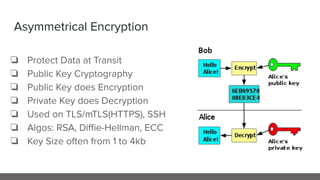
Asymmetrical Encryption
❏ Protect Data at Transit
❏ Public Key Cryptography
❏ Public Key does Encryption
❏ Private Key does Decryption
❏ Used on TLS/mTLS(HTTPS), SSH
❏ Algos: RSA, Diffie-Hellman, ECC
❏ Key Size often from 1 to 4kb
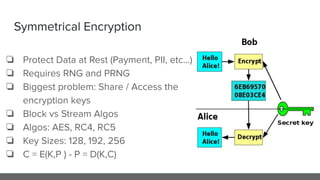
Symmetrical Encryption
❏ Protect Data at Rest (Payment, PII, etc…)
❏ Requires RNG and PRNG
❏ Biggest problem: Share / Access the
encryption keys
❏ Block vs Stream Algos
❏ Algos: AES, RC4, RC5
❏ Key Sizes: 128, 192, 256
❏ C = E(K,P ) - P = D(K,C)
Symmetrical Encryption
❏ Ciphertext same or slightly bigger than the plaintext
❏ Ciphertext is never smaller than the plaintext
❏ Permutations should be determined by the key
❏ Different keys should result in different permutation
❏ The permutation should look random
❏ Kerckhoffs Principle - 1883 - Really on a secret key - not on the
secrecy of the Cipher
❏ Storage vs Application level encryption
Application side encryption Drawbacks
❏ For sure more secure, however…
❏ Requires Engineering Discipline
❏ Requires constant Education / Training
❏ Cripple Features (Uniquines, Joins, Search)
❏ Bugs, Changes, Improvements Intrusive Require Migrations
❏ Key Scoping is mirror by Conway’s law / Architecture
Protecting Keys
❏ Storing the key on a hardware token(Smart Card or USB
dongle)
❏ On the fly generation from a password
❏ Wrapping - protecting the key with another key
❏ Key Management System
Randomness
❏ Randomness is a probability distribution
❏ Probability is about the likelihood of something happening:
0 never, 1 certain.
❏ Uniform Distribution when all probabilities are equal
chance do happens
❏ Toss a coin (Tail or Head) is 1/2 + 1/2 = 1, 1/2 chance head,
1/2 chance tail.
Entropy
❏ Entropy as a measure of Uncertain
❏ The measure of disorder in a system
❏ Entropy is the amount of surprise found in the result of
a random process
❏ Higher entropy less the certain found on the result
❏ Entropy is maximized when the distribution is uniform
RNG
❏ A Source of incertain, or a source of entropy
❏ A Crypto algo to produce high-quality bits from the source of
entropy
❏ RNG could be sampling from(Sources of entropy):
❏ measurements of temperature, acoustic noise, air turbulence,
or electric static (which are not always available)
❏ Entropy from OS: sensors, I/O devices, network, disk, logs,
running process (But can be fragile and manipulated by an
attacker)
PRNG
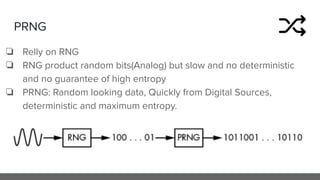
❏ Relly on RNG
❏ RNG product random bits(Analog) but slow and no deterministic
and no guarantee of high entropy
❏ PRNG: Random looking data, Quickly from Digital Sources,
deterministic and maximum entropy.
PRNG
❏ PRNG needs to ensure backtracking resistance (previously
generated bits are impossible to recover)
❏ PRNG needs to ensure prediction resistance (impossible to predict
future bits)
❏ /dev/random vs /dev/urandom (un-blocking)
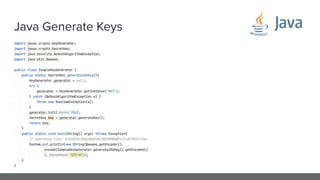
❏ Java Secure Random
AES
❏ World defacto standard encryption
❏ NSA approved AES for TOP-Secret
information
❏ AES is more Belgian than American
❏ Blocks of 128 bits (128, 192, 256)
❏ AES will never be broken
❏ All input bytes depends on output bytes
in some complex pseudo random way
AES
❏ 2011 - People found a way to recover
AES 128 bits key but require an insane
amount of data plaintext ciphertext
pairs 2 ^ 88 bits (so we don't need to
worry about it)
❏ The biggest threat is not the CORE algo
bug the Operation Modes
❏ Authentication vs Confidentiality modes
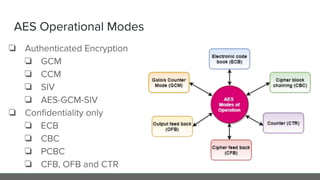
AES Operational Modes
❏ Authenticated Encryption
❏ GCM
❏ CCM
❏ SIV
❏ AES-GCM-SIV
❏ Confidentiality only
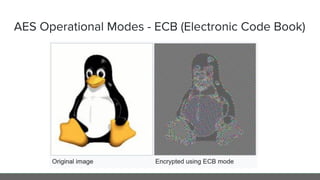
❏ ECB
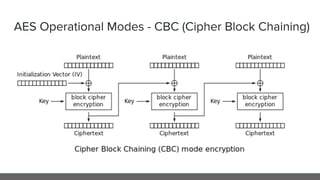
❏ CBC
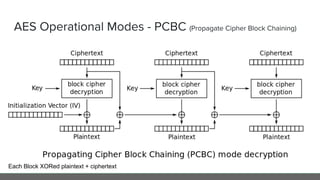
❏ PCBC
❏ CFB, OFB and CTR
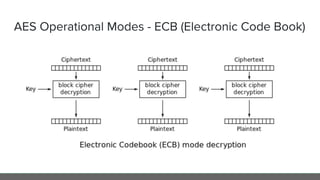
AES Operational Modes - ECB (Electronic Code Book)
AES Operational Modes - CBC (Cipher Block Chaining)
AES Operational Modes - PCBC (Propagate Cipher Block Chaining)
Each Block XORed plaintext + ciphertext
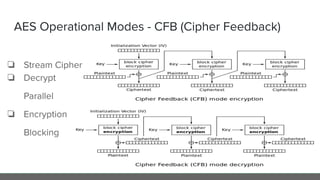
AES Operational Modes - CFB (Cipher Feedback)
❏ Stream Cipher
❏ Decrypt
Parallel
❏ Encryption
Blocking
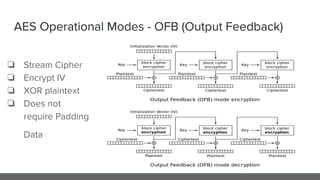
AES Operational Modes - OFB (Output Feedback)
❏ Stream Cipher
❏ Encrypt IV
❏ XOR plaintext
❏ Does not
require Padding
Data
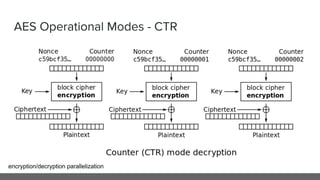
AES Operational Modes - CTR
encryption/decryption parallelization
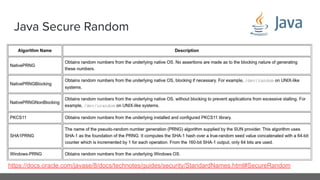
Java Secure Random
https://docs.oracle.com/javase/8/docs/technotes/guides/security/StandardNames.html#SecureRandom
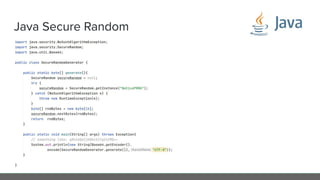
Java Secure Random
Java Generate Keys
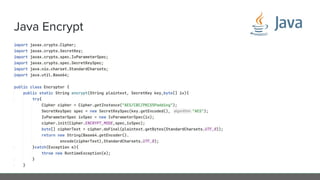
Java Encrypt
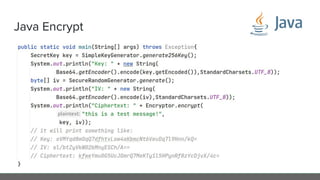
Java Encrypt
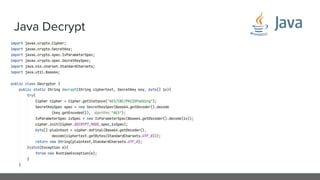
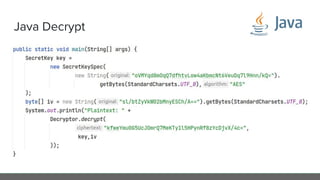
Java Decrypt
Java Decrypt
Keys & Data Rotations
❏ Use cases: Regular or Breach
❏ Standard Industry Practice
❏ In AVG around 90 days
❏ Downtime vs No-Downtime
❏ Can have reliability implications
❏ Requires Data Catalogs
❏ Operationality, Observability, Rowbacability challenges
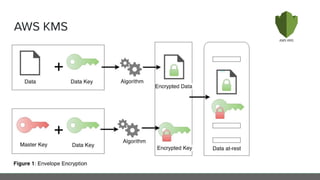
Envelope Encryption
❏ More Secure
❏ Industry Standard
❏ Keys with the Data
❏ Key Encrypting: Keys, Metadata and Data
❏ Bootstrapping problem
❏ KMS
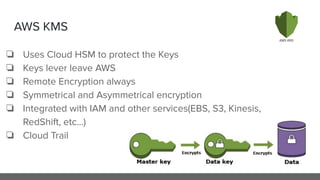
AWS KMS
❏ Uses Cloud HSM to protect the Keys
❏ Keys lever leave AWS
❏ Remote Encryption always
❏ Symmetrical and Asymmetrical encryption
❏ Integrated with IAM and other services(EBS, S3, Kinesis,
RedShift, etc...)
❏ Cloud Trail
AWS KMS
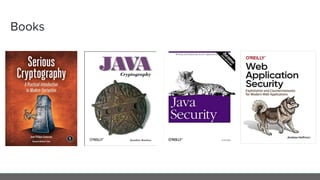
Books
Encryption
Deep Dive
Diego Pacheco

Encryption Deep Dive

  • 1.
  • 2.
    @diego_pacheco ❏ Cat's Father ❏Head of Software Architect ❏ Agile Coach ❏ SOA/Microservices Expert ❏ DevOps Practitioner ❏ Speaker ❏ Author diegopacheco http://diego-pacheco.blogspot.com.br/ About me... https://diegopacheco.github.io/
  • 3.
  • 4.
    Asymmetrical Encryption ❏ ProtectData at Transit ❏ Public Key Cryptography ❏ Public Key does Encryption ❏ Private Key does Decryption ❏ Used on TLS/mTLS(HTTPS), SSH ❏ Algos: RSA, Diffie-Hellman, ECC ❏ Key Size often from 1 to 4kb
  • 5.
    Symmetrical Encryption ❏ ProtectData at Rest (Payment, PII, etc…) ❏ Requires RNG and PRNG ❏ Biggest problem: Share / Access the encryption keys ❏ Block vs Stream Algos ❏ Algos: AES, RC4, RC5 ❏ Key Sizes: 128, 192, 256 ❏ C = E(K,P ) - P = D(K,C)
  • 6.
    Symmetrical Encryption ❏ Ciphertextsame or slightly bigger than the plaintext ❏ Ciphertext is never smaller than the plaintext ❏ Permutations should be determined by the key ❏ Different keys should result in different permutation ❏ The permutation should look random ❏ Kerckhoffs Principle - 1883 - Really on a secret key - not on the secrecy of the Cipher ❏ Storage vs Application level encryption
  • 7.
    Application side encryptionDrawbacks ❏ For sure more secure, however… ❏ Requires Engineering Discipline ❏ Requires constant Education / Training ❏ Cripple Features (Uniquines, Joins, Search) ❏ Bugs, Changes, Improvements Intrusive Require Migrations ❏ Key Scoping is mirror by Conway’s law / Architecture
  • 8.
    Protecting Keys ❏ Storingthe key on a hardware token(Smart Card or USB dongle) ❏ On the fly generation from a password ❏ Wrapping - protecting the key with another key ❏ Key Management System
  • 9.
    Randomness ❏ Randomness isa probability distribution ❏ Probability is about the likelihood of something happening: 0 never, 1 certain. ❏ Uniform Distribution when all probabilities are equal chance do happens ❏ Toss a coin (Tail or Head) is 1/2 + 1/2 = 1, 1/2 chance head, 1/2 chance tail.
  • 10.
    Entropy ❏ Entropy asa measure of Uncertain ❏ The measure of disorder in a system ❏ Entropy is the amount of surprise found in the result of a random process ❏ Higher entropy less the certain found on the result ❏ Entropy is maximized when the distribution is uniform
  • 11.
    RNG ❏ A Sourceof incertain, or a source of entropy ❏ A Crypto algo to produce high-quality bits from the source of entropy ❏ RNG could be sampling from(Sources of entropy): ❏ measurements of temperature, acoustic noise, air turbulence, or electric static (which are not always available) ❏ Entropy from OS: sensors, I/O devices, network, disk, logs, running process (But can be fragile and manipulated by an attacker)
  • 12.
    PRNG ❏ Relly onRNG ❏ RNG product random bits(Analog) but slow and no deterministic and no guarantee of high entropy ❏ PRNG: Random looking data, Quickly from Digital Sources, deterministic and maximum entropy.
  • 13.
    PRNG ❏ PRNG needsto ensure backtracking resistance (previously generated bits are impossible to recover) ❏ PRNG needs to ensure prediction resistance (impossible to predict future bits) ❏ /dev/random vs /dev/urandom (un-blocking) ❏ Java Secure Random
  • 14.
    AES ❏ World defactostandard encryption ❏ NSA approved AES for TOP-Secret information ❏ AES is more Belgian than American ❏ Blocks of 128 bits (128, 192, 256) ❏ AES will never be broken ❏ All input bytes depends on output bytes in some complex pseudo random way
  • 15.
    AES ❏ 2011 -People found a way to recover AES 128 bits key but require an insane amount of data plaintext ciphertext pairs 2 ^ 88 bits (so we don't need to worry about it) ❏ The biggest threat is not the CORE algo bug the Operation Modes ❏ Authentication vs Confidentiality modes
  • 16.
    AES Operational Modes ❏Authenticated Encryption ❏ GCM ❏ CCM ❏ SIV ❏ AES-GCM-SIV ❏ Confidentiality only ❏ ECB ❏ CBC ❏ PCBC ❏ CFB, OFB and CTR
  • 17.
    AES Operational Modes- ECB (Electronic Code Book)
  • 18.
    AES Operational Modes- ECB (Electronic Code Book)
  • 19.
    AES Operational Modes- CBC (Cipher Block Chaining)
  • 20.
    AES Operational Modes- PCBC (Propagate Cipher Block Chaining) Each Block XORed plaintext + ciphertext
  • 21.
    AES Operational Modes- CFB (Cipher Feedback) ❏ Stream Cipher ❏ Decrypt Parallel ❏ Encryption Blocking
  • 22.
    AES Operational Modes- OFB (Output Feedback) ❏ Stream Cipher ❏ Encrypt IV ❏ XOR plaintext ❏ Does not require Padding Data
  • 23.
    AES Operational Modes- CTR encryption/decryption parallelization
  • 24.
  • 25.
  • 26.
  • 27.
  • 28.
  • 29.
  • 30.
  • 31.
    Keys & DataRotations ❏ Use cases: Regular or Breach ❏ Standard Industry Practice ❏ In AVG around 90 days ❏ Downtime vs No-Downtime ❏ Can have reliability implications ❏ Requires Data Catalogs ❏ Operationality, Observability, Rowbacability challenges
  • 32.
    Envelope Encryption ❏ MoreSecure ❏ Industry Standard ❏ Keys with the Data ❏ Key Encrypting: Keys, Metadata and Data ❏ Bootstrapping problem ❏ KMS
  • 33.
    AWS KMS ❏ UsesCloud HSM to protect the Keys ❏ Keys lever leave AWS ❏ Remote Encryption always ❏ Symmetrical and Asymmetrical encryption ❏ Integrated with IAM and other services(EBS, S3, Kinesis, RedShift, etc...) ❏ Cloud Trail
  • 34.
  • 35.
  • 36.