How to build vibrant communities within the enterprise Can organizations build better web communities with predictable success? David Terrar – D2C and WordFrame with contributions from: Dennis Howlett – AccMan & ZDNet Philip Woodgate – Goodman Jones
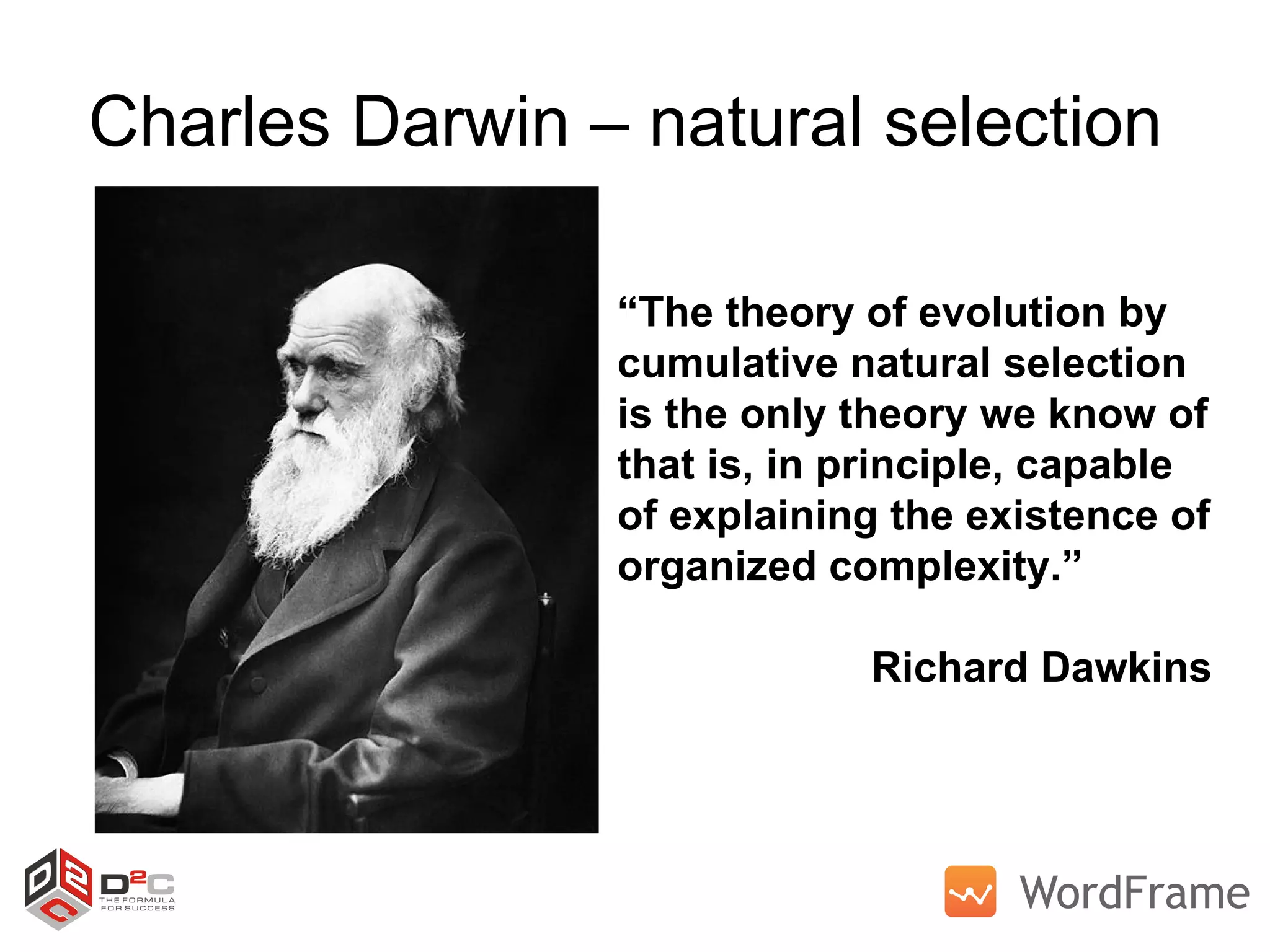
Charles Darwin – natural selection  “ The theory of evolution by  cumulative natural selection  is the only theory we know of  that is, in principle, capable  of explaining the existence of  organized complexity.” Richard Dawkins
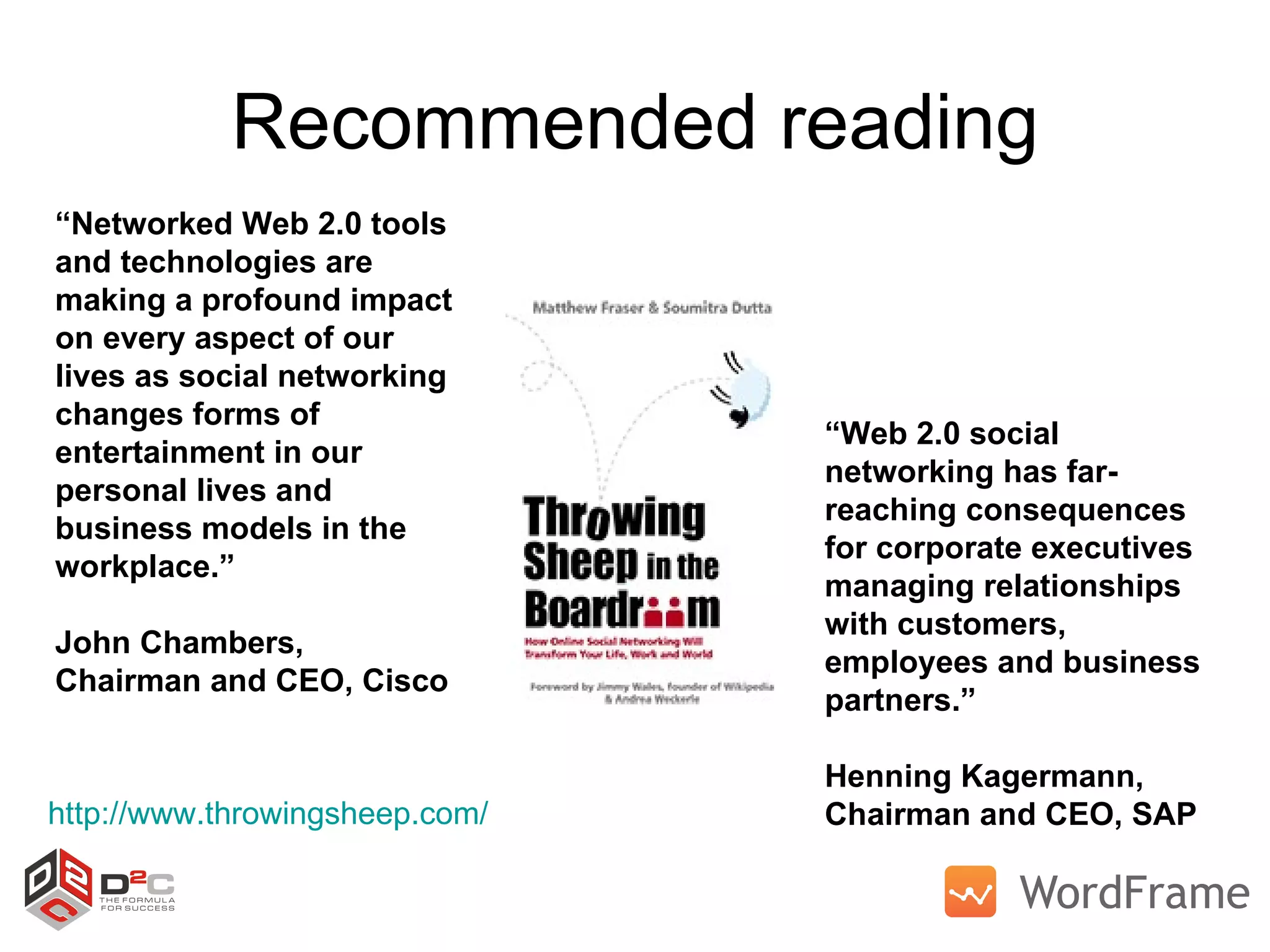
Recommended reading http://www.throwingsheep.com/   “ Networked Web 2.0 tools and technologies are making a profound impact on every aspect of our lives as social networking changes forms of entertainment in our personal lives and business models in the workplace.”  John Chambers,  Chairman and CEO, Cisco  “ Web 2.0 social networking has far-reaching consequences for corporate executives managing relationships with customers, employees and business partners.”  Henning Kagermann,  Chairman and CEO, SAP
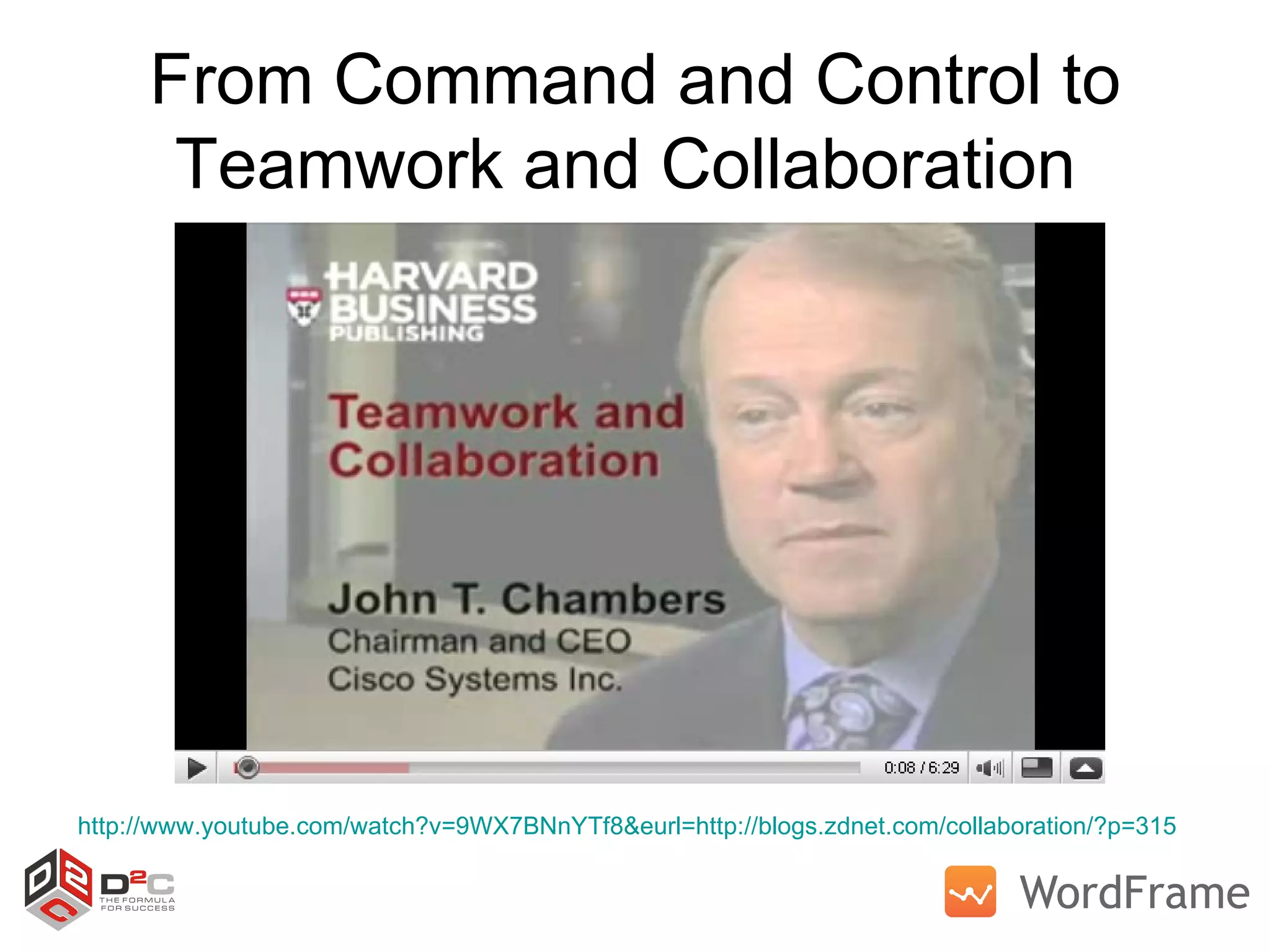
From Command and Control to Teamwork and Collaboration  http://www.youtube.com/watch?v=9WX7BNnYTf8&eurl=http://blogs.zdnet.com/collaboration/?p=315
Agenda  Why build communities? What motivates people to participate? What is ICAEW doing with ion? Other examples Success factors for community sites Can we build communities with predictable success? Conclusions and best practice Recommendations References
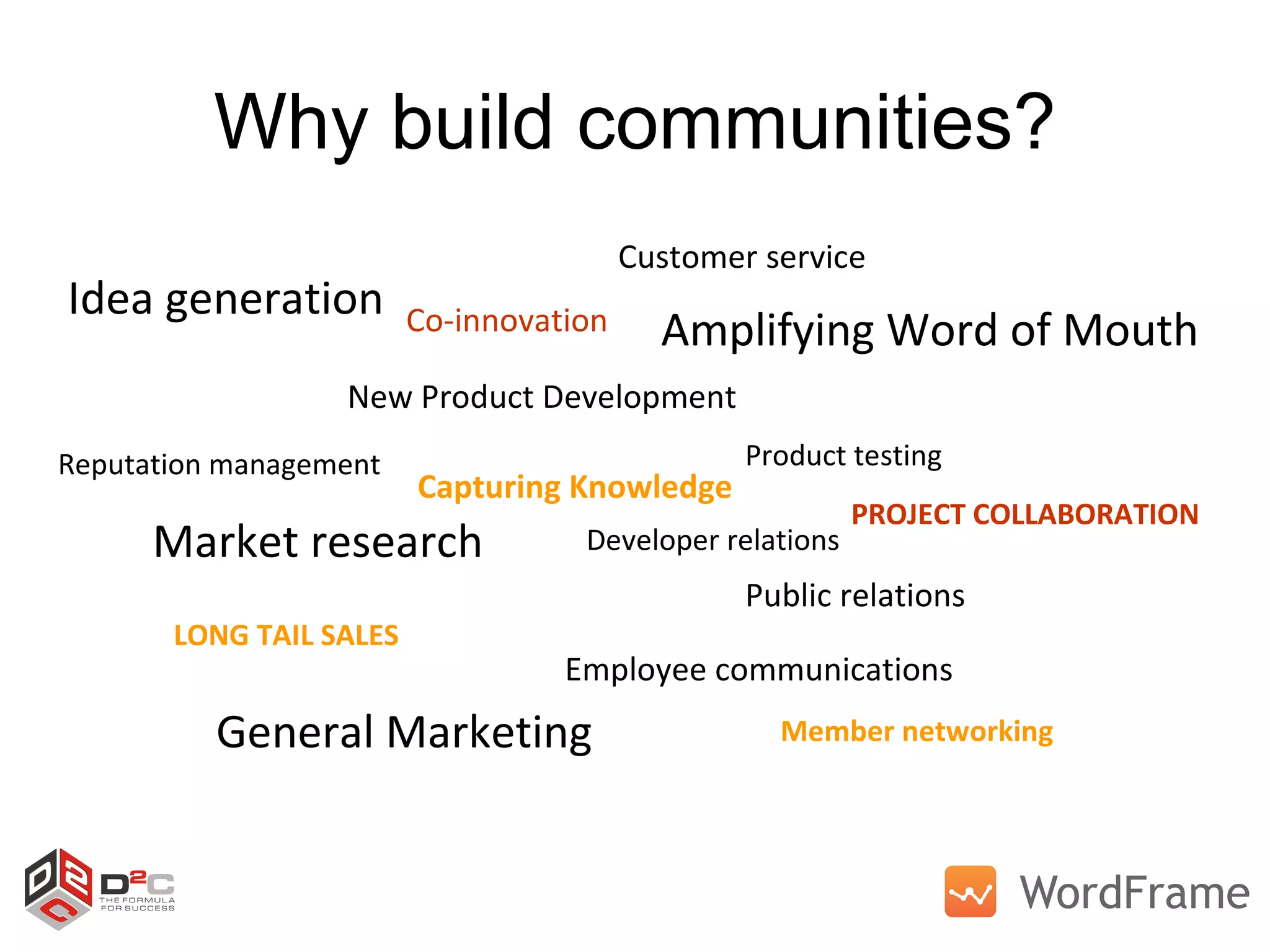
Why build communities? New Product Development Customer service Idea generation Market research Developer relations Amplifying Word of Mouth Employee communications General Marketing Reputation management Product testing Public relations LONG TAIL SALES PROJECT COLLABORATION Co-innovation Member networking Capturing Knowledge
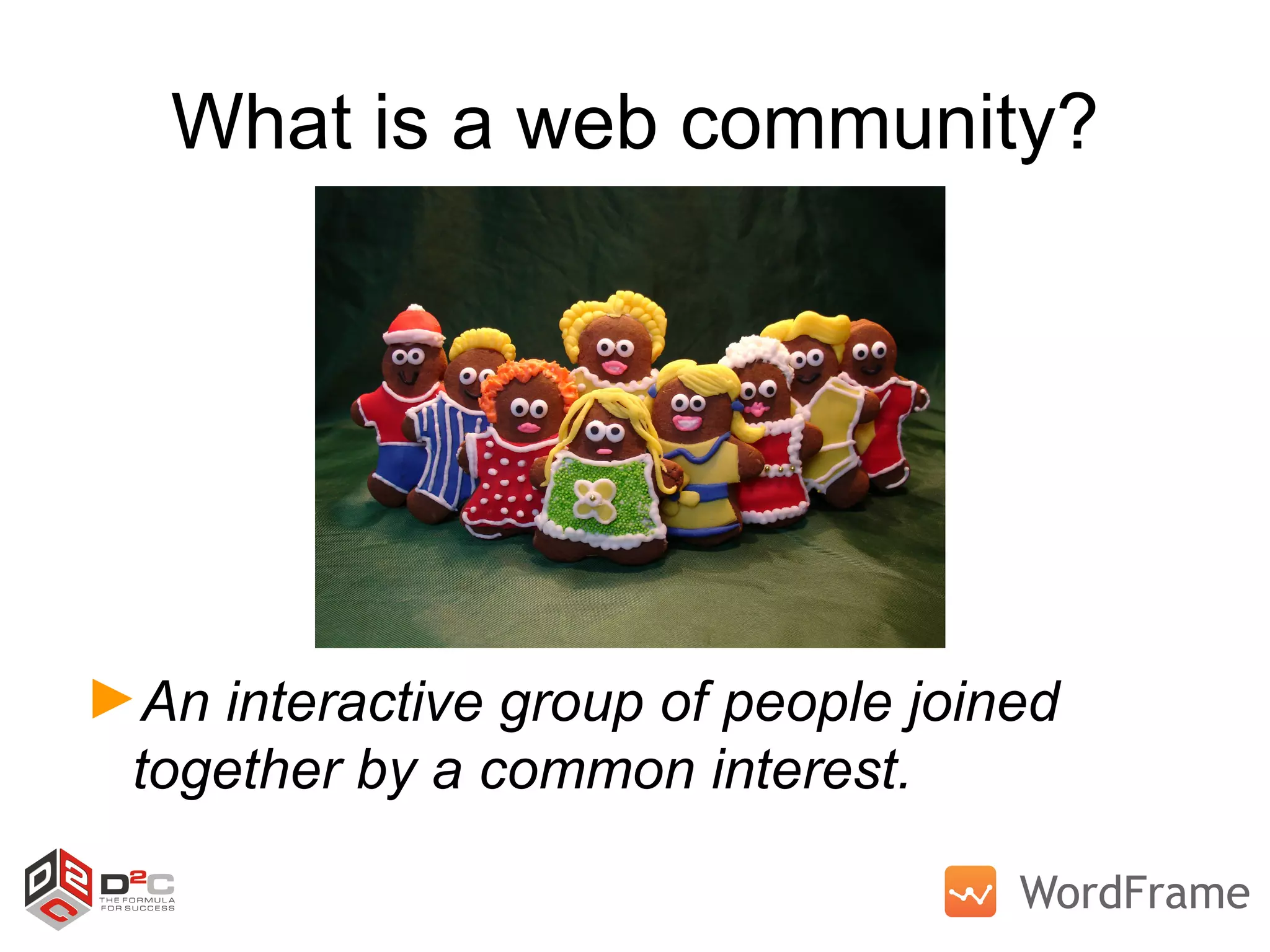
What is a web community? An interactive group of people joined together by a common interest.
What motivates people to participate? Expressing themselves Support Listening Sharing Recognition Power The culture of the organization "Culture is a mealy-mouthed way of talking about power.“   - Euan Semple
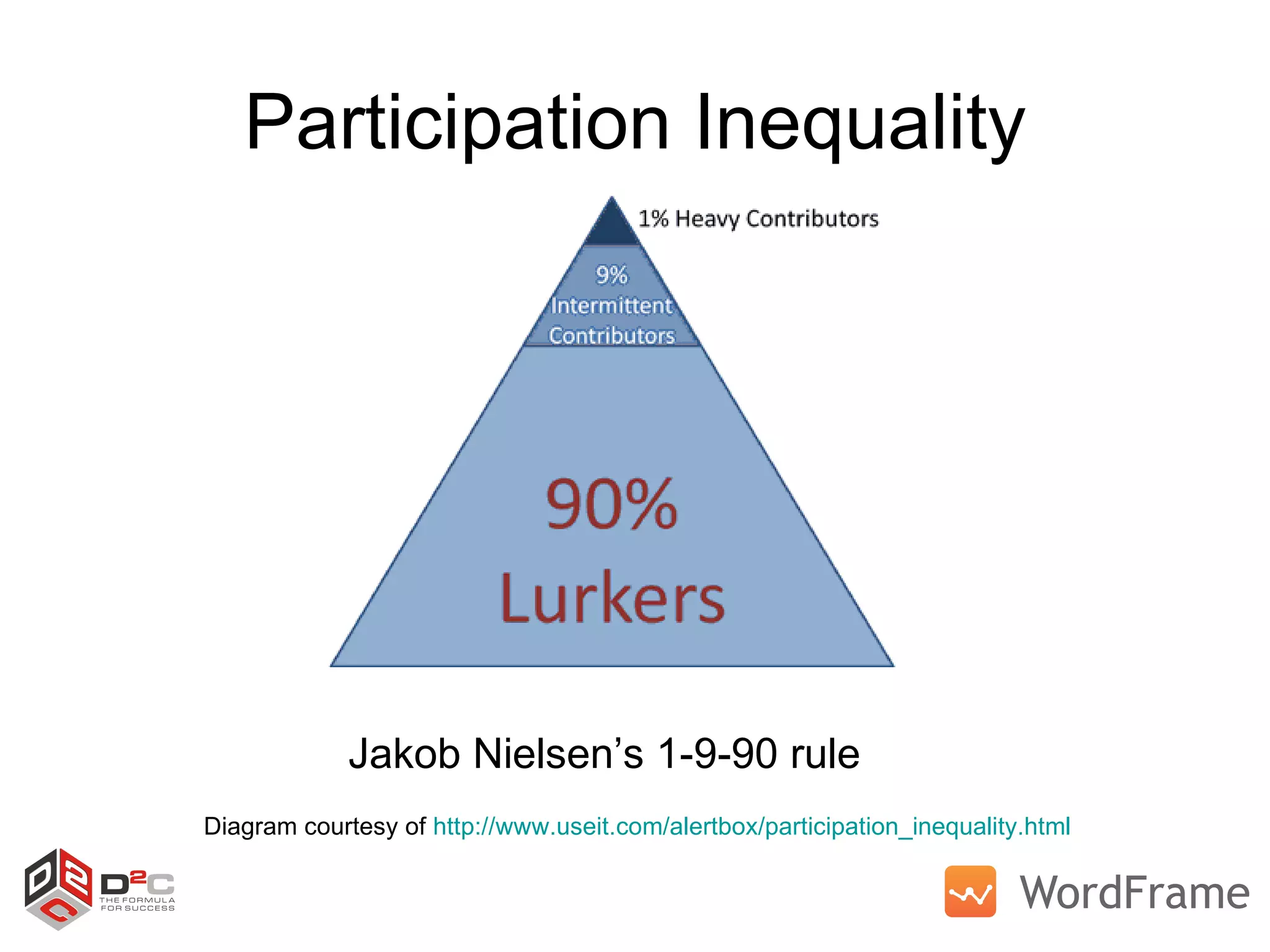
Participation Inequality Jakob Nielsen’s 1-9-90 rule Diagram courtesy of  http://www.useit.com/alertbox/participation_inequality.html
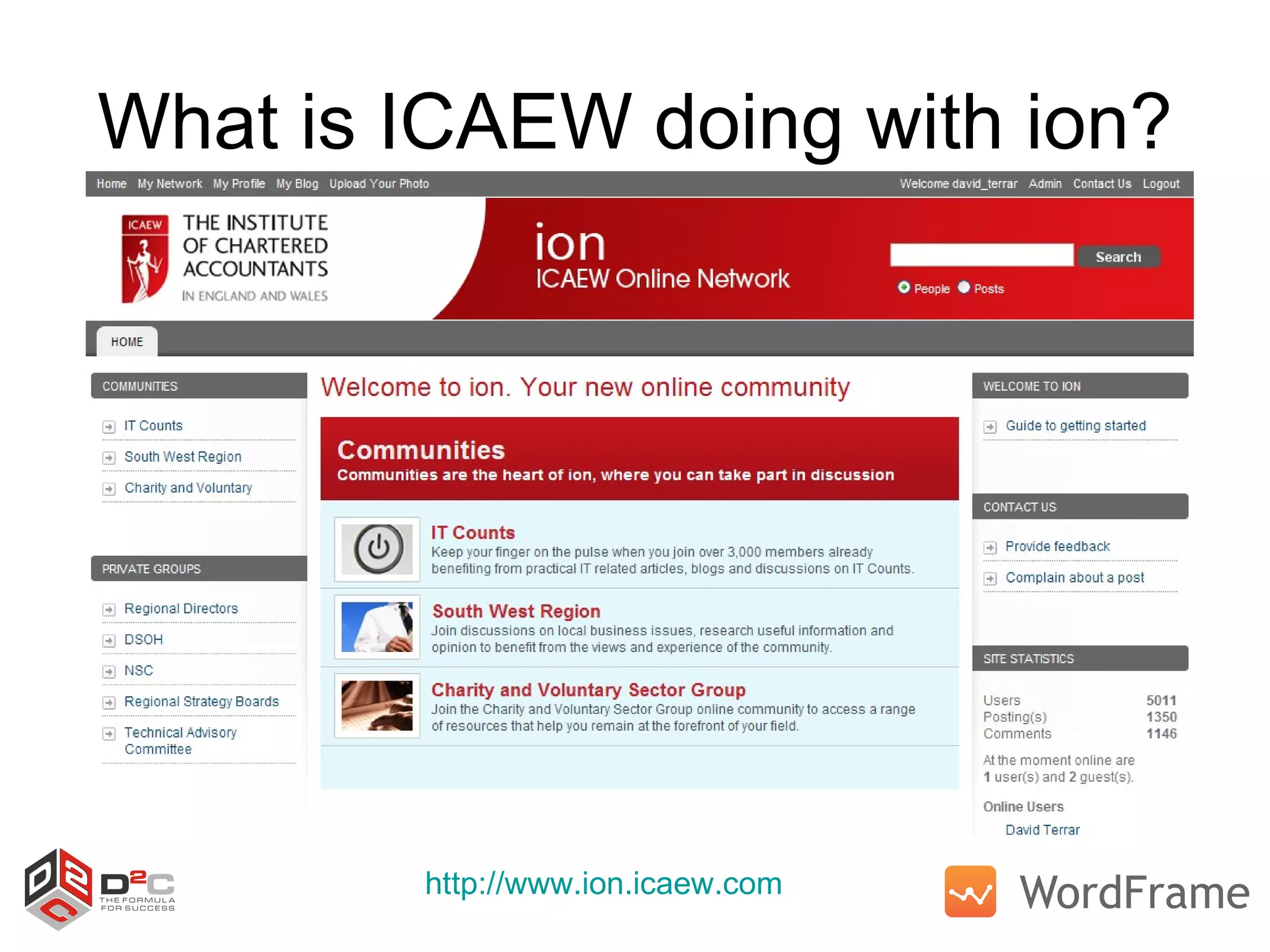
What is ICAEW doing with ion? http://www.ion.icaew.com
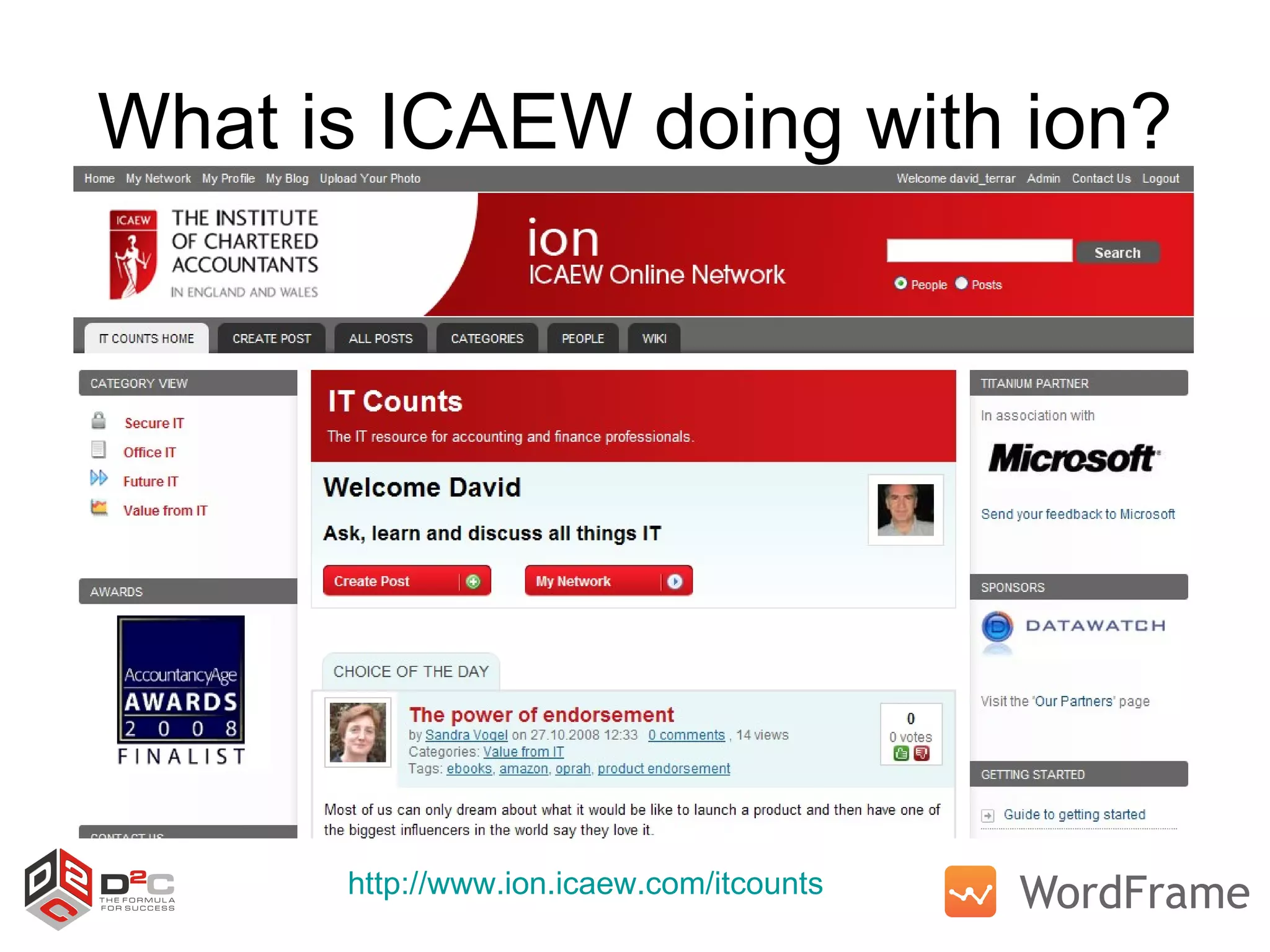
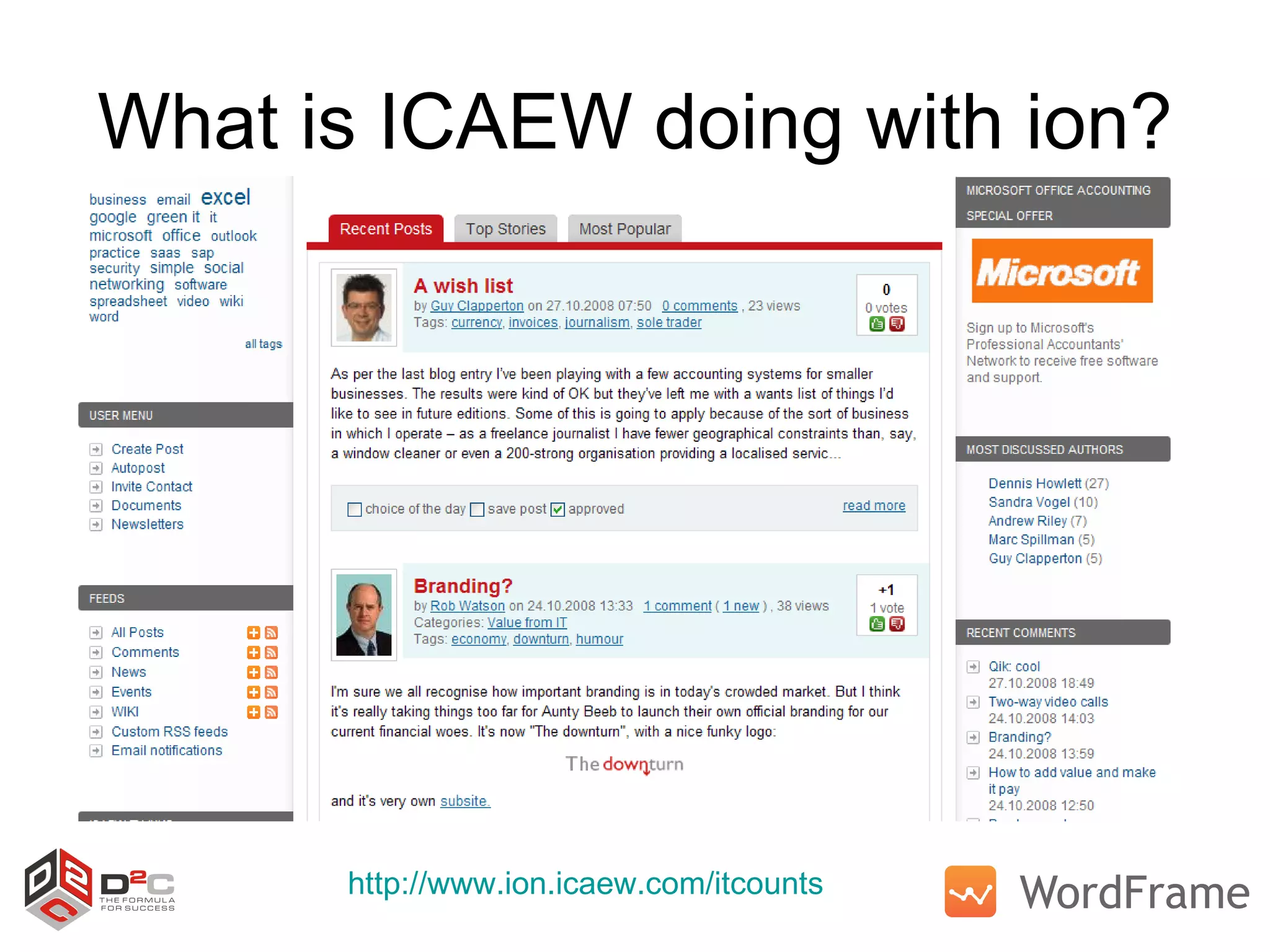
What is ICAEW doing with ion? http://www.ion.icaew.com/itcounts
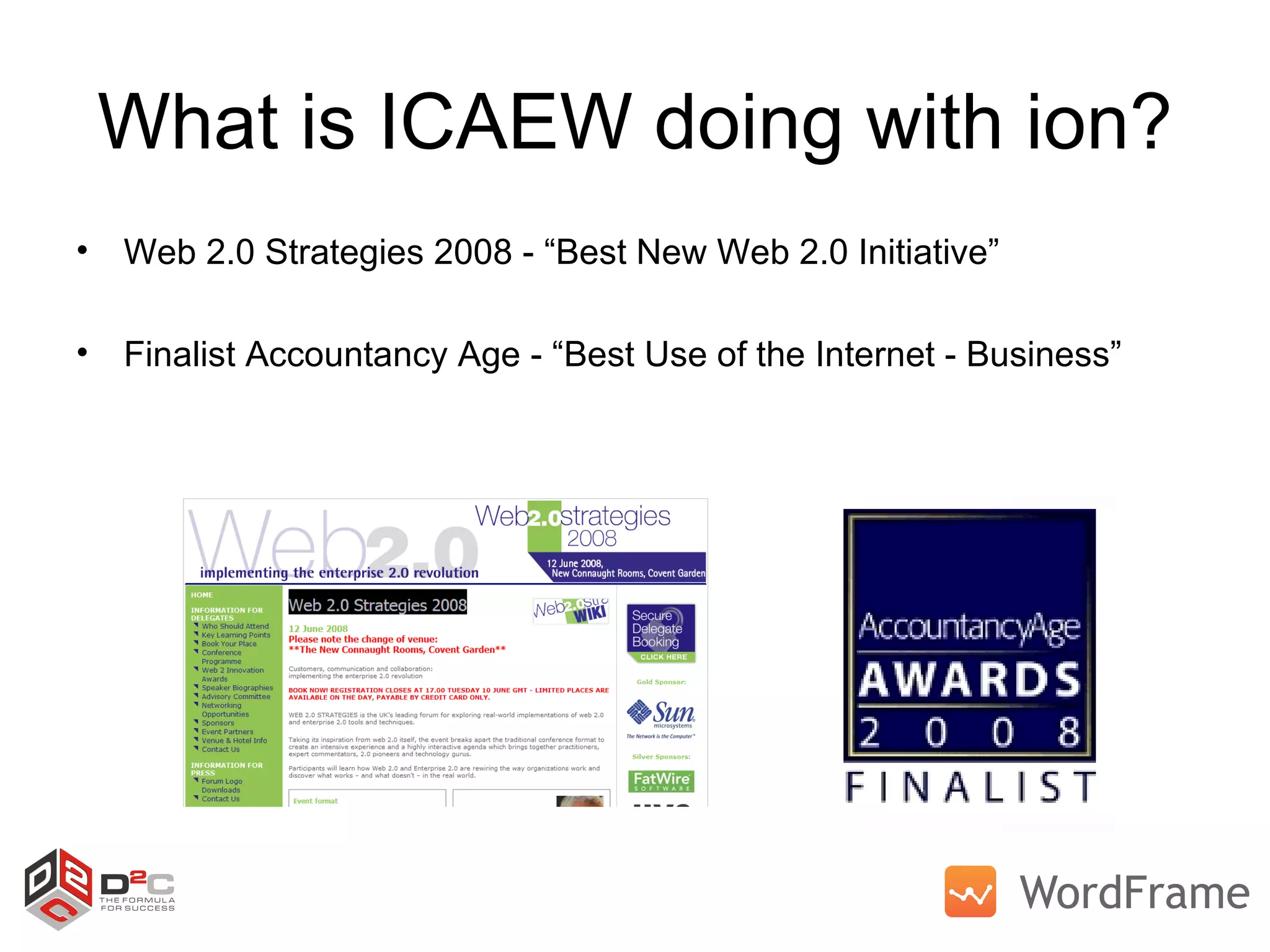
What is ICAEW doing with ion? Web 2.0 Strategies 2008 - “Best New Web 2.0 Initiative” Finalist Accountancy Age - “Best Use of the Internet - Business”
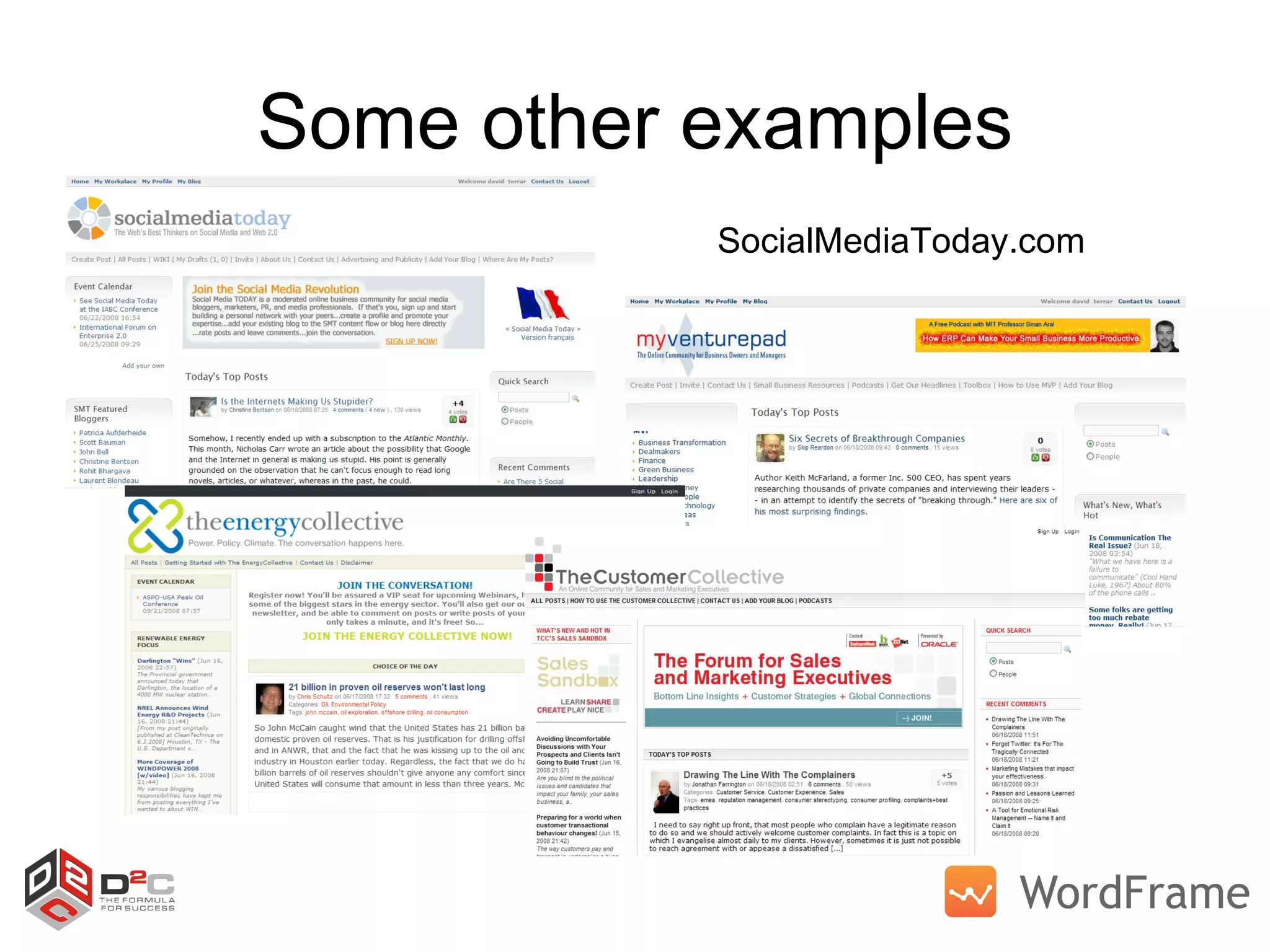
Some other examples SocialMediaToday.com
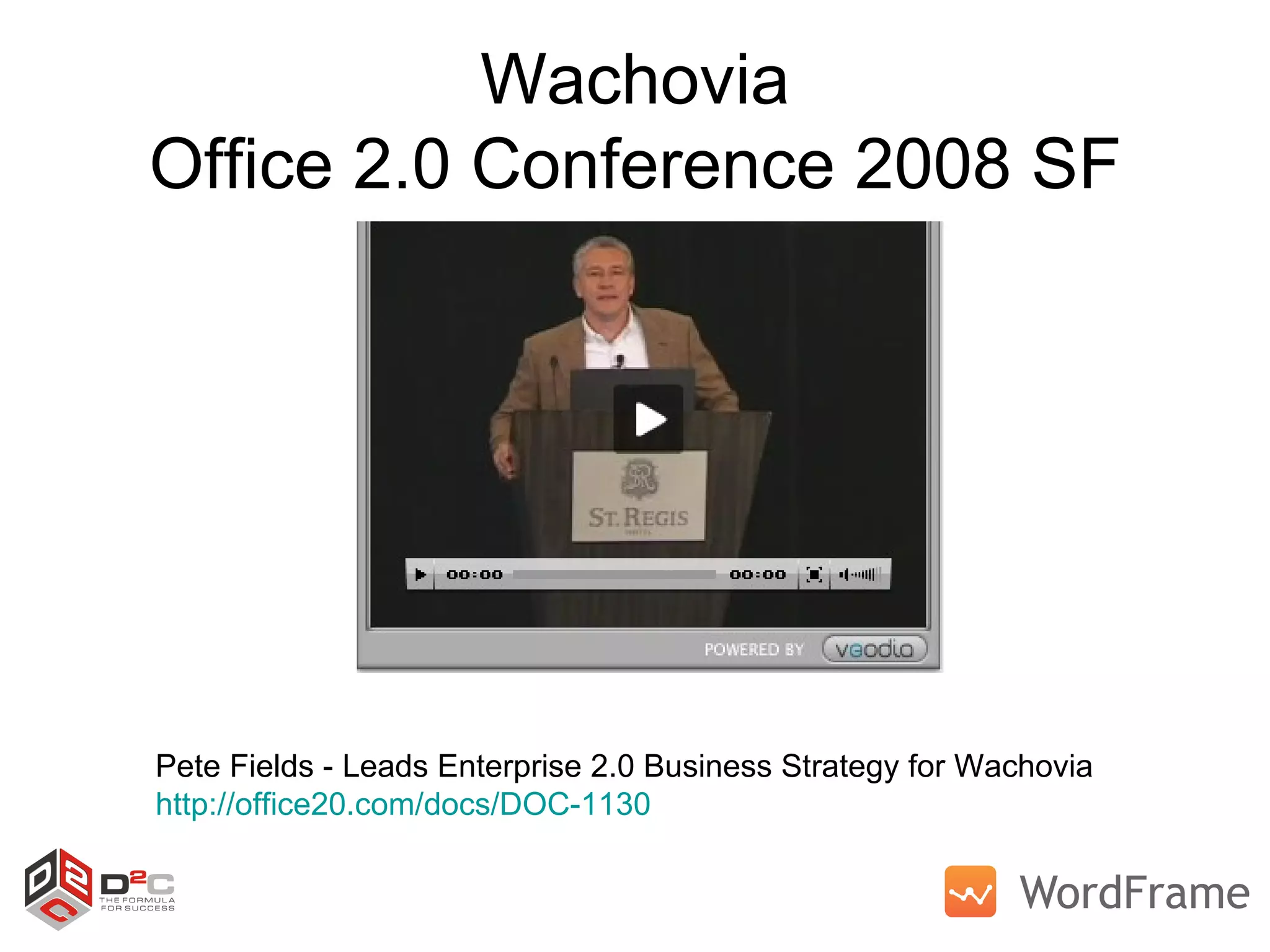
Wachovia Office 2.0 Conference 2008 SF Pete Fields -  Leads Enterprise 2.0 Business Strategy for Wachovia http://office20.com/docs/DOC-1130
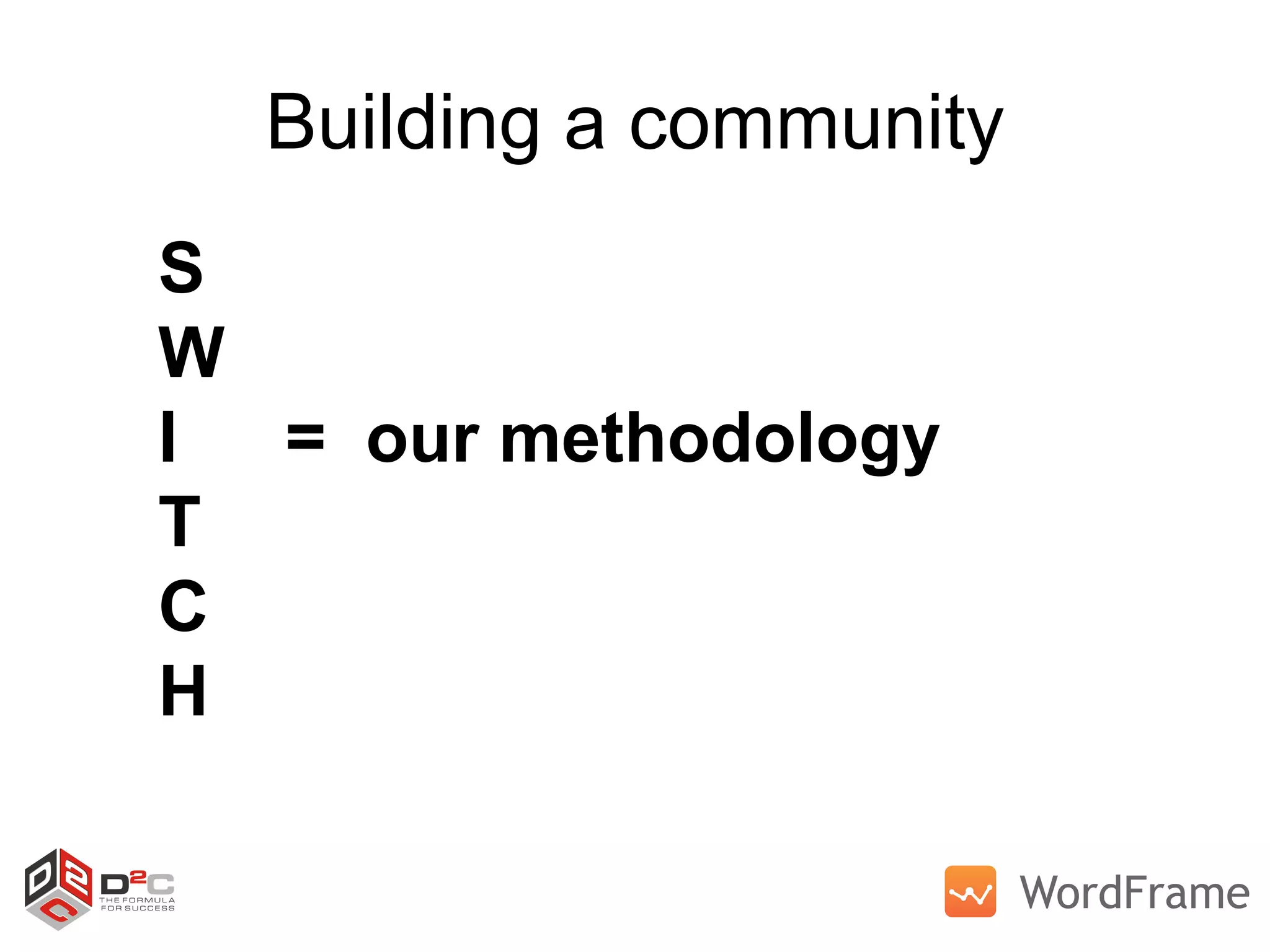
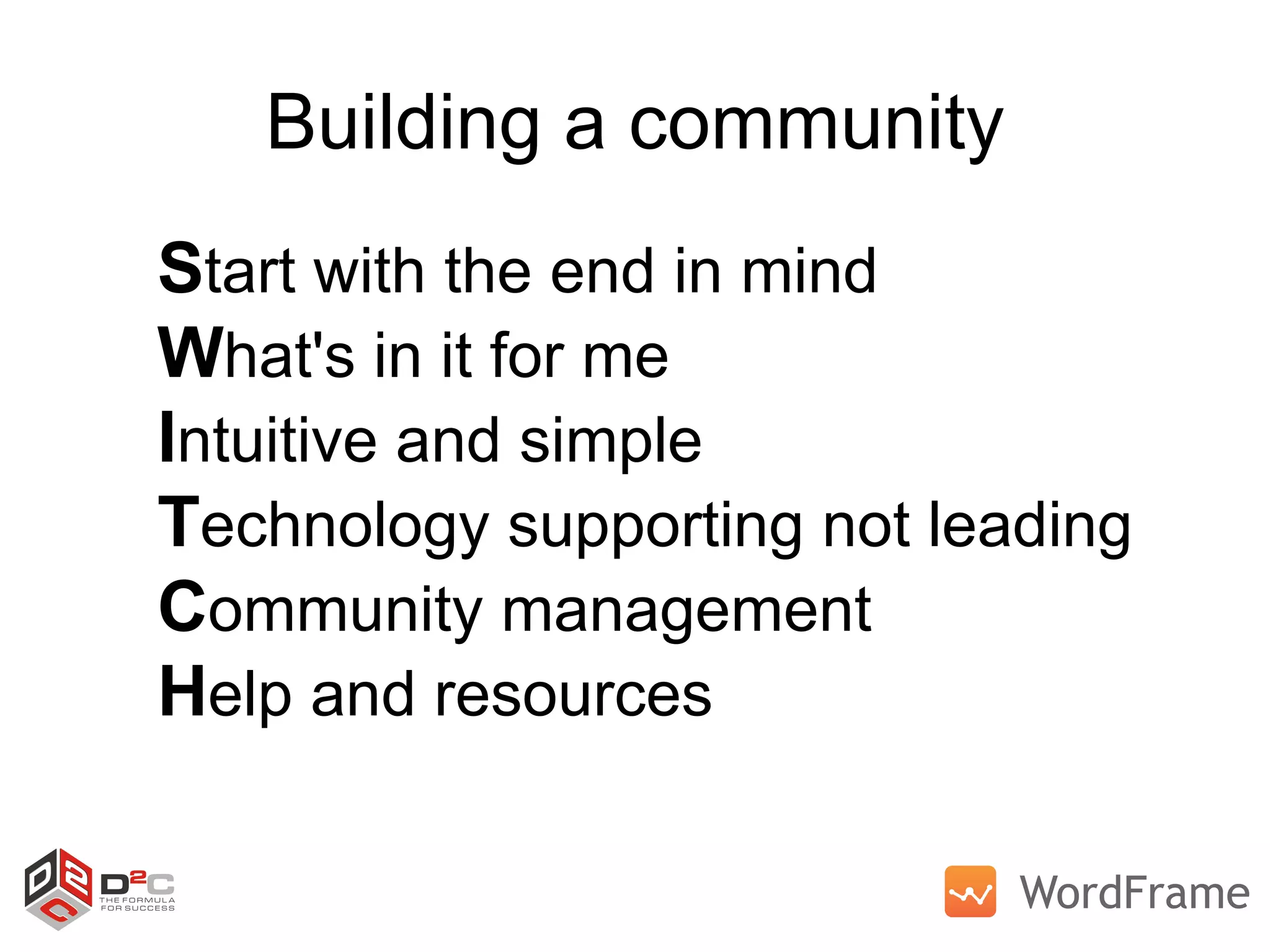
Building a community S W I =  our methodology T C H
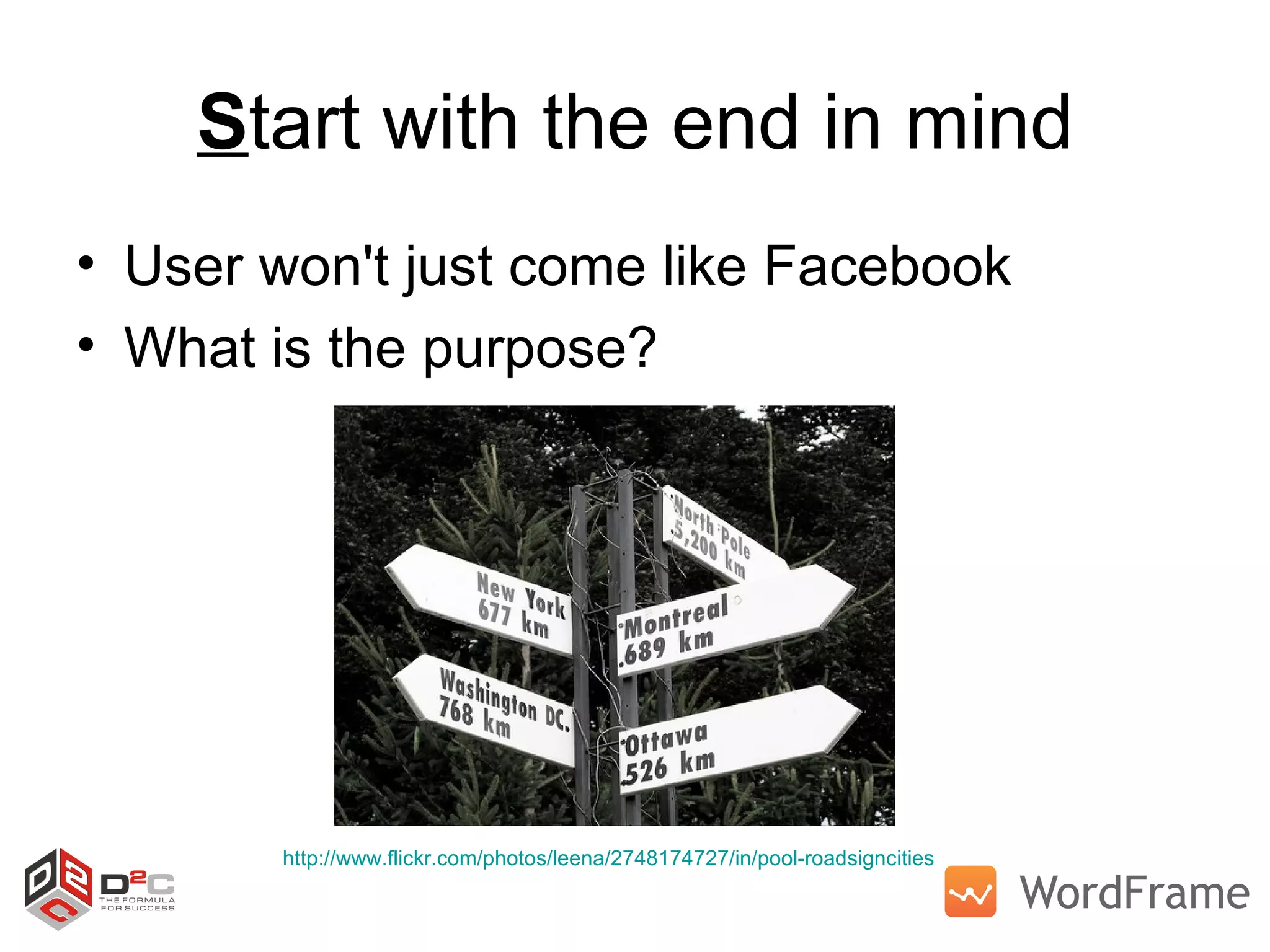
S tart with the end in mind User won't just come like Facebook What is the purpose? http://www.flickr.com/photos/leena/2748174727/in/pool-roadsigncities
W hat's in it for me ?
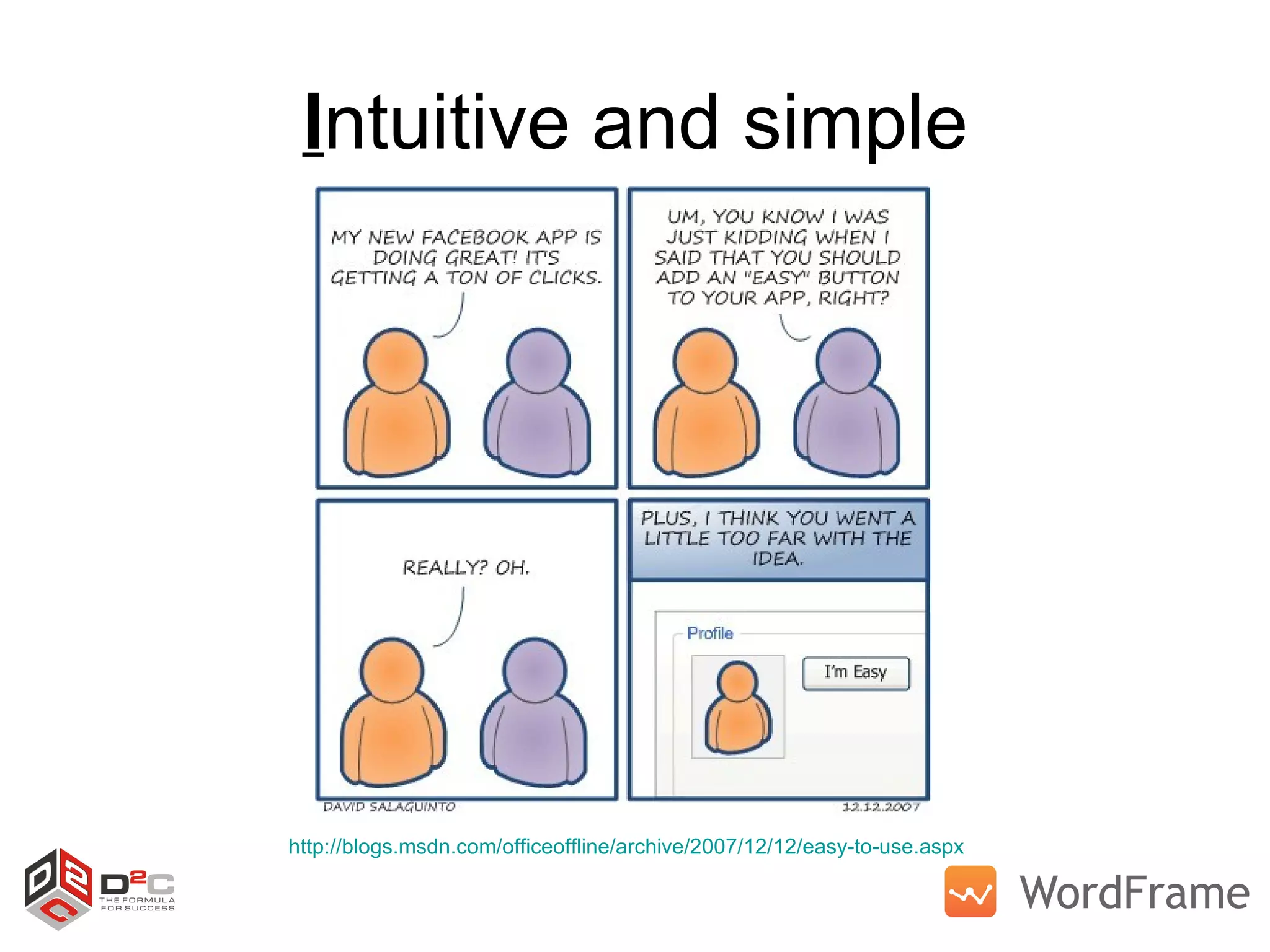
I ntuitive and simple http://blogs.msdn.com/officeoffline/archive/2007/12/12/easy-to-use.aspx
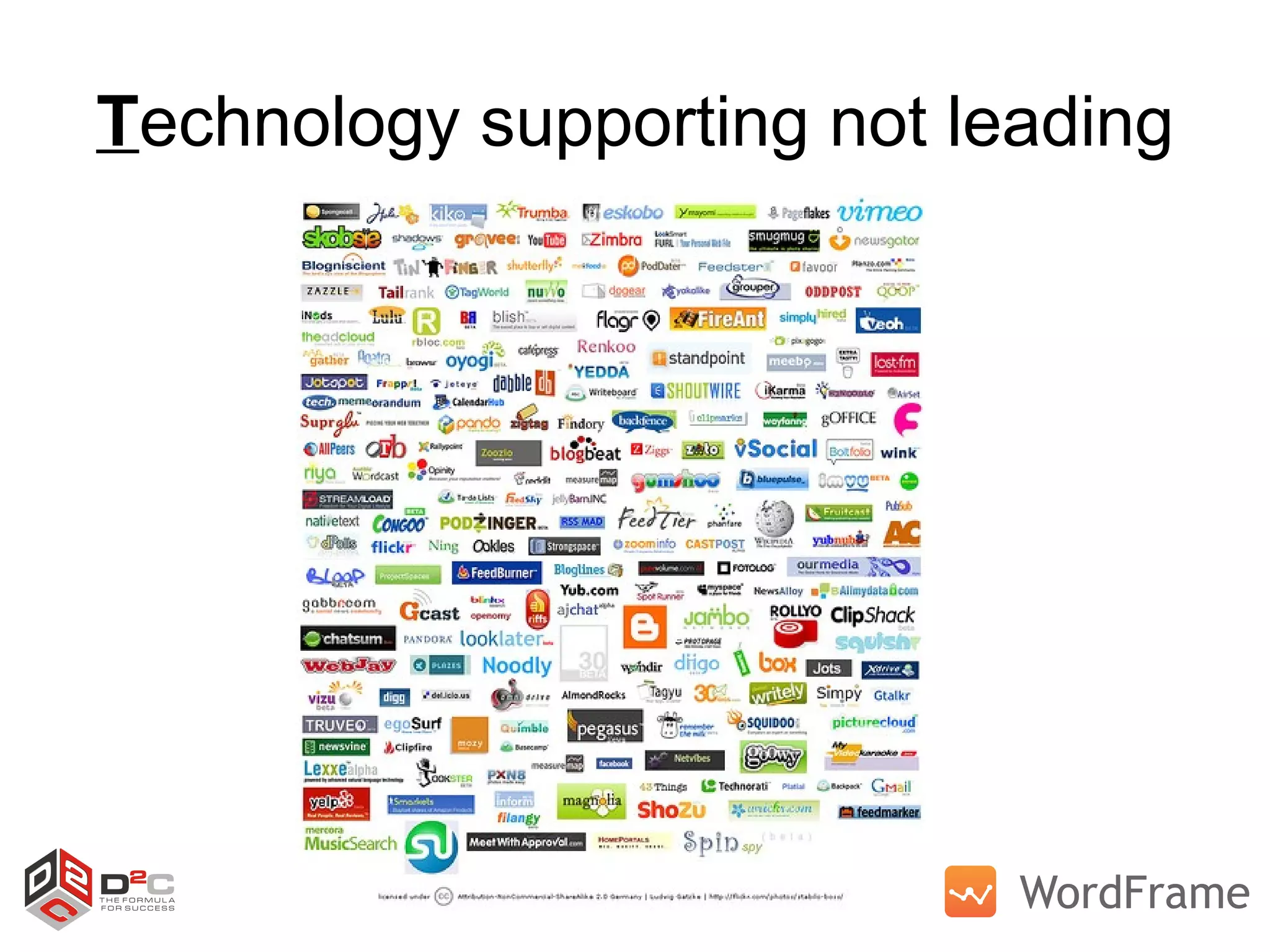
T echnology supporting not leading
C ommunity management
C ommunity facilitation
C ommunity management Champions Teamwork Prepare to lose control Moderation guidelines Community manager needed Corporate standards Not just bottom up
H elp and resources Online help and documentation “ How to”s Videos Examples Contributor guidelines Helpdesk Chat support Community manager support
Building a community S tart with the end in mind W hat's in it for me I ntuitive and simple T echnology supporting not leading C ommunity management H elp and resources
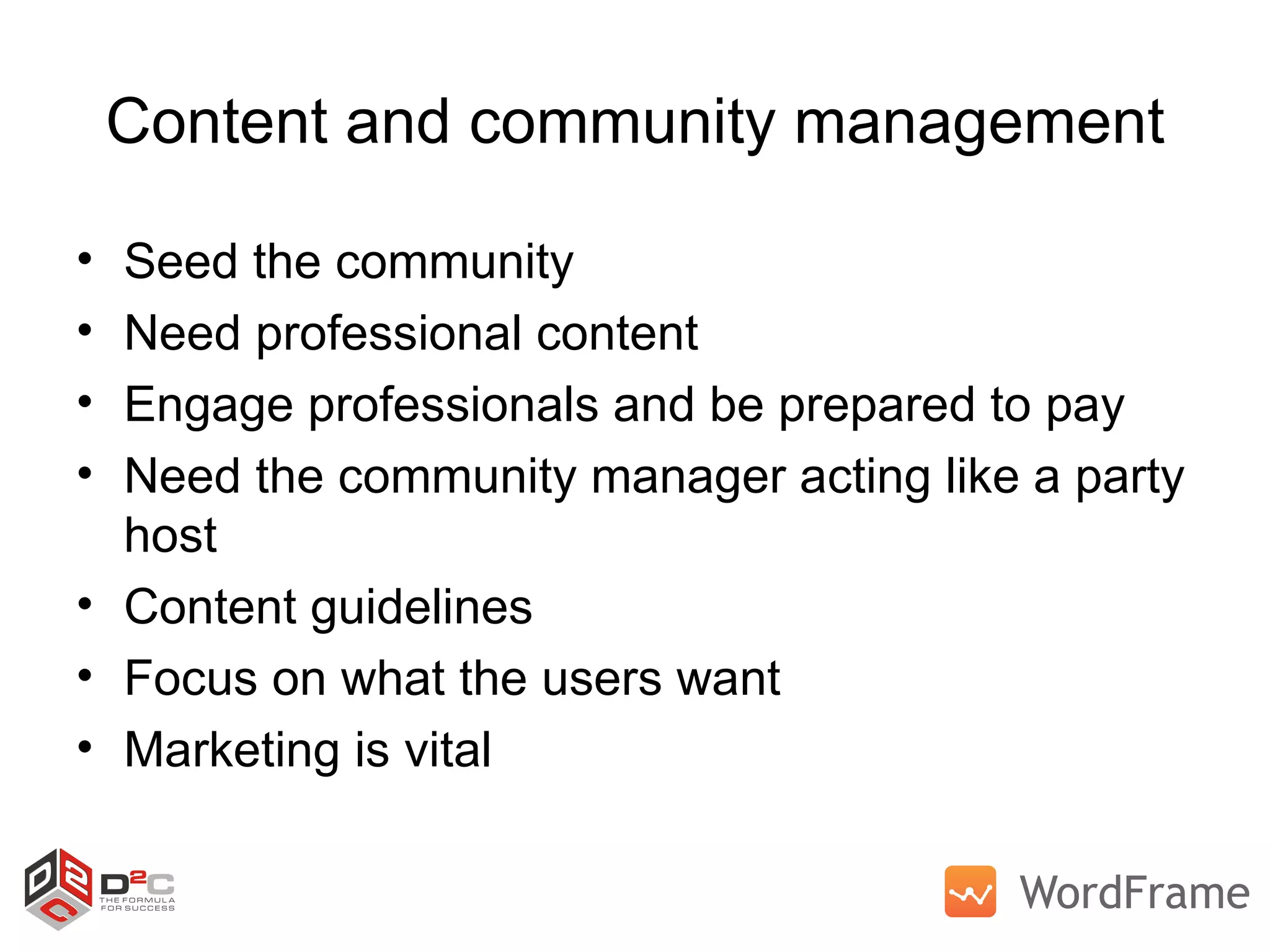
Content and community management Seed the community Need professional content Engage professionals and be prepared to pay Need the community manager acting like a party host Content guidelines Focus on what the users want Marketing is vital
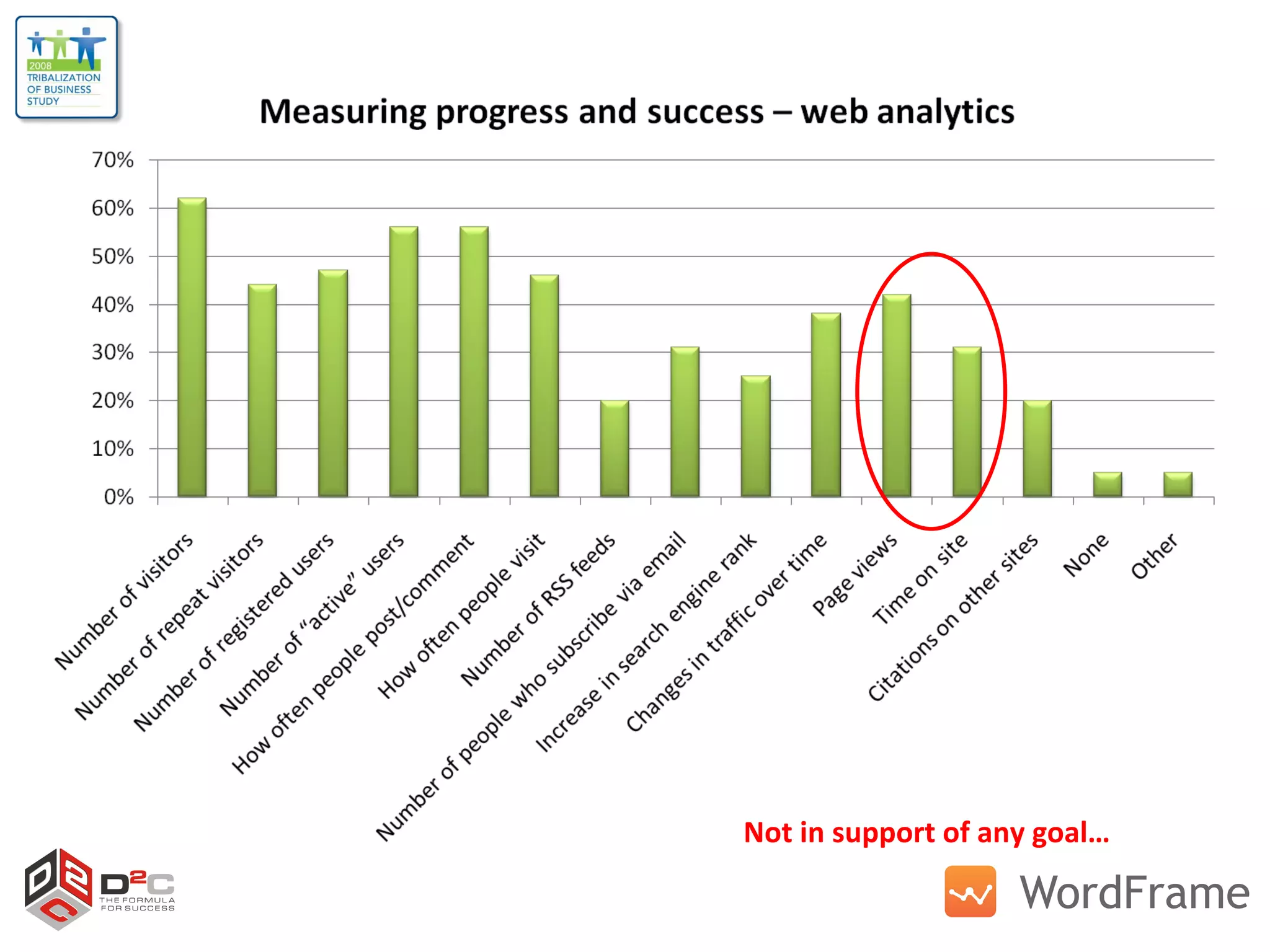
Not in support of any goal…
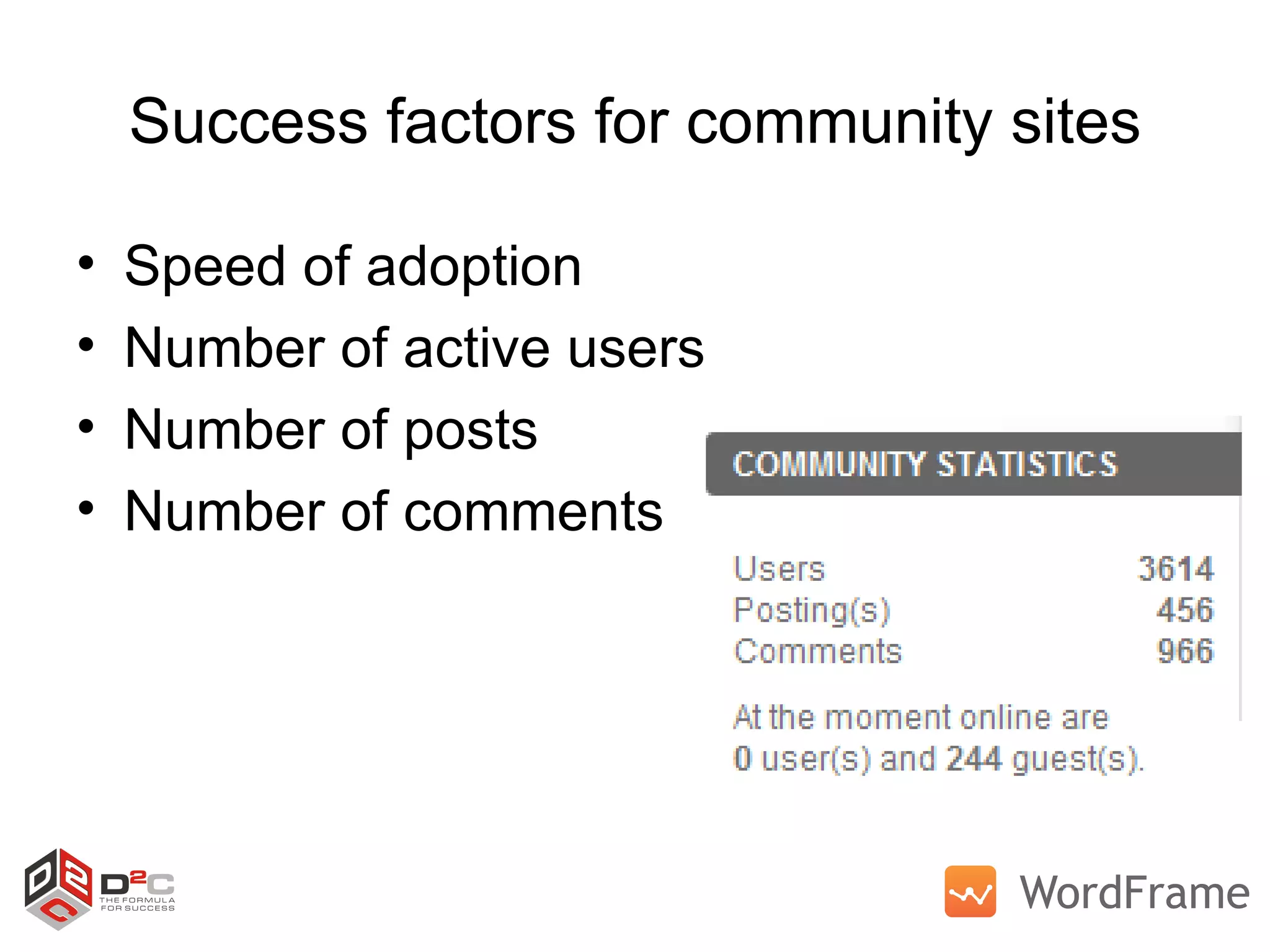
Success factors for community sites Speed of adoption Number of active users Number of posts Number of comments
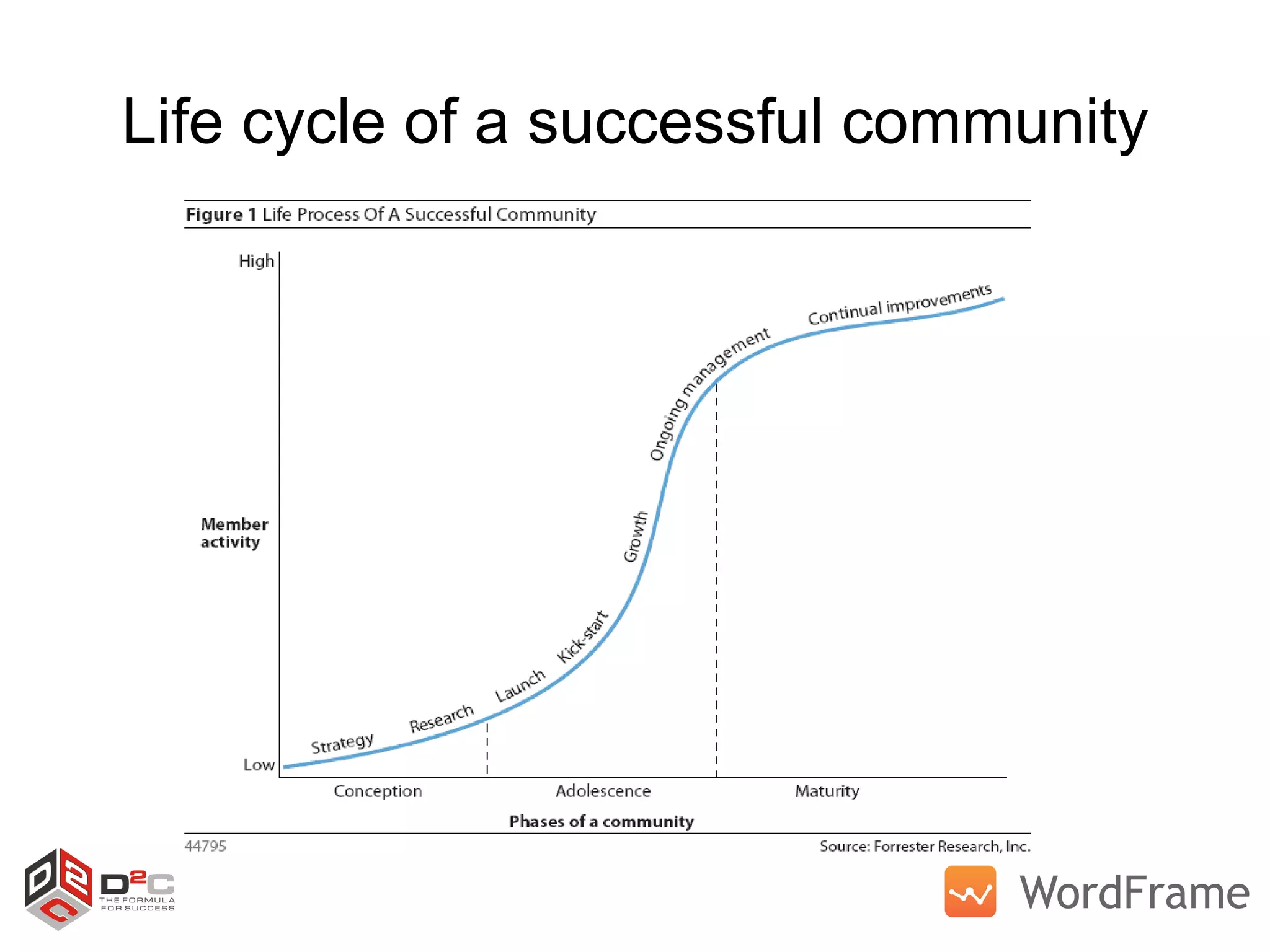
Life cycle of a successful community
 
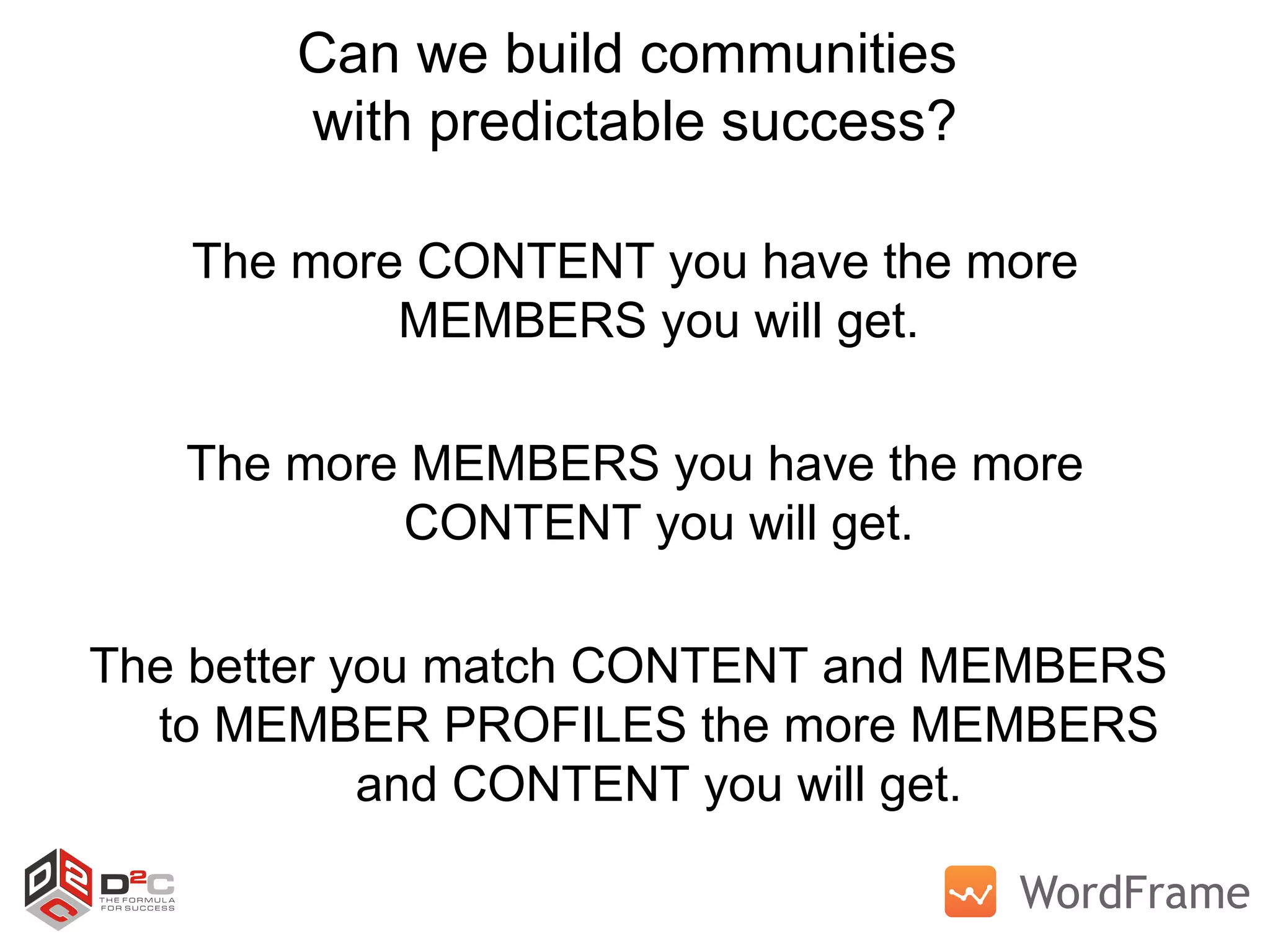
Can we build communities  with predictable success? The more CONTENT you have the more MEMBERS you will get. The more MEMBERS you have the more CONTENT you will get. The better you match CONTENT and MEMBERS  to MEMBER PROFILES the more MEMBERS and CONTENT you will get.
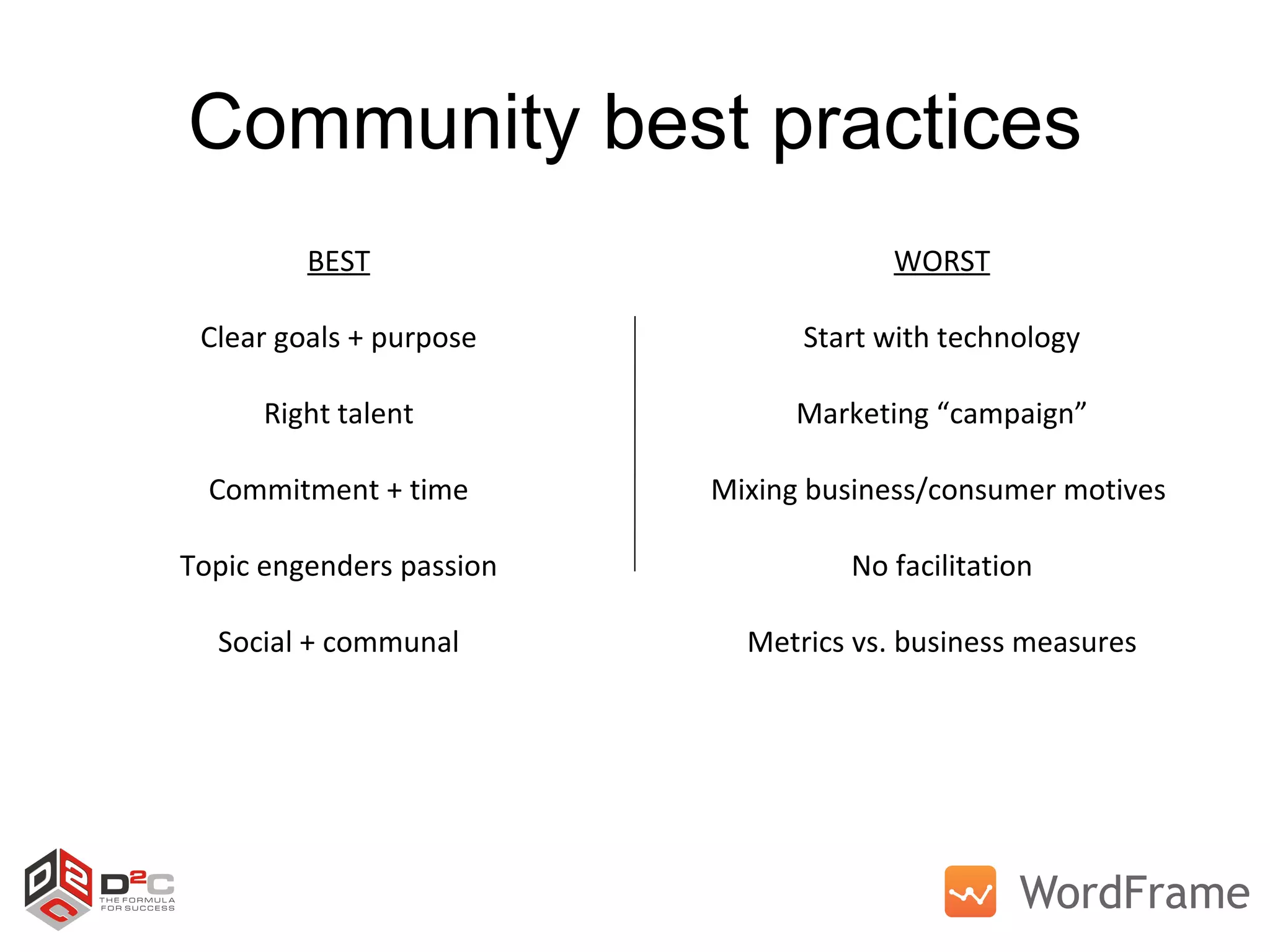
Community best practices BEST Clear goals + purpose Right talent Commitment + time Topic engenders passion Social + communal WORST Start with technology Marketing “campaign” Mixing business/consumer motives  No facilitation Metrics vs. business measures
Conclusions The Technology Infrastructure of the community is important The Social Infrastructure of the community is MORE important
Recommendations Recognise it will be hard work Focus on usability Community manager needed, and they have to act like a party host Content, content, content Basic marketing e.g. email key posts Brand advertising and incentives don't work Use available resources e.g. Wikipatterns Coherent technology is important People and culture more important Make sure the key stakeholders involved understand new marketing Make sure they understanding social networks by using some and getting their hands dirty
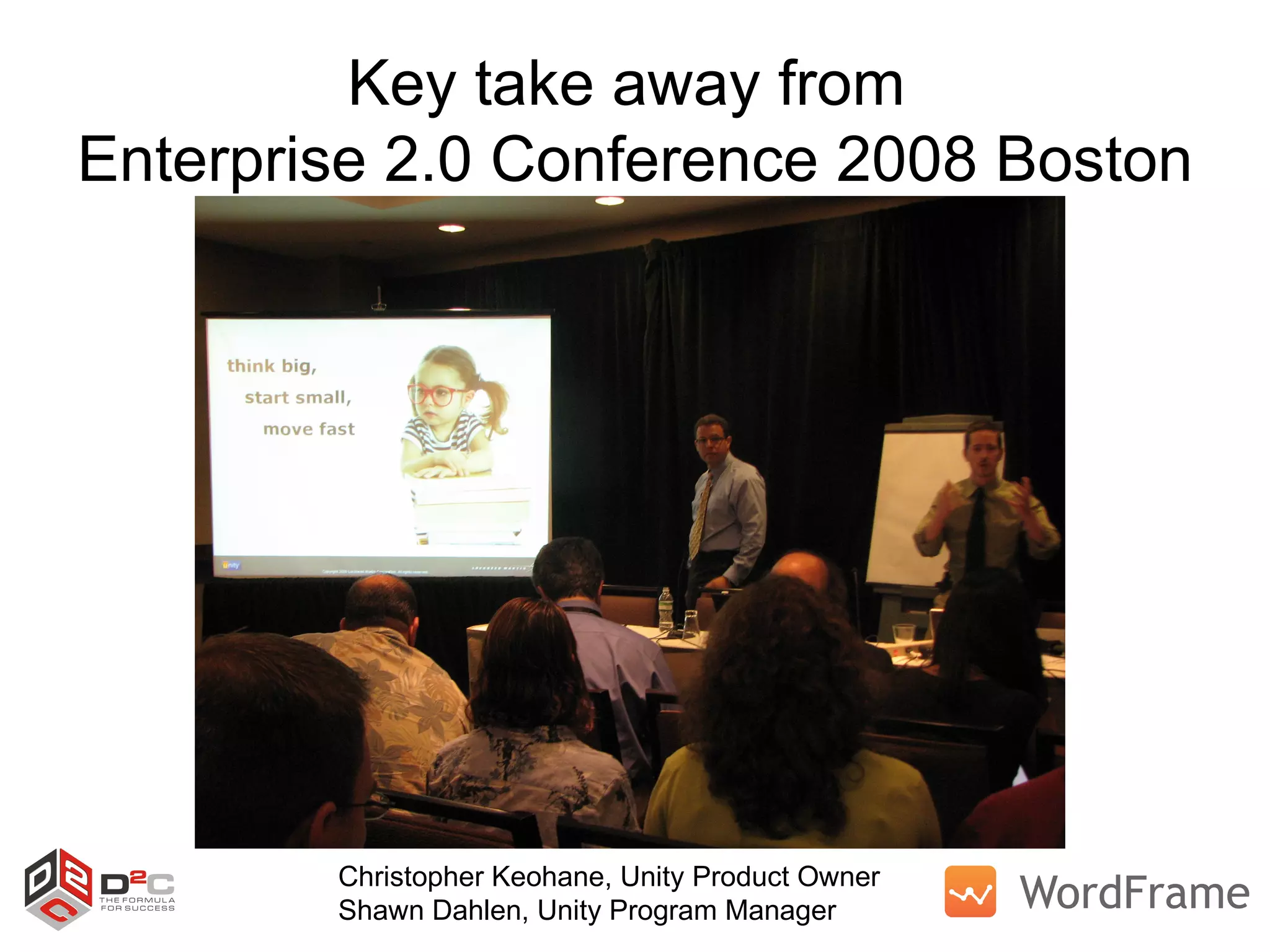
Key take away from  Enterprise 2.0 Conference 2008 Boston Christopher Keohane, Unity Product Owner Shawn Dahlen, Unity Program Manager
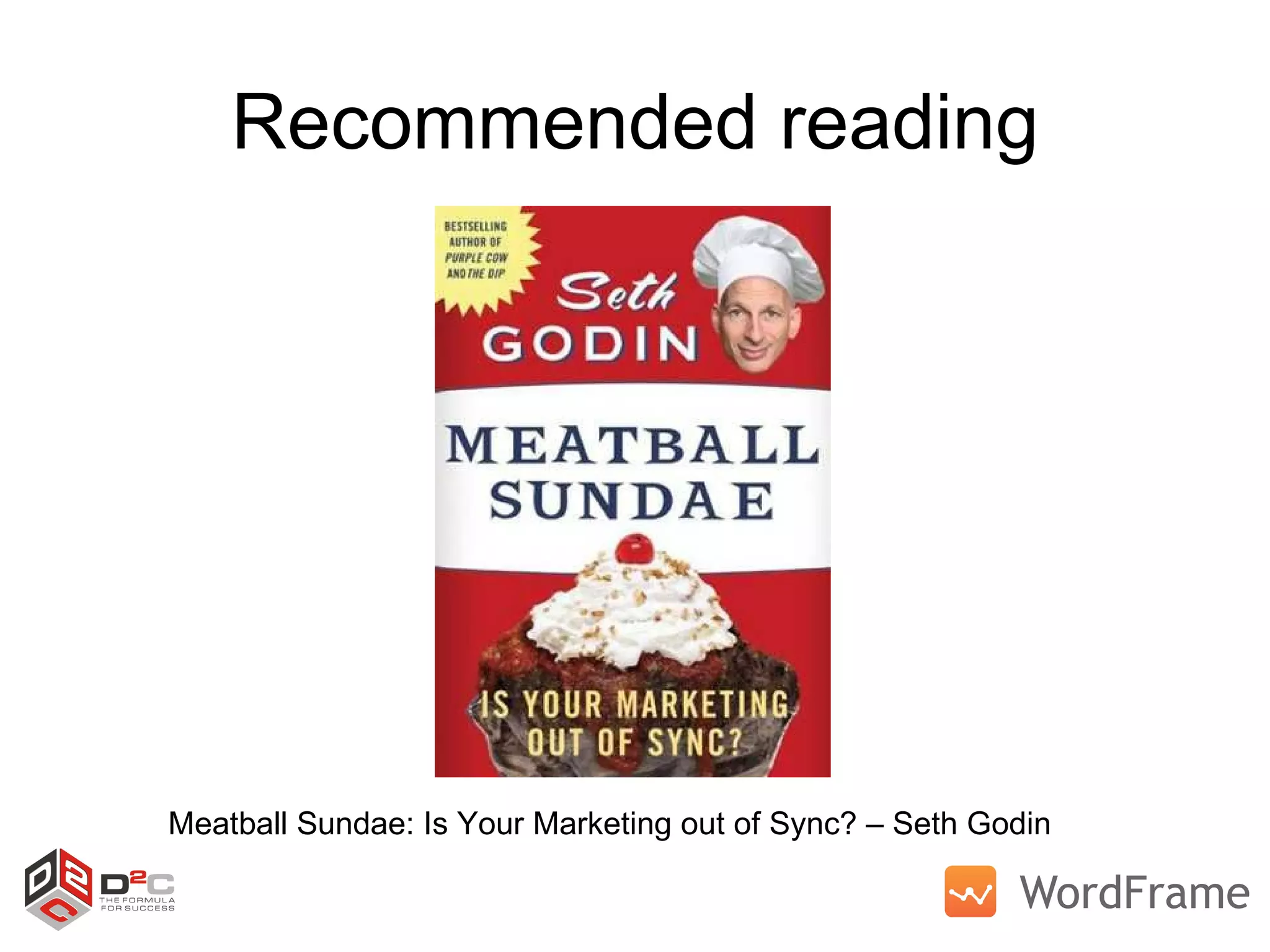
Recommended reading Meatball Sundae: Is Your Marketing out of Sync? – Seth Godin
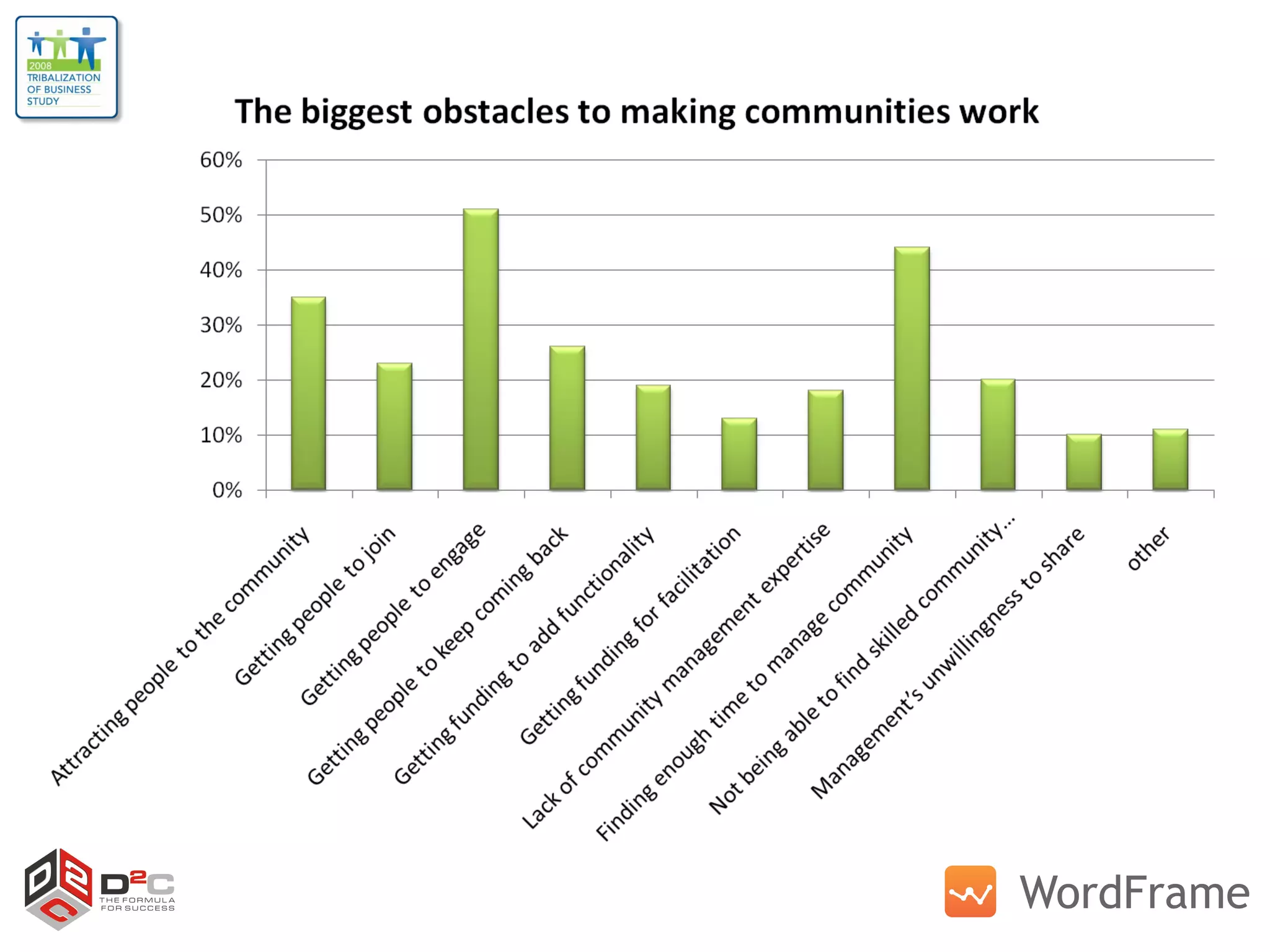
References Tribalization of  business study 2008  Francois Gossieaux http://www.emergencemarketing.com/2008/04/24/2008-tribalization-of-business-study-preliminary-results/ http://www.nevillehobson.com/2008/10/09/fir-interview-francois-gossieaux-on-tribalization-of-business/   Online Community Best Practices Jeremiah Owyang http://www.web-strategist.com/blog/2008/03/14/online-community-best-practices-slideshare-and-zero-cost-publishing/   Wikipatterns  Stewart Mader and friends http://www.wikipatterns.com/display/wikipatterns/Wikipatterns   http://ikiw.org
Contact details David Terrar CEO – D2C and  Executive Director - ITBrix / WordFrame p: +44 (0)1727 838285  (direct) m: +44 (0)7715 159423 e:  [email_address]  and  [email_address]   w:  www.d2c.org.uk  and  www.wordframe.com   skype: david_terrar twitter: DT linkedin:  http://www.linkedin.com/in/davidterrar   blog:  http://biztwozero.com

How To Build Vibrant Communities Within The Enterprise

  • 1.
    How to buildvibrant communities within the enterprise Can organizations build better web communities with predictable success? David Terrar – D2C and WordFrame with contributions from: Dennis Howlett – AccMan & ZDNet Philip Woodgate – Goodman Jones
  • 2.
    Charles Darwin –natural selection “ The theory of evolution by cumulative natural selection is the only theory we know of that is, in principle, capable of explaining the existence of organized complexity.” Richard Dawkins
  • 3.
    Recommended reading http://www.throwingsheep.com/ “ Networked Web 2.0 tools and technologies are making a profound impact on every aspect of our lives as social networking changes forms of entertainment in our personal lives and business models in the workplace.” John Chambers, Chairman and CEO, Cisco “ Web 2.0 social networking has far-reaching consequences for corporate executives managing relationships with customers, employees and business partners.” Henning Kagermann, Chairman and CEO, SAP
  • 4.
    From Command andControl to Teamwork and Collaboration http://www.youtube.com/watch?v=9WX7BNnYTf8&eurl=http://blogs.zdnet.com/collaboration/?p=315
  • 5.
    Agenda Whybuild communities? What motivates people to participate? What is ICAEW doing with ion? Other examples Success factors for community sites Can we build communities with predictable success? Conclusions and best practice Recommendations References
  • 6.
    Why build communities?New Product Development Customer service Idea generation Market research Developer relations Amplifying Word of Mouth Employee communications General Marketing Reputation management Product testing Public relations LONG TAIL SALES PROJECT COLLABORATION Co-innovation Member networking Capturing Knowledge
  • 7.
    What is aweb community? An interactive group of people joined together by a common interest.
  • 8.
    What motivates peopleto participate? Expressing themselves Support Listening Sharing Recognition Power The culture of the organization "Culture is a mealy-mouthed way of talking about power.“ - Euan Semple
  • 9.
    Participation Inequality JakobNielsen’s 1-9-90 rule Diagram courtesy of http://www.useit.com/alertbox/participation_inequality.html
  • 10.
    What is ICAEWdoing with ion? http://www.ion.icaew.com
  • 11.
    What is ICAEWdoing with ion? http://www.ion.icaew.com/itcounts
  • 12.
    What is ICAEWdoing with ion? http://www.ion.icaew.com/itcounts
  • 13.
    What is ICAEWdoing with ion? Web 2.0 Strategies 2008 - “Best New Web 2.0 Initiative” Finalist Accountancy Age - “Best Use of the Internet - Business”
  • 14.
    Some other examplesSocialMediaToday.com
  • 15.
    Wachovia Office 2.0Conference 2008 SF Pete Fields - Leads Enterprise 2.0 Business Strategy for Wachovia http://office20.com/docs/DOC-1130
  • 16.
    Building a communityS W I = our methodology T C H
  • 17.
    S tart withthe end in mind User won't just come like Facebook What is the purpose? http://www.flickr.com/photos/leena/2748174727/in/pool-roadsigncities
  • 18.
    W hat's init for me ?
  • 19.
    I ntuitive andsimple http://blogs.msdn.com/officeoffline/archive/2007/12/12/easy-to-use.aspx
  • 20.
  • 21.
  • 22.
  • 23.
    C ommunity managementChampions Teamwork Prepare to lose control Moderation guidelines Community manager needed Corporate standards Not just bottom up
  • 24.
    H elp andresources Online help and documentation “ How to”s Videos Examples Contributor guidelines Helpdesk Chat support Community manager support
  • 25.
    Building a communityS tart with the end in mind W hat's in it for me I ntuitive and simple T echnology supporting not leading C ommunity management H elp and resources
  • 26.
    Content and communitymanagement Seed the community Need professional content Engage professionals and be prepared to pay Need the community manager acting like a party host Content guidelines Focus on what the users want Marketing is vital
  • 27.
    Not in supportof any goal…
  • 28.
    Success factors forcommunity sites Speed of adoption Number of active users Number of posts Number of comments
  • 29.
    Life cycle ofa successful community
  • 30.
  • 31.
    Can we buildcommunities with predictable success? The more CONTENT you have the more MEMBERS you will get. The more MEMBERS you have the more CONTENT you will get. The better you match CONTENT and MEMBERS to MEMBER PROFILES the more MEMBERS and CONTENT you will get.
  • 32.
    Community best practicesBEST Clear goals + purpose Right talent Commitment + time Topic engenders passion Social + communal WORST Start with technology Marketing “campaign” Mixing business/consumer motives No facilitation Metrics vs. business measures
  • 33.
    Conclusions The TechnologyInfrastructure of the community is important The Social Infrastructure of the community is MORE important
  • 34.
    Recommendations Recognise itwill be hard work Focus on usability Community manager needed, and they have to act like a party host Content, content, content Basic marketing e.g. email key posts Brand advertising and incentives don't work Use available resources e.g. Wikipatterns Coherent technology is important People and culture more important Make sure the key stakeholders involved understand new marketing Make sure they understanding social networks by using some and getting their hands dirty
  • 35.
    Key take awayfrom Enterprise 2.0 Conference 2008 Boston Christopher Keohane, Unity Product Owner Shawn Dahlen, Unity Program Manager
  • 36.
    Recommended reading MeatballSundae: Is Your Marketing out of Sync? – Seth Godin
  • 37.
    References Tribalization of business study 2008 Francois Gossieaux http://www.emergencemarketing.com/2008/04/24/2008-tribalization-of-business-study-preliminary-results/ http://www.nevillehobson.com/2008/10/09/fir-interview-francois-gossieaux-on-tribalization-of-business/ Online Community Best Practices Jeremiah Owyang http://www.web-strategist.com/blog/2008/03/14/online-community-best-practices-slideshare-and-zero-cost-publishing/ Wikipatterns Stewart Mader and friends http://www.wikipatterns.com/display/wikipatterns/Wikipatterns http://ikiw.org
  • 38.
    Contact details DavidTerrar CEO – D2C and Executive Director - ITBrix / WordFrame p: +44 (0)1727 838285 (direct) m: +44 (0)7715 159423 e: [email_address] and [email_address] w: www.d2c.org.uk and www.wordframe.com skype: david_terrar twitter: DT linkedin: http://www.linkedin.com/in/davidterrar blog: http://biztwozero.com