The Path of Least Resistance


Dave Pattern | Library Systems Manager | University of Huddersfield
                      http://daveyp.com/blog
                          twitter @daveyp
Dave’s Law...


 Users should not have
     to become mini-
  librarians in order to
      use the library.
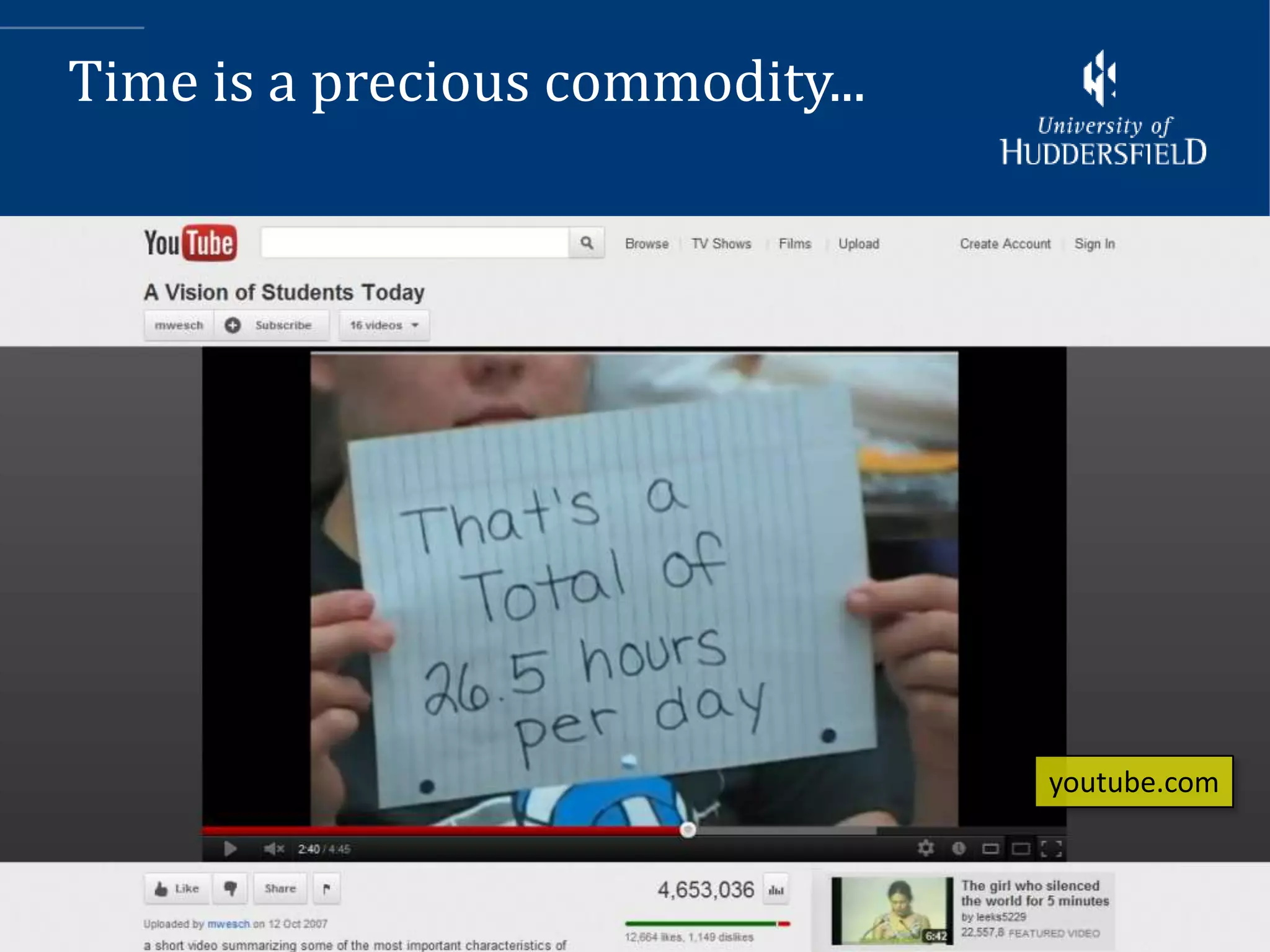
Time is a precious commodity...


                                  youtube.com
Libraries are too hard...


“As early as 2004, in a focus group for
 one of my research studies, a college
 freshman bemoaned, ‘Why is Google
 so easy and the library so hard?’”
  – Carol Tenopir, University of Tennessee, Knoxville
    (“Visualize the Perfect Search”, Library Journal, 2009)

                                               libraryjournal.com
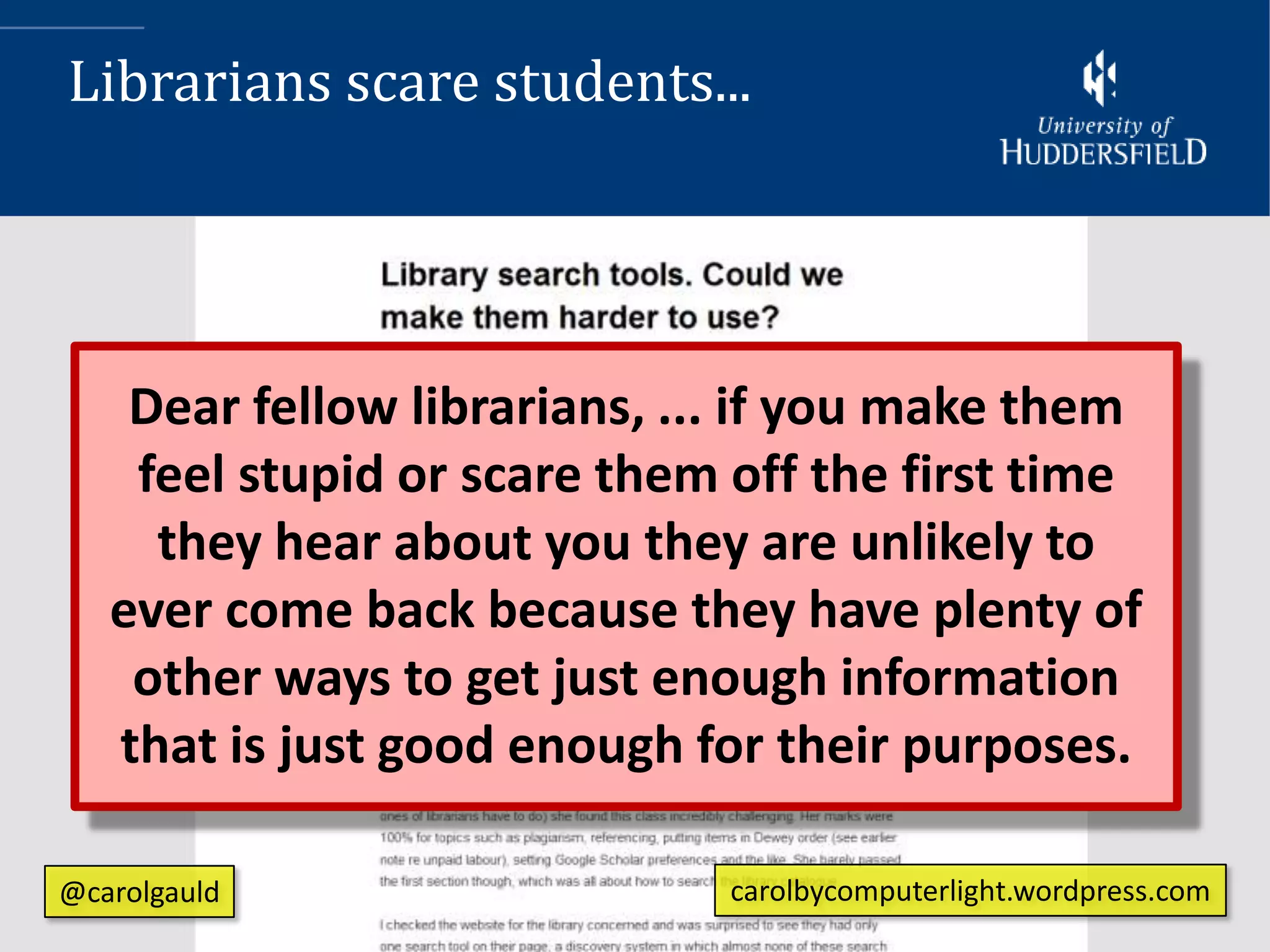
Librarians scare students...


    Dear fellow librarians, ... if you make them
    feel stupid or scare them off the first time
     they hear about you they are unlikely to
   ever come back because they have plenty of
    other ways to get just enough information
   that is just good enough for their purposes.

@carolgauld                   carolbycomputerlight.wordpress.com
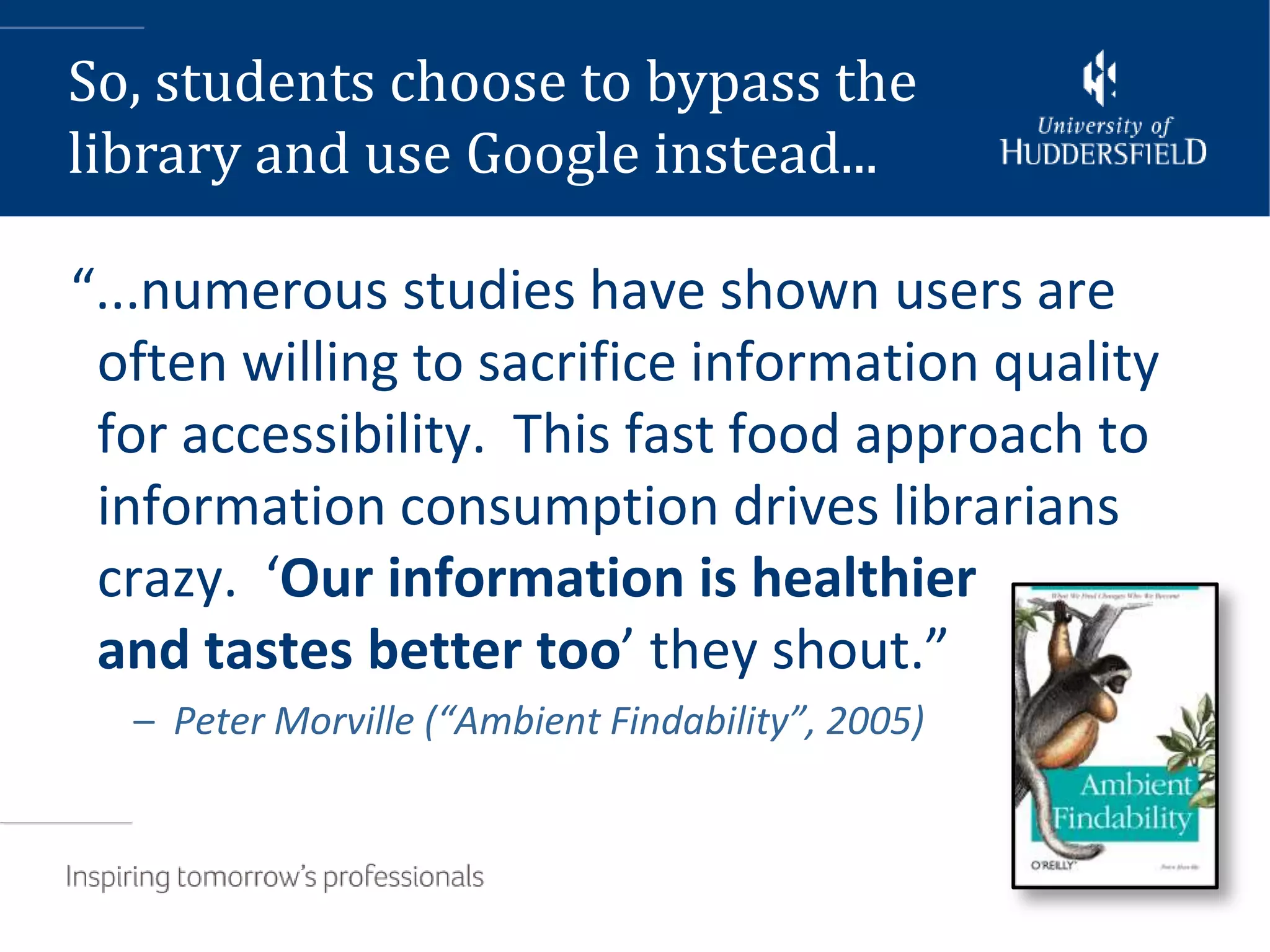
So, students choose to bypass the
library and use Google instead...

“...numerous studies have shown users are
 often willing to sacrifice information quality
 for accessibility. This fast food approach to
 information consumption drives librarians
 crazy. ‘Our information is healthier
 and tastes better too’ they shout.”
  – Peter Morville (“Ambient Findability”, 2005)
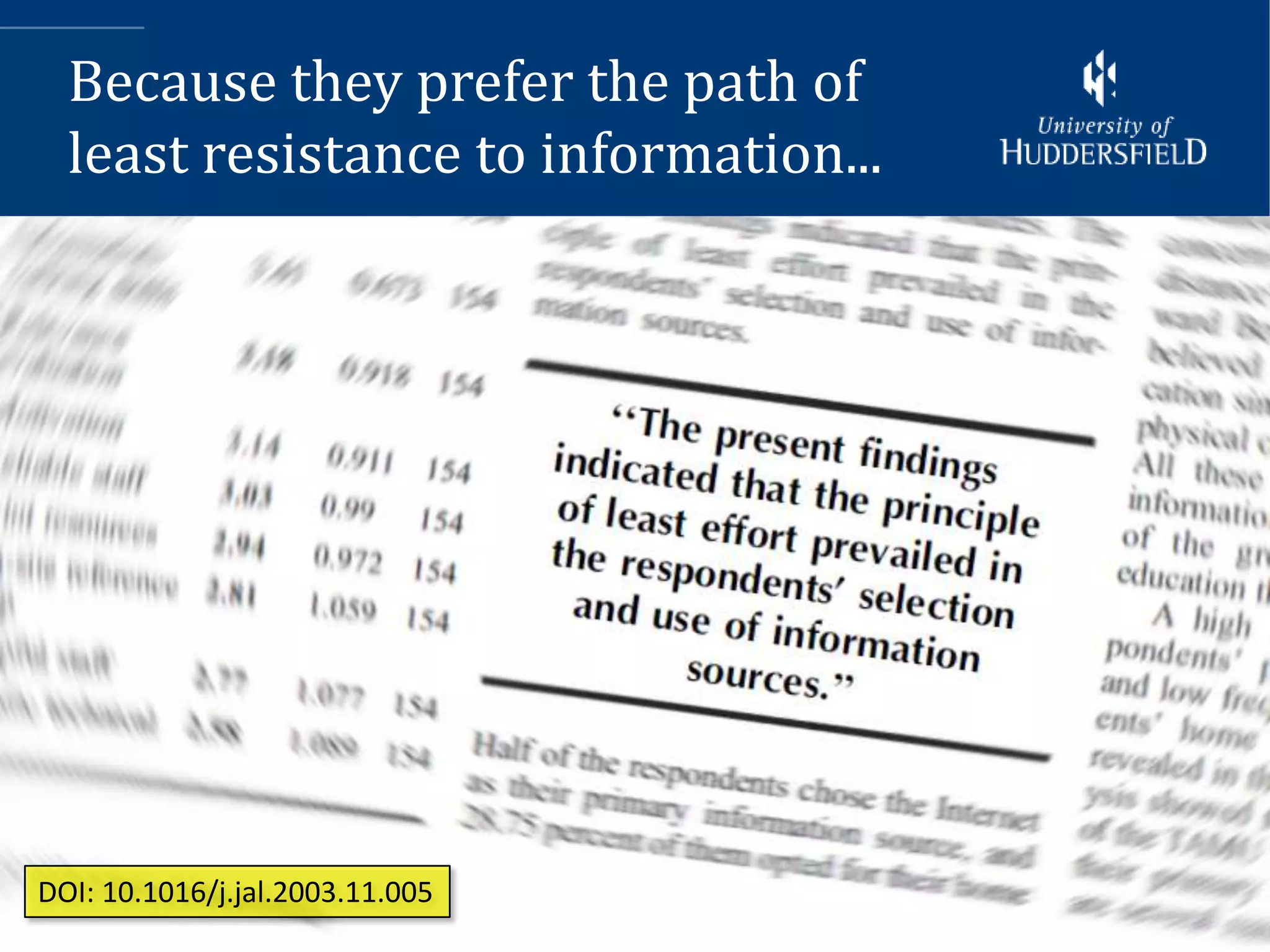
Because they prefer the path of
  least resistance to information...


DOI: 10.1016/j.jal.2003.11.005
...and this is well understood
and documented behaviour

“...an information [seeker] will tend to
 use the most convenient search
 method, in the least exacting mode
 available. Information seeking
 behaviour stops as soon as minimally
 acceptable results are found.”
                                 en.wikipedia.org
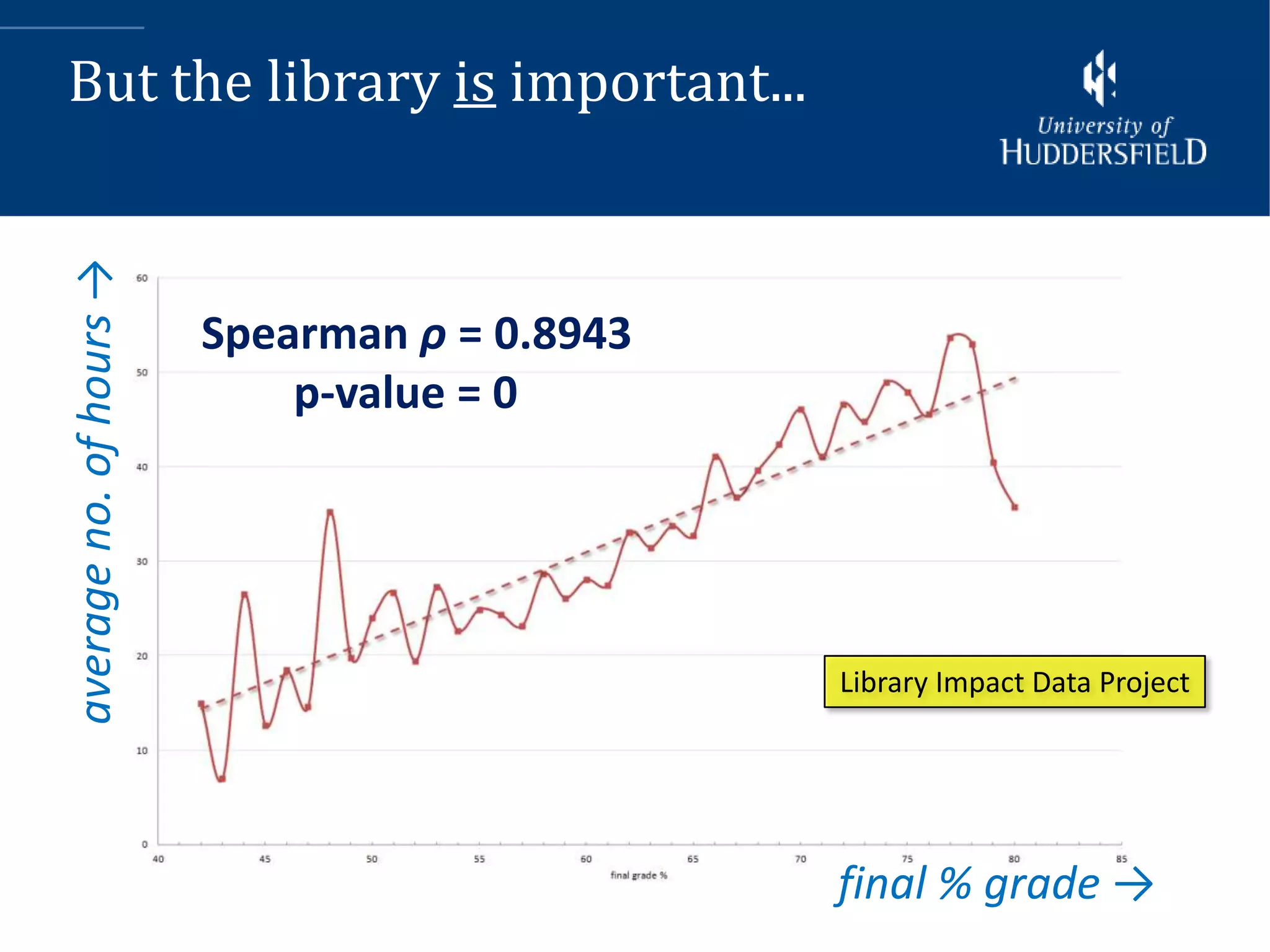
But the library is important...
average no. of hours →


                         Spearman ρ = 0.8943
                             p-value = 0


                                               Library Impact Data Project


                                               final % grade →
So, we need to make it easier for
users to access our resources...

“The challenge for academic libraries
 [...] is to offer an experience that has
 the simplicity of Google...”
  – Judy Luther & Maureen C. Kelly (Library Journal, 2011)


                                              libraryjournal.com
...and we need to help free up
their time to do other stuff


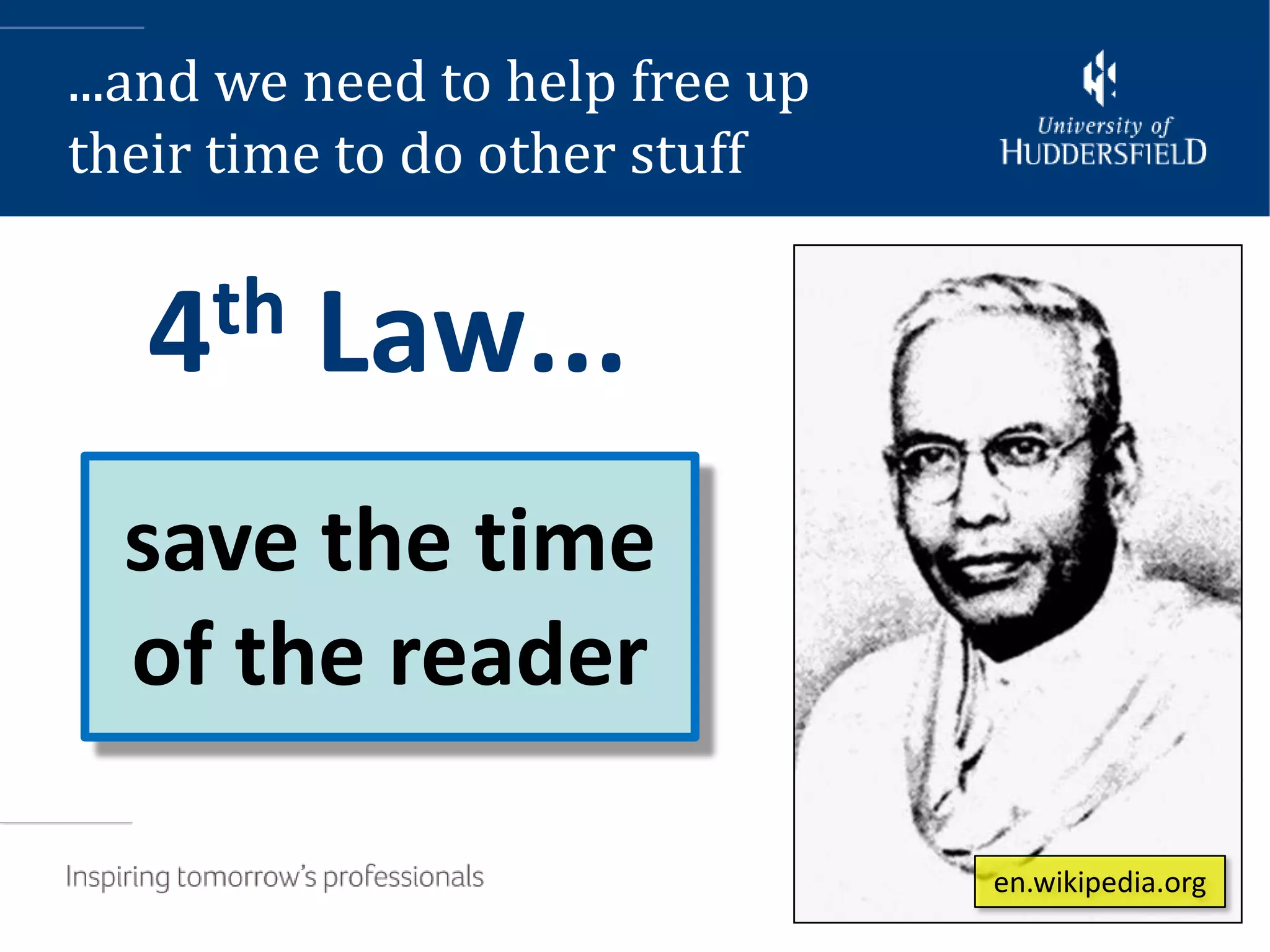
   4th    Law...
  save the time
  of the reader

                                 en.wikipedia.org
                                              11
More time to do stuff like...


• Watching “El Nombre”
• Going to the pub
• Looking at Facebook
• Maybe even evaluating
  the articles they’ve
  found on Summon? 
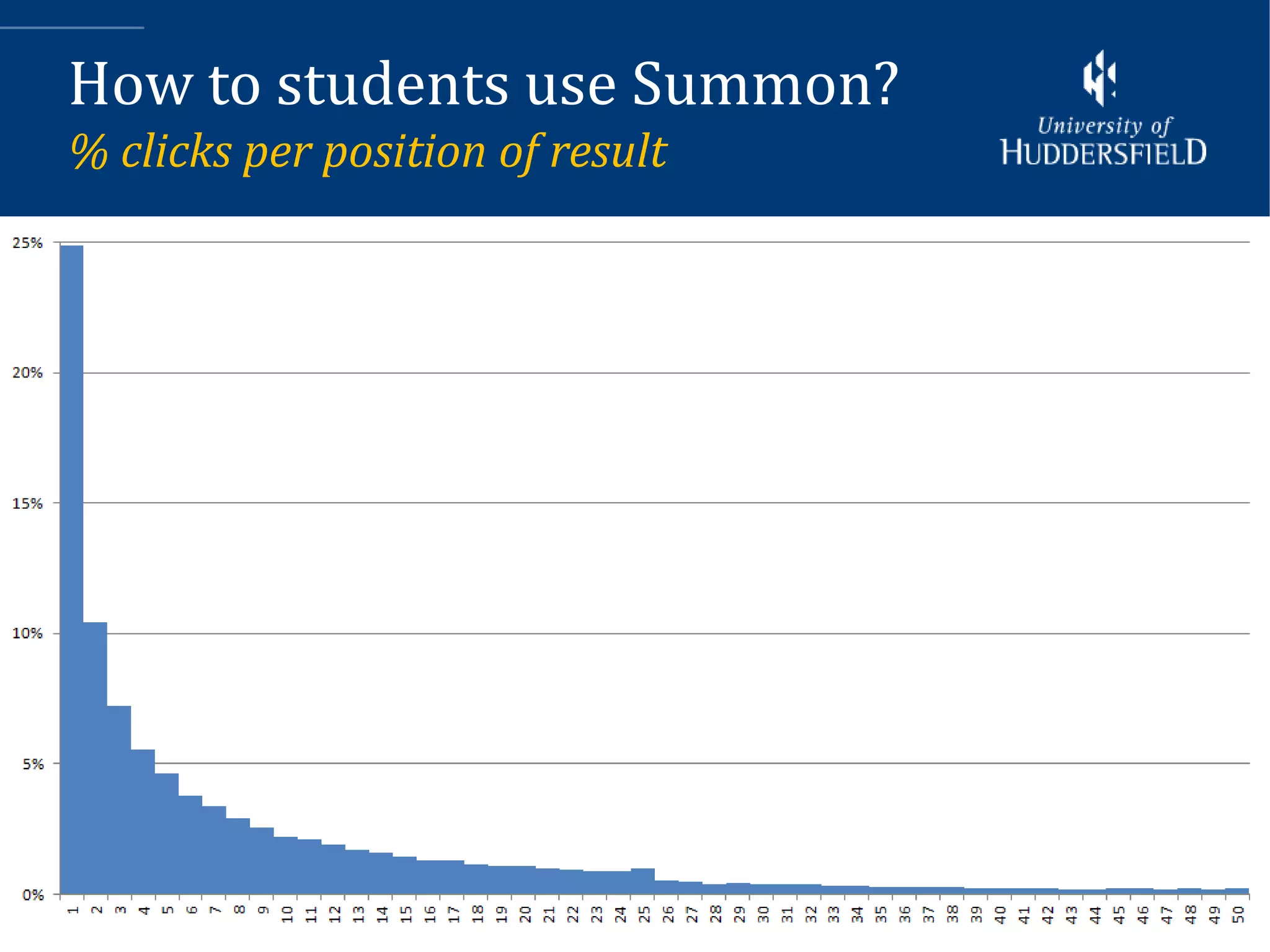
How to students use Summon?
% clicks per position of result
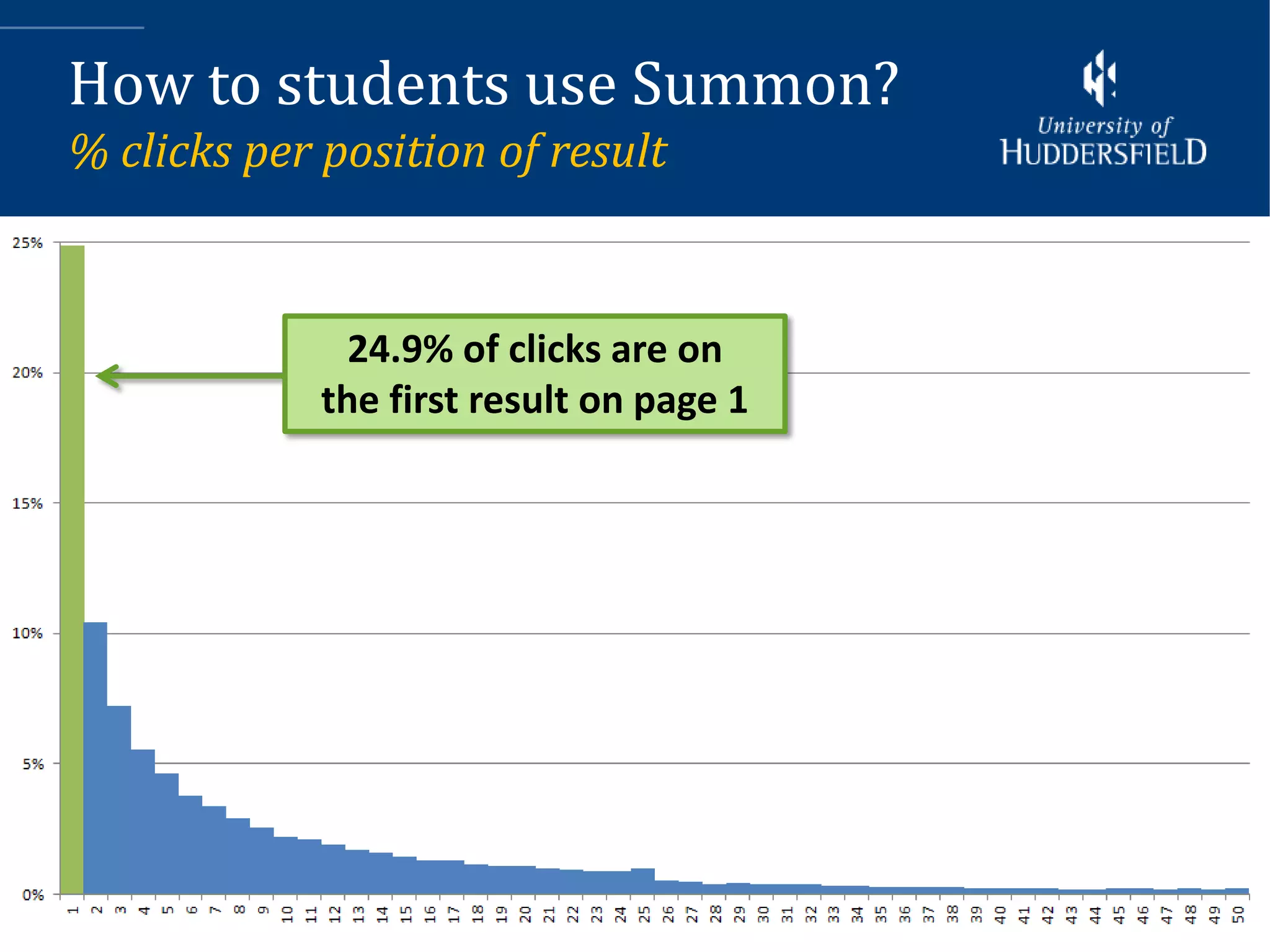
How to students use Summon?
% clicks per position of result


               24.9% of clicks are on
             the first result on page 1
How to students use Summon?
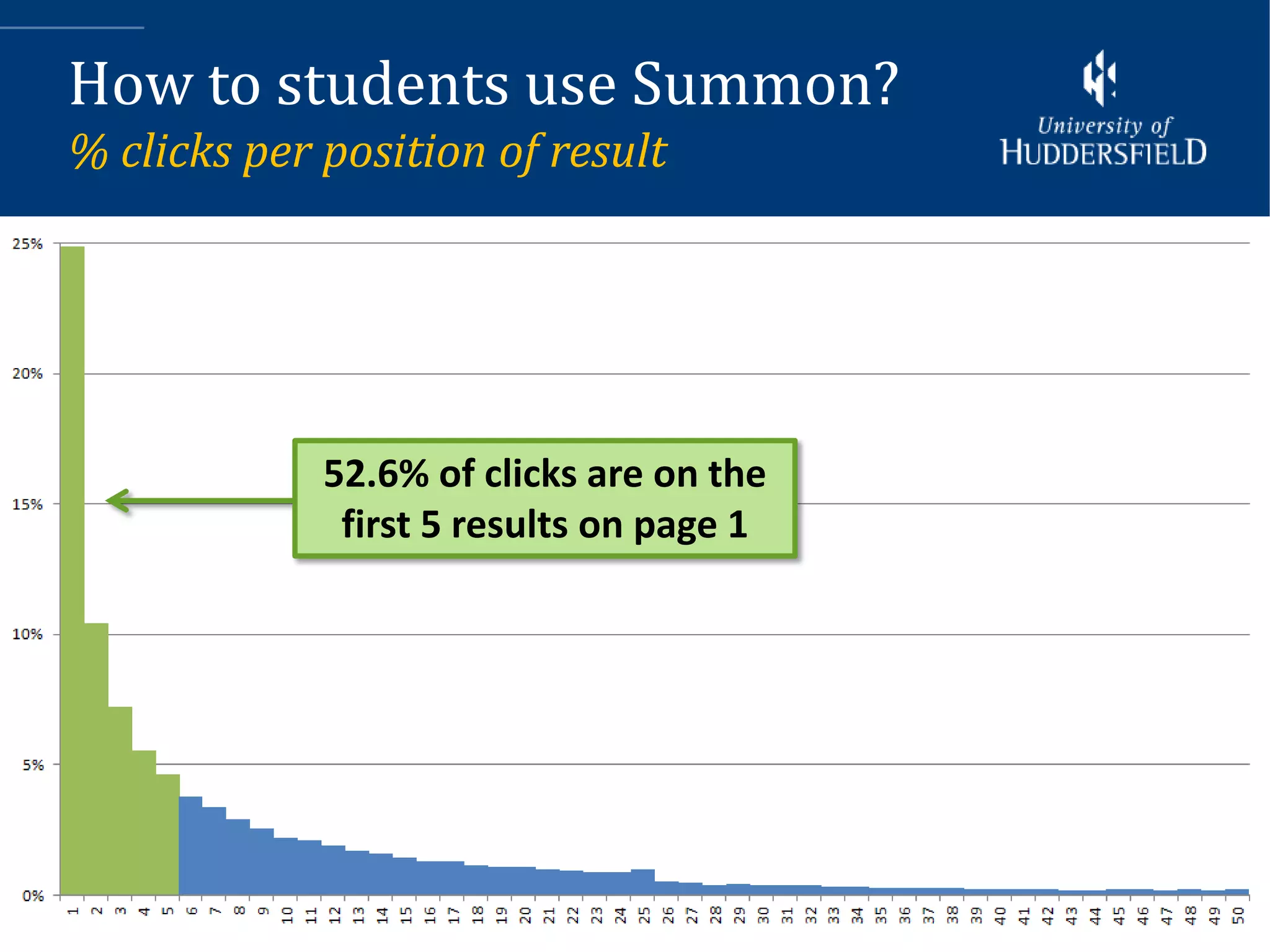
% clicks per position of result


             52.6% of clicks are on the
              first 5 results on page 1
How to students use Summon?
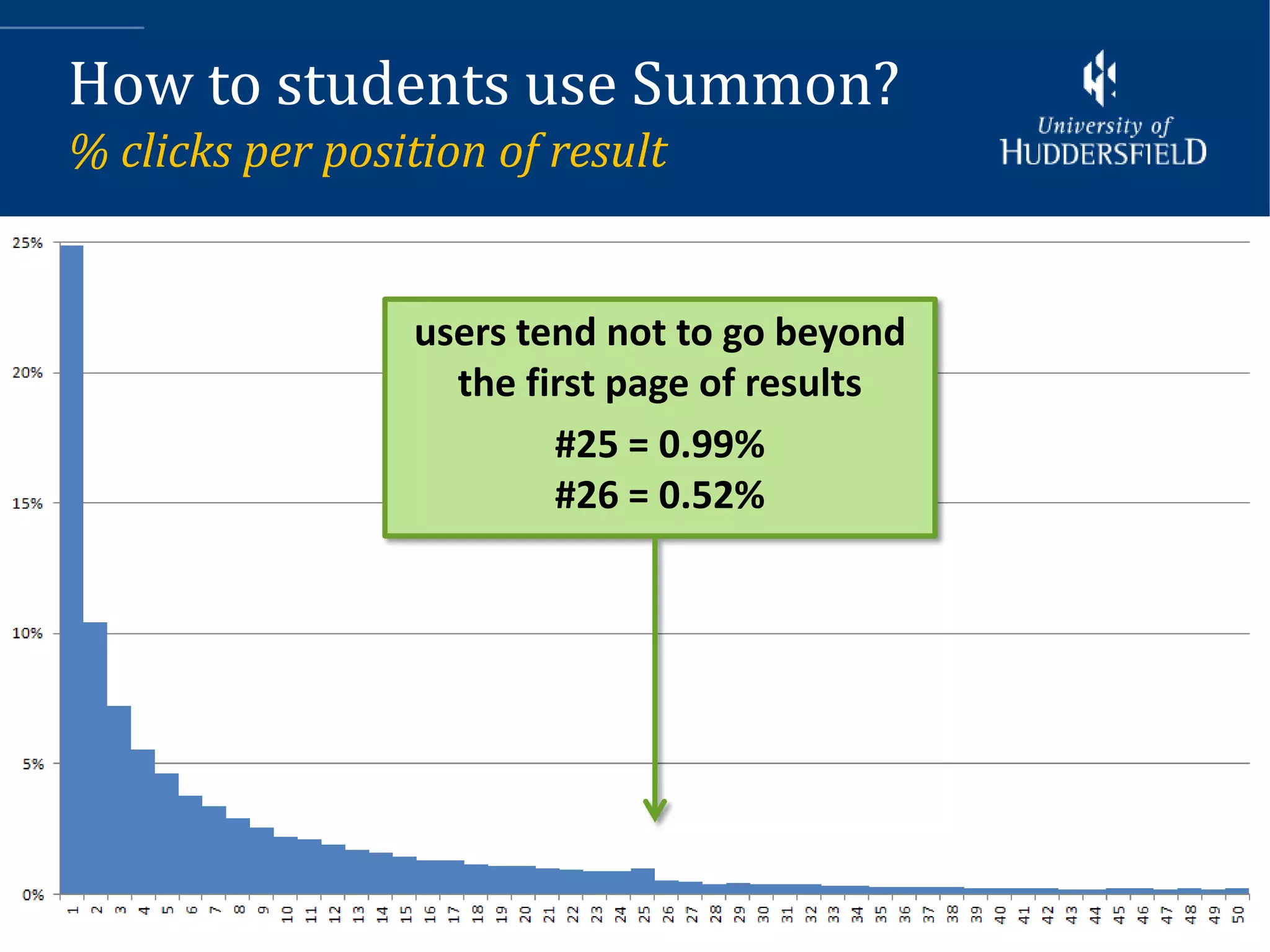
% clicks per position of result


                 users tend not to go beyond
                   the first page of results
                         #25 = 0.99%
                         #26 = 0.52%
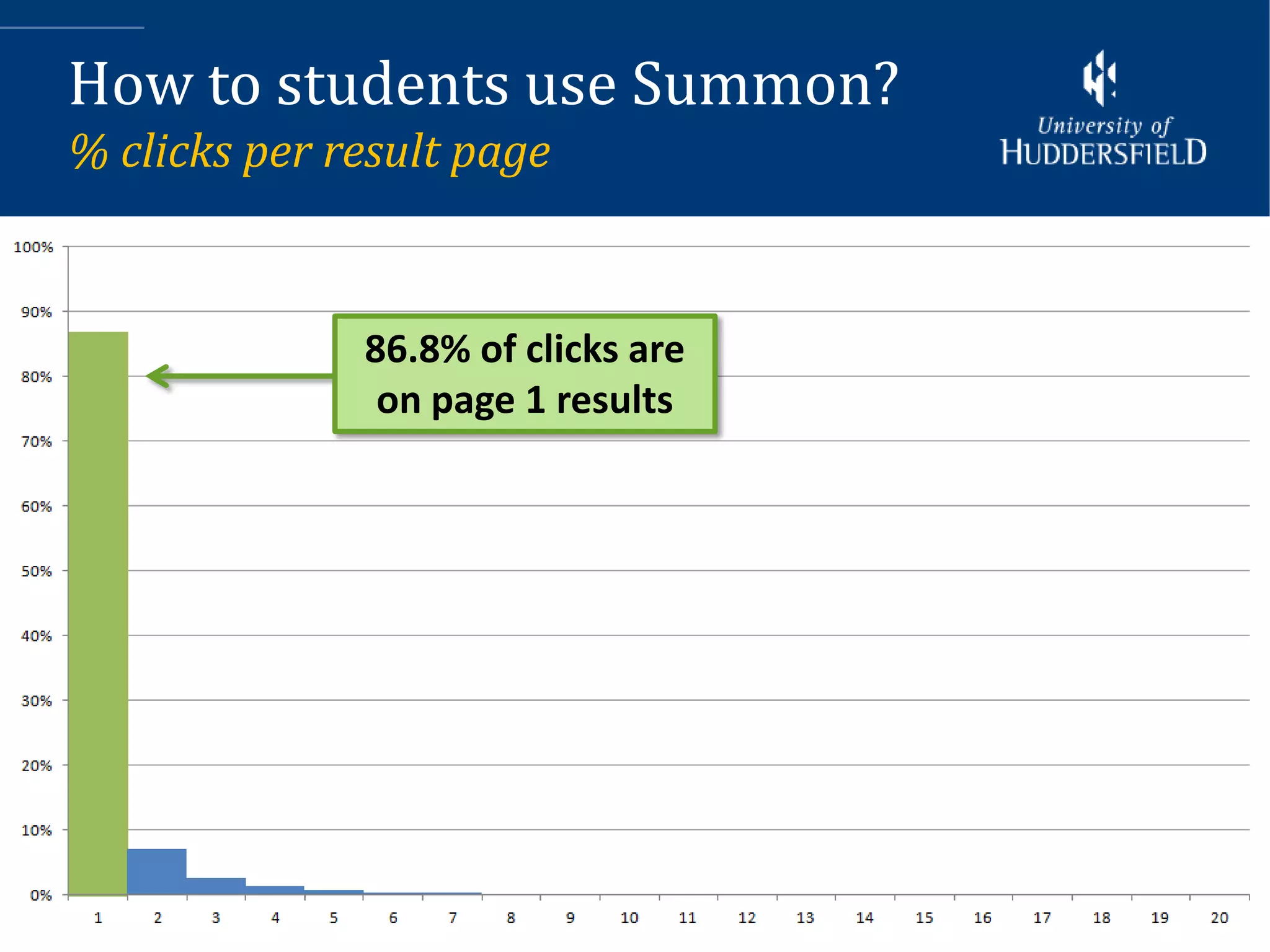
How to students use Summon?
% clicks per result page


              86.8% of clicks are
               on page 1 results
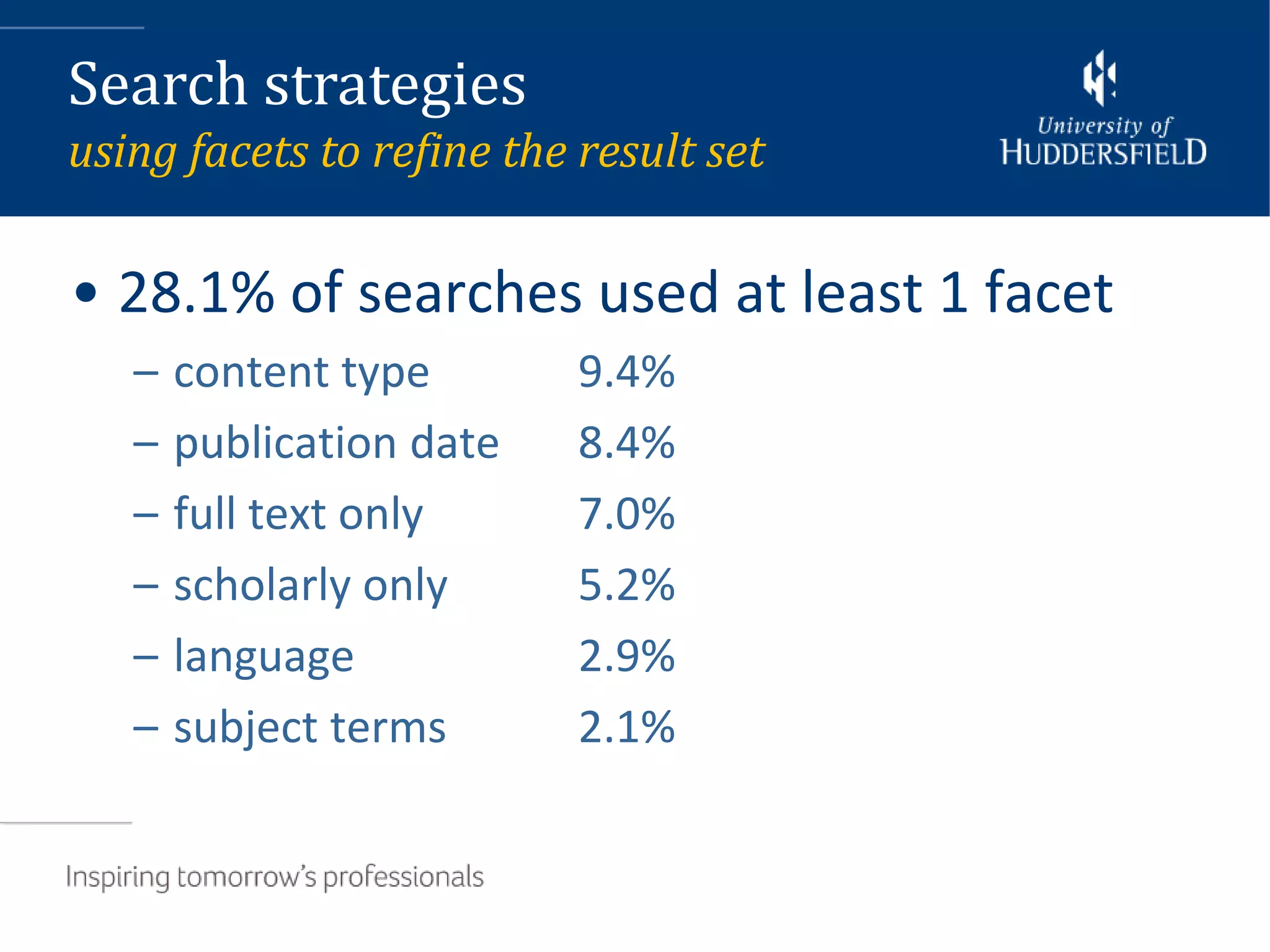
Search strategies
using facets to refine the result set

• 28.1% of searches used at least 1 facet
   –   content type        9.4%
   –   publication date    8.4%
   –   full text only      7.0%
   –   scholarly only      5.2%
   –   language            2.9%
   –   subject terms       2.1%
Search strategies
based on 78,274 searches

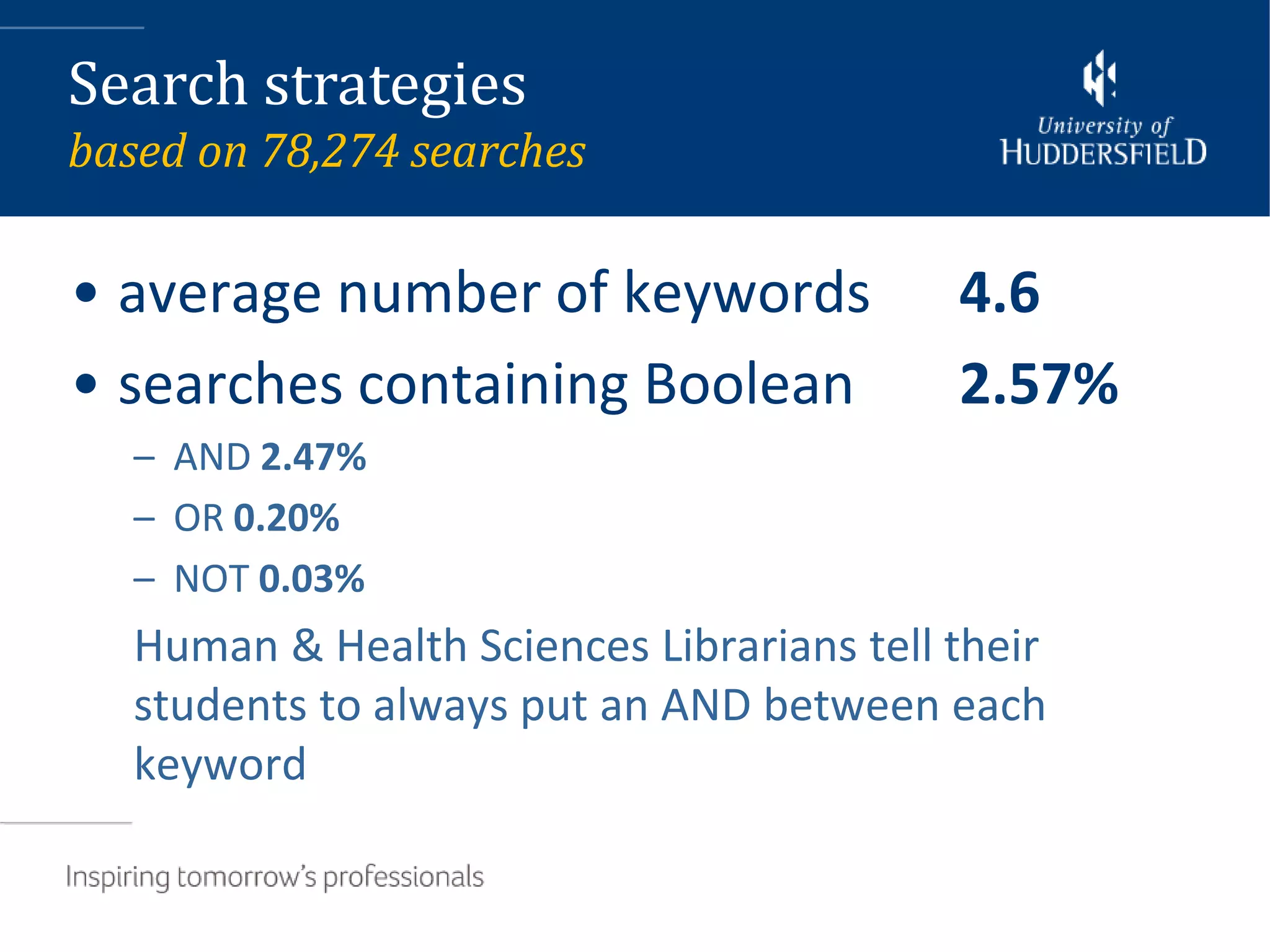
• average number of keywords               4.6
• searches containing Boolean              2.57%
   – AND 2.47%
   – OR 0.20%
   – NOT 0.03%
   Human & Health Sciences Librarians tell their
   students to always put an AND between each
   keyword
Search strategies
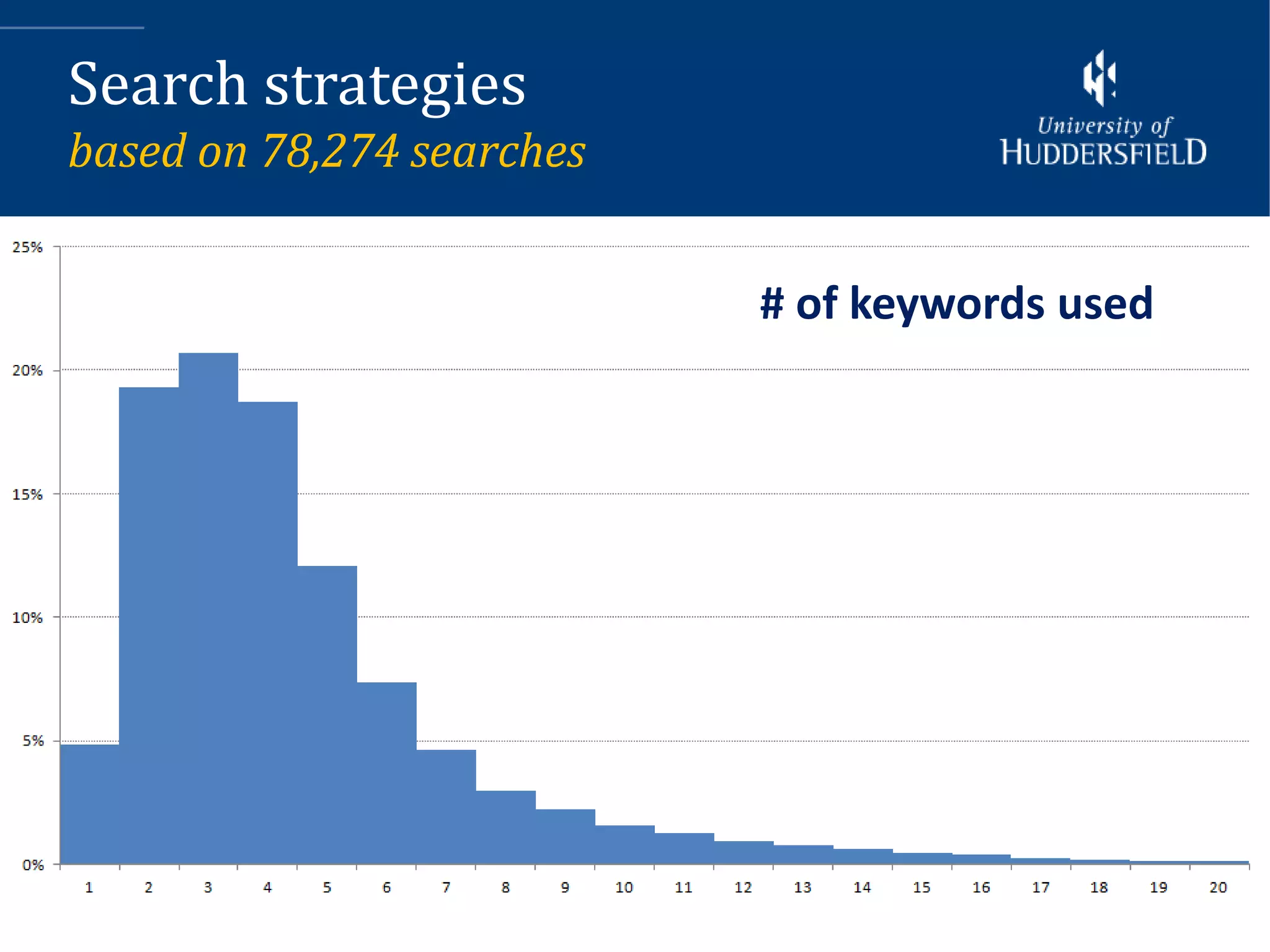
based on 78,274 searches


                           # of keywords used
Search strategies
based on 78,274 searches


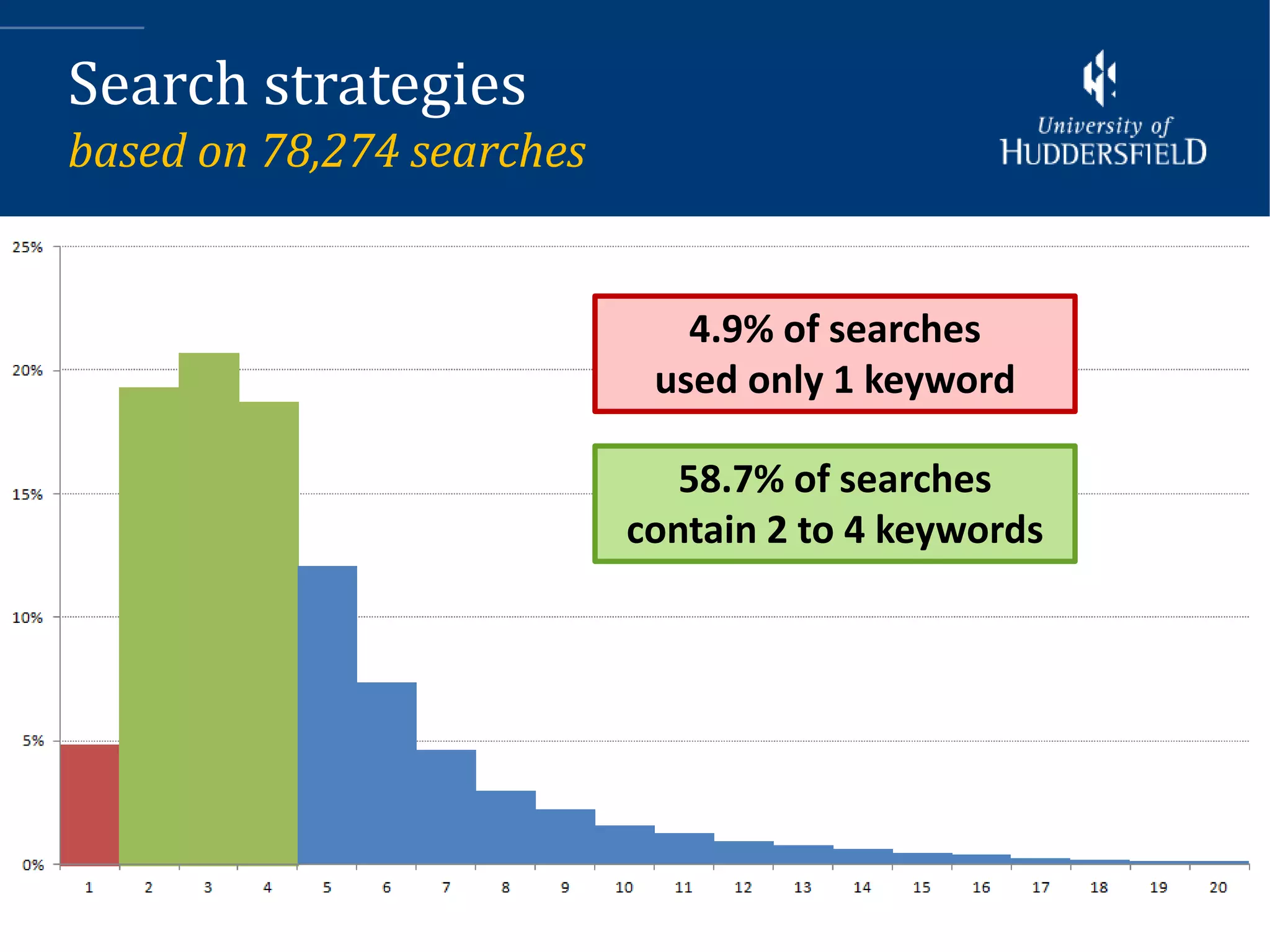
                              4.9% of searches
                            used only 1 keyword

                              58.7% of searches
                           contain 2 to 4 keywords
Search strategies
  most search keywords: 185

      The literature reveals that errors of drug administration are a widely distributed and
 common occurrence The frequency of errors and their underlying causes are discussed, and
the literature is surveyed to determine reasons for mistakes and possible remedial measures
    Ideas are drawn from industrial sources to describe a model of preventing mistakes at
source, by making errors impossible The ideas of Crosby and Shingo are discussed and a zero
    defects philosophy is described and developed This paper attempts to determine if this
 quality model developed and used in industry can be transferred to the health service, and
  concludes that it needs adaptation and cautious application Recommendations are made
      for improved practices and improvements, both clinical and managerial The author
  recommends a multidisciplinary review of all practices and systems to develop a radically
 different procedure with no drug errors as its aim It is questioned whether this is possible in
     the present health service environment, as this would require sustained management
   commitment to both the idea and the quality system However, the author believes that
               some of the principles can be applied as individual quality initiatives

                                                                           Summon results

Summon: The Path of Least Resistance

  • 1.
    The Path ofLeast Resistance Dave Pattern | Library Systems Manager | University of Huddersfield http://daveyp.com/blog twitter @daveyp
  • 2.
    Dave’s Law... Usersshould not have to become mini- librarians in order to use the library.
  • 3.
    Time is aprecious commodity... youtube.com
  • 4.
    Libraries are toohard... “As early as 2004, in a focus group for one of my research studies, a college freshman bemoaned, ‘Why is Google so easy and the library so hard?’” – Carol Tenopir, University of Tennessee, Knoxville (“Visualize the Perfect Search”, Library Journal, 2009) libraryjournal.com
  • 5.
    Librarians scare students... Dear fellow librarians, ... if you make them feel stupid or scare them off the first time they hear about you they are unlikely to ever come back because they have plenty of other ways to get just enough information that is just good enough for their purposes. @carolgauld carolbycomputerlight.wordpress.com
  • 6.
    So, students chooseto bypass the library and use Google instead... “...numerous studies have shown users are often willing to sacrifice information quality for accessibility. This fast food approach to information consumption drives librarians crazy. ‘Our information is healthier and tastes better too’ they shout.” – Peter Morville (“Ambient Findability”, 2005)
  • 7.
    Because they preferthe path of least resistance to information... DOI: 10.1016/j.jal.2003.11.005
  • 8.
    ...and this iswell understood and documented behaviour “...an information [seeker] will tend to use the most convenient search method, in the least exacting mode available. Information seeking behaviour stops as soon as minimally acceptable results are found.” en.wikipedia.org
  • 9.
    But the libraryis important... average no. of hours → Spearman ρ = 0.8943 p-value = 0 Library Impact Data Project final % grade →
  • 10.
    So, we needto make it easier for users to access our resources... “The challenge for academic libraries [...] is to offer an experience that has the simplicity of Google...” – Judy Luther & Maureen C. Kelly (Library Journal, 2011) libraryjournal.com
  • 11.
    ...and we needto help free up their time to do other stuff 4th Law... save the time of the reader en.wikipedia.org 11
  • 12.
    More time todo stuff like... • Watching “El Nombre” • Going to the pub • Looking at Facebook • Maybe even evaluating the articles they’ve found on Summon? 
  • 13.
    How to studentsuse Summon? % clicks per position of result
  • 14.
    How to studentsuse Summon? % clicks per position of result 24.9% of clicks are on the first result on page 1
  • 15.
    How to studentsuse Summon? % clicks per position of result 52.6% of clicks are on the first 5 results on page 1
  • 16.
    How to studentsuse Summon? % clicks per position of result users tend not to go beyond the first page of results #25 = 0.99% #26 = 0.52%
  • 17.
    How to studentsuse Summon? % clicks per result page 86.8% of clicks are on page 1 results
  • 18.
    Search strategies using facetsto refine the result set • 28.1% of searches used at least 1 facet – content type 9.4% – publication date 8.4% – full text only 7.0% – scholarly only 5.2% – language 2.9% – subject terms 2.1%
  • 19.
    Search strategies based on78,274 searches • average number of keywords 4.6 • searches containing Boolean 2.57% – AND 2.47% – OR 0.20% – NOT 0.03% Human & Health Sciences Librarians tell their students to always put an AND between each keyword
  • 20.
    Search strategies based on78,274 searches # of keywords used
  • 21.
    Search strategies based on78,274 searches 4.9% of searches used only 1 keyword 58.7% of searches contain 2 to 4 keywords
  • 22.
    Search strategies most search keywords: 185 The literature reveals that errors of drug administration are a widely distributed and common occurrence The frequency of errors and their underlying causes are discussed, and the literature is surveyed to determine reasons for mistakes and possible remedial measures Ideas are drawn from industrial sources to describe a model of preventing mistakes at source, by making errors impossible The ideas of Crosby and Shingo are discussed and a zero defects philosophy is described and developed This paper attempts to determine if this quality model developed and used in industry can be transferred to the health service, and concludes that it needs adaptation and cautious application Recommendations are made for improved practices and improvements, both clinical and managerial The author recommends a multidisciplinary review of all practices and systems to develop a radically different procedure with no drug errors as its aim It is questioned whether this is possible in the present health service environment, as this would require sustained management commitment to both the idea and the quality system However, the author believes that some of the principles can be applied as individual quality initiatives Summon results

Editor's Notes

  • #4 Prof Michael Wesch, Kansas State University“A Vision of Students Today” (2004)
  • #5 Carol Tenopir (University of Tennessee, Knoxville)http://www.libraryjournal.com/article/CA6639354.html?industryid=47130Via Ken Chad http://www.kenchadconsulting.com/wp-content/uploads/2012/03/Transforming_LibrarySystems_Ken_Chad_UCISA_March2012.pdf
  • #6 Caroline Gauldhttp://carolbycomputerlight.wordpress.com/2012/06/04/library-search-tools-could-we-make-them-harder-to-use/http://www.twitter.com/carolgauld
  • #7 ISBN: 0596007655http://findability.org/http://shop.oreilly.com/product/9780596007652.do
  • #8 “Factors Influencing Distance-Education Graduate Students' Use of Information Sources: A User Study”Zao Liu andZheng Ye (Lan) Yang The Journal of Academic LibrarianshipVolume 30, Issue 1, January 2004, Pages 24–35http://dx.doi.org/10.1016/j.jal.2003.11.005
  • #10 2010/11 graduates and their use of e-resources in the final year (as measured via Ezproxy)http://library.hud.ac.uk/lidp
  • #11 Judy Luther & Maureen C. Kellyhttp://www.libraryjournal.com/lj/ljinprintcurrentissue/889250-403/the_next_generation_of_discovery.html.cspVia Ken Chad http://www.kenchadconsulting.com/wp-content/uploads/2012/03/Transforming_LibrarySystems_Ken_Chad_UCISA_March2012.pdf
  • #12 http://en.wikipedia.org/wiki/Five_laws_of_library_science