Chapter 2
Assemblers
Assembly Language Programming
• Writing a program in assembly lang is more
convenient than in machine lang.
• Assembly program is more readable.
• Assembly lang is machine dependent.
• Assembly program is written using
symbols(Mnemonics).
• Assembly program is translated into machine
code before execution.
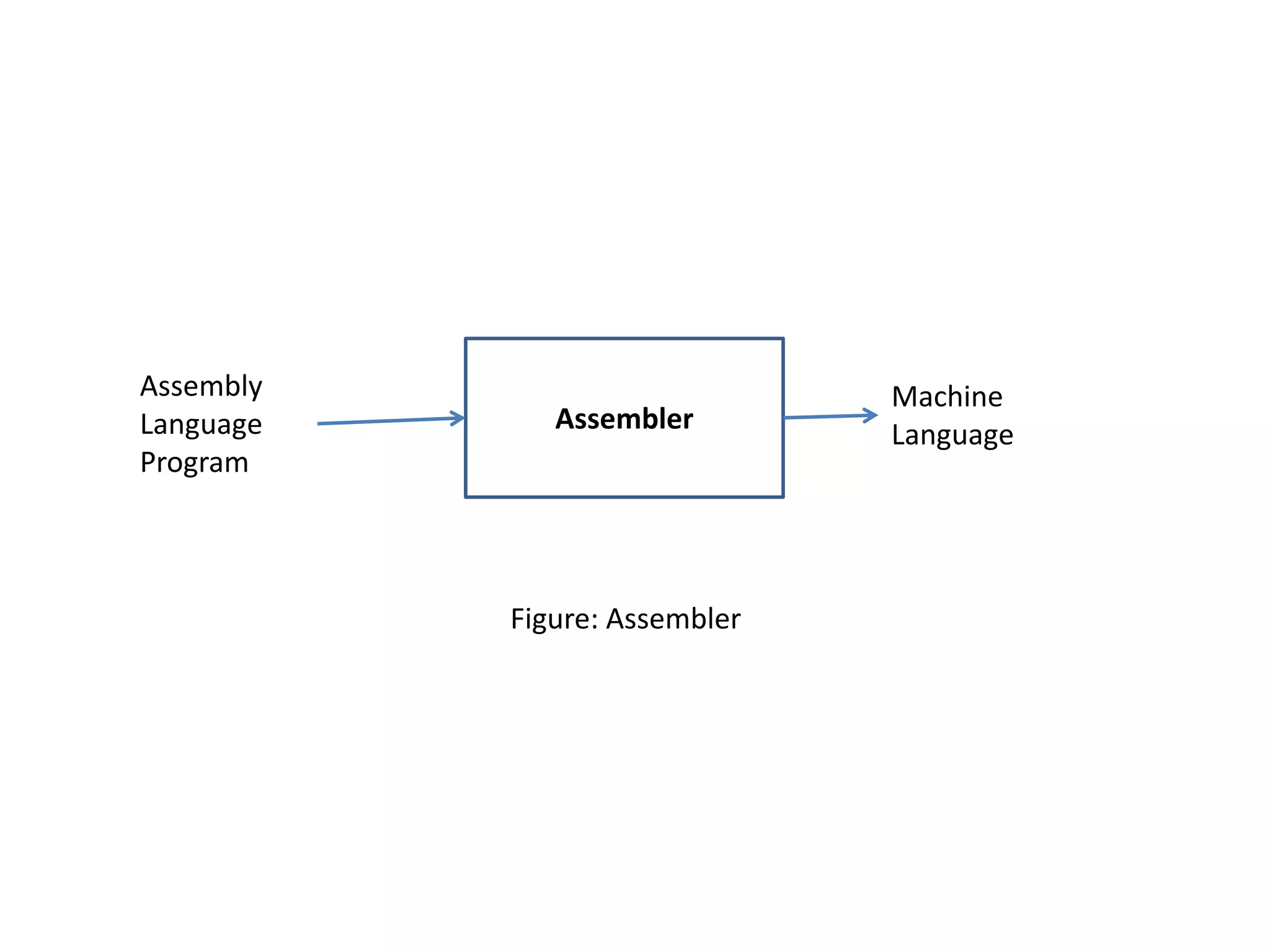
Assembler
Assembly
Language
Program
Machine
Language
Figure: Assembler
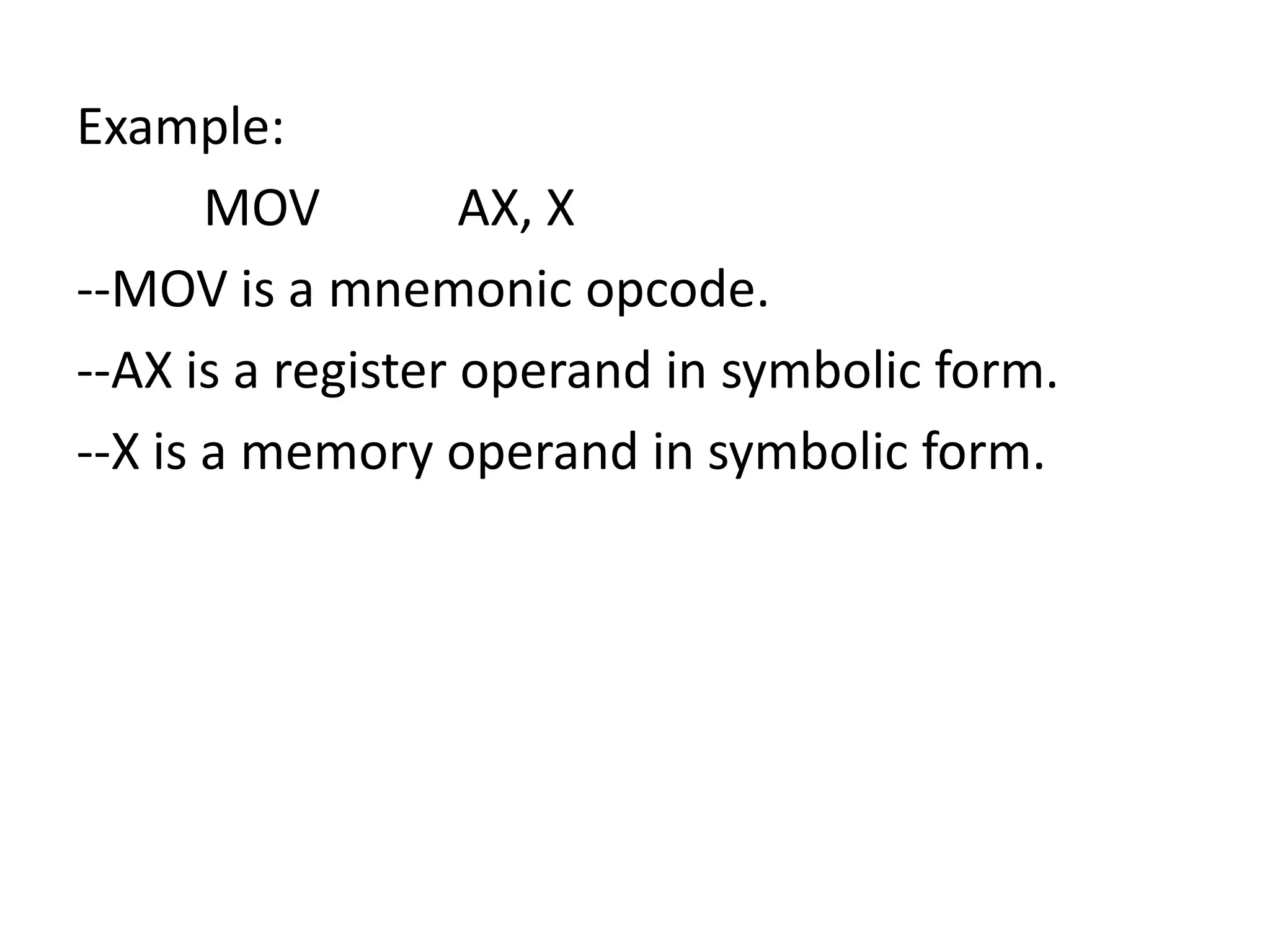
Example:
MOV AX, X
--MOV is a mnemonic opcode.
--AX is a register operand in symbolic form.
--X is a memory operand in symbolic form.
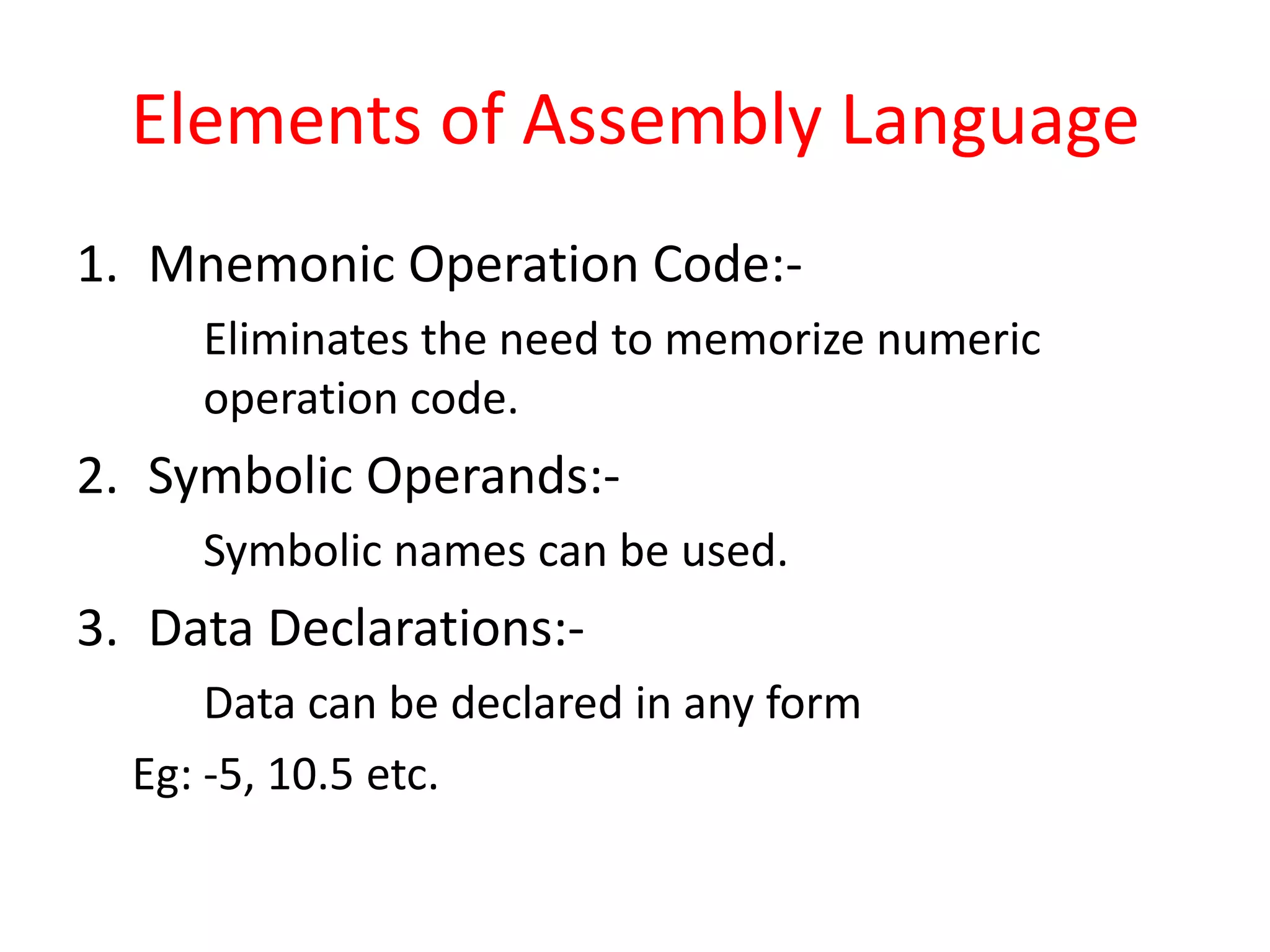
Elements of Assembly Language
1. Mnemonic Operation Code:-
Eliminates the need to memorize numeric
operation code.
2. Symbolic Operands:-
Symbolic names can be used.
3. Data Declarations:-
Data can be declared in any form
Eg: -5, 10.5 etc.
Statement Format
[Label] <Opcode> <operand Spec> [<operand spec>….]
1. Label:- Is optional.
2. Opcode:- Symbolic opcode
3. Operand:- Symbolic name (Register or Memory
variable)
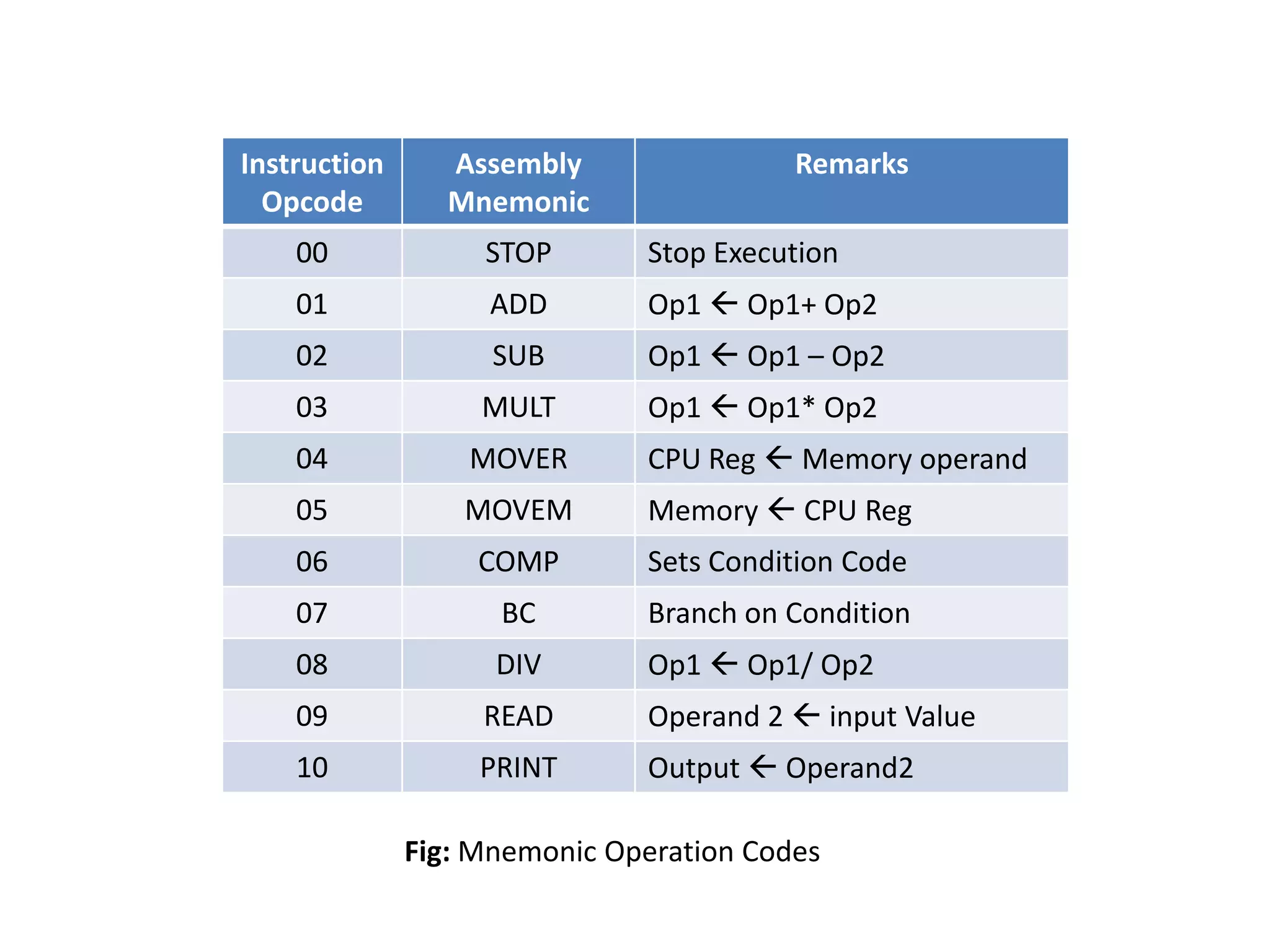
Instruction
Opcode
Assembly
Mnemonic
Remarks
00 STOP Stop Execution
01 ADD Op1  Op1+ Op2
02 SUB Op1  Op1 – Op2
03 MULT Op1  Op1* Op2
04 MOVER CPU Reg  Memory operand
05 MOVEM Memory  CPU Reg
06 COMP Sets Condition Code
07 BC Branch on Condition
08 DIV Op1  Op1/ Op2
09 READ Operand 2  input Value
10 PRINT Output  Operand2
Fig: Mnemonic Operation Codes
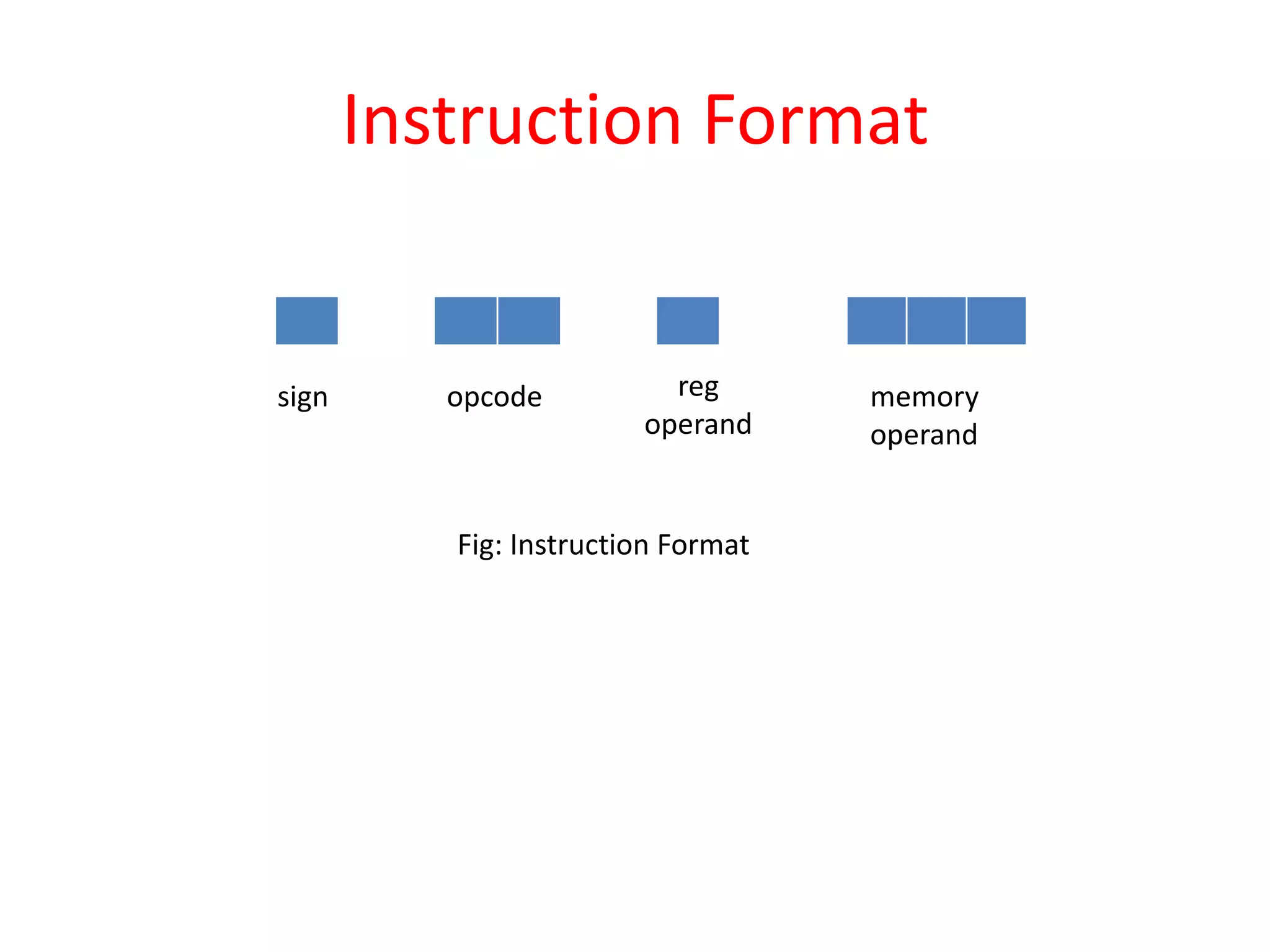
Instruction Format
sign opcode reg
operand
memory
operand
Fig: Instruction Format
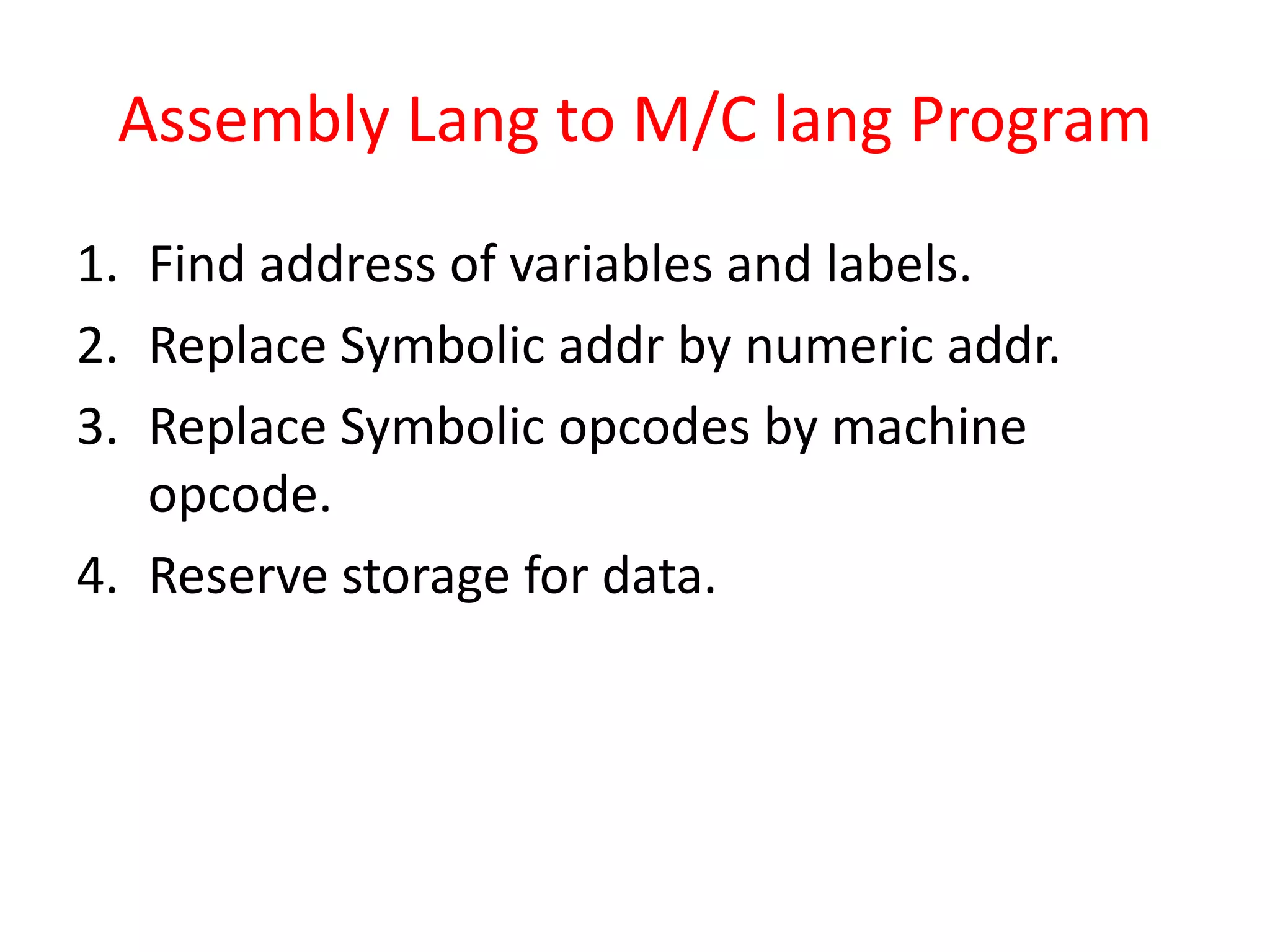
Assembly Lang to M/C lang Program
1. Find address of variables and labels.
2. Replace Symbolic addr by numeric addr.
3. Replace Symbolic opcodes by machine
opcode.
4. Reserve storage for data.
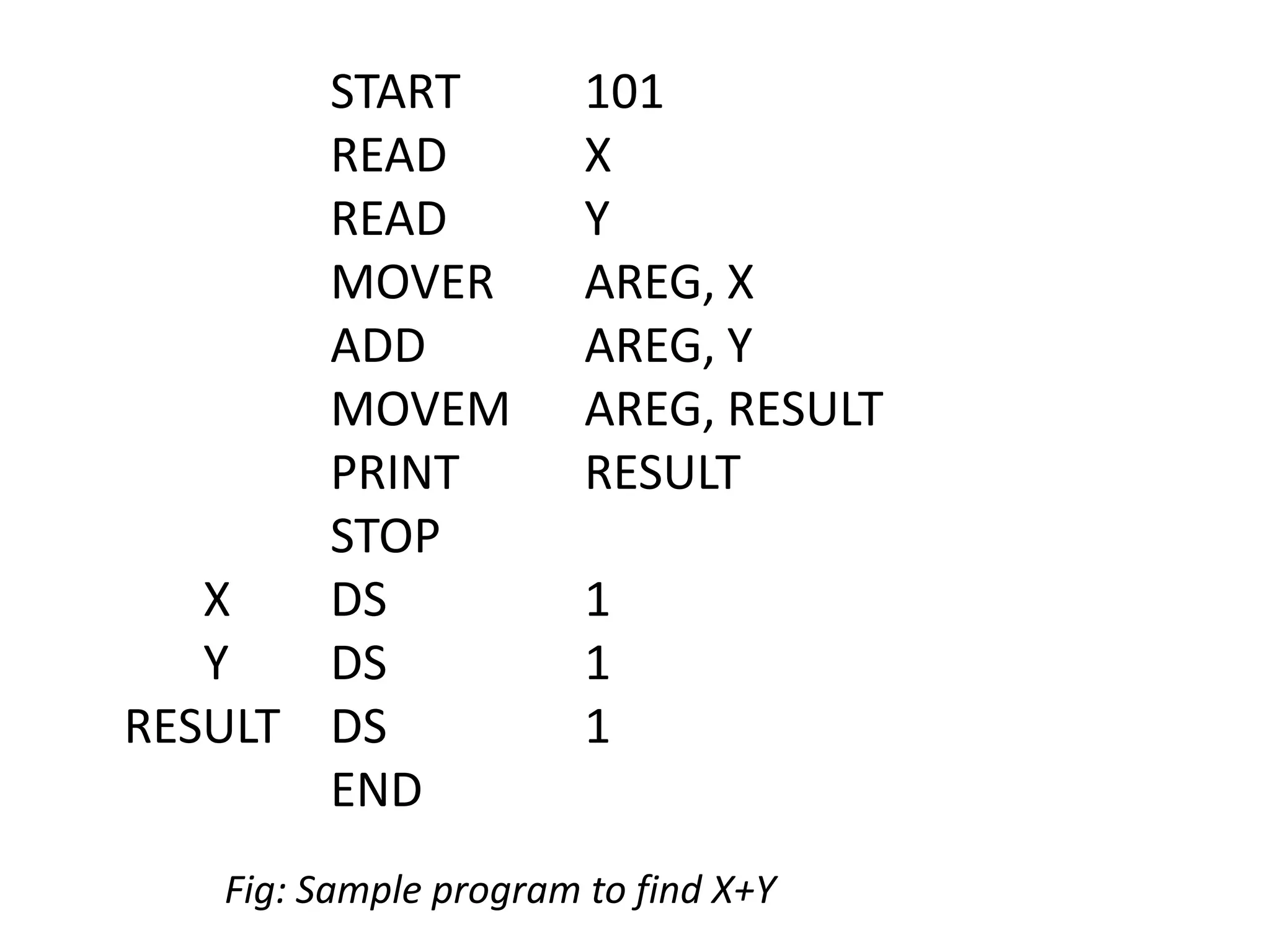
START 101
READ X
READ Y
MOVER AREG, X
ADD AREG, Y
MOVEM AREG, RESULT
PRINT RESULT
STOP
X DS 1
Y DS 1
RESULT DS 1
END
Fig: Sample program to find X+Y
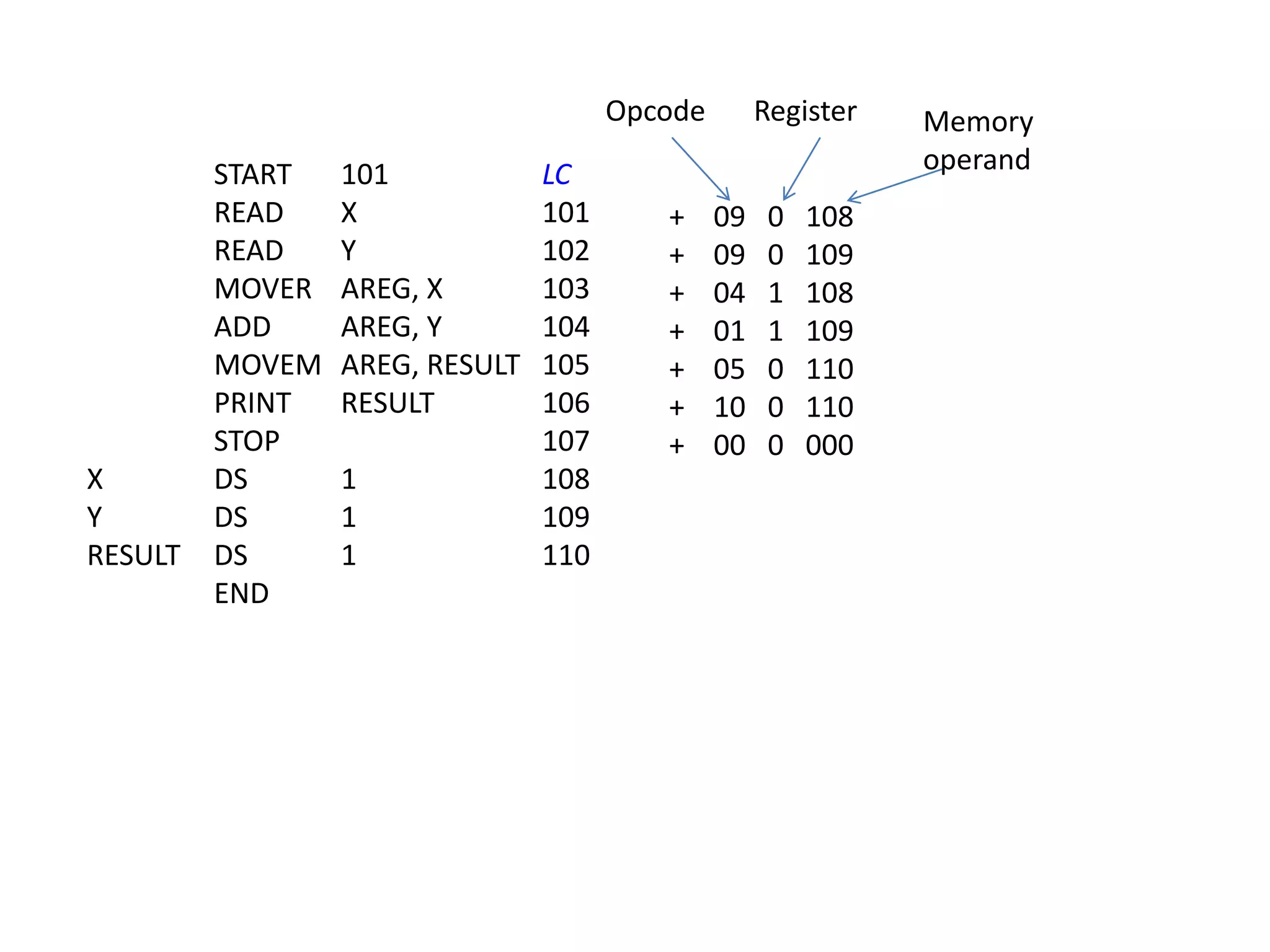
START 101
READ X
READ Y
MOVER AREG, X
ADD AREG, Y
MOVEM AREG, RESULT
PRINT RESULT
STOP
X DS 1
Y DS 1
RESULT DS 1
END
LC
101
102
103
104
105
106
107
108
109
110
+ 09 0 108
+ 09 0 109
+ 04 1 108
+ 01 1 109
+ 05 0 110
+ 10 0 110
+ 00 0 000
Opcode Register Memory
operand
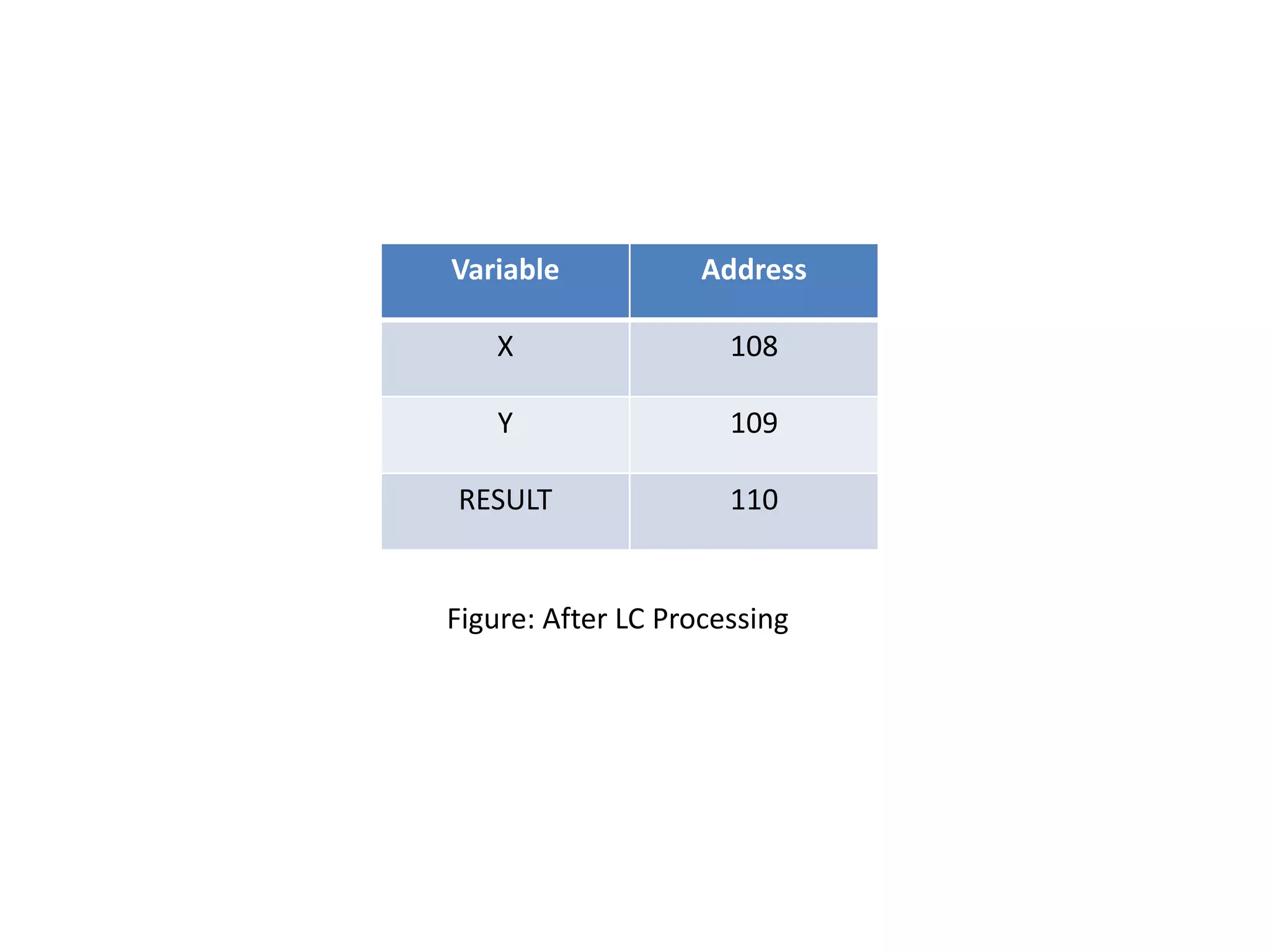
Variable Address
X 108
Y 109
RESULT 110
Figure: After LC Processing
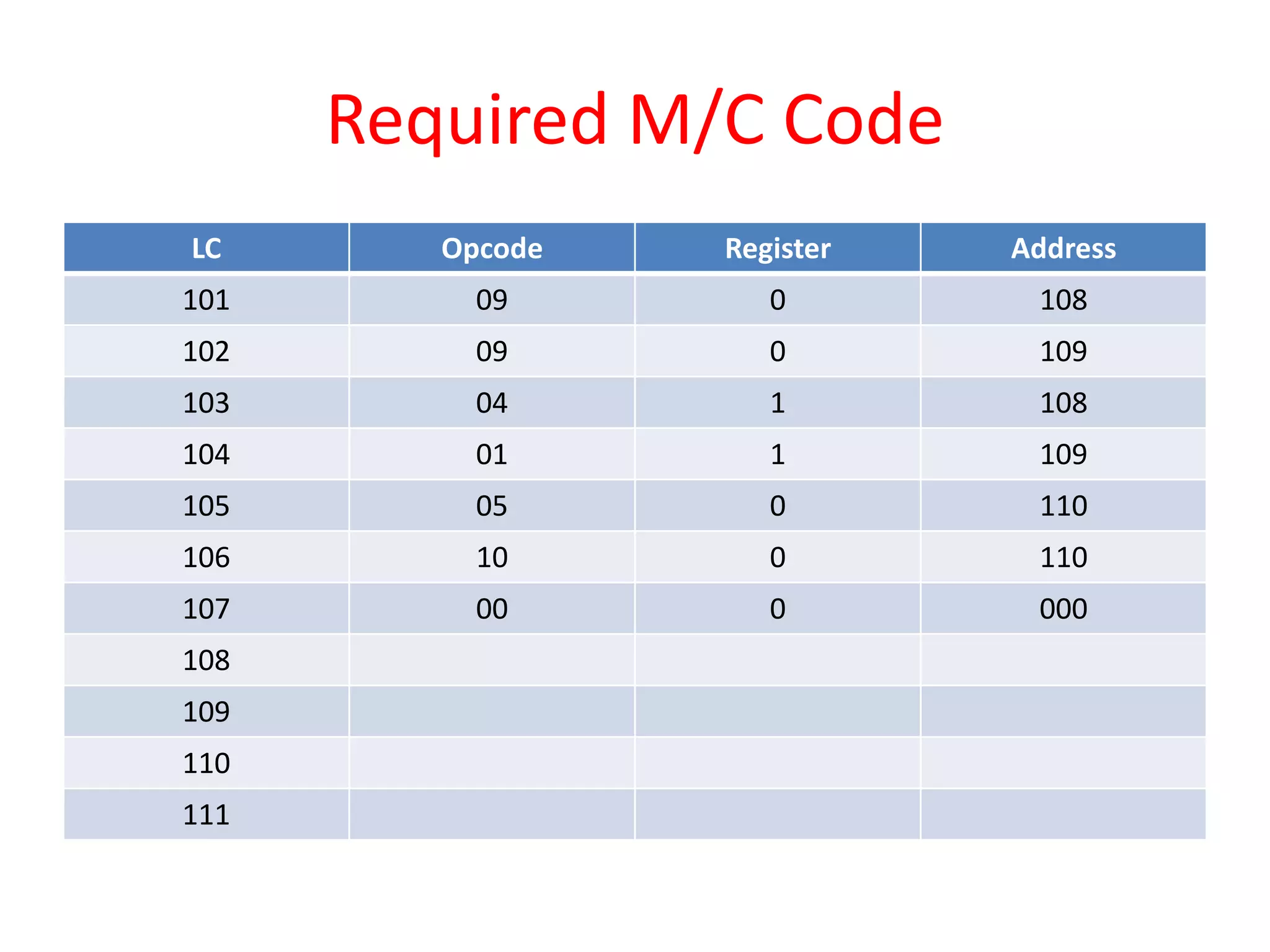
Required M/C Code
LC Opcode Register Address
101 09 0 108
102 09 0 109
103 04 1 108
104 01 1 109
105 05 0 110
106 10 0 110
107 00 0 000
108
109
110
111
Assembly Language Statement
1. Imperative Statement.
2. Declaration Statement.
3. Assembler Directives.
• Imperative Statements:-
– Indicates an action to be taken during execution of a
program.
– Eg: MOV, ADD, MULT, etc.
• Declaration Statement:-
– To reserve memory for variable.
[Label] DS <constant> eg: X DS 5
[Label] DC ‘<value>’ eg: X DC 3
• Assembler Directives:-
– Instructs the assembler to perform ceratin action during
assembly of a program.
START <constant>
END
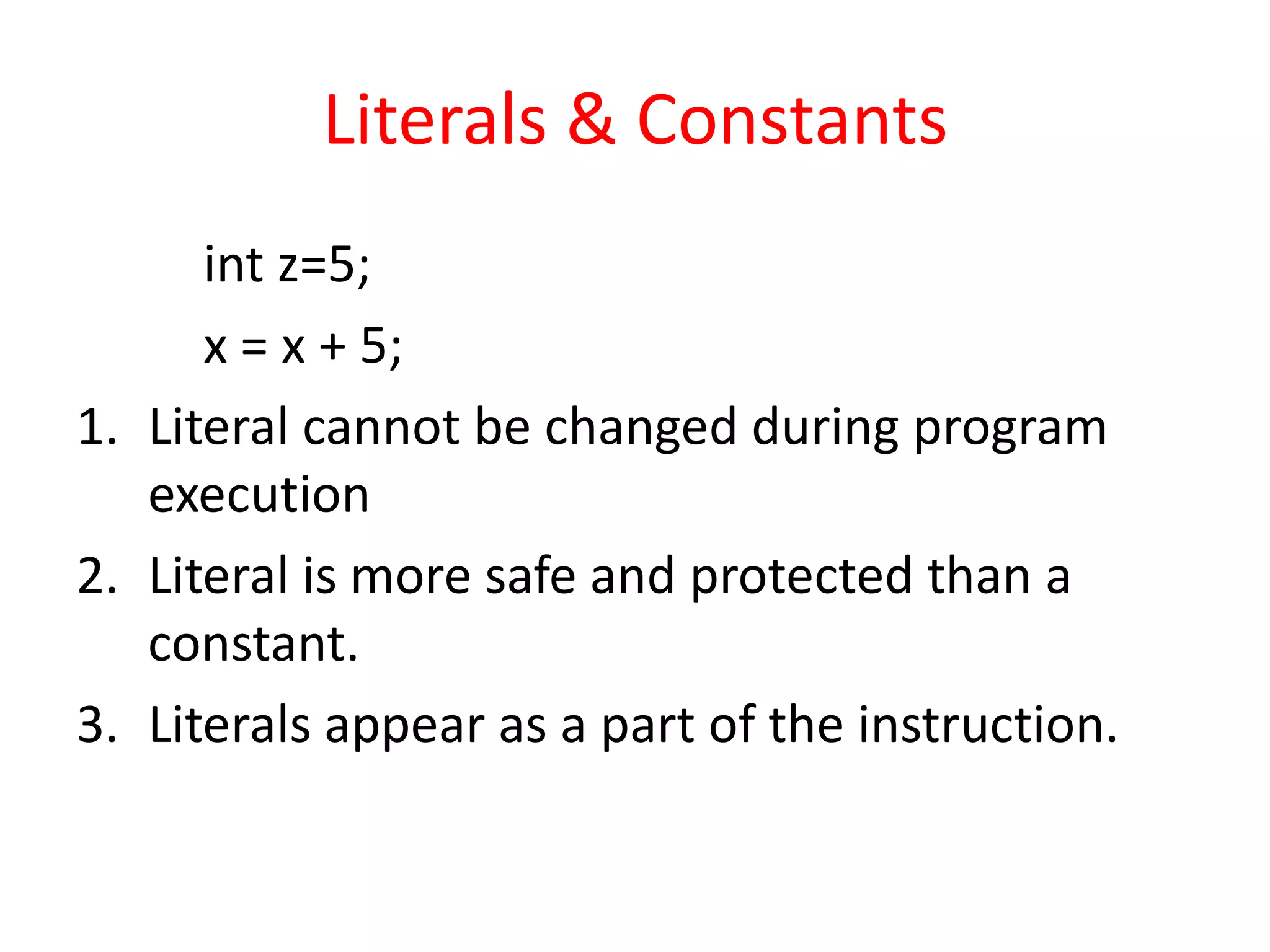
Literals & Constants
int z=5;
x = x + 5;
1. Literal cannot be changed during program
execution
2. Literal is more safe and protected than a
constant.
3. Literals appear as a part of the instruction.
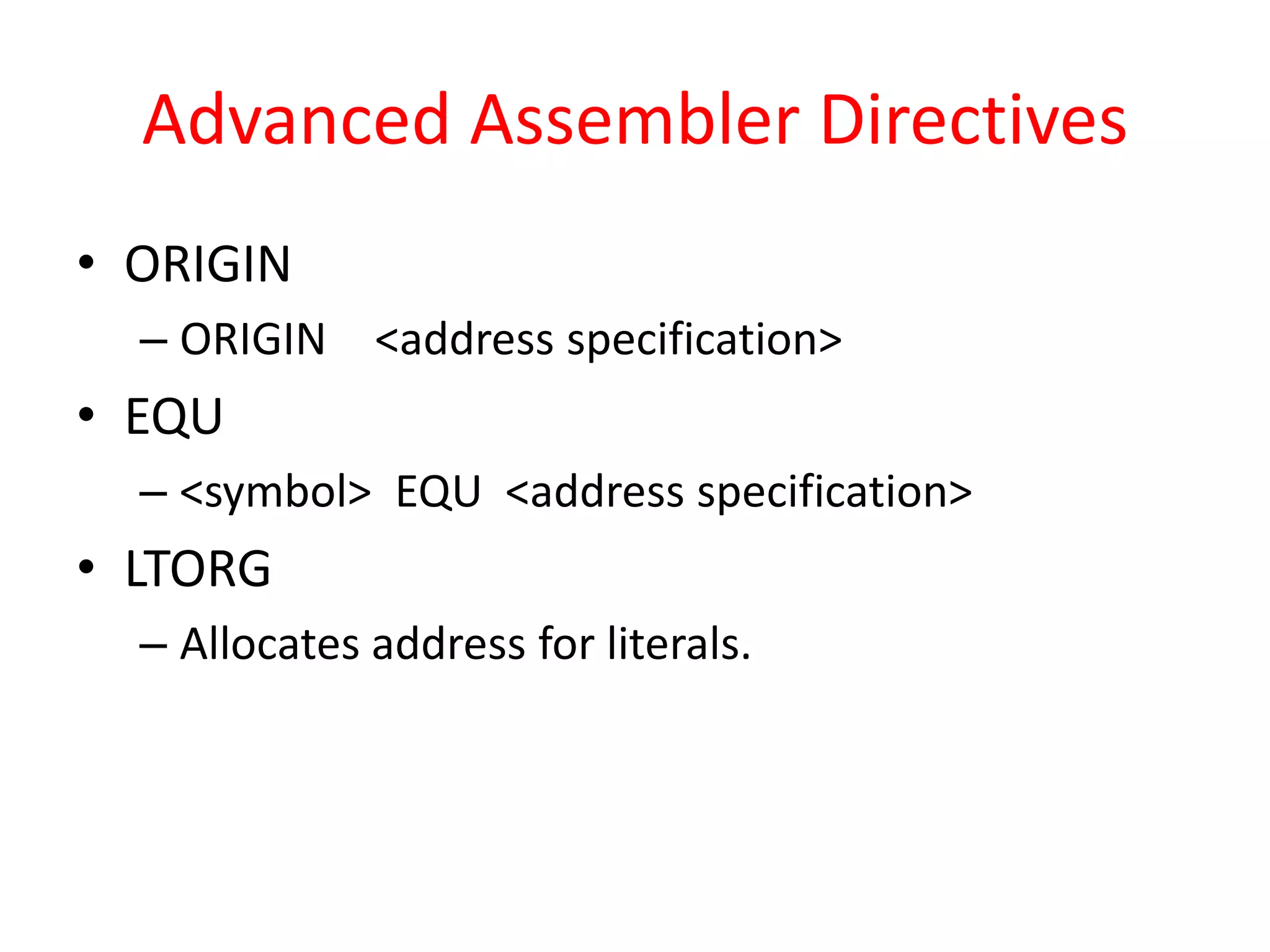
Advanced Assembler Directives
• ORIGIN
– ORIGIN <address specification>
• EQU
– <symbol> EQU <address specification>
• LTORG
– Allocates address for literals.
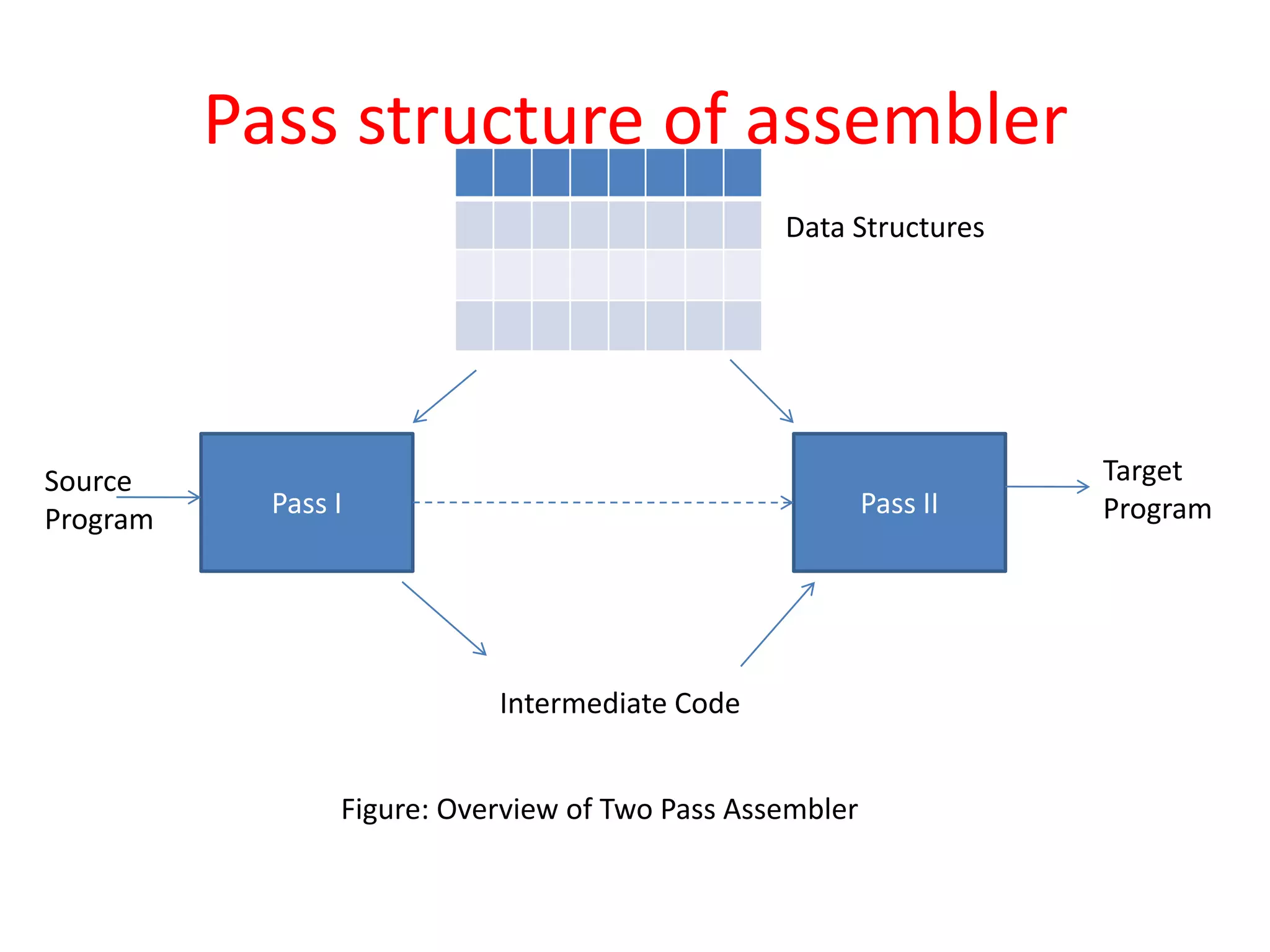
Pass structure of assembler
Pass I Pass II
Intermediate Code
Source
Program
Target
Program
Figure: Overview of Two Pass Assembler
Data Structures
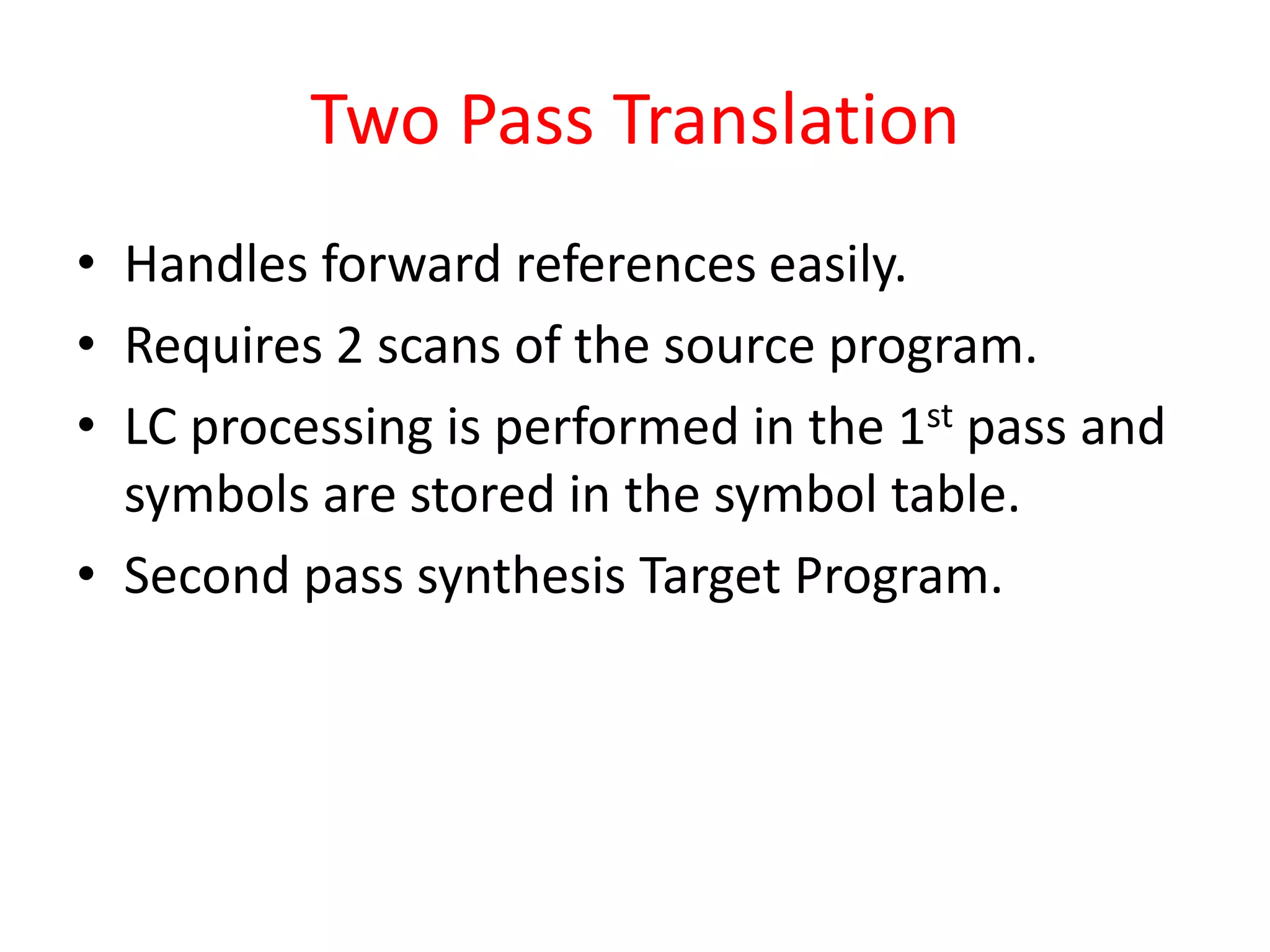
Two Pass Translation
• Handles forward references easily.
• Requires 2 scans of the source program.
• LC processing is performed in the 1st pass and
symbols are stored in the symbol table.
• Second pass synthesis Target Program.
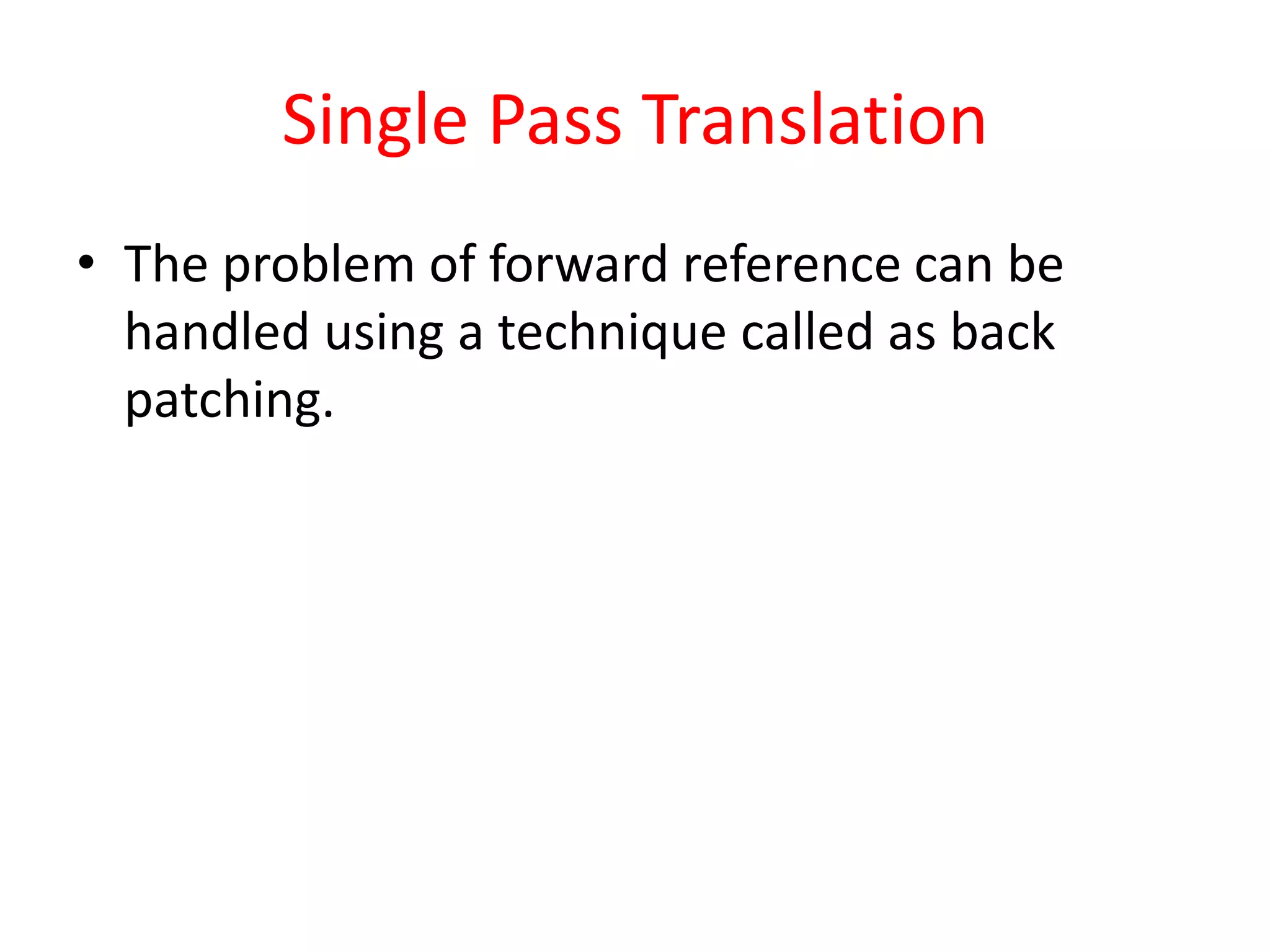
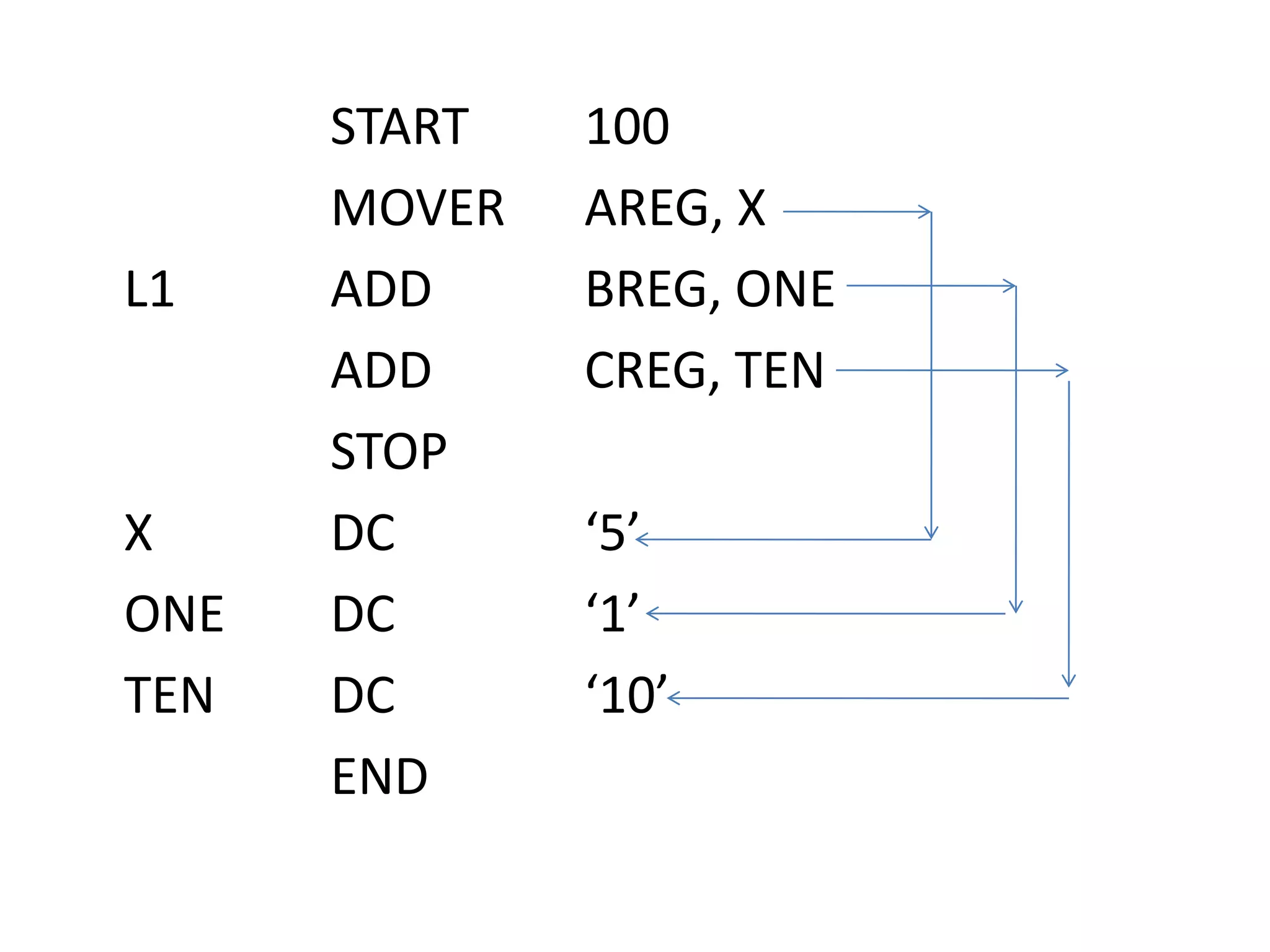
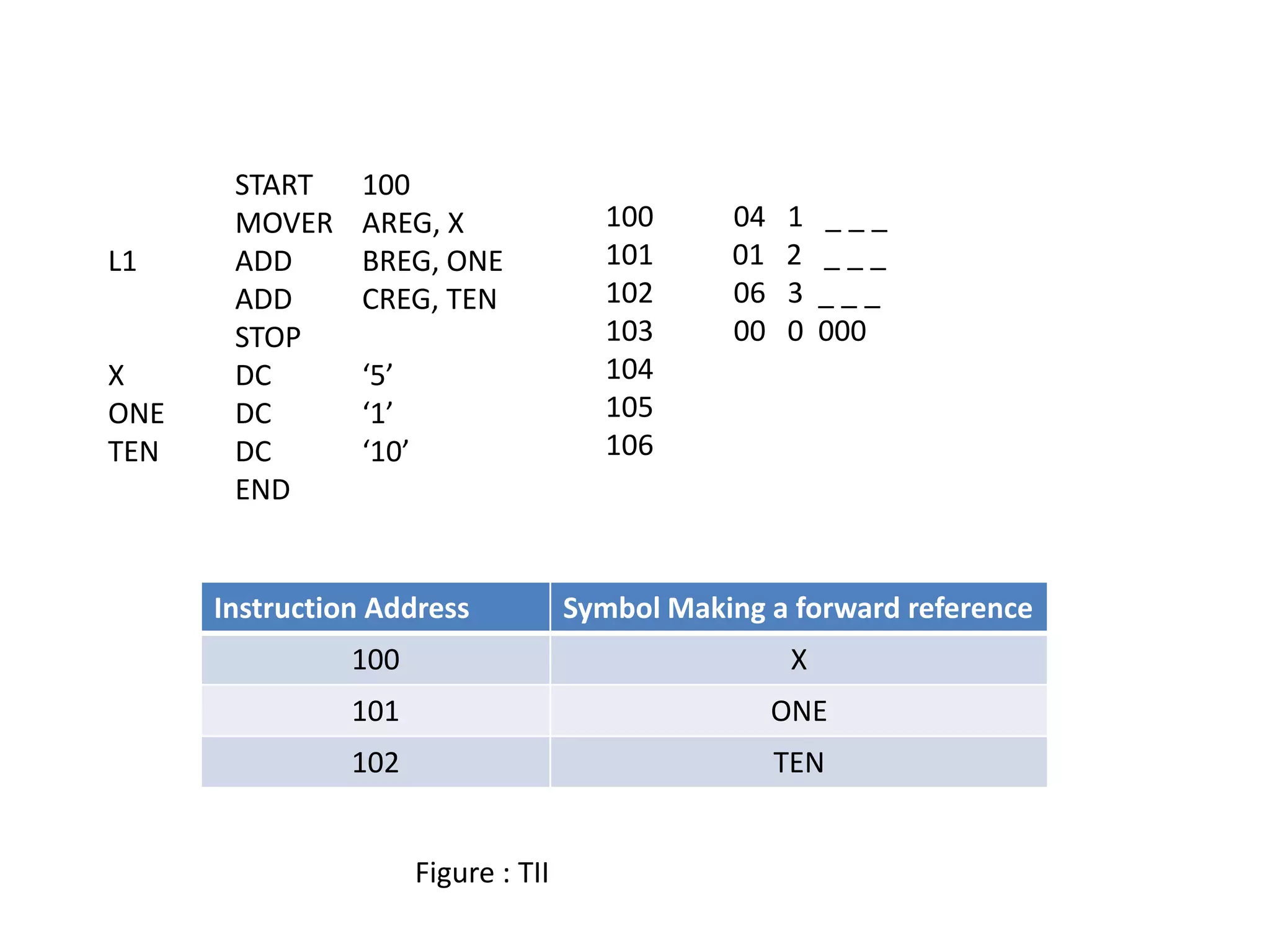
Single Pass Translation
• The problem of forward reference can be
handled using a technique called as back
patching.
START 100
MOVER AREG, X
L1 ADD BREG, ONE
ADD CREG, TEN
STOP
X DC ‘5’
ONE DC ‘1’
TEN DC ‘10’
END
START 100
MOVER AREG, X
L1 ADD BREG, ONE
ADD CREG, TEN
STOP
X DC ‘5’
ONE DC ‘1’
TEN DC ‘10’
END
100 04 1 _ _ _
101 01 2 _ _ _
102 06 3 _ _ _
103 00 0 000
104
105
106
Instruction Address Symbol Making a forward reference
100 X
101 ONE
102 TEN
Figure : TII
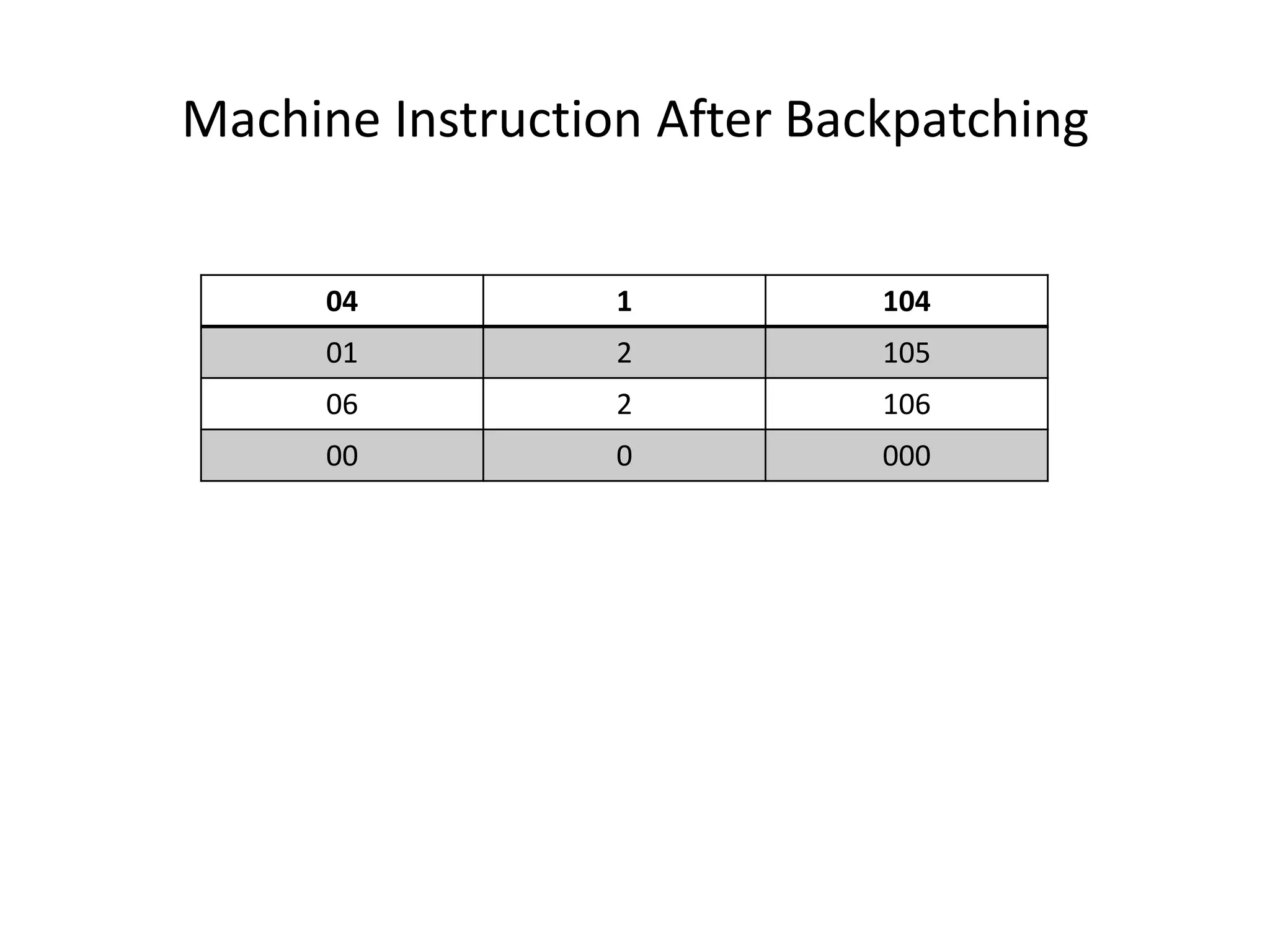
Machine Instruction After Backpatching
04 1 104
01 2 105
06 2 106
00 0 000
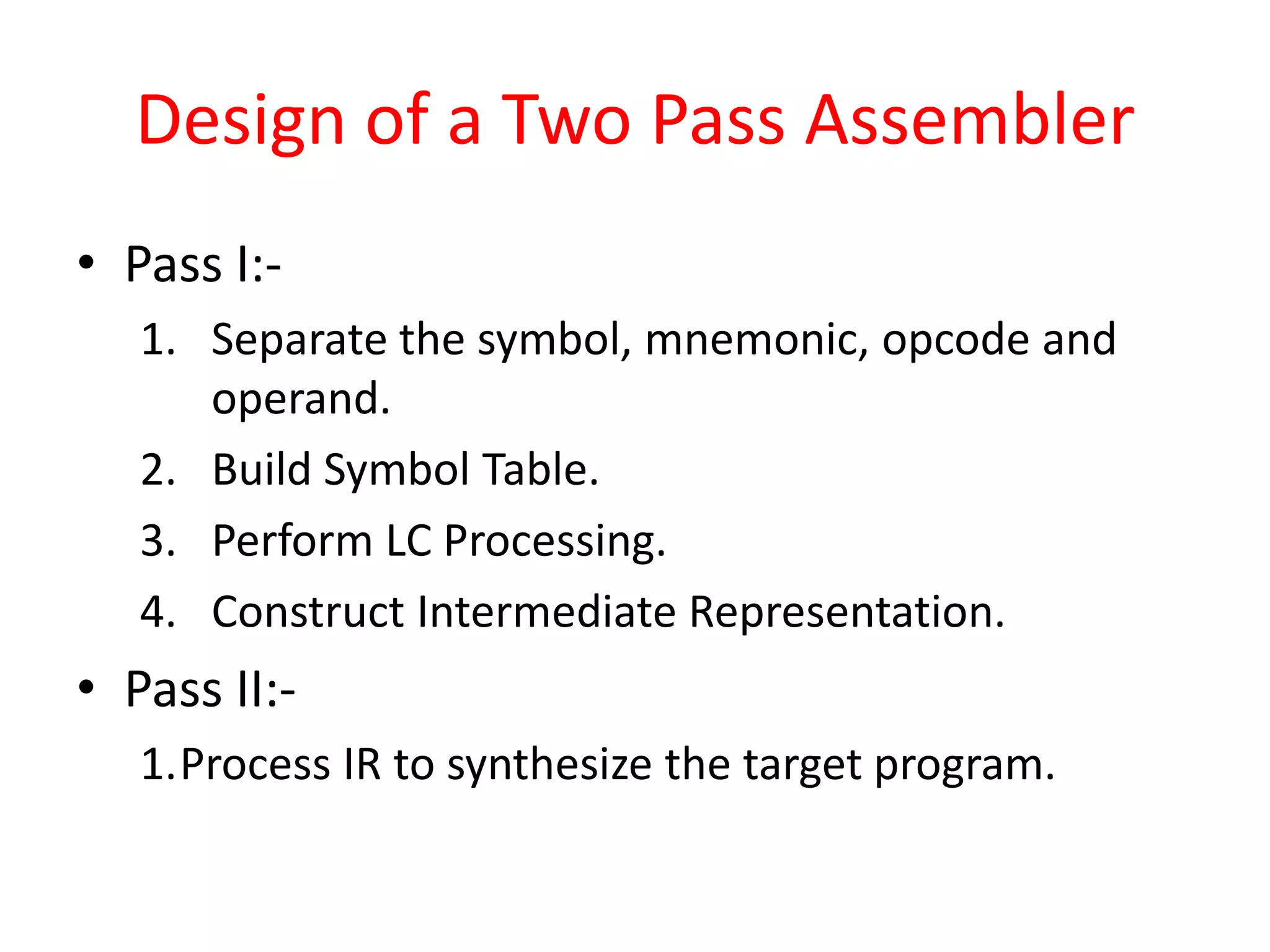
Design of a Two Pass Assembler
• Pass I:-
1. Separate the symbol, mnemonic, opcode and
operand.
2. Build Symbol Table.
3. Perform LC Processing.
4. Construct Intermediate Representation.
• Pass II:-
1.Process IR to synthesize the target program.
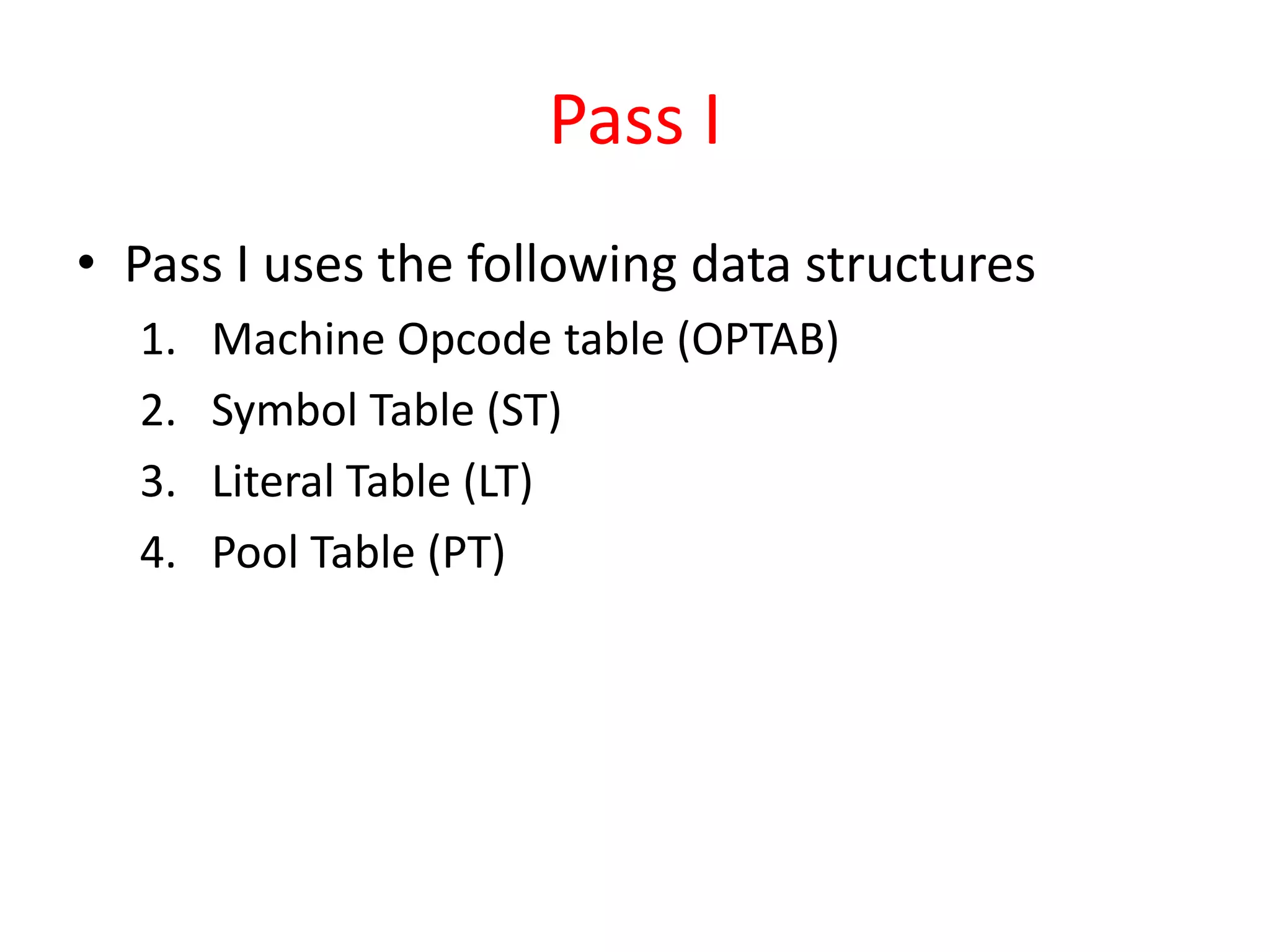
Pass I
• Pass I uses the following data structures
1. Machine Opcode table (OPTAB)
2. Symbol Table (ST)
3. Literal Table (LT)
4. Pool Table (PT)
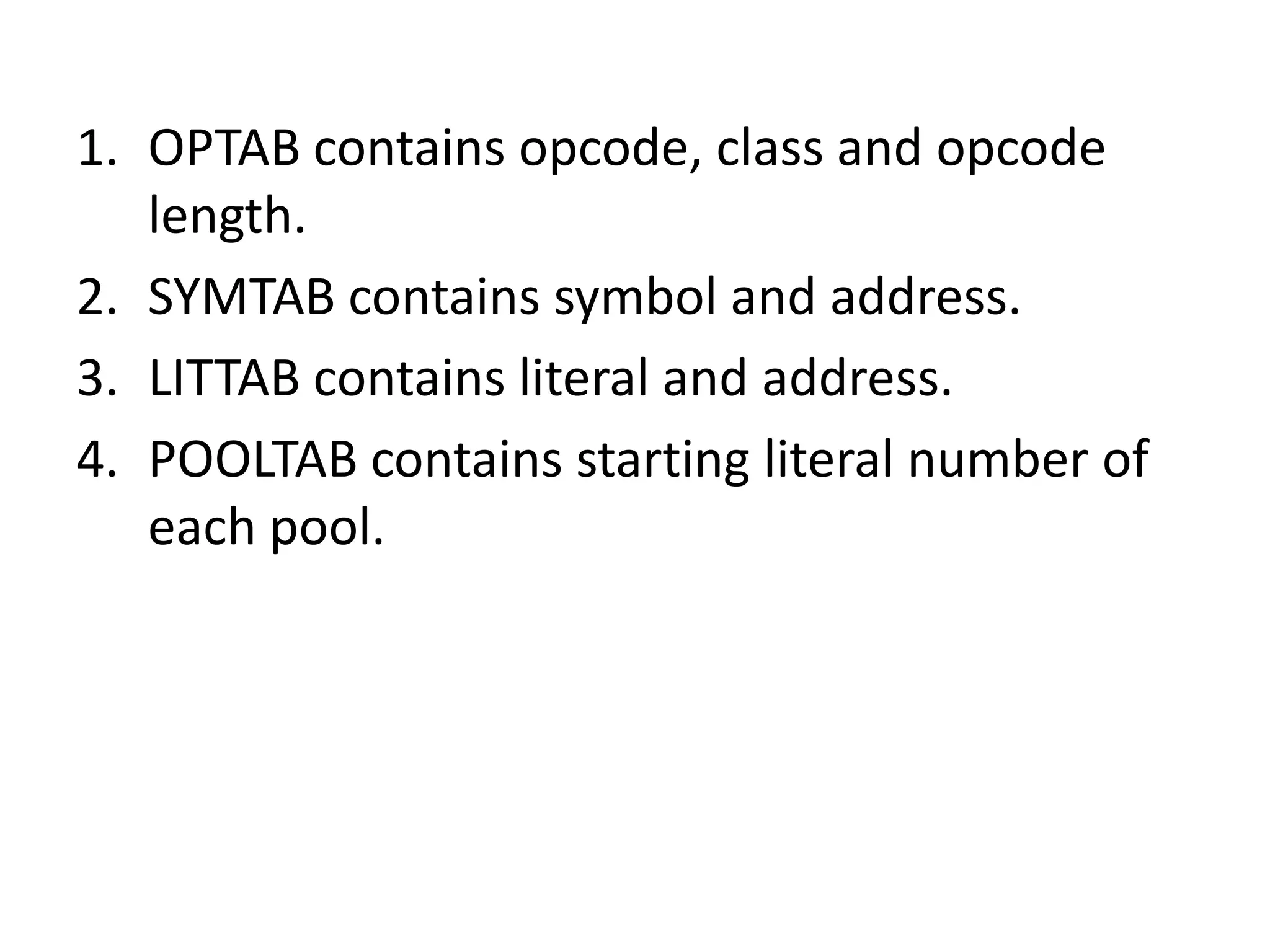
1. OPTAB contains opcode, class and opcode
length.
2. SYMTAB contains symbol and address.
3. LITTAB contains literal and address.
4. POOLTAB contains starting literal number of
each pool.
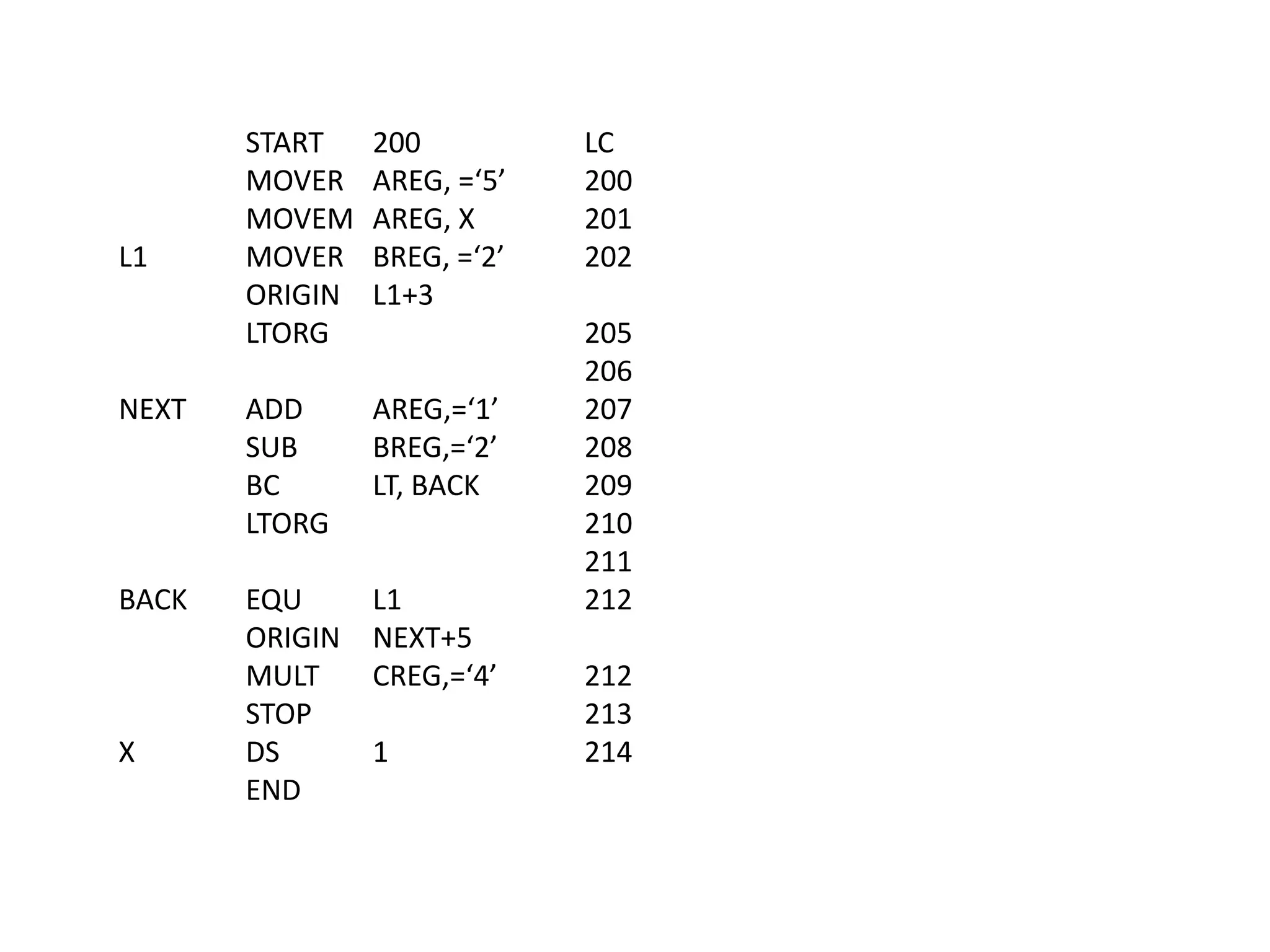
START 200
MOVER AREG, =‘5’
MOVEM AREG, X
L1 MOVER BREG, =‘2’
ORIGIN L1+3
LTORG
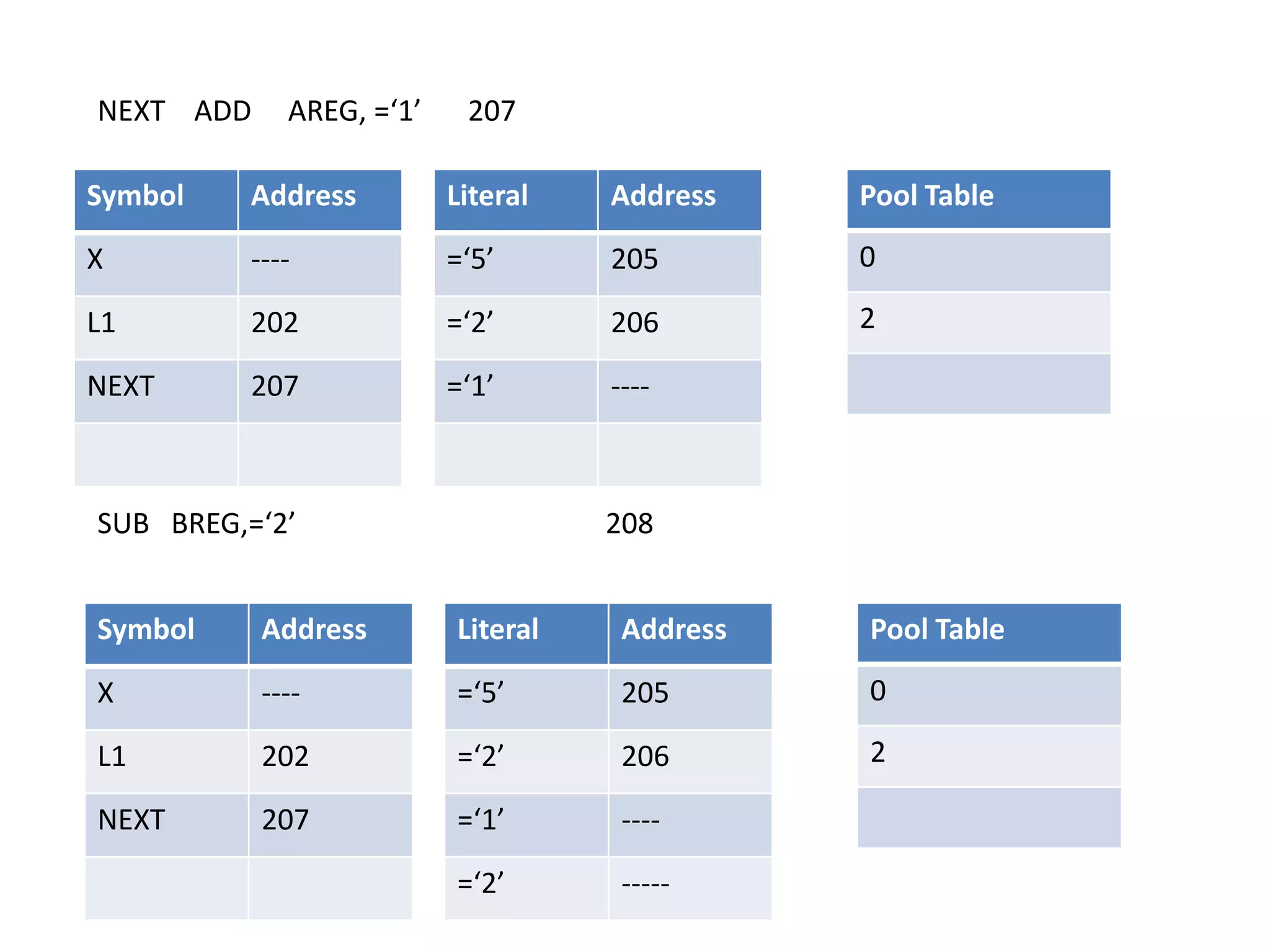
NEXT ADD AREG,=‘1’
SUB BREG,=‘2’
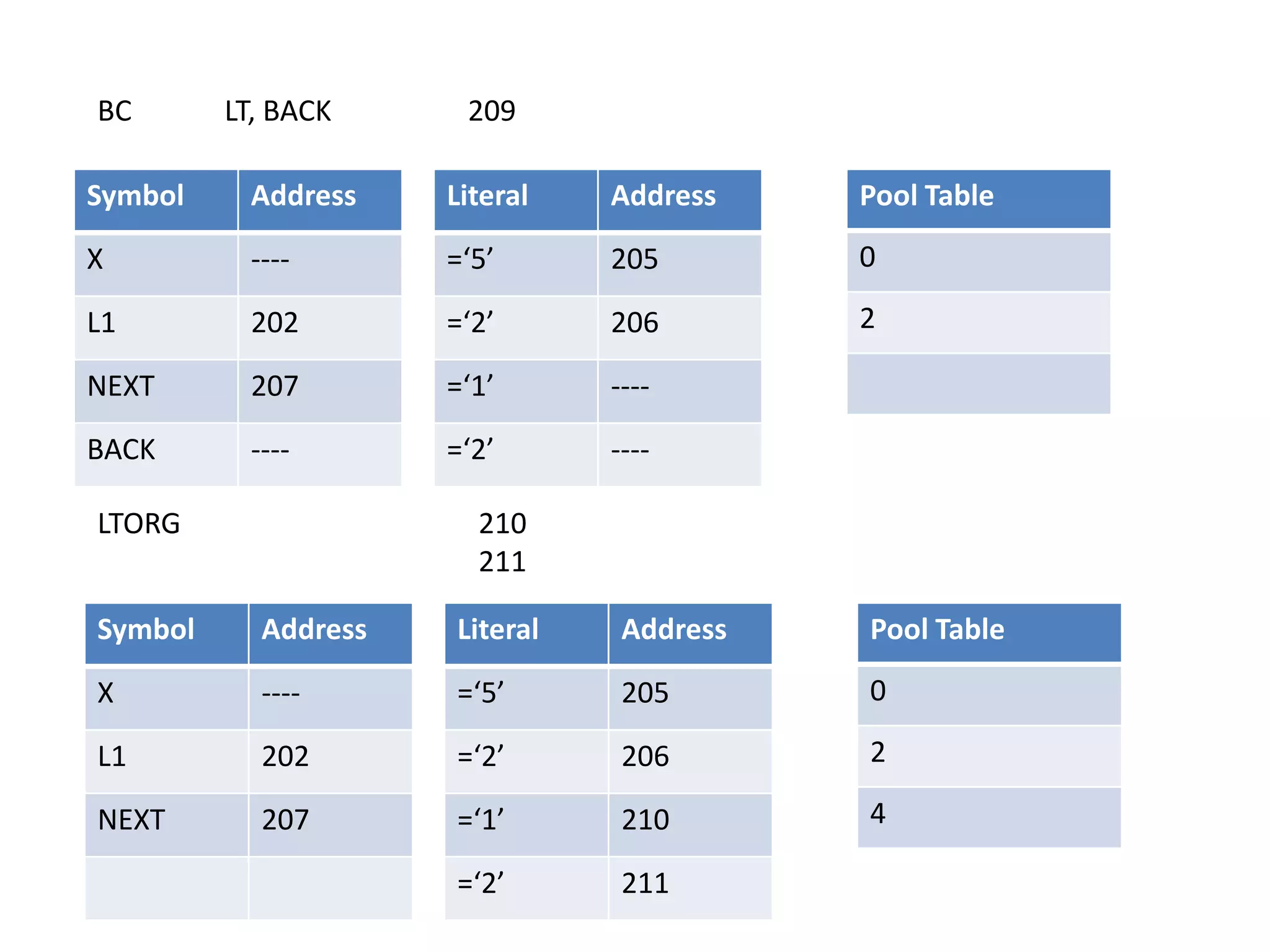
BC LT, BACK
LTORG
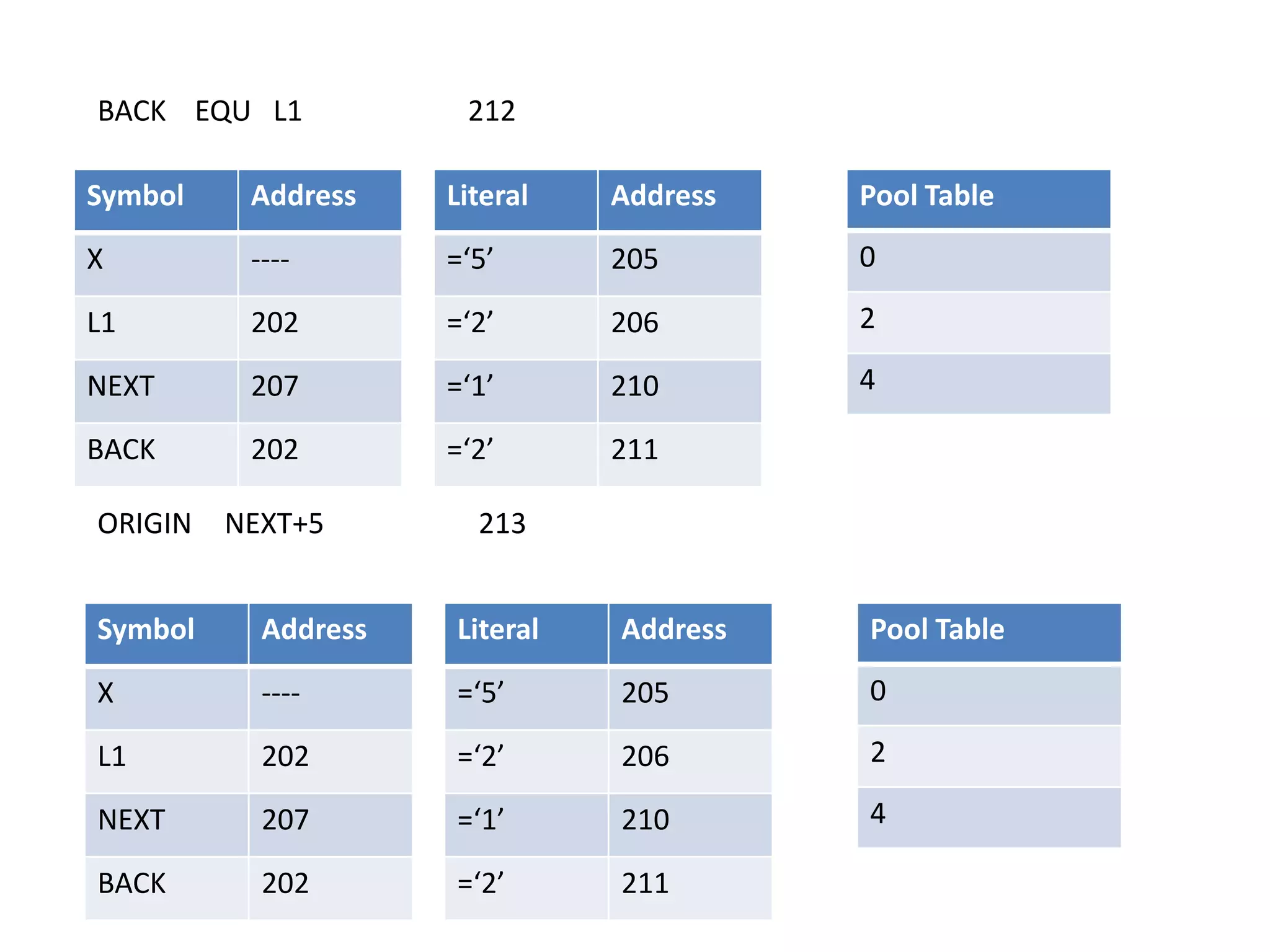
BACK EQU L1
ORIGIN NEXT+5
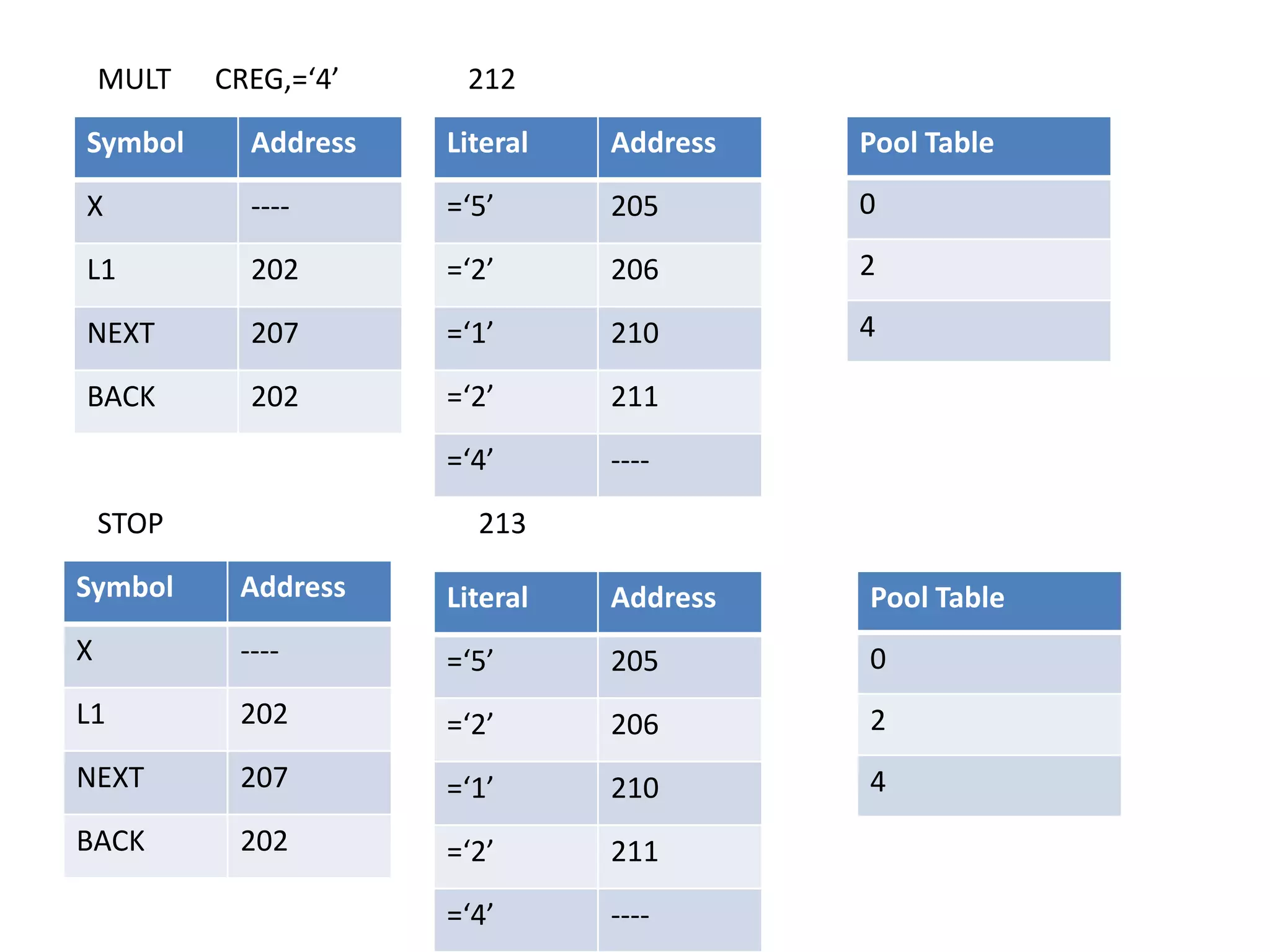
MULT CREG,=‘4’
STOP
X DS 1
END
LC
200
201
202
205
206
207
208
209
210
211
212
212
213
214
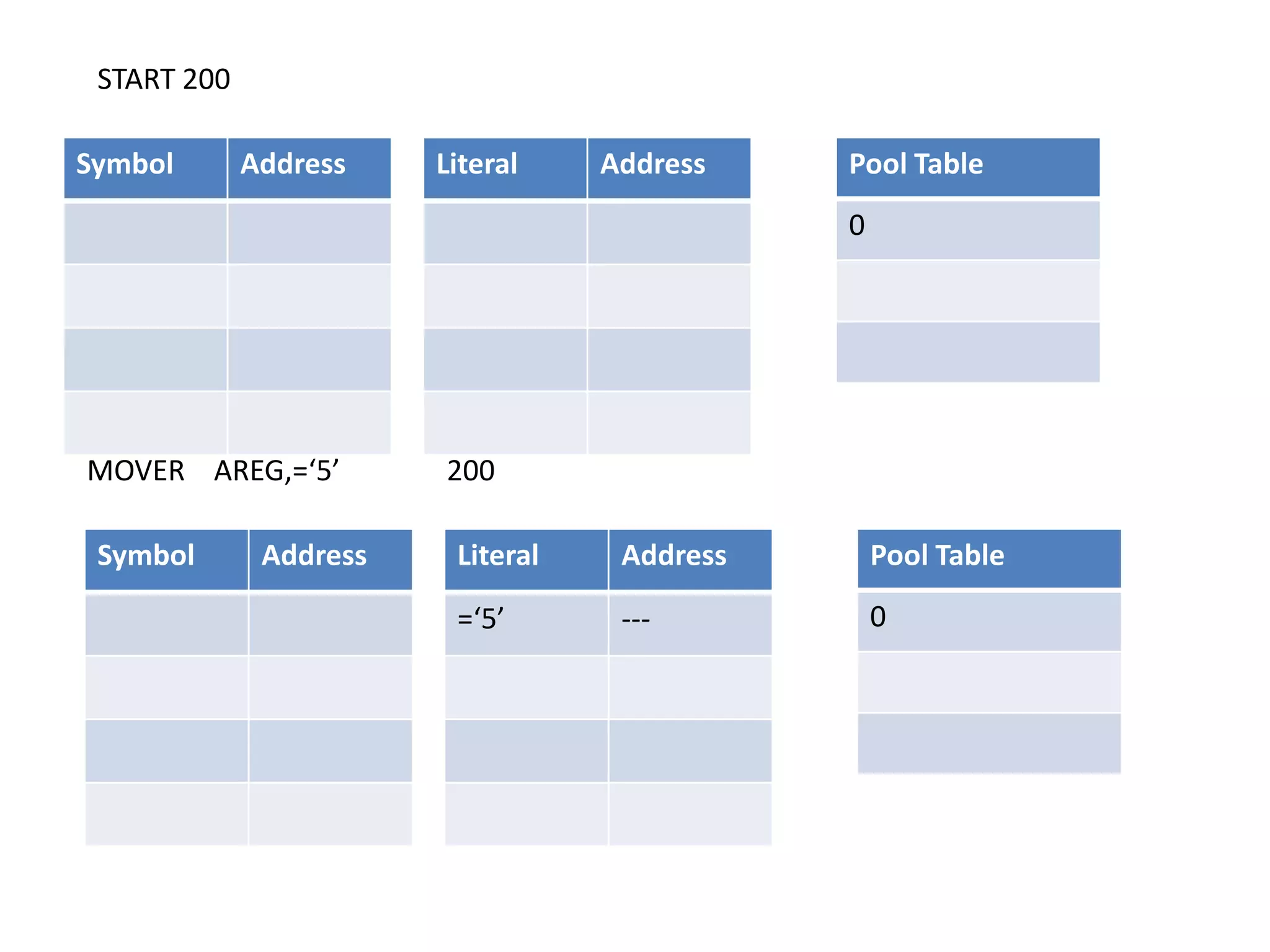
Symbol Address Literal Address Pool Table
0
START 200
MOVER AREG,=‘5’ 200
Symbol Address Literal Address
=‘5’ ---
Pool Table
0
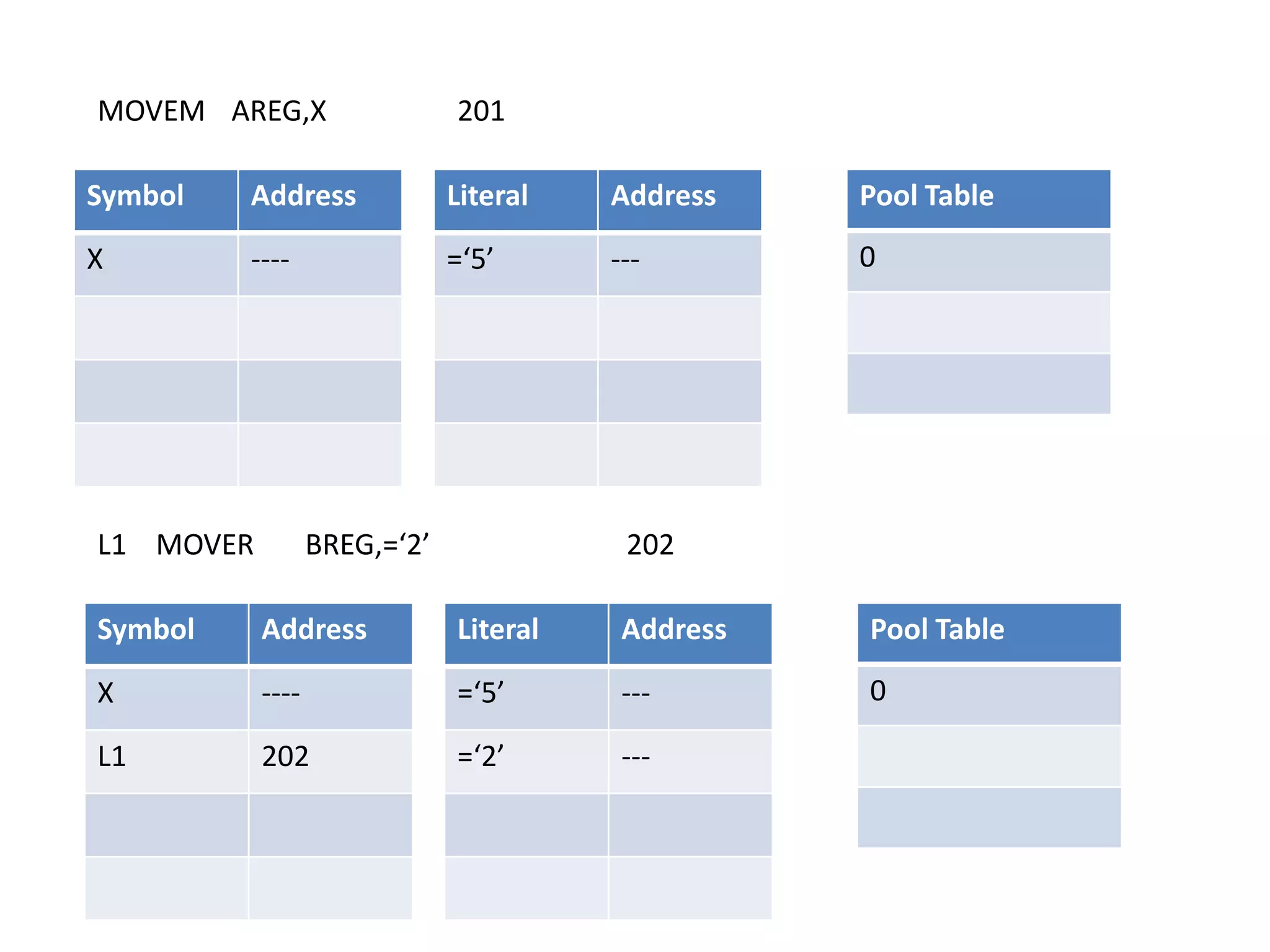
MOVEM AREG,X 201
Symbol Address
X ----
Literal Address
=‘5’ ---
Pool Table
0
L1 MOVER BREG,=‘2’ 202
Symbol Address
X ----
L1 202
Literal Address
=‘5’ ---
=‘2’ ---
Pool Table
0
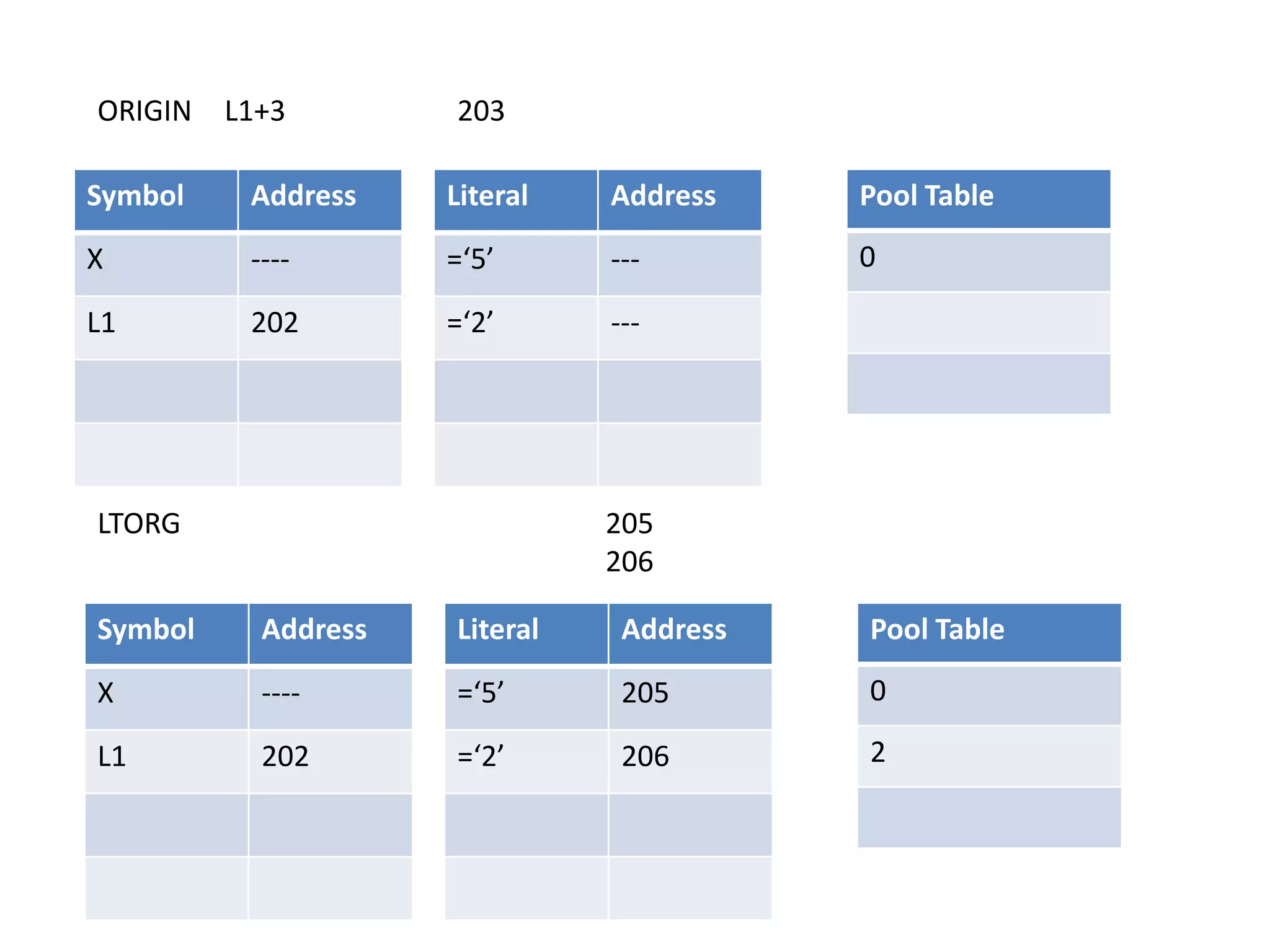
ORIGIN L1+3 203
Symbol Address
X ----
L1 202
Literal Address
=‘5’ ---
=‘2’ ---
Pool Table
0
LTORG 205
206
Symbol Address
X ----
L1 202
Literal Address
=‘5’ 205
=‘2’ 206
Pool Table
0
2
NEXT ADD AREG, =‘1’ 207
Symbol Address
X ----
L1 202
NEXT 207
Literal Address
=‘5’ 205
=‘2’ 206
=‘1’ ----
Pool Table
0
2
SUB BREG,=‘2’ 208
Symbol Address
X ----
L1 202
NEXT 207
Literal Address
=‘5’ 205
=‘2’ 206
=‘1’ ----
=‘2’ -----
Pool Table
0
2
BC LT, BACK 209
Symbol Address
X ----
L1 202
NEXT 207
BACK ----
Literal Address
=‘5’ 205
=‘2’ 206
=‘1’ ----
=‘2’ ----
Pool Table
0
2
LTORG 210
211
Symbol Address
X ----
L1 202
NEXT 207
Literal Address
=‘5’ 205
=‘2’ 206
=‘1’ 210
=‘2’ 211
Pool Table
0
2
4
BACK EQU L1 212
Symbol Address
X ----
L1 202
NEXT 207
BACK 202
Literal Address
=‘5’ 205
=‘2’ 206
=‘1’ 210
=‘2’ 211
Pool Table
0
2
4
ORIGIN NEXT+5 213
Symbol Address
X ----
L1 202
NEXT 207
BACK 202
Literal Address
=‘5’ 205
=‘2’ 206
=‘1’ 210
=‘2’ 211
Pool Table
0
2
4
MULT CREG,=‘4’ 212
Symbol Address
X ----
L1 202
NEXT 207
BACK 202
Literal Address
=‘5’ 205
=‘2’ 206
=‘1’ 210
=‘2’ 211
=‘4’ ----
Pool Table
0
2
4
STOP 213
Symbol Address
X ----
L1 202
NEXT 207
BACK 202
Pool Table
0
2
4
Literal Address
=‘5’ 205
=‘2’ 206
=‘1’ 210
=‘2’ 211
=‘4’ ----
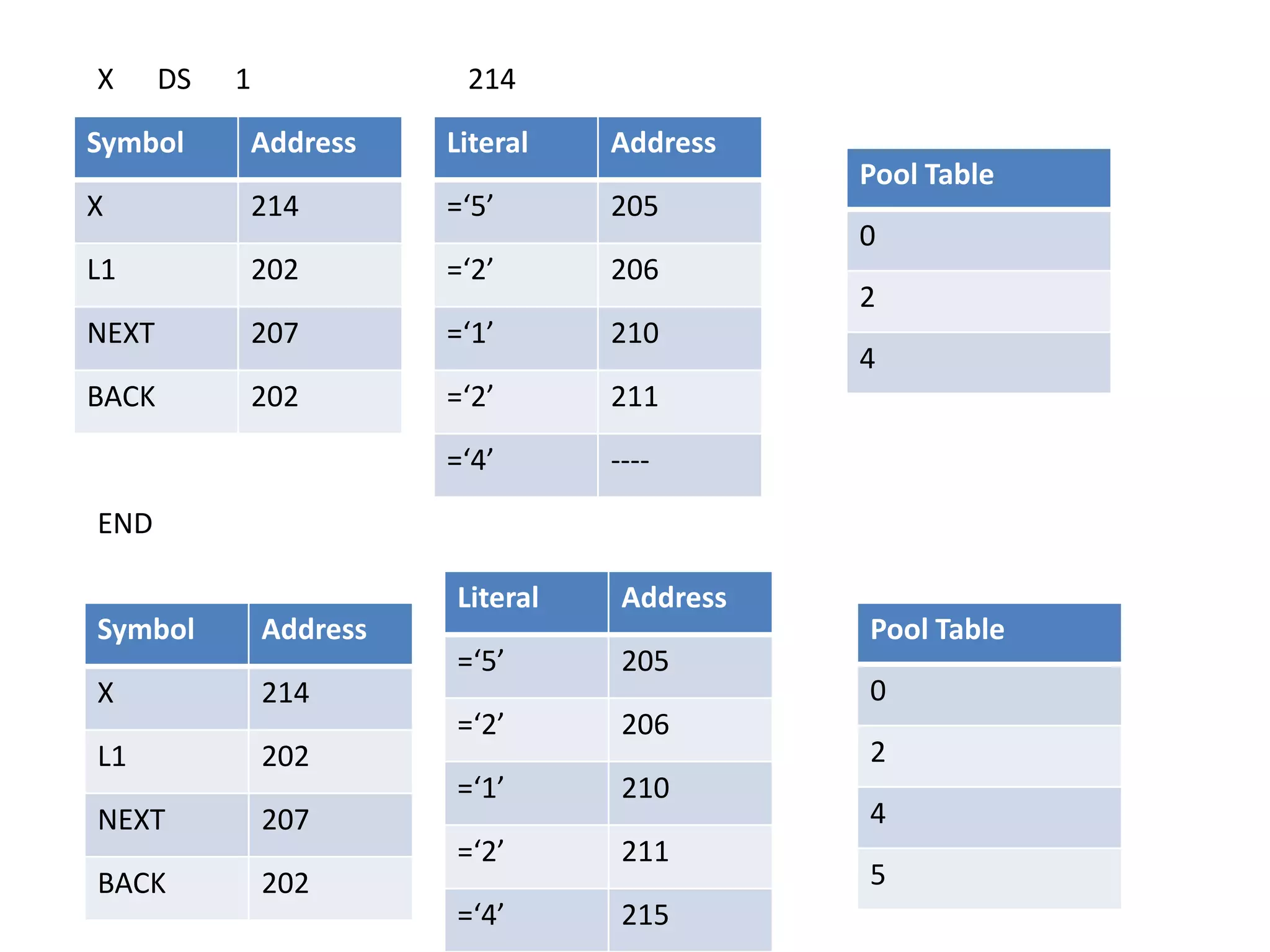
X DS 1 214
Symbol Address
X 214
L1 202
NEXT 207
BACK 202
Pool Table
0
2
4
END
Symbol Address
X 214
L1 202
NEXT 207
BACK 202
Pool Table
0
2
4
5
Literal Address
=‘5’ 205
=‘2’ 206
=‘1’ 210
=‘2’ 211
=‘4’ ----
Literal Address
=‘5’ 205
=‘2’ 206
=‘1’ 210
=‘2’ 211
=‘4’ 215

Assemblers

  • 1.
  • 2.
    Assembly Language Programming •Writing a program in assembly lang is more convenient than in machine lang. • Assembly program is more readable. • Assembly lang is machine dependent. • Assembly program is written using symbols(Mnemonics). • Assembly program is translated into machine code before execution.
  • 3.
  • 4.
    Example: MOV AX, X --MOVis a mnemonic opcode. --AX is a register operand in symbolic form. --X is a memory operand in symbolic form.
  • 5.
    Elements of AssemblyLanguage 1. Mnemonic Operation Code:- Eliminates the need to memorize numeric operation code. 2. Symbolic Operands:- Symbolic names can be used. 3. Data Declarations:- Data can be declared in any form Eg: -5, 10.5 etc.
  • 6.
    Statement Format [Label] <Opcode><operand Spec> [<operand spec>….] 1. Label:- Is optional. 2. Opcode:- Symbolic opcode 3. Operand:- Symbolic name (Register or Memory variable)
  • 7.
    Instruction Opcode Assembly Mnemonic Remarks 00 STOP StopExecution 01 ADD Op1  Op1+ Op2 02 SUB Op1  Op1 – Op2 03 MULT Op1  Op1* Op2 04 MOVER CPU Reg  Memory operand 05 MOVEM Memory  CPU Reg 06 COMP Sets Condition Code 07 BC Branch on Condition 08 DIV Op1  Op1/ Op2 09 READ Operand 2  input Value 10 PRINT Output  Operand2 Fig: Mnemonic Operation Codes
  • 8.
    Instruction Format sign opcodereg operand memory operand Fig: Instruction Format
  • 9.
    Assembly Lang toM/C lang Program 1. Find address of variables and labels. 2. Replace Symbolic addr by numeric addr. 3. Replace Symbolic opcodes by machine opcode. 4. Reserve storage for data.
  • 10.
    START 101 READ X READY MOVER AREG, X ADD AREG, Y MOVEM AREG, RESULT PRINT RESULT STOP X DS 1 Y DS 1 RESULT DS 1 END Fig: Sample program to find X+Y
  • 11.
    START 101 READ X READY MOVER AREG, X ADD AREG, Y MOVEM AREG, RESULT PRINT RESULT STOP X DS 1 Y DS 1 RESULT DS 1 END LC 101 102 103 104 105 106 107 108 109 110 + 09 0 108 + 09 0 109 + 04 1 108 + 01 1 109 + 05 0 110 + 10 0 110 + 00 0 000 Opcode Register Memory operand
  • 12.
    Variable Address X 108 Y109 RESULT 110 Figure: After LC Processing
  • 13.
    Required M/C Code LCOpcode Register Address 101 09 0 108 102 09 0 109 103 04 1 108 104 01 1 109 105 05 0 110 106 10 0 110 107 00 0 000 108 109 110 111
  • 14.
    Assembly Language Statement 1.Imperative Statement. 2. Declaration Statement. 3. Assembler Directives.
  • 15.
    • Imperative Statements:- –Indicates an action to be taken during execution of a program. – Eg: MOV, ADD, MULT, etc. • Declaration Statement:- – To reserve memory for variable. [Label] DS <constant> eg: X DS 5 [Label] DC ‘<value>’ eg: X DC 3 • Assembler Directives:- – Instructs the assembler to perform ceratin action during assembly of a program. START <constant> END
  • 16.
    Literals & Constants intz=5; x = x + 5; 1. Literal cannot be changed during program execution 2. Literal is more safe and protected than a constant. 3. Literals appear as a part of the instruction.
  • 17.
    Advanced Assembler Directives •ORIGIN – ORIGIN <address specification> • EQU – <symbol> EQU <address specification> • LTORG – Allocates address for literals.
  • 18.
    Pass structure ofassembler Pass I Pass II Intermediate Code Source Program Target Program Figure: Overview of Two Pass Assembler Data Structures
  • 19.
    Two Pass Translation •Handles forward references easily. • Requires 2 scans of the source program. • LC processing is performed in the 1st pass and symbols are stored in the symbol table. • Second pass synthesis Target Program.
  • 20.
    Single Pass Translation •The problem of forward reference can be handled using a technique called as back patching.
  • 21.
    START 100 MOVER AREG,X L1 ADD BREG, ONE ADD CREG, TEN STOP X DC ‘5’ ONE DC ‘1’ TEN DC ‘10’ END
  • 22.
    START 100 MOVER AREG,X L1 ADD BREG, ONE ADD CREG, TEN STOP X DC ‘5’ ONE DC ‘1’ TEN DC ‘10’ END 100 04 1 _ _ _ 101 01 2 _ _ _ 102 06 3 _ _ _ 103 00 0 000 104 105 106 Instruction Address Symbol Making a forward reference 100 X 101 ONE 102 TEN Figure : TII
  • 23.
    Machine Instruction AfterBackpatching 04 1 104 01 2 105 06 2 106 00 0 000
  • 24.
    Design of aTwo Pass Assembler • Pass I:- 1. Separate the symbol, mnemonic, opcode and operand. 2. Build Symbol Table. 3. Perform LC Processing. 4. Construct Intermediate Representation. • Pass II:- 1.Process IR to synthesize the target program.
  • 25.
    Pass I • PassI uses the following data structures 1. Machine Opcode table (OPTAB) 2. Symbol Table (ST) 3. Literal Table (LT) 4. Pool Table (PT)
  • 26.
    1. OPTAB containsopcode, class and opcode length. 2. SYMTAB contains symbol and address. 3. LITTAB contains literal and address. 4. POOLTAB contains starting literal number of each pool.
  • 27.
    START 200 MOVER AREG,=‘5’ MOVEM AREG, X L1 MOVER BREG, =‘2’ ORIGIN L1+3 LTORG NEXT ADD AREG,=‘1’ SUB BREG,=‘2’ BC LT, BACK LTORG BACK EQU L1 ORIGIN NEXT+5 MULT CREG,=‘4’ STOP X DS 1 END LC 200 201 202 205 206 207 208 209 210 211 212 212 213 214
  • 28.
    Symbol Address LiteralAddress Pool Table 0 START 200 MOVER AREG,=‘5’ 200 Symbol Address Literal Address =‘5’ --- Pool Table 0
  • 29.
    MOVEM AREG,X 201 SymbolAddress X ---- Literal Address =‘5’ --- Pool Table 0 L1 MOVER BREG,=‘2’ 202 Symbol Address X ---- L1 202 Literal Address =‘5’ --- =‘2’ --- Pool Table 0
  • 30.
    ORIGIN L1+3 203 SymbolAddress X ---- L1 202 Literal Address =‘5’ --- =‘2’ --- Pool Table 0 LTORG 205 206 Symbol Address X ---- L1 202 Literal Address =‘5’ 205 =‘2’ 206 Pool Table 0 2
  • 31.
    NEXT ADD AREG,=‘1’ 207 Symbol Address X ---- L1 202 NEXT 207 Literal Address =‘5’ 205 =‘2’ 206 =‘1’ ---- Pool Table 0 2 SUB BREG,=‘2’ 208 Symbol Address X ---- L1 202 NEXT 207 Literal Address =‘5’ 205 =‘2’ 206 =‘1’ ---- =‘2’ ----- Pool Table 0 2
  • 32.
    BC LT, BACK209 Symbol Address X ---- L1 202 NEXT 207 BACK ---- Literal Address =‘5’ 205 =‘2’ 206 =‘1’ ---- =‘2’ ---- Pool Table 0 2 LTORG 210 211 Symbol Address X ---- L1 202 NEXT 207 Literal Address =‘5’ 205 =‘2’ 206 =‘1’ 210 =‘2’ 211 Pool Table 0 2 4
  • 33.
    BACK EQU L1212 Symbol Address X ---- L1 202 NEXT 207 BACK 202 Literal Address =‘5’ 205 =‘2’ 206 =‘1’ 210 =‘2’ 211 Pool Table 0 2 4 ORIGIN NEXT+5 213 Symbol Address X ---- L1 202 NEXT 207 BACK 202 Literal Address =‘5’ 205 =‘2’ 206 =‘1’ 210 =‘2’ 211 Pool Table 0 2 4
  • 34.
    MULT CREG,=‘4’ 212 SymbolAddress X ---- L1 202 NEXT 207 BACK 202 Literal Address =‘5’ 205 =‘2’ 206 =‘1’ 210 =‘2’ 211 =‘4’ ---- Pool Table 0 2 4 STOP 213 Symbol Address X ---- L1 202 NEXT 207 BACK 202 Pool Table 0 2 4 Literal Address =‘5’ 205 =‘2’ 206 =‘1’ 210 =‘2’ 211 =‘4’ ----
  • 35.
    X DS 1214 Symbol Address X 214 L1 202 NEXT 207 BACK 202 Pool Table 0 2 4 END Symbol Address X 214 L1 202 NEXT 207 BACK 202 Pool Table 0 2 4 5 Literal Address =‘5’ 205 =‘2’ 206 =‘1’ 210 =‘2’ 211 =‘4’ ---- Literal Address =‘5’ 205 =‘2’ 206 =‘1’ 210 =‘2’ 211 =‘4’ 215