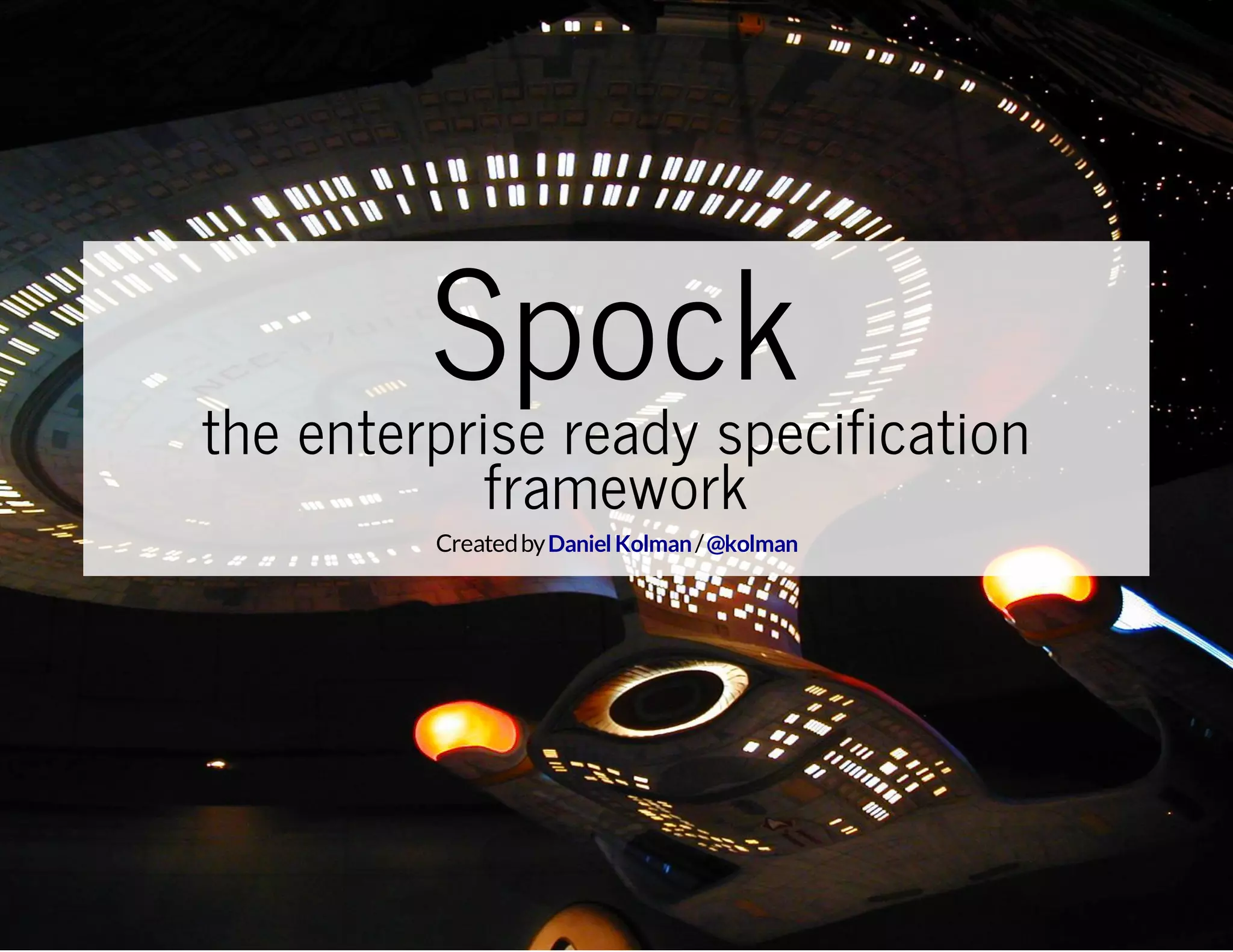
Spock
the enterprise ready specification
framework

Created by Daniel Kolman / @kolman
Spock is Groovy
...and Groovy is Bliss!

def user = new User(firstName: 'Johnny', lastName: 'Walker')
def street = company?.address?.street
users.filter { it.age > 20 }
.sort { it.salary }
.collect { it.lastName + ', ' + it.firstName }
def message = [subject: 'Hello jOpenSpace!', body: 'Meet me at the bar']

Groovy is dense and expressive. Don't
worry it's dynamic - this is a test framework
and tests are executed after every commit!
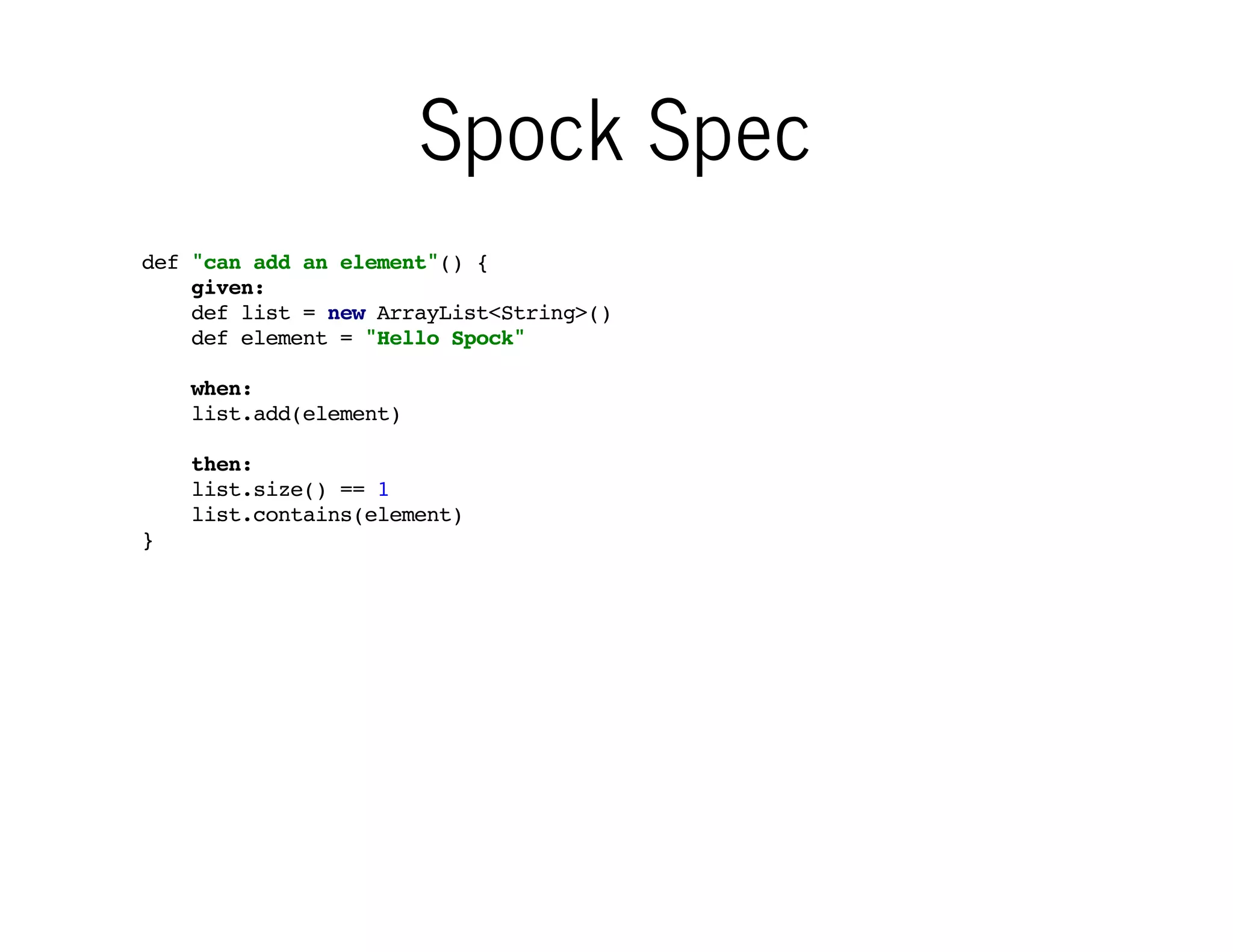
Spock Spec
def "can add an element"() {
given:
def list = new ArrayList<String>()
def element = "Hello Spock"
when:
list.add(element)
then:
list.size() == 1
list.contains(element)
}

Spock test (= "feature method") is
structured into well-known blocks
with defined meaning
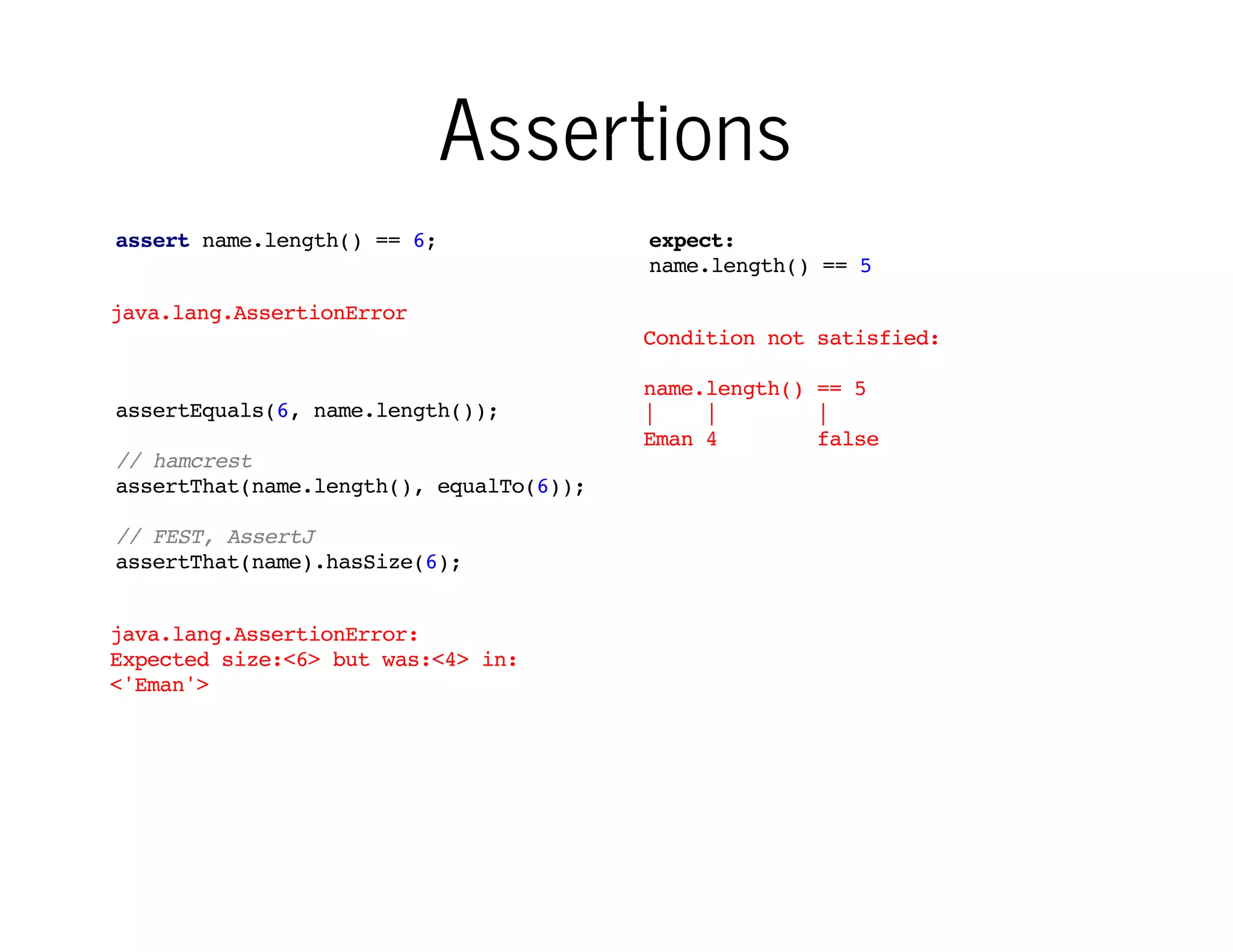
Assertions
assert name.length() == 6;

expect:
name.length() == 5

java.lang.AssertionError
Condition not satisfied:
assertEquals(6, name.length());

name.length() == 5
|
|
|
Eman 4
false

// hamcrest
assertThat(name.length(), equalTo(6));
// FEST, AssertJ
assertThat(name).hasSize(6);
java.lang.AssertionError:
Expected size:<6> but was:<4> in:
<'Eman'>

Assertions commonly used in
Java are complicated or have
ugly fail messages

Spock makes it simple...
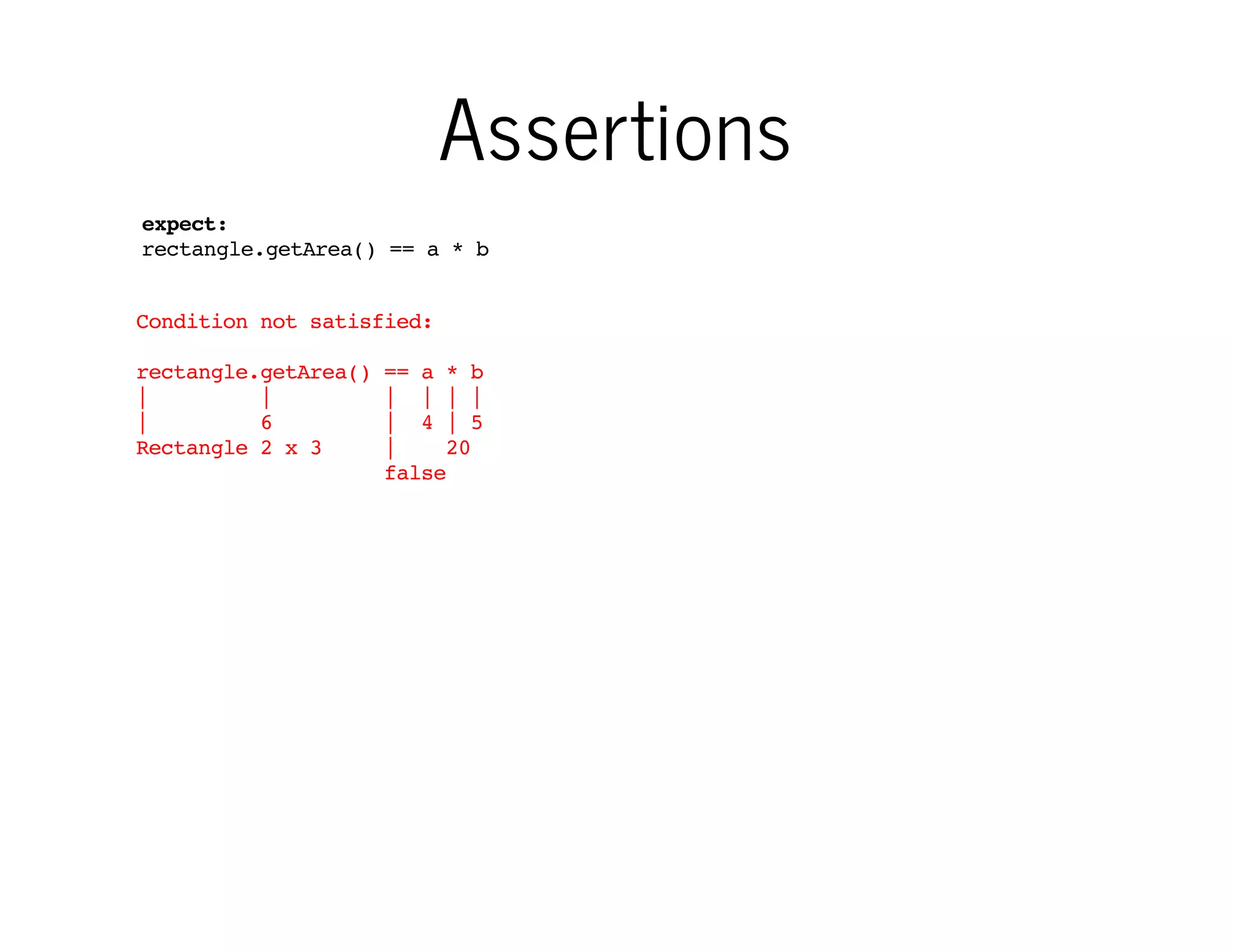
Assertions
expect:
rectangle.getArea() == a * b
Condition not satisfied:
rectangle.getArea()
|
|
|
6
Rectangle 2 x 3

== a * b
| | | |
| 4 | 5
|
20
false

…and when something goes
wrong, it writes nice and detailed
fail message
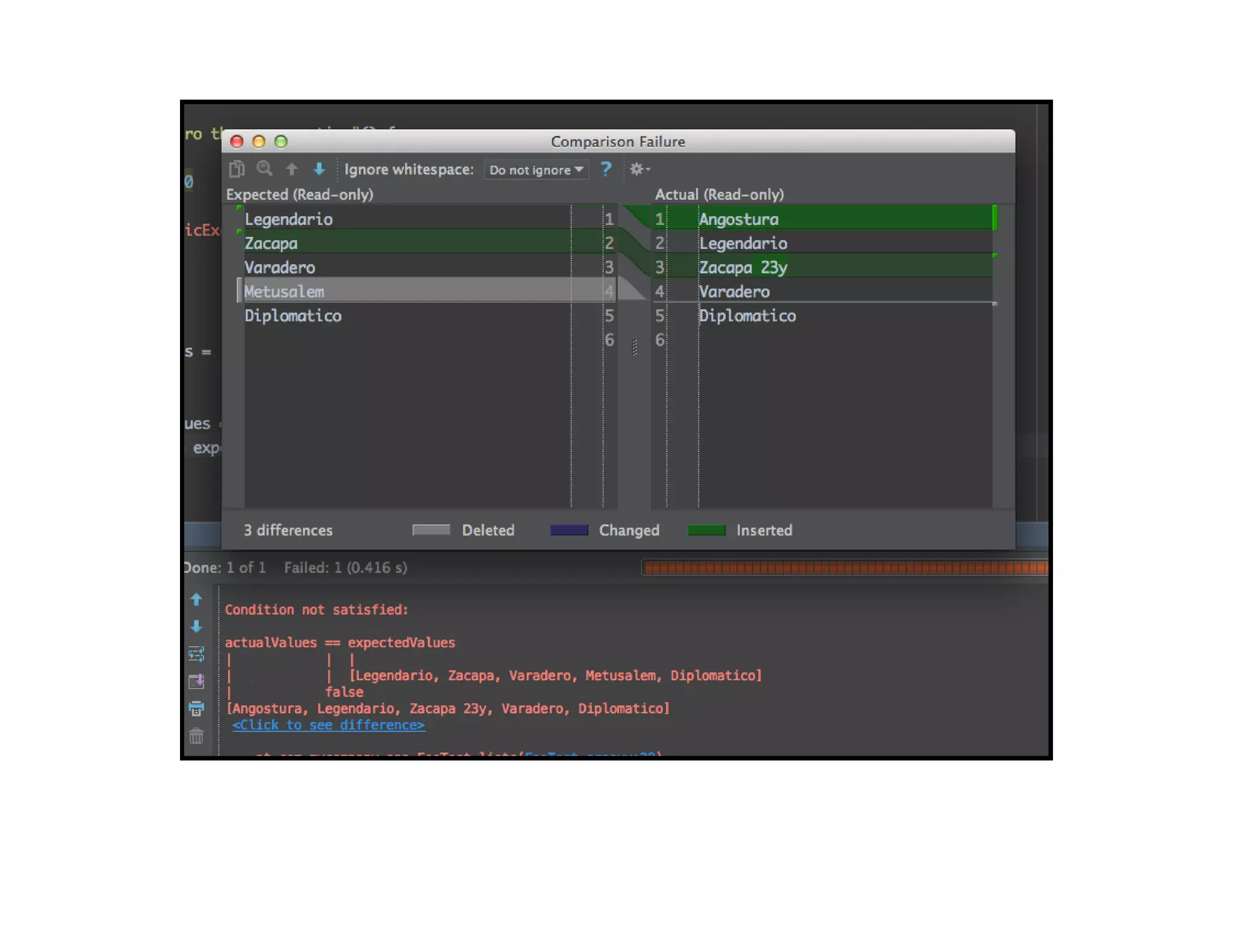
Assertions
expect:
def expectedValues =
["Legendario", "Zacapa", "Varadero", "Metusalem", "Diplomatico"]
actualValues == expectedValues
Condition not satisfied:
actualValues == expectedValues
|
| |
|
| [Legendario, Zacapa, Varadero, Metusalem, Diplomatico]
|
false
[Angostura, Legendario, Zacapa 23y, Varadero, Diplomatico]

…even for lists
IntelliJ IDEA can even display a diff of
expected and actual values
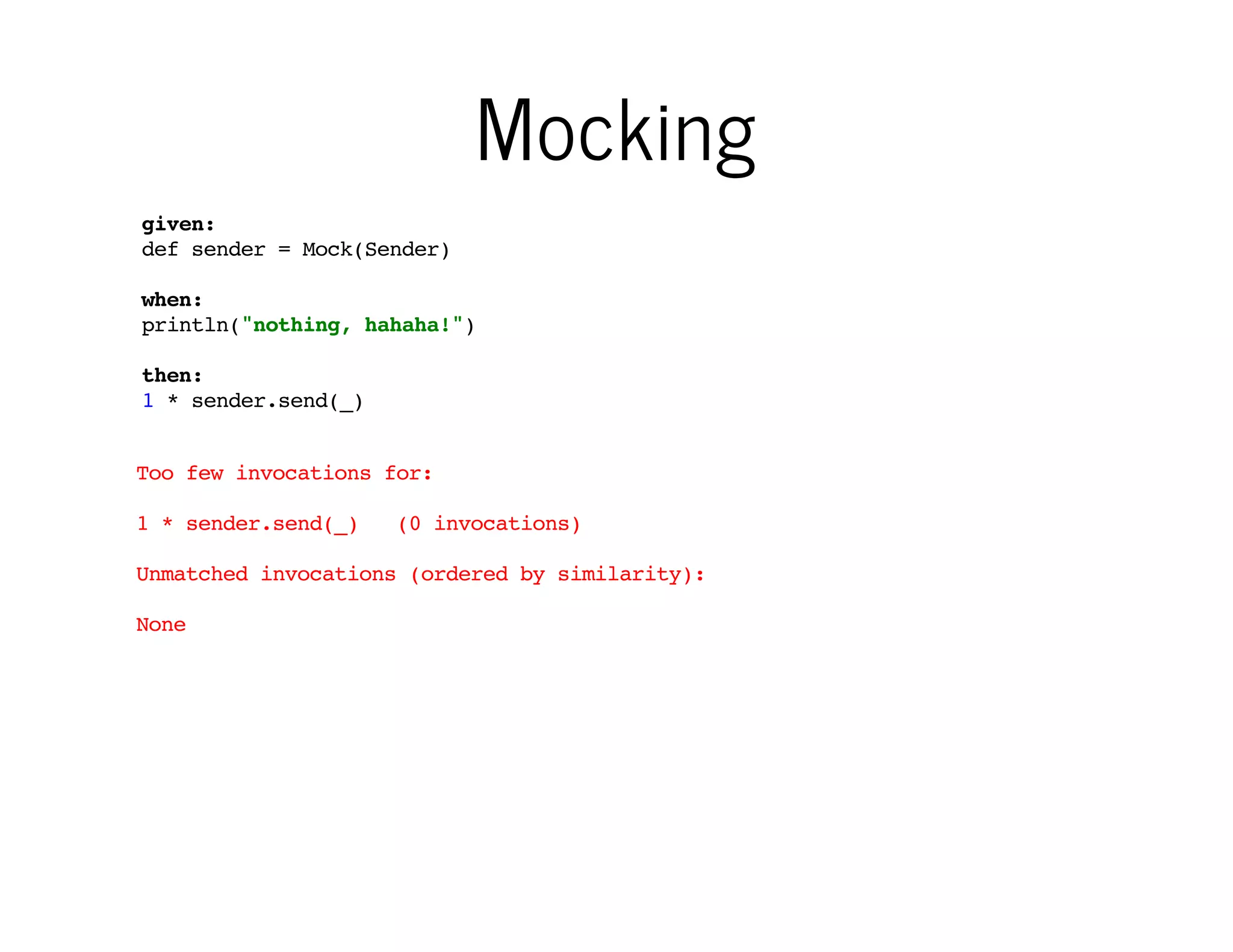
Mocking
given:
def sender = Mock(Sender)

Verifying behavior
with mock is simple

when:
println("nothing, hahaha!")
then:
1 * sender.send(_)
Too few invocations for:
1 * sender.send(_)

You can use ranges for invocation
count and wildcards for parameters

(0 invocations)

Unmatched invocations (ordered by similarity):
None
Stubbing
given:
def subscriber = Mock(Subscriber)
// pattern matching
subscriber.receive("poison") >> "oh wait..."
subscriber.receive(_) >> "ok"
when:
def response = subscriber.receive("poison")

…and setting expectations
has some powerful features

// returning sequence
subscriber.receive(_) >>> ["ok", "ok", "hey this is too much"]

// computing return value
subscriber.receive(_) >> { String msg -> msg.size() < 10 ? "ok" : "tl;dr" }
Data Driven Tests
def "maximum of two numbers"() {
expect:
Math.max(a, b) == c

def "maximum of two numbers"() {
expect:
Math.max(a, b) == expectedMax

where:
a << [1, 8, 9]
b << [7, 3, 9]
c << [7, 8, 9]

where:
a | b |
1 | 7 |
8 | 3 |
9 | 9 |

}

expectedMax
7
8
9

}

Spock has first-class
support for
parametrized tests

You can even use
table-like structure
for setting input data

Forget JUnit theories or
TestNG data providers!
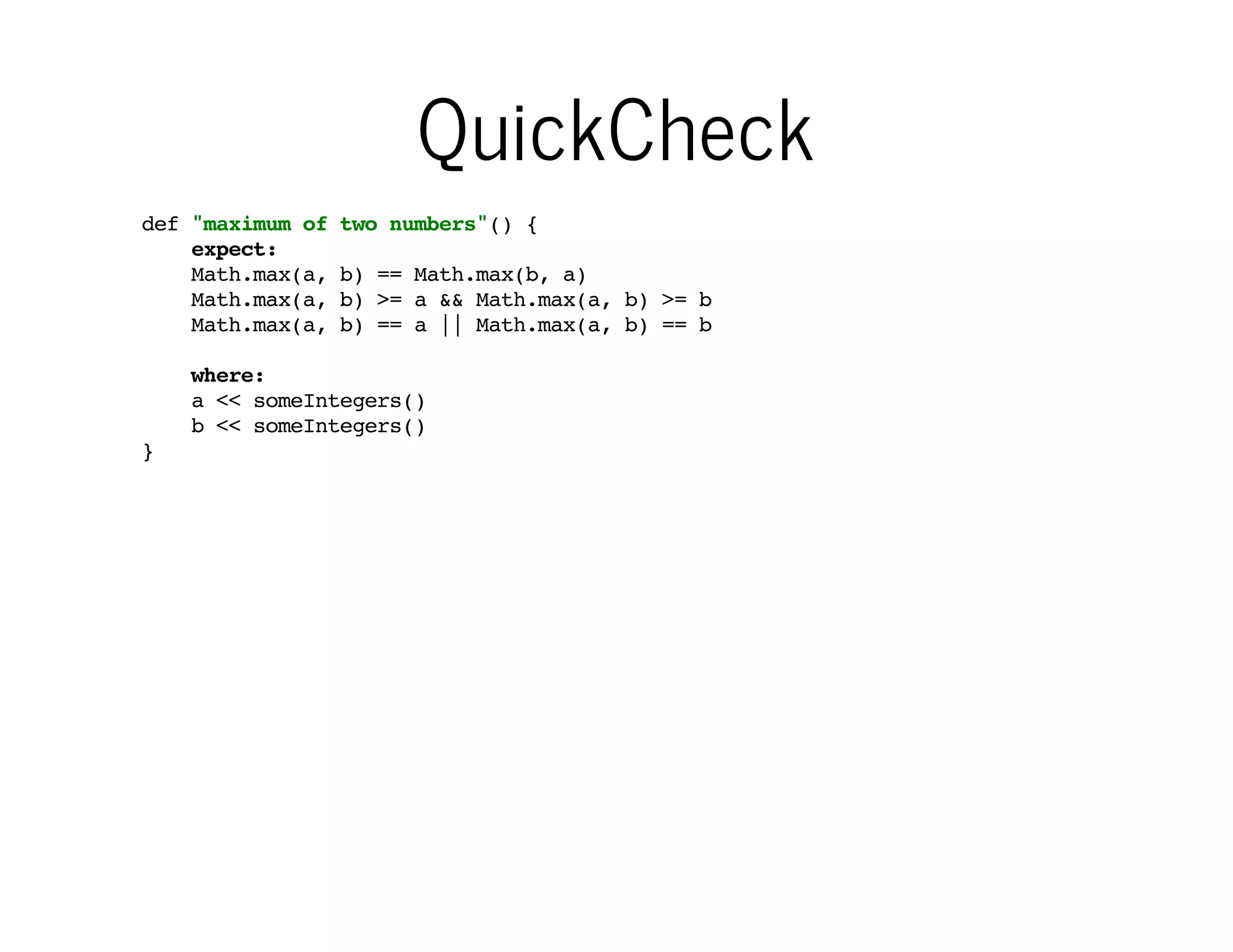
QuickCheck
def "maximum of
expect:
Math.max(a,
Math.max(a,
Math.max(a,

two numbers"() {
b) == Math.max(b, a)
b) >= a && Math.max(a, b) >= b
b) == a || Math.max(a, b) == b

where:
a << someIntegers()
b << someIntegers()
}

Input data can be
anything Iterable...

…and that makes it simple to
use something like QuickCheck
for generating random data
Property-Based Testing
def "sorts a list"() {
when:
def sorted = list.sort(false)

You define invariant
"properties" that hold
true for any valid input

then:
sorted == sorted.sort(false)
sorted.first() == list.min()
sorted.last() == list.max()
sorted.eachWithIndex { x, i -> assert i==0 || sorted[i-1] <= x }
where:
list << someLists(integers())
}

Data-driven tests tend to have
different structure than traditional
"example-based" tests
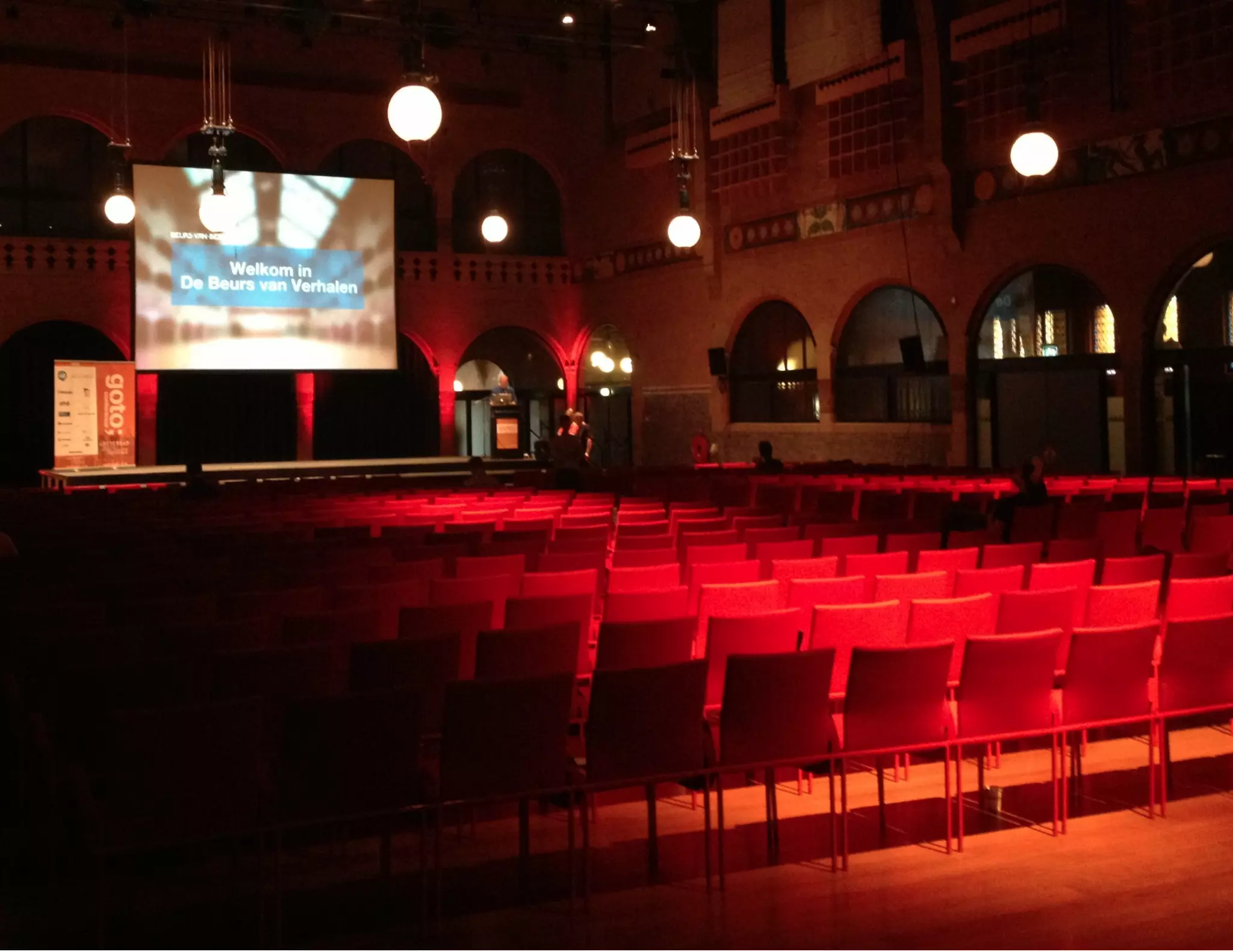
I attended GOTO conference
in Amsterdam this year...
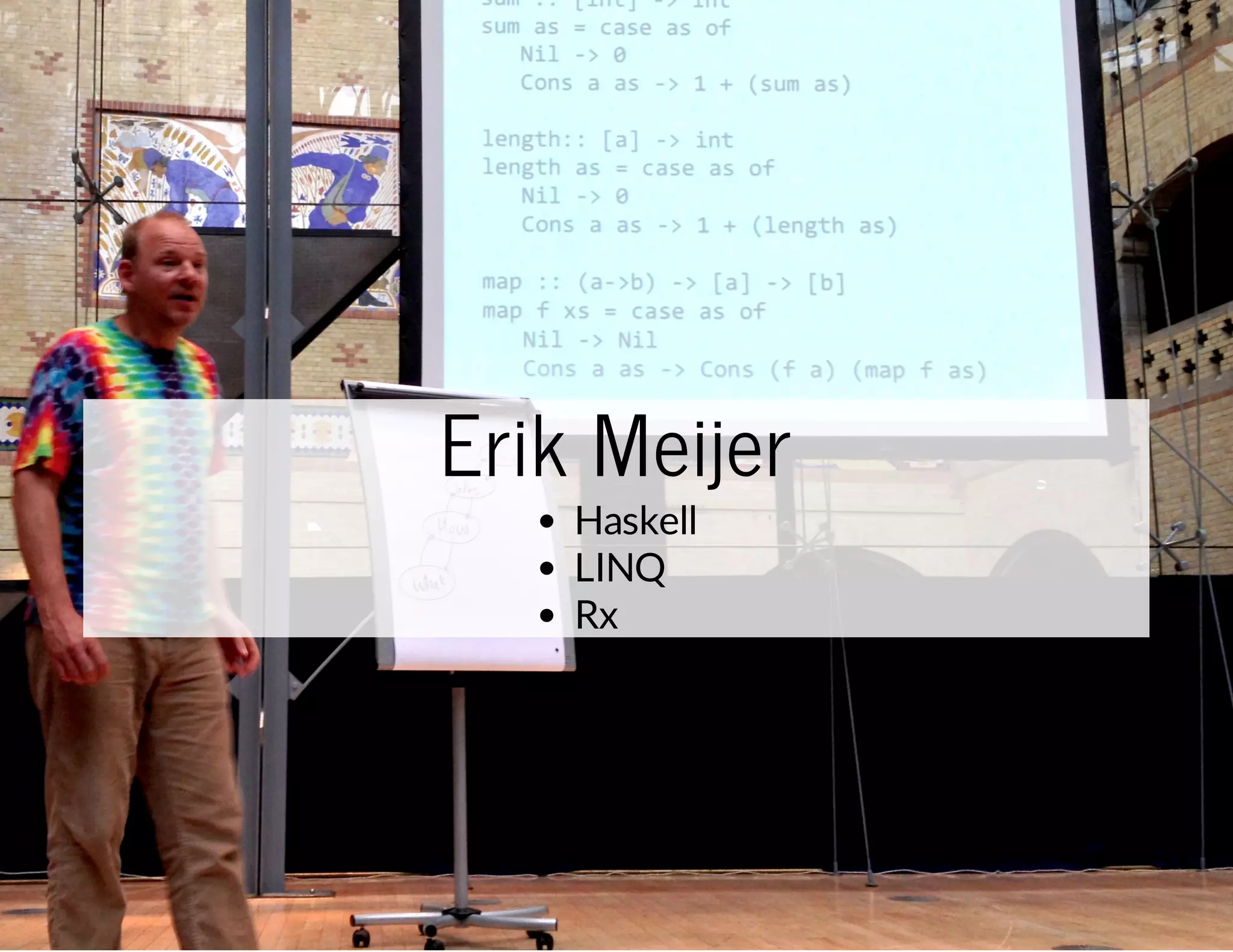
Erik Meijer
Haskell
LINQ
Rx

…and one of the speakers was Erik Meijer,
who was developing Haskell and worked on
LINQ and Reactive Extensions in Microsoft...
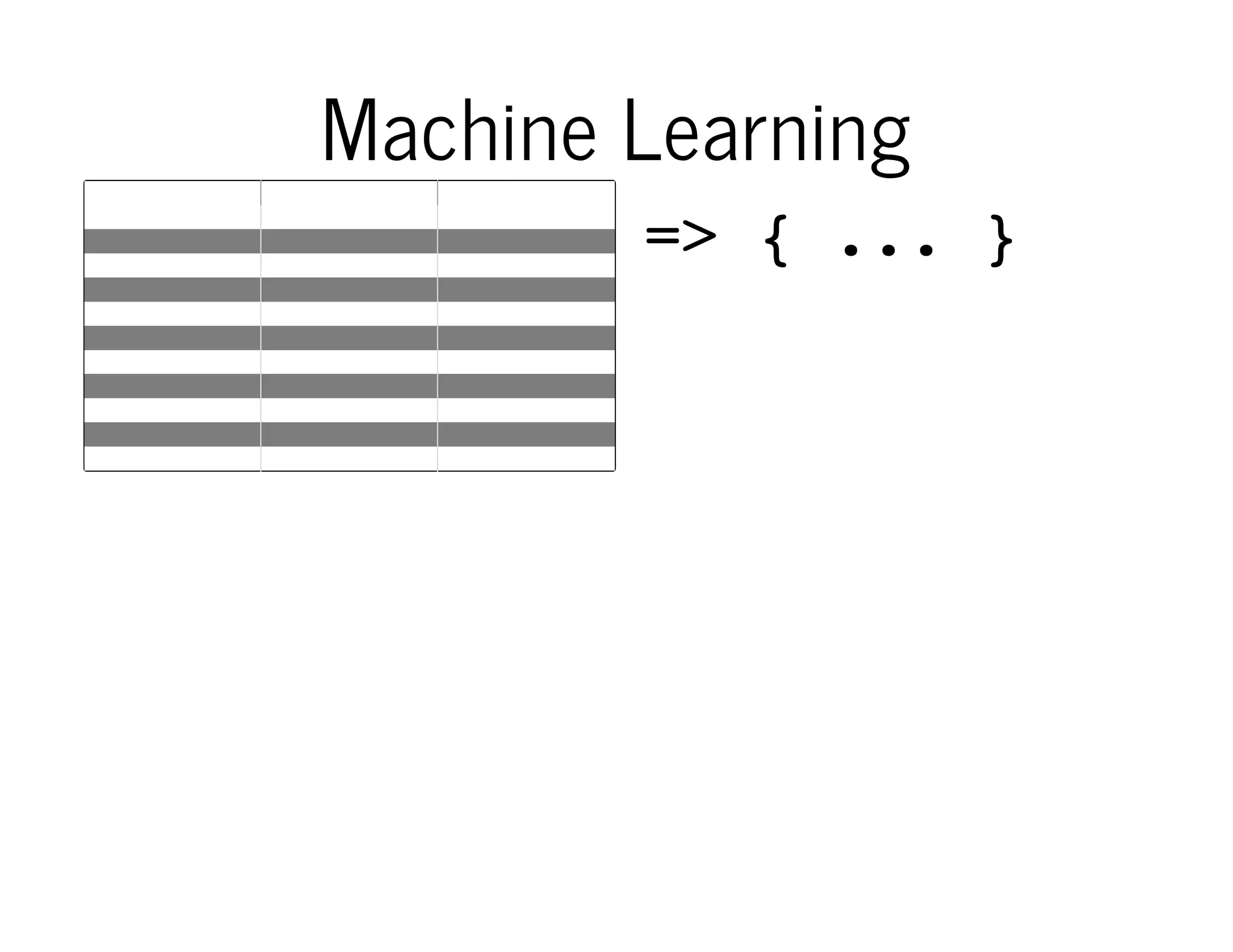
Machine Learning
=> { ... }

…and he gave a great talk
about machine learning
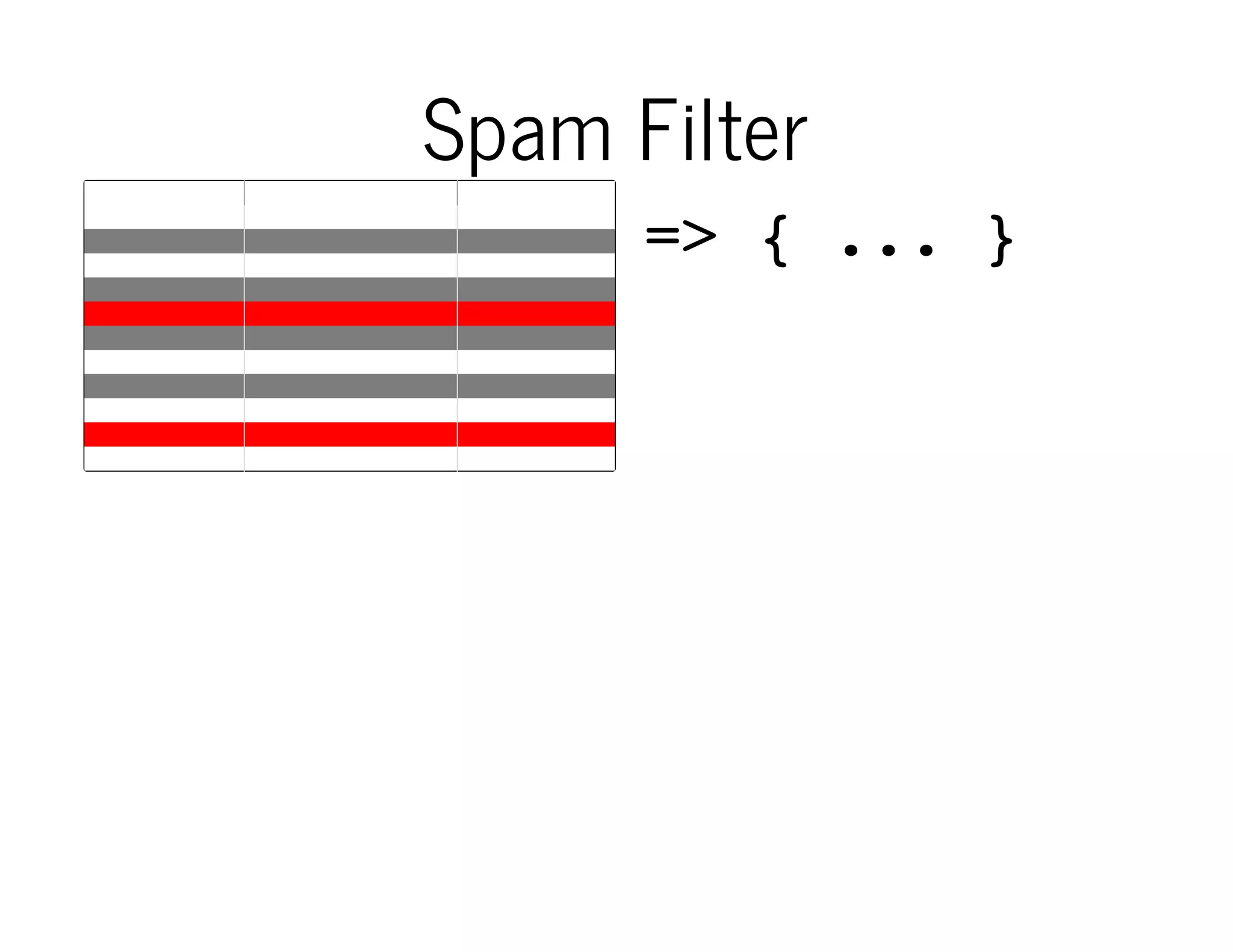
From

Subject

Spam Filter
Body

=> { ... }

In essence, machine learning is
generating computer code based
on data

E.g. generate a code to recognize
a spam, based on analysis of
bunch of email messages
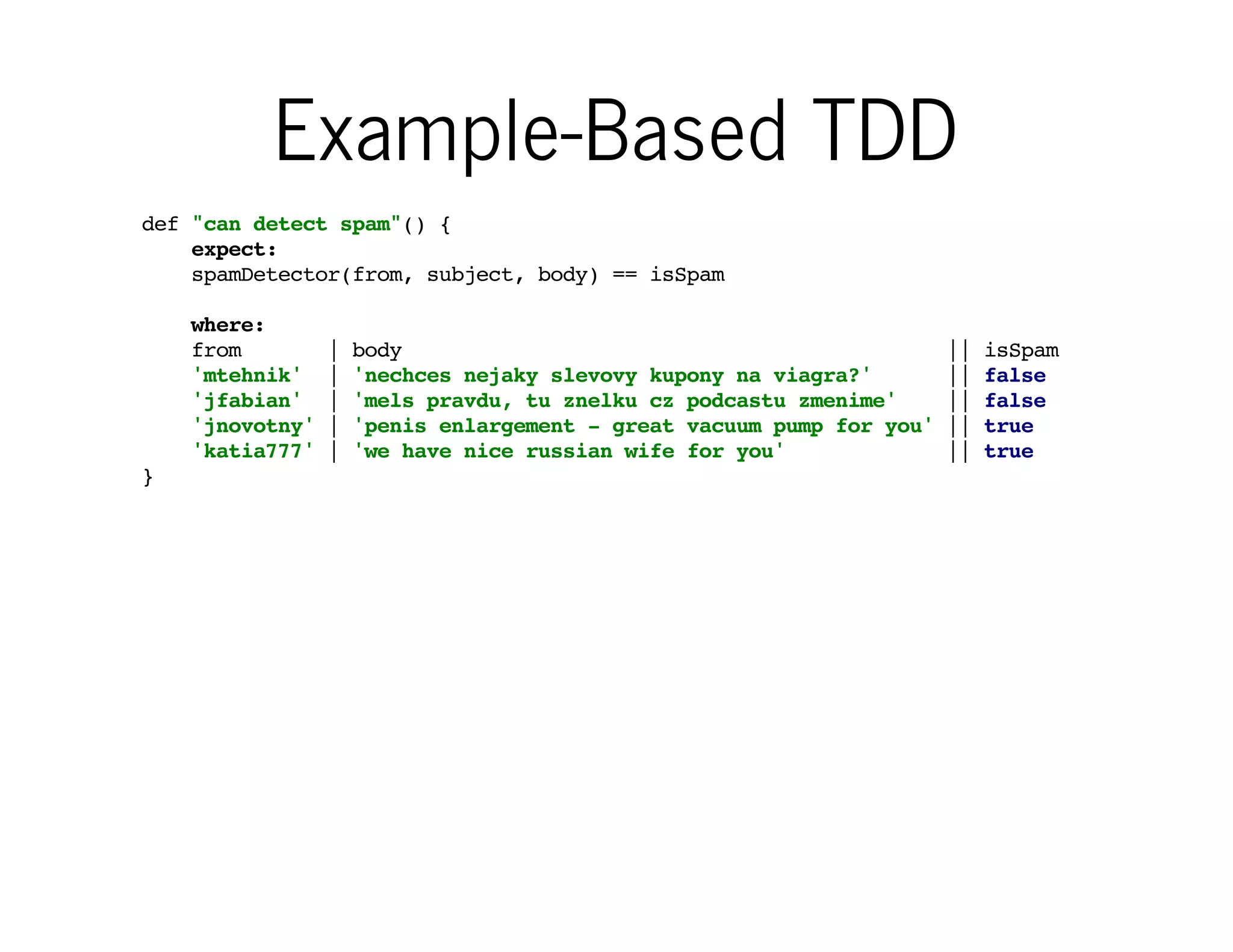
Example-Based TDD
def "can detect spam"() {
expect:
spamDetector(from, subject, body) == isSpam
where:
from
'mtehnik'
'jfabian'
'jnovotny'
'katia777'

|
|
|
|
|

body
'nechces nejaky slevovy kupony na viagra?'
'mels pravdu, tu znelku cz podcastu zmenime'
'penis enlargement - great vacuum pump for you'
'we have nice russian wife for you'

||
||
||
||
||

isSpam
false
false
true
true

}

And that is very similar to TDD. You
are providing more and more test
cases to specify the desired behavior

The difference is, you don't
write the implementation - it is
generated by computer
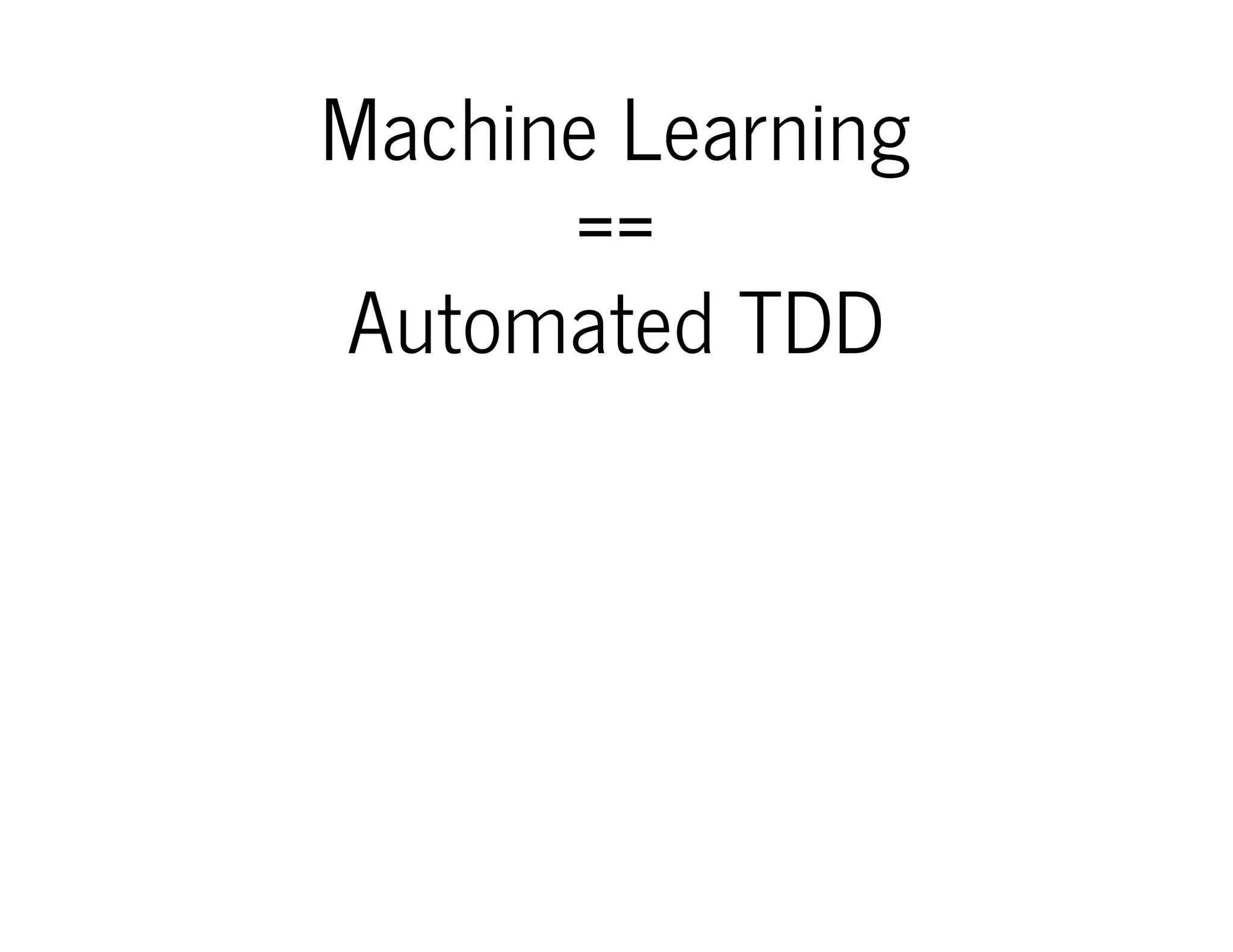
Machine Learning
==
Automated TDD
Therefore, Erik Meijer claims
that machine learning is just
automated TDD
Prepare for the Future

In 10 years, programmers will be replaced by generated code

…and that can have some
impact on job security
Generated Code
Machine learning
Genetic programming

There are already some
real-world usages of
generated code

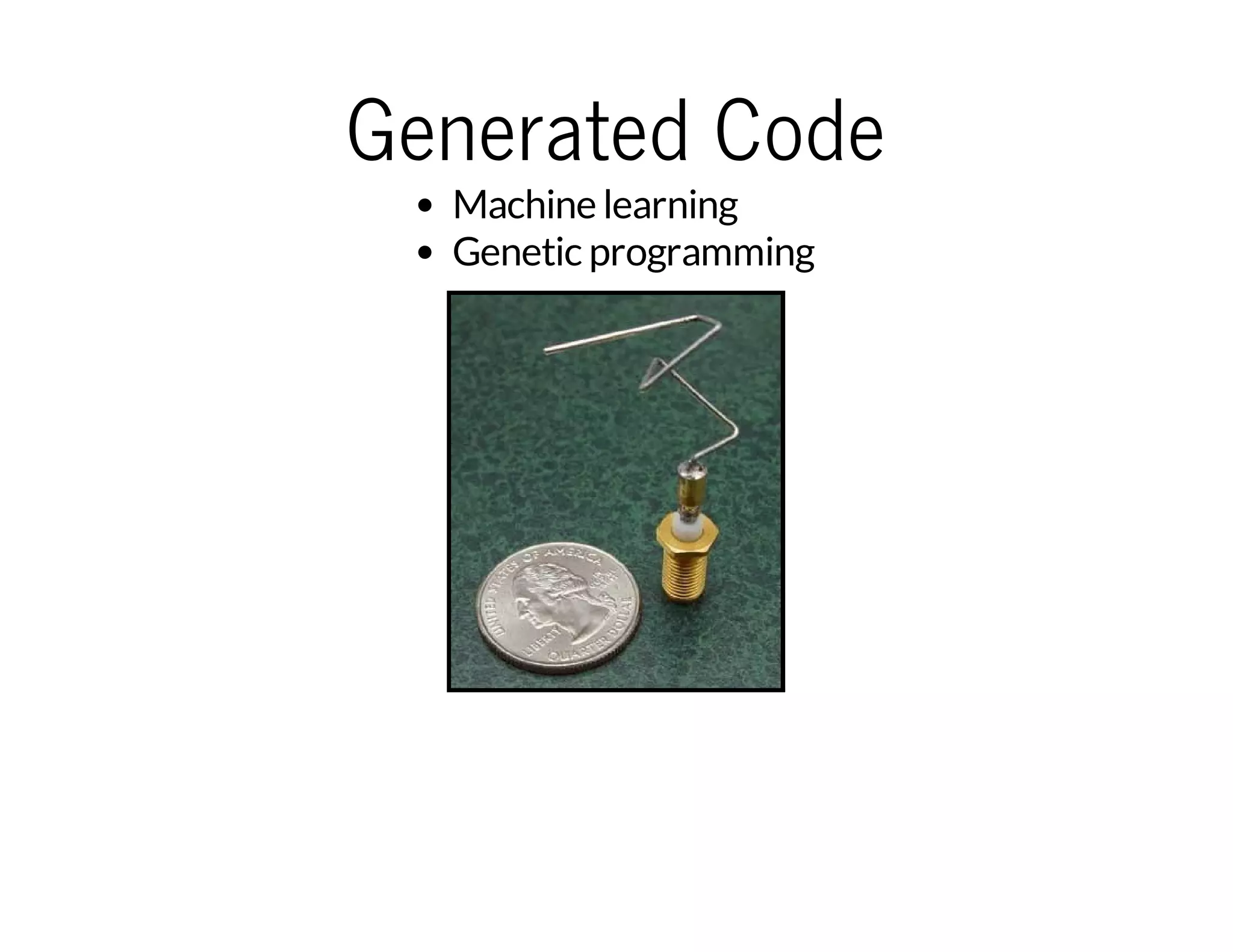
This is an antenna designed
by evolutionary algorithm,
that NASA actually used on
a spacecraft

http://idesign.ucsc.edu/projects/evo_antenna.html
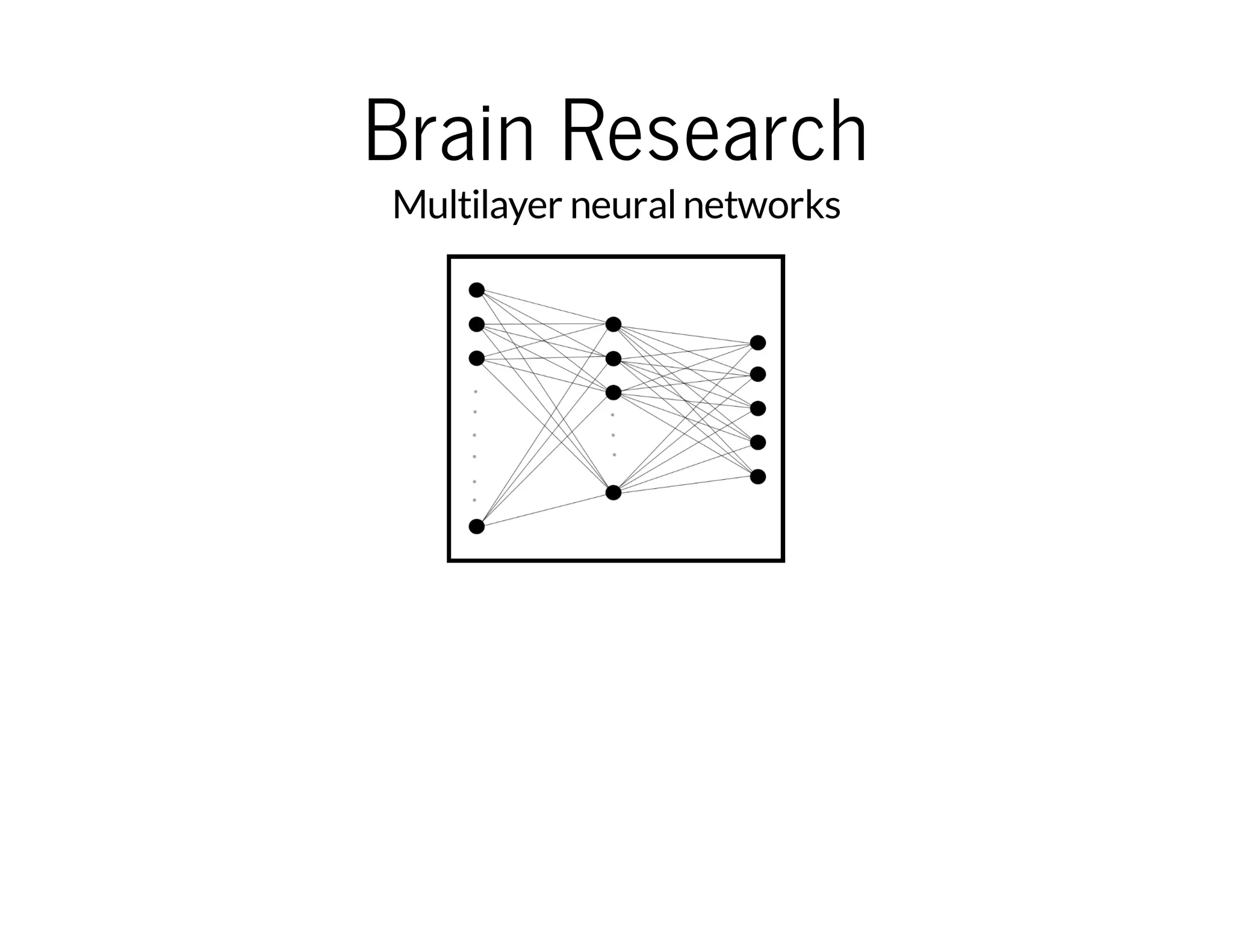
Brain Research
Multilayer neural networks

…and our understanding of how
the brain works is getting better

https://www.simonsfoundation.org/quanta/20130723-as-machines-get-smarter-evidence-they-learn-like-us/
Property-Based Testing
def "sorts a list"() {
when:
def sorted = list.sort(false)
then:
sorted == sorted.sort(false)
sorted.first() == list.min()
sorted.last() == list.max()
sorted.eachWithIndex { x, i -> assert i==0 || sorted[i-1] <= x }
where:
list << someLists(integers())
}

Now take a second look
at property-based test

It is only matter of time when it will be
cheaper to generate code from
specification than to write it manually

Can there be better specification
for code generator?
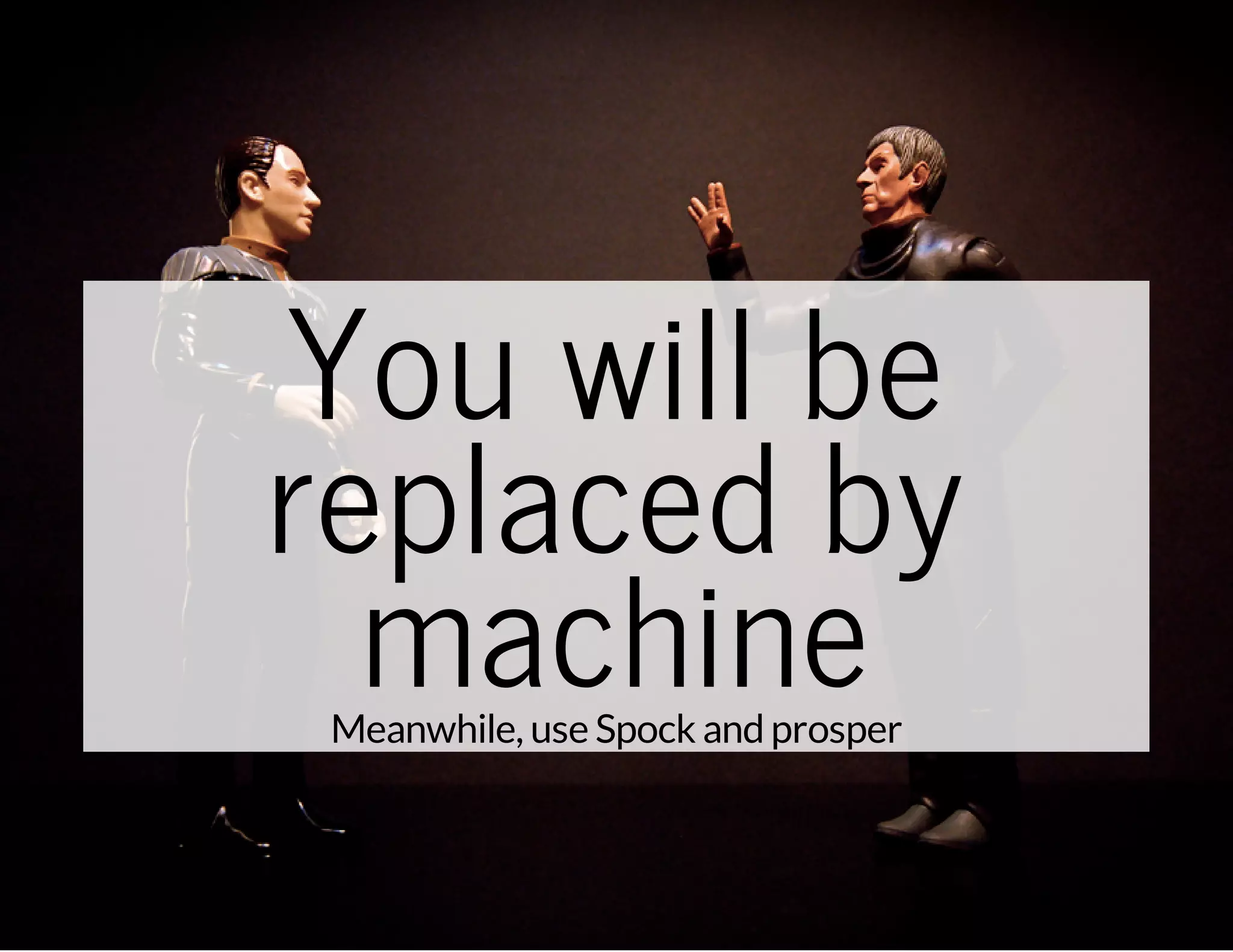
You will be
replaced by
machine
Meanwhile, use Spock and prosper
Credits

http://www.flickr.com/photos/kt/1217157
http://www.flickr.com/photos/rooners/7290977402
http://www.flickr.com/photos/jdhancock/4425900247
http://www.agiledojo.net/2013/09/and-now-for-somethingcompletely.html
https://www.simonsfoundation.org/quanta/20130723-asmachines-get-smarter-evidence-they-learn-like-us/
TestNG vs. Spock
@DataProvider(name = "maximumOfTwoNumbersProvider")
public Object[][] createDataForMaximum() {
return new Object[][]{
{1, 7, 7},
{8, 3, 8},
{9, 9, 9}
};
}
@Test(dataProvider = "maximumOfTwoNumbersProvider")
public void maximumOfTwoNumbers(int a, int b, int expectedMax) {
assertThat(Math.max(a, b)).isEqualTo(expectedMax);
}

def "maximum of two numbers"() {
expect:
Math.max(a, b) == expectedMax
where:
a | b |
1 | 7 |
8 | 3 |
9 | 9 |
}

expectedMax
7
8
9

Bonus slide - comparison of
parametrized test in TestNG
(above) and Spock (bellow)

Spock Framework

  • 1.
    Spock the enterprise readyspecification framework Created by Daniel Kolman / @kolman
  • 2.
    Spock is Groovy ...andGroovy is Bliss! def user = new User(firstName: 'Johnny', lastName: 'Walker') def street = company?.address?.street users.filter { it.age > 20 } .sort { it.salary } .collect { it.lastName + ', ' + it.firstName } def message = [subject: 'Hello jOpenSpace!', body: 'Meet me at the bar'] Groovy is dense and expressive. Don't worry it's dynamic - this is a test framework and tests are executed after every commit!
  • 3.
    Spock Spec def "canadd an element"() { given: def list = new ArrayList<String>() def element = "Hello Spock" when: list.add(element) then: list.size() == 1 list.contains(element) } Spock test (= "feature method") is structured into well-known blocks with defined meaning
  • 4.
    Assertions assert name.length() ==6; expect: name.length() == 5 java.lang.AssertionError Condition not satisfied: assertEquals(6, name.length()); name.length() == 5 | | | Eman 4 false // hamcrest assertThat(name.length(), equalTo(6)); // FEST, AssertJ assertThat(name).hasSize(6); java.lang.AssertionError: Expected size:<6> but was:<4> in: <'Eman'> Assertions commonly used in Java are complicated or have ugly fail messages Spock makes it simple...
  • 5.
    Assertions expect: rectangle.getArea() == a* b Condition not satisfied: rectangle.getArea() | | | 6 Rectangle 2 x 3 == a * b | | | | | 4 | 5 | 20 false …and when something goes wrong, it writes nice and detailed fail message
  • 6.
    Assertions expect: def expectedValues = ["Legendario","Zacapa", "Varadero", "Metusalem", "Diplomatico"] actualValues == expectedValues Condition not satisfied: actualValues == expectedValues | | | | | [Legendario, Zacapa, Varadero, Metusalem, Diplomatico] | false [Angostura, Legendario, Zacapa 23y, Varadero, Diplomatico] …even for lists
  • 7.
    IntelliJ IDEA caneven display a diff of expected and actual values
  • 8.
    Mocking given: def sender =Mock(Sender) Verifying behavior with mock is simple when: println("nothing, hahaha!") then: 1 * sender.send(_) Too few invocations for: 1 * sender.send(_) You can use ranges for invocation count and wildcards for parameters (0 invocations) Unmatched invocations (ordered by similarity): None
  • 9.
    Stubbing given: def subscriber =Mock(Subscriber) // pattern matching subscriber.receive("poison") >> "oh wait..." subscriber.receive(_) >> "ok" when: def response = subscriber.receive("poison") …and setting expectations has some powerful features // returning sequence subscriber.receive(_) >>> ["ok", "ok", "hey this is too much"] // computing return value subscriber.receive(_) >> { String msg -> msg.size() < 10 ? "ok" : "tl;dr" }
  • 10.
    Data Driven Tests def"maximum of two numbers"() { expect: Math.max(a, b) == c def "maximum of two numbers"() { expect: Math.max(a, b) == expectedMax where: a << [1, 8, 9] b << [7, 3, 9] c << [7, 8, 9] where: a | b | 1 | 7 | 8 | 3 | 9 | 9 | } expectedMax 7 8 9 } Spock has first-class support for parametrized tests You can even use table-like structure for setting input data Forget JUnit theories or TestNG data providers!
  • 11.
    QuickCheck def "maximum of expect: Math.max(a, Math.max(a, Math.max(a, twonumbers"() { b) == Math.max(b, a) b) >= a && Math.max(a, b) >= b b) == a || Math.max(a, b) == b where: a << someIntegers() b << someIntegers() } Input data can be anything Iterable... …and that makes it simple to use something like QuickCheck for generating random data
  • 12.
    Property-Based Testing def "sortsa list"() { when: def sorted = list.sort(false) You define invariant "properties" that hold true for any valid input then: sorted == sorted.sort(false) sorted.first() == list.min() sorted.last() == list.max() sorted.eachWithIndex { x, i -> assert i==0 || sorted[i-1] <= x } where: list << someLists(integers()) } Data-driven tests tend to have different structure than traditional "example-based" tests
  • 14.
    I attended GOTOconference in Amsterdam this year...
  • 15.
    Erik Meijer Haskell LINQ Rx …and oneof the speakers was Erik Meijer, who was developing Haskell and worked on LINQ and Reactive Extensions in Microsoft...
  • 16.
    Machine Learning => {... } …and he gave a great talk about machine learning
  • 17.
    From Subject Spam Filter Body => {... } In essence, machine learning is generating computer code based on data E.g. generate a code to recognize a spam, based on analysis of bunch of email messages
  • 18.
    Example-Based TDD def "candetect spam"() { expect: spamDetector(from, subject, body) == isSpam where: from 'mtehnik' 'jfabian' 'jnovotny' 'katia777' | | | | | body 'nechces nejaky slevovy kupony na viagra?' 'mels pravdu, tu znelku cz podcastu zmenime' 'penis enlargement - great vacuum pump for you' 'we have nice russian wife for you' || || || || || isSpam false false true true } And that is very similar to TDD. You are providing more and more test cases to specify the desired behavior The difference is, you don't write the implementation - it is generated by computer
  • 19.
    Machine Learning == Automated TDD Therefore,Erik Meijer claims that machine learning is just automated TDD
  • 20.
    Prepare for theFuture In 10 years, programmers will be replaced by generated code …and that can have some impact on job security
  • 21.
    Generated Code Machine learning Geneticprogramming There are already some real-world usages of generated code This is an antenna designed by evolutionary algorithm, that NASA actually used on a spacecraft http://idesign.ucsc.edu/projects/evo_antenna.html
  • 22.
    Brain Research Multilayer neuralnetworks …and our understanding of how the brain works is getting better https://www.simonsfoundation.org/quanta/20130723-as-machines-get-smarter-evidence-they-learn-like-us/
  • 23.
    Property-Based Testing def "sortsa list"() { when: def sorted = list.sort(false) then: sorted == sorted.sort(false) sorted.first() == list.min() sorted.last() == list.max() sorted.eachWithIndex { x, i -> assert i==0 || sorted[i-1] <= x } where: list << someLists(integers()) } Now take a second look at property-based test It is only matter of time when it will be cheaper to generate code from specification than to write it manually Can there be better specification for code generator?
  • 24.
    You will be replacedby machine Meanwhile, use Spock and prosper
  • 25.
  • 26.
    TestNG vs. Spock @DataProvider(name= "maximumOfTwoNumbersProvider") public Object[][] createDataForMaximum() { return new Object[][]{ {1, 7, 7}, {8, 3, 8}, {9, 9, 9} }; } @Test(dataProvider = "maximumOfTwoNumbersProvider") public void maximumOfTwoNumbers(int a, int b, int expectedMax) { assertThat(Math.max(a, b)).isEqualTo(expectedMax); } def "maximum of two numbers"() { expect: Math.max(a, b) == expectedMax where: a | b | 1 | 7 | 8 | 3 | 9 | 9 | } expectedMax 7 8 9 Bonus slide - comparison of parametrized test in TestNG (above) and Spock (bellow)