American Culture and Pragmatics
         Spring 2012
    Ms. Candice Quiñones
Overview
                   
 Definitions
 How to Explain
 Finding the Right Level
 Ten Ways to Explain Things More Effectively
Definition
ex·plain
                    
 verb (used with object)
  1. to make plain or clear; render understandable or
     intelligible: to explain an obscure point.
  2. to make known in detail: to explain how to do
     something.
  3. to assign a meaning to; interpret: How can you
     explain such a silly remark?
  4. to make clear the cause or reason of; account for: I
     cannot explain his strange behavior.
 verb (used without object)
  5. to give an explanation.
                       Source: Dictionary.com
Definition
ex·pla·na·tion
                         
 noun
  1. the act or process of explaining.
  2. something that explains; a statement made to clarify
     something and make it understandable; exposition:
       a)   an explanation of a poem.
  3.    a meaning or interpretation:
       a)   to find an explanation for a mystery.
  4. a mutual declaration of the meaning of words spoken,
     actions, motives, etc., with a view to adjusting a
     misunderstanding or reconciling differences:
       a)   After a long and emotional explanation they were friends
            again.           Source: Dictionary.com
How To Explain
                
 When we explain, our goal is to make things clear.
 In order to do this, we need several “tools” in our
  verbal “toolbox”.
    Clarity
       Details
    Reasons
       Honesty
    Foreshadowing
    Logical connectors
    Finding the right level
Clarity
                         
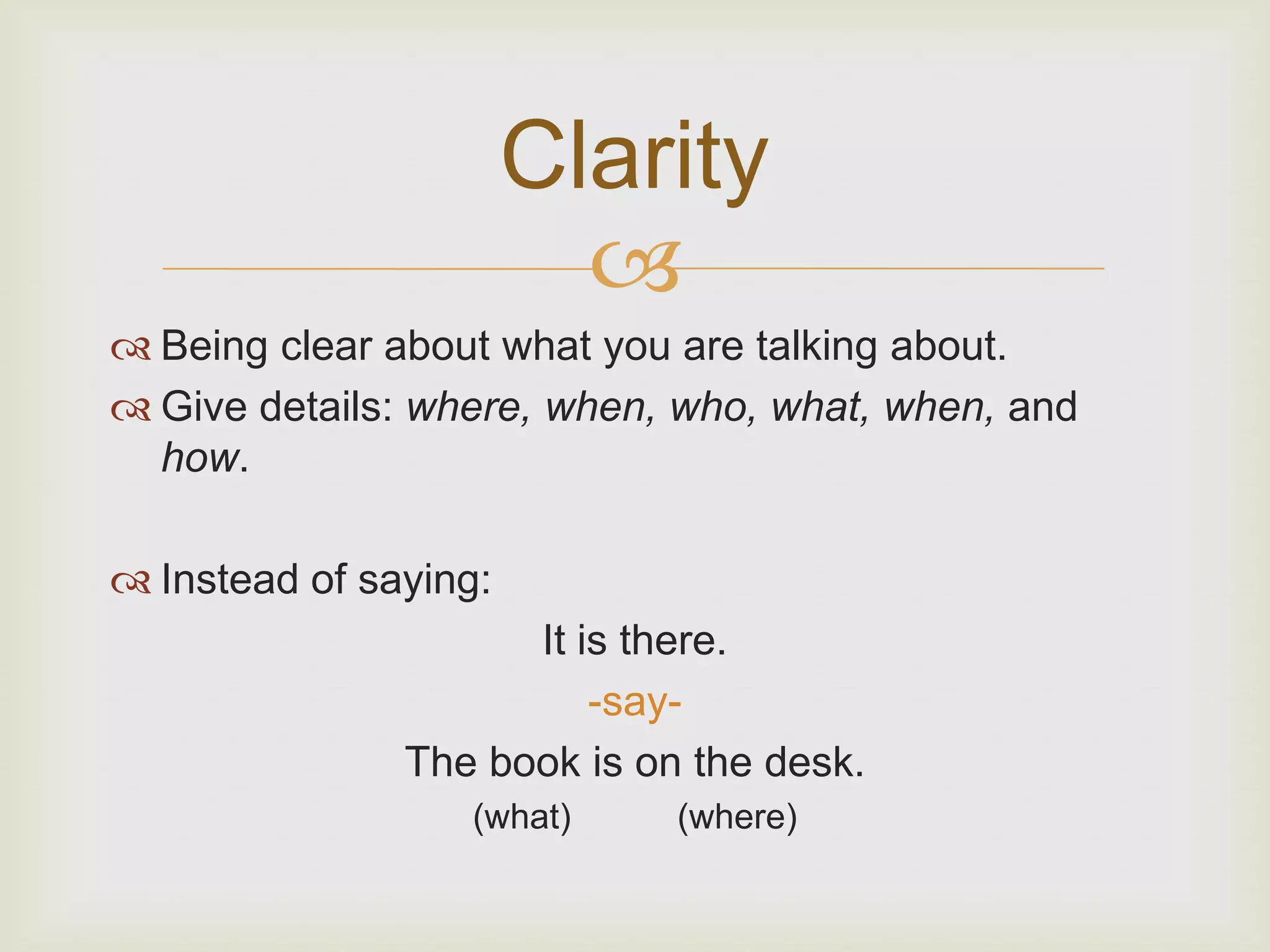
 Being clear about what you are talking about.
 Give details: where, when, who, what, when, and
  how.

 Instead of saying:
                     It is there.
                         -say-
               The book is on the desk.
                  (what)     (where)
Clarity
                       
 Avoid pronouns and use nouns instead.
   Answer the question “who?” or “what?”
   A noun is a name for a person, place, thing or
    idea.
      Ex. University, Grape Street, girlfriend, compassion,
       etc.


   A pronoun is a word used to substitute for a
    noun.
      Ex. He, she,Source: Dr. Deborah Mowshowitz,
                    it, they, we, me, him, her, us, them,
                  Department of Biological Sciences,
       etc.              Columbia University
Clarity
                         
 Use active, descriptive verbs instead of passive,
  boring ones.
    Answer the question “how?”
    Note: “be” is a passive verb


 Instead of saying:
                    We went there.
                         -say-
    My family and I drove to the Lehigh Valley Mall.
Clarity
                     
 So remember, to be clear:
   Give details
   Use nouns, not pronouns
   Use descriptive verbs
Reasons
                   
 When you explain, it is important to give the reasons
  behind your thoughts or actions.
    Answer the question “why?”
 Instead of saying:
                     I’m leaving.
                         -say-
    I’m leaving now so I can catch my bus on time.
Reasons
                    
When giving reasons it is important to be honest.
 If you don’t know how to explain something, it is okay
  to say “I don’t know.”
 It is usually better to be honest about your reasons
  for something than to lie.
    If you lie, the reasons you invent may not make sense.
    If you lie, you may forget the reasons you gave and
     the person will find out later (and may be hurt or
     angry).
Foreshadowing
                 
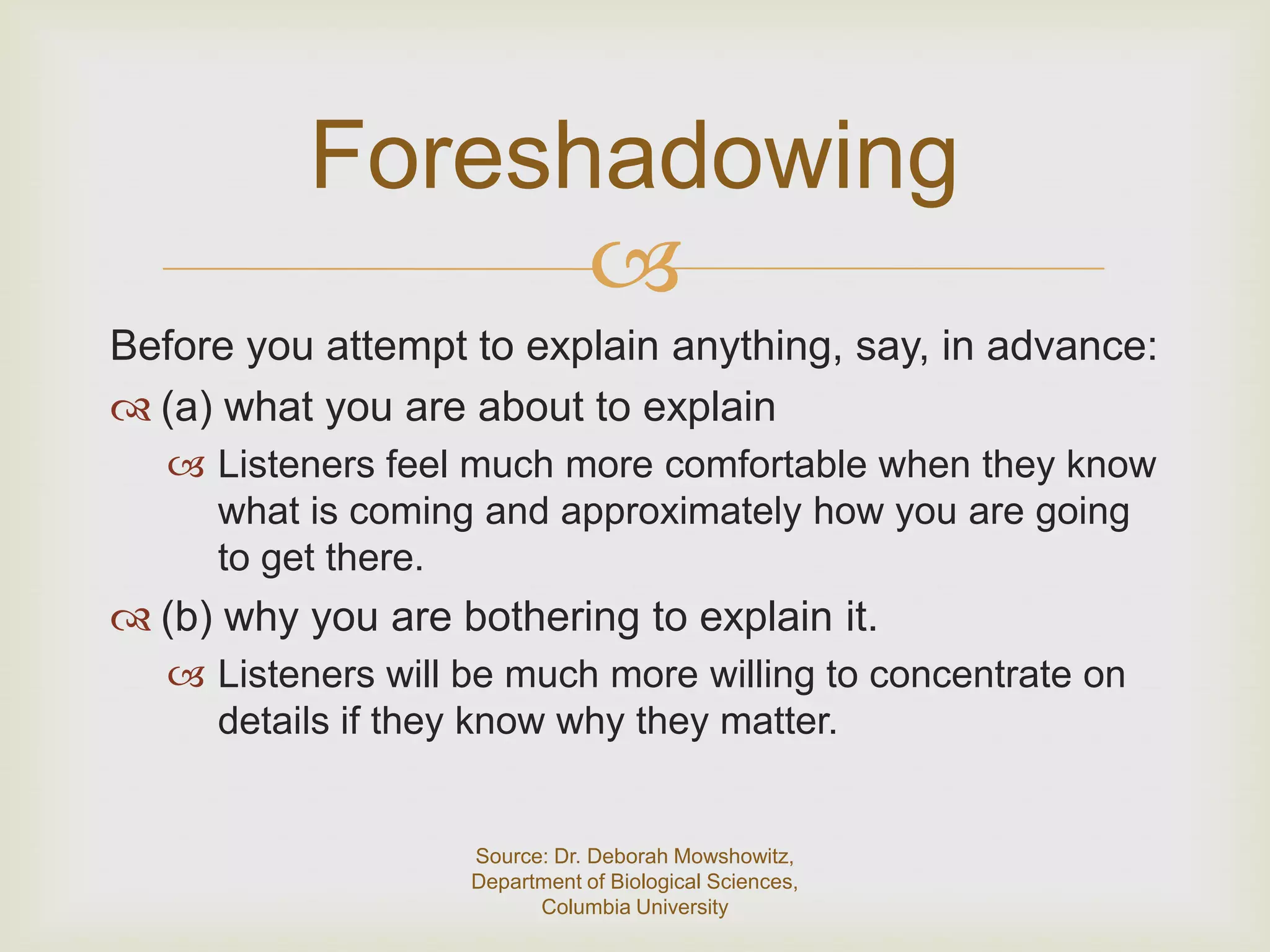
Before you attempt to explain anything, say, in advance:
 (a) what you are about to explain
    Listeners feel much more comfortable when they know
     what is coming and approximately how you are going
     to get there.
 (b) why you are bothering to explain it.
    Listeners will be much more willing to concentrate on
     details if they know why they matter.


                    Source: Dr. Deborah Mowshowitz,
                    Department of Biological Sciences,
                          Columbia University
Foreshadowing
                
 Example
 First you say “Let me explain how to get to Brooklyn
  – it will take 3 trains.”
 Then explain: Why do we want to go to Brooklyn in
  the first place? Why go now?
 Then you go into the details of which you take first,
  where you transfer, etc.


                   Source: Dr. Deborah Mowshowitz
Logical Connectors
              
 Logical connectors are used to signal the relationship
  between what you are about to say and what you
  have already said.
    They are also known as transition words.
Logical Connectors
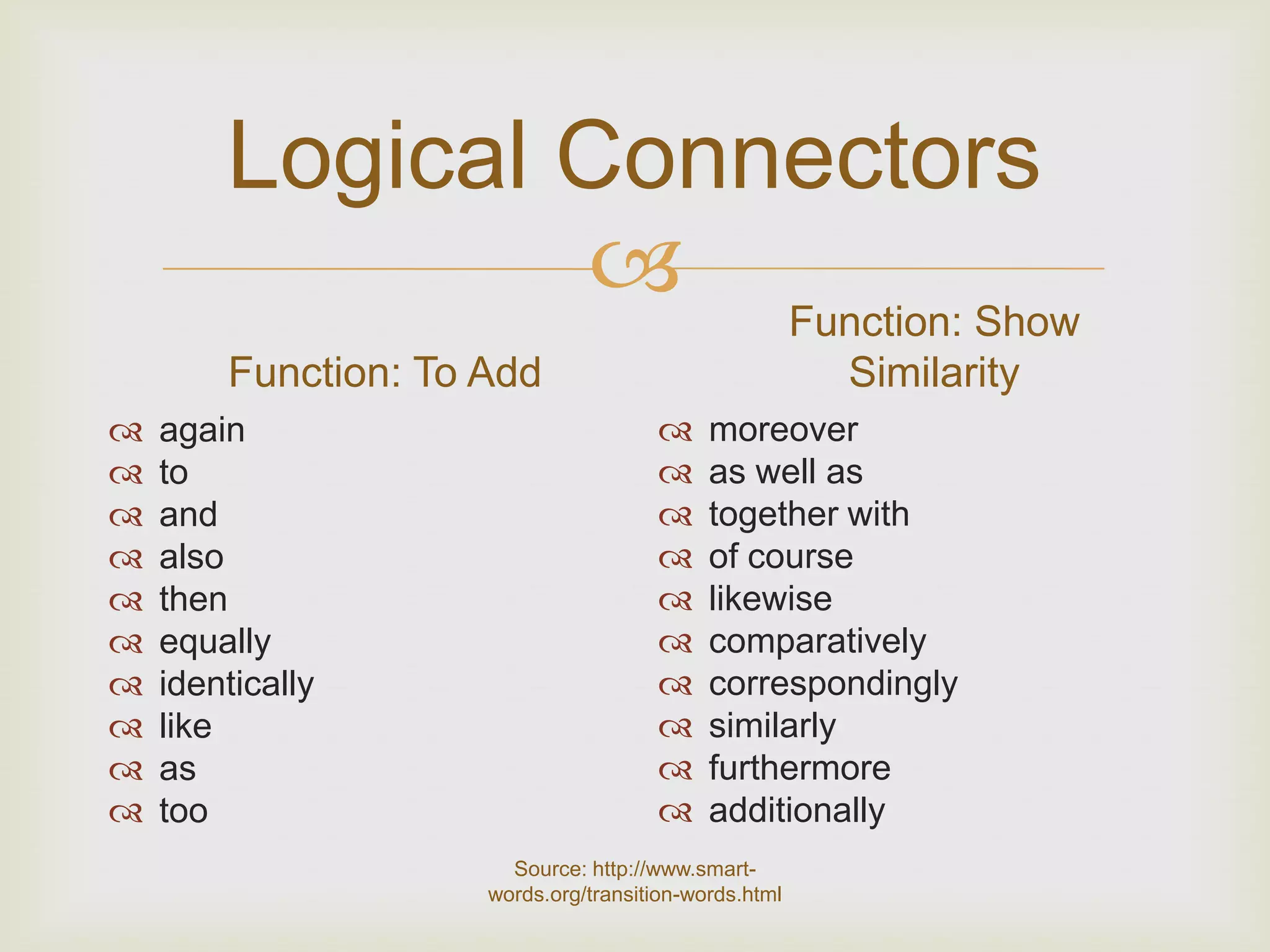
                 Function: Show
        Function: To Add                               Similarity
   again                                  moreover
   to                                     as well as
   and                                    together with
   also                                   of course
   then                                   likewise
   equally                                comparatively
   identically                            correspondingly
   like                                   similarly
   as                                     furthermore
   too                                    additionally
                       Source: http://www.smart-
                     words.org/transition-words.html
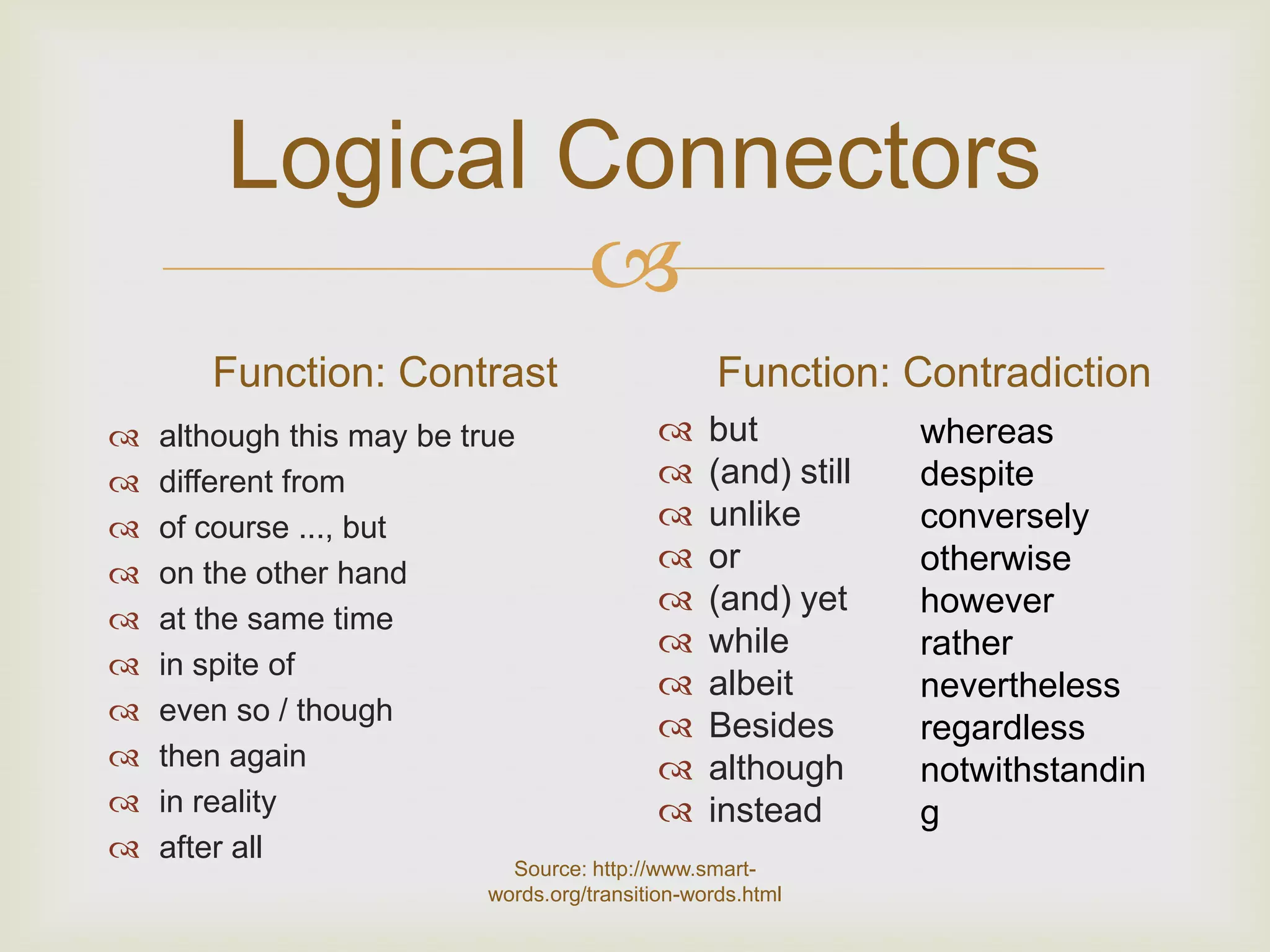
Logical Connectors
                
       Function: Contrast                          Function: Contradiction
   although this may be true                    but           whereas
   different from                               (and) still   despite
   of course ..., but                           unlike        conversely
   on the other hand                            or            otherwise
                                                 (and) yet     however
   at the same time
                                                 while         rather
   in spite of
                                                 albeit        nevertheless
   even so / though
                                                 Besides       regardless
   then again                                   although      notwithstandin
   in reality                                   instead       g
   after all
                             Source: http://www.smart-
                           words.org/transition-words.html
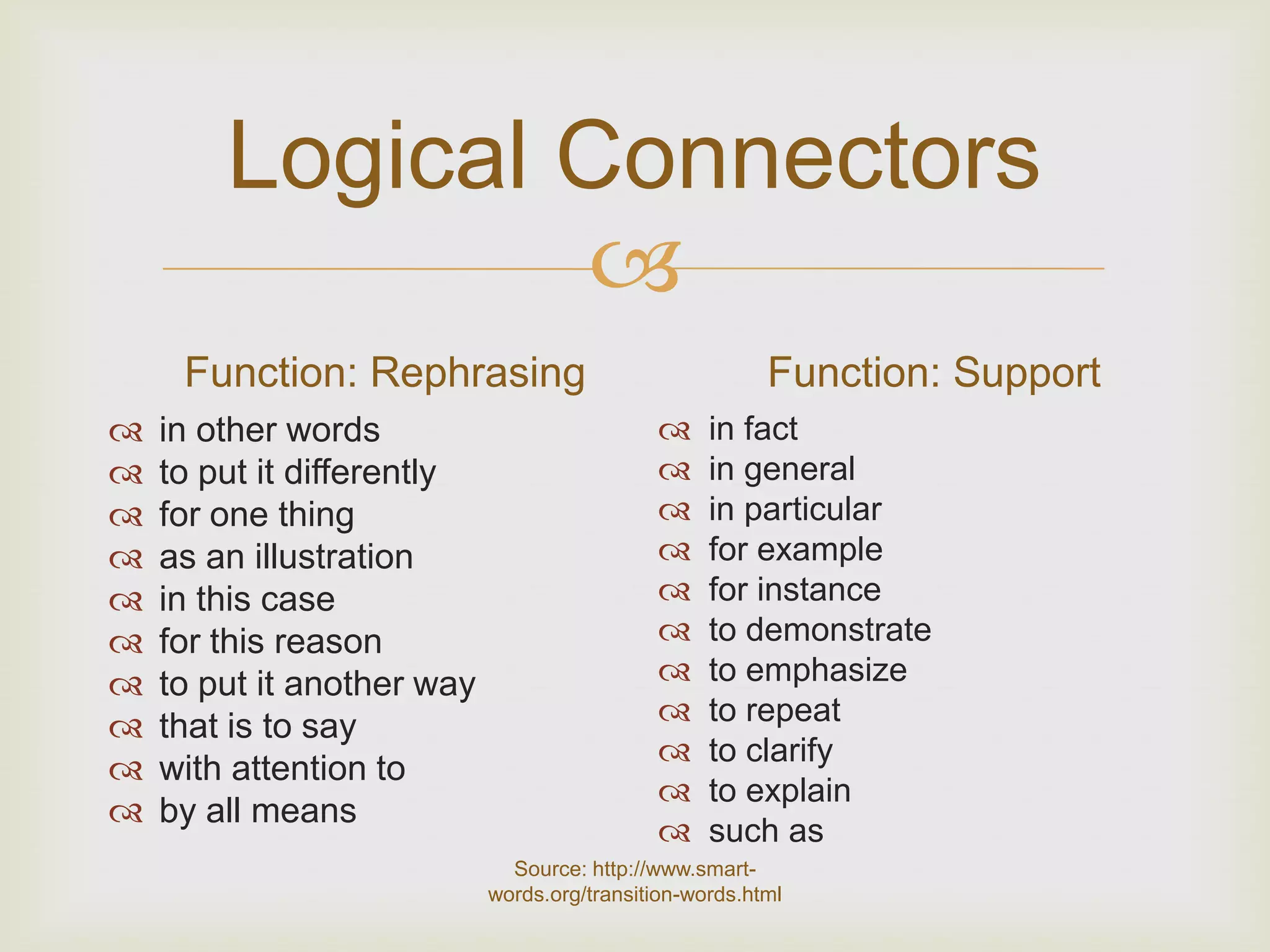
Logical Connectors
                
     Function: Rephrasing                                Function: Support
   in other words                                in fact
   to put it differently                         in general
   for one thing                                 in particular
   as an illustration                            for example
   in this case                                  for instance
   for this reason                               to demonstrate
   to put it another way                         to emphasize
   that is to say                                to repeat
                                                  to clarify
   with attention to
                                                  to explain
   by all means
                                                  such as
                              Source: http://www.smart-
                            words.org/transition-words.html
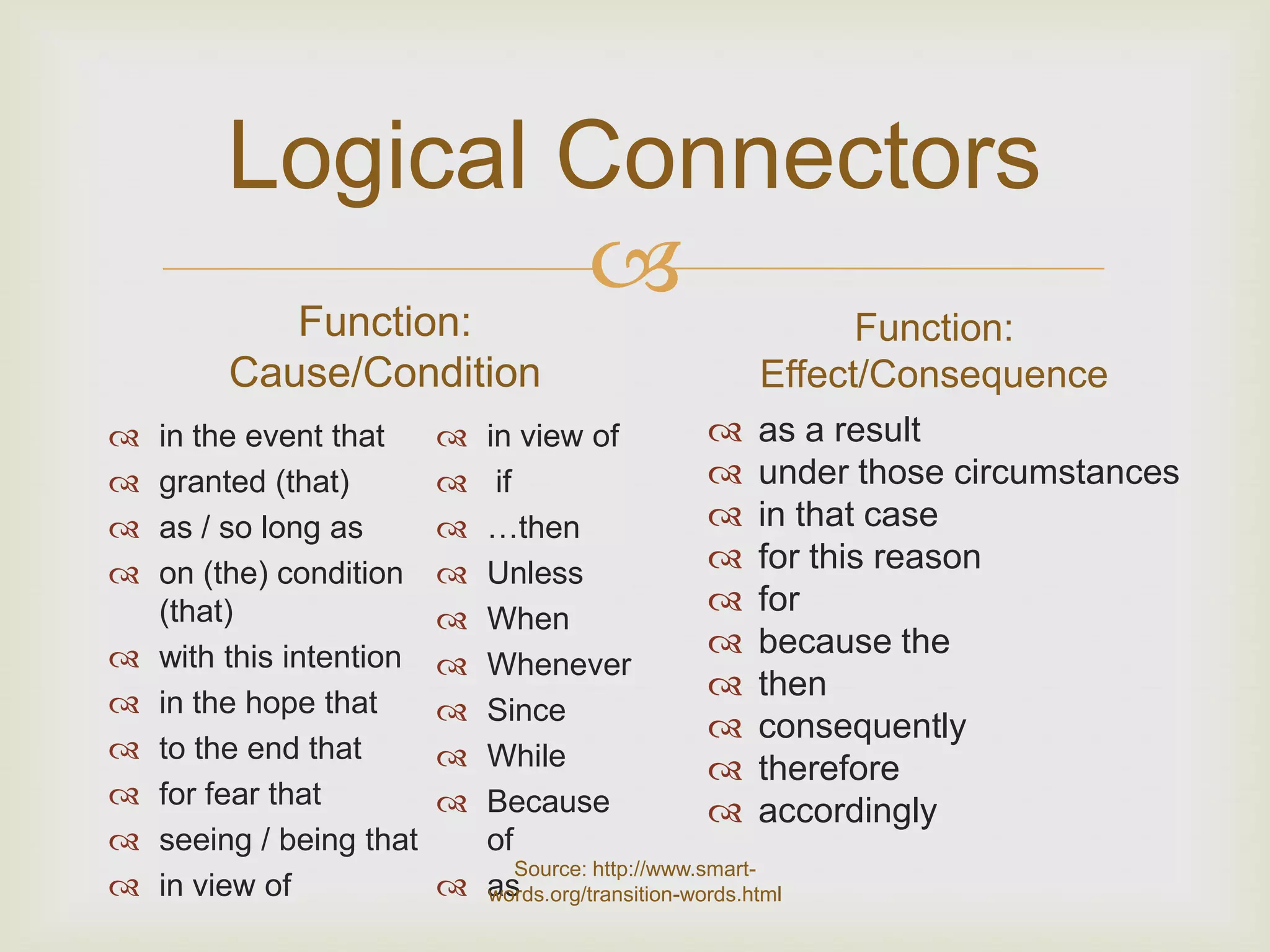
Logical Connectors
         Function:
                   
                                                       Function:
         Cause/Condition                         Effect/Consequence
   in the event that      in view of               as a result
   granted (that)          if                      under those circumstances
   as / so long as        …then                    in that case
   on (the) condition     Unless                   for this reason
    (that)                                           for
                           When
   with this intention                              because the
                           Whenever
                                                     then
   in the hope that       Since
                                                     consequently
   to the end that        While                    therefore
   for fear that          Because                  accordingly
   seeing / being that     of
                                Source: http://www.smart-
   in view of             as
                            words.org/transition-words.html
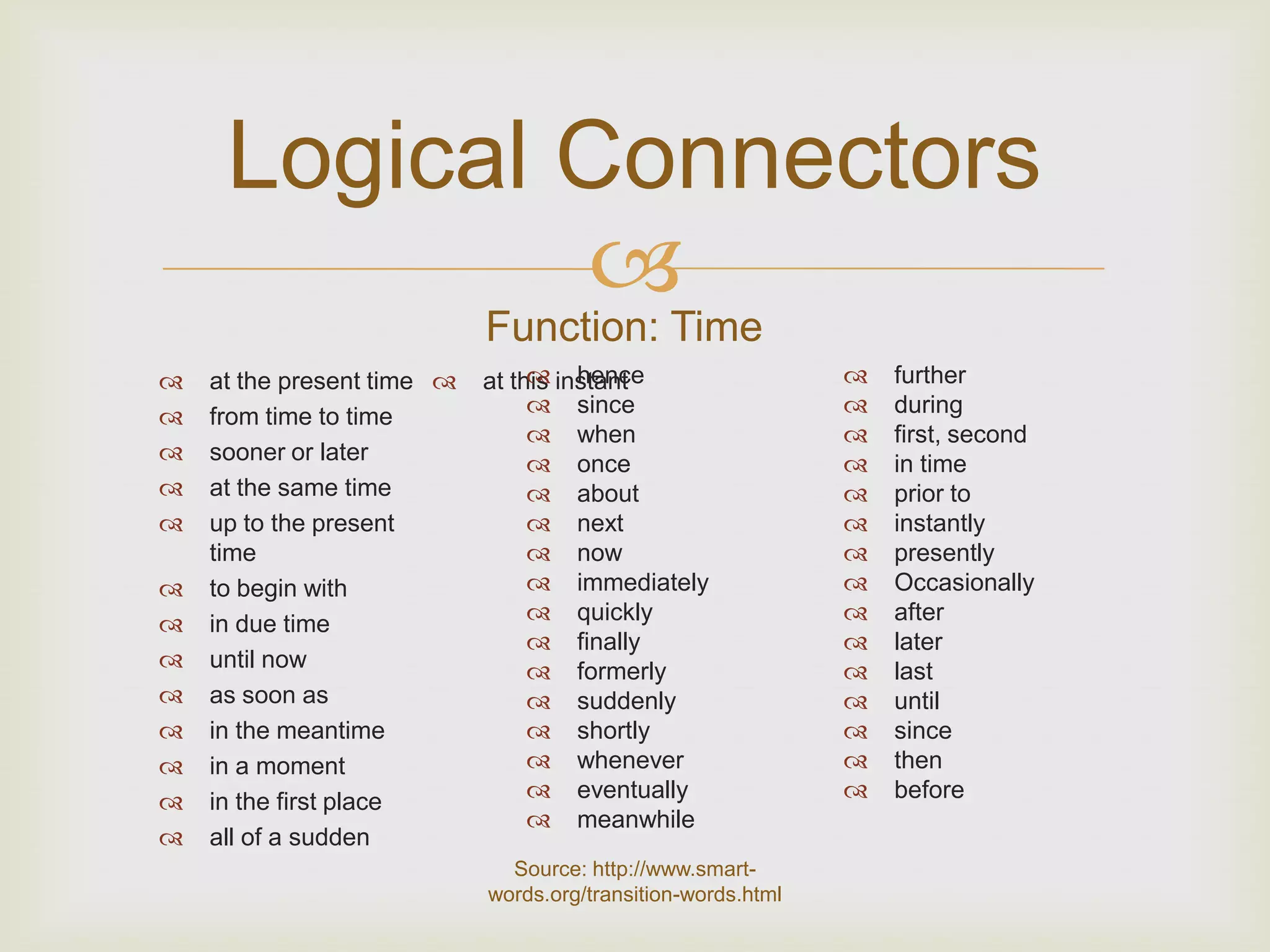
Logical Connectors
             
                            Function: Time
   at the present time          hence
                            at this instant                      further
   from time to time             since                         during
                                  when                          first, second
   sooner or later               once                          in time
   at the same time              about                         prior to
   up to the present             next                          instantly
    time                          now                           presently
   to begin with                 immediately                   Occasionally
   in due time                   quickly                       after
                                  finally                       later
   until now                     formerly                      last
   as soon as                    suddenly                      until
   in the meantime               shortly                       since
   in a moment                   whenever                      then
   in the first place            eventually                    before
                                  meanwhile
   all of a sudden
                              Source: http://www.smart-
                            words.org/transition-words.html
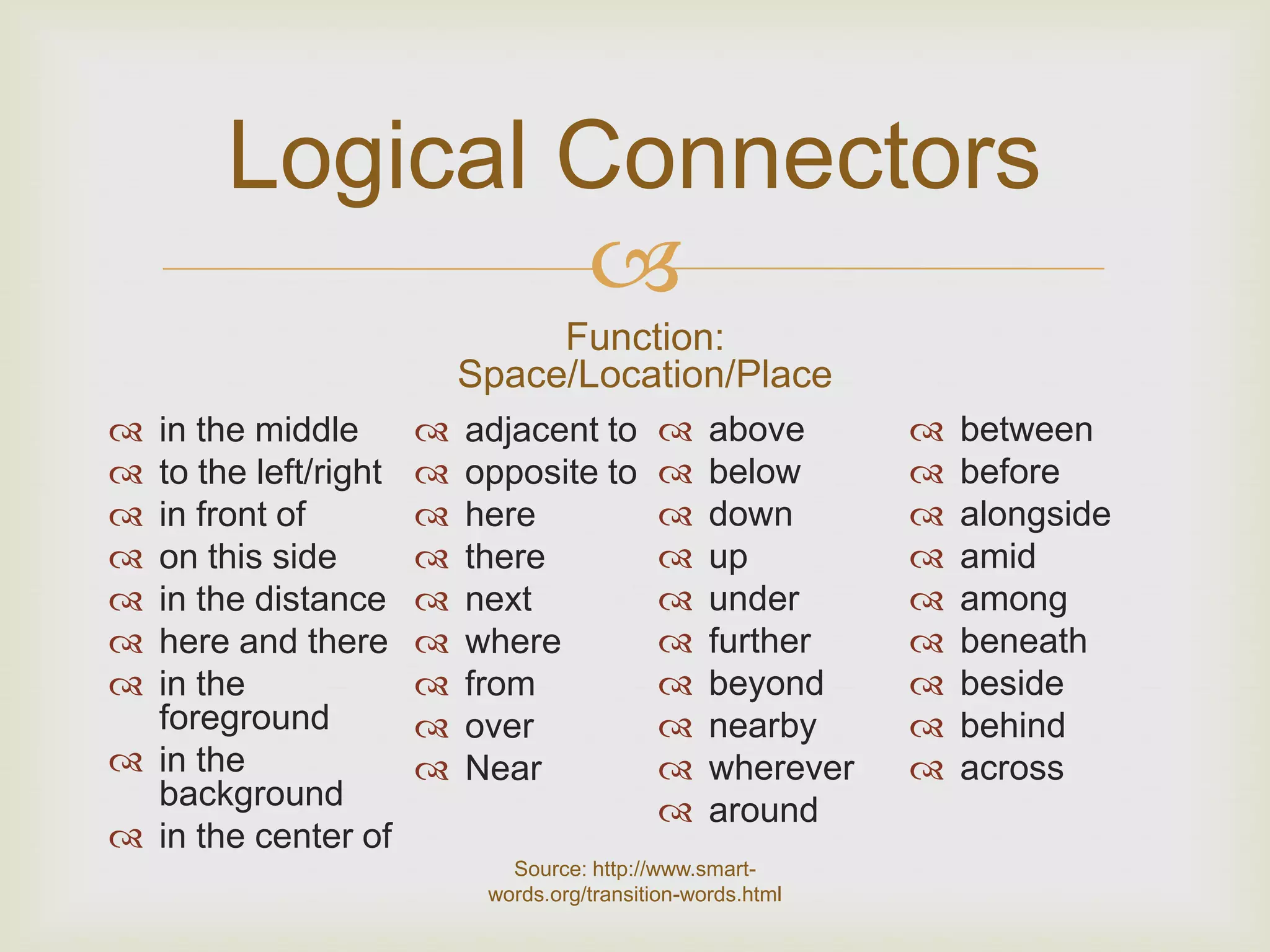
Logical Connectors
               
                               Function:
                          Space/Location/Place
 in the middle          adjacent to            above         between
 to the left/right      opposite to            below         before
 in front of            here                   down          alongside
 on this side           there                  up            amid
 in the distance        next                   under         among
 here and there         where                  further       beneath
 in the                 from                   beyond        beside
  foreground             over                   nearby        behind
 in the                 Near                   wherever      across
  background                                     around
 in the center of
                             Source: http://www.smart-
                           words.org/transition-words.html
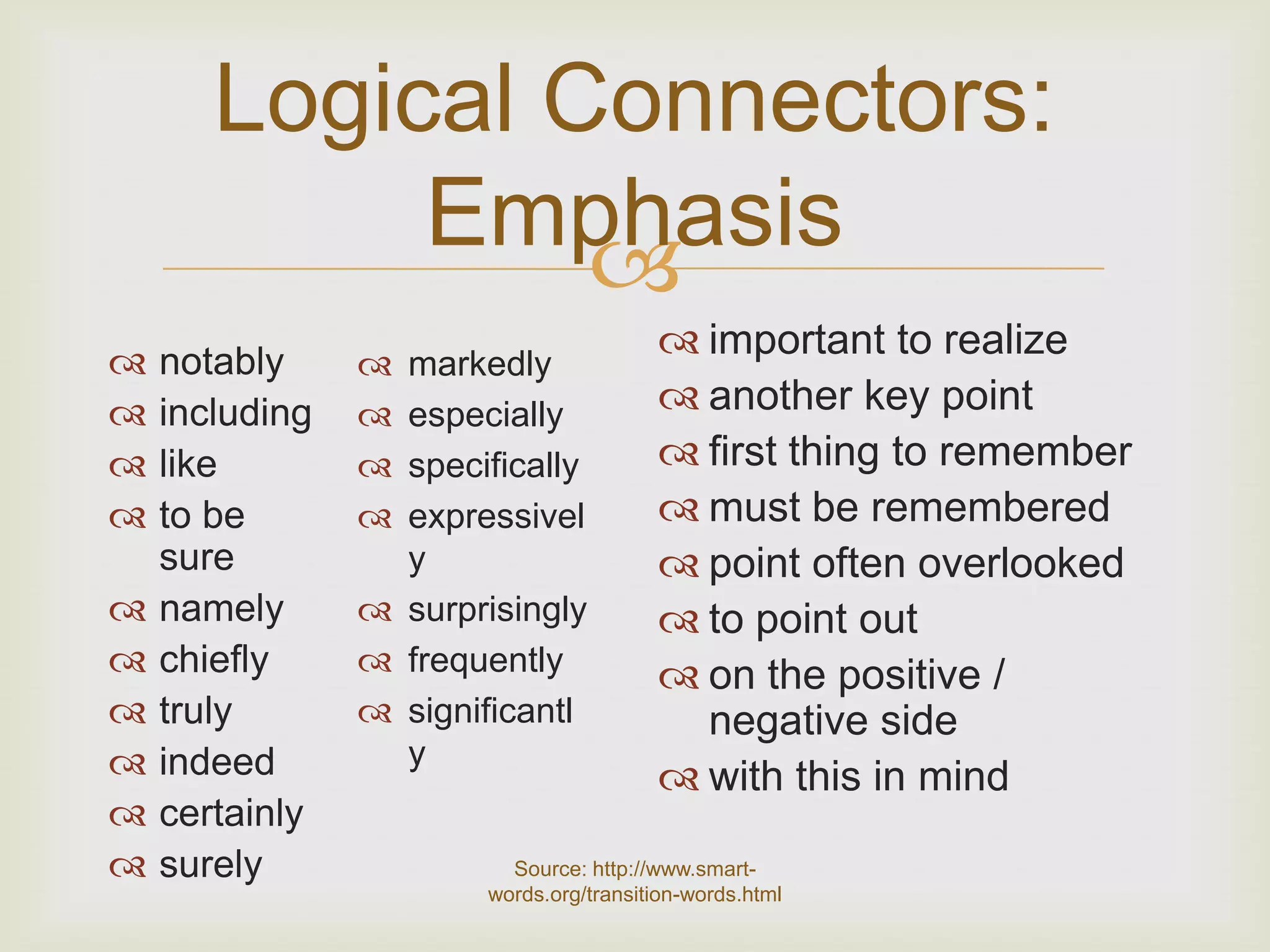
Logical Connectors:
            Emphasis
                

                                         important to realize
    notably      markedly
   including    especially             another key point
   like         specifically           first thing to remember
   to be        expressivel            must be remembered
    sure          y                      point often overlooked
   namely       surprisingly           to point out
   chiefly      frequently             on the positive /
   truly        significantl            negative side
   indeed        y
                                         with this in mind
   certainly
   surely               Source: http://www.smart-
                       words.org/transition-words.html
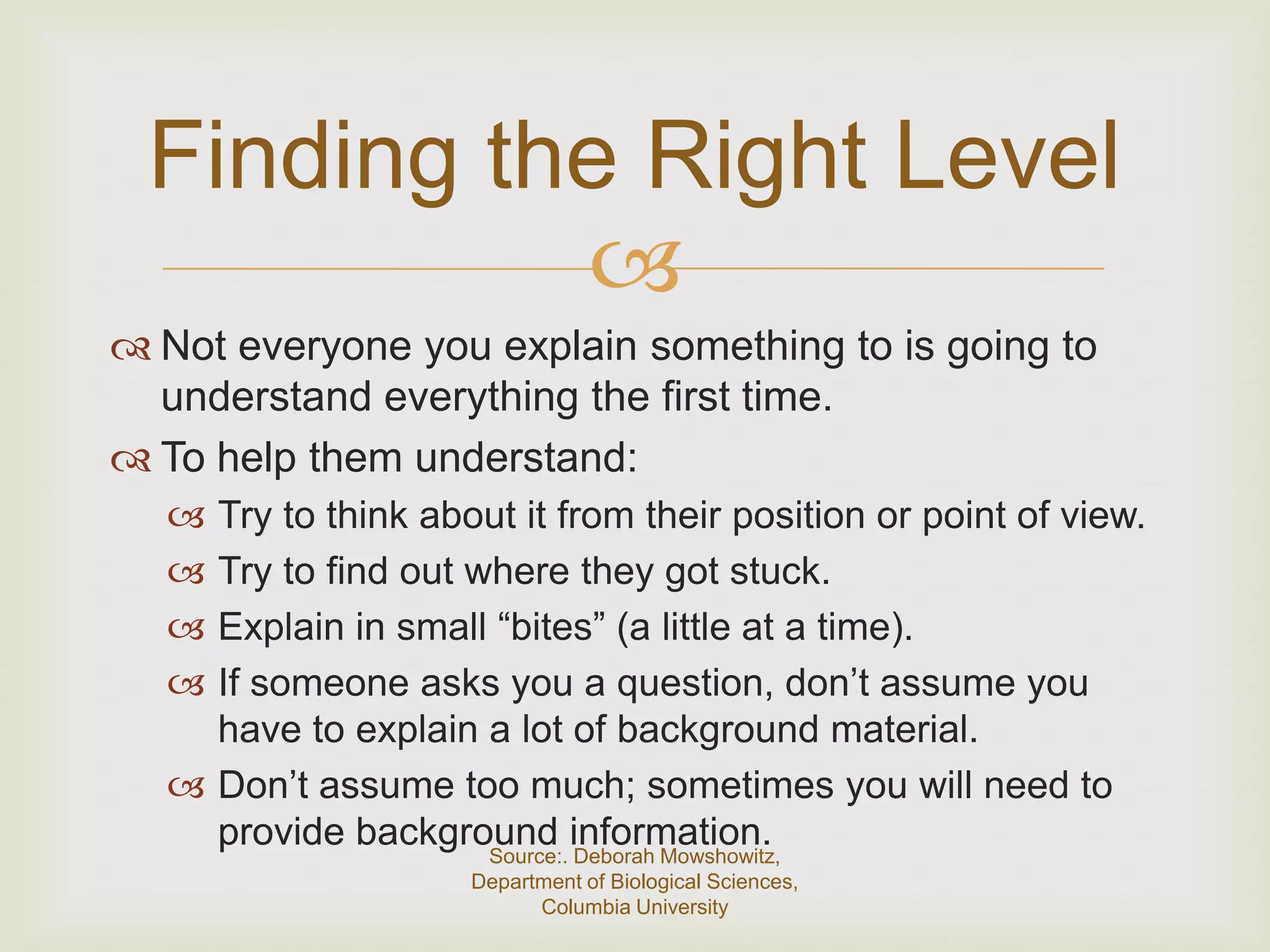
Finding the Right Level
           
 Not everyone you explain something to is going to
  understand everything the first time.
 To help them understand:
   Try to think about it from their position or point of view.
   Try to find out where they got stuck.
   Explain in small “bites” (a little at a time).
   If someone asks you a question, don’t assume you
    have to explain a lot of background material.
   Don’t assume too much; sometimes you will need to
    provide background information.
                     Source:. Deborah Mowshowitz,
                    Department of Biological Sciences,
                          Columbia University
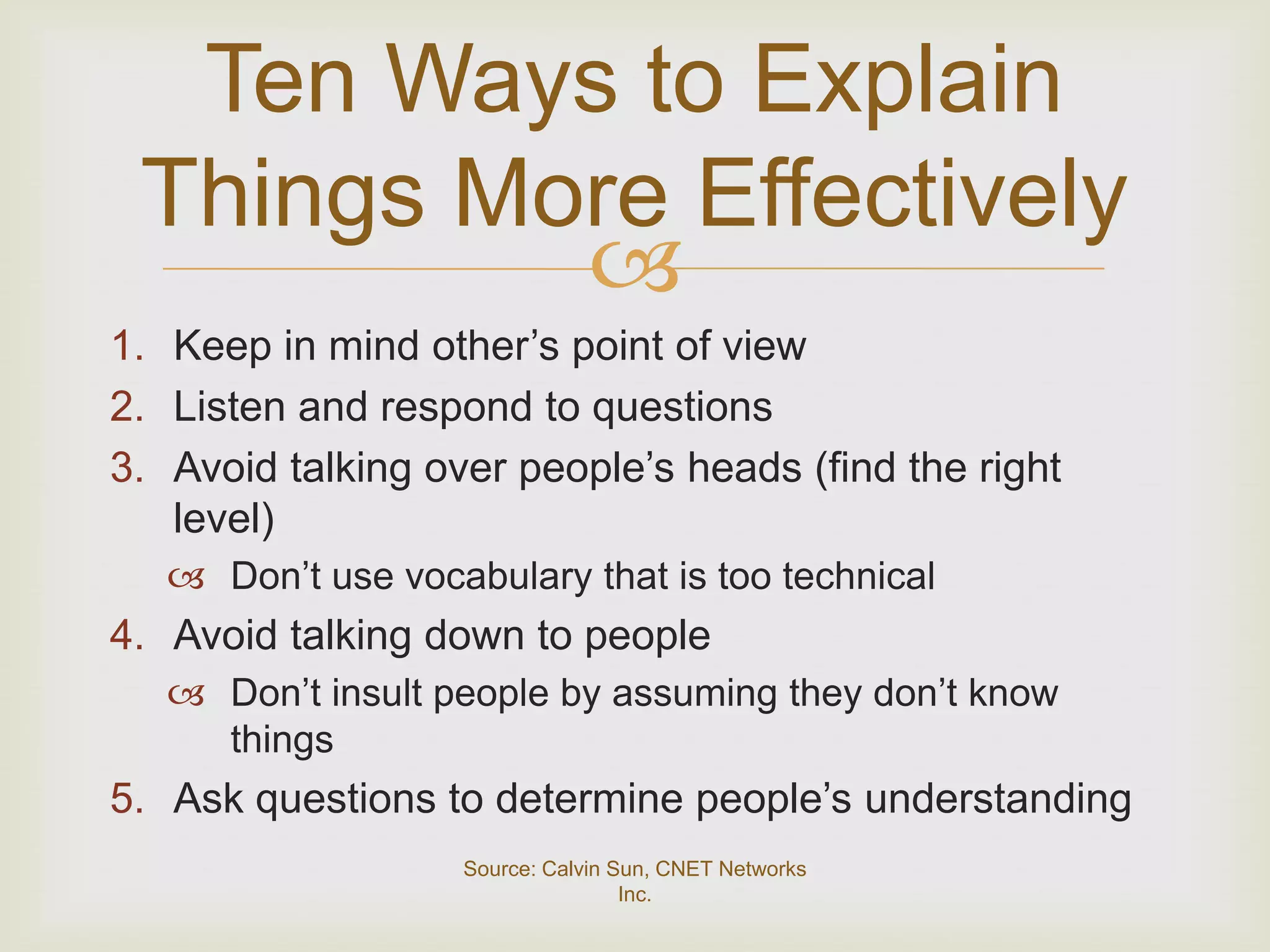
Ten Ways to Explain
 Things More Effectively
          
1. Keep in mind other’s point of view
2. Listen and respond to questions
3. Avoid talking over people’s heads (find the right
   level)
    Don’t use vocabulary that is too technical
4. Avoid talking down to people
    Don’t insult people by assuming they don’t know
     things
5. Ask questions to determine people’s understanding
                   Source: Calvin Sun, CNET Networks
                                   Inc.
Ten Ways to Explain
 Things More Effectively
          
6. Focus on benefits, not features.
    Features are inherent properties of objects.
    Benefits are ways features help a person
7. Use analogies to make concepts clearer
    Analogy is explaining an unfamiliar concept using a
     familiar one.
8. Compare new concepts to familiar ones.
9. Use the concepts of subsets and supersets.
    Ex. Brooklyn is a subset of NYC, because all of it is in
     NYC.
10. Confirm that your explanation makes sense.
                   Source: Calvin Sun, CNET Networks,
                              Inc.
Time to Practice
                
 Please explain to me the relationship between
  humans and their pets.
 Please explain to me what “the early bird gets the
  worm” means.
 Please explain the difference between fear and
  respect to me.
 Please explain the process of buying a plane ticket to
  me.
 Please explain what each color on your flag
  represents.
 Please explain the main idea of a book you are

How to explain

  • 1.
    American Culture andPragmatics Spring 2012 Ms. Candice Quiñones
  • 2.
    Overview   Definitions  How to Explain  Finding the Right Level  Ten Ways to Explain Things More Effectively
  • 3.
    Definition ex·plain   verb (used with object) 1. to make plain or clear; render understandable or intelligible: to explain an obscure point. 2. to make known in detail: to explain how to do something. 3. to assign a meaning to; interpret: How can you explain such a silly remark? 4. to make clear the cause or reason of; account for: I cannot explain his strange behavior.  verb (used without object) 5. to give an explanation. Source: Dictionary.com
  • 4.
    Definition ex·pla·na·tion   noun 1. the act or process of explaining. 2. something that explains; a statement made to clarify something and make it understandable; exposition: a) an explanation of a poem. 3. a meaning or interpretation: a) to find an explanation for a mystery. 4. a mutual declaration of the meaning of words spoken, actions, motives, etc., with a view to adjusting a misunderstanding or reconciling differences: a) After a long and emotional explanation they were friends again. Source: Dictionary.com
  • 5.
    How To Explain   When we explain, our goal is to make things clear.  In order to do this, we need several “tools” in our verbal “toolbox”.  Clarity  Details  Reasons  Honesty  Foreshadowing  Logical connectors  Finding the right level
  • 6.
    Clarity   Being clear about what you are talking about.  Give details: where, when, who, what, when, and how.  Instead of saying: It is there. -say- The book is on the desk. (what) (where)
  • 7.
    Clarity   Avoid pronouns and use nouns instead.  Answer the question “who?” or “what?”  A noun is a name for a person, place, thing or idea.  Ex. University, Grape Street, girlfriend, compassion, etc.  A pronoun is a word used to substitute for a noun.  Ex. He, she,Source: Dr. Deborah Mowshowitz, it, they, we, me, him, her, us, them, Department of Biological Sciences, etc. Columbia University
  • 8.
    Clarity   Use active, descriptive verbs instead of passive, boring ones.  Answer the question “how?”  Note: “be” is a passive verb  Instead of saying: We went there. -say- My family and I drove to the Lehigh Valley Mall.
  • 9.
    Clarity   So remember, to be clear:  Give details  Use nouns, not pronouns  Use descriptive verbs
  • 10.
    Reasons   When you explain, it is important to give the reasons behind your thoughts or actions.  Answer the question “why?”  Instead of saying: I’m leaving. -say- I’m leaving now so I can catch my bus on time.
  • 11.
    Reasons  When giving reasons it is important to be honest.  If you don’t know how to explain something, it is okay to say “I don’t know.”  It is usually better to be honest about your reasons for something than to lie.  If you lie, the reasons you invent may not make sense.  If you lie, you may forget the reasons you gave and the person will find out later (and may be hurt or angry).
  • 12.
    Foreshadowing  Before you attempt to explain anything, say, in advance:  (a) what you are about to explain  Listeners feel much more comfortable when they know what is coming and approximately how you are going to get there.  (b) why you are bothering to explain it.  Listeners will be much more willing to concentrate on details if they know why they matter. Source: Dr. Deborah Mowshowitz, Department of Biological Sciences, Columbia University
  • 13.
    Foreshadowing   Example  First you say “Let me explain how to get to Brooklyn – it will take 3 trains.”  Then explain: Why do we want to go to Brooklyn in the first place? Why go now?  Then you go into the details of which you take first, where you transfer, etc. Source: Dr. Deborah Mowshowitz
  • 14.
    Logical Connectors   Logical connectors are used to signal the relationship between what you are about to say and what you have already said.  They are also known as transition words.
  • 15.
    Logical Connectors  Function: Show Function: To Add Similarity  again  moreover  to  as well as  and  together with  also  of course  then  likewise  equally  comparatively  identically  correspondingly  like  similarly  as  furthermore  too  additionally Source: http://www.smart- words.org/transition-words.html
  • 16.
    Logical Connectors  Function: Contrast Function: Contradiction  although this may be true  but whereas  different from  (and) still despite  of course ..., but  unlike conversely  on the other hand  or otherwise  (and) yet however  at the same time  while rather  in spite of  albeit nevertheless  even so / though  Besides regardless  then again  although notwithstandin  in reality  instead g  after all Source: http://www.smart- words.org/transition-words.html
  • 17.
    Logical Connectors  Function: Rephrasing Function: Support  in other words  in fact  to put it differently  in general  for one thing  in particular  as an illustration  for example  in this case  for instance  for this reason  to demonstrate  to put it another way  to emphasize  that is to say  to repeat  to clarify  with attention to  to explain  by all means  such as Source: http://www.smart- words.org/transition-words.html
  • 18.
    Logical Connectors Function:  Function: Cause/Condition Effect/Consequence  in the event that  in view of  as a result  granted (that)  if  under those circumstances  as / so long as  …then  in that case  on (the) condition  Unless  for this reason (that)  for  When  with this intention  because the  Whenever  then  in the hope that  Since  consequently  to the end that  While  therefore  for fear that  Because  accordingly  seeing / being that of Source: http://www.smart-  in view of  as words.org/transition-words.html
  • 19.
    Logical Connectors  Function: Time  at the present time   hence at this instant  further  from time to time  since  during  when  first, second  sooner or later  once  in time  at the same time  about  prior to  up to the present  next  instantly time  now  presently  to begin with  immediately  Occasionally  in due time  quickly  after  finally  later  until now  formerly  last  as soon as  suddenly  until  in the meantime  shortly  since  in a moment  whenever  then  in the first place  eventually  before  meanwhile  all of a sudden Source: http://www.smart- words.org/transition-words.html
  • 20.
    Logical Connectors  Function: Space/Location/Place  in the middle  adjacent to  above  between  to the left/right  opposite to  below  before  in front of  here  down  alongside  on this side  there  up  amid  in the distance  next  under  among  here and there  where  further  beneath  in the  from  beyond  beside foreground  over  nearby  behind  in the  Near  wherever  across background  around  in the center of Source: http://www.smart- words.org/transition-words.html
  • 21.
    Logical Connectors: Emphasis    important to realize notably  markedly  including  especially  another key point  like  specifically  first thing to remember  to be  expressivel  must be remembered sure y  point often overlooked  namely  surprisingly  to point out  chiefly  frequently  on the positive /  truly  significantl negative side  indeed y  with this in mind  certainly  surely Source: http://www.smart- words.org/transition-words.html
  • 22.
    Finding the RightLevel   Not everyone you explain something to is going to understand everything the first time.  To help them understand:  Try to think about it from their position or point of view.  Try to find out where they got stuck.  Explain in small “bites” (a little at a time).  If someone asks you a question, don’t assume you have to explain a lot of background material.  Don’t assume too much; sometimes you will need to provide background information. Source:. Deborah Mowshowitz, Department of Biological Sciences, Columbia University
  • 23.
    Ten Ways toExplain Things More Effectively  1. Keep in mind other’s point of view 2. Listen and respond to questions 3. Avoid talking over people’s heads (find the right level)  Don’t use vocabulary that is too technical 4. Avoid talking down to people  Don’t insult people by assuming they don’t know things 5. Ask questions to determine people’s understanding Source: Calvin Sun, CNET Networks Inc.
  • 24.
    Ten Ways toExplain Things More Effectively  6. Focus on benefits, not features.  Features are inherent properties of objects.  Benefits are ways features help a person 7. Use analogies to make concepts clearer  Analogy is explaining an unfamiliar concept using a familiar one. 8. Compare new concepts to familiar ones. 9. Use the concepts of subsets and supersets.  Ex. Brooklyn is a subset of NYC, because all of it is in NYC. 10. Confirm that your explanation makes sense. Source: Calvin Sun, CNET Networks, Inc.
  • 25.
    Time to Practice   Please explain to me the relationship between humans and their pets.  Please explain to me what “the early bird gets the worm” means.  Please explain the difference between fear and respect to me.  Please explain the process of buying a plane ticket to me.  Please explain what each color on your flag represents.  Please explain the main idea of a book you are