
Professor Paul Mapfumo
Soil Fertility Consortium for Southern Africa (SOFECSA)
&
Department of Soil Science & Agricultural Engineering
UNIVERSITY OF ZIMBABWE


  University	
  of	
  Zimbabwe
–™ Africa is a food deficit global zone but economies
remain primarily hinged on agriculture (includes
forestry and fisheries)
™ Crop and livestock production and natural
ecosystems are intricately inter-dependent (but
declining & challenging institutional and policy norms)
™ Communities responding to multiple stress factors
plus climate change and climate variability
Introduction: Africa’s climate dependent
production & livelihood systems


  University	
  of	
  Zimbabwe
–™ What does this imply:
–  Increased external inputs (fertilizers, chemicals,
mechanization: how different from agricultural
growth pathways of the past e.g. in Europe & Asia)
–  Accelerated deforestation, loss of grasslands to
cropping, encroachment into fragile ecosystems and
broad scale natural resources depletion
–  Increased emissions and less carbon sinks???
–  How have farmers responded and do they perceive a
scope for alternative growth pathways
Introduction: Africa requires
accelerated agricultural growth


  University	
  of	
  Zimbabwe
–™ New paradigms in the architectural (structural and functional)
designs of crop and livestock production systems
™ New regimes of ecosystems services
™ Socio-ecological transformations providing win-win-win agro-
ecological systems (agricultural intensification-sustainable
natural resources management - diversified livelihood options)
™ Need to expand opportunity horizons for enhanced adaptive
capacity and livelihood benefits beyond farms (e.g.
communities living beyond the reach of markets, limiting scope
for science, technology assimilation and innovation
Increasing calls for more productive,
efficient and resilient farming systems


  University	
  of	
  Zimbabwe
–™  Consider core CSA elements (FAO): increasing productivity;
resilience (adaptation), greenhouse gases mitigation, and enhanced
achievement of national food security and development goals
™  Conservation Agriculture (CA) -based technologies
™  Integrated Soil Fertility Management (ISFM)- based technologies
™  Agroforestry-based technologies (fertilizer trees)
™  Community Based Natural Resource Management (CBNRM)
™  How can these be adapted and integrated into farming systems
to yield greater benefits (SOFECSA’s emerging concept of
Learning Centres)
Responding through CSA:
What is on the ground?


  University	
  of	
  Zimbabwe
–
Demand for CSA: Do farmers perceive
a changing climate?
™ Shortening rainfall seasons: late start and/or early end of the
season
™ Increasing number of hot days in a season
™ Worsening within season rainfall distribution
™ Farmers relying more on indigenous knowledge for
agricultural decision-making but indicators often also
climate sensitive
™ Poor access to climate information presents a major
challenge for adaptation
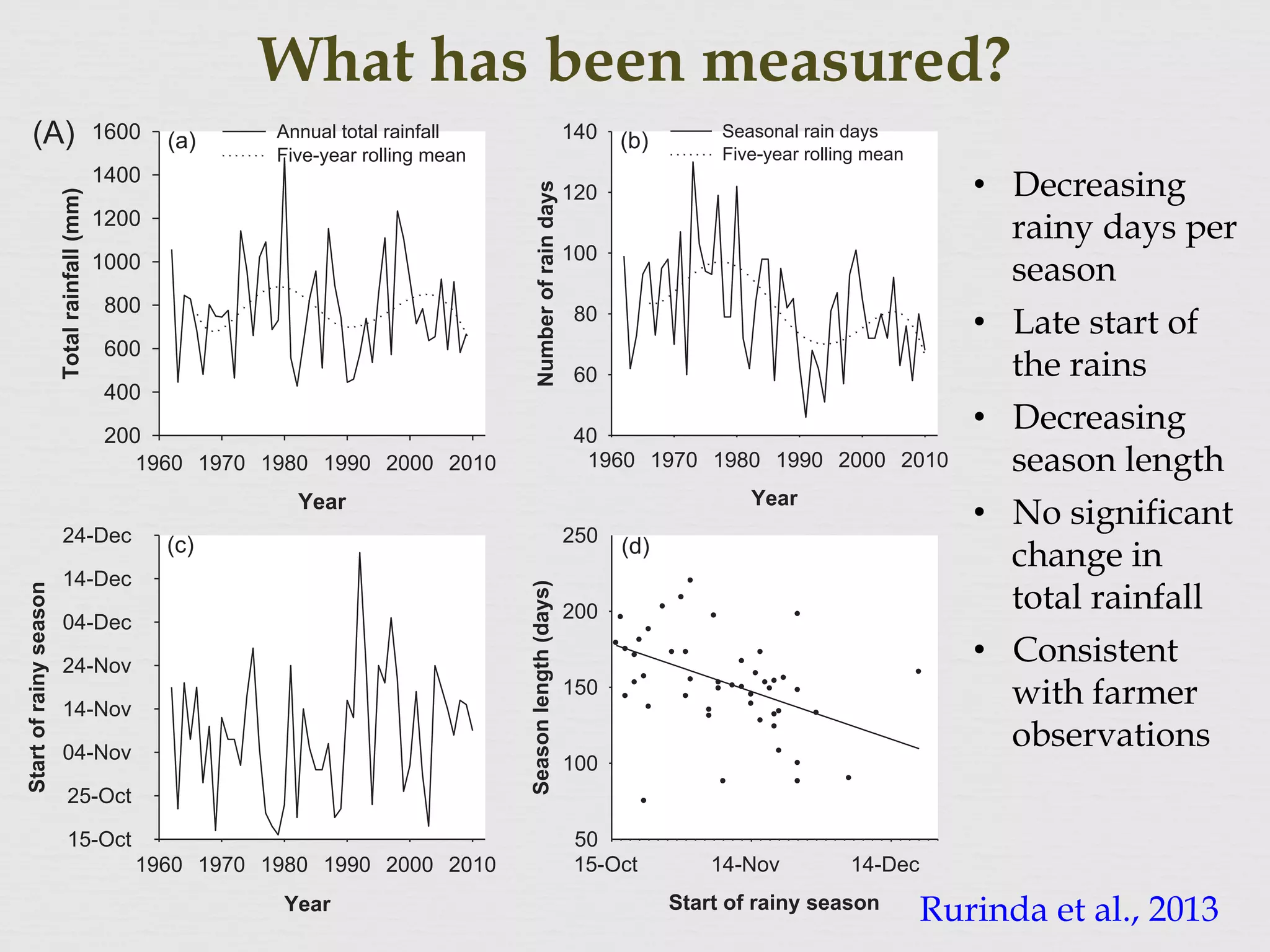
What has been measured?
ARTICLE IN PRESSes15
J. Rurinda et al. / Field Crops Research xxx (2013) xxx–xxx 7
Year
1960 1970 1980 1990 2000 2010
Startofrainyseason
15-Oct
25-Oct
04-Nov
14-Nov
24-Nov
04-Dec
14-Dec
24-Dec
Year
1960 1970 1980 1990 2000 2010
Numberofraindays
40
60
80
100
120
140 Seasonal rain days
Five-year rolling mean
(b)
Year
1960 1970 1980 1990 2000 2010
Totalrainfall(mm)
200
400
600
800
1000
1200
1400
1600 Annual total rainfall
Five-year rolling mean
(a)
Start of rainy season
15-Oct 14-Nov 14-Dec
Seasonlength(days)
50
100
150
200
250
(d)(c)
(A)
•  Decreasing
rainy days per
season
•  Late start of
the rains
•  Decreasing
season length
•  No significant
change in
total rainfall
•  Consistent
with farmer
observations
Rurinda et al., 2013
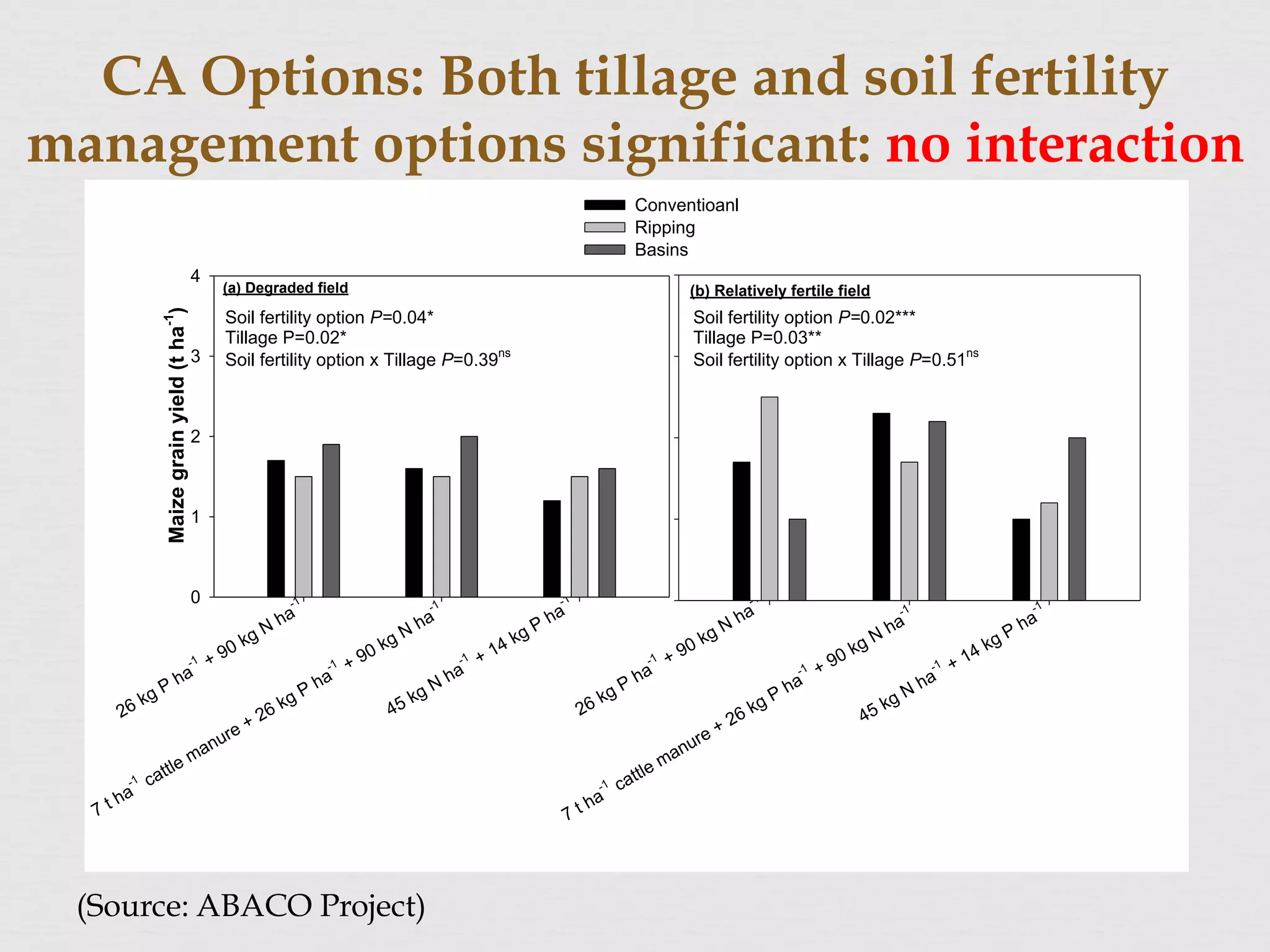
CA Options: Both tillage and soil fertility
management options significant: no interaction
26 kg P ha
-1 + 90 kg N
ha
-1
7 t ha
-1 cattle manure + 26 kg P ha
-1 + 90 kg N
ha
-1
45 kg N
ha
-1 + 14 kg P ha
-1
26 kg P ha
-1 + 90 kg N
ha
-1
7 t ha
-1 cattle manure + 26 kg P ha
-1 + 90 kg N
ha
-1
45 kg N
ha
-1 + 14 kg P ha
-1
(a) Degraded field
Maizegrainyield(tha-1
)
0
1
2
3
4
(b) Relatively fertile field
Conventioanl
Ripping
Basins
Soil fertility option P=0.04*
Tillage P=0.02*
Soil fertility option x Tillage P=0.39ns
Soil fertility option P=0.02***
Tillage P=0.03**
Soil fertility option x Tillage P=0.51ns
!
(Source: ABACO Project)


  University	
  of	
  Zimbabwe
–
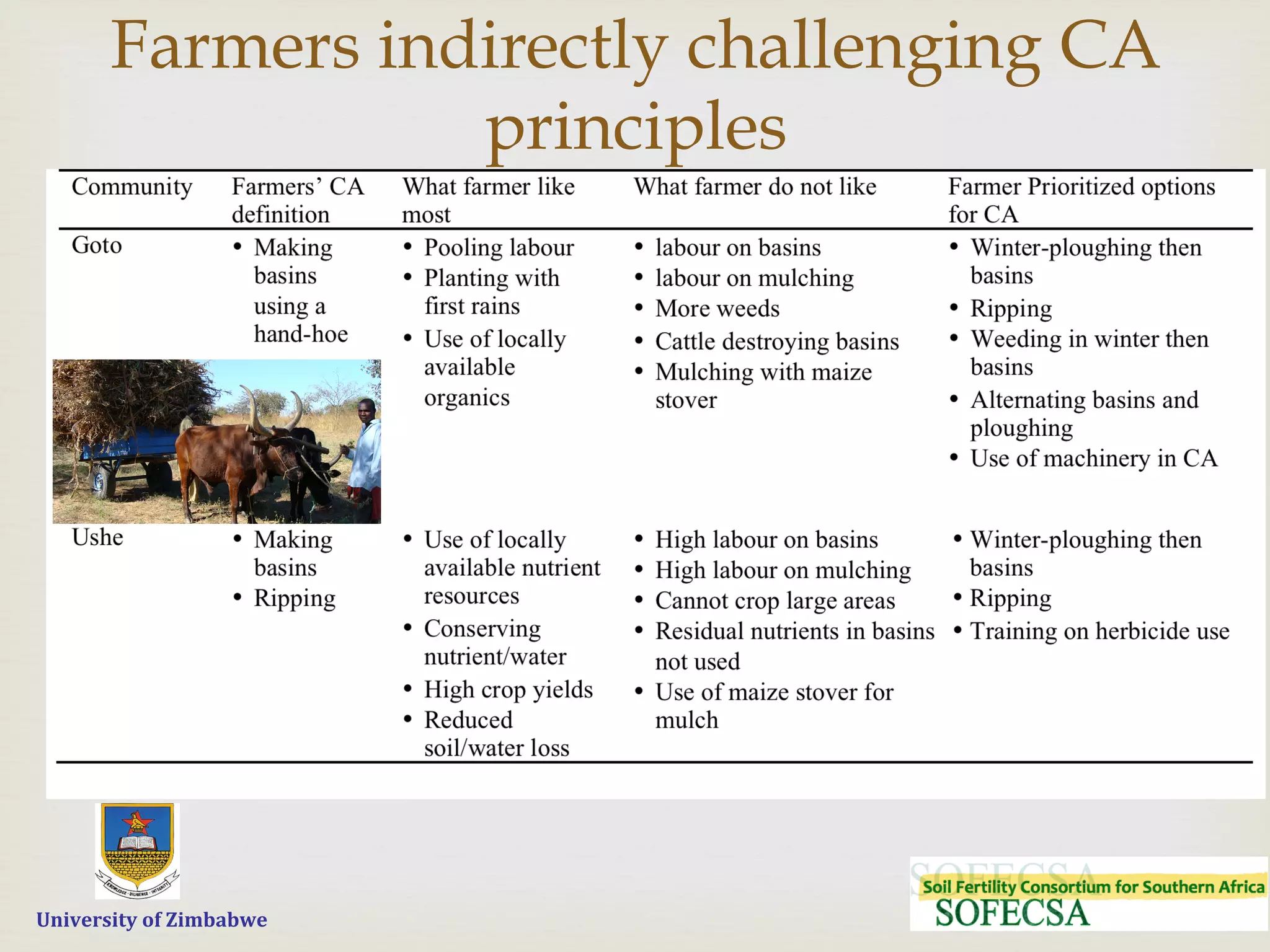
Farmers indirectly challenging CA
principles
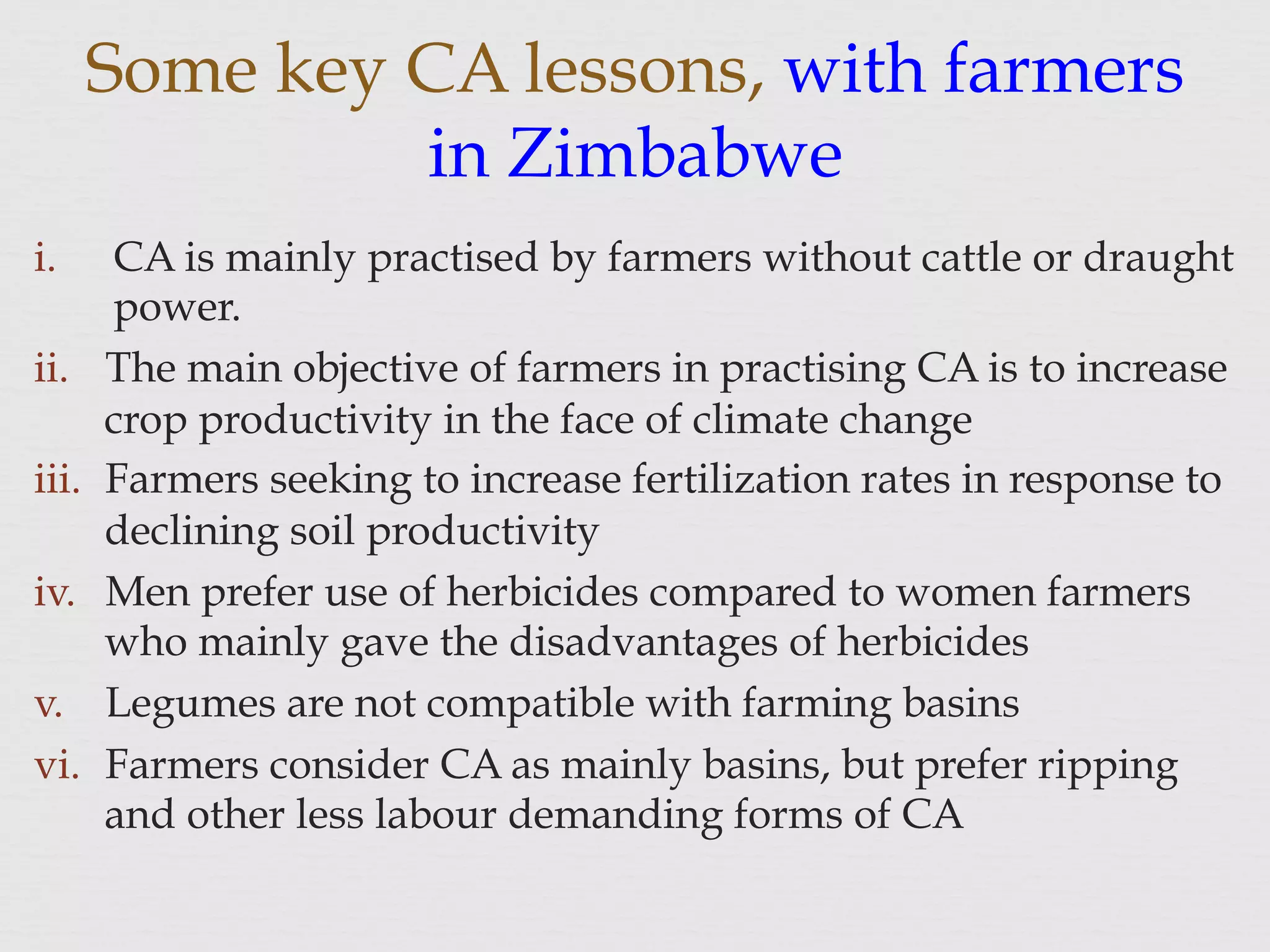
Some key CA lessons, with farmers
in Zimbabwe
i.  CA is mainly practised by farmers without cattle or draught
power.
ii.  The main objective of farmers in practising CA is to increase
crop productivity in the face of climate change
iii.  Farmers seeking to increase fertilization rates in response to
declining soil productivity
iv.  Men prefer use of herbicides compared to women farmers
who mainly gave the disadvantages of herbicides
v.  Legumes are not compatible with farming basins
vi.  Farmers consider CA as mainly basins, but prefer ripping
and other less labour demanding forms of CA


  University	
  of	
  Zimbabwe
–
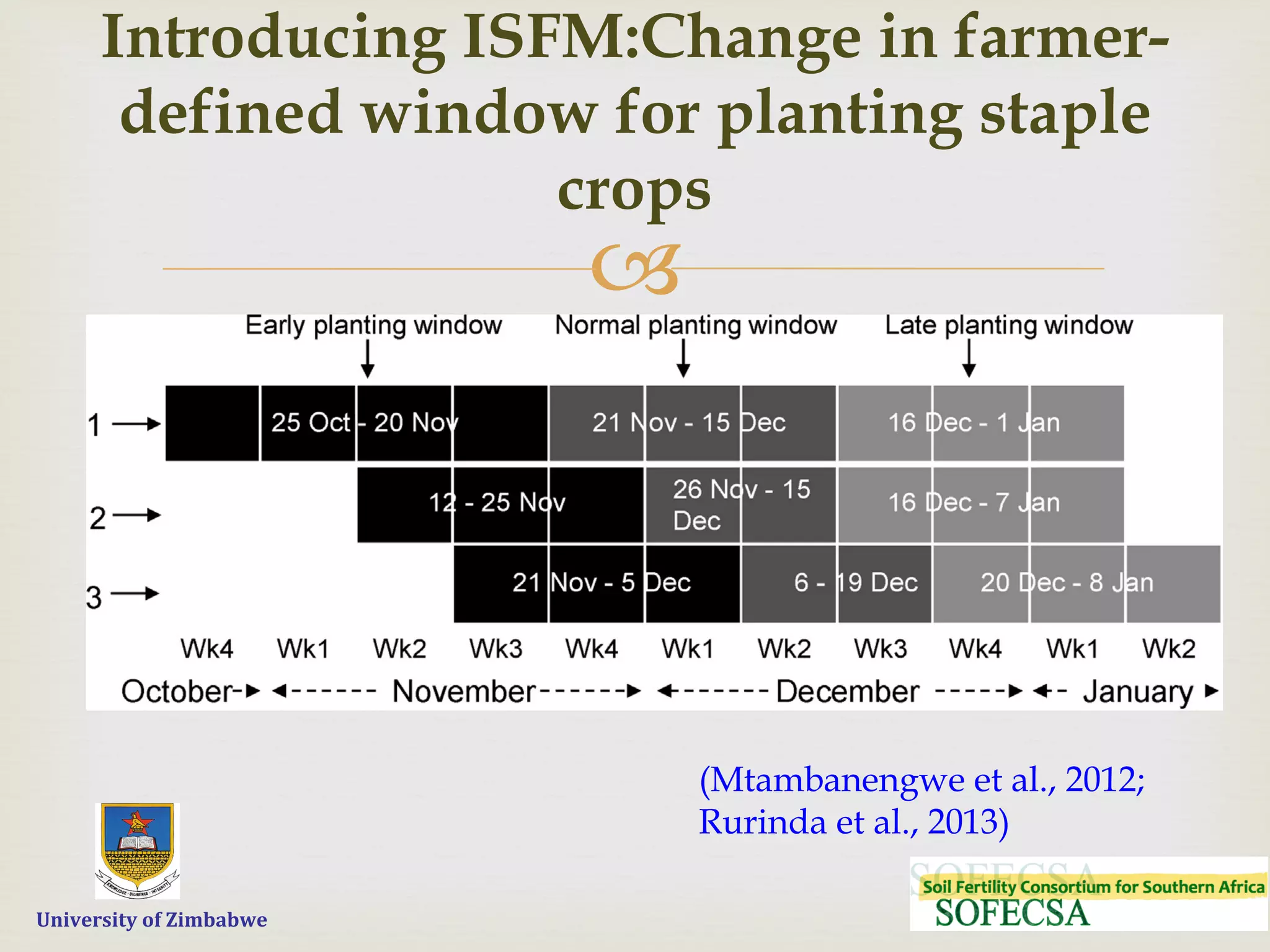
Introducing ISFM:Change in farmer-
defined window for planting staple
cropsARTICLE IN PRESSPages 15
J. Rurinda et al. / Field Crops Research xxx (2013) xxx–xxx
d crop planting windows based on perceived long-term seasonal rainfall types and season’s rainfall quality in Makoni and Hwed
ecall, (2) planting windows for the 2009/2010 season and (3) planting windows for the 2010/2011 season.
on is generally considered good when the number
exceeds 15 (Lineham, 1983).
the rainy season for all planting windows. The
was almost bare at ploughing in each site. W
at normal and late plantings using a hand hoe
(Mtambanengwe et al., 2012;
Rurinda et al., 2013)
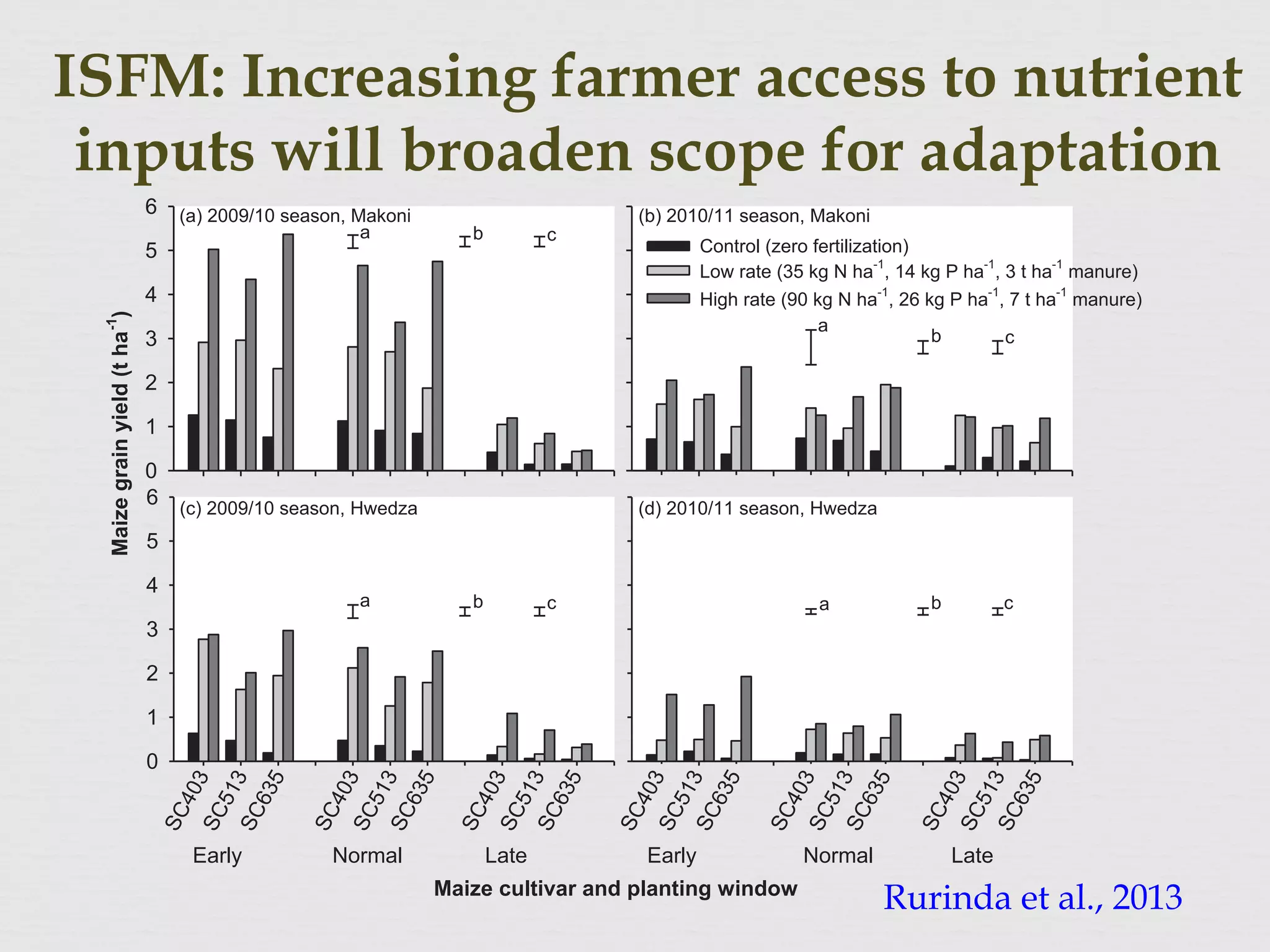
ISFM: Increasing farmer access to nutrient
inputs will broaden scope for adaptation
ARTICLE IN PRESSNo. of Pages 15
J. Rurinda et al. / Field Crops Research xxx (2013) xxx–xxx
0
1
2
3
4
5
6
Maize cultivar and planting window
Maizegrainyield(tha
-1
)
0
1
2
3
4
5
6
Control (zero fertilization)
Low rate (35 kg N ha-1
, 14 kg P ha-1
, 3 t ha-1
manure)
High rate (90 kg N ha-1
, 26 kg P ha-1
, 7 t ha-1
manure)
SC403
SC513SC635
SC403
SC513SC635
SC403
SC513SC635
SC403
SC513SC635
SC403
SC513SC635
SC403
SC513SC635
a b c
a b c
(a) 2009/10 season, Makoni (b) 2010/11 season, Makoni
(c) 2009/10 season, Hwedza (d) 2010/11 season, Hwedza
a
b c
a b c
Early Normal Late Early Normal Late
grain yield in response to cultivar, planting date, and fertilization rate for (a) 2009/10 and (b) 2010/11 seasons in Makoni; and for (c) 2009/10 and
Rurinda et al., 2013
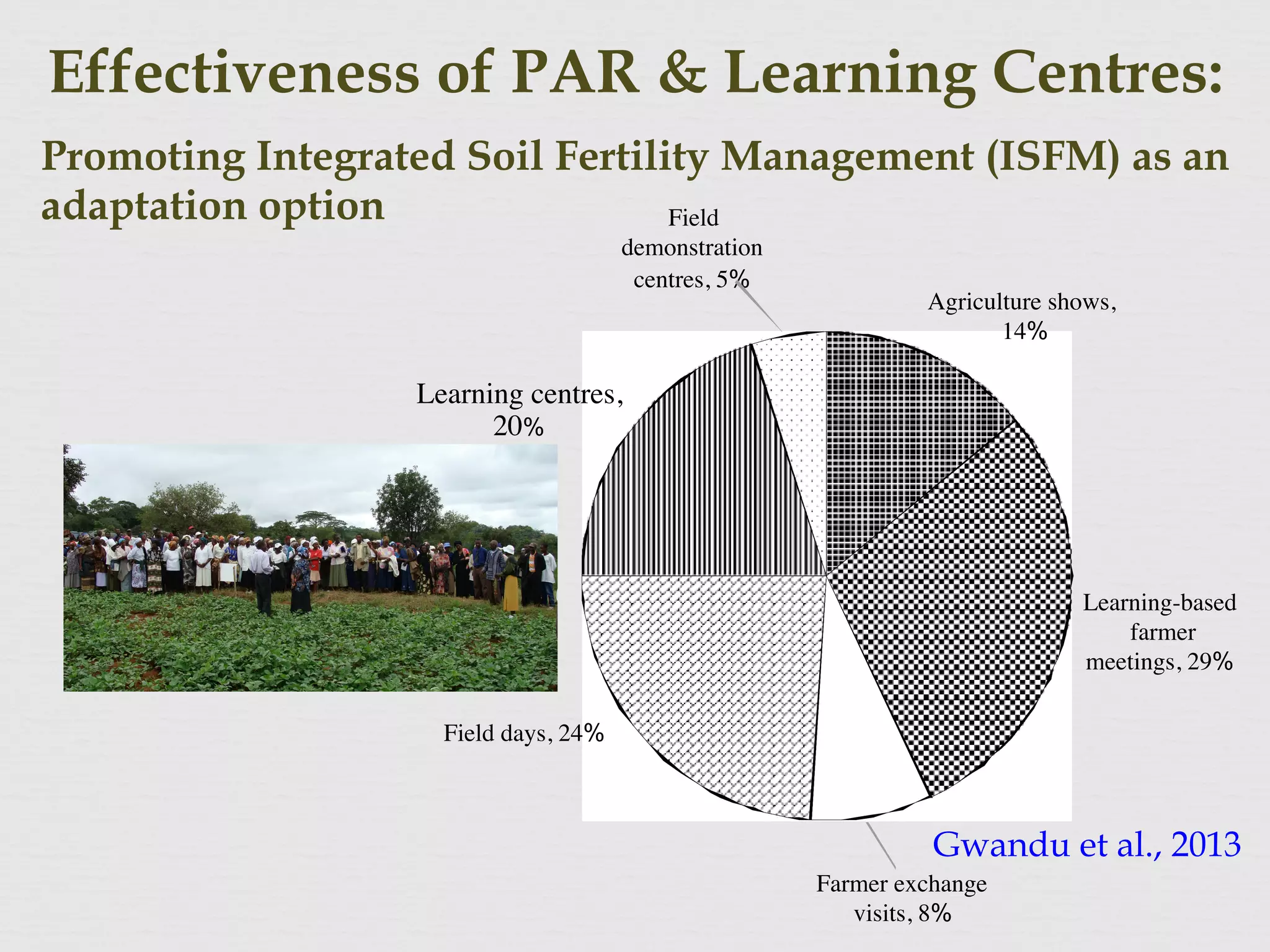
Effectiveness of PAR & Learning Centres:
Agriculture shows,
14%
Learning-based
farmer
meetings, 29%
Farmer exchange
visits, 8%
Field days, 24%
Learning centres,
20%
Field
demonstration
centres, 5%
Access to ISFM Information in Rural ZPromoting Integrated Soil Fertility Management (ISFM) as an
adaptation option
Gwandu et al., 2013


  University	
  of	
  Zimbabwe
–
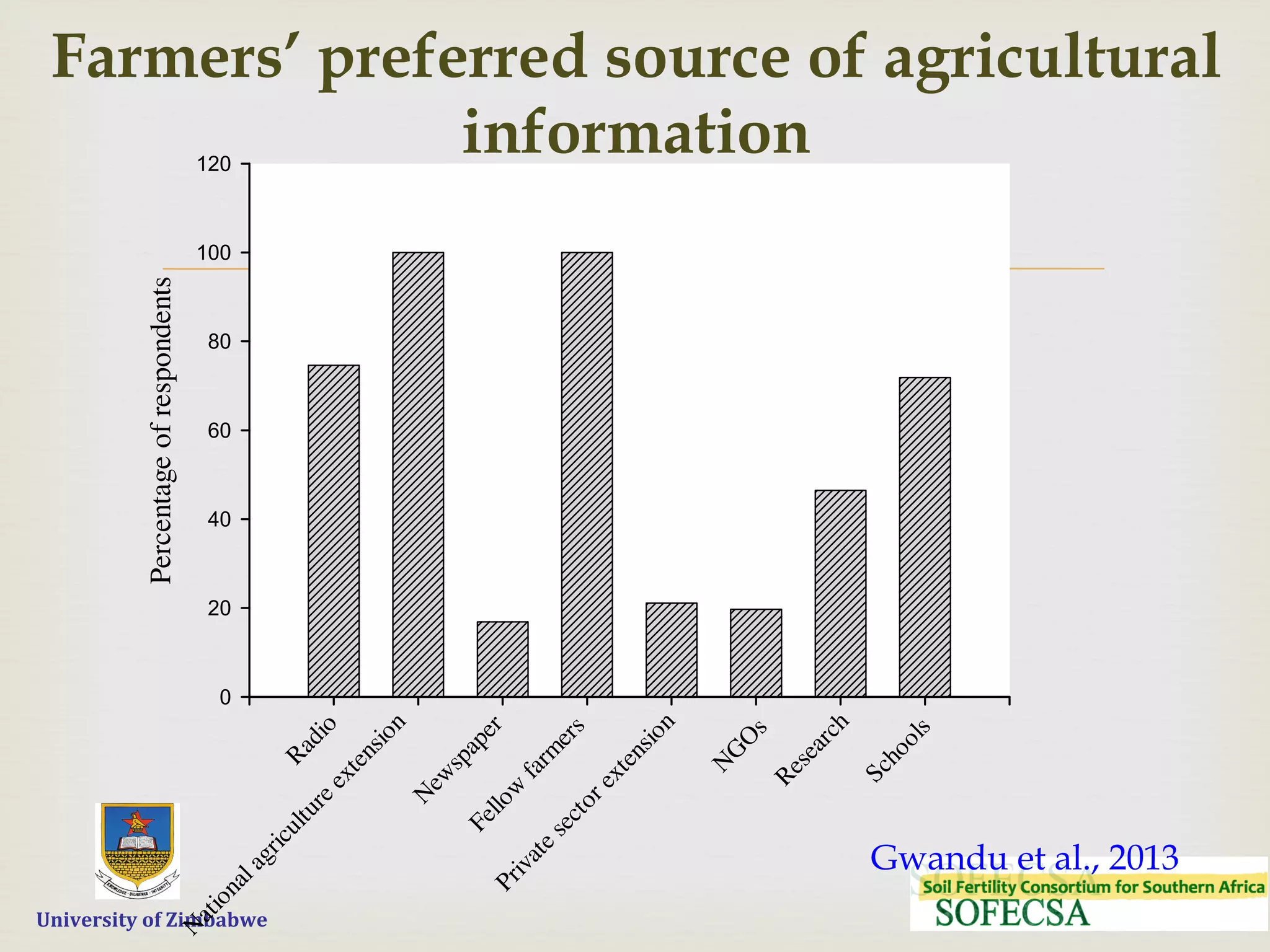
Farmers’ preferred source of agricultural
informationPercentageofrespondents
0
20
40
60
80
100
120
Radio
N
ationalagricultureextension
N
ew
spaper
Fellow
farm
ers
Privatesectorextension
N
G
O
s
Research
Schools
8 T. Gwandu et al.
Gwandu et al., 2013
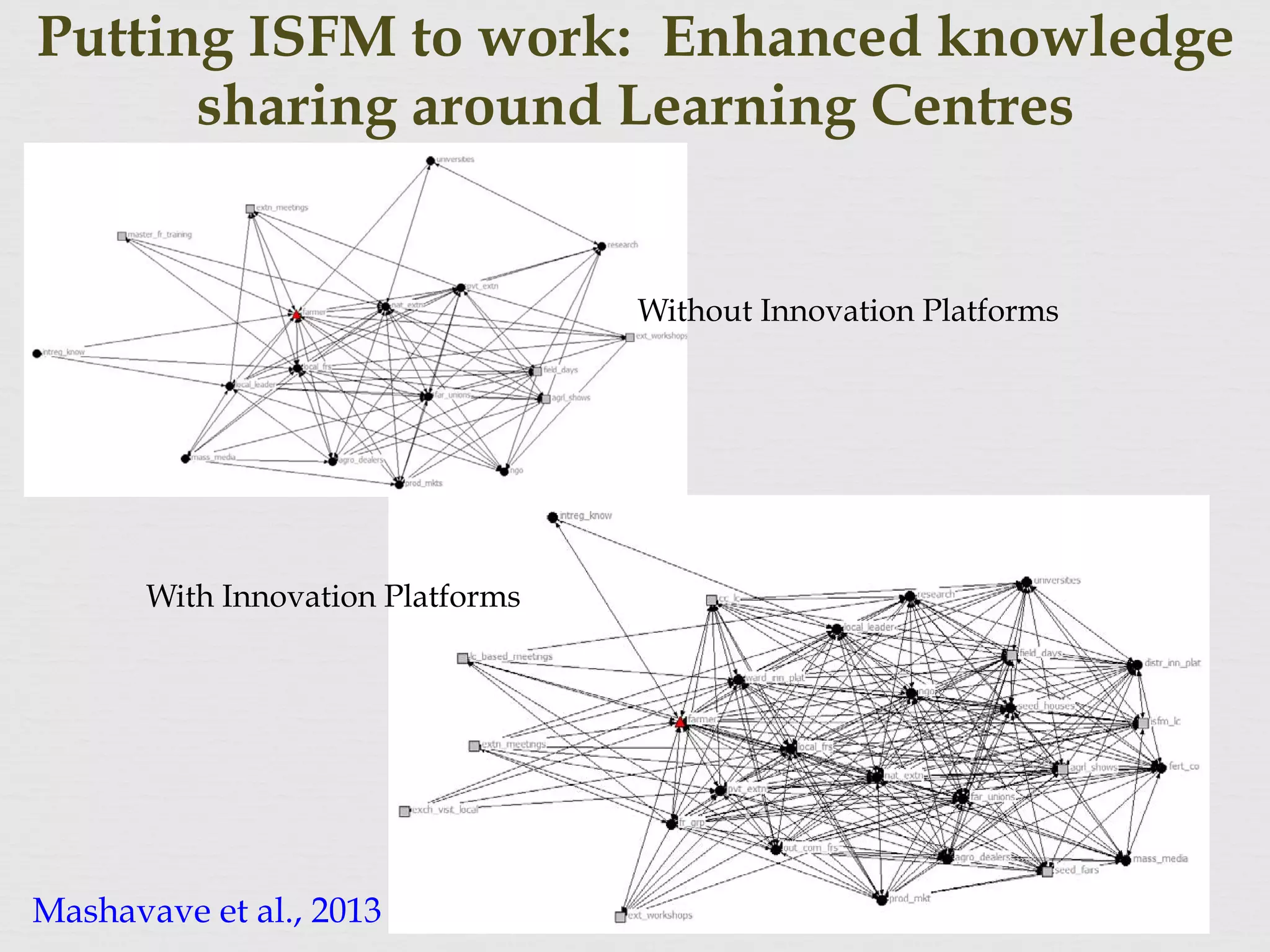
Putting ISFM to work: Enhanced knowledge
sharing around Learning Centres
AfJARE Vol 8 No 1 Mashavave et al.
7
loping stable relationships with suppliers or traders. Currently, exchanges with local
ers were mostly incidental and consisted of informal dialogue devoid of sufficient
mation to constitute ‘purposeful interaction’. Generally, farmer-to-farmer interactions
along dimensions such as age, religion and gender, a characteristic known as homophily
cial network analysis (McPherson et al. 2001; Leonard et al. 2008).
Black circles indicate sources of ISFM information and knowledge, while grey squares indicate platforms
cess to and sharing ISFM information)
ure 2: Structural layout for non-participant smallholder social network in Chinyika,
Makoni District, Zimbabwe
des extension meetings, other identified platforms for access to and sharing of
mation included field days, agricultural shows, external workshops and Master Farmer
ning Programmes being run by the national extension agency, AGRITEX. However,
er Farmer Training Programmes were the most isolated platform for access to and
ng of information and knowledge. Information on extension meetings would be
eyed through village chairpersons by verbal communication, mobile phones and/or
ol children. The composition of participants at field days was mostly farmers from within
ommunity, with very few outsiders, hence such activities were rarely conducted in this
cular area. Farmers in this network failed to organise themselves towards production and
Without Innovation Platforms
With Innovation Platforms
Mashavave et al., 2013
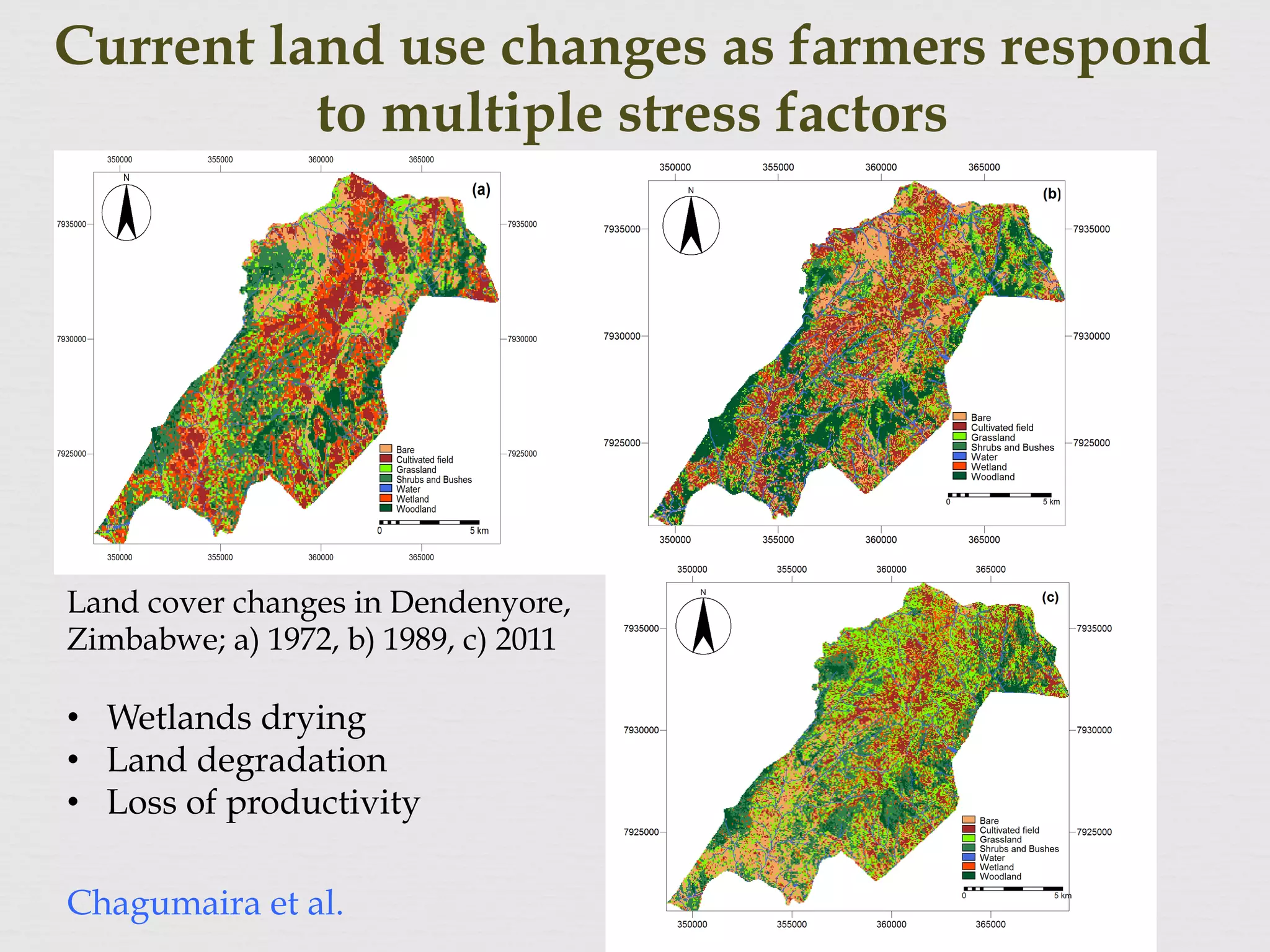
Current land use changes as farmers respond
to multiple stress factors
Land cover changes in Dendenyore,
Zimbabwe; a) 1972, b) 1989, c) 2011
•  Wetlands drying
•  Land degradation
•  Loss of productivity
Chagumaira et al.
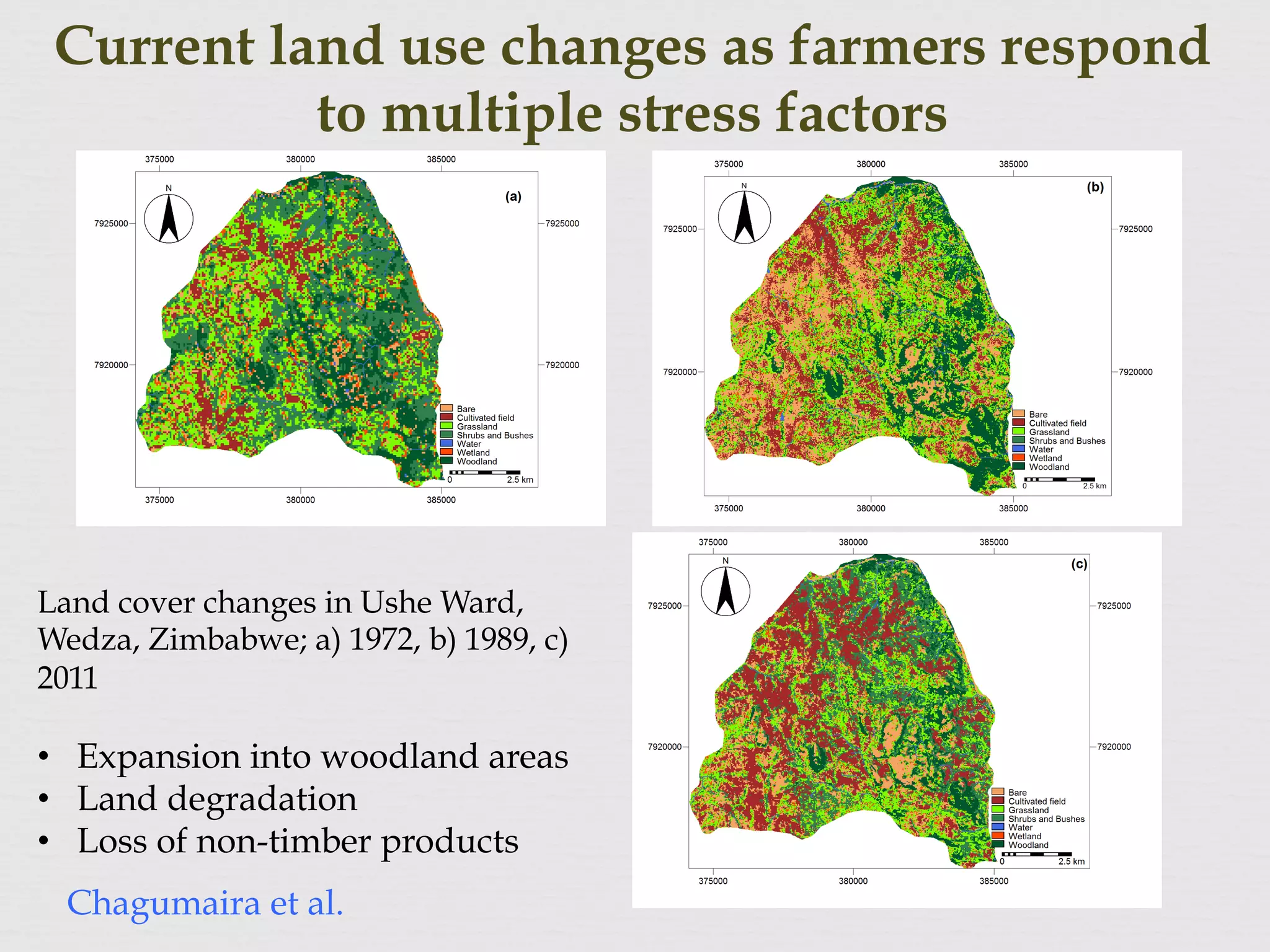
Current land use changes as farmers respond
to multiple stress factors
Land cover changes in Ushe Ward,
Wedza, Zimbabwe; a) 1972, b) 1989, c)
2011
•  Expansion into woodland areas
•  Land degradation
•  Loss of non-timber products
Chagumaira et al.


  University	
  of	
  Zimbabwe
–
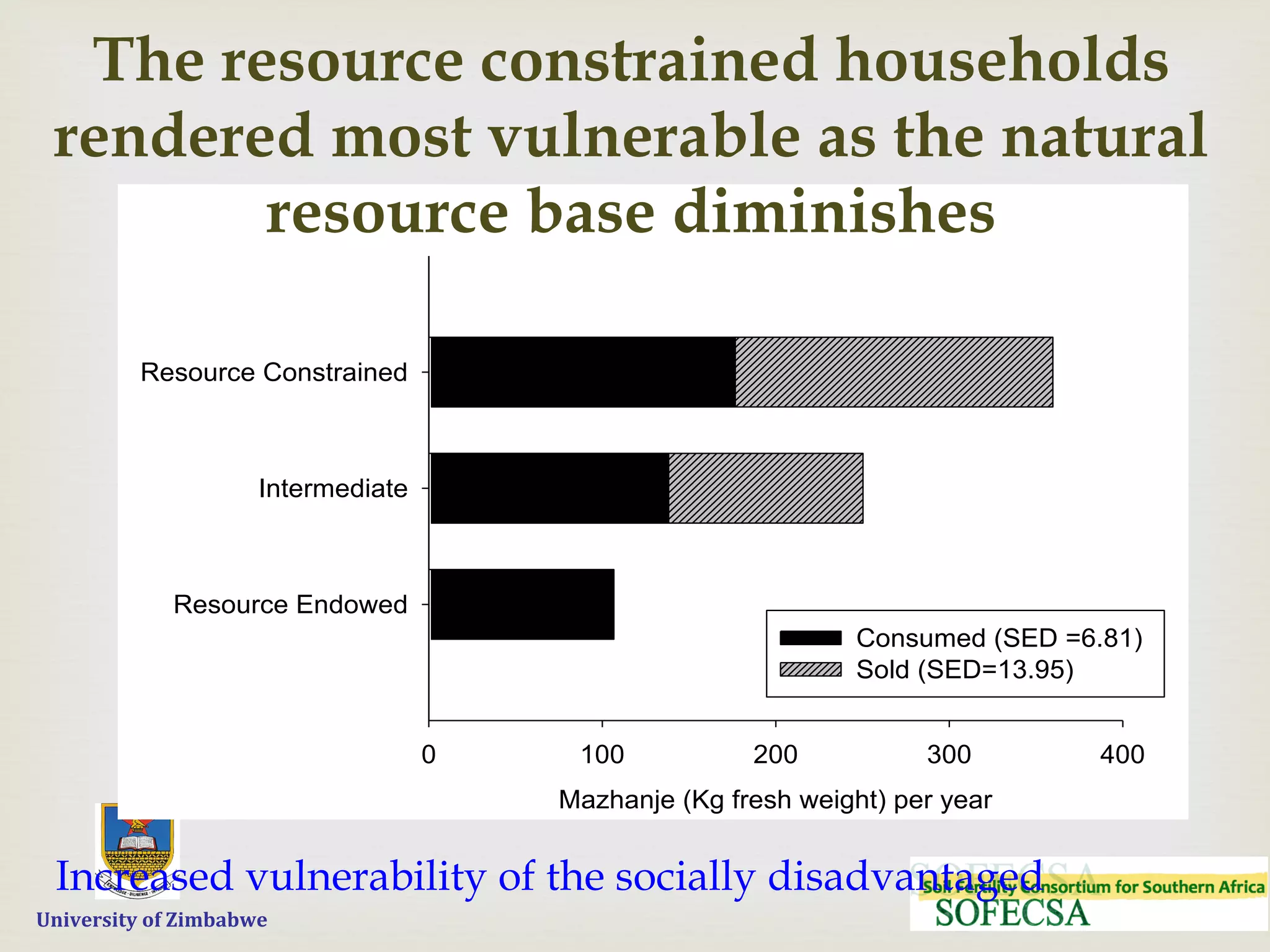
Mazhanje (Kg fresh weight) per year
0 100 200 300 400
Resource Endowed
Intermediate
Resource Constrained
Consumed (SED =6.81)
Sold (SED=13.95)
The resource constrained households
rendered most vulnerable as the natural
resource base diminishes
Increased vulnerability of the socially disadvantaged
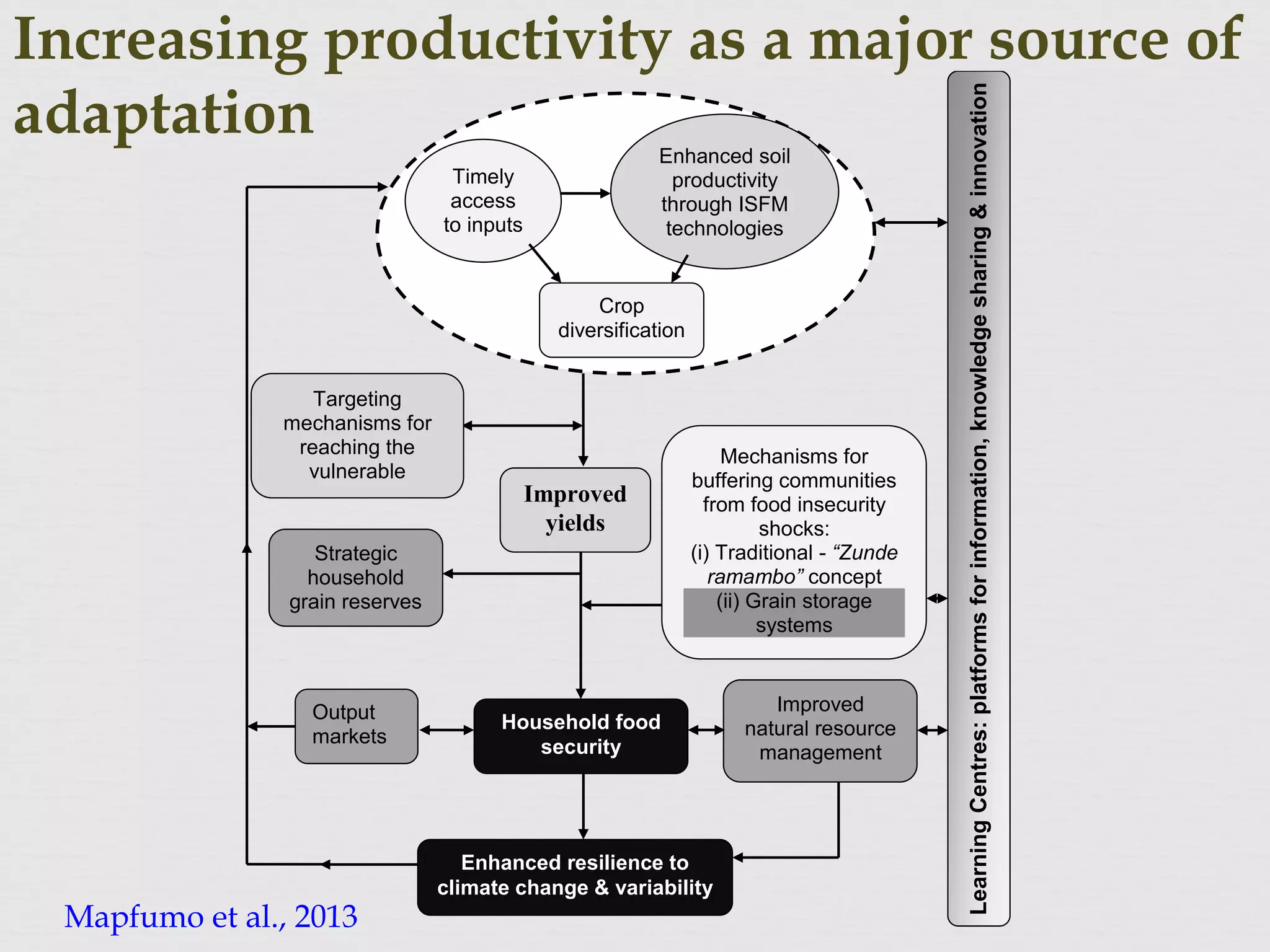
Increasing productivity as a major source of
adaptation
LearningCentres:platformsforinformation,knowledgesharing&innovation
Improved
yields
Targeting
mechanisms for
reaching the
vulnerable
Crop
diversification
Timely
access
to inputs
Household food
security
Improved
natural resource
management
Strategic
household
grain reserves
Enhanced resilience to
climate change & variability
Enhanced soil
productivity
through ISFM
technologies
Mechanisms for
buffering communities
from food insecurity
shocks:
(i) Traditional - “Zunde
ramambo” concept
(ii) Grain storage
systems
Output
markets
Mapfumo et al., 2013
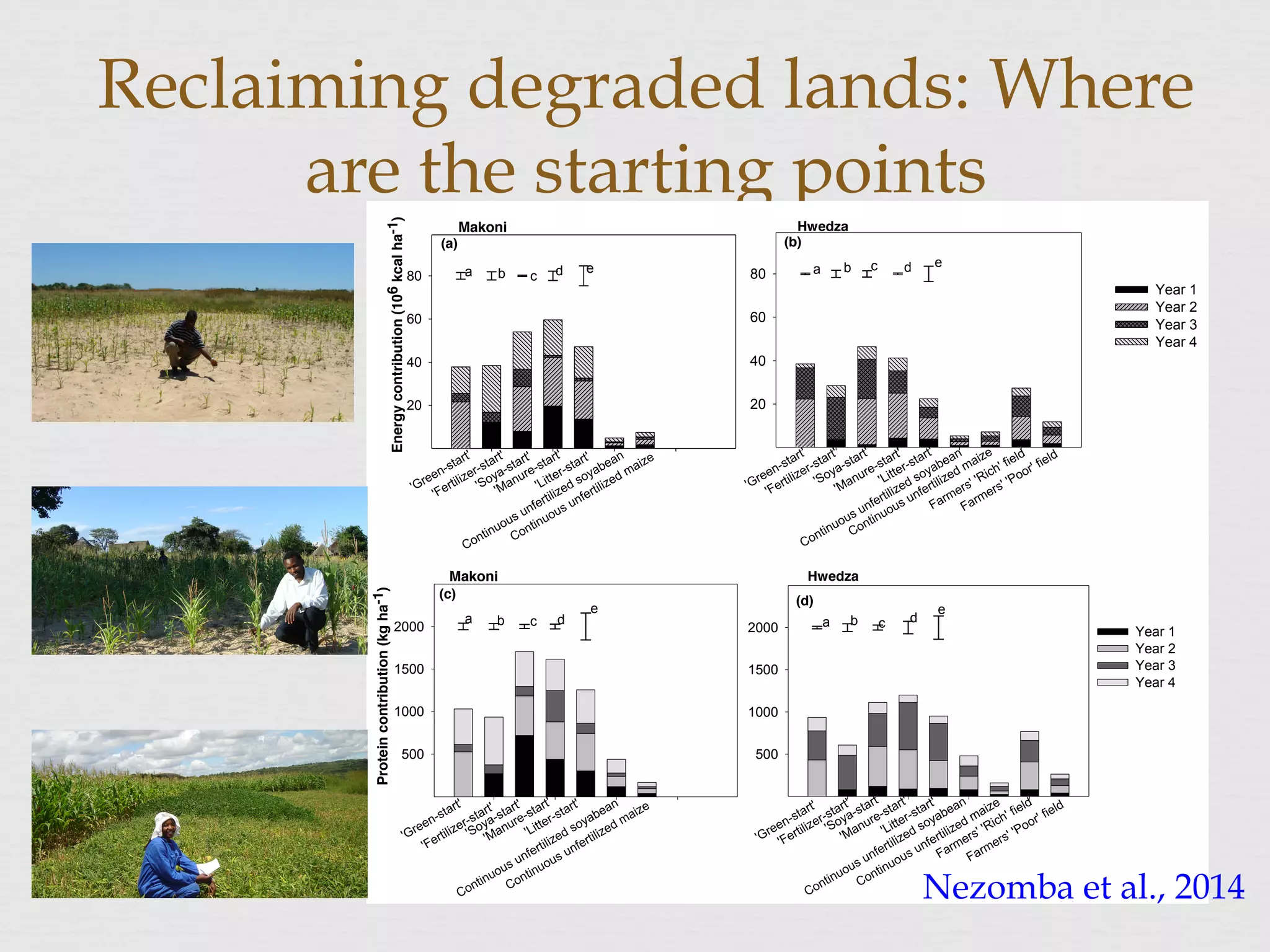
Reclaiming degraded lands: Where
are the starting points
48
Figure 2.49
Makoni
Energycontribution(106kcalha-1)
20
40
60
80
Year 1
Year 2
Year 3
Year 4
20
40
60
80
Hwedza
Makoni
Proteincontribution(kgha-1)
500
1000
1500
2000 Year 1
Year 2
Year 3
Year 4
Hwedza
500
1000
1500
2000
'Green-start'
'Fertilizer-start'
'Manure-start'
'Soya-start'
'Litter-start'
Farmers' 'Rich' field
Farmers' 'Poor' field
Continuous unfertilized maize
Continuous unfertilized soyabean
'Green-start'
'Fertilizer-start'
'Soya-start'
'Manure-start'
'Litter-start'
Continuous unfertilized soyabean
Continuous unfertilized maize
'Green-start'
'Fertilizer-start'
'Manure-start'
'Soya-start'
'Litter-start'
Continuous unfertilized maize
Continuous unfertilized soyabean
Farmers' 'Rich' field
Farmers' 'Poor' field
'Green-start'
'Fertilizer-start'
'Soya-start'
'Manure-start'
'Litter-start'
Continuous unfertilized soyabean
Continuous unfertilized maize
(a) (b)
(c)
(d)
a b c d
e
a
a a
b
b bc
c
c
d
d d
ee
e
50
51
52
Nezomba et al., 2014


  University	
  of	
  Zimbabwe
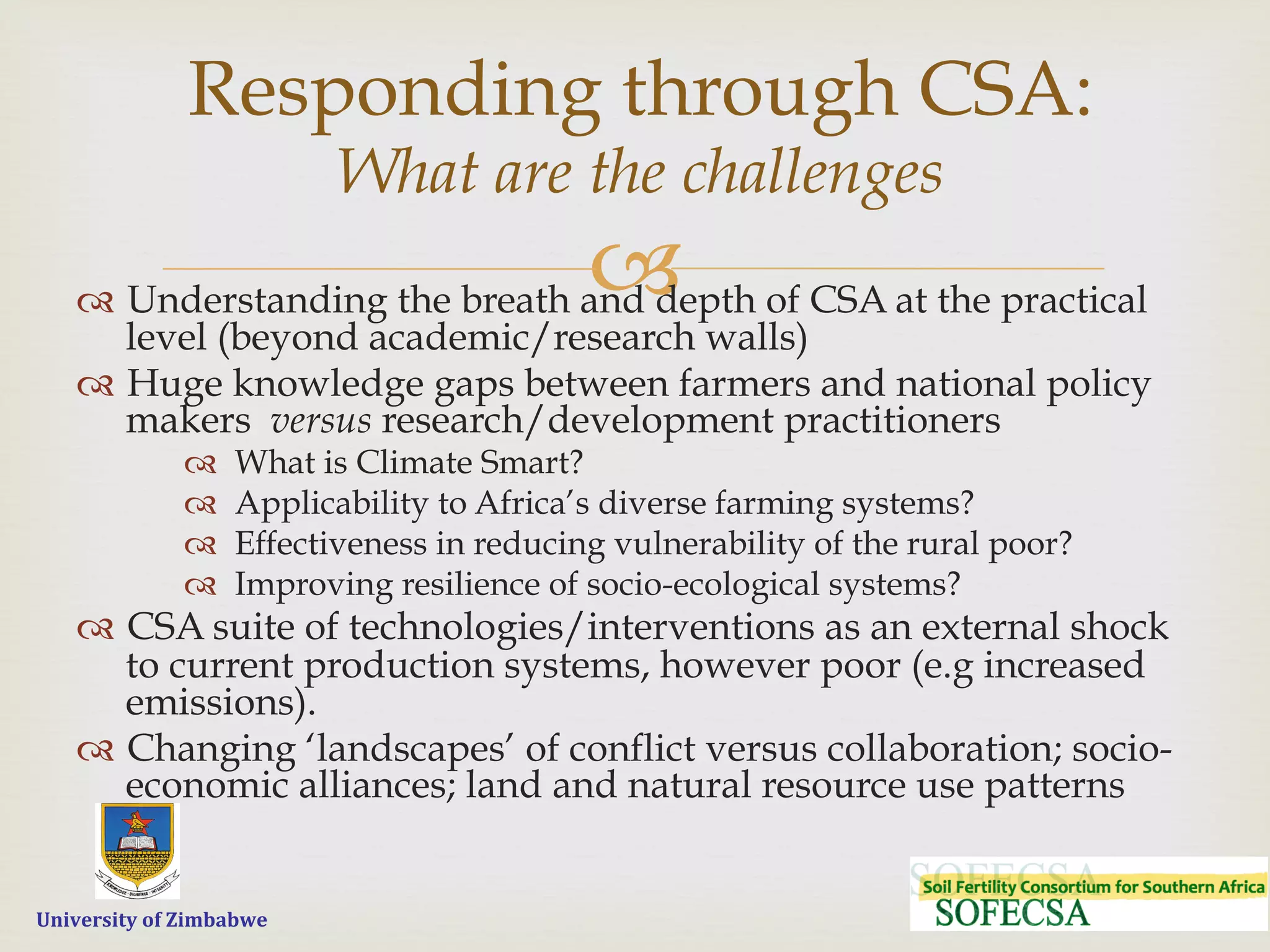
–™  Understanding the breath and depth of CSA at the practical
level (beyond academic/research walls)
™  Huge knowledge gaps between farmers and national policy
makers versus research/development practitioners
™  What is Climate Smart?
™  Applicability to Africa’s diverse farming systems?
™  Effectiveness in reducing vulnerability of the rural poor?
™  Improving resilience of socio-ecological systems?
™  CSA suite of technologies/interventions as an external shock
to current production systems, however poor (e.g increased
emissions).
™  Changing ‘landscapes’ of conflict versus collaboration; socio-
economic alliances; land and natural resource use patterns
Responding through CSA:
What are the challenges


  University	
  of	
  Zimbabwe
–™  There are a range of practices currently undertaken by
farmers and promoted by diverse practitioners: these still
need to be adapted to be really climate smart at scale’
™  As policy makers open up to the CSA concept, there is a
danger for policy before evidence: huge knowledge gaps still
exist BIG OPPORTUNITY
™  Currently demands for food and nutrition security by
communities in Africa call for extraordinary measures to
balance sustainable (but transformed) agricultural
production systems and ecosystem services that yield
benefits on climate change mitigation
™  Africa will therefore require strategic CSA solutions that
promote mitigation within an adaptation framework
Concluding remarks


  University	
  of	
  Zimbabwe
–
Thank You

Linking eartly actions on the ground to generate co-benefits through Climate-Smart Agriculture

  • 1.
    Professor Paul Mapfumo SoilFertility Consortium for Southern Africa (SOFECSA) & Department of Soil Science & Agricultural Engineering UNIVERSITY OF ZIMBABWE
  • 2.
             University  of  Zimbabwe –™ Africa is a food deficit global zone but economies remain primarily hinged on agriculture (includes forestry and fisheries) ™ Crop and livestock production and natural ecosystems are intricately inter-dependent (but declining & challenging institutional and policy norms) ™ Communities responding to multiple stress factors plus climate change and climate variability Introduction: Africa’s climate dependent production & livelihood systems
  • 3.
             University  of  Zimbabwe –™ What does this imply: –  Increased external inputs (fertilizers, chemicals, mechanization: how different from agricultural growth pathways of the past e.g. in Europe & Asia) –  Accelerated deforestation, loss of grasslands to cropping, encroachment into fragile ecosystems and broad scale natural resources depletion –  Increased emissions and less carbon sinks??? –  How have farmers responded and do they perceive a scope for alternative growth pathways Introduction: Africa requires accelerated agricultural growth
  • 4.
             University  of  Zimbabwe –™ New paradigms in the architectural (structural and functional) designs of crop and livestock production systems ™ New regimes of ecosystems services ™ Socio-ecological transformations providing win-win-win agro- ecological systems (agricultural intensification-sustainable natural resources management - diversified livelihood options) ™ Need to expand opportunity horizons for enhanced adaptive capacity and livelihood benefits beyond farms (e.g. communities living beyond the reach of markets, limiting scope for science, technology assimilation and innovation Increasing calls for more productive, efficient and resilient farming systems
  • 5.
             University  of  Zimbabwe –™  Consider core CSA elements (FAO): increasing productivity; resilience (adaptation), greenhouse gases mitigation, and enhanced achievement of national food security and development goals ™  Conservation Agriculture (CA) -based technologies ™  Integrated Soil Fertility Management (ISFM)- based technologies ™  Agroforestry-based technologies (fertilizer trees) ™  Community Based Natural Resource Management (CBNRM) ™  How can these be adapted and integrated into farming systems to yield greater benefits (SOFECSA’s emerging concept of Learning Centres) Responding through CSA: What is on the ground?
  • 6.
             University  of  Zimbabwe – Demand for CSA: Do farmers perceive a changing climate? ™ Shortening rainfall seasons: late start and/or early end of the season ™ Increasing number of hot days in a season ™ Worsening within season rainfall distribution ™ Farmers relying more on indigenous knowledge for agricultural decision-making but indicators often also climate sensitive ™ Poor access to climate information presents a major challenge for adaptation
  • 7.
    What has beenmeasured? ARTICLE IN PRESSes15 J. Rurinda et al. / Field Crops Research xxx (2013) xxx–xxx 7 Year 1960 1970 1980 1990 2000 2010 Startofrainyseason 15-Oct 25-Oct 04-Nov 14-Nov 24-Nov 04-Dec 14-Dec 24-Dec Year 1960 1970 1980 1990 2000 2010 Numberofraindays 40 60 80 100 120 140 Seasonal rain days Five-year rolling mean (b) Year 1960 1970 1980 1990 2000 2010 Totalrainfall(mm) 200 400 600 800 1000 1200 1400 1600 Annual total rainfall Five-year rolling mean (a) Start of rainy season 15-Oct 14-Nov 14-Dec Seasonlength(days) 50 100 150 200 250 (d)(c) (A) •  Decreasing rainy days per season •  Late start of the rains •  Decreasing season length •  No significant change in total rainfall •  Consistent with farmer observations Rurinda et al., 2013
  • 8.
    CA Options: Bothtillage and soil fertility management options significant: no interaction 26 kg P ha -1 + 90 kg N ha -1 7 t ha -1 cattle manure + 26 kg P ha -1 + 90 kg N ha -1 45 kg N ha -1 + 14 kg P ha -1 26 kg P ha -1 + 90 kg N ha -1 7 t ha -1 cattle manure + 26 kg P ha -1 + 90 kg N ha -1 45 kg N ha -1 + 14 kg P ha -1 (a) Degraded field Maizegrainyield(tha-1 ) 0 1 2 3 4 (b) Relatively fertile field Conventioanl Ripping Basins Soil fertility option P=0.04* Tillage P=0.02* Soil fertility option x Tillage P=0.39ns Soil fertility option P=0.02*** Tillage P=0.03** Soil fertility option x Tillage P=0.51ns ! (Source: ABACO Project)
  • 9.
             University  of  Zimbabwe – Farmers indirectly challenging CA principles
  • 10.
    Some key CAlessons, with farmers in Zimbabwe i.  CA is mainly practised by farmers without cattle or draught power. ii.  The main objective of farmers in practising CA is to increase crop productivity in the face of climate change iii.  Farmers seeking to increase fertilization rates in response to declining soil productivity iv.  Men prefer use of herbicides compared to women farmers who mainly gave the disadvantages of herbicides v.  Legumes are not compatible with farming basins vi.  Farmers consider CA as mainly basins, but prefer ripping and other less labour demanding forms of CA
  • 11.
             University  of  Zimbabwe – Introducing ISFM:Change in farmer- defined window for planting staple cropsARTICLE IN PRESSPages 15 J. Rurinda et al. / Field Crops Research xxx (2013) xxx–xxx d crop planting windows based on perceived long-term seasonal rainfall types and season’s rainfall quality in Makoni and Hwed ecall, (2) planting windows for the 2009/2010 season and (3) planting windows for the 2010/2011 season. on is generally considered good when the number exceeds 15 (Lineham, 1983). the rainy season for all planting windows. The was almost bare at ploughing in each site. W at normal and late plantings using a hand hoe (Mtambanengwe et al., 2012; Rurinda et al., 2013)
  • 12.
    ISFM: Increasing farmeraccess to nutrient inputs will broaden scope for adaptation ARTICLE IN PRESSNo. of Pages 15 J. Rurinda et al. / Field Crops Research xxx (2013) xxx–xxx 0 1 2 3 4 5 6 Maize cultivar and planting window Maizegrainyield(tha -1 ) 0 1 2 3 4 5 6 Control (zero fertilization) Low rate (35 kg N ha-1 , 14 kg P ha-1 , 3 t ha-1 manure) High rate (90 kg N ha-1 , 26 kg P ha-1 , 7 t ha-1 manure) SC403 SC513SC635 SC403 SC513SC635 SC403 SC513SC635 SC403 SC513SC635 SC403 SC513SC635 SC403 SC513SC635 a b c a b c (a) 2009/10 season, Makoni (b) 2010/11 season, Makoni (c) 2009/10 season, Hwedza (d) 2010/11 season, Hwedza a b c a b c Early Normal Late Early Normal Late grain yield in response to cultivar, planting date, and fertilization rate for (a) 2009/10 and (b) 2010/11 seasons in Makoni; and for (c) 2009/10 and Rurinda et al., 2013
  • 13.
    Effectiveness of PAR& Learning Centres: Agriculture shows, 14% Learning-based farmer meetings, 29% Farmer exchange visits, 8% Field days, 24% Learning centres, 20% Field demonstration centres, 5% Access to ISFM Information in Rural ZPromoting Integrated Soil Fertility Management (ISFM) as an adaptation option Gwandu et al., 2013
  • 14.
             University  of  Zimbabwe – Farmers’ preferred source of agricultural informationPercentageofrespondents 0 20 40 60 80 100 120 Radio N ationalagricultureextension N ew spaper Fellow farm ers Privatesectorextension N G O s Research Schools 8 T. Gwandu et al. Gwandu et al., 2013
  • 15.
    Putting ISFM towork: Enhanced knowledge sharing around Learning Centres AfJARE Vol 8 No 1 Mashavave et al. 7 loping stable relationships with suppliers or traders. Currently, exchanges with local ers were mostly incidental and consisted of informal dialogue devoid of sufficient mation to constitute ‘purposeful interaction’. Generally, farmer-to-farmer interactions along dimensions such as age, religion and gender, a characteristic known as homophily cial network analysis (McPherson et al. 2001; Leonard et al. 2008). Black circles indicate sources of ISFM information and knowledge, while grey squares indicate platforms cess to and sharing ISFM information) ure 2: Structural layout for non-participant smallholder social network in Chinyika, Makoni District, Zimbabwe des extension meetings, other identified platforms for access to and sharing of mation included field days, agricultural shows, external workshops and Master Farmer ning Programmes being run by the national extension agency, AGRITEX. However, er Farmer Training Programmes were the most isolated platform for access to and ng of information and knowledge. Information on extension meetings would be eyed through village chairpersons by verbal communication, mobile phones and/or ol children. The composition of participants at field days was mostly farmers from within ommunity, with very few outsiders, hence such activities were rarely conducted in this cular area. Farmers in this network failed to organise themselves towards production and Without Innovation Platforms With Innovation Platforms Mashavave et al., 2013
  • 16.
    Current land usechanges as farmers respond to multiple stress factors Land cover changes in Dendenyore, Zimbabwe; a) 1972, b) 1989, c) 2011 •  Wetlands drying •  Land degradation •  Loss of productivity Chagumaira et al.
  • 17.
    Current land usechanges as farmers respond to multiple stress factors Land cover changes in Ushe Ward, Wedza, Zimbabwe; a) 1972, b) 1989, c) 2011 •  Expansion into woodland areas •  Land degradation •  Loss of non-timber products Chagumaira et al.
  • 18.
             University  of  Zimbabwe – Mazhanje (Kg fresh weight) per year 0 100 200 300 400 Resource Endowed Intermediate Resource Constrained Consumed (SED =6.81) Sold (SED=13.95) The resource constrained households rendered most vulnerable as the natural resource base diminishes Increased vulnerability of the socially disadvantaged
  • 19.
    Increasing productivity asa major source of adaptation LearningCentres:platformsforinformation,knowledgesharing&innovation Improved yields Targeting mechanisms for reaching the vulnerable Crop diversification Timely access to inputs Household food security Improved natural resource management Strategic household grain reserves Enhanced resilience to climate change & variability Enhanced soil productivity through ISFM technologies Mechanisms for buffering communities from food insecurity shocks: (i) Traditional - “Zunde ramambo” concept (ii) Grain storage systems Output markets Mapfumo et al., 2013
  • 20.
    Reclaiming degraded lands:Where are the starting points 48 Figure 2.49 Makoni Energycontribution(106kcalha-1) 20 40 60 80 Year 1 Year 2 Year 3 Year 4 20 40 60 80 Hwedza Makoni Proteincontribution(kgha-1) 500 1000 1500 2000 Year 1 Year 2 Year 3 Year 4 Hwedza 500 1000 1500 2000 'Green-start' 'Fertilizer-start' 'Manure-start' 'Soya-start' 'Litter-start' Farmers' 'Rich' field Farmers' 'Poor' field Continuous unfertilized maize Continuous unfertilized soyabean 'Green-start' 'Fertilizer-start' 'Soya-start' 'Manure-start' 'Litter-start' Continuous unfertilized soyabean Continuous unfertilized maize 'Green-start' 'Fertilizer-start' 'Manure-start' 'Soya-start' 'Litter-start' Continuous unfertilized maize Continuous unfertilized soyabean Farmers' 'Rich' field Farmers' 'Poor' field 'Green-start' 'Fertilizer-start' 'Soya-start' 'Manure-start' 'Litter-start' Continuous unfertilized soyabean Continuous unfertilized maize (a) (b) (c) (d) a b c d e a a a b b bc c c d d d ee e 50 51 52 Nezomba et al., 2014
  • 21.
             University  of  Zimbabwe –™  Understanding the breath and depth of CSA at the practical level (beyond academic/research walls) ™  Huge knowledge gaps between farmers and national policy makers versus research/development practitioners ™  What is Climate Smart? ™  Applicability to Africa’s diverse farming systems? ™  Effectiveness in reducing vulnerability of the rural poor? ™  Improving resilience of socio-ecological systems? ™  CSA suite of technologies/interventions as an external shock to current production systems, however poor (e.g increased emissions). ™  Changing ‘landscapes’ of conflict versus collaboration; socio- economic alliances; land and natural resource use patterns Responding through CSA: What are the challenges
  • 22.
             University  of  Zimbabwe –™  There are a range of practices currently undertaken by farmers and promoted by diverse practitioners: these still need to be adapted to be really climate smart at scale’ ™  As policy makers open up to the CSA concept, there is a danger for policy before evidence: huge knowledge gaps still exist BIG OPPORTUNITY ™  Currently demands for food and nutrition security by communities in Africa call for extraordinary measures to balance sustainable (but transformed) agricultural production systems and ecosystem services that yield benefits on climate change mitigation ™  Africa will therefore require strategic CSA solutions that promote mitigation within an adaptation framework Concluding remarks
  • 23.
             University  of  Zimbabwe – Thank You