Climate information
and social difference
The impact of information on adaptive capacity among
socially marginalized smallholder agriculturalists
Alexa Jay
Climate information
and social difference
The impact of information on adaptive capacity among
socially marginalized smallholder agriculturalists
Alexa Jay
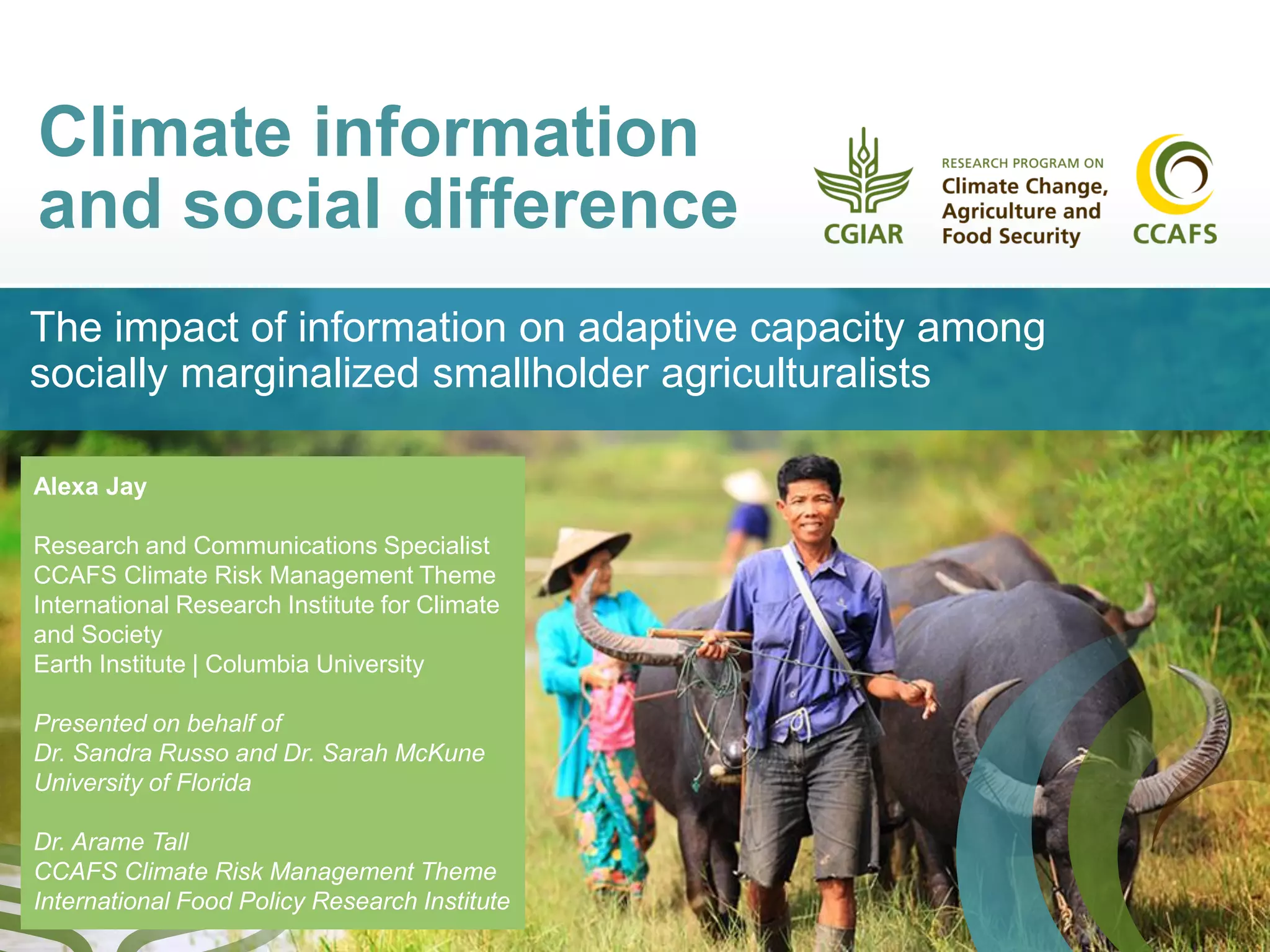
Research and Communications Specialist
CCAFS Climate Risk Management Theme
International Research Institute for Climate
and Society
Earth Institute | Columbia University
Presented on behalf of
Dr. Sandra Russo and Dr. Sarah McKune
University of Florida
Dr. Arame Tall
CCAFS Climate Risk Management Theme
International Food Policy Research Institute
Power, privilege, and social exclusion
• Bringing climate information services
(CIS) into agricultural extension and
advisory services is seen as crucial for
achieving climate smart agricultural
(CSA) development in a variable and
changing climate.
• Vulnerable groups, including women,
are less likely to be targeted or
involved in CIS and CSA
• Access to standalone agricultural
extension services is significantly lower
for women as compared with men
(Swanson et al. 1990; World Bank and
IFPRI 2010; Ragasa 2012)
Why aren’t we there yet?
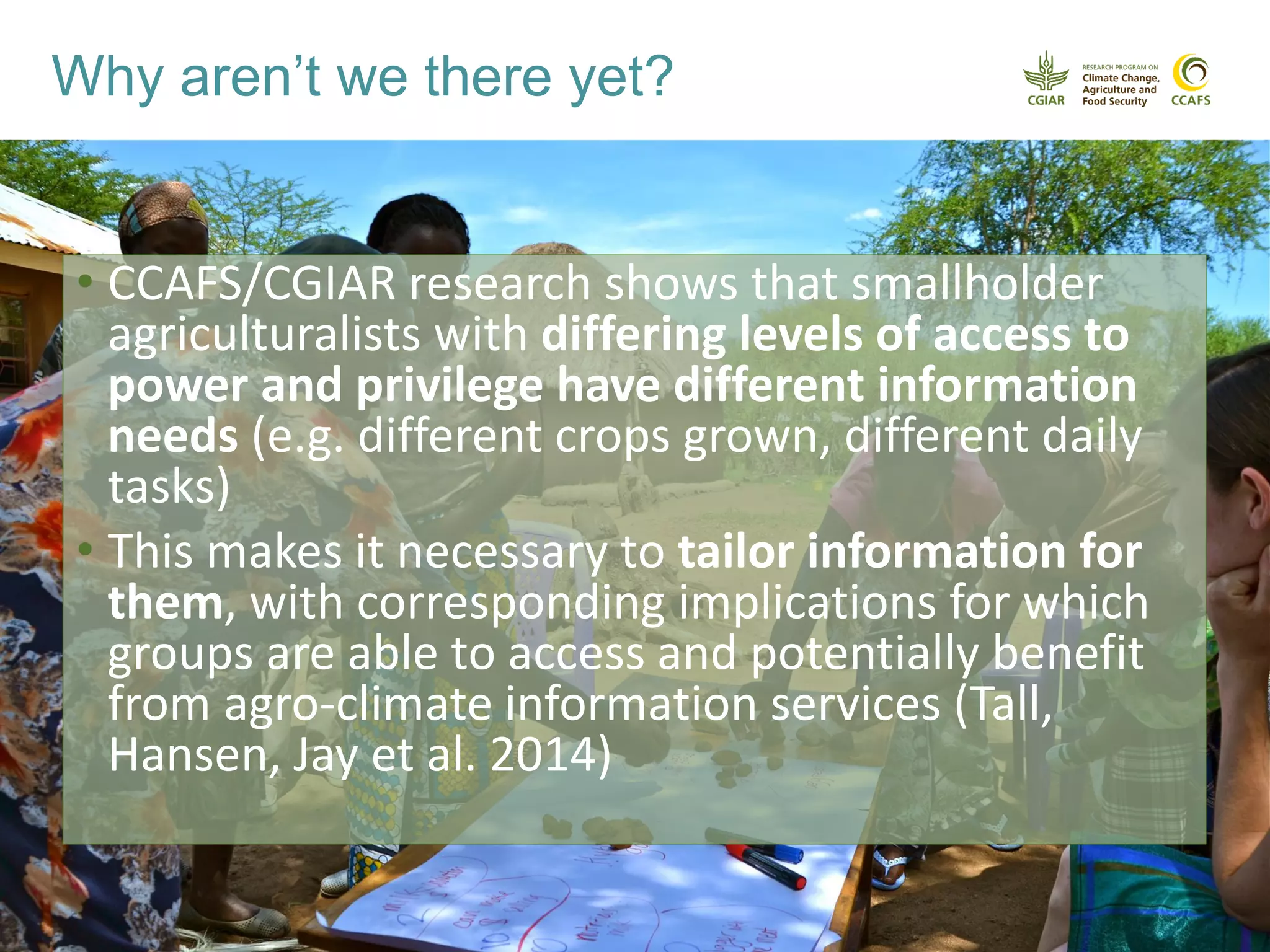
• CCAFS/CGIAR research shows that smallholder
agriculturalists with differing levels of access to
power and privilege have different information
needs (e.g. different crops grown, different daily
tasks)
• This makes it necessary to tailor information for
them, with corresponding implications for which
groups are able to access and potentially benefit
from agro-climate information services (Tall,
Hansen, Jay et al. 2014)
Why evaluate the impact of climate
services?
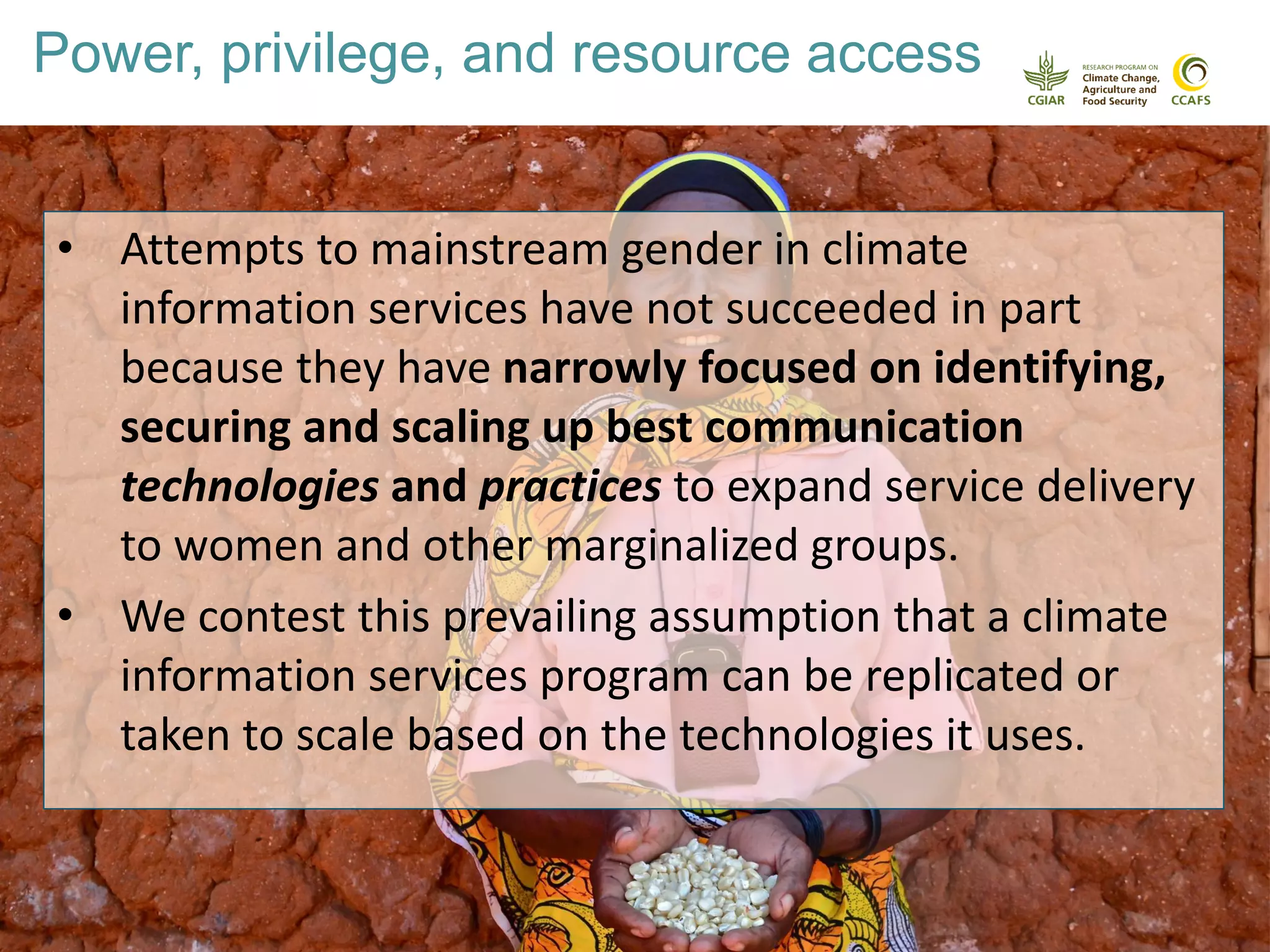
• Attempts to mainstream gender in climate
information services have not succeeded in part
because they have narrowly focused on identifying,
securing and scaling up best communication
technologies and practices to expand service delivery
to women and other marginalized groups.
• We contest this prevailing assumption that a climate
information services program can be replicated or
taken to scale based on the technologies it uses.
Power, privilege, and resource access
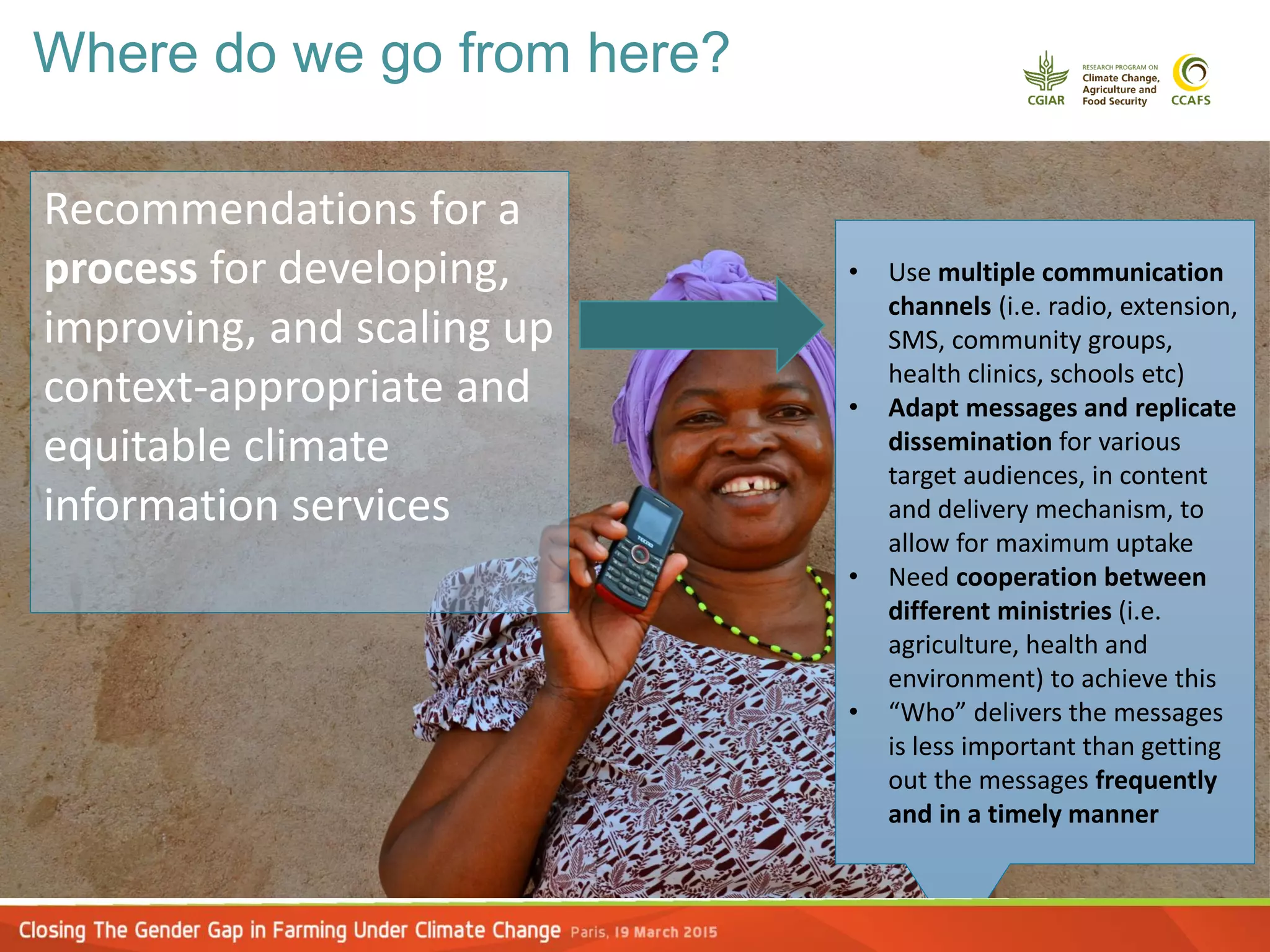
Recommendations for a
process for developing,
improving, and scaling up
context-appropriate and
equitable climate
information services
• Use multiple communication
channels (i.e. radio, extension,
SMS, community groups,
health clinics, schools etc)
• Adapt messages and replicate
dissemination for various
target audiences, in content
and delivery mechanism, to
allow for maximum uptake
• Need cooperation between
different ministries (i.e.
agriculture, health and
environment) to achieve this
• “Who” delivers the messages
is less important than getting
out the messages frequently
and in a timely manner
Where do we go from here?
Thank you
ccafs.cgiar.org/themes/climate-risk-management
ccafs.cgiar.org/gender
Contact point: ajay@iri.columbia.edu

Climate information and social difference

  • 1.
    Climate information and socialdifference The impact of information on adaptive capacity among socially marginalized smallholder agriculturalists Alexa Jay
  • 2.
    Climate information and socialdifference The impact of information on adaptive capacity among socially marginalized smallholder agriculturalists Alexa Jay Research and Communications Specialist CCAFS Climate Risk Management Theme International Research Institute for Climate and Society Earth Institute | Columbia University Presented on behalf of Dr. Sandra Russo and Dr. Sarah McKune University of Florida Dr. Arame Tall CCAFS Climate Risk Management Theme International Food Policy Research Institute
  • 3.
    Power, privilege, andsocial exclusion • Bringing climate information services (CIS) into agricultural extension and advisory services is seen as crucial for achieving climate smart agricultural (CSA) development in a variable and changing climate. • Vulnerable groups, including women, are less likely to be targeted or involved in CIS and CSA • Access to standalone agricultural extension services is significantly lower for women as compared with men (Swanson et al. 1990; World Bank and IFPRI 2010; Ragasa 2012)
  • 4.
    Why aren’t wethere yet? • CCAFS/CGIAR research shows that smallholder agriculturalists with differing levels of access to power and privilege have different information needs (e.g. different crops grown, different daily tasks) • This makes it necessary to tailor information for them, with corresponding implications for which groups are able to access and potentially benefit from agro-climate information services (Tall, Hansen, Jay et al. 2014)
  • 5.
    Why evaluate theimpact of climate services? • Attempts to mainstream gender in climate information services have not succeeded in part because they have narrowly focused on identifying, securing and scaling up best communication technologies and practices to expand service delivery to women and other marginalized groups. • We contest this prevailing assumption that a climate information services program can be replicated or taken to scale based on the technologies it uses. Power, privilege, and resource access
  • 6.
    Recommendations for a processfor developing, improving, and scaling up context-appropriate and equitable climate information services • Use multiple communication channels (i.e. radio, extension, SMS, community groups, health clinics, schools etc) • Adapt messages and replicate dissemination for various target audiences, in content and delivery mechanism, to allow for maximum uptake • Need cooperation between different ministries (i.e. agriculture, health and environment) to achieve this • “Who” delivers the messages is less important than getting out the messages frequently and in a timely manner Where do we go from here?
  • 7.