High Powered Messaging withJames CarrSoftware EngineerOCI
About Your Speaker
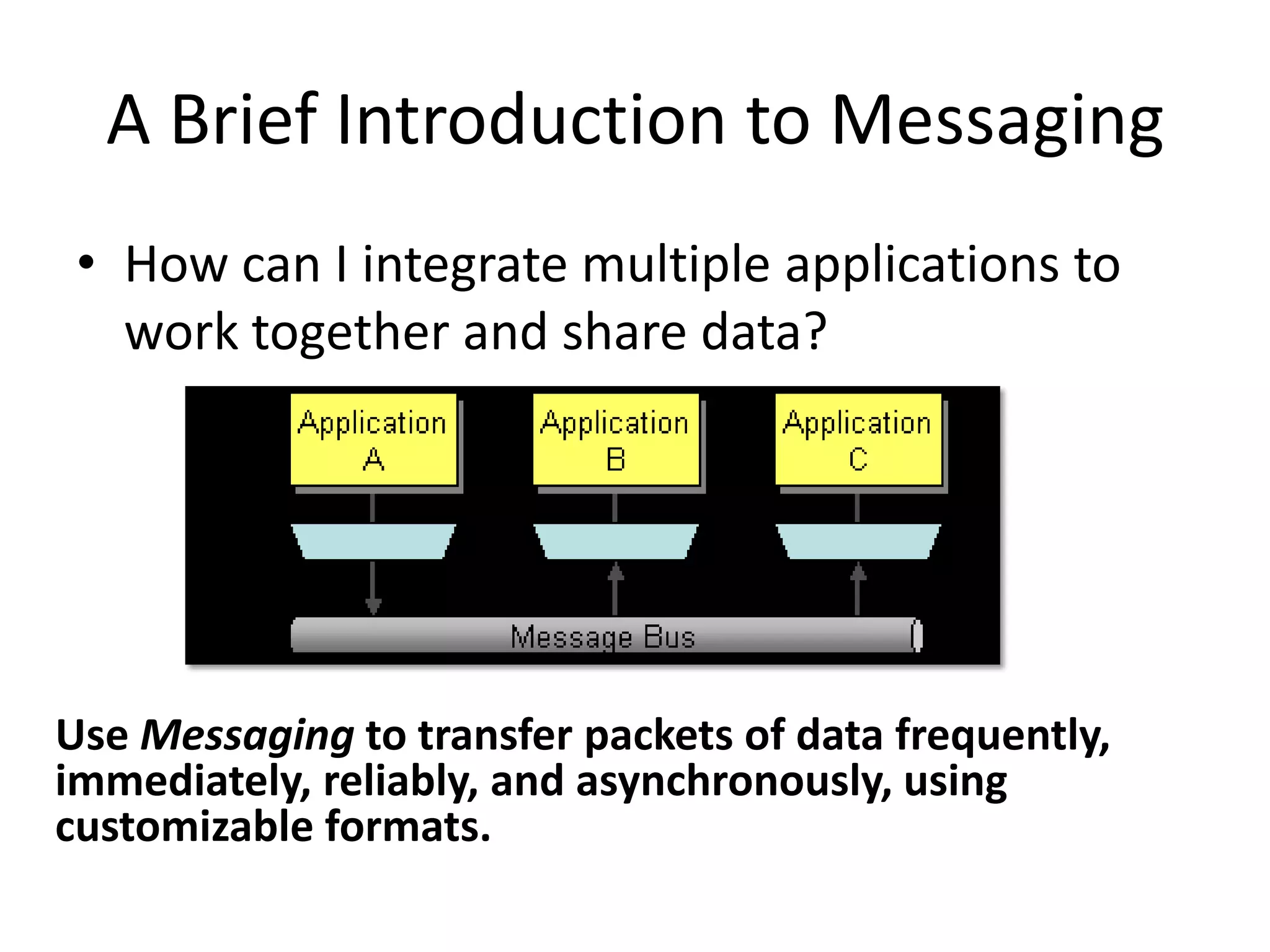
A Brief Introduction to MessagingHow can I integrate multiple applications to work together and share data?Use Messaging to transfer packets of data frequently, immediately, reliably, and asynchronously, using customizable formats.
You might need messaging if…Need to integrate different systems to work togetherNeed to scaleNeed to be able to monitor data feedsDecoupled Publishers and SubscribersQueuing and Buffering for later delivery
You Might Not Need Messaging If…Just need single process asynchronous behaviorWant to just isolate concepts within the application (package scope or even OSGi might work better here)Use your best judgement! 
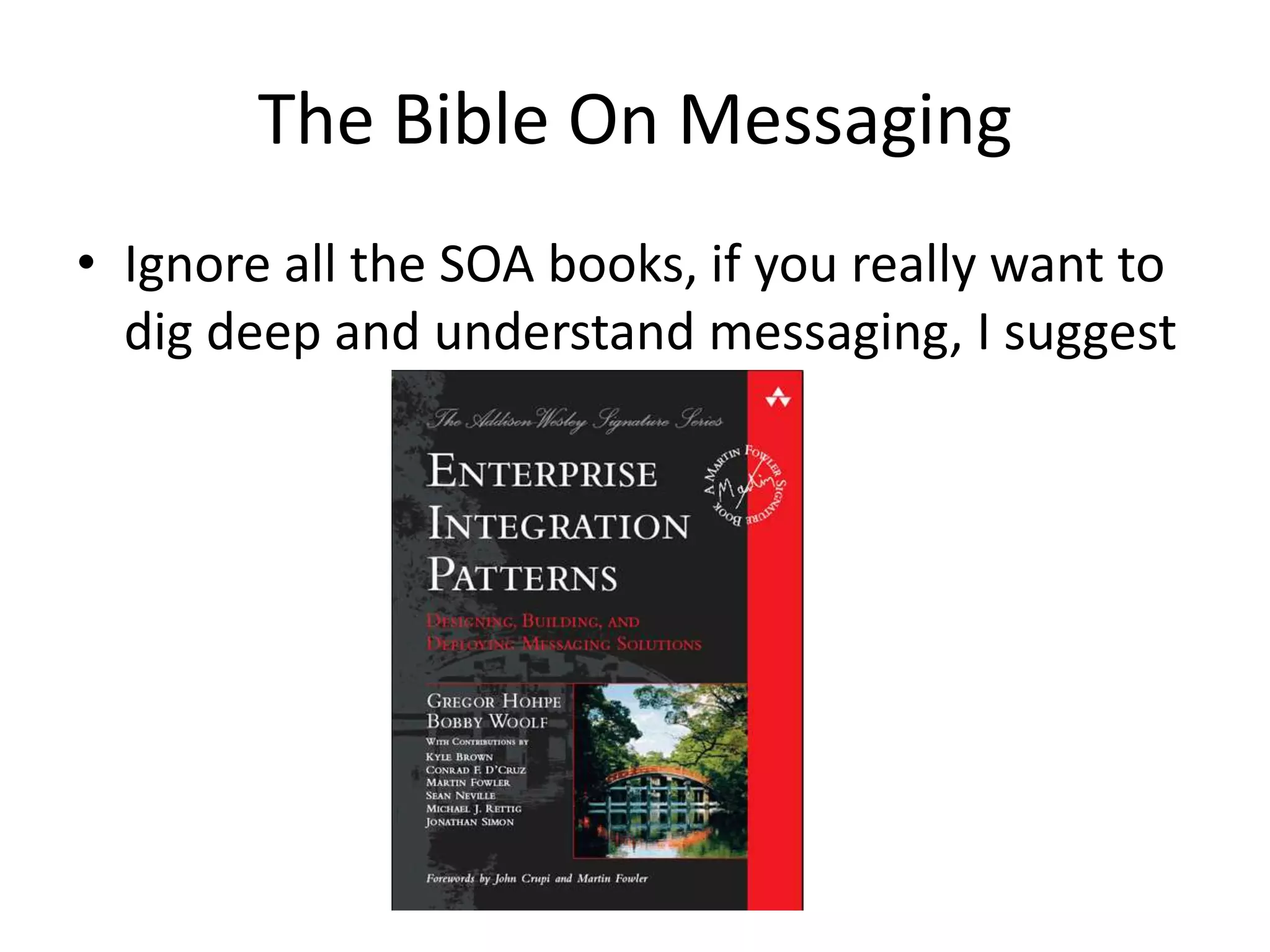
The Bible On MessagingIgnore all the SOA books, if you really want to dig deep and understand messaging, I suggest
Brief Overview of MessagingBefore we dig deep, it’s good to have a brief overview of concepts that are used in messaging
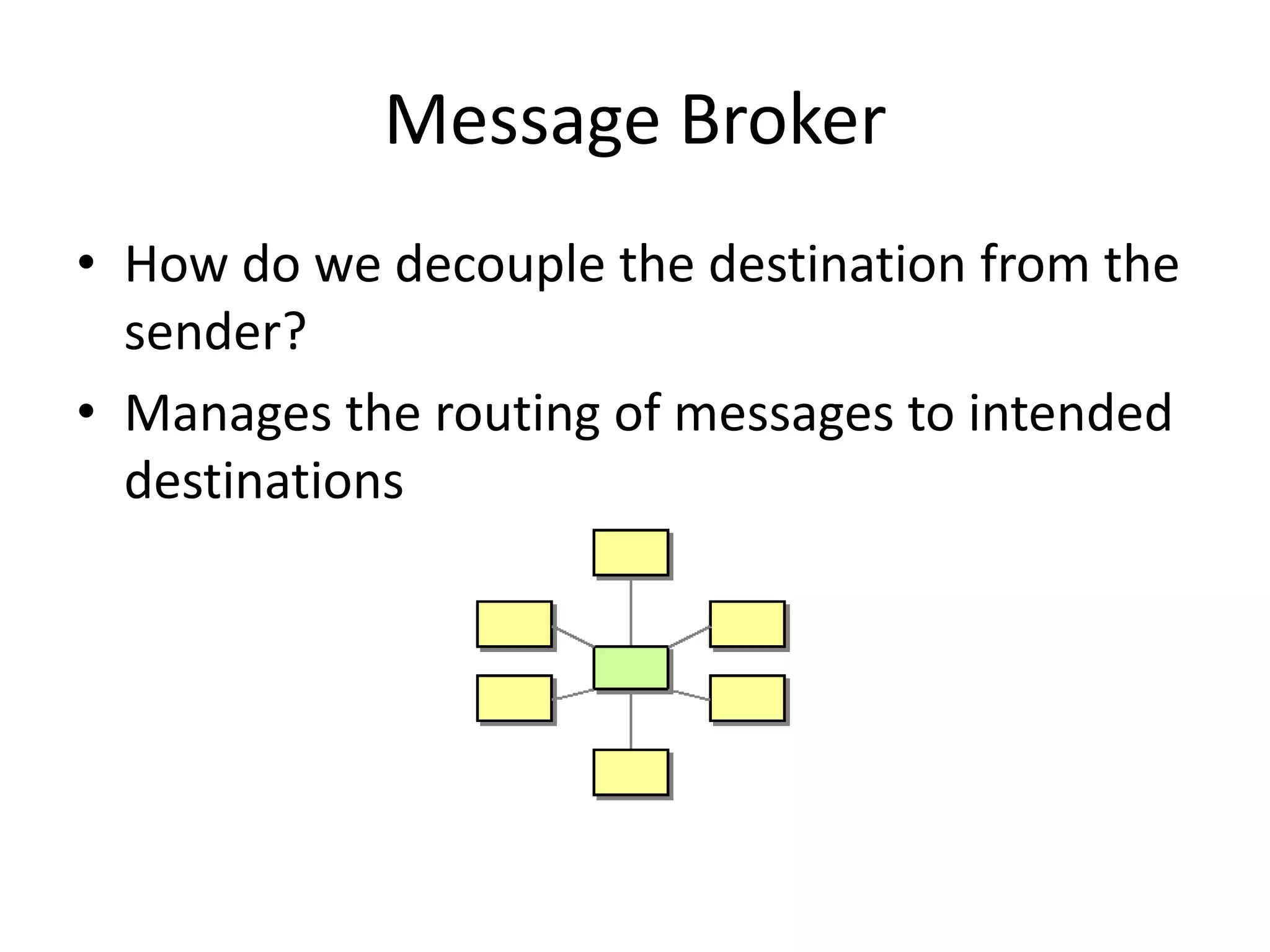
Message BrokerHow do we decouple the destination from the sender?Manages the routing of messages to intended destinations
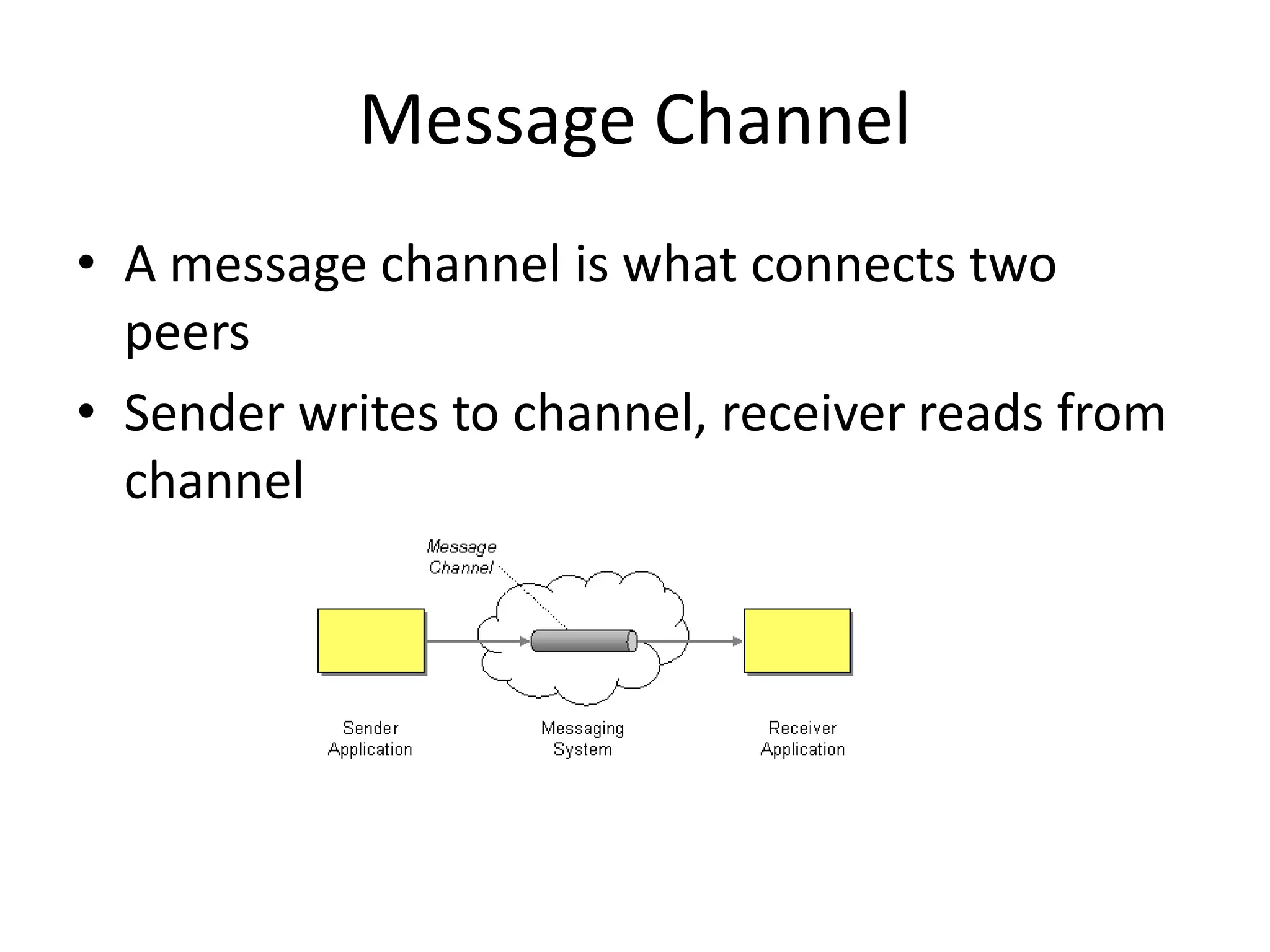
Message ChannelA message channel is what connects two peersSender writes to channel, receiver reads from channel
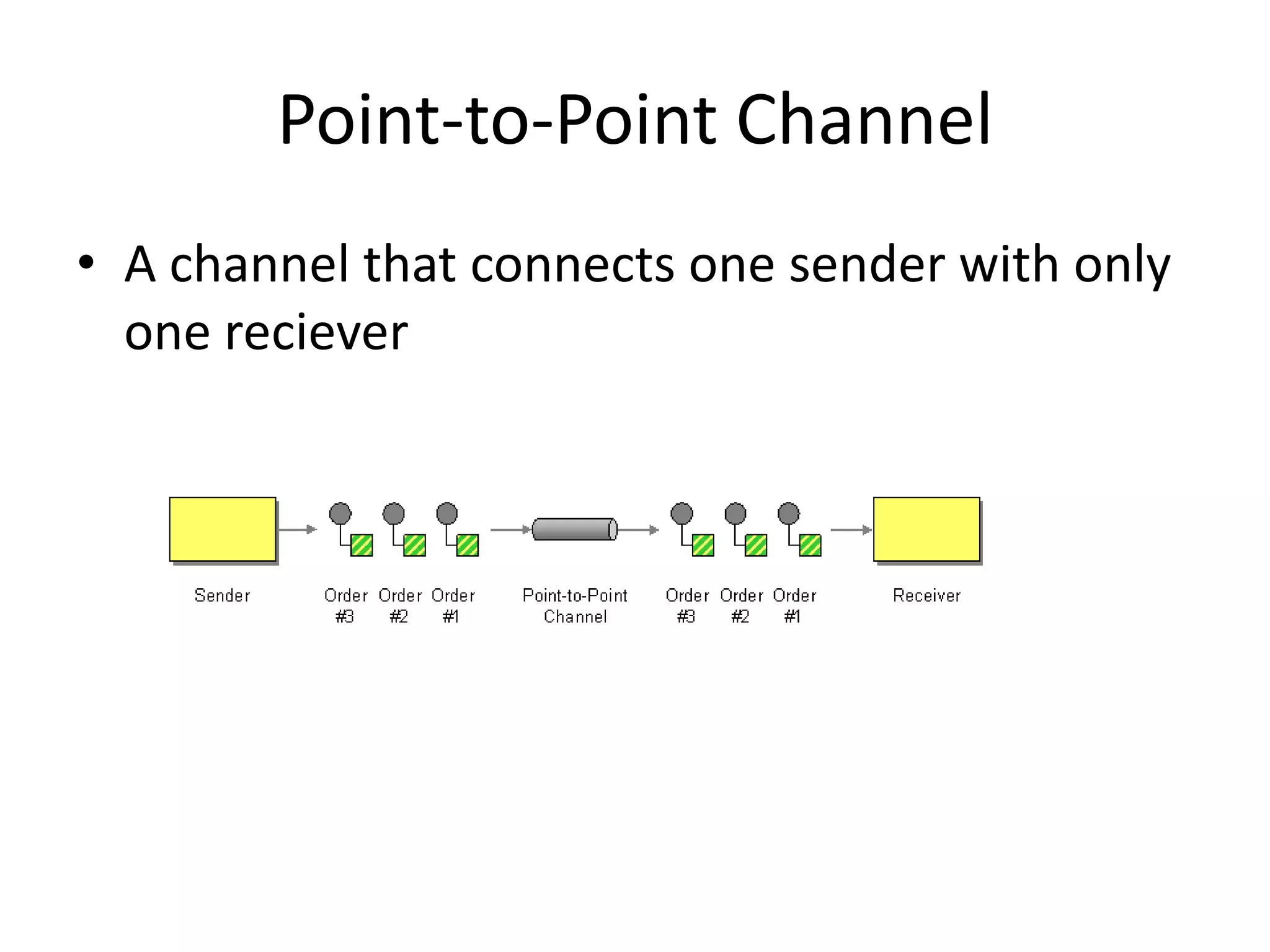
Point-to-Point ChannelA channel that connects one sender with only one reciever
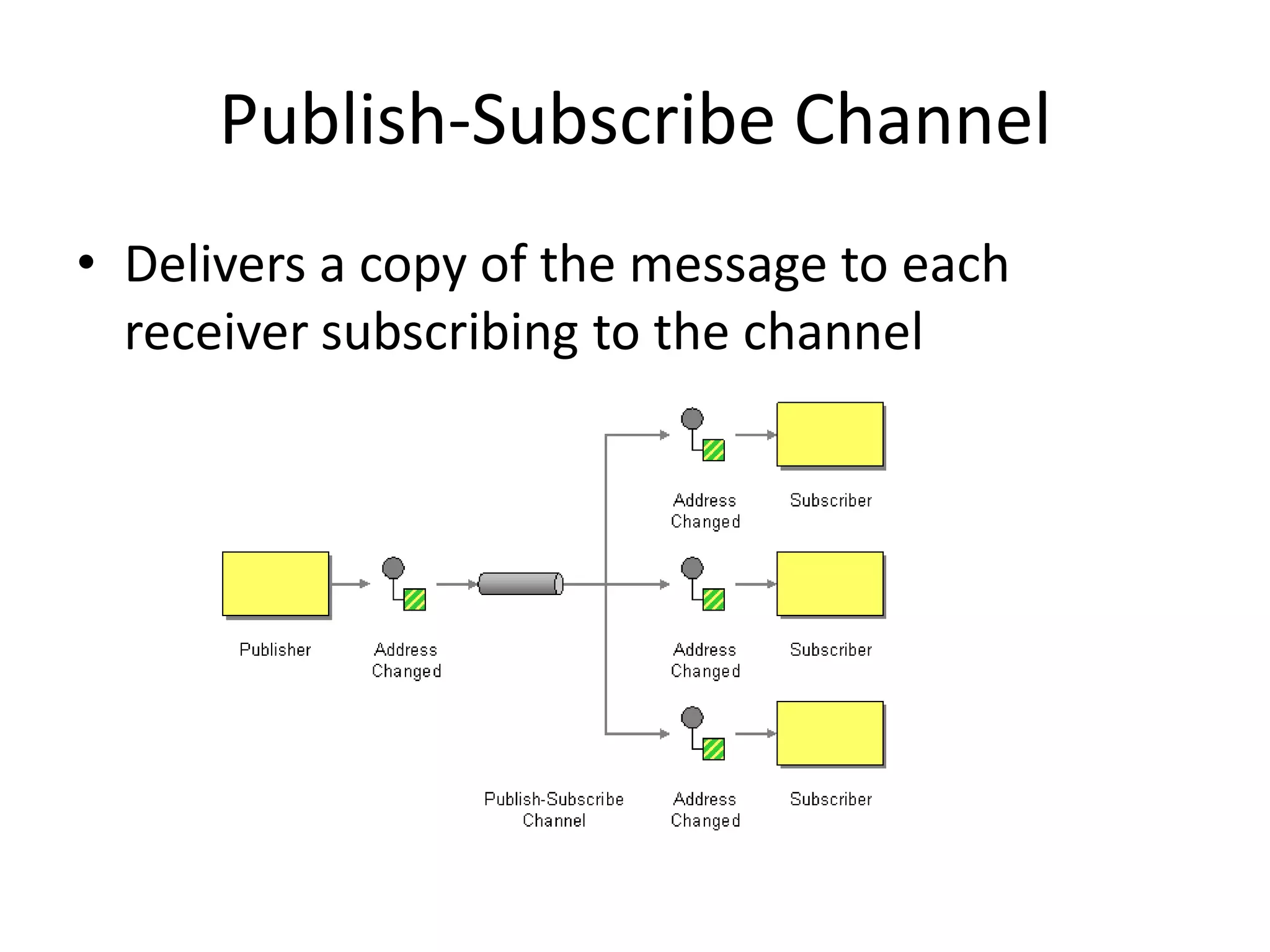
Publish-Subscribe ChannelDelivers a copy of the message to each receiver subscribing to the channel
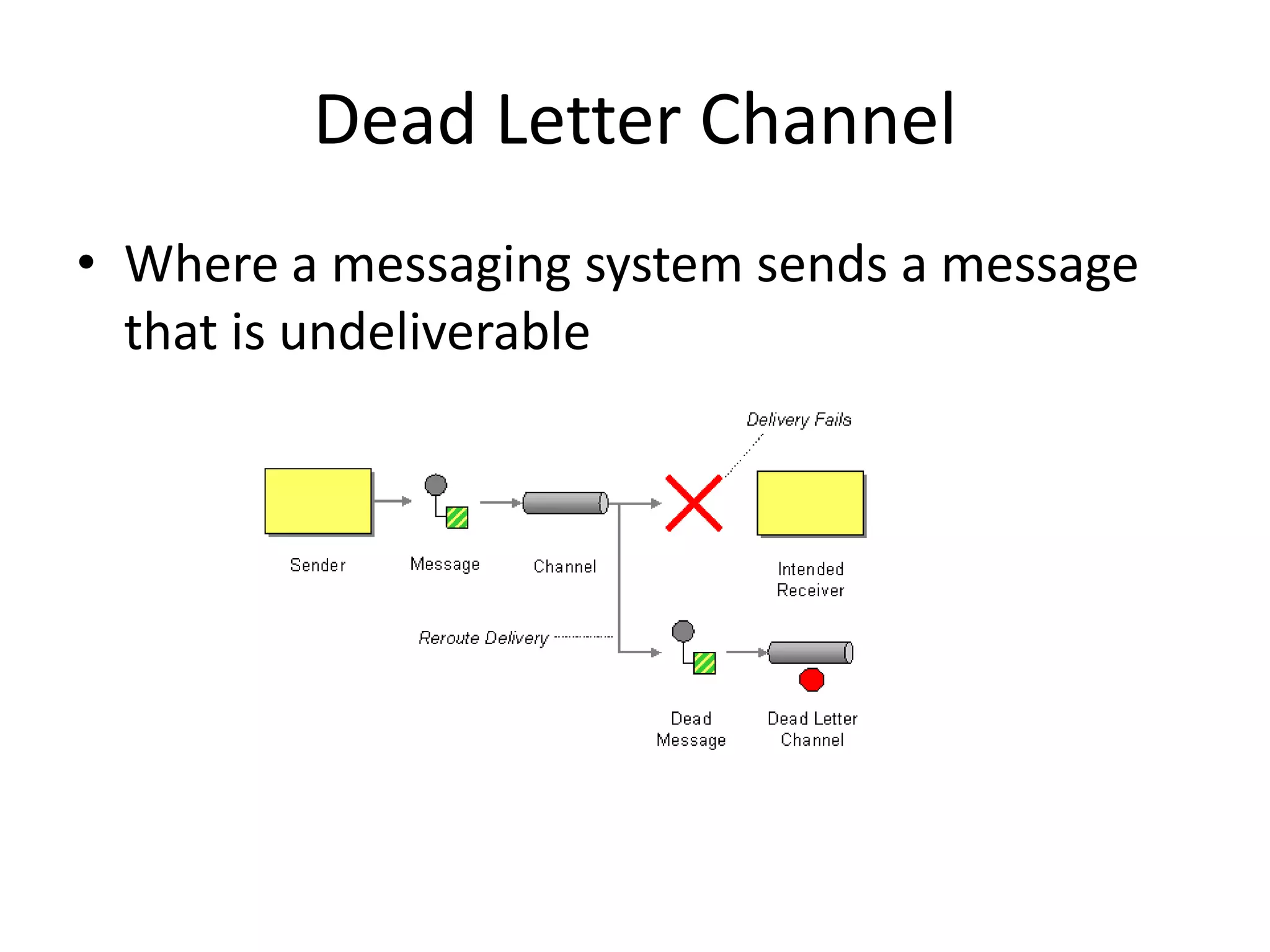
Dead Letter ChannelWhere a messaging system sends a message that is undeliverable
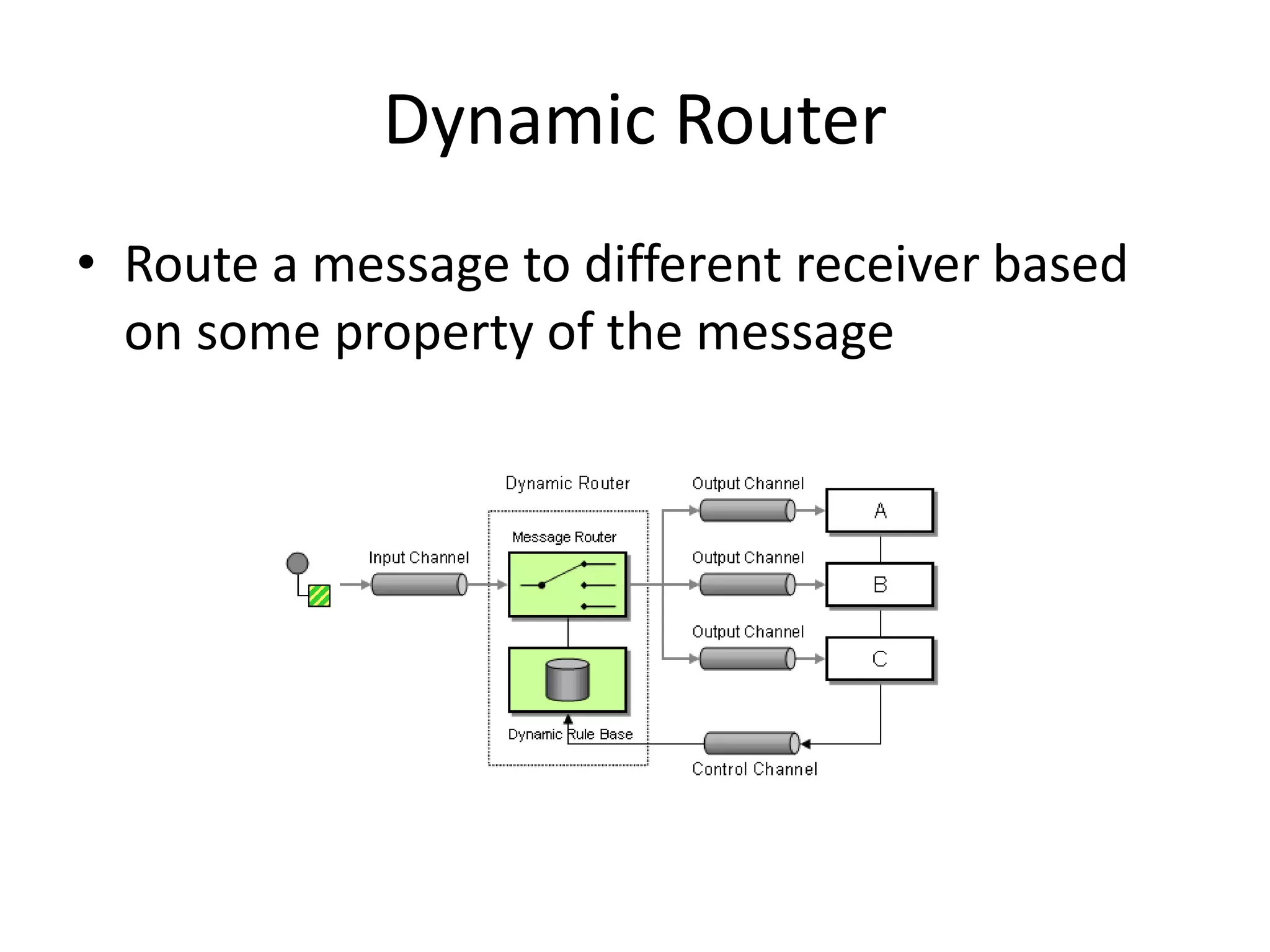
Dynamic RouterRoute a message to different receiver based on some property of the message
The Sad State of MessagingMessage oriented middleware is the “holy grail” of many enterprises
Lots and lots of vendor locked in solutions exist (yes, I’m looking at YOU, Oracle)
Complex, proprietary, and closed
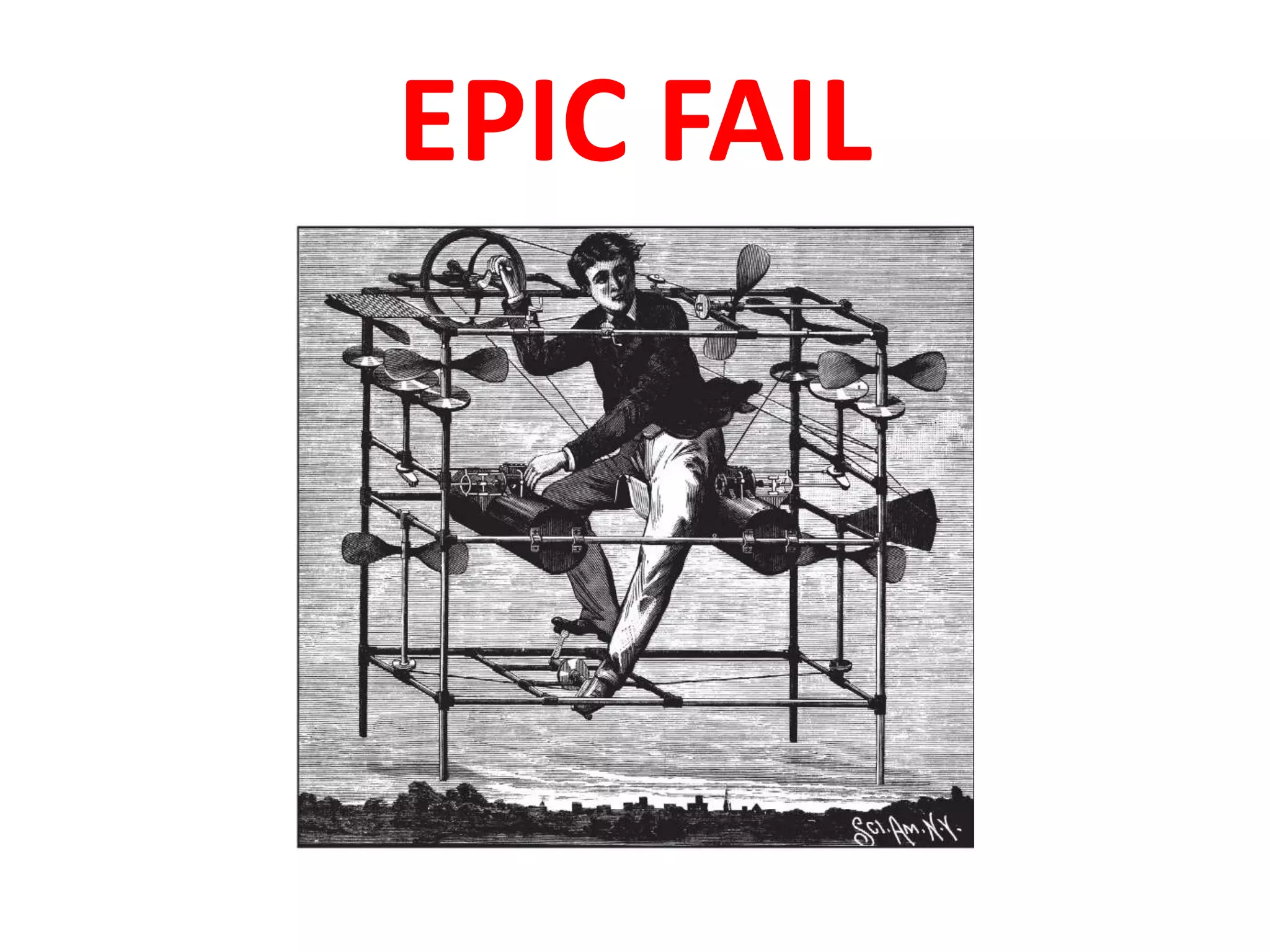
Support contracts and licensing fees can shoot into the stratosphereEPIC FAIL
Open Standards to the Rescue!AMQPSTOMPXMPPJSON-RPCFor this presentation I’ll mostly cover AMQP, but delve a little into STOMP
       AMQP Features
Where? Who?
AMQPAdvanced Message Queuing PrototcolDefines the wire level protocol (whereas JMS defines only an API)Completely open and specified by the AMQP Working GroupIncludes many companies, such as J.P. Morgan, Bank of America, Cisco, Red Hat, iMatrix, Rabbit Technologies, etc.Defines the semantics of server and client behavior to ensure interoperability.
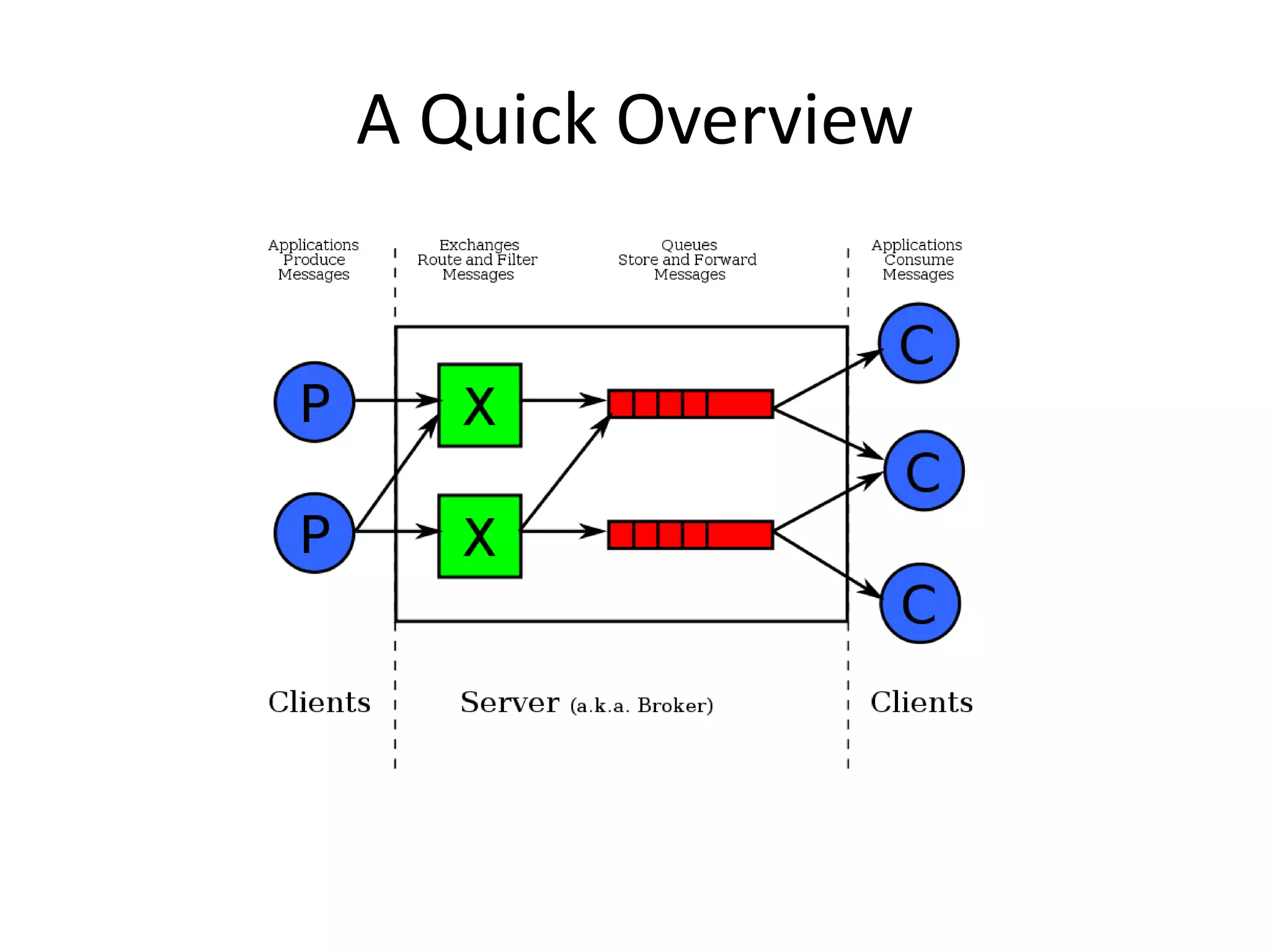
A Quick Overview
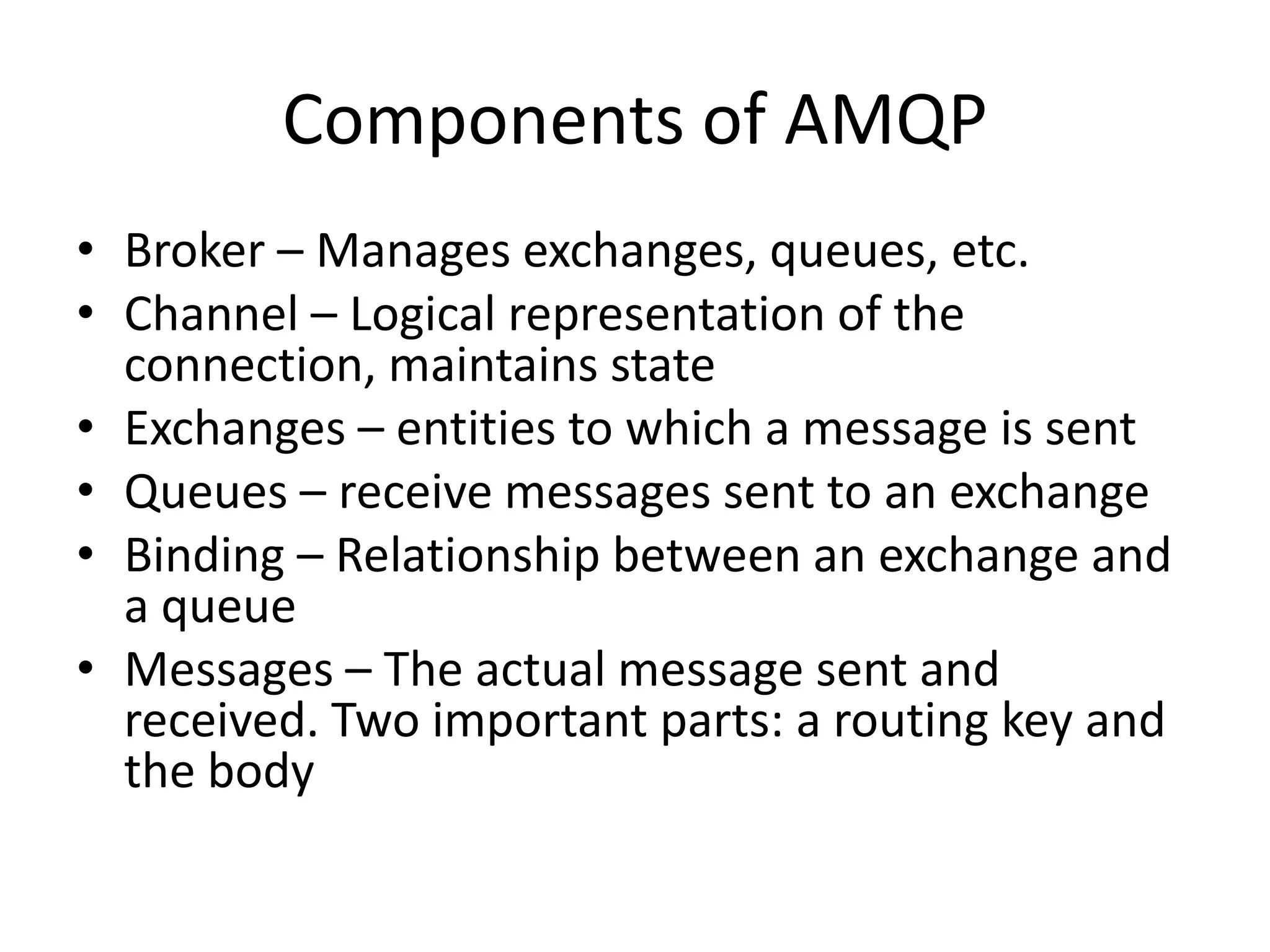
Components of AMQPBroker – Manages exchanges, queues, etc.Channel – Logical representation of the connection, maintains stateExchanges – entities to which a message is sentQueues – receive messages sent to an exchangeBinding – Relationship between an exchange and a queueMessages – The actual message sent and received. Two important parts: a routing key and the body
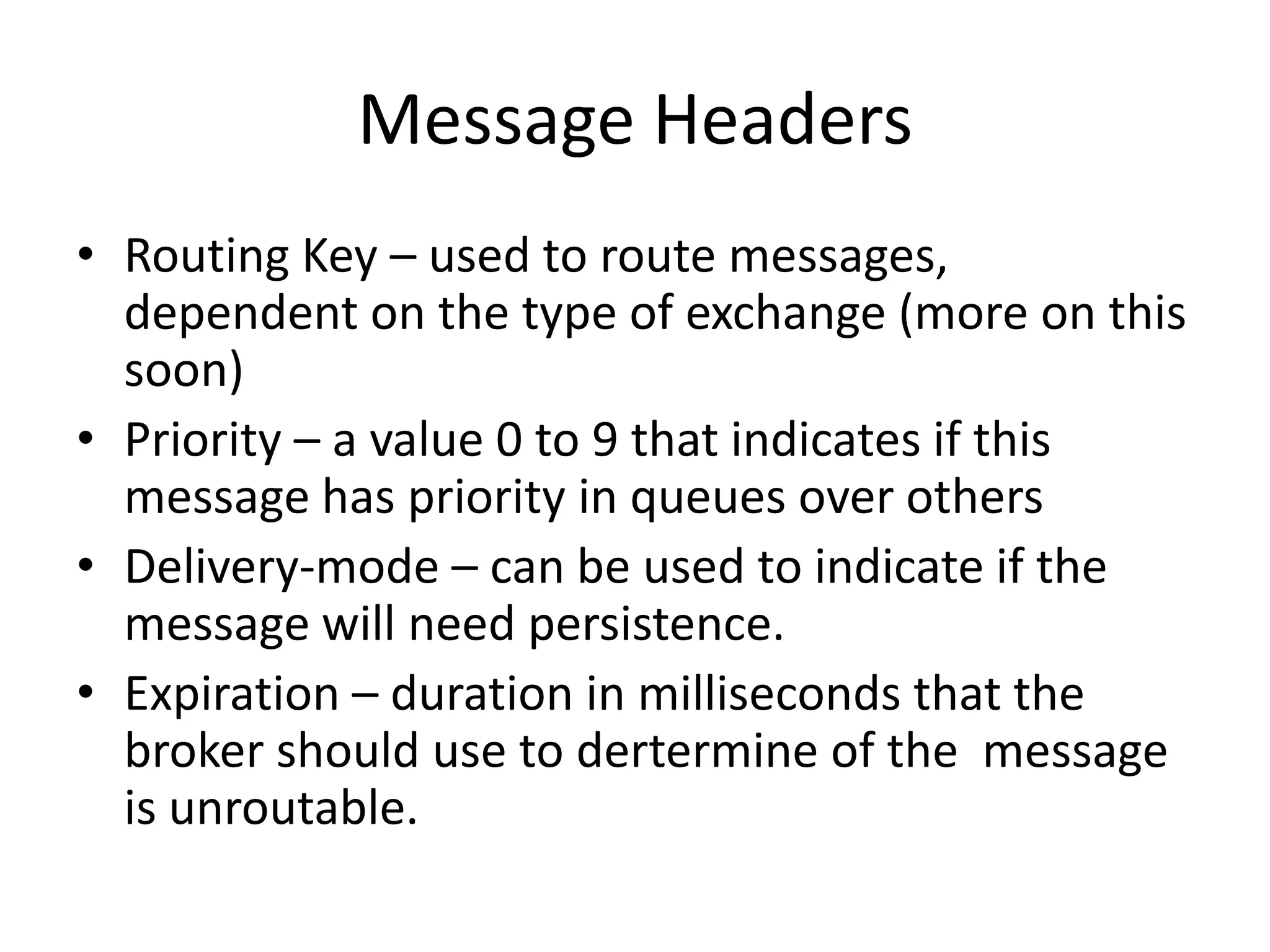
Message HeadersRouting Key – used to route messages, dependent on the type of exchange (more on this soon)Priority – a value 0 to 9 that indicates if this message has priority in queues over othersDelivery-mode – can be used to indicate if the message will need persistence. Expiration – duration in milliseconds that the broker should use to dertermine of the  message is unroutable.
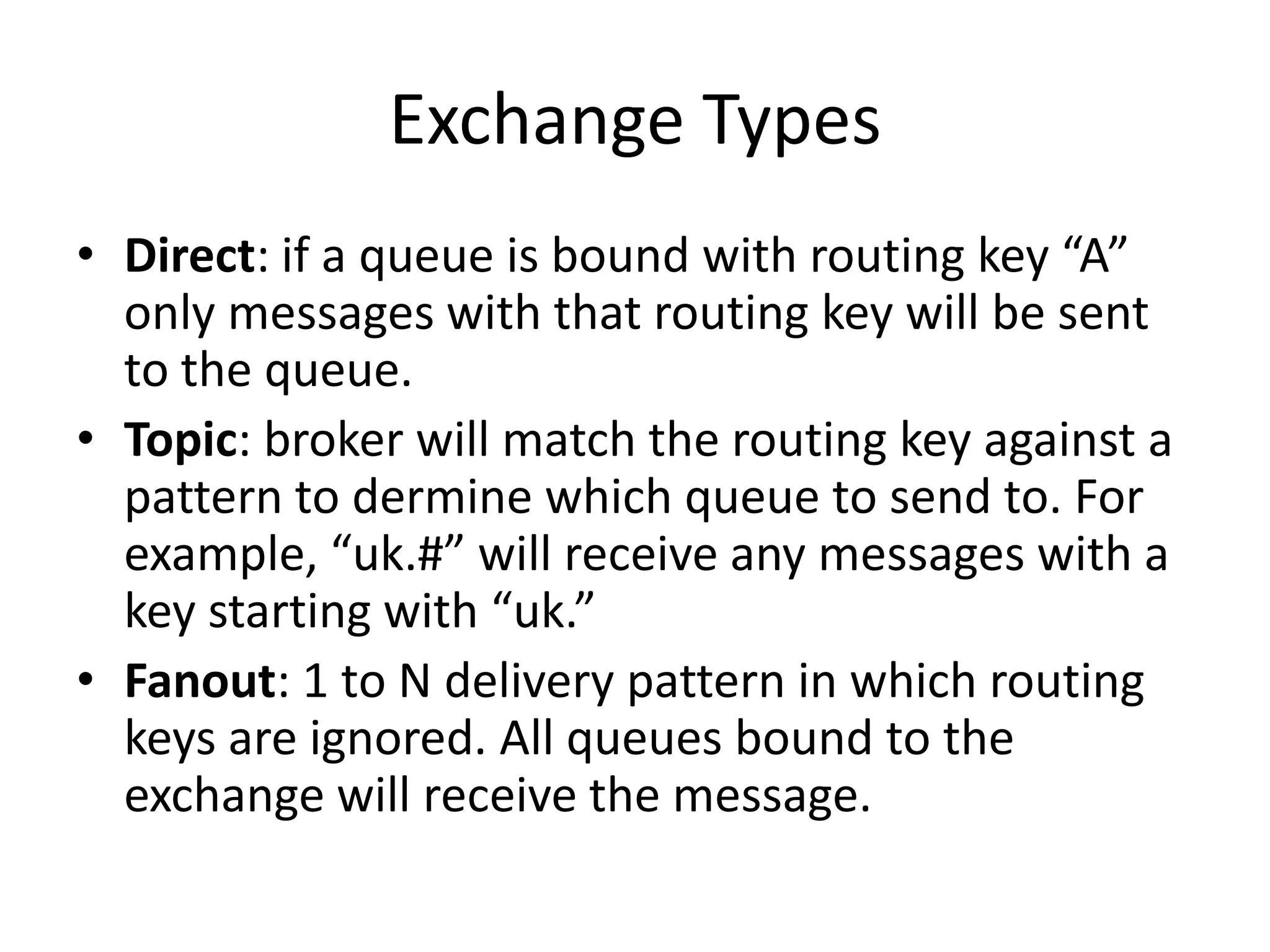
Exchange TypesDirect: if a queue is bound with routing key “A” only messages with that routing key will be sent to the queue. Topic: broker will match the routing key against a pattern to dermine which queue to send to. For example, “uk.#” will receive any messages with a key starting with “uk.”Fanout: 1 to N delivery pattern in which routing keys are ignored. All queues bound to the exchange will receive the message.
ExchangesWho creates exchanges?Clients do. Other configurable properties: Passive: will not create the exchange, but will fail if it doesn’t exist.Durable: exchange will survive a broker restartAuto-delete: exchange will get deleted as soon as there are no more queues bound to it.
QueuesQueues receive messages, in orderConsumers subscribe to queuesConsumers can also consume the queue as they see fit Inherits the same properties an exchange has (durable, auto-delete,passive) with a couple additional ones:Exclusive: only one client can subscribe to this queueAlternate-exchange: exchange to reroute rejected or orphaned messages
BindingSpecifies how messages flow from exchange to queueMatch the routing algorithm used in the exchangeDirect: “foo.bar.baz”Fanout: “#”Topic: “foo.*.baz” or “foo.#”
Check out http://www.amqp.org if you want to learn more.
AMQP BrokersActiveMQ - http://activemq.apache.org/ZeroMQ(integrates with) – http://zeromq.orgApache Qpid - http://qpid.apache.org/RabbitMQ - http://www.rabbitmq.com/
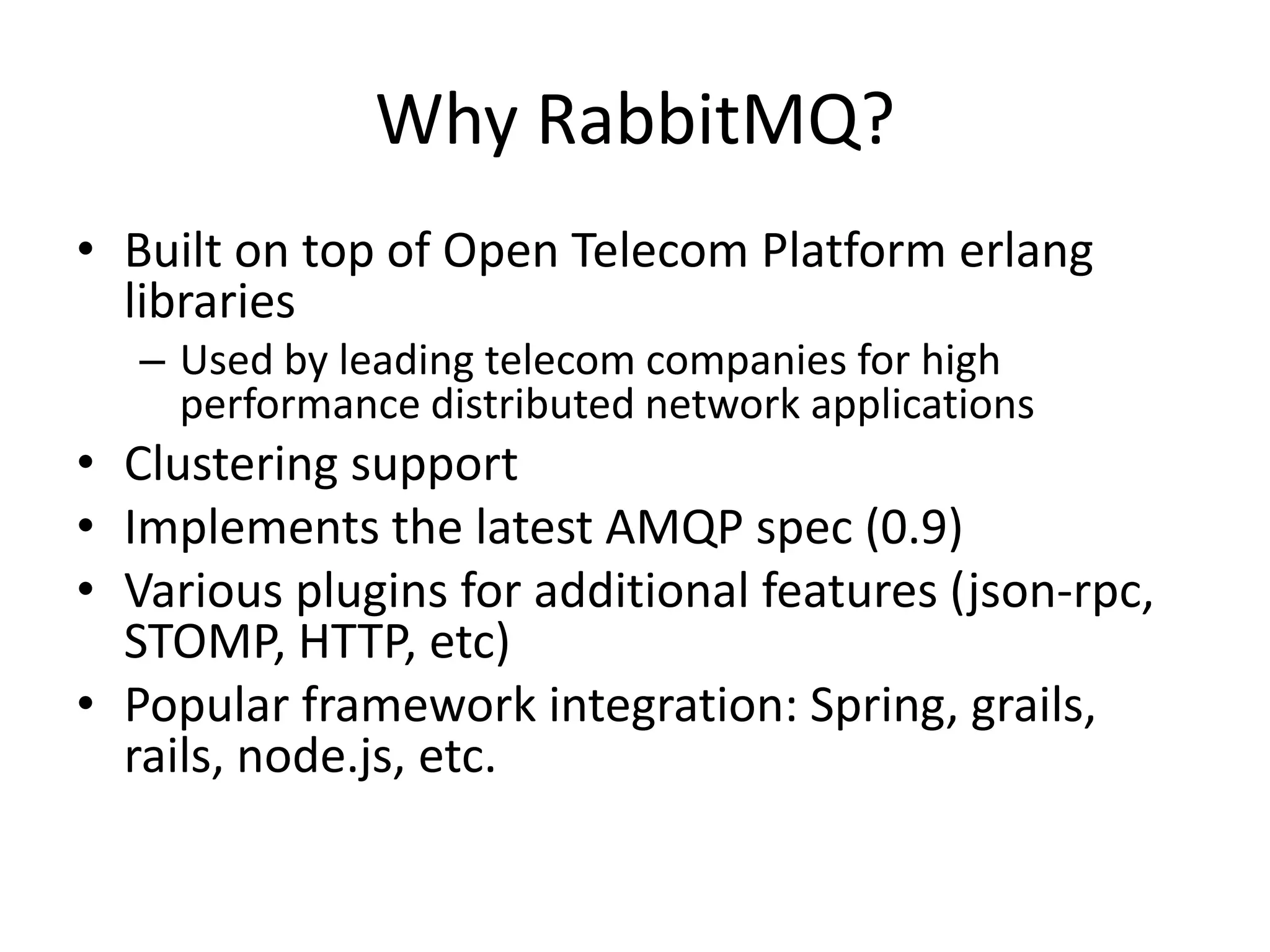
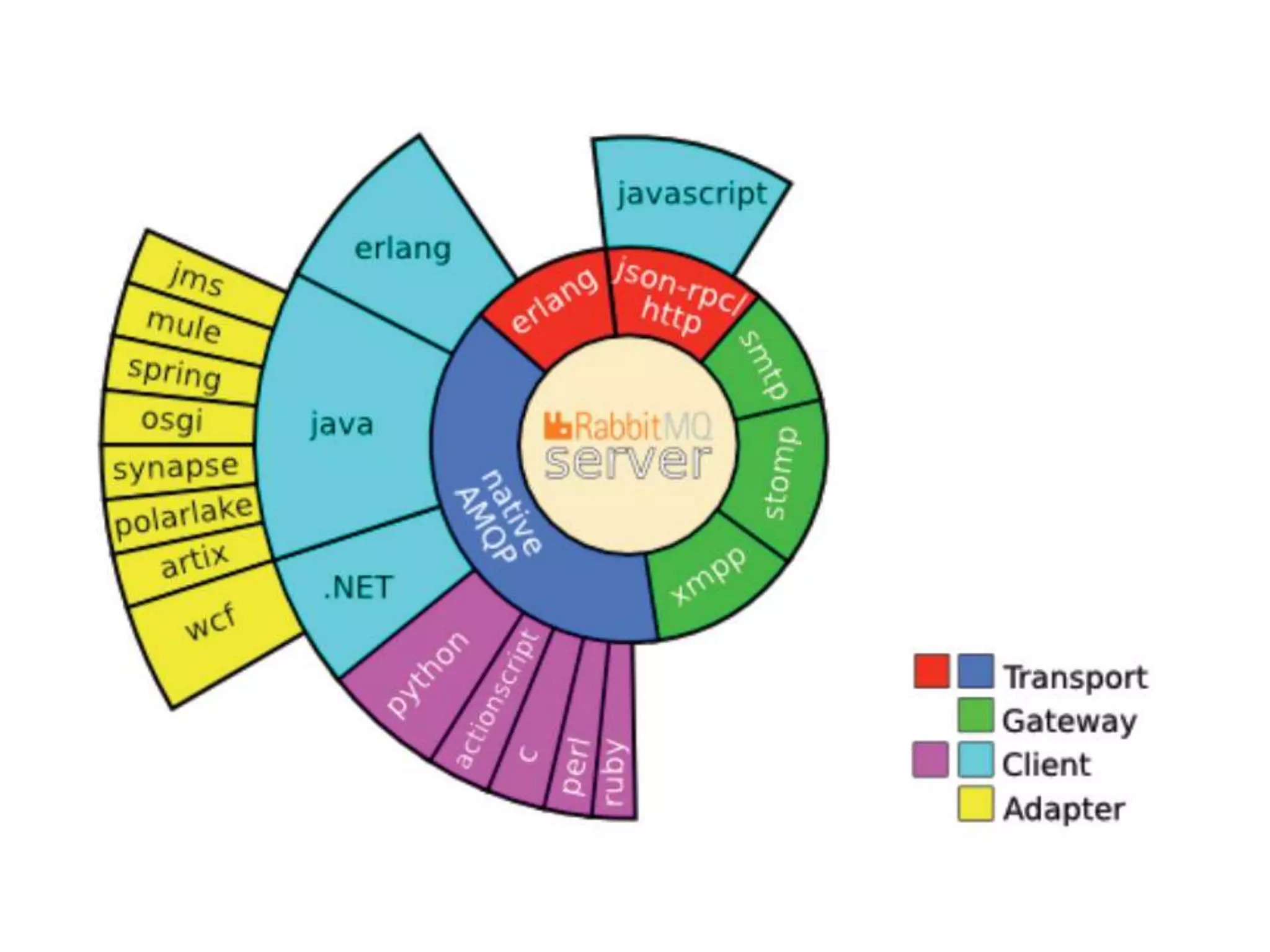
Why RabbitMQ?Built on top of Open Telecom Platform erlang librariesUsed by leading telecom companies for high performance distributed network applicationsClustering supportImplements the latest AMQP spec (0.9)Various plugins for additional features (json-rpc, STOMP, HTTP, etc)Popular framework integration: Spring, grails, rails, node.js, etc.
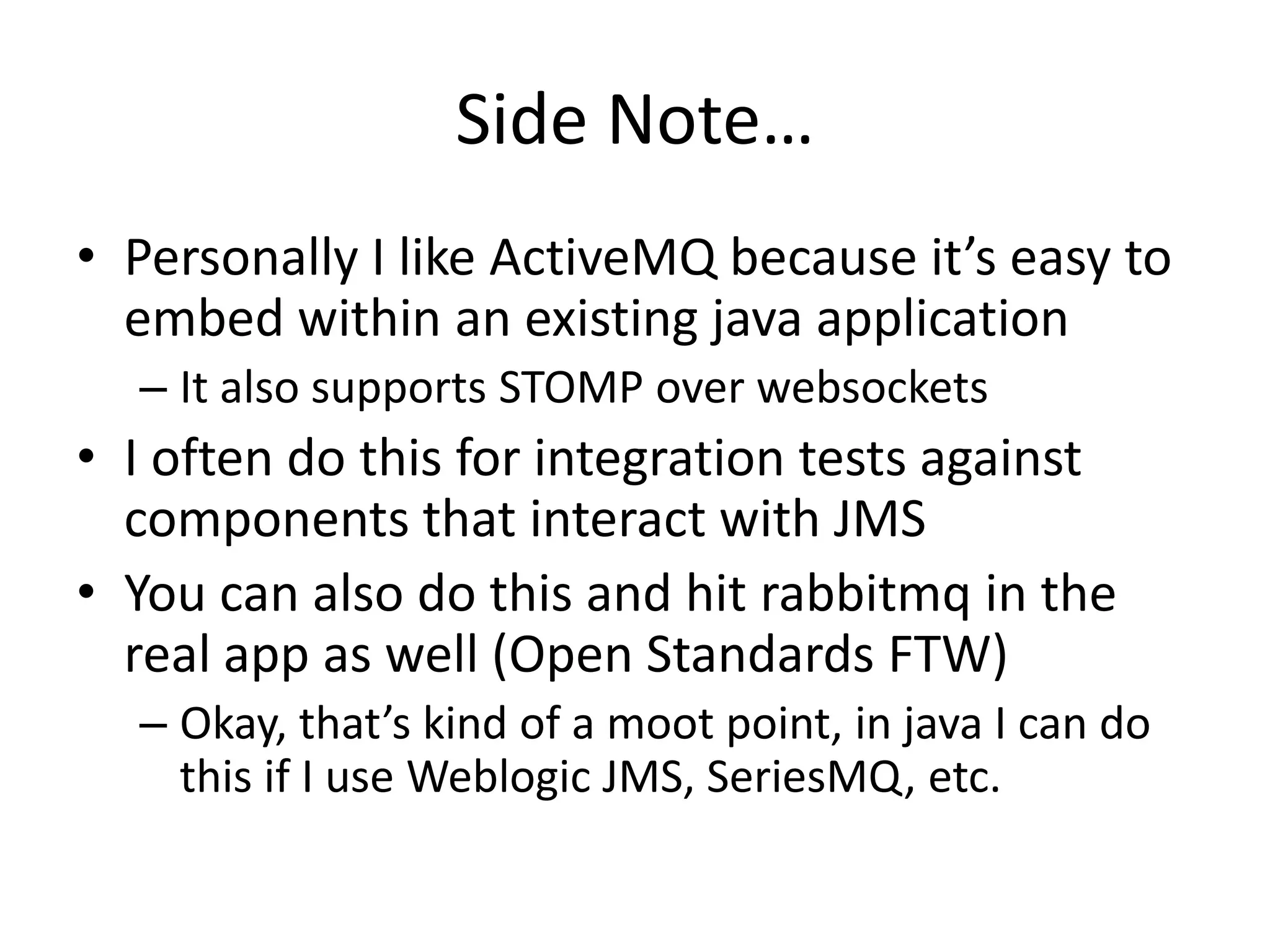
Side Note…Personally I like ActiveMQ because it’s easy to embed within an existing java application It also supports STOMP over websocketsI often do this for integration tests against components that interact with JMSYou can also do this and hit rabbitmq in the real app as well (Open Standards FTW)Okay, that’s kind of a moot point, in java I can do this if I use Weblogic JMS, SeriesMQ, etc.
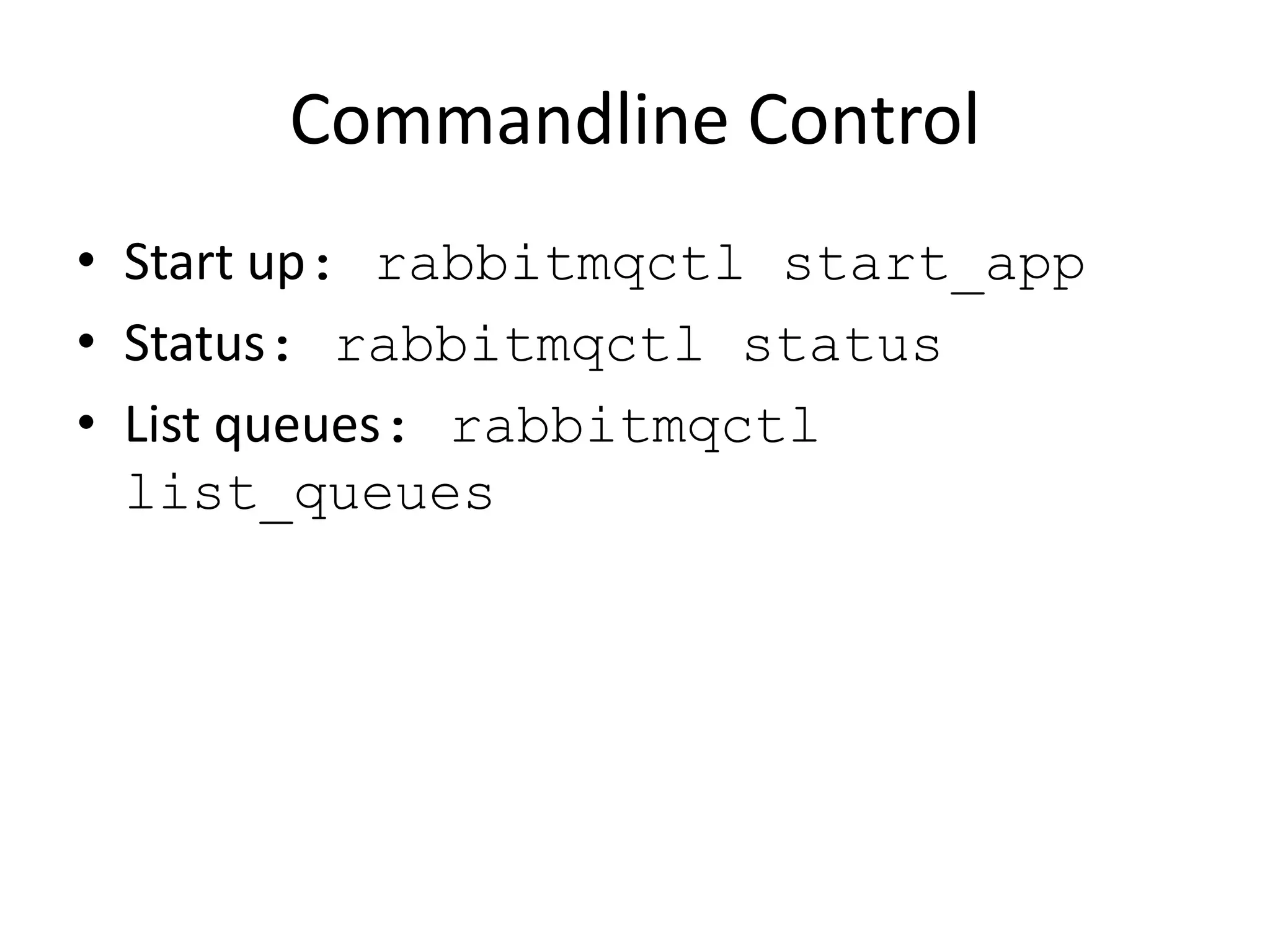
Commandline ControlStart up: rabbitmqctlstart_appStatus: rabbitmqctl statusList queues: rabbitmqctllist_queues
Enough Jibber Jabber! Show me an example fool!
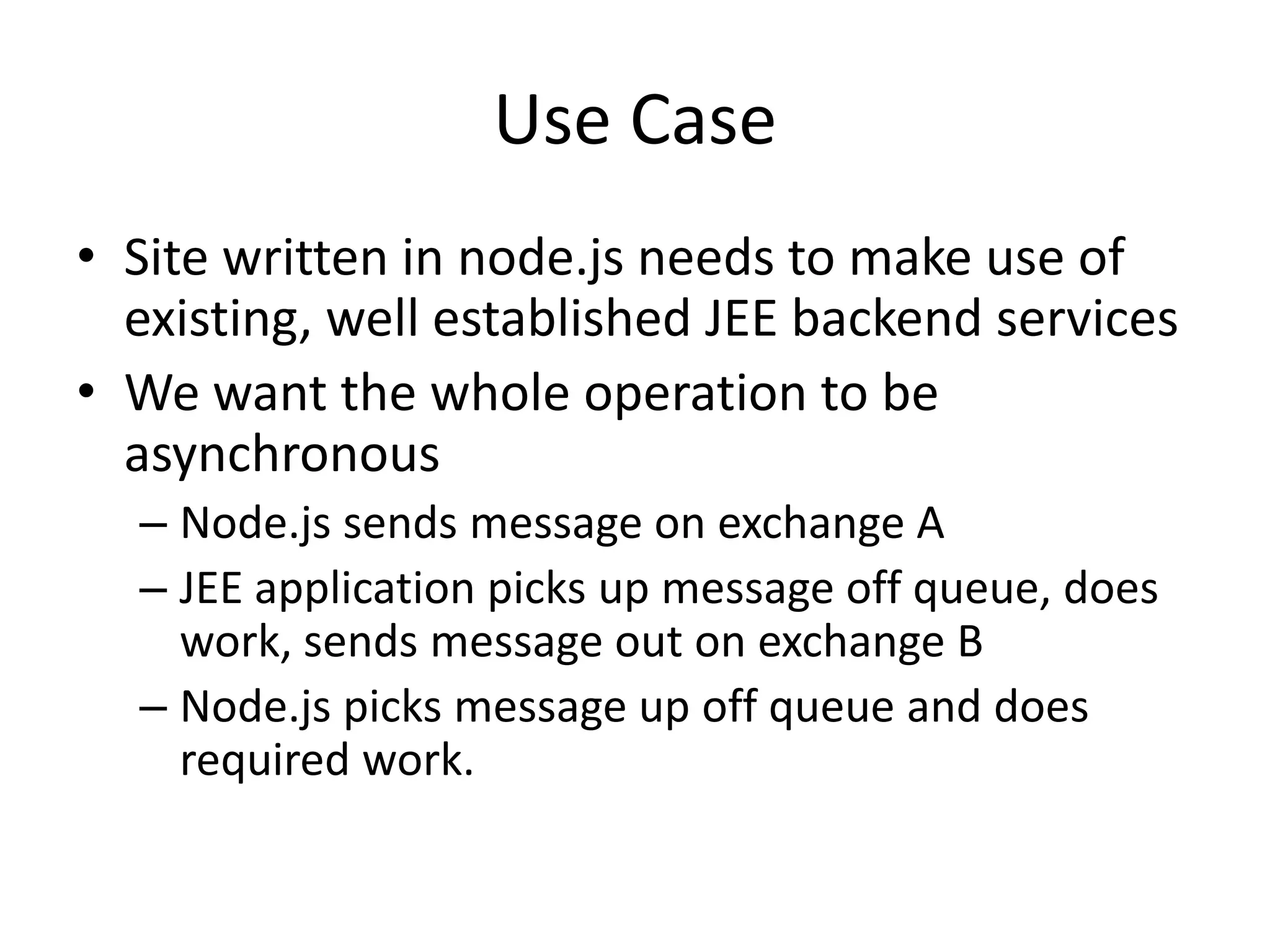
Use CaseSite written in node.js needs to make use of existing, well established JEE backend servicesWe want the whole operation to be asynchronousNode.js sends message on exchange AJEE application picks up message off queue, does work, sends message out on exchange BNode.js picks message up off queue and does required work.
Using RabbitMQ in JavaThe client library from the rabbitmq siteApache camel’s amqp component to send and receive messages from rabbitmqspring-amqp (currently available as a milestone release, 1.0.0.M1)This means you mavenizers will need to use the alternate repository locationhttp://maven.springframework.org/milestoneThere’s also a rabbitmq grails plugin. 

High powered messaging with RabbitMQ

  • 1.
    High Powered MessagingwithJames CarrSoftware EngineerOCI
  • 2.
  • 3.
    A Brief Introductionto MessagingHow can I integrate multiple applications to work together and share data?Use Messaging to transfer packets of data frequently, immediately, reliably, and asynchronously, using customizable formats.
  • 4.
    You might needmessaging if…Need to integrate different systems to work togetherNeed to scaleNeed to be able to monitor data feedsDecoupled Publishers and SubscribersQueuing and Buffering for later delivery
  • 5.
    You Might NotNeed Messaging If…Just need single process asynchronous behaviorWant to just isolate concepts within the application (package scope or even OSGi might work better here)Use your best judgement! 
  • 6.
    The Bible OnMessagingIgnore all the SOA books, if you really want to dig deep and understand messaging, I suggest
  • 7.
    Brief Overview ofMessagingBefore we dig deep, it’s good to have a brief overview of concepts that are used in messaging
  • 8.
    Message BrokerHow dowe decouple the destination from the sender?Manages the routing of messages to intended destinations
  • 9.
    Message ChannelA messagechannel is what connects two peersSender writes to channel, receiver reads from channel
  • 10.
    Point-to-Point ChannelA channelthat connects one sender with only one reciever
  • 11.
    Publish-Subscribe ChannelDelivers acopy of the message to each receiver subscribing to the channel
  • 12.
    Dead Letter ChannelWherea messaging system sends a message that is undeliverable
  • 13.
    Dynamic RouterRoute amessage to different receiver based on some property of the message
  • 14.
    The Sad Stateof MessagingMessage oriented middleware is the “holy grail” of many enterprises
  • 15.
    Lots and lotsof vendor locked in solutions exist (yes, I’m looking at YOU, Oracle)
  • 16.
  • 17.
    Support contracts andlicensing fees can shoot into the stratosphereEPIC FAIL
  • 18.
    Open Standards tothe Rescue!AMQPSTOMPXMPPJSON-RPCFor this presentation I’ll mostly cover AMQP, but delve a little into STOMP
  • 19.
    AMQP Features
  • 20.
  • 21.
    AMQPAdvanced Message QueuingPrototcolDefines the wire level protocol (whereas JMS defines only an API)Completely open and specified by the AMQP Working GroupIncludes many companies, such as J.P. Morgan, Bank of America, Cisco, Red Hat, iMatrix, Rabbit Technologies, etc.Defines the semantics of server and client behavior to ensure interoperability.
  • 22.
  • 23.
    Components of AMQPBroker– Manages exchanges, queues, etc.Channel – Logical representation of the connection, maintains stateExchanges – entities to which a message is sentQueues – receive messages sent to an exchangeBinding – Relationship between an exchange and a queueMessages – The actual message sent and received. Two important parts: a routing key and the body
  • 24.
    Message HeadersRouting Key– used to route messages, dependent on the type of exchange (more on this soon)Priority – a value 0 to 9 that indicates if this message has priority in queues over othersDelivery-mode – can be used to indicate if the message will need persistence. Expiration – duration in milliseconds that the broker should use to dertermine of the message is unroutable.
  • 25.
    Exchange TypesDirect: ifa queue is bound with routing key “A” only messages with that routing key will be sent to the queue. Topic: broker will match the routing key against a pattern to dermine which queue to send to. For example, “uk.#” will receive any messages with a key starting with “uk.”Fanout: 1 to N delivery pattern in which routing keys are ignored. All queues bound to the exchange will receive the message.
  • 26.
    ExchangesWho creates exchanges?Clientsdo. Other configurable properties: Passive: will not create the exchange, but will fail if it doesn’t exist.Durable: exchange will survive a broker restartAuto-delete: exchange will get deleted as soon as there are no more queues bound to it.
  • 27.
    QueuesQueues receive messages,in orderConsumers subscribe to queuesConsumers can also consume the queue as they see fit Inherits the same properties an exchange has (durable, auto-delete,passive) with a couple additional ones:Exclusive: only one client can subscribe to this queueAlternate-exchange: exchange to reroute rejected or orphaned messages
  • 28.
    BindingSpecifies how messagesflow from exchange to queueMatch the routing algorithm used in the exchangeDirect: “foo.bar.baz”Fanout: “#”Topic: “foo.*.baz” or “foo.#”
  • 29.
    Check out http://www.amqp.orgif you want to learn more.
  • 30.
    AMQP BrokersActiveMQ -http://activemq.apache.org/ZeroMQ(integrates with) – http://zeromq.orgApache Qpid - http://qpid.apache.org/RabbitMQ - http://www.rabbitmq.com/
  • 31.
    Why RabbitMQ?Built ontop of Open Telecom Platform erlang librariesUsed by leading telecom companies for high performance distributed network applicationsClustering supportImplements the latest AMQP spec (0.9)Various plugins for additional features (json-rpc, STOMP, HTTP, etc)Popular framework integration: Spring, grails, rails, node.js, etc.
  • 33.
    Side Note…Personally Ilike ActiveMQ because it’s easy to embed within an existing java application It also supports STOMP over websocketsI often do this for integration tests against components that interact with JMSYou can also do this and hit rabbitmq in the real app as well (Open Standards FTW)Okay, that’s kind of a moot point, in java I can do this if I use Weblogic JMS, SeriesMQ, etc.
  • 34.
    Commandline ControlStart up:rabbitmqctlstart_appStatus: rabbitmqctl statusList queues: rabbitmqctllist_queues
  • 35.
    Enough Jibber Jabber!Show me an example fool!
  • 36.
    Use CaseSite writtenin node.js needs to make use of existing, well established JEE backend servicesWe want the whole operation to be asynchronousNode.js sends message on exchange AJEE application picks up message off queue, does work, sends message out on exchange BNode.js picks message up off queue and does required work.
  • 37.
    Using RabbitMQ inJavaThe client library from the rabbitmq siteApache camel’s amqp component to send and receive messages from rabbitmqspring-amqp (currently available as a milestone release, 1.0.0.M1)This means you mavenizers will need to use the alternate repository locationhttp://maven.springframework.org/milestoneThere’s also a rabbitmq grails plugin. 
  • 38.
    Dirty Details…Licensed underthe Mozilla Public LicenseCommercial Support ExistsGet it now, be up and running in minutes.Contribute!
  • 39.
    LinksMy Node.js example:http://github.com/jamescarr/nodejs-amqp-exampleSpring AMQP: http://www.springsource.org/spring-amqpApache Camel: http://camel.apache.org/RabbitMQhttp://www.rabbitmq.comOpen Source Repository: http://www.rabbitmq.comRabbitMQplugin for grails: http://blog.springsource.com/2010/08/23/rabbitmq-plugin-for-grails-early-access/