Node.js
A Guided Tour


Presenter: C. Aaron Cois, Ph.D.
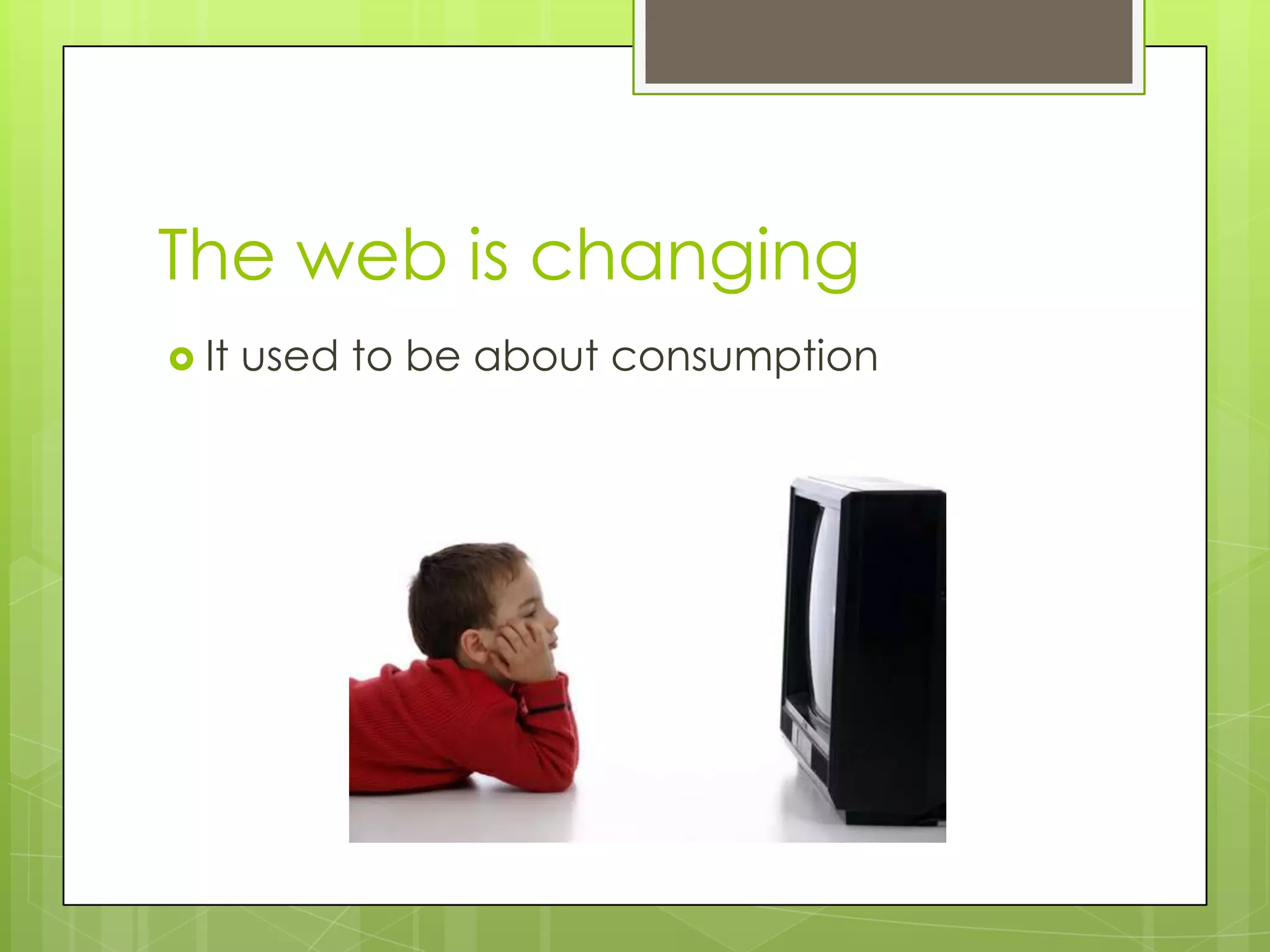
The web is changing
 It   used to be about consumption
Real-time Interaction
 Real-Time   Games
 Chat
 Stock tickers
 Twitter Feeds
 Collaboration
 Creation


…on a massive scale
What do we need to make it
happen?
 Fast,   persistent I/O
     HTTP wasn’t built for this
     Server’s need to push data to clients
     Polling is slow and inefficient


 Scalability
 Usability
 Maintainability
Outline
 What is Node.js?
 Technology Overview
 How does it work?
 Demo
 Code!
 Deployment and Hosting
What is Node.js?
Node.js
 Node.js
        is an event-driven, server-side
 JavaScript environment
    Based on the V8 JavaScript Engine,
     developed by Google
 Most   importantly, node.js is a
    server-side runtime environment, that
    compiles and executes JavaScript very
     efficiently.
Platforms
 Runs    on OSX, Linux, Windows

 Clickable   installers for:
     Windows
     Mac OSX


 Linux   has apt-get and yum
Why Node?
 Node.js is specifically designed for
  building fast, efficient, scalable network
  applications
 Node uses an event-driven, non-blocking
  I/O model to maximize efficiency
Technology: V8 Engine
   Developed by Google
   Ships with the Google Chrome web browser
   Allows Chrome to run JavaScript code much
    faster
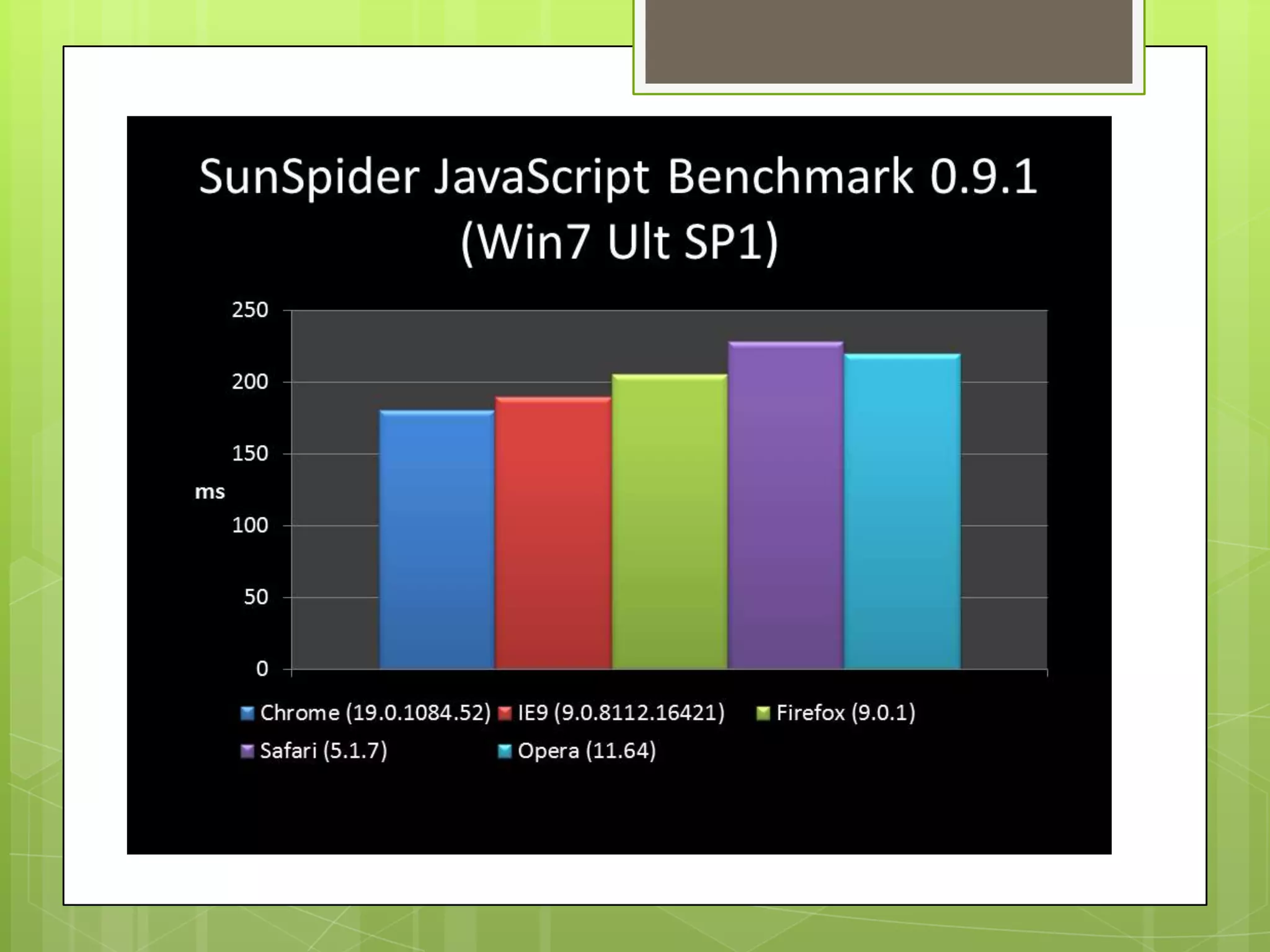
       It does this by compiling the JavaScript directly
        into native machine code
       As opposed to interpreting JavaScript, or
        execute it as bytecode
   What does this mean for us, and for Node.js?
Technology: JavaScript
 JavaScript      is:
    A fully-functional programming language
      Capable of doing anything other traditional
       languages (C++, Java, Ruby, etc) can do
    Has an excellent event model
    Traditionally resigned to the context of the
     web application frontend
      i.e.   running inside a web browser
Technology: JavaScript2
 There’sno reason the JavaScript
 language can’t be used elsewhere (say,
 server-side)
     This is where node.js comes in, executing
      JavaScript efficiently on the server-side
 JavaScript   brings to Node.js:
     Natural event-based programming, ideal
      for client-server applications
     A known language, with low overhead
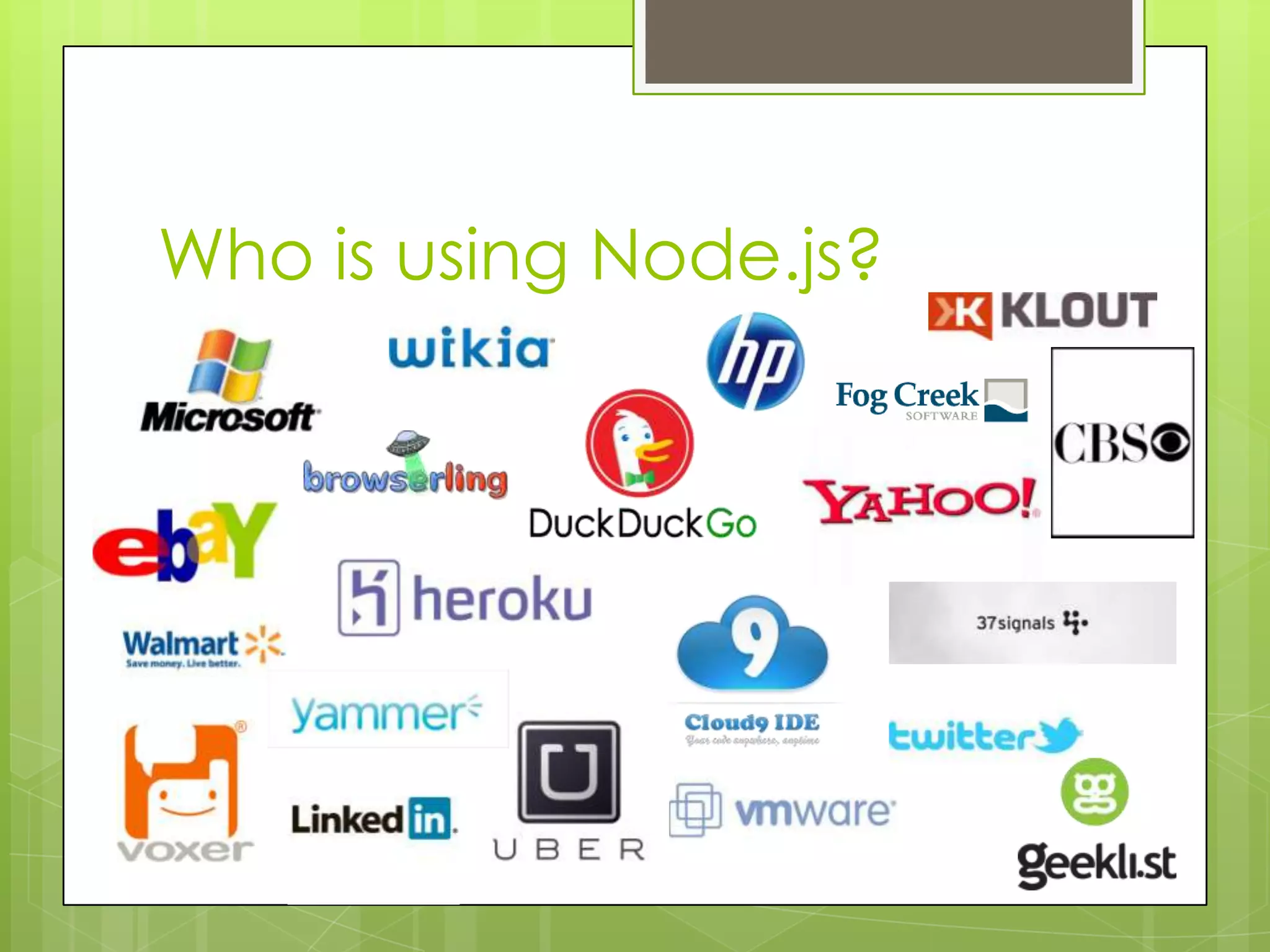
Who is using Node.js?
How does it work?
The Basic Idea


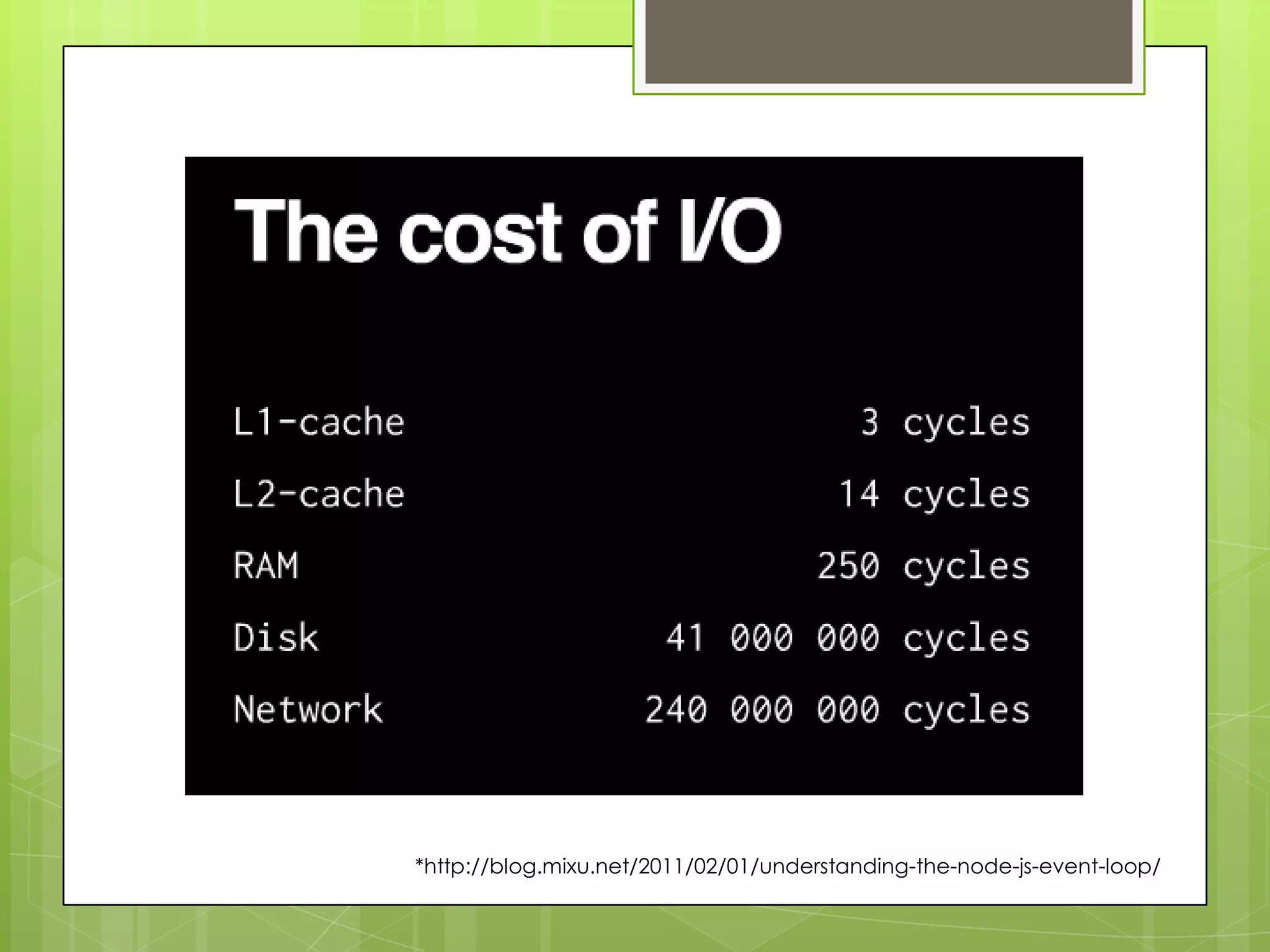
    I/O is expensive
*http://blog.mixu.net/2011/02/01/understanding-the-node-js-event-loop/
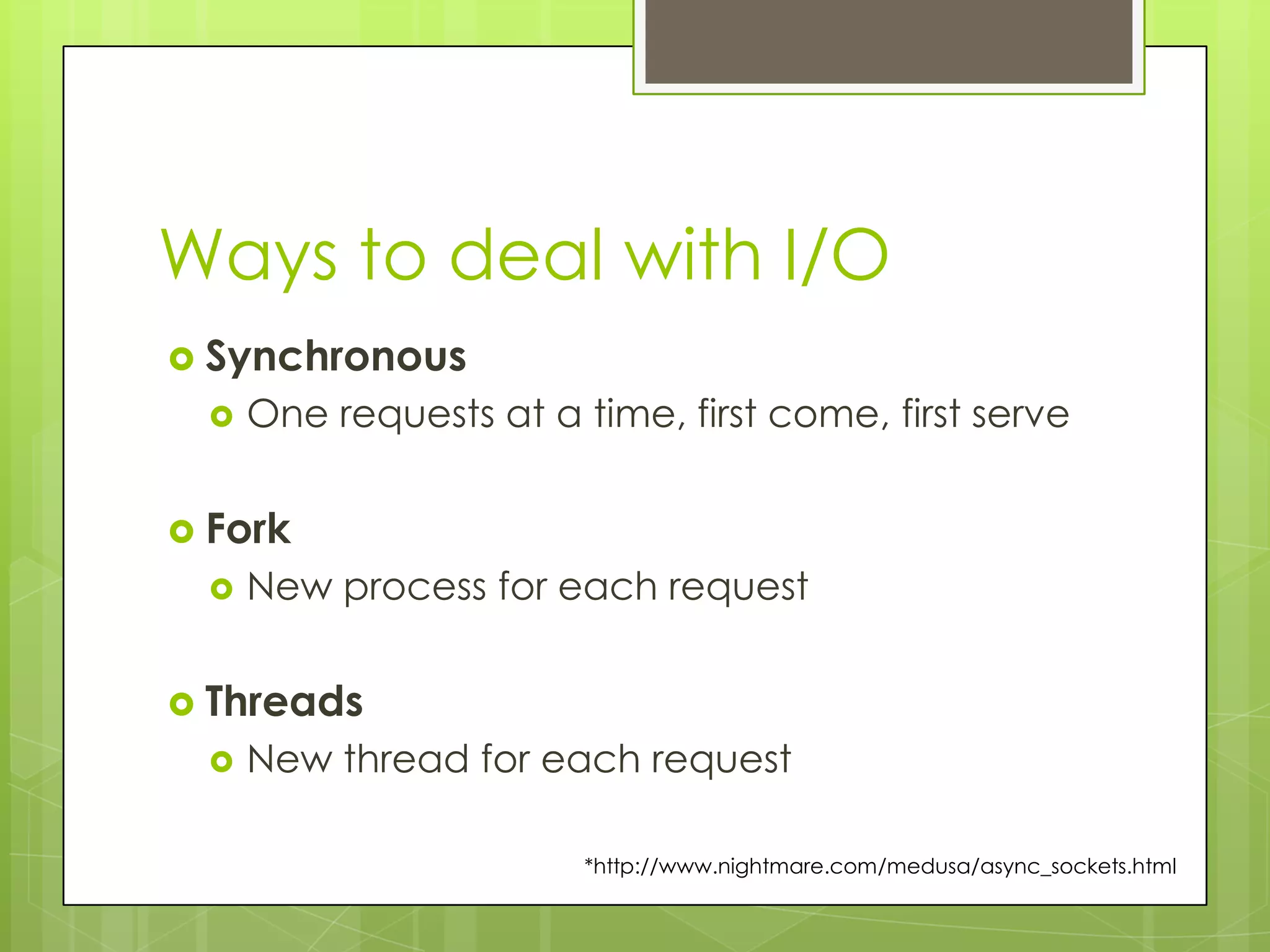
Ways to deal with I/O
 Synchronous
     One requests at a time, first come, first serve


 Fork
     New process for each request


 Threads
     New thread for each request

                         *http://www.nightmare.com/medusa/async_sockets.html
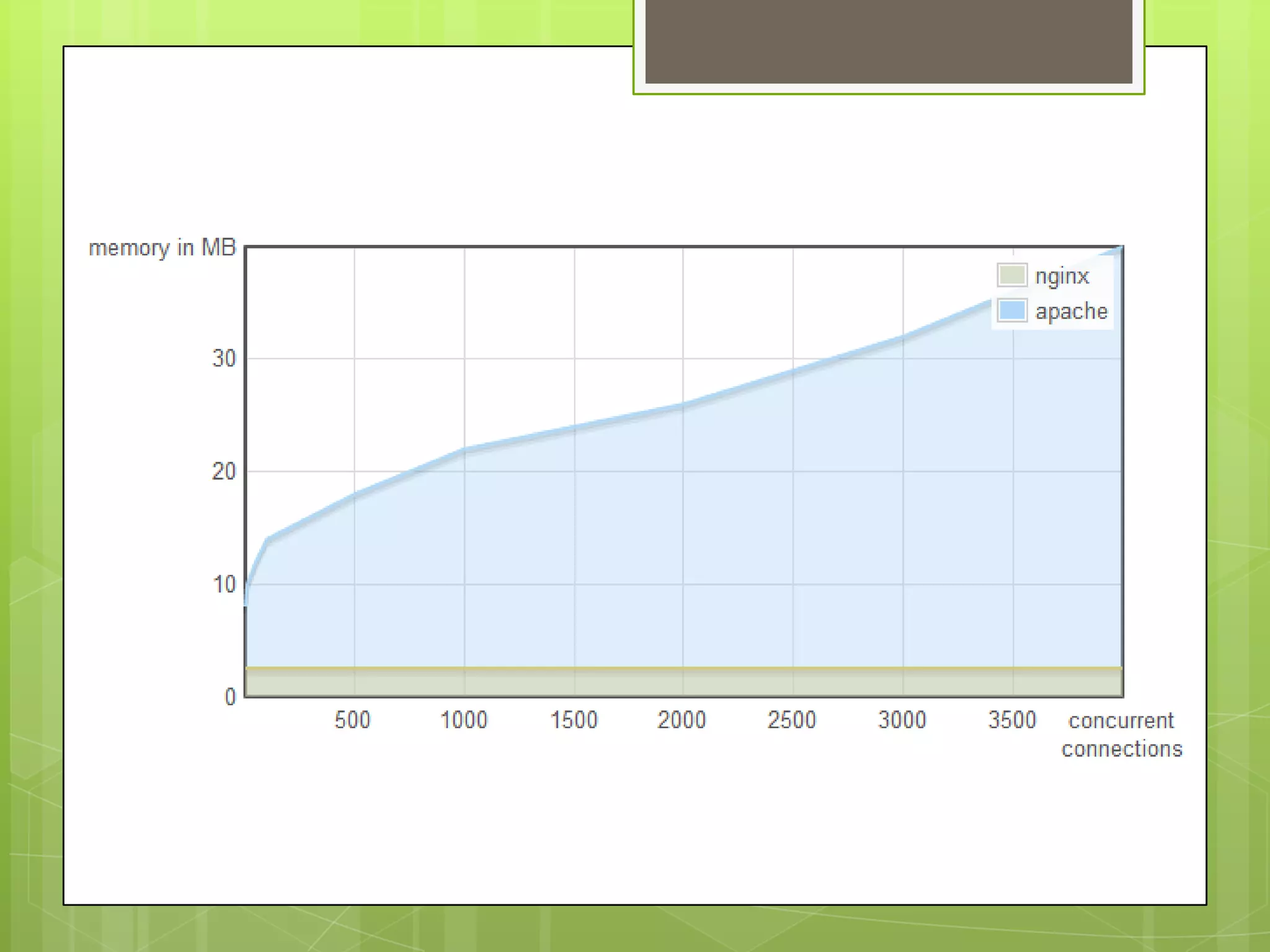
Another Thesis


Thread-per-connection
 is memory-expensive
Traditional Threaded Model
N  worker threads/processes
 Each incoming connection handed
  to a worker
  That   worker is now “in use”, and can
     handle no other connection, even if it is
     waiting on:
      FileI/O
      DB I/O
      Network I/O
      etc
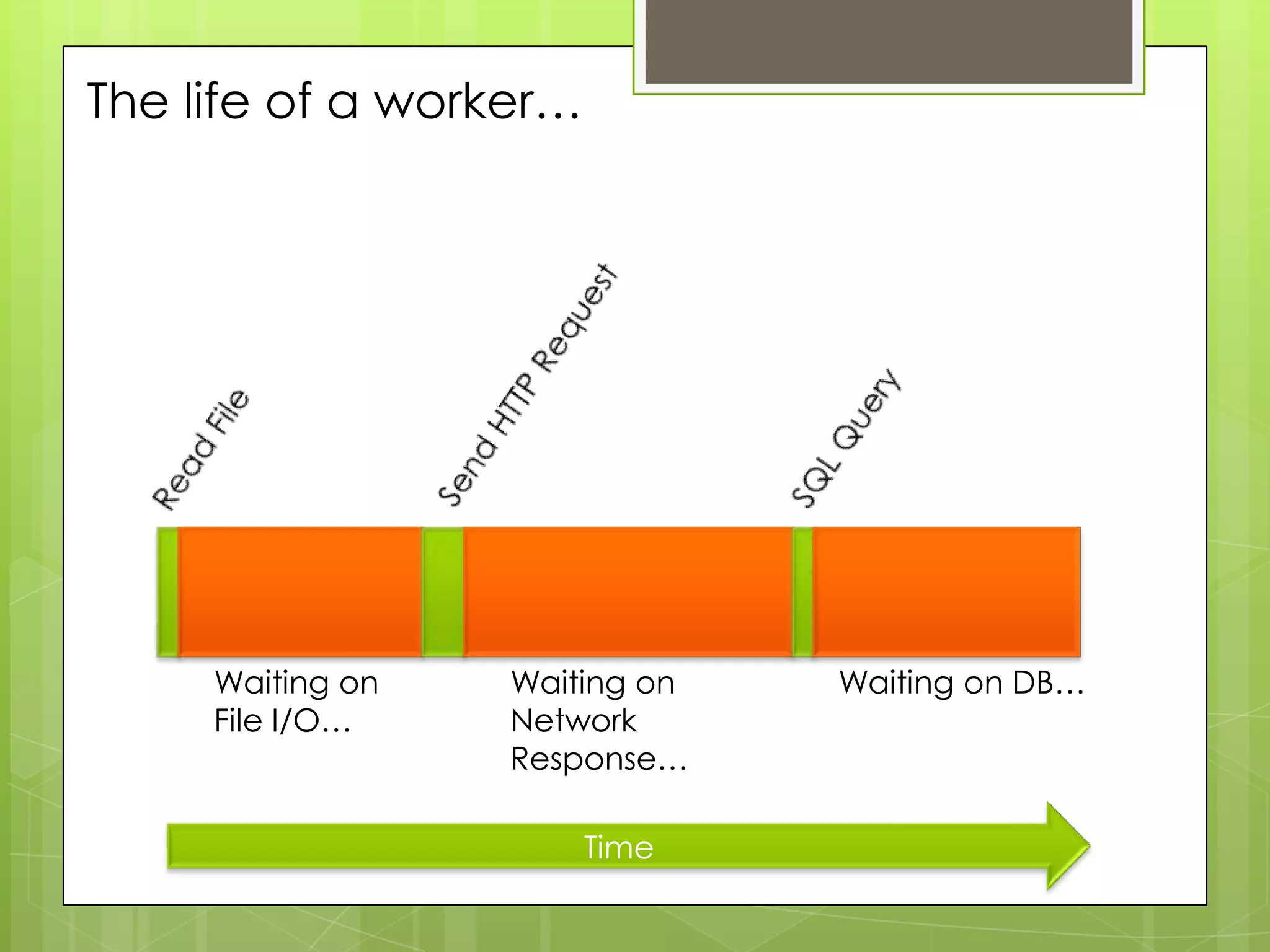
The life of a worker…


     Waiting on   Waiting on   Waiting on DB…
     File I/O…    Network
                  Response…

                        Time
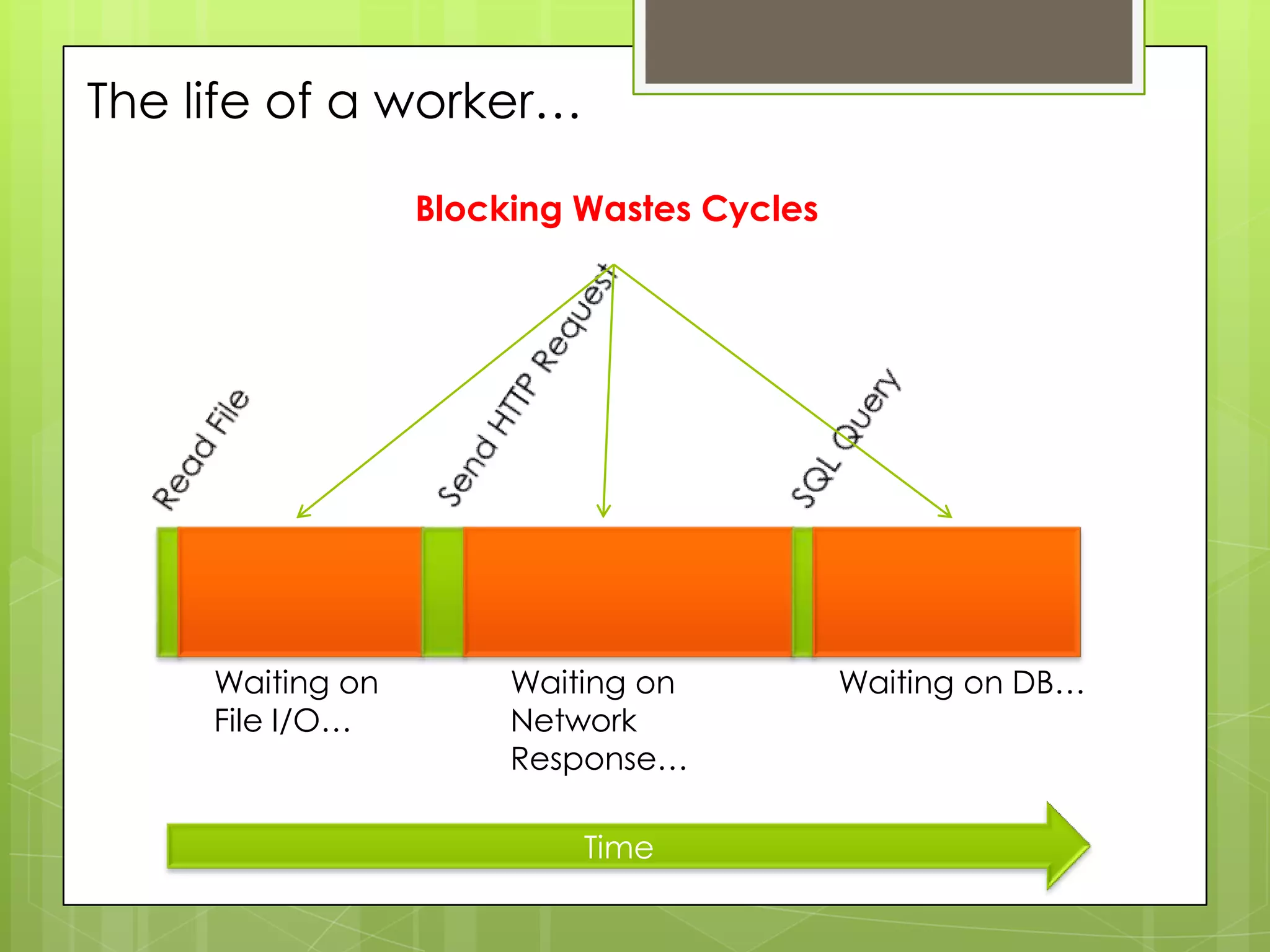
The life of a worker…

                  Blocking Wastes Cycles


     Waiting on        Waiting on          Waiting on DB…
     File I/O…         Network
                       Response…

                           Time
The Other Basic Idea


Writing (Good) Threaded
    Code is DIFFICULT
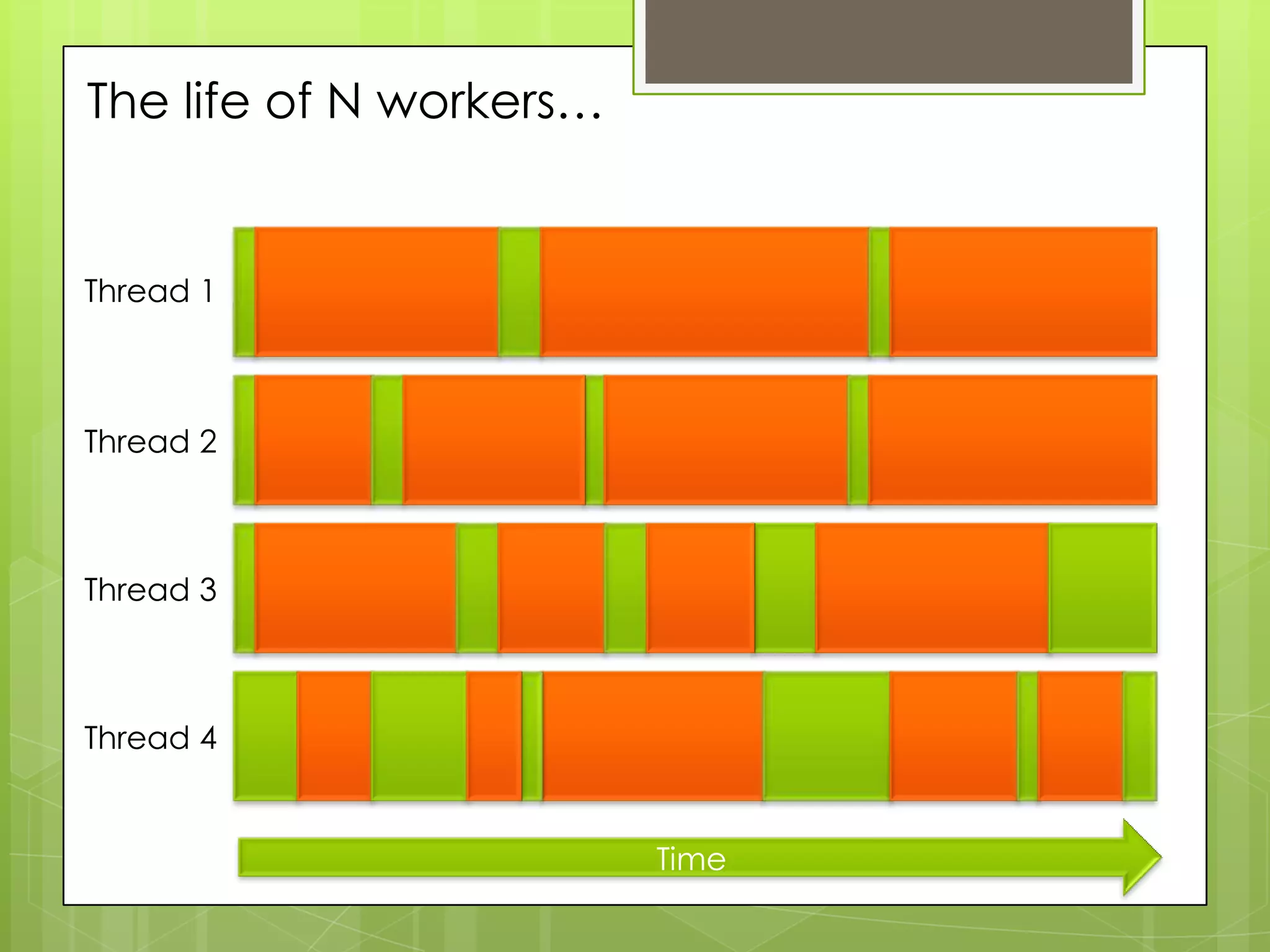
The life of N workers…


Thread 1


Thread 2


Thread 3


Thread 4


                         Time
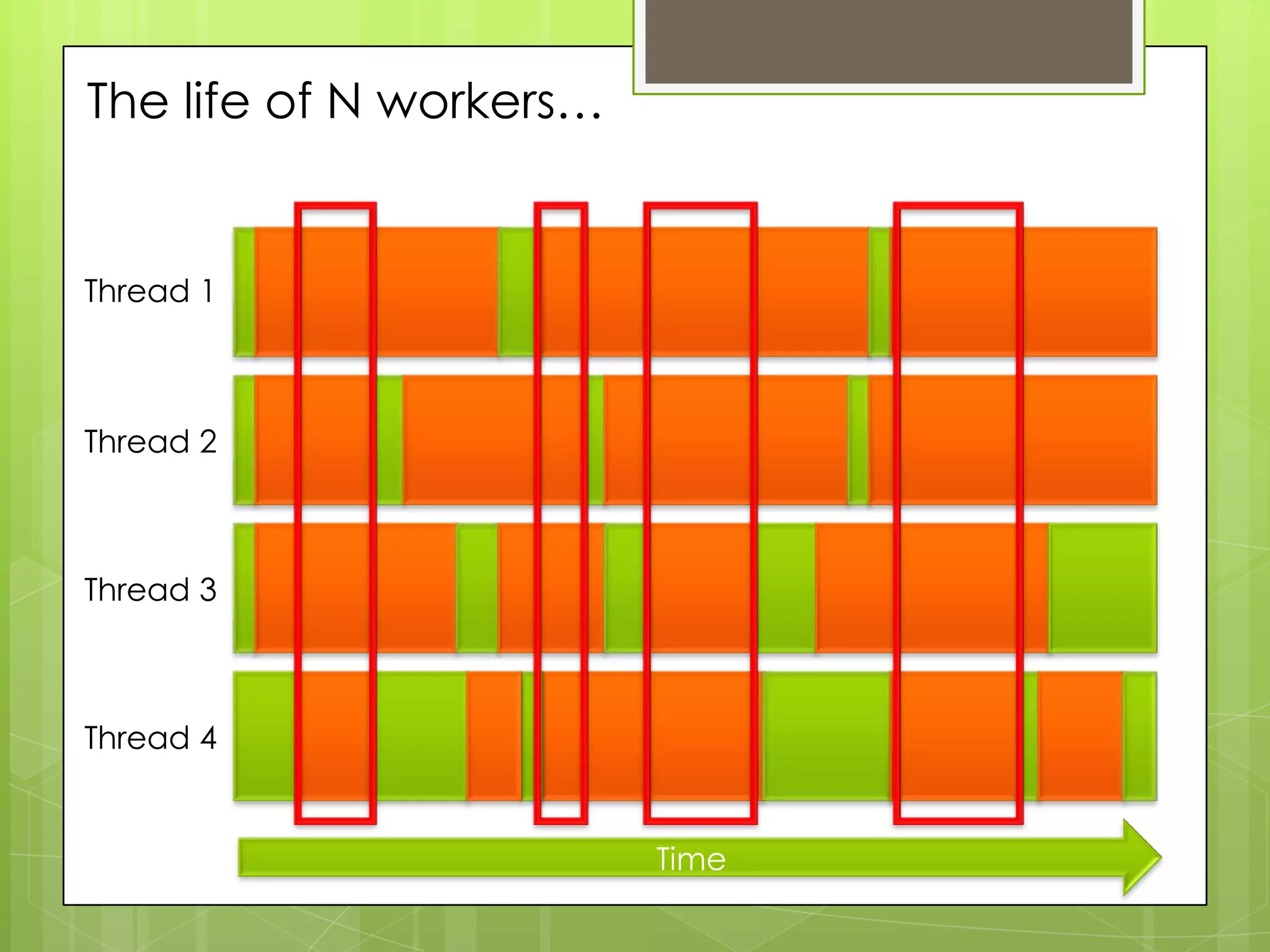
The life of N workers…


Thread 1


Thread 2


Thread 3


Thread 4


                         Time
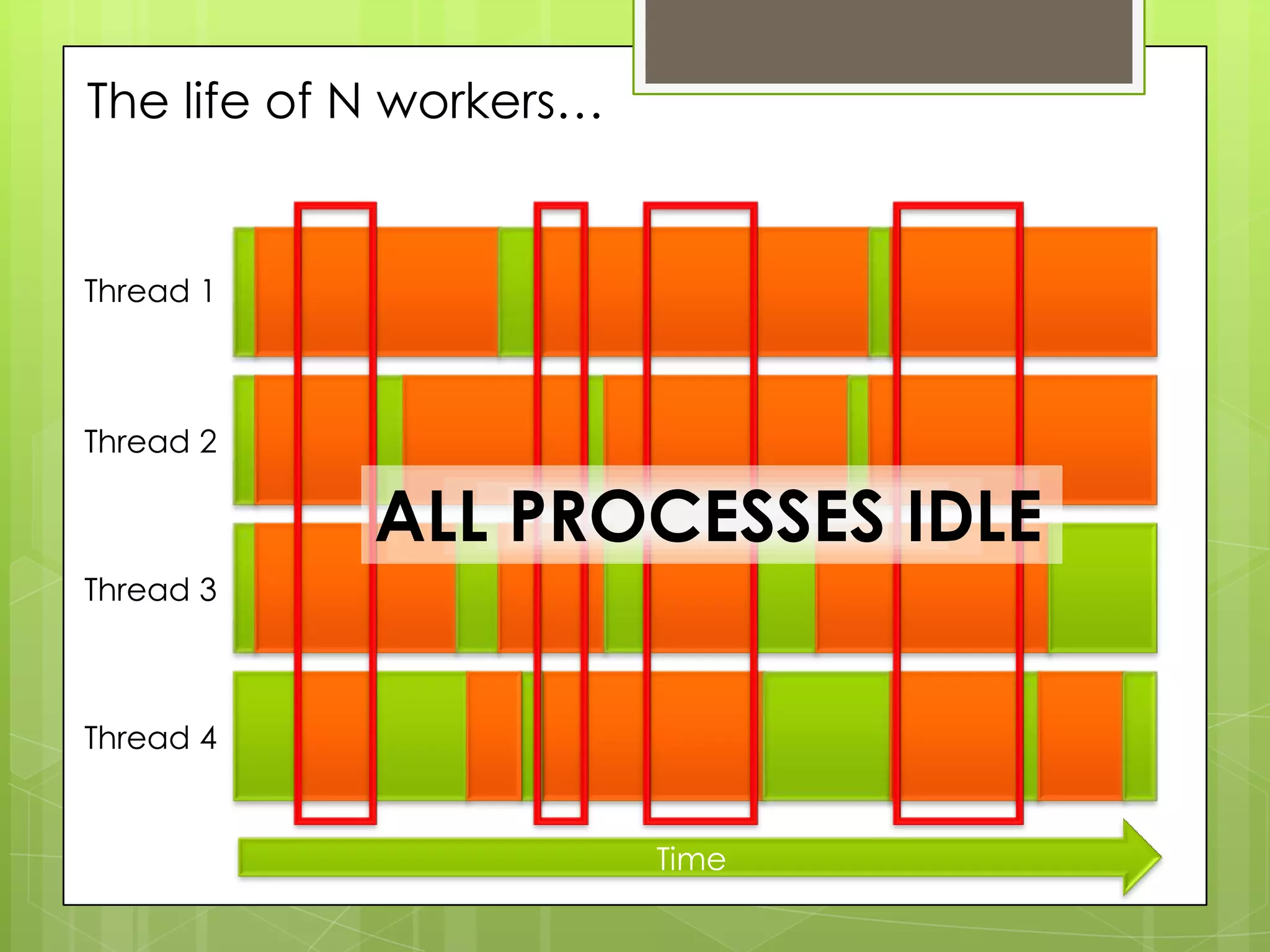
The life of N workers…


Thread 1


Thread 2

            ALL PROCESSES IDLE
Thread 3


Thread 4


                         Time
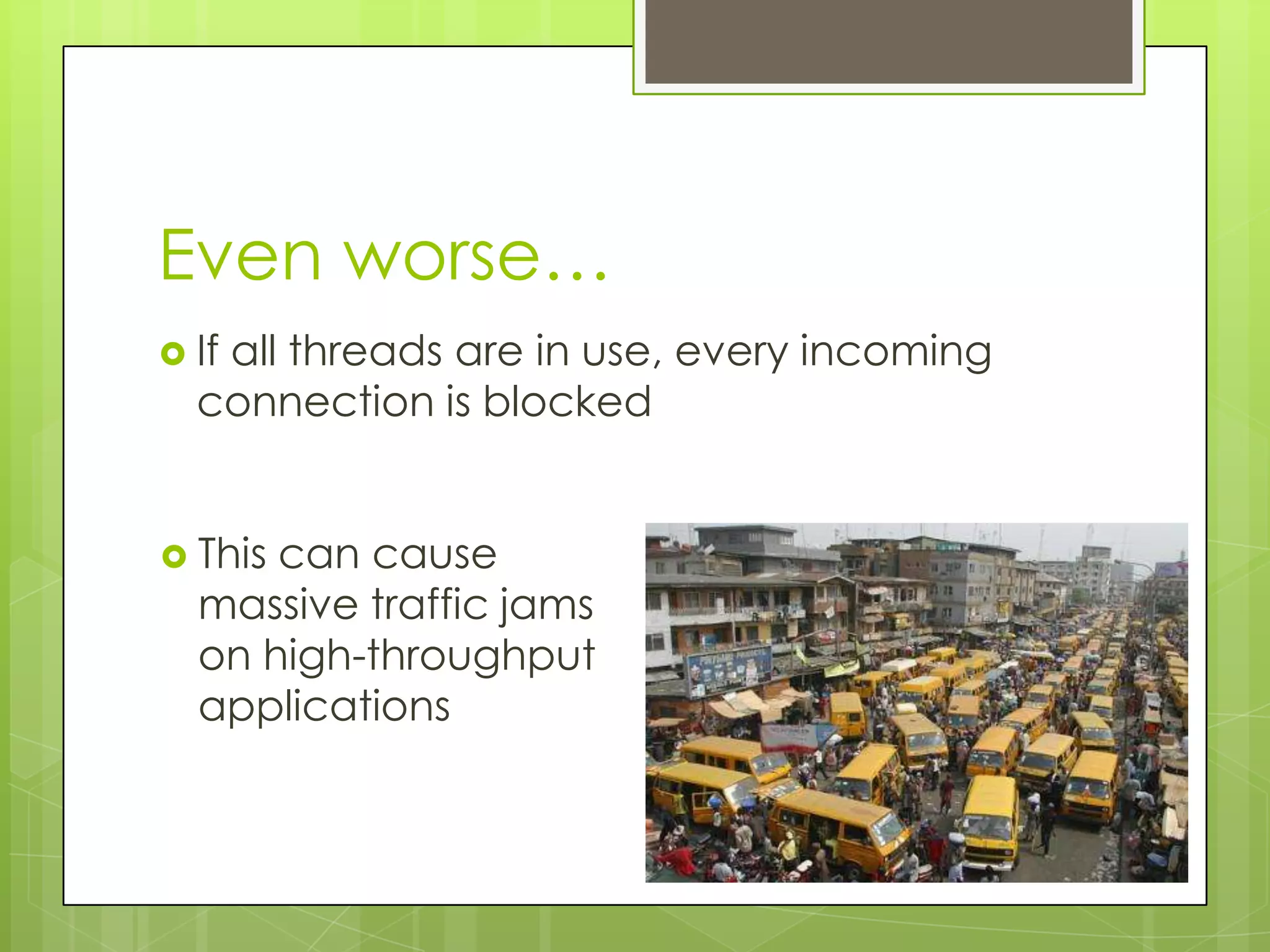
Even worse…
 If
   all threads are in use, every incoming
  connection is blocked


 Thiscan cause
  massive traffic jams
  on high-throughput
  applications
Is this the only way?


                         There is
                        another…
The Node.js way
   Axiom:
       Multi-Threaded code
         Is difficult to write
         Is difficult to debug
         Sucks up more dev/test/maintenance cycles
         Most often has inefficient performance


   Conclusion:
       Screw it: Write code using a single thread
Single threaded?!?
     Skeptical? I don’t blame you


          But hear me out…
Node.js Event Loop
 Event   Loop (from Wikipedia):
    A “construct that waits for and dispatches
     events or messages in a program”


 Instead
        of performing I/O ourselves, we
 dispatch I/O events to Node’s event loop
    It handles threads, process optimization,
     concurrency, etc
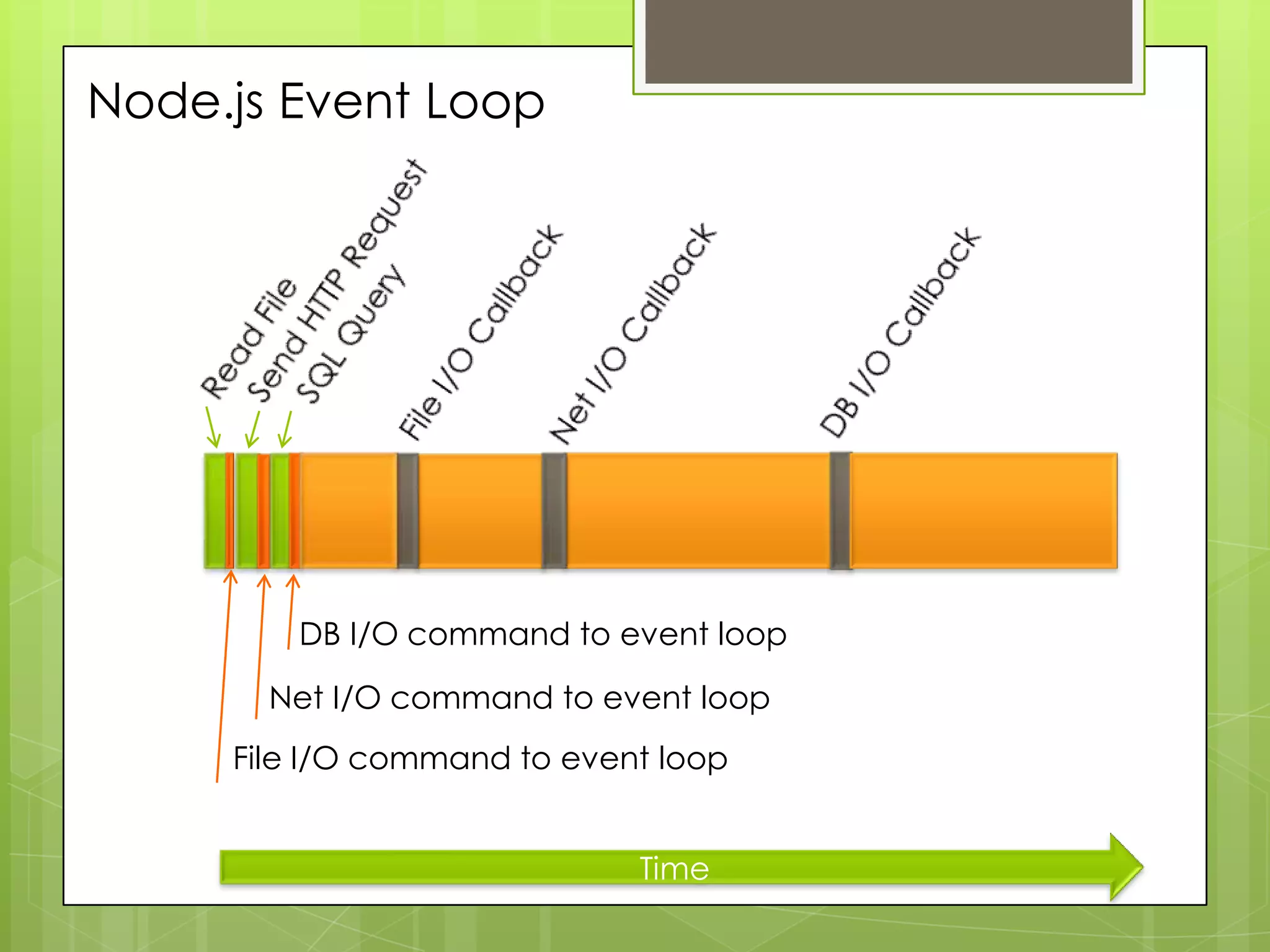
Node.js Event Loop


         DB I/O command to event loop

       Net I/O command to event loop
     File I/O command to event loop


                             Time
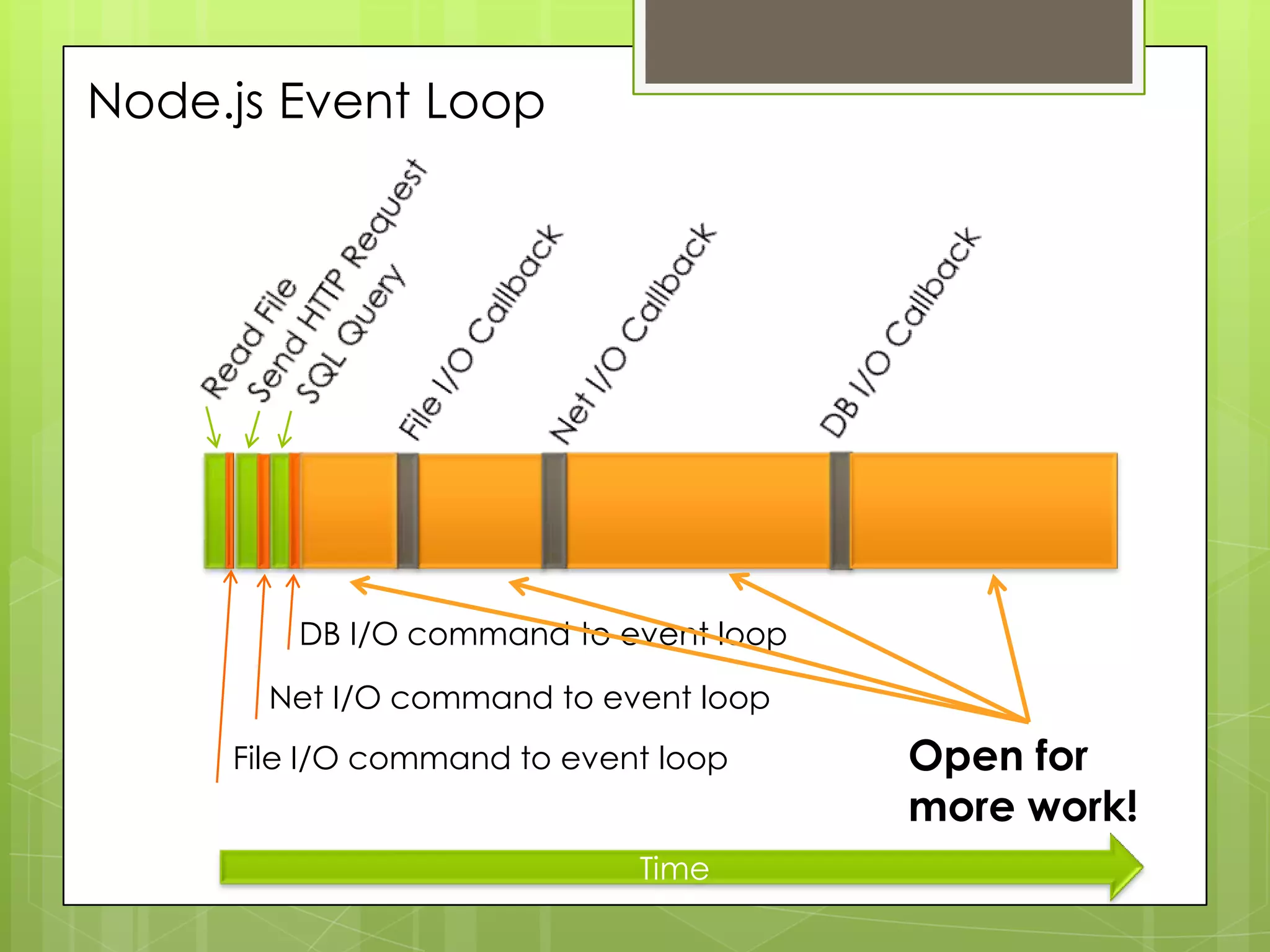
Node.js Event Loop


         DB I/O command to event loop

       Net I/O command to event loop
     File I/O command to event loop     Open for
                                        more work!
                             Time
Node.js app code…
 Isrun entirely in a single thread
 Passes I/O requests to the event loop,
  along with callbacks

 Your    code then:
      Goes to sleep
      Uses no system resources
      Will be notified via callback when I/O is
       complete
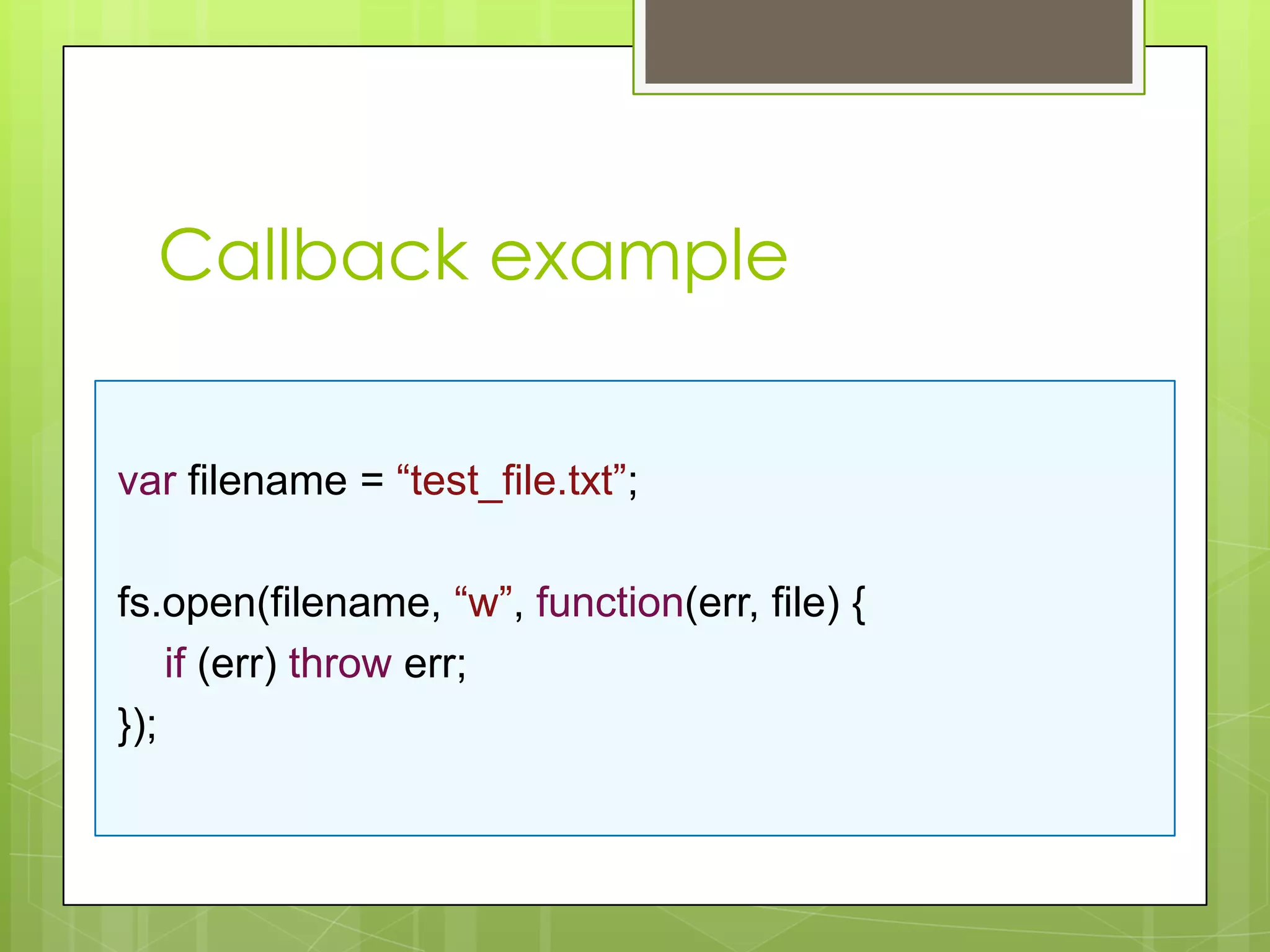
Callback example


var filename = “test_file.txt”;

fs.open(filename, “w”, function(err, file) {
    if (err) throw err;
});
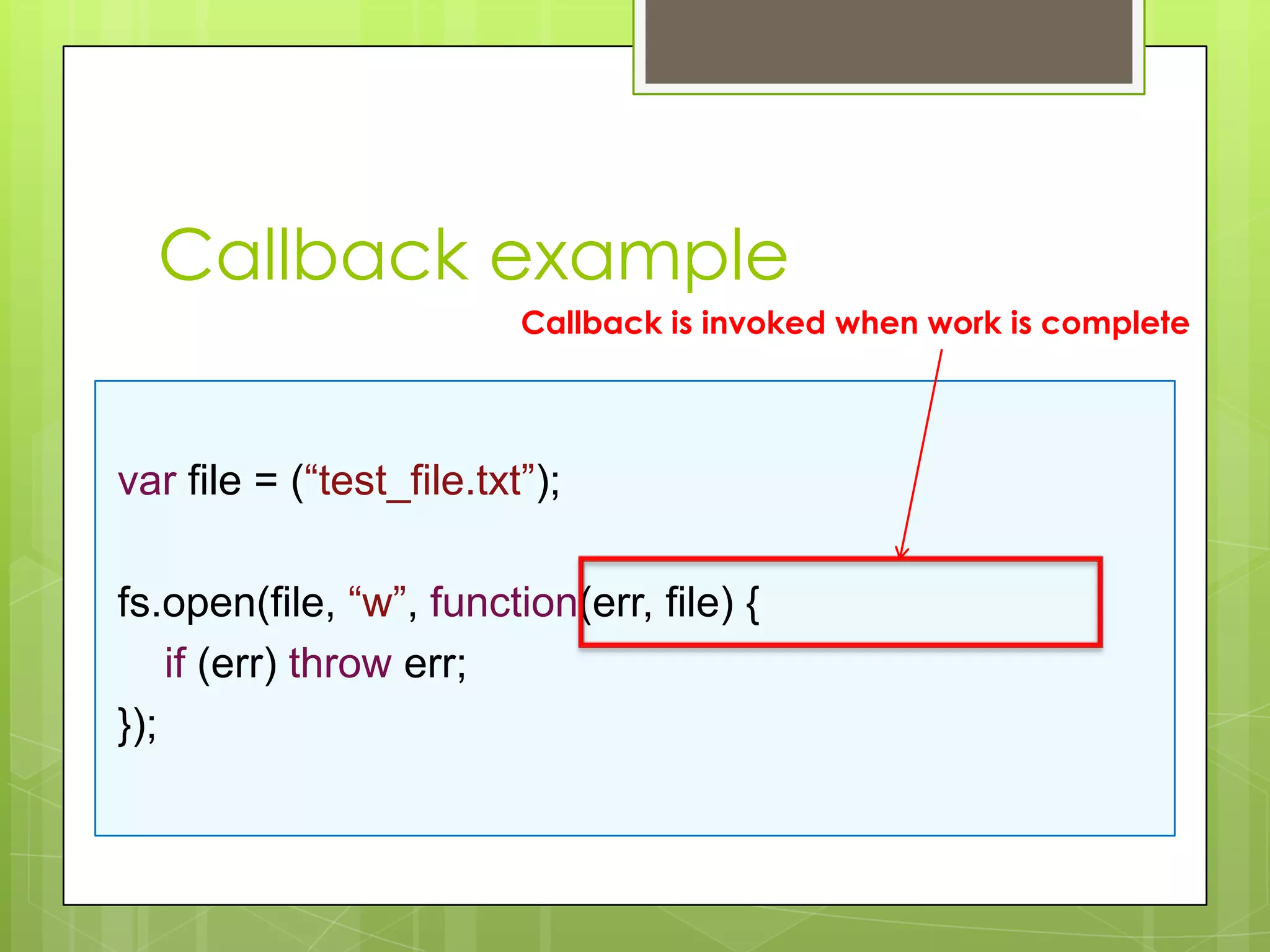
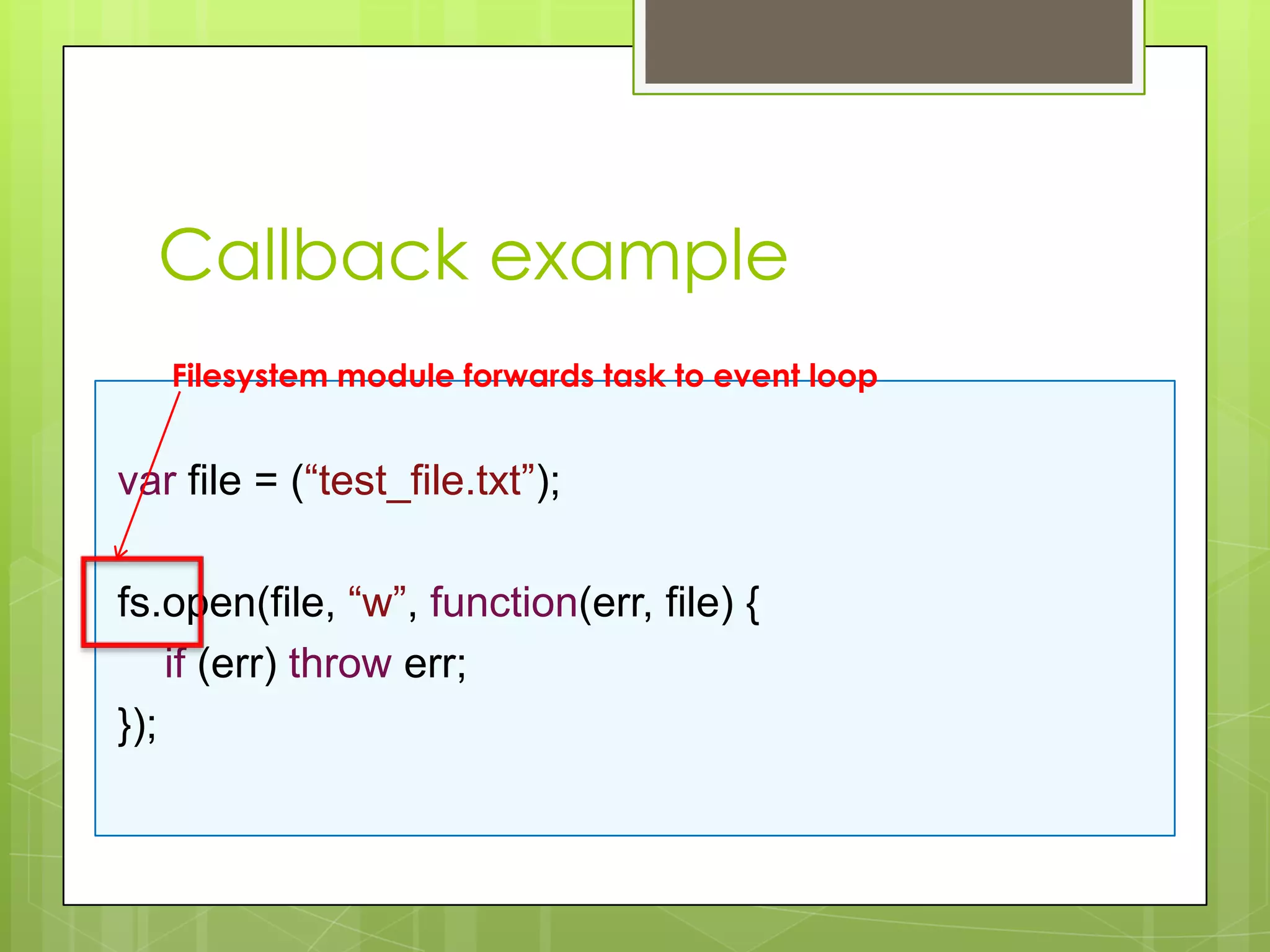
Callback example
   Filesystem module forwards task to event loop


var file = (“test_file.txt”);

fs.open(file, “w”, function(err, file) {
    if (err) throw err;
});
Callback example
                          Callback is invoked when work is complete


var file = (“test_file.txt”);

fs.open(file, “w”, function(err, file) {
    if (err) throw err;
});
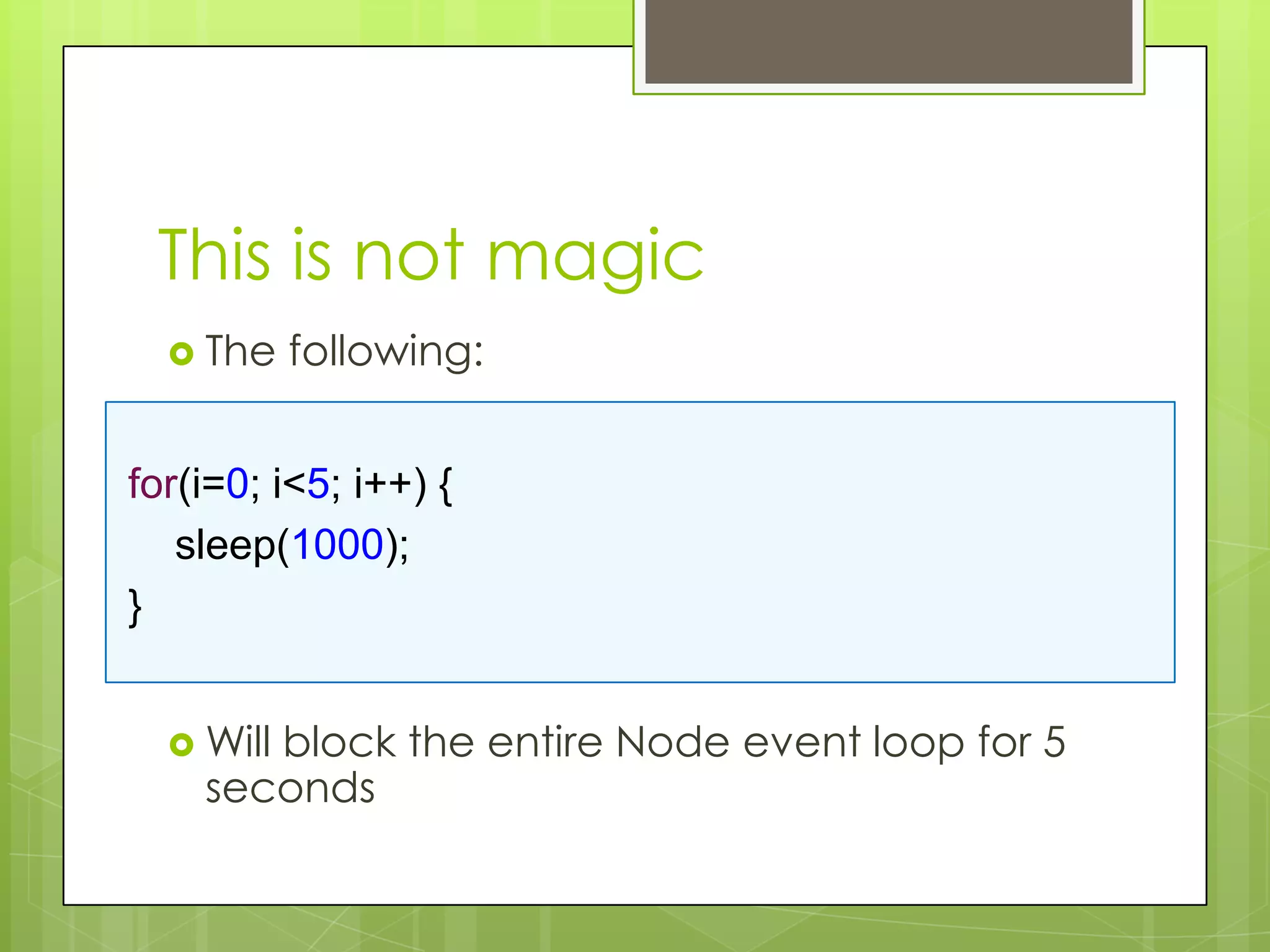
This is not magic
   The    following:


for(i=0; i<5; i++) {
   sleep(1000);
}


   Will
       block the entire Node event loop for 5
    seconds
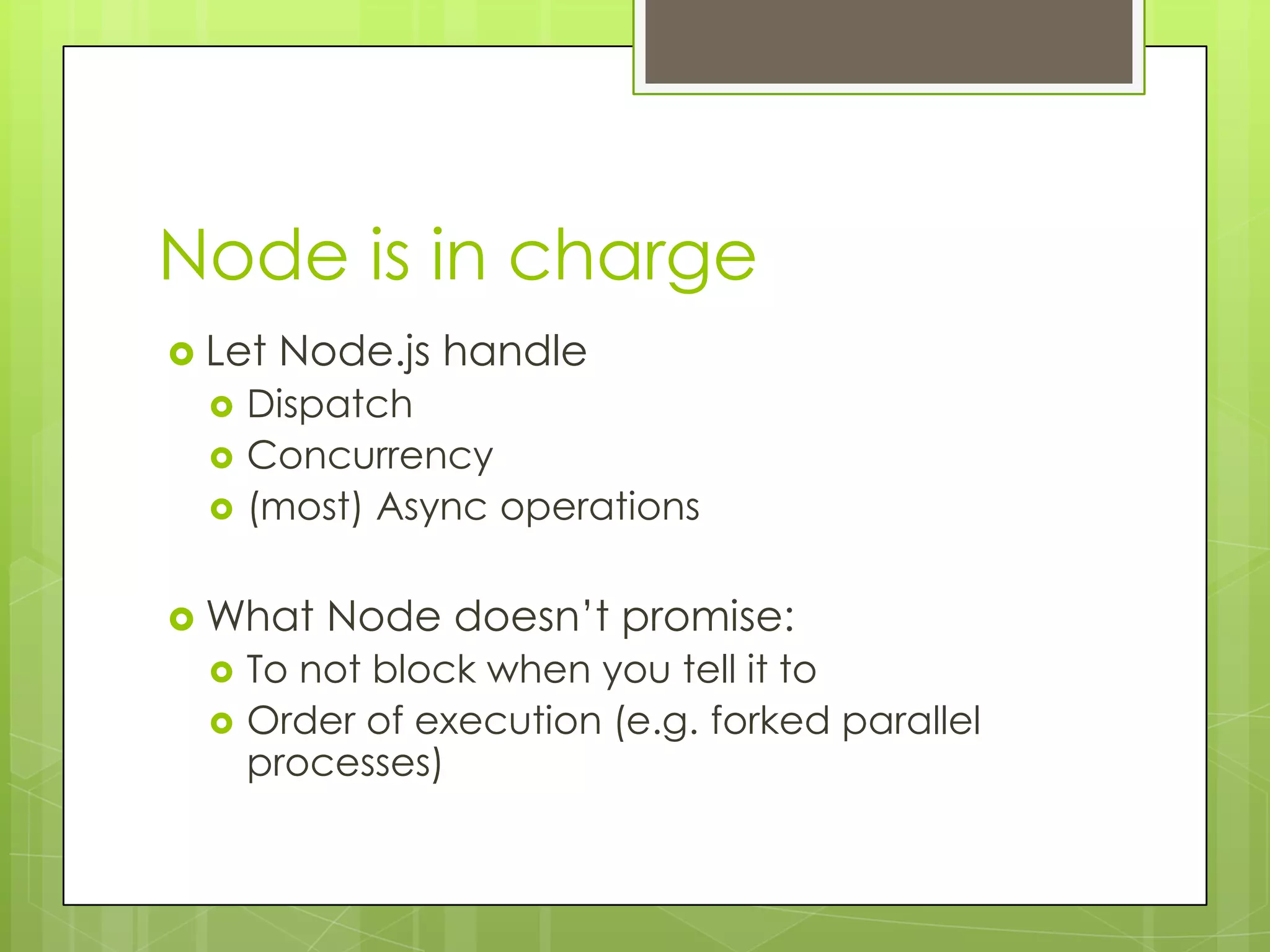
Node is in charge
 Let   Node.js handle
     Dispatch
     Concurrency
     (most) Async operations

 What    Node doesn’t promise:
     To not block when you tell it to
     Order of execution (e.g. forked parallel
      processes)
Interlude: Modules
Node.js API
   Node provides an API in the form of modules
    (a.k.a. libraries)
       Modules work with event loop to dispatch async
        tasks

   API modules are installed along with Node
       They provide standard application framework
        functionality
         STDIO: console logging, timing, tracing
         File System: File system access
         …etc
A Few Good Modules
   Net           Network socket support

   HTTP          HTTP communication

   File System   File system access

   Crypto        Cryptography

   Streams       STDIO

   Many more…
Node.js Community
 Additionally,
              the Node.js community
 maintains excellent modules to enhance
 the capabilities of Node

 These   modules operate as
     Libraries
     Toolkits
     Frameworks
     …and much more.
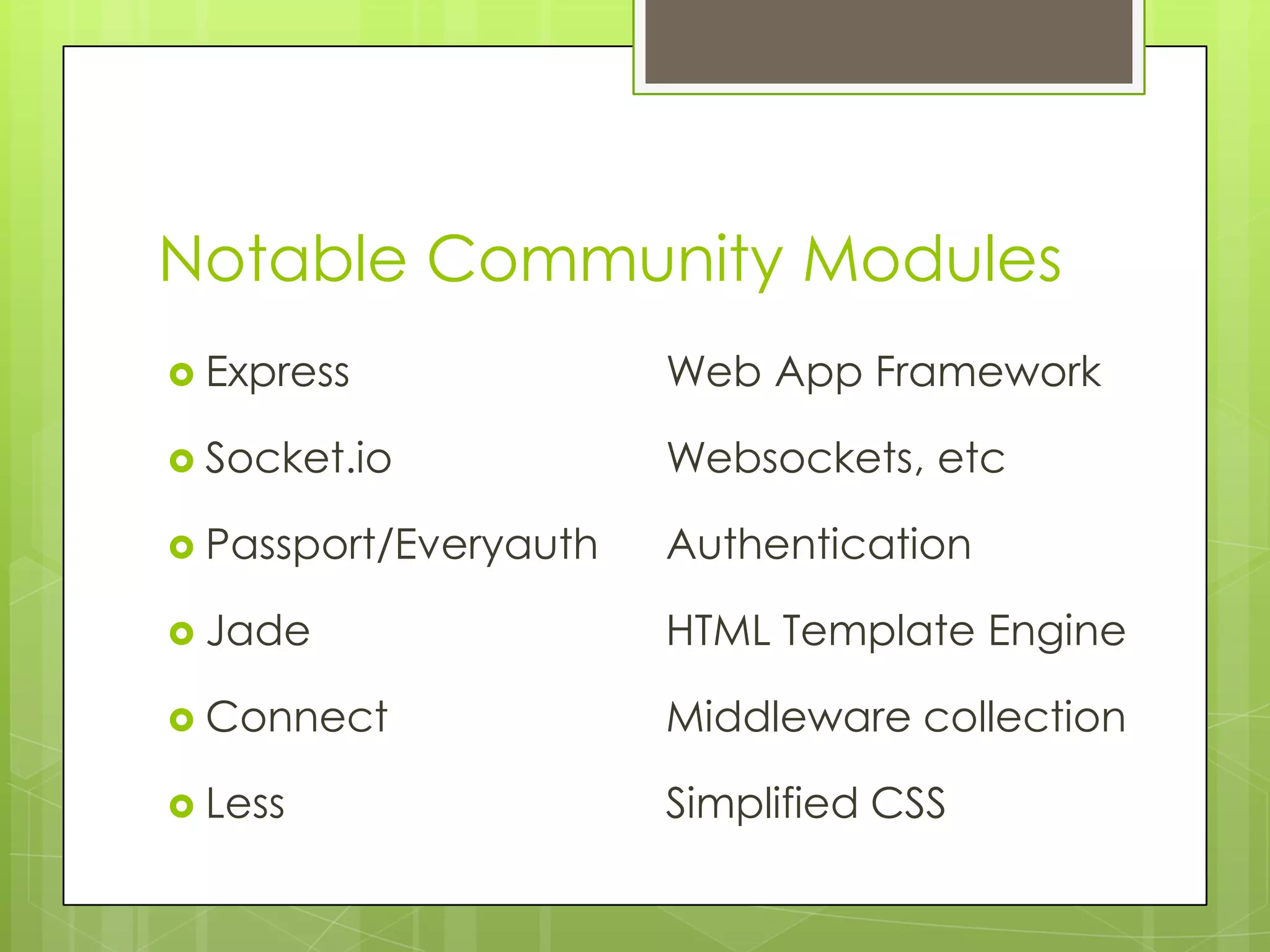
Notable Community Modules
 Express              Web App Framework

 Socket.io            Websockets, etc

 Passport/Everyauth   Authentication

 Jade                 HTML Template Engine

 Connect              Middleware collection

 Less                 Simplified CSS
Let’s see some code!
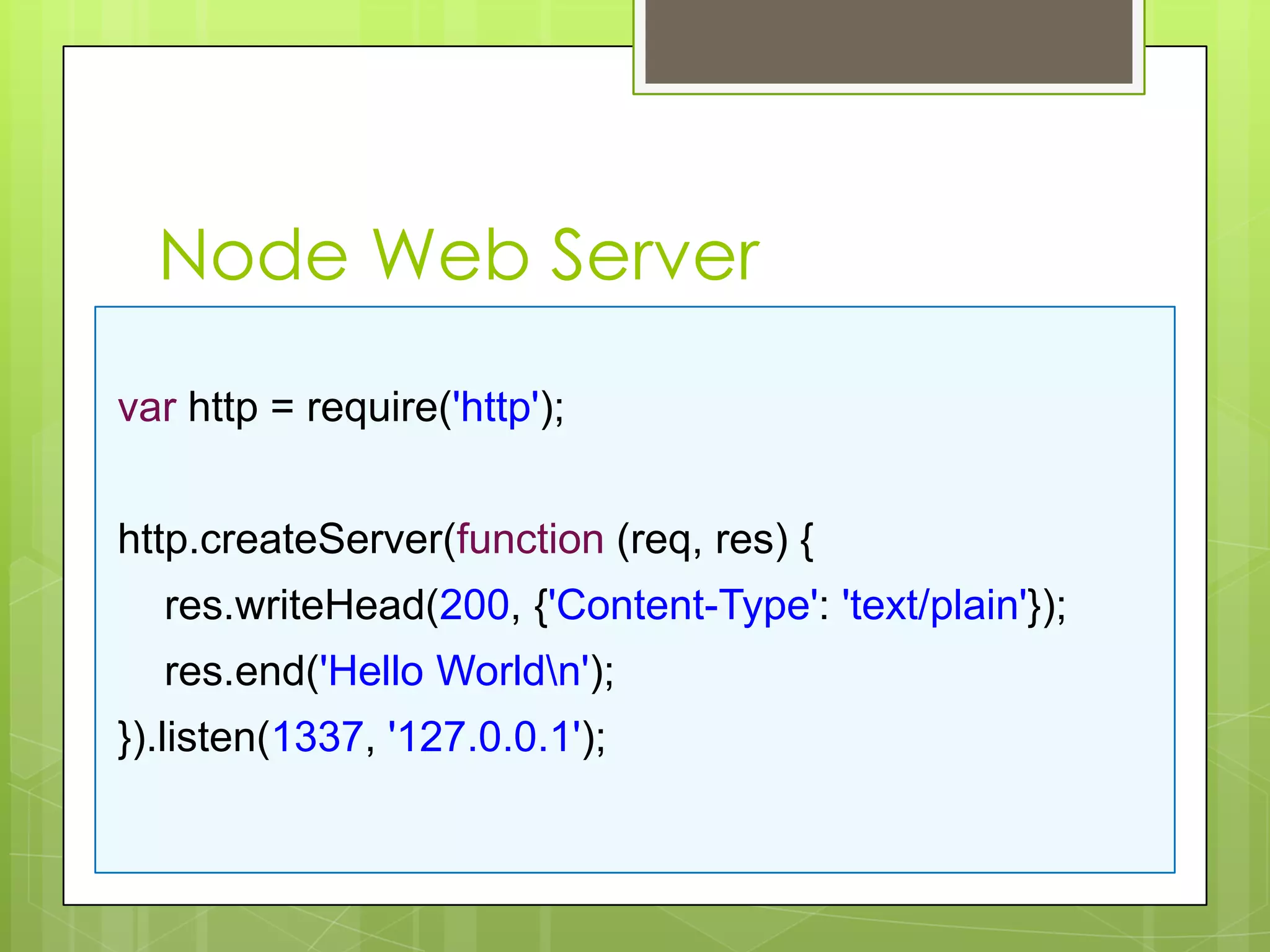
Node Web Server

var http = require('http');


http.createServer(function (req, res) {
  res.writeHead(200, {'Content-Type': 'text/plain'});
  res.end('Hello Worldn');
}).listen(1337, '127.0.0.1');
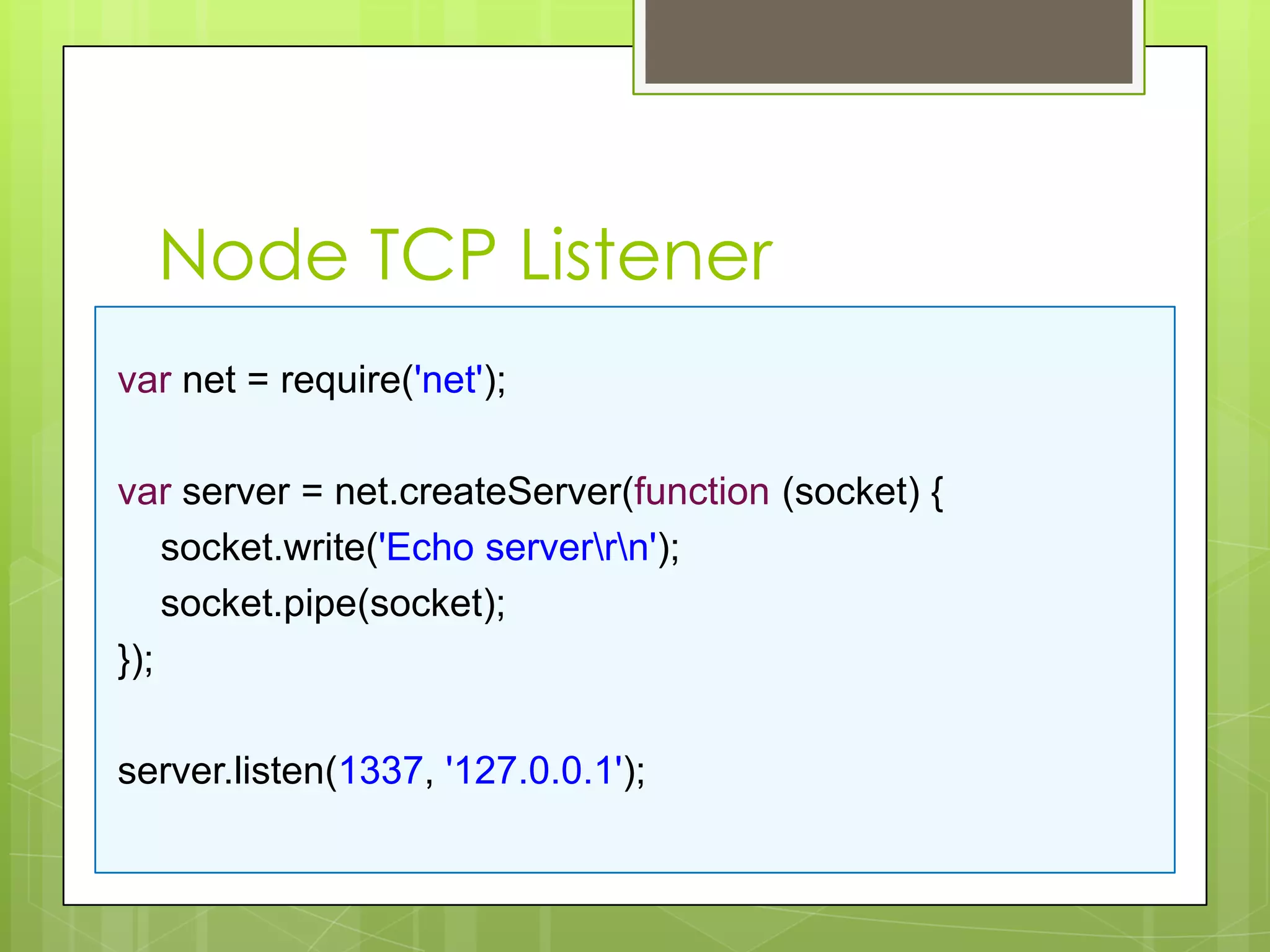
Node TCP Listener
var net = require('net');

var server = net.createServer(function (socket) {
    socket.write('Echo serverrn');
    socket.pipe(socket);
});

server.listen(1337, '127.0.0.1');
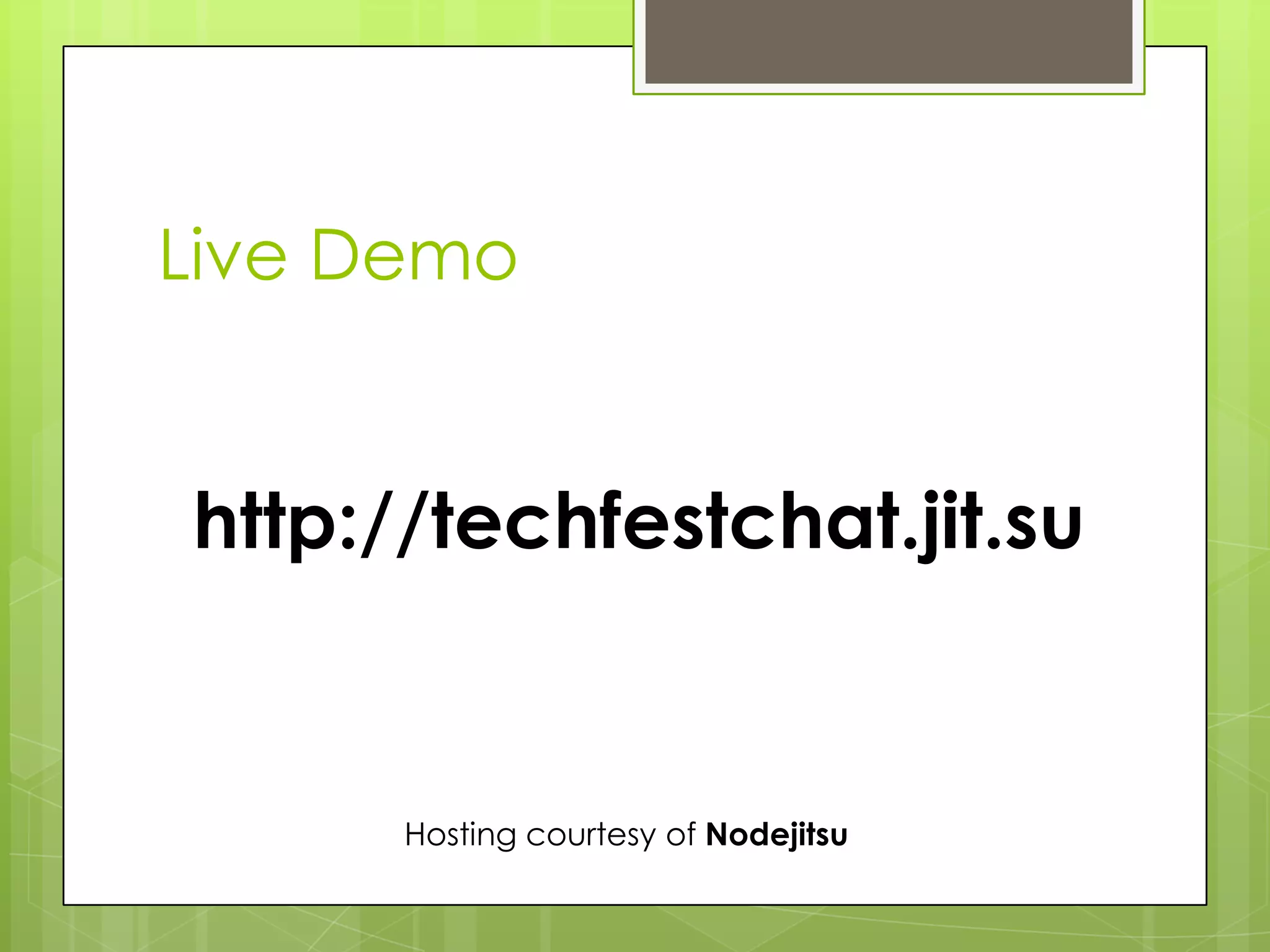
Live Demo


http://techfestchat.jit.su


      Hosting courtesy of Nodejitsu
Any .NET Devs in the room?

 Microsoft has been expending a lot of
 effort to make Node a first class
 framework


And now…
A sneak preview!
MS WebMatrix 2
   Open WebMatrix 2
Node.js Deployment and
Hosting
Cloud Hosting
   Heroku
   Microsoft Azure
   Nodejitsu
   Cloud Foundry
   Nodester
   DotCloud
   Appfog
   Joyent (coming soon)
   …
Thanks!
   Feel free to look me up at:

http://www.codehenge.net

I love questions, collaborations, and talking with
people!

   If you are interested in formal Node.js
    learning, I also have a course available at:

http://www.udemy.com/learn-nodejs-by-
example/

Node.js: A Guided Tour

  • 1.
  • 2.
    The web ischanging  It used to be about consumption
  • 3.
  • 4.
    Real-time Interaction  Real-Time Games  Chat  Stock tickers  Twitter Feeds  Collaboration  Creation …on a massive scale
  • 5.
    What do weneed to make it happen?  Fast, persistent I/O  HTTP wasn’t built for this  Server’s need to push data to clients  Polling is slow and inefficient  Scalability  Usability  Maintainability
  • 7.
    Outline  What isNode.js?  Technology Overview  How does it work?  Demo  Code!  Deployment and Hosting
  • 8.
  • 9.
    Node.js  Node.js is an event-driven, server-side JavaScript environment  Based on the V8 JavaScript Engine, developed by Google  Most importantly, node.js is a  server-side runtime environment, that  compiles and executes JavaScript very efficiently.
  • 10.
    Platforms  Runs on OSX, Linux, Windows  Clickable installers for:  Windows  Mac OSX  Linux has apt-get and yum
  • 11.
    Why Node?  Node.jsis specifically designed for building fast, efficient, scalable network applications  Node uses an event-driven, non-blocking I/O model to maximize efficiency
  • 12.
    Technology: V8 Engine  Developed by Google  Ships with the Google Chrome web browser  Allows Chrome to run JavaScript code much faster  It does this by compiling the JavaScript directly into native machine code  As opposed to interpreting JavaScript, or execute it as bytecode  What does this mean for us, and for Node.js?
  • 14.
    Technology: JavaScript  JavaScript is:  A fully-functional programming language  Capable of doing anything other traditional languages (C++, Java, Ruby, etc) can do  Has an excellent event model  Traditionally resigned to the context of the web application frontend  i.e. running inside a web browser
  • 15.
    Technology: JavaScript2  There’snoreason the JavaScript language can’t be used elsewhere (say, server-side)  This is where node.js comes in, executing JavaScript efficiently on the server-side  JavaScript brings to Node.js:  Natural event-based programming, ideal for client-server applications  A known language, with low overhead
  • 16.
    Who is usingNode.js?
  • 17.
  • 18.
    The Basic Idea I/O is expensive
  • 19.
  • 20.
    Ways to dealwith I/O  Synchronous  One requests at a time, first come, first serve  Fork  New process for each request  Threads  New thread for each request *http://www.nightmare.com/medusa/async_sockets.html
  • 21.
  • 23.
    Traditional Threaded Model N worker threads/processes  Each incoming connection handed to a worker  That worker is now “in use”, and can handle no other connection, even if it is waiting on:  FileI/O  DB I/O  Network I/O  etc
  • 24.
    The life ofa worker… Waiting on Waiting on Waiting on DB… File I/O… Network Response… Time
  • 25.
    The life ofa worker… Blocking Wastes Cycles Waiting on Waiting on Waiting on DB… File I/O… Network Response… Time
  • 26.
    The Other BasicIdea Writing (Good) Threaded Code is DIFFICULT
  • 27.
    The life ofN workers… Thread 1 Thread 2 Thread 3 Thread 4 Time
  • 28.
    The life ofN workers… Thread 1 Thread 2 Thread 3 Thread 4 Time
  • 29.
    The life ofN workers… Thread 1 Thread 2 ALL PROCESSES IDLE Thread 3 Thread 4 Time
  • 30.
    Even worse…  If all threads are in use, every incoming connection is blocked  Thiscan cause massive traffic jams on high-throughput applications
  • 31.
    Is this theonly way? There is another…
  • 32.
    The Node.js way  Axiom:  Multi-Threaded code  Is difficult to write  Is difficult to debug  Sucks up more dev/test/maintenance cycles  Most often has inefficient performance  Conclusion:  Screw it: Write code using a single thread
  • 33.
    Single threaded?!? Skeptical? I don’t blame you But hear me out…
  • 34.
    Node.js Event Loop Event Loop (from Wikipedia):  A “construct that waits for and dispatches events or messages in a program”  Instead of performing I/O ourselves, we dispatch I/O events to Node’s event loop  It handles threads, process optimization, concurrency, etc
  • 35.
    Node.js Event Loop DB I/O command to event loop Net I/O command to event loop File I/O command to event loop Time
  • 36.
    Node.js Event Loop DB I/O command to event loop Net I/O command to event loop File I/O command to event loop Open for more work! Time
  • 37.
    Node.js app code… Isrun entirely in a single thread  Passes I/O requests to the event loop, along with callbacks  Your code then:  Goes to sleep  Uses no system resources  Will be notified via callback when I/O is complete
  • 38.
    Callback example var filename= “test_file.txt”; fs.open(filename, “w”, function(err, file) { if (err) throw err; });
  • 39.
    Callback example Filesystem module forwards task to event loop var file = (“test_file.txt”); fs.open(file, “w”, function(err, file) { if (err) throw err; });
  • 40.
    Callback example Callback is invoked when work is complete var file = (“test_file.txt”); fs.open(file, “w”, function(err, file) { if (err) throw err; });
  • 41.
    This is notmagic  The following: for(i=0; i<5; i++) { sleep(1000); }  Will block the entire Node event loop for 5 seconds
  • 42.
    Node is incharge  Let Node.js handle  Dispatch  Concurrency  (most) Async operations  What Node doesn’t promise:  To not block when you tell it to  Order of execution (e.g. forked parallel processes)
  • 43.
  • 44.
    Node.js API  Node provides an API in the form of modules (a.k.a. libraries)  Modules work with event loop to dispatch async tasks  API modules are installed along with Node  They provide standard application framework functionality  STDIO: console logging, timing, tracing  File System: File system access  …etc
  • 45.
    A Few GoodModules  Net Network socket support  HTTP HTTP communication  File System File system access  Crypto Cryptography  Streams STDIO  Many more…
  • 46.
    Node.js Community  Additionally, the Node.js community maintains excellent modules to enhance the capabilities of Node  These modules operate as  Libraries  Toolkits  Frameworks  …and much more.
  • 47.
    Notable Community Modules Express Web App Framework  Socket.io Websockets, etc  Passport/Everyauth Authentication  Jade HTML Template Engine  Connect Middleware collection  Less Simplified CSS
  • 48.
  • 49.
    Node Web Server varhttp = require('http'); http.createServer(function (req, res) { res.writeHead(200, {'Content-Type': 'text/plain'}); res.end('Hello Worldn'); }).listen(1337, '127.0.0.1');
  • 50.
    Node TCP Listener varnet = require('net'); var server = net.createServer(function (socket) { socket.write('Echo serverrn'); socket.pipe(socket); }); server.listen(1337, '127.0.0.1');
  • 51.
    Live Demo http://techfestchat.jit.su Hosting courtesy of Nodejitsu
  • 52.
    Any .NET Devsin the room?  Microsoft has been expending a lot of effort to make Node a first class framework And now…
  • 53.
  • 54.
    MS WebMatrix 2 Open WebMatrix 2
  • 55.
  • 56.
    Cloud Hosting  Heroku  Microsoft Azure  Nodejitsu  Cloud Foundry  Nodester  DotCloud  Appfog  Joyent (coming soon)  …
  • 57.
    Thanks!  Feel free to look me up at: http://www.codehenge.net I love questions, collaborations, and talking with people!  If you are interested in formal Node.js learning, I also have a course available at: http://www.udemy.com/learn-nodejs-by- example/