Identification, assessment, and classification chapter 3 pp. 63
1.
Identification, Assessment
, andClassification
Chapter 3 in Education of Students with an Intellectual Disability:
Research and Practice; Foreman, Phil; 2009
2.
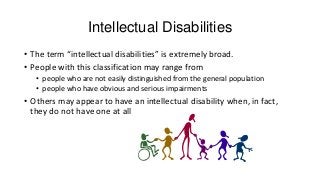
Intellectual Disabilities
• Theterm “intellectual disabilities” is extremely broad.
• People with this classification may range from
• people who are not easily distinguished from the general population
• people who have obvious and serious impairments
• Others may appear to have an intellectual disability when, in fact,
they do not have one at all
3.
Intellectual Disabilities (cont.)
•ID is not a medical diagnose
• Classifications within ID may provide more specific information about
a person’s abilities
• Positive use of classifications provide information for needed
supports – health, physical, educational, etc.
• Negative use of classifications may cause us to underestimate a
person’s abilities or discriminate against them in some way
4.
A Rose Isa Rose
• Many terms that were once acceptable for people with intellectual
disabilities are not longer considered acceptable; some of the history
is very interesting
• As I mentioned before, my BS Education degree in MR or “Mental
Retardation”; my dad was president of NCARC (North Carolina
Association for Retarded Citizens) for many years; my brother was
classified as trainable mentally retarded.
5.
Current Classifications
• Mild,moderate, and severe disabilities
• current classification system used for educational purposes
• impacts the amount of support offered
• Note Table 3.1 on p. 65. The simple classifications and explanations
provide information about supports that will likely be needed.
• Note the “approximate” terms. There are no fixed IQ or adaptive
behavior numbers. In other words, a one (1) point difference
between a person with a tested IQ score of 69 and a person with an
IQ score of 70 does not automatically classify one as intellectually
disabled while the other is not.
6.
PIMD (Profound Intellectualand Multiple
Disabilities)
• If you are interested in this population, there are some excellent
teachers at North Shelby where you may want to observe or
volunteer.
• Types of educational goals on the IEPs of these students may be
• Communication goals
• Social experiences
• With their typically developing peers
• Within the community
• Physical goals
7.
Classification Changes
• Classificationchanges reflect a movement away from the severity of
one’s disabilities to the level of support services that are appropriate
for one’s level of functioning.
• Level of supports are based on helping a person maximize his/her
ability to function
• Level of supports needed are fluid will change over time
8.
Classification Changes (cont.)
•Failure moved to fault with the environment not meeting the needs
of the student rather than being a fault within the person. This
indicates a shift in thinking over the years.
• This gets into some of the discussions we have had about societal
views of disabilities and how we can view “them” as “people first”
rather than a separate category of people. As Horton says, “Don’t
give up. I believe in your all. A person’s a person no matter how
small” (Dr. Seuss in Horton Hears a Who!)
9.
Intelligence Tests
• Theresults of an IQ test must be viewed as the results of a given test to a
given person on a given day
• The results provide only enough information for us to draw some
conclusions about one’s intelligence and may not be considered the final
word.
• Teachers should be more concerned about how children respond to
teaching; it then becomes our responsibility to adjust our classrooms and
our teaching to optimize a child’s opportunities to learn and develop
• Problems in assessments and results may be associated with problems
other than intelligence, such as attention, speech and motor, or behavioral
issues.
10.
Testing Jargon
• Goodtests are valid and reliable
• Validity – the tests measure what they are supposed to measure
• Reliability – the test results are similar on any given day as given by any
properly trained assessor.
• Standard error of measurement (SEM) – on any given day, test results will
likely fall within this range. A SEM of 3 on the WISC-R will mean that a test
score of 70 will likely result in a test score within the range of 67 – 73 on
any given day for the same person. It has a slight chance of falling outside
that range.
• For those of you who took the SAT and PSAT in high school, you may
remember the SEM. If you took it again, your original test score sheet gave
a likelihood of your scoring within a certain range on any subsequent tests.
11.
Beware of Barriers
•There are many barriers to assessing intelligence in babies and
toddlers
• All assessments must be part of comprehensive assessments
• Development is babies and toddlers is so sporadic that changes may
occur rapidly and new skills may emerge quickly
• Development assessments for babies and toddlers should be viewed
as measures of a child’s current level of development rather than a
predictor of future development
• The younger the child, the greater the need for caution when using
test scores for future predictions
12.
Moving On!
• Thetext describes several tests and pros and cons associated with the
various instruments for infants and toddlers and school-age children.
• There is no need to try to interpret all of that.
• Skim over the information to get an idea of the business of fairly
testing for intellectual disabilities (pp. 72 [bottom] – 78)
• Do know the definition for intellectual disabilities and the 3
components of the definition – be able to recognize testing for
intelligence as compared to testing for adaptive behavior
13.
Veronica – p.74
• Veronica’s assessment case study on p. 74 is interesting. The author’s
questions have more to do with assessment instrument questions.
• Look at the story from the perspective of Veronica’s preschool
teacher.
• Before results of her testing are completed, what type goals might you want
to consider for Veronica?
• What changes do you think need to be made to meet Veronica’s needs?
14.
Intermission
• This isa natural break in Chapter 3 readings.
• This next section covers pages 79 – 96.
15.
Adaptive Behavior
• “Thecurrent AAIDD definition refers to “significant limitations both in
intellectual functioning and in adaptive behavior as expressed in
conceptual, social, and practical adaptive skills” (Luckasson et al.,
2002).” (Foreman, 2009)
• How do children measure according to intelligence levels?
• How do children manage in day to day activities?
• Problems in both must be present for a child to be categorized as
having an intellectual disability (along with these problems
manifesting themselves prior to the child becoming 18 years old)
16.
Adaptive Behavior (cont.)
•
•
•
•
Ameasure of how a child functions in everyday life
More directly observable than intellectual functioning
Related to how the child functions in his/her environment
Information is generally gathered from an informant who is familiar with
the child (unlike the professionals who must administer intelligence tests)
• The child may not need to be present for adaptive behavior assessments to
be completed (unlike intelligence tests)
• The responses to a variety of questions related to the different
developmental domains are gathered and the information is compared to
development of similarly aged children
17.
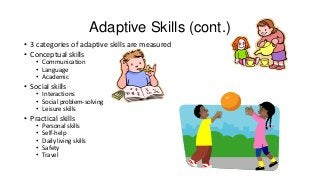
Adaptive Skills (cont.)
•3 categories of adaptive skills are measured
• Conceptual skills
• Communication
• Language
• Academic
• Social skills
• Interactions
• Social problem-solving
• Leisure skills
• Practical skills
•
•
•
•
•
Personal skills
Self-help
Daily living skills
Safety
Travel
18.
Adaptive Behavior (cont.)
•Children with adaptive behaviors in the bottom 3% as compared to
children of the same age are considered to have significant adaptive
behavior delays.
• There is generally a high correlation between a person’s intellectual
functioning and his/her adaptive behavior functioning
• The adaptive behavior component has prevented some people who
are able to function well in society from being labeled with an
intellectual disability.
• Most likely to occur for people with borderline IQ scores
19.
Measuring Adaptive Behaviors
•
•
•
•
•
Theseinstruments are described on pp. 81 – 87
Pros and cons of each instrument are addressed
Information is gathered from people familiar with the child being assessed
Cultural expectations must be taken into account
Some instruments are designed to diagnose an intellectual disability, not
for program planning or assessment of effectiveness of interventions.
• Others are designed in ways that may be used for program planning and
evaluation, assisting in diagnosis and classification, assessment of
progress, and identifying needed supports
20.
Assessing Support Needs
•Paradigm shift from identifying a person’s deficits to identifying and
providing needed supports.
• Supports Intensity Scale (SIS) (Thompson et all.; 2004)
• Can be used to identify the equipment and supports that help
individuals further their goals associated with quality of life and
integration into community
21.
4-Step Process (Thompsonet al.; 2002)
• Identify goals
• Determine needed supports
• Develop support plan based on individual needs
• Monitor progress
• This model is designed to be used for older people, but similar
models are in place for children as documented through their IFSPs or
IEPs
22.
Support Model Pitfalls
•Support needs assessments are generally subjective
• Support needs are subject to funding
• Experienced and trained raters may have more reliable results
Support Model Positives
• Person centered
• Emphasizes quality of life
• Encourages inclusion
23.
Dual Diagnosis
• Justas with the “regular” population, people with ID are may have a
diagnosis of psychiatric disorders, mental illness or behavioral
disorders.
• Some causes may be
• The result of their experiences as a person with ID
• A direct result of their ID
• A genetic or biochemical abnormality
• Some illnesses may be undiagnosed if they are not recognized as
separate from the diagnosis of ID
• There may be a higher prevalence of some mental health disorders in
people identified with ID
24.
Dual Diagnosis (cont.)
•The author discusses several tools that are currently available globally
for medical doctors to diagnosis mental illness in people with ID
• There are other tools available for helping diagnose students with
self-injurious and aggressive behaviors.
25.
Dual Diagnosis (cont.)Teacher Role
• Teachers have a frontline role in the diagnosis of dual behaviors
• Through referrals based on classroom concerns
• Through communication with parents who have concerns
• Through observations using checklists, frequency counts, or other
observation tools
• Through follow-up such as ensuring medications are taken, changes in
behavior following treatment changes, implementing positive behavior
support, recognition of side effects, etc.
• As part of the interdisciplinary team who review and carry out the student’s
IEP (Individualized Education Plan)
26.
References
• Foreman, Paul.(2009) Education of Students with an Intellectual Disability:
Research and Practice. Charlotte, NC., Information Age Publisher.
• Luckasson, R., Borthwick-Duffy, S., Buntinx, W., Coulter, D., Ellis, C., Reeve,
A., et al. (2002). Mental retardation: Definition, classification and supports
(10th ed.). Washington, DC: American Association on Mental Retardation.
• Thompson, J.R., Bryant, B.R., Craig, E., Campbell, E., Hughes, C., Rotholz, D.,
et al. (2004). Supports Intensity Scale. Washington, DC: American
Association on Mental Retardation.
• Thompson, J. R., Hughes, C., Schalock, R., Silverman, W., Tasse, M. J.,
Bryant, B., et al. (2002). Integrating supports in assessment and planning.
Mental Retardation, 40(5), 390–405.
![Moving On!
• The text describes several tests and pros and cons associated with the
various instruments for infants and toddlers and school-age children.
• There is no need to try to interpret all of that.
• Skim over the information to get an idea of the business of fairly
testing for intellectual disabilities (pp. 72 [bottom] – 78)
• Do know the definition for intellectual disabilities and the 3
components of the definition – be able to recognize testing for
intelligence as compared to testing for adaptive behavior](https://image.slidesharecdn.com/identificationassessmentandclassificationchapter3pp-140223154556-phpapp01/85/Identification-assessment-and-classification-chapter-3-pp-63-12-320.jpg?cb=1393170438)