1Digital Youth and Participatory Learning Workshop 2010 © Becker 2010 Magic Bullet
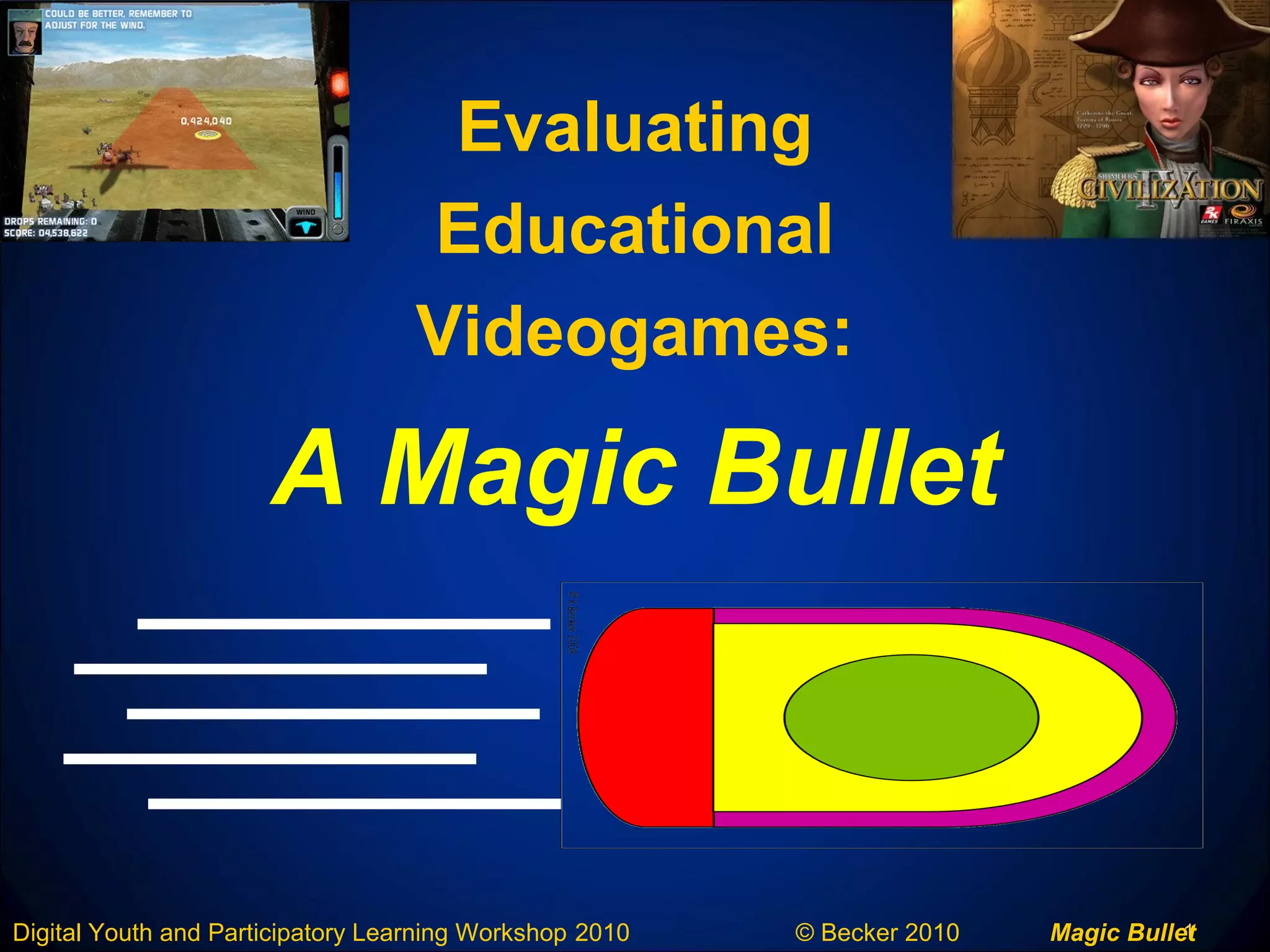
A Magic Bullet
Evaluating
Educational
Videogames:
2Digital Youth and Participatory Learning Workshop 2010 © Becker 2010 Magic Bullet
My Background
• B.Sc., M.Sc. In Computer Science
• Taught CS 1982 - 2008
• Ph.D. in Ed. Tech 2003 - 2008
• Have taught in Science, Education, Art,
Engineering
• Have taught: Programming, Data Architecture,
CAL, DGBL, Game Design, Technical Writing,
General Science & Math
• Using games since 1998
• Maintain extensive websites & course sites
• Hatching Program since 1989
3Digital Youth and Participatory Learning Workshop 2010 © Becker 2010 Magic Bullet
Backstory
• What attracted me to CS
– What I could do w/ it
• What got me into ID
– What I could make w/ it
• My end goal:
– Can we teach Ed game design… ?
• Understand Ed game design 
• Understand game design 
• Understand Ed design 
• Understand software design / understand
entertainment design….
4Digital Youth and Participatory Learning Workshop 2010 © Becker 2010 Magic Bullet
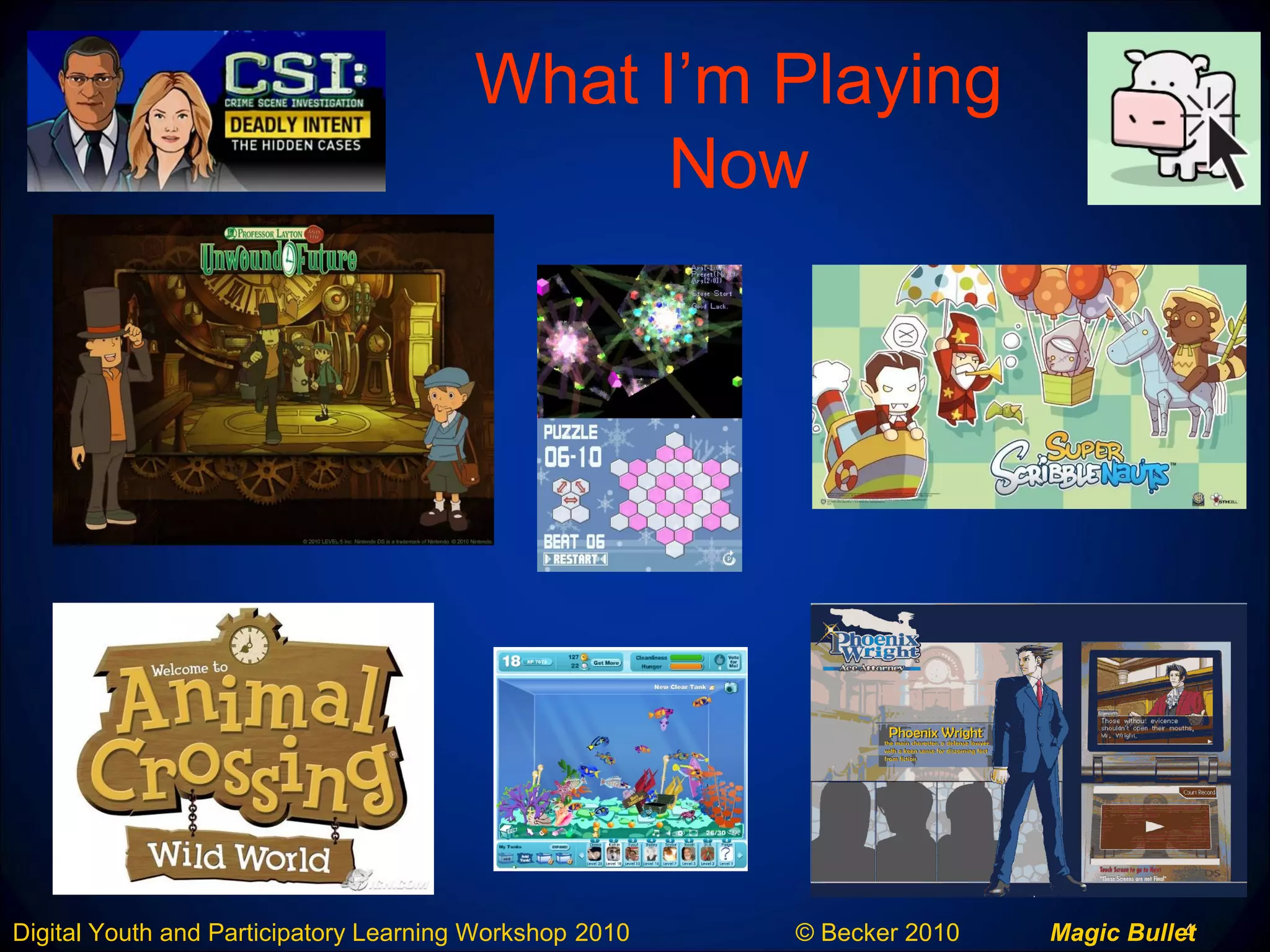
What I’m Playing
Now
5Digital Youth and Participatory Learning Workshop 2010 © Becker 2010 Magic Bullet
The Current Landscape
• Games are hot.
• But are they a good fit
for Education?
• Are they better
than....?
– Little hard data.
– Barriers to adoption
remain high
• administration, support,
time, tech requirements,
security concerns,
support
Mushroom Men
6Digital Youth and Participatory Learning Workshop 2010 © Becker 2010 Magic Bullet
What Do Educators Want?What Do Educators Want?
• Engaged Learners
• Authentic & Relevant
Learning
• High ROI
• Low cost
• Low entry barriers
IMPORTANT:
– MUST avoid repeat of
Edutainment Era
Mass Effect 2
7Digital Youth and Participatory Learning Workshop 2010 © Becker 2010 Magic Bullet
The Great Debates
In Games for Learning:
Learning vs. Fun
Instructional Design vs. Game Design
Game as Receptacle vs. Game as Method
Blood Magic
8Digital Youth and Participatory Learning Workshop 2010 © Becker 2010 Magic Bullet
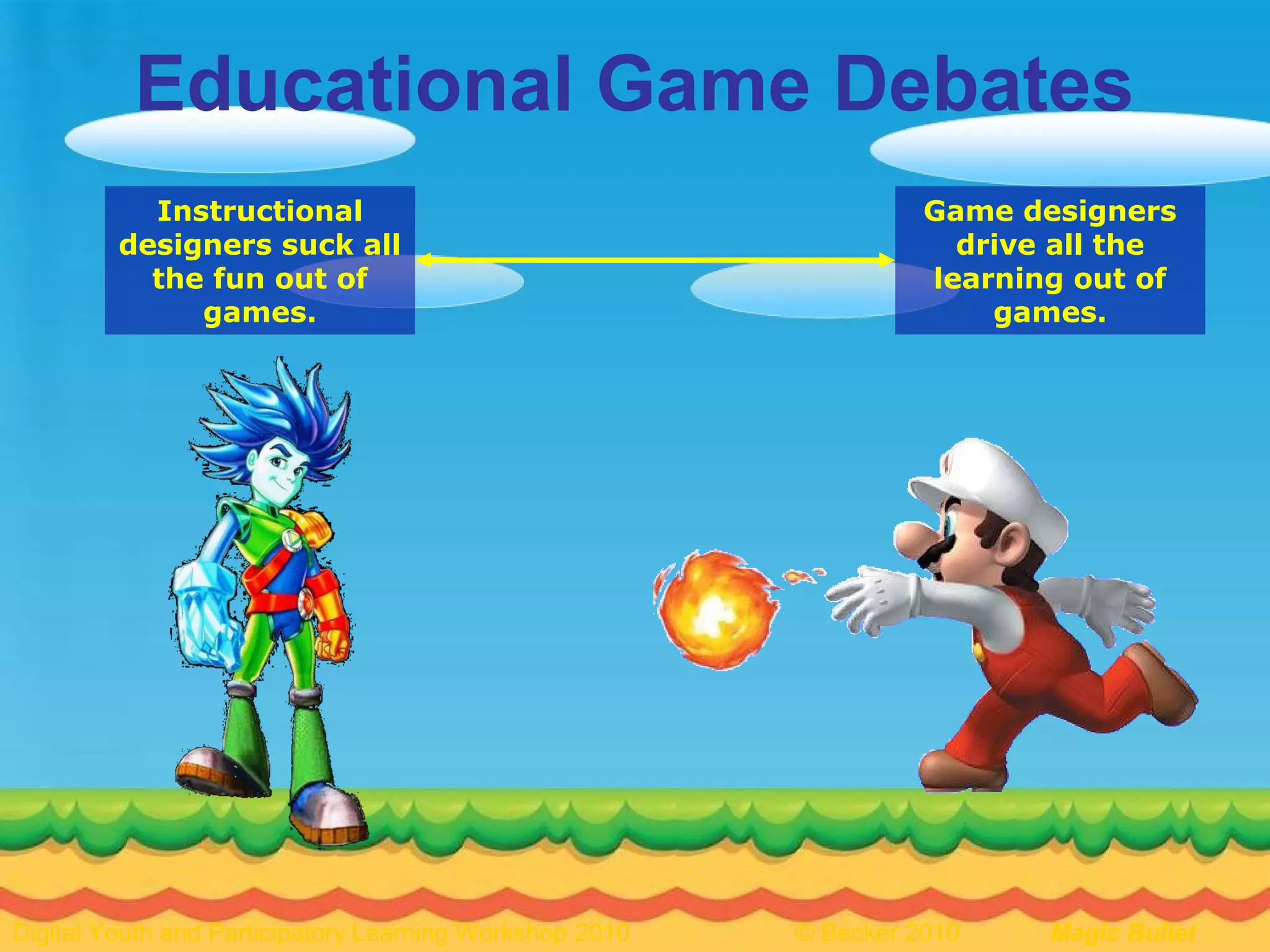
Educational Game Debates
Instructional
designers suck all
the fun out of
games.
Game designers
drive all the
learning out of
games.
9Digital Youth and Participatory Learning Workshop 2010 © Becker 2010 Magic Bullet
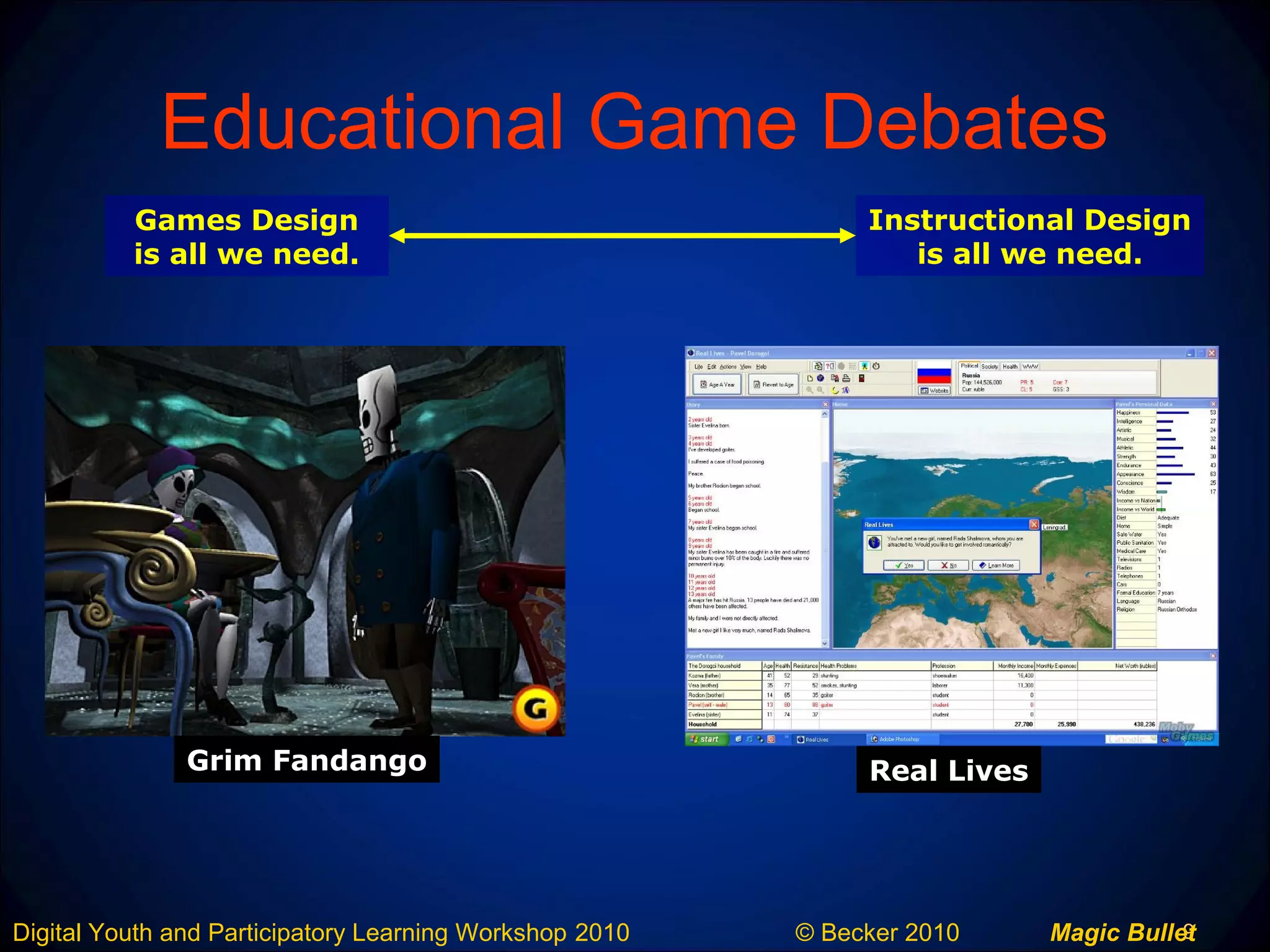
Educational Game Debates
Games Design
is all we need.
Instructional Design
is all we need.
Grim FandangoGrim Fandango Real LivesReal Lives
10Digital Youth and Participatory Learning Workshop 2010 © Becker 2010 Magic Bullet
Practicalities: Removing Barriers
• Easy to run & maintain.
• Clear connections to accepted pedagogy.
• Shallow learning curve.
• Internally supported orientation.
• LOTS of support materials
– Manuals
– Tutorials
– Lesson Plans
Heavy Rain
11Digital Youth and Participatory Learning Workshop 2010 © Becker 2010 Magic Bullet
Practicalities: Removing Barriers
Clear
connections
to accepted
pedagogy.
Heavy Rain
12Digital Youth and Participatory Learning Workshop 2010 © Becker 2010 Magic Bullet
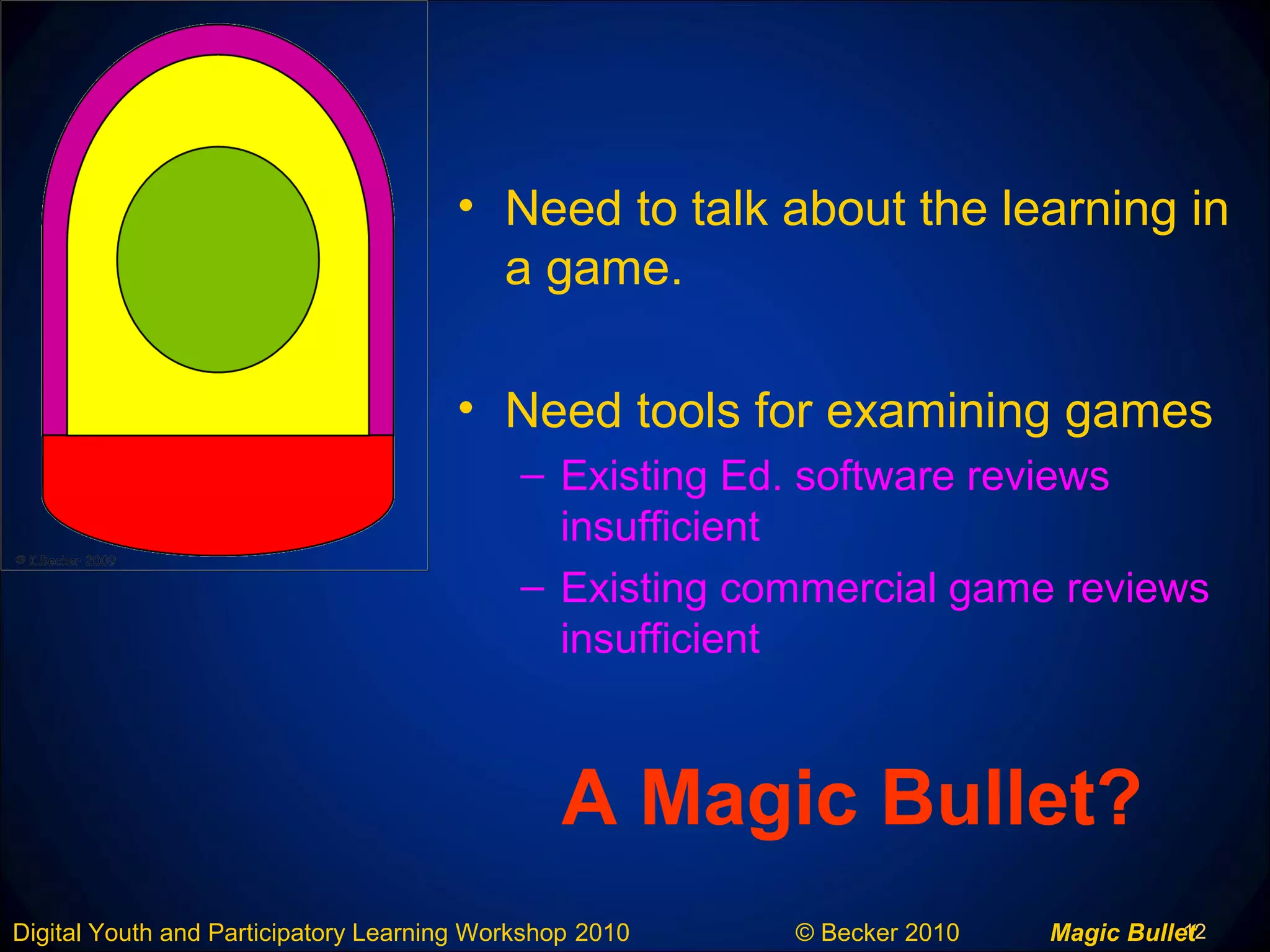
A Magic Bullet?
• Need to talk about the learning in
a game.
• Need tools for examining games
– Existing Ed. software reviews
insufficient
– Existing commercial game reviews
insufficient
13Digital Youth and Participatory Learning Workshop 2010 © Becker 2010 Magic Bullet
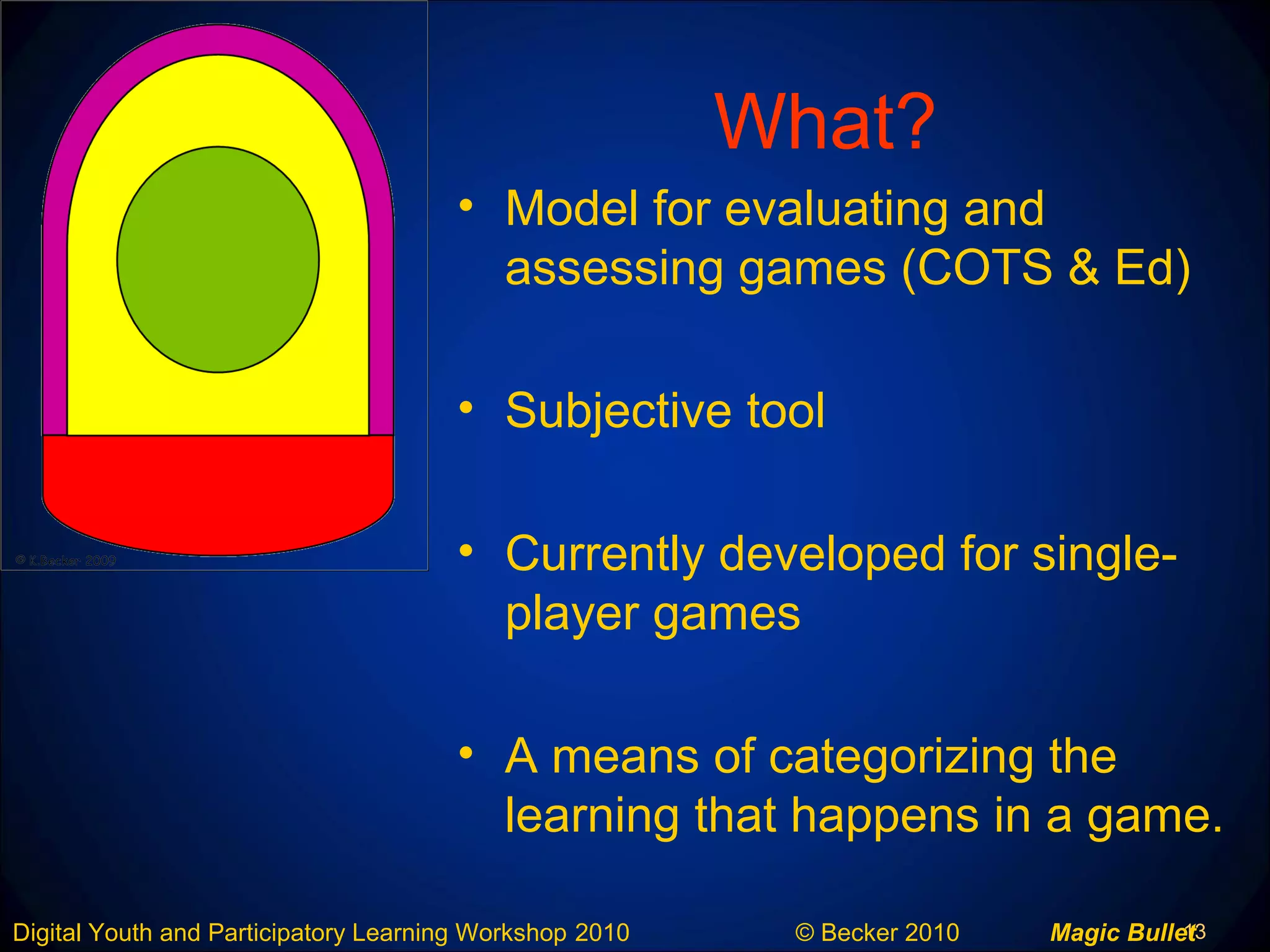
What?
• Model for evaluating and
assessing games (COTS & Ed)
• Subjective tool
• Currently developed for single-
player games
• A means of categorizing the
learning that happens in a game.
14Digital Youth and Participatory Learning Workshop 2010 © Becker 2010 Magic Bullet
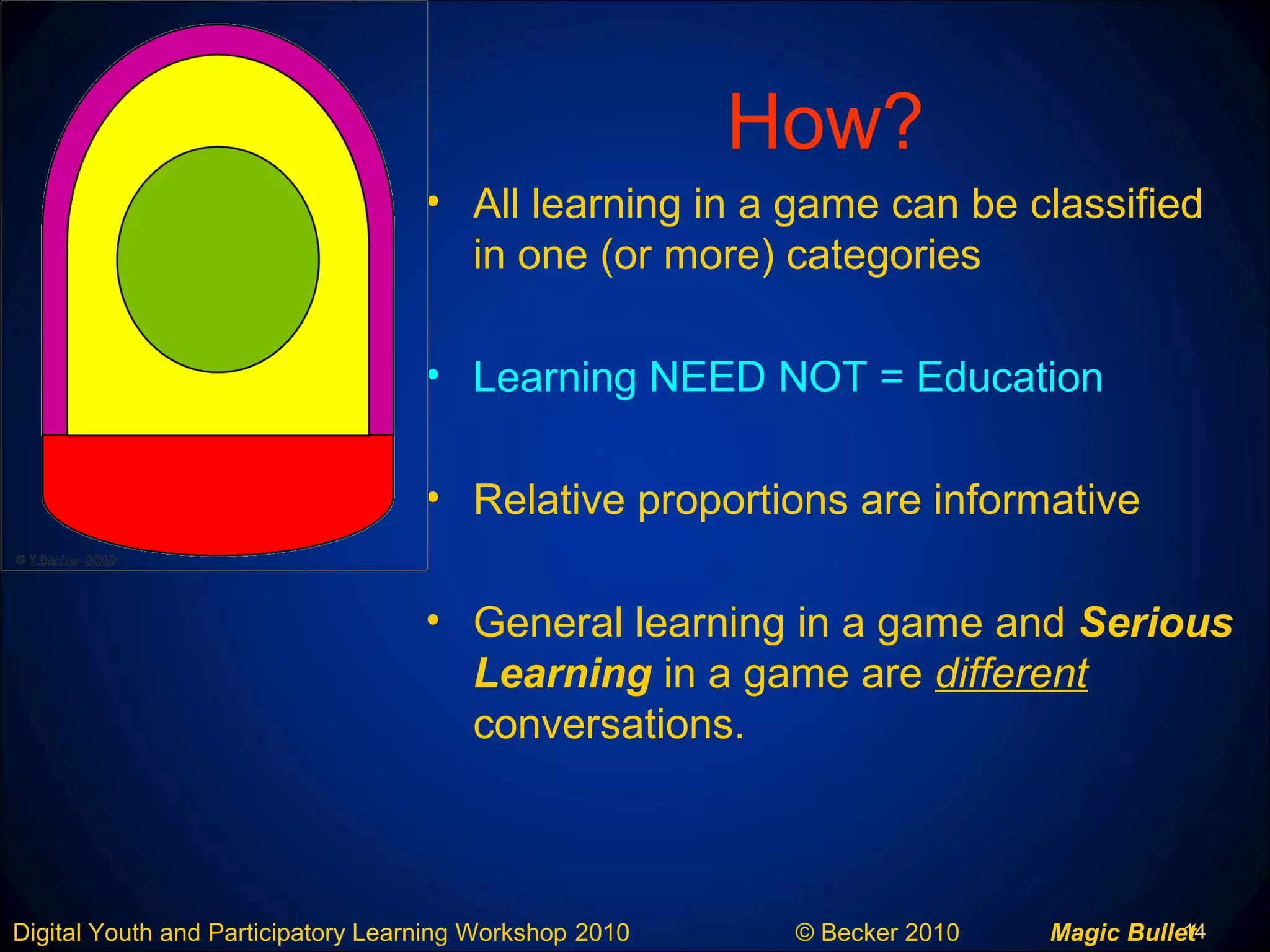
How?
• All learning in a game can be classified
in one (or more) categories
• Learning NEED NOT = Education
• Relative proportions are informative
• General learning in a game and Serious
Learning in a game are different
conversations.
15Digital Youth and Participatory Learning Workshop 2010 © Becker 2010 Magic Bullet
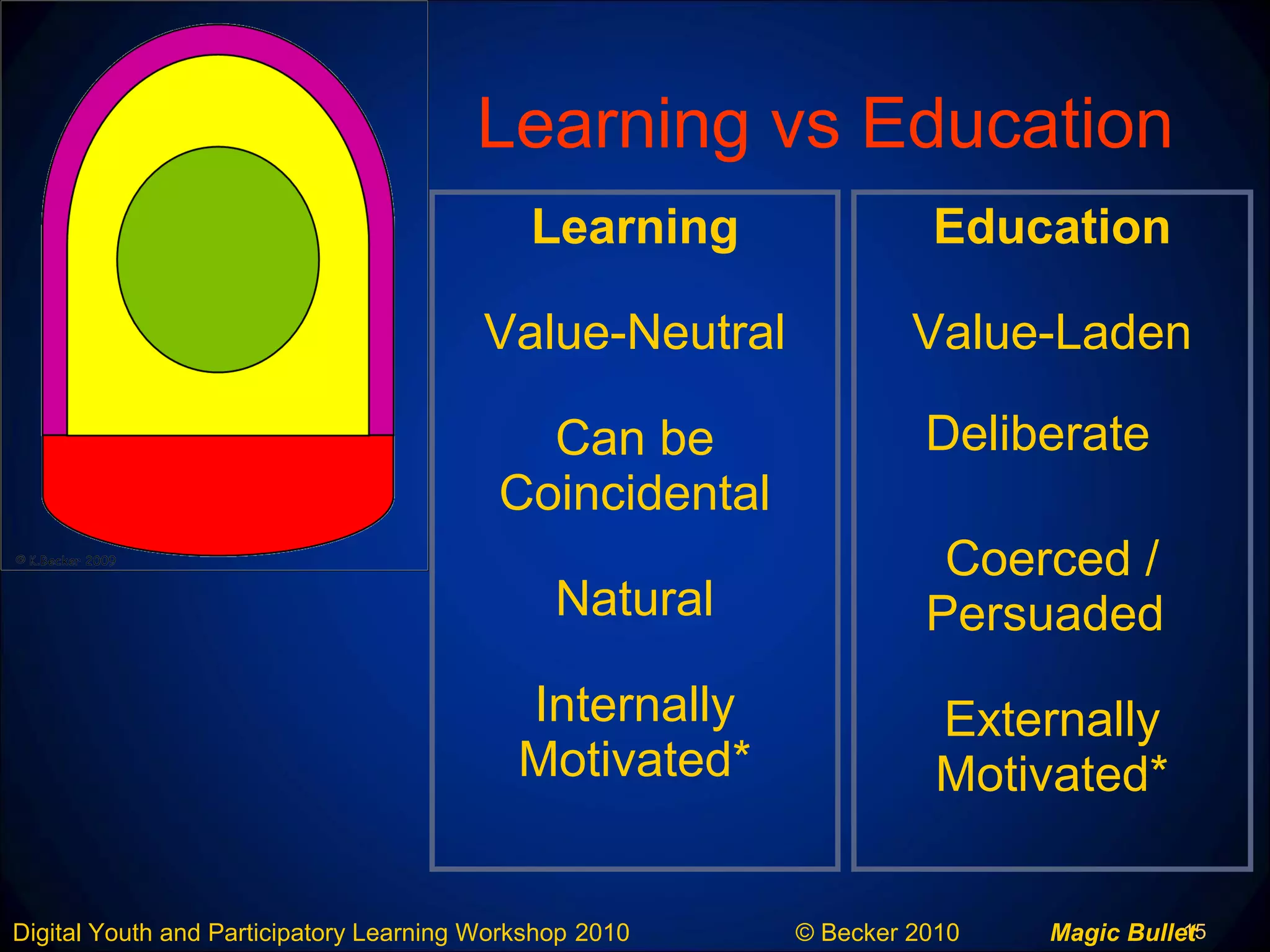
Learning vs Education
Learning
Value-Neutral
Can be
Coincidental
Natural
Internally
Motivated*
Education
Value-Laden
Deliberate
Coerced /
Persuaded
Externally
Motivated*
16Digital Youth and Participatory Learning Workshop 2010 © Becker 2010 Magic Bullet
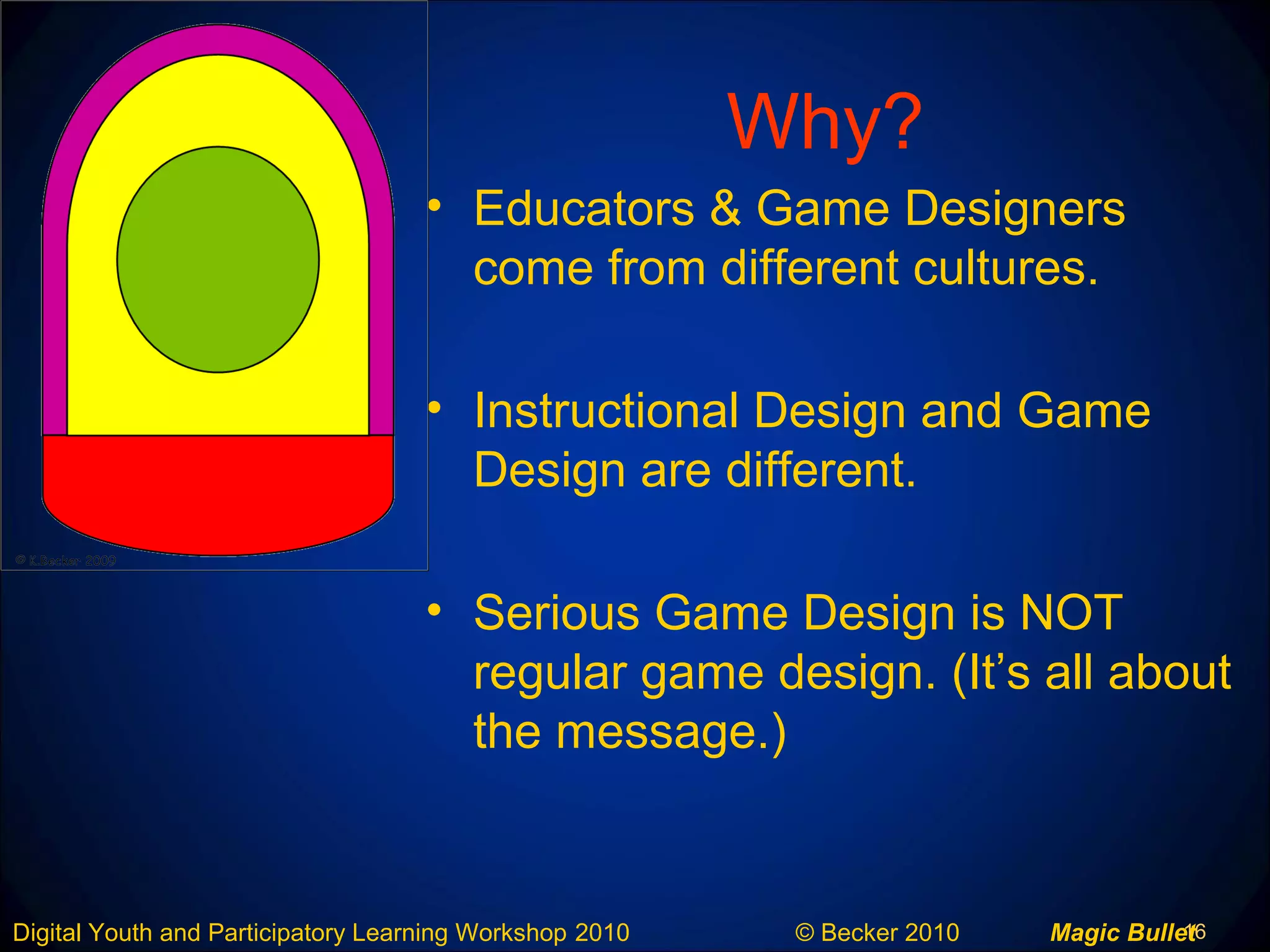
Why?
• Educators & Game Designers
come from different cultures.
• Instructional Design and Game
Design are different.
• Serious Game Design is NOT
regular game design. (It’s all about
the message.)
17Digital Youth and Participatory Learning Workshop 2010 © Becker 2010 Magic Bullet
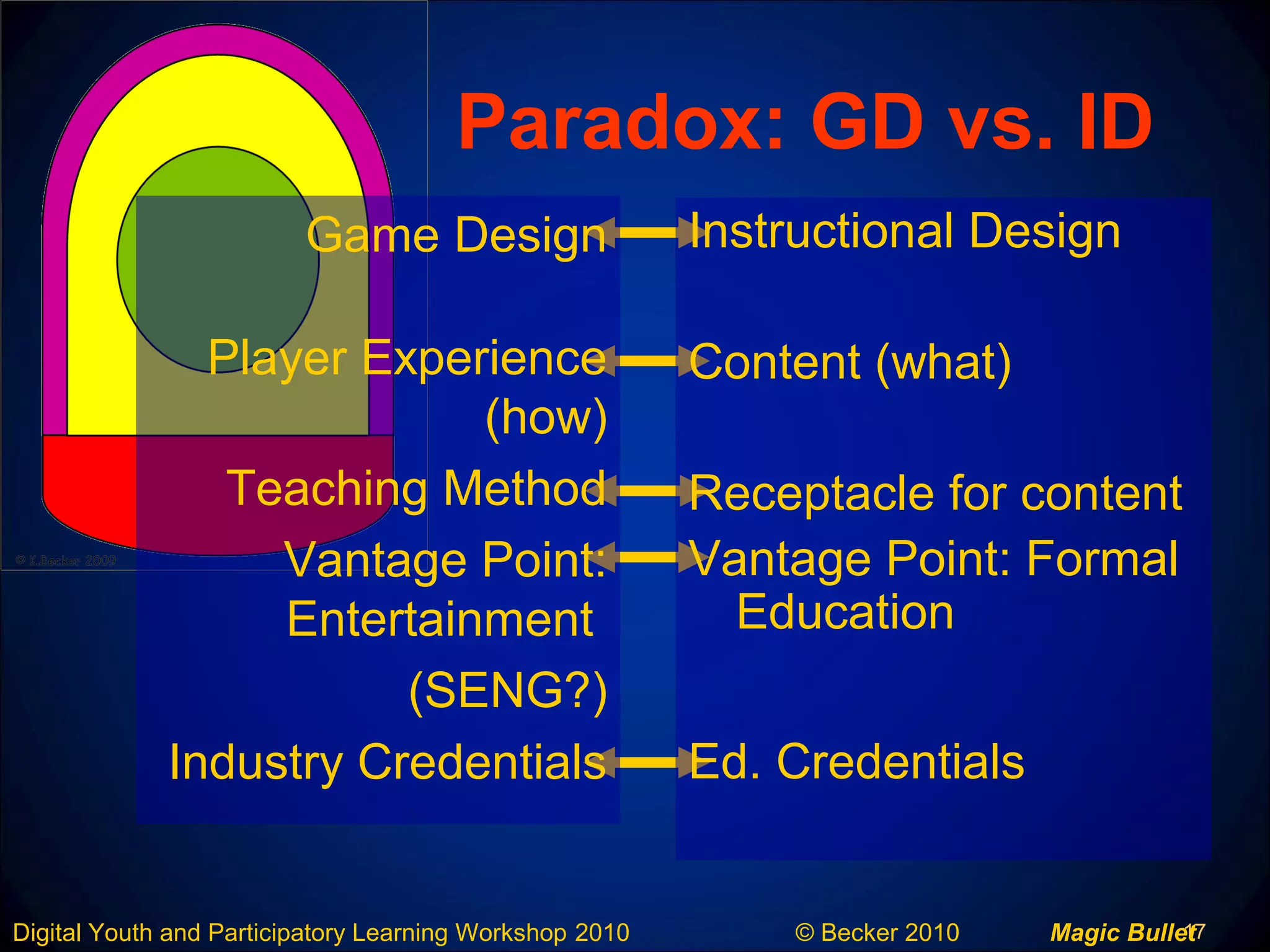
Paradox: GD vs. ID
Instructional Design
Content (what)
Receptacle for content
Vantage Point: Formal
Education
Ed. Credentials
Game Design
Player Experience
(how)
Teaching Method
Vantage Point:
Entertainment
(SENG?)
Industry Credentials
18Digital Youth and Participatory Learning Workshop 2010 © Becker 2010 Magic Bullet
Why?
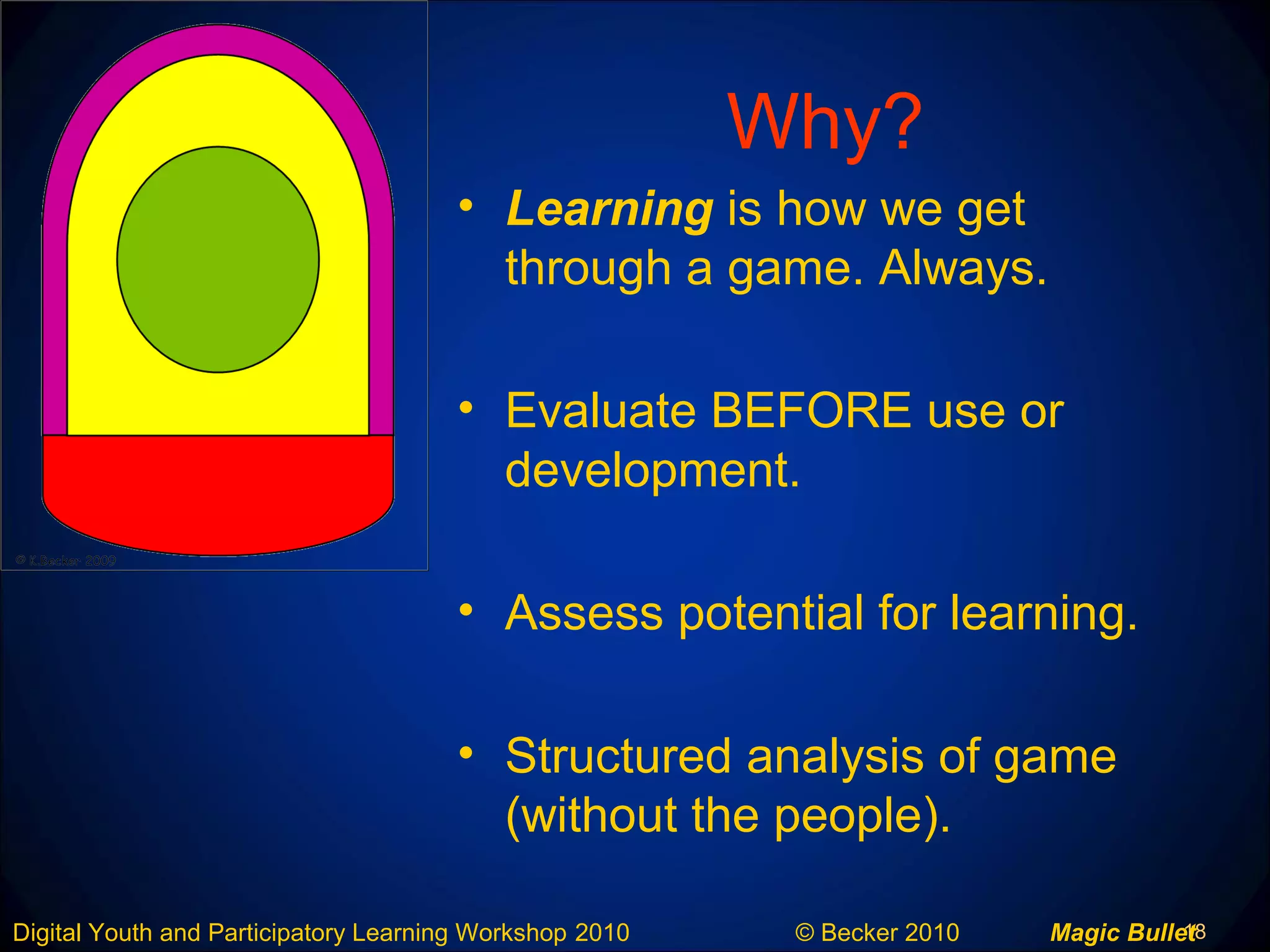
• Learning is how we get
through a game. Always.
• Evaluate BEFORE use or
development.
• Assess potential for learning.
• Structured analysis of game
(without the people).
19Digital Youth and Participatory Learning Workshop 2010 © Becker 2010 Magic Bullet
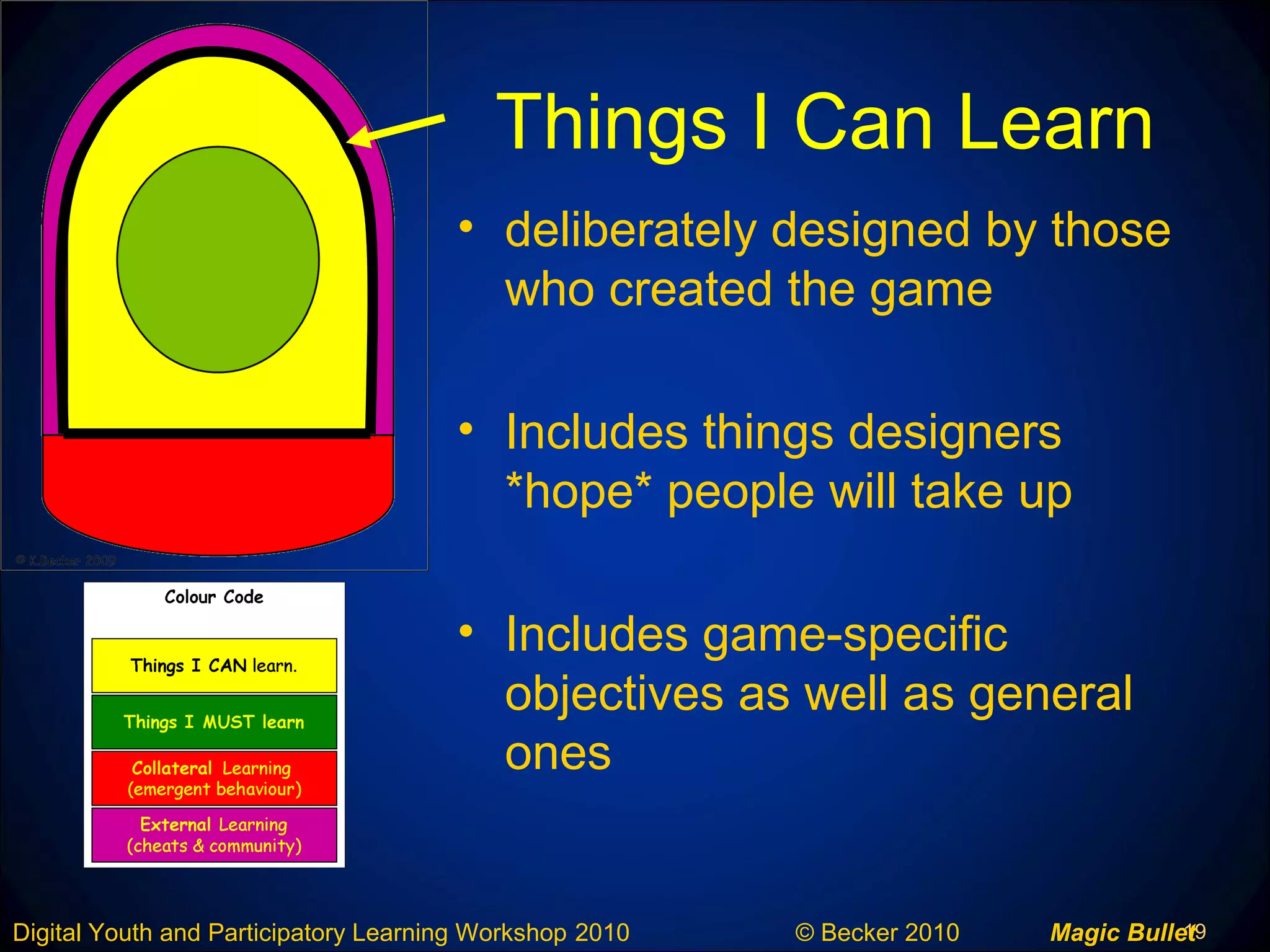
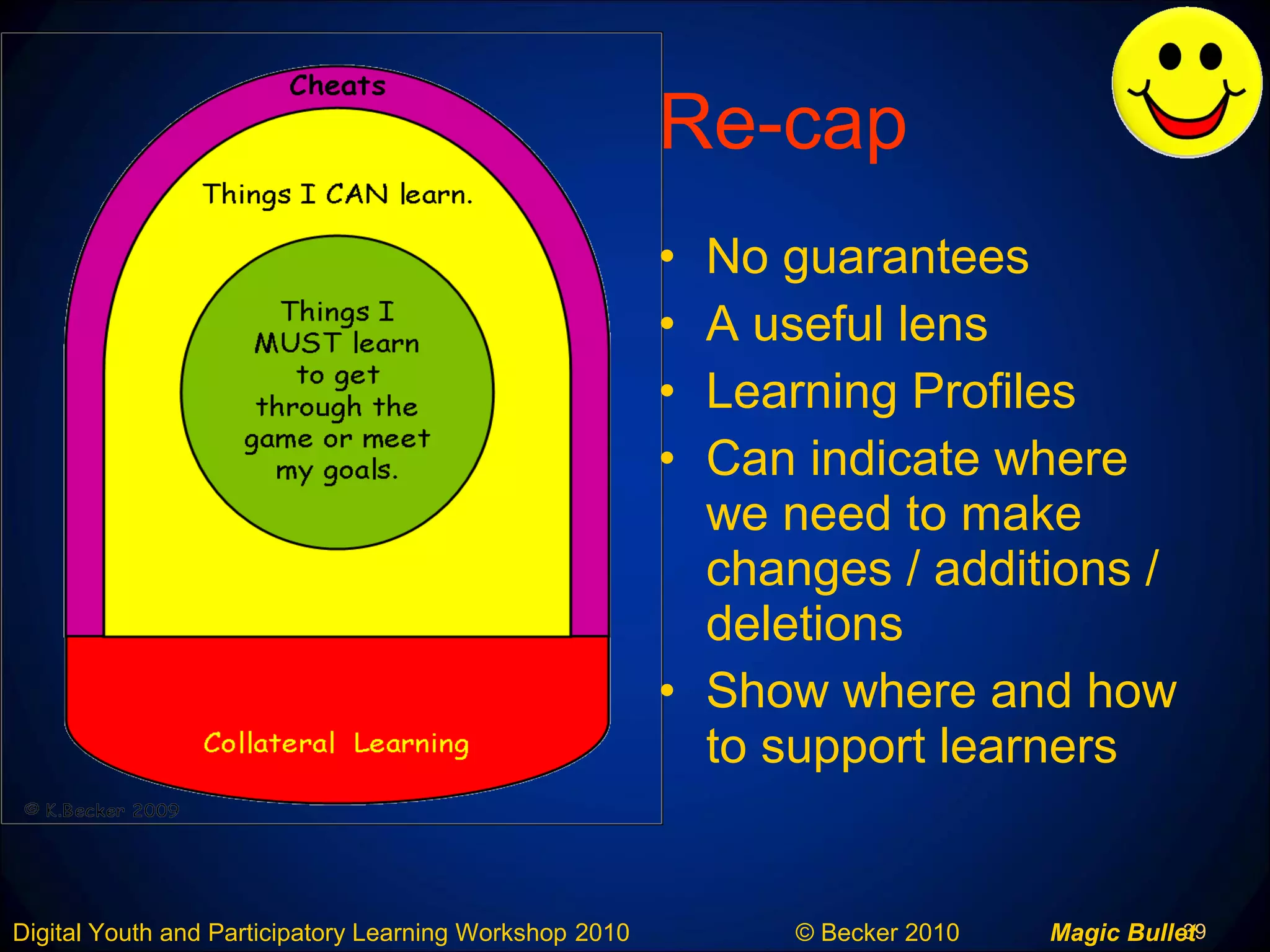
Things I Can Learn
• deliberately designed by those
who created the game
• Includes things designers
*hope* people will take up
• Includes game-specific
objectives as well as general
ones
20Digital Youth and Participatory Learning Workshop 2010 © Becker 2010 Magic Bullet
Things I MUST
Learn
• Should be a subset of the first
category
• Required in order to achieve a
specific goal or to win
• Includes strategies, skills,
facts,...
21Digital Youth and Participatory Learning Workshop 2010 © Becker 2010 Magic Bullet
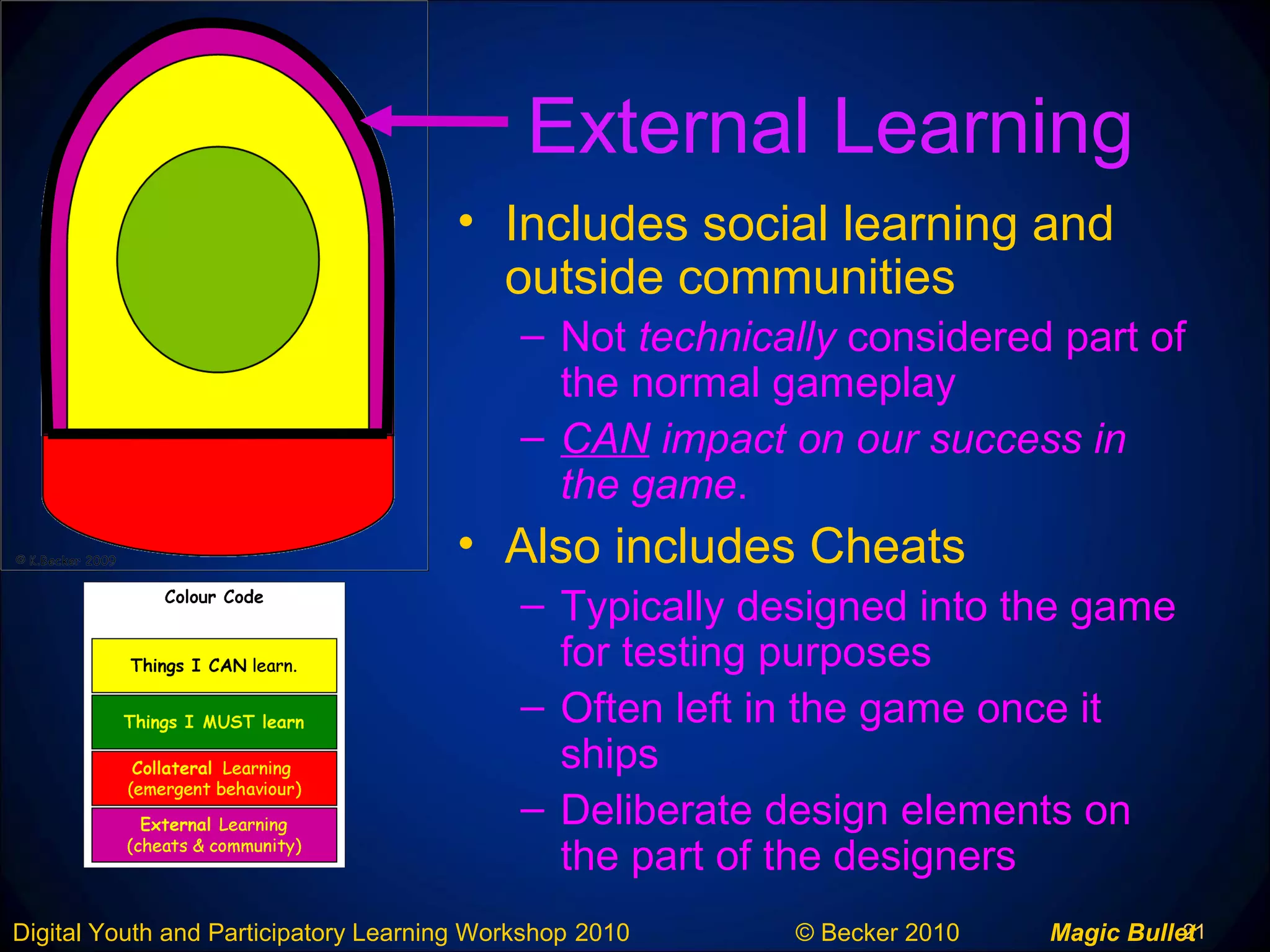
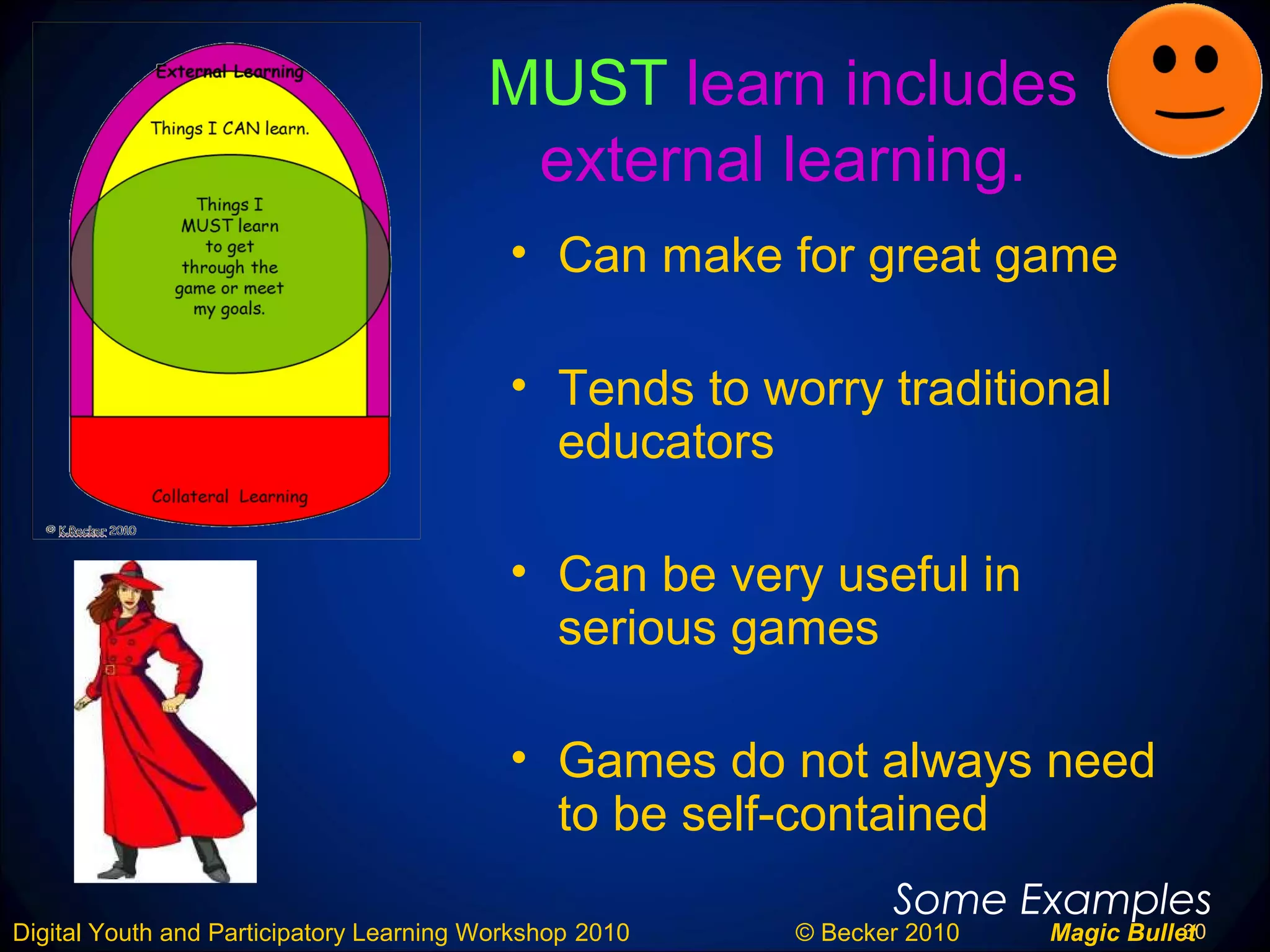
External Learning
• Includes social learning and
outside communities
– Not technically considered part of
the normal gameplay
– CAN impact on our success in
the game.
• Also includes Cheats
– Typically designed into the game
for testing purposes
– Often left in the game once it
ships
– Deliberate design elements on
the part of the designers
22Digital Youth and Participatory Learning Workshop 2010 © Becker 2010 Magic Bullet
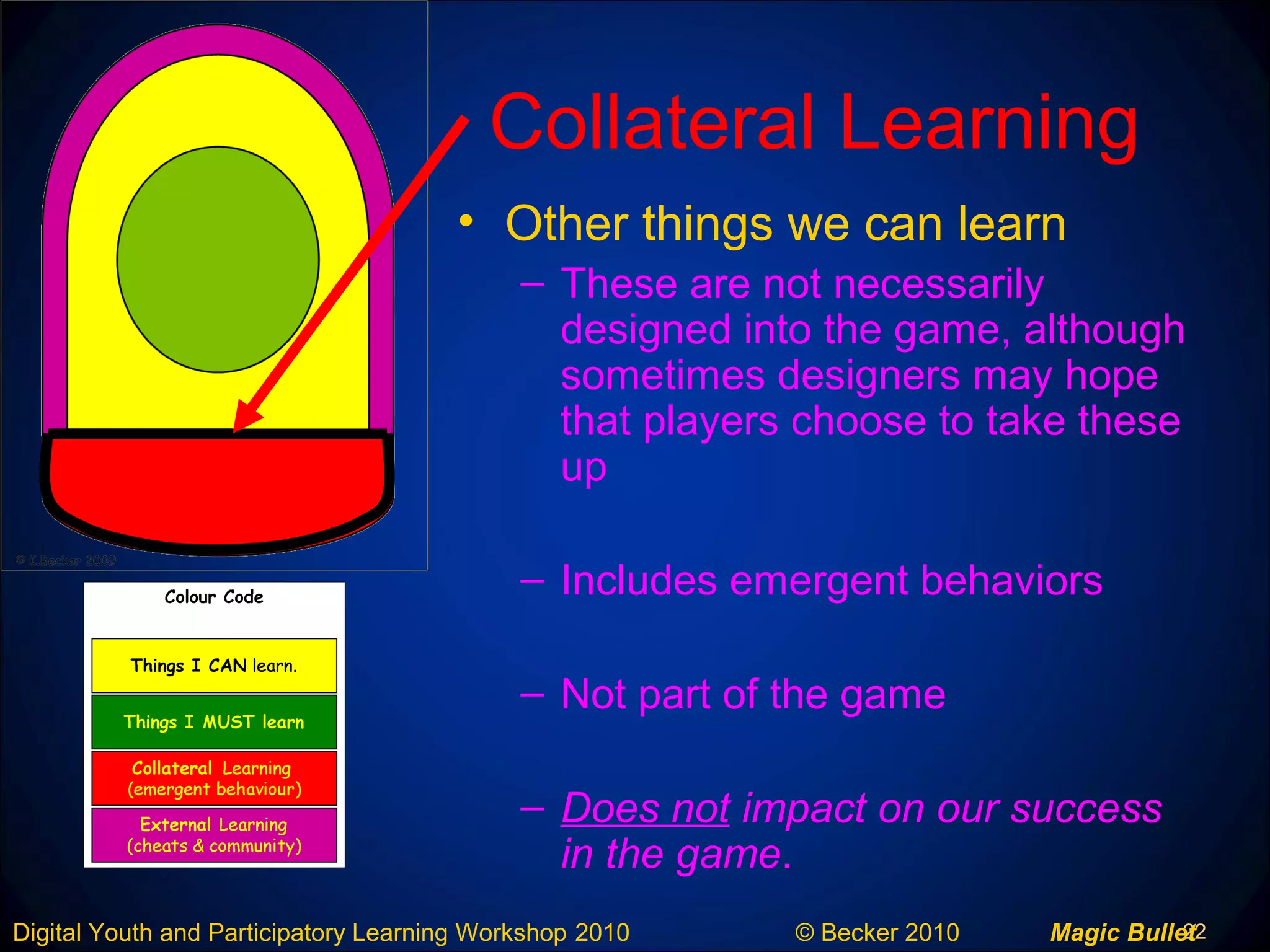
Collateral Learning
• Other things we can learn
– These are not necessarily
designed into the game, although
sometimes designers may hope
that players choose to take these
up
– Includes emergent behaviors
– Not part of the game
– Does not impact on our success
in the game.
23Digital Youth and Participatory Learning Workshop 2010 © Becker 2010 Magic Bullet
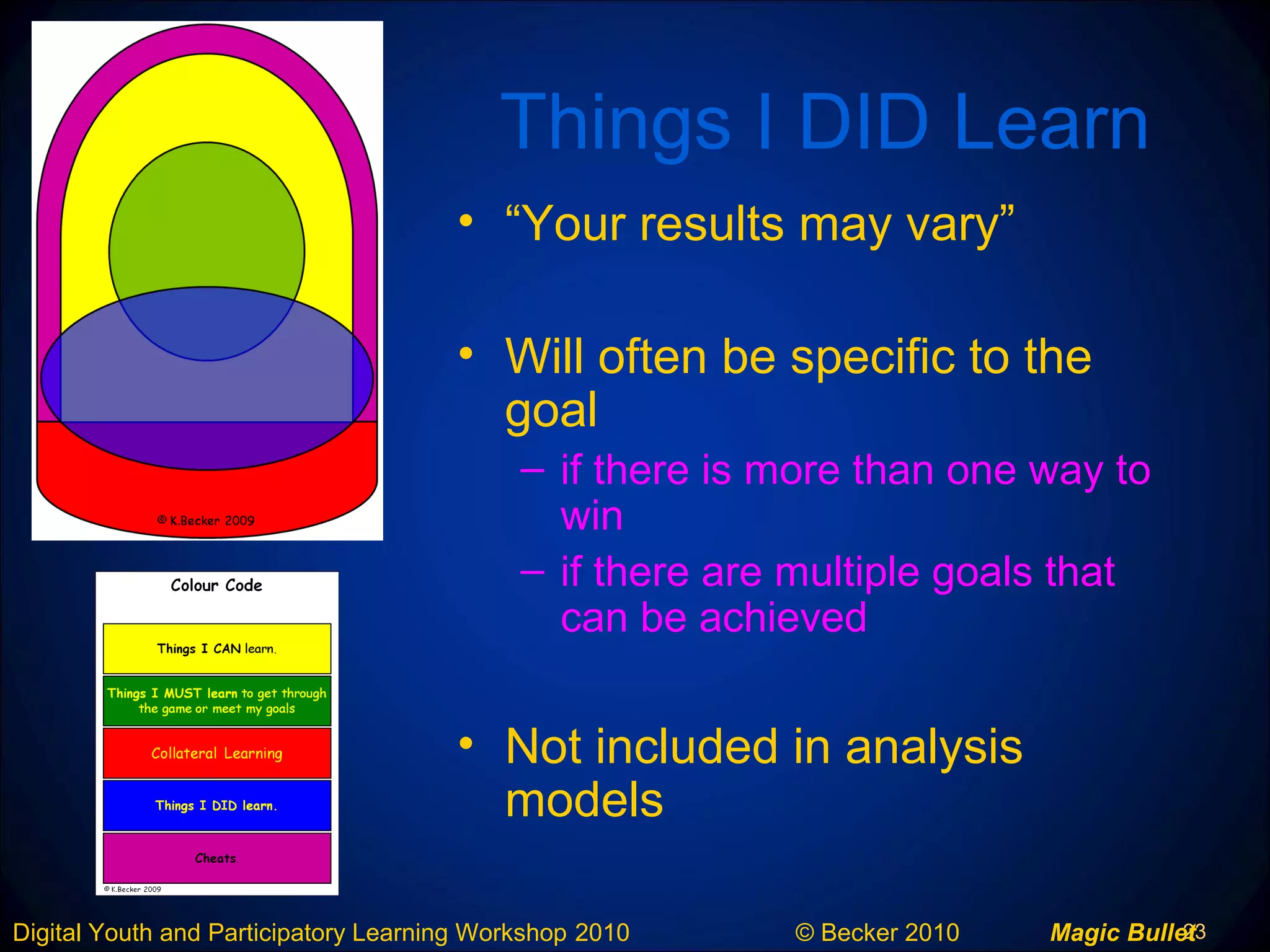
Things I DID Learn
• “Your results may vary”
• Will often be specific to the
goal
– if there is more than one way to
win
– if there are multiple goals that
can be achieved
• Not included in analysis
models
24Digital Youth and Participatory Learning Workshop 2010 © Becker 2010 Magic Bullet
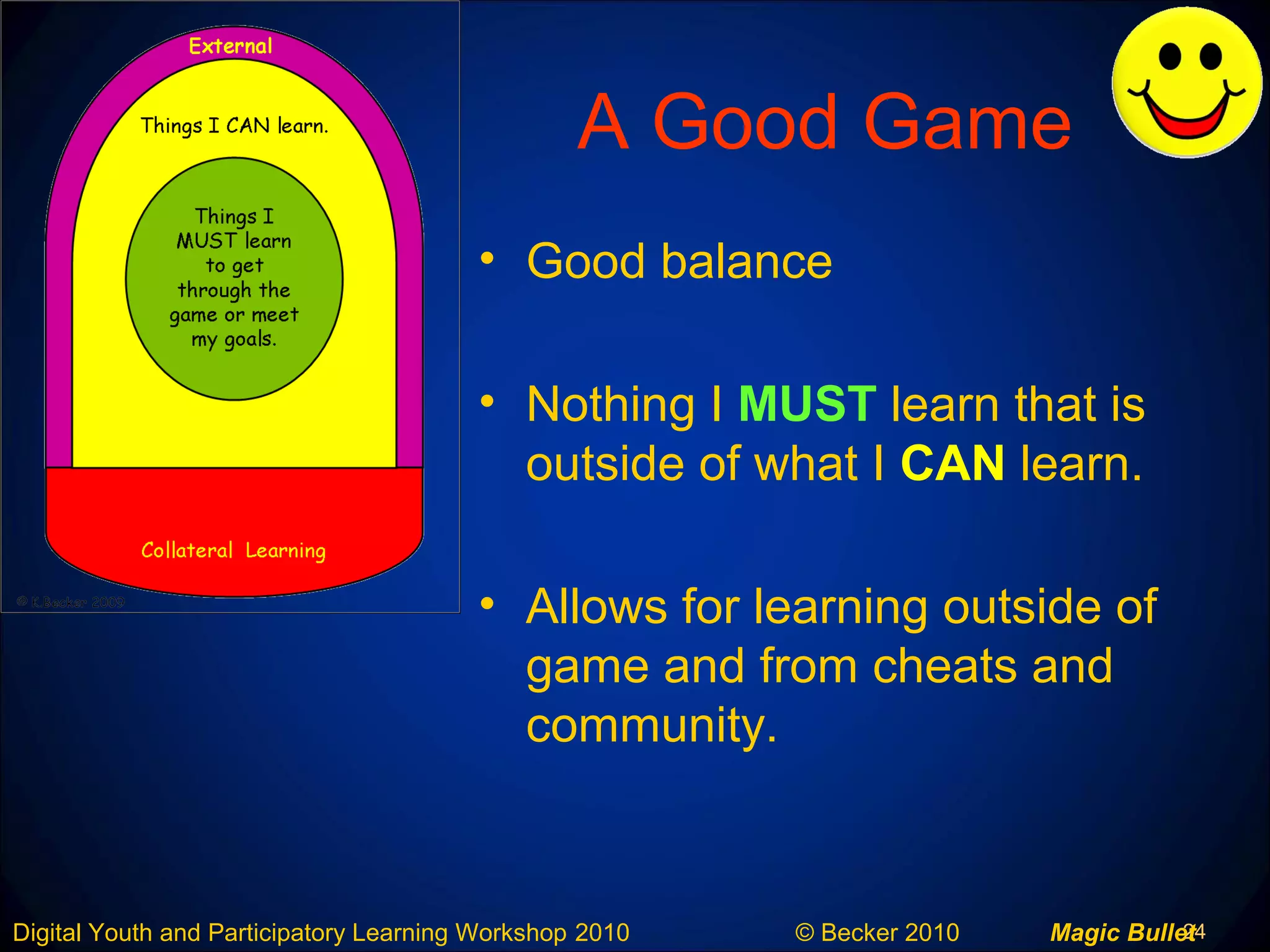
A Good Game
• Good balance
• Nothing I MUST learn that is
outside of what I CAN learn.
• Allows for learning outside of
game and from cheats and
community.
25Digital Youth and Participatory Learning Workshop 2010 © Becker 2010 Magic Bullet
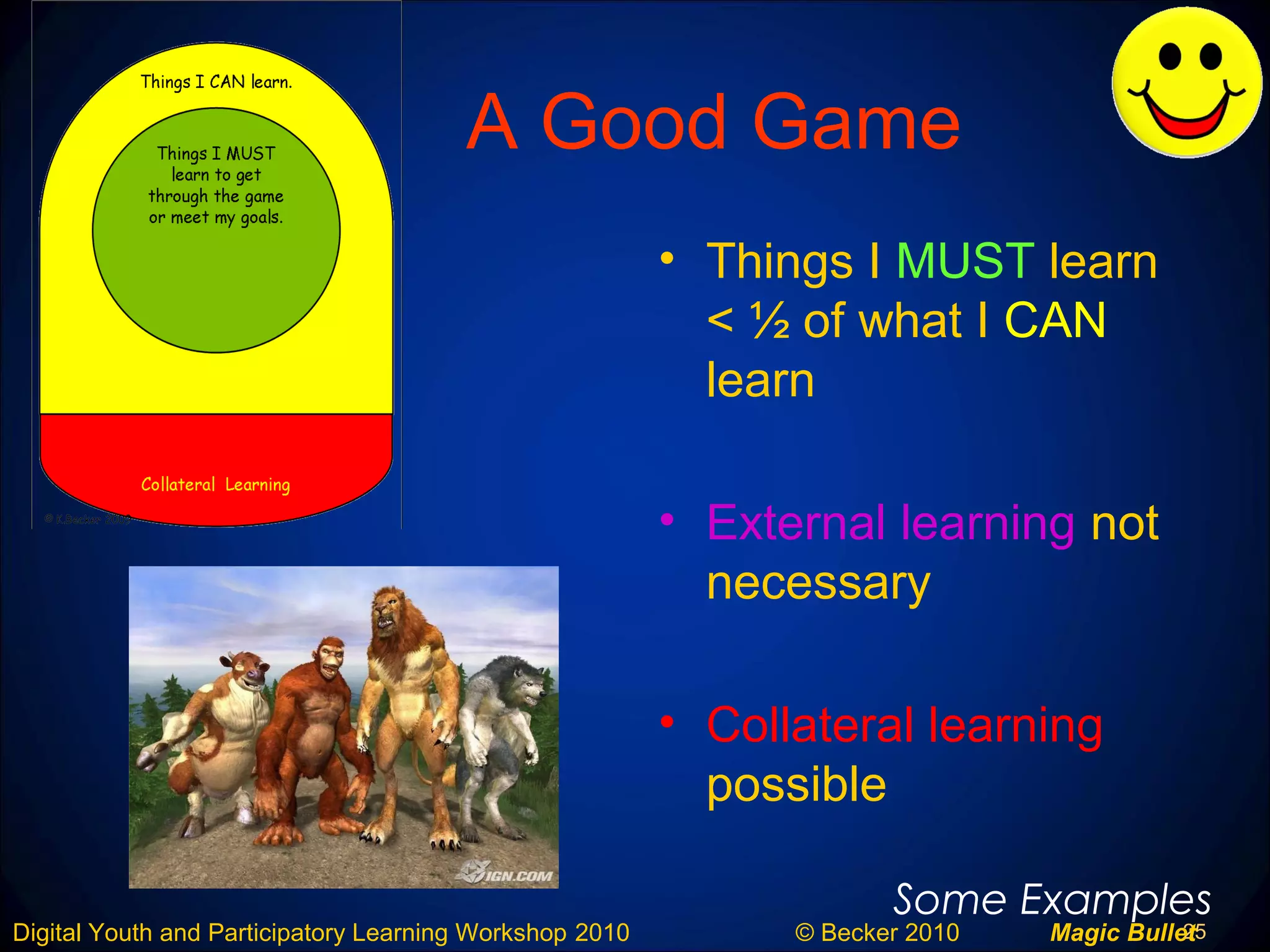
A Good Game
• Things I MUST learn
< ½ of what I CAN
learn
• External learning not
necessary
• Collateral learning
possible
Some Examples
26Digital Youth and Participatory Learning Workshop 2010 © Becker 2010 Magic Bullet
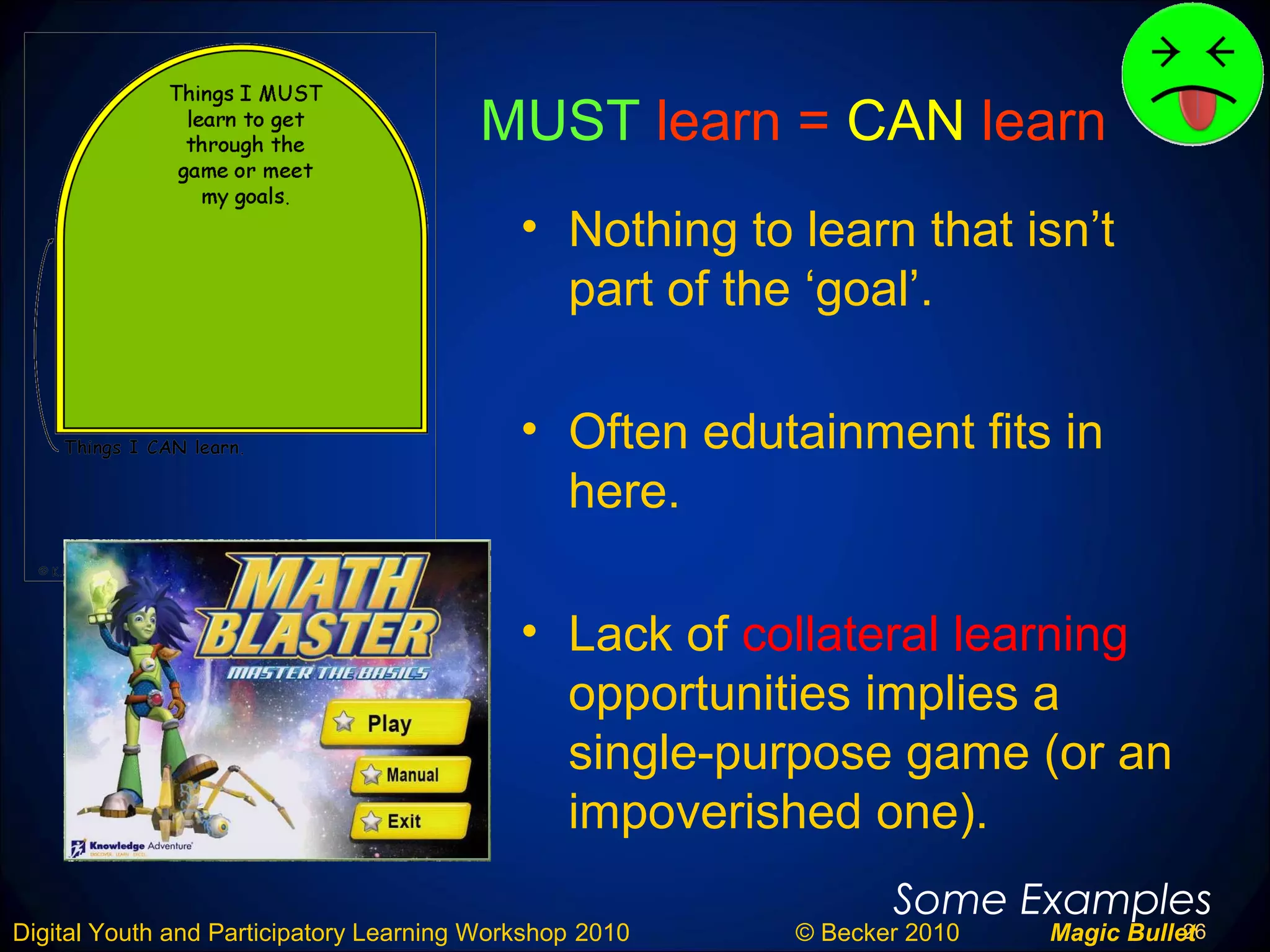
MUST learn = CAN learn
• Nothing to learn that isn’t
part of the ‘goal’.
• Often edutainment fits in
here.
• Lack of collateral learning
opportunities implies a
single-purpose game (or an
impoverished one).
Some Examples
27Digital Youth and Participatory Learning Workshop 2010 © Becker 2010 Magic Bullet
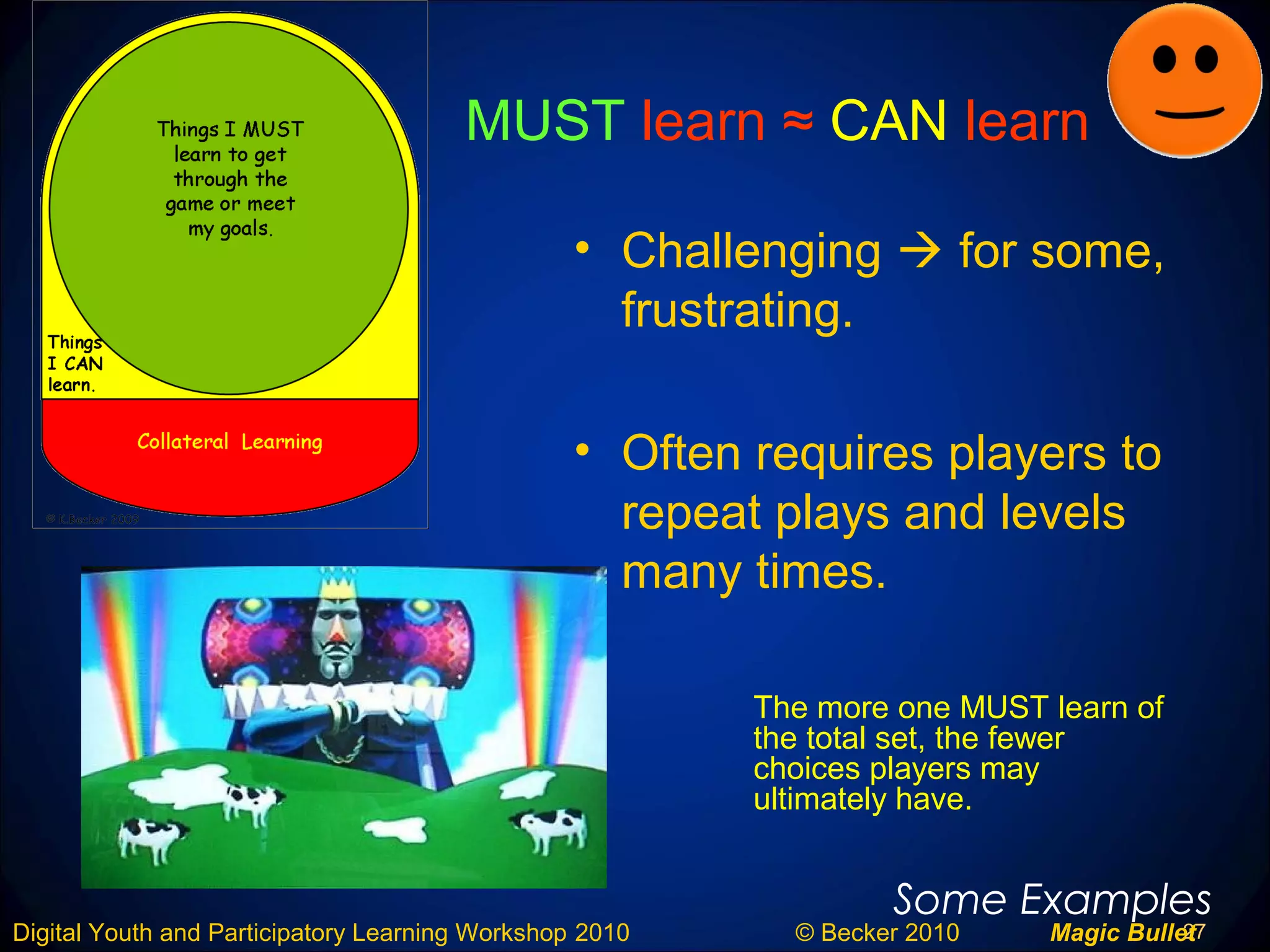
MUST learn ≈ CAN learn
• Challenging  for some,
frustrating.
• Often requires players to
repeat plays and levels
many times.
Some Examples
The more one MUST learn of
the total set, the fewer
choices players may
ultimately have.
28Digital Youth and Participatory Learning Workshop 2010 © Becker 2010 Magic Bullet
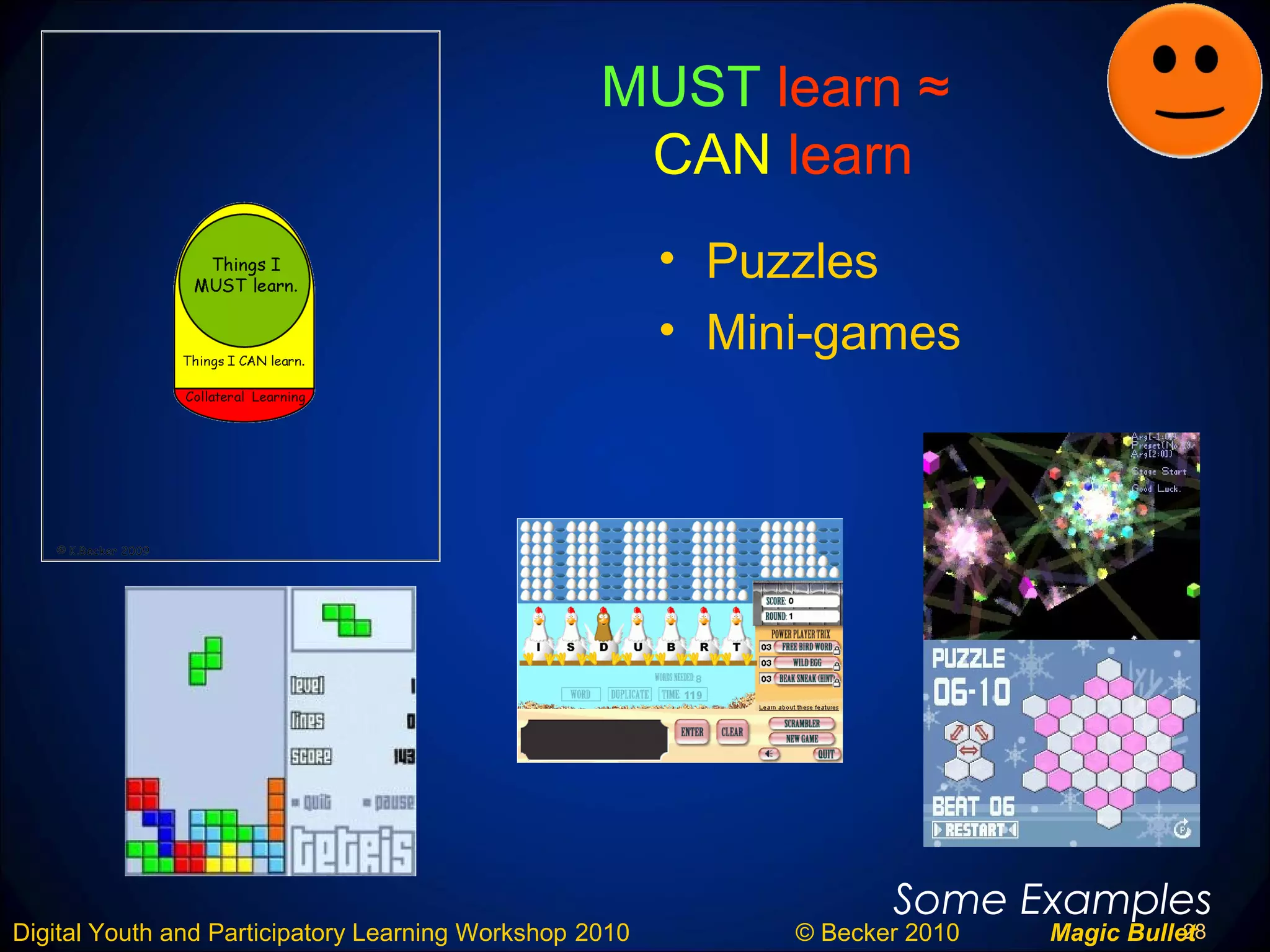
MUST learn ≈
CAN learn
• Puzzles
• Mini-games
Some Examples
29Digital Youth and Participatory Learning Workshop 2010 © Becker 2010 Magic Bullet
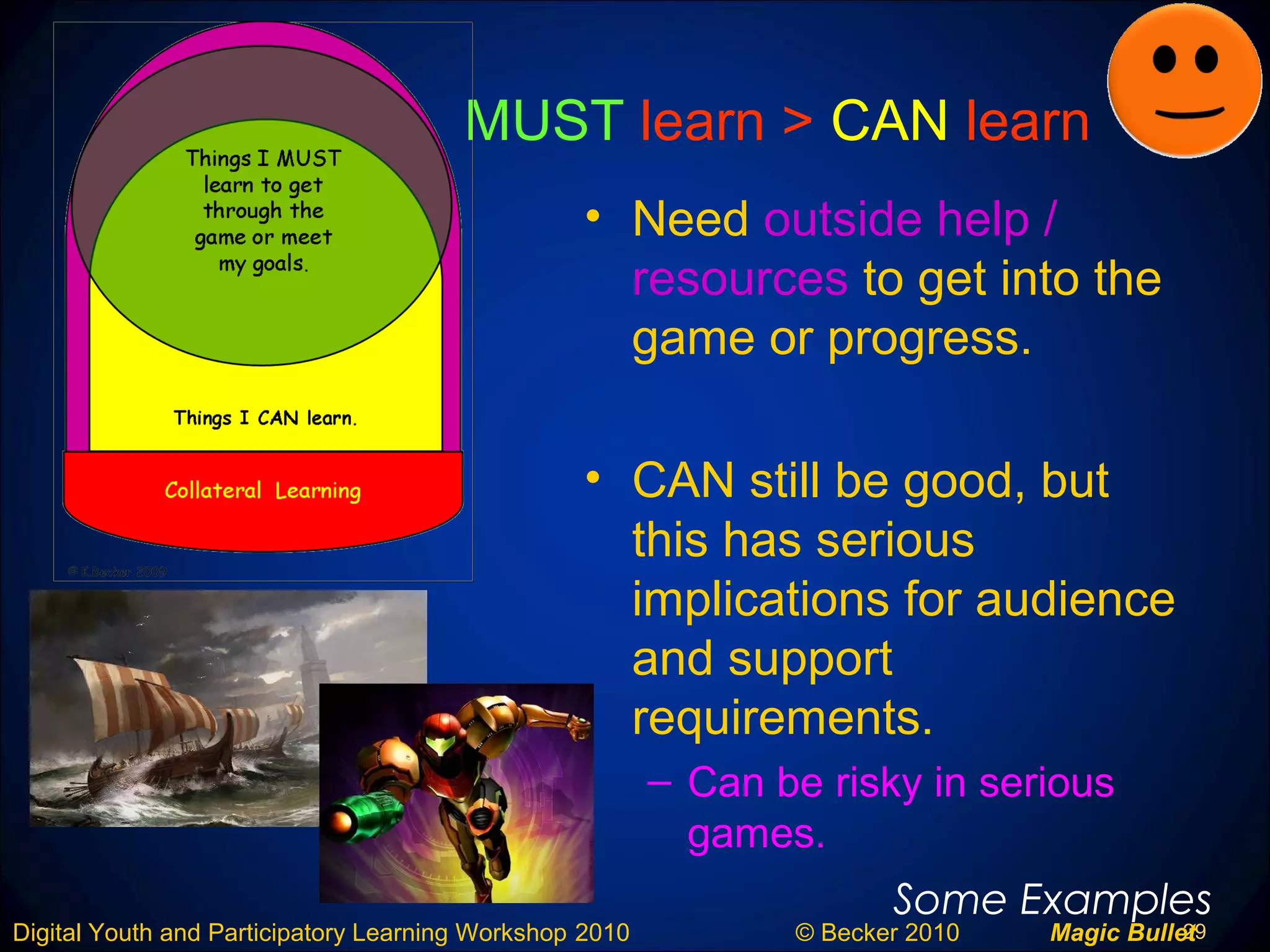
MUST learn > CAN learn
• Need outside help /
resources to get into the
game or progress.
• CAN still be good, but
this has serious
implications for audience
and support
requirements.
– Can be risky in serious
games.
Some Examples
30Digital Youth and Participatory Learning Workshop 2010 © Becker 2010 Magic Bullet
MUST learn includes
external learning.
• Can make for great game
• Tends to worry traditional
educators
• Can be very useful in
serious games
• Games do not always need
to be self-contained
Some Examples
31Digital Youth and Participatory Learning Workshop 2010 © Becker 2010 Magic Bullet
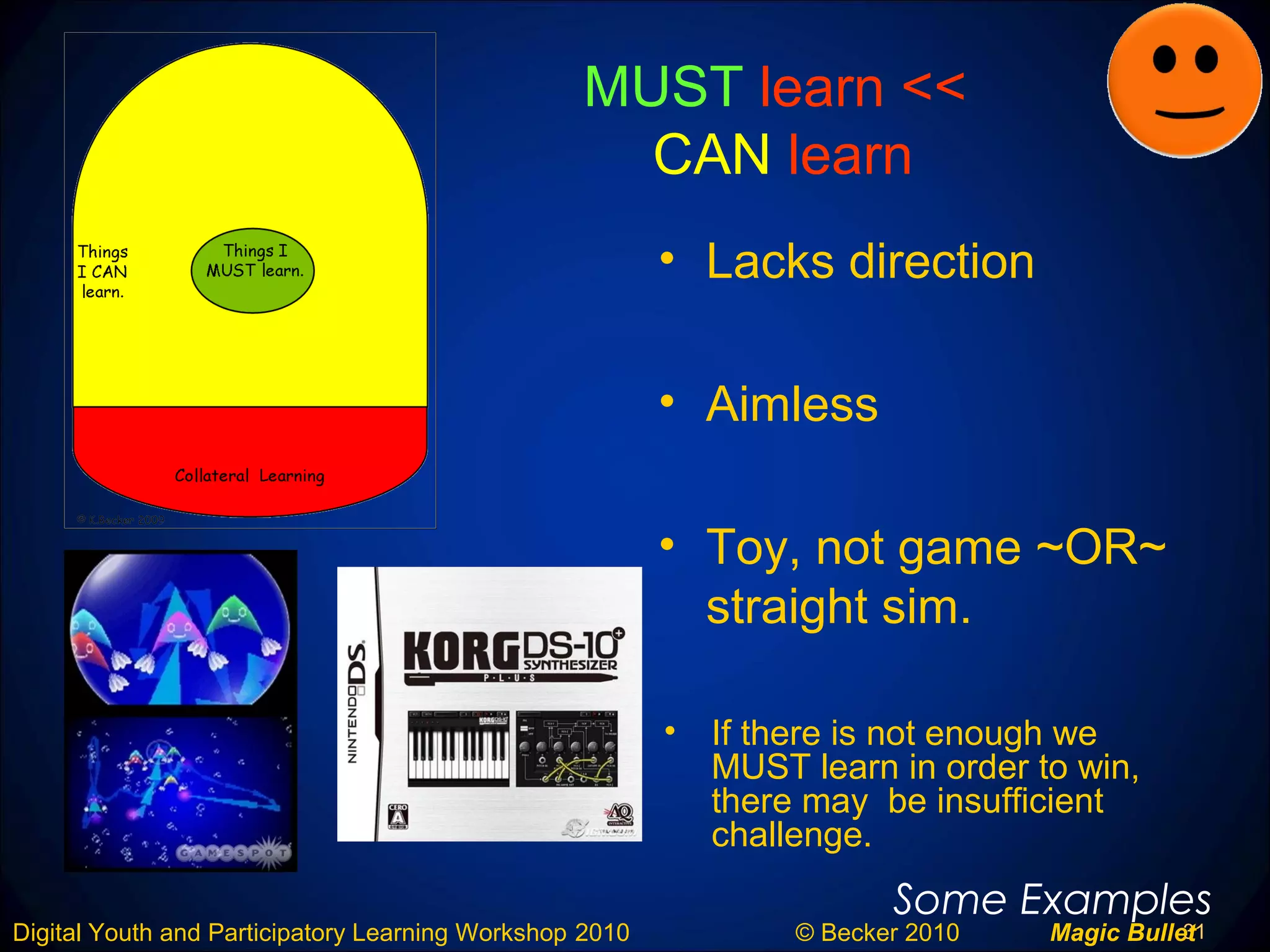
MUST learn <<
CAN learn
• Lacks direction
• Aimless
• Toy, not game ~OR~
straight sim.
Some Examples
• If there is not enough we
MUST learn in order to win,
there may be insufficient
challenge.
32Digital Youth and Participatory Learning Workshop 2010 © Becker 2010 Magic Bullet
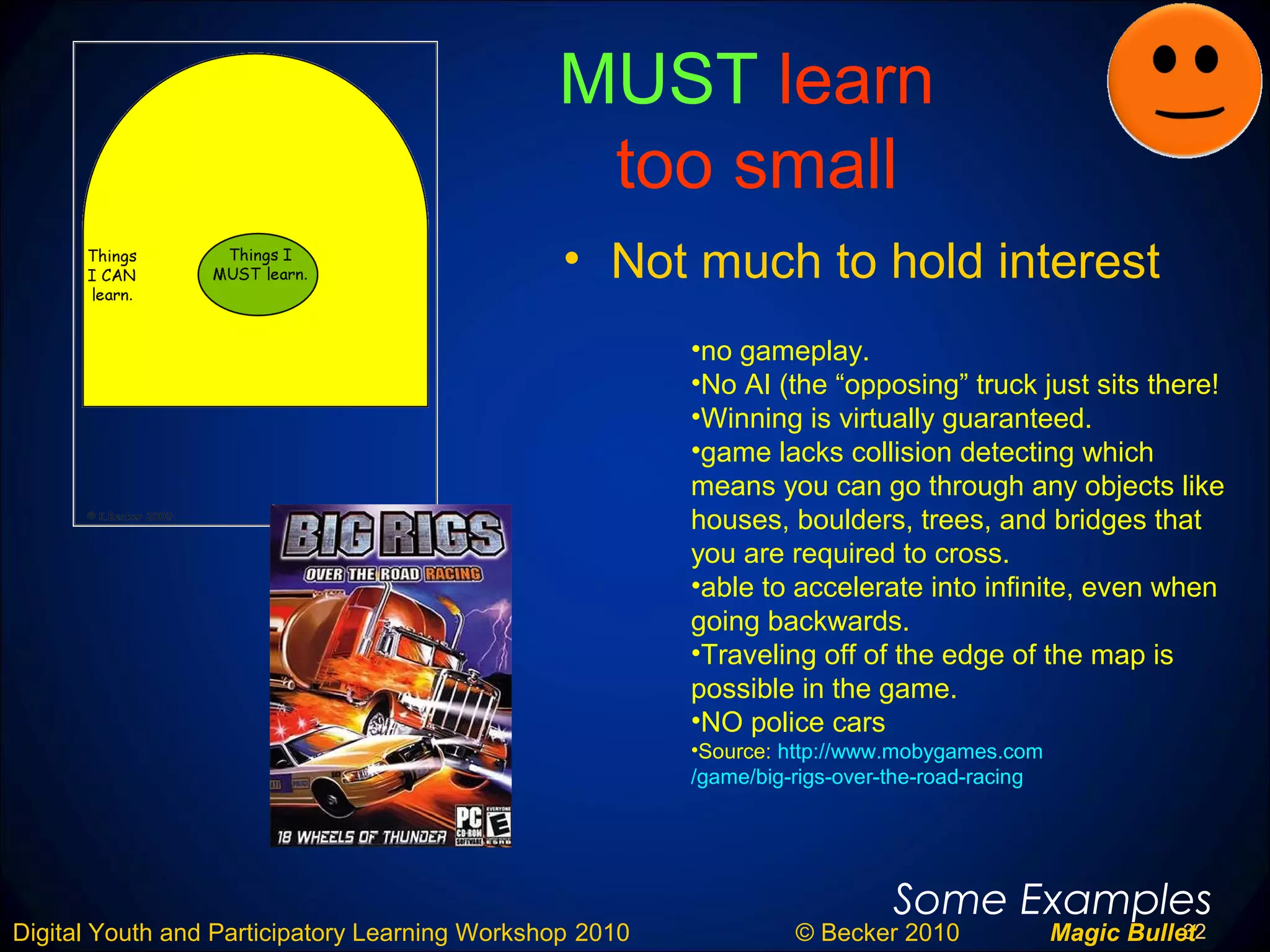
MUST learn
too small
• Not much to hold interest
Some Examples
•no gameplay.
•No AI (the “opposing” truck just sits there!
•Winning is virtually guaranteed.
•game lacks collision detecting which
means you can go through any objects like
houses, boulders, trees, and bridges that
you are required to cross.
•able to accelerate into infinite, even when
going backwards.
•Traveling off of the edge of the map is
possible in the game.
•NO police cars
•Source: http://www.mobygames.com
/game/big-rigs-over-the-road-racing
33Digital Youth and Participatory Learning Workshop 2010 © Becker 2010 Magic Bullet
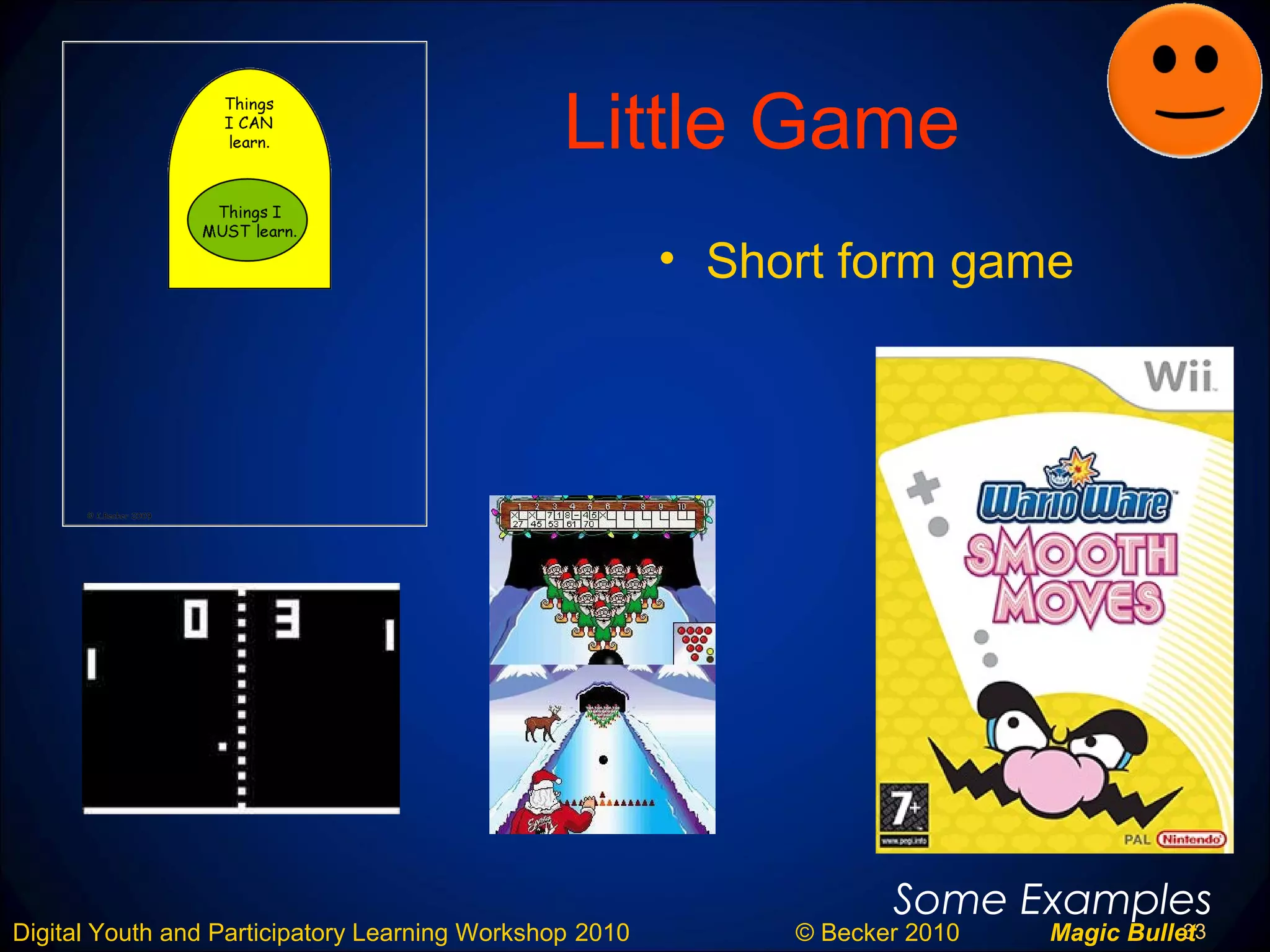
Little Game
• Short form game
Some Examples
34Digital Youth and Participatory Learning Workshop 2010 © Becker 2010 Magic Bullet
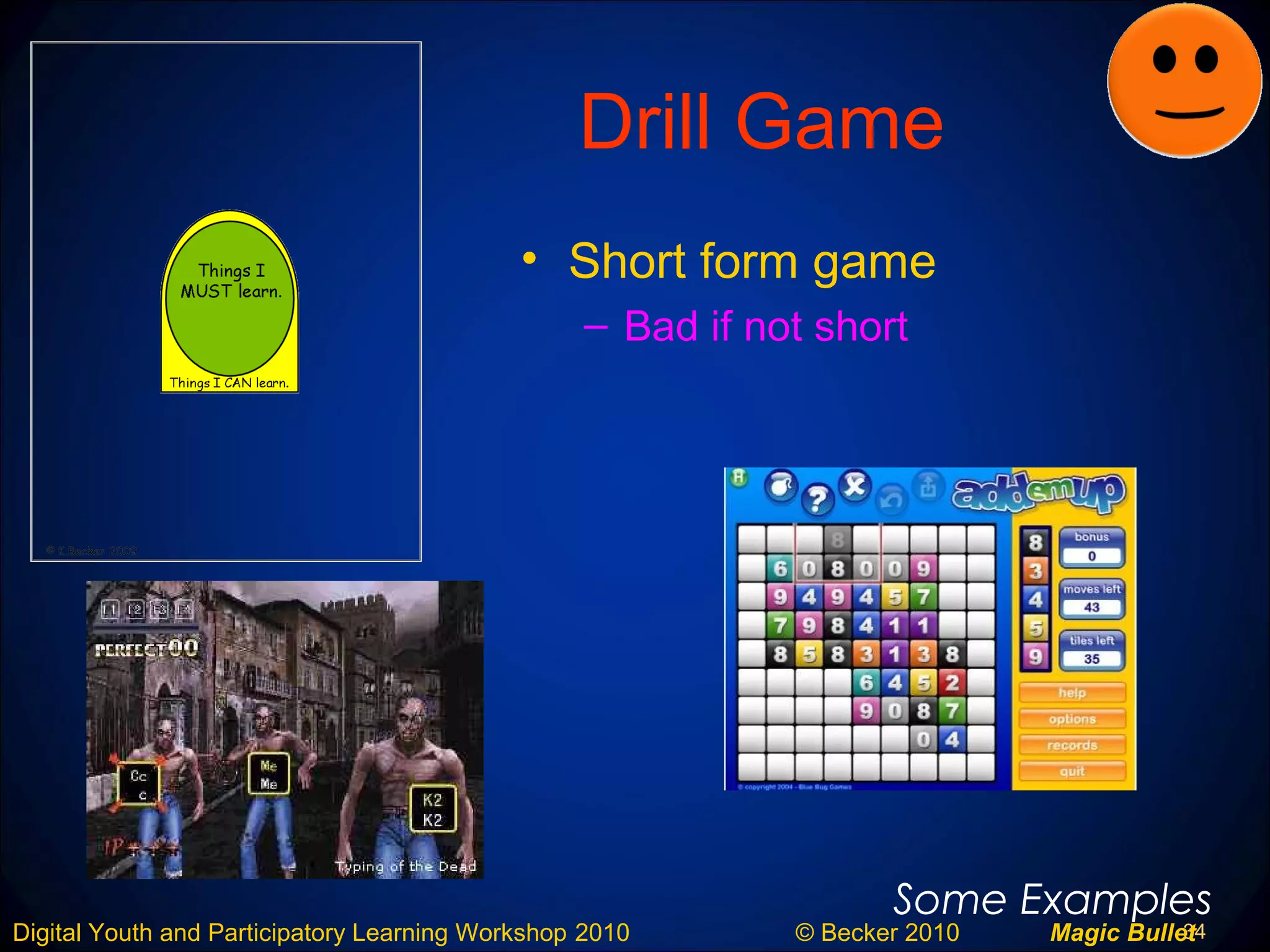
Drill Game
• Short form game
– Bad if not short
Some Examples
35Digital Youth and Participatory Learning Workshop 2010 © Becker 2010 Magic Bullet
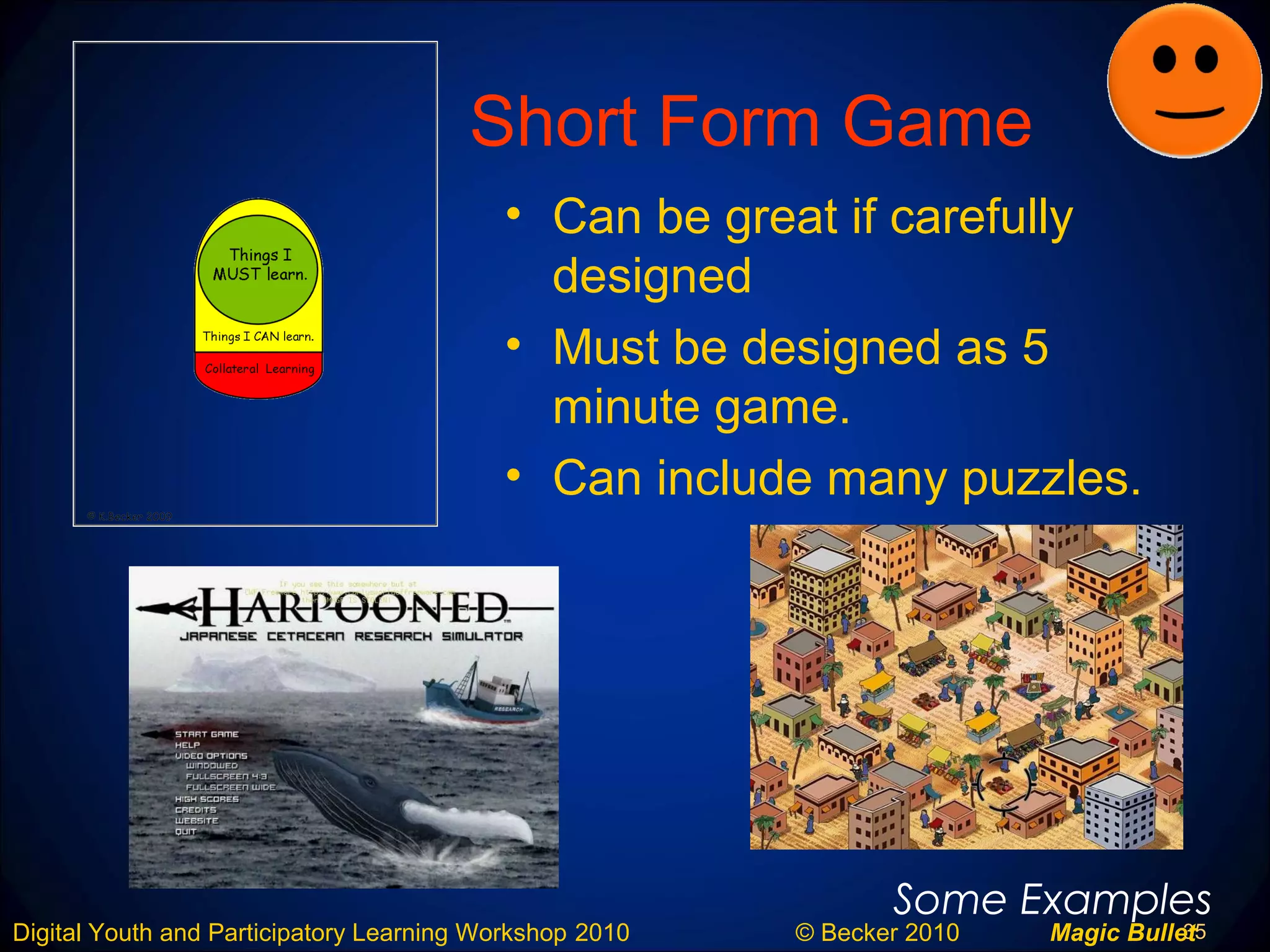
Short Form Game
• Can be great if carefully
designed
• Must be designed as 5
minute game.
• Can include many puzzles.
Some Examples
36Digital Youth and Participatory Learning Workshop 2010 © Becker 2010 Magic Bullet
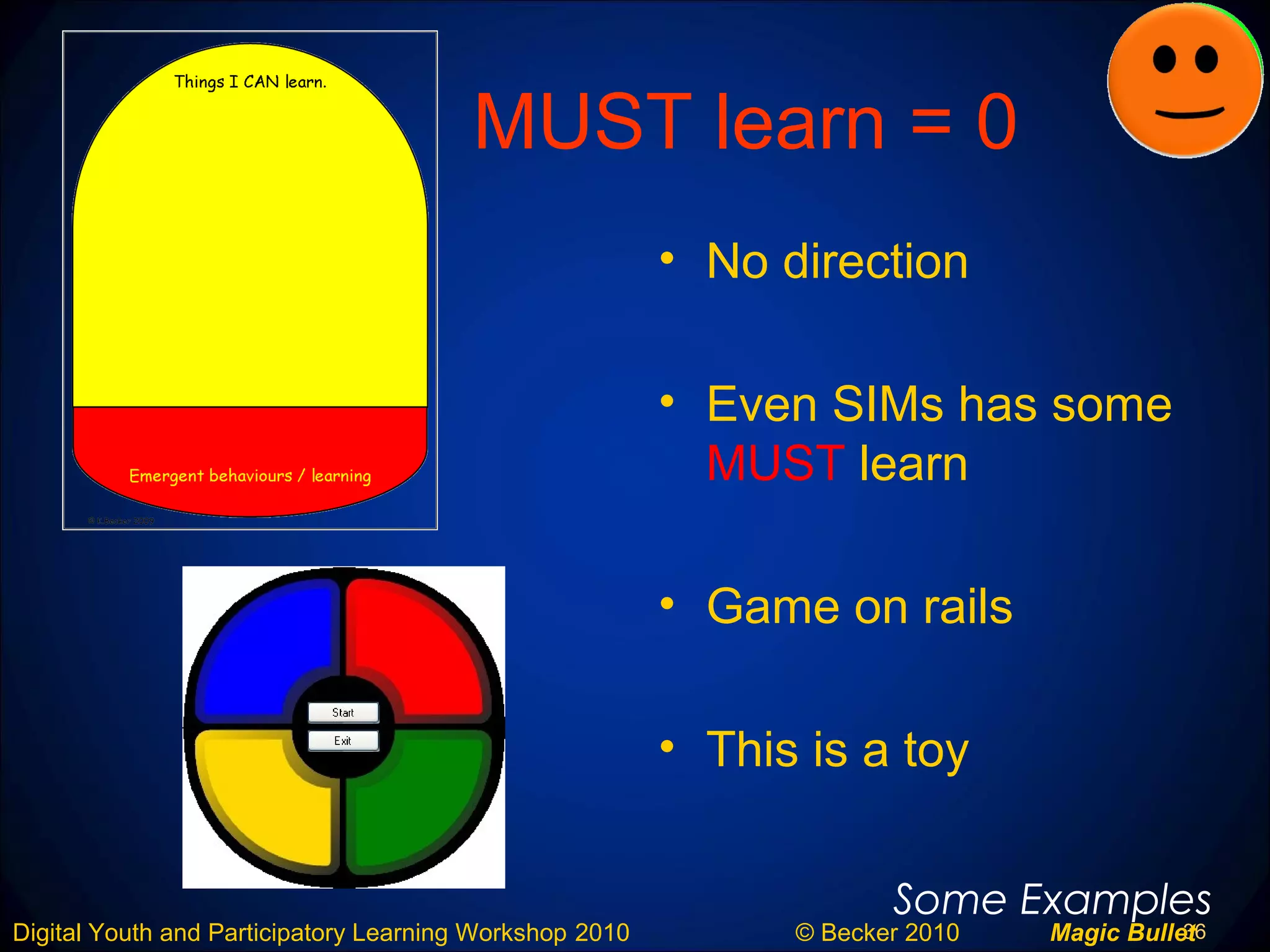
MUST learn = 0
• No direction
• Even SIMs has some
MUST learn
• Game on rails
• This is a toy
Some Examples
37Digital Youth and Participatory Learning Workshop 2010 © Becker 2010 Magic Bullet
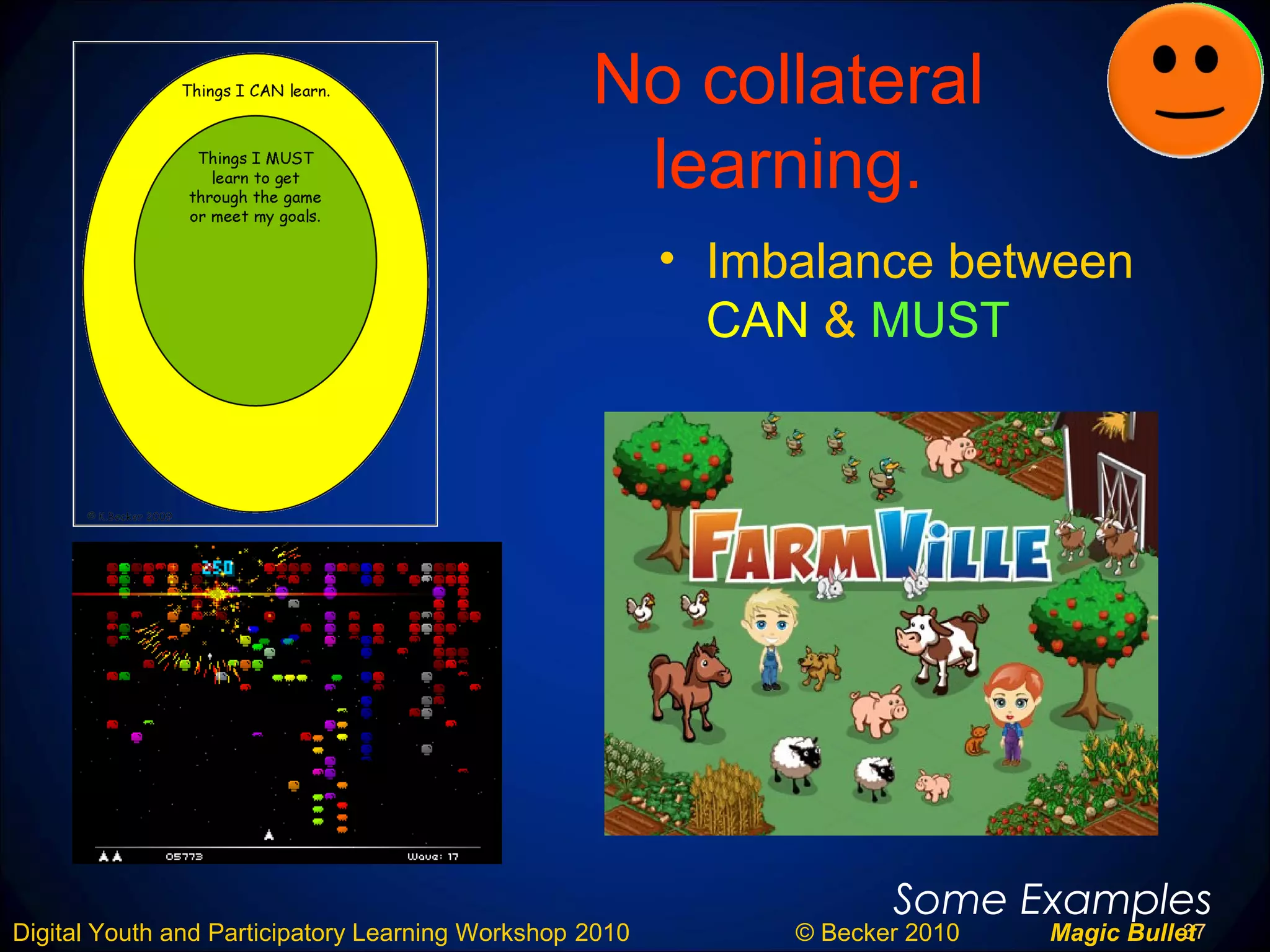
No collateral
learning.
• Imbalance between
CAN & MUST
Some Examples
38Digital Youth and Participatory Learning Workshop 2010 © Becker 2010 Magic Bullet
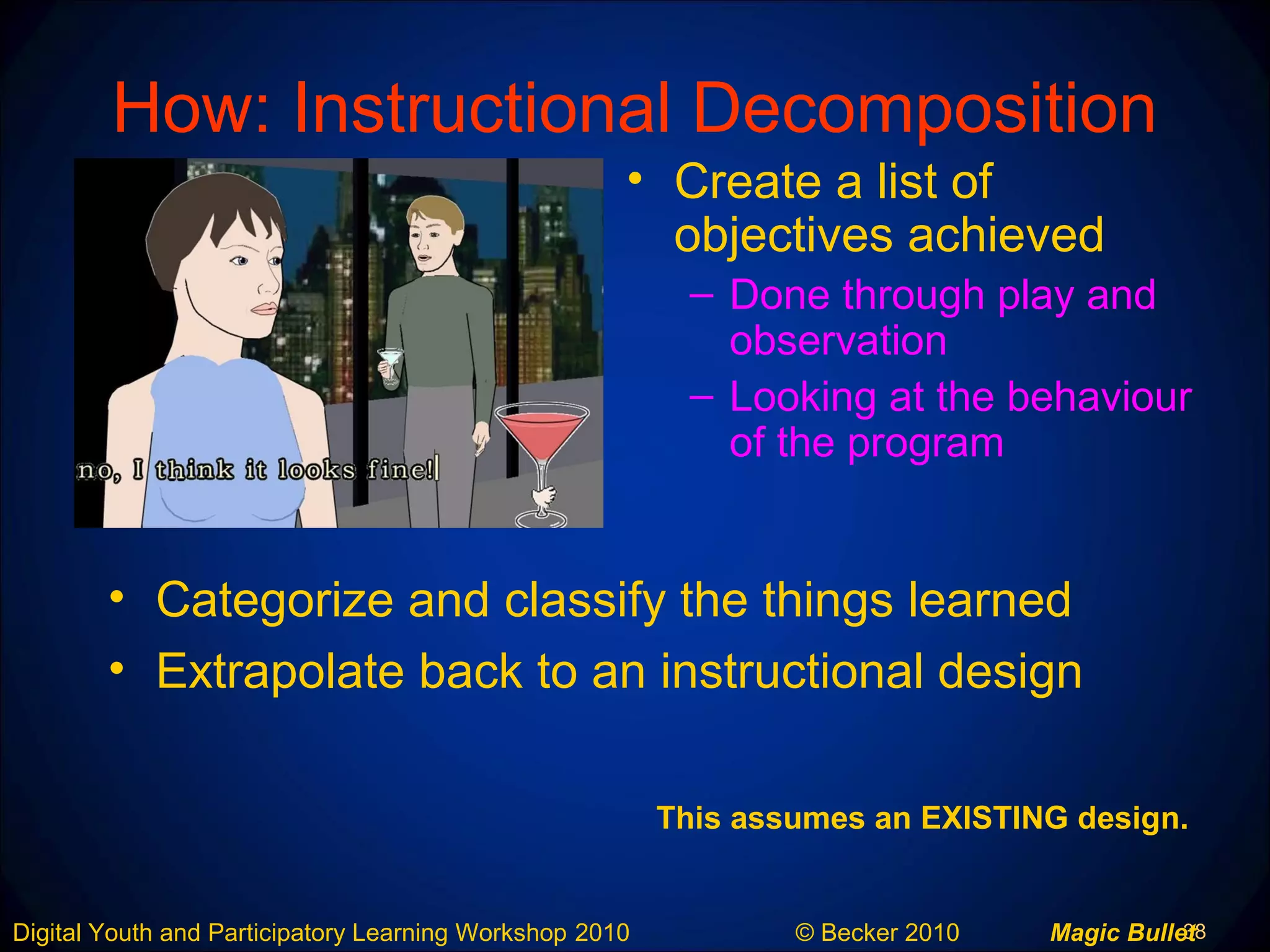
How: Instructional Decomposition
• Categorize and classify the things learned
• Extrapolate back to an instructional design
• Create a list of
objectives achieved
– Done through play and
observation
– Looking at the behaviour
of the program
This assumes an EXISTING design.
39Digital Youth and Participatory Learning Workshop 2010 © Becker 2010 Magic Bullet
Re-cap
• No guarantees
• A useful lens
• Learning Profiles
• Can indicate where
we need to make
changes / additions /
deletions
• Show where and how
to support learners
40Digital Youth and Participatory Learning Workshop 2010 © Becker 2010 Magic Bullet
Last Thoughts
• The process of generating the list of ‘things learned’ and
classifying them into Can-Learn, Must-Learn, Collateral
Learning, and External Learning is simple enough to be
highly flexible yet structured enough to result in a
thorough analysis.
• The idea of using games as learning objects is very
attractive. However, without a thorough analysis of the
tool, it is very difficult to take full advantage of the
medium.
41Digital Youth and Participatory Learning Workshop 2010 © Becker 2010 Magic Bullet
THANKS!
Image & Game Credits
• Cover Slide: Civilization,
Food Force
• Mushroom Men
• Mass Effect 2
• Black & White
• Mathblaster
• Katamary Damacy
• Tetris, Honeycomb Beat,
Chicktionary
• Metroid Prime, Civilization
• Carmen Sandiego
• Electroplancton, KORG DS10
• Big Rigs
• Pong, Elf Bowling, Warioware
Smooth Moves
• Typing of the Dead, Add ‘Em
Up
• Harpooned, September 12
• Simon
• Space Invaders
• Façade
• Screenshots: IGN.com,
Gamespot.com,
Mobygames.com,
Gamewallpapers.com

Evaluating Educational Videogames

  • 1.
    1Digital Youth andParticipatory Learning Workshop 2010 © Becker 2010 Magic Bullet A Magic Bullet Evaluating Educational Videogames:
  • 2.
    2Digital Youth andParticipatory Learning Workshop 2010 © Becker 2010 Magic Bullet My Background • B.Sc., M.Sc. In Computer Science • Taught CS 1982 - 2008 • Ph.D. in Ed. Tech 2003 - 2008 • Have taught in Science, Education, Art, Engineering • Have taught: Programming, Data Architecture, CAL, DGBL, Game Design, Technical Writing, General Science & Math • Using games since 1998 • Maintain extensive websites & course sites • Hatching Program since 1989
  • 3.
    3Digital Youth andParticipatory Learning Workshop 2010 © Becker 2010 Magic Bullet Backstory • What attracted me to CS – What I could do w/ it • What got me into ID – What I could make w/ it • My end goal: – Can we teach Ed game design… ? • Understand Ed game design  • Understand game design  • Understand Ed design  • Understand software design / understand entertainment design….
  • 4.
    4Digital Youth andParticipatory Learning Workshop 2010 © Becker 2010 Magic Bullet What I’m Playing Now
  • 5.
    5Digital Youth andParticipatory Learning Workshop 2010 © Becker 2010 Magic Bullet The Current Landscape • Games are hot. • But are they a good fit for Education? • Are they better than....? – Little hard data. – Barriers to adoption remain high • administration, support, time, tech requirements, security concerns, support Mushroom Men
  • 6.
    6Digital Youth andParticipatory Learning Workshop 2010 © Becker 2010 Magic Bullet What Do Educators Want?What Do Educators Want? • Engaged Learners • Authentic & Relevant Learning • High ROI • Low cost • Low entry barriers IMPORTANT: – MUST avoid repeat of Edutainment Era Mass Effect 2
  • 7.
    7Digital Youth andParticipatory Learning Workshop 2010 © Becker 2010 Magic Bullet The Great Debates In Games for Learning: Learning vs. Fun Instructional Design vs. Game Design Game as Receptacle vs. Game as Method Blood Magic
  • 8.
    8Digital Youth andParticipatory Learning Workshop 2010 © Becker 2010 Magic Bullet Educational Game Debates Instructional designers suck all the fun out of games. Game designers drive all the learning out of games.
  • 9.
    9Digital Youth andParticipatory Learning Workshop 2010 © Becker 2010 Magic Bullet Educational Game Debates Games Design is all we need. Instructional Design is all we need. Grim FandangoGrim Fandango Real LivesReal Lives
  • 10.
    10Digital Youth andParticipatory Learning Workshop 2010 © Becker 2010 Magic Bullet Practicalities: Removing Barriers • Easy to run & maintain. • Clear connections to accepted pedagogy. • Shallow learning curve. • Internally supported orientation. • LOTS of support materials – Manuals – Tutorials – Lesson Plans Heavy Rain
  • 11.
    11Digital Youth andParticipatory Learning Workshop 2010 © Becker 2010 Magic Bullet Practicalities: Removing Barriers Clear connections to accepted pedagogy. Heavy Rain
  • 12.
    12Digital Youth andParticipatory Learning Workshop 2010 © Becker 2010 Magic Bullet A Magic Bullet? • Need to talk about the learning in a game. • Need tools for examining games – Existing Ed. software reviews insufficient – Existing commercial game reviews insufficient
  • 13.
    13Digital Youth andParticipatory Learning Workshop 2010 © Becker 2010 Magic Bullet What? • Model for evaluating and assessing games (COTS & Ed) • Subjective tool • Currently developed for single- player games • A means of categorizing the learning that happens in a game.
  • 14.
    14Digital Youth andParticipatory Learning Workshop 2010 © Becker 2010 Magic Bullet How? • All learning in a game can be classified in one (or more) categories • Learning NEED NOT = Education • Relative proportions are informative • General learning in a game and Serious Learning in a game are different conversations.
  • 15.
    15Digital Youth andParticipatory Learning Workshop 2010 © Becker 2010 Magic Bullet Learning vs Education Learning Value-Neutral Can be Coincidental Natural Internally Motivated* Education Value-Laden Deliberate Coerced / Persuaded Externally Motivated*
  • 16.
    16Digital Youth andParticipatory Learning Workshop 2010 © Becker 2010 Magic Bullet Why? • Educators & Game Designers come from different cultures. • Instructional Design and Game Design are different. • Serious Game Design is NOT regular game design. (It’s all about the message.)
  • 17.
    17Digital Youth andParticipatory Learning Workshop 2010 © Becker 2010 Magic Bullet Paradox: GD vs. ID Instructional Design Content (what) Receptacle for content Vantage Point: Formal Education Ed. Credentials Game Design Player Experience (how) Teaching Method Vantage Point: Entertainment (SENG?) Industry Credentials
  • 18.
    18Digital Youth andParticipatory Learning Workshop 2010 © Becker 2010 Magic Bullet Why? • Learning is how we get through a game. Always. • Evaluate BEFORE use or development. • Assess potential for learning. • Structured analysis of game (without the people).
  • 19.
    19Digital Youth andParticipatory Learning Workshop 2010 © Becker 2010 Magic Bullet Things I Can Learn • deliberately designed by those who created the game • Includes things designers *hope* people will take up • Includes game-specific objectives as well as general ones
  • 20.
    20Digital Youth andParticipatory Learning Workshop 2010 © Becker 2010 Magic Bullet Things I MUST Learn • Should be a subset of the first category • Required in order to achieve a specific goal or to win • Includes strategies, skills, facts,...
  • 21.
    21Digital Youth andParticipatory Learning Workshop 2010 © Becker 2010 Magic Bullet External Learning • Includes social learning and outside communities – Not technically considered part of the normal gameplay – CAN impact on our success in the game. • Also includes Cheats – Typically designed into the game for testing purposes – Often left in the game once it ships – Deliberate design elements on the part of the designers
  • 22.
    22Digital Youth andParticipatory Learning Workshop 2010 © Becker 2010 Magic Bullet Collateral Learning • Other things we can learn – These are not necessarily designed into the game, although sometimes designers may hope that players choose to take these up – Includes emergent behaviors – Not part of the game – Does not impact on our success in the game.
  • 23.
    23Digital Youth andParticipatory Learning Workshop 2010 © Becker 2010 Magic Bullet Things I DID Learn • “Your results may vary” • Will often be specific to the goal – if there is more than one way to win – if there are multiple goals that can be achieved • Not included in analysis models
  • 24.
    24Digital Youth andParticipatory Learning Workshop 2010 © Becker 2010 Magic Bullet A Good Game • Good balance • Nothing I MUST learn that is outside of what I CAN learn. • Allows for learning outside of game and from cheats and community.
  • 25.
    25Digital Youth andParticipatory Learning Workshop 2010 © Becker 2010 Magic Bullet A Good Game • Things I MUST learn < ½ of what I CAN learn • External learning not necessary • Collateral learning possible Some Examples
  • 26.
    26Digital Youth andParticipatory Learning Workshop 2010 © Becker 2010 Magic Bullet MUST learn = CAN learn • Nothing to learn that isn’t part of the ‘goal’. • Often edutainment fits in here. • Lack of collateral learning opportunities implies a single-purpose game (or an impoverished one). Some Examples
  • 27.
    27Digital Youth andParticipatory Learning Workshop 2010 © Becker 2010 Magic Bullet MUST learn ≈ CAN learn • Challenging  for some, frustrating. • Often requires players to repeat plays and levels many times. Some Examples The more one MUST learn of the total set, the fewer choices players may ultimately have.
  • 28.
    28Digital Youth andParticipatory Learning Workshop 2010 © Becker 2010 Magic Bullet MUST learn ≈ CAN learn • Puzzles • Mini-games Some Examples
  • 29.
    29Digital Youth andParticipatory Learning Workshop 2010 © Becker 2010 Magic Bullet MUST learn > CAN learn • Need outside help / resources to get into the game or progress. • CAN still be good, but this has serious implications for audience and support requirements. – Can be risky in serious games. Some Examples
  • 30.
    30Digital Youth andParticipatory Learning Workshop 2010 © Becker 2010 Magic Bullet MUST learn includes external learning. • Can make for great game • Tends to worry traditional educators • Can be very useful in serious games • Games do not always need to be self-contained Some Examples
  • 31.
    31Digital Youth andParticipatory Learning Workshop 2010 © Becker 2010 Magic Bullet MUST learn << CAN learn • Lacks direction • Aimless • Toy, not game ~OR~ straight sim. Some Examples • If there is not enough we MUST learn in order to win, there may be insufficient challenge.
  • 32.
    32Digital Youth andParticipatory Learning Workshop 2010 © Becker 2010 Magic Bullet MUST learn too small • Not much to hold interest Some Examples •no gameplay. •No AI (the “opposing” truck just sits there! •Winning is virtually guaranteed. •game lacks collision detecting which means you can go through any objects like houses, boulders, trees, and bridges that you are required to cross. •able to accelerate into infinite, even when going backwards. •Traveling off of the edge of the map is possible in the game. •NO police cars •Source: http://www.mobygames.com /game/big-rigs-over-the-road-racing
  • 33.
    33Digital Youth andParticipatory Learning Workshop 2010 © Becker 2010 Magic Bullet Little Game • Short form game Some Examples
  • 34.
    34Digital Youth andParticipatory Learning Workshop 2010 © Becker 2010 Magic Bullet Drill Game • Short form game – Bad if not short Some Examples
  • 35.
    35Digital Youth andParticipatory Learning Workshop 2010 © Becker 2010 Magic Bullet Short Form Game • Can be great if carefully designed • Must be designed as 5 minute game. • Can include many puzzles. Some Examples
  • 36.
    36Digital Youth andParticipatory Learning Workshop 2010 © Becker 2010 Magic Bullet MUST learn = 0 • No direction • Even SIMs has some MUST learn • Game on rails • This is a toy Some Examples
  • 37.
    37Digital Youth andParticipatory Learning Workshop 2010 © Becker 2010 Magic Bullet No collateral learning. • Imbalance between CAN & MUST Some Examples
  • 38.
    38Digital Youth andParticipatory Learning Workshop 2010 © Becker 2010 Magic Bullet How: Instructional Decomposition • Categorize and classify the things learned • Extrapolate back to an instructional design • Create a list of objectives achieved – Done through play and observation – Looking at the behaviour of the program This assumes an EXISTING design.
  • 39.
    39Digital Youth andParticipatory Learning Workshop 2010 © Becker 2010 Magic Bullet Re-cap • No guarantees • A useful lens • Learning Profiles • Can indicate where we need to make changes / additions / deletions • Show where and how to support learners
  • 40.
    40Digital Youth andParticipatory Learning Workshop 2010 © Becker 2010 Magic Bullet Last Thoughts • The process of generating the list of ‘things learned’ and classifying them into Can-Learn, Must-Learn, Collateral Learning, and External Learning is simple enough to be highly flexible yet structured enough to result in a thorough analysis. • The idea of using games as learning objects is very attractive. However, without a thorough analysis of the tool, it is very difficult to take full advantage of the medium.
  • 41.
    41Digital Youth andParticipatory Learning Workshop 2010 © Becker 2010 Magic Bullet THANKS! Image & Game Credits • Cover Slide: Civilization, Food Force • Mushroom Men • Mass Effect 2 • Black & White • Mathblaster • Katamary Damacy • Tetris, Honeycomb Beat, Chicktionary • Metroid Prime, Civilization • Carmen Sandiego • Electroplancton, KORG DS10 • Big Rigs • Pong, Elf Bowling, Warioware Smooth Moves • Typing of the Dead, Add ‘Em Up • Harpooned, September 12 • Simon • Space Invaders • Façade • Screenshots: IGN.com, Gamespot.com, Mobygames.com, Gamewallpapers.com