A Short Tutorial to Semantic Media Wiki (SMW)  [[date:: July 21, 2009 ]] At  [[part of:: Web Science Summer Research Week ]] By  [[has speaker:: Jie Bao ]] and [[has speaker:: Li Ding ]] [[Category:Tutorial]]
#1 What is SMW? #2 Editing #3 Browsing #4 Using Semantics #5 Example Apps #6 Additional Resources Outline
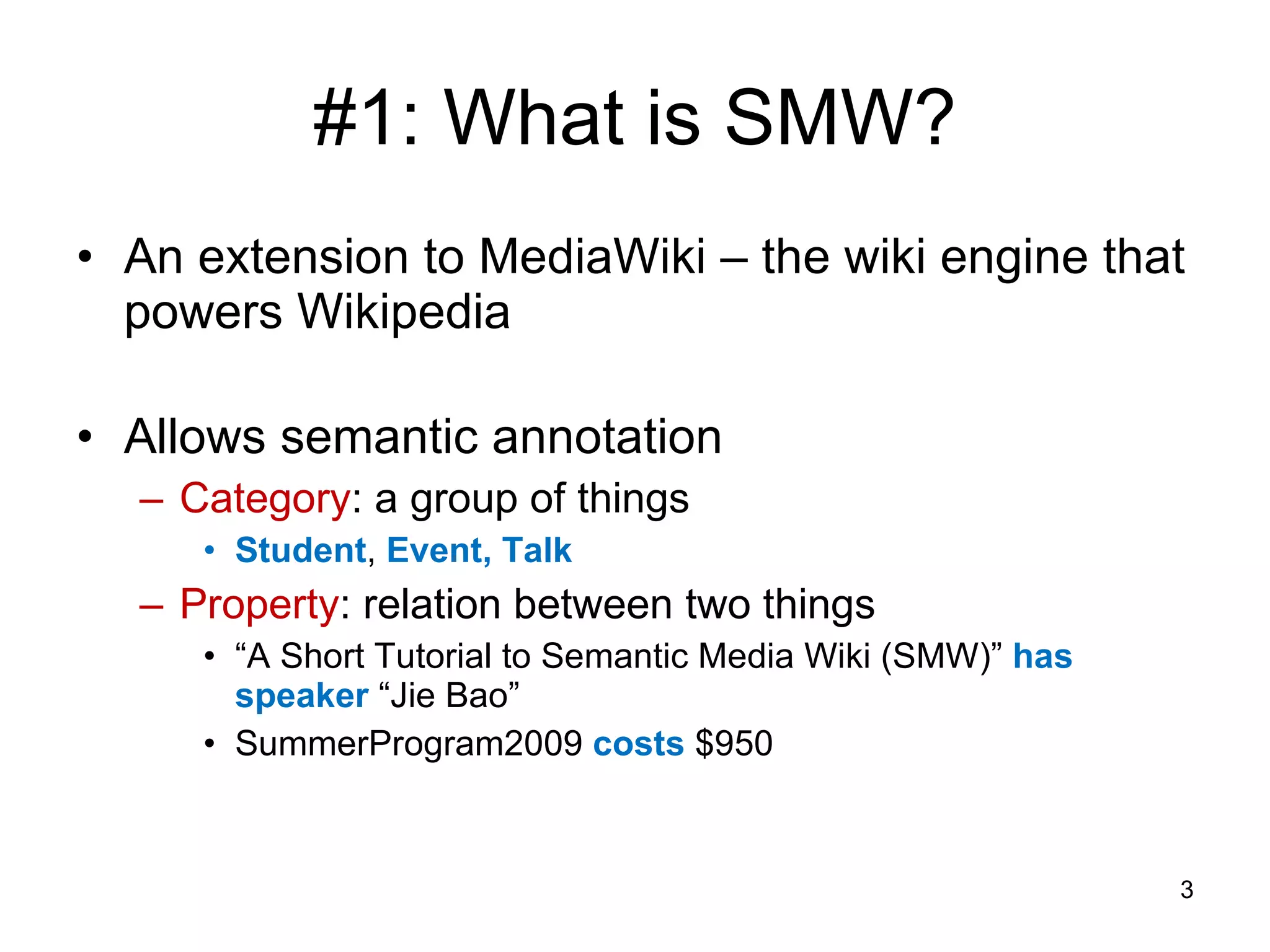
#1: What is SMW? An extension to MediaWiki – the wiki engine that powers Wikipedia Allows semantic annotation Category : a group of things Student ,  Event, Talk Property :   relation between two things “ A Short Tutorial to Semantic Media Wiki (SMW)”  has speaker  “Jie Bao” SummerProgram2009  costs  $950
SMW is A wiki: simple, collaborative Semantic Web in the small A light-weight semantic database A platform to build other apps …
Exercise Wiki http://tw.rpi.edu/portal/SummerProgram2009 (please create an account and log in)
#2: Editing
Create A New Page Click the “red links” How to get the red links? Search “A new page” in search box, or Add “[[A new page]]” on some existent page
Non-semantic syntax Click “edit” tab to enter the editing page Simple MediaWiki formatting syntax: Headings of different levels ==heading== ===level 1===  Bullet list * first * second Numbered list  # one # two Link to another page on the wiki [[pagename]] Link to another page on the wiki, but show different text [[pagename|show_text]]
Semantic Annotation Syntax Categories and properties are also wiki pages Category:Talk Property:date Description Syntax Example Assign a page to a category [[Category:categoryname]] [[ Category:Talk ]] Add a property (with value) to a page [[propertyname::value]] [[ date::July 21, 2009 ]] Add a property (with value) to a page, but show “show_value” [[propertyname::value|show_value]] [[ date::July 21, 2009|21st July ]]
Advanced Topics (not covered here) Inline queries Semantic templates and forms Importing and exporting data Graphic user interface (Halo extension) Many more extensions… More on http://semantic-mediawiki.org/wiki/Help:SMW_extensions
Exercise  Write something about yourself: http://tw.rpi.edu/portal/SummerProgram2009
#3: Browsing Methods for browsing the regular wiki Similar to browsing a website Some links specific to the wiki “ what links here” in the toolbox sidebar Methods for browsing the annotated data Factbox Property links to property pages Category links to category pages Semantic browsing
Browsing - Track changes Track changes on the whole Wiki use “ Recent changes ” in the navigation sidebar Track changes on one wiki page use the “ history ” tab Track changes on pages related to one wiki page Use the “ Related changes ” in the toolbox sidebar Track semantic changes of triples (an extension) Example: http://tw.rpi.edu/semhis
#4: Using Semantics
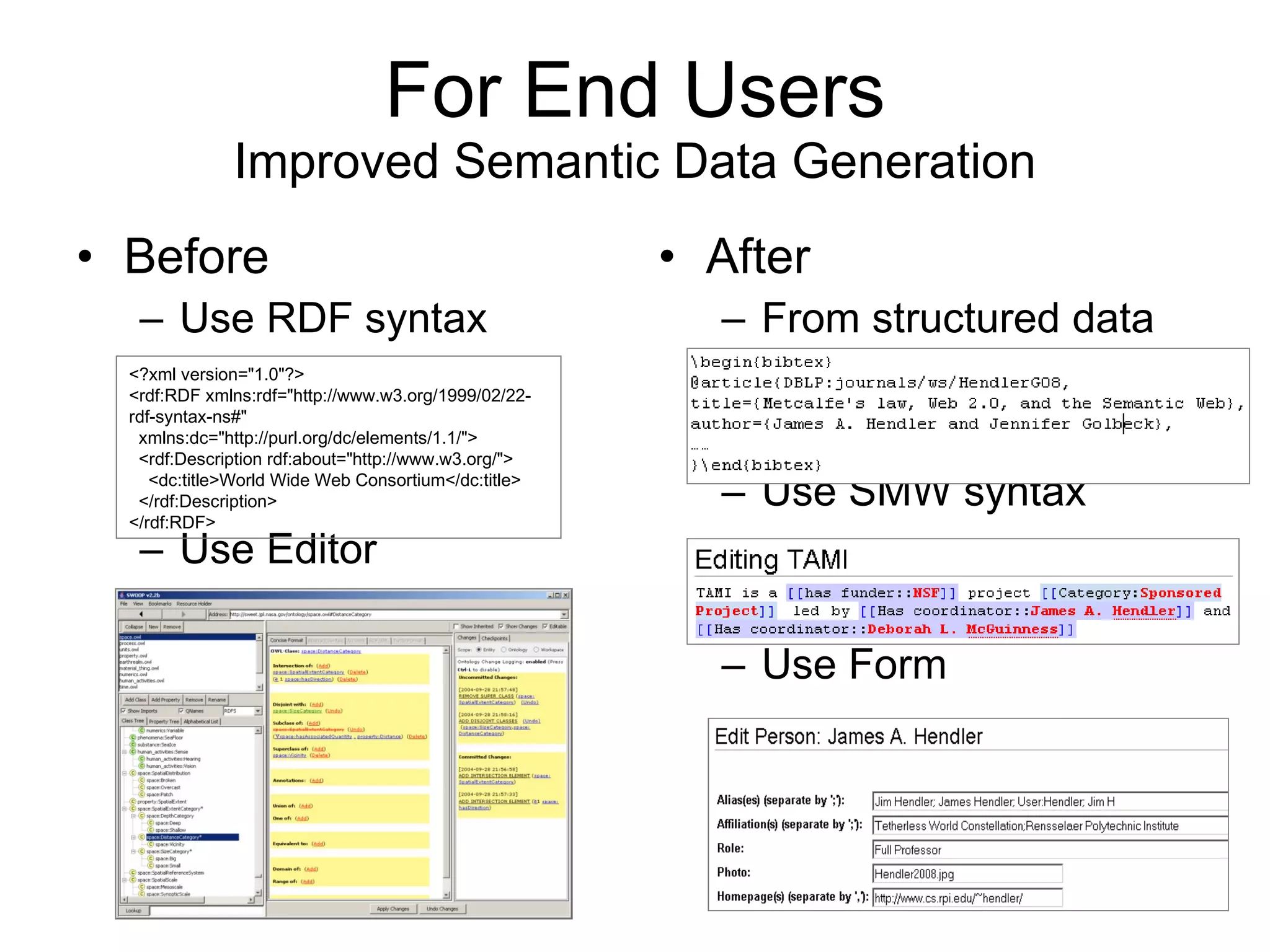
For End Users Improved Semantic Data Generation Before Use RDF syntax Use Editor After From structured data Use SMW syntax Use Form <?xml version=&quot;1.0&quot;?> <rdf:RDF xmlns:rdf=&quot;http://www.w3.org/1999/02/22-rdf-syntax-ns#&quot; xmlns:dc=&quot;http://purl.org/dc/elements/1.1/&quot;> <rdf:Description rdf:about=&quot;http://www.w3.org/&quot;> <dc:title>World Wide Web Consortium</dc:title>  </rdf:Description> </rdf:RDF>
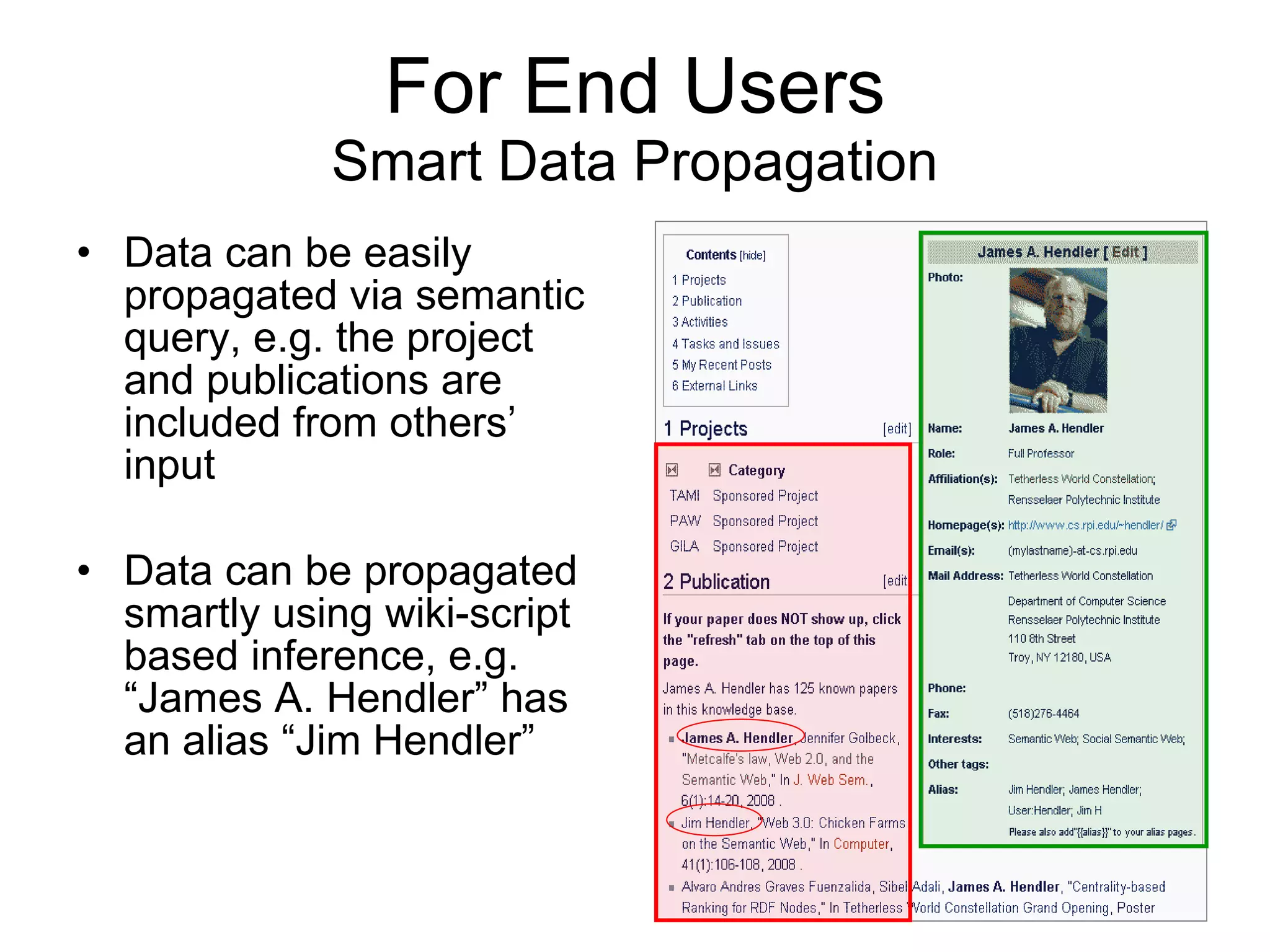
For End Users Smart Data Propagation Data can be easily propagated via semantic query, e.g. the project and publications are included from others’ input Data can be propagated smartly using wiki-script based inference, e.g.  “James A. Hendler” has an alias “Jim Hendler”
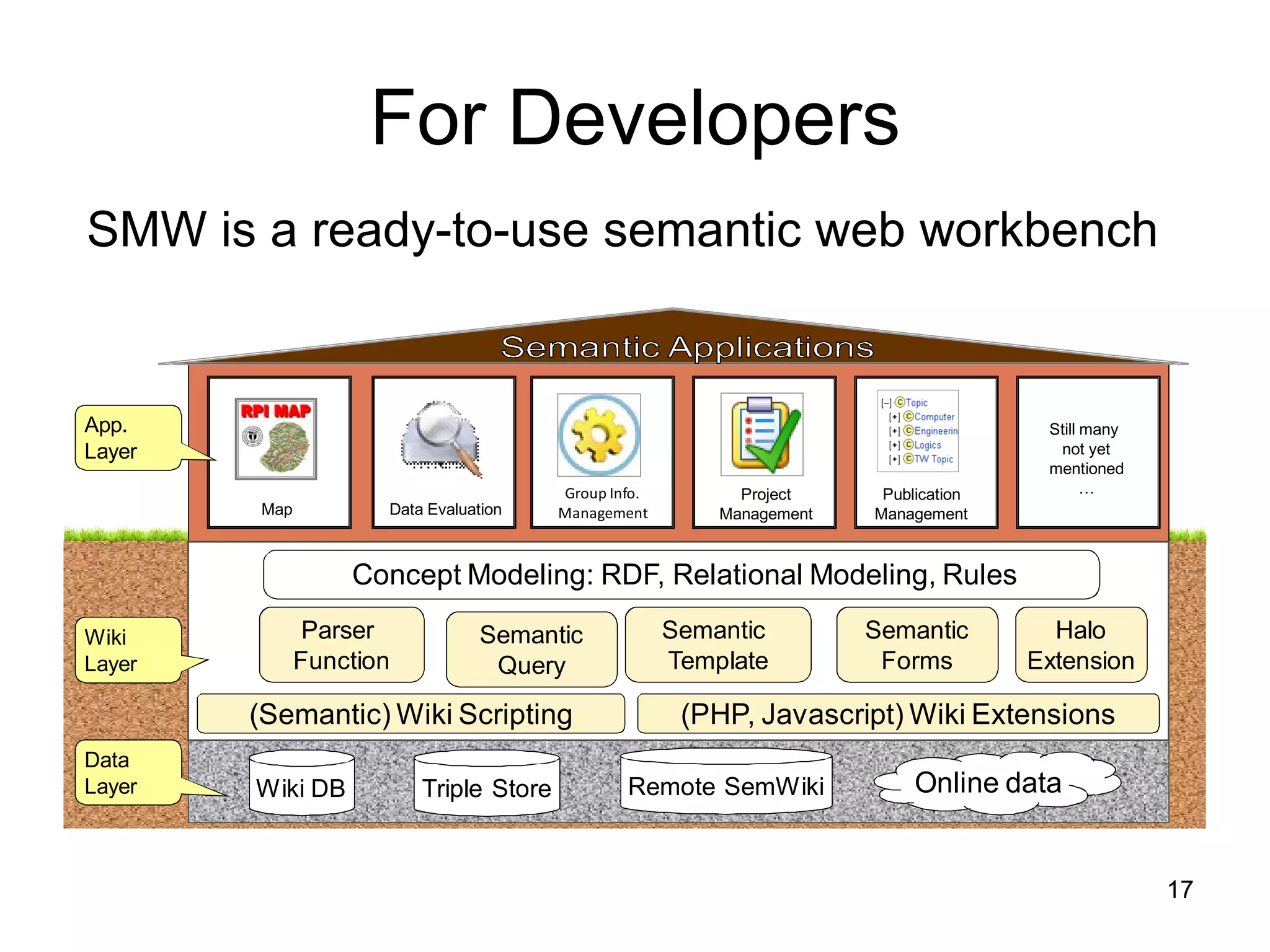
For Developers SMW is a ready-to-use semantic web workbench
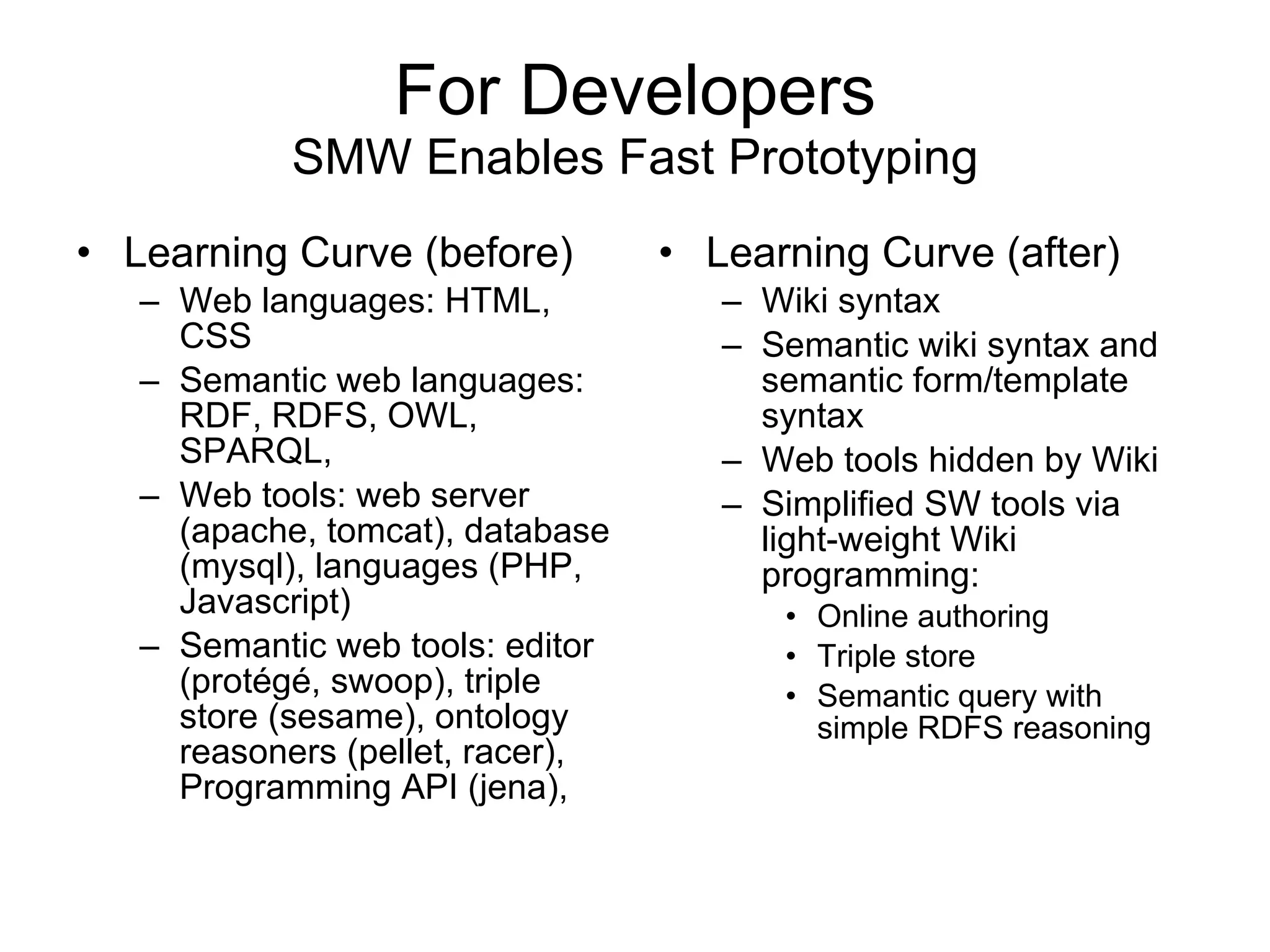
For Developers SMW Enables Fast Prototyping Learning Curve (before) Web languages: HTML, CSS Semantic web languages: RDF, RDFS, OWL, SPARQL,  Web tools: web server (apache, tomcat), database (mysql), languages (PHP, Javascript) Semantic web tools: editor (protégé, swoop), triple store (sesame), ontology reasoners (pellet, racer), Programming API (jena),  Learning Curve (after) Wiki syntax  Semantic wiki syntax and semantic form/template syntax Web tools hidden by Wiki Simplified SW tools via light-weight Wiki programming: Online authoring Triple store Semantic query with simple RDFS reasoning
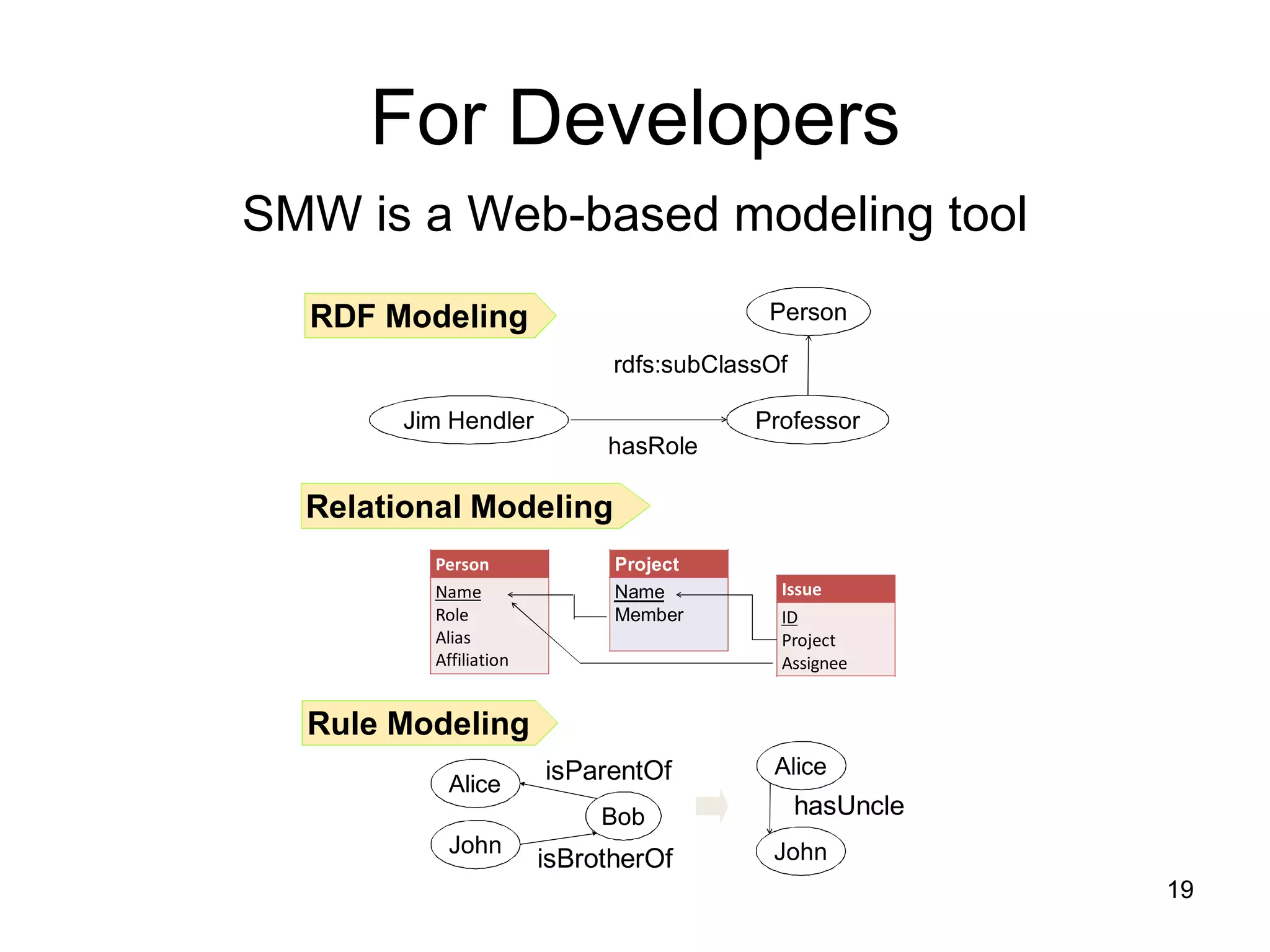
For Developers SMW is a Web-based modeling tool
#5: Example Apps
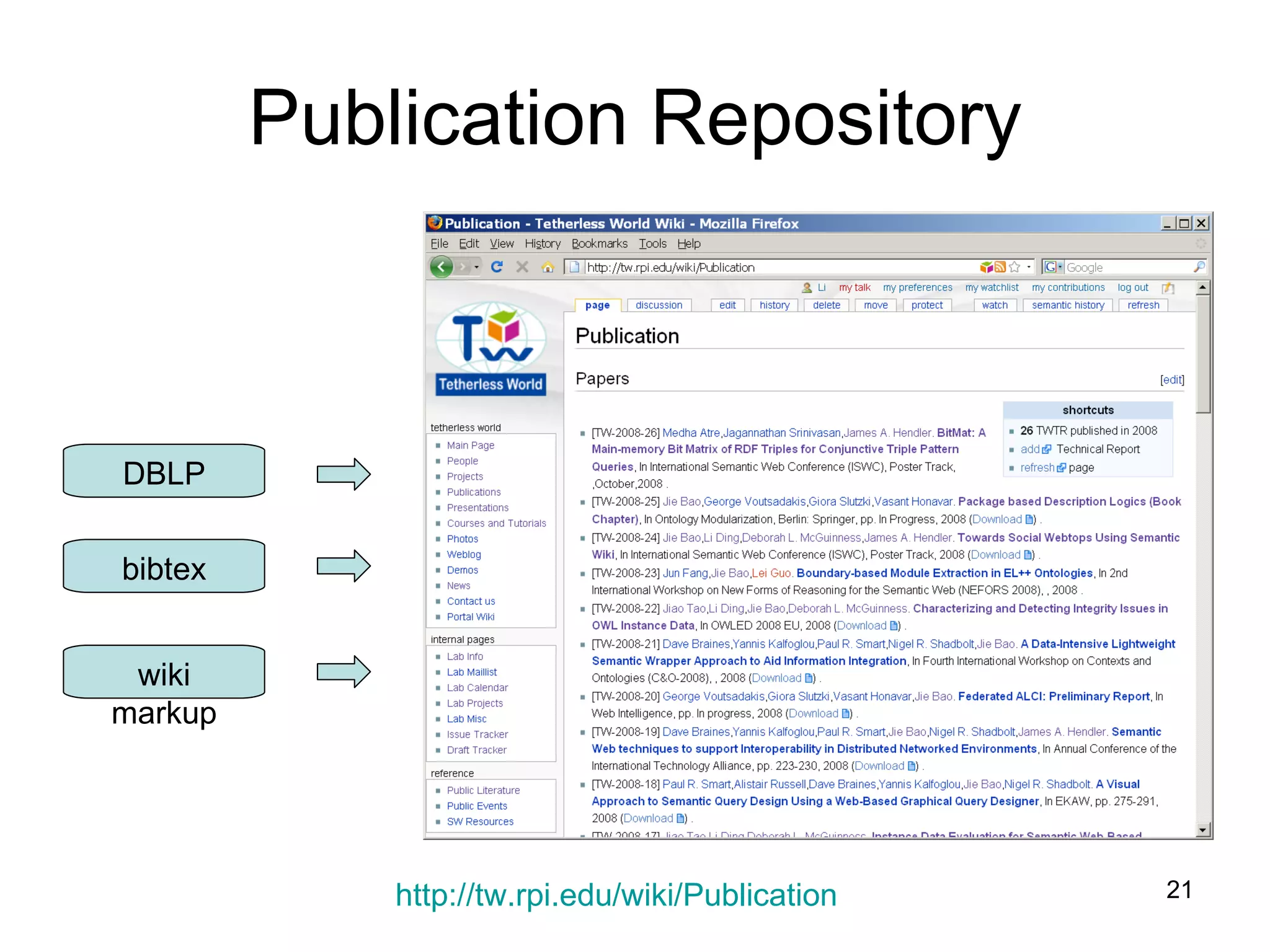
Publication Repository http://tw.rpi.edu/wiki/Publication DBLP bibtex wiki markup
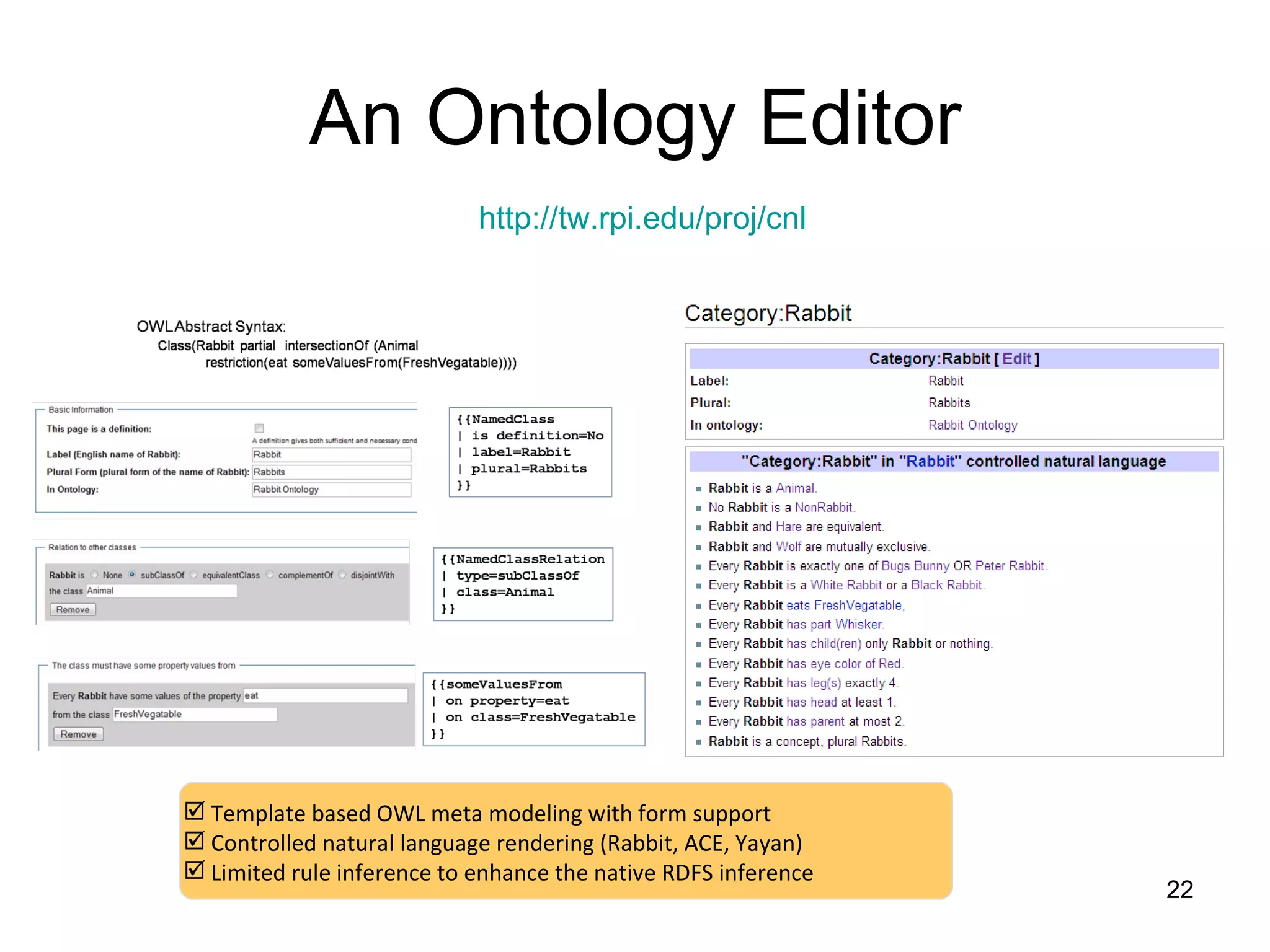
An Ontology Editor Template based OWL meta modeling with form support Controlled natural language rendering (Rabbit, ACE, Yayan) Limited rule inference to enhance the native RDFS inference http://tw.rpi.edu/proj/cnl
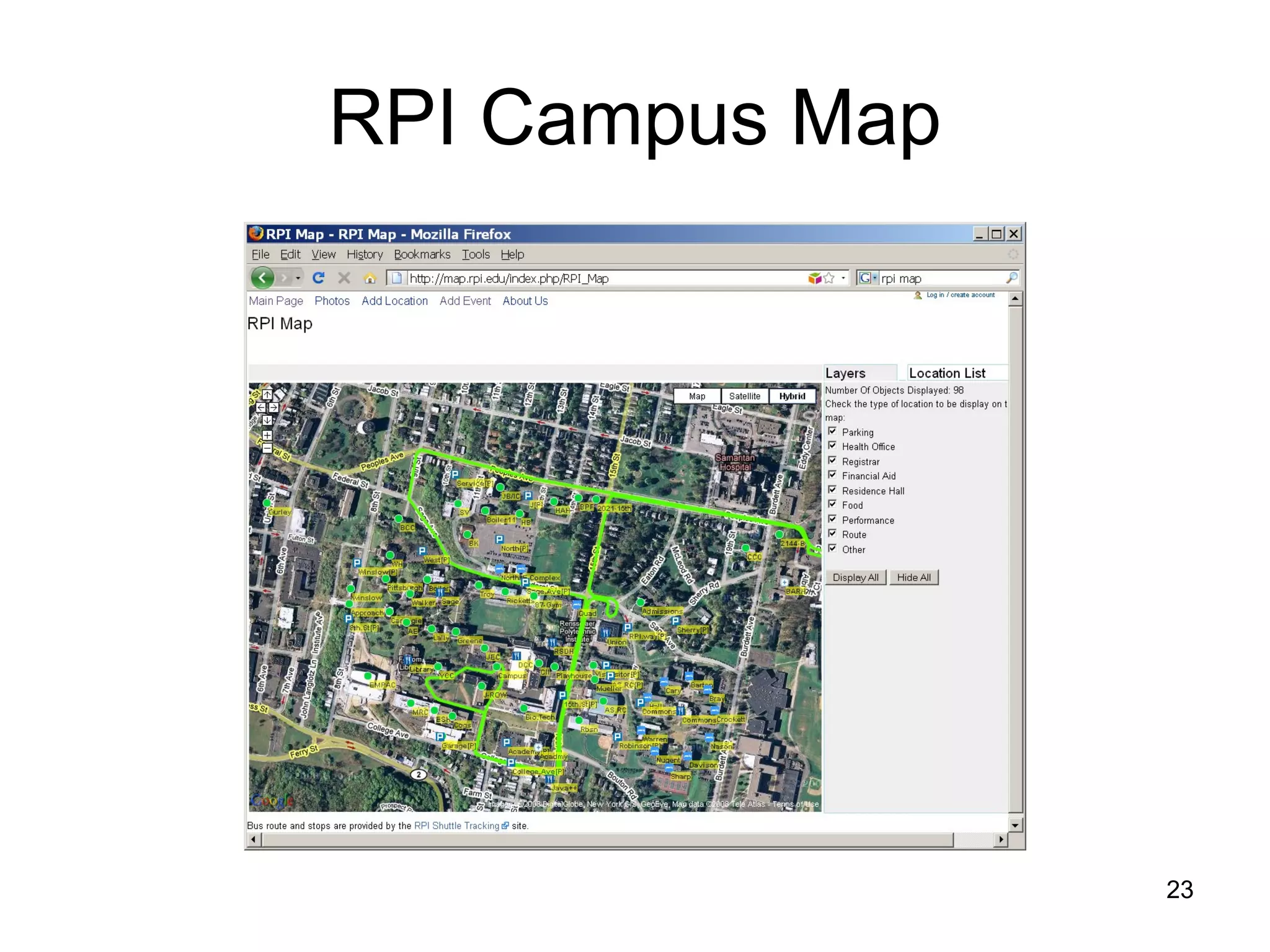
RPI Campus Map
#6 Additional Resources SMW site: http://semantic-mediawiki.org   A 1.5 hour video tutorial:  http://videolectures.net/eswc08_vrandecic_sw/ SMW +  User Forum: http://smwforum.ontoprise.com/ Tetherless World Work on SMW http://tw.rpi.edu/wiki/Semantic_Portal_Wiki

A Short Tutorial to Semantic Media Wiki (SMW)

  • 1.
    A Short Tutorialto Semantic Media Wiki (SMW) [[date:: July 21, 2009 ]] At [[part of:: Web Science Summer Research Week ]] By [[has speaker:: Jie Bao ]] and [[has speaker:: Li Ding ]] [[Category:Tutorial]]
  • 2.
    #1 What isSMW? #2 Editing #3 Browsing #4 Using Semantics #5 Example Apps #6 Additional Resources Outline
  • 3.
    #1: What isSMW? An extension to MediaWiki – the wiki engine that powers Wikipedia Allows semantic annotation Category : a group of things Student , Event, Talk Property : relation between two things “ A Short Tutorial to Semantic Media Wiki (SMW)” has speaker “Jie Bao” SummerProgram2009 costs $950
  • 4.
    SMW is Awiki: simple, collaborative Semantic Web in the small A light-weight semantic database A platform to build other apps …
  • 5.
    Exercise Wiki http://tw.rpi.edu/portal/SummerProgram2009(please create an account and log in)
  • 6.
  • 7.
    Create A NewPage Click the “red links” How to get the red links? Search “A new page” in search box, or Add “[[A new page]]” on some existent page
  • 8.
    Non-semantic syntax Click“edit” tab to enter the editing page Simple MediaWiki formatting syntax: Headings of different levels ==heading== ===level 1=== Bullet list * first * second Numbered list # one # two Link to another page on the wiki [[pagename]] Link to another page on the wiki, but show different text [[pagename|show_text]]
  • 9.
    Semantic Annotation SyntaxCategories and properties are also wiki pages Category:Talk Property:date Description Syntax Example Assign a page to a category [[Category:categoryname]] [[ Category:Talk ]] Add a property (with value) to a page [[propertyname::value]] [[ date::July 21, 2009 ]] Add a property (with value) to a page, but show “show_value” [[propertyname::value|show_value]] [[ date::July 21, 2009|21st July ]]
  • 10.
    Advanced Topics (notcovered here) Inline queries Semantic templates and forms Importing and exporting data Graphic user interface (Halo extension) Many more extensions… More on http://semantic-mediawiki.org/wiki/Help:SMW_extensions
  • 11.
    Exercise Writesomething about yourself: http://tw.rpi.edu/portal/SummerProgram2009
  • 12.
    #3: Browsing Methodsfor browsing the regular wiki Similar to browsing a website Some links specific to the wiki “ what links here” in the toolbox sidebar Methods for browsing the annotated data Factbox Property links to property pages Category links to category pages Semantic browsing
  • 13.
    Browsing - Trackchanges Track changes on the whole Wiki use “ Recent changes ” in the navigation sidebar Track changes on one wiki page use the “ history ” tab Track changes on pages related to one wiki page Use the “ Related changes ” in the toolbox sidebar Track semantic changes of triples (an extension) Example: http://tw.rpi.edu/semhis
  • 14.
  • 15.
    For End UsersImproved Semantic Data Generation Before Use RDF syntax Use Editor After From structured data Use SMW syntax Use Form <?xml version=&quot;1.0&quot;?> <rdf:RDF xmlns:rdf=&quot;http://www.w3.org/1999/02/22-rdf-syntax-ns#&quot; xmlns:dc=&quot;http://purl.org/dc/elements/1.1/&quot;> <rdf:Description rdf:about=&quot;http://www.w3.org/&quot;> <dc:title>World Wide Web Consortium</dc:title> </rdf:Description> </rdf:RDF>
  • 16.
    For End UsersSmart Data Propagation Data can be easily propagated via semantic query, e.g. the project and publications are included from others’ input Data can be propagated smartly using wiki-script based inference, e.g. “James A. Hendler” has an alias “Jim Hendler”
  • 17.
    For Developers SMWis a ready-to-use semantic web workbench
  • 18.
    For Developers SMWEnables Fast Prototyping Learning Curve (before) Web languages: HTML, CSS Semantic web languages: RDF, RDFS, OWL, SPARQL, Web tools: web server (apache, tomcat), database (mysql), languages (PHP, Javascript) Semantic web tools: editor (protégé, swoop), triple store (sesame), ontology reasoners (pellet, racer), Programming API (jena), Learning Curve (after) Wiki syntax Semantic wiki syntax and semantic form/template syntax Web tools hidden by Wiki Simplified SW tools via light-weight Wiki programming: Online authoring Triple store Semantic query with simple RDFS reasoning
  • 19.
    For Developers SMWis a Web-based modeling tool
  • 20.
  • 21.
  • 22.
    An Ontology EditorTemplate based OWL meta modeling with form support Controlled natural language rendering (Rabbit, ACE, Yayan) Limited rule inference to enhance the native RDFS inference http://tw.rpi.edu/proj/cnl
  • 23.
  • 24.
    #6 Additional ResourcesSMW site: http://semantic-mediawiki.org A 1.5 hour video tutorial: http://videolectures.net/eswc08_vrandecic_sw/ SMW +  User Forum: http://smwforum.ontoprise.com/ Tetherless World Work on SMW http://tw.rpi.edu/wiki/Semantic_Portal_Wiki

Editor's Notes

  • #13 Example for method 1.1: follow “Survivor” link in “Main Page”  “Survivor” Example for method 1.2: follow “ RealityTelevisionShow ” link in “Survivor”  “Category:RealityTelevisionShow” follow “Category” link in “Category:RealityTelevisionShow”  “Categories” Example for method 2.1: follow “Main Page” in navigation  “Main Page” Example for method 2.2: follow “what links here” in “Main Page”  no inlinks to “Main Page” follow “what links here” in “Survivor”