
Selling to Libraries The New E-Book Aggregation Options Chair: Fredric Nachbaur, Fordham University Press Casper Grathwohl, Vice President and Publisher, Reference and Online, Oxford University Press Bruce Heterick, Vice President, ITHAKA Erin Igoe, Library Sales and Marketing Manager, Cambridge University Press Michael Levine-Clark, Collections Librarian, Penrose Library, and Associate Professor, University of Denver Dean Smith, Director, Project MUSE, The Johns Hopkins University Press
Selling to Libraries: The New E-Book Aggregation Options
Selling to Libraries: The New E-Book Aggregation Options Major Players From Cambridge University Press: Academic Publishing Online (APO) From JSTOR: A Platform that Also Features Monographs From the University Press eBook Consortium and Project MUSE Editions: University Press Content Consortium (UPCC) From Oxford University Press: University Press Scholarship Online (UPSO)
Selling to Libraries: The New E-Book Aggregation Options Modes of Content Delivery APO: Chapter-sized PDF JSTOR: Chapter-sized PDF, ePub and XML UPCC: Chapter-sized PDF UPSO: Hypertext generated from XML with downloadable chapter-sized PDF
Selling to Libraries: The New E-Book Aggregation Options XML Implementation APO:  No  – But will be implemented Early 2012 JSTOR: Yes UPCC:  No  – But exploring future implementation UPSO: Yes
Selling to Libraries: The New E-Book Aggregation Options XML Implementation PRO: Readily convertible to e-book and e-reader formats Allows for more granular tagging and cross-referencing A more versatile format that is more “future proof” and less cumbersome than PDF
Selling to Libraries: The New E-Book Aggregation Options XML Implementation CON: Requires additional tagging during the editorial process Cost of tagging renders extensive backlist conversion problematic Longer production schedules and change of workflow
Selling to Libraries: The New E-Book Aggregation Options Accepts PDFs APO: Yes JSTOR: Yes UPCC: Yes UPSO:  No
Selling to Libraries: The New E-Book Aggregation Options PDF Advantages For most presses, recent backlist titles will already be available as print PDFs (No/limited conversion needed) Scanning older backlist titles to produce PDFs is relatively inexpensive
Selling to Libraries: The New E-Book Aggregation Options Accepts Backlist Titles APO: Yes JSTOR: Yes UPCC: Yes UPSO:  Some
Selling to Libraries: The New E-Book Aggregation Options Backlist Support APO will provide some assistance converting print PDF files to web-ready format JSTOR will offer scanning services to produce PDF files UPCC is exploring the possibility of providing funding assistance for scanning and conversion in the future UPSO will feature a limited list of bestselling backlist titles because of the cost of converting them to XML
Selling to Libraries: The New E-Book Aggregation Options Keywording and Cross-Referencing Cross-referencing and robust keyword lists allow for greater discoverability of content All four aggregators offer chapter-level keywords and abstracts JSTOR’s and UPSO’s early implementation of XML allows for an exceptional depth of cross-referencing
Selling to Libraries: The New E-Book Aggregation Options Marketing Experience APO: 1 Year  JSTOR: 16 Years UPCC: 18 Years UPSO: 10 Years
Selling to Libraries: The New E-Book Aggregation Options Marketing Experience and Market Share Cambridge Books Online (the precursor to APO) launched in January 2010 A marketing team dedicated to selling APO exclusively CBO has a 20% market share within its core market of global higher educational institutions
Selling to Libraries: The New E-Book Aggregation Options Marketing Experience and Market Share JSTOR has been in operation providing online scholarship since 1995 More than 7,000 institutions worldwide and more than 95% of accredited higher learning institutions in the United States participate
Selling to Libraries: The New E-Book Aggregation Options Marketing Experience and Market Share UPCC is a joint venture between the young University Press eBook Consortium and the venerable Project MUSE Project MUSE is one of the oldest purveyors of online scholarship, in operation since 1993 Project MUSE has almost 2,500 institutional subscribers
Selling to Libraries: The New E-Book Aggregation Options Marketing Experience and Market Share Oxford University Press has ten years of experiencing marketing its Oxford Scholarship Online (OSO) product to libraries and research institutions A dedicated marketing team will market UPSO exclusively 60% of research libraries in the world are currently OSO subscribers
Selling to Libraries: The New E-Book Aggregation Options Portal Branding APO: Yes JSTOR: Yes UPCC:  No  UPSO: Yes
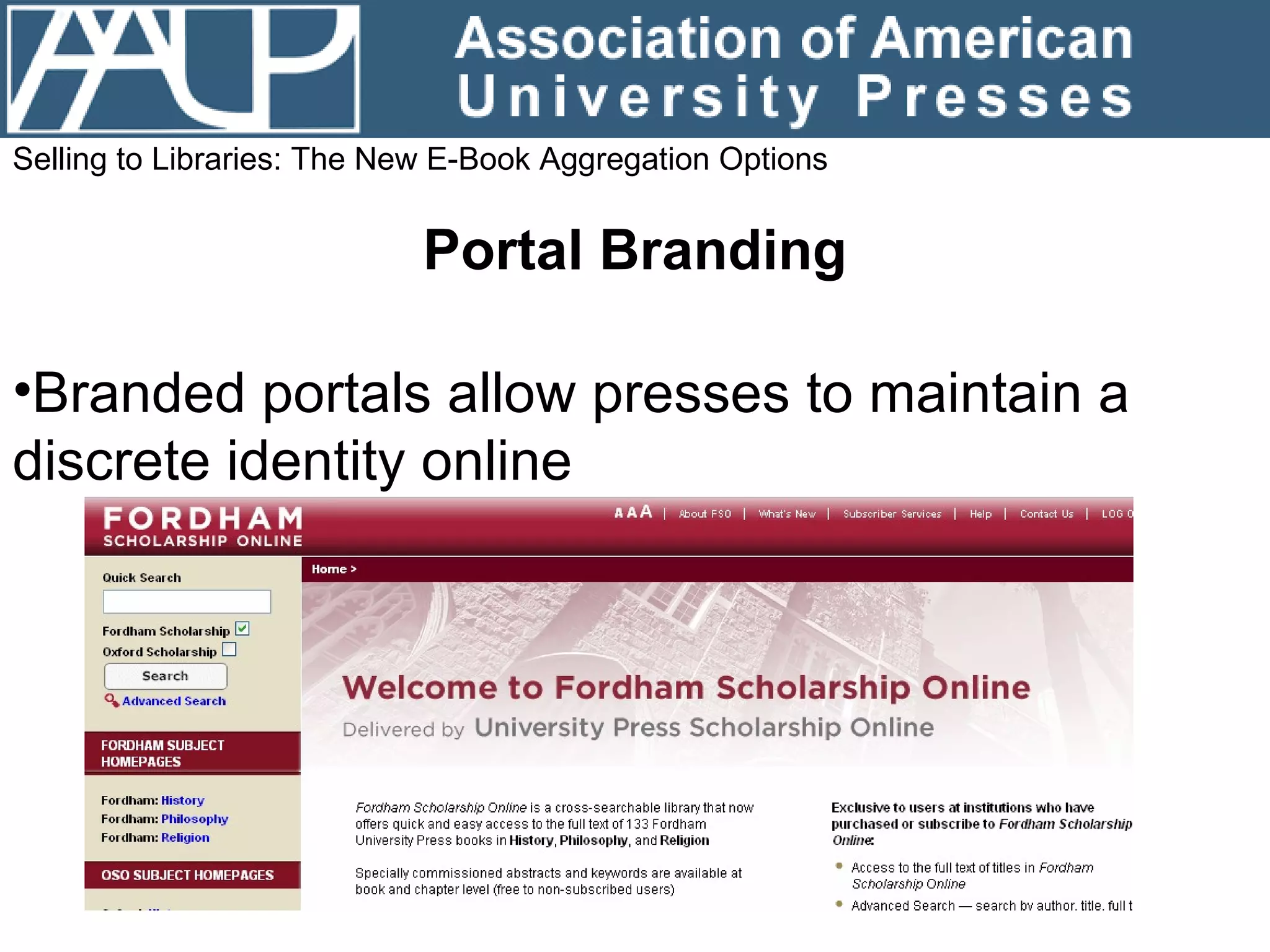
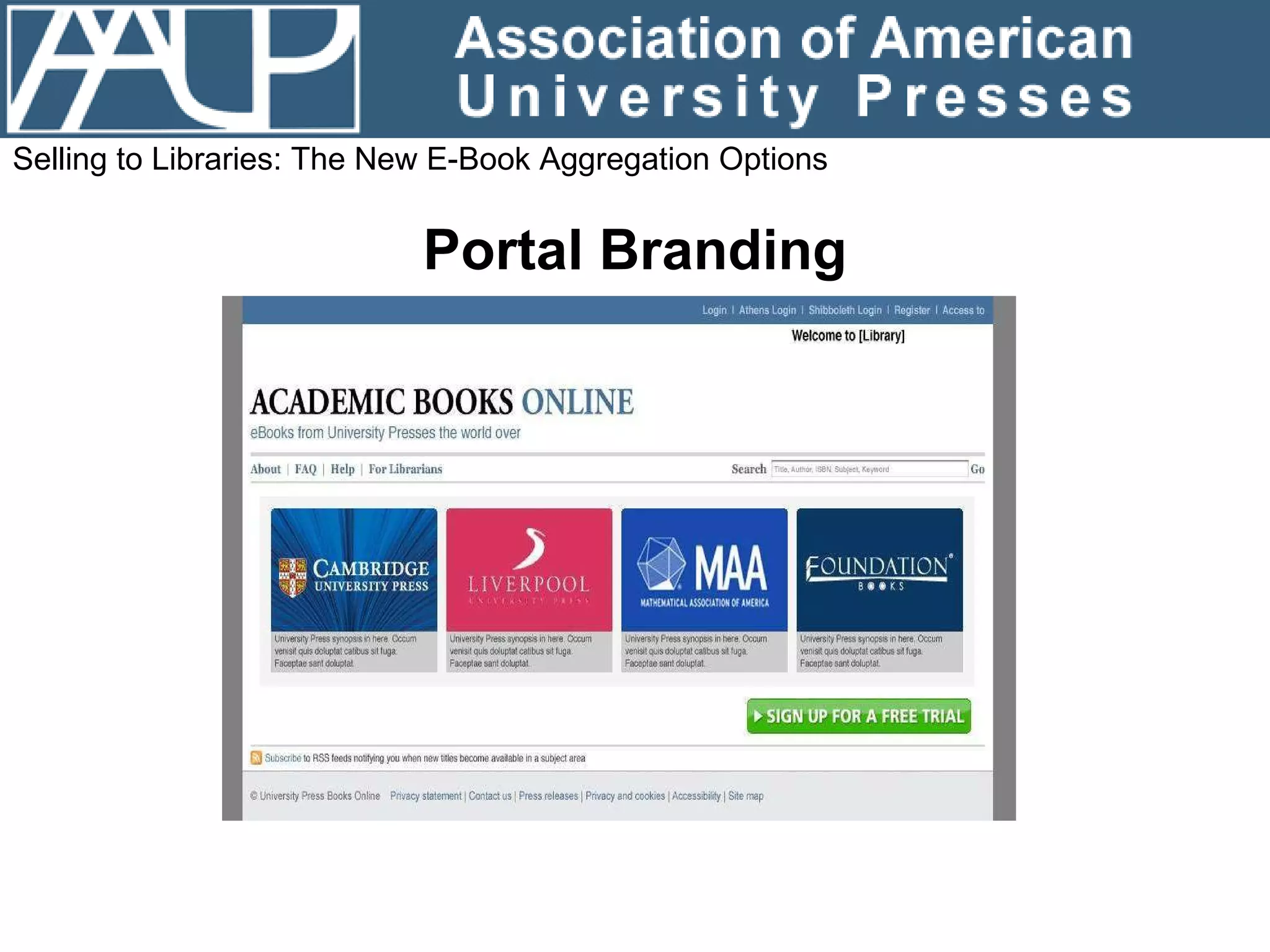
Selling to Libraries: The New E-Book Aggregation Options Portal Branding Branded portals allow presses to maintain a discrete identity online
Selling to Libraries: The New E-Book Aggregation Options Portal Branding
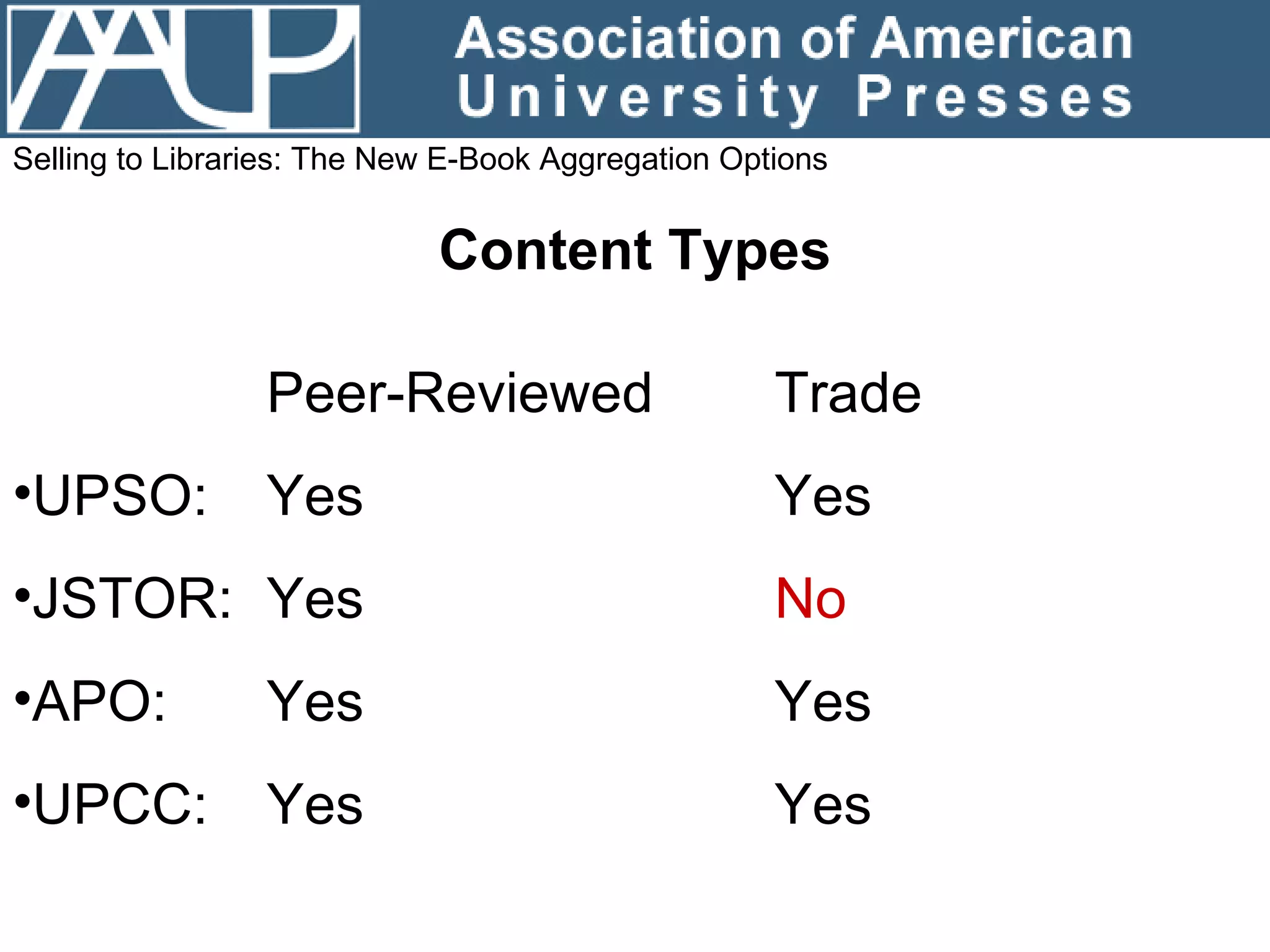
Selling to Libraries: The New E-Book Aggregation Options Content Types Peer-Reviewed Trade UPSO:  Yes Yes JSTOR:  Yes No APO:  Yes Yes UPCC: Yes Yes
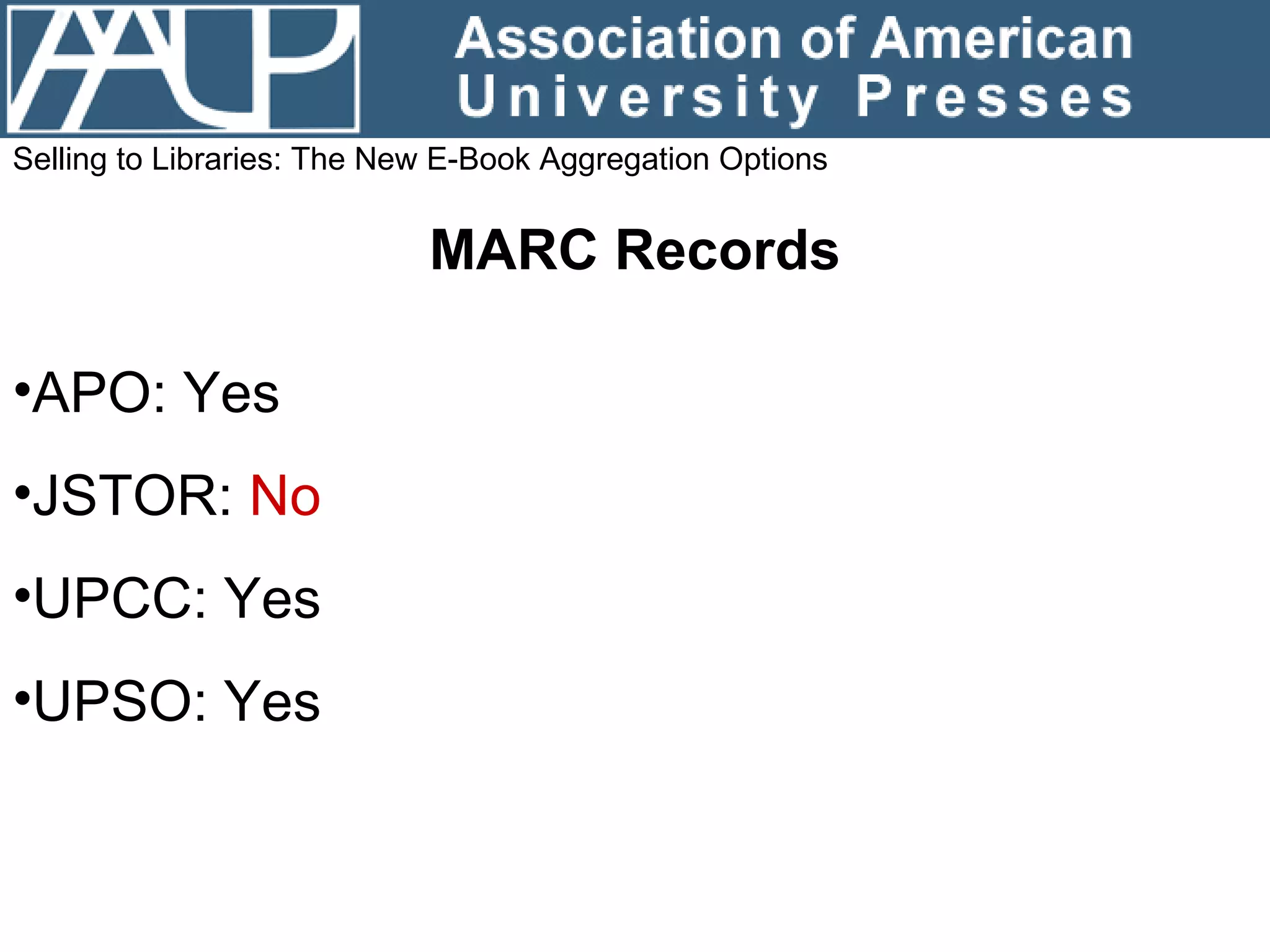
Selling to Libraries: The New E-Book Aggregation Options MARC Records APO: Yes JSTOR:  No UPCC: Yes  UPSO: Yes
Selling to Libraries: The New E-Book Aggregation Options Digital Rights Management (DRM) APO: Yes JSTOR: No UPCC: No  UPSO: Yes
Selling to Libraries: The New E-Book Aggregation Options Digital Rights Management (DRM) APO and UPSO employ unobtrusive DRM that allows downloads of chapter-sized PDFs, but discourages piracy JSTOR provides minimal DRM, though course adoption titles will receive more restrictive DRM UPCC provides minimal DRM
eBook Aggregators: What Do Libraries Want? Michael Levine-Clark University of Denver AAUP Annual Meeting June 3, 2011 Selling to Libraries: The New E-Book Aggregation Options
 
Flexibility Content Platform DRM Pricing Workflow integration Selling to Libraries: The New E-Book Aggregation Options
Content Full availability All titles All aggregators All pricing models Simultaneous E/P Clear expectations Selling to Libraries: The New E-Book Aggregation Options
Platform Too many bells and whistles Are unnecessary  Confuse the user No special downloads Functional with any ereader Functional with any browser Integration (when relevant) with journal platform Fewer platforms Selling to Libraries: The New E-Book Aggregation Options
Digital Rights Management Perpetual access = ownership Less is better, but publishers need some control No limitations  On device On use Limitations on sharing Selling to Libraries: The New E-Book Aggregation Options
Pricing Flexibility! Title-by-title or package Purchase or subscription Demand-Driven Acquisition (DDA) Short-term lease ILL Component of DDA Selling to Libraries: The New E-Book Aggregation Options
Pricing Ability to acquire E/P bundle, even retroactively Consortial options Must recognize traditional spending patterns Should work across aggregators Selling to Libraries: The New E-Book Aggregation Options
Integration with Print Workflow Approval vendor(s) Deduplication Bundling Billing Selling to Libraries: The New E-Book Aggregation Options
Thank You Michael Levine-Clark Collections Librarian University of Denver [email_address]   Selling to Libraries: The New E-Book Aggregation Options
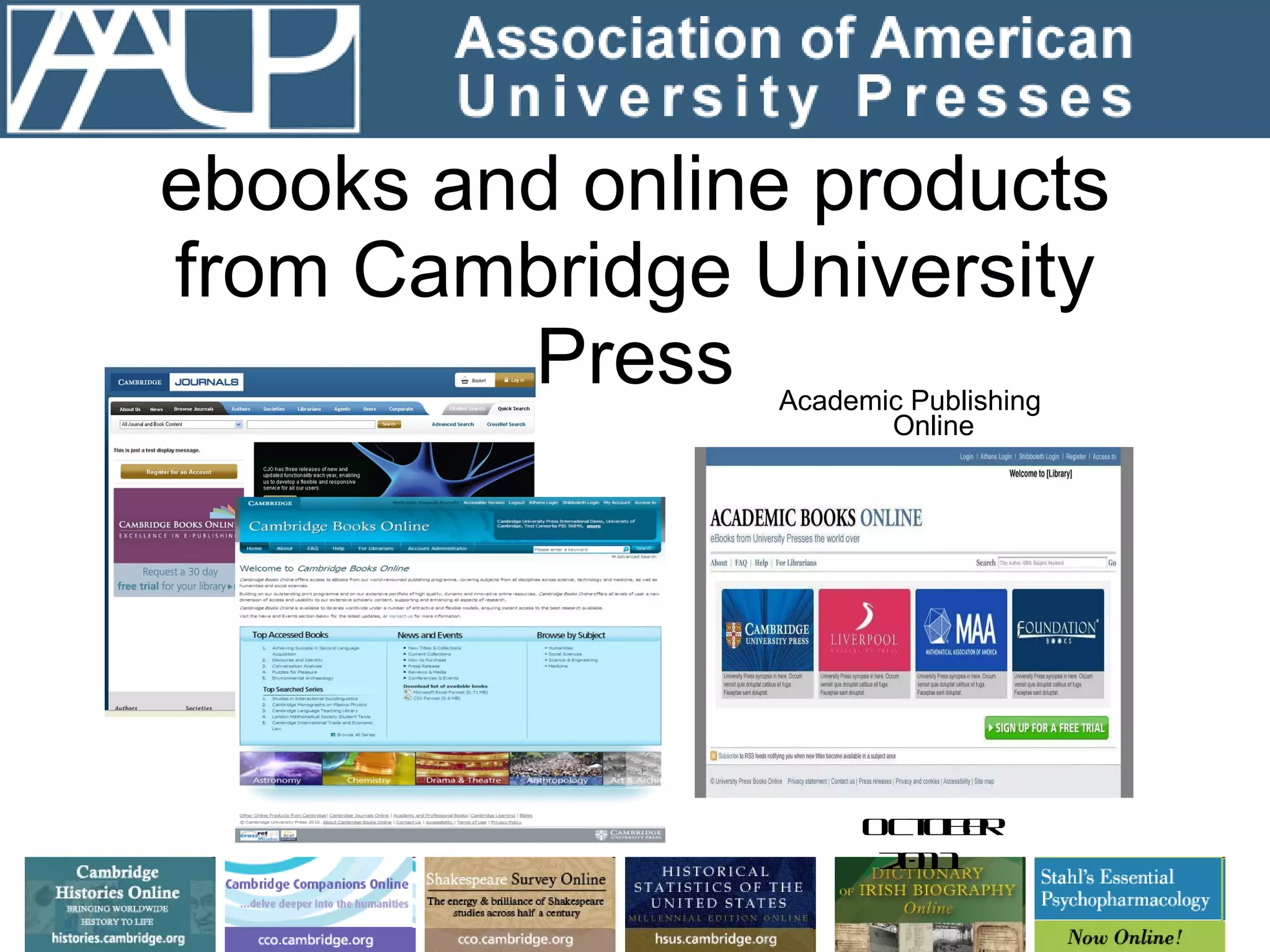
ebooks and online products from Cambridge University Press Academic Publishing Online October 2011
The critical factors Multiple acquisition options  Collections -and- individual title selection Unlimited -and- limited concurrency Perpetual access -and- subscription Acceptable license agreement Transparent pricing E-archiving and perpetual access guarantees
Critical factors – pt. 2 Compliance with major industry standards  Usage statistics MARC records Disability access Content Front and backlist availability Simultaneous print and online publication Frequent title uploads Advance title information Non-intrusive DRM
Other key considerations Discovery services Powerful search and browse capabilities Book and chapter level DOI’s Citation management tools Mobile device compatibility
Thank you. Questions? Contact me at  [email_address] Visit Cambridge Books Online  ebooks.cambridge.org Selling to Libraries: The New E-Book Aggregation Options
Books at JSTOR Library Discussions | May 2011
What Libraries Are Telling JSTOR … Move purchasing decision from “why?” to “why not?” No data to support “why?” decision at this point, therefore most UP content is seen as “wanna have” vs. “gotta have” Get the content “in the flow” Silos are insufficient OPACs – the traditional discovery place for monographs – are not really “in the flow” Long-term preservation is essential ILL (or whatever you want to call it in e-) is in our cultural fabric and needs requires a solution with e-books Independence – both at the platform level and the device level – is imperative to promote “ownership” “ I had no idea about course adoption titles” … Would love to have those titles included Can’t load the revenue expectations of those titles onto the library
Selling to Libraries: The New E-Book Aggregation Options Project MUSE/UPCC and Libraries MUSE/JHUP and UPeC conducted extensive market research with libraries (2009-11) Surveys/interviews/user groups: ALA, ACRL, Charleston Formed UPCC Library Advisory Board (2011) 12 librarians representing academic institutions of various sizes Feedback has focused on content offering, access, duplication and discoverability, and pricing model
Selling to Libraries: The New E-Book Aggregation Options Project MUSE/UPCC and Libraries: Content Offering 1. Only meaningful if the content is integrated on Project MUSE Content (books/journals) aggregated and searchable in a seamless  interface 2.  Peer review is really the line in the sand  A complete academic collection of original, peer-reviewed research 3. Academic libraries want to purchase UP monographs, in e-formats 4. One-stop shopping for academic libraries Librarians prefer and want larger collections from many publishers, not small collections from a limited number of publishers
Selling to Libraries: The New E-Book Aggregation Options Project MUSE/UPCC and Libraries: Access   1.  Generate revenue from different kinds of usage, but don’t get in the way  of  the user by restricting access 2 .  Librarians want the same level of access they have with journals : Simultaneous P and E access with minimal DRM Multiple simultaneous users Downloading rather than streaming Copy, cut, paste, print, download at the chapter level ILL, E-reserves Single-title and patron-driven demand options  Archiving through LOCKSS/CLOCKSS and Portico
Selling to Libraries: The New E-Book Aggregation Options Project MUSE/UPCC and Libraries: Duplication and Discoverability 1. Recognize that libraries already have systems and partnerships in place Critical to cooperate with multiple book vendors used by libraries to enable integration with approval plans and supply of MARC records Libraries are not in a position to buy the same content twice Duplication will force libraries to select one collection and not purchase others Share metadata with discovery services (Summon, etc.)
Selling to Libraries: The New E-Book Aggregation Options Project MUSE/UPCC and Libraries: Pricing Models 1. Multiple purchasing models are needed  for: Comprehensive and subject-based collections Frontlist and backlist  Single title and PDA Ownership (perpetual access) and subscription (annual renewal) Customization of collections 2. Allow us to pay for what we use  3. Measuring usage will be significant for ongoing purchases 4. May accept model that uses a multiplier for course titles
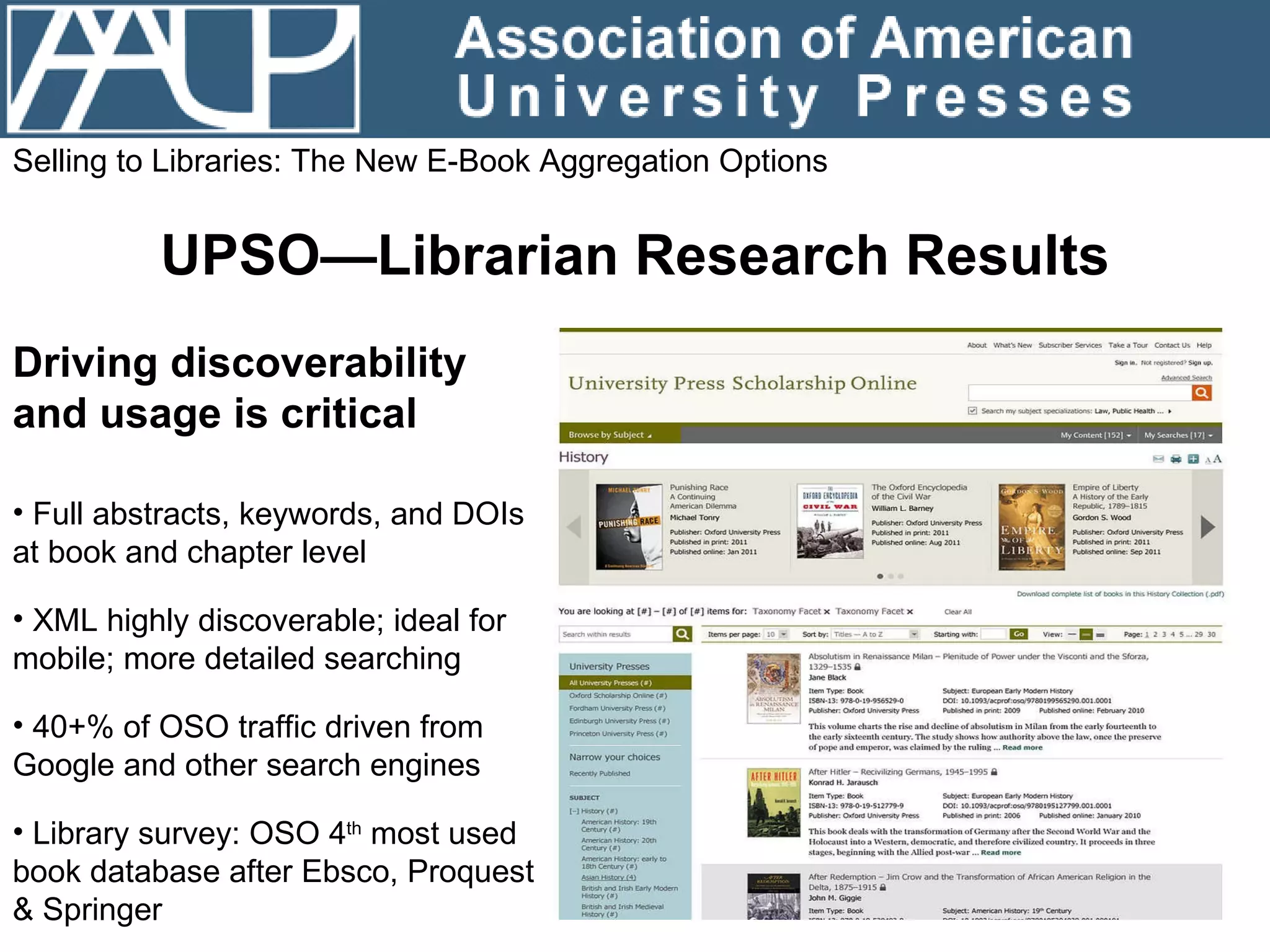
Selling to Libraries: The New E-Book Aggregation Options UPSO—Librarian Research Results Driving discoverability and usage is critical  Full abstracts, keywords, and DOIs at book and chapter level XML highly discoverable; ideal for mobile; more detailed searching 40+% of OSO traffic driven from Google and other search engines  Library survey: OSO 4 th  most used book database after  Ebsco, Proquest & Springer
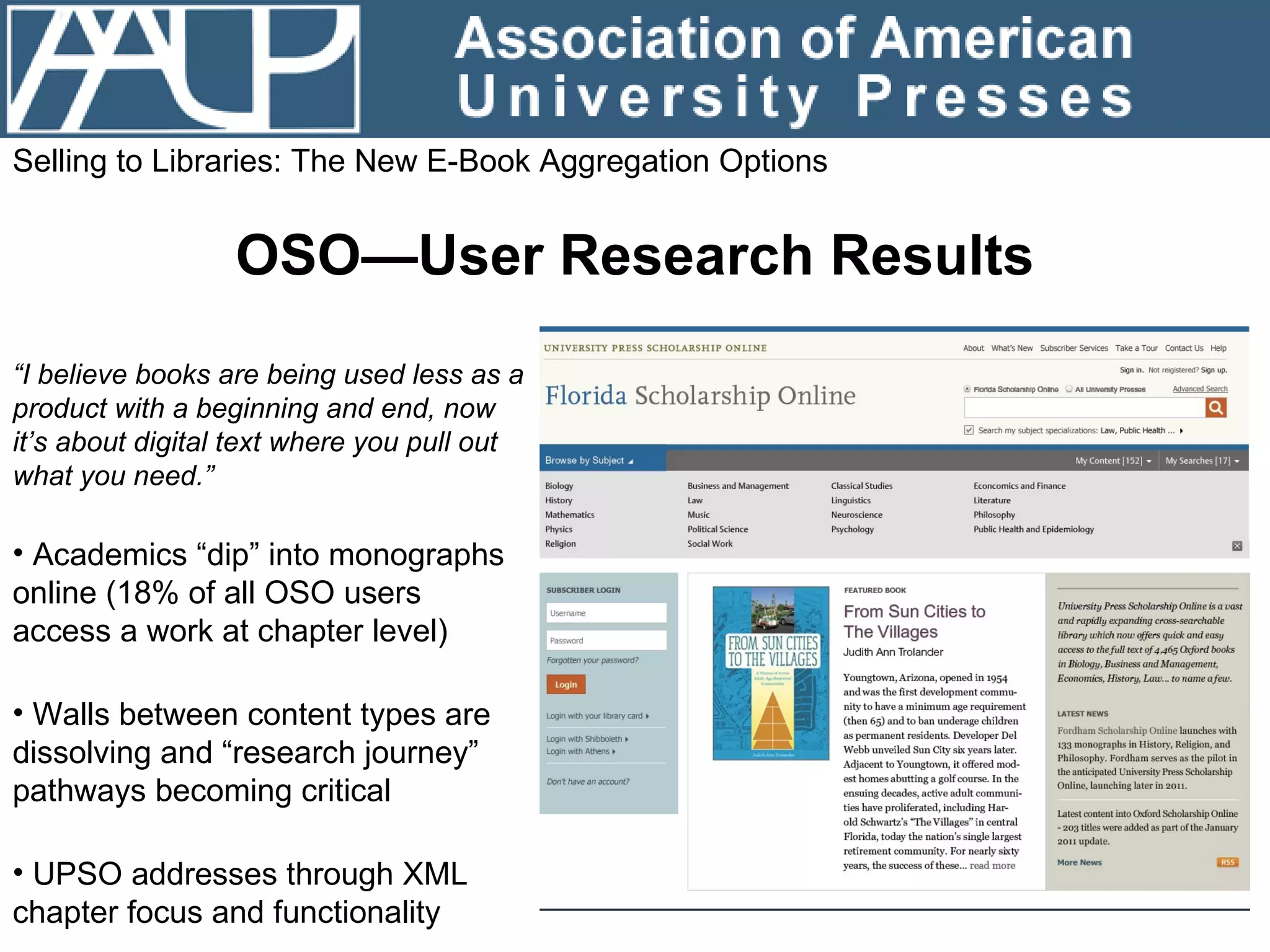
Selling to Libraries: The New E-Book Aggregation Options OSO—User Research Results “ I believe books are being used less as a product with a beginning and end, now it’s about digital text where you pull out what you need.”  Academics “dip” into monographs online (18% of all OSO users access a work at chapter level)  Walls between content types are dissolving and “research journey” pathways becoming critical UPSO addresses through XML chapter focus and functionality
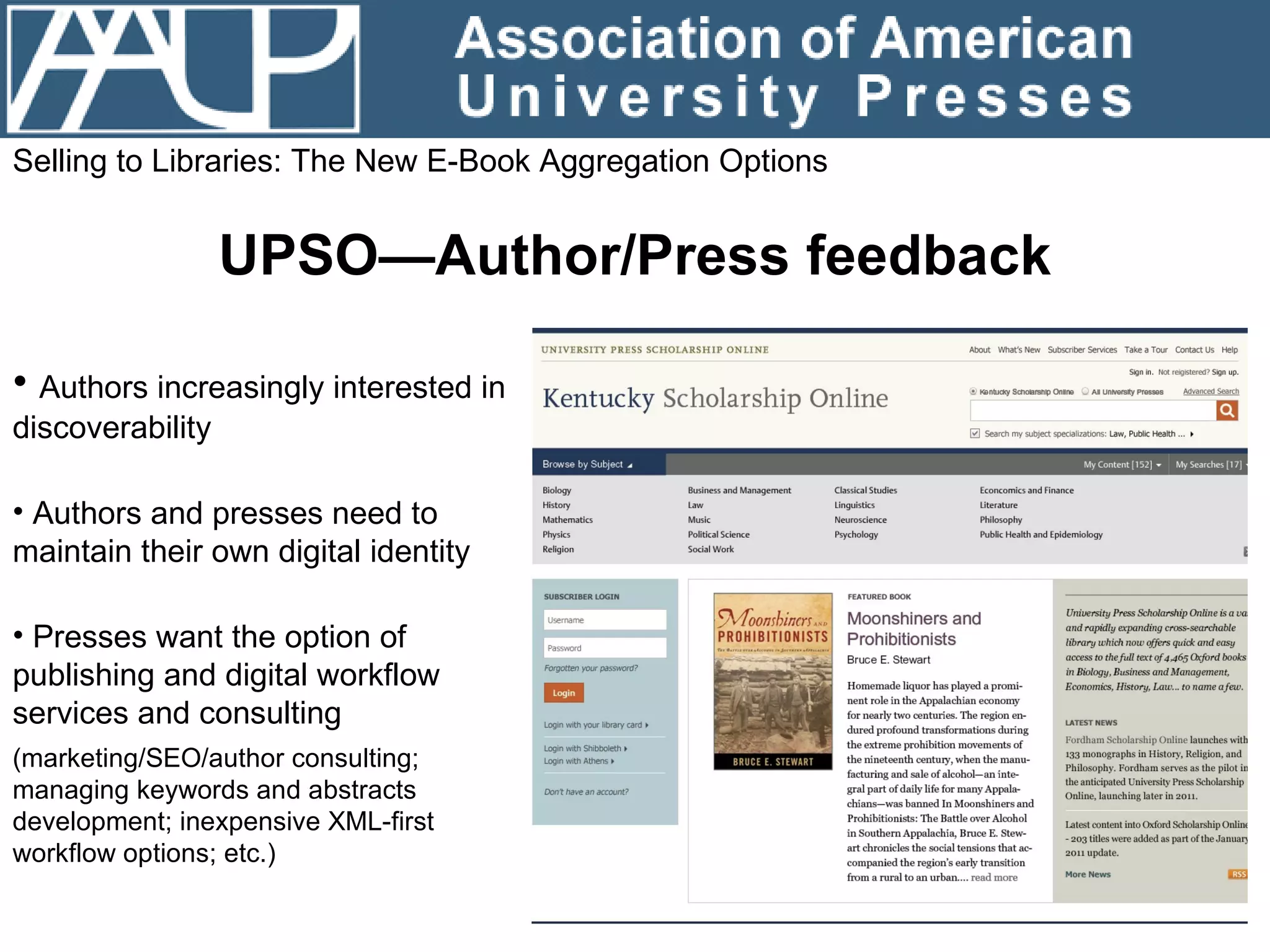
Selling to Libraries: The New E-Book Aggregation Options UPSO—Author/Press feedback Authors increasingly interested in discoverability Authors and presses need to maintain their own digital identity  Presses want the option of publishing and digital workflow services and consulting  (marketing/SEO/author consulting; managing keywords and abstracts development; inexpensive XML-first workflow options; etc.)
Selling to Libraries The New E-Book Aggregation Options Fredric Nachbaur  fnachbaur@fordham.edu Casper Grathwohl  [email_address] Bruce Heterick  Bruce.Heterick@ithaka.org Erin Igoe  EIgoe@cambridge.org Michael Levine-Clark  michael.levine-clark@du.edu Dean Smith  djs@press.jhu.edu Thank you!

AAUP 2011: New E-book Aggregations

  • 1.
    Selling to LibrariesThe New E-Book Aggregation Options Chair: Fredric Nachbaur, Fordham University Press Casper Grathwohl, Vice President and Publisher, Reference and Online, Oxford University Press Bruce Heterick, Vice President, ITHAKA Erin Igoe, Library Sales and Marketing Manager, Cambridge University Press Michael Levine-Clark, Collections Librarian, Penrose Library, and Associate Professor, University of Denver Dean Smith, Director, Project MUSE, The Johns Hopkins University Press
  • 2.
    Selling to Libraries:The New E-Book Aggregation Options
  • 3.
    Selling to Libraries:The New E-Book Aggregation Options Major Players From Cambridge University Press: Academic Publishing Online (APO) From JSTOR: A Platform that Also Features Monographs From the University Press eBook Consortium and Project MUSE Editions: University Press Content Consortium (UPCC) From Oxford University Press: University Press Scholarship Online (UPSO)
  • 4.
    Selling to Libraries:The New E-Book Aggregation Options Modes of Content Delivery APO: Chapter-sized PDF JSTOR: Chapter-sized PDF, ePub and XML UPCC: Chapter-sized PDF UPSO: Hypertext generated from XML with downloadable chapter-sized PDF
  • 5.
    Selling to Libraries:The New E-Book Aggregation Options XML Implementation APO: No – But will be implemented Early 2012 JSTOR: Yes UPCC: No – But exploring future implementation UPSO: Yes
  • 6.
    Selling to Libraries:The New E-Book Aggregation Options XML Implementation PRO: Readily convertible to e-book and e-reader formats Allows for more granular tagging and cross-referencing A more versatile format that is more “future proof” and less cumbersome than PDF
  • 7.
    Selling to Libraries:The New E-Book Aggregation Options XML Implementation CON: Requires additional tagging during the editorial process Cost of tagging renders extensive backlist conversion problematic Longer production schedules and change of workflow
  • 8.
    Selling to Libraries:The New E-Book Aggregation Options Accepts PDFs APO: Yes JSTOR: Yes UPCC: Yes UPSO: No
  • 9.
    Selling to Libraries:The New E-Book Aggregation Options PDF Advantages For most presses, recent backlist titles will already be available as print PDFs (No/limited conversion needed) Scanning older backlist titles to produce PDFs is relatively inexpensive
  • 10.
    Selling to Libraries:The New E-Book Aggregation Options Accepts Backlist Titles APO: Yes JSTOR: Yes UPCC: Yes UPSO: Some
  • 11.
    Selling to Libraries:The New E-Book Aggregation Options Backlist Support APO will provide some assistance converting print PDF files to web-ready format JSTOR will offer scanning services to produce PDF files UPCC is exploring the possibility of providing funding assistance for scanning and conversion in the future UPSO will feature a limited list of bestselling backlist titles because of the cost of converting them to XML
  • 12.
    Selling to Libraries:The New E-Book Aggregation Options Keywording and Cross-Referencing Cross-referencing and robust keyword lists allow for greater discoverability of content All four aggregators offer chapter-level keywords and abstracts JSTOR’s and UPSO’s early implementation of XML allows for an exceptional depth of cross-referencing
  • 13.
    Selling to Libraries:The New E-Book Aggregation Options Marketing Experience APO: 1 Year JSTOR: 16 Years UPCC: 18 Years UPSO: 10 Years
  • 14.
    Selling to Libraries:The New E-Book Aggregation Options Marketing Experience and Market Share Cambridge Books Online (the precursor to APO) launched in January 2010 A marketing team dedicated to selling APO exclusively CBO has a 20% market share within its core market of global higher educational institutions
  • 15.
    Selling to Libraries:The New E-Book Aggregation Options Marketing Experience and Market Share JSTOR has been in operation providing online scholarship since 1995 More than 7,000 institutions worldwide and more than 95% of accredited higher learning institutions in the United States participate
  • 16.
    Selling to Libraries:The New E-Book Aggregation Options Marketing Experience and Market Share UPCC is a joint venture between the young University Press eBook Consortium and the venerable Project MUSE Project MUSE is one of the oldest purveyors of online scholarship, in operation since 1993 Project MUSE has almost 2,500 institutional subscribers
  • 17.
    Selling to Libraries:The New E-Book Aggregation Options Marketing Experience and Market Share Oxford University Press has ten years of experiencing marketing its Oxford Scholarship Online (OSO) product to libraries and research institutions A dedicated marketing team will market UPSO exclusively 60% of research libraries in the world are currently OSO subscribers
  • 18.
    Selling to Libraries:The New E-Book Aggregation Options Portal Branding APO: Yes JSTOR: Yes UPCC: No UPSO: Yes
  • 19.
    Selling to Libraries:The New E-Book Aggregation Options Portal Branding Branded portals allow presses to maintain a discrete identity online
  • 20.
    Selling to Libraries:The New E-Book Aggregation Options Portal Branding
  • 21.
    Selling to Libraries:The New E-Book Aggregation Options Content Types Peer-Reviewed Trade UPSO: Yes Yes JSTOR: Yes No APO: Yes Yes UPCC: Yes Yes
  • 22.
    Selling to Libraries:The New E-Book Aggregation Options MARC Records APO: Yes JSTOR: No UPCC: Yes UPSO: Yes
  • 23.
    Selling to Libraries:The New E-Book Aggregation Options Digital Rights Management (DRM) APO: Yes JSTOR: No UPCC: No UPSO: Yes
  • 24.
    Selling to Libraries:The New E-Book Aggregation Options Digital Rights Management (DRM) APO and UPSO employ unobtrusive DRM that allows downloads of chapter-sized PDFs, but discourages piracy JSTOR provides minimal DRM, though course adoption titles will receive more restrictive DRM UPCC provides minimal DRM
  • 25.
    eBook Aggregators: WhatDo Libraries Want? Michael Levine-Clark University of Denver AAUP Annual Meeting June 3, 2011 Selling to Libraries: The New E-Book Aggregation Options
  • 26.
  • 27.
    Flexibility Content PlatformDRM Pricing Workflow integration Selling to Libraries: The New E-Book Aggregation Options
  • 28.
    Content Full availabilityAll titles All aggregators All pricing models Simultaneous E/P Clear expectations Selling to Libraries: The New E-Book Aggregation Options
  • 29.
    Platform Too manybells and whistles Are unnecessary Confuse the user No special downloads Functional with any ereader Functional with any browser Integration (when relevant) with journal platform Fewer platforms Selling to Libraries: The New E-Book Aggregation Options
  • 30.
    Digital Rights ManagementPerpetual access = ownership Less is better, but publishers need some control No limitations On device On use Limitations on sharing Selling to Libraries: The New E-Book Aggregation Options
  • 31.
    Pricing Flexibility! Title-by-titleor package Purchase or subscription Demand-Driven Acquisition (DDA) Short-term lease ILL Component of DDA Selling to Libraries: The New E-Book Aggregation Options
  • 32.
    Pricing Ability toacquire E/P bundle, even retroactively Consortial options Must recognize traditional spending patterns Should work across aggregators Selling to Libraries: The New E-Book Aggregation Options
  • 33.
    Integration with PrintWorkflow Approval vendor(s) Deduplication Bundling Billing Selling to Libraries: The New E-Book Aggregation Options
  • 34.
    Thank You MichaelLevine-Clark Collections Librarian University of Denver [email_address] Selling to Libraries: The New E-Book Aggregation Options
  • 35.
    ebooks and onlineproducts from Cambridge University Press Academic Publishing Online October 2011
  • 36.
    The critical factorsMultiple acquisition options Collections -and- individual title selection Unlimited -and- limited concurrency Perpetual access -and- subscription Acceptable license agreement Transparent pricing E-archiving and perpetual access guarantees
  • 37.
    Critical factors –pt. 2 Compliance with major industry standards Usage statistics MARC records Disability access Content Front and backlist availability Simultaneous print and online publication Frequent title uploads Advance title information Non-intrusive DRM
  • 38.
    Other key considerationsDiscovery services Powerful search and browse capabilities Book and chapter level DOI’s Citation management tools Mobile device compatibility
  • 39.
    Thank you. Questions?Contact me at [email_address] Visit Cambridge Books Online ebooks.cambridge.org Selling to Libraries: The New E-Book Aggregation Options
  • 40.
    Books at JSTORLibrary Discussions | May 2011
  • 41.
    What Libraries AreTelling JSTOR … Move purchasing decision from “why?” to “why not?” No data to support “why?” decision at this point, therefore most UP content is seen as “wanna have” vs. “gotta have” Get the content “in the flow” Silos are insufficient OPACs – the traditional discovery place for monographs – are not really “in the flow” Long-term preservation is essential ILL (or whatever you want to call it in e-) is in our cultural fabric and needs requires a solution with e-books Independence – both at the platform level and the device level – is imperative to promote “ownership” “ I had no idea about course adoption titles” … Would love to have those titles included Can’t load the revenue expectations of those titles onto the library
  • 42.
    Selling to Libraries:The New E-Book Aggregation Options Project MUSE/UPCC and Libraries MUSE/JHUP and UPeC conducted extensive market research with libraries (2009-11) Surveys/interviews/user groups: ALA, ACRL, Charleston Formed UPCC Library Advisory Board (2011) 12 librarians representing academic institutions of various sizes Feedback has focused on content offering, access, duplication and discoverability, and pricing model
  • 43.
    Selling to Libraries:The New E-Book Aggregation Options Project MUSE/UPCC and Libraries: Content Offering 1. Only meaningful if the content is integrated on Project MUSE Content (books/journals) aggregated and searchable in a seamless interface 2. Peer review is really the line in the sand A complete academic collection of original, peer-reviewed research 3. Academic libraries want to purchase UP monographs, in e-formats 4. One-stop shopping for academic libraries Librarians prefer and want larger collections from many publishers, not small collections from a limited number of publishers
  • 44.
    Selling to Libraries:The New E-Book Aggregation Options Project MUSE/UPCC and Libraries: Access 1. Generate revenue from different kinds of usage, but don’t get in the way of the user by restricting access 2 . Librarians want the same level of access they have with journals : Simultaneous P and E access with minimal DRM Multiple simultaneous users Downloading rather than streaming Copy, cut, paste, print, download at the chapter level ILL, E-reserves Single-title and patron-driven demand options Archiving through LOCKSS/CLOCKSS and Portico
  • 45.
    Selling to Libraries:The New E-Book Aggregation Options Project MUSE/UPCC and Libraries: Duplication and Discoverability 1. Recognize that libraries already have systems and partnerships in place Critical to cooperate with multiple book vendors used by libraries to enable integration with approval plans and supply of MARC records Libraries are not in a position to buy the same content twice Duplication will force libraries to select one collection and not purchase others Share metadata with discovery services (Summon, etc.)
  • 46.
    Selling to Libraries:The New E-Book Aggregation Options Project MUSE/UPCC and Libraries: Pricing Models 1. Multiple purchasing models are needed for: Comprehensive and subject-based collections Frontlist and backlist Single title and PDA Ownership (perpetual access) and subscription (annual renewal) Customization of collections 2. Allow us to pay for what we use 3. Measuring usage will be significant for ongoing purchases 4. May accept model that uses a multiplier for course titles
  • 47.
    Selling to Libraries:The New E-Book Aggregation Options UPSO—Librarian Research Results Driving discoverability and usage is critical Full abstracts, keywords, and DOIs at book and chapter level XML highly discoverable; ideal for mobile; more detailed searching 40+% of OSO traffic driven from Google and other search engines Library survey: OSO 4 th most used book database after Ebsco, Proquest & Springer
  • 48.
    Selling to Libraries:The New E-Book Aggregation Options OSO—User Research Results “ I believe books are being used less as a product with a beginning and end, now it’s about digital text where you pull out what you need.” Academics “dip” into monographs online (18% of all OSO users access a work at chapter level) Walls between content types are dissolving and “research journey” pathways becoming critical UPSO addresses through XML chapter focus and functionality
  • 49.
    Selling to Libraries:The New E-Book Aggregation Options UPSO—Author/Press feedback Authors increasingly interested in discoverability Authors and presses need to maintain their own digital identity Presses want the option of publishing and digital workflow services and consulting (marketing/SEO/author consulting; managing keywords and abstracts development; inexpensive XML-first workflow options; etc.)
  • 50.
    Selling to LibrariesThe New E-Book Aggregation Options Fredric Nachbaur fnachbaur@fordham.edu Casper Grathwohl [email_address] Bruce Heterick Bruce.Heterick@ithaka.org Erin Igoe EIgoe@cambridge.org Michael Levine-Clark michael.levine-clark@du.edu Dean Smith djs@press.jhu.edu Thank you!

Editor's Notes

  • #27 Flickr, Creative Commons: Choo Yut Shing http://www.flickr.com/photos/25802865@N08/3686204262/
  • #36 *Switch over from Ebooks to Ereference – even though the medium is the same it is slightly difference (end user behavior; budgets, etc) *revenue is a blend of new sales and renewals *will end up FY about $100,000 down from last year. Very pleased with this – no new products this year. Made up entire amount on new business (New York Public Library, Penn State, Notre Dame, U of Illinois) and retaining existing customers *about 1M last FY *Still processing renewals and new orders this week – LSU (CHO) and Toronto (SSO)
  • #37 Thank you Meslissane for slotting the time for this presentation into the sales conference. What I would like to do if provide a brief overview of Cambridge Books Online, our other digital reference projects and our ebook sales through our partners. To clarify my remarks will focus on institutional digital sales rather than individual. What do I mean by institutional: Our core market for ebooks and digital reference are Academic Libraries (as well as some publics, corporate and government). They are purchasing digital content on behalf of their patrons and users. These can be multi-person licenses or single use. The flip side to insitutional sales (and still a very nice chunk of revenue for us) are Individual sales via traditional retail partners. This would cover sales for Kindle, Nook, Ipad, KOBO.
  • #38 Thousands of front & backlist titles (11,135in April 11). Upload titles to the platform once a month with functionality updates twice a year. Since we’ve launched we’ve had 3 with the most recent this week! One thing that has become very clear to me when dealing with libraries and ebooks is that one size does not fit all as far as ebook collection development. Each institution has different rates of conversion and this can vary across library selectors and budget segments. Having flexibility with content selection has been key. Comprehensive library support tools including downloadable MARC records, usage reports and access & authentication methods
  • #39 Start with the centerpiece of the current program – Cambridge Books Online CBO launched in January 2010 Build by our colleagues in Manila using much of the technology developed by Cambridge Journals Online. So far positive feedback, and product will continue to evolve to respond to the changing needs of the market *The platform was awarded a Choice Outstanding Academic Title designation this past January and has gotten positive reviews from library media. Large number of titles, on par with competitors (Wiley, T&F, Elsevier) but CBO has larger number of far backlist
  • #40 I know this was a lot of information (and acronyms) in a short amount of time but I’d like to thank you all for your attention and please let me know if you have any questions or would like any marketing materials for our products discusses today.
  • #48 I realize it’s probably not going to make launch, but we should talk up the mobile end of the site. XML really helps here because instead of downloading a PDF, we’re offering HTML (generated from XML) which will generally be smaller and faster to download. XML also allows us to reflow text which makes for a far superior mobile reading experience. if you need a talking point about why XML is better than PDF beyond mobile, here are a few of the advanced search fields that would not be available on a PDF platform:   Headings Index Bibliography Captions Tables   It’s also unlikely that PDF will support links between references and notes.