EuropeAid


What is Corruption?


Dr Heather Marquette, University of Birmingham


 European Commission Training Seminar: EC Support to Governance
                in Partner Countries (Africa focus)
                          4-8 July 2011
What is corruption?                      EuropeAid


 o   Introduction

 o   Definitions

 o   Forms and typologies

 o   Causes and consequences

 o   Challenges in fighting corruption
Why worry                                                           EuropeAid

about corruption?
 Cost of Corruption:
 €   Decreases GDP by 1%/yr (UN)
 €   Bribery alone = $1 trillion/yr
     (World Bank)
 €   3-5% world GDP
     (World Bank and IMF)


 Corruption:
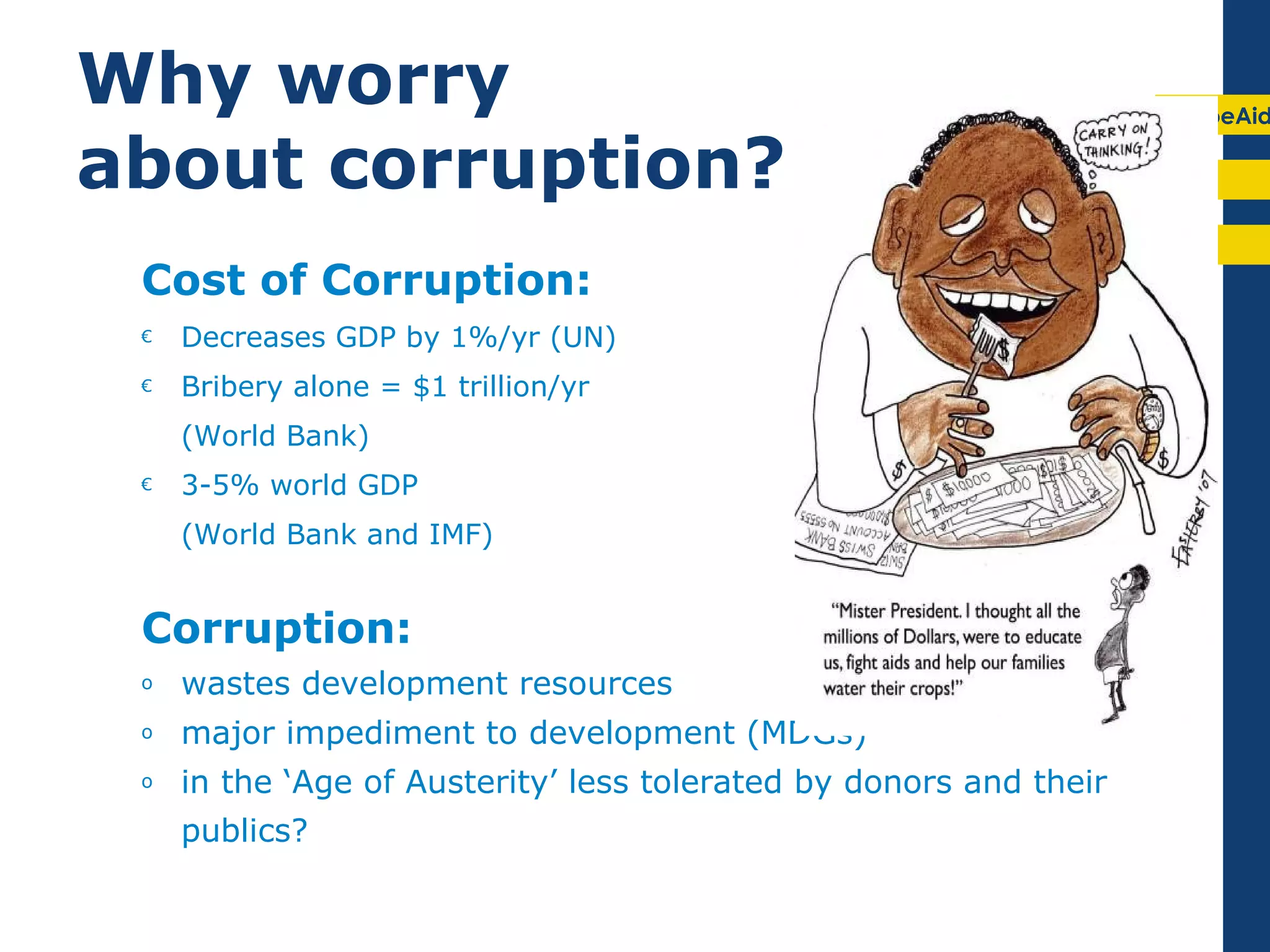
 o   wastes development resources
 o   major impediment to development (MDGs)
 o   in the ‘Age of Austerity’ less tolerated by donors and their
     publics?
Definitions of corruption                                          EuropeAid


 o   Defining corruption is complex because of ‘absence of a fixed
     disciplinary allegiance’ (Williams, 1999)

 o   Definitions vary according to approaches, aims and needs of
     analysts/policymakers

 o   How corruption is defined determines how it is viewed, the
     policy approaches adopted and the legitimacy of policies

 o   Recognizing this complexity, the EC has acknowledged several
     approaches to defining corruption
      • Legal
      • Socio-economic
      • Anthropological
Legal approaches                                                               EuropeAid


to defining
corruption
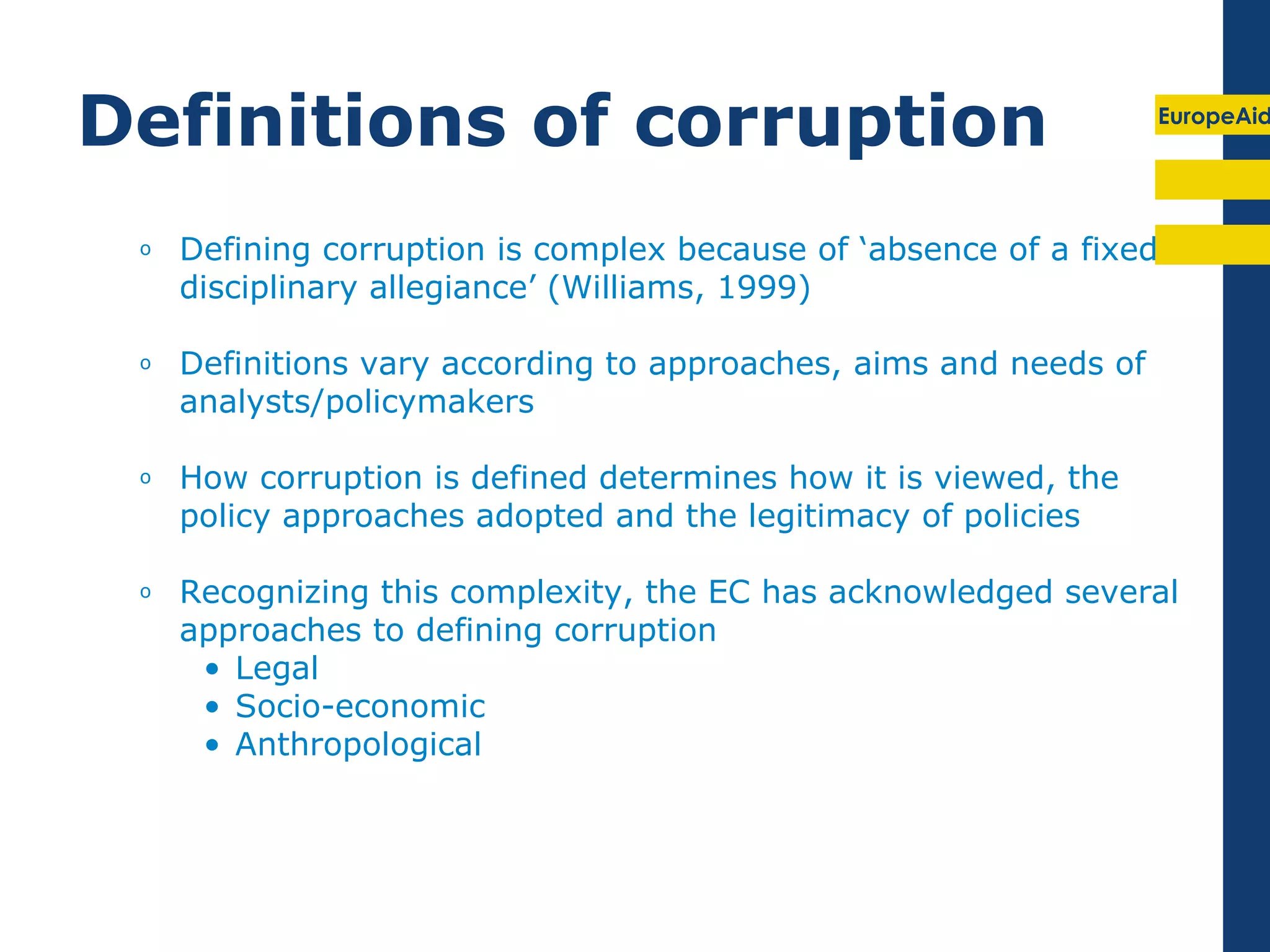
 o   In very basic terms, if it is illegal, it is
     corruption; if it is legal, it is not

 o   International conventions provide harmonised definitions of corruption-
     related offences facilitating judicial cooperation between partner
     countries

 o   National legal definitions for corruption-related offences vary, due to
     different legal traditions and social norms

 o   Critiques?
      • The powerful set the law
      • Ignores offenses that may be legal but which society defines as
          corrupt
      • Facilitates a ‘tick box’ approach to anti-corruption; e.g., is there a
          law against X? Tick! De jure may not mean de facto
      • Cross-national comparisons difficult
Socio-economic approaches                                                     EuropeAid

to defining corruption
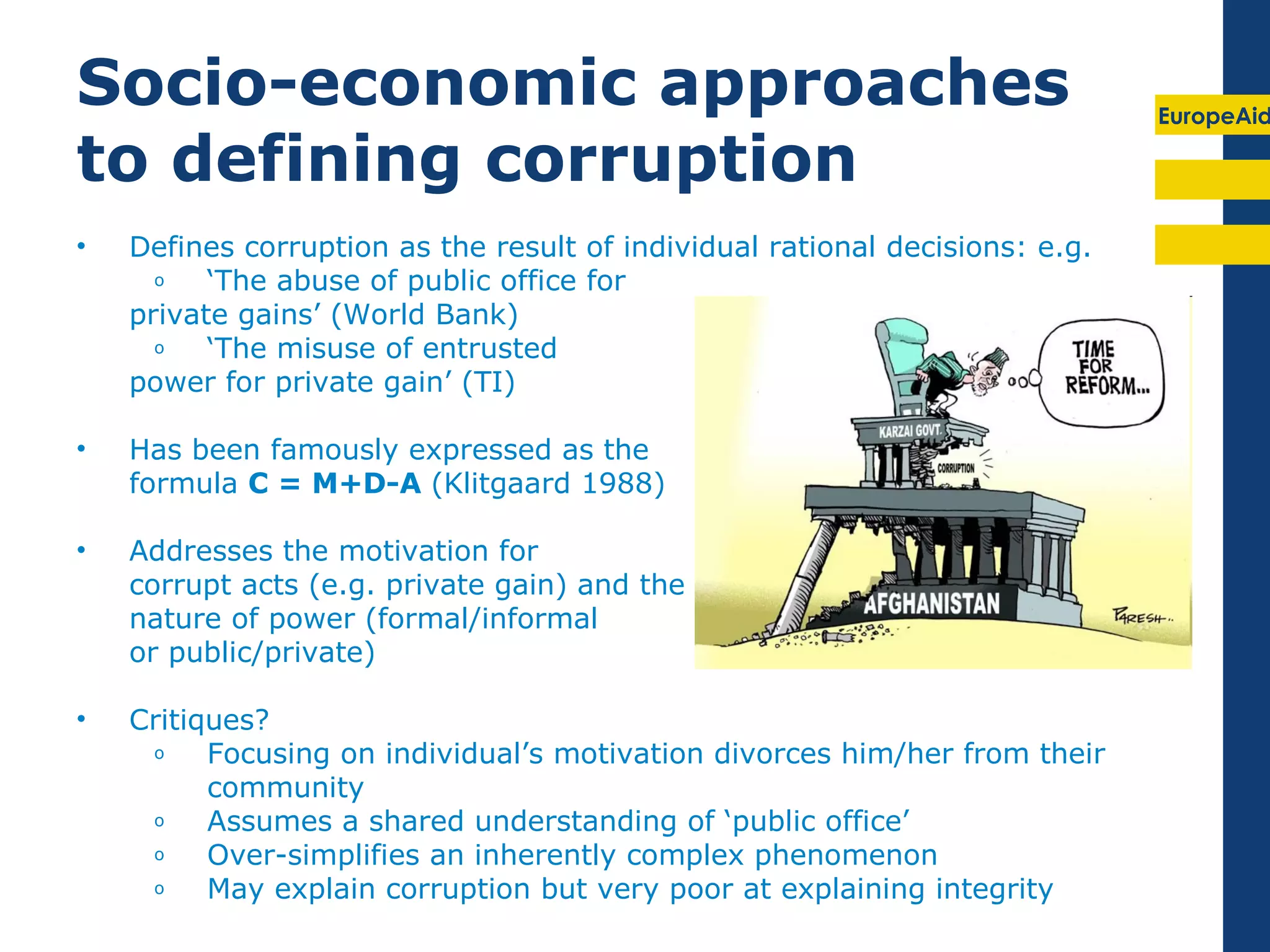
•   Defines corruption as the result of individual rational decisions: e.g.
      o   ‘The abuse of public office for
    private gains’ (World Bank)
      o   ‘The misuse of entrusted
    power for private gain’ (TI)

•   Has been famously expressed as the
    formula C = M+D-A (Klitgaard 1988)

•   Addresses the motivation for
    corrupt acts (e.g. private gain) and the
    nature of power (formal/informal
    or public/private)

•   Critiques?
     o    Focusing on individual’s motivation divorces him/her from their
          community
     o    Assumes a shared understanding of ‘public office’
     o    Over-simplifies an inherently complex phenomenon
     o    May explain corruption but very poor at explaining integrity
Anthropological approaches                                                            EuropeAid

to defining corruption
•   Concerned with the motivations, organisation of power, as well as
    contexts where corrupt acts take place

•   Considers corruption as both individual and collective phenomena

•   The anthropological approach takes into account:
     o   Norms, rules, customs, and perception of corruption
     o   The importance of morality and trust issues
     o    Forms and organisation of powers

•   Critiques?
     o    Too ‘academic’; difficult to translate into policy
     o    Ignores international norms; too context-specific
     o    May be used to justify an ‘anything goes’ approach

     (Nb: Will be covered in more depth in the next session. Probably the least
         understood/known of all approaches, with a great deal of potential to help
         improve anti-corruption policy-making…despite critiques!)
Corruption: An EU Definition                                             EuropeAid


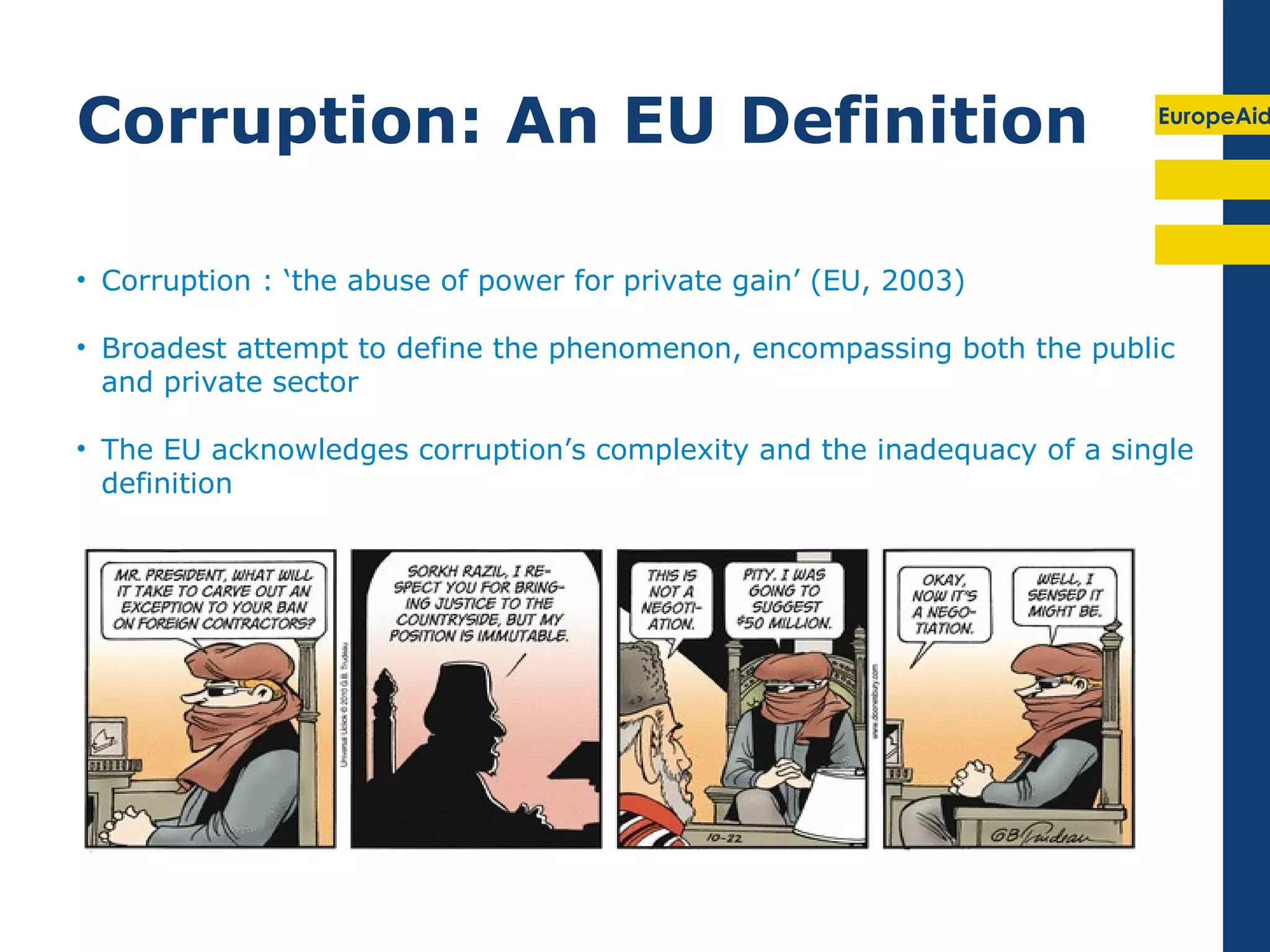
• Corruption : ‘the abuse of power for private gain’ (EU, 2003)

• Broadest attempt to define the phenomenon, encompassing both the public
  and private sector

• The EU acknowledges corruption’s complexity and the inadequacy of a single
  definition
Typologies of corruption          EuropeAid


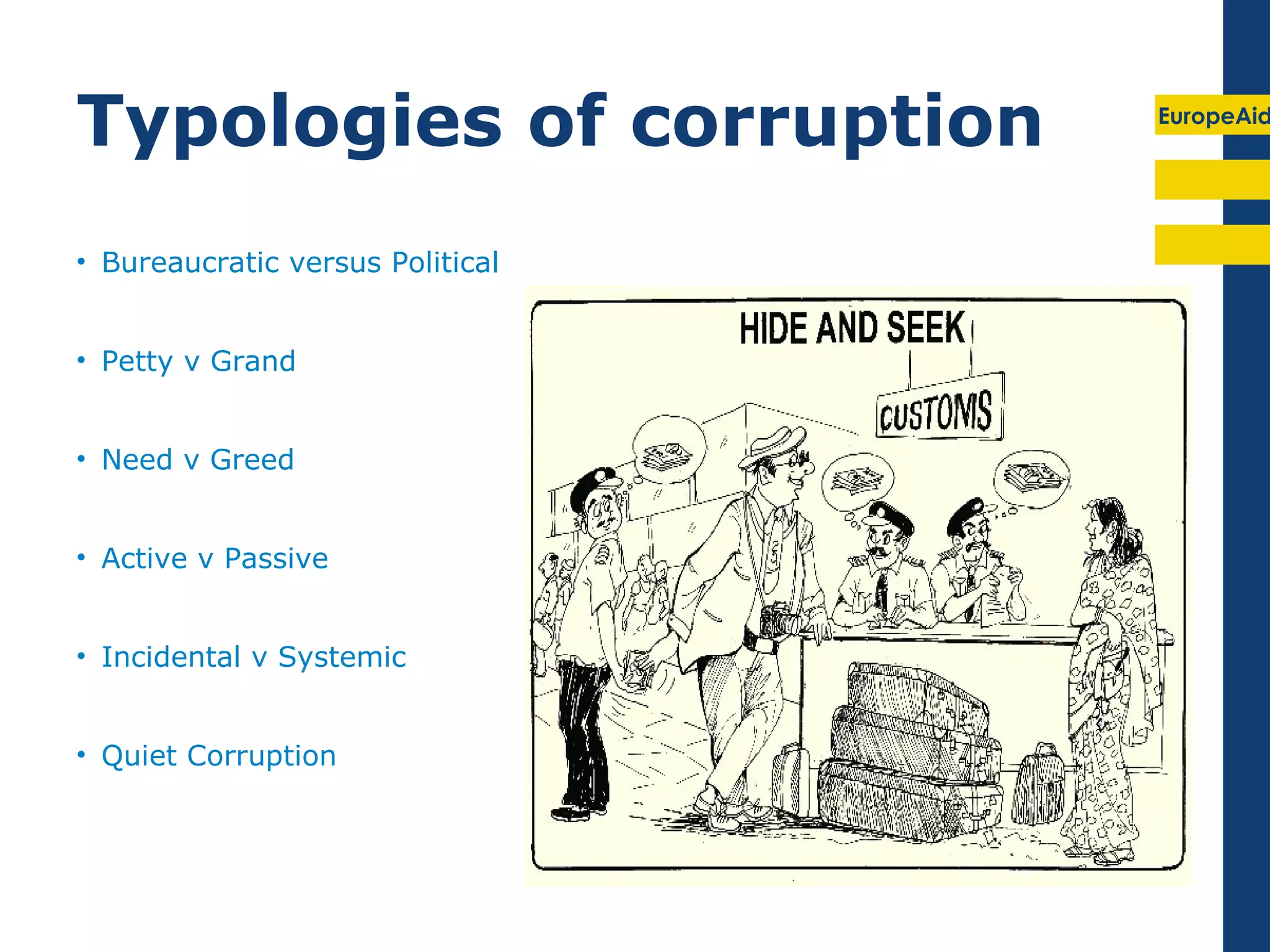
• Bureaucratic versus Political


• Petty v Grand


• Need v Greed


• Active v Passive


• Incidental v Systemic


• Quiet Corruption
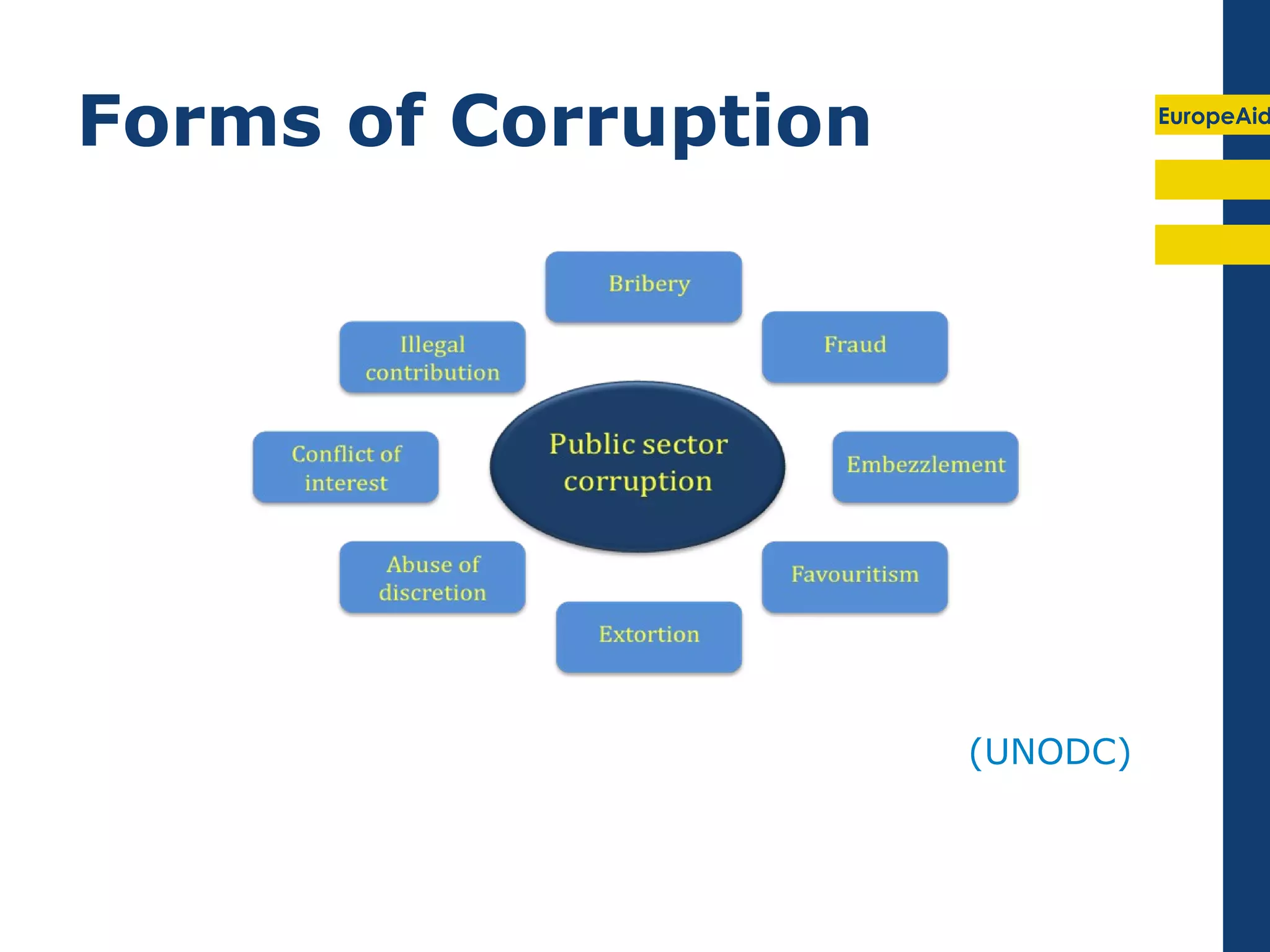
Forms of Corruption             EuropeAid


                      (UNODC)
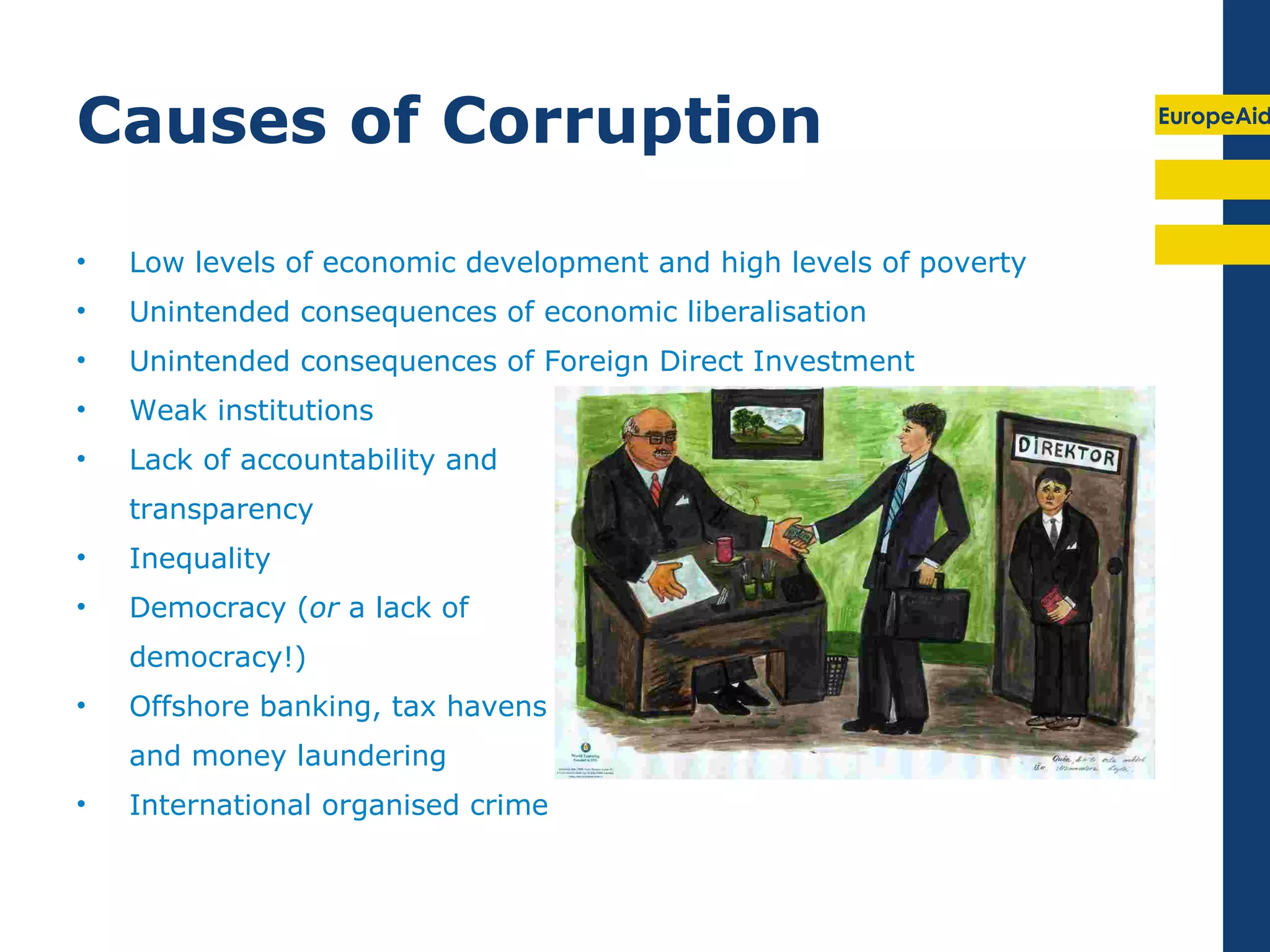
Causes of Corruption                                                EuropeAid


•   Low levels of economic development and high levels of poverty
•   Unintended consequences of economic liberalisation
•   Unintended consequences of Foreign Direct Investment
•   Weak institutions
•   Lack of accountability and
    transparency
•   Inequality
•   Democracy (or a lack of
    democracy!)
•   Offshore banking, tax havens
    and money laundering
•   International organised crime
Consequences of Corruption                                                   EuropeAid


•   Hampers economic growth and development

•   Jeopardizes poverty reduction

•   Increases cost of services, especially
    for the poor

•   Weakens democracy

•   Contributes to conflict

•   Reduces the effectiveness of aid

•   Weakens public support for aid
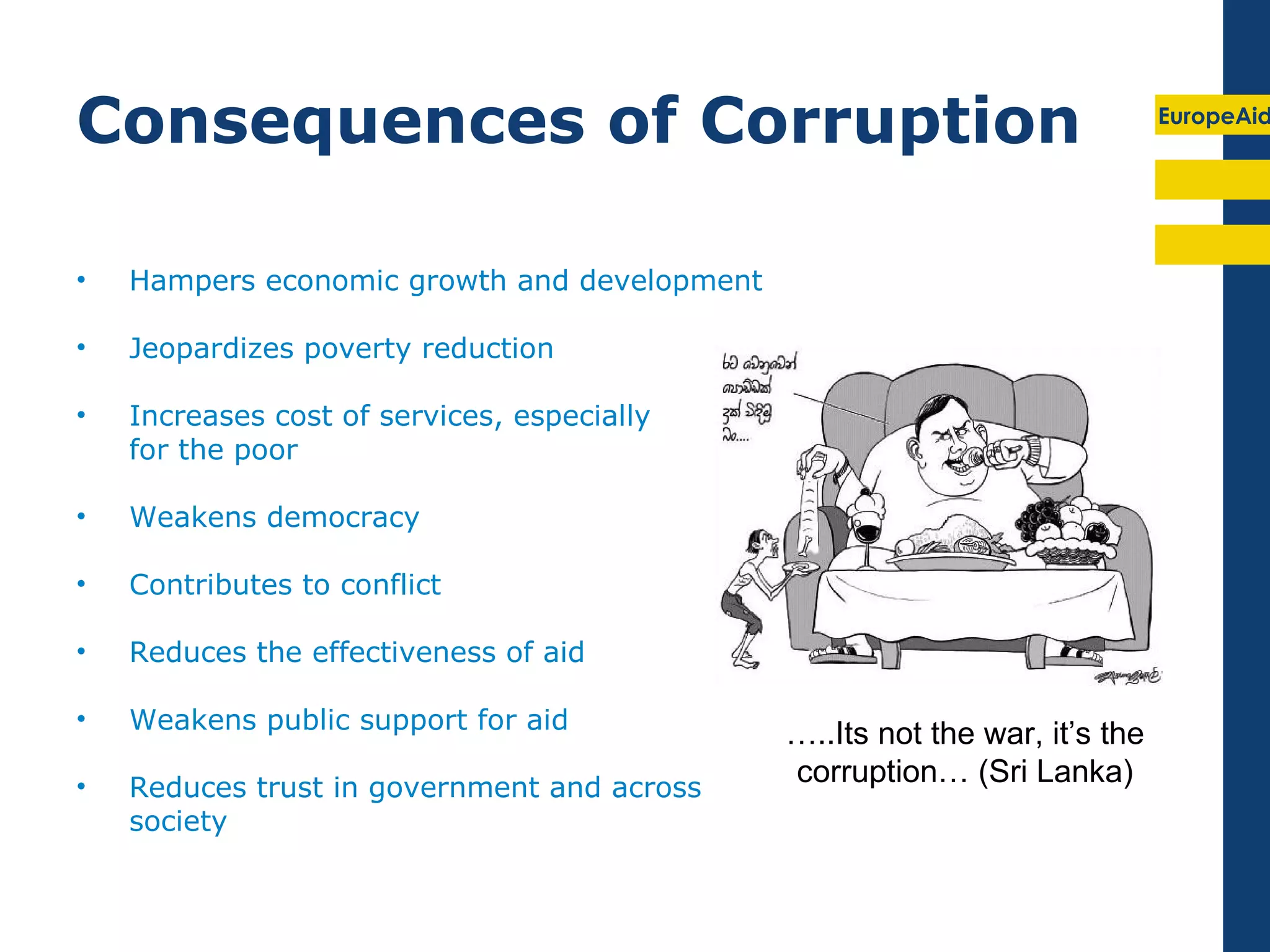
                                              …..Its not the war, it’s the
•   Reduces trust in government and across
                                              corruption… (Sri Lanka)
    society
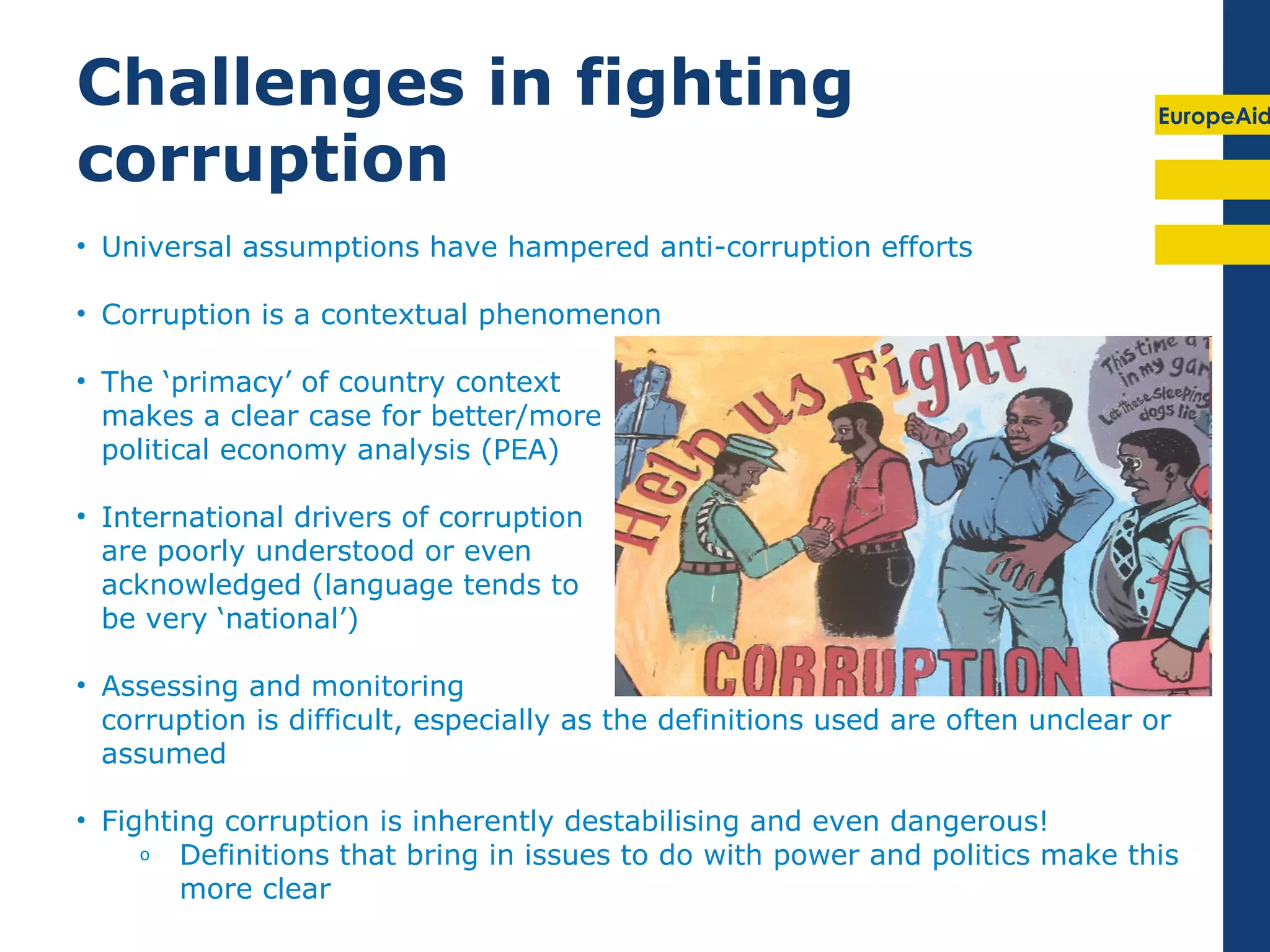
Challenges in fighting                                                           EuropeAid

corruption
• Universal assumptions have hampered anti-corruption efforts

• Corruption is a contextual phenomenon

• The ‘primacy’ of country context
  makes a clear case for better/more
  political economy analysis (PEA)

• International drivers of corruption
  are poorly understood or even
  acknowledged (language tends to
  be very ‘national’)

• Assessing and monitoring
  corruption is difficult, especially as the definitions used are often unclear or
  assumed

• Fighting corruption is inherently destabilising and even dangerous!
     o  Definitions that bring in issues to do with power and politics make this
        more clear

2.what is corruption

  • 1.
    EuropeAid What is Corruption? DrHeather Marquette, University of Birmingham European Commission Training Seminar: EC Support to Governance in Partner Countries (Africa focus) 4-8 July 2011
  • 2.
    What is corruption? EuropeAid o Introduction o Definitions o Forms and typologies o Causes and consequences o Challenges in fighting corruption
  • 3.
    Why worry EuropeAid about corruption? Cost of Corruption: € Decreases GDP by 1%/yr (UN) € Bribery alone = $1 trillion/yr (World Bank) € 3-5% world GDP (World Bank and IMF) Corruption: o wastes development resources o major impediment to development (MDGs) o in the ‘Age of Austerity’ less tolerated by donors and their publics?
  • 4.
    Definitions of corruption EuropeAid o Defining corruption is complex because of ‘absence of a fixed disciplinary allegiance’ (Williams, 1999) o Definitions vary according to approaches, aims and needs of analysts/policymakers o How corruption is defined determines how it is viewed, the policy approaches adopted and the legitimacy of policies o Recognizing this complexity, the EC has acknowledged several approaches to defining corruption • Legal • Socio-economic • Anthropological
  • 5.
    Legal approaches EuropeAid to defining corruption o In very basic terms, if it is illegal, it is corruption; if it is legal, it is not o International conventions provide harmonised definitions of corruption- related offences facilitating judicial cooperation between partner countries o National legal definitions for corruption-related offences vary, due to different legal traditions and social norms o Critiques? • The powerful set the law • Ignores offenses that may be legal but which society defines as corrupt • Facilitates a ‘tick box’ approach to anti-corruption; e.g., is there a law against X? Tick! De jure may not mean de facto • Cross-national comparisons difficult
  • 6.
    Socio-economic approaches EuropeAid to defining corruption • Defines corruption as the result of individual rational decisions: e.g. o ‘The abuse of public office for private gains’ (World Bank) o ‘The misuse of entrusted power for private gain’ (TI) • Has been famously expressed as the formula C = M+D-A (Klitgaard 1988) • Addresses the motivation for corrupt acts (e.g. private gain) and the nature of power (formal/informal or public/private) • Critiques? o Focusing on individual’s motivation divorces him/her from their community o Assumes a shared understanding of ‘public office’ o Over-simplifies an inherently complex phenomenon o May explain corruption but very poor at explaining integrity
  • 7.
    Anthropological approaches EuropeAid to defining corruption • Concerned with the motivations, organisation of power, as well as contexts where corrupt acts take place • Considers corruption as both individual and collective phenomena • The anthropological approach takes into account: o Norms, rules, customs, and perception of corruption o The importance of morality and trust issues o Forms and organisation of powers • Critiques? o Too ‘academic’; difficult to translate into policy o Ignores international norms; too context-specific o May be used to justify an ‘anything goes’ approach (Nb: Will be covered in more depth in the next session. Probably the least understood/known of all approaches, with a great deal of potential to help improve anti-corruption policy-making…despite critiques!)
  • 8.
    Corruption: An EUDefinition EuropeAid • Corruption : ‘the abuse of power for private gain’ (EU, 2003) • Broadest attempt to define the phenomenon, encompassing both the public and private sector • The EU acknowledges corruption’s complexity and the inadequacy of a single definition
  • 9.
    Typologies of corruption EuropeAid • Bureaucratic versus Political • Petty v Grand • Need v Greed • Active v Passive • Incidental v Systemic • Quiet Corruption
  • 10.
    Forms of Corruption EuropeAid (UNODC)
  • 11.
    Causes of Corruption EuropeAid • Low levels of economic development and high levels of poverty • Unintended consequences of economic liberalisation • Unintended consequences of Foreign Direct Investment • Weak institutions • Lack of accountability and transparency • Inequality • Democracy (or a lack of democracy!) • Offshore banking, tax havens and money laundering • International organised crime
  • 12.
    Consequences of Corruption EuropeAid • Hampers economic growth and development • Jeopardizes poverty reduction • Increases cost of services, especially for the poor • Weakens democracy • Contributes to conflict • Reduces the effectiveness of aid • Weakens public support for aid …..Its not the war, it’s the • Reduces trust in government and across corruption… (Sri Lanka) society
  • 13.
    Challenges in fighting EuropeAid corruption • Universal assumptions have hampered anti-corruption efforts • Corruption is a contextual phenomenon • The ‘primacy’ of country context makes a clear case for better/more political economy analysis (PEA) • International drivers of corruption are poorly understood or even acknowledged (language tends to be very ‘national’) • Assessing and monitoring corruption is difficult, especially as the definitions used are often unclear or assumed • Fighting corruption is inherently destabilising and even dangerous! o Definitions that bring in issues to do with power and politics make this more clear