
GROUP MEMBERS
        SYAFIQAH BINTI RAZALE
            D20101037538
 TUAN NURUL SHAHIRA BINTI TUAN YACOB
            D20101037520
WAN NURULFARHAH BINTI AWANG@HASAN
            D20101037532
What is smart school?
• A Malaysian education system which the education system in
  school including the management are reinvented.
Goals :
1) To provide all-round development of the individual like
   intellectual, physical, emotional, and spiritual
2) To provide opportunities to enhance individual strengths
   and abilities.
3) To produce thinking and technology-literate workforce
   and apply technology in teaching and learning.
4) Democratized education
1) To increase the participation of stakeholders
Four Waves of The Smart
 School Implementation
• Pilot phase
        • Is the plan of the original implementation
1999-     Plan
2002

        • Post Pilot Phase
2002-   • Involved ICT as a key enables learning.
2005
        • Making all schools smart
2005-
2010
        • The consolidate and stabilized technology become an
          integral part of nation’s learning process .
2010-   • technology becomes key enable in teaching and
2020      learning and the computers will be made available for
How Smart School is differ from
       a normal school?
 The smart school is differ based on their
  characteristics which does not have in normal
  school.
 The characteristics were included the process of:
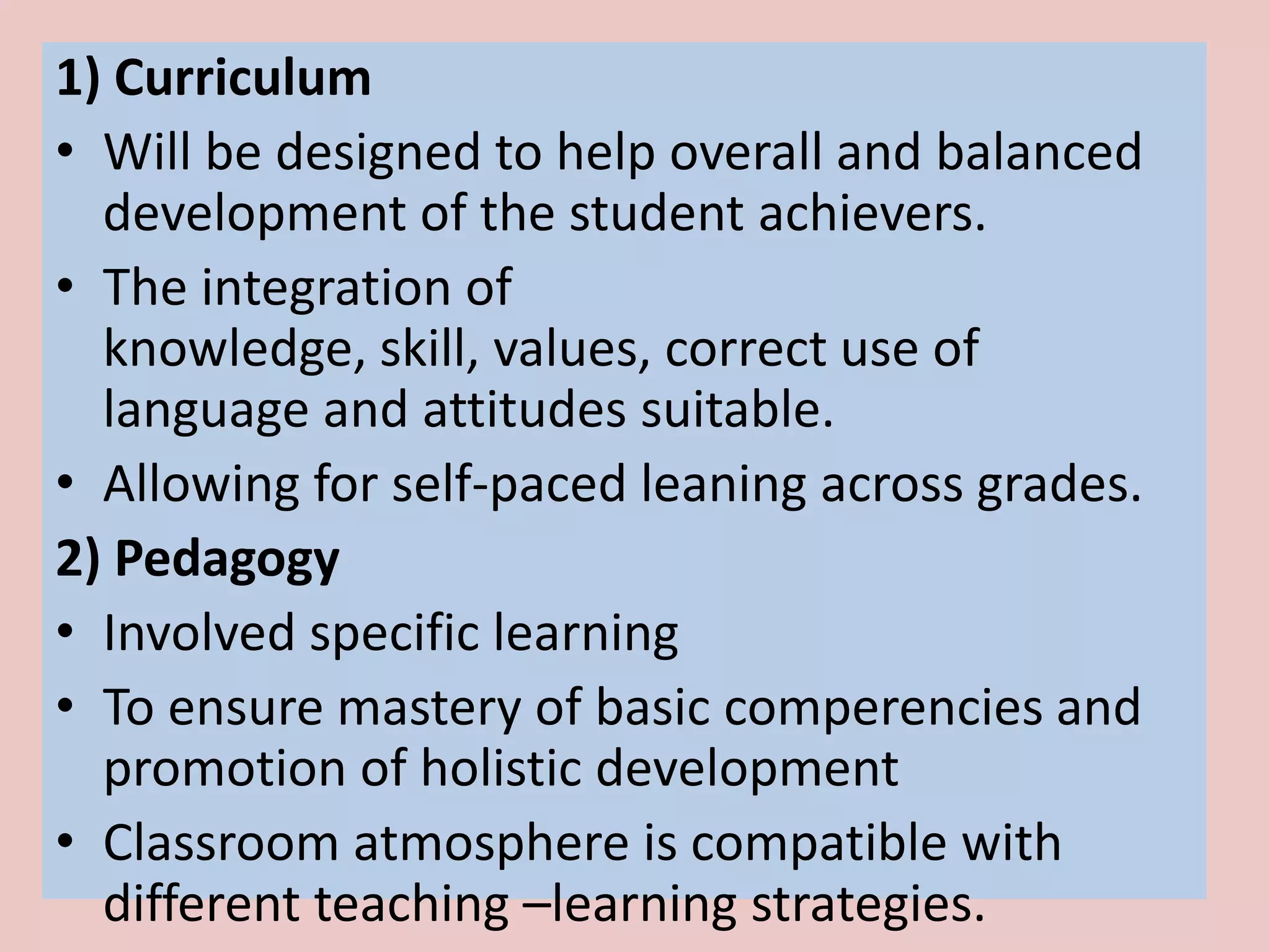
  1) Curriculum
  2) Pedagogy
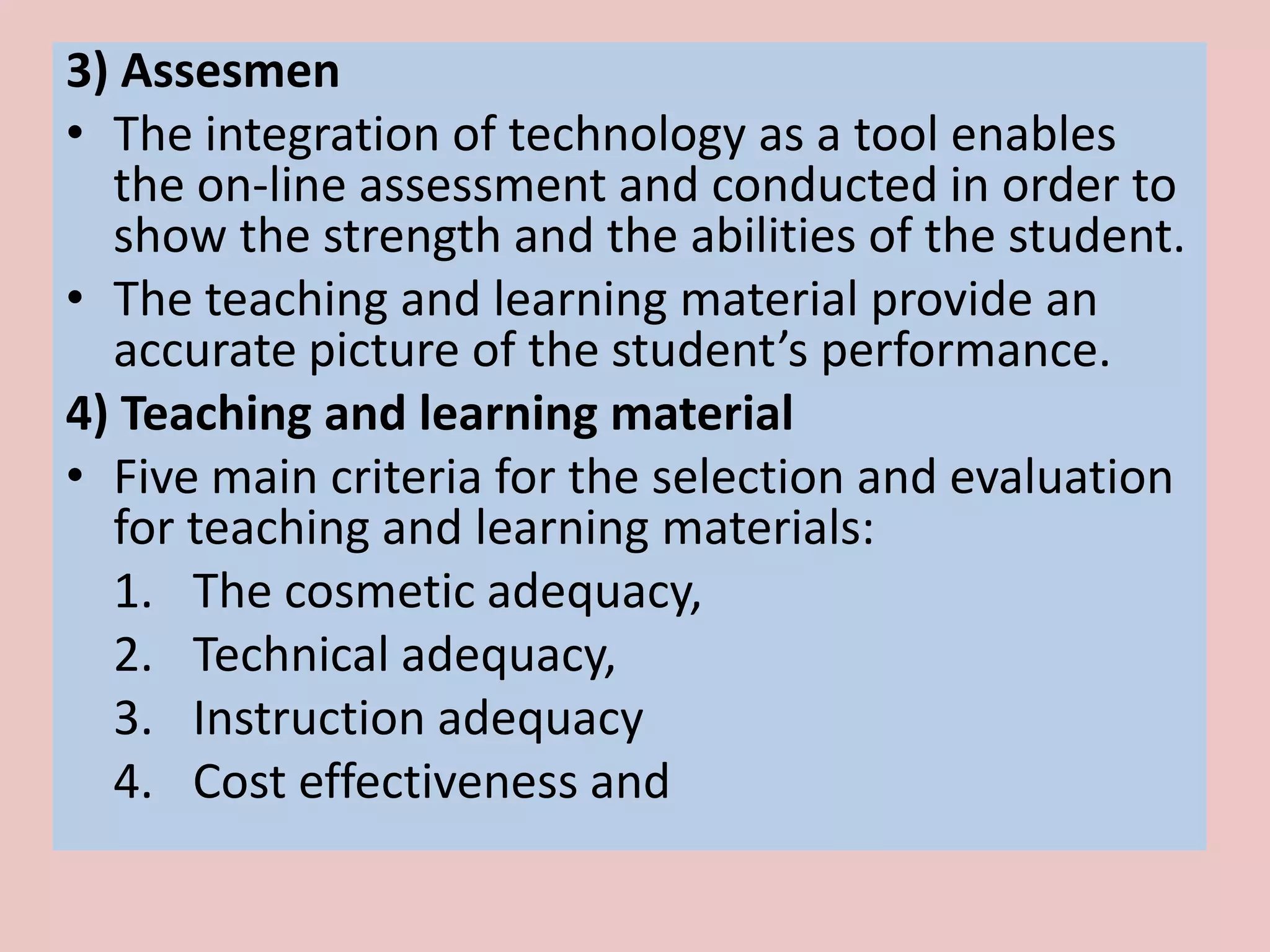
  3) Assessment
  4) Teaching and learning material
1) Curriculum
• Will be designed to help overall and balanced
  development of the student achievers.
• The integration of
  knowledge, skill, values, correct use of
  language and attitudes suitable.
• Allowing for self-paced leaning across grades.
2) Pedagogy
• Involved specific learning
• To ensure mastery of basic comperencies and
  promotion of holistic development
• Classroom atmosphere is compatible with
  different teaching –learning strategies.
3) Assesmen
• The integration of technology as a tool enables
  the on-line assessment and conducted in order to
  show the strength and the abilities of the student.
• The teaching and learning material provide an
  accurate picture of the student’s performance.
4) Teaching and learning material
• Five main criteria for the selection and evaluation
  for teaching and learning materials:
  1. The cosmetic adequacy,
  2. Technical adequacy,
  3. Instruction adequacy
  4. Cost effectiveness and
The use of the technology as enables
 contained in smart school concept
• In order to support the country’s ICT master plan
  and in line with the country’s drive to fulfill vision
  2020, the education system has to be transform.
• The catalyst for this transformation will be
   ICT-enable Smart School.
• As to reduce the digital divide that exist in
  different part of the country, the computer
  laboratories were provided to thousands of
  school.
• The ministry has formulated three main policies for
  ICT in education, such as:

   First policy : ICT for all student.
   Second policy: Emphasises the role and function of
                   ICT in education as a teaching and
                   learning tool.
   Third policy :Emphasises using ICT to increase
                  productivity, efficiency and
                  effectiveness of the management
                  system.
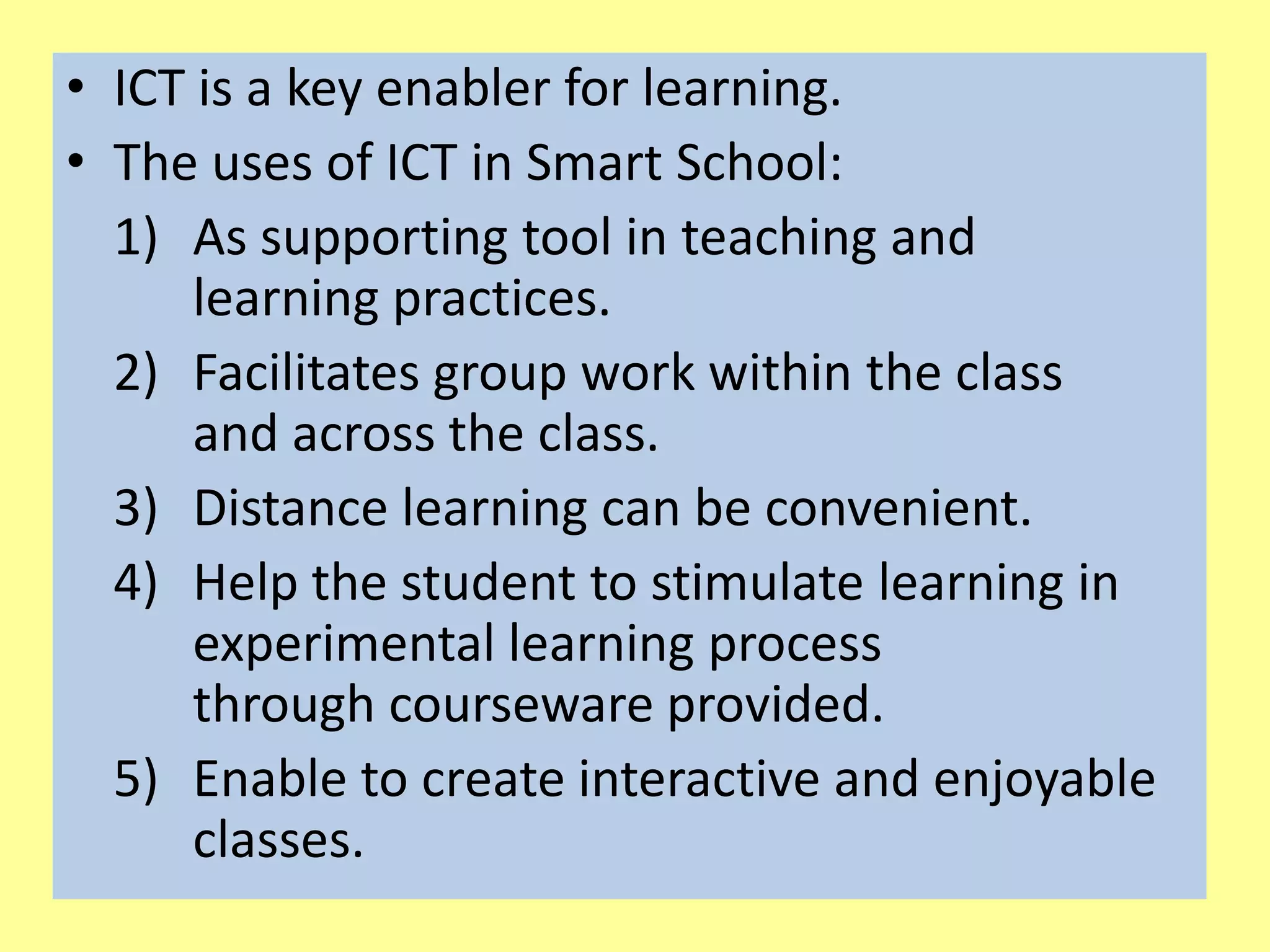
• ICT is a key enabler for learning.
• The uses of ICT in Smart School:
  1) As supporting tool in teaching and
      learning practices.
  2) Facilitates group work within the class
      and across the class.
  3) Distance learning can be convenient.
  4) Help the student to stimulate learning in
      experimental learning process
      through courseware provided.
  5) Enable to create interactive and enjoyable
      classes.
Overview of The
Progression of Smart
   School So Far
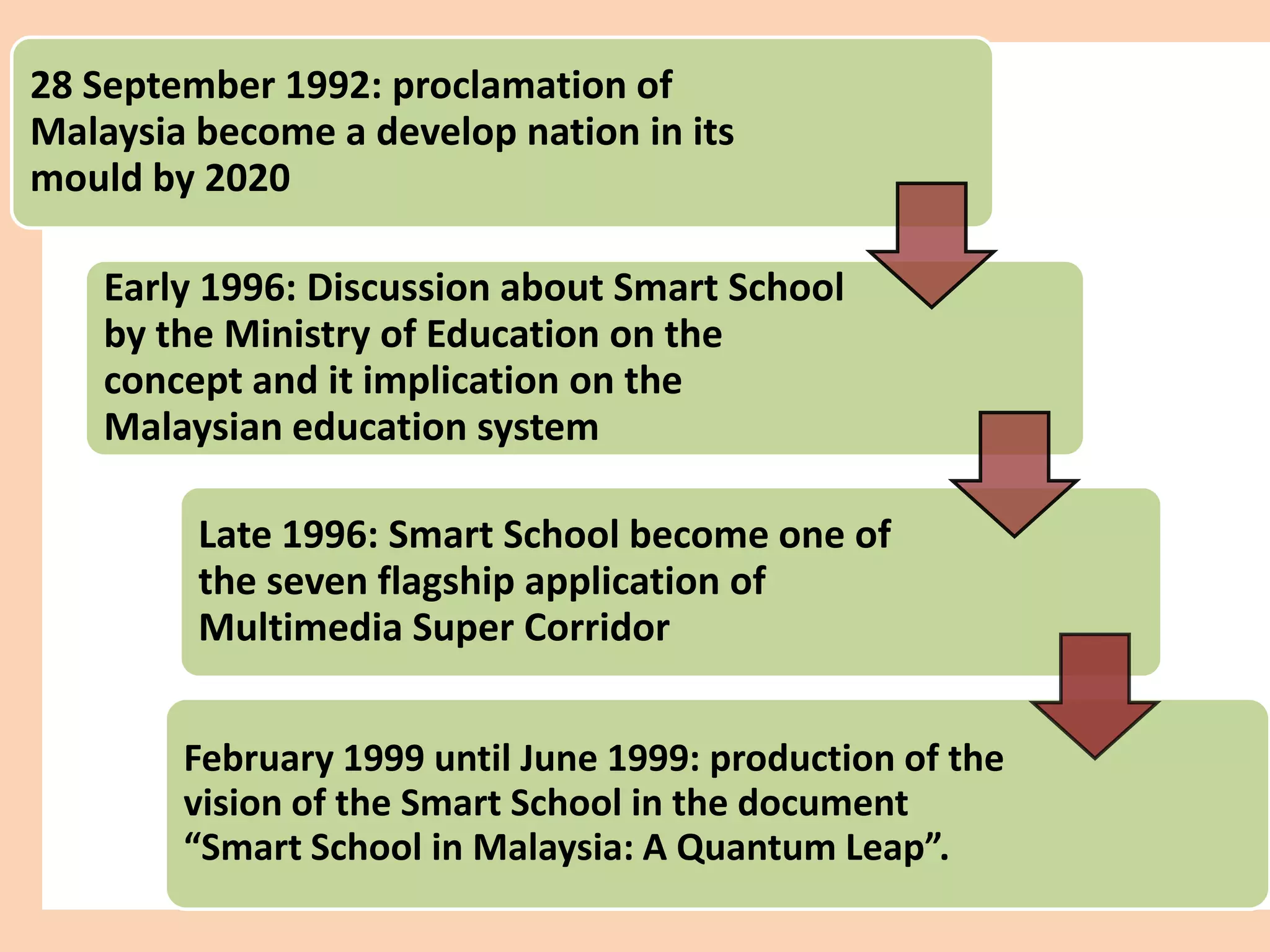
28 September 1992: proclamation of
Malaysia become a develop nation in its
mould by 2020

    Early 1996: Discussion about Smart School
    by the Ministry of Education on the
    concept and it implication on the
    Malaysian education system

         Late 1996: Smart School become one of
         the seven flagship application of
         Multimedia Super Corridor


        February 1999 until June 1999: production of the
        vision of the Smart School in the document
        “Smart School in Malaysia: A Quantum Leap”.
1999-2002: 88 schools were
selected to run as smart school
provided with 5809 computer sets
and 261 computer technicion


 2003: the education system had started
 the teaching and learning of science and
 mathematics in English and the using of
 interactive courseware during class

         2006-2010: the government has
         implemented the “in cultured
         school with smart technology”
         program as an agenda in the
         education development master
         plan (EDMP).
Overview on the Bestari
       training
1998-2000: Duration of Bestari
teachers training was 14 weeks.


  2001-2003:The training become in-serving
  course (KDP) of 12 week to satisfy
  teachers training requirement in Sarawak.

        2004-2005: The training period once
        again changed from 12 weeks to 8
        weeks because teacher being away
        from school

            2007: the training mode changed to 4
            weeks. Two week at institute teachers
            education (IPG) and another two
            weeks at school
Challenges Since The
Implementation of Smart
        School
1) Most of the teachers are still using the traditional
ways of teaching and refuse to integrate the teaching
and learning with ICT


2) There were also voices of rejection ,they are worried as
how far the Smarts school can ensure the achievement of
excellent student because the last thing being evaluated is
the achievement in examination


3) Software which is currently used since the
implementation of Smarts school. It has been criticized
by the parents and teachers because the software
provided were sub-standard and did not suitable for the
high achieving student .
4) There were many complaints about the shortage of
computers.
Due to the increasing of students which cause each
computer have to be shared by two students and this may
reduce the opportunity of using computer equally


5) Exam centered learning
One student said: “Learning using the computer is only
deepening your knowledge but it does not help you in
your examination”.
Smart school

Smart school

  • 1.
    GROUP MEMBERS SYAFIQAH BINTI RAZALE D20101037538 TUAN NURUL SHAHIRA BINTI TUAN YACOB D20101037520 WAN NURULFARHAH BINTI AWANG@HASAN D20101037532
  • 2.
    What is smartschool? • A Malaysian education system which the education system in school including the management are reinvented. Goals : 1) To provide all-round development of the individual like intellectual, physical, emotional, and spiritual 2) To provide opportunities to enhance individual strengths and abilities. 3) To produce thinking and technology-literate workforce and apply technology in teaching and learning. 4) Democratized education 1) To increase the participation of stakeholders
  • 3.
    Four Waves ofThe Smart School Implementation
  • 4.
    • Pilot phase • Is the plan of the original implementation 1999- Plan 2002 • Post Pilot Phase 2002- • Involved ICT as a key enables learning. 2005 • Making all schools smart 2005- 2010 • The consolidate and stabilized technology become an integral part of nation’s learning process . 2010- • technology becomes key enable in teaching and 2020 learning and the computers will be made available for
  • 5.
    How Smart Schoolis differ from a normal school?  The smart school is differ based on their characteristics which does not have in normal school.  The characteristics were included the process of: 1) Curriculum 2) Pedagogy 3) Assessment 4) Teaching and learning material
  • 6.
    1) Curriculum • Willbe designed to help overall and balanced development of the student achievers. • The integration of knowledge, skill, values, correct use of language and attitudes suitable. • Allowing for self-paced leaning across grades. 2) Pedagogy • Involved specific learning • To ensure mastery of basic comperencies and promotion of holistic development • Classroom atmosphere is compatible with different teaching –learning strategies.
  • 7.
    3) Assesmen • Theintegration of technology as a tool enables the on-line assessment and conducted in order to show the strength and the abilities of the student. • The teaching and learning material provide an accurate picture of the student’s performance. 4) Teaching and learning material • Five main criteria for the selection and evaluation for teaching and learning materials: 1. The cosmetic adequacy, 2. Technical adequacy, 3. Instruction adequacy 4. Cost effectiveness and
  • 8.
    The use ofthe technology as enables contained in smart school concept • In order to support the country’s ICT master plan and in line with the country’s drive to fulfill vision 2020, the education system has to be transform. • The catalyst for this transformation will be ICT-enable Smart School. • As to reduce the digital divide that exist in different part of the country, the computer laboratories were provided to thousands of school.
  • 9.
    • The ministryhas formulated three main policies for ICT in education, such as: First policy : ICT for all student. Second policy: Emphasises the role and function of ICT in education as a teaching and learning tool. Third policy :Emphasises using ICT to increase productivity, efficiency and effectiveness of the management system.
  • 10.
    • ICT isa key enabler for learning. • The uses of ICT in Smart School: 1) As supporting tool in teaching and learning practices. 2) Facilitates group work within the class and across the class. 3) Distance learning can be convenient. 4) Help the student to stimulate learning in experimental learning process through courseware provided. 5) Enable to create interactive and enjoyable classes.
  • 11.
    Overview of The Progressionof Smart School So Far
  • 12.
    28 September 1992:proclamation of Malaysia become a develop nation in its mould by 2020 Early 1996: Discussion about Smart School by the Ministry of Education on the concept and it implication on the Malaysian education system Late 1996: Smart School become one of the seven flagship application of Multimedia Super Corridor February 1999 until June 1999: production of the vision of the Smart School in the document “Smart School in Malaysia: A Quantum Leap”.
  • 13.
    1999-2002: 88 schoolswere selected to run as smart school provided with 5809 computer sets and 261 computer technicion 2003: the education system had started the teaching and learning of science and mathematics in English and the using of interactive courseware during class 2006-2010: the government has implemented the “in cultured school with smart technology” program as an agenda in the education development master plan (EDMP).
  • 14.
    Overview on theBestari training
  • 15.
    1998-2000: Duration ofBestari teachers training was 14 weeks. 2001-2003:The training become in-serving course (KDP) of 12 week to satisfy teachers training requirement in Sarawak. 2004-2005: The training period once again changed from 12 weeks to 8 weeks because teacher being away from school 2007: the training mode changed to 4 weeks. Two week at institute teachers education (IPG) and another two weeks at school
  • 16.
  • 17.
    1) Most ofthe teachers are still using the traditional ways of teaching and refuse to integrate the teaching and learning with ICT 2) There were also voices of rejection ,they are worried as how far the Smarts school can ensure the achievement of excellent student because the last thing being evaluated is the achievement in examination 3) Software which is currently used since the implementation of Smarts school. It has been criticized by the parents and teachers because the software provided were sub-standard and did not suitable for the high achieving student .
  • 18.
    4) There weremany complaints about the shortage of computers. Due to the increasing of students which cause each computer have to be shared by two students and this may reduce the opportunity of using computer equally 5) Exam centered learning One student said: “Learning using the computer is only deepening your knowledge but it does not help you in your examination”.