Correct Reuse of Transformations is
Hard to Guarantee
Rick Salay, Steffen Zschaler, and Marsha
Chechik
July 04, 2016
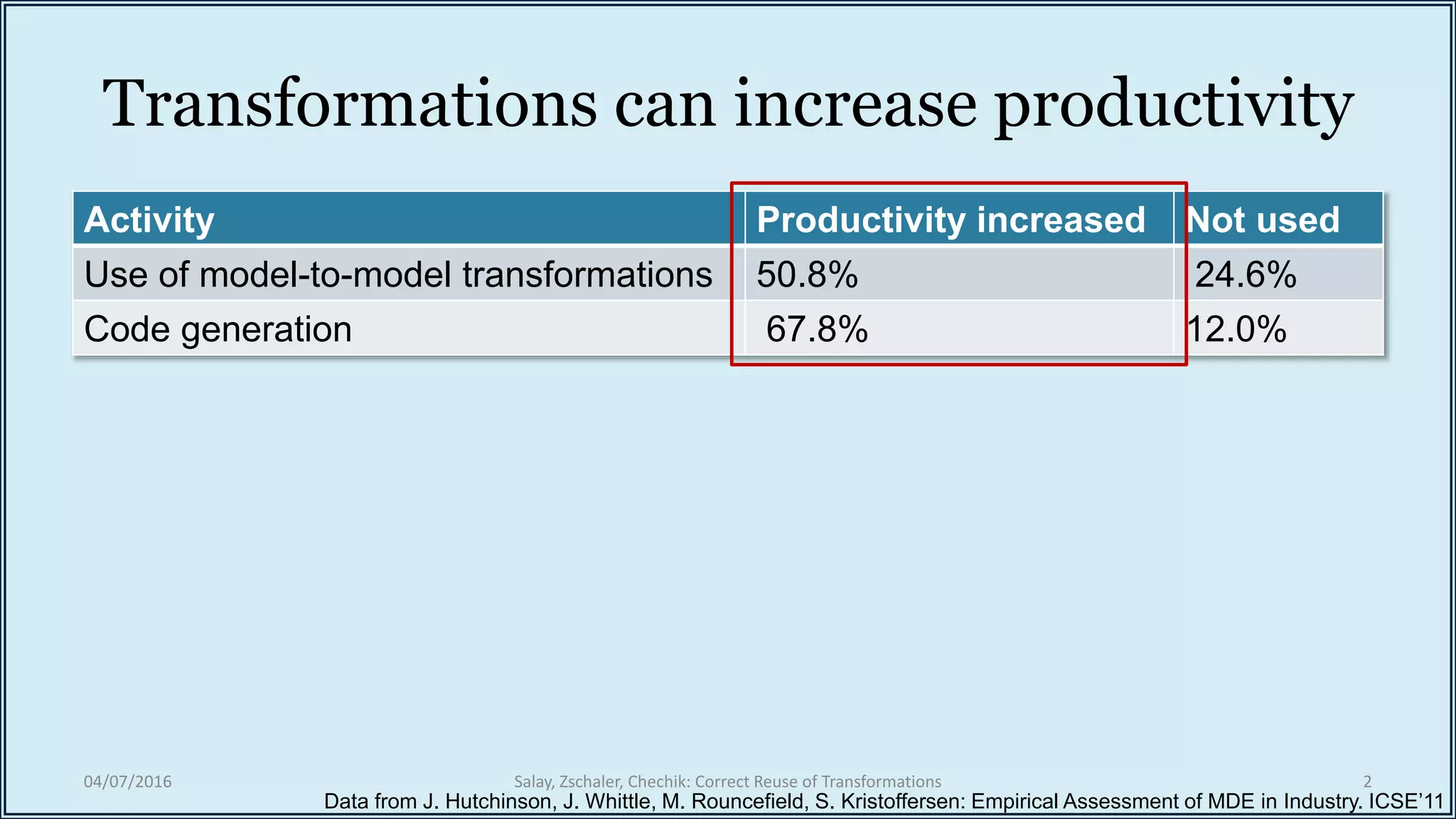
Transformations can increase productivity
Activity Productivity increased Not used
Use of model-to-model transformations 50.8% 24.6%
Code generation 67.8% 12.0%
Data from J. Hutchinson, J. Whittle, M. Rouncefield, S. Kristoffersen: Empirical Assessment of MDE in Industry. ICSE’11
04/07/2016 Salay, Zschaler, Chechik: Correct Reuse of Transformations 2
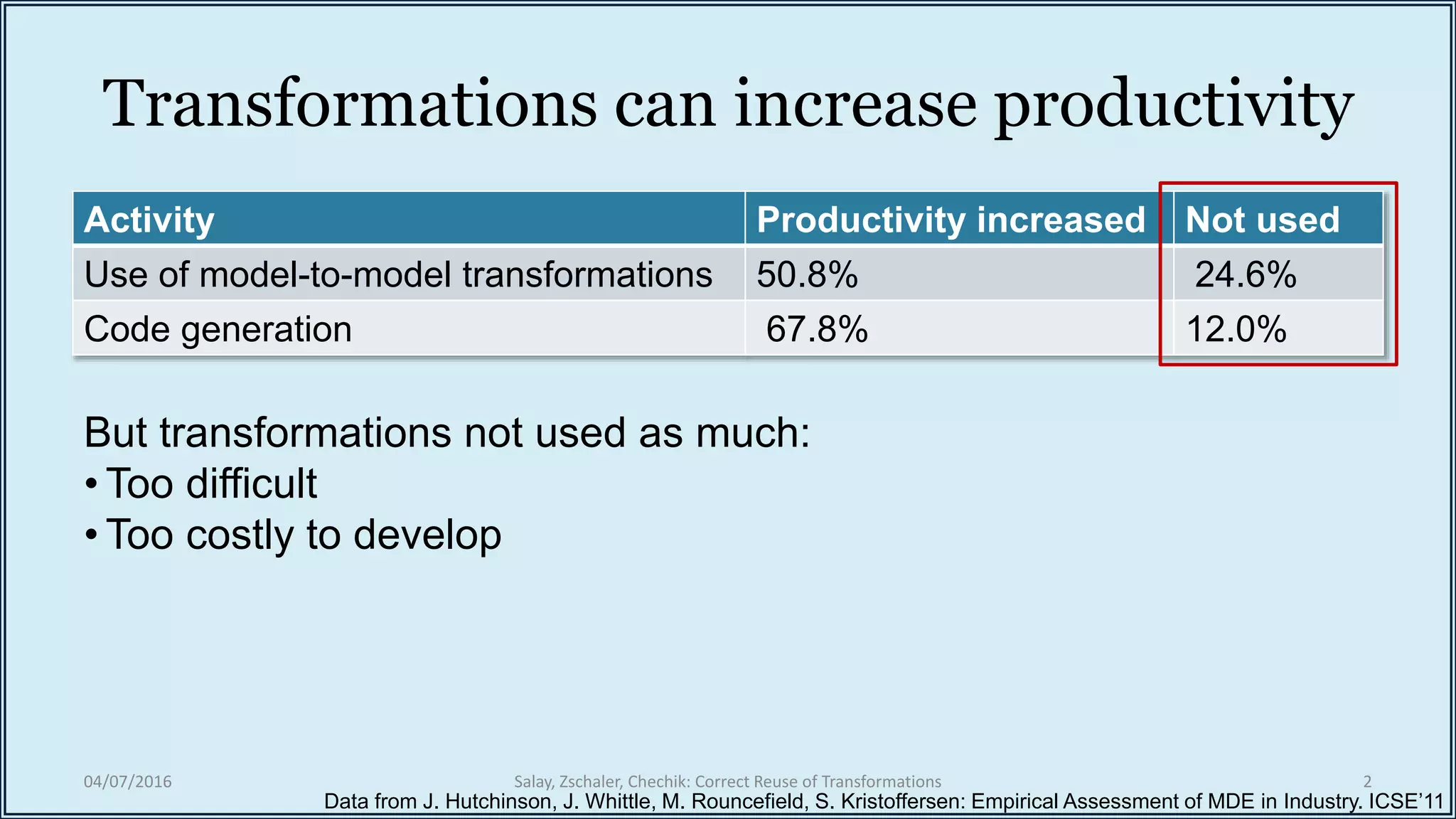
Transformations can increase productivity
Activity Productivity increased Not used
Use of model-to-model transformations 50.8% 24.6%
Code generation 67.8% 12.0%
Data from J. Hutchinson, J. Whittle, M. Rouncefield, S. Kristoffersen: Empirical Assessment of MDE in Industry. ICSE’11
But transformations not used as much:
• Too difficult
• Too costly to develop
04/07/2016 Salay, Zschaler, Chechik: Correct Reuse of Transformations 2
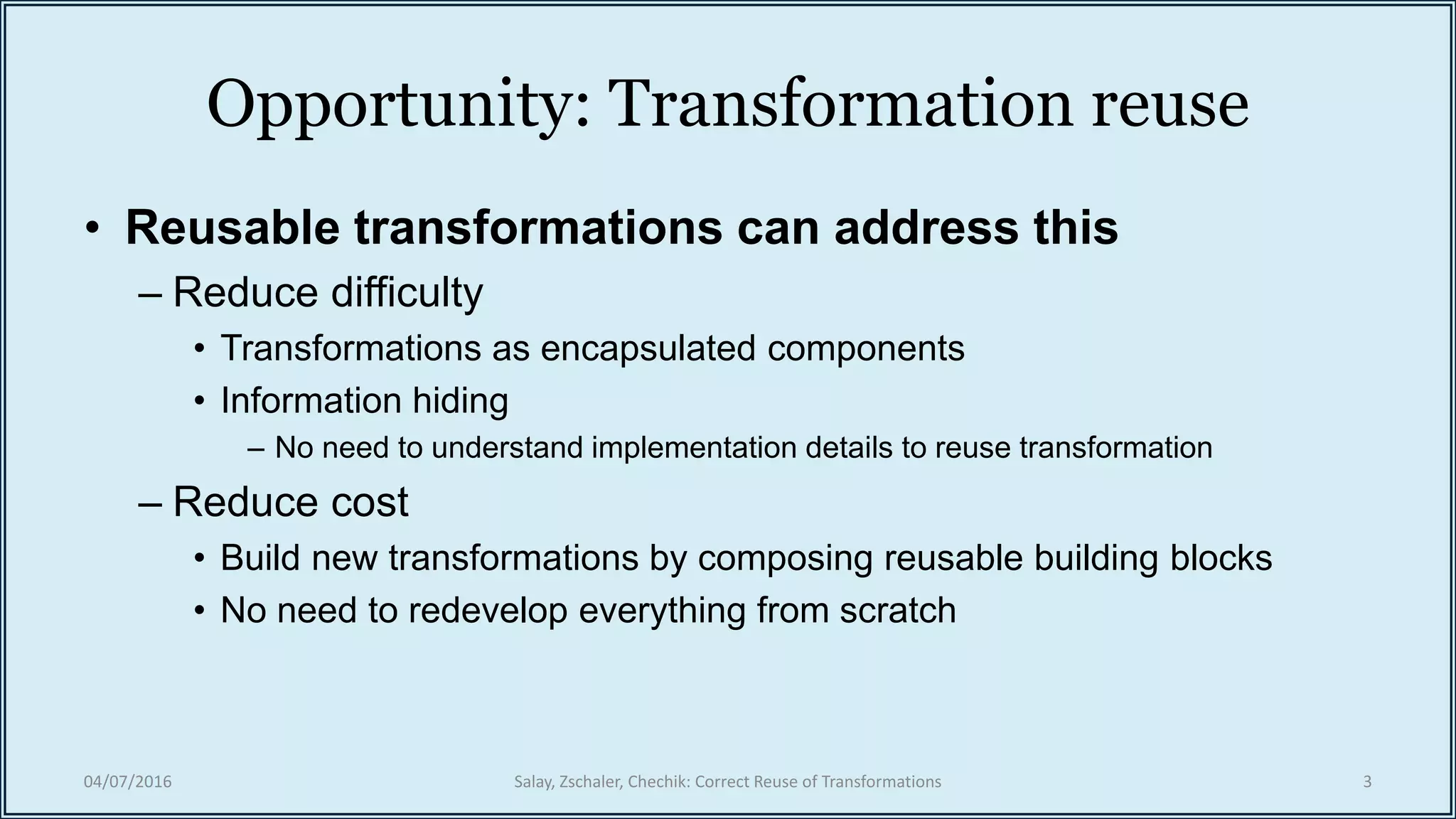
Opportunity: Transformation reuse
• Reusable transformations can address this
– Reduce difficulty
• Transformations as encapsulated components
• Information hiding
– No need to understand implementation details to reuse transformation
– Reduce cost
• Build new transformations by composing reusable building blocks
• No need to redevelop everything from scratch
04/07/2016 Salay, Zschaler, Chechik: Correct Reuse of Transformations 3
Opportunity: Transformation reuse
• Reusable transformations can address this
– Reduce difficulty
• Transformations as encapsulated components
• Information hiding
– No need to understand implementation details to reuse transformation
– Reduce cost
• Build new transformations by composing reusable building blocks
• No need to redevelop everything from scratch
BUT: Only if we can ensure correct reuse of transformations !
04/07/2016 Salay, Zschaler, Chechik: Correct Reuse of Transformations 3
Correct transformation reuse
1. What do we mean by it?
2. How do existing reuse mechanisms fit in?
3. Why is it difficult?
04/07/2016 Salay, Zschaler, Chechik: Correct Reuse of Transformations 4
Correct transformation reuse
1. What do we mean by it?
04/07/2016 Salay, Zschaler, Chechik: Correct Reuse of Transformations 4
Transformation Reuse
Needs a reuse mechanism
04/07/2016 Salay, Zschaler, Chechik: Correct Reuse of Transformations 5
Transformation Reuse
Needs a reuse mechanism
1. Model type mapping:
• Transformation defined over a set of model types but applied to a
different set
04/07/2016 Salay, Zschaler, Chechik: Correct Reuse of Transformations 5
Provided by engineer
Transformation Reuse
Needs a reuse mechanism
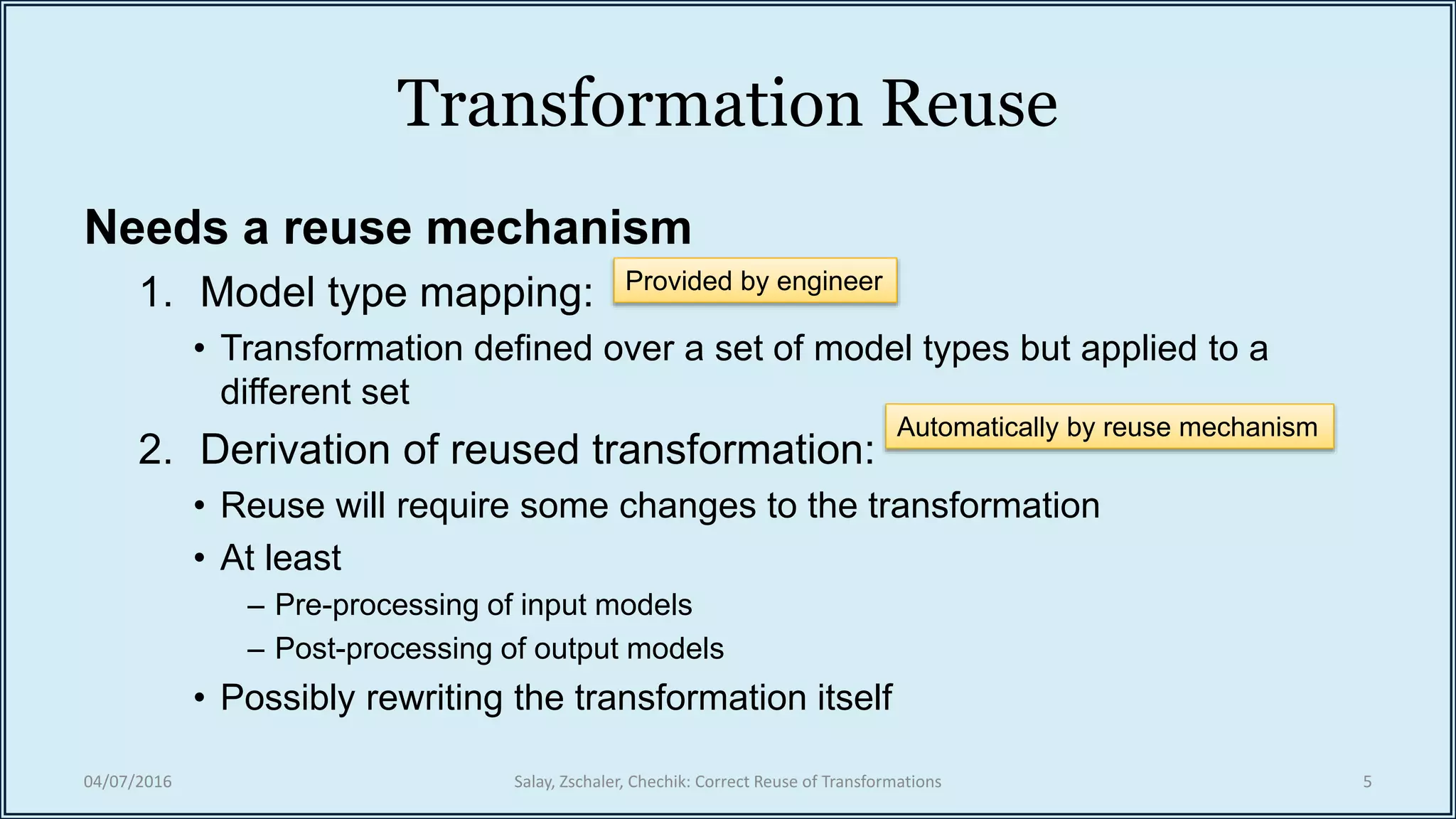
1. Model type mapping:
• Transformation defined over a set of model types but applied to a
different set
2. Derivation of reused transformation:
• Reuse will require some changes to the transformation
• At least
– Pre-processing of input models
– Post-processing of output models
• Possibly rewriting the transformation itself
04/07/2016 Salay, Zschaler, Chechik: Correct Reuse of Transformations 5
Provided by engineer
Automatically by reuse mechanism
Example
04/07/2016 Salay, Zschaler, Chechik: Correct Reuse of Transformations 6
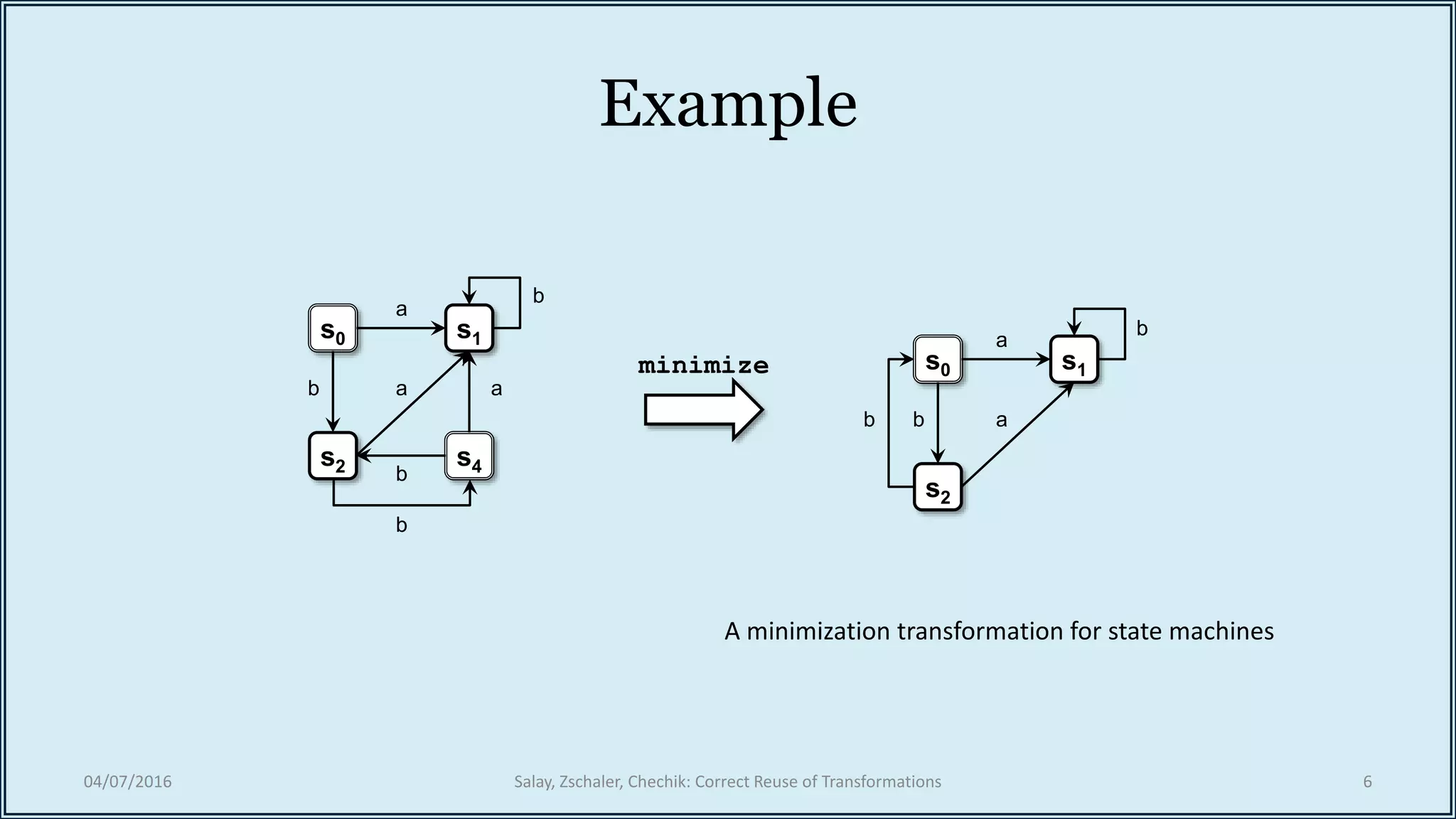
s0 s1
s4s2
a
a a
b
b
b
b
s0 s1
s2
a
a
b
b b
minimize
A minimization transformation for state machines
Example (2)
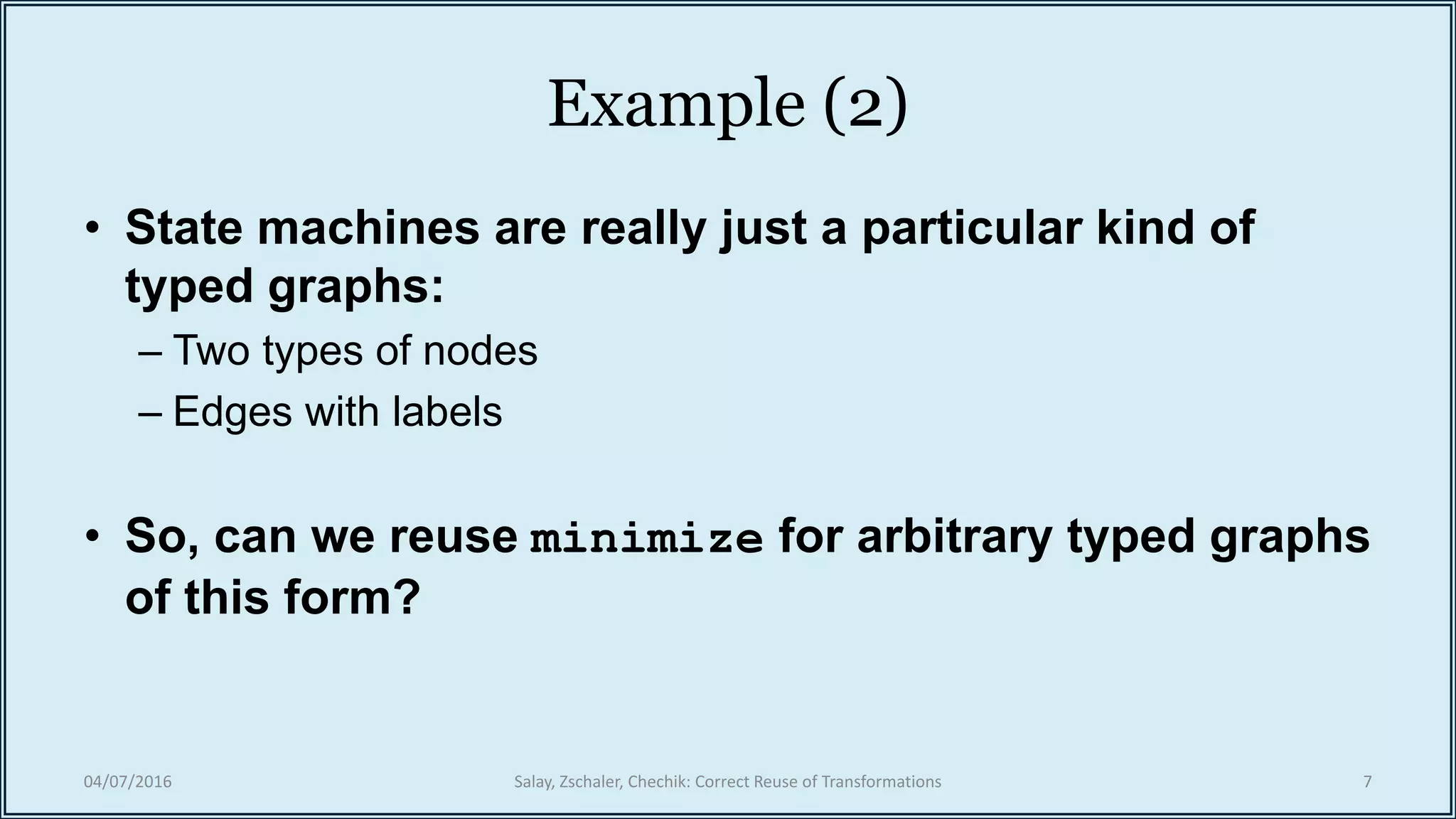
• State machines are really just a particular kind of
typed graphs:
– Two types of nodes
– Edges with labels
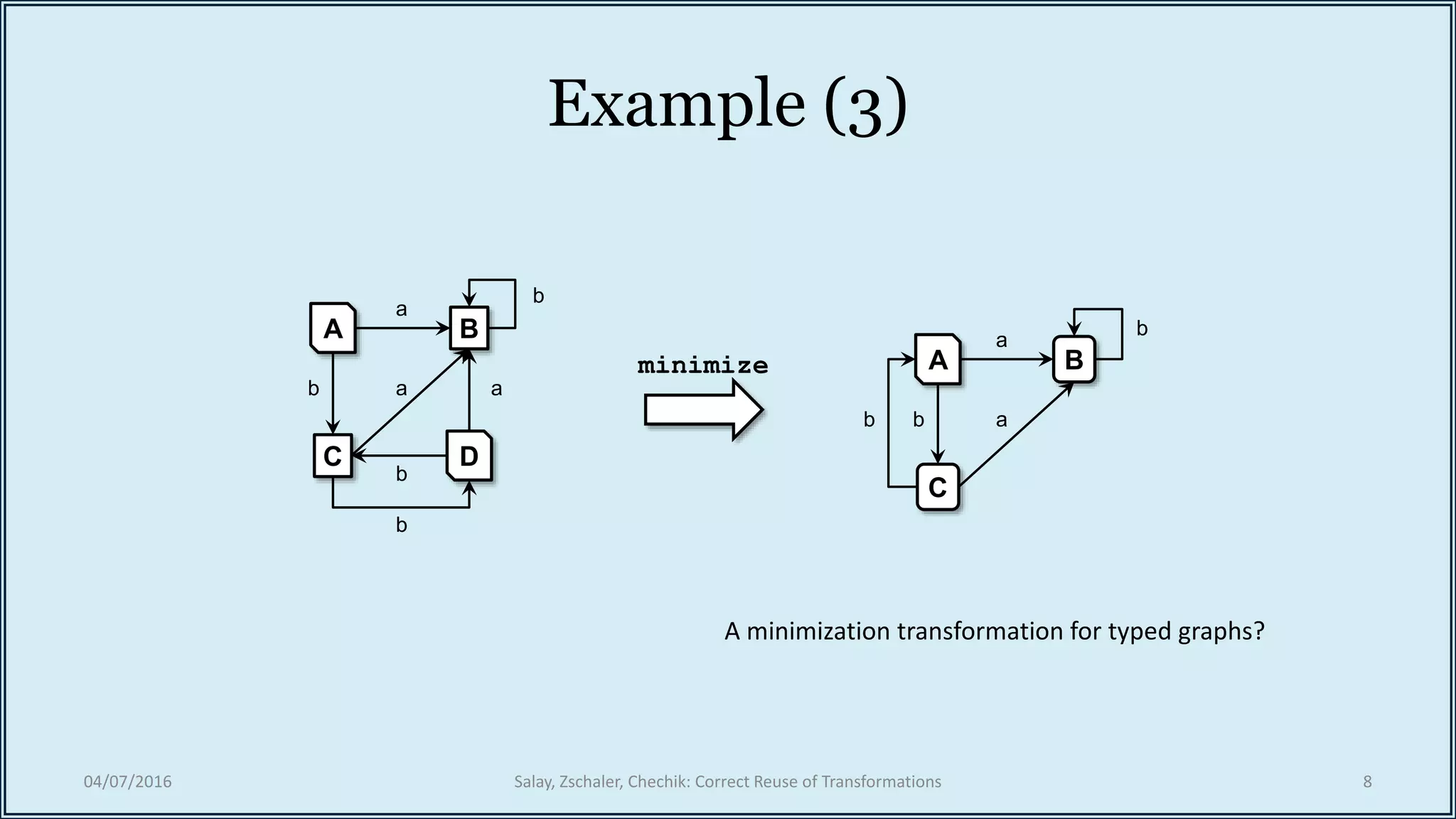
• So, can we reuse minimize for arbitrary typed graphs
of this form?
04/07/2016 Salay, Zschaler, Chechik: Correct Reuse of Transformations 7
Example (3)
04/07/2016 Salay, Zschaler, Chechik: Correct Reuse of Transformations 8
A B
DC
a
a a
b
b
b
b
A B
C
a
a
b
b b
minimize
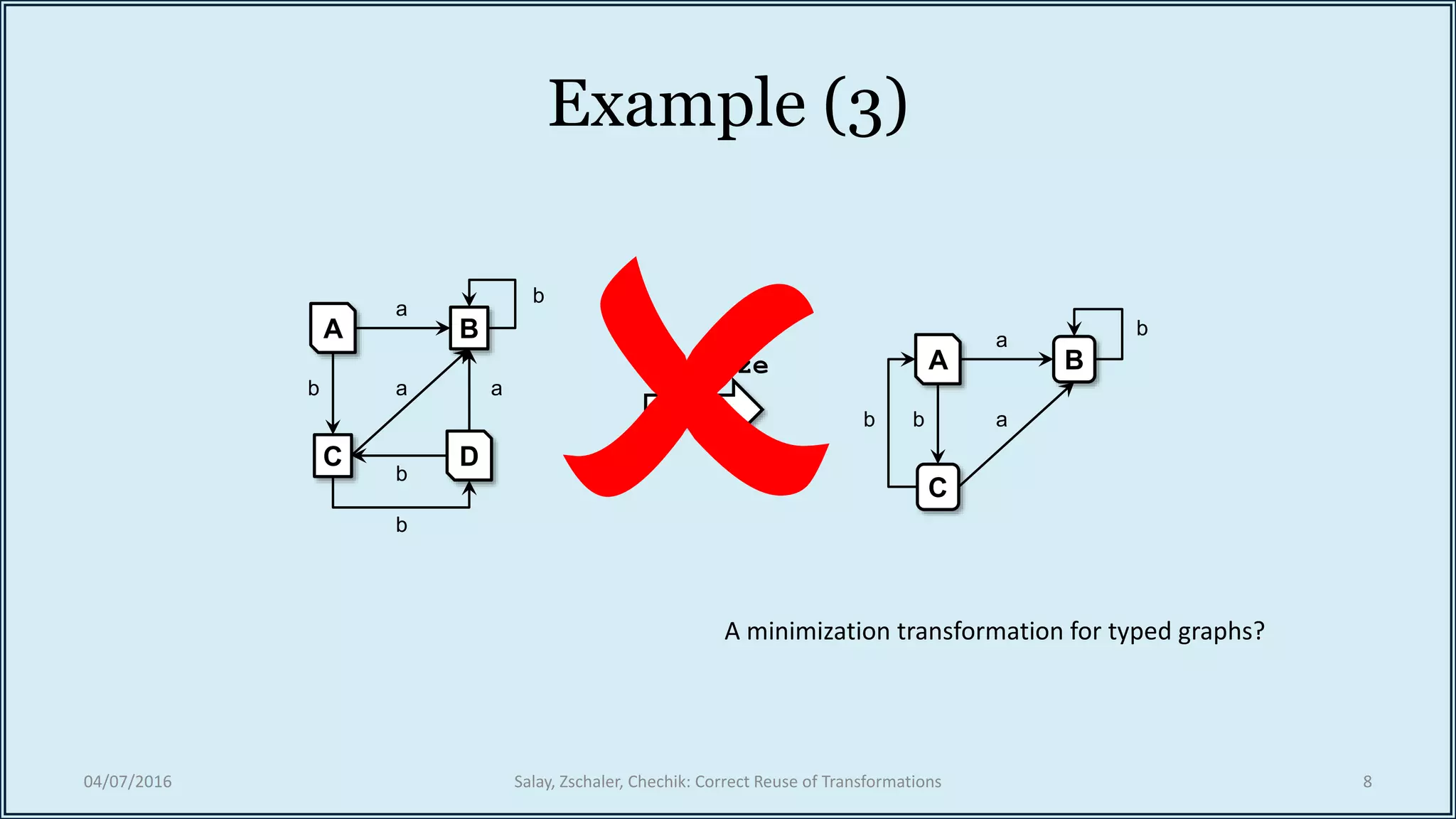
A minimization transformation for typed graphs?
Example (3)
04/07/2016 Salay, Zschaler, Chechik: Correct Reuse of Transformations 8
A B
DC
a
a a
b
b
b
b
A B
C
a
a
b
b b
minimize
A minimization transformation for typed graphs?
Transformation Intent
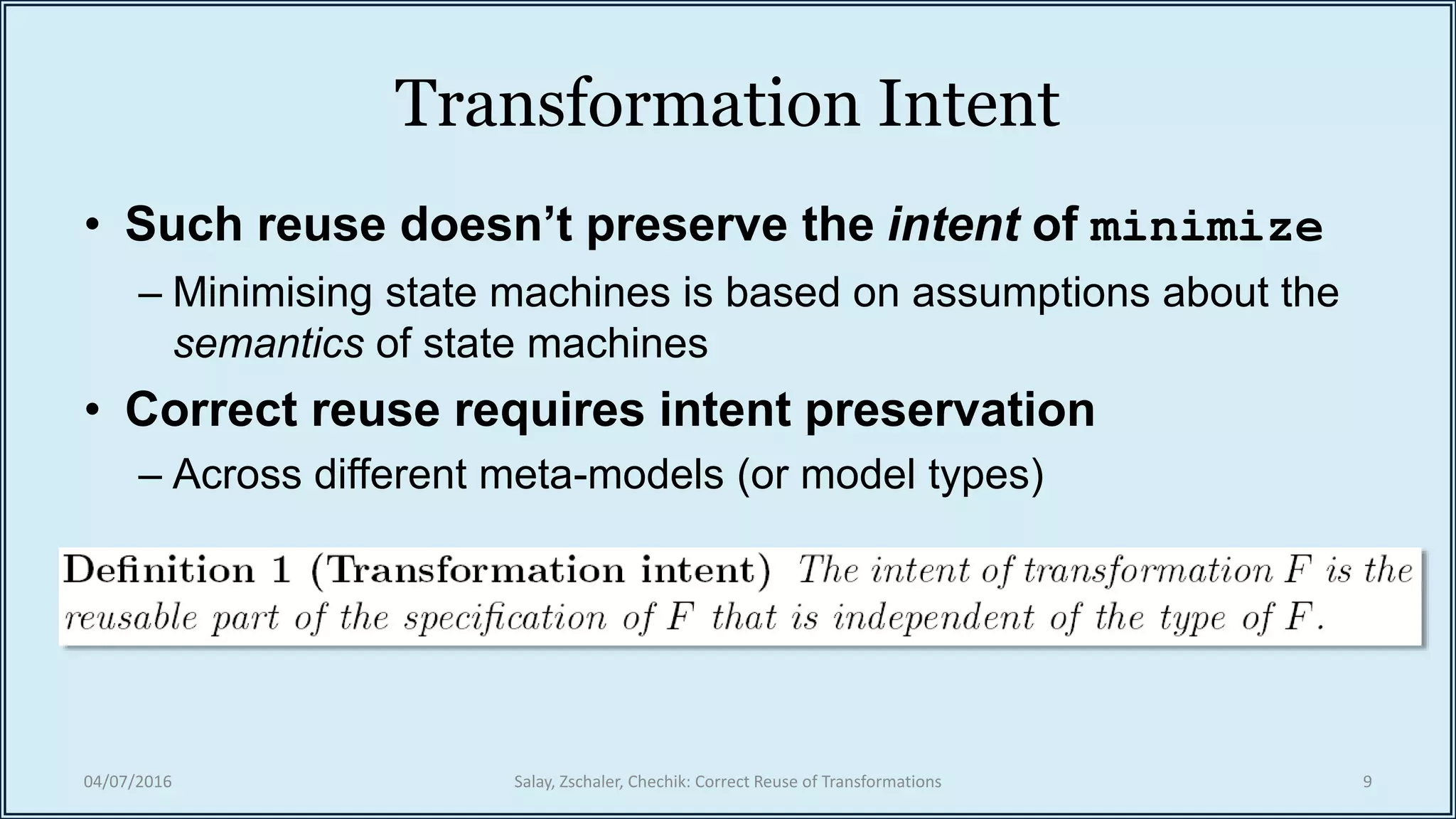
• Such reuse doesn’t preserve the intent of minimize
– Minimising state machines is based on assumptions about the
semantics of state machines
• Correct reuse requires intent preservation
– Across different meta-models (or model types)
04/07/2016 Salay, Zschaler, Chechik: Correct Reuse of Transformations 9
Transformation Intent
• Such reuse doesn’t preserve the intent of minimize
– Minimising state machines is based on assumptions about the
semantics of state machines
• Correct reuse requires intent preservation
– Across different meta-models (or model types)
04/07/2016 Salay, Zschaler, Chechik: Correct Reuse of Transformations 9
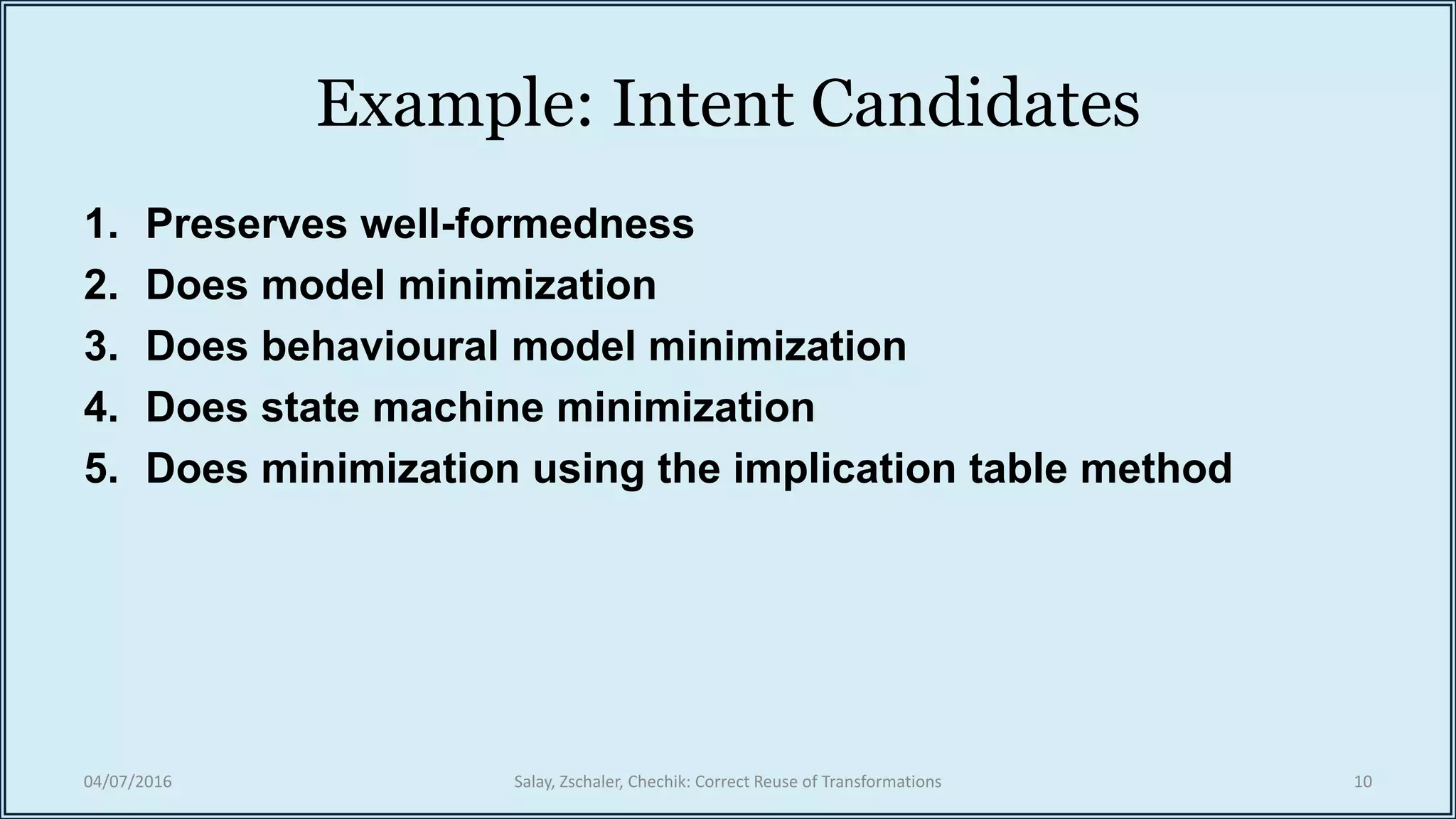
Example: Intent Candidates
1. Preserves well-formedness
2. Does model minimization
3. Does behavioural model minimization
4. Does state machine minimization
5. Does minimization using the implication table method
04/07/2016 Salay, Zschaler, Chechik: Correct Reuse of Transformations 10
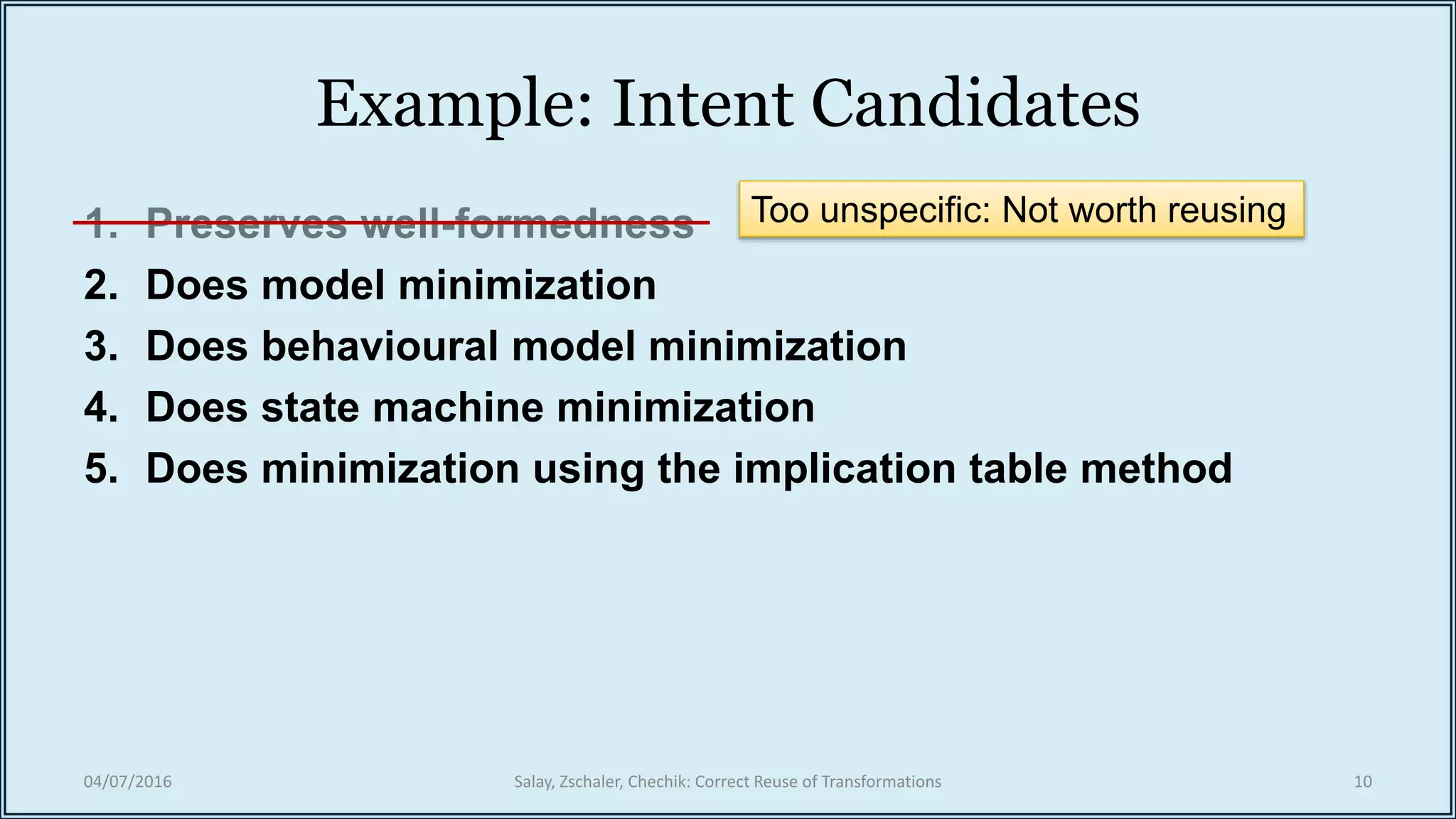
Example: Intent Candidates
2. Does model minimization
3. Does behavioural model minimization
4. Does state machine minimization
5. Does minimization using the implication table method
04/07/2016 Salay, Zschaler, Chechik: Correct Reuse of Transformations 10
Too unspecific: Not worth reusing
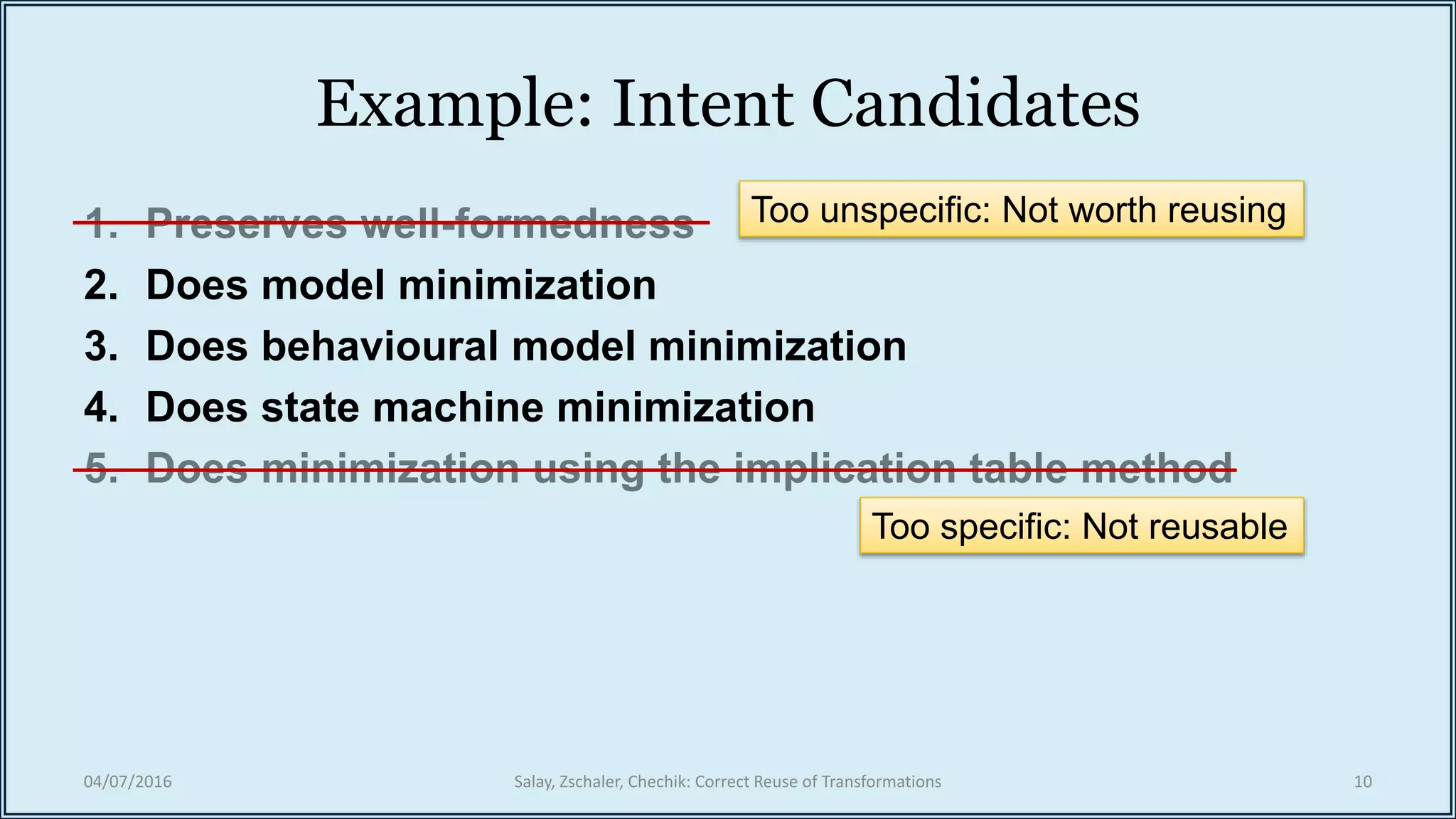
Example: Intent Candidates
2. Does model minimization
3. Does behavioural model minimization
4. Does state machine minimization
04/07/2016 Salay, Zschaler, Chechik: Correct Reuse of Transformations 10
Too unspecific: Not worth reusing
Too specific: Not reusable
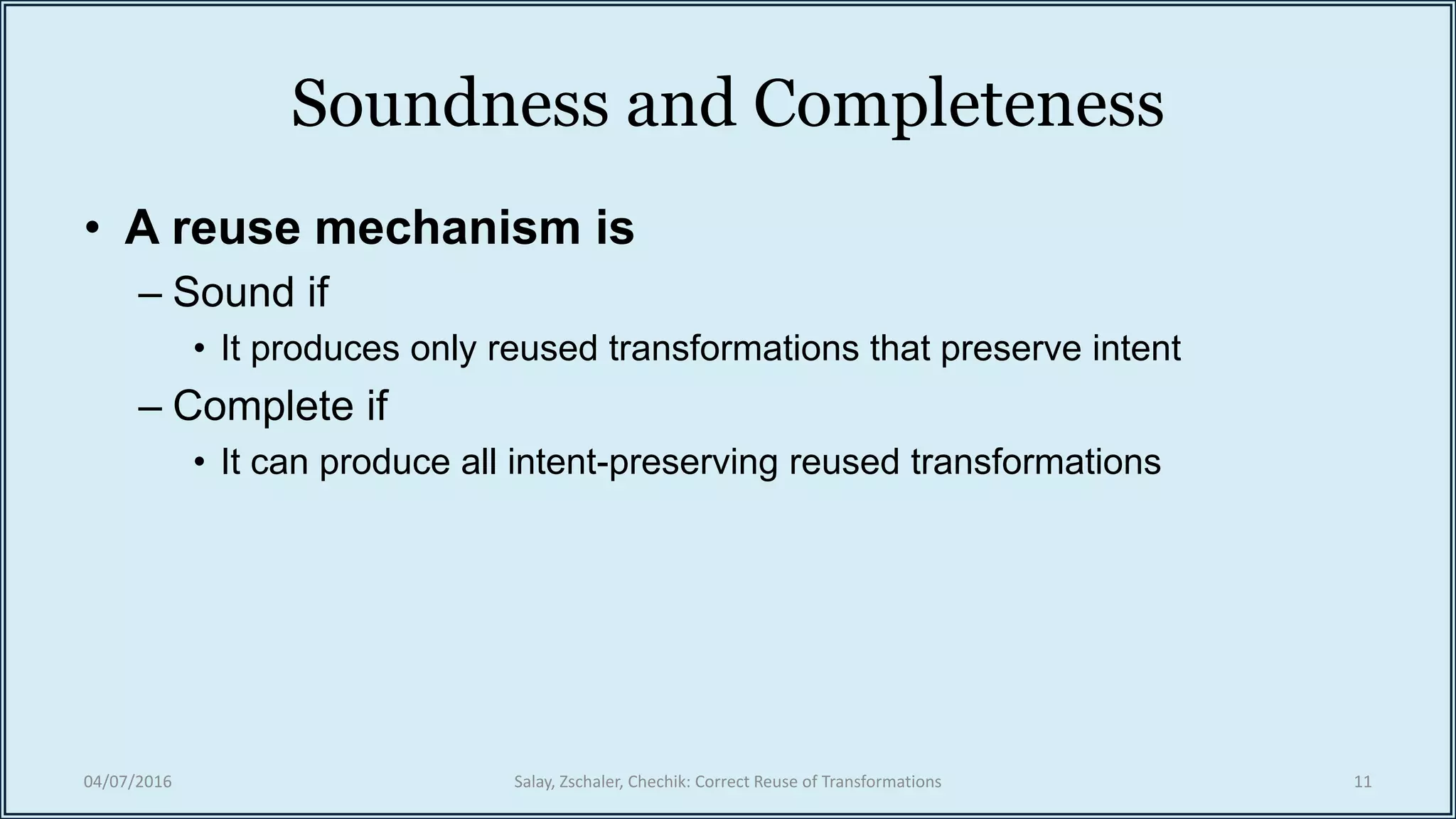
Soundness and Completeness
• A reuse mechanism is
– Sound if
• It produces only reused transformations that preserve intent
– Complete if
• It can produce all intent-preserving reused transformations
04/07/2016 Salay, Zschaler, Chechik: Correct Reuse of Transformations 11
Correct transformation reuse
2. How do existing reuse mechanisms fit in?
3. Why is it difficult?
04/07/2016 Salay, Zschaler, Chechik: Correct Reuse of Transformations 12
Correct transformation reuse
2. How do existing reuse mechanisms fit in?
04/07/2016 Salay, Zschaler, Chechik: Correct Reuse of Transformations 12
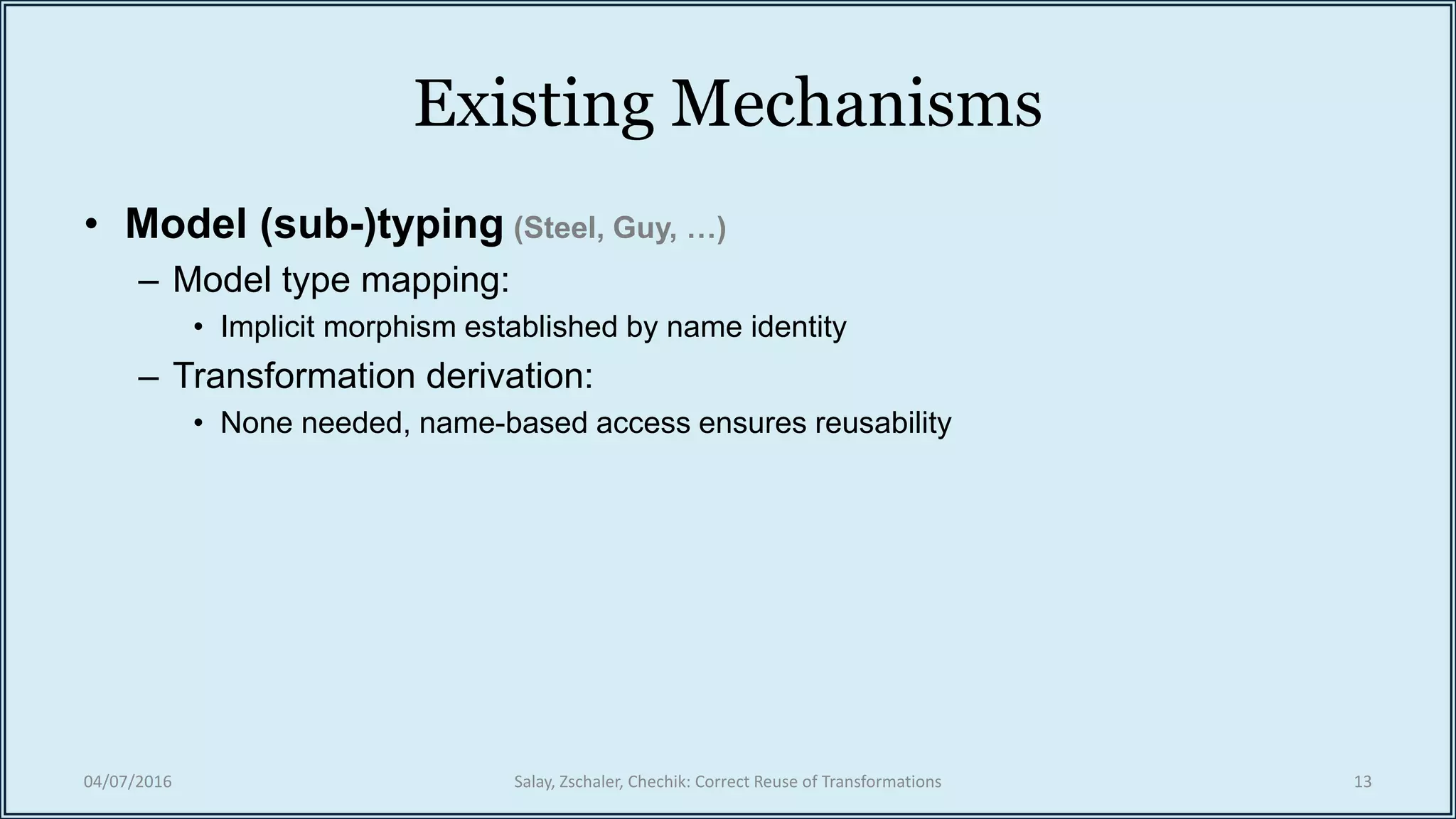
Existing Mechanisms
• Model (sub-)typing (Steel, Guy, …)
– Model type mapping:
• Implicit morphism established by name identity
– Transformation derivation:
• None needed, name-based access ensures reusability
04/07/2016 Salay, Zschaler, Chechik: Correct Reuse of Transformations 13
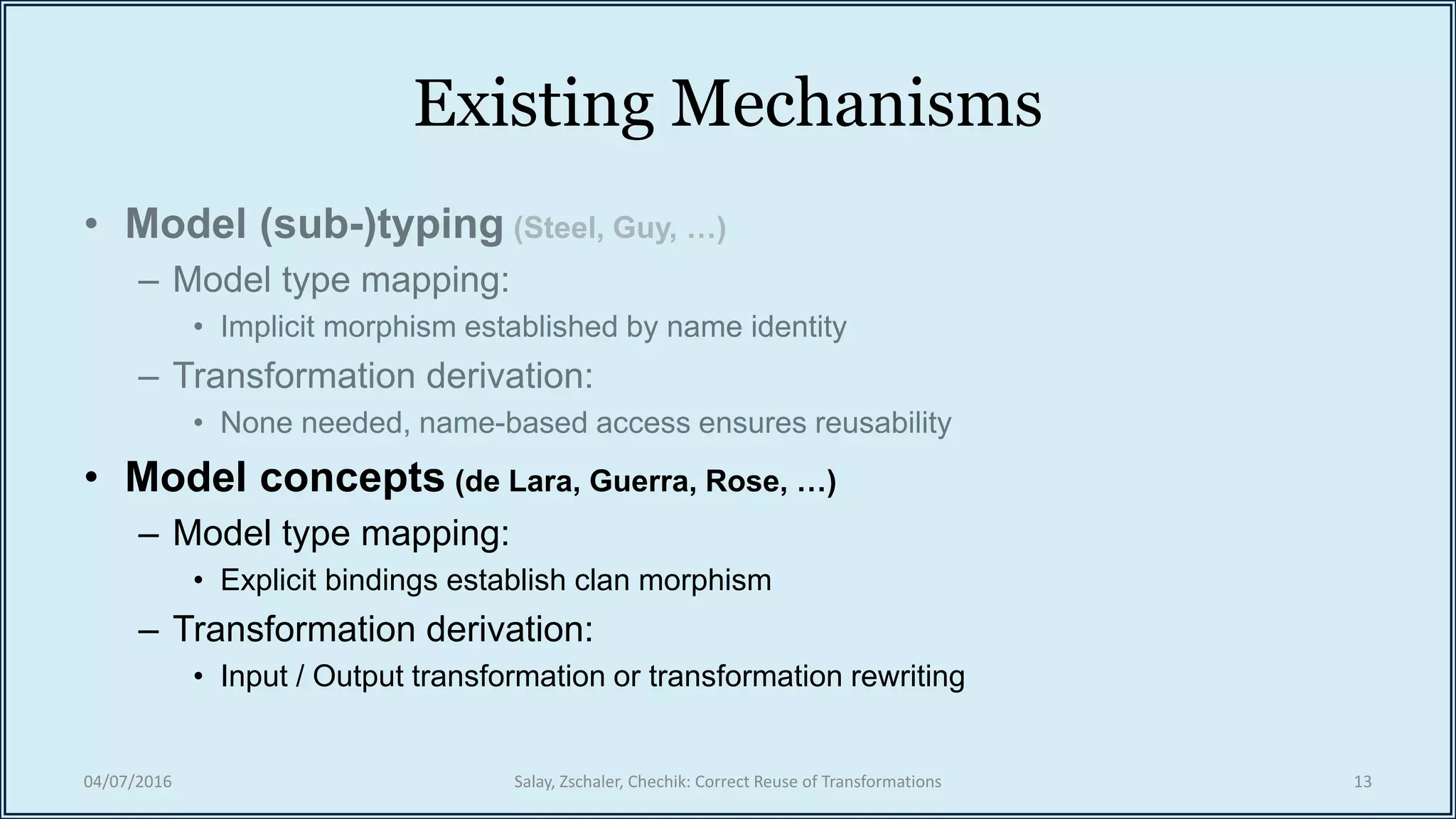
Existing Mechanisms
• Model concepts (de Lara, Guerra, Rose, …)
– Model type mapping:
• Explicit bindings establish clan morphism
– Transformation derivation:
• Input / Output transformation or transformation rewriting
04/07/2016 Salay, Zschaler, Chechik: Correct Reuse of Transformations 13
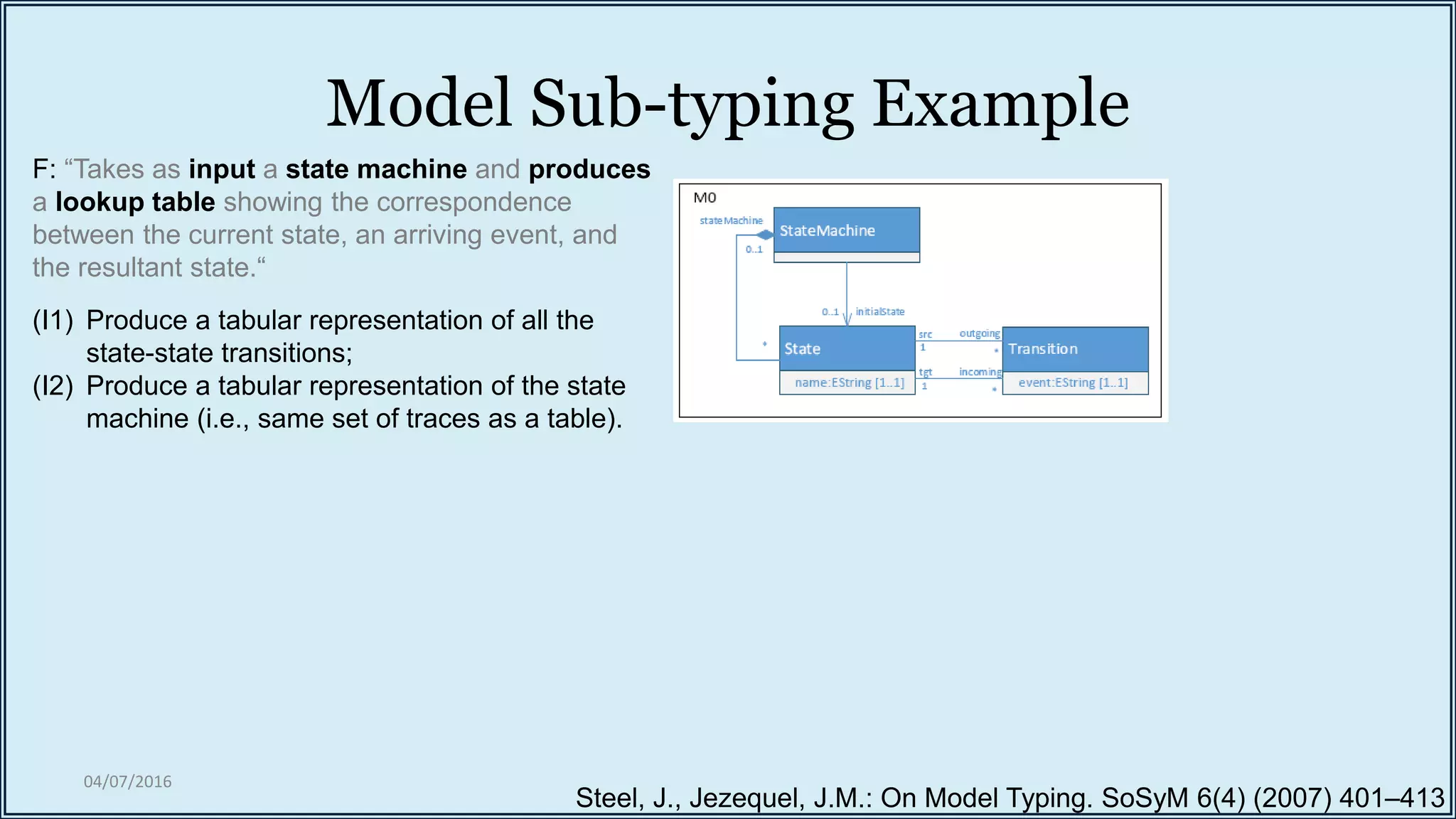
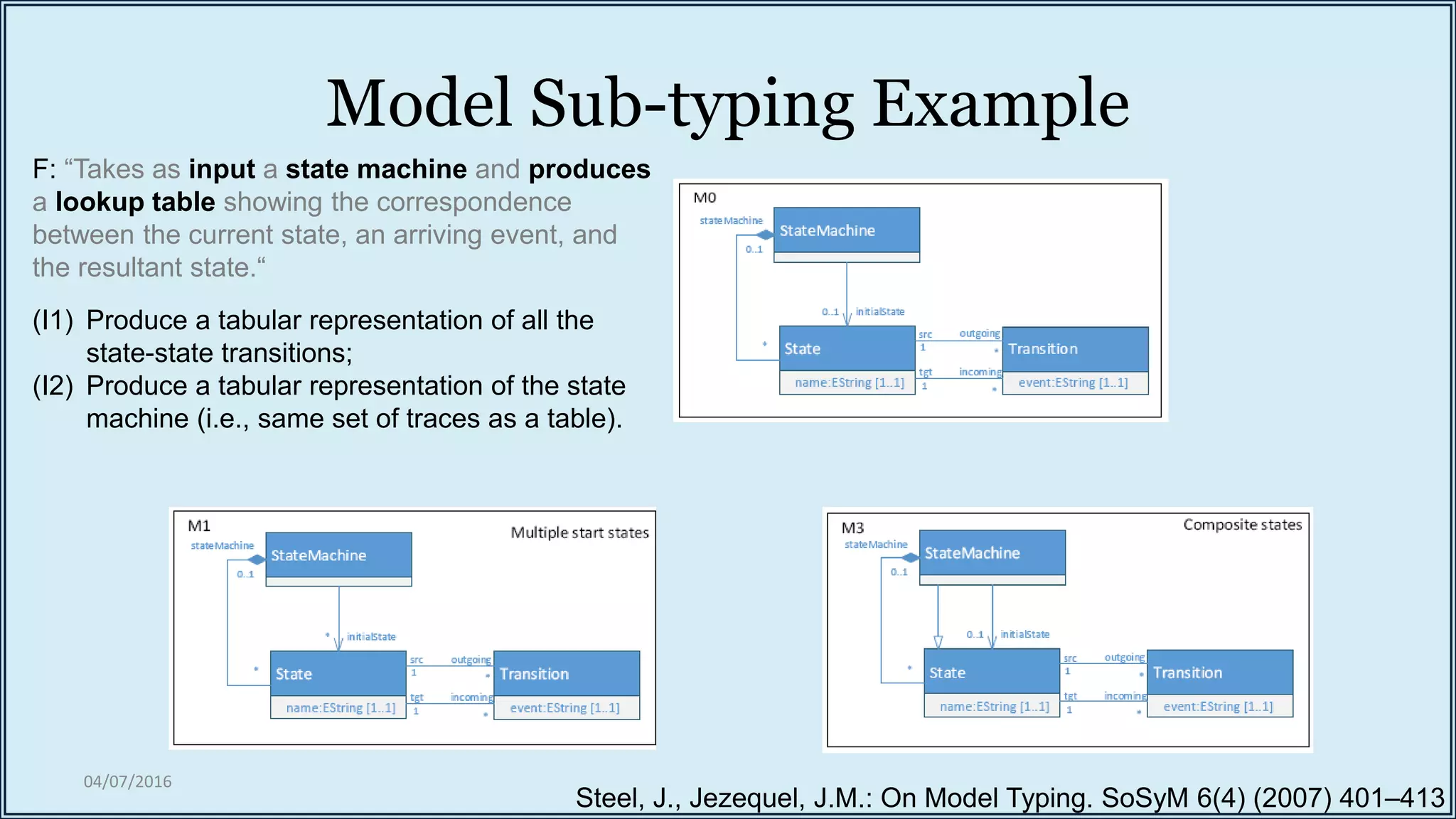
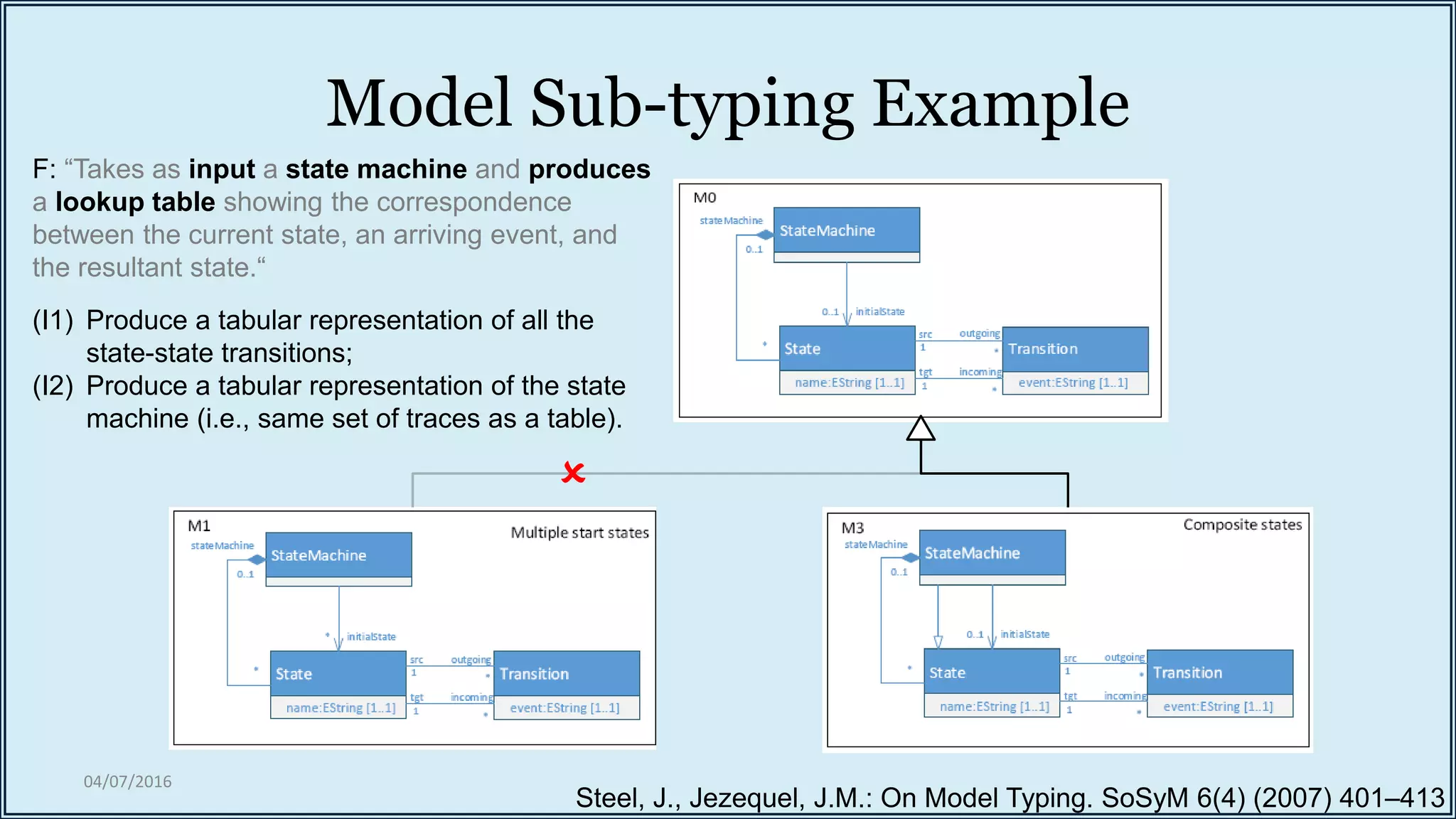
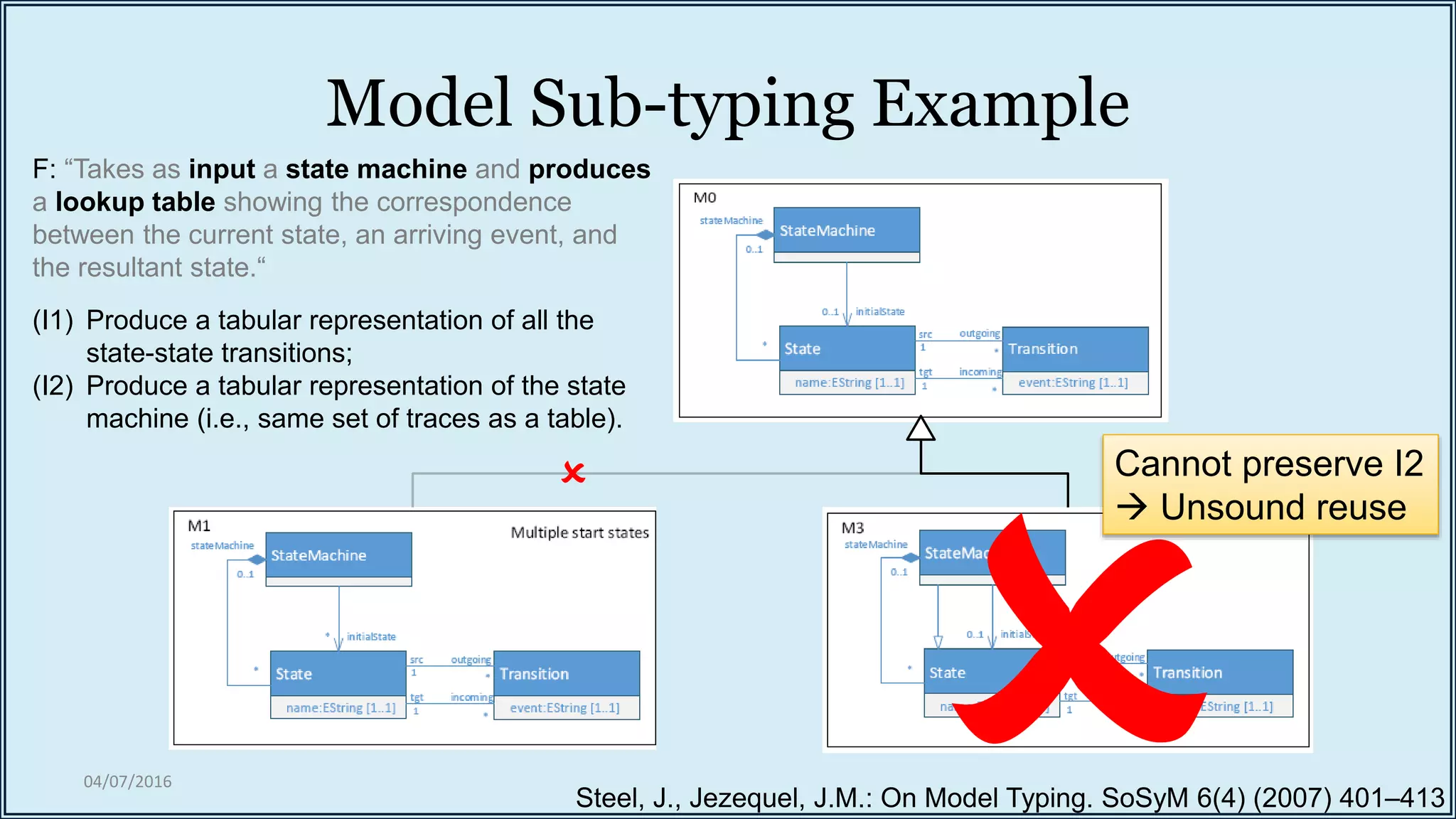
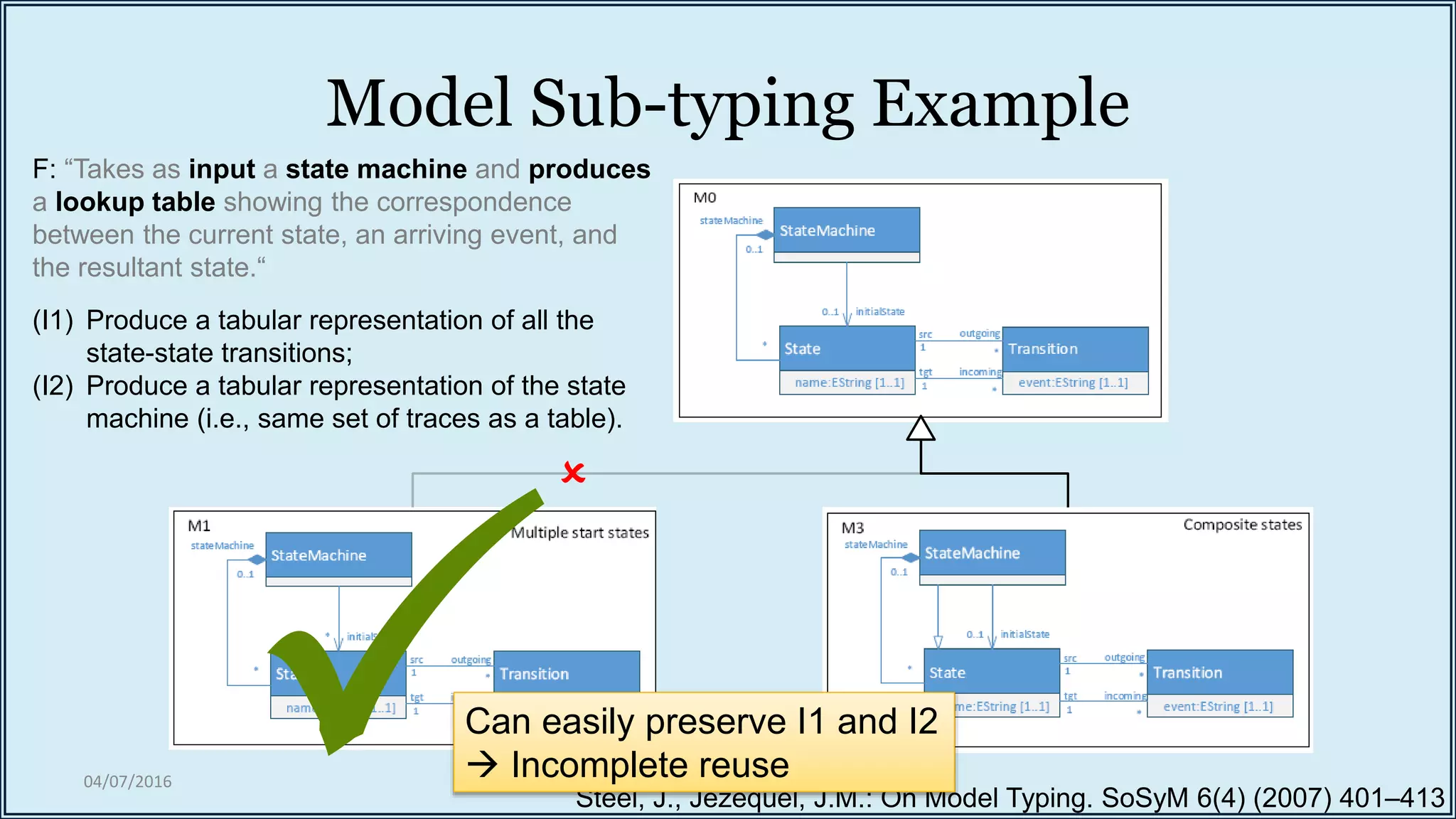
Model Sub-typing Example
04/07/2016
Steel, J., Jezequel, J.M.: On Model Typing. SoSyM 6(4) (2007) 401–413
F: “Takes as input a state machine and produces
a lookup table showing the correspondence
between the current state, an arriving event, and
the resultant state.“
(I1) Produce a tabular representation of all the
state-state transitions;
(I2) Produce a tabular representation of the state
machine (i.e., same set of traces as a table).
Model Sub-typing Example
04/07/2016
Steel, J., Jezequel, J.M.: On Model Typing. SoSyM 6(4) (2007) 401–413
F: “Takes as input a state machine and produces
a lookup table showing the correspondence
between the current state, an arriving event, and
the resultant state.“
(I1) Produce a tabular representation of all the
state-state transitions;
(I2) Produce a tabular representation of the state
machine (i.e., same set of traces as a table).
Model Sub-typing Example
04/07/2016
Steel, J., Jezequel, J.M.: On Model Typing. SoSyM 6(4) (2007) 401–413
F: “Takes as input a state machine and produces
a lookup table showing the correspondence
between the current state, an arriving event, and
the resultant state.“
(I1) Produce a tabular representation of all the
state-state transitions;
(I2) Produce a tabular representation of the state
machine (i.e., same set of traces as a table).
Model Sub-typing Example
04/07/2016

Steel, J., Jezequel, J.M.: On Model Typing. SoSyM 6(4) (2007) 401–413
F: “Takes as input a state machine and produces
a lookup table showing the correspondence
between the current state, an arriving event, and
the resultant state.“
(I1) Produce a tabular representation of all the
state-state transitions;
(I2) Produce a tabular representation of the state
machine (i.e., same set of traces as a table).
Model Sub-typing Example
04/07/2016

Steel, J., Jezequel, J.M.: On Model Typing. SoSyM 6(4) (2007) 401–413
F: “Takes as input a state machine and produces
a lookup table showing the correspondence
between the current state, an arriving event, and
the resultant state.“
(I1) Produce a tabular representation of all the
state-state transitions;
(I2) Produce a tabular representation of the state
machine (i.e., same set of traces as a table).
Cannot preserve I2
 Unsound reuse
Model Sub-typing Example
04/07/2016

Steel, J., Jezequel, J.M.: On Model Typing. SoSyM 6(4) (2007) 401–413
F: “Takes as input a state machine and produces
a lookup table showing the correspondence
between the current state, an arriving event, and
the resultant state.“
(I1) Produce a tabular representation of all the
state-state transitions;
(I2) Produce a tabular representation of the state
machine (i.e., same set of traces as a table).
Can easily preserve I1 and I2
 Incomplete reuse
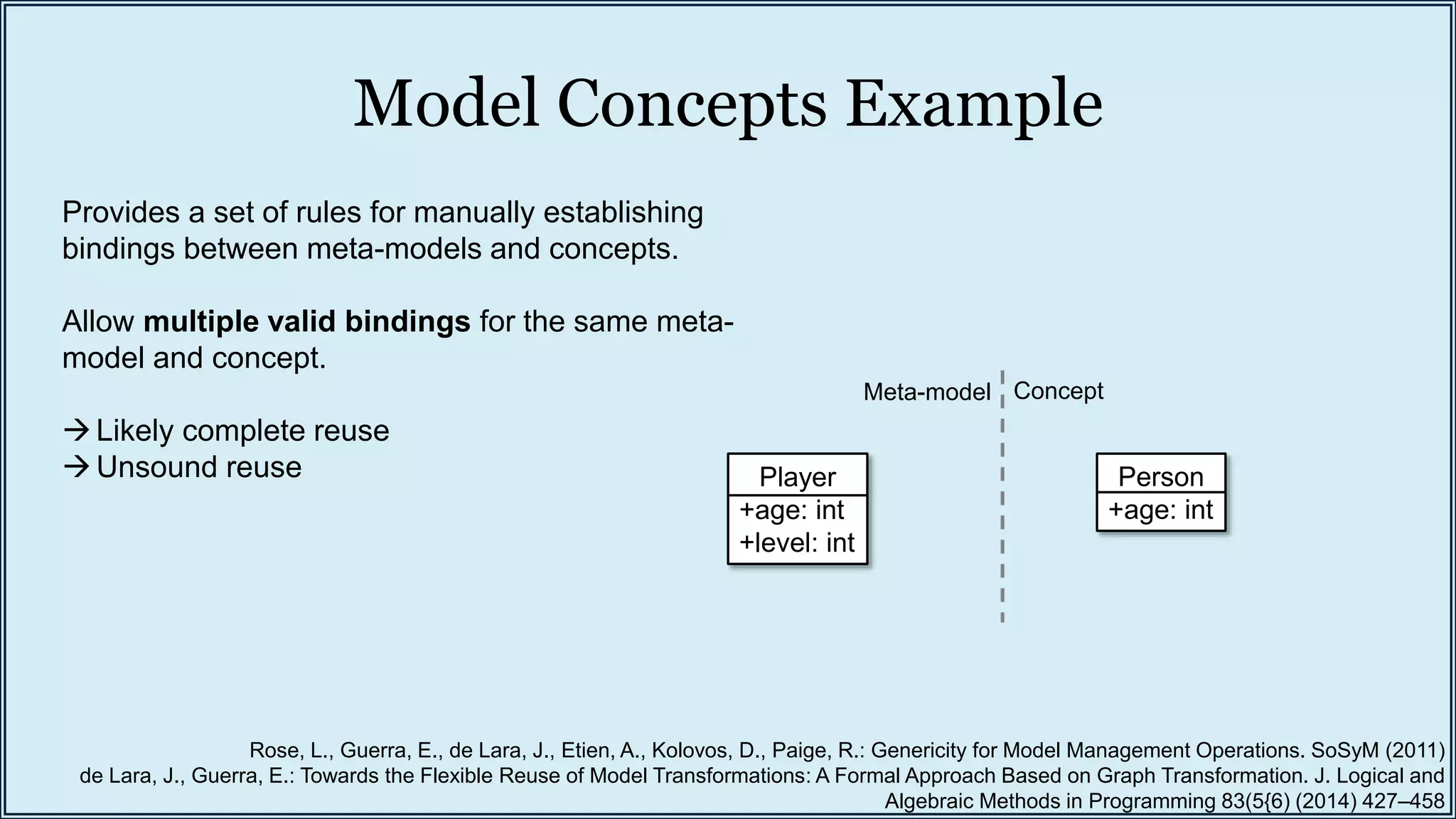
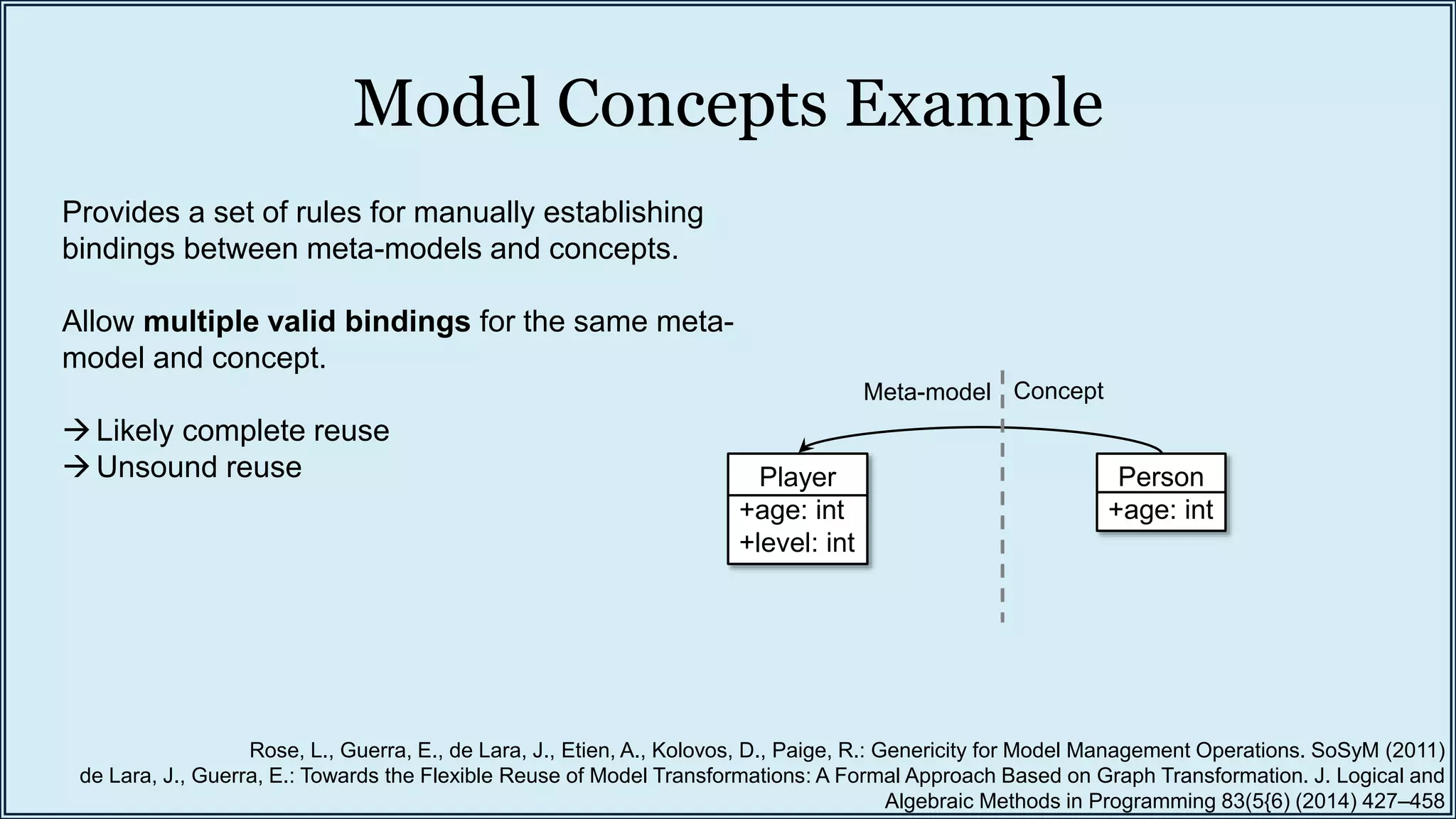
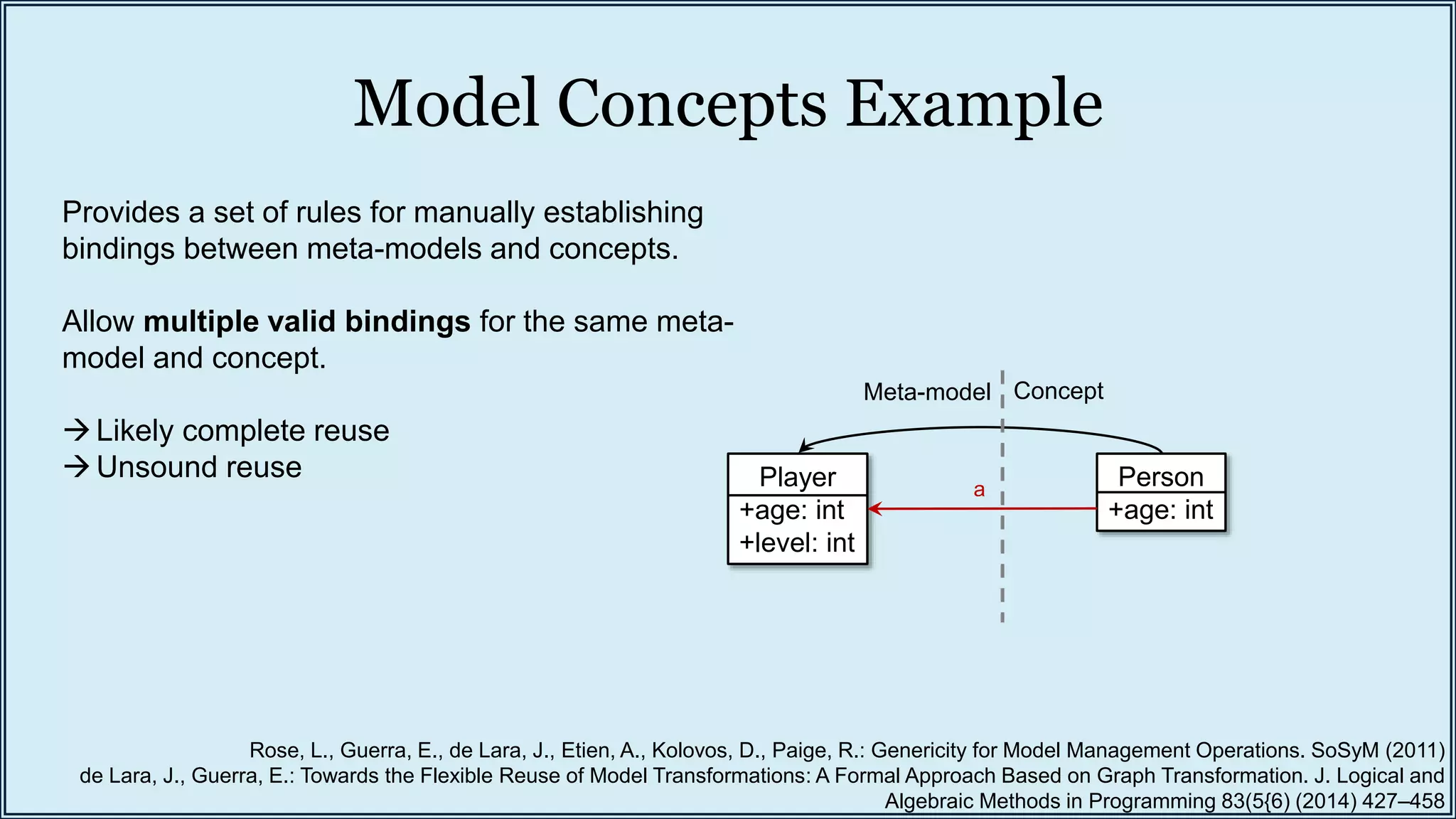
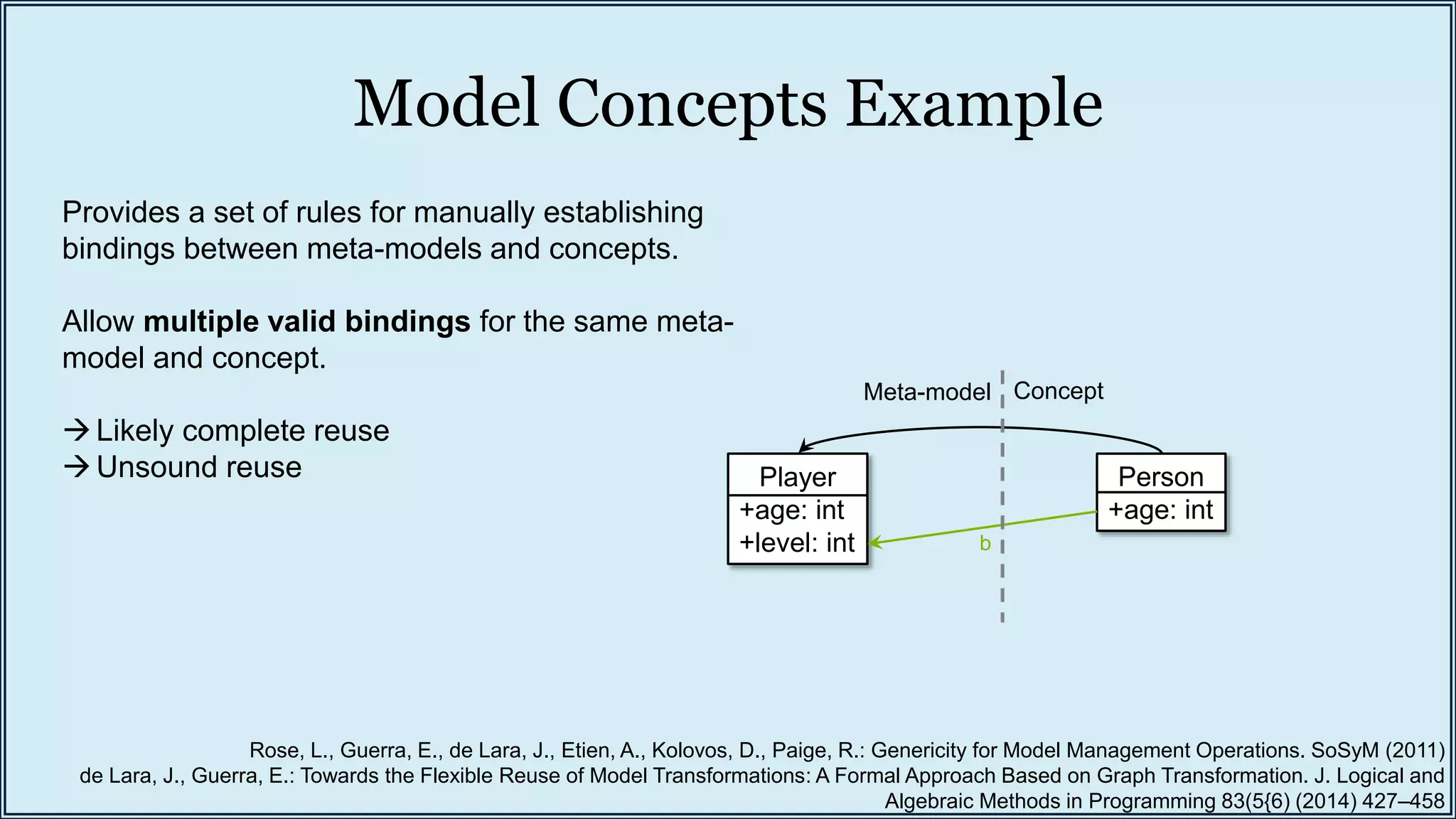
Model Concepts Example
Person
+age: int
Player
+age: int
+level: int
ConceptMeta-model
Provides a set of rules for manually establishing
bindings between meta-models and concepts.
Allow multiple valid bindings for the same meta-
model and concept.
Likely complete reuse
Unsound reuse
Rose, L., Guerra, E., de Lara, J., Etien, A., Kolovos, D., Paige, R.: Genericity for Model Management Operations. SoSyM (2011)
de Lara, J., Guerra, E.: Towards the Flexible Reuse of Model Transformations: A Formal Approach Based on Graph Transformation. J. Logical and
Algebraic Methods in Programming 83(5{6) (2014) 427–458
Model Concepts Example
Person
+age: int
Player
+age: int
+level: int
ConceptMeta-model
Provides a set of rules for manually establishing
bindings between meta-models and concepts.
Allow multiple valid bindings for the same meta-
model and concept.
Likely complete reuse
Unsound reuse
Rose, L., Guerra, E., de Lara, J., Etien, A., Kolovos, D., Paige, R.: Genericity for Model Management Operations. SoSyM (2011)
de Lara, J., Guerra, E.: Towards the Flexible Reuse of Model Transformations: A Formal Approach Based on Graph Transformation. J. Logical and
Algebraic Methods in Programming 83(5{6) (2014) 427–458
Model Concepts Example
Person
+age: int
Player
+age: int
+level: int
a
ConceptMeta-model
Provides a set of rules for manually establishing
bindings between meta-models and concepts.
Allow multiple valid bindings for the same meta-
model and concept.
Likely complete reuse
Unsound reuse
Rose, L., Guerra, E., de Lara, J., Etien, A., Kolovos, D., Paige, R.: Genericity for Model Management Operations. SoSyM (2011)
de Lara, J., Guerra, E.: Towards the Flexible Reuse of Model Transformations: A Formal Approach Based on Graph Transformation. J. Logical and
Algebraic Methods in Programming 83(5{6) (2014) 427–458
Model Concepts Example
Person
+age: int
Player
+age: int
+level: int b
ConceptMeta-model
Provides a set of rules for manually establishing
bindings between meta-models and concepts.
Allow multiple valid bindings for the same meta-
model and concept.
Likely complete reuse
Unsound reuse
Rose, L., Guerra, E., de Lara, J., Etien, A., Kolovos, D., Paige, R.: Genericity for Model Management Operations. SoSyM (2011)
de Lara, J., Guerra, E.: Towards the Flexible Reuse of Model Transformations: A Formal Approach Based on Graph Transformation. J. Logical and
Algebraic Methods in Programming 83(5{6) (2014) 427–458
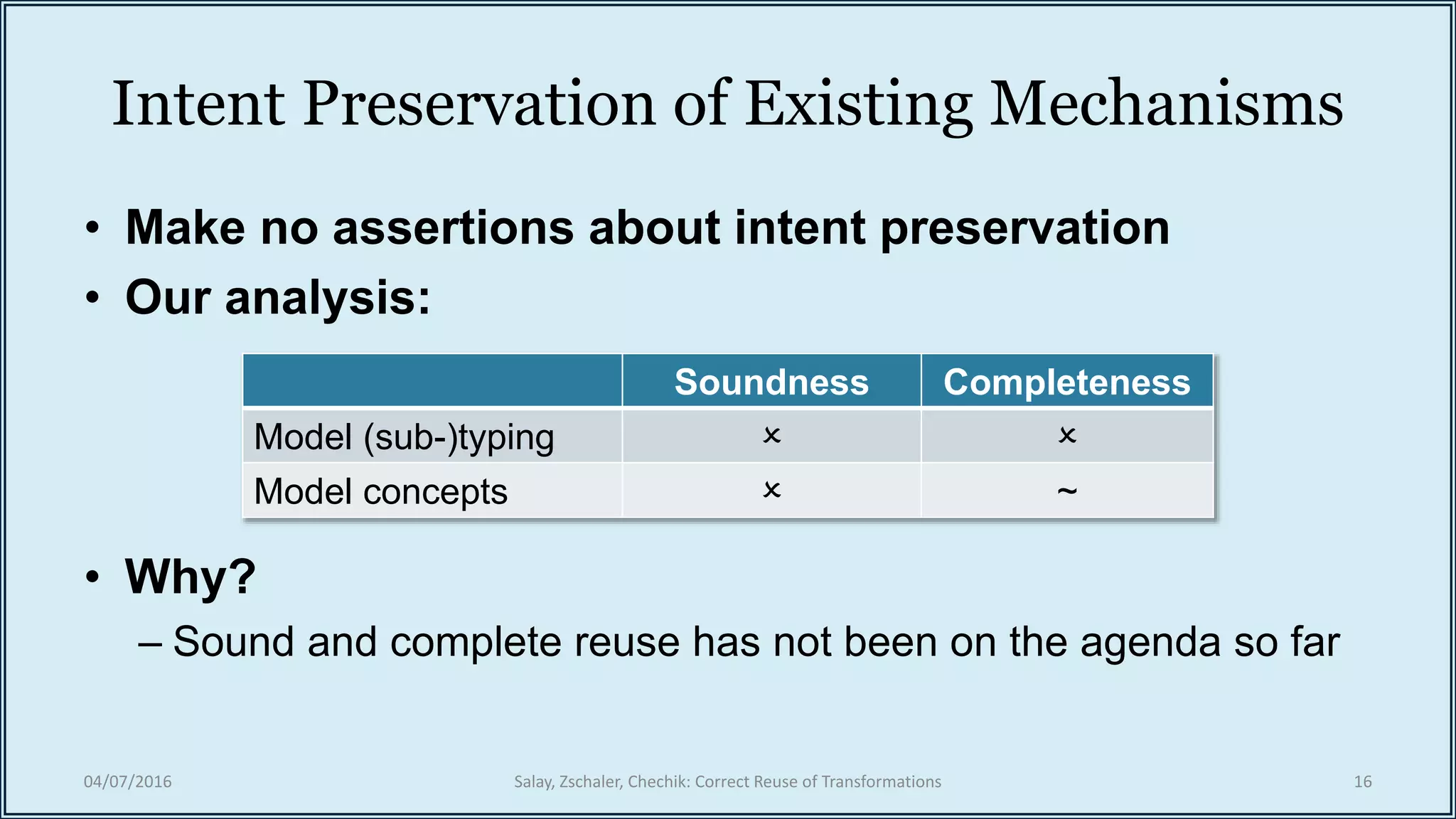
Intent Preservation of Existing Mechanisms
• Make no assertions about intent preservation
• Our analysis:
• Why?
– Sound and complete reuse has not been on the agenda so far
04/07/2016 Salay, Zschaler, Chechik: Correct Reuse of Transformations 16
Soundness Completeness
Model (sub-)typing  
Model concepts  ~
Correct transformation reuse
3. Why is it difficult?
04/07/2016 Salay, Zschaler, Chechik: Correct Reuse of Transformations 17
What’s difficult, then?
• Transformation semantics (and intents) depend on
– Syntax of source and target languages
• Can be aligned using standard morphism constructions
• Model typing and model concepts do this
– Semantics of source and target languages
• Can be in arbitrary relation to language syntax
• Expression depends on language syntax
• No easy mappings
04/07/2016 Salay, Zschaler, Chechik: Correct Reuse of Transformations 18
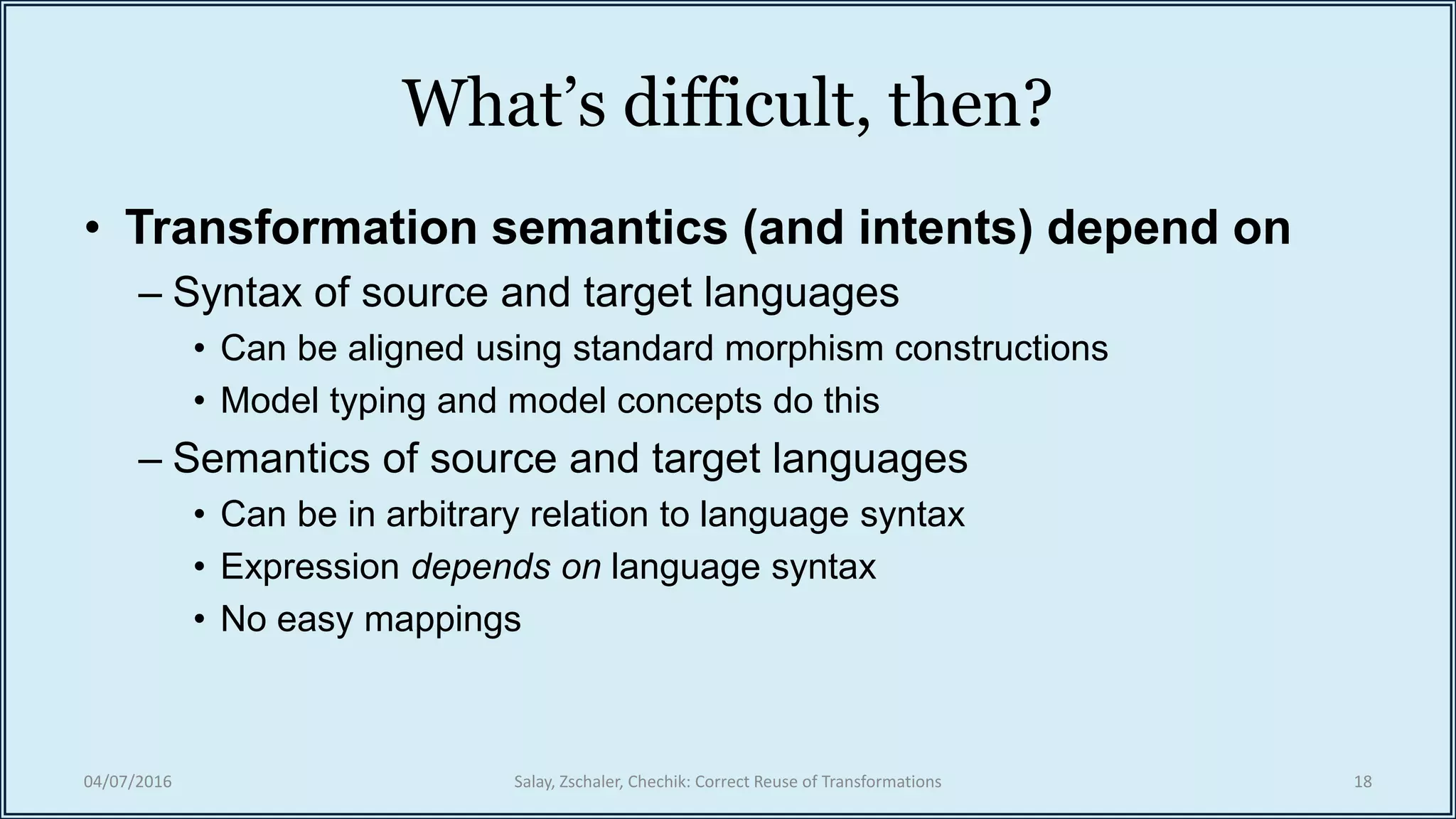
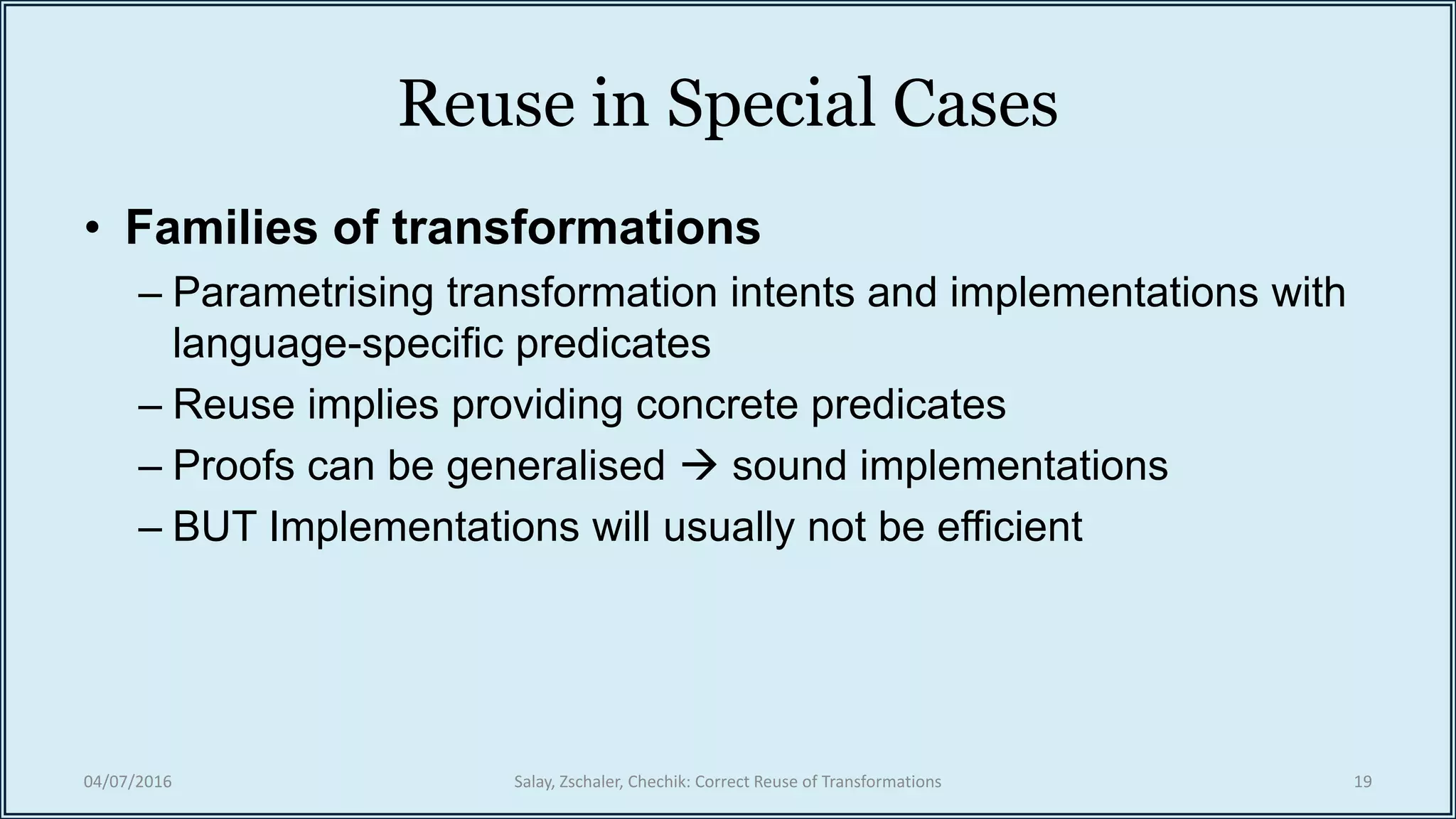
Reuse in Special Cases
• Families of transformations
– Parametrising transformation intents and implementations with
language-specific predicates
– Reuse implies providing concrete predicates
– Proofs can be generalised  sound implementations
– BUT Implementations will usually not be efficient
04/07/2016 Salay, Zschaler, Chechik: Correct Reuse of Transformations 19
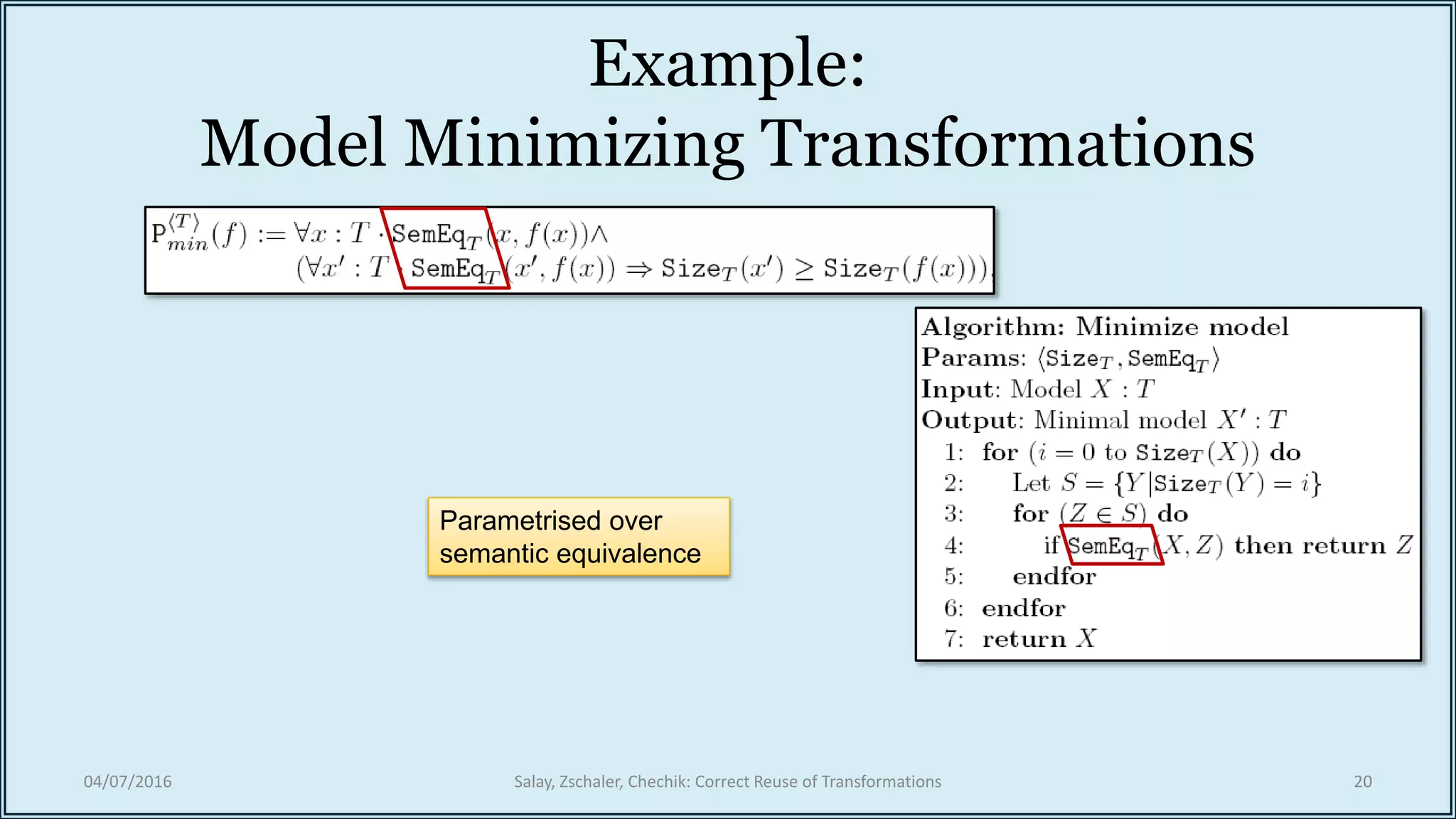
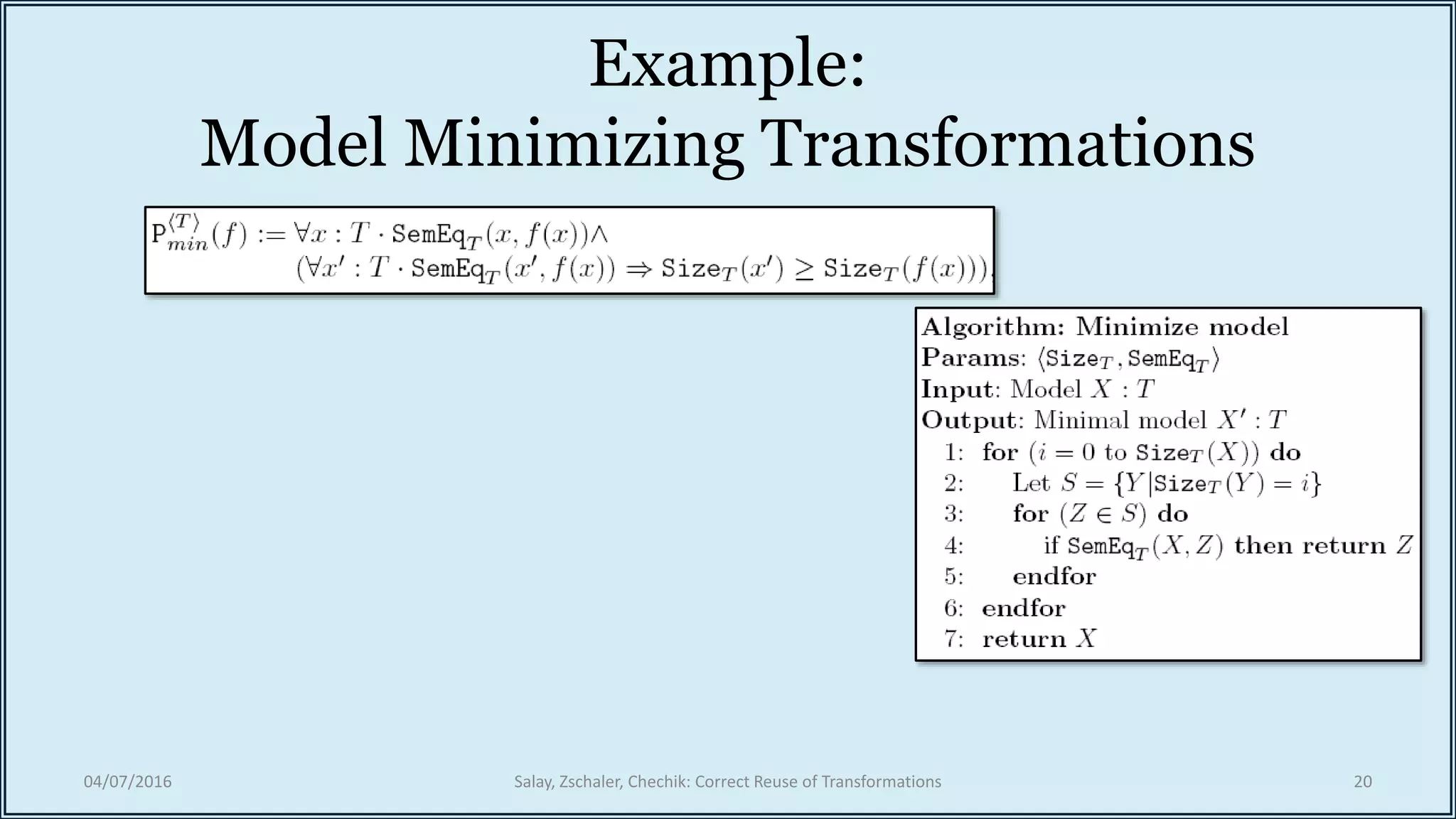
Example:
Model Minimizing Transformations
04/07/2016 Salay, Zschaler, Chechik: Correct Reuse of Transformations 20
Example:
Model Minimizing Transformations
04/07/2016 Salay, Zschaler, Chechik: Correct Reuse of Transformations 20
Parametrised over
semantic equivalence
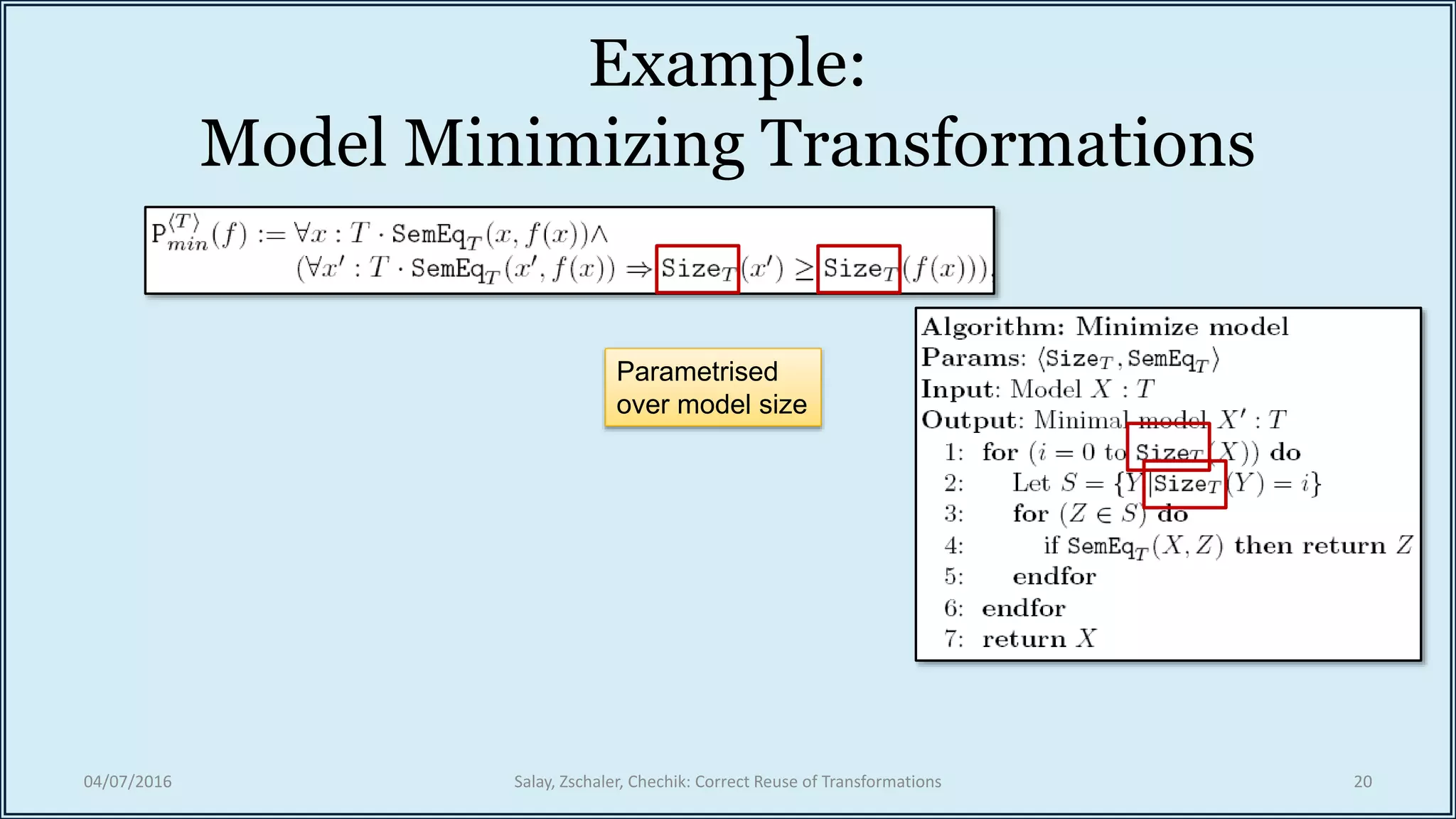
Example:
Model Minimizing Transformations
04/07/2016 Salay, Zschaler, Chechik: Correct Reuse of Transformations 20
Parametrised
over model size
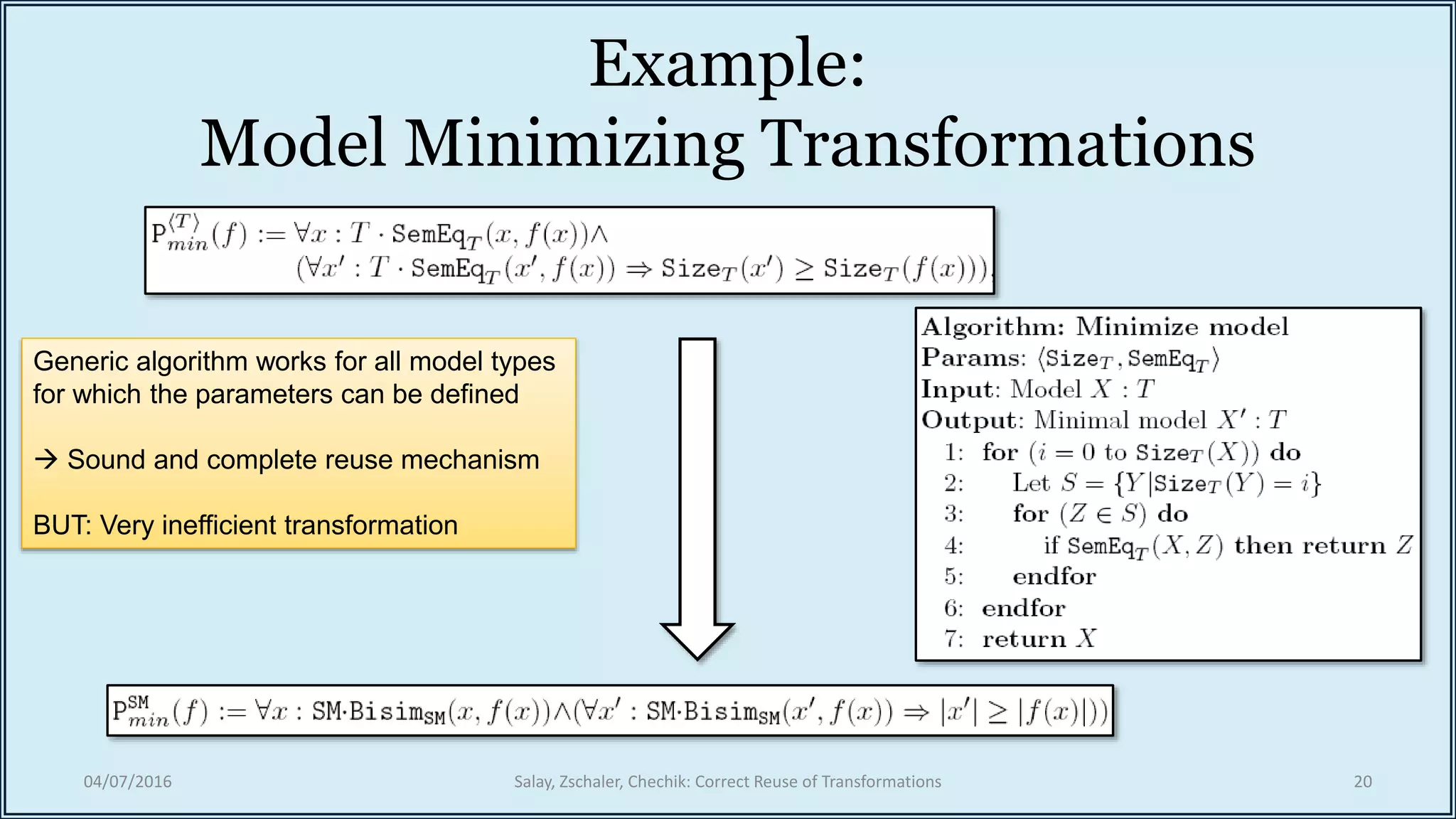
Example:
Model Minimizing Transformations
04/07/2016 Salay, Zschaler, Chechik: Correct Reuse of Transformations 20
Generic algorithm works for all model types
for which the parameters can be defined
 Sound and complete reuse mechanism
BUT: Very inefficient transformation
Reuse in Special Cases (2)
• Families of model types
– Restrict transformation reuse to a specific family of languages
• E.g., state-machine models
– Restricts semantic variability
– Allows more efficient reusable implementations
 Future work
04/07/2016 Salay, Zschaler, Chechik: Correct Reuse of Transformations 21
Conclusions / Outlook
• Semantics are key to correct transformation reuse
– Transformation intents
– Language semantics
04/07/2016 Salay, Zschaler, Chechik: Correct Reuse of Transformations 22
Conclusions / Outlook
• Semantics are key to correct transformation reuse
– Transformation intents
– Language semantics
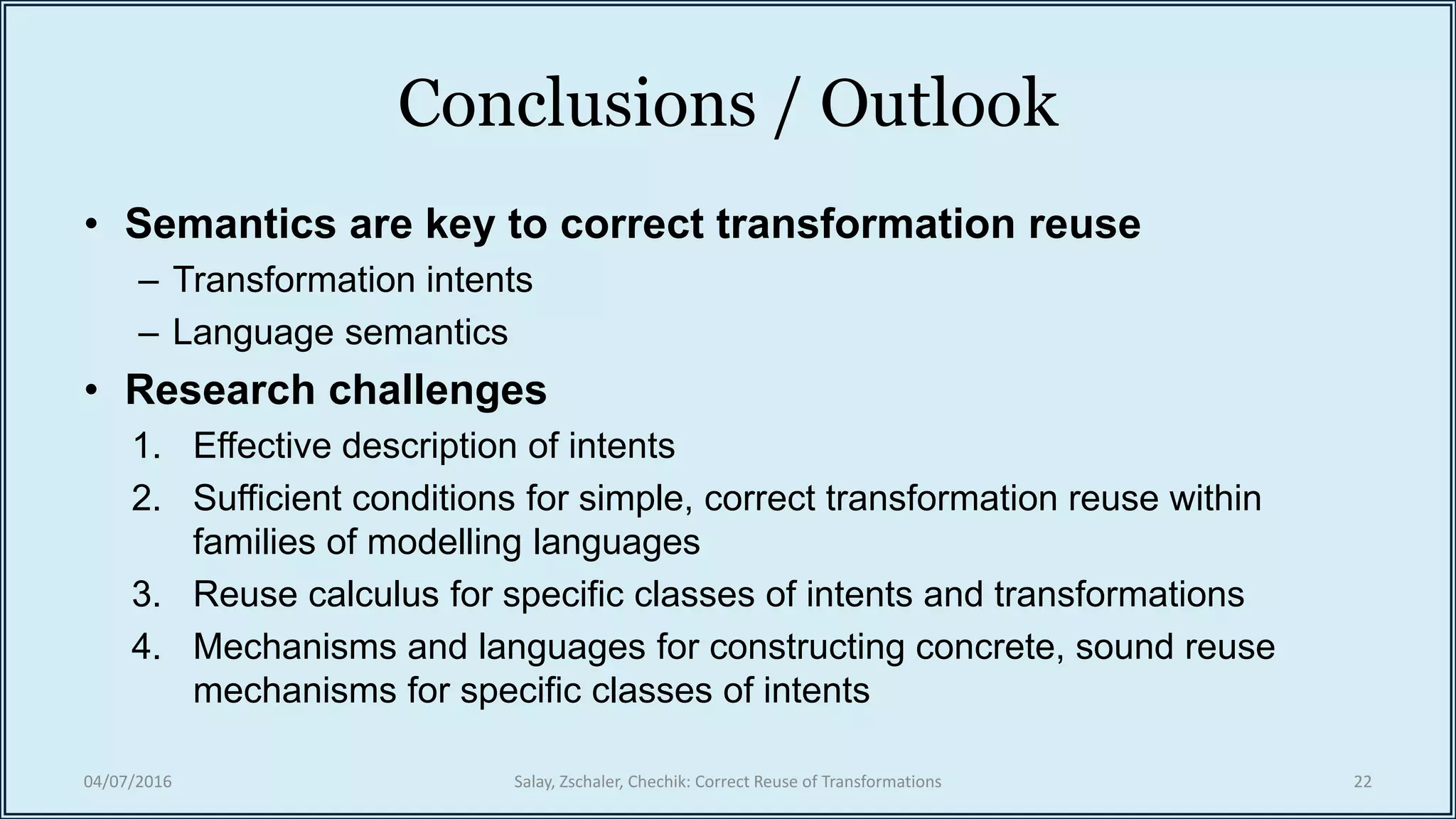
• Research challenges
1. Effective description of intents
2. Sufficient conditions for simple, correct transformation reuse within
families of modelling languages
3. Reuse calculus for specific classes of intents and transformations
4. Mechanisms and languages for constructing concrete, sound reuse
mechanisms for specific classes of intents
04/07/2016 Salay, Zschaler, Chechik: Correct Reuse of Transformations 22
QUESTIONS?
szschaler@acm.org
04/07/2016 Salay, Zschaler, Chechik: Correct Reuse of Transformations 23

Correct Reuse of Transformations is Hard to Guarantee (ICMT'16)

  • 1.
    Correct Reuse ofTransformations is Hard to Guarantee Rick Salay, Steffen Zschaler, and Marsha Chechik July 04, 2016
  • 2.
    Transformations can increaseproductivity Activity Productivity increased Not used Use of model-to-model transformations 50.8% 24.6% Code generation 67.8% 12.0% Data from J. Hutchinson, J. Whittle, M. Rouncefield, S. Kristoffersen: Empirical Assessment of MDE in Industry. ICSE’11 04/07/2016 Salay, Zschaler, Chechik: Correct Reuse of Transformations 2
  • 3.
    Transformations can increaseproductivity Activity Productivity increased Not used Use of model-to-model transformations 50.8% 24.6% Code generation 67.8% 12.0% Data from J. Hutchinson, J. Whittle, M. Rouncefield, S. Kristoffersen: Empirical Assessment of MDE in Industry. ICSE’11 But transformations not used as much: • Too difficult • Too costly to develop 04/07/2016 Salay, Zschaler, Chechik: Correct Reuse of Transformations 2
  • 4.
    Opportunity: Transformation reuse •Reusable transformations can address this – Reduce difficulty • Transformations as encapsulated components • Information hiding – No need to understand implementation details to reuse transformation – Reduce cost • Build new transformations by composing reusable building blocks • No need to redevelop everything from scratch 04/07/2016 Salay, Zschaler, Chechik: Correct Reuse of Transformations 3
  • 5.
    Opportunity: Transformation reuse •Reusable transformations can address this – Reduce difficulty • Transformations as encapsulated components • Information hiding – No need to understand implementation details to reuse transformation – Reduce cost • Build new transformations by composing reusable building blocks • No need to redevelop everything from scratch BUT: Only if we can ensure correct reuse of transformations ! 04/07/2016 Salay, Zschaler, Chechik: Correct Reuse of Transformations 3
  • 6.
    Correct transformation reuse 1.What do we mean by it? 2. How do existing reuse mechanisms fit in? 3. Why is it difficult? 04/07/2016 Salay, Zschaler, Chechik: Correct Reuse of Transformations 4
  • 7.
    Correct transformation reuse 1.What do we mean by it? 04/07/2016 Salay, Zschaler, Chechik: Correct Reuse of Transformations 4
  • 8.
    Transformation Reuse Needs areuse mechanism 04/07/2016 Salay, Zschaler, Chechik: Correct Reuse of Transformations 5
  • 9.
    Transformation Reuse Needs areuse mechanism 1. Model type mapping: • Transformation defined over a set of model types but applied to a different set 04/07/2016 Salay, Zschaler, Chechik: Correct Reuse of Transformations 5 Provided by engineer
  • 10.
    Transformation Reuse Needs areuse mechanism 1. Model type mapping: • Transformation defined over a set of model types but applied to a different set 2. Derivation of reused transformation: • Reuse will require some changes to the transformation • At least – Pre-processing of input models – Post-processing of output models • Possibly rewriting the transformation itself 04/07/2016 Salay, Zschaler, Chechik: Correct Reuse of Transformations 5 Provided by engineer Automatically by reuse mechanism
  • 11.
    Example 04/07/2016 Salay, Zschaler,Chechik: Correct Reuse of Transformations 6 s0 s1 s4s2 a a a b b b b s0 s1 s2 a a b b b minimize A minimization transformation for state machines
  • 12.
    Example (2) • Statemachines are really just a particular kind of typed graphs: – Two types of nodes – Edges with labels • So, can we reuse minimize for arbitrary typed graphs of this form? 04/07/2016 Salay, Zschaler, Chechik: Correct Reuse of Transformations 7
  • 13.
    Example (3) 04/07/2016 Salay,Zschaler, Chechik: Correct Reuse of Transformations 8 A B DC a a a b b b b A B C a a b b b minimize A minimization transformation for typed graphs?
  • 14.
    Example (3) 04/07/2016 Salay,Zschaler, Chechik: Correct Reuse of Transformations 8 A B DC a a a b b b b A B C a a b b b minimize A minimization transformation for typed graphs?
  • 15.
    Transformation Intent • Suchreuse doesn’t preserve the intent of minimize – Minimising state machines is based on assumptions about the semantics of state machines • Correct reuse requires intent preservation – Across different meta-models (or model types) 04/07/2016 Salay, Zschaler, Chechik: Correct Reuse of Transformations 9
  • 16.
    Transformation Intent • Suchreuse doesn’t preserve the intent of minimize – Minimising state machines is based on assumptions about the semantics of state machines • Correct reuse requires intent preservation – Across different meta-models (or model types) 04/07/2016 Salay, Zschaler, Chechik: Correct Reuse of Transformations 9
  • 17.
    Example: Intent Candidates 1.Preserves well-formedness 2. Does model minimization 3. Does behavioural model minimization 4. Does state machine minimization 5. Does minimization using the implication table method 04/07/2016 Salay, Zschaler, Chechik: Correct Reuse of Transformations 10
  • 18.
    Example: Intent Candidates 2.Does model minimization 3. Does behavioural model minimization 4. Does state machine minimization 5. Does minimization using the implication table method 04/07/2016 Salay, Zschaler, Chechik: Correct Reuse of Transformations 10 Too unspecific: Not worth reusing
  • 19.
    Example: Intent Candidates 2.Does model minimization 3. Does behavioural model minimization 4. Does state machine minimization 04/07/2016 Salay, Zschaler, Chechik: Correct Reuse of Transformations 10 Too unspecific: Not worth reusing Too specific: Not reusable
  • 20.
    Soundness and Completeness •A reuse mechanism is – Sound if • It produces only reused transformations that preserve intent – Complete if • It can produce all intent-preserving reused transformations 04/07/2016 Salay, Zschaler, Chechik: Correct Reuse of Transformations 11
  • 21.
    Correct transformation reuse 2.How do existing reuse mechanisms fit in? 3. Why is it difficult? 04/07/2016 Salay, Zschaler, Chechik: Correct Reuse of Transformations 12
  • 22.
    Correct transformation reuse 2.How do existing reuse mechanisms fit in? 04/07/2016 Salay, Zschaler, Chechik: Correct Reuse of Transformations 12
  • 23.
    Existing Mechanisms • Model(sub-)typing (Steel, Guy, …) – Model type mapping: • Implicit morphism established by name identity – Transformation derivation: • None needed, name-based access ensures reusability 04/07/2016 Salay, Zschaler, Chechik: Correct Reuse of Transformations 13
  • 24.
    Existing Mechanisms • Modelconcepts (de Lara, Guerra, Rose, …) – Model type mapping: • Explicit bindings establish clan morphism – Transformation derivation: • Input / Output transformation or transformation rewriting 04/07/2016 Salay, Zschaler, Chechik: Correct Reuse of Transformations 13
  • 25.
    Model Sub-typing Example 04/07/2016 Steel,J., Jezequel, J.M.: On Model Typing. SoSyM 6(4) (2007) 401–413 F: “Takes as input a state machine and produces a lookup table showing the correspondence between the current state, an arriving event, and the resultant state.“ (I1) Produce a tabular representation of all the state-state transitions; (I2) Produce a tabular representation of the state machine (i.e., same set of traces as a table).
  • 26.
    Model Sub-typing Example 04/07/2016 Steel,J., Jezequel, J.M.: On Model Typing. SoSyM 6(4) (2007) 401–413 F: “Takes as input a state machine and produces a lookup table showing the correspondence between the current state, an arriving event, and the resultant state.“ (I1) Produce a tabular representation of all the state-state transitions; (I2) Produce a tabular representation of the state machine (i.e., same set of traces as a table).
  • 27.
    Model Sub-typing Example 04/07/2016 Steel,J., Jezequel, J.M.: On Model Typing. SoSyM 6(4) (2007) 401–413 F: “Takes as input a state machine and produces a lookup table showing the correspondence between the current state, an arriving event, and the resultant state.“ (I1) Produce a tabular representation of all the state-state transitions; (I2) Produce a tabular representation of the state machine (i.e., same set of traces as a table).
  • 28.
    Model Sub-typing Example 04/07/2016  Steel,J., Jezequel, J.M.: On Model Typing. SoSyM 6(4) (2007) 401–413 F: “Takes as input a state machine and produces a lookup table showing the correspondence between the current state, an arriving event, and the resultant state.“ (I1) Produce a tabular representation of all the state-state transitions; (I2) Produce a tabular representation of the state machine (i.e., same set of traces as a table).
  • 29.
    Model Sub-typing Example 04/07/2016  Steel,J., Jezequel, J.M.: On Model Typing. SoSyM 6(4) (2007) 401–413 F: “Takes as input a state machine and produces a lookup table showing the correspondence between the current state, an arriving event, and the resultant state.“ (I1) Produce a tabular representation of all the state-state transitions; (I2) Produce a tabular representation of the state machine (i.e., same set of traces as a table). Cannot preserve I2  Unsound reuse
  • 30.
    Model Sub-typing Example 04/07/2016  Steel,J., Jezequel, J.M.: On Model Typing. SoSyM 6(4) (2007) 401–413 F: “Takes as input a state machine and produces a lookup table showing the correspondence between the current state, an arriving event, and the resultant state.“ (I1) Produce a tabular representation of all the state-state transitions; (I2) Produce a tabular representation of the state machine (i.e., same set of traces as a table). Can easily preserve I1 and I2  Incomplete reuse
  • 31.
    Model Concepts Example Person +age:int Player +age: int +level: int ConceptMeta-model Provides a set of rules for manually establishing bindings between meta-models and concepts. Allow multiple valid bindings for the same meta- model and concept. Likely complete reuse Unsound reuse Rose, L., Guerra, E., de Lara, J., Etien, A., Kolovos, D., Paige, R.: Genericity for Model Management Operations. SoSyM (2011) de Lara, J., Guerra, E.: Towards the Flexible Reuse of Model Transformations: A Formal Approach Based on Graph Transformation. J. Logical and Algebraic Methods in Programming 83(5{6) (2014) 427–458
  • 32.
    Model Concepts Example Person +age:int Player +age: int +level: int ConceptMeta-model Provides a set of rules for manually establishing bindings between meta-models and concepts. Allow multiple valid bindings for the same meta- model and concept. Likely complete reuse Unsound reuse Rose, L., Guerra, E., de Lara, J., Etien, A., Kolovos, D., Paige, R.: Genericity for Model Management Operations. SoSyM (2011) de Lara, J., Guerra, E.: Towards the Flexible Reuse of Model Transformations: A Formal Approach Based on Graph Transformation. J. Logical and Algebraic Methods in Programming 83(5{6) (2014) 427–458
  • 33.
    Model Concepts Example Person +age:int Player +age: int +level: int a ConceptMeta-model Provides a set of rules for manually establishing bindings between meta-models and concepts. Allow multiple valid bindings for the same meta- model and concept. Likely complete reuse Unsound reuse Rose, L., Guerra, E., de Lara, J., Etien, A., Kolovos, D., Paige, R.: Genericity for Model Management Operations. SoSyM (2011) de Lara, J., Guerra, E.: Towards the Flexible Reuse of Model Transformations: A Formal Approach Based on Graph Transformation. J. Logical and Algebraic Methods in Programming 83(5{6) (2014) 427–458
  • 34.
    Model Concepts Example Person +age:int Player +age: int +level: int b ConceptMeta-model Provides a set of rules for manually establishing bindings between meta-models and concepts. Allow multiple valid bindings for the same meta- model and concept. Likely complete reuse Unsound reuse Rose, L., Guerra, E., de Lara, J., Etien, A., Kolovos, D., Paige, R.: Genericity for Model Management Operations. SoSyM (2011) de Lara, J., Guerra, E.: Towards the Flexible Reuse of Model Transformations: A Formal Approach Based on Graph Transformation. J. Logical and Algebraic Methods in Programming 83(5{6) (2014) 427–458
  • 35.
    Intent Preservation ofExisting Mechanisms • Make no assertions about intent preservation • Our analysis: • Why? – Sound and complete reuse has not been on the agenda so far 04/07/2016 Salay, Zschaler, Chechik: Correct Reuse of Transformations 16 Soundness Completeness Model (sub-)typing   Model concepts  ~
  • 36.
    Correct transformation reuse 3.Why is it difficult? 04/07/2016 Salay, Zschaler, Chechik: Correct Reuse of Transformations 17
  • 37.
    What’s difficult, then? •Transformation semantics (and intents) depend on – Syntax of source and target languages • Can be aligned using standard morphism constructions • Model typing and model concepts do this – Semantics of source and target languages • Can be in arbitrary relation to language syntax • Expression depends on language syntax • No easy mappings 04/07/2016 Salay, Zschaler, Chechik: Correct Reuse of Transformations 18
  • 38.
    Reuse in SpecialCases • Families of transformations – Parametrising transformation intents and implementations with language-specific predicates – Reuse implies providing concrete predicates – Proofs can be generalised  sound implementations – BUT Implementations will usually not be efficient 04/07/2016 Salay, Zschaler, Chechik: Correct Reuse of Transformations 19
  • 39.
    Example: Model Minimizing Transformations 04/07/2016Salay, Zschaler, Chechik: Correct Reuse of Transformations 20
  • 40.
    Example: Model Minimizing Transformations 04/07/2016Salay, Zschaler, Chechik: Correct Reuse of Transformations 20 Parametrised over semantic equivalence
  • 41.
    Example: Model Minimizing Transformations 04/07/2016Salay, Zschaler, Chechik: Correct Reuse of Transformations 20 Parametrised over model size
  • 42.
    Example: Model Minimizing Transformations 04/07/2016Salay, Zschaler, Chechik: Correct Reuse of Transformations 20 Generic algorithm works for all model types for which the parameters can be defined  Sound and complete reuse mechanism BUT: Very inefficient transformation
  • 43.
    Reuse in SpecialCases (2) • Families of model types – Restrict transformation reuse to a specific family of languages • E.g., state-machine models – Restricts semantic variability – Allows more efficient reusable implementations  Future work 04/07/2016 Salay, Zschaler, Chechik: Correct Reuse of Transformations 21
  • 44.
    Conclusions / Outlook •Semantics are key to correct transformation reuse – Transformation intents – Language semantics 04/07/2016 Salay, Zschaler, Chechik: Correct Reuse of Transformations 22
  • 45.
    Conclusions / Outlook •Semantics are key to correct transformation reuse – Transformation intents – Language semantics • Research challenges 1. Effective description of intents 2. Sufficient conditions for simple, correct transformation reuse within families of modelling languages 3. Reuse calculus for specific classes of intents and transformations 4. Mechanisms and languages for constructing concrete, sound reuse mechanisms for specific classes of intents 04/07/2016 Salay, Zschaler, Chechik: Correct Reuse of Transformations 22
  • 46.
    QUESTIONS? szschaler@acm.org 04/07/2016 Salay, Zschaler,Chechik: Correct Reuse of Transformations 23

Editor's Notes

  • #7 Mention we don’t have the final answers to these questions. Our contribution is in enabling the questions to be asked.
  • #8 Mention we don’t have the final answers to these questions. Our contribution is in enabling the questions to be asked.
  • #22 Mention we don’t have the final answers to these questions. Our contribution is in enabling the questions to be asked.
  • #23 Mention we don’t have the final answers to these questions. Our contribution is in enabling the questions to be asked.
  • #37 Mention we don’t have the final answers to these questions. Our contribution is in enabling the questions to be asked.