
Chapter 9
Network Management
A note on the use of these ppt slides:
We’re making these slides freely available to all (faculty, students, readers).
They’re in PowerPoint form so you see the animations; and can add, modify,
and delete slides (including this one) and slide content to suit your needs.
They obviously represent a lot of work on our part. In return for use, we only
ask the following:
 If you use these slides (e.g., in a class) that you mention their source
(after all, we’d like people to use our book!)
 If you post any slides on a www site, that you note that they are adapted
from (or perhaps identical to) our slides, and note our copyright of this
material.
Thanks and enjoy! JFK/KWR

Computer
Networking: A Top
Down Approach
6th edition
Jim Kurose, Keith Ross
Addison-Wesley
March 2012

All material copyright 1996-2012
J.F Kurose and K.W. Ross, All Rights Reserved
Network Management

9-1
Chapter 9: Network Management
Chapter goals:






introduction to network management
 motivation
 major components
Internet network management framework
 MIB: management information base
 SMI: data definition language
 SNMP: protocol for network management
 security and administration
presentation services: ASN.1
Network Management

9-2
Chapter 9 outline
What is network management?
 Internet-standard management framework
 Structure of Management Information: SMI
 Management Information Base: MIB
 SNMP Protocol Operations and Transport
Mappings
 Security and Administration
 ASN.1


Network Management

9-3
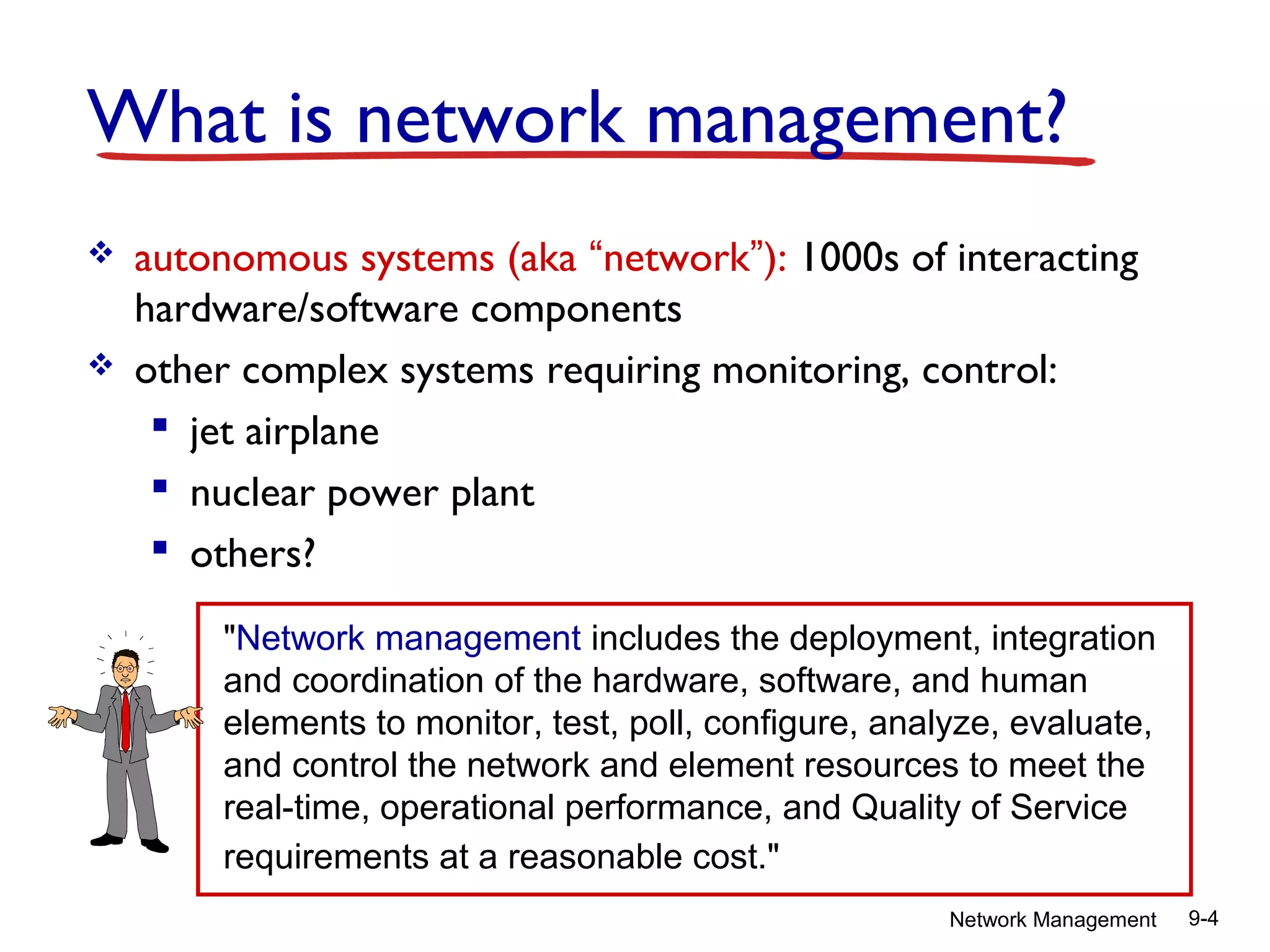
What is network management?




autonomous systems (aka “network”): 1000s of interacting
hardware/software components
other complex systems requiring monitoring, control:
 jet airplane
 nuclear power plant
 others?
"Network management includes the deployment, integration
and coordination of the hardware, software, and human
elements to monitor, test, poll, configure, analyze, evaluate,
and control the network and element resources to meet the
real-time, operational performance, and Quality of Service
requirements at a reasonable cost."
Network Management

9-4
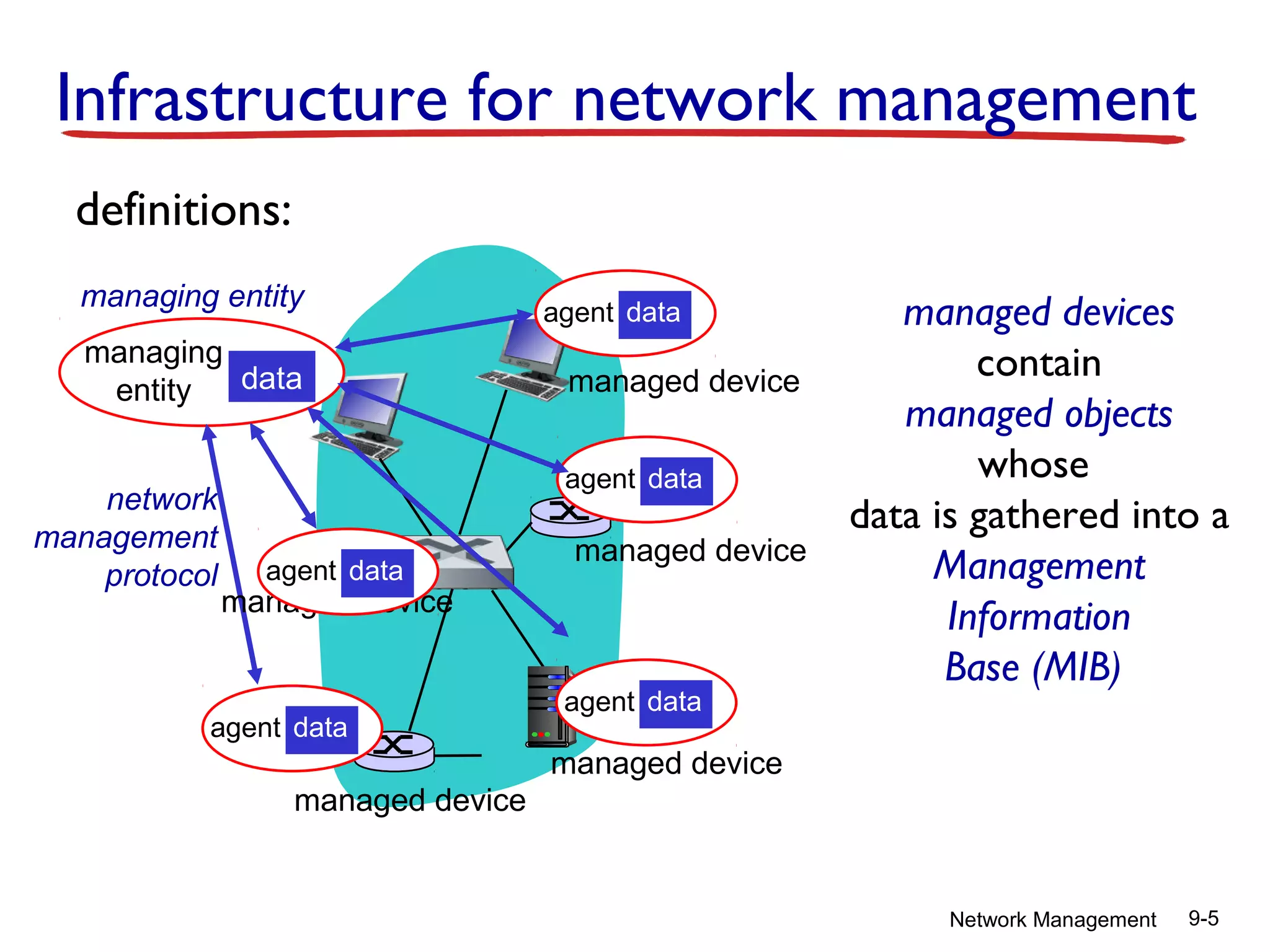
Infrastructure for network management
definitions:
managing entity
managing
data
entity
network
management
protocol

agent data

managed device
agent data

agent data

managed device

managed device

agent data

agent data

managed devices
contain
managed objects
whose
data is gathered into a
Management
Information
Base (MIB)

managed device
managed device

Network Management

9-5
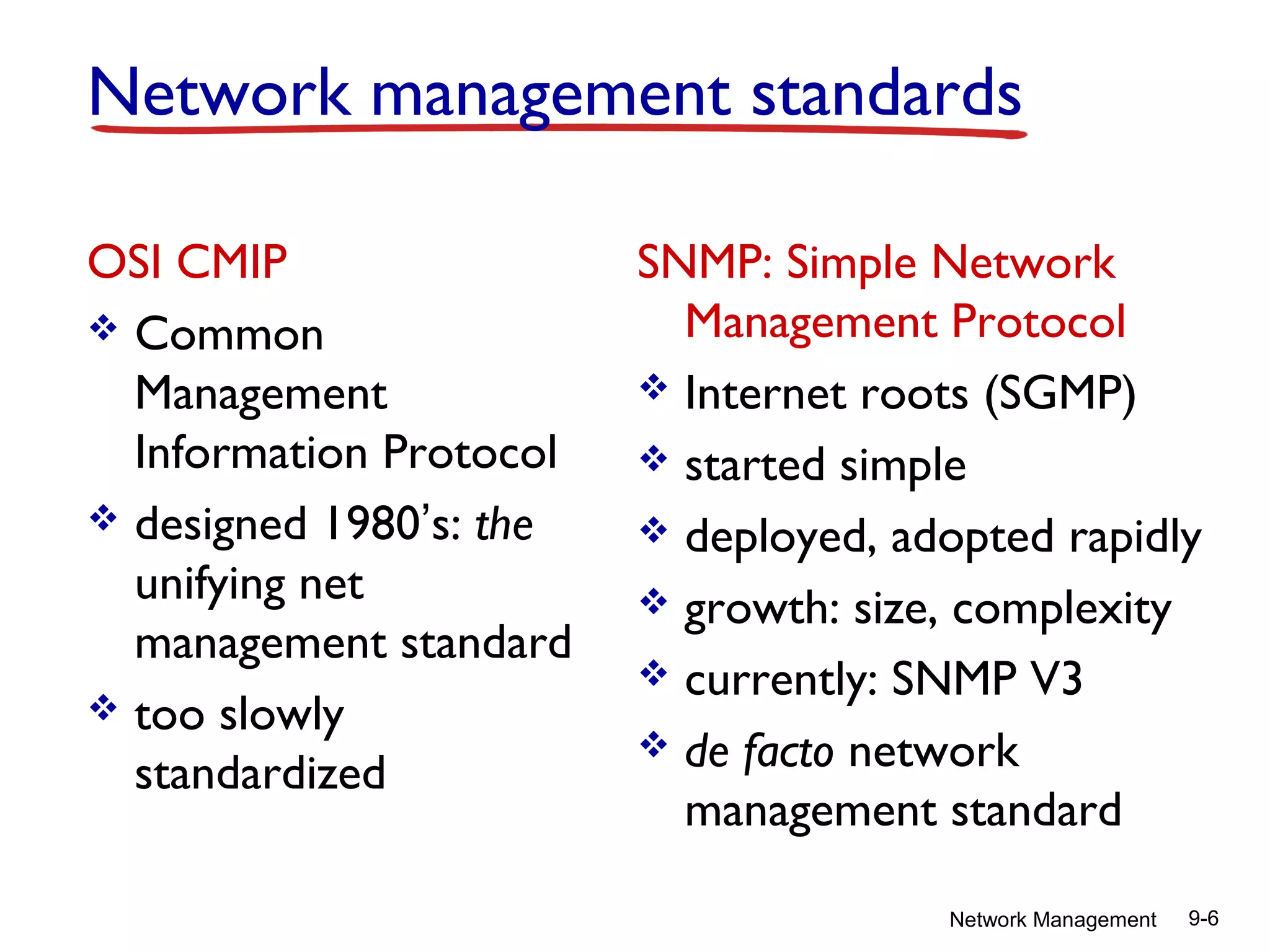
Network management standards
OSI CMIP
 Common
Management
Information Protocol
 designed 1980’s: the
unifying net
management standard
 too slowly
standardized

SNMP: Simple Network
Management Protocol
 Internet roots (SGMP)
 started simple
 deployed, adopted rapidly
 growth: size, complexity
 currently: SNMP V3
 de facto network
management standard
Network Management

9-6
Chapter 9 outline
What is network management?
 Internet-standard management framework
 Structure of Management Information: SMI
 Management Information Base: MIB
 SNMP Protocol Operations and Transport
Mappings
 Security and Administration
 ASN.1


Network Management

9-7
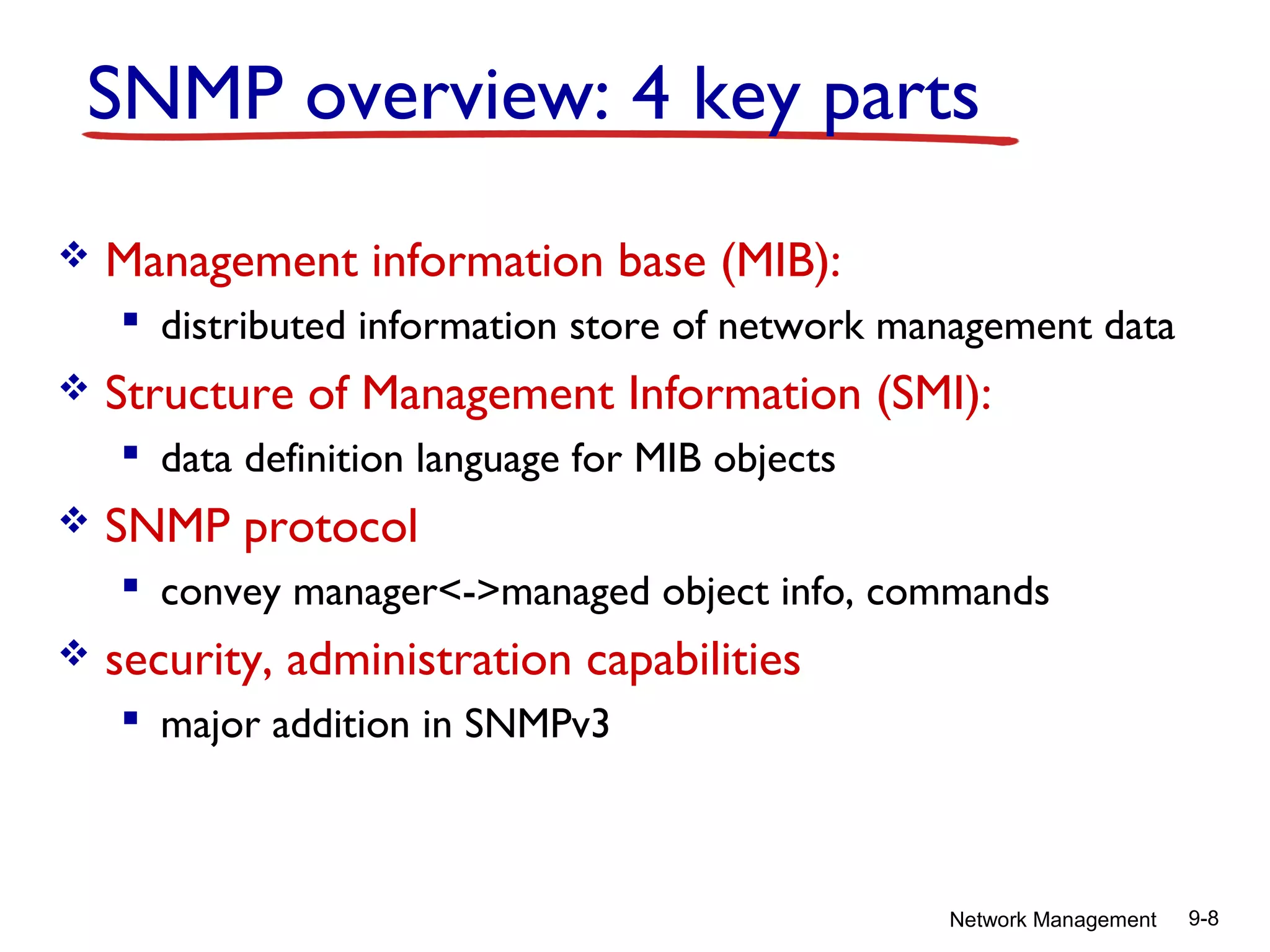
SNMP overview: 4 key parts


Management information base (MIB):
 distributed information store of network management data



Structure of Management Information (SMI):
 data definition language for MIB objects



SNMP protocol
 convey manager<->managed object info, commands



security, administration capabilities
 major addition in SNMPv3

Network Management

9-8
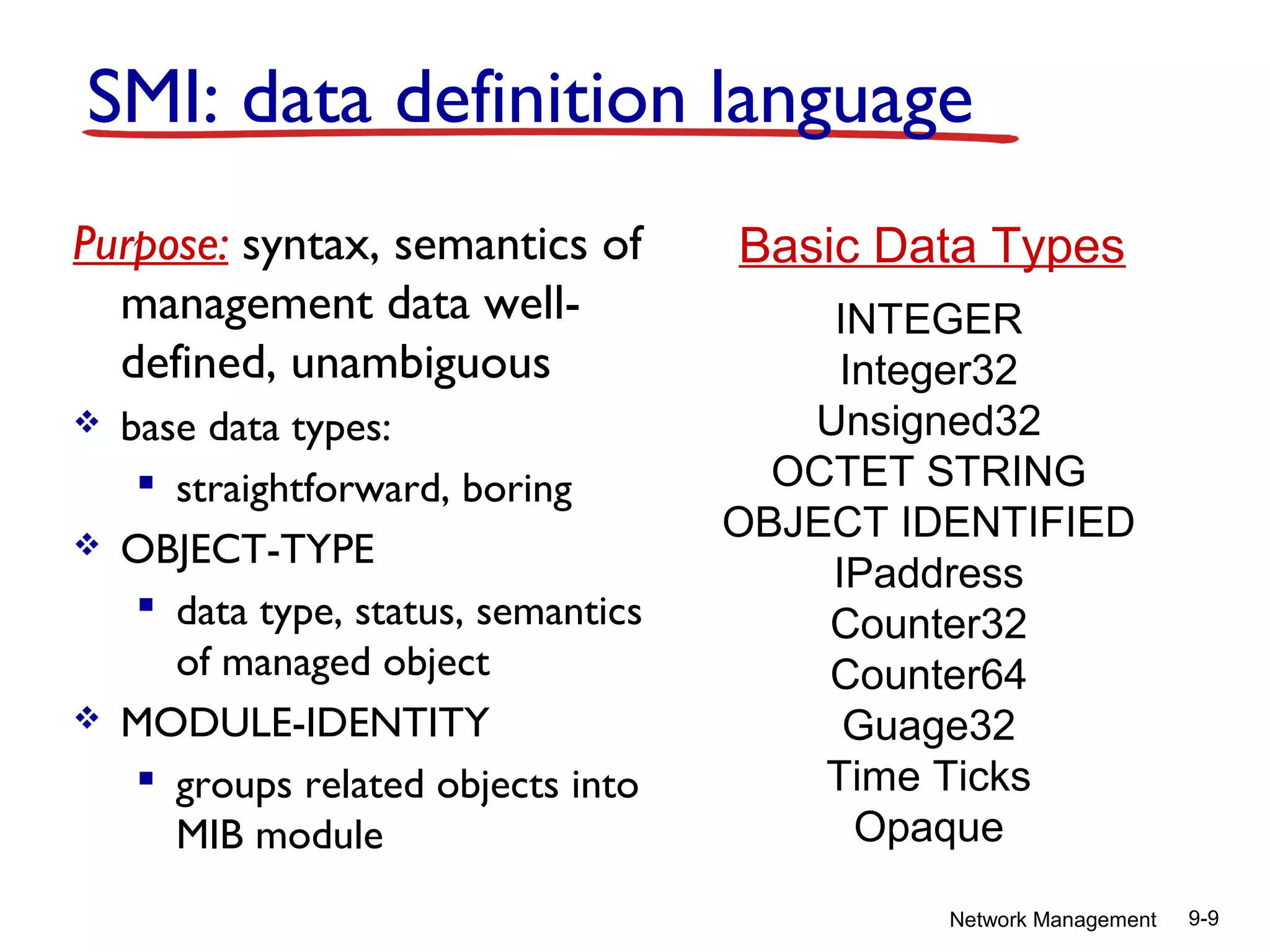
SMI: data definition language
Purpose: syntax, semantics of
management data welldefined, unambiguous






base data types:
 straightforward, boring
OBJECT-TYPE
 data type, status, semantics
of managed object
MODULE-IDENTITY
 groups related objects into
MIB module

Basic Data Types
INTEGER
Integer32
Unsigned32
OCTET STRING
OBJECT IDENTIFIED
IPaddress
Counter32
Counter64
Guage32
Time Ticks
Opaque
Network Management

9-9
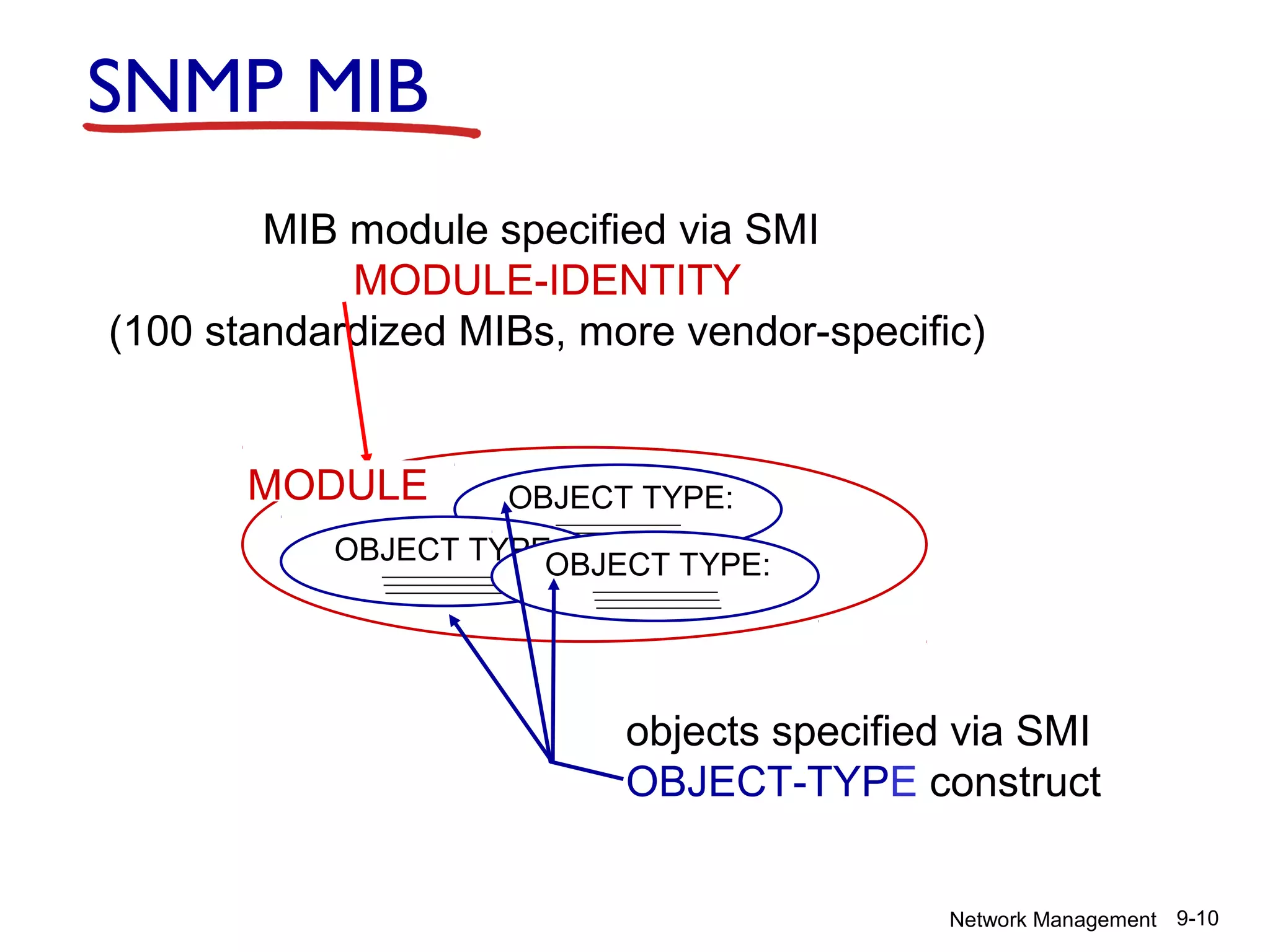
SNMP MIB
MIB module specified via SMI
MODULE-IDENTITY
(100 standardized MIBs, more vendor-specific)

MODULE

OBJECT TYPE:

OBJECT TYPE:
OBJECT TYPE:

objects specified via SMI
OBJECT-TYPE construct
Network Management 9-10
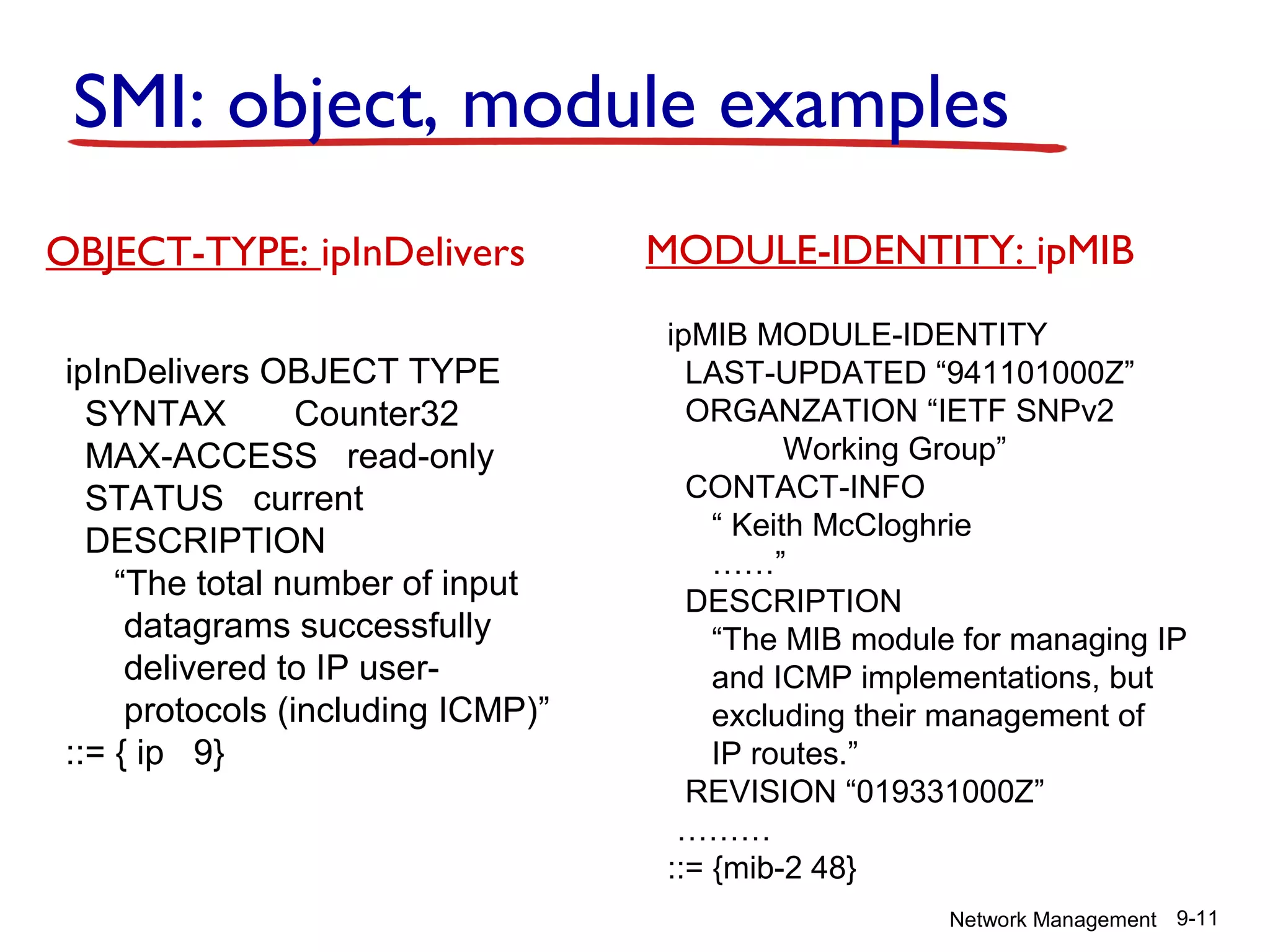
SMI: object, module examples
OBJECT-TYPE: ipInDelivers
ipInDelivers OBJECT TYPE
SYNTAX
Counter32
MAX-ACCESS read-only
STATUS current
DESCRIPTION
“The total number of input
datagrams successfully
delivered to IP userprotocols (including ICMP)”
::= { ip 9}

MODULE-IDENTITY: ipMIB
ipMIB MODULE-IDENTITY
LAST-UPDATED “941101000Z”
ORGANZATION “IETF SNPv2
Working Group”
CONTACT-INFO
“ Keith McCloghrie
……”
DESCRIPTION
“The MIB module for managing IP
and ICMP implementations, but
excluding their management of
IP routes.”
REVISION “019331000Z”
………
::= {mib-2 48}
Network Management 9-11
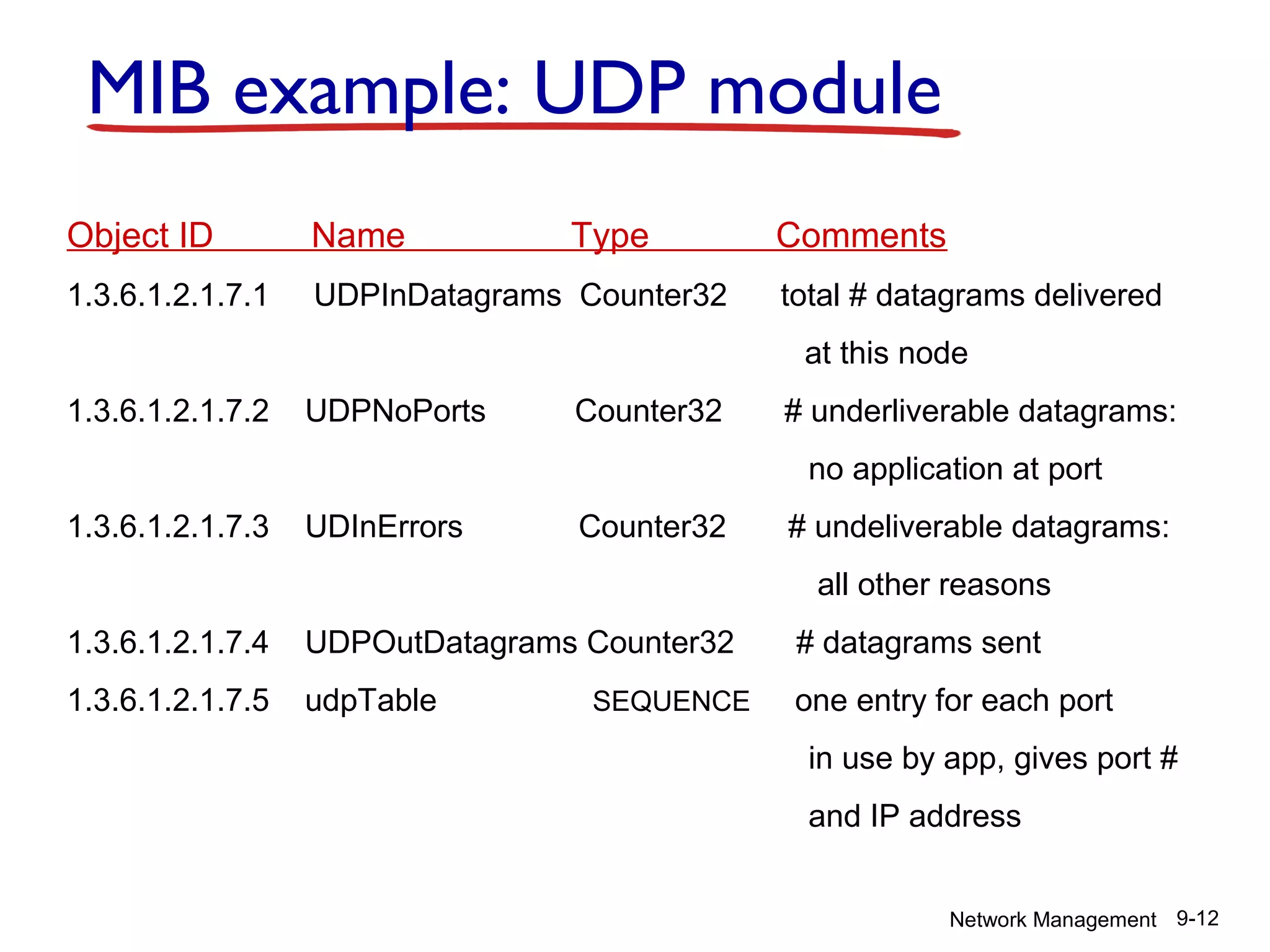
MIB example: UDP module
Object ID

Name

Type

1.3.6.1.2.1.7.1

UDPInDatagrams Counter32

Comments
total # datagrams delivered
at this node

1.3.6.1.2.1.7.2

UDPNoPorts

Counter32

# underliverable datagrams:
no application at port

1.3.6.1.2.1.7.3

UDInErrors

Counter32

# undeliverable datagrams:
all other reasons

1.3.6.1.2.1.7.4

UDPOutDatagrams Counter32

# datagrams sent

1.3.6.1.2.1.7.5

udpTable

one entry for each port

SEQUENCE

in use by app, gives port #
and IP address
Network Management 9-12
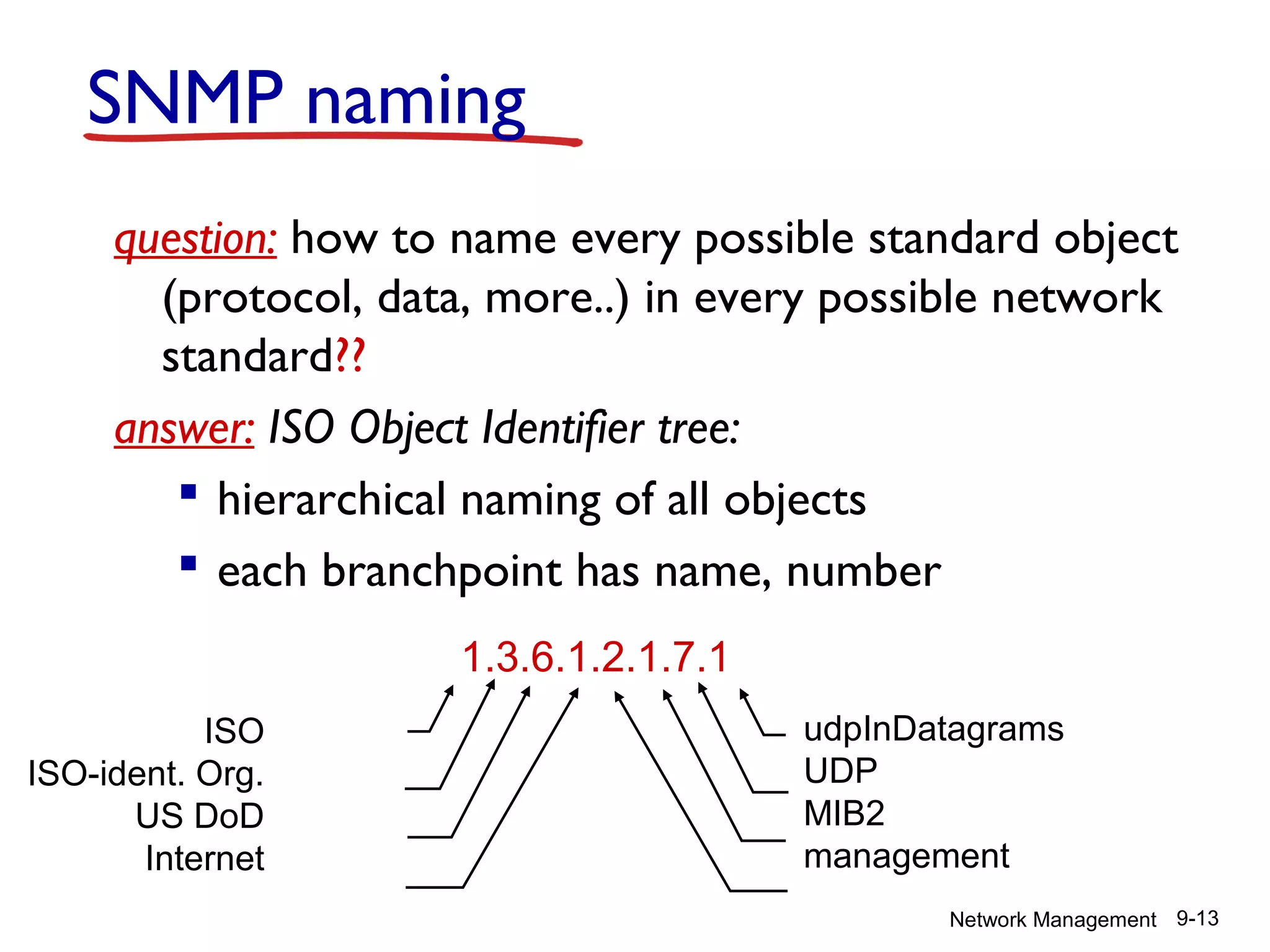
SNMP naming
question: how to name every possible standard object
(protocol, data, more..) in every possible network
standard??
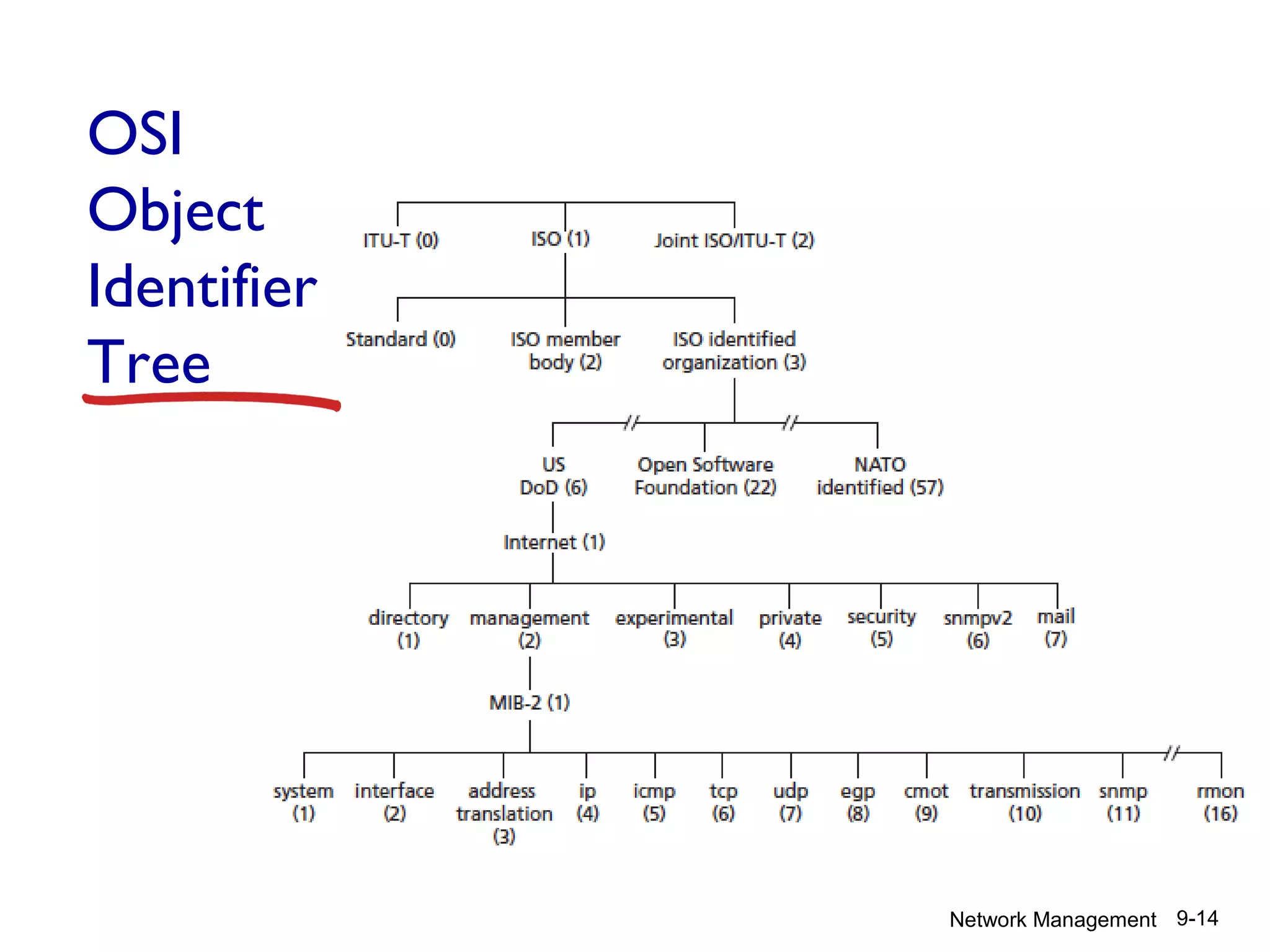
answer: ISO Object Identifier tree:
 hierarchical naming of all objects
 each branchpoint has name, number
1.3.6.1.2.1.7.1
ISO
ISO-ident. Org.
US DoD
Internet

udpInDatagrams
UDP
MIB2
management
Network Management 9-13
OSI
Object
Identifier
Tree

Network Management 9-14
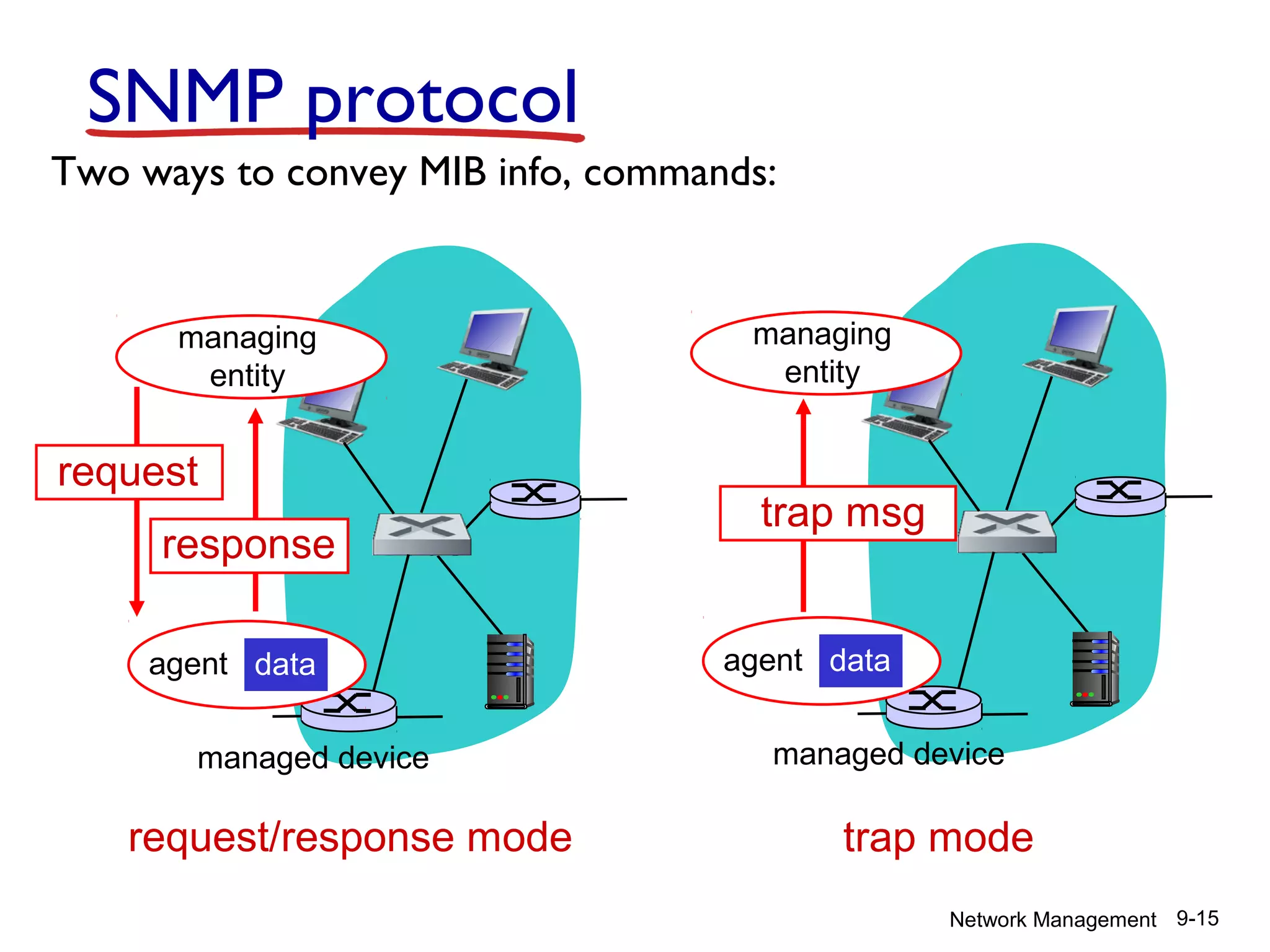
SNMP protocol
Two ways to convey MIB info, commands:

managing
entity

request
response
agent data
managed device

request/response mode

managing
entity

trap msg

agent data
managed device

trap mode
Network Management 9-15
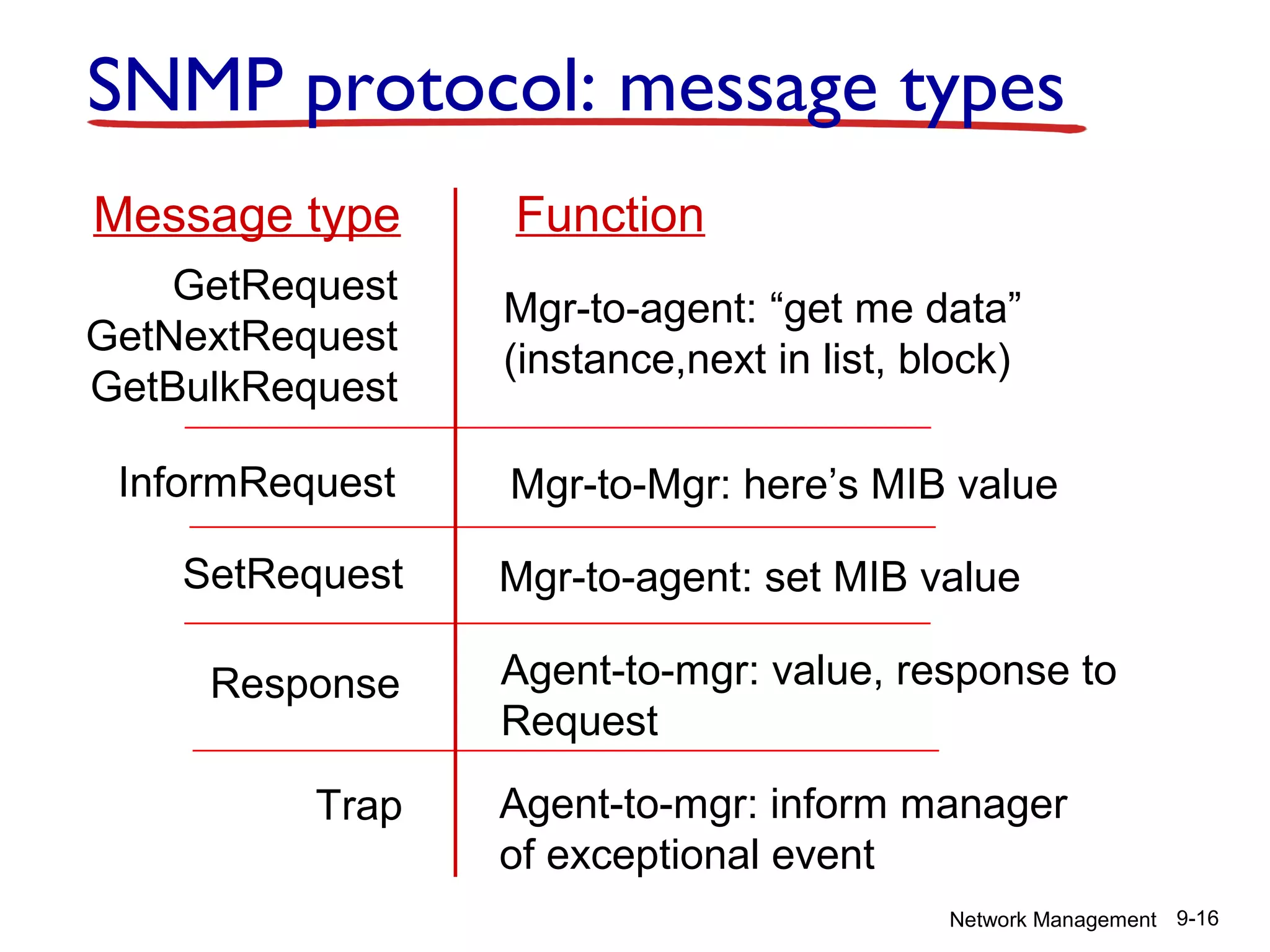
SNMP protocol: message types
Message type

Function

GetRequest
GetNextRequest
GetBulkRequest

Mgr-to-agent: “get me data”
(instance,next in list, block)

InformRequest
SetRequest
Response
Trap

Mgr-to-Mgr: here’s MIB value
Mgr-to-agent: set MIB value
Agent-to-mgr: value, response to
Request
Agent-to-mgr: inform manager
of exceptional event
Network Management 9-16
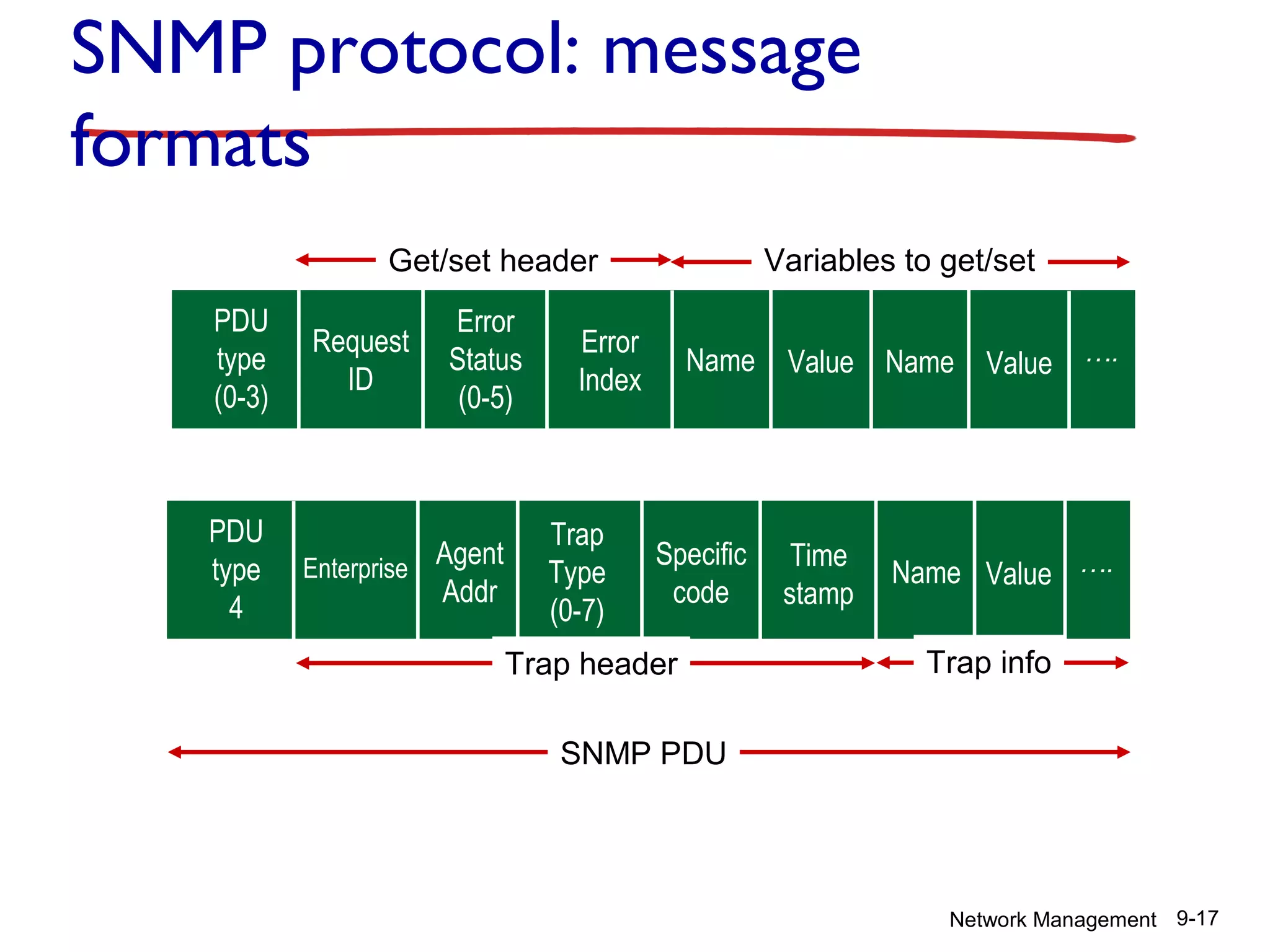
SNMP protocol: message
formats
Variables to get/set

Get/set header
PDU
type
(0-3)

PDU
type
4

Request
ID

Error
Status
(0-5)

Enterprise Agent
Addr

Error
Index

Trap
Type
(0-7)

Name

Specific
code

Trap header

Value Name

Time
stamp

Value ….

Name Value ….
Trap info

SNMP PDU

Network Management 9-17
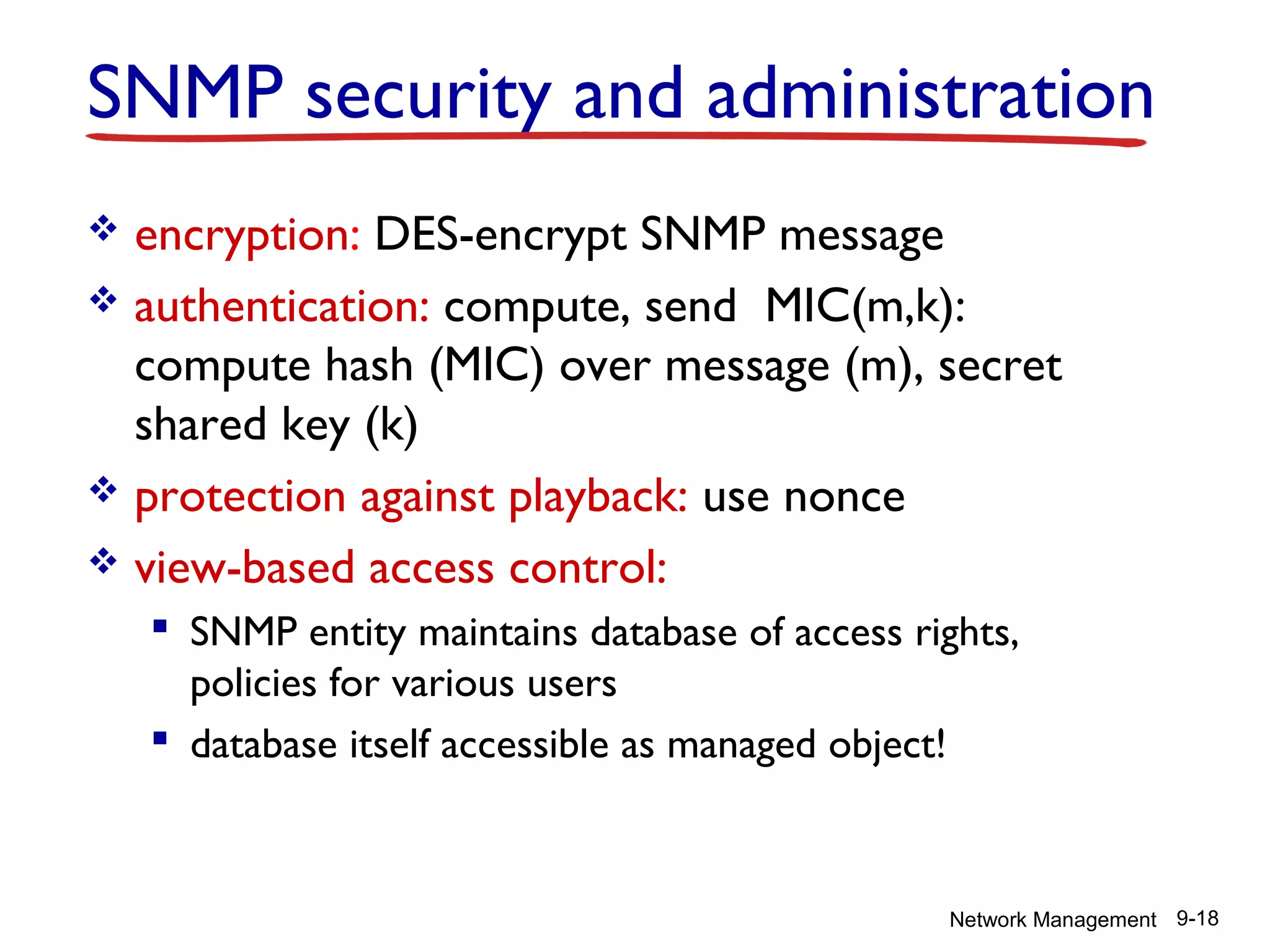
SNMP security and administration
encryption: DES-encrypt SNMP message
 authentication: compute, send MIC(m,k):
compute hash (MIC) over message (m), secret
shared key (k)
 protection against playback: use nonce
 view-based access control:


 SNMP entity maintains database of access rights,
policies for various users
 database itself accessible as managed object!

Network Management 9-18
Chapter 9 outline
What is network management?
 Internet-standard management framework
 Structure of Management Information: SMI
 Management Information Base: MIB
 SNMP Protocol Operations and Transport
Mappings
 Security and Administration
 The presentation problem: ASN.1


Network Management 9-19
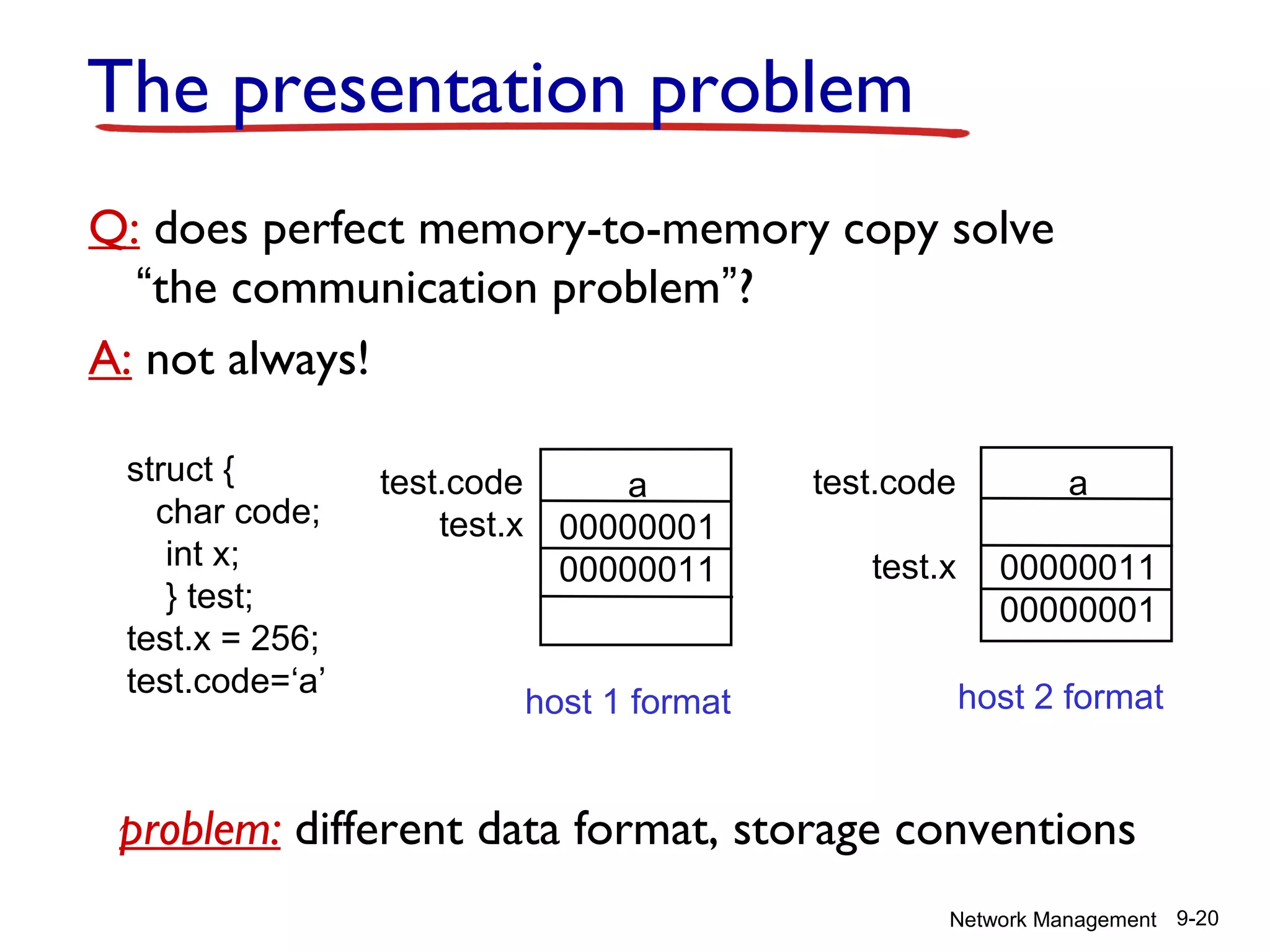
The presentation problem
Q: does perfect memory-to-memory copy solve
“the communication problem”?
A: not always!
struct {
char code;
int x;
} test;
test.x = 256;
test.code=‘a’

test.code
test.x

a
00000001
00000011

host 1 format

test.code
test.x

a
00000011
00000001
host 2 format

problem: different data format, storage conventions
Network Management 9-20
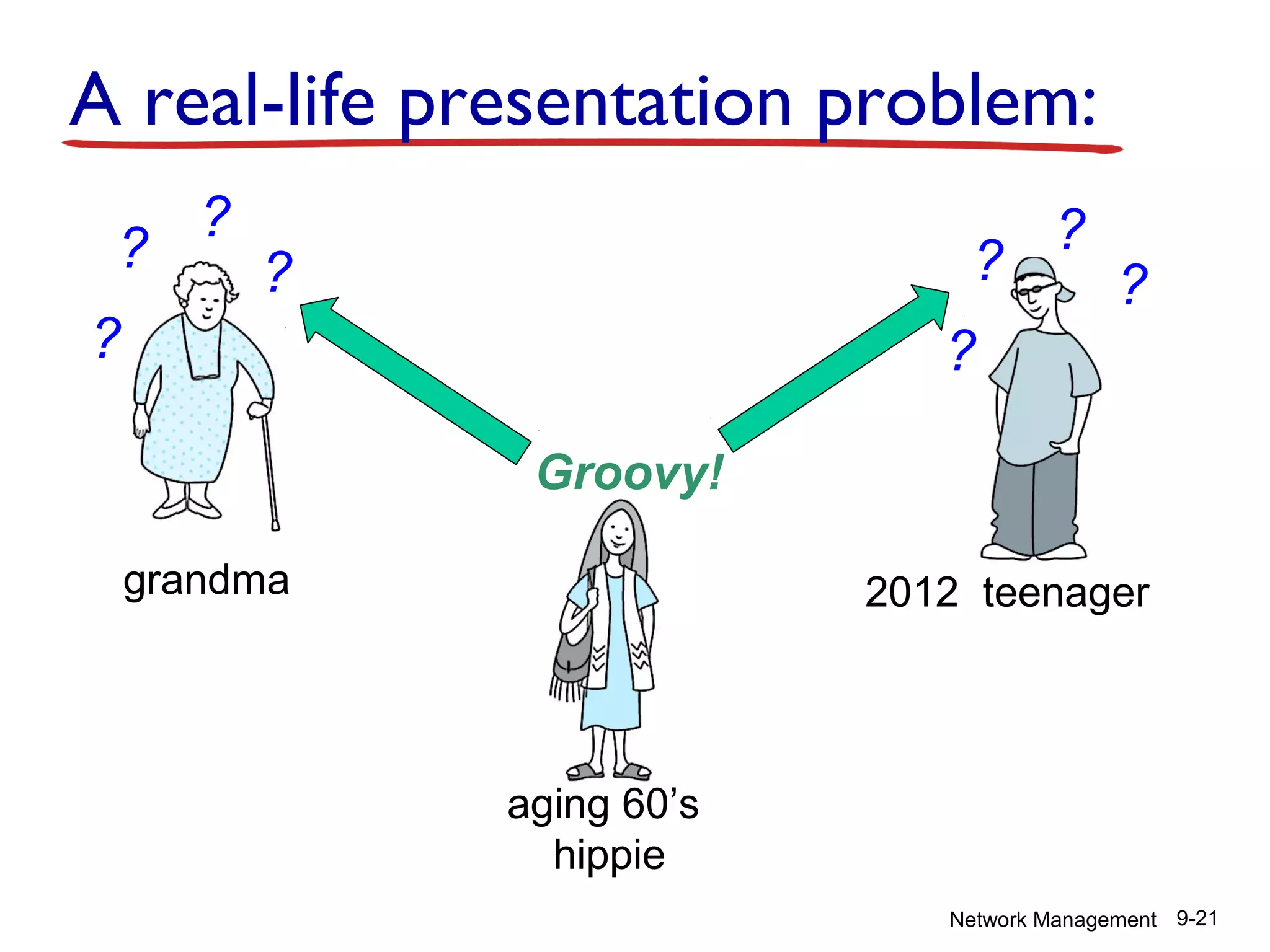
A real-life presentation problem:
?

?

?

?

?

?

?

?
Groovy!
grandma

2012 teenager

aging 60’s
hippie
Network Management 9-21
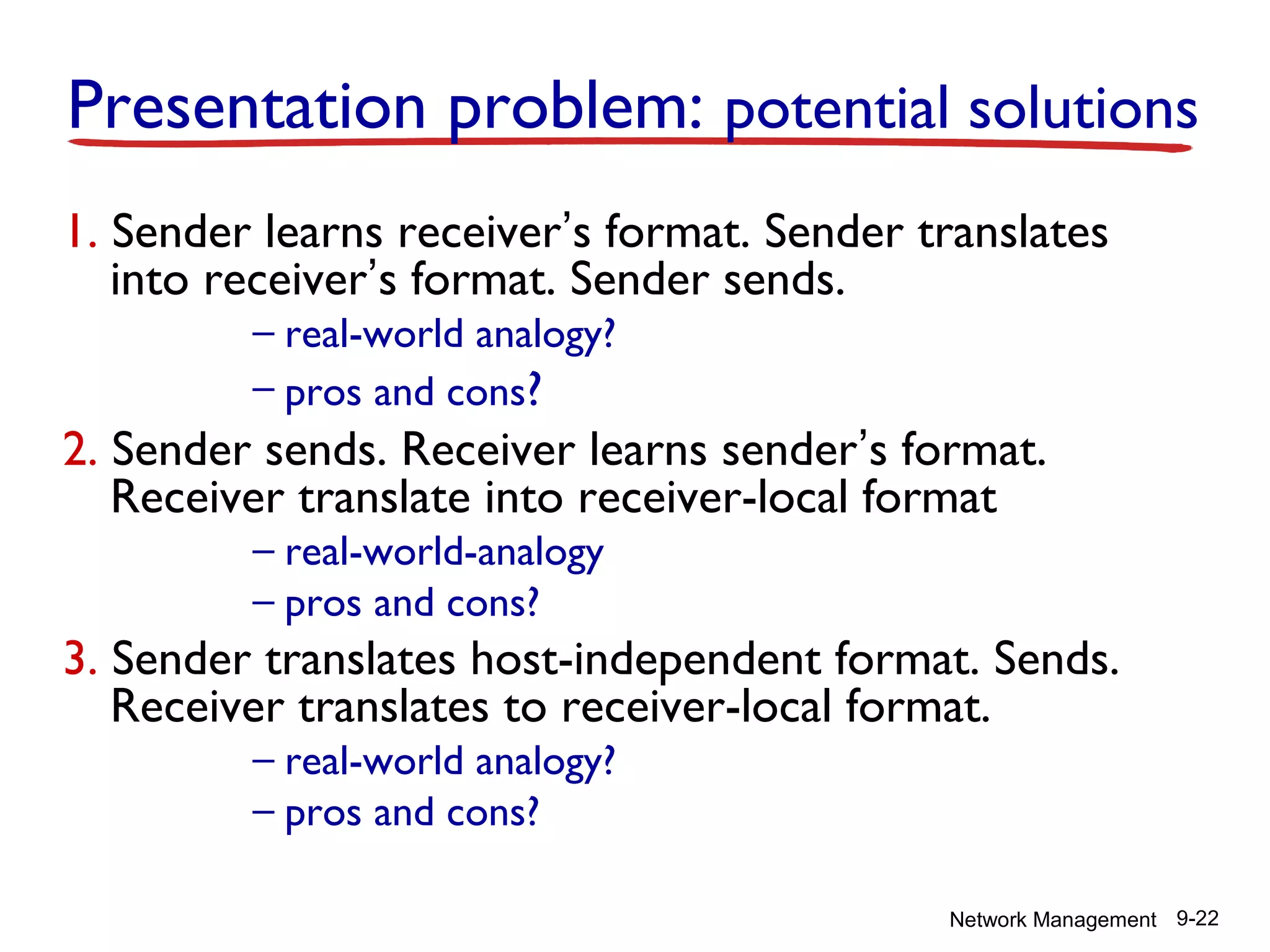
Presentation problem: potential solutions
1. Sender learns receiver’s format. Sender translates
into receiver’s format. Sender sends.
– real-world analogy?
– pros and cons?

2. Sender sends. Receiver learns sender’s format.
Receiver translate into receiver-local format
– real-world-analogy
– pros and cons?

3. Sender translates host-independent format. Sends.
Receiver translates to receiver-local format.
– real-world analogy?
– pros and cons?

Network Management 9-22
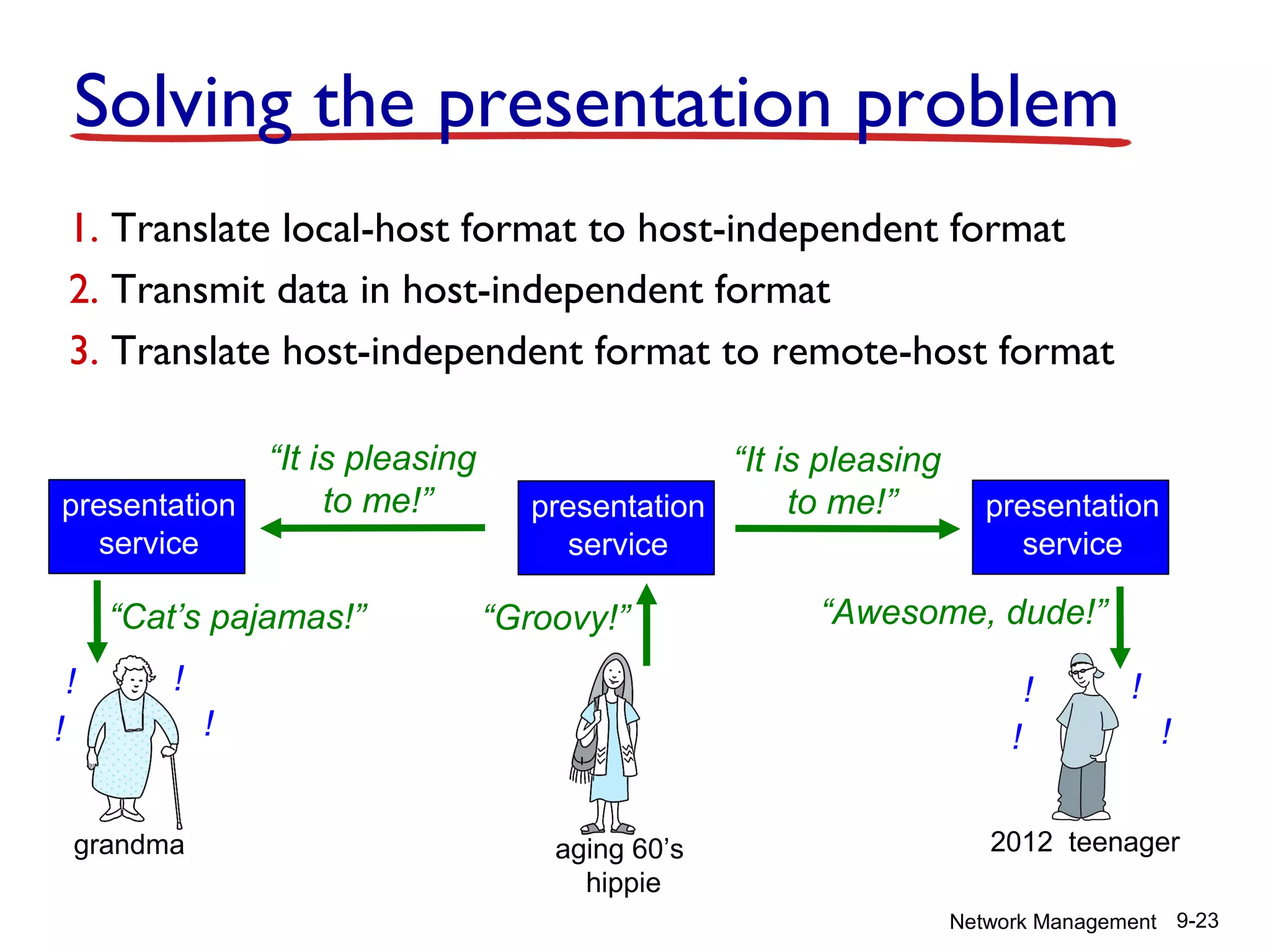
Solving the presentation problem
1. Translate local-host format to host-independent format
2. Transmit data in host-independent format
3. Translate host-independent format to remote-host format
“It is pleasing
to me!”
presentation
service

service

“Cat’s pajamas!”
!

“It is pleasing
to me!”
presentation
“Groovy!”

presentation
service

“Awesome, dude!”

!

!

!

!
grandma

!
aging 60’s
hippie

!
!

2012 teenager
Network Management 9-23
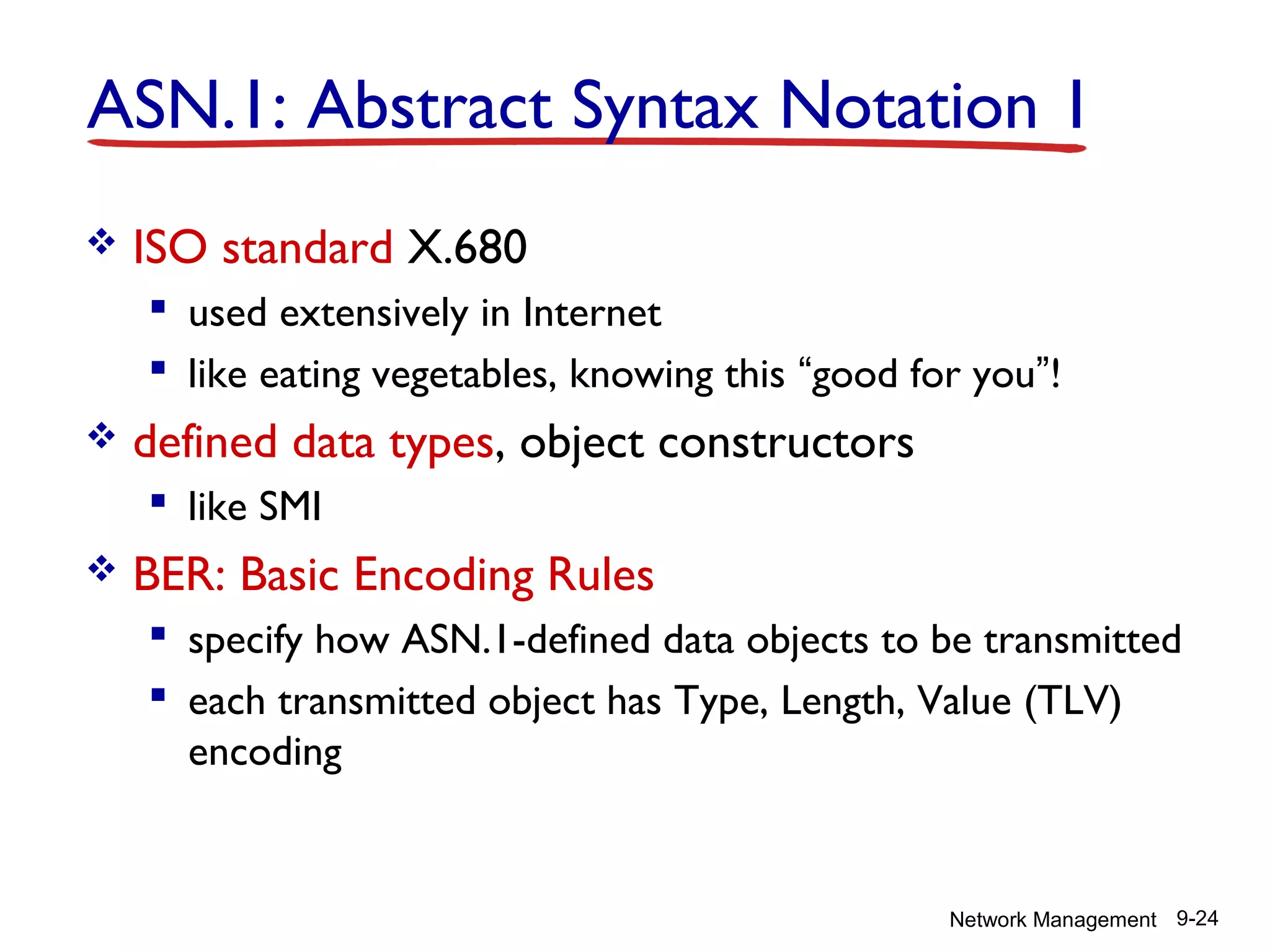
ASN.1: Abstract Syntax Notation 1


ISO standard X.680
 used extensively in Internet
 like eating vegetables, knowing this “good for you”!



defined data types, object constructors
 like SMI



BER: Basic Encoding Rules
 specify how ASN.1-defined data objects to be transmitted
 each transmitted object has Type, Length, Value (TLV)
encoding

Network Management 9-24
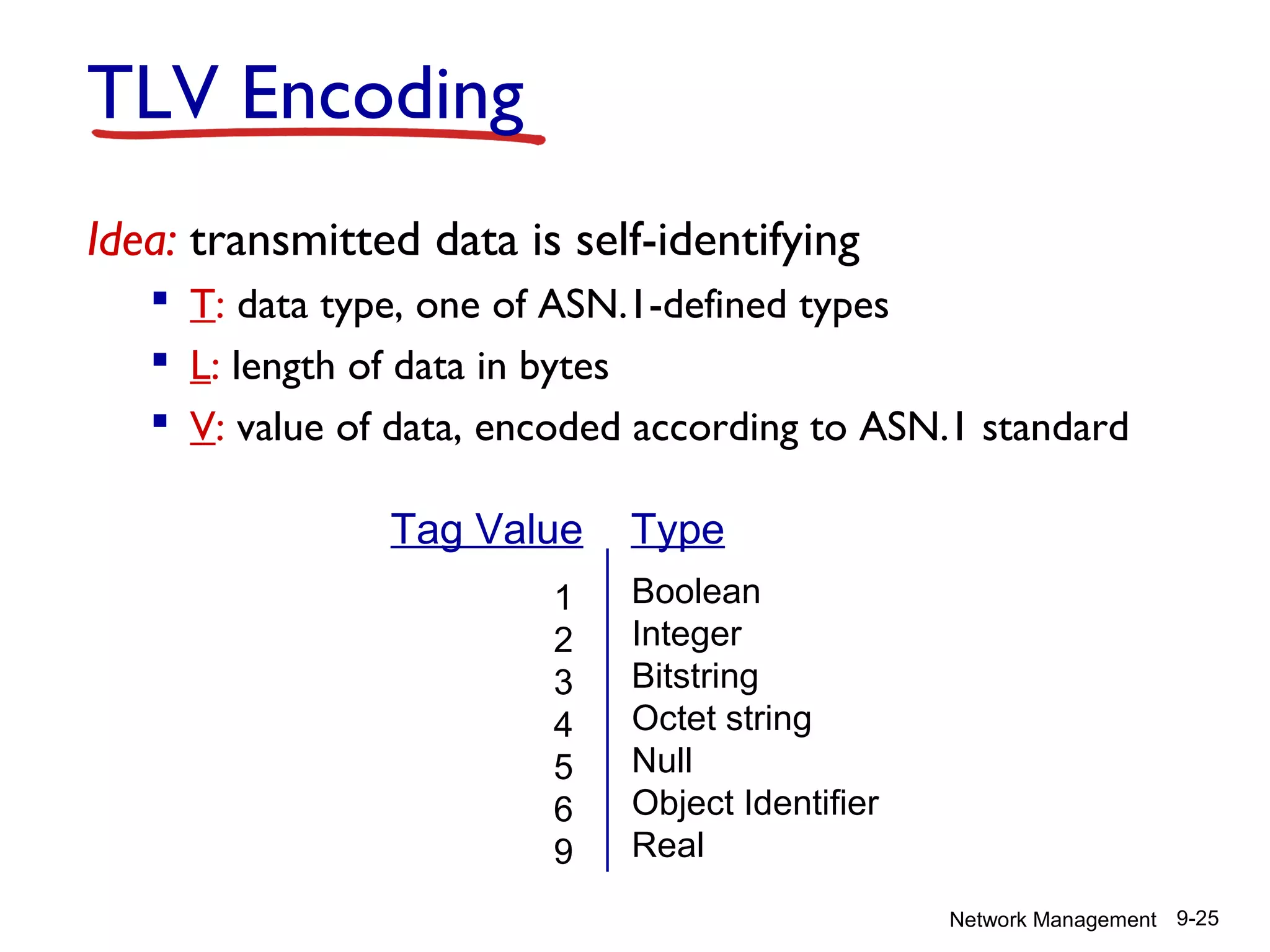
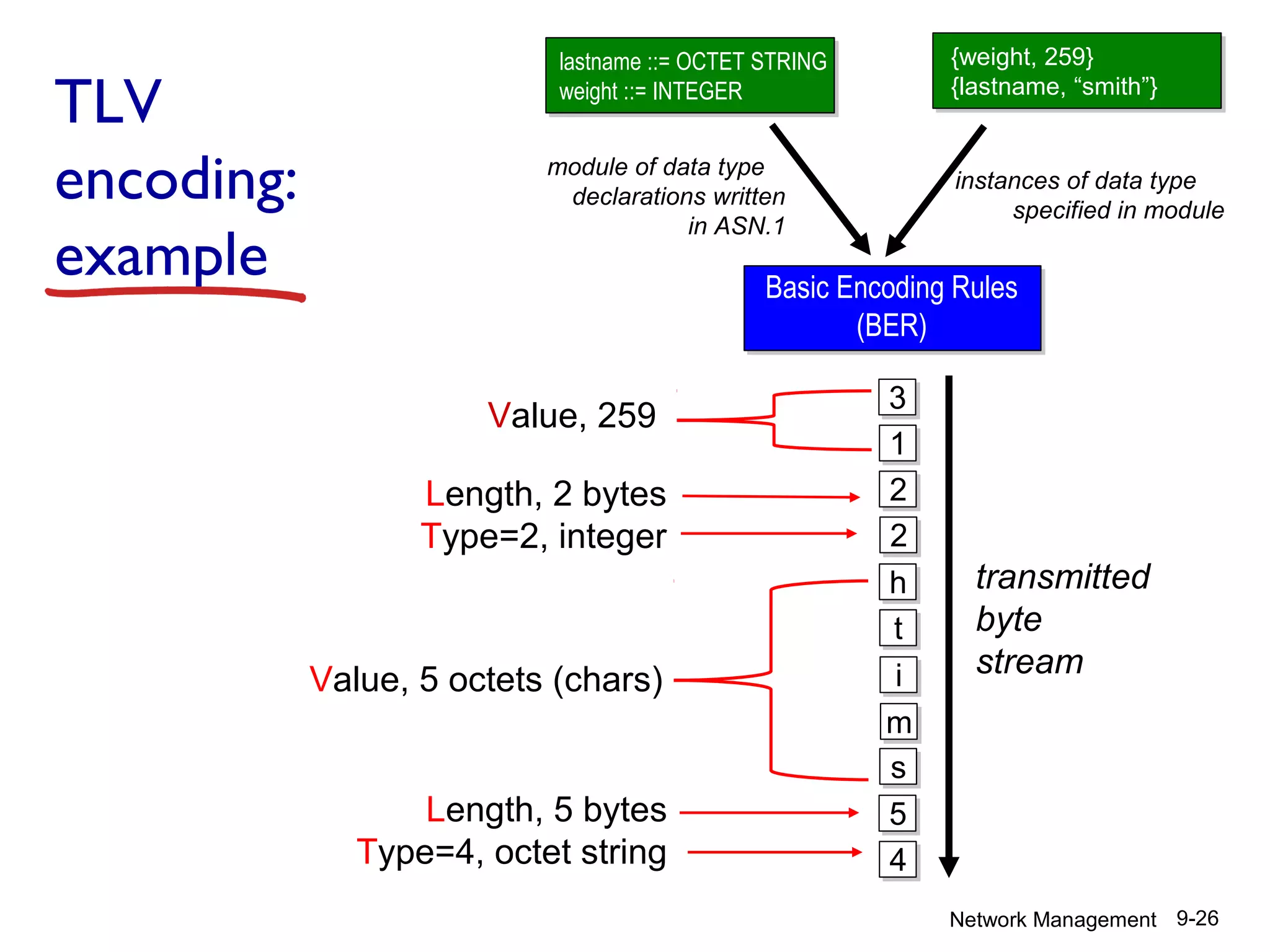
TLV Encoding
Idea: transmitted data is self-identifying
 T: data type, one of ASN.1-defined types
 L: length of data in bytes
 V: value of data, encoded according to ASN.1 standard
Tag Value
1
2
3
4
5
6
9

Type
Boolean
Integer
Bitstring
Octet string
Null
Object Identifier
Real
Network Management 9-25
TLV
encoding:
example

{weight, 259}
{lastname, “smith”}

lastname ::= OCTET STRING
weight ::= INTEGER
module of data type
declarations written
in ASN.1

instances of data type
specified in module

Basic Encoding Rules
(BER)

Value, 259
Length, 2 bytes
Type=2, integer

Value, 5 octets (chars)

Length, 5 bytes
Type=4, octet string

3
1
2
2
h
t
i
m
s
5
4

transmitted
byte
stream

Network Management 9-26
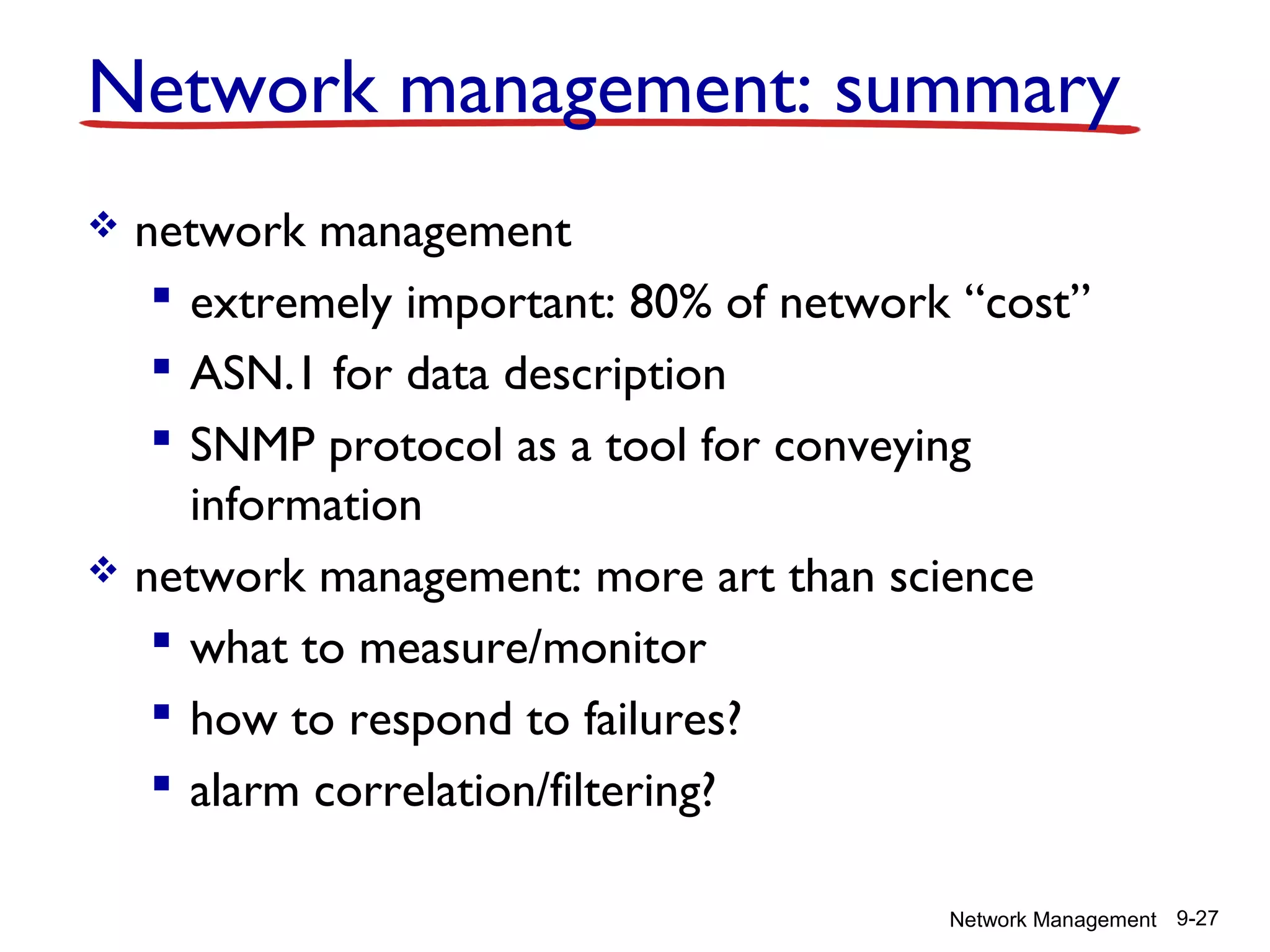
Network management: summary
network management
 extremely important: 80% of network “cost”
 ASN.1 for data description
 SNMP protocol as a tool for conveying
information
 network management: more art than science
 what to measure/monitor
 how to respond to failures?
 alarm correlation/filtering?


Network Management 9-27

Chapter 9 v6.0

  • 1.
    Chapter 9 Network Management Anote on the use of these ppt slides: We’re making these slides freely available to all (faculty, students, readers). They’re in PowerPoint form so you see the animations; and can add, modify, and delete slides (including this one) and slide content to suit your needs. They obviously represent a lot of work on our part. In return for use, we only ask the following:  If you use these slides (e.g., in a class) that you mention their source (after all, we’d like people to use our book!)  If you post any slides on a www site, that you note that they are adapted from (or perhaps identical to) our slides, and note our copyright of this material. Thanks and enjoy! JFK/KWR Computer Networking: A Top Down Approach 6th edition Jim Kurose, Keith Ross Addison-Wesley March 2012 All material copyright 1996-2012 J.F Kurose and K.W. Ross, All Rights Reserved Network Management 9-1
  • 2.
    Chapter 9: NetworkManagement Chapter goals:    introduction to network management  motivation  major components Internet network management framework  MIB: management information base  SMI: data definition language  SNMP: protocol for network management  security and administration presentation services: ASN.1 Network Management 9-2
  • 3.
    Chapter 9 outline Whatis network management?  Internet-standard management framework  Structure of Management Information: SMI  Management Information Base: MIB  SNMP Protocol Operations and Transport Mappings  Security and Administration  ASN.1  Network Management 9-3
  • 4.
    What is networkmanagement?   autonomous systems (aka “network”): 1000s of interacting hardware/software components other complex systems requiring monitoring, control:  jet airplane  nuclear power plant  others? "Network management includes the deployment, integration and coordination of the hardware, software, and human elements to monitor, test, poll, configure, analyze, evaluate, and control the network and element resources to meet the real-time, operational performance, and Quality of Service requirements at a reasonable cost." Network Management 9-4
  • 5.
    Infrastructure for networkmanagement definitions: managing entity managing data entity network management protocol agent data managed device agent data agent data managed device managed device agent data agent data managed devices contain managed objects whose data is gathered into a Management Information Base (MIB) managed device managed device Network Management 9-5
  • 6.
    Network management standards OSICMIP  Common Management Information Protocol  designed 1980’s: the unifying net management standard  too slowly standardized SNMP: Simple Network Management Protocol  Internet roots (SGMP)  started simple  deployed, adopted rapidly  growth: size, complexity  currently: SNMP V3  de facto network management standard Network Management 9-6
  • 7.
    Chapter 9 outline Whatis network management?  Internet-standard management framework  Structure of Management Information: SMI  Management Information Base: MIB  SNMP Protocol Operations and Transport Mappings  Security and Administration  ASN.1  Network Management 9-7
  • 8.
    SNMP overview: 4key parts  Management information base (MIB):  distributed information store of network management data  Structure of Management Information (SMI):  data definition language for MIB objects  SNMP protocol  convey manager<->managed object info, commands  security, administration capabilities  major addition in SNMPv3 Network Management 9-8
  • 9.
    SMI: data definitionlanguage Purpose: syntax, semantics of management data welldefined, unambiguous    base data types:  straightforward, boring OBJECT-TYPE  data type, status, semantics of managed object MODULE-IDENTITY  groups related objects into MIB module Basic Data Types INTEGER Integer32 Unsigned32 OCTET STRING OBJECT IDENTIFIED IPaddress Counter32 Counter64 Guage32 Time Ticks Opaque Network Management 9-9
  • 10.
    SNMP MIB MIB modulespecified via SMI MODULE-IDENTITY (100 standardized MIBs, more vendor-specific) MODULE OBJECT TYPE: OBJECT TYPE: OBJECT TYPE: objects specified via SMI OBJECT-TYPE construct Network Management 9-10
  • 11.
    SMI: object, moduleexamples OBJECT-TYPE: ipInDelivers ipInDelivers OBJECT TYPE SYNTAX Counter32 MAX-ACCESS read-only STATUS current DESCRIPTION “The total number of input datagrams successfully delivered to IP userprotocols (including ICMP)” ::= { ip 9} MODULE-IDENTITY: ipMIB ipMIB MODULE-IDENTITY LAST-UPDATED “941101000Z” ORGANZATION “IETF SNPv2 Working Group” CONTACT-INFO “ Keith McCloghrie ……” DESCRIPTION “The MIB module for managing IP and ICMP implementations, but excluding their management of IP routes.” REVISION “019331000Z” ……… ::= {mib-2 48} Network Management 9-11
  • 12.
    MIB example: UDPmodule Object ID Name Type 1.3.6.1.2.1.7.1 UDPInDatagrams Counter32 Comments total # datagrams delivered at this node 1.3.6.1.2.1.7.2 UDPNoPorts Counter32 # underliverable datagrams: no application at port 1.3.6.1.2.1.7.3 UDInErrors Counter32 # undeliverable datagrams: all other reasons 1.3.6.1.2.1.7.4 UDPOutDatagrams Counter32 # datagrams sent 1.3.6.1.2.1.7.5 udpTable one entry for each port SEQUENCE in use by app, gives port # and IP address Network Management 9-12
  • 13.
    SNMP naming question: howto name every possible standard object (protocol, data, more..) in every possible network standard?? answer: ISO Object Identifier tree:  hierarchical naming of all objects  each branchpoint has name, number 1.3.6.1.2.1.7.1 ISO ISO-ident. Org. US DoD Internet udpInDatagrams UDP MIB2 management Network Management 9-13
  • 14.
  • 15.
    SNMP protocol Two waysto convey MIB info, commands: managing entity request response agent data managed device request/response mode managing entity trap msg agent data managed device trap mode Network Management 9-15
  • 16.
    SNMP protocol: messagetypes Message type Function GetRequest GetNextRequest GetBulkRequest Mgr-to-agent: “get me data” (instance,next in list, block) InformRequest SetRequest Response Trap Mgr-to-Mgr: here’s MIB value Mgr-to-agent: set MIB value Agent-to-mgr: value, response to Request Agent-to-mgr: inform manager of exceptional event Network Management 9-16
  • 17.
    SNMP protocol: message formats Variablesto get/set Get/set header PDU type (0-3) PDU type 4 Request ID Error Status (0-5) Enterprise Agent Addr Error Index Trap Type (0-7) Name Specific code Trap header Value Name Time stamp Value …. Name Value …. Trap info SNMP PDU Network Management 9-17
  • 18.
    SNMP security andadministration encryption: DES-encrypt SNMP message  authentication: compute, send MIC(m,k): compute hash (MIC) over message (m), secret shared key (k)  protection against playback: use nonce  view-based access control:   SNMP entity maintains database of access rights, policies for various users  database itself accessible as managed object! Network Management 9-18
  • 19.
    Chapter 9 outline Whatis network management?  Internet-standard management framework  Structure of Management Information: SMI  Management Information Base: MIB  SNMP Protocol Operations and Transport Mappings  Security and Administration  The presentation problem: ASN.1  Network Management 9-19
  • 20.
    The presentation problem Q:does perfect memory-to-memory copy solve “the communication problem”? A: not always! struct { char code; int x; } test; test.x = 256; test.code=‘a’ test.code test.x a 00000001 00000011 host 1 format test.code test.x a 00000011 00000001 host 2 format problem: different data format, storage conventions Network Management 9-20
  • 21.
    A real-life presentationproblem: ? ? ? ? ? ? ? ? Groovy! grandma 2012 teenager aging 60’s hippie Network Management 9-21
  • 22.
    Presentation problem: potentialsolutions 1. Sender learns receiver’s format. Sender translates into receiver’s format. Sender sends. – real-world analogy? – pros and cons? 2. Sender sends. Receiver learns sender’s format. Receiver translate into receiver-local format – real-world-analogy – pros and cons? 3. Sender translates host-independent format. Sends. Receiver translates to receiver-local format. – real-world analogy? – pros and cons? Network Management 9-22
  • 23.
    Solving the presentationproblem 1. Translate local-host format to host-independent format 2. Transmit data in host-independent format 3. Translate host-independent format to remote-host format “It is pleasing to me!” presentation service service “Cat’s pajamas!” ! “It is pleasing to me!” presentation “Groovy!” presentation service “Awesome, dude!” ! ! ! ! grandma ! aging 60’s hippie ! ! 2012 teenager Network Management 9-23
  • 24.
    ASN.1: Abstract SyntaxNotation 1  ISO standard X.680  used extensively in Internet  like eating vegetables, knowing this “good for you”!  defined data types, object constructors  like SMI  BER: Basic Encoding Rules  specify how ASN.1-defined data objects to be transmitted  each transmitted object has Type, Length, Value (TLV) encoding Network Management 9-24
  • 25.
    TLV Encoding Idea: transmitteddata is self-identifying  T: data type, one of ASN.1-defined types  L: length of data in bytes  V: value of data, encoded according to ASN.1 standard Tag Value 1 2 3 4 5 6 9 Type Boolean Integer Bitstring Octet string Null Object Identifier Real Network Management 9-25
  • 26.
    TLV encoding: example {weight, 259} {lastname, “smith”} lastname::= OCTET STRING weight ::= INTEGER module of data type declarations written in ASN.1 instances of data type specified in module Basic Encoding Rules (BER) Value, 259 Length, 2 bytes Type=2, integer Value, 5 octets (chars) Length, 5 bytes Type=4, octet string 3 1 2 2 h t i m s 5 4 transmitted byte stream Network Management 9-26
  • 27.
    Network management: summary networkmanagement  extremely important: 80% of network “cost”  ASN.1 for data description  SNMP protocol as a tool for conveying information  network management: more art than science  what to measure/monitor  how to respond to failures?  alarm correlation/filtering?  Network Management 9-27