The document discusses different ways of representing numerical data in computing systems, including:
1) Binary representation, which converts decimal numbers to binary by repeatedly dividing by column headings and tracking the remainders as 1s and 0s.
2) Negative numbers can be represented using sign-and-magnitude or two's complement methods.
3) Other number systems like octal and hexadecimal are also discussed which use different column headings but the same representation principles.
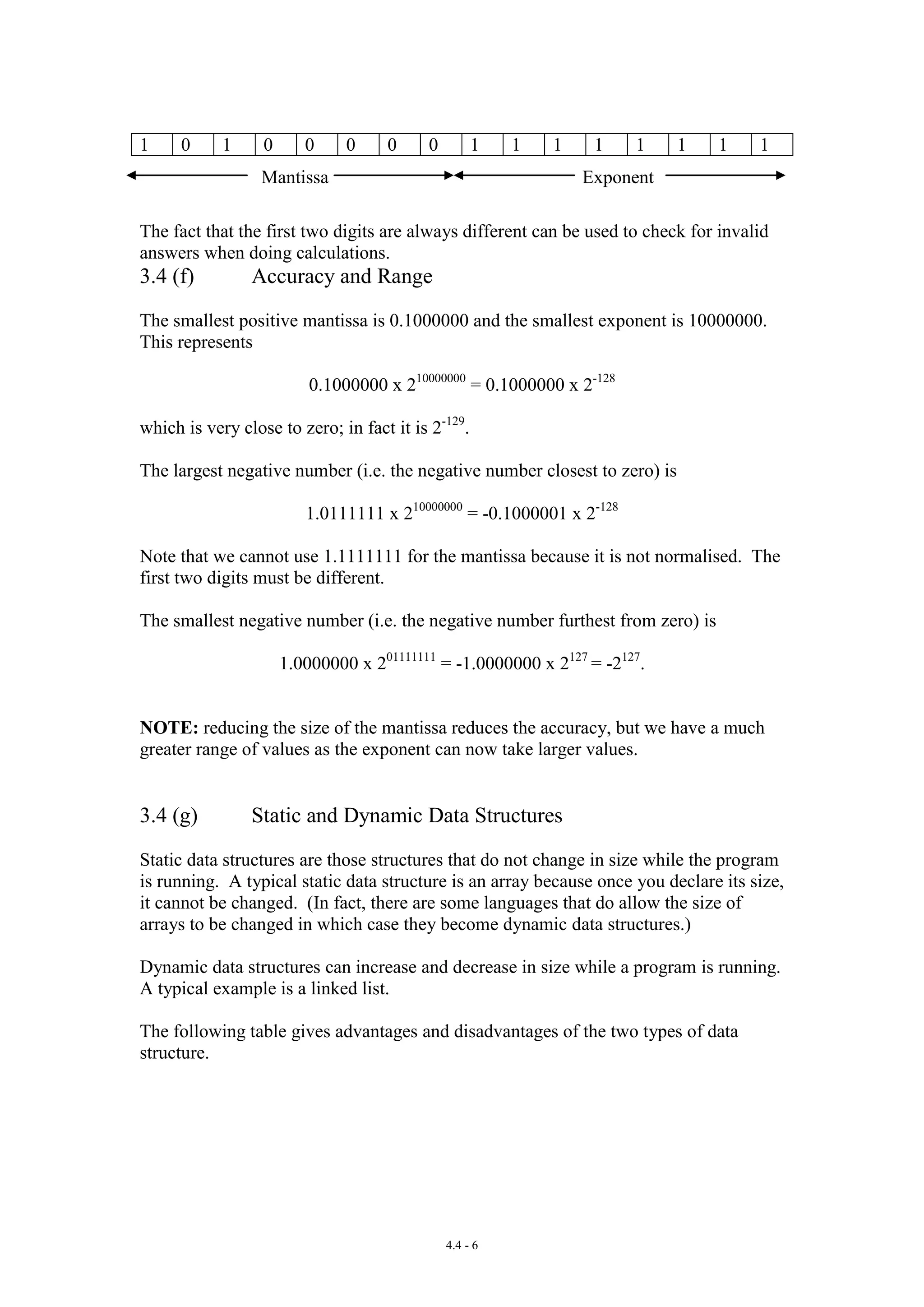
4) Floating point representation separates a real number into a mantissa and exponent to store fractional numbers more efficiently in binary.





![3.4 (j) Searching Methods
Serial Search
Let the data consist of n values held in an array called DataArray which has subscripts
numbered from 1 upwards. Let X be the value we are trying to find. We must check
that the array is not empty before starting the search.
The algorithm to find the position of X is
1. If n < 1 then report error, array is empty.
2. For i = 1 to n do
a. If DataArray[i] = X then return i and stop.
3. Report error, X is not in the array and stop.
Note that the for loop only acts on the indented line. If there is more than one
operation to perform inside a loop, make sure that all the lines are indented.
Binary Search
Assume that the data is held in an array as described above but that the data is in
ascending order in the array. We must split the lists in two. If there is an even
number of values, dividing by two will give a whole number and this will tell us
where to split the list. However, if the list consists of an odd number of values we
will need to find the integer part of it, as an array subscript must be an integer.
We must also make sure that, when we split a list in two, we use the correct one for
the next search. Suppose we have a list of eight values. Splitting this gives a list of
the four values in cells 1 to 4 and four values in cells 5 to 8. When we started we
needed to consider the list in cells 1 to 8. That is the first cell was 1 and the last cell
was 8. Now, if we move into the first list (cells 1 to 4), the first cell stays at 1 but the
last cell becomes 4. Similarly, if we use the second list (cells 5 to 8), the first cell
becomes 5 and the last is still 8. This means that if we use the first list, the first cell in
the new list is unchanged but the last is changed. However, if we use the second list,
the first cell is changed but the last is not changed. This gives us the clue of how to
do the sort.
3.4 (k) Sorting and Merging
Sorting is placing values in an order such as numeric order or alphabetic order. The
order may be ascending or descending. For example the values
3 5 6 8 12 16 25
are in ascending numeric order and
Will Rose Mattu Juni Hazel Dopu Anne
are in descending alphabetic order.
4.4 - 12](https://image.slidesharecdn.com/6916572/75/3-4-12-2048.jpg)


