The UNESCO convention
of the Intangible Cultural Heritage
New Ways and Opportunities to Strengthen and
Safeguard Traditional Sports in Europe
Albert van der Zeijden
scientific policy advisor
Dutch Centre for Intangible Heritage
• Accredited NGO, ‘competent body’, responsible
for the coordination and implementation of the
ICH convention in the Netherlands
• Advise functions (national + international)
• Raising awareness
• Knowledge, information, advise, mediating
• Supporting the communities in their safeguarding
efforts (eg. Safeguarding methodologies)
and the sports
About the Sport Programme
UNESCO is the United Nations’ lead agency for Physical
Education and Sport (PES).
This programme focuses on the following diverse themes:
Sport for Peace and Development
Quality Physical Education
Traditional Sports and Games
Women and Sport
Anti-Doping
and the traditional sports
Traditional sports and games (TSG) can form the backbone of a
community, and UNESCO is driven to protect and promote
these sports to further community spirit, bring peoples
together and install a sense of pride in a society’s cultural roots.
In the Declaration of Punta del Este, in December 1999,
ministers emphasized the preservation and the appraisal of
traditional and indigenous sports from different regional and
national cultural heritages, including the establishment of a
World Heritage List of Traditional Games and Sports.
Importance ICH convention for the
traditional sports
• ICH convention most effective policy tool UNESCO
• Convention is about safeguarding: giving a future
to intangible heritage
• Traditional Sports are part of the Intangible
Cultural Heritage
• Convention ratified by most countries in the
world
• Goal: International cooperation and mutual
assistance
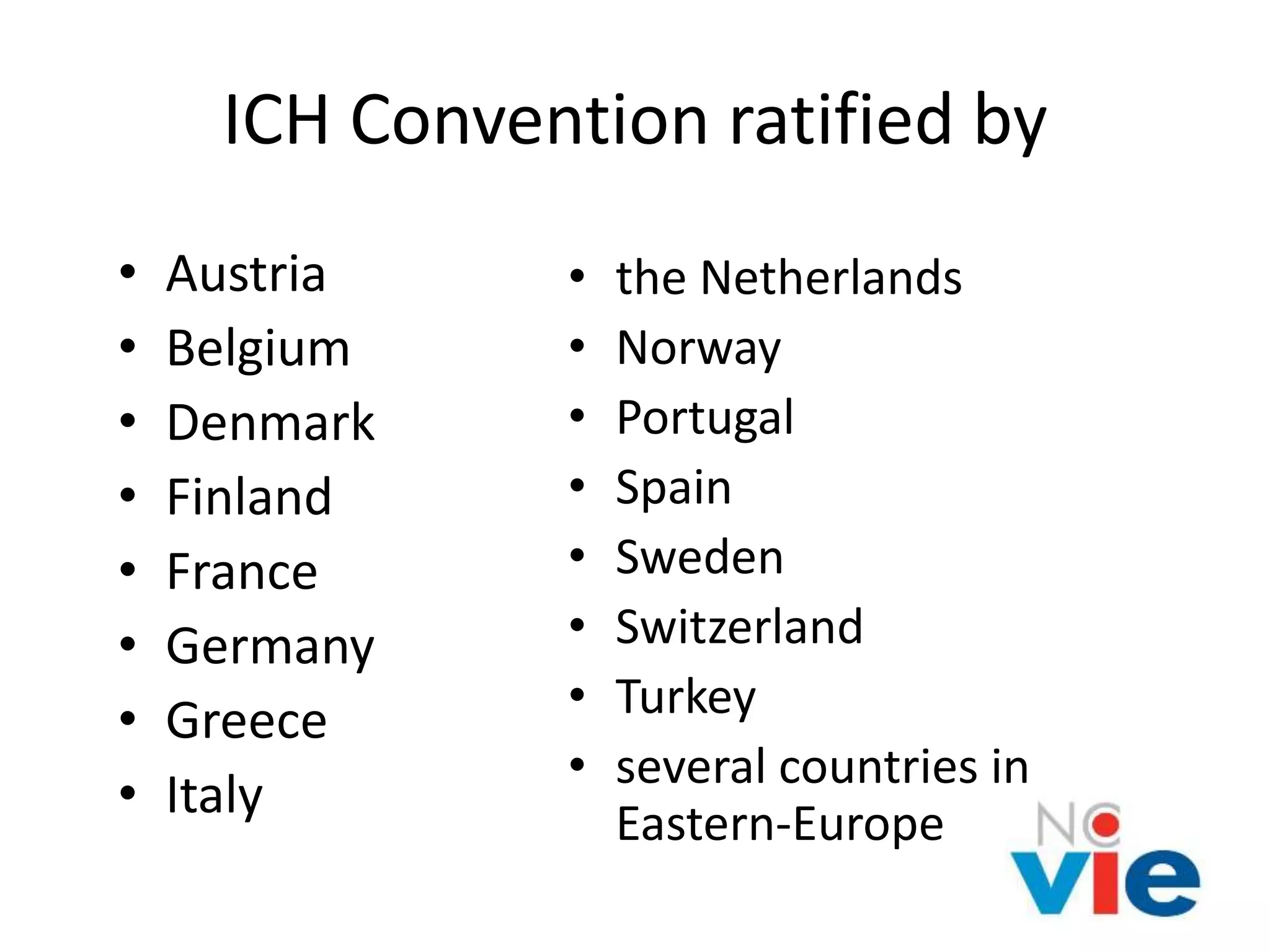
ICH Convention ratified by
• Austria
• Belgium
• Denmark
• Finland
• France
• Germany
• Greece
• Italy
• the Netherlands
• Norway
• Portugal
• Spain
• Sweden
• Switzerland
• Turkey
• several countries in
Eastern-Europe
Purposes of the Convention
The purposes of this Convention are:
(a) to safeguard the intangible cultural heritage;
(b) to ensure respect for the intangible cultural heritage of the
communities, groups and individuals concerned;
(c) to raise awareness at the local, national and international levels of
the importance of the intangible cultural heritage, and of ensuring
mutual appreciation thereof;
(d) to provide for international cooperation and assistance.
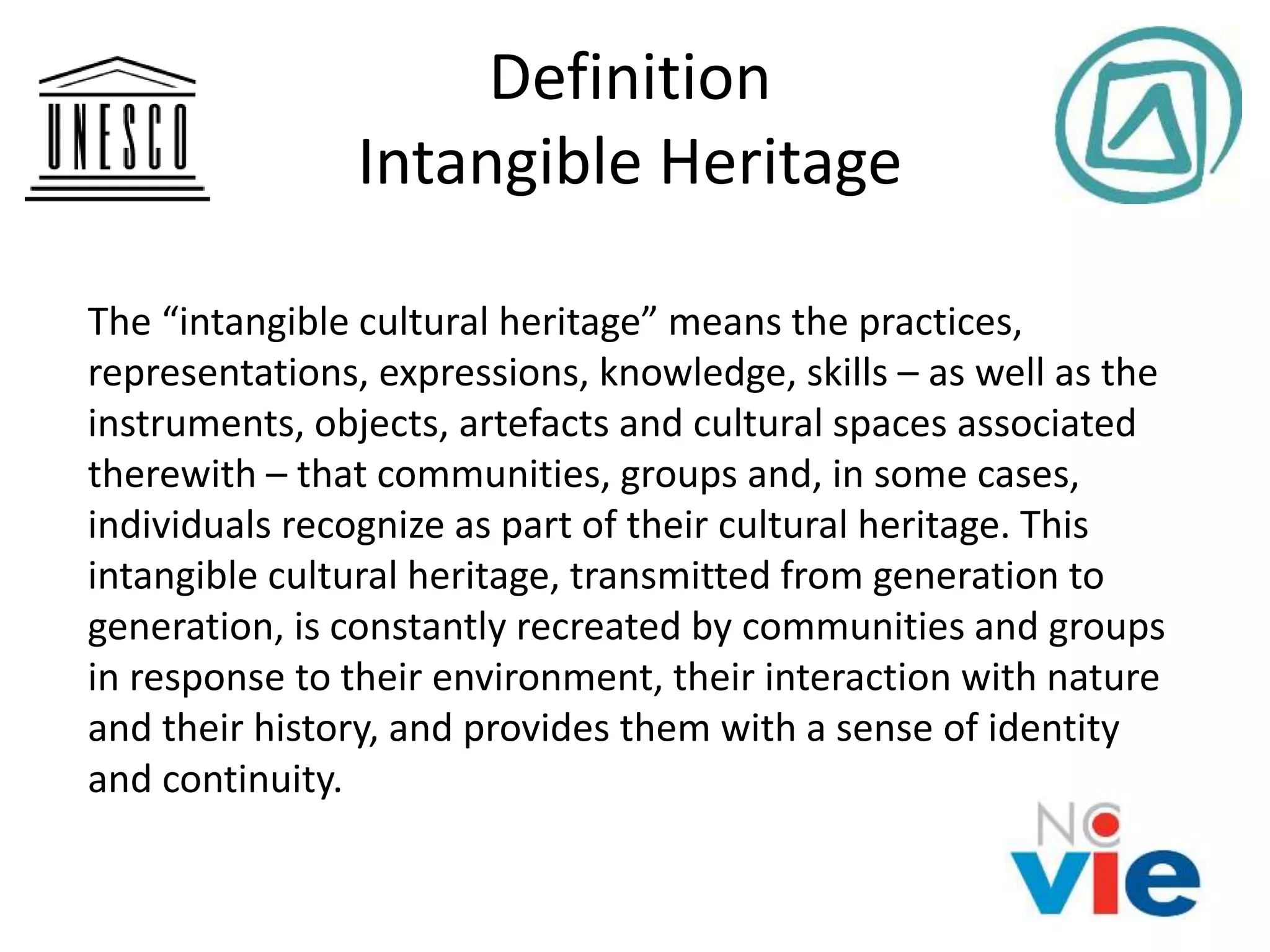
Definition
Intangible Heritage
The “intangible cultural heritage” means the practices,
representations, expressions, knowledge, skills – as well as the
instruments, objects, artefacts and cultural spaces associated
therewith – that communities, groups and, in some cases,
individuals recognize as part of their cultural heritage. This
intangible cultural heritage, transmitted from generation to
generation, is constantly recreated by communities and groups
in response to their environment, their interaction with nature
and their history, and provides them with a sense of identity
and continuity.
Intangible Heritage
Domains
The “intangible cultural heritage” is manifested
in the following domains:
(a) oral traditions and expressions, including
language as a vehicle of the intangible
cultural heritage;
(b) performing arts;
(c) social practices, rituals and festive events;
(d) knowledge and practices concerning nature and
the universe;
(e) traditional craftsmanship.
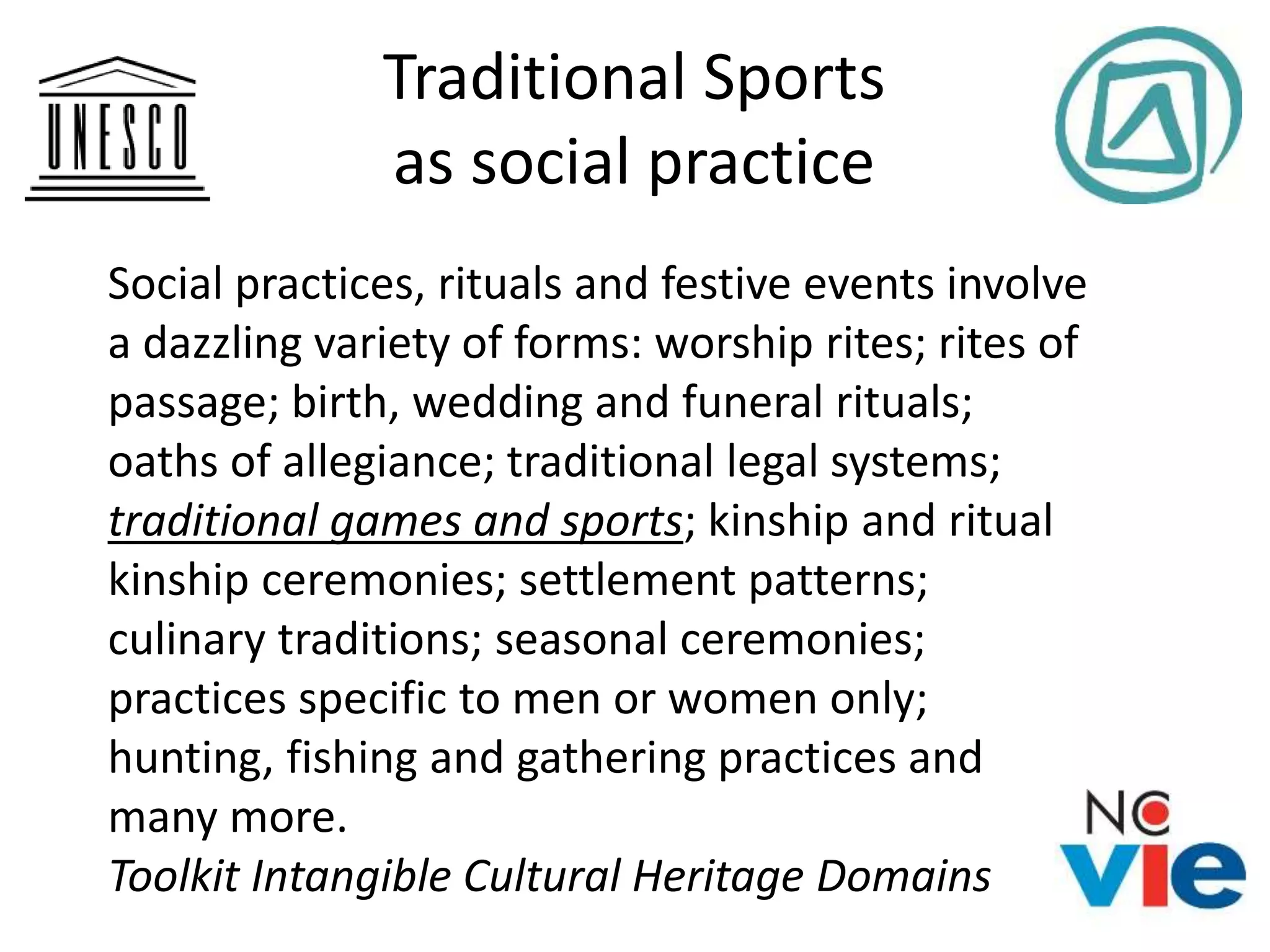
Traditional Sports
as social practice
Social practices, rituals and festive events involve
a dazzling variety of forms: worship rites; rites of
passage; birth, wedding and funeral rituals;
oaths of allegiance; traditional legal systems;
traditional games and sports; kinship and ritual
kinship ceremonies; settlement patterns;
culinary traditions; seasonal ceremonies;
practices specific to men or women only;
hunting, fishing and gathering practices and
many more.
Toolkit Intangible Cultural Heritage Domains
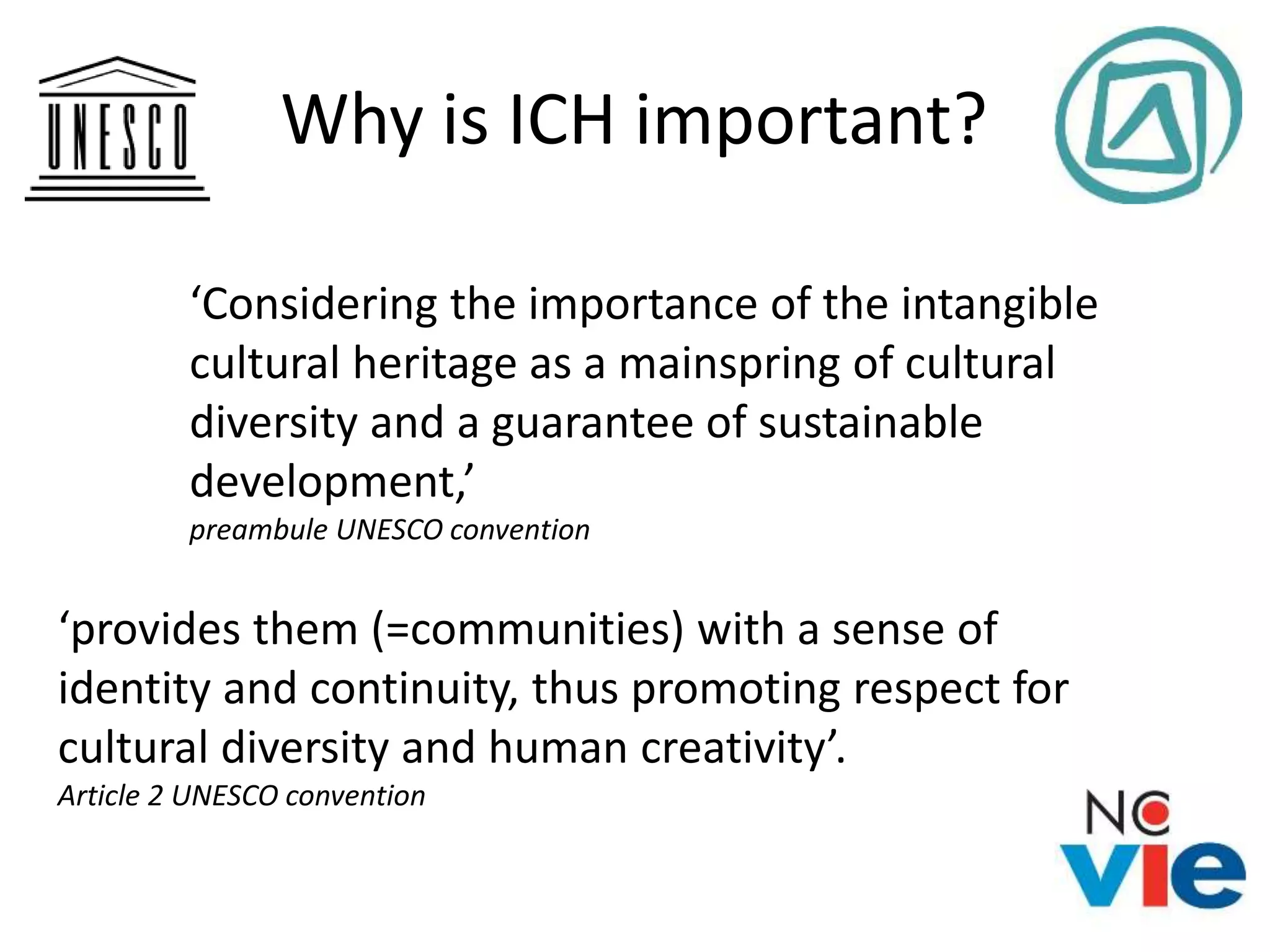
Why is ICH important?
‘Considering the importance of the intangible
cultural heritage as a mainspring of cultural
diversity and a guarantee of sustainable
development,’
preambule UNESCO convention
‘provides them (=communities) with a sense of
identity and continuity, thus promoting respect for
cultural diversity and human creativity’.
Article 2 UNESCO convention
Communities first
Within the framework of its safeguarding activities
of the intangible cultural heritage, each
State Party shall endeavour to ensure the widest
possible participation of communities, groups
and, where appropriate, individuals that create,
maintain and transmit such heritage, and to
involve them actively in its management.
Article 15 – Participation of communities, groups
and individuals
Obligations States Parties
Each State Party shall:
(a) take the necessary measures to ensure the
safeguarding of the intangible cultural heritage present
in its territory;
(b) identify and define the various elements of the
intangible cultural heritage present in its territory, with
the participation of communities, groups and relevant
nongovernmental organizations.
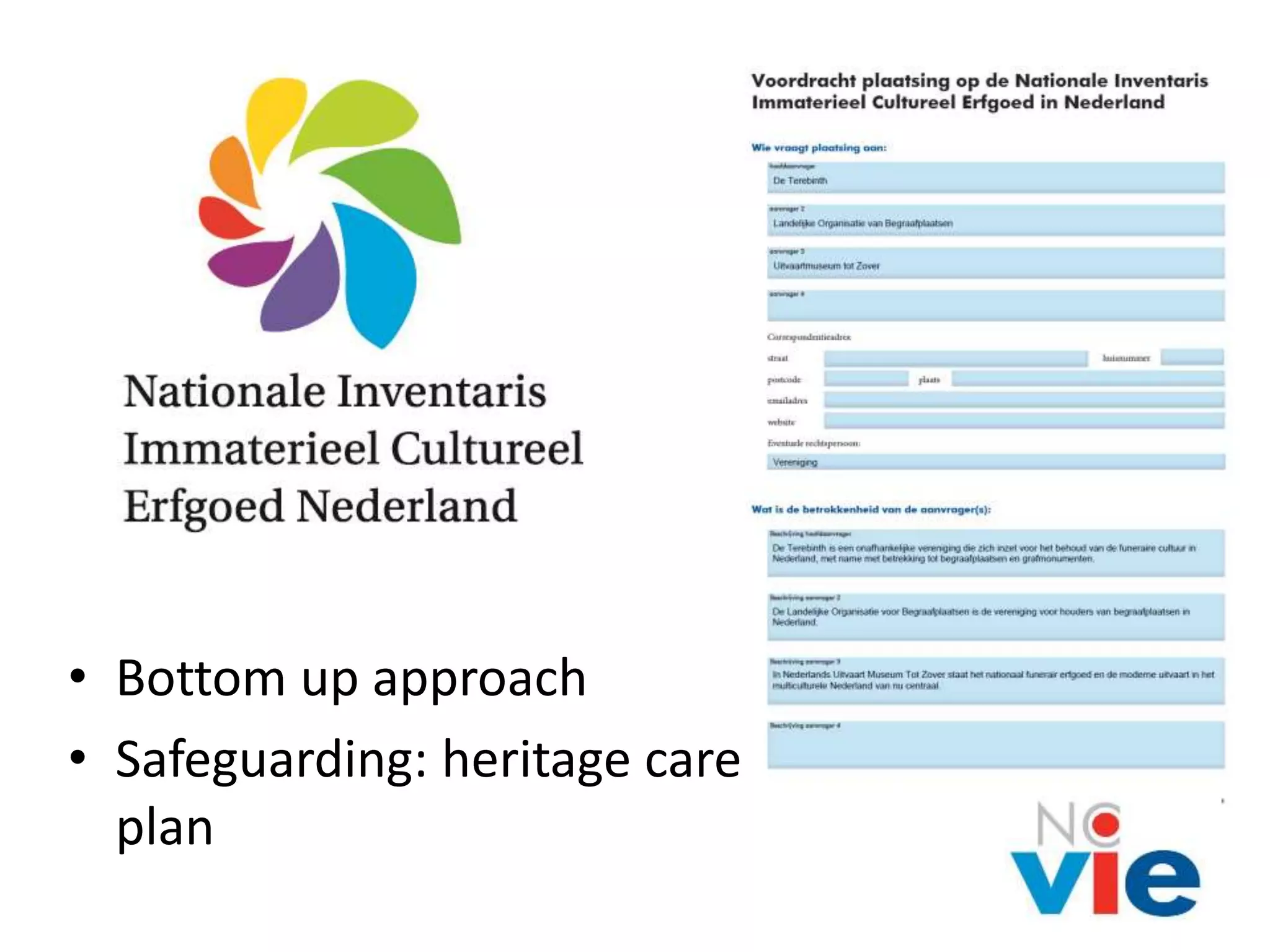
• Bottom up approach
• Safeguarding: heritage care
plan
Bottom up approach
• Communities / communtiy associations can
put forward their tradition for the Inventory
• In the form they should give a clear
description of the (history) of the tradition
and of the people participating
• The safeguardingplan starts with a swot
analysis of the tradition
• Weak and strong points and how to address
them
National Inventories
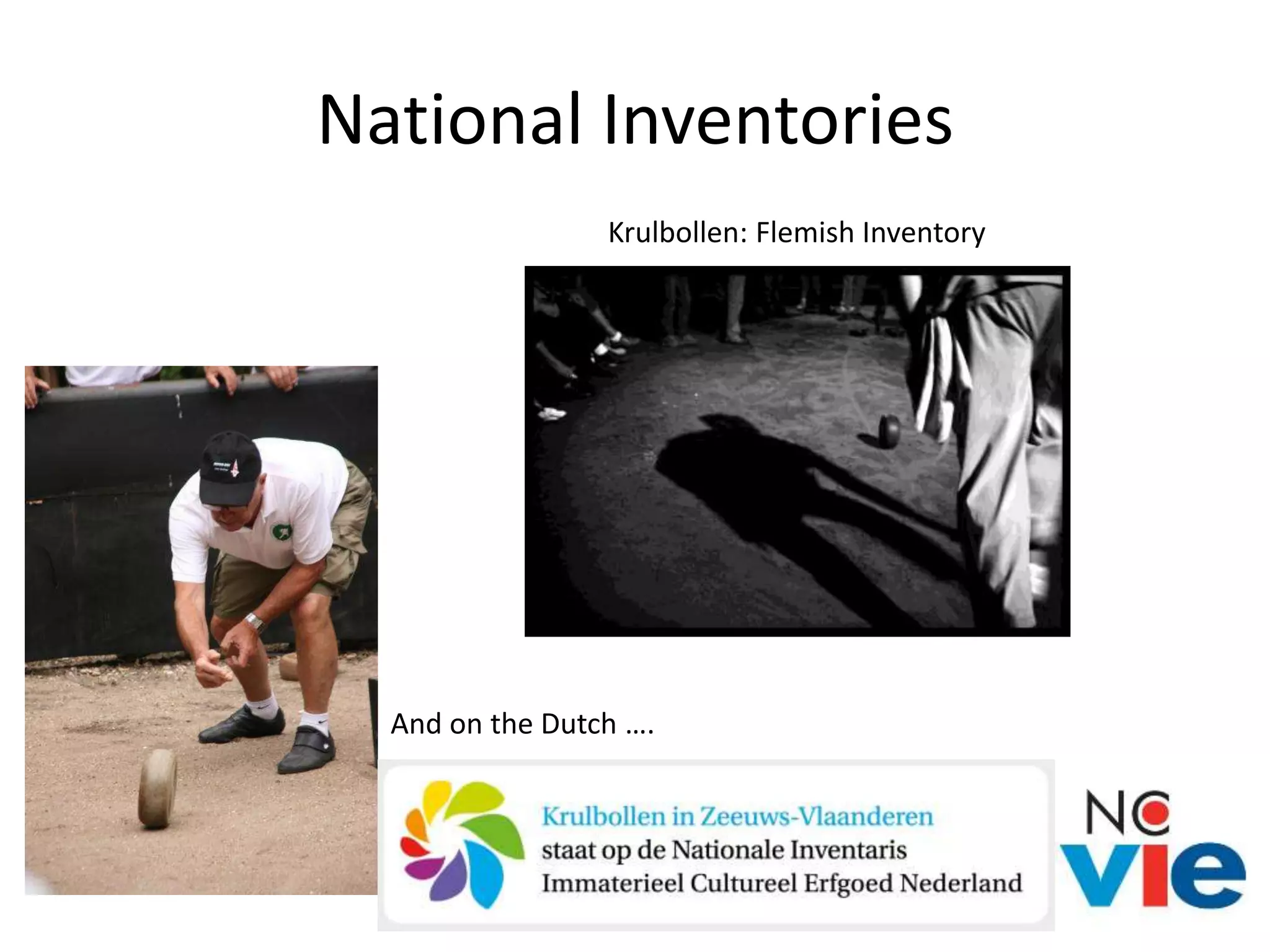
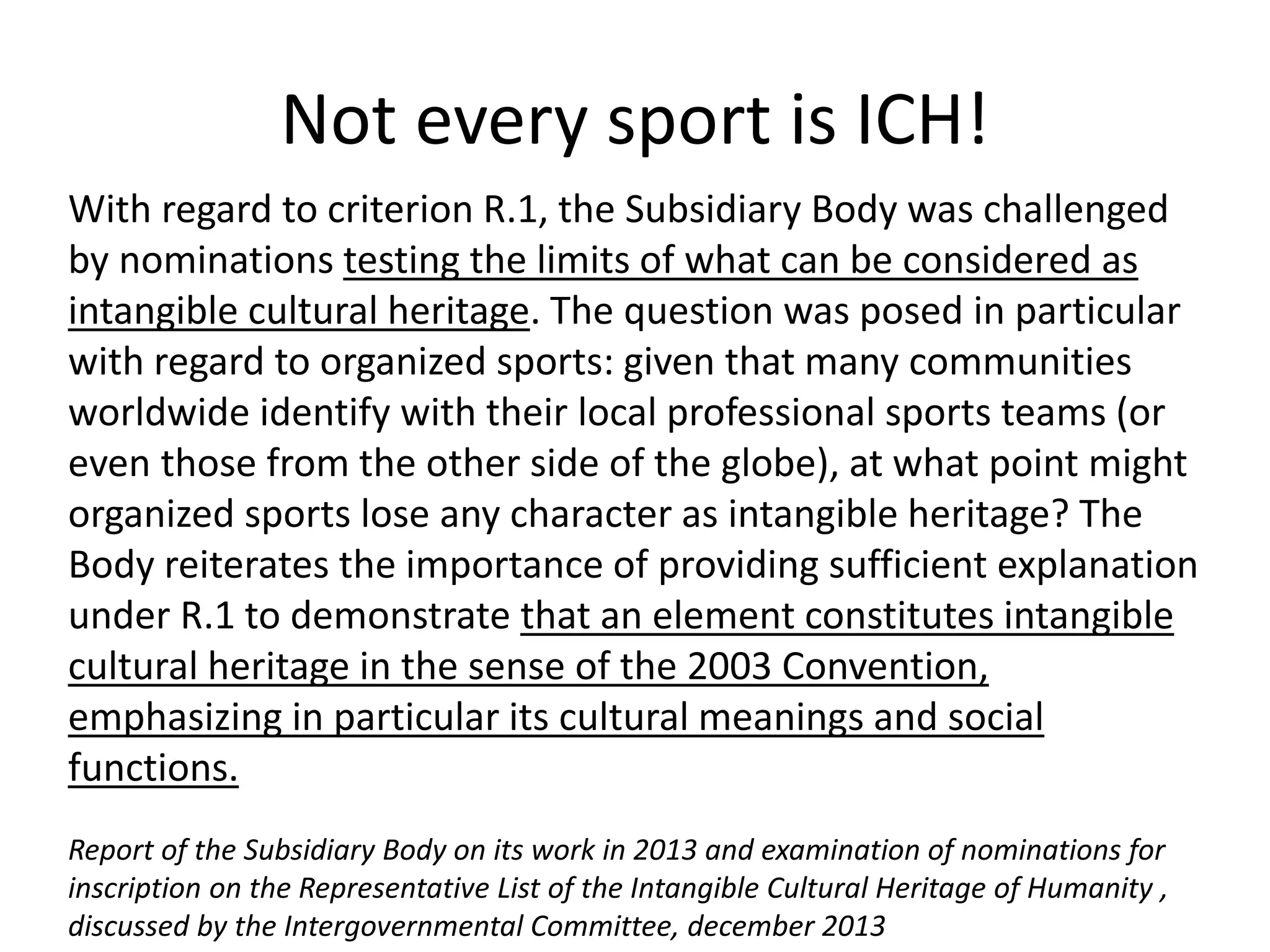
Krulbollen: Flemish Inventory
And on the Dutch ….
Other sports on the
Dutch Inventory
Sports on the Dutch Inventory
• Krulbollen Zeeuws Vlaanderen
• Valkerij
• Schoonrijden
• Vierdaagse Nijmegen
• Harddraverij Stompwijk
• Acht van Chaam
What makes a sport
intangible heritage?
• Heritage and cultural identity important
• It should be a ‘traditional’ sport with a history
and it should be important for a community
who wants to safeguard this tradition
With regard to criterion R.1, the Subsidiary Body was challenged
by nominations testing the limits of what can be considered as
intangible cultural heritage. The question was posed in particular
with regard to organized sports: given that many communities
worldwide identify with their local professional sports teams (or
even those from the other side of the globe), at what point might
organized sports lose any character as intangible heritage? The
Body reiterates the importance of providing sufficient explanation
under R.1 to demonstrate that an element constitutes intangible
cultural heritage in the sense of the 2003 Convention,
emphasizing in particular its cultural meanings and social
functions.
Report of the Subsidiary Body on its work in 2013 and examination of nominations for
inscription on the Representative List of the Intangible Cultural Heritage of Humanity ,
discussed by the Intergovernmental Committee, december 2013
Not every sport is ICH!
Classical horsemanship and the High
School of the Spanish Riding School
Vienna
In the proposal not enough mention of its cultural
meanings, social functions and communities involved
International Inventories
• Representative List
• Urgent Safeguarding List
• Register of Best Practices
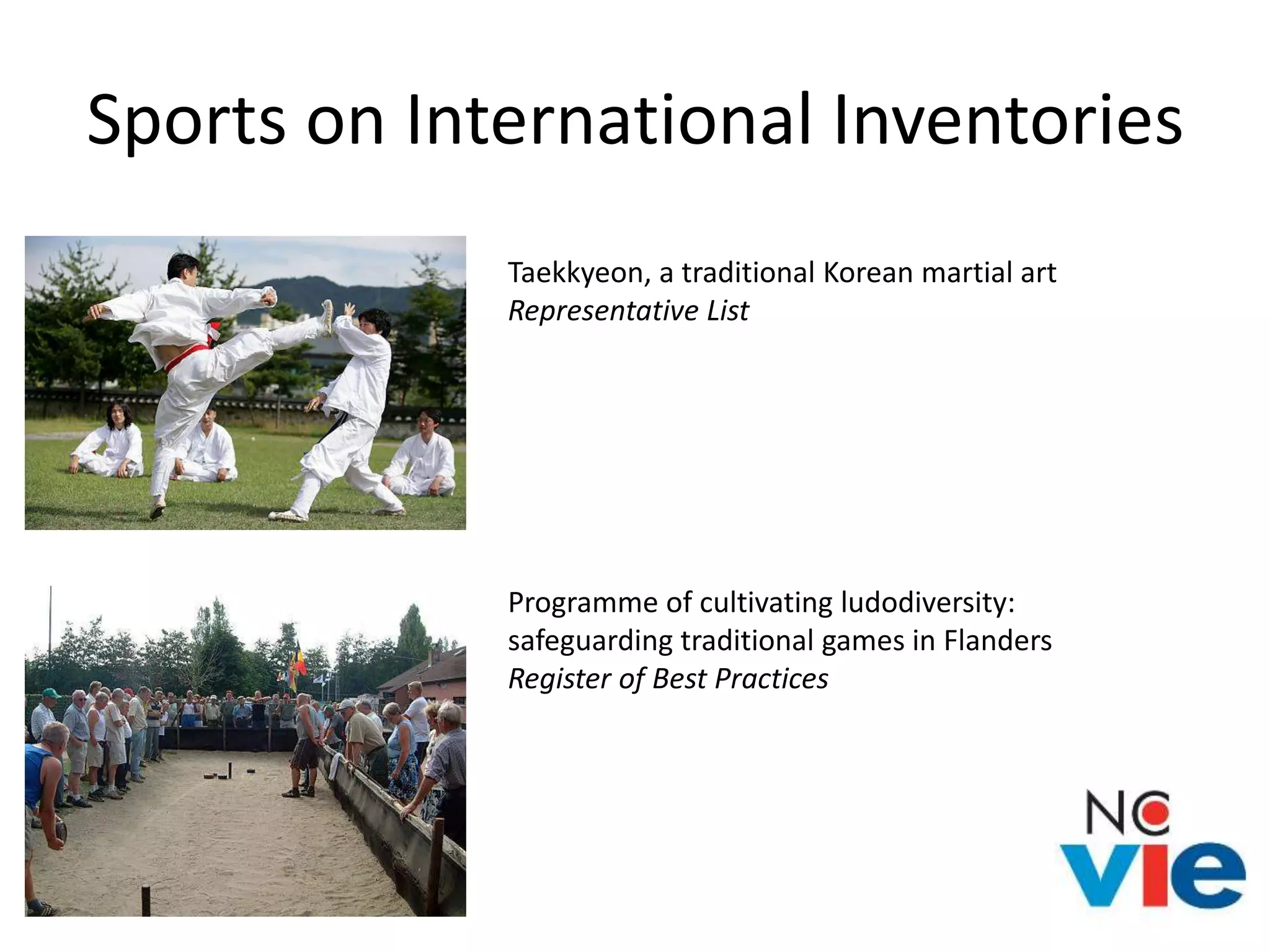
Sports on International Inventories
Taekkyeon, a traditional Korean martial art
Representative List
Programme of cultivating ludodiversity:
safeguarding traditional games in Flanders
Register of Best Practices
Ludo diversity
The non-governmental organization Sportimonium, together
with local communities and associations, has taken measures
to safeguard the heritage of games and sports in Flanders,
Belgium, including twenty-three types of traditional games,
among them forms of shooting games, bowl games, throwing
games and ball games.
Ludo diversity:
interesting example best practice
Safeguarding measures undertaken by Sportimonium include:
• support to specialized and umbrella organizations
• publications
• festivals
• demonstrations
• exchanges of expertise
• promotion activities
• loan services providing people with traditional games
equipment
• Traditional Games Park.
International treaty
with international networks
• Bureau in Paris, General Assembly and
Intergovernemental Committee
• NGOs
• Communities: European Sint
Maartennetwork, Association Européenne des
jeux et sports traditionnels
• International cooperation and mutual
assistance
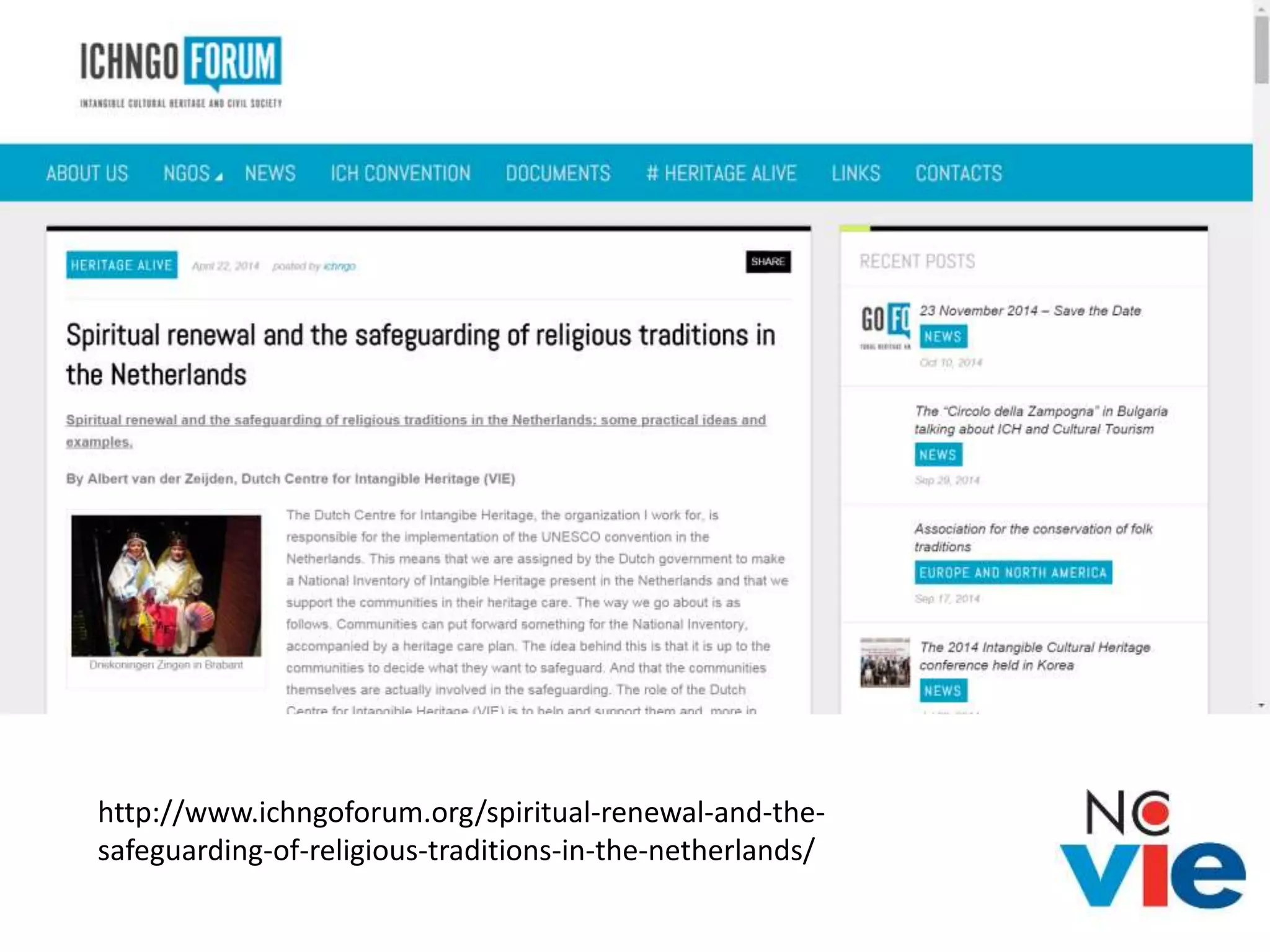
http://www.ichngoforum.org/spiritual-renewal-and-the-
safeguarding-of-religious-traditions-in-the-netherlands/
Things to do
(some of them already taking care off!)
• SWOT analysis
• specialized umbrella organizations
• festivals and demonstrations
• exchanges of expertise
• promotion activities
• International cooperation and mutual assistance
• Necessary measures to ensure the safeguarding
of the intangible cultural heritage
USE the national AND international
UNESCO inventories to safeguard
traditional sports

The UNESCO convention of the intangible cultural heritage - Albert Van der Zeijden

  • 1.
    The UNESCO convention ofthe Intangible Cultural Heritage New Ways and Opportunities to Strengthen and Safeguard Traditional Sports in Europe Albert van der Zeijden scientific policy advisor Dutch Centre for Intangible Heritage
  • 2.
    Dutch Centre forIntangible Heritage • Accredited NGO, ‘competent body’, responsible for the coordination and implementation of the ICH convention in the Netherlands • Advise functions (national + international) • Raising awareness • Knowledge, information, advise, mediating • Supporting the communities in their safeguarding efforts (eg. Safeguarding methodologies)
  • 3.
    and the sports Aboutthe Sport Programme UNESCO is the United Nations’ lead agency for Physical Education and Sport (PES). This programme focuses on the following diverse themes: Sport for Peace and Development Quality Physical Education Traditional Sports and Games Women and Sport Anti-Doping
  • 4.
    and the traditionalsports Traditional sports and games (TSG) can form the backbone of a community, and UNESCO is driven to protect and promote these sports to further community spirit, bring peoples together and install a sense of pride in a society’s cultural roots. In the Declaration of Punta del Este, in December 1999, ministers emphasized the preservation and the appraisal of traditional and indigenous sports from different regional and national cultural heritages, including the establishment of a World Heritage List of Traditional Games and Sports.
  • 5.
    Importance ICH conventionfor the traditional sports • ICH convention most effective policy tool UNESCO • Convention is about safeguarding: giving a future to intangible heritage • Traditional Sports are part of the Intangible Cultural Heritage • Convention ratified by most countries in the world • Goal: International cooperation and mutual assistance
  • 6.
    ICH Convention ratifiedby • Austria • Belgium • Denmark • Finland • France • Germany • Greece • Italy • the Netherlands • Norway • Portugal • Spain • Sweden • Switzerland • Turkey • several countries in Eastern-Europe
  • 7.
    Purposes of theConvention The purposes of this Convention are: (a) to safeguard the intangible cultural heritage; (b) to ensure respect for the intangible cultural heritage of the communities, groups and individuals concerned; (c) to raise awareness at the local, national and international levels of the importance of the intangible cultural heritage, and of ensuring mutual appreciation thereof; (d) to provide for international cooperation and assistance.
  • 8.
    Definition Intangible Heritage The “intangiblecultural heritage” means the practices, representations, expressions, knowledge, skills – as well as the instruments, objects, artefacts and cultural spaces associated therewith – that communities, groups and, in some cases, individuals recognize as part of their cultural heritage. This intangible cultural heritage, transmitted from generation to generation, is constantly recreated by communities and groups in response to their environment, their interaction with nature and their history, and provides them with a sense of identity and continuity.
  • 9.
    Intangible Heritage Domains The “intangiblecultural heritage” is manifested in the following domains: (a) oral traditions and expressions, including language as a vehicle of the intangible cultural heritage; (b) performing arts; (c) social practices, rituals and festive events; (d) knowledge and practices concerning nature and the universe; (e) traditional craftsmanship.
  • 10.
    Traditional Sports as socialpractice Social practices, rituals and festive events involve a dazzling variety of forms: worship rites; rites of passage; birth, wedding and funeral rituals; oaths of allegiance; traditional legal systems; traditional games and sports; kinship and ritual kinship ceremonies; settlement patterns; culinary traditions; seasonal ceremonies; practices specific to men or women only; hunting, fishing and gathering practices and many more. Toolkit Intangible Cultural Heritage Domains
  • 11.
    Why is ICHimportant? ‘Considering the importance of the intangible cultural heritage as a mainspring of cultural diversity and a guarantee of sustainable development,’ preambule UNESCO convention ‘provides them (=communities) with a sense of identity and continuity, thus promoting respect for cultural diversity and human creativity’. Article 2 UNESCO convention
  • 12.
    Communities first Within theframework of its safeguarding activities of the intangible cultural heritage, each State Party shall endeavour to ensure the widest possible participation of communities, groups and, where appropriate, individuals that create, maintain and transmit such heritage, and to involve them actively in its management. Article 15 – Participation of communities, groups and individuals
  • 13.
    Obligations States Parties EachState Party shall: (a) take the necessary measures to ensure the safeguarding of the intangible cultural heritage present in its territory; (b) identify and define the various elements of the intangible cultural heritage present in its territory, with the participation of communities, groups and relevant nongovernmental organizations.
  • 14.
    • Bottom upapproach • Safeguarding: heritage care plan
  • 15.
    Bottom up approach •Communities / communtiy associations can put forward their tradition for the Inventory • In the form they should give a clear description of the (history) of the tradition and of the people participating • The safeguardingplan starts with a swot analysis of the tradition • Weak and strong points and how to address them
  • 16.
    National Inventories Krulbollen: FlemishInventory And on the Dutch ….
  • 17.
    Other sports onthe Dutch Inventory
  • 18.
    Sports on theDutch Inventory • Krulbollen Zeeuws Vlaanderen • Valkerij • Schoonrijden • Vierdaagse Nijmegen • Harddraverij Stompwijk • Acht van Chaam
  • 19.
    What makes asport intangible heritage? • Heritage and cultural identity important • It should be a ‘traditional’ sport with a history and it should be important for a community who wants to safeguard this tradition
  • 20.
    With regard tocriterion R.1, the Subsidiary Body was challenged by nominations testing the limits of what can be considered as intangible cultural heritage. The question was posed in particular with regard to organized sports: given that many communities worldwide identify with their local professional sports teams (or even those from the other side of the globe), at what point might organized sports lose any character as intangible heritage? The Body reiterates the importance of providing sufficient explanation under R.1 to demonstrate that an element constitutes intangible cultural heritage in the sense of the 2003 Convention, emphasizing in particular its cultural meanings and social functions. Report of the Subsidiary Body on its work in 2013 and examination of nominations for inscription on the Representative List of the Intangible Cultural Heritage of Humanity , discussed by the Intergovernmental Committee, december 2013 Not every sport is ICH!
  • 21.
    Classical horsemanship andthe High School of the Spanish Riding School Vienna In the proposal not enough mention of its cultural meanings, social functions and communities involved
  • 22.
    International Inventories • RepresentativeList • Urgent Safeguarding List • Register of Best Practices
  • 23.
    Sports on InternationalInventories Taekkyeon, a traditional Korean martial art Representative List Programme of cultivating ludodiversity: safeguarding traditional games in Flanders Register of Best Practices
  • 24.
    Ludo diversity The non-governmentalorganization Sportimonium, together with local communities and associations, has taken measures to safeguard the heritage of games and sports in Flanders, Belgium, including twenty-three types of traditional games, among them forms of shooting games, bowl games, throwing games and ball games.
  • 25.
    Ludo diversity: interesting examplebest practice Safeguarding measures undertaken by Sportimonium include: • support to specialized and umbrella organizations • publications • festivals • demonstrations • exchanges of expertise • promotion activities • loan services providing people with traditional games equipment • Traditional Games Park.
  • 26.
    International treaty with internationalnetworks • Bureau in Paris, General Assembly and Intergovernemental Committee • NGOs • Communities: European Sint Maartennetwork, Association Européenne des jeux et sports traditionnels • International cooperation and mutual assistance
  • 27.
  • 28.
    Things to do (someof them already taking care off!) • SWOT analysis • specialized umbrella organizations • festivals and demonstrations • exchanges of expertise • promotion activities • International cooperation and mutual assistance • Necessary measures to ensure the safeguarding of the intangible cultural heritage
  • 29.
    USE the nationalAND international UNESCO inventories to safeguard traditional sports