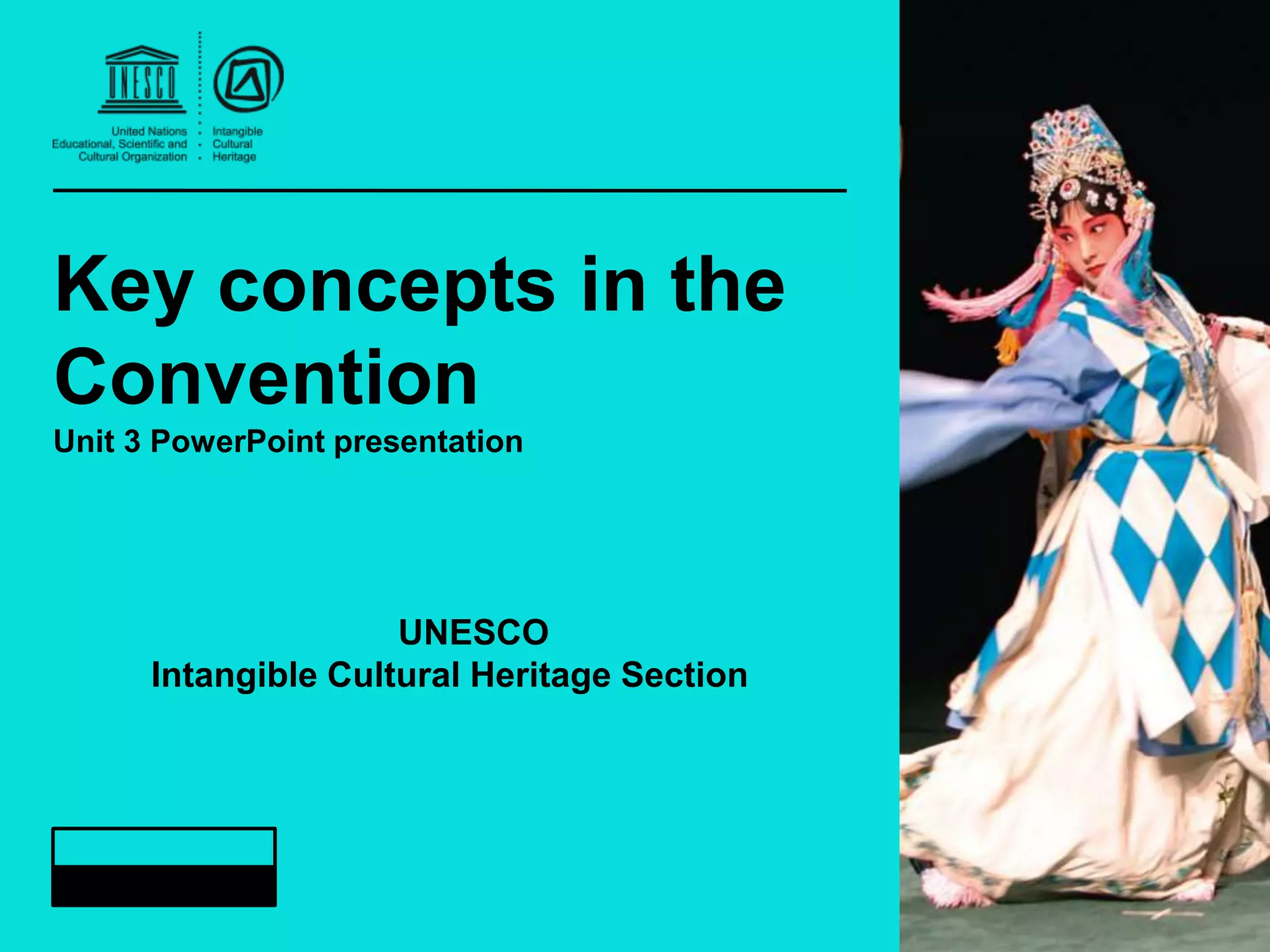
Key concepts in the
Convention
Unit 3 PowerPoint presentation
UNESCO
Intangible Cultural Heritage Section
2
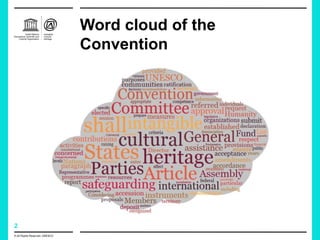
Word cloud of the
Convention
© All Rights Reserved: UNESCO
3
In this presentation …
More about the Convention:
• A flexible instrument
• ‘Anchoring the Convention’
Terms to be discussed:
• Intangible heritage; elements
• Communities, groups, individuals
• Safeguarding
© All Rights Reserved: UNESCO
4
The Convention – a flexible
instrument
• Few obligations
• Few definitions
• Open definitions
• Non-exhaustive classifications (domains of ICH,
safeguarding measures)
• No official glossary
© All Rights Reserved: UNESCO
5
‘Anchoring the Convention’
at the country level
The term ‘ICH’ translated:
• Turathi za tamaduni zisizogusika (Kiswahili)
• Di sản văn hóa phi vật thể (Vietnamese for ‘heritage –
cultural, not [phi] tangible’)
• Nematerialno kulturno nasledstvo (Bulgarian for ‘non-
material cultural heritage’)
• Mukei (Japanese for ‘not having form’)
• Vaimne kultuuripärand (Estonian)
• Patrimônio cultural imaterial (Portuguese)
© All Rights Reserved: UNESCO
6
© All Rights Reserved: UNESCO
INTANGIBLE CULTURAL HERITAGE
7
The Convention’s definition
of intangible heritage (1)
© All Rights Reserved: UNESCO
Article 2.1:
For the purposes of the Convention, the ‘Intangible
Cultural Heritage’ means the practices, representations,
expressions, knowledge, skills
– as well as the instruments, objects, artefacts and
cultural spaces associated therewith –
that communities, groups and, in some cases,
individuals recognize as part of their cultural heritage.
8
The Convention’s definition
of intangible heritage (2)
© All Rights Reserved: UNESCO
Article 2.1 continues:
This intangible cultural heritage, transmitted from
generation to generation, is constantly recreated by
communities and groups in response to their
environment, their interaction with nature and their
history, and provides them with a sense of identity and
continuity, thus promoting respect for cultural diversity
and human creativity.
9
The Convention’s definition
of intangible heritage (3)
© All Rights Reserved: UNESCO
Article 2.1 further:
For the purposes of this Convention, consideration will
be given solely to such intangible cultural heritage as is
compatible with existing international human rights
instruments, as well as with the requirements of mutual
respect among communities, groups and individuals,
and of sustainable development.
10
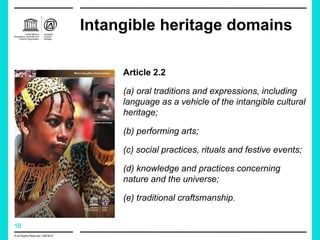
Intangible heritage domains
Article 2.2
(a) oral traditions and expressions, including
language as a vehicle of the intangible cultural
heritage;
(b) performing arts;
(c) social practices, rituals and festive events;
(d) knowledge and practices concerning
nature and the universe;
(e) traditional craftsmanship.
© All Rights Reserved: UNESCO
11
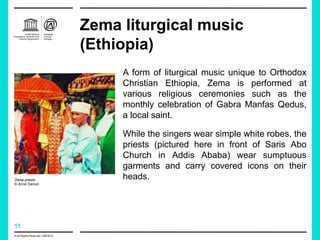
Zema liturgical music
(Ethiopia)
A form of liturgical music unique to Orthodox
Christian Ethiopia, Zema is performed at
various religious ceremonies such as the
monthly celebration of Gabra Manfas Qedus,
a local saint.
While the singers wear simple white robes, the
priests (pictured here in front of Saris Abo
Church in Addis Ababa) wear sumptuous
garments and carry covered icons on their
heads.
Zema priests
© Anne Damon
© All Rights Reserved: UNESCO
12
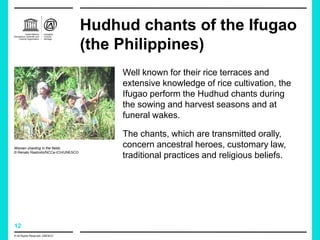
Hudhud chants of the Ifugao
(the Philippines)
Well known for their rice terraces and
extensive knowledge of rice cultivation, the
Ifugao perform the Hudhud chants during
the sowing and harvest seasons and at
funeral wakes.
The chants, which are transmitted orally,
concern ancestral heroes, customary law,
traditional practices and religious beliefs.
Women chanting in the fields
© Renato Rastrollo/NCCa-ICH/UNESCO
© All Rights Reserved: UNESCO
13
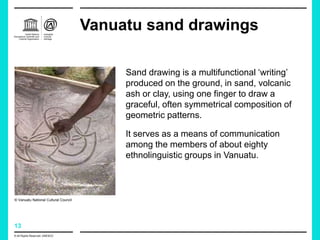
Vanuatu sand drawings
Sand drawing is a multifunctional ‘writing’
produced on the ground, in sand, volcanic
ash or clay, using one finger to draw a
graceful, often symmetrical composition of
geometric patterns.
It serves as a means of communication
among the members of about eighty
ethnolinguistic groups in Vanuatu.
© All Rights Reserved: UNESCO
© Vanuatu National Cultural Council
14
© All Rights Reserved: UNESCO
COMMUNITIES,
GROUPS AND INDIVIDUALS
15
Defining the community
concerned
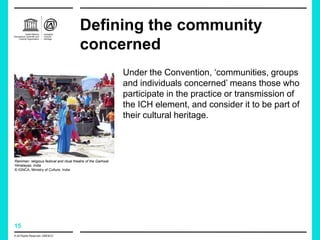
Under the Convention, ‘communities, groups
and individuals concerned’ means those who
participate in the practice or transmission of
the ICH element, and consider it to be part of
their cultural heritage.
Ramman: religious festival and ritual theatre of the Garhwal
Himalayas, India
© IGNCA, Ministry of Culture, India
© All Rights Reserved: UNESCO
16
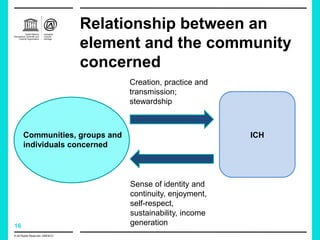
Relationship between an
element and the community
concerned
© All Rights Reserved: UNESCO
Communities, groups and
individuals concerned
ICH
Creation, practice and
transmission;
stewardship
Sense of identity and
continuity, enjoyment,
self-respect,
sustainability, income
generation
17
© All Rights Reserved: UNESCO
SAFEGUARDING
18
Safeguarding concepts
© All Rights Reserved: UNESCO
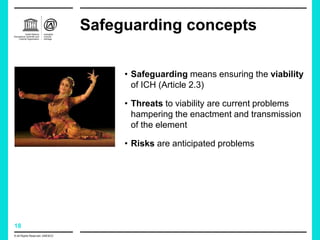
• Safeguarding means ensuring the viability
of ICH (Article 2.3)
• Threats to viability are current problems
hampering the enactment and transmission
of the element
• Risks are anticipated problems
19
Key safeguarding measures
© All Rights Reserved: UNESCO
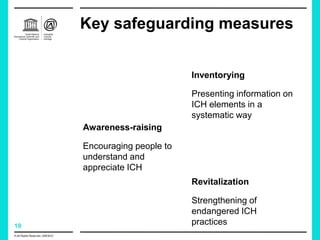
Inventorying
Presenting information on
ICH elements in a
systematic way
Revitalization
Strengthening of
endangered ICH
practices
Awareness-raising
Encouraging people to
understand and
appreciate ICH
20
More safeguarding measures
© All Rights Reserved: UNESCO
• Documentation, research
• Identification, definition
• Preservation, protection
• Promotion, enhancement
• Transmission, e.g. through education
21
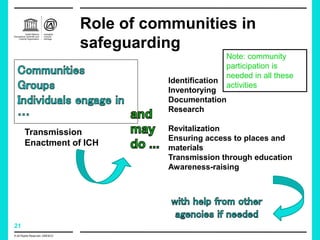
Role of communities in
safeguarding
© All Rights Reserved: UNESCO
Transmission
Enactment of ICH
Identification
Inventorying
Documentation
Research
Revitalization
Ensuring access to places and
materials
Transmission through education
Awareness-raising
Note: community
participation is
needed in all these
activities
22
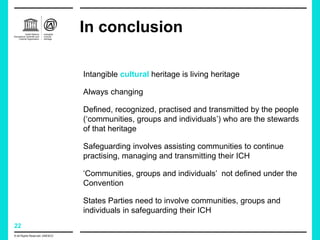
In conclusion
© All Rights Reserved: UNESCO
Intangible cultural heritage is living heritage
Always changing
Defined, recognized, practised and transmitted by the people
(‘communities, groups and individuals’) who are the stewards
of that heritage
Safeguarding involves assisting communities to continue
practising, managing and transmitting their ICH
‘Communities, groups and individuals’ not defined under the
Convention
States Parties need to involve communities, groups and
individuals in safeguarding their ICH

Key_concepts_in_the_Convention.ppt

  • 1.
    Key concepts inthe Convention Unit 3 PowerPoint presentation UNESCO Intangible Cultural Heritage Section
  • 2.
    2 Word cloud ofthe Convention © All Rights Reserved: UNESCO
  • 3.
    3 In this presentation… More about the Convention: • A flexible instrument • ‘Anchoring the Convention’ Terms to be discussed: • Intangible heritage; elements • Communities, groups, individuals • Safeguarding © All Rights Reserved: UNESCO
  • 4.
    4 The Convention –a flexible instrument • Few obligations • Few definitions • Open definitions • Non-exhaustive classifications (domains of ICH, safeguarding measures) • No official glossary © All Rights Reserved: UNESCO
  • 5.
    5 ‘Anchoring the Convention’ atthe country level The term ‘ICH’ translated: • Turathi za tamaduni zisizogusika (Kiswahili) • Di sản văn hóa phi vật thể (Vietnamese for ‘heritage – cultural, not [phi] tangible’) • Nematerialno kulturno nasledstvo (Bulgarian for ‘non- material cultural heritage’) • Mukei (Japanese for ‘not having form’) • Vaimne kultuuripärand (Estonian) • Patrimônio cultural imaterial (Portuguese) © All Rights Reserved: UNESCO
  • 6.
    6 © All RightsReserved: UNESCO INTANGIBLE CULTURAL HERITAGE
  • 7.
    7 The Convention’s definition ofintangible heritage (1) © All Rights Reserved: UNESCO Article 2.1: For the purposes of the Convention, the ‘Intangible Cultural Heritage’ means the practices, representations, expressions, knowledge, skills – as well as the instruments, objects, artefacts and cultural spaces associated therewith – that communities, groups and, in some cases, individuals recognize as part of their cultural heritage.
  • 8.
    8 The Convention’s definition ofintangible heritage (2) © All Rights Reserved: UNESCO Article 2.1 continues: This intangible cultural heritage, transmitted from generation to generation, is constantly recreated by communities and groups in response to their environment, their interaction with nature and their history, and provides them with a sense of identity and continuity, thus promoting respect for cultural diversity and human creativity.
  • 9.
    9 The Convention’s definition ofintangible heritage (3) © All Rights Reserved: UNESCO Article 2.1 further: For the purposes of this Convention, consideration will be given solely to such intangible cultural heritage as is compatible with existing international human rights instruments, as well as with the requirements of mutual respect among communities, groups and individuals, and of sustainable development.
  • 10.
    10 Intangible heritage domains Article2.2 (a) oral traditions and expressions, including language as a vehicle of the intangible cultural heritage; (b) performing arts; (c) social practices, rituals and festive events; (d) knowledge and practices concerning nature and the universe; (e) traditional craftsmanship. © All Rights Reserved: UNESCO
  • 11.
    11 Zema liturgical music (Ethiopia) Aform of liturgical music unique to Orthodox Christian Ethiopia, Zema is performed at various religious ceremonies such as the monthly celebration of Gabra Manfas Qedus, a local saint. While the singers wear simple white robes, the priests (pictured here in front of Saris Abo Church in Addis Ababa) wear sumptuous garments and carry covered icons on their heads. Zema priests © Anne Damon © All Rights Reserved: UNESCO
  • 12.
    12 Hudhud chants ofthe Ifugao (the Philippines) Well known for their rice terraces and extensive knowledge of rice cultivation, the Ifugao perform the Hudhud chants during the sowing and harvest seasons and at funeral wakes. The chants, which are transmitted orally, concern ancestral heroes, customary law, traditional practices and religious beliefs. Women chanting in the fields © Renato Rastrollo/NCCa-ICH/UNESCO © All Rights Reserved: UNESCO
  • 13.
    13 Vanuatu sand drawings Sanddrawing is a multifunctional ‘writing’ produced on the ground, in sand, volcanic ash or clay, using one finger to draw a graceful, often symmetrical composition of geometric patterns. It serves as a means of communication among the members of about eighty ethnolinguistic groups in Vanuatu. © All Rights Reserved: UNESCO © Vanuatu National Cultural Council
  • 14.
    14 © All RightsReserved: UNESCO COMMUNITIES, GROUPS AND INDIVIDUALS
  • 15.
    15 Defining the community concerned Underthe Convention, ‘communities, groups and individuals concerned’ means those who participate in the practice or transmission of the ICH element, and consider it to be part of their cultural heritage. Ramman: religious festival and ritual theatre of the Garhwal Himalayas, India © IGNCA, Ministry of Culture, India © All Rights Reserved: UNESCO
  • 16.
    16 Relationship between an elementand the community concerned © All Rights Reserved: UNESCO Communities, groups and individuals concerned ICH Creation, practice and transmission; stewardship Sense of identity and continuity, enjoyment, self-respect, sustainability, income generation
  • 17.
    17 © All RightsReserved: UNESCO SAFEGUARDING
  • 18.
    18 Safeguarding concepts © AllRights Reserved: UNESCO • Safeguarding means ensuring the viability of ICH (Article 2.3) • Threats to viability are current problems hampering the enactment and transmission of the element • Risks are anticipated problems
  • 19.
    19 Key safeguarding measures ©All Rights Reserved: UNESCO Inventorying Presenting information on ICH elements in a systematic way Revitalization Strengthening of endangered ICH practices Awareness-raising Encouraging people to understand and appreciate ICH
  • 20.
    20 More safeguarding measures ©All Rights Reserved: UNESCO • Documentation, research • Identification, definition • Preservation, protection • Promotion, enhancement • Transmission, e.g. through education
  • 21.
    21 Role of communitiesin safeguarding © All Rights Reserved: UNESCO Transmission Enactment of ICH Identification Inventorying Documentation Research Revitalization Ensuring access to places and materials Transmission through education Awareness-raising Note: community participation is needed in all these activities
  • 22.
    22 In conclusion © AllRights Reserved: UNESCO Intangible cultural heritage is living heritage Always changing Defined, recognized, practised and transmitted by the people (‘communities, groups and individuals’) who are the stewards of that heritage Safeguarding involves assisting communities to continue practising, managing and transmitting their ICH ‘Communities, groups and individuals’ not defined under the Convention States Parties need to involve communities, groups and individuals in safeguarding their ICH