



 Robert Baird
President
+1 215 353 0696
Error Proofing
20-May-14 1www.leanteamsusa.com
Error Proofing a new mindset
Even onedefective product can causea
company a lot of business
20-May-14 www.leanteamsusa.com 2
20/05/2014
What causes defects
Cultural
factors
•Wrong procedures or
standards are applied
•People expecting and
accepting defects
Variance
•Material variation
(thickness, finish,
etc.)
•Worn machine parts
•Input drifting
Complexity
•Too many steps
•Many input variables
•Unique knowledge
Mistakes
•Humans – errors
because of poorly
designed systems
20/05/2014
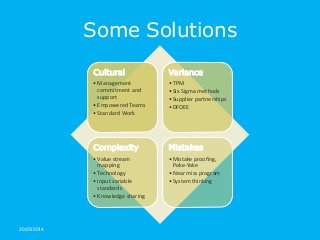
Some Solutions
Cultural
•Management
commitment and
support
•Empowered Teams
•Standard Work
Variance
•TPM
•Six Sigma methods
•Supplier partnerships
•DFOEE
Complexity
•Value stream
mapping
•Technology
•input variable
standards
•Knowledge sharing
Mistakes
•Mistake proofing,
Poke-Yoke
•Near miss program
•System thinking
To err is human
Have youever done the following:
• Driven to work and not remembered
certain events?
• Driven from work to home when you meant
to stop at a store?
It happens to workers too
• Workers finish the shift and don’t
rememberwhat they have done.
• After buildinggreen widgets all morning,
the workers put green parts on the red widgets in
the afternoon.
It doesn’t work
• Majority of corrective actions reported
at least 20-30% of corrective actions were
worker reprimanded and retraining
• The warning to be more careful or
pay attention are not effective for
humans, especially in repetitive environments.
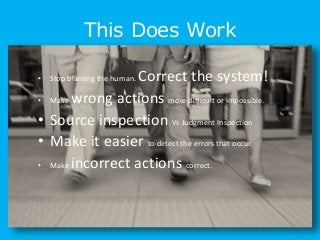
This Does Work
• Stop blaming the human. Correct the system!
• Make wrong actions more difficult or impossible.
• Source inspection Vs Judgment Inspection
• Make it easier to detect the errors that occur.
• Make incorrect actions correct.
20/05/2014
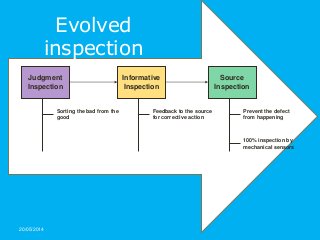
Evolved
inspection
Judgment
Inspection
Sorting the bad from the
good
Informative
Inspection
Feedback to the source
for corrective action
Source
Inspection
Prevent the defect
from happening
100% inspection by
mechanical sensors
20/05/2014
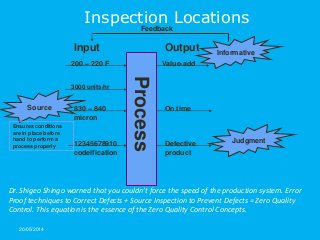
Inspection Locations
Process
Input
200 – 220 F
3000 units/hr
830 – 840
micron
12345678910
codeification
Value-add
On time
Output
Defective
product
Judgment
Informative
Source
Feedback
Ensures conditions
are in place before
hand to perform a
process properly
Dr. Shigeo Shingo warned that you couldn’t force the speed of the production system. Error
Proof techniques to Correct Defects + Source Inspection to Prevent Defects = Zero Quality
Control. This equation is the essence of the Zero Quality Control Concepts.
20/05/2014
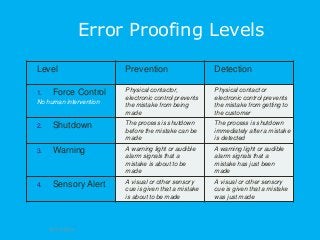
Error Proofing Levels
Level Prevention Detection
1. Force Control
No human intervention
Physical contactor,
electronic control prevents
the mistake from being
made
Physical contact or
electronic control prevents
the mistake from getting to
the customer
2. Shutdown The process is shutdown
before the mistake can be
made
The process is shutdown
immediately after a mistake
is detected
3. Warning A warning light or audible
alarm signals that a
mistake is about to be
made
A warning light or audible
alarm signals that a
mistake has just been
made
4. Sensory Alert A visual or other sensory
cue is given that a mistake
is about to be made
A visual or other sensory
cue is given that a mistake
was just made
20/05/2014
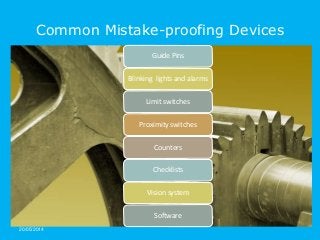
Common Mistake-proofing Devices
Guide Pins
Blinking lights and alarms
Limit switches
Proximity switches
Counters
Checklists
Vision system
Software
We Provide Guidance, Training, and Support
• Lean Teams USA Lean Consulting
• View My Profile on LinkedIn
• Lean Teams USA +1 215 353 0696
• @Robertbaird10
20-May-14 www.leanteamsusa.com 13

Lean Error proofing

  • 1.
     Robert Baird President +1215 353 0696 Error Proofing 20-May-14 1www.leanteamsusa.com
  • 2.
    Error Proofing anew mindset Even onedefective product can causea company a lot of business 20-May-14 www.leanteamsusa.com 2
  • 3.
    20/05/2014 What causes defects Cultural factors •Wrongprocedures or standards are applied •People expecting and accepting defects Variance •Material variation (thickness, finish, etc.) •Worn machine parts •Input drifting Complexity •Too many steps •Many input variables •Unique knowledge Mistakes •Humans – errors because of poorly designed systems
  • 4.
    20/05/2014 Some Solutions Cultural •Management commitment and support •EmpoweredTeams •Standard Work Variance •TPM •Six Sigma methods •Supplier partnerships •DFOEE Complexity •Value stream mapping •Technology •input variable standards •Knowledge sharing Mistakes •Mistake proofing, Poke-Yoke •Near miss program •System thinking
  • 5.
    To err ishuman Have youever done the following: • Driven to work and not remembered certain events? • Driven from work to home when you meant to stop at a store?
  • 6.
    It happens toworkers too • Workers finish the shift and don’t rememberwhat they have done. • After buildinggreen widgets all morning, the workers put green parts on the red widgets in the afternoon.
  • 7.
    It doesn’t work •Majority of corrective actions reported at least 20-30% of corrective actions were worker reprimanded and retraining • The warning to be more careful or pay attention are not effective for humans, especially in repetitive environments.
  • 8.
    This Does Work •Stop blaming the human. Correct the system! • Make wrong actions more difficult or impossible. • Source inspection Vs Judgment Inspection • Make it easier to detect the errors that occur. • Make incorrect actions correct.
  • 9.
    20/05/2014 Evolved inspection Judgment Inspection Sorting the badfrom the good Informative Inspection Feedback to the source for corrective action Source Inspection Prevent the defect from happening 100% inspection by mechanical sensors
  • 10.
    20/05/2014 Inspection Locations Process Input 200 –220 F 3000 units/hr 830 – 840 micron 12345678910 codeification Value-add On time Output Defective product Judgment Informative Source Feedback Ensures conditions are in place before hand to perform a process properly Dr. Shigeo Shingo warned that you couldn’t force the speed of the production system. Error Proof techniques to Correct Defects + Source Inspection to Prevent Defects = Zero Quality Control. This equation is the essence of the Zero Quality Control Concepts.
  • 11.
    20/05/2014 Error Proofing Levels LevelPrevention Detection 1. Force Control No human intervention Physical contactor, electronic control prevents the mistake from being made Physical contact or electronic control prevents the mistake from getting to the customer 2. Shutdown The process is shutdown before the mistake can be made The process is shutdown immediately after a mistake is detected 3. Warning A warning light or audible alarm signals that a mistake is about to be made A warning light or audible alarm signals that a mistake has just been made 4. Sensory Alert A visual or other sensory cue is given that a mistake is about to be made A visual or other sensory cue is given that a mistake was just made
  • 12.
    20/05/2014 Common Mistake-proofing Devices GuidePins Blinking lights and alarms Limit switches Proximity switches Counters Checklists Vision system Software
  • 13.
    We Provide Guidance,Training, and Support • Lean Teams USA Lean Consulting • View My Profile on LinkedIn • Lean Teams USA +1 215 353 0696 • @Robertbaird10 20-May-14 www.leanteamsusa.com 13

Editor's Notes

  • #7 The mistakes I would like to focus on are some times called slips. They occur when an action is executed on “autopilot” but has an unintended result. Mistake-proofing usually(but not always) will involve precluding behaviors that under other circumstances would be correct. Putting green parts on widgets is a correct behavior when the widgets are green, but not when they’re red.
  • #8 Survey results here! xxx
  • #9 Donald Norman has some recommendations for responding effectively to how the human mind works.
  • #14 <iframe src="http://www.slideshare.net/slideshow/embed_code/31848628" width="476" height="400" frameborder="0" marginwidth="0" marginheight="0" scrolling="no"></iframe>